The Westerner

poster85

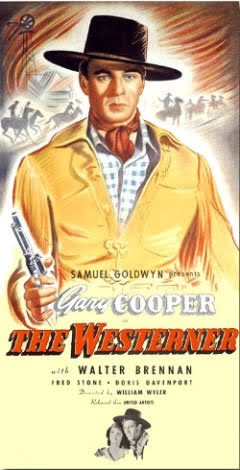
One of the recurring themes of the western is the conflict between the cattlemen of the open range and the fence-building homesteaders, or sodbusters. In truth, this clash (freedom, as represented by the range, and the slow encroachment of civil society from the east) lies near the very heart of the genre. It is this which forms the framework of The Westerner (1940), but the film really revolves around the relationship between two very different men. As such it eschews action in favour of character development, and slots nicely into the group of more mature westerns that were starting to appear at the time.

The film’s prologue sets the scene in the years following the Civil War when the westward expansion was in full swing. Judge Roy Bean (Walter Brennan) has established himself as the self-styled “Law West of the Pecos” in his own remote corner of Texas. He is shown dispensing his own brand of justice from his saloon/courtroom in the case of a man accused of committing one of the most serious of all crimes, that of murdering a steer. Having tried, convicted and carried out the sentence personally, he comes face to face with his next defendant. Cole Harden (Gary Cooper) is a drifter and saddle tramp who’s had the misfortune of buying a stolen horse. This is another capital crime and the case looks to be an open and shut one. When the jury retires to back room to play cards and down some liquor before delivering the inevitable guilty verdict, Harden takes the only path open to him. Noticing that the saloon has been made up as a virtual shrine to Lily Langtry, Harden claims to have made the acquaintance of the judge’s beloved actress and to have a lock of her hair in his possession. Well, clearly such a man can’t simply be hauled out and hanged so the sentence is suspended and the two men form an uneasy alliance. However, Harden finds himself drawn to Jane Ellen Matthews (Doris Davenport), daughter of a local settler, and is soon caught between the two rival factions.

Gary Cooper was a highly deceptive actor. There are those who would claim that his laconic style was wooden and that he couldn’t act, but to say that is to ignore the subtlety of the man’s craft. There was no expansiveness to Cooper but everything was communicated through his face and small unpretentious gestures. There is a marvellous example of this during the trial scene in this movie where fear, calculation and, ultimately, triumph are all readable just from his eyes. He’s at his best in the scenes he shares with Walter Brennan but, perversely, has every one of those scenes stolen right from under his nose. I don’t think it would be too much of a stretch to say that Brennan was the finest character actor American cinema has ever produced. He turned in performances which ranged from fine to excellent in anything I’ve seen him in. His Judge Roy Bean is a multi-layered character who goes from mean and ornery to endearingly childlike and back again. It’s no mean acting feat to make this figure sympathetic, but Brennan managed it and picked up his third Oscar for his troubles.

Visually, the film looks great, due in no small part to the photography of Gregg Toland. With all this talent at his disposal, director William Wyler marshals it with his typical professionalism. He offers up some fine cinematic moments, such as the attack on the homesteaders. In the midst of a thanksgiving ceremony, as the camera surveys a rich, tranquil and fertile land to the accompaniment of noble words, the idyll is abruptly shattered by a murderous arson raid. As flames sear the screen, the settlers paradise is transformed in a matter of minutes into a scorched, desolate landscape. Those smouldering, blackened ruins of former homes pointing accusingly towards the heavens are an eloquent reminder of the fickle and dangerous unpredictability of frontier life.

The Westerner was reissued on DVD in R1 late last spring by MGM/Fox and the transfer is a very fine one. I can’t say I noticed any significant damage marks or signs of manipulation, just a crisp, clean B&W image. Previous MGM releases were no more than adequate but the distribution deal with Fox seems to have led to an improvement in quality. The only criticism is the lack of any extra content, but I guess you  can’t have everything. I’d rate The Westerner as a good example of a ’40s oater for grown-ups; it has drama and it’s moving but it also has a vein of sly, dark humour running through it. Recommended.


Buchanan Rides Alone

poster80

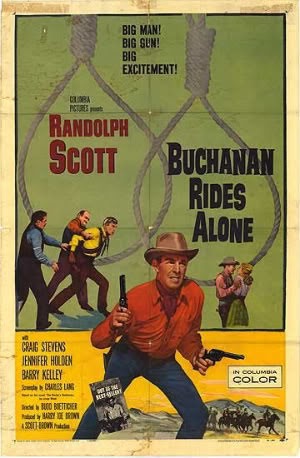
When one thinks of the Boetticher/Scott films the image that generally springs to mind is that of a tough loner haunted by a past hurt and struggling to make his peace with the present. The drama is typically played out against a sparse backdrop with a small cast, among whom there is a woman who has a significant role. Buchanan Rides Alone (1958) dispenses with all these elements, and stands out as a unique entry in the series. It has a lighter, almost comedic tone, women barely figure, and Randolph Scott’s character has no back-story to speak of. For all these reasons I deliberately left it to the end of this short series of pieces on the recently released Ranown titles. I think that, for anyone planning to watch these movies as a group, it is probably better to save Buchanan Rides Alone for last. After the sombre, and sometimes tragic, mood of the other pictures it rounds things off in an upbeat fashion.

The movie derives from a story entitled The Name’s Buchanan, and the line is used by the hero (Randolph Scott) when he rides into a small border town on his way back to west Texas, having made his money fighting in the Mexican revolution. The town in question has effectively been sewn up by the three Agry brothers, who hold the positions of sheriff, hotel proprietor and judge respectively. The most powerful is the judge, Simon Agry (Tol Avery), although they’re all equally corrupt, grasping and manipulative. The killing of the judge’s son by a young and wealthy Mexican sees Buchanan wrongly accused of complicity, and he finds himself drawn into the machinations of the brothers who pragmatically view the family tragedy as a means of extorting a hefty ransom. What follows is a series of crosses and double-crosses as the members of the Agry clan jockey for position and try to gull each other out of said ransom. It is this greed and sibling rivalry, rather than any especially adept maneuvering on Buchanan’s part, that finally brings about their downfall during a botched prisoner exchange. Unlike Boetticher’s other westerns, the motivation for Scott’s character is not based on any grudge but merely on his efforts to secure the release of the Mexican and recover his own money.

£6

Buchanan Rides Alone afforded Scott the opportunity to put in his most amiable performance of any of the Ranown series. There’s an element of self parody in the way he acknowledges his own ineptitude at being unable to formulate a coherent plan of action, and he even quips about his lack of progress when he ends up behind bars for a second time. The film is full of dry humour, courtesy of Charles Lang’s pithy script; some of the best coming when L Q Jones delivers a memorable eulogy over a body he’s just laid to rest atop a tree. The three Agry brothers are almost caricatures although Barry Kelley brings a more malevolent streak to his role as the profiteering sheriff. No Ranown western would be complete without a charming villain, and Craig Stevens supplies that ingredient as the black-clad enforcer with a stronger sense of honour than his reptilian employer. Boetticher uses a good combination of exteriors and interiors for this film and it works pretty well. The town has a more authentic feel and you don’t get that cheap, artificial look that weakens Decision at Sundown. Taylor Hackford points out on the accompanying featurette that the idea of a lone stranger riding into a corrupt town and presiding over the destruction of its rival factions could be seen as a kind of forerunner for A Fistful of Dollars. However, even granting that Leone was admittedly influenced by the style of Boetticher, I’m not sure I’d want to go too far down that road.

Well, that brings me to the end of this brief series, and I have to say that getting the chance to watch these films one on top of the other has been an enormous pleasure. I had seen them all at various points over the years, but watching them as a group allows one to better appreciate them as a body of work. The themes running through them seem to blend together, as Scott’s character evolved and Boetticher’s style became more apparent. They may have been B films in terms of budget, but they’re A films in terms of style and execution. Furthermore, they’re important films for those interested in the development of the western. In his book Horizons West (named after a Budd Boetticher movie, incidentally), Jim Kitses makes the point that the evolution of the western can be traced in a direct line from Ford and Mann, through Boetticher and Peckinpah, right up to Leone and Eastwood. That in itself should tell you that these films form an essential link. If anyone has been following these pieces and toying with the idea of picking up this set, then I can only say that you should do so; your western collection is incomplete without them.

Decision at Sundown

poster84

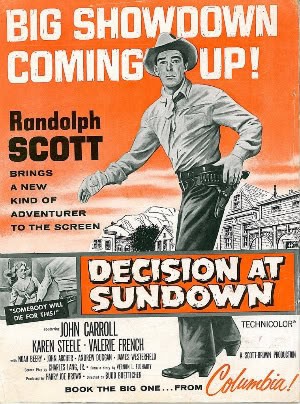
The Ranown westerns that I’ve looked at so far all made ample use of their Lone Pine locations and Burt Kennedy’s sublime scripting. Decision at Sundown (1957) is a bit of a departure in that those two ingredients are absent. In their place we get a tense town based tale from the pen of Charles Lang; as a result, it ranks lower than The Tall T, Ride Lonesome and Comanche Station. However, even a lesser Ranown film is a cut above most movies and, despite some shortcomings, Decision at Sundown has much to recommend it.

Once again Budd Boetticher and Randolph Scott offer up a story about revenge, but this one has an unexpected sting in the tail. Bart Allison (Scott) arrives in the town of Sundown with the aim of killing a man. The man in question is the local big shot Tate Kimbrough (John Carroll), and it just happens to be his wedding day. Given a situation like this it’s hard not to be reminded of High Noon, but the roles appear to be reversed here. Before long Allison and his friend Sam (Noah Beery) find themselves holed up in the livery stable and under siege from Kimbrough’s cronies. As the day wears on, a whole series of developments forces the viewer to radically re-evaluate his assumptions. Gradually, it is revealed that nothing is quite as clear cut as would seem to be the case at the beginning of the picture. The result of this is the shifting of the viewer’s sympathy as Allison and Kimbrough, both now stripped of friends and allies, stride out to face one another at the climax. The film ultimately highlights the pointless and self-destructive nature of revenge, but it also has things to say about the consequences of apathy and the need for communities to face up to their collective responsibilities. By the end, everybody involved has learned some hard lessons and nothing can ever be the same again for them.

£5

Scott plays a highly complicated man in this film, a far cry from the basically decent and honourable characters one expects from him. Essentially, he’s a hollow man whose only reason for existing is to settle the score for a wrong he feels was done to him. At the end of the movie, when his own folly finally dawns on him, he seems a slightly pathetic figure. As the dishevelled and bewildered man shambles off the screen it’s hard not to feel pity for him. One suspects he has allowed his desire for a reckoning to consume him to the point that he no longer has a reason to go on; a sombre ending indeed. John Carroll is another of those personable villains that people Boetticher’s films. He may have strong-armed his way into a position of power, and held on to it ruthlessly, but there’s a lot to admire in the manner in which he swallows his own fear and doubts to finally face off man to man with Scott. The two female characters (Karen Steele and Valerie French) are of the typically gutsy variety favoured by the director, and Miss French gets to have a significant hand in the resolution of the story. Of the support players, Noah Beery and Ray Teal (who gets to play a good guy for a change) stand out, but there’s also some good work from Andrew Duggan as the amoral sheriff.

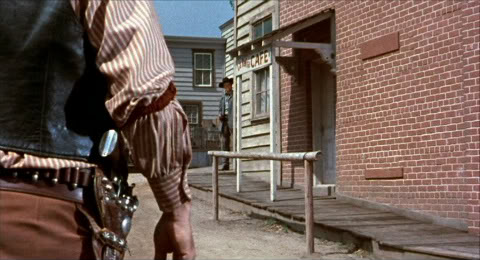
Boetticher moves things along at a fair lick once again, with not a shot wasted. The setting lends a claustrophobic feel to the events on screen, but this is also one of the weaknesses of the picture. Location shooting was able to paper over the lack of cash available for the other Ranown productions whereas the reliance on interiors here tends to emphasise it. However, there are still plenty of Boetticher’s trademark shots on view, such as the screencap above. Knowing that Sergio Leone voiced his admiration for the Ranown films, it’s easy to see where he got the inspiration for some of his own set-ups. While Charles Lang’s script offers an interesting alternative take on the usual Scott persona I feel that it still comes out second best compared to Burt Kennedy’s efforts, perhaps because it lacks the latter’s memorable dialogue.

Decision at Sundown is yet another excellent presentation on DVD from Sony. There’s no commentary track on this disc, but there is the usual short featurette on the film. Although it only runs for around six minutes, Taylor Hackford manages to provide a few interesting observations. So, even if the movie is a touch below the standard set by some of the other Ranown titles it’s still a fine piece of work. Seeing Scott in anti-heroic mode should be enough of a recommendation on its own.

Ride Lonesome

A man needs a reason to ride this country…

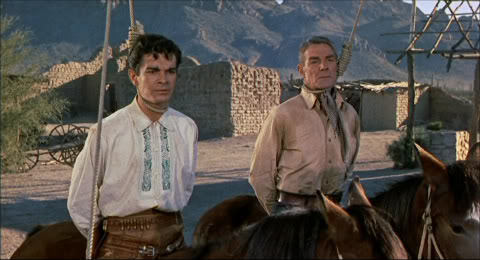
In Ride Lonesome (1959) the reasons are vengeance, bounty and amnesty. The penultimate Ranown western serves up all three but the focus remains firmly on the first. The notion of a lone man driven on by the pain of a past trauma is a recurring theme in Boetticher’s westerns, and is explored in depth in Ride Lonesome. Of the seven films Boetticher and star Randolph Scott made together, I would say this is the best; the plot, dialogue, imagery and performances all mesh to perfection. Nothing is wasted in this picture, where every shot, every gesture and every word is loaded with significance.

The viewer is immediately pitched into the action from the opening shot of the starkly familiar rocky landscape of Lone Pine, and the tension and pace never let up until the final credits roll. Ben Brigade (Scott) is introduced as a lone bounty hunter, and within minutes of appearing on screen has captured a young outlaw. Moving on to the nearest stagecoach swing station, with the outlaw’s brother in pursuit, he finds himself in another dangerous situation. The only occupants are the station master’s wife (Karen Steele) and two wanted men, Boone and Whit (Pernell Roberts and James Coburn), looking to find a way out of their current situation. Turning in the young prisoner would allow them to take advantage of an offer of amnesty, but that also necessitates their disposing of Brigade. The lone hero now finds himself part of an uneasy group and facing threats from three fronts; his new companions, the chasing pack of outlaws and a rampaging Mescalero war party. As the story progresses it becomes apparent that Brigade’s determination to see his captive to Santa Cruz, and an appointment with the hangman, is only part of his motivation. It’s fairly clear that the boy is merely the bait with which Brigade hopes to hook a bigger and more personal catch, although the exact reason for this isn’t revealed until the climax. In these moments, as Brigade stands and gazes impassively at the twisted hanging tree, the full power of the tale strikes home. The cold, unemotional hunter of men is no longer just a bounty killer but a figure lifted straight from classical tragedy.

Ride Lonesome offered Scott one of his harshest characters in Ben Brigade. There’s very little humour on display and even in those moments when he shows some modicum of tenderness towards Karen Steele it’s of the gruff and brusque variety. However, this is absolutely in keeping with a man who’s carrying around deep scars. Burt Kennedy supplied him with his finest, most distinctive dialogue and Scott delivers it in a suitably terse fashion. Pernell Roberts and James Coburn (in his screen debut) are excellent as the bad men who aren’t all bad – the real villain of the piece is Lee Van Cleef, and the only complaint that could be made about him is that he gets so little screen time. Karen Steele looks good and plays the typically tough and stoical Boetticher heroine whose only moment of weakness comes when she learns the fate of her missing husband. This was the director’s first film in cinemascope and he employs the wide lens to great effect. The action takes place exclusively outdoors and once again highlights Boetticher’s gift for disguising the limited budget he had to work with. There’s a Fordian quality to the tiny figures dwarfed by an expansive landscape which mirrors the scripts nods to the old master. Isn’t there something vaguely familiar about that story of the embittered, driven man on a vengeful quest only to find himself alone and apart from society at its end? There’s also a degree of religious symbolism in the climactic scenes with Scott standing before the hanging tree which resembles a crude cross. It’s as though he has borne his own cross for years and now returns to his personal Golgotha to lay the past to rest before the final cathartic act of burning the tree.

Ride Lonesome is another strong DVD transfer by Sony. Like the other titles in the Films of Budd Boetticher set, the colours are strong and true, and the picture looks suitably filmic. There  is a commentary track provided, and another of those short featurettes with Martin Scorsese. As I said earlier, I think this is the best of the lot – Boetticher’s finest film, and a real treat for western fans.

The Tall T

Some things a man can’t ride around…

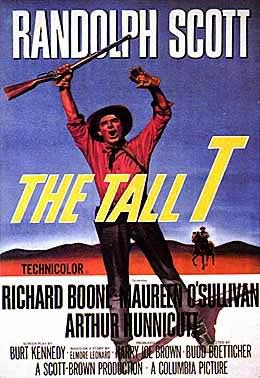
The first official entry in the Budd Boetticher / Ranown cycle of westerns is The Tall T (1957). The story here was adapted by Burt Kennedy from an Elmore Leonard short story called The Captives. That makes for an impressive set of credits and, in truth, the end result is a near perfect film. Once again Boetticher and Kennedy boil the western down to its absolute essentials, and the bulk of the action involves just five people and how they all relate to one another. Everything from location and plot to dialogue is pared right down and the film is all the better for that. What is left is a raw and visceral western with a strong moral current running through it and characters who we actually care about.

For a film with a short running time – under 80 minutes – it’s really a story with two distinct parts. The opening section introduces the character of Pat Brennan (Randolph Scott), a happy-go-lucky type in the process of building up his newly acquired ranch. He comes across as a gently charming sort who stops off on his way to town to pass the time of day with the local stationmaster and his young son. He even takes the time in town to pick up some candy for the boy as he had promised to do. When he visits his former employer, and loses his horse in an ill-judged wager, you start to wonder how such a hapless innocent could survive in a harsh environment. It is from this point on though that the depth of Brennan’s character begins to become apparent. Hitching a ride on a private stagecoach, hired for the honeymoon of Mrs. Mimms (Maureen O’Sullivan) and her gold-digging chiseller of a husband, he stops off to deliver the candy to the stationmaster’s boy. The station has been taken over by outlaw Frank (Richard Boone) and his two sidekicks (Henry Silva and Skip Homeier) with the aim of holding up the regular stage. Faced with the horror of what has just taken place, and the likely fate awaiting him and the other hostages, the character of Brennan undergoes a sea change. Almost immediately the easy-going ex-ramrod is transformed into a cool, calculating avenger who knows he must now play for time while waiting for the opportunity save himself and the woman. It’s a credit to all involved that this transition appears so natural as to be nearly seamless.

Scott’s flinty features once again blend in with the bleak Lone Pine locations which dominate the picture. The character shift I mentioned is magnificently achieved in the scene where the fate of the stationmaster and his boy is revealed in cold, matter-of-fact fashion by Henry Silva. Scott’s face hardens almost imperceptibly yet the meaning is all too clear. This kind of thing makes for great screen acting and the lead was a pastmaster in the art of underplayed emotion. Richard Boone was always interesting to watch, and in Frank he gives a fascinating performance as the outlaw you want to sympathise with. When he dispatches Mrs. Mimm’s husband, whose craven character offends his own personal morality, it’s difficult not to feel some grudging admiration. The two subsidiary villains are of less interest, but Silva manages to tap into a vaguely detached psychosis that works very well. Maureen O’Sullivan has an unglamorous role which offers her the chance to play something which is a cut above the standard damsel in distress. The fact that we get such well rounded characters in a short run time speaks volumes about the writing skills of Burt Kennedy. Boetticher again excels at making a cheaply produced picture look far more expensive. The framing and camera placement are miles away from the usual point and shoot style employed in low budget fare; this man had a real flair for the quirky and the unexpected. His handling of the action scenes is again exemplary, and they have both a frankly brutal quality and an odd humanity that make them stand out from other pictures of this vintage. There’s something deeply satisfying about Randolph Scott turning to the sobbing woman at his side, after the violent climax, and quietly intoning: Come on now, it’s gonna be a nice day.

Sony’s presentation of The Tall T on DVD is another excellent one. Some may carp at the amount of grain on view but I don’t regard that as a bad thing. The anamorphic widescreen picture is bright and colorful throughout. The disc also carries a short featurette with Martin Scorsese praising the film. Best of all, there’s the feature length documentary Budd Boetticher: A Man Can Do That. So, we get a great movie which is presented with care and respect – what more could you ask for.

Comanche Station

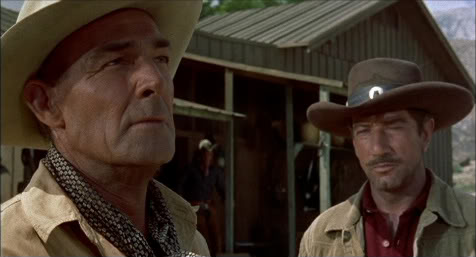
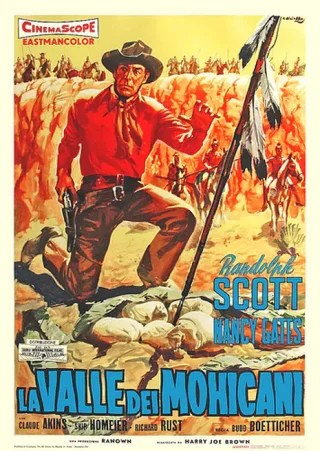
Lean and spare are the words often used to describe the westerns of Budd Boetticher and I won’t argue with that. Of course, budgetary constraints were generally the reason for the minimalist approach but Boetticher was masterful at disguising that fact. Burt Kennedy’s drum tight scripting and Boetticher’s control of the camera mean that you never stop to think that what’s on the screen was originally shot as a B picture. Between 1956 and 1960 the director made seven westerns with star Randolph Scott, all but the first produced by Scott’s Ranown. Shooting for the most part around Lone Pine gave these films a distinctive look and feel in much the same way that Monument Valley defined the westerns of Ford. Comanche Station (1960) was their last collaboration and Scott’s penultimate movie.

The plot is quite simple really, and that’s generally the strength of all the Ranown westerns; there’s no excess baggage, and the viewer only sees and hears what is absolutely necessary. Cody (Scott) is a lonely man, a former soldier, who has spent years wandering the west in search of his abducted wife. Whenever he hears a rumor of a white captive he sets off with a mule loaded with trade goods hoping that this time his quest may end. It is said that he’s rescued countless captives but it’s never the right one for Cody. This time will be no different. He trades with the Comanche for the freedom of one Mrs. Lowe (Nancy Gates) and aims to see her safely back to her husband. However, before he can do so, three men turn up and throw a spanner in the works. Lane, Frank and Dobie (Claude Akins, Skip Homeier and Richard Rust) are running from the Comanche, and Cody suspects it’s because they’re scalphunters. Cody’s distrust of Lane dates back to their years in the army, when he had the latter court-martialed for his role in an Indian massacre. It turns out that Mrs. Lowe’s husband has offered a $5000 reward for her return, dead or alive. While the viewer is immediately aware that Cody knew nothing of this, no-one else believes it. The challenge now is for him to save his own skin and that of the woman from both the Comanche and his new companions. As the story progresses it becomes very obvious where the greatest threat lies.

Randolph Scott’s lean and craggy appearance compliments both the landscape and Boetticher’s sparse morality tale. He looks every inch the laconic westerner who’s spent years scouring the scorched, barren land with only his pain and loss for company. The older he got the more adept he became at conveying a kind of buttoned-up emotion combined with an iron sense of personal honor. He was the first actor to draw me to the western as a child, and now I’m more convinced than ever that he may have been the greatest cowboy, surpassing even Wayne and Cooper. In fact all five actors in this film play off each other perfectly, and much of that comes down to the writing of Burt Kennedy. Everyone gets something to get their teeth into and it’s difficult not to feel even some sympathy for all of them. None of the villains in Boetticher’s westerns were ever one dimensional and Kennedy always managed to provide them with enough backstory or characteristic dialogue to keep the viewer interested. Boetticher does a fine job of moving his camera around to offer some unexpected shots and angles, and his use of the wide screen makes what is essentially a small picture look very big indeed.

After what seems like an eternity of waiting, Sony have finally released the five Ranown westerns in their possession onto DVD as The Films of Budd Boetticher. All the films come on their own discs and Comanche Station looks just wonderful. Like the other titles in the set, it boasts a healthy amount of film grain and sports a fine anamorphic transfer with good, strong color. The disc also carries a short featurette with Clint Eastwood offering a few thoughts on the movie. Sony have done a bang up job with this set – I have no hesitation in saying it’s the release of the year for me.

Duel at Diablo

duelatd

The Hollywood western in the mid-60s was at a crossroads. Television had effectively saturated the market with oaters and the whole genre was becoming filled with cliches. In Europe, the spaghetti westerns of directors like Leone and Corbucci were posing other challenges by taking a new approach to genre conventions and increasing the levels of violence. The dilemma faced by Hollywood was whether it should stick with the traditional formula or borrow from the Europeans. The initial result was a kind of compromise or halfway house. Ralph Nelson will be best known for his brutal cavalry western Soldier Blue; in a way it’s slightly ironic for a man who really only dabbled in the genre. Soldier Blue isn’t all that good a film, and much of its fame derives from the revisionist depiction of the violent excesses of the US cavalry. However, a few years earlier, Nelson made his first western, Duel at Diablo (1966), which offered a similarly bloodthirsty view of the Apache. Taken together, it could be said that the two films balance each other out, although Duel at Diablo is much closer to the traditional western in execution.

The opening of the film gives some indication of what’s to come, as the screen is sliced open by a bloodied knife to reveal a charred corpse suspended over a slow burning fire. From a distance, cavalry scout Jess Remsberg (James Garner) watches  and grimaces. Almost immediately, a rider comes into view pursued by two mounted warriors. This is Ellen Grange (Bibi Andersson), a white woman trying to make her way back to the Apache camp from which she has recently been rescued. The film is essentially an examination of race relations within the framework of the conventional revenge western. It is later revealed that Mrs. Grange bore a son while a captive, and this is a large part of her desire to return. However, that’s not her only reason; her husband Will (Dennis Weaver) cannot bring himself to come to terms with what has happened and rejects her. In her husband’s opinion, any decent woman would have killed herself rather than relinquish her honour. The attitude is widespread and is highlighted when Remsberg has to step in and save her as she is assaulted by a group of men convinced of her easy virtue. Remsberg is the only person to show any real compassion towards Mrs. Grange, and that’s because he too has placed himself on the fringes of white society. The second plot thread running through the movie concerns Remsberg’s quest to hunt down the man responsible for the murder, and subsequent scalping, of his Indian wife. While, eventually, the two threads merge and a measure of closure is achieved, the racial issue remains unresolved and the future awaiting both Remsberg and Mrs. Grange is far from certain.

James Garner may not be everyone’s first choice to play a hardened army scout but he acquits himself well. If anyone doubts his ability to play tough and gritty western characters I can only suggest they check out his performance a few years later in John Sturges’ Hour of the Gun. In truth, the casting in general is a little unorthodox, but it works for the most part. The exception would be Sidney Poitier’s dandified ex-soldier, who appears totally out of his element and never truly convinces. Swedish actress Andersson does well as the woman caught between two worlds and her odd accent actually serves to emphasise both her isolation and the outsider status of her character. Bill Travers was another piece of bold casting as the Scots cavalry lieutenant who dreams of promotion. Again I had no real problem with this since it seemed to blend into the overall scheme of highlighting the racial diversity of frontier life.

Ralph Nelson performs the director’s chores competently enough, even managing a few visually evocative shots of the cavalry column which recalls the great John Ford. His best work, however, is most apparent in the action scenes; the clashes between the cavalry and the Apache are well staged and exciting. He also displays a taste for the gruesome that he would indulge further in Soldier Blue; there are a number of scenes of Apache torture that, though tame by today’s standards, must surely have been regarded as strong stuff at the time. Nevertheless, I don’t believe he had any real feel for the western and fails to draw in the viewer in the way  the genre’s masters could. Another problem is the score by Neal Hefti, whose jazzy compositions work extremely well in the context of The Odd Couple and How to Murder Your Wife, but tend to grate a little in a western.

Duel at Diablo comes to DVD from MGM in both R1 and R2. The R2 is a typically ordinary transfer from this company (I’m not sure, but I’d imagine the R1 fares about the same) that’s neither all good nor all bad. On the plus side, the image is anamorphic 1.78:1 and there’s a theatrical trailer available, but it tends to be too soft in places. Even though it’s no classic I’d say the film is well worth a view for the interesting casting and storyline.


Dark Command

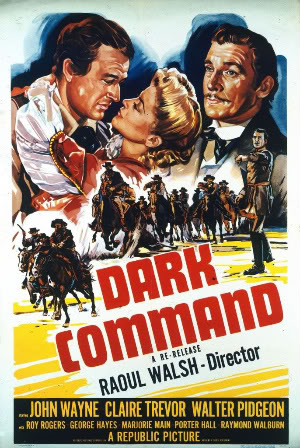
William Clarke Quantrill was one of those controversial figures who gained fame or noteriety, depending on where one’s sympathies lay, as a result of his activities during the Civil War. The nature of those activities has ensured that his character and associates have continued to appear on screen on a fairly regular basis, right up to Ang Lee’s much maligned Ride with the Devil. Raoul Walsh’s Dark Command (1940) takes Quantrill, changes his name to Cantrell, and adds a written caveat at the beginning to explain that certain liberties have been taken with the truth. As such it’s not a biopic of the man in the traditional sense; it merely uses the character and a few events from his life to tell a standard western story. Taken on this level it works very well, but then I don’t think I’ve ever seen a film by Walsh that didn’t work on some level.

Dark Command opens in Lawrence, Kansas on the eve of the Civil War, with Bob Seton (John Wayne) arriving in town in the company of perennial sidekick ‘Gabby’ Hayes. Seton is an uncomplicated Texan who’s in the process of working his way across the country. In making the acquaintance of banker’s daughter Mary McCloud (Claire Trevor), he also meets local schoolteacher Cantrell (Walter Pidgeon). Both men clearly have romantic designs on Miss McCloud, and their rivalry later extends to the political arena when they run for the newly instituted position of town marshal. It is Seton’s victory in this election that proves the catalyst for Cantrell’s abandonment of civic duty in favour of a much more lucrative career as a guerilla raider. Actually this brings about a change in the two lead characters; Seton becoming tougher and more assured once the weight of responsibility falls on his shoulders, and Cantrell revealing his venal nature in his quest to attain “greatness”. This personal animosity is played out while, all around, the town divides itself along pro-Union and pro-Confederacy lines. The wider national conflict is referred to only through dialogue and one of those, now cliched, burning map shots.

As I said before the film isn’t a straight biopic and never claims to be giving all the historical facts. Having said that Quantrill did work as a teacher in Lawrence in the years preceding the Civil War, although I’m not aware of his running for marshal or other elected office. It has been said of Raoul Walsh that his idea of humour was burning down a whorehouse; in Dark Command he goes one step further by burning down a whole town, although not for comedic value. The sacking of Lawrence by Quantrill is a known historical event and the film duly acknowledges this. However, this set piece, which forms the climax of the story, doesn’t dwell on the gory excesses of Quantrill’s men. Instead it uses it as a means of neatly wrapping up the personal battle between Seton and Cantrell. One could pick out all kinds inaccuracies relating to timelines, weaponry, the ultimate fate of Quantrill and so on, but I’ve never felt that this serves much of a purpose. Movies are a means of telling stories, and if this requires the makers to play a little fast and loose with the facts, well, so be it.

John Wayne made Dark Command one year after Stagecoach, the film which offered him a way out of the cycle of B westerns he’d been doing since the failure of Walsh’s The Big Trail. It’s a little ironic that the man who first introduced Wayne to the cinema-going public should again feature at the rebirth of his career. The Duke is still not the finished product here, although he’s not far away; audiences wouldn’t really see his fully formed western character until Tall in the Saddle, a few years later. There’s a bit too much mugging in the first half of the picture, although the easy, confident Wayne we’re all familiar with starts to emerge as the story moves along. Walter Pidgoen was an actor I’ve never really warmed to, but he was capable of turning in good performances as men carrying around a lot of internal baggage – How Green Was My Valley would be a good example of this. His Cantrell is never all that convincing as an out-and-out villain but maybe that’s just the way the part was written. Where he’s at his best are those private moments when he gives vent to all the pent up frustration that comes from thwarted ambition. Claire Trevor, who received top billing here, was a fine actress and does well as the conflicted woman at the centre of events. In Stagecoach she showed good chemistry with Wayne and that spark continues to be evident in this film. Romantic interludes were never Wayne’s strong suit but the tough Miss Trevor manages to draw out her co-star quite successfully.

I’ve already alluded to the fact that Raoul Walsh’s sense of humour tended towards the broad, and that’s certainly the case in the scenes with ‘Gabby’ Hayes. In much the same way as with Walsh’s contemporary and fellow Irish-American John Ford, audiences either get this kind of humour or they don’t. Superficially, one could see similarities in the styles of these two directors, but Ford remains the better known filmmaker. That’s not to say that Walsh should be regarded as a lesser figure, mind; he was every inch the professional and turned out some of the finest films of classic era Hollywood. It should also be mentioned that Dark Command contains some top class second unit work from the great Yakima Canutt. There’s a spectacular wagon jump from atop a cliff, and another outing for his patented under-a-moving-wagon escape ala Indiana Jones. Today’s climate of clumsy editing and overused CGI makes this viewer yearn for the era when there was genuine creativity and artistry in the second unit.

The movie is available on DVD in both R1 and R2. I have the old R1 from Artisan and the picture quality is quite good. Like all those Republic pictures released by Artisan there hasn’t been any restoration done, so there are instances of speckling and the odd cigarette burn. However, the print remains in pretty good shape and is always watchable. The R2 comes from Universal UK, and while I don’t have it to compare I would be wary of its quality considering its source. Dark Command is a fine western with an epic feel that comes partly from the bigger budget that Republic granted it. I’d recommend it to the general western fan and anyone with an interest in the Civil War era, or the development of the Duke’s career.

Where Danger Lives

poster71

The films produced at RKO under the stewardship of Howard Hughes were a mixed bag to say the least; the billionaire’s’s involvement lending a crass, juvenile quality to more than one movie. While he led the once great studio along the path to bankruptcy and oblivion, he also introduced the cinema-going public to number of new starlets such as Jane Russell and Faith Domergue. Miss Domergue never made that many memorable pictures, save for Where Danger Lives, This Island Earth and It Came from Beneath the Sea. Of those three, Where Danger Lives (1950) has the slightly odd distinction of presenting her with her best role while also being the least known. In fact, this is a fine movie all round with stylish direction by noir stalwart John Farrow, a powerful lead performance by Robert Mitchum, moody cinematography by Nicholas Musuraca, and a Charles Bennett script.

At first glance the film may seem like a standard lovers-on-the-run yarn, but that’s merely the framing device for a tale of obsessive love, deception and madness. Jeff Cameron (Robert Mitchum) is introduced as an overworked but dedicated doctor who, at the end of his shift, is called upon to treat an attempted suicide. He is immediately attracted to the patient, Margo (Faith Domergue), and soon embarks on an affair. The immediate effect of this is that Cameron develops a callous disregard for both his job and his devoted sweetheart, played by director’s wife Maureen O’Sullivan. The whole point of the story is how lust can blind a man to reality and allow him to be deceived and manipulated. The film is packed with lies and liars and it seems that just about everyone is prepared to bend the truth to suit their own agenda, right down to ambulance drivers and small town doctors. When Cameron receives a blow on the head in a struggle, the resulting concussion gradually impairs his judgement and allows him to be more easily duped. In a marvellously surreal passage, the fleeing couple arrive in a town where everyone is bearded and dressed in western apparel. For a moment it looks as though the action has taken a detour into the Twilight Zone, until it is revealed that Mitchum and Domergue have stumbled into a local festival. The idea of nobody being quite what they appear is nicely highlighted when a local boy draws facial hair onto a photograph of Domergue, while muttering that everyone has to have a beard. From first to last, the movie concentrates on shifting identities and false perceptions.

Robert Mitchum was an old hand at playing noir anti-heroes and the role of Jeff Cameron offers him the opportunity to flex his acting muscles. He goes from being an upstanding professional at the beginning of the film to a shambling brain damaged wreck of a man by the climax. In the hands of a lesser actor the part could easily have descended into eye-rolling histrionics, but Mitchum’s deceptively lazy style ensures that credibility is maintained as his character’s mental state deteriorates and he floats between clarity and confusion. Faith Domergue’s Margo is a fine femme fatale in the classic mould. Her performance isn’t as controlled as Mitchum’s but she still manages to be convincing. It’s obvious from the start that there’s something not quite right about Margo, but you can’t really put your finger on what. Claude Rains appears in a small but significant part, and adds some real class to proceedings; in his few minutes of screen time he shows us another psychologically twisted character, and his playing is every bit the equal of that of his co-stars. John Farrow always seemed comfortable in noir territory, and does a good job of holding together a story that could have easily spun out of control. Farrow is ably assisted by his director of photography Nicholas Musuraca, whose camera does good things with the bleak desert backdrops and shadowy small towns that dominate the film.

Where Danger Lives comes to DVD, paired on disc with Tension, from Warners in R1 via their fourth noir set. It’s a fine, clean transfer which shows Musuraca’s excellent black and white photography at its best. The film comes with a trailer and a short featurette on the movie. This is a  film that I wasn’t at all familiar with until I picked up the box set. I can’t think why it has been such an obscure and hard to see movie since I’d rate it as an excellent example of classic era noir. Highly recommended.

The Long Memory

hhrbybb

I seem to be on a bit of a Robert Hamer kick at the moment. Having recently enjoyed Pink String and Sealing Wax, I decided to give The Long Memory (1952) a spin. While the former is a Gothic/Victorian noir which may stretch the definition for purists, the latter is the real deal. It has the contemporary setting, stark photography and relentlessly downbeat moodiness that should satisfy all who have a penchant for dark cinema. The story is classic noir wherein an innocent man is persecuted for a crime he has not committed and subsequently finds himself consumed by his thirst for revenge on those responsible for his plight.

Phillip Davidson (John Mills) has just been released from prison, having served twelve years for murder. An early flashback establishes that he had been wrongfully convicted, and that the false testimony of his then fiancee (Elizabeth Sellars) played a significant part in securing that conviction. In a neat twist, it also transpires that the treacherous fiancee has, in the intervening years, married the policeman originally in charge of Davidson’s case (John McCallum). Aware of the fact that Davidson still bears a grudge, the authorities track him Kent where he takes up residence in an abandoned barge along the desolate Thames estuary. As Davidson grimly sets about the task of seeking out his former tormentors the action alternates between his search and the slow unravelling of the idyllic domesticity of the policeman’s life. Running parallel to this is the development of a relationship between Davidson and a refugee girl (Eva Bergh) working as a waitress in a dingy cafe. This plot thread is not mere romantic padding but an essential element that clearly demonstrates just how deep Davidson’s scars run. By the end of the movie the quest for revenge has transformed into more of a journey towards spiritual redemption.

£6

The acting is out of the top drawer all round with the only weak link in the chain being Elizabeth Sellars. Her performance comes across as even more wooden given the emotional depth shown by almost everyone else around her. John Mills does a fine understated turn in the lead role. The scenes he plays in the old barge with Eva Bergh have such a touching and heartrending quality. These are two people who have spent so long living within themselves that the effort of reaching out to another is close to physically painful. John McCallum is also fine as the decent cop who gradually comes to realise that the woman he married is not all she seems, and who must resign himself to the fact that his career cannot continue if he’s to come out of it all with any sense of honour intact. There’s plenty of good support from a selection of familiar British character actors; special mention going to Michael Martin Harvey as Mills’ slightly kooky neighbour.

Where Pink String and Sealing Wax suffered from an undisciplined and unfocused script, The Long Memory can boast tighter writing and pacing. Hamer moves his camera around effectively and makes maximum use of the barren Kent coastline. He also controls the flow of the story very well, and cuts tellingly between the gradual flowering of the Mills/Bergh relationship and the simultaneous disintegration of Sellars and McCallum’s. All of this is backed up by the excellent cinematography of Harry Waxman who manages to throw in some welcome deep focus shots.

The Long Memory is currently only available on DVD as part of the John Mills Centenary Collection II from ITV DVD in R2. The set is a bit pricey but it does offer a good selection of Mills films and is worth checking out. This movie comes on its own disc and, while not perfect, gets a pretty good transfer. There’s optional subs, production notes and a gallery included. I hadn’t seen this film for a number of years and had forgotten what an underrated little gem it is. I give it a big thumbs up and recommend it wholeheartedly.