The Westerner

poster85

One of the recurring themes of the western is the conflict between the cattlemen of the open range and the fence-building homesteaders, or sodbusters. In truth, this clash (freedom, as represented by the range, and the slow encroachment of civil society from the east) lies near the very heart of the genre. It is this which forms the framework of The Westerner (1940), but the film really revolves around the relationship between two very different men. As such it eschews action in favour of character development, and slots nicely into the group of more mature westerns that were starting to appear at the time.

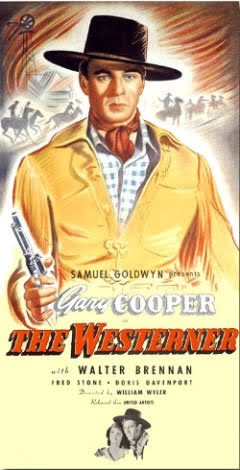
The film’s prologue sets the scene in the years following the Civil War when the westward expansion was in full swing. Judge Roy Bean (Walter Brennan) has established himself as the self-styled “Law West of the Pecos” in his own remote corner of Texas. He is shown dispensing his own brand of justice from his saloon/courtroom in the case of a man accused of committing one of the most serious of all crimes, that of murdering a steer. Having tried, convicted and carried out the sentence personally, he comes face to face with his next defendant. Cole Harden (Gary Cooper) is a drifter and saddle tramp who’s had the misfortune of buying a stolen horse. This is another capital crime and the case looks to be an open and shut one. When the jury retires to back room to play cards and down some liquor before delivering the inevitable guilty verdict, Harden takes the only path open to him. Noticing that the saloon has been made up as a virtual shrine to Lily Langtry, Harden claims to have made the acquaintance of the judge’s beloved actress and to have a lock of her hair in his possession. Well, clearly such a man can’t simply be hauled out and hanged so the sentence is suspended and the two men form an uneasy alliance. However, Harden finds himself drawn to Jane Ellen Matthews (Doris Davenport), daughter of a local settler, and is soon caught between the two rival factions.

Gary Cooper was a highly deceptive actor. There are those who would claim that his laconic style was wooden and that he couldn’t act, but to say that is to ignore the subtlety of the man’s craft. There was no expansiveness to Cooper but everything was communicated through his face and small unpretentious gestures. There is a marvellous example of this during the trial scene in this movie where fear, calculation and, ultimately, triumph are all readable just from his eyes. He’s at his best in the scenes he shares with Walter Brennan but, perversely, has every one of those scenes stolen right from under his nose. I don’t think it would be too much of a stretch to say that Brennan was the finest character actor American cinema has ever produced. He turned in performances which ranged from fine to excellent in anything I’ve seen him in. His Judge Roy Bean is a multi-layered character who goes from mean and ornery to endearingly childlike and back again. It’s no mean acting feat to make this figure sympathetic, but Brennan managed it and picked up his third Oscar for his troubles.

Visually, the film looks great, due in no small part to the photography of Gregg Toland. With all this talent at his disposal, director William Wyler marshals it with his typical professionalism. He offers up some fine cinematic moments, such as the attack on the homesteaders. In the midst of a thanksgiving ceremony, as the camera surveys a rich, tranquil and fertile land to the accompaniment of noble words, the idyll is abruptly shattered by a murderous arson raid. As flames sear the screen, the settlers paradise is transformed in a matter of minutes into a scorched, desolate landscape. Those smouldering, blackened ruins of former homes pointing accusingly towards the heavens are an eloquent reminder of the fickle and dangerous unpredictability of frontier life.

The Westerner was reissued on DVD in R1 late last spring by MGM/Fox and the transfer is a very fine one. I can’t say I noticed any significant damage marks or signs of manipulation, just a crisp, clean B&W image. Previous MGM releases were no more than adequate but the distribution deal with Fox seems to have led to an improvement in quality. The only criticism is the lack of any extra content, but I guess you  can’t have everything. I’d rate The Westerner as a good example of a ’40s oater for grown-ups; it has drama and it’s moving but it also has a vein of sly, dark humour running through it. Recommended.
 

Dark Command

William Clarke Quantrill was one of those controversial figures who gained fame or noteriety, depending on where one’s sympathies lay, as a result of his activities during the Civil War. The nature of those activities has ensured that his character and associates have continued to appear on screen on a fairly regular basis, right up to Ang Lee’s much maligned Ride with the Devil. Raoul Walsh’s Dark Command (1940) takes Quantrill, changes his name to Cantrell, and adds a written caveat at the beginning to explain that certain liberties have been taken with the truth. As such it’s not a biopic of the man in the traditional sense; it merely uses the character and a few events from his life to tell a standard western story. Taken on this level it works very well, but then I don’t think I’ve ever seen a film by Walsh that didn’t work on some level.

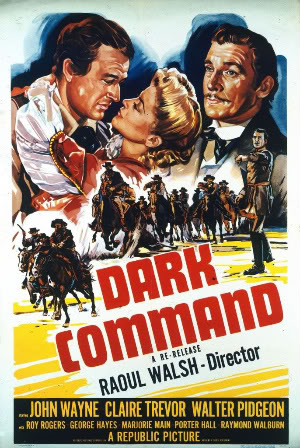
Dark Command opens in Lawrence, Kansas on the eve of the Civil War, with Bob Seton (John Wayne) arriving in town in the company of perennial sidekick ‘Gabby’ Hayes. Seton is an uncomplicated Texan who’s in the process of working his way across the country. In making the acquaintance of banker’s daughter Mary McCloud (Claire Trevor), he also meets local schoolteacher Cantrell (Walter Pidgeon). Both men clearly have romantic designs on Miss McCloud, and their rivalry later extends to the political arena when they run for the newly instituted position of town marshal. It is Seton’s victory in this election that proves the catalyst for Cantrell’s abandonment of civic duty in favour of a much more lucrative career as a guerilla raider. Actually this brings about a change in the two lead characters; Seton becoming tougher and more assured once the weight of responsibility falls on his shoulders, and Cantrell revealing his venal nature in his quest to attain “greatness”. This personal animosity is played out while, all around, the town divides itself along pro-Union and pro-Confederacy lines. The wider national conflict is referred to only through dialogue and one of those, now cliched, burning map shots.

As I said before the film isn’t a straight biopic and never claims to be giving all the historical facts. Having said that Quantrill did work as a teacher in Lawrence in the years preceding the Civil War, although I’m not aware of his running for marshal or other elected office. It has been said of Raoul Walsh that his idea of humour was burning down a whorehouse; in Dark Command he goes one step further by burning down a whole town, although not for comedic value. The sacking of Lawrence by Quantrill is a known historical event and the film duly acknowledges this. However, this set piece, which forms the climax of the story, doesn’t dwell on the gory excesses of Quantrill’s men. Instead it uses it as a means of neatly wrapping up the personal battle between Seton and Cantrell. One could pick out all kinds inaccuracies relating to timelines, weaponry, the ultimate fate of Quantrill and so on, but I’ve never felt that this serves much of a purpose. Movies are a means of telling stories, and if this requires the makers to play a little fast and loose with the facts, well, so be it.

John Wayne made Dark Command one year after Stagecoach, the film which offered him a way out of the cycle of B westerns he’d been doing since the failure of Walsh’s The Big Trail. It’s a little ironic that the man who first introduced Wayne to the cinema-going public should again feature at the rebirth of his career. The Duke is still not the finished product here, although he’s not far away; audiences wouldn’t really see his fully formed western character until Tall in the Saddle, a few years later. There’s a bit too much mugging in the first half of the picture, although the easy, confident Wayne we’re all familiar with starts to emerge as the story moves along. Walter Pidgoen was an actor I’ve never really warmed to, but he was capable of turning in good performances as men carrying around a lot of internal baggage – How Green Was My Valley would be a good example of this. His Cantrell is never all that convincing as an out-and-out villain but maybe that’s just the way the part was written. Where he’s at his best are those private moments when he gives vent to all the pent up frustration that comes from thwarted ambition. Claire Trevor, who received top billing here, was a fine actress and does well as the conflicted woman at the centre of events. In Stagecoach she showed good chemistry with Wayne and that spark continues to be evident in this film. Romantic interludes were never Wayne’s strong suit but the tough Miss Trevor manages to draw out her co-star quite successfully.

I’ve already alluded to the fact that Raoul Walsh’s sense of humour tended towards the broad, and that’s certainly the case in the scenes with ‘Gabby’ Hayes. In much the same way as with Walsh’s contemporary and fellow Irish-American John Ford, audiences either get this kind of humour or they don’t. Superficially, one could see similarities in the styles of these two directors, but Ford remains the better known filmmaker. That’s not to say that Walsh should be regarded as a lesser figure, mind; he was every inch the professional and turned out some of the finest films of classic era Hollywood. It should also be mentioned that Dark Command contains some top class second unit work from the great Yakima Canutt. There’s a spectacular wagon jump from atop a cliff, and another outing for his patented under-a-moving-wagon escape ala Indiana Jones. Today’s climate of clumsy editing and overused CGI makes this viewer yearn for the era when there was genuine creativity and artistry in the second unit.

The movie is available on DVD in both R1 and R2. I have the old R1 from Artisan and the picture quality is quite good. Like all those Republic pictures released by Artisan there hasn’t been any restoration done, so there are instances of speckling and the odd cigarette burn. However, the print remains in pretty good shape and is always watchable. The R2 comes from Universal UK, and while I don’t have it to compare I would be wary of its quality considering its source. Dark Command is a fine western with an epic feel that comes partly from the bigger budget that Republic granted it. I’d recommend it to the general western fan and anyone with an interest in the Civil War era, or the development of the Duke’s career.

Pink String and Sealing Wax

poster59

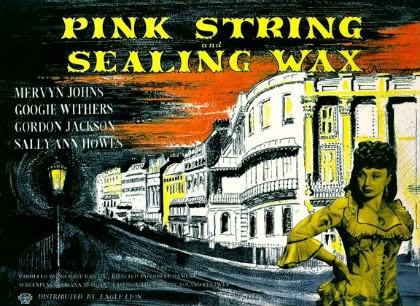
Robert Hamer may well have been the best director to work for Ealing. The man who produced  Kind Hearts and Coronets cut his teeth on one of the segments in the grandfather of all horror anthologies, Dead of Night. He also made one of the most memorable British noirs in It Always Rains on Sunday (1947), featuring Googie Withers. One year before that, he used the same actress in the Victorian noir Pink String and Sealing Wax, the title of which refers to a chemist’s means of packaging his remedies. While I wouldn’t say this is the best of Hamer’s films, it is a solid enough effort hampered by an unfocused script.

Edward Sutton (Mervyn Johns) is a Brighton chemist, a self-made man who has clawed his way up from humble beginnings to attain respectability as a forensic analyst. He remains, however, a thoroughly objectionable prig and domestic tyrant. Returning from court in a thundering good mood, having just seen his testimony send a woman to the gallows, he proceeds to humiliate his lovelorn son, reduce first his younger daughter to tears by informing her (on her birthday no less) that he intends using the guinea pigs she thought were a present in some unmentionable experiments, and then draw a similar reaction from the elder girl by dashing her hopes of a career in music – and all this before lunch has even been served! So it’s no surprise when the eldest son, David (Gordon Jackson), decides to go out and get hammered in the seedier part of town. He finds himself in a pub run by Pearl Bond (Withers) and her brutish, alcoholic husband. It’s this part of the story, which concentrates on Pearl and her complicated and unhappy relationships, that makes up the real substance of the film. The action moves away from the twee and slightly soapy Sutton clan to the far more colorful and vital world of the lower classes. David finds himself attracted to Pearl and the loose living world she inhabits, and slowly, unwittingly, he is drawn into her plans to relieve herself of her increasingly abusive spouse. The real pity is that the script meanders too much and this straying from the point blunts the thrust of the narrative. Far too much time is wasted on the unnecessary subplot concerning the eldest daughter’s efforts to pursue her dream of becoming an opera singer. I guess the idea was to highlight the inflexible nature of Sutton senior, but in doing so much of the tension of the plot drains away and the whole picture suffers.

Googie Withers plays the part of the femme fatale to the hilt and manages to capture the sympathy of the viewer as effortlessly as she captures the affections of the men around her. She puts in a really fine piece of film acting, conveying as much of her thinking and emotion through her eyes and body language as through her words. A very young Gordon Jackson is quite appealing as the poor innocent sap who finds himself in over his head before he knows it. Mervyn Johns is always watchable, although his is pretty much a one-note performance as the rigid and domineering head of the house who sees his authority come under attack. Still and all, his final confrontation with Withers, as he calmly and coldly points out the fate awaiting her, is powerfully delivered and retains a chilling quality. Hamer directs smoothly and handles both the intimate scenes and the sourer and more bitter ones with equal skill. As I said, he’s only let down by the untidy script which should have left out some of the more pointless scenes.

Optimum’s R2 DVD is a fairly good if unspectacular affair. The print used is in reasonable condition but there does seem to be a bit of contrast and brightness boosting here and there. As usual with Optimum this is a barebones disc with no subs and just a chapter menu. All in all, Pink String and Sealing Wax is an enjoyably dark movie with some good acting and professional direction. It’s just a pity the writing couldn’t have been tightened up a bit.


Desert Fury

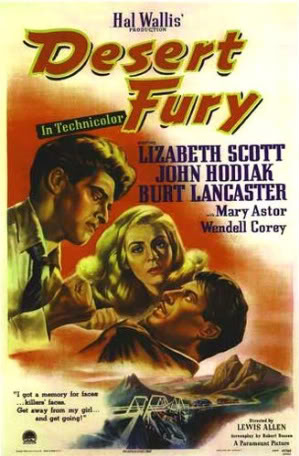
Can a technicolor movie be considered a film noir? I think so. Sure, the form lends itself better to the harshness of black and white photography where the light and shadows can be more skilfully manipulated. Having said that, film noir is more than just a photographic style – it’s a style of film making. To me, noir is a combination of many elements (theme, character, time, location, photography etc.) and the more boxes we can check, the closer we come to defining it. Photography is, undoubtedly, one of the major elements that needs to be present – I just feel that photographic style rather than color vs B&W is the clincher. As such, I feel Desert Fury (1947) is most definitely noir. Although the movie is shot in blinding technicolor, the themes and characterization place it firmly in the realm of dark cinema.

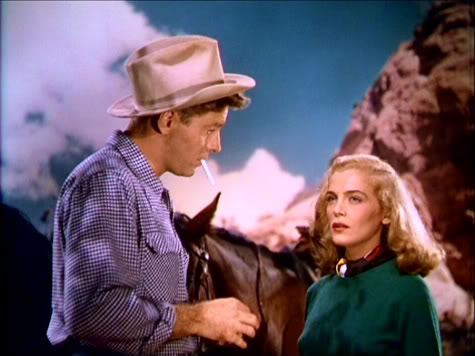
Paula Haller (Lizabeth Scott) returns to Chuckawalla, the small desert town where she was raised by her widowed mother Fritzi (Mary Astor). Paula is shown to be an outsider right from the off, snubbed by the locals due to her mother’s ownership of the town’s gambling joint. The only friend she has is Tom Hanson (Burt Lancaster), a former cowboy now working as town deputy after an accident put an end to his former career. Paula’s arrival back home coincides with the reappearance of a shady character called Eddie Bendix (John Hodiak), whose wife died years earlier in a mysterious road accident. When Paula falls for Bendix a whole hornet’s nest of passion is stirred up as Fritzi, Hanson, and Bendix’s partner Johnny (Wendell Corey) all, for their own reasons, try to keep them apart. What tilts this into noir, rather than straight melodrama, is the twisted nature of the relationships involved. Paula is said to bear a strong resemblance to Bendix’s late wife; Fritzi and Bendix were formerly lovers; there’s more than a hint of jealous competition between the two female leads; and there are strong suggestions that the relationship of Bendix and Johnny might involve some sexual undercurrents – heady stuff indeed for 1947. There’s also a nice cyclical form to the movie, which both opens and closes with characters staring over the rails of a bridge at the site of a fatal crash.

This is a picture that’s dominated by the performances of the women. Mary Astor is near perfect casting as the worldly and tough dame who rules the roost in a man’s world, yet struggles to tame the impulses of her headstrong daughter. Lizabeth Scott was born to star in films noir, and she does the business here as the troubled heroine with the whiskey voice who has to learn a few hard lessons. Burt Lancaster’s role is a bit of a thankless one; he seems to do little more than cruise up and down the desert highway, hoping to run into Scott on her return from Hodiak’s rented pad. Hodiak himself gives an interesting performance as man who’s clearly not all he seems. His initial detachment and suppressed aggression hint at some dark secret, and he gradually descends further into a kind of manic vindictiveness until his flaws and weakness are finally exposed by the sly and knowing Corey. Director Lewis Allen makes sure everything moves along smoothly and makes excellent use of the harshly beautiful locations. A word also for cinematographer Charles Lang, who makes those same desolate landscapes positively pop off the screen.

Desert Fury is available on DVD in R4 from a company called DV1. Their disc looks fantastic with strong color and detail, although there are some speckles and damage marks here and there. It is, however, totally barebones with not even subs offered. On the plus side there are some interesting liner notes  printed on the reverse of the cover – and it should be available cheaply. For me, this was pretty much a blind buy and I ended up enjoying it a lot. Recommended.

The Woman in the Window

poster13

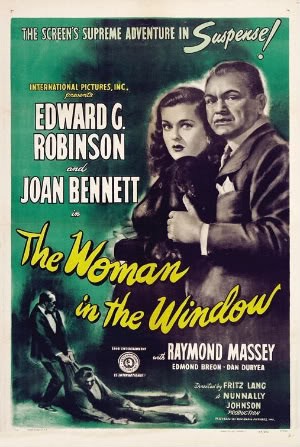
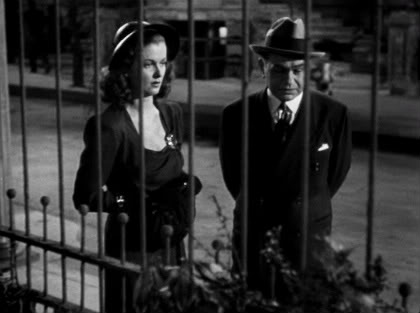
In many ways Fritz Lang’s The Woman in the Window (1944) plays like a dress rehearsal for his production of Scarlet Street the following year. Both films feature the same three stars – Edward G Robinson, Joan Bennett and Dan Duryea – and tell the story of a married, middle-aged man whose chance meeting with a young woman leads him into a vortex of murder, blackmail and ruin. However, where Scarlet Street is relentlessly grim, The Woman in the Window is a paler shade of noir – and not just because of its ending.

Richard Wanley (Robinson) is an assistant professor at a New York college whose wife and family have gone off on a trip, leaving him to his own devices. After an evening spent at his club with a couple of friends, including the District Attorney (Raymond Massey), he pauses on his way home to admire a portrait of a woman in the window of an adjacent art gallery. As he’s gazing through the window, the subject of the portrait, Alice Reed (Joan Bennett), appears by his side and, one thing leading to another, he ends back at her apartment. Up to this point everything seems innocent enough, but the abrupt and violent arrival of Reed’s lover sends the situation spiralling out of control. Although Wanley is left with no alternative but to kill his assailant out of self defence, he is also aware that his story is unlikely to be accepted and, even if it is, his life will be ruined. The solution – dump the body, destroy all the evidence and make like it never happened. Naturally, all of Wanley’s well laid plans start to unravel before his eyes as the police investigation starts to build up a body of forensic evidence that may soon cast suspicion on the hapless professor. The greatest danger, however, is posed by a shady ex-cop (Dan Duryea) with blackmail on his mind. The plot builds inexorably towards a suitably downbeat climax, yet this film has one last sting in its tail. I won’t spoil things for anyone who hasn’t seen this, but suffice to say that this ending has led some to question the noir credentials of the movie. Personally, I don’t share this view but I can see why it remains a bone of contention with some.

£37

As I said above, The Woman in the Window comes off as a lighter form of noir than Scarlet Street, and a good deal of this, aside from the ending, comes down to the portrayal of the characters. It is much easier to sympathise with Robinson’s character here, somehow his decisions, while questionable, seem more understandable. Bennett, too, is much less repugnant than would be the case in Scarlet Street. She is clearly a kept woman and a femme fatale, in the sense that she leads the protagonist into a dangerous, doomed situation, yet her motives are neither malicious nor wholly selfish. It’s only Dan Duryea, in another trademark role as a smirking villain, who fails to endear himself to the audience. There was something about the man – I think it relates to the casually mocking note in his voice – that led to his being typecast in such parts. There’s lots of noir imagery on show with a good deal of the action taking place at night and on rainy city streets. One recurring motif throughout the film is the number of shots which follow events through a series of open doors, symbolising (I suppose) the characters’ deepening crisis. The more I watch and re-watch Lang’s American films, the higher he grows in my estimation – I’d definitely rank him up among my top five directors.

The film was released on DVD last summer, along with a few other noir titles, by MGM in R1. The disc is totally barebones but the transfer is very good, maybe a little soft. There is a R2 available from Spain (I’m not sure about other countries) which, despite an English soundtrack and removable subs, is nowhere near this in terms of picture quality – fortunately, I managed to offload my copy on a friend who remains stubbornly locked into region two. If you’re a fan of noir or Lang then the R1 is the way to go, and I have no hesitation in recommending the movie.


My Darling Clementine

poster7

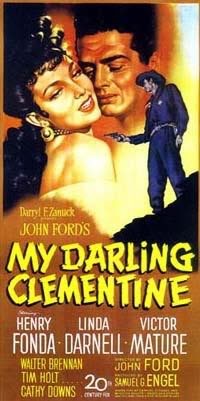
John Ford always maintained that his version of the events at the OK Corral was based on conversations that the director had had with Wyatt Earp himself. While Ford probably did know Earp (the old lawman reputedly spent a lot of time on and around the early Hollywood sets in his later years) and likely talked with him about what happened in Tombstone, the story played out in My Darling Clementine (1946) is most assuredly not the truth. Despite Ford’s grandiose claims of authenticity, his film is really a remake of Dwan’s Frontier Marshal. Both movies were based on the Stuart N. Lake book, and both are highly romanticized accounts. The difference is that, where Dwan’s film is a workmanlike effort, Ford’s take has all those little artistic touches that move it onto another level. Of course Ford was known for spinning the most outrageous yarns when it suited him, but the huge historical errors don’t change the fact that his film is still the best version by far of the famous story.

The Earp brothers actually feature in this film unlike the earlier version from Dwan. Wyatt (Henry Fonda), Morgan (Ward Bond), Virgil (Tim Holt) and James (Don Garner) stop off outside of Tombstone while on a cattle drive. On the recommendation of Old Man Clanton (Walter Brennan) they take a trip into town, leaving little brother James to stand watch over the herd. On their return the three older brothers find their cattle have been rustled and James killed. Suspecting the Clantons of perpetrating the crime, Wyatt accepts the position of town marshal. What follows is a picture of the emergence of civilization (most notably represented by the founding of the town’s first church), and the effects it has on the characters.

Wyatt is transformed from a dusty, unshaven trail hand into the coiffed and suit-wearing face of the law and civic respectability. The scene where Wyatt primly escorts Clementine Carter (Cathy Downs) along the main street of Tombstone towards the new church, with the strains of ‘Shall we gather at the river’ playing in the background, is deservedly famous and remains one of the most touching and romantic sequences ever put on film. This contrasts sharply with the Clantons, who are shown as a bunch of barely human barbarians. A marvelously sadistic moment takes place when Old Man Clanton savagely horse whips his sons before berating them : “When you pull a gun, kill a man.” The bridge between the two extremes is provided by Doc Holliday (Victor Mature) – a man with a cultured background (at one point quoting from Hamlet to help out a drunken actor) who is consumed with self loathing at the knowledge of what he has become.

Henry Fonda plays Wyatt with nobility and that quiet dignity that he seemed to bring to all his roles. The self-conscious diffidence he shows fits perfectly for a man who has been more accustomed to living rough in the wilds. It’s no bad thing either that Fonda always seemed comfortable in a western setting, able to mount and sit a horse naturally. I wish I could say the same thing for Victor Mature but, however hard I try, I just cannot accept him in western roles. I’ve seen Mature in many other genre films and thought him fine, but when it comes to westerns – no thanks. I know this is just a personal prejudice but, for me, his casting doesn’t work at all*. Walter Brennan’s Old Man Clanton makes for a wonderful villain, a figure of pure evil who has molded his sons in his own image – especially the leering Billy (John Ireland) and the slow-witted, and vaguely psychotic, Ike (Grant Withers). Linda Darnell’s Chihuahua is something of a caricature of the typical Mexican spitfire, but she does elicit a lot of sympathy as a woman passionately in love with a man who repeatedly spurns her.

Since the bulk of the story takes place in and around Tombstone, Ford makes less use of Monument Valley than he would in other pictures. However, there are a few scenes that feature his favorite location and they look magnificent as always. Much attention is paid to the town, to all the little rituals of frontier life, and the variety of characters who inhabit it. The celebration of community is pure Ford and you get the feeling he enjoyed recreating this much more than he did the action scenes. Having said that, the inevitable shootout at the OK Corral, though wildly inaccurate, is both stylish and excitingly executed.

My Darling Clementine has been available for some time now on DVD from Fox, but has recently been reissued with the addition of Frontier Marshal as an extra. The transfer is exactly the same on the new disc, but that’s not a criticism since there wasn’t much that needed improvement anyway. You get to choose between the final release version of the film and the pre-release cut, and I’m not really sure which I prefer. I feel the edited version is tighter but I also think Ford’s original cut of the farewell scene between Wyatt and Clementine is better. I suppose we should be grateful that we have both versions to compare. Either way, this is a special film and one that does reward repeated viewings.

*EDIT – Sometimes we speak dismissively of hindsight, but sometimes now I look back on pieces I wrote many years ago and see that old adage about the viewers changing but not the movies as gaining in truth all the time. I now feel that I was overcritical of Mature, and quite unfair in my assessment of his performance here,  when I first put this up well over a dozen  years ago.

Sorry, Wrong Number

I’ll start off by saying that I like films that employ flashbacks in the telling of the story. Of course, if this technique is going to be used it needs to be done well. An example of its misuse/abuse would be Passage to Marseille; where there are flashbacks within flashbacks within flashbacks to the point that the viewer is driven half crazy and loses all sense of time and place. Sorry, Wrong Number (1948) avoids falling into this trap. Here, those trips down memory lane are necessary to drive the story forward and they work perfectly.

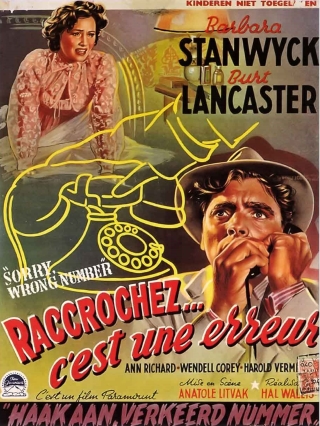
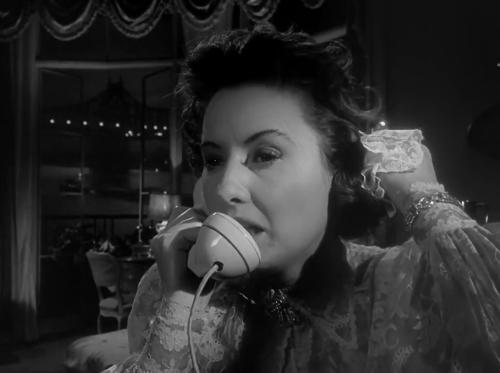
The film was adapted from a radio play and summarising the plot is not so easy without giving away too much, and thus ruining it for anyone who hasn’t seen it. Almost all of the action is played out via a series of telephone conversations involving Leona Stevenson (Barbara Stanwyck). Leona is introduced as a rich, pampered invalid who lives in luxury in Manhattan and, alone and bed-ridden, has only her telephone as a means of communicating with the outside world. As a result of a crossed line, she overhears a conversation between two unknown men as they finalise the details of a murder soon to be committed. Naturally alarmed, Leona first tries to tip off the police but they profess an inability to act given the sketchy information available. Her next thought is to get in touch with her husband Henry (Burt Lancaster), but that proves more difficult. Her attempt to contact him results in a series phone calls (and accompanying flashbacks) which gradually build up a complete picture of Leona, Henry and their life together. With each call another piece of the puzzle falls into place, and Leona slowly arrives at a horrifying realization.

Barbara Stanwyck has come to be regarded as something of a noir icon, largely through her icy portrayal of Phyllis Dietrichson in Double Indemnity. Where that film cast her as the archetypal femme fatale, Sorry, Wrong Number has her play the helpless woman in distress. She does well here with a character that starts off as an unsympathetic figure. As Leona moves from an initial petulance, through frustration to panicked terror, she manages to avoid the temptation to overact. All the emotions on display fit in with the type of woman revealed over the course of the film. Burt Lancaster was in the middle of a series of noirs, or noir tinged movies, at this point and he’s pretty convincing in the role of Henry. He begins as a blue-collar bit of rough who catches Leona’s fancy, becomes her pet plaything, and finally allows his simmering frustration and innate greed to draw him into criminality. There are also plenty of good turns from a support cast which boasts Wendell Corey, Ed Begley, Leif Erickson and William Conrad. While this is a movie full of flawed and unsavoury characters, the one sympathetic figure is Harold Vermilyea’s Waldo Evans. He’s the soft-spoken little chemist who dreams and saves in the hope of owning a farm where horses can roam free. When Henry spins him a tale that promises enough cash to realise this dream, the poor sap falls for it and his fate is sealed.

Sorry, Wrong Number fits the noir bill by delivering a story where there are no winners and no happy endings. We have a roster of characters whose greed, selfishness and weakness set them on a path towards their own self-destruction. The moody photography of Sol Polito is another essential ingredient, and it’s at its most effective in the scenes on Staten Island. This desolate setting, especially the decrepit 20 Dunstan Terrace, is a place where you just know darkness lurks.

The film has long been available on DVD in R1 from Paramount, and it’s a pretty good transfer. The print used is clean but it does display very heavy grain, particularly in the darker scenes. As usual from Paramount there’s not much in the way of extras, just a theatrical trailer. Still, the disc can be picked up for very little and the quality of the movie alone is more than enough reason to justify a purchase.

The Killers

I did something wrong…once.

So says the Swede (Burt Lancaster) as he lies in bed bereft of all hope, and calmly awaits his end. I love that scene near the beginning of the 1946 version of The Killers. It is one of the great moments of film noir and says so much about the genre – if you can even call it a genre. A good deal of its bleak power comes from the fact that it seems to run contrary to all normal human instincts. If someone were to burst into your room and breathlessly inform you that a couple of mean-looking hitmen had just rolled into town with the express aim of rubbing you out, most people would take the opportunity to make tracks fast. But Lancaster just remains prone in the shadows and delivers that line in the detached tone of a man already dead; when fate pays that last call there’s no ducking out.

Robert Siodmak’s film takes Ernest Hemingway’s short story (and it’s a very short story) and uses it merely as the jumping off point. The rest of the movie follows insurance investigator Reardon (Edmond O’Brien) as he tries to find out why the Swede ended up in a small New Jersey town waiting passively to greet a hail of bullets. The story is revealed by a succession of characters who had known the Swede, and a number of flashbacks gradually piece together all the events that brought about his demise. The Swede starts off as a medium grade fighter who, after breaking his hand and ending his career, begins the slow descent into the criminal underworld. This culminates in a payroll heist, the aftermath of which leads to the eventual downfall of just about everybody involved. The character of the Swede is basically a good-natured oaf whose desire for easy money allows him to be dazzled and duped by the grasping and predatory Kitty Collins (Ava Gardner). In a sense the whole film is as much about Kitty as anyone else; as we see her manipulations provide the catalyst for the betrayals that litter the story.

The Killers marked the screen debut of Burt Lancaster and his tough vulnerability is shown to good effect in the movie. There’s enough innocence in the Swede for you to genuinely sympathise with him and despair at the big lug’s stupidity as Kitty plays him for the ultimate sucker. Ava Gardner’s Kitty gets the classic femme fatale intro; we first see her as the Swede does – seductively clad in black satin and vamping for all she’s worth in a night club. Her character is rotten all the way through – effortlessly hooking the smitten Swede, playing the gang off against each other, and finally, tearfully begging a dying man to save her neck by damning himself. The role of Edmond O’Brien is to offer perspective and lead the viewer through the labyrinth of deceit; he’s really the linking device between all the small episodes that make up the whole. O’Brien’s own guide along the way is police lieutenant Lubinsky (Sam Levene from the Thin Man movies) and there is good support from gang members Albert Dekker, Jack Lambert and Jeff Corey. However, two of the most memorable turns come from William Conrad and Charles McGraw as Max and Al, the killers of the title. Their roles don’t extend much beyond the first ten minutes of the film, but those are ten truly magical minutes. They get some of the choicest dialogue (and deliver it perfectly) as they simultaneously mock and menace the occupants of the Brentwood lunch counter.

Robert Siodmak made some of the best noirs of the forties and I feel The Killers is his standout work. This is one of those films where plot, direction, characterization and photography all seem to come together harmoniously. Deep, dark shadows are everywhere and only the policeman’s terrace, where the ideal wife serves lemonade on a hot day, seems to rise above the murkiness. I should also say a word about the powerful score by Miklos Rozsa which is especially effective whenever Messrs Conrad and McGraw make an appearance.

The Killers is out on DVD from Criterion in R1 and from Universal in R2. I can’t comment on the presentation on the R2 disc as I haven’t seen it but bitter experience has taught that Universal’s UK releases are a hit and miss affair, with a high proportion of misses. The Criterion is everything you would expect from them with a beautiful, clean transfer to show off those deep, black shadows. As you would expect, the film comes packed with useful and informative extras – and, best of all, it is paired with Don Siegel’s 1964 remake (and Andrei Tarkovsky’s student film version). All in all, this represents the definitive presentation of what is probably my favorite film noir.

I Shot Jesse James

jesse_james0

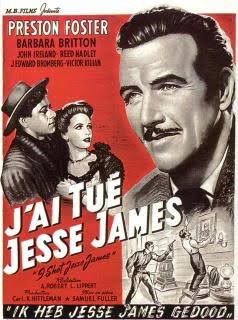
Sam Fuller made his directorial debut in 1949 with this take on the old story. I Shot Jesse James, as the title suggests, keeps the focus squarely on Bob Ford (John Ireland) and shows him in a more sympathetic light than usual. Like most film representations of these characters, there are some elements of the truth woven into the story. This film comes a little closer to reality in depicting the demise of Bob Ford than was the case with The Return of Frank James; here the name of the killer, the location and the means are broadly correct. Where the story drifts off into total fiction is the inclusion of the romantic triangle as the centrepiece of the drama.

The story opens with a botched bank robbery that leaves Bob Ford wounded and forced to lay up at the James home in Missouri. As he recuperates, he has the opportunity to visit the love of his life Cynthy Waters (Barbara Britton) who is an actress in a travelling theatre company. This meeting lays the groundwork for all that is to follow. When Ford arrives to see his woman he also meets a man called Kelley (Preston Foster) – a prospector who is clearly smitten with Cynthy. And thus the aforementioned triangle is set up. Cynthy begs Ford to abandon his outlaw ways and settle down to a decent life, thereby providing the motive for the subsequent murder of his friend. The rest of the movie is a portrait of guilt and a man trying to make good on his promise to go straight, yet foiled at every turn by his past and a love destined to remain unfulfilled.

In many ways I Shot Jesse James is a slight film, no more than a B movie really. What makes it notable is the way it tries to show Ford as a real person and not the greed driven caricature of earlier versions. I can’t say I was bothered by the playing around with historical facts since the reason for this was clearly the need to provide the character of Ford with a motive that might be understood. John Ireland does a pretty good job in showing us a man who is left bewildered when his actions draw not only the scorn of strangers but drive away the very woman whose heart he’d hoped to capture. Barbara Britton is good enough too as her character goes from love for Ford, through disgust at his actions, and finally to fear of what he has become. Preston Foster, as Kelley, isn’t called on to do much more than be the strong, dependable, moral anchor but he does it capably enough.

Sam Fuller would go on to make more famous, and better films than this but there are some memorable scenes. The climactic shootout has Ford framed in inky blackness – maybe signifying the moral void he now inhabits. There’s also a great scene in a saloon where Ford listens to a travelling minstrel sing about the murder of Jesse James. This was mirrored in the recent film by Andrew Dominik, but I prefer the way it was done here. After introducing himself, Ford insists that the singer complete his ballad as he stares implacably at him. You can almost taste the man’s fear as he chokes his way through the song, and struggles to utter the words ‘the dirty, little coward’ to Bob Ford’s face.

Criterion put this out on DVD in the ‘First Films of Samuel Fuller’ set, and it’s not available separately. This is part of the Eclipse line, and hasn’t had the careful restoration commonly associated with Criterion releases. However, it still looks good enough and I didn’t find the damage marks present to be particularly distracting. All in all, I Shot Jesse James is an interesting, if minor film.


Ministry of Fear

poster60

The ‘entertainments’ of Graham Greene have provided a rich source of material for makers of Film Noir. The Third Man, This Gun for Hire and Brighton Rock have all been derived from his works and, if you want to stretch the point, a case could also be made for the inclusion of The Fallen Idol and Confidential Agent. This all goes to prove that there is enough darkness and pessimism in Greene’s writings for them to lend themselves to the shadowy world of noir. And so we come to Fritz Lang’s 1944 adaptation of Ministry of Fear, where a frightened Ray Milland blunders through the bombed out streets of wartime London in pursuit of fifth columnists.

Stephen Neale (Milland) has just been released from an asylum after having been confined for the mercy killing of his wife and, naturally, is anxious to avoid any further entanglements with the law. As he waits to catch a train to London, he wanders into a charity fete where a palmist helps him to guess the weight of a cake and win it. With this seemingly innocuous incident Neale finds himself drawn into a nightmare world of murder and espionage. It turns out that the fake spiritualist had mistaken Neale for a Nazi agent (Dan Duryea) and that the cake contained something worth killing for. Neale’s curiosity leads him to follow up the matter in London where he attends a seance in the company of, among others, the aforementioned agent. When the spy is murdered Neale is falsely accused.  He believes that due to his past conviction no one will believe him innocent of the murder and so he goes on the run. His only assistance comes from an Austrian refugee (Marjorie Reynolds), and while the pair try to seek out the truth they are all the time dogged by a shadowy figure in a bowler hat.

Ray Milland’s star was in the ascendancy at this point and he would win an Oscar for his performance in The Lost Weekend the following year. His role here allows him to get in a bit of practice in psychological anguish and the natural affability of the man means that it’s easy to sympathize with the plight of his character. Marjorie Reynolds is fine as his Girl Friday but the forced Austrian accent does begin to grate a little at times. Dan Duryea is always good value as a villain and the only complaint that could be made is that his character is not given nearly enough screen time. Indeed the same could be said for much of the support cast who seem to breeze in and out of the picture, but all leave lasting impressions. A notable feature of so many films of this period is the marvellous gallery of eccentrics that cropped up time and again. These people, whose faces are immediately recognizable yet whose names escape us, were character specialists who usually played similar parts in every movie and their presence added enormously to the enjoyment.

Fritz Lang’s background in expressionist film-making serves him well here and is most notable in the early scenes of the picture. The charity fete provides that slightly surreal quality that continues throughout the film. The parts with the fake blind man on the train and the ensuing chase over the fogbound moor are also beautifully photographed. Everything seems to have been shot on studio sets but this is no criticism as it helps heighten the unreal, otherworldly feel of the movie.

Optimum released Ministry of Fear on DVD in R2 last year. The transfer is not bad but it could use a clean up. All in all, this is a highly enjoyable mix of noir and espionage and it’s always good to see more of Fritz Lang’s movies making it out onto the market.