Wake of the Red Witch

poster75-1_zps2237c1f2

Mention John Wayne and the tendency for most people is to think of his western roles. He has become so strongly identified with that particular genre in the public consciousness that it’s easy to forget how wide-ranging his career was. The many years Wayne spent at Republic Pictures saw him cast in a variety of genre pictures, some more suited to his talents than others. Aside from westerns, he tended to do well in adventurous pictures, if the setting happened to be an exotic one then so much the better. Wake of the Red Witch (1948) was one of Wayne’s more enjoyable non-western films of the 1940s, emphasizing his strengths as a performer for the most part. The movie itself is a reasonable effort, but is perhaps a little too dense in its plotting, and melodramatic in style, to be considered a complete success.

The story is adapted from Garland Roark’s bestselling novel, and it mixes in romance, high adventure and some pretty low skullduggery. Everything takes place in the South Seas, and opens on board the titular ship, The Red Witch. The crew are gathered on the deck to watch two of their shipmates beat each other into a bloody pulp, supervised by the vessel’s master. This is Captain Ralls (John Wayne), a grim, harsh figure who has ordered the two men to slug it out until he sees fit as punishment for their starting a fight on his ship. Right away we can see Ralls isn’t going to be an entirely sympathetic figure, and that initial impression is backed up by his subsequent actions: conspiring to cast doubts on the sanity of one of his officers, and then deliberately scuttling his own vessel. But why is Ralls doing such inexplicable things? We witness his drinking and the black rages that descend upon him, we hear allusions to a troubled past, but it’s only after his acquittal by a board of inquiry that the pieces begin to fall into place. By means of a couple of flashback sequences, it’s revealed that we’ve been seeing the fallout of a doomed love affair and the rivalry and thirst for revenge it inspired. As viewers, we’re seeing the tale develop through the eyes of Rosen (Gig Young), Ralls’ first officer. Rosen thought everything revolved around the millions in bullion lying in the belly of the sunken Red Witch, and the pearls they are currently seeking. However, these turn out to be merely side issues, and the real source of the mystery is a romantic triangle from the past. The side of this triangle are formed by Ralls, his former employer Sidneye (Luther Adler), and Angelique (Gail Russell). The aforementioned flashbacks show how greed brought Ralls and Sidneye together, and how their mutual desire for Angelique subsequently drove a wedge between them. Still, it’s no simple tale of revenge and thwarted love; the relationship between Ralls and Sidneye is extremely complex, and makes it clear that they still respect each other, while treating their quest for vengeance as a kind of grotesque game.

£25

I think the biggest problem with Wake of the Red Witch is the complicated nature of the story, and the methods used to tell it. As a rule, I enjoy flashbacks in movies. They help reveal plot points to us slowly and allow a greater build up of mystery or suspense in the early stages. However, I feel they’re not always necessary, and can actually muddle a story. When you’ve got a fairly dense plot, with strong character interaction, there’s a good case for using simple and traditional linear storytelling. Honestly, this film has a lot going on, with various action sequences (including a fight with a giant octopus) running concurrent to the main drama. Now it’s all very entertaining, if a little heavy on the melodramatics at times, but it does tend to swamp you a little. The film was shot mainly on sets and in and around Californian locations but it still looks attractive. The lack of genuine location filming could be criticized, but movies with exotic settings were usually shot in this way at the time. Personally, I’m fond of these 40s pictures that recreate jungles and lost islands on the backlot; they have a look and charm all of their own and there’s a kind of artistry to their illusions. Edward Ludwig was never a top rank director despite a long list of credits and eventually moved into television. He does good enough work here though, especially in the action scenes. Also, Ludwig and his cameraman, Reggie Lanning, put together some nicely composed and atmospherically lit shots.

You still find plenty of people who will cheerfully declare that John Wayne wasn’t much of an actor, although that’s often accompanied by the sheepish admission that they haven’t seen that many of his films. I guess the whole larger than life persona of Wayne, the myth that seemed to grow up around the man is partially responsible for this. Of course he did make some eminently forgettable films too, but that’s something that can be said about almost any of the big stars of the studio system. Directors like Ford and Hawks were able to get the best out of Wayne, but it would be a mistake to think he only did good work for them. As important as the directors were, the quality of the role mattered too. In Wake of the Red Witch, Wayne got handed a strong part, and he ran with it. Ralls is a multifaceted character, a very three-dimensional figure. At times, he’s the expansive model of vigor – the kind Wayne could play with his eyes shut. And then there’s the darker side, the man of murderous rages and brooding intensity. It’s the ease with which Wayne managed to move between these contrasting aspects, and quite convincingly too, that makes his performance so memorable.

£26

Gail Russell had a very fragile quality on screen, and for a good reason. That fragility was no affectation, it was a reflection of her own insecurities. Her film career was a short one, curtailed by her drinking and the premature death that came as a result. Nevertheless, she made some great films, particularly in the 40s, before her demons finally ran her to ground. She had already starred alongside Wayne with success in the charming Angel and the Badman, and their chemistry stands out in this film too. Most of her scenes in the movie are played with Wayne, and he seemed to bring out her warmth and vulnerability. Russell’s beauty is unquestioned, but the naturalism she displayed around Wayne only enhanced her screen presence. Forming the final side of the triangle was Luther Adler, an excellent character actor whatever the situation. The best screen villains are always the interesting ones, those who are more than flat cartoon figures. Adler nailed the malevolence and obsessiveness of Sidneye, and managed to make him curiously pitiful at the same time. One of the most fascinating things in Wake of the Red Witch is dynamic between Ralls and Sidneye – despite their enmity, they admire each other and actually appear to take pleasure in their mutual hatred.

Wake of the Red Witch isn’t so hard to find on DVD, having been released in a number of territories. It had been released in the US by Artisan back when that company had distribution rights to the Republic library. Those Artisan editions were a hit and miss affair, with some transfers being acceptable while others were extremely poor. Wake of the Red Witch was one of their better releases, displaying some damage but looking sharp and clean for the most part. There are no extra features whatsoever on the disc. The Republic library is now being handled by Olive Films in the US and this title is due for release in April. It will be offered on DVD or Blu-ray, and I should imagine it will scrub up nicely for those seeking a HD copy. I like the movie quite a lot, in spite of its weaknesses. Apart from the fact it looks good and has that escapist quality that grabbed me when I first saw it on TV as a kid, there also a really fine performance by John Wayne to recommend it. Maybe it’s not a great film, but it certainly is great fun.

The Fallen Sparrow

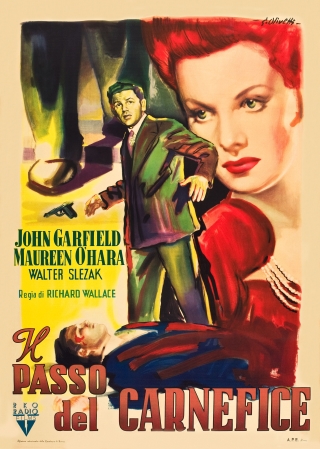
Wartime propaganda movies can be a bit of a mixed bag when viewed with modern eyes, the passage time allowing them to be considered more objectively as pieces of cinema. Some fare very poorly, with weak, stereotypical characterization tending to be the principal fault. On the other hand, there are others which hold up better, which use a little more subtlety and whose stories are more engrossing. The Fallen Sparrow (1943) is one of the stronger efforts, thanks largely to its star and cinematographer. However, it’s not a movie without its faults, most of which stem from an inability to fit comfortably into any one category: it’s a spy thriller with an antifascist message, a film noir in visual terms, and a psychological melodrama. I think it’s the propaganda aspect that lets it down the most though, not because it’s especially dated but more because the motivation of the villains is hard to swallow.

John McKittrick (John Garfield) is a war veteran, not of WWII but the Spanish Civil War. A policeman’s son, he fought on the Loyalist side, was captured and held prisoner long after the conflict had ended. We first see him on a train bound for his native New York. There’s a nervy urgency about the man, and a glimpse at a scrap of newspaper tells us that he’s heading home as a result of an apparently accidental death. A boyhood friend took a dive from a high-rise apartment, and it’s soon made clear that McKittrick is unsatisfied with the official version of events.So far the plot has all the hallmarks of a standard mystery thriller, but it’s McKittrick’s back story that gives it an added twist. During his incarceration in Spain McKittrick was a victim of prolonged sessions of torture, and he only escaped due to the intervention of his recently deceased friend. The effect of this is twofold – McKittrick suspects that the death was no accident and was actually linked to events in Spain; additionally, those years in the dungeons suffering at the hands of faceless tormentors have left him in a psychologically fragile state. With the police keen to give him the brush off, McKittrick sets about looking into the circumstances of the death himself. This leads him into the slightly surreal world of the refugee community – where exiled aristocrats keep company with night club musicians and the granddaughter of a prince (Maureen O’Hara) sells hats to society matrons for a living. Within this odd milieu lurks the threat of a fascist cell and its preoccupation with the recovery of one of the more unusual spoils of war. Teetering on the brink of sanity, McKittrick weaves his way through this group of blue bloods, spies and assorted lackeys in an effort to get to the bottom of the mystery and exorcise his personal demons.

Richard Wallace isn’t a director i can say I’m all that familiar with. He’s probably best know for taking charge of Sinbad, the Sailor with Douglas Fairbanks Jr, but he also made a moderately good noir, Framed, with Glenn Ford. Both Framed and The Fallen Sparrow show that Wallace had some talent for the dark cinema, and this movie in particular features a few very nice touches. I guess the fact that Nicholas Musuraca, who photographed some of the most visually interesting film noirs, was behind the camera helped a lot, and the pair conjure up a handful of scenes whose atmosphere wouldn’t look out of place in a horror movie. There are plenty of impenetrable shadows that whisper menace, and architectural features like pillars and balustrades are used to pin the hapless and haunted McKittrick in place. The overall effect is to heighten the sense that the hero of the movie is still trapped by the ghosts and monsters of his past, and he frequently seems to be as much the prey of the dark forces crowding around him as the hunter he’s trying to be.

The film very much belongs to John Garfield, although there’s good support from Maureen O’Hara and Walter Slezak. I think Garfield is one of the most tragic figures of Hollywood’s Golden Age – a man of immense talent and raw power doomed by poor health and the political climate of the times. He always came across to me as the tough guy with the soft center, possessed of a streetwise cockiness and vulnerability that, while an elusive quality, was a key ingredient of the finest noir protagonists. His career lasted only thirteen years and by 1952 he was dead, aged just 39. He suffered from a heart condition and it’s highly likely that his hounding by HUAC during the McCarthyite Red Scare of the late 40s and 50s was a contributory factor in his early demise. However, in the short time he graced the screen with his presence, Garfield made some terrific and memorable movies, especially noir pictures. Body and Soul, Force of Evil and The Breaking Point are all genuine classics as far as I’m concerned, and even his lesser works like The Fallen Sparrow show how good he could be. I think the most interesting thing about this movie isn’t really the plot, instead it’s Garfield’s portrayal of a severely damaged individual, a psychologically shattered man clinging to the remnants of his sanity. His terror, as the nights draw in and the shadows lengthen, is palpable. The viewer really gets to share in his dread, boxed up in his apartment and sweating despite the snow falling outside, as the dragging footsteps of the limping man of his nightmare past echo in his mind. Walter Slezak brought a creeping menace to many roles, not least Hitchcock’s Lifeboat, and his turn as a crippled intellectual fascinated by man’s cruelty to man is well realized. The early scene where he softly lectures a drawing-room of stuffy society types on the delicacies of the torturer’s art, as Garfield stands awkward and withdrawn before him, is a chilling moment. Maureen O’Hara is only one of three women linked to the mystery – the others being Patricia Morison and Martha O’Driscoll – but she gets the meatier and more significant role. She’s not an actress that you would automatically associate with film noir but does fine as a possibly duplicitous woman with divided loyalties.

The Fallen Sparrow was an RKO production and is now widely available in DVD in Spain, Italy, France and the US (via the Warner Archive). I have the UK edition of the film released by Odeon and it’s a reasonable transfer. The image is fairly sharp and has good contrast levels to show off Musuraca’s photography. However, it has to be said the print is quite dirty, with plenty of speckles and instances of minor damage. The disc is completely free of extras, just the option to play the movie or select a scene. The movie is adapted from a book by Dorothy B Hughes and while it’s not up to the standards of the best versions of her stories – In a Lonely Place and Ride the Pink Horse – I reckon it’s still a movie that most fans of film noir would want to see. I feel that aspects of the plot, derived from the overdone combination of propaganda, espionage and melodrama, do hurt it. Having said that, Garfield’s intense performance and Musuraca’s beautiful, atmospheric photography raise the quality quite a few notches. All in all, it’s an enjoyable if not wholly successful film.

The Big Sleep

But down these mean streets a man must go who is not himself mean, who is neither tarnished nor afraid. The detective in this kind of story must be such a man. He is the hero, he is everything. He must be a complete man and a common man and yet an unusual man. He must be, to use a rather weathered phrase, a man of honor, by instinct, by inevitability, without thought of it, and certainly without saying it. He must be the best man in his world and a good enough man for any world. I do not care much about his private life; he is neither a eunuch nor a satyr; I think he might seduce a duchess and I am quite sure he would not spoil a virgin; if he is a man of honor in one thing, he is that in all things. (Raymond Chandler, The Simple Art of Murder, 1950)

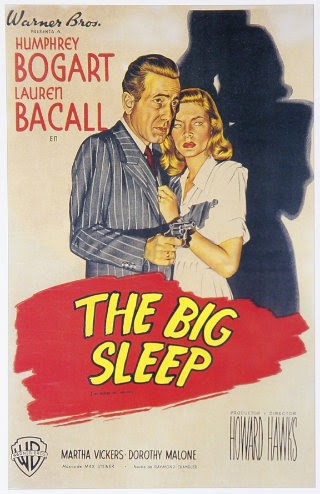
That quote from Chandler is a distillation of what he felt were the characteristics of the fictional private eye, and it’s a view that continues to endure. The reason for the popularity of this particular representation is understandable enough: not only does it portray the detective as the classical hero, it also allows the audience to identify with him, to see in him the kind of man they’d probably like to be themselves. Chandler’s knight errant Philip Marlowe has appeared on screen a number of times with varying degrees of success, but the incarnation that I, and I guess a lot of other people too, have the highest regard for is Humphrey Bogart’s take in Howard Hawks’ The Big Sleep (1946).

Some aspects of the plotting of The Big Sleep are notoriously complicated – the story goes that screenwriters William Faulkner and Leigh Brackett, along with director Hawks, were so confused about who committed one of the murders that they contacted Chandler for clarification. Apparently, the author found himself similarly stumped. The thing is that the murders, motives and twists of the plot pile up so relentlessly that it does take a fair bit of concentration on the part of the viewer to keep up with it all. However, that’s not really the point of the movie and the basic thrust of the narrative is easy enough to follow in itself. Philip Marlowe (Humphrey Bogart) is the private detective engaged by the ailing General Sternwood (Charles Waldron) to take care of a blackmailer who is putting the squeeze on Carmen (Martha Vickers), the younger and wilder of his two daughters. In the course of his investigation, which rapidly descends into a murder case, Marlowe finds that the elder sister, Vivian (Lauren Bacall), appears to be tangled up in things too. Vivian’s a cooler, more composed customer than her sister, yet her involvement with a shady gambler, Eddie Mars (John Ridgely), indicates that she too is keeping dangerous company. I’m not going to go into the labyrinthine twists and turns of the plot here, firstly to avoid spoilers, and secondly because it will likely serve to do nothing more than confuse readers. Suffice to say the stories of General Sternwood’s two girls eventually dovetail and all the various plot strands are drawn together satisfactorily. Yet, as I said before, you don’t watch The Big Sleep just to find out who did what to whom, when and for what reason. This is truly one of those movies where the journey is far more important than the destination. As we follow Marlowe around a moody and threatening Los Angeles, we go on a tour of the seedy underbelly of the city. Even though the time is spent in the company of high rollers and the glamorous set, it’s all merely a glittering veneer for a world of pornography, drugs, deviance, betrayal and violence.

Vivian: I don’t like your manners.

Marlowe: And I’m not crazy about yours. I didn’t ask to see you. I don’t mind if you don’t like my manners, I don’t like them myself. They are pretty bad. I grieve over them on long winter evenings. I don’t mind your ritzing me or drinking your lunch out of a bottle. But don’t waste your time trying to cross-examine me.

One of the great pleasures of The Big Sleep is the dialogue. Most of the memorable lines and passages, such as the little sample above, are lifted almost directly from the pages of Chandler’s novel. However, Brackett, Faulkner and Jules Furthman did have to make some alterations to turn in a workable script, both for storytelling reasons and to ensure the finished product was going to get past the Hays Office. Therefore, the more overt references to the unsavory nature of the blackmailer’s racket had to be toned down for example. The infamous production code is often criticized, and with good reason, for imposing draconian and logic-defying restrictions on what could be shown on the screen. The thing is though, a good deal could be implied if not directly stated, and clever writers could exploit this loophole. In a sort of perverse way, the very restrictiveness of the code meant that filmmakers were forced to be more creative in their efforts to circumvent it; I think The Big Sleep stands as an excellent example of this apparent paradox. The two houses in which much of the tale plays out are the Sternwood mansion and the home of Geiger, the blackmailer. Hawks and his crew succeed in bathing both locations in such an atmosphere of decadence and iniquity that it needs little imagination to appreciate the depravity lurking beneath the surface. Perhaps Hawks’ greatest triumph in the picture is the way he manages to ensure that style rises above substance throughout and he creates a crime story where the crimes and their resolution become secondary to our enjoyment of the ride through Chandler’s twilight world.

While The Big Sleep benefits enormously from a snappy script, strong source material and a first class director, what helps elevate it to true classic status is the casting. The second collaboration of Bogart and Bacall builds beautifully on the foundations already laid in To Have and Have Not. The movie took their on and off-screen courtship to new and more sophisticated levels, and the air fairly crackles whenever they share a scene. I think Bogart was born to play Marlowe, he perfectly encapsulates the weary nobility of Chandler’s creation like no other actor before or since. The part can be seen as an extension or refinement of Hammett’s Sam Spade from The Maltese Falcon, but there’s a greater sense of honour and less aggressive smugness this time. I already mentioned this in an earlier post, but Bogart’s delivery of his lines is perfect, so much so that it’s very hard to read the novel and not hear him saying the words. On the receiving end of much of Bogart’s wise-cracking, and pitching back every bit as good as she got, was Bacall. Watching her performance today, it’s hard to believe that Bacall wasn’t much past twenty years old when the movie was shot. There’s an air of assurance and worldliness about her that belies her years, the hard-boiled dialogue flowing smoothly as though from a woman who’d been around a long time and had seen all there was to see. In truth, the whole cast does excellent work, but the women in particular stand out. Martha Vickers is all coy treachery, and there are fine and memorable bit parts for Dorothy Malone and Sonia Darrin. Of the men, I feel Elisha Cook Jr deserves a mention for another of his characteristic turns as an unfortunate fall guy. I guess the only real weakness was John Ridgely, it’s not that he gives a poor performance but he never fully convinces as a dangerous mobster – having said that, he does get one fantastic send off.

The US R1 DVD of The Big Sleep contains two versions of the movie (as far as I know the R2 doesn’t offer this choice) – the preview version and the theatrical cut. I mention this mainly because there are some notable differences in the two cuts. I’m not going to laboriously list all the changes here, that information is readily available elsewhere online, but I will say that they change the feel of the movie significantly. In short, the preview cut is an altogether blander affair, although it helps to make the plot more comprehensible. The theatrical version is much more stylish, placing more emphasis on the Bogart/Bacall dynamic while sacrificing some of the narrative coherence. Personally, I far prefer the theatrical cut, and not just because it’s the more familiar of the two. While the preview version does offer more exposition, it throws the pacing off balance and fails to fully capitalize on the chemistry of the star pairing. It’s nice to have it available for comparison purposes but that’s about it for me. The transfer is reasonable enough, maybe not up there with the best that Warner Brothers have done in the past but it’s certainly not poor. The disc also offers a short feature on the differences between the versions of the movie, and is useful in giving an overview if you don’t feel inclined to watch both cuts all the way through. This movie and The Maltese Falcon helped cement Bogart’s image as the archetypical private eye. Others have played the part of Marlowe, and others have taken on the role of various private detectives, but Bogart nailed it. The film as a whole, can be viewed as a film noir (although of the lighter variety), a crime/detective story, or simply as an outstandingly well-crafted piece of classic Hollywood filmmaking. It comes most highly recommended.

Blood on the Moon

Pa8uCNs

Having already covered a number of westerns which have crossed over into noir territory, it’s time to turn the spotlight on one more. If we regard the mid-late 1940s as the heyday of film noir proper, then it’s only reasonable to find one of the strongest western variants within that time period. Blood on the Moon (1948) follows all the typical western conventions but uses a recognizably noir figure as its protagonist and employs the dark cinema’s trademark shadowy photography to emphasize both the sense of danger and moral ambiguity implicit in the story. As is always the case with these genre straddling examples, the film stops just short of being noir at its purest – the essential pessimism of that form rarely blending naturally or completely into a western story.

Jim Garry (Robert Mitchum) is one of those guys who’s no stranger to bad luck, a drifter with an ill-defined past first seen traversing a bleak and rocky ridge in the middle of a driving rain storm. When you see a guy strike a frugal camp and bed down to rest his weary bones, gaining some respite from the harsh elements, only to have his outfit smashed to pulp by a wildly stampeding herd of cattle, it’s easy to tell fortune isn’t exactly smiling on him. The herd belongs to Lufton (Tom Tully), and when Garry is taken back to the cattleman’s campsite he receives a kind of backhanded welcome. The west of Blood on the Moon isn’t an open or warm place, rather it’s a world of shadows, suspicion and wariness. Garry has ridden into a developing range war, the classic stand-off between the ranchers and the homesteaders. On one side we have Lufton, a rancher with a herd of beef that the Indian agent has refused to buy and which is about to be seized by the army unless it’s removed from the reservation post-haste. The opposition is a ragtag bunch of settlers, organized and dominated by Tate Riling (Robert Preston), and bolstered in strength by a handful of hired gunmen. Riling is denying Lufton access to old grazing land, ostensibly on the pretext that he’s defending the rights of the settlers. However, his real motivation is the opportunity to force Lufton into selling to him on the cheap, thus allowing him to make a financial killing through his dealings with the crooked Indian agent (Frank Faylen). Garry and Riling are old friends, the former having arrived due to the promise of a job with Riling. Initially, Garry isn’t particularly thrilled with the role he’s been cast in but a job’s a job. Although he doesn’t put it into words, it clear enough that Garry is uneasy about the double-dealing of Riling. What’s more, he’s clearly more impressed by the apparent straightforwardness of Lufton, and then there’s the attraction he feels towards the rancher’s younger daughter, Amy (Barbara Bel Geddes). For Garry, the turning point arrives in the aftermath of a violent raid on Lufton’s encampment that leads to the tragic death of the son of a widowed settler (Walter Brennan). With his realization of the depth of Riling’s ruthlessness, Garry experiences a crisis of conscience and finds his allegiance shifting.

Apart from the strong cast, Blood on the Moon featured a wealth of talent behind the cameras too. The story was adapted from Luke Short’s novel Gunman’s Chance, and has a scripting credit for the author himself. It appears that story caught the attention of the up and coming Robert Wise and he persuaded Dore Schary to let him run with the project. Wise had served a long and telling apprenticeship at RKO, editing Citizen Kane for Orson Welles and directing a couple of pictures for Val Lewton. In learning his trade, Wise had been keeping some esteemed company, and the experience showed up in this his first stab at directing a western. With cameraman Nicholas Musuraca achieving beautiful effects with light and shadow, Wise produced a western that’s dark, moody and heavy on atmosphere. There’s some good use of Arizona locations for the exteriors, but the most memorable aspect of the film is the gloomy and claustrophobic interior work. The low ceilings of the buildings, illuminated by guttering oil lamps, seem to press down on the characters, squeezing them and restricting their options as much as their movements. Although there are a number of noteworthy scenes, the highlight is arguably the brawl between Mitchum and Preston in a deserted cantina. This isn’t the typical cartoon scrap that we find in countless westerns; instead it’s a vicious and visceral affair that sees the two combatants slugging it out realistically. There’s no music to distract from the thudding, crunching landing of blows, and the naturalistic half-light makes the bruised and bloody faces and hands all the more convincing.


The first scene we shot after Mitch got outfitted was in the barroom. Walter Brennan was sitting at a table with a couple of pals and Brennan was very interested in the Old West, it was a hobby of his. And I’ll never forget when Bob came on the set, just standing there, with the costume and the whole attitude that he gave to it, and Brennan got a look at him and was terribly impressed. He pointed at Mitchum and said, “That is the goddamndest realest cowboy I’ve ever seen!”  – Robert Mitchum – Baby, I Don’t Care by Lee Server, Faber & Faber 2001, p180

The above quote comes from Robert Wise and is as good an illustration as any of the degree of authenticity that Robert Mitchum brought to his western roles. Brennan’s observation was spot on for Mitchum does indeed look the real deal here and gives another of his deceptively easy performances. While he seemed to relish the physical stuff that I mentioned above the quieter scenes are played out with great subtlety and, throughout it all, he moved around the landscape and sets with tremendous grace. Robert Preston was good casting as Riling, turning on the false charm and grins when it suited and really bringing out the slippery side of the character. I thought Barbara Bel Geddes was impressive too, even though the western wasn’t a genre she did a lot of work in. Her role called for a fair bit of shooting and riding and she made for a game, independent heroine. The supporting cast is a long and starry one: Walter Brennan, Tom Tully, the wonderfully gritty Charles McGraw, Phyllis Thaxter, Frank Faylen and Clifton Young all doing good work and helping to flesh out the story.

Blood on the Moon is available on DVD from both Montparnasse in France and Odeon in the UK. Seeing as I have the two discs, I’m of the opinion that the transfers are identical – both sport the same significant print damage during the raid/stampede scene at around the half hour mark. In terms of extras, the French disc (with optional subs) has the usual disposable introduction, and the UK release has a gallery. Overall, I suppose the Odeon disc is marginally more attractive, at least in relation to its packaging which features a reproduction of the original poster art on the reverse of the sleeve. The aforementioned damage, along with various other nicks and scratches, show that no restoration work has been done and the transfer does tend to look a little soft. However, the feature is quite watchable and there are no better alternatives that I’m aware of anyway. The movie is an entertaining and striking one, a strong entry in the filmographies of both Mitchum and Wise. The development and resolution of the plot do dilute the noir credentials to an extent yet the strong visual style means it never strays too far either. Personally, I feel it hits the mark as a western and comes pretty close as a film noir too; as such, it’s recommended to fans of both types of movie.


The Verdict

poster192-1

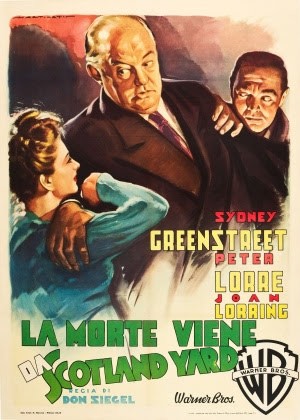
Some films just seem to work for me, to click if you like. They need not necessarily be movies of any extraordinary depth or have any abiding influence. The Verdict (1946) is one of these; it’s a small movie, a B picture really, but through a happy combination of elements it just checks most of the boxes for me. Firstly, there’s the setting: Victorian London as only Hollywood of the 1940s could depict it. Then there’s the fact that the plot revolves around a classic impossible crime, a locked room puzzle. And finally, a star pairing who worked so well and so memorably in tandem that they almost created a little sub-genre of their own. Mixing all these ingredients together results in a delightful little film that has no pretensions of greatness, that seeks only to entertain, and achieves that, not inconsiderable, goal admirably.

The opening is a first class piece of moody and atmospheric scene setting. The caption informs us that we’re in London in 1890, a dark and brooding place, as the camera tracks in to focus on Newgate prison, the last stop for many a condemned man. With the fog clinging to the gas street lamps and a bell solemnly tolling the hour of execution, the story’s protagonist looms into view. Superintendent Grodman (Sydney Greenstreet) is, quite literally, the big man in Scotland Yard. His lumbering bulk and sombre features speak of a man deeply contemplating his actions and his role in the world. Grodman’s latest investigation has drawn to a close and a convicted murderer is on his way to the gallows. Yet Grodman takes no pleasure in this, reflecting that success for a man in his position leaves only a bitter taste. In a sense, Grodman is condemned too, and we’re soon made aware of this paradox as the tale unfolds. Fate, circumstance and the pettiness of a rival have conspired to bring bout a dreadful miscarriage of justice. Grodman has sent an innocent man to the gallows. His professional disgrace is only one aspect of the matter though; a fine little montage succinctly sums up the guilt and paranoia Grodman suffers. Now settled into retirement, Grodman finds himself drawn back into his old life when a curious murder takes place in the boarding house opposite his own quarters. A reprehensible young man (Morton Lowry) had been found stabbed in his room under inexplicable circumstances: the door is locked from the inside and all the windows are sealed up. Grodman’s rival and successor at the Yard, Buckley (George Coulouris), is stumped and reluctantly calls on him for advice. Aside from the baffling mechanics of how the crime was committed, there are a clutch of fascinating suspects: Peter Lorre as an illustrator with a macabre sense of humour, Paul Cavanagh as a stiff-necked politician, June Lorring as Music Hall girl, and Rosalind Ivan’s hysterical housekeeper. Additionally, the possible motives for the murder form a complex web that encompasses jealousy, passion and blackmail. While Grodman strides in his stately manner through this labyrinth of suspicion, it emerges that history is in danger of repeating itself, with the possibility of another innocent victim being ground up by the wheels of blind justice.

The Verdict is adapted from The Big Bow Mystery by Israel Zangwill, one of the classic texts on the problem of the locked room – my thanks to Sergio of Tipping My Fedora for pointing out to me that this is available free as an e-book here & as an audiobook here. This particular form of impossible crime has been a staple of detective fiction for a long time, although its heyday was around the middle of the 20th century. At its best, the locked room problem depends more on the subtle art of misdirection than mechanical hoaxing. As such, this form of the detective story doesn’t always translate well to the screen and is generally far more effective in print. Still, I think Zangwill’s contribution to the canon does hit the mark and should succeed in confounding those not well-versed in this school of trickery. John Dickson Carr, the undisputed master of the locked room, also details the murder method used here in chapter 17 of The Three Coffins – the wonderful lecture on all things impossible delivered by Dr Fell – in case anyone wants spoilers without reading the Zangwill book.

The Verdict was Don Siegel’s first full length movie as director, although he had had extensive experience working in montage and the second unit in the years leading up to it. As a debut feature, it’s an impressive piece of work and demonstrates this was a talented individual with a future. While the film doesn’t bear much relation to what we might think of as a typical Siegel production, it does show that he already had a flair for visuals and pacing. The story is told economically, without unnecessary or tedious exposition, and maintains a consistent rhythm. With cameraman Ernest Haller making the most of the shadowy setups, Siegel uses a variety of interesting angles, dissolves and montage to keep things moving and strike the right tone. Aside from the excellent opening sequence, there’s a fine little section involving a late night exhumation that wouldn’t look out of place in a horror feature. The whole movie is a studio bound affair but, like the best B efforts, it turns this limitation to its advantage. The foggy London streets and mews where the action takes place may be no more than a Hollywood confection yet they have enormous charm, and the controlled environment leaves Siegel and Haller free to extract the maximum level of menace.

Peter Lorre and Sydney Greenstreet established a great on-screen partnership in the 1940s at Warner Brothers, earning themselves the nickname “The Laurel and Hardy of Crime”  – although that term seems to have been developed in retrospect. I remain of the opinion that The Mask of Dimitrios represents their best work together but The Verdict, their final collaboration, isn’t that far behind. Both these men had the knack of injecting a vein of comedy into their playing, of adding a human face to the menacing characters they so often portrayed. In this film, it’s Lorre who gets to indulge in a bit of sly black humour as the philandering cartoonist with a penchant for the gruesome. In contrast, Greenstreet cuts a much more tragic figure, his heavy features reflecting the regret and despair of his character. While Greenstreet’s huge physical presence, frequently emphasized by low angle shooting, dominates every frame he appears in, it’s the scenes he shares with Lorre that tend to be the most memorable. These two brought out the best in one another and seemed very comfortable working together. The main support came from George Coulouris, another actor who specialized in telling character roles, and he has just the right touch of venality as Buckley. In some ways he can be seen as the true villain of the piece, the blustering career cop whose inaction sets the whole affair in motion. Joan Lorring does fine as the blowsy entertainer who may know too much for her own good and ends up as one of Buckley’s chief suspects. Paul Cavanagh, who appeared in three Universal Sherlock Holmes films, has the ideal kind of patrician bearing for the part of the honour bound politician carrying around a guilty secret. Rosalind Ivan is essentially a caricature, a noisy, brittle busybody consumed by unfulfilled passion. The minor parts are filled by Morton Lowry as the slimy cad who becomes the murder victim and Arthur Shields playing yet another of his intense, tight-lipped clergymen.

The Verdict was made available on DVD in the US a while back through the Warner Archive. Additionally, the film has just recently been given a release on pressed disc by Sinister Films in Italy and that’s the edition I own. The transfer is pretty good, although there are plenty of minor speckles and blemishes on show. Some scenes are sharper than others but there’s no serious inconsistency or distraction either. The only extra on the disc is labeled as the theatrical trailer, but it’s actually the opening few minutes of the feature. The film is presented with three audio options: the original soundtrack and no subtitles, an Italian dub, or the original track with Italian subs. The movie is an excellent piece of entertainment, featuring fine central performances, atmospheric direction and an engrossing mystery story. It’s highly recommended for fans of Lorre and Greenstreet or those who like noirish thrillers. The fact that it features a classic locked room problem is an added bonus in my eyes, although those viewers especially familiar with that detective story variant shouldn’t have too much difficulty figuring out the method used.


Road House

poster255

We tend to think of film noir in an urban setting, the iconography of neon and slick, wet streets being such a powerful influence. However, the style isn’t confined to those mean city streets with their ominously shadowed alleyways. Noir can be every bit as effective in a rural or small town environment – the photographic opportunities, while obviously different, still exist and dark existentialism can be found wherever human beings interact. Road House (1948) is one of those partially neglected noir pictures that moves the action out of the city and places it in a small town near the Canadian border, or to be more exact in and around the titular establishment. The somewhat isolated setting works particularly well in this instance, and the classic romantic triangle that underpins the plot has the advantage of involving three top class performers in roles that play to their individual strengths.

The only alley in Road House is the one with bowling lanes in the business owned by Jefty (Richard Widmark) and managed by his childhood friend Pete (Cornel Wilde). It seems that Jefty inherited his money and kept his old friend by his side after the war ended. At the beginning of the movie both men are on the best of terms, coming across as something akin to business partners as opposed to boss and employee. However, a fly in the ointment is introduced in the shape of Lily Stevens (Ida Lupino), the new lounge singer and, it’s heavily implied, Jefty’s latest squeeze. The opening scene where Pete comes upon the world-weary Lily reclining, shoes off and ever-present cigarette burning on the table edge, in Jefty’s office offers up some great hard-boiled and insolent dialogue. Pete initially flirts and then, as he realizes that Lily is just another in a long line of “entertainers” that Jefty has brought back, fences with the newcomer. Despite Jefty’s obvious enthusiasm, Pete has seen it all before and tries to pack Lily off on the next bus out of town. However, Lily is one of those tough broads from Chicago and has no intention of being bounced so easily. Pete slowly warms to the idea that Lily may after all be good for business when her debut performance (a smoky, throaty rendition of One for my Baby) goes down a storm with the customers. When Jefty heads off for a hunting trip, Pete and Lily find themselves spending more and more time together and their mutual attraction grows. The problem is that neither one of them had cottoned on to the depth of Jefty’s feelings, and it comes as a huge shock when he arrives back with a marriage license in his pocket and a proposal on his lips. The situation’s obviously not a comfortable one so the two lovers decide the only option is to pack up and be on their way. While it was only hinted at and alluded to before, it now becomes clear that Jefty is both devious and emotionally unstable. He arranges to have Pete framed on a trumped-up embezzlement charge and put on trial. But this is only the tip of the iceberg; Jefty uses his influence to swing the court decision and have Pete placed in his custody. Pete is thus transformed into a classic noir dupe, tormented and pushed to the very brink by the increasingly erratic Jefty as Lily can do little but stand helplessly by and watch. The tale powers along towards a terrific and melodramatic climax in the forests along the Canadian border as the former friends go head to head, with love and freedom the prizes at stake.

I guess director Jean Negulesco is most famous for the glossy dramas and musicals he made during the 50s. For me though, his most interesting work remains the tight little thrillers and noir pictures he produced in the 40s. I’m immensely fond of The Mask of Dimitrios, adapted from Eric Ambler’s novel, a low budget thriller dripping in noir atmosphere that makes excellent use of the talents of Sydney Greenstreet and Peter Lorre. Road House though is probably the purest piece of noir that Negulesco worked on, and it indicates that he had a great deal of ability in this area had he chosen to exploit it further. With Joseph LaShelle taking care of the cinematography, Negulesco uses the sets of the Fox backlot to create a stifling yet strangely attractive world in which his three leads can enact their overheated drama. Forests have always held a menacing air, particularly when the action takes place at night allowing the leaves and branches to cast their dappled shadows. It also lends a touch of confusion, characters stumble blindly though whipping, blinding vegetation either in pursuit or seeking refuge. And then there’s the splendid isolation, the sense that events have exited the typical everyday world and passed into a more primal and uncertain landscape. It’s also worth mentioning how music is used so sparsely in Road House: apart from the numbers Lily sings as part of her set, the action plays out against a natural sounding backdrop. Music can of course be extremely effective in building and sustaining mood, but there are enough fireworks taking place on the screen in this movie to render it largely unnecessary.

The US DVD of Road House includes a short documentary feature that focuses on Richard Widmark and Ida Lupino, and it’s particularly heartening to see it drawing attention to Ms Lupino’s abilities. Apparently, Darryl Zanuck acquired the script for the movie specifically with Ida Lupino in mind. She was only thirty years old when the film was made but had already taken on a kind of worldly air which, when combined with a Gloria Grahame style sexiness, slotted nicely into the noir world. Lupino was an incredibly talented woman and, along with her acting, carved out a niche for herself as one of the few female directors of that era – The Hitch-Hiker is a fantastic piece of low-budget filmmaking. Lupino is cast as a sort of unwitting and reluctant femme fatale whose presence provides the spark for what follows. The aforementioned documentary also makes the point that Lupino, as the drifter with a possibly shady past who arrives in town, gets the traditionally male part in the movie and she certainly infuses her role with the kind of tough fatalism that we normally see noir men display. The movie essentially belongs to Widmark and Lupino, with the latter dominating the opening hour before the former grabs all the attention in the last third. Widmark was still tied into the psycho parts that followed on from his searing debut in Hathaway’s Kiss of Death. He comes across as quite affable in the early stages of the story, demonstrating the range that he was soon to explore further as his career progressed, before gradually descending into the giggling lunacy that he practically owned the copyright on. The thing is though, Widmark always had an edge, an emotional fragility if you like, and so the transition his character goes through is never totally jarring – it feels as though it’s simply a natural progression. With two powerhouse performers at work a stable centre was necessary, and that was provided by Cornel Wilde. His part was considerably less showy but that stoicism was important and stops the whole picture from sliding too far and losing credibility. Celeste Holm rounded out the cast in a somewhat thankless part as the girl Wilde throws over in favour of Lupino, helping to save the day in the end and suffering a few unkind digs directed at her appetite and weight along the way.

Road House was one of the last noir movies that Fox put out on DVD in the US before shutting up shop and moving into the murkier waters of MOD releases. The transfer is a good enough effort, despite a warning that the elements used were the best available, there’s no especially noticeable damage to the print. The disc has some nice extra features too: a commentary track with Eddie Muller and Kim Morgan, the documentary I’ve already spoken about, and some galleries. When Fox were running their film noir series there were a few questionable entries, but Road House is the real deal. The direction and performances are spot on and the pacing is very well-judged. While I wouldn’t class this as a forgotten movie, I think it’s fair to say it hasn’t always been given its due. Highly recommended for fans of the leads or film noir.


Whispering Smith

poster264

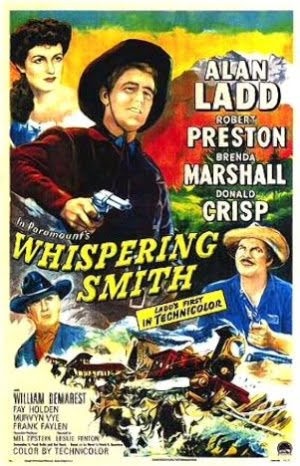
We’re back in remake territory, proving yet again that this is no modern phenomenon. Whispering Smith (1948) was the third time Hollywood had tackled Frank Spearman’s novel about the soft-spoken railroad detective. It wouldn’t be that last either: Audie Murphy went on to portray the character in the short-lived TV show of the same name in 1961. The film places the railroad and its importance right at the centre, in keeping with the vital role it  actually played in the conquest, building and civilization of the frontier. Down through the years, the movies have shown the railroad companies in both a positive and negative light depending on the view of the west they wanted to emphasize – regarding the coming of the Iron Horse as either the agent of corruption and restricted freedom or as the champion of progress and modernization. Whispering Smith, for the most part, adopts the latter position.

Luke ‘Whispering’ Smith (Alan Ladd) is the railroad’s star cop, with a reputation for being a calm but deadly man. The opening sees Smith falling victim to a couple of bushwhackers, later revealed as members of the Barton gang. The company has sent Smith west to bring in these outlaws, and he lives up to his billing by efficiently taking out two of the brothers when they attempt to hold up the train he has boarded. However, Smith doesn’t walk away unharmed; the shootout leaves him wounded – saved from death only by a bullet deflecting off the harmonica he carried in his breast pocket. As he recuperates in the home of an old friend, salvage engineer and small-time rancher Murray Sinclair (Robert Preston), we learn that there was some history between Smith and Sinclair’s wife Marion (Brenda Marshall). This is only one of the plot threads though. The other, and more significant one, concerns Smith’s gradual suspicion that Sinclair may have taken his first steps along a shady path. For one thing, there’s Sinclair’s association with a notorious crook and rustler, Rebstock (Donald Crisp), and then there’s the small matter of his apparently living beyond the means of a railroad employee. Still, the friendship between the two men holds firm for the time being. What puts it under strain, and ultimately breaks it, is the bullish refusal on Sinclair’s part to bow down and accept the fact the railroad now has new policies, new men in charge, and is determined to crack down on the kind of petty corruption that would have been overlooked in the past. In the end, both Smith and Sinclair have to choose between friendship and the old, freewheeling ways and the more hard-nosed corporate sensibility of their mutual employer.

I think the whole issue of the railroad is approached in an interesting way in Whispering Smith. With the title character as the hero, his carrying out of his employer’s wishes automatically earns a lot of legitimacy in the eyes of the viewer. Many westerns have portrayed railroad representatives as good for nothing flunkies riding roughshod over the pioneering settlers. By showing Smith to be an upright and admirable character and his immediate superior to be a refined man capable of some understanding, the film gives a human face to the railroad. At the same time though, the point is clearly made that it’s the inflexibility of head office, and their rejection of Smith’s direct appeal, that finally pushes Sinclair into out and out criminality. As such, there is a degree of ambivalence in the script’s attitude. Ultimately the railroad, albeit with the human face of Smith to soften the impact, represents the relentless forward march of progress and the inevitable end of the old freedoms that Sinclair personifies.

Leslie Fenton had a relatively brief directing career and his best work, Whispering Smith and Streets of Laredo, came towards the end of it. Both these movies saw Fenton work with cameraman Ray Rennahan, and together they created some beautiful images. Whispering Smith makes great use of the Technicolor process in the indoor and outdoor scenes, resulting in a film that’s rich and textured. There’s also an economy to the storytelling; the fact that Smith, Sinclair and Marion have a shared history is deftly summed up early on by the simple expedient of using close-ups of the characters’ facial reactions. And then the sequence detailing Sinclair’s descent into banditry sidesteps the need for tedious exposition by employing a brief but spectacular montage of wrecks and robberies.

Whispering Smith saw Alan Ladd appear in his first western in a starring role, and it proved that he had a promising future in the genre. Ladd used his quiet toughness to great effect in film noir throughout the 40s and this new departure for him provided an equally productive outlet. His character is given a strong build up early on and he effortlessly lives up to the deadly reputation. Ladd seemed at ease and at home in a western setting and, while there’s nothing gratuitous about his more violent moments, there’s never the slightest doubt that Smith represents a capable and menacing figure. The actor’s ability to seamlessly blend the gentler, more intimate passages with those highlighting his skills with the gun points the way towards his peerless performance in Shane a few years later. Robert Preston had shared the screen with Ladd in the past, most memorably in This Gun for Hire, but this time their roles were reversed. Preston’s Sinclair is a complex mix of ebullience and repressed fury, and the actor creates an interesting character who is three-dimensional enough to remain sympathetic to the end; bearing in mind the loyalty to Sinclair that Smith retains throughout, this is a vital quality to communicate. Brenda Marshall, who had been excellent opposite Errol Flynn in The Sea Hawk, was close to her early retirement from the movies at this point. I thought she gave a fine, restrained performance as the woman between Ladd and Preston, conveying very well the regret she felt for the chances of happiness she had lost by marrying the wrong man yet remaining steadfast in her vows – there’s a lovely little moment where Marshall and Ladd speak obliquely about their former relationship, and all their mutual longing and desire is clear to see in their eyes even as they talk around it. The film boasts a particularly strong supporting cast, headed up by the ever reliable Donald Crisp and William Demarest while Frank Faylen also deserves a mention for his turn as the creepily sadistic Whitey Du Sang.

Initially produced by Paramount, the rights for Whispering Smith now reside with Universal who have issued it on DVD in the US. That disc presents the film in the correct Academy ratio and it’s an extremely strong transfer, with no print damage to speak of and rich, vibrant colours. The only extra feature offered is the trailer. The movie is a good example of a late 40s western; it’s a fairly straightforward affair but there are some hints of the complexity that genre pieces from the following decade would more fully explore. It’s also noteworthy for offering Alan Ladd his first serious western role and giving a new direction to his career. All told, the movie is a fine piece of entertainment that looks very attractive.


Cry Wolf

poster55

The popularity of certain genres, or perhaps sub-genre is more accurate in this case, is always subject to change. Old dark house movies seem to have lost a lot of their appeal; I think they would have to be accompanied by significant quantities of gore to generate a lot of interest these days. Such films rely heavily on atmosphere and a sustained level of tension that is hard to achieve in the age of lightning editing and a succession of jump-cut shocks. Cry Wolf (1947) is one of these vaguely old-fashioned yarns where mood and setting play a major role in maintaining the suspense. I would term it a moderately or intermittently successful vehicle; the plot is serviceable without being particularly remarkable, but the look of it all and the unexpected casting makes for interesting viewing.

The opening has a breathless, intense quality: a black automobile hurtles along winding rural roads while a rider on horseback tracks along and ahead. As the horse clears a boundary wall, the car pulls up in front of an imposing mansion. Two figures, a man and a woman, alight and are admitted by the help. These two people are Senator Caldwell (Jerome Cowan) and Sandra Marshall (Barbara Stanwyck), and they’ve been racing through the countryside to attend a wake. An interview with Mark Caldwell (Errol Flynn), the senator’s brother and head of the house, establishes the fact that Sandra has arrived at this place of mourning to pay her respects to her late husband. Sandra claims that she was married to the deceased, the nephew of Mark and the senator, and has come to see the instructions he left in his will are carried out. It transpires that the dead man was extremely wealthy, his fortune held in trust and administered by Mark until he should turn 30 or marry. His sudden departure means that Sandra now stands to inherit a substantial fortune, providing her claims bear scrutiny of course. Mark is naturally suspicious of this unexpected widow, but that feeling is reciprocated. The death of Sandra’s husband is accounted for in fairly vague terms, the casket has been sealed, and the entire household appear to be held in the grip of some nameless dread. If Mark wants to find out a little more about Sandra’s assertions then that’s as nothing compared to her determination to dig deeper into the Caldwells’ past. She instinctively knows that something doesn’t ring true; there are little details that niggle, but the main issue is the sinister atmosphere that hangs over everybody and everything. The presence of a fragile, neurotic niece, the mysterious laboratory where Mark works late at night, and the awful, unacknowledged screams that echo along the corridors in the darkness all combine to drive Sandra to investigate further. It’s tempting to try to predict the outcome of this story and the trail is littered with clues and allusions, but there are various red herrings present too. By the time the tale twists its way to the climax I reckon it would take a very savvy viewer to step around the pitfalls and reach the correct conclusion.

I haven’t seen too much from director Peter Godfrey apart from the Bogart/Stanwyck feature The Two Mrs Carrolls. This movie shares the same feeling of overheated melodrama, and both films tend to disguise a mediocre script through the use of heavy atmosphere. I don’t usually comment on matters such as set design, but Cry Wolf, with its predominantly indoor setting, relies quite a lot on this. The sprawling Caldwell mansion and estate becomes almost a character in itself, a kind of brooding edifice that’s full of secrets and menace. Godfrey and cameraman Carl Guthrie use the architecture well to build mood – shooting from below and through the balustrades to achieve the classic noir imagery of characters pinned in place by shadows and bars, and mix this up with high angle shots from the gallery that coldly objectify the small figures milling about below. Even the outdoors scenes, with their matte paintings as backgrounds, blend in well. Theoretically, this ought to give the movie a cheap, B picture vibe but it actually adds to the air of unreality, heightening the sense of the characters inhabiting a world apart in much the same way that Hitchcock employed such techniques.

Errol Flynn rarely gets a lot of credit for his acting abilities. He even admitted in his (fantastically entertaining) autobiography that, especially in the post-1942 years, he was often just going through the motions, basically churning out pictures simply to cover his expenses. He was always at his most memorable in swashbuckling action roles, yet he was capable of more subtle performances whenever the opportunity arose. Cry Wolf offered him something quite different, a calmer, more thoughtful and genuinely ambiguous part. Perhaps some thoughts of his own father came into play when he assumed the role of the slightly aloof, pipe-smoking scientist. While he could be criticized here for a certain stiffness, I think he hit the right note under the circumstances; the character of Mark Caldwell is, after all, a man living under intense pressure with a lot of skeletons rattling around the family closet. I guess it could be said though that he doesn’t bring a strong enough sense of menace or threat to his performance to make it as convincing as possible. In something of a reversal of roles it’s Barbara Stanwyck who gets to do all the proactive stuff in the movie: riding horses, clambering across rooftops, dangling through skylights and generally toughing it out. As such, this was a perfect piece of casting since Stanwyck was one of the few actresses of the period who could credibly pull off this kind of thing. She was enormously versatile, at home in most any genre, yet particularly suited to playing gritty heroines who remained unfazed by physical danger. I’ll also give a mention to Geraldine Brooks who was highly effective and quite moving, in her debut role here, as the emotionally brittle and highly strung niece.

As far as I know, the only way to get Cry Wolf on DVD at the moment is via the Warner Archives disc. I remember buying this title on VHS way back in 1989 and I have to say that it looks very much like the same master has been used for the DVD. That’s not to say the image is poor, but there are plenty of speckles and damage marks, not to mention a general lack of crispness, that betray an unrestored source. The disc, as is usual with these MOD products, is very basic: no extra features whatsoever, a generic menu and standard ten minute chapter stops. I’ve tagged this picture as a film noir, but the truth is that it’s a borderline entry at best. The plotting has more in common with a Mary Roberts Rinehart style of mystery – a gutsy heroine blundering into a perilous situation. However, the dark mood and the atmospheric photography do earn it a place on the periphery of the noir world. Personally, I’m a fan of both the stars and I like the fact that it has Flynn playing against type for a change. It’s by no means a perfect film though it is a lot of fun – therefore, it earns my qualified recommendation.


I Wake Up Screaming

“I’ll follow you into your grave. I’ll write my name on your tombstone.”

It’s hard to pin down exactly when film noir came into being, almost as hard as defining the term itself. Some argue that Stranger on the Third Floor kicked it all off, others point to John Huston’s version of The Maltese Falcon, and there are those who reckon it was even a year or two after that. So where does that leave I Wake Up Screaming (1941)? Well it came out around the time of The Maltese Falcon, so it falls into that early/proto-noir grouping. Unlike Huston’s film, there is a degree of unevenness to the tone; it veers between some broadly farcical moments and a darker, shadowy world of danger and complex psychology. In fairness though, the latter aspect does dominate and, even if one concedes that it’s not fully fledged noir, there is some wonderful photography and imagery on show.

The opening is a dramatic one, with a newspaper seller announcing the murder of Vicky Lynn (Carole Landis) as the camera invites us into police headquarters. Inside, over the course of two interrogation sessions, we learn who this girl was and how she came to meet her end. Both Frankie Christopher (Victor Mature), a promoter, and Jill Lynn (Betty Grable), the victim’s sister, are under the spotlight and – via flashback –  filling in the background for the audience. It’s shown how Frankie and two friends (Alan Mowbray & Allyn Joslyn) make a Pygmalion style bet to turn waitress Vicky into a celebrity. Seeing as they have quality material to work with, things turn out fine. Maybe too fine though, since all three men have romantic designs on their muse, while she has plans to move to Hollywood. Anyway, Vicky winds up murdered and Frankie is sweating it out in the interrogation cell as suspect number one. The investigation is being headed up by an unusual cop, the soft-spoken and slow-moving Ed Cornell (Laird Cregar). Cornell seems sure Frankie’s the killer and is determined to break him. This immense and vaguely sinister figure becomes Frankie’s shadow, teasing and menacing him. On one memorable occasion, Frankie wakes suddenly from a bad dream only to find the Buddha-like figure of Cornell sitting in a chair in his room, just watching him. As Jill and Frankie join forces to trace Vicky’s killer, they draw closer together and it also starts to become apparent that the motives behind Cornell’s obsessive determination to nail his prey may not be quite as clear cut as they first seem.

I Wake Up Screaming, adapted from Steve Fisher’s novel, is as much a whodunit as a film noir. It’s the behaviour of a couple of the characters and the chiaroscuro lighting and imagery that earn it a place in the noir lineup. I mentioned the uneven tone, and that’s perhaps most evident in the opening segment, where the action alternates between the interrogations and the flashbacks. The latter tend to be bright and have a light, jokey feel about them as the three friends go about making Vicky over. This is where the transitional nature of the film is noticeable, as those scenes are reminiscent of the screwball style of the 30s. It also reflects something of the director’s background. H Bruce Humberstone is maybe best remembered for his handling of a few of the best Charlie Chan movies, and those flashback scenes recall that kind of mood. Cameraman Edward Cronjager had worked with Fritz Lang, and would do so again, and it’s tempting to wonder if this association may have had some influence over the look of the interrogation scenes. These are pure noir, full of harsh key lights, deep shadows and threatening, disorienting camera angles. In fact, this style dominates the remainder of the film and results in some strong visual imagery. I don’t often spend a lot of time discussing the musical scores in these pieces, but I’ll do so here as I feel there’s some added significance in this case. The movie’s main theme is Alfred Newman’s Street Scene, which would become something of a staple in Fox crime pictures. However, another very famous melody, Over the Rainbow, also features prominently throughout the film, and it’s that I particularly want to focus on. Initially, this might seem an odd choice for a noir/crime movie, being so closely associated with The Wizard of Oz. Nevertheless, it not only works but is also highly appropriate – that half-hopeful, half-melancholic song perfectly captures the nature of two important characters, both striving and straining to reach something that must forever remain unattainable.

In retrospect, there’s something incredibly sad about I Wake Up Screaming, and it’s not just the fate of some of the characters. Within a few short years, both Carole Landis and Laird Cregar would be dead. Landis would die by her own hand, and Cregar would bring on a fatal heart attack as a result of extreme dieting. Landis was pretty good in the role of the victim, seen only in flashback and in a clip of film her character made as a screen test. Although her screen time is limited, she still conveyed the ambition and single-mindedness of the character well enough. Cregar is phenomenally good, the best thing about the whole picture in my opinion. Despite the fact he may not have thought so himself, his bulk was one of his greatest assets as a performer. He dominates the frame whenever he appears, and his mock joviality comes across as nothing more than a veneer to cover up something much more sinister below. But there’s more than that, something about the eyes or voice had a soulful quality, a hint of regret maybe. By the end of the movie, Cornell (apparently Steve Fisher named the character after fellow writer Cornell Woolrich) develops into an extremely poignant figure. I always thought Cregar was great in anything I’ve seen him in, and his passing away at such an early age was a real tragedy. There’s also a small but pivotal role for cinema’s favourite runt, Elisha Cook Jr; the man was born to play losers and victims, and his plaintive, bewildered persona is put to good effect in this film. Which brings me to the two leads, Betty Grable and Victor Mature. Grable was essentially a musical star, not the kind of person you expect to see in a hard-boiled crime movie. Having said that, she does fine as the sister of the victim and is quite credible in a serious dramatic role – there was a short musical number shot for inclusion but this was, quite sensibly, cut and is presented as one of the extras on the DVD. If I have any quibbles about her it’s only that her relationship with Mature seems to grow too quickly to be realistic – still, that’s a scripting rather than an acting issue. Victor Mature featured in a fair number of noirs, and I have no problems with his work on this one. However, it has to be said, and again this really relates to the writing, that both Mature and Grable’s characters are a little too straight and square. Noir always works best when there’s a touch of ambiguity or doubt surrounding the protagonists, and that’s never convincingly achieved with either of these characters.

I Wake Up Screaming is on DVD from Fox in the US as part of their noir line, and looks great. The transfer is very clean and sharp, and the contrast is strong. The disc also offers a fair selection of extras, the commentary track by Eddie Muller and the aforementioned deleted scene being the most notable. As I’ve tried to make clear throughout, the film is not full-blown noir. Cinematic genres and styles are all about evolution, things don’t arrive fully formed out of the blue. As the world, and the US in particular, plunged further into crisis and war,  cinema would gradually reflect the darkness and disillusionment more. Even if films like I Wake Up Screaming don’t quite go the full distance, they’re still not too far off. Either way, it remains a classy movie that is recommended viewing.

Gilda

Hate can be a very exciting emotion. Very exciting. Haven’t you noticed that?

I guess one of the defining characteristics of film noir is its subversive nature. It tends to take traditional scenarios and situations and casts its dark and cynical shadows over them, carrying the audience along on a journey into a murky and unfamiliar world. This subversion can apply to the legal system, social matters, or affairs of the heart. Gilda (1946) concentrates on the latter category, spinning its tale of three people locked into a romantic triangle, unable to decide if they love or hate each other and apparently unaware of the distinction between these powerful and conflicting emotions.

The story begins in Argentina at some unspecified point towards the end of WWII. But there’s a timeless, otherworldly quality to it all – the end of the war and the ensuing celebrations are mentioned in a throwaway fashion that’s surely meant to emphasize the detachment of the lead characters from the real world and the more mundane concerns of most people. These people seem to exist and operate within their own self-contained universe, a glamorous yet nightmarish demi-monde, where the bigger picture of world-changing events are relevant only as a kind of Hitchcockian MacGuffin. The opening shot of the movie introduces Johnny Farrell (Glenn Ford), a down on his luck grifter rolling dice on the waterfront and looking for easy marks. His strategy is a high risk one, not just because he’s a gambler but because his loaded dice are sure to attract the attention of disgruntled suckers sooner or later. When the inevitable happens, and Johnny finds himself the victim of a shakedown on a dark and forbidding wharf, his hide is saved by the intervention of a suave gentleman with a handy sword stick. This is Ballin Mundson (George Macready), a casino owner with an interest in shadier and even more profitable ventures. Johnny is nothing if not an opportunist and soon talks himself into employment, and a position of trust, with Ballin. For a time this mutually beneficial arrangement works and everything is sailing along smoothly on calm waters, until a woman appears and brews up a storm. Gilda (Rita Hayworth) is a sexual powerhouse, a woman whose passionate nature and provocative insolence seems to radiate from within. Her sudden and dramatic appearance as Ballin’s wife, after a whirlwind courtship, throws Johnny for a loop and irreversibly alters the dynamic of the relationship between the two men. Gilda’s arrival on the scene has an immediate and profound effect on Johnny – their introduction is a charged affair, and the confusion that Johnny’s barely able to disguise is shared by the audience. The rippling undercurrent of hostility gives rise to all sorts of questions about these people. I’m not giving away much here when I point out that it’s soon revealed that Gilda and Johnny were once lovers, before he walked out on her. And there we have our triangle: a cagey, duplicitous affair where the three protagonists circle each other warily and seem bent on mutual destruction. While it all develops nicely, I’ve always thought that the ending is weak – a little too abrupt and not all that convincing.

In my opinion, the reason Gilda is classified as a film noir is down to the theme more than the look. Cameraman Rudolph Maté does create some characteristically noir images – the waterfront opening, some of the nighttime casino scenes, and the way Ballin seems to blend and merge with the shadows – but much of the movie features bright, flat lighting. The edgy, darker tone stems largely from the setting and plot twists. A casino has a built-in sense of fatalism to it anyway, a place where fortune quite literally depends on the turn of a card or a throw of the dice. When this is combined with the South American setting, and the allusions to ex-Nazis involved in political and economic intrigue, it conjures up that sense of exotic danger that was very much in fashion in the mid to late 40s. Of course all this really only amounts to Casablanca style escapism; the key element that tips it over into the world of noir is the sadomasochistic relationship at the centre of the tale. The film is essentially a love story, but there’s a vicious, unpleasant side to the romance. Everything revolves around the title character, as she punishes both Johnny and Ballin, but in so doing she incurs arguably greater punishment at their hands in return.

The unquestionable star of the show is Rita Hayworth, the role becoming the one with which she would remain most closely identified for the rest of her life. Hayworth herself acknowledged this and it seems she had mixed feelings about it – her frank admission that the men in her life went to bed with Gilda and woke up with her is very telling. Whatever the personal legacy may have been, Hayworth certainly breathed life into what, in other hands, could have been a cardboard cutout character. She was excellent at getting across the contrast between the vivacious bravado that characterized Gilda’s public facade and the uncertainty and self-loathing she felt in more private moments. Her big scene, the one that is endlessly referenced in books and retrospectives, where she tries to provoke a reaction from Johnny with a knowing parody of a public striptease is justly famous. However, it also tends to overshadow the good work she did all through the movie.

While Rita Hayworth is the one most people will remember from the movie, Gilda worked wonders for the career of another of its stars. Glenn Ford, like a number of other actors, had seen service during the war, and Gilda was the film that gave him the boost he needed and raised his profile. Wartime experiences affected a lot of performers, it gave them a different air, a toughness and a touch of weariness too. Ford went on to work in some pretty good noir pictures, Lang’s The Big Heat being the best of them, and he did seem to belong in that world. As he did in his numerous western roles, Ford brought a kind of dissatisfaction with himself to his noir parts. Johnny Farrell has a veneer of cockiness and self-assurance to him, but Ford could always invest his characters with a nervy, slightly uncomfortable quality too. These may be little things yet they add up and make characters more believable and realistic. Although both Johnny and Gilda are flawed individuals, they’re not villainous. But a movie like this needs a bogeyman, and George Macready was a fine choice for the role of Ballin. Right from the beginning there’s a sinister air about him, and Macready’s innate charm and culture accentuates that. The repressed manner and wonderfully distinctive voice add to his calm menace – you honestly get the feeling that crossing this man would be an extremely foolish move. Of the supporting cast, I find Steven Geray the most memorable. This washroom attendant whose contempt for just about everyone, apart from Gilda, sees him making one flip comment after another seems to be given a lot of slack. I especially like the way we never find out exactly what leverage he has – the one time he’s about to reveal it he’s interrupted, and we’re left wondering.

I actually drafted this piece back in July, after I’d seen it one balmy Saturday night in an outdoor cinema in Athens – always a great way to enjoy a classic movie. However, I realized my holidays were fast approaching and so I decided to hold off publishing it. I though I might want to go back and tweak it some, but I’ve decided to leave it just as I’d written it a few days after watching the film. I’ve seen Gilda many times over the years and always enjoyed its dark romance. I wouldn’t say it’s one of those movies that reveals too many new things on repeated viewings yet it’s not the kind that grows stale either. It’s earned its classic status, and it’s well worth visiting or revisiting.