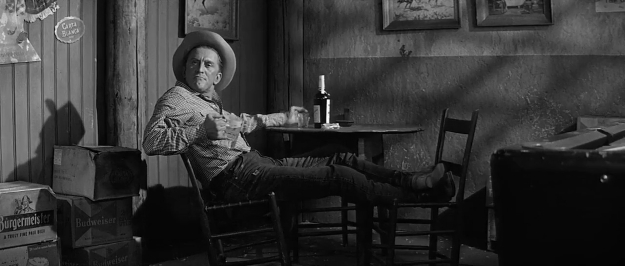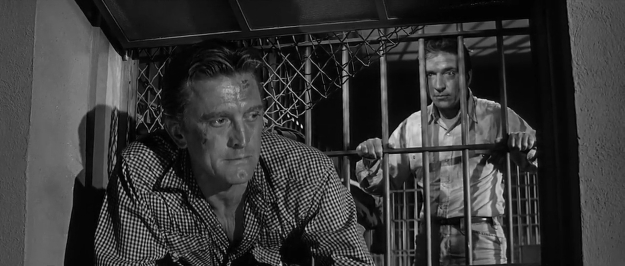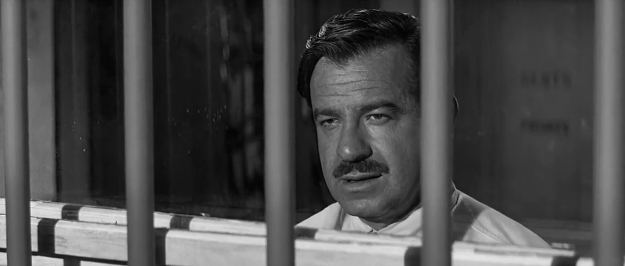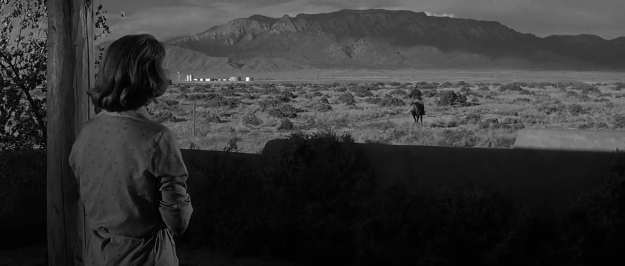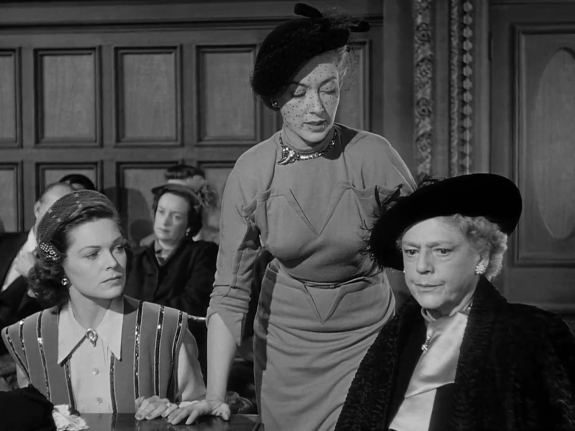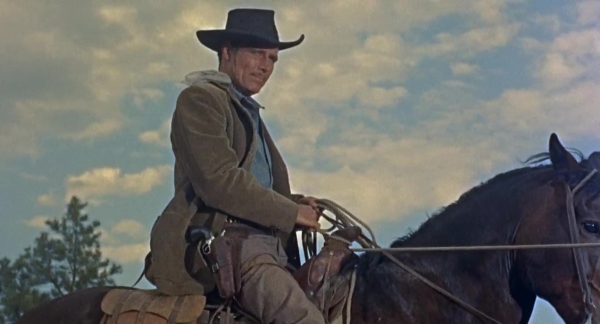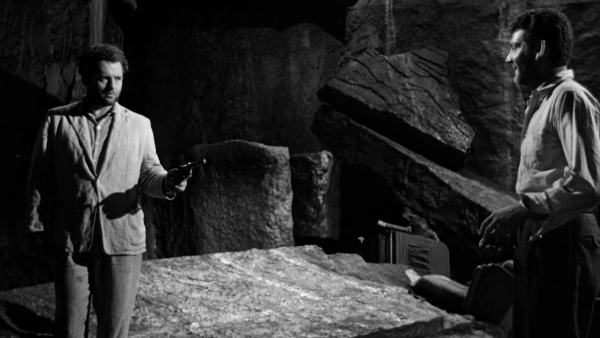
Deadline – U.S.A.

“…the right of the public to a marketplace of ideas, news and opinions. Not of one man’s, or one leader’s, or even one government’s.”

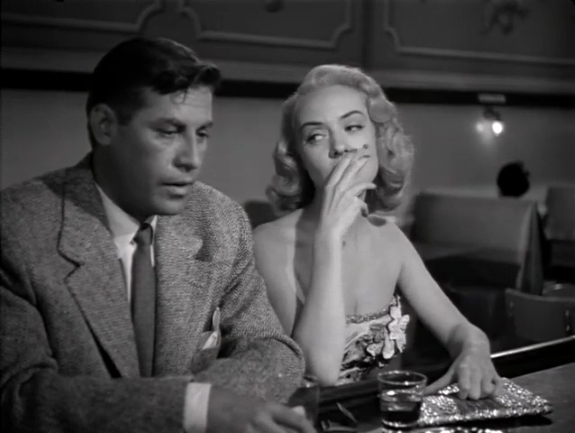
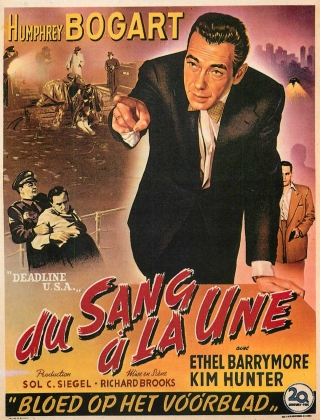
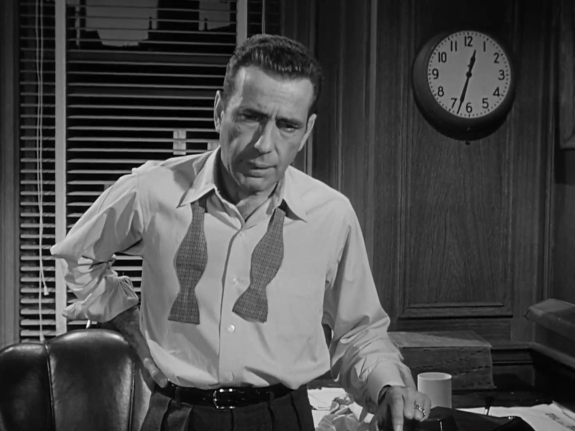
That eulogy to the Fourth Estate, not merely to its desirability but to its necessity as a vital pillar of a functioning democracy is delivered relatively late on in Deadline – U.S.A. (1952) by Humphrey Bogart’s committed and conscientious editor. It might come late in the movie yet everything has been building towards that and the narrative would already have led us to that conclusion even if the script had not spelled it out. If this point needed to be made back in 1952, it is arguably even more essential now where the current era of demagoguery sees the foundations of democracy chipped away at on a daily basis.

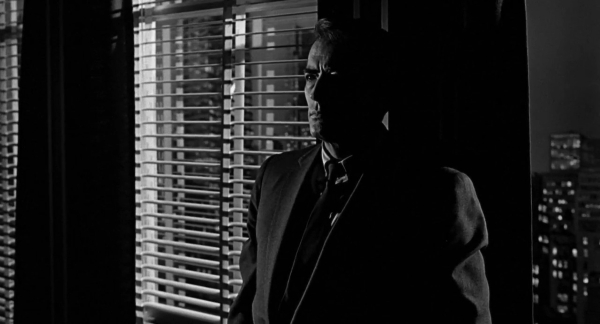
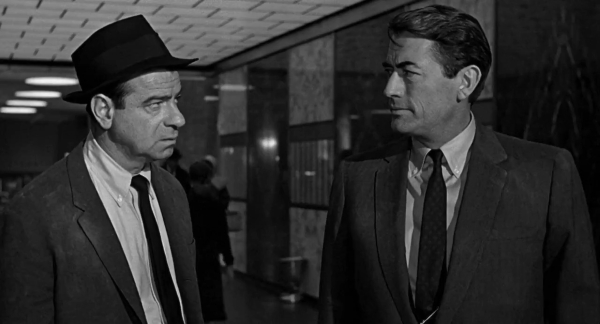
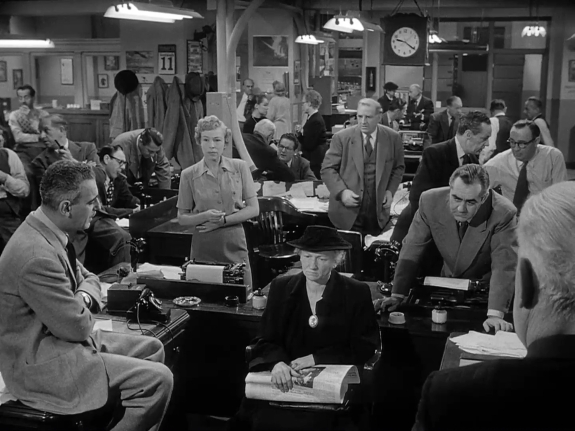
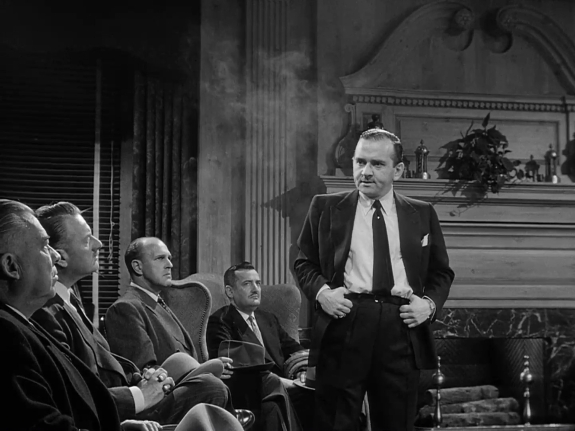
On various occasions throughout the film various characters refer to a murder, a wake and a funeral. It’s as though the shadow of death hangs heavily over the entire project. However, it’s not the death of person, even though there are a handful of those folded into the plot, but instead the demise of a newspaper which is alluded to. This sense of a paper as a living entity, with as much conscience and soul as a human being, pervades the movie. To be perfectly frank, the newspaper in question could be said to have more human characteristics than some of the individuals portrayed. Anyway, this anthropomorphism is key to understanding Deadline – U.S.A. and the points writer and director Richard Brooks seeks to hammer home. The paper in question is The Day, a publication which prides itself on its standards and its history. The editor Ed Hutcheson (Humphrey Bogart), as well as the staff, regards it as a newspaper as opposed to a purveyor of sensationalist yellow journalism. Despite that noble intent, or a cynic might posit because of it, The Day is on its way out. Life support is about to be unplugged and the owners, the detached and disinterested heirs of the founder, are in the process of selling off the carcass to a competitor whose primary interest is buying it in order to close it down and thus corner the market. The viewer is invited to follow the final days of this venerable institution where regardless of the sense of inevitability, there is also a resilience on show. Maybe it’s a losing battle but Hutcheson isn’t going down without a fight and the battlefield he’s chosen for the paper to stage its last stand is one reigned over by Tomas Rienzi (Martin Gabel).

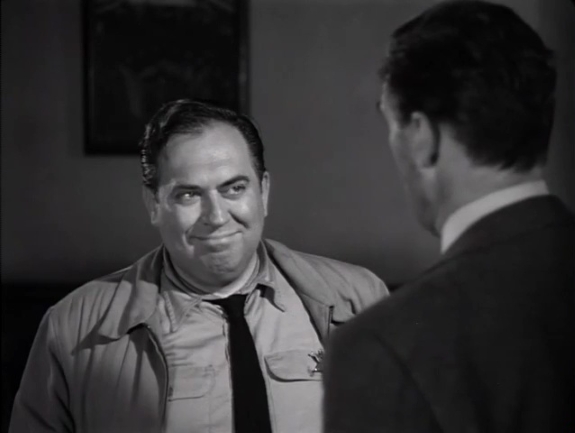
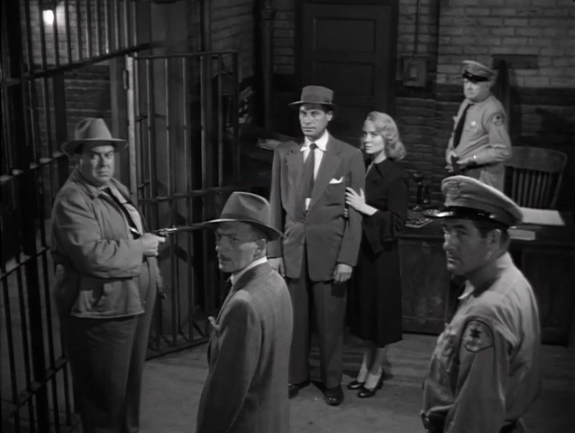
Rienzi is an old school hood, one of those guys where the patina of civilization is especially thin. He’s been investigated for corruption and graft but nothing seems to stick. This time may be different though – the body of a mink clad good-time girl has been fished out of the river and gradually a trail leading back to this Teflon don becomes apparent. In essence, a race takes place to see whether all the connections can be made before the courts put the seal on the sale of the paper, or before Rienzi’s enforcers can make enough witnesses and whistleblowers disappear. While there are other subplots touched on to varying degrees, it is here that the movie sets out its stall. Brooks wants to make the point that real journalism serves a vital civic purpose – “to comfort the afflicted and afflict the comfortable” if you like. Personally, I think his argument is both valid and worthwhile, maybe even more pronounced now than it was all those decades ago. If the printed press has gone into near terminal decline, the voice, function and long established ethics of the legacy media remain essential, even as they come under attack from a range of chiselers and charlatans.

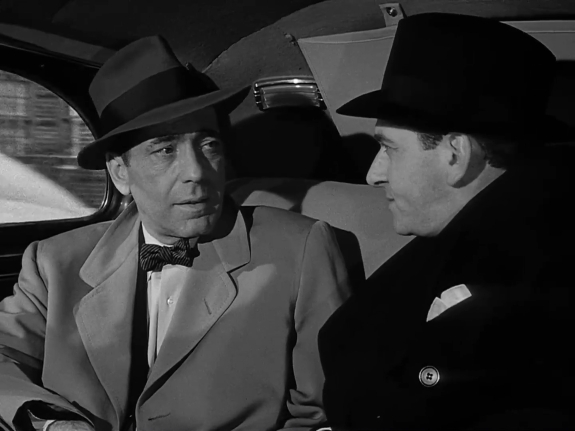
Movies about journalism, indeed the same could be said for that other subset movies about the movies themselves, seem to have their own  special energy. That such productions should exhibit a vitality ought not to be much a surprise when one stops to think how many writers and filmmakers had a background in journalism. The accepted wisdom is to write about what you know and there’s plenty of evidence to suggest that this kind authenticity does lend an added touch of passion to proceedings. Richard Brooks was one of those writer/directors who started out working as a reporter and the latent respect for the trade colors what he puts up on the screen in Deadline – U.S.A.  – that said, I do seem to recall seeing an interview he gave many years later where he expressed dissatisfaction with the title, feeling that it was meaningless in itself. Well if the title is somewhat awkward, the arguments underpinning the plot are not. Brooks keeps it moving along, capturing the noise and urgency of both the newsroom and the press room. There are a couple of instances of less convincing back projection but Milton Krasner has it looking attractive for the most part. Outside of the newspaper building itself, the most effective scene is that inside Rienzi’s car, where he and Hutcheson spar and both Bogart and Gabel make the most of Brooks’ snappy dialogue.

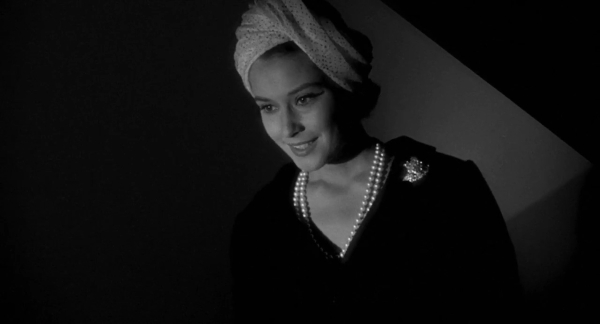
By this stage Bogart was an old hand at either playing it tough and cynical or tough and noble. He goes down the latter path here and his conviction is never in doubt whether he’s trading threats with a mobster or arguing ethics in the boardroom. The only less convincing aspect is his attempt to rebuild his marriage with his ex-wife Kim Hunter. She was an accomplished actress with successful work in A Streetcar Named Desire and A Matter of Life and Death behind her yet there’s a certain listlessness to her performance in this film which weakens that plot strand. On the other hand, Martin Gabel is a fine adversary for Bogart, desperate to convey respectability – “I’m in the cement and contractin’ bu’iness” – while his rough edges keep poking through the facade. There’s plenty of menace on display from Gabel, a man I’ll always associate with the role of Strutt in Hitchcock’s Marnie, but who also directed the atmospheric The Lost Moment.

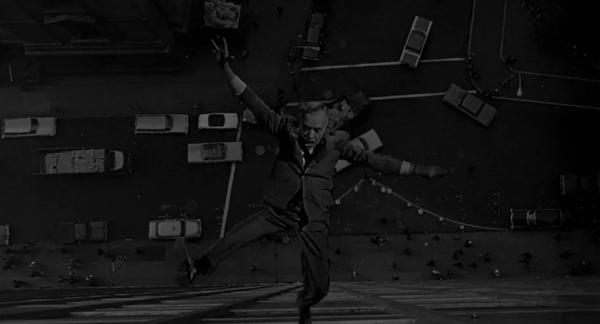
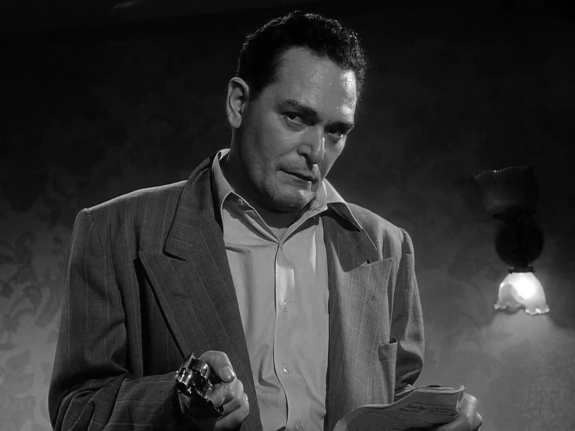
As is frequently the case with big studio productions of the era, there is strong support from a deep cast of familiar faces. Ethel Barrymore rolls out her wise old owl act once more, but she does it so well and so attractively that it’s a pleasure to watch. Ed Begley is comfortably solid, and Paul Stewart (someone else who could shift with ease between villainous and sympathetic parts) casts alternately weary and wary looks from beneath his ever expressive brows. Joseph De Santis has a ball as the scumbag brother of the murder victim, smirking and sweaty as he chisels his way to an undeserved payday before making a spectacular exit where he literally becomes front page news. Jim Backus, Tom Powers, Warren Stevens, Fay Baker, Joe Sawyer and Willis Bouchey among others drift in and out. Apparently, James Dean had a small uncredited part but I’ve never been able to spot him even after numerous viewings.

I’m not sure how well regarded Deadline – U.S.A. is or what kind of reputation it has. I do know I’ve always liked it, it has one of those roles which feel tailor-made for Bogart and the sentiments of the script appeal. I guess I’m something of a sucker for movies focused on newspapers and reporters. It should be easy enough to access in good quality these days; this was not always the case but there are high grade Blu-rays and DVDs of the movie available in most territories now – I have the German DVD myself. While the more venal sections of society endeavor to undermine public trust in the integrity of the mainstream media, it’s good to remind oneself of how important it was and is to all of us.

As an Amazon Associate I earn from qualifying purchases made through links on this page. 


Undertow

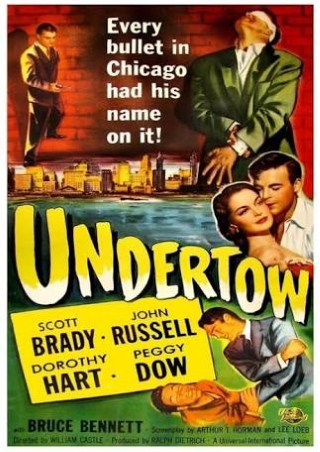
In an era where entertainment gives the impression of becoming ever more bloated and unwieldy, where books seem to be sold by the page count and thus by weight like some indigestible stodge, where even movies which tell essentially pulp stories have running times that defy both logic and the endurance of the human body, it is a true joy to watch a film which is tight and trim enough to take care of business in just an hour and ten minutes. That ought to be a recommendation in itself yet Undertow (1949) has the added bonus of being a remarkably entertaining film noir, William Castle’s best effort in the genre/style in fact.

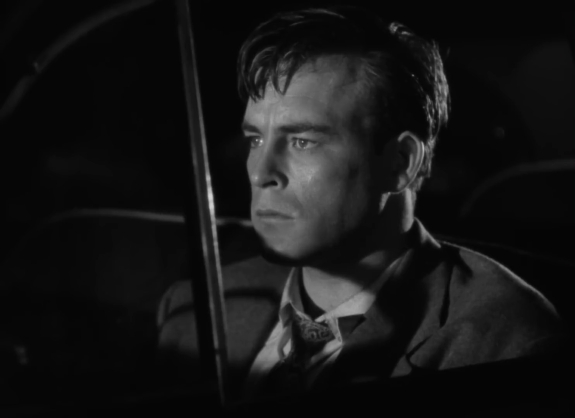
The war as a watershed – how many times has one come across that particular bromide? Yet its essential truth is undeniable. The image of the returning veteran, those men who dreamed of better days amid the waking nightmare of their years of service, is one familiar to the noir audience. Such men immediately draw sympathy by virtue of the sacrifices they made and this adds an edge to the dangers and depravities they confront on their return home. By 1949 the war was already slipping back into the misty corners of the past, the world was rushing ahead and wasn’t necessarily in any mood to slow down and wait for men trying to catch up with events that had bounded four years and more ahead of them. Tony Reagan (Scott Brady) is introduced as a classic postwar character. He’s a veteran with a vaguely shady past who has grown as a result of his experiences and is now focused on cementing a future for himself and the woman he hopes to make his wife. He has just bought a share in the hunting lodge business of a fallen comrade in arms, and is on his way to Chicago to propose to his fiancée Sally (Dorothy Hart). His last evening in Reno sees him briefly hooking up with a pal from his gambling past Danny Morgan (John Russell), as well as making the brief acquaintance of vacationing schoolteacher Ann McKnight (Peggy Dow). All of these people will cross his path when he lands in Chicago and also lands in deep trouble.  The classic noir protagonist frequently finds himself skewered on the horns of a dilemma, trapped somewhere between the pull of his past and typically bad choices going forward. This certainly fits Tony Reagan, a man who was told by crime boss, and Sally’s uncle, Big Jim Lee to stay out of Chicago and away from his niece.

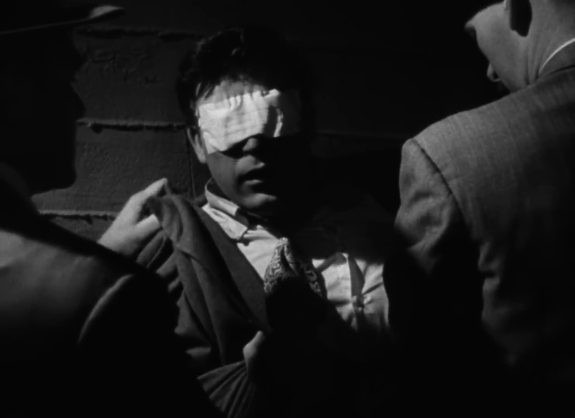
There’s to be no hero’s welcome for Reagan; on his arrival at the airport he’s met by cops who run him downtown for a bit of friendly advice from the precinct captain, namely that he shouldn’t waste any time unpacking. That he ignores this tip shouldn’t come as any surprise, nor should the fact that he is soon slugged, blindfolded and shot, all as a prelude to a frame that looks like fitting him very snugly. If the movie has a weakness it stems from the way it sets itself up as a kind of whodunit where there’s no great mystery with regard to the actual culprit. In this case certain character traits as well as the way a vital piece of information was only available to one person don’t so much point the finger at as turn the spotlight full force on one individual, and when you see who that is then the rest of it kind of falls into place. Still, none of that really matters as much of the pleasure derived from following Reagan on his nighttime odyssey through Chicago trying to keep a half a step ahead of the cops, calling in favors and only realizing the full extent of his peril at the last moment.

William Castle, like all studio era directors, worked in just about every genre but the bulk of his work fell into three categories: horror, crime and westerns. The horror movies have traditionally gained more attention from critics and fans alike, which arguably says as much for the enduring popularity of that genre as it does for the movies themselves. If I’m being honest, I don’t believe the quality of Castle’s films overall is commensurate with the level of attention they have received down the years. That may come across as somewhat curmudgeonly yet it’s not my intention to do so – I like Castle’s films for the most part and find the majority of them entertaining, just not necessarily always that good. Still, his better work does stand out and I’d have no hesitation in placing Undertow among those better pictures. At this stage in his career there was none of the gimmickry and clowning that would come to be seen as characteristic of the man. Instead, what we get is a compact and atmospheric piece of budget filmmaking that punches well above its weight.

Shakespeare had Caesar remark that Cassius had a lean and hungry look and was therefore dangerous. Perhaps John Russell ought to have been cast as Cassius then at some point in his career for he surely fitted that description. Even though he had heroic leading roles on TV  in both Soldier of Fortune and then Lawman, his villainous parts on the big screen tend to be memorable and carry an edge of authenticity to them. He turned in a strong performance in De Toth’s Man in the Saddle and I watched him a while back in Hell Bound and was again impressed. The latter has that typical mean streak that can be found in Bel-Air movies and Russell managed to embody that successfully. Scott Brady was a suitable pick for the lead too, only a few years out of WWII service himself, he had the right combination of toughness and sympathy to be believable as someone with underworld connections but also with the nous to realize his future lay in a different direction. Bruce Bennett’s reassuring presence as the conflicted friend adds solidity to the supporting cast; his well played scenes with his boss and particularly the short interlude in the basement workroom of his home help to ground the story. The two female roles were filled by actresses who had very short screen careers. Peggy Dow appeared for a mere three years between 1949 and 1952 , while Dorothy Hart stretched it out a little longer, running from 1947 to 1952 in features and a couple more on TV. Both had a number of good movies to their credit with Dow possibly squeezing more memorable work in during her brief time as an actress.

Undertow acts as a noteworthy example of the kind of well crafted crime and noir movies Universal-International was capable of producing. It’s gratifying that so many of these are now accessible and can be viewed in good quality, something fans of the studio’s output could only dream of a few years ago. Already released in the US in one of Kino’s box sets, the movie is getting an individual release here in the UK ( Amazon linkAs an Amazon Associate I earn from qualifying purchases) with plenty of supplementary features via Powerhouse/Indicator in January.

Gun Fury

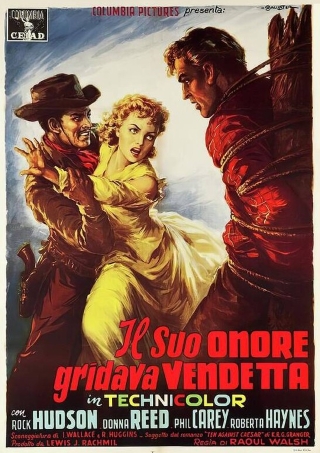
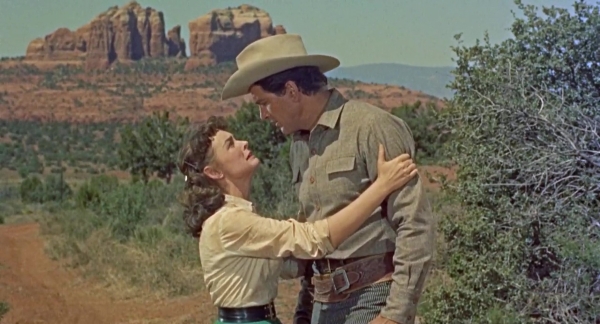
Every time I view a Raoul Walsh movie I find I’m struck by one thought: why don’t I watch more of his movies more often? It says something for a director whose work is so diverse and spread over so many decades that this should occur to me so consistently – in short, I don’t believe I’ve ever seen a Walsh movie that didn’t leave me thirsty for another. Gun Fury (1953) is a standard pursuit and revenge western, but it scrutinizes other themes such as pacifism, isolationism, the hold exerted by the past, and a flirtation with, as opposed to a full embrace of, the classic concept of redemption.

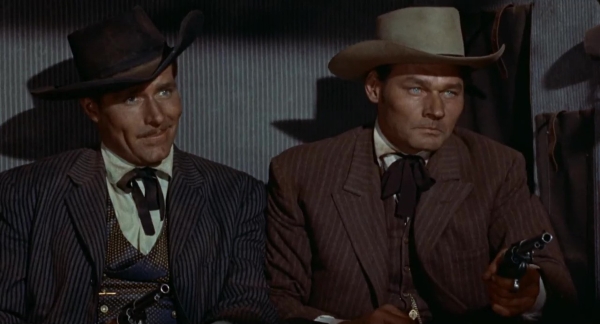
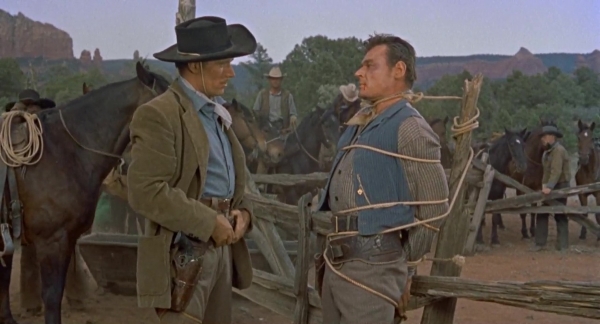
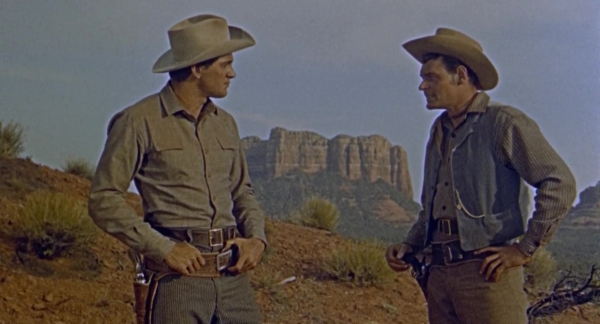
The setup is quite simple. A stagecoach headed west is carrying among its passengers one Jennifer Ballard (Donna Reed), a woman journeying to meet her fiance Ben Warren (Rock Hudson) in order to get married and then continue on their way to California and the prospect of a future ranching. They find themselves sharing space with several others, ostensibly traveling on business of one kind or another. Before long these supposed gentlemen are revealed to be Frank Slayton (Phil Carey) and Jess Burgess (Leo Gordon), a pair of outlaws making the journey simply to facilitate the robbery of the stagecoach by the rest of their gang. In the course of the holdup Warren is shot and while merely wounded he is mistakenly thought to be dead and so abandoned. Slayton has set his sights on Jennifer and brings her along as they set out on the run south to Mexico. The pursuit element is therefore set in motion as Warren goes off in search of his woman, while the revenge aspect is strengthened by the fact Slayton and Burgess quarrel over the decision to abduct the woman, resulting in the latter being bound and left to die in the shadow of circling vultures. His rescue by Warren leads to the formation of an initially uneasy alliance, one held together by the promise of taking Slayton as the prize. Support comes from an unlikely quarter, an Indian called Johash (Pat Hogan) who is also hungry for revenge on Slayton whom he blames for the death of his sister. And so the chase is on, with the outlaws unaware to begin that anyone is on their trail.

Gun Fury was written for the screen by Roy Huggins, the creator of Maverick, The Rockford Files and, more significantly, The Fugitive. The previous year Huggins had both written and directed the very fine Randolph Scott vehicle Hangman’s Knot, also starring Donna Reed as it happens. Gun Fury proves to be a pacy and surprisingly tough little western which utilizes the revenge motif well. All of the characters are essentially driven by a desire for revenge of one kind or another – Warren for the treatment of his woman, Burgess for his the grisly fate planned for him, Johash for his family honor, later a Mexican girl (Roberta Haynes) for her betrayal, and even Slayton himself seems bent on settling scores with life itself for the losses inflicted by the Civil War. As with the best written westerns, revenge for all of these characters is ultimately shown to be a hollow and unworthy goal. The redemption strand is mainly seen in the character played by Leo Gordon, although it has to be said this not as successfully executed as it might be. Personally, I feel this thread ends up being undermined by the developments that take place in the final act. Others may be less swayed by that though. While the script by Huggins offers much food for thought, the direction of Walsh powers it all along. There is never any sense of drift and, as ever, the director skillfully juggles the character development with regular bursts of action, and all shot against a primal Sedona backdrop.

Rock Hudson is credible in the lead, catching something of the driven quality that Anthony Mann would coax out of James Stewart in their western collaborations, even if it doesn’t quite attain those levels of intensity. Hudson holds onto that hopefulness that defines his character, a feature that one would expect to find in a young man on the cusp of a new life in California. It is through Hudson’s Ben Warren that the pacifist and isolationist elements are explored. He has been strongly influenced by the recent Civil War, sickened by the wholesale killing and no doubt that would have struck a chord with audiences less than a decade after WWII and right at the tail end of the Korean War. His isolationist stance – he refers early on to his ranch being bounded on the west by the ocean and on the east by the river, and he claims to have no interest in anything happening on the other side of that river – is tested and thrown back at him as he seeks out allies in his race to catch up with the outlaws. Rebuffed time and again by people too scared or just apathetic and self-absorbed, he is left with no option but to face up to his own former beliefs and reassess them. Finding a way to reconcile a desire for peaceful coexistence with the realization that a civilized man cannot simply retreat behind the barricades of personal interest is a complex theme to examine; it’s to the credit of all involved that it is articulated so smoothly within the framework of the movie.

Phil Carey never quite made it as a lead player. Columbia was casting him in some pretty good pictures around this time, but mainly as the second lead and sometimes in rather unsympathetic parts. The character of Frank Slayton was not what anyone could term attractive – he’s not only a killer but a sadistic one to boot, leaving one man to perish horribly in the wilderness and having another of his gang staked out on the ground and trampled to death for an act of betrayal, and that’s before we get to his frankly abusive treatment of both Donna Reed and Roberta Haynes. The paradox of course is that he regards himself in a wholly different light, as a dispossessed gentleman craving only a return to the gracious living he believes he was robbed of and which is his due. The following year Donna Reed would star alongside Carey again in Phil Karlson’s They Rode West.  Her role here is better than that unfocused effort and she would go on to do further good work in westerns over the next couple of years first in another Roy Huggins scripted movie Three Hours to Kill and also more impressively for John Sturges in Backlash.

Leo Gordon is such a welcome presence in just about anything. Frequently cast as the one-dimensional villain, it’s a pleasure to see him given a more nuanced role. I’m not convinced that the character we have followed on screen would have behaved in the way he does in the final act, but that’s not the fault of the actor. Lee Marvin typically did a great deal with minor characters in small parts in his early films. Some actors have what it takes to make their mark on screen, something largely indefinable but instantly recognizable too. Marvin had that something. The movie business is rife with “what if” scenarios and always has been. There’s some irony in the fact that  Roberta Haynes tested and apparently came close to being cast in From Here to Eternity, in the role which would ultimately go to Donna Reed and for which she would win an Oscar. That’s Hollywood for you! Also featured in a supporting role as one of the outlaw gang is perennial heavy Neville Brand.

Gun Fury is a mid range Raoul Walsh movie in my opinion, which means it’s a good film by any standard. Plots which are relatively straightforward yet carry within them an abundance of ideas that are put forward in an intelligent and adult way are very appealing. I have always liked this film and I reckon it is the kind that should go down well with most fans of the classic western.

Back from Eternity

If there are really only seven basic plots or stories then that probably explains why remakes, which are practically as old as cinema itself, are so common. From a business perspective, something that has proven to be successful once may well do so again so the temptation is always there to take another trip back to the creative well. In among the virtual ocean of remakes there is to be found a more exclusive subset, that of a director redoing his own earlier films. Filmmakers as diverse as Alfred Hitchcock, Raoul Walsh and George Marshall did this over the course of their careers. In two of those cases ,The Man Who Knew Too Much and Colorado Territory, I know I like the later films better and if I wouldn’t go quite so far with Marshall’s Destry, I still feel it’s a worthwhile movie. In 1956 John Farrow remade his own Five Came Back (1939) as Back to Eternity, but I can make no comment on how it stacks up against its first iteration for the simple reason that I’ve not seen the earlier version.

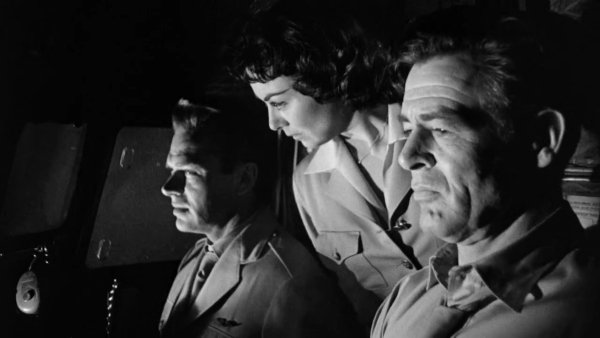
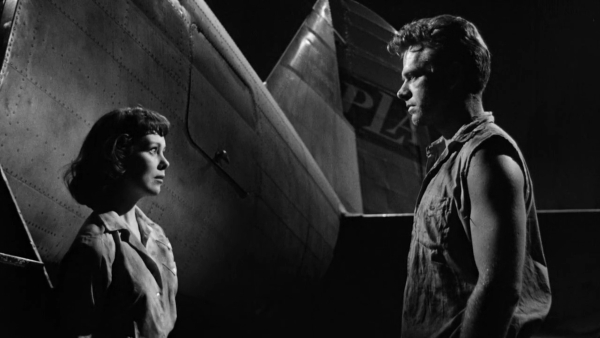
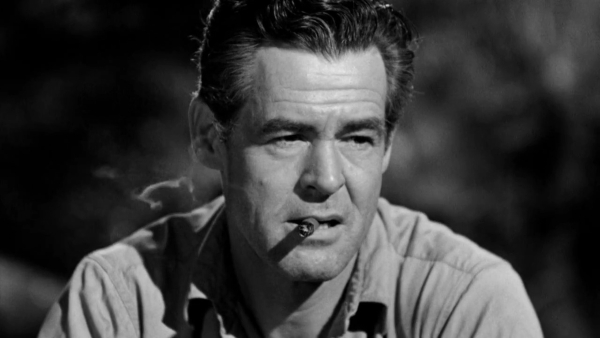
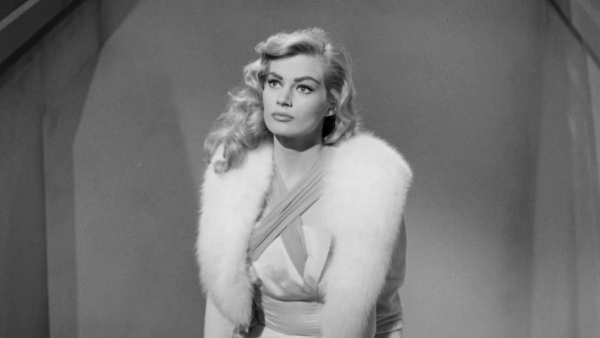
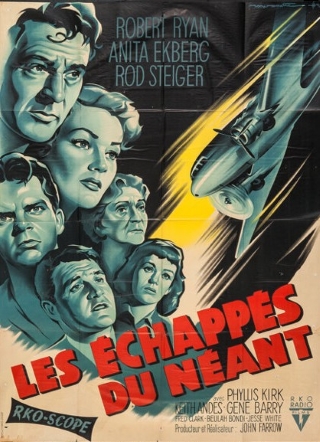
The “stranded in the wasteland” story is one which is ripe with possibilities. It promises danger, excitement and suspense, it allows for drama to grow out of shifting group dynamics, it acts as a platform for endurance and ingenuity, and it can also easily blend in themes of spirituality and even notions of redemption. Back from Eternity manages to combine all of those elements in its sub-100 minute running time. The first half hour or so is given over to the kind of character introductions that are necessary. Thus we see the eager new pilot (Keith Andes) and the older flyer (Robert Ryan) weighed down by the accumulation of a lifetime’s emotional baggage as well as a fondness for the whiskey bottle. There is a glamorous refugee (Anita Ekberg) now discarded by her shady lover and on her was to an even shadier future in what sounds like a South American bordello. Among the others there’s a brace of couples, one young and contemplating marriage (Gene Barry & Phyllis Kirk) and the other old and devoted (Beulah Bondi & Cameron Prud’homme), and a political assassin on his way to face execution (Rod Steiger). When a violent storm forces their plane down in the middle of an unexplored jungle in headhunter country, the real drama kicks in. They say that a crisis brings out the best and the worst in people and that is seen to be so here, selfishness and selflessness clashing like a couple of ethical knights in a jousting match of the conscience. Casting people back into a primal landscape and circumstances peels away their civilized veneer and reveals the true characters beneath. Everything comes to a head when the plane has been patched up but only to the point where it is capable of safely taking off and staying in the air with just five people on board. The question naturally arises as to who will go and who will stay, and all the while the unseen threat in the jungle inches ever closer.

Back from Eternity was scripted by Jonathan Latimer, a man who wrote a good many screenplays which John Farrow directed. He was a fine novelist too and his Bill Crane mysteries are a real delight and are highly recommended. As a novelist he was adept at weaving a rich thread of humor into his hard-boiled setups, however there is none of that on display here. Instead, there is a strong flavor of what I think of as Farrow’s influence. He was a director who frequently evinced a noticeably spiritual side to his work and it is clear to see in this movie. Aside from one overtly religious scene, there are the allied themes of sacrifice and redemption coursing through the fabric of the narrative. This is placed front and center in the decisions taken and the character arcs traced by the elderly Spangler couple and Rod Steiger’s Vasquel. It can be glimpsed too in the change of heart experienced by Jesse White’s former hood, in the renewed hope and motivation which stirs in Ryan’s disillusioned pilot, and also in the maternal protectiveness that a new found sense of responsibility draws forth in Ekberg.

All of this lends substance to the story, although it should be noted that it doesn’t arrive at the expense of the tension or danger that sustains the interest of the viewer. William C Mellor does some fine things with the lighting in the airplane and jungle scenes and I feel Farrow was wise to keep the headhunters off screen throughout. We only see the results of their handiwork on a couple of occasions and the rest of the time their oppressive presence is indicated only by the softly ominous beat of drums and a brief glimpse of a hand brushing aside some vegetation – out of sight yet very much on our minds.

What then of the acting? Rod Steiger is nothing if not interesting, a performer steeped in the Method and one who has garnered both fulsome praise and scathing criticism. Humphrey Bogart said his technique was of the “scratch your ass and mumble” variety, yet he was nominated for an Oscar in On the Waterfront, won one for In the Heat of the Night and did some remarkable things on screen in The Pawnbroker. Like him or loathe him, he was a talent, but he too often abandoned all restraint and seemed to tear movies apart with the sheer artificiality of his work. Fortunately, he holds himself in check in Back from Eternity, operating within his boundaries instead of trashing them. His one indulgence is his adoption of a frankly bizarre accent, a weird type of strangled German or middle European effort that calls unnecessary attention to itself. Robert Ryan is very subdued as the pilot, disenchanted and with a cool noirish cynicism, but never despondent. Anita Ekberg is largely decorative, a pleasingly pneumatic presence and Phyllis Kirk comes over rather starched and stuffy in comparison. Gene Barry is pretty good too as a slick type who quickly sees the polish wear off when he’s in jeopardy – it’s not at all a sympathetic role and I always admire actors who have the guts to take on that kind of part. Generally, the cast turn in professional work and all of them have their moments.

Back from Eternity was released by Warner Brothers on DVD as an Archive title. It looks solid throughout, presenting a crisp widescreen image which is in good shape overall. As I said at the top of this piece, I’m not in a position to draw comparisons with Farrow’s first go at telling this story, but I hope to get to that movie at some stage. Anyway, I’m a believer in taking films on their own terms and merits, and I can only say that I enjoyed this one.

Viewing Notes – A Month with Hitchcock

Without having initially planned to do so, I ended up watching a selection of movies directed by Alfred Hitchcock all through September. I tried to choose those titles I had not seen for quite some time and have been jotting down and recording my thoughts on each in brief as I’ve gone along. Having done so, I figured I might as well assemble them here as an end of month round-up. So here goes:

The Birds (1963)

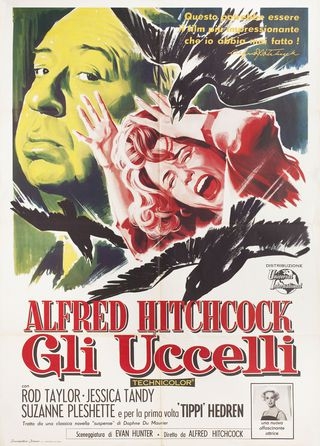
It’s been many years since I last watched this and I’d forgotten just how well constructed it is, not to mention its technical proficiency bearing in mind the era.
That long, slow build-up is the work of a deeply confident filmmaker. It’s never boring or tedious and the gradual, estrogen-fueled tension, with all the cats among the pigeons, is drawn ever tighter in tiny but finely judged increments. When the full chaos is finally unleashed in the apocalyptic latter half Rod Taylor does get to flex bit of muscle, literally and figuratively.

Under Capricorn (1949)

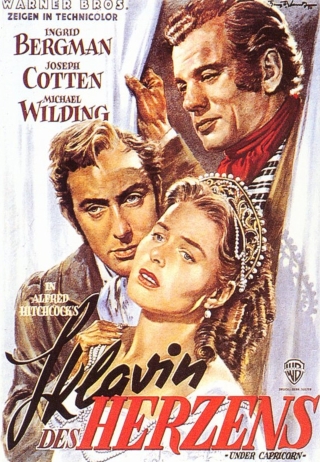
Very much lesser Hitchcock, a movie which barely anyone ever has a good word to say for. Well, I’ll at least say that it is handsomely shot, courtesy of Jack Cardiff, and the acting is fine even if Michael Wilding does lay the whimsy on with a trowel at times.
But yes, it is a problematic movie. And that is largely because it tells a story which is thin, not uninteresting in itself but too thin for its running time. It needed to be trimmed and compressed, which would have been hard to do because of the other great flaw – the director’s insistence at the time on experimenting with long takes. It hamstrung the previous year’s Rope (though that one has other issues dragging it down too) and was a technique that was antithetical to Hitchcock’s style.

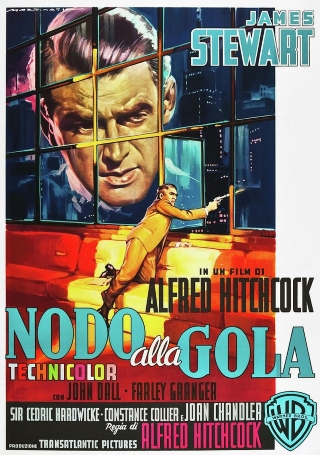
Rope (1948)

I’ve never especially liked this. The technical ambition is admirable, and I’ve always been somewhat hypnotized by the seamless skill involved in the gradual change in the lighting of the studio bound skyline as the tale unfolds in real time. However, the whole continuous take conceit imposes huge limitations on the cast and crew and the process must have been a genuine pain for everyone involved. As with Under Capricorn, the entire business works to undermine the director’s natural strengths.

The biggest problem I have with the movie though is the coldness and indeed the malice at its core. Nobody aside from Cedric Hardwicke’s anxious and compassionate father comes out of it well. That’s not to say it’s badly played of course. Granger could do that weak sister act with his eyes closed and Dall has the clinical and supercilious aspects down pat too – he always seemed to manage that though and there’s a hint of that inherent unlikeability also found in Laurence Harvey in all his parts. James Stewart nails the creeping suspicion that blossoms into horror and then outrage and (self?) disgust. But his character is not really sympathetic either – a man of his intelligence ought to have realized the kind of seeds his intellectual posing was planting.

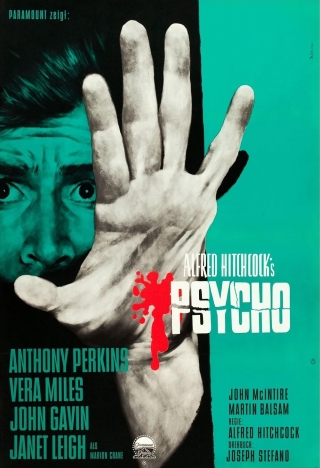
Psycho (1960)

It’s probably 15 years, maybe even more, since I last watched this. The first half always worked best for me and I still feel the same. The paranoia and gnawing guilt of Janet Leigh’s Marion is perfectly encapsulated in the minimalist style of that whole opening section – the rain, the ever more frantic musing, Herrmann’s nervy score and those seemingly permanent close ups of Leigh’s huge, expressive eyes.

And then there’s that frankly sublime sequence in the motel cabin. Cagey and uncomfortable, pathetically flirtatious and taut all at the same time. I reckon it’s the best scene in the entire movie. What follows in the last hour engages me less. It remains visually astounding and technically flawless, but too much of the artful subtlety drains away with the bath water. It still grips and shocks at times, just much more conventionally and it never again approaches the emotional precipice that was teased by the interaction amid stuffed birds, sandwiches and milk.

Nevertheless, it is still undeniably a great piece of cinema, the heights approached and attained in that first hour and the total assurance of a director genuinely in love with his medium are enough to ensure that.

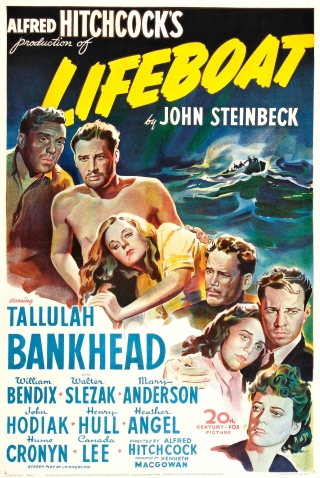
Lifeboat (1944)

A wartime propaganda picture from Hitchcock. Still, being a Hitchcock movie there’s more to it than that – by a circuitous route it winds up as something of a celebration of cohesiveness. Just about every stratum of western society is represented, from Henry Hull’s super rich kingpin to John Hodiak’s blue collar revolutionary, from the stoicism of Canada Lee to the louche decadence of Tallulah Bankhead. All the disparate characters are by turns gulled, threatened and finally drawn together by the malignant presence of Walter Slezak’s cool and cunning Nazi.

It’s another of the director’s challenges to himself, an exercise in the potential of confinement that makes up for in intensity what it arguably lacks in suspense. Alongside the more eye-catching dramatics of those further up the cast list, it’s satisfying to watch the slow development of a gentle romance between fairly regular Hitchcock collaborator Hume Cronyn and Mary Anderson, an actress who never much graduated beyond supporting roles except perhaps in the rarely seen but rather good Chicago Calling.

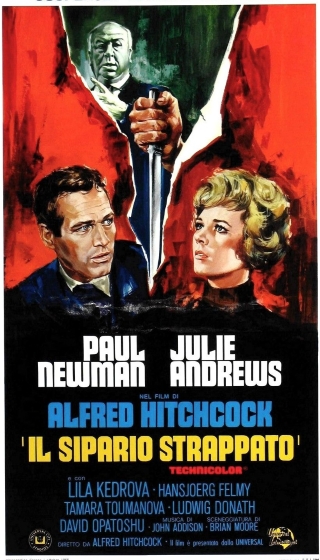
Torn Curtain (1966)

This is the point at which Hitchcock’s decline can be discerned. This Cold War thriller starts out as a double-cross drama where the bluff is drawn out too long before turning into a more successful cross-country chase, the kind of affair Hitchcock could make with his eyes closed.

The first half of the movie misses more than it hits, the brief bookstore scene in Copenhagen errs just on the right side of oddness, but the drab grey/green palate when events move to East Germany reflects the dullness of much of that section, not helped by a listless and detached performance by Paul Newman and an uncomfortable looking Julie Andrews. Some of it does work though – I like the entire build up to the farmhouse scene where the Stasi spook Gromek is laboriously disposed of, and Ludwig Donath is spikily entertaining as a caricatured professor.

The bus ride/pursuit has its moments, helped by John Addison’s slightly eccentric score and an earnest David Opatoshu. There are a few late flourishes too – the hiding among a crowd/creating a distraction ploy is revisited for at least the fourth time – off the top of my head variations thereof are employed in The 39 Steps, Saboteur and North By Northwest if not more.

So, a mixed bag all told. I guess it does more wrong than it does right yet I’ve always had a greater fondness for it than it probably deserves.

War Arrow

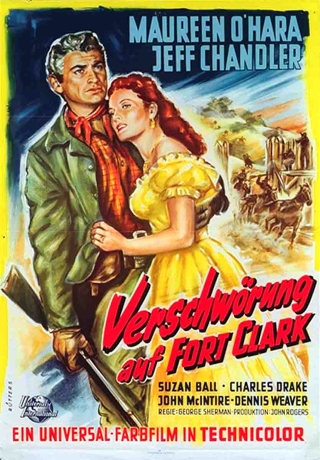
Something about the mid-range westerns that Universal-International was producing in the 1950s points to that hard to define quality which makes the genre so attractive. It’s partially down to the look, the color and locations, and partially the no nonsense style of storytelling. It’s not always easy to come up with a movie that offers entertainment while quietly making some point about a given issue. Universal-International movies often managed this, and the westerns directed by George Sherman during his time at the studio from the late 1940s on are a good example of this. In particular, his films that give some prominence to Indian or Native American affairs sidestep the ponderous or pretentious  pitfalls that have bedeviled many a well intentioned movie. War Arrow (1953) will not be found on any ‘best of’ lists and there’s no reason why it should; it breaks no new ground, nor does it do anything especially startling. However, the film is enjoyable, it uses its strong cast effectively, and Sherman’s characteristic sympathy for the Native American is subtly and seamlessly blended into the narrative.

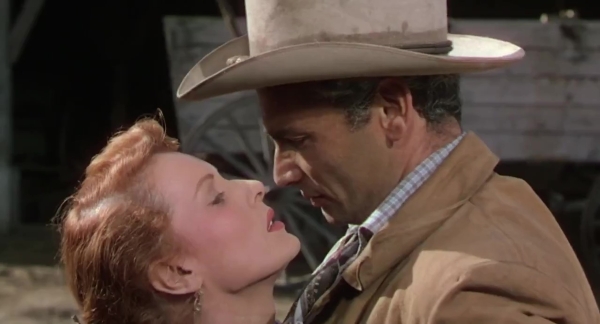
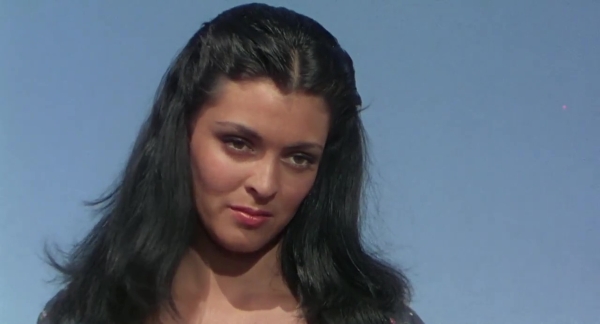
War Arrow is one of those westerns that takes its inspiration from some real historical event, in this instance the recruitment of Seminole tribesmen as cavalry scouts. I say inspiration here because it is a movie after all, not some attempt to represent real history. The film starts out with Major Brady (Jeff Chandler) and two sergeants (Noah Beery Jr and Charles Drake) on their way to Fort Clark, Texas. They have been sent to help in the struggle to contain the raiding parties of Kiowa that have been sweeping the state. They come across the grisly aftermath of one of those raids, with corpses and a burnt out wagon strewn like broken and discarded playthings on the scorched grass. Quite what three individuals are supposed to achieve where the full complement of a fort have failed is anybody’s guess. Their arrival is greeted with some suspicion by the local commander Colonel Meade (John McIntire), a feeling that will gradually be distilled into open hostility as he sees his approach sidelined and his authority not quite usurped but certainly undermined by Brady’s willingness to think outside the box. Meade is an adherent of the West Point manual, rigid in his views of both military tactics and the local tribes. Brady, on the other hand, is an opportunist at heart, a man who is prepared to take a more unorthodox path, and to improvise where necessary. His plan is to employ the kind of guerilla methods the Kiowa themselves have perfected, fighting fire with fire in a sense. And he’s keen to go a step further, to use the dispossessed and dislocated Seminoles as a sort of semi-official, roving commando. As the friction between the two schools of military thought grows in intensity there is another complication elbowing its way into Brady’s life.  The widow (Maureen O’Hara) of one one of the fort’s officers who is missing presumed dead has caught his eye. In itself, that ought not to represent a great problem were it not for the fact that she appears uneasy, and perhaps unconvinced, over the fate of her husband, while the frankly radical daughter (Suzan Ball) of the Seminole chief is also showing signs of interest.
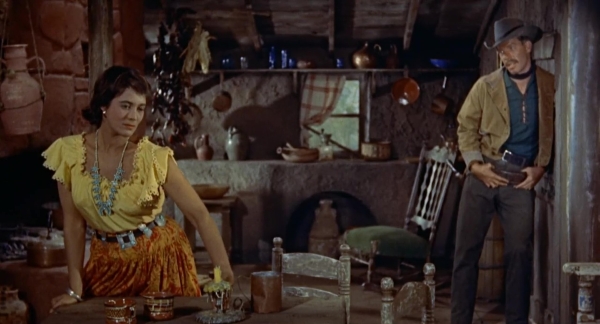
Sherman was a director who knew the genre and how to bring in a movie according to the studio’s requirements. Universal-International seemed to suit him and his time there saw him do some of his best work. I won’t claim that War Arrow represents him at his best, but it is an example of how he could produce a solid piece of entertainment from fairly ordinary material and get worthwhile work from his cast. His depiction of the Native Americans is as sympathetic as one would expect – granted the Kiowa do not come off well and act as bogeyman villains open to outside manipulation, but the Seminole fare much better. The script is by John Michael Hayes, someone who hadn’t much of a pedigree in westerns and who I tend to think of more in relation to his work for Hitchcock in the 50s, and it presents the Seminole in a strong light. They come across as indispensable to the success of the campaign planned out by Brady. They are seen as gutsy and committed, and a good deal more honorable than the frequently petty and hidebound Meade and his junior officers. Sherman gives plenty of time to this aspect, and shoots the battle scenes and skirmishes in a way that is both exciting and which highlights the contributions of the Seminole.

Jeff Chandler typically was good in military roles, either in westerns or contemporary war movies. Gravitas and authority came easily to him and these qualities could be tempered by thoughtfulness, inner conflict or iron determination as required. The part of Major Brady is a relatively straightforward one, an easy run out for him in essence and he carries it off with his usual smooth accomplishment. Maureen O’Hara made a number of films for George Sherman, including the director’s last Big Jake, with variable results. Personally, I think the actress did her best work in the genre for Ford, but this isn’t a bad effort and she is better in the latter stages where her character is given a little more depth. Suzan Ball was the other female star and she is marvelously forthright and assertive, although probably anachronistically so. It’s an attractively spirited performance and serves to emphasize the cruel tragedy of her short life – cancer would claim her just two years later at the age of 22. I think it’s fair to say that any movie benefits from the presence of John McInitre, a class act who could play it mean or sympathetic and who manages to inhabit the obduracy of his character here. Charles Drake and Noah Beery Jr add some lightness to proceedings, while Henry Brandon – still a few years away from his most memorable role as Scar in The Searchers – is the Seminole chief Maygro, with Dennis Weaver and Jay Silverheels filling the other native parts.

It always pleases me to sit down with a George Sherman film, especially one of his westerns. Even if War Arrow isn’t among his top titles, it still shows his professionalism and his sensibilities as a director are apparent, not least with regard to how he viewed Native Americans. The movie shouldn’t be that difficult to track down on DVD although the German Blu-ray, originally released by Koch Media, that I picked up years ago sadly seems to have drifted out of print.

I’m offering this as a contribution to the Legends of Western Cinema Week being hosted by Hamlette’s Soliloquy and others.

The House on Telegraph Hill

The fact that it is not a proper genre, per se, means film noir is in the fortunate position of being able to cross over all kinds of boundaries. This allows it to shift from its most characteristic low-rent, modern urban milieu to various points in history as well as a wide range of locales. In short, it is versatile enough to hook up with just about any genre one cares to mention. The woman in peril picture is a sub-genre that has a strong connection to the Gothic romance of literature. It typically sees a young woman, often of humble background, who is suddenly thrust into an alien situation or environment, one where the initial attractions are soon stripped of their charm only to reveal some ugly threat beneath. Both in visual and thematic terms, there is ample opportunity to apply the classic noir setup and The House on Telegraph Hill (1951) does so very attractively.

The story has its roots in a very understandable desire to escape the past, to eke out a more promising future, and to do so by assuming a totally different identity. Everything begins in Europe, in the death camp of Belsen to be precise. A young Polish woman Viktoria (Valentina Cortese) endures the horrors and deprivation of the camp and when liberation arrives she impulsively grabs at the chance to make a new start. She takes on the identity of her dead friend Karin in the hope that this will facilitate her move to the USA, where that friend’s young son is being raised by relatives. Since the boy was too young to have any memory of his real mother and no other direct family members are still alive, the deception looks like it may succeed. It seems even more likely when she ends up marrying the child’s guardian Alan Spender (Richard Basehart) and moving to San Francisco to live in the titular mansion overlooking the city by the bay. After the living hell of Belsen this opulent life in California seems almost too good to be true, and so it proves to be as the realization gradually dawns on her that someone is determined to kill her.

A Gothic mystery, or romance, conjures images of the past, of imposing and isolated houses under lowering skies that serve to confine as much as protect. So it is with The House on Telegraph Hill, where despite the contemporary setting the residence itself feels like it is an extension of a bygone age. This is the source of both its allure and its peril – the house is wonderfully realized, ornate and oozing old world luxury within while the exterior has a brooding aura. It draws Karin, and the audience too, with the promise of comfort and security and simultaneously acts as a trap of sorts, a jail with expertly carved balustrades and pillars standing in for the more customary stark iron bars. The location work on the streets of San Francisco add a touch of modern realism to the movie – especially in the excellent sequence where Karin’s car races uncontrollably down those steep hills after the brakes have been tampered with – but those interior scenes are the most atmospheric.

Robert Wise had cut his teeth and learnt his craft at RKO editing for Welles and then getting his chance to direct a couple of dark fairy tales under the supervision of Val Lewton. By the time he made The House on Telegraph Hill he had almost a dozen movies as director under his belt. The opening scenes at Belsen have a suitably grim and gritty tone, similar to what he had captured in the prison sequence in Two Flags West a few years earlier. The pace does flag a little after that and while the build up to Karin and Alan’s marriage needs to be shown, and is done reasonably briskly, it still slows things down somewhat. Nevertheless, once we move to San Francisco both the tone and pace remain remarkably consistent and focused. Lucien Ballard’s cinematography is used to great effect here and he evokes suspicion and unease from such normally mundane images as a branch tapping against a window pane at night or a figure silhouetted in a doorway. Sol Kaplan delivers what I would term a muscular score, admittedly one which some may find overbearing a times.

Hitchcock liked to use the generally innocuous glass of milk – see Notorious or Suspicion – as a conduit for something altogether less wholesome, as did Peter Godfrey in The Two Mrs Carrolls for that matter. Wise opts for a glass of orange juice and gets some mileage out of a game of chicken as a result. Richard Basehart started out playing vaguely unhinged types and the fact is he had a certain look about him that encouraged that. There was something about his fair features and impenetrable eyes in those early years that was slightly unsettling and that business with the orange juice, which allowed for and demanded close-ups, leaned into that quality. I believe The House on Telegraph Hill was the film where Basehart and Valentina Cortese met, and they subsequently married. She excels in the concentration camp scenes and their aftermath, touching on the right blend of determination and despair. All told, she does good work and convincingly grows into the part of woman whose increasing confidence is continually being undermined by her fear and a gnawing sense of guilt over the deception she is engaged in. William Lundigan was an actor I have always felt was a bit colorless – that said, he did appear very creditably in Richard Fleischer’s hugely enjoyable noir Follow Me Quietly. Robert Wise had already directed him in the slight but fun Mystery in Mexico and uses his grounded, modest air well in this film. He provides a kind of equilibrium amid all the melodrama. Fay Baker is someone I feel might have had a better or more prominent career based on her work as the nanny/housekeeper, but for one reason or another it wasn’t to be.

The House on Telegraph Hill was a 20th Century Fox movie and has the characteristic gloss of the the studio’s output at that time. It was released years ago on DVD as part of the Fox Noir line and while I’m not sure if it ever made it to Blu-ray there really is nothing to complain about in terms of quality with that old disc. It’s a professional and atmospheric piece of filmmaking and if it’s one of Wise’s less celebrated movies it deserves to be better known.

Robbers’ Roost

There is an interesting concept or ploy at work in Robbers’ Roost (1955), one which provides an intriguing setup for the movie but which ultimately fails to achieve what its architect envisaged. The character in question claims at one point that he is employing the principle of setting a thief to catch a thief. I don’t think that’s actually the case though or it isn’t an accurate description at any rate – sure there are two bands of criminals involved, but they are being used more as a counterbalance to each other than a trap. If anything, the idea is to play the two ends off against the center, thus neutralizing the threat of both. At the center stands a man with his own personal reasons for becoming involved. Adapted from a Zane Grey novel, the movie loosely prefigures the idea that would form the basis first of Kurosawa’s Yojimbo and then of Leone’s A Fistful of Dollars.

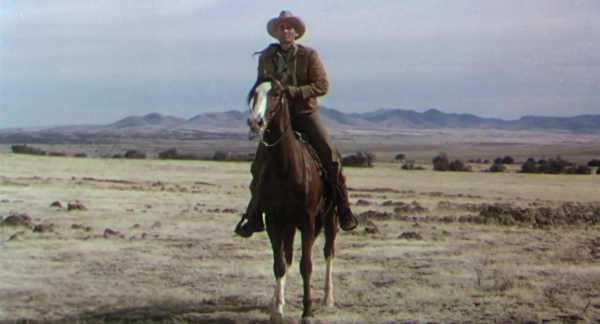
It begins with a lone rider (George Montgomery) checking the brands on horses after entering a new town, the kind of thing a man might do were he searching for someone. He proceeds to scan the wanted posters nailed on the wall, but there’s something furtive in his scrutiny, something a little too eager perhaps and then that quick turning away lest anyone catch sight of him doing so. Is he the seeker or the sought? Maybe a bit of both, but the viewer will have to wait a while before any real light is shed in that direction. The focus shifts to the two rival gangs of thieves mentioned above. They are led respectively by Heesman (Peter Graves) and Hank Hays (Richard Boone), and it’s the latter group that our protagonist throws in with. He claims to go by the dubious name of Tex and is reluctant to divulge any more personal details. Both these gangs have been hired by a local rancher, Bull Herrick (Bruce Bennett), who has been left paralyzed as a result of a riding accident and he has hit on the idea that the best way to keep the rustlers from decimating his herd is to employ them and trust to their mutual hatred ensuring they keep an eye on each other. A sound plan as far as it goes, and it does seem to be going the right way till they decide to cooperate in thinning out his herd and then there is the inevitable falling out – the myth of honor among thieves proving to be as fragile as all other myths. Throw in complications provoked by the presence of Herrick’s sister (Sylvia Findley), as well as the fact Tex has his own scores to settle, and the plot thickens satisfyingly.

Robbers’ Roost relies heavily on the twists and turns of its plot and characterization is relegated to a bit of an afterthought. The bad guys are bad just because they are and Montgomery’s ambiguous hero is on the side of the angels simply because he does mainly good deeds. Now I’ve never read the novel which the movie is based on – although I have picked up a free eBook of it so that can be remedied – and as such I’m not in a position to say whether the script cut much out. Nevertheless, as the movie stands the main interest is seeing how the gang conflict will play out and how Montgomery’s Tex will fare. I think one of the main strengths of the film is the extensive location shooting, an element which grows more prominent as the story progresses. To be frank, the early scenes around the town, and to some extent those around the Herrick ranch, are not especially inspiring. Sidney Salkow was a middling director at best, a safe pair of hands with extensive experience in B movies and supporting features, but no great visual stylist. That said, the Durango locations look quite splendid and the second half of the picture, with its abundance of action and outdoors shooting, makes for a particularly enjoyable watch.

George Montgomery is on fine two-fisted form, riding tall in the saddle and walking tall to boot, he looks and sounds like a classic western hero. His character is carrying a secret, the movie does need a touch of mystery to keep everything ticking along, and he catches some of the reticence necessary in such a role. There’s nothing all that notable about his performance – the script doesn’t demand that, to be fair – but there’s nothing wrong with it either. In short, if you’re a fan of his westerns, then Robbers’ Roost will do just what you expect. As the pair of villains, both Peter Graves and Richard Boone are fine, although the latter has the showier part and was the stronger actor in general. As I said above, neither one sees his character develop beyond that which we see at the beginning. It’s worth pointing out, however, that there is always much pleasure to be derived from any flat out villainous turn by Richard Boone. It feels as though Bruce Bennett, ever a reliable supporting actor, is being set up to play a more significant part but he essentially disappears in the second half, reduced to peering belligerently from a window as friends and enemies alike ride off to squabble over his sister and his stock. Leo Gordon and Warren Stevens fare much better as opposing rustlers, but William Hopper (TV’s Paul Drake from the Perry Mason show) must have been left wondering what he’d been hired for.  Sylvia Findley is the only woman in the movie, and apart from this her sole acting credit is in Hugo Fregonese’s long neglected Black Tuesday. There must be some reason for that.

Over the years I’ve come to the conclusion that the condition a movie is in when viewed has an effect on the way we perceive it. Watching the German Blu-ray of Robbers’ Roost brought this home to me once more as I felt a lot better about the film than I had in the past. There is a lot of day-for-night shooting and that aspect never looked great on the old DVD copy I’d seen before. The Blu-ray has everything looking cleaner, clearer and sharper, just like watching a different movie. All in all, this is an unpretentious little western, nicely paced, well shot and pleasingly acted. I’m glad I revisited it.

Cry Danger

The frame up and revenge are classic noir ingredients, saps suckered into taking a fall and then looking to square it with those responsible have kept the motors humming on many a dark crime drama. Cry Danger (1951) is based on these themes, with thoughts about loyalty and love tossed into the mix as well. The movie is a bit like an old friend in the sense that it is packed to the rafters with familiar elements, and like an old friend I’ve visited it a few times over the years. I guess that’s another characteristic that applies to most films noir; they never seem to wear out their welcome no matter how many times they’ve been viewed, the setups and situations becoming something akin to reminiscences among acquaintances.

I mentioned revenge in the opening sentence, but the fact is that Cry Danger is more concerned with a quest for justice than anything else. Rocky Mulloy (Dick Powell) has just caught a break, even if he’s not thinking of it in those terms as he steps off the train in Los Angeles. He’s fresh out of prison, having served five years of a life sentence for his part in a killing and robbery. Why is he back on the streets so soon? Well aside from the fact he knows he was not guilty of the crime, a witness has just turned up who could corroborate his alibi from all those years ago. Delong (Richard Erdman) is a one-legged ex-serviceman who is only now able to back up Mulloy’s claims that he was drinking in a bar with a group of Marines when the heist was going down. Mulloy is naturally sore that he’s essentially lost those years but he’s also keen to find the real perpetrators, both for his own vindication and to secure the release of a friend who has also been jailed for the crime. In a neat twist, it’s revealed very early on that Delong never spent the evening drinking with Mulloy, never even met him before. He’s just a guy on the make who reckons that helping out like this will mean he can come in for a cut of the $100,000 take which was never recovered. Mulloy’s search for justice takes him to the trailer park where his friend’s wife and his own former fiancée (Rhonda Fleming) is living, and then back into the murky world inhabited by crooked bookie Castro (William Conrad). By the end, after more crosses than there are factors to describe them and some gratuitous violence on the side, Mulloy digs his way to an unpalatable truth.

Cry Danger was the first movie directed by Robert Parrish. He’d served a long apprenticeship in the editing and sound departments and worked on a number of films for John Ford. By 1951 he was therefore in a strong position to take what he’d learnt and craft his own pictures. Cry Danger saw him off to an impressive start and he made a series of mostly good, and in a handful of cases truly excellent, films throughout the decade. This was also the first of four productions for Parrish where William Bowers was involved in the writing. And the script here is one of the strengths, tightly paced and twisty without becoming unnecessarily complex, it benefits from some marvelously snappy dialogue that catches the flavor of the hard-boiled idiom. Unlike a lot of films noir, there isn’t a great deal of overt social commentary. There’s not, for instance, much if any background provided for Mulloy, nothing to hint at how this man got himself tied up with bookies and crooks in the first place. The one concession to the consequences of life in the post-war world is the portrayal of Delong. This disabled veteran makes only the briefest reference in passing to the loss of his leg, but there is a suggestion that his prodigious drinking has its roots in that injury. A good deal of that too is treated in a light and offhand manner, though there is one point where the possibility or advisability of his trying to quit is raised. The wistful look, one tinged with a shadow of desperation, that passes over Delong’s face alludes to some inner suffering. Nothing much is made of this but it is there for the viewers to take on board should they wish to do so.

Dick Powell had grown confident and comfortable in roles such as this, a tough and smart guy who has some blind spots when it comes to friends. The clever patter rolls of the tongue easily and he has an excellent foil in Richard Erdman who was just as quick on the quip. Rhonda Fleming is arguably too attractive to be entirely believable as someone living out of a trailer park, though the fact her husband is doing time kind of justifies this. The path of her relationship with Powell’s character is complicated and, bearing in mind how everything is resolved in the end, it’s quite a subtle piece of acting on her part. As such, Cry Danger is certainly one of those movies where repeated viewings help to emphasize just how carefully she played the role. I’ve already referred to Erdman and it will probably suffice to say that his deadpan wit adds considerably to the film and makes it all the more enjoyable. In support, William Conrad never looks like someone trustworthy although he never comes across as all that menacing either – corrupt and devious, but not all that threatening. Regis Toomey was born to play cops and did so on numerous occasions. He had that weary practicality about him that felt authoritative and he uses it effectively as Powell’s ever present shadow.

Olive Films released a restored print of Cry Danger well over a decade ago now and it still looks fine. It’s a slick and pacy noir with the kind of plot that avoids overdoing the complications yet offers Powell the type of cool but tough part he excelled at playing. Highly watchable.

Pitfall

The daily grind, routine and repetitious. This is something most people can relate to, an integral part of all our lives just as much as sunrise and sunset. What does it represent though? Is it boon or bane? Well it certainly encapsulates the concept of security, and not just in a financial sense. That familiarity, that precise knowledge of where one is going to be at a given hour, perhaps even a given minute, of any day of the calendar offers reassurance. Yet reassurance is necessarily wedded to restrictiveness and at some point the balance between those two points of reference might just start to slip. That’s what happens in Pitfall (1948), a frank analysis of the way post-war suburban security and comfort could start to smother. Everything about it characterizes the classic film noir setup, the slow drift into dissatisfaction, the allure of the forbidden, the unwise choices and the way rapidly snowballing consequences threaten to smash everything in their path.

Johnny Forbes (Dick Powell) is a man who ought to be happy with his lot in life. He’s got a devoted wife (Jane Wyatt) and a bright young son. He’s got what appears to be a successful career in insurance and lives in a neat and attractive suburban home. What could be better than waking up to a breakfast that has been prepared and laid out before him, with his family around him, the sun pouring through the window and the promise of another relatively carefree day ahead. That’s how it should be, but the pain of predictability is etched into the hangdog features of Johnny Forbes as he contemplates it all. Both his demeanor and his conversation betray a man ripe for rebellion, a guy who has wearied of respectable averageness, of being part of the backbone of society. Such a man is just a step away from recklessness, he’s practically sleepwalking into peril. A visit to an embezzler’s ex in order to see how much can be recovered is all it takes. The ex in question is Mona Stevens (Lizabeth Scott), a model in a dress store. The hook that snags Forbes comes in the form of a trip to the marina to see the boat Mona’s boyfriend bought her with the money he stole. Just a smile from the girl and then a quick ride in the speedboat are enough – Forbes is soon asking her out for drinks, and it doesn’t take much imagination to realize where all this is heading. The affair itself only goes so far though, and not necessarily due to any moral qualms on the part of Forbes at this stage. A bigger issue is the fact that the private eye employed by the insurance firm to track down Mona Stevens in the first place (Raymond Burr) is besotted with her to the point he not only roughs up Forbes, but is also prepared to destroy anyone who stands in the way of his desires.

André de Toth made a handful of films noir and I think this is the best of them, although a strong case can be made for Crime Wave too. He perfectly captures the sheer ordinariness and regularity of suburban life, its bright and brisk order imparting a feeling of living on a well maintained social conveyor belt. Everything operates like clockwork, including the people. Dick Powell perfectly captures the ennui of a man gradually becoming just another obedient automaton. Everything about him screams normality, his quiet tailoring, his discreet briefcase, and the inevitable slow slide towards middle-aged and middle-class mediocrity that accompanies all that. This is no disillusioned veteran either – he was no decorated war hero like the father of his son’s friend, he rode out the war in Denver, Colorado – just an everyday guy who has come to the appalling conclusion that this is all he’s ever going to be. When he wrinkles his nose at the comic books he reckons have given his son nightmares it’s hard not to see a bit of resentment in it for not being one of those colorful figures himself. It is to De Toth’s credit that there is never any overt call to pass judgement on this man, no nudge towards any moral superiority or cheap finger pointing. Film noir works best when characters are portrayed as people with flaws who sometimes makes poor choices that the audience get to witness. Navigating life can be an ambiguous business at best and the better noirs seek to capture that incertitude rather than encourage self-righteousness.

The portrayal of the two female characters in Pitfall is interesting, and the movie offers good roles for both Jane Wyatt and Lizabeth Scott. There are those who say film noir must have a femme fatale, that it’s one of the vital ingredients. I’m not sure that’s true, and I’m also not sure if Lizabeth Scott’s Mona Stevens should be characterized as such. Yes, she draws the men in the movie into danger, fatally in one case at least and the ending leaves it open as to whether or not that’s going to apply to another as well. Still, if she is a femme fatale, she is surely a reluctant one and arguably a victim of both her own weakness and the limited options open to a woman like her at that time. She acts as a magnet for negative forces, drawing danger to her without actively wanting to. Jane Wyatt as the wife is a tougher, more grounded and practical creation. All the way through she remains focused on the security of the family unit. It’s quite a clinical piece of work by Wyatt and the cool way she appraises the benefits and drawbacks of each new development that assaults her existence contrasts with the reckless opportunism of Powell and the emotional helplessness of Scott. Raymond Burr gets the creepy obsessiveness of his character across well, manipulating everybody and maneuvering them like chess pieces towards an endgame that will profit only him. The scene where he stalks Scott in the salon where she works is masterly in the way he humiliates her in plain view yet maintains a wholly innocent air. His bulk and physicality is employed effectively too, filling and almost overwhelming Powell’s office when he visits.

1948 was a particularly strong year for film noir in Hollywood, maybe one of the strongest, and Pitfall sits comfortably among the leading pack. Nobody puts a foot wrong in this movie and the script has no flab or slackness about it. It is a tight, direct story that asks plenty of questions but offers up no easy answers. In short, it’s a good movie and one worth watching.