The Unforgiven

poster120

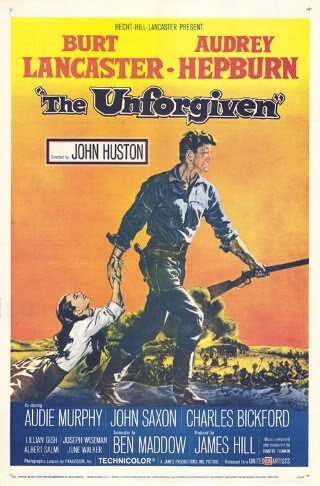
John Huston has to be one of my favourite directors but I’ve only just realised that, before today, I hadn’t written up any of his films on this blog. A quick browse through his lengthy and wide ranging filmography also drew my attention to the fact that he only made two westerns – I’m not counting The Misfits or The Treasure of the Sierra Madre, although some probably would – and I thought that seemed a little odd. The Unforgiven (1960) is a movie that doesn’t get talked up very much (the director professed a dislike of it which may have hurt its reputation some) but I believe it’s worthy of a bit of attention. The movie derives from a story by Alan Le May (The Searchers) and, perhaps unsurprisingly, concerns the fate of captives. What makes The Unforgiven a little different is the fact that the abduction that forms the background is a reversal of the usual white child spirited away by Indians one. In this case the settlers have taken a Kiowa baby and adopted her as one of their own. This storyline offers the opportunity to examine the effects of racism not only within the community but within the confines of the family as well.

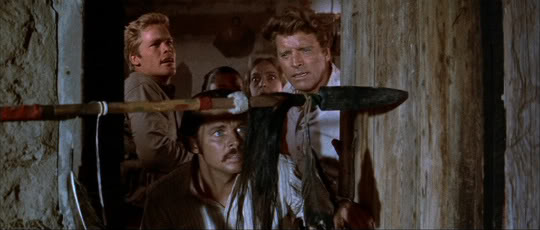
The Zachary’s are a close knit frontier family who, with the father dead as a result of a Kiowa raid, are held together by eldest son Ben (Burt Lancaster). He, with the help of brothers Cash (Audie Murphy) and Andy (Doug McClure), has been putting together a herd of cattle to send to Wichita and make their fortune. The family’s future looks secure and there is a chance of marrying the only sister, Rachel (Audrey Hepburn), into a neighbouring family of fellow ranchers, thereby cementing their partnership. However, the Zacharys’ dreams are built on shaky foundations and are soon to be swept away. Into their midst rides a mysterious old man (Joseph Wiseman), clad in a decaying Civil War uniform complete with sabre. In between quoting scripture he tosses out casual innuendo relating to a dark secret held by the Zacharys. Before long, Ben and Cash find themselves having to hunt down this otherworldly figure, knowing as they do that he intends to destroy them. This leads to one of the most memorable scenes in the film, as the two brothers chase their ghostlike quarry through a swirling dust storm – the old man seeming to appear and disappear at will, and then rushing out of the clouds of windswept sand with his sabre swinging murderously. Nevertheless, despite their best efforts, their nemesis evades them and poisons their neighbours and former friends against them. By the time the Kiowa turn up outside the sod covered family home demanding the return of what they claim belongs to them the Zacharys are about to tear themselves apart. Cash is an unashamed racist haunted by visions of his father’s death at the hands of the Kiowa, and barely able to contain his contempt and hatred for the red men. Therefore, Ben must prove himself the rock upon which the others can depend in order to weather the gathering storm.
£3

I’ve read that John Huston may have been displeased with the final product due to the fact that Audrey Hepburn later suffered a miscarriage, possibly as a result of a fall during production, not to mention that Audie Murphy almost drowned etc. Be that as it may, the film remains a solid, professional piece of work from Huston. He and DOP Franz Planer made excellent use of the wide angle lens to capture the scenery around Durango, and it contrasts well with the dark and claustrophobic interiors of the Zachary home. Apart from the aforementioned dust storm, the action scenes during the climactic siege are quite impressive.

The cast as a whole acquit themselves very well, with Lancaster displaying his customary stoicism interspersed with the occasional witticism. Audrey Hepburn would hardly rank as anyone’s idea of a western heroine but I thought she was pretty convincing in a difficult role. Audie Murphy never gets a lot of credit as an actor but this movie, probably more than any other, shows just how capable he was. He invests the character of Cash with a simmering mix of conflicting emotions that enables him to steal almost every scene he’s in. Lillian Gish also has a high old time as the tough matriarch with a steely resolve, and has a wonderful scene where she sits playing the piano outside at night to counter the music of the Kiowa medicine men. Joseph Wiseman chews up everything in sight as the spectral (no pun intended) Abe Kelsey, a genuinely scary yet pitiful husk of a man driven insane by grief and a desire for vengeance on those he deems responsible for past wrongs.

Given the indifferent treatment MGM often handed their catalogue releases the R2 DVD of The Unforgiven is actually quite pleasing. It’s given a handsome anamorphic scope transfer that has little damage on show save for a bit of light speckling here and there. Since this film is not widely regarded as one of Huston’s greatest it’s no real surprise that the only extra available is the theatrical trailer. I think this movie has been unjustly maligned by many and, even if it never comes to be seen as vintage Huston, it does work well as a mature western that at least tries to tackle a complicated issue. All in all, I like it and feel the performances and photography are ample reasons to give it a go.
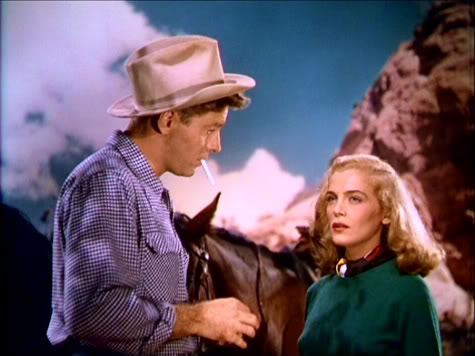
Desert Fury

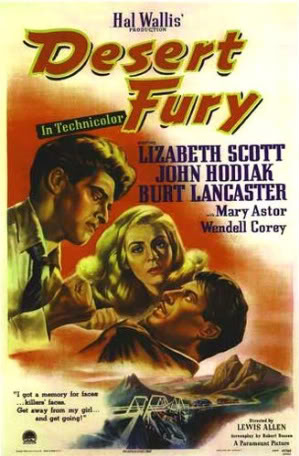
Can a technicolor movie be considered a film noir? I think so. Sure, the form lends itself better to the harshness of black and white photography where the light and shadows can be more skilfully manipulated. Having said that, film noir is more than just a photographic style – it’s a style of film making. To me, noir is a combination of many elements (theme, character, time, location, photography etc.) and the more boxes we can check, the closer we come to defining it. Photography is, undoubtedly, one of the major elements that needs to be present – I just feel that photographic style rather than color vs B&W is the clincher. As such, I feel Desert Fury (1947) is most definitely noir. Although the movie is shot in blinding technicolor, the themes and characterization place it firmly in the realm of dark cinema.

Paula Haller (Lizabeth Scott) returns to Chuckawalla, the small desert town where she was raised by her widowed mother Fritzi (Mary Astor). Paula is shown to be an outsider right from the off, snubbed by the locals due to her mother’s ownership of the town’s gambling joint. The only friend she has is Tom Hanson (Burt Lancaster), a former cowboy now working as town deputy after an accident put an end to his former career. Paula’s arrival back home coincides with the reappearance of a shady character called Eddie Bendix (John Hodiak), whose wife died years earlier in a mysterious road accident. When Paula falls for Bendix a whole hornet’s nest of passion is stirred up as Fritzi, Hanson, and Bendix’s partner Johnny (Wendell Corey) all, for their own reasons, try to keep them apart. What tilts this into noir, rather than straight melodrama, is the twisted nature of the relationships involved. Paula is said to bear a strong resemblance to Bendix’s late wife; Fritzi and Bendix were formerly lovers; there’s more than a hint of jealous competition between the two female leads; and there are strong suggestions that the relationship of Bendix and Johnny might involve some sexual undercurrents – heady stuff indeed for 1947. There’s also a nice cyclical form to the movie, which both opens and closes with characters staring over the rails of a bridge at the site of a fatal crash.

This is a picture that’s dominated by the performances of the women. Mary Astor is near perfect casting as the worldly and tough dame who rules the roost in a man’s world, yet struggles to tame the impulses of her headstrong daughter. Lizabeth Scott was born to star in films noir, and she does the business here as the troubled heroine with the whiskey voice who has to learn a few hard lessons. Burt Lancaster’s role is a bit of a thankless one; he seems to do little more than cruise up and down the desert highway, hoping to run into Scott on her return from Hodiak’s rented pad. Hodiak himself gives an interesting performance as man who’s clearly not all he seems. His initial detachment and suppressed aggression hint at some dark secret, and he gradually descends further into a kind of manic vindictiveness until his flaws and weakness are finally exposed by the sly and knowing Corey. Director Lewis Allen makes sure everything moves along smoothly and makes excellent use of the harshly beautiful locations. A word also for cinematographer Charles Lang, who makes those same desolate landscapes positively pop off the screen.

Desert Fury is available on DVD in R4 from a company called DV1. Their disc looks fantastic with strong color and detail, although there are some speckles and damage marks here and there. It is, however, totally barebones with not even subs offered. On the plus side there are some interesting liner notes  printed on the reverse of the cover – and it should be available cheaply. For me, this was pretty much a blind buy and I ended up enjoying it a lot. Recommended.

Gunfight at the O.K. Corral

poster8

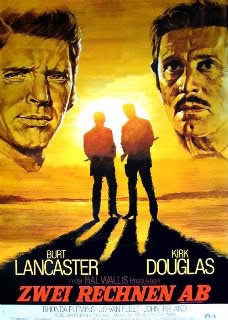
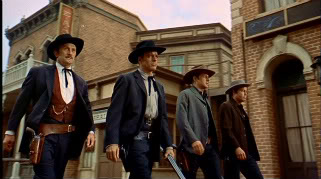
With Gunfight at the O.K. Corral (1957) John Sturges took his turn at putting Wyatt Earp’s story on the screen. When this film is compared to those which went before, there can be no doubt that it does come closer to the truth. There are more characters represented who actually played a part in the real events, small incidents which have a basis in fact are shown, and a little back story is provided. Having said all that, there are still lots of inaccuracies with names being changed and things not happening as they really did. Still, this is not a documentary, it’s a movie – and a highly polished and entertaining movie at that.

Frankie Laine’s rendition of the title song opens the movie as Wyatt Earp (Burt Lancaster) rides into Fort Griffin, Texas in pursuit of Ike Clanton. During his stay he meets Doc Holliday (Kirk Douglas), whom he subsequently saves from an angry mob intent on lynching him. This places Holliday in his debt and provides the basis for the two men’s friendship. As the film proceeds we see Earp and Holliday cross paths again in Dodge City before moving on to Tombstone, and the famous showdown. The fact that each segment is both punctuated and linked together by the theme song gives the film a slightly episodic feel. Mind you, that’s not a criticism; Laine’s vocals work almost as well as Tex Ritter’s do in High Noon (both of which, coincidentally, were scored by Dimitri Tiomkin). There are romantic sub-plots thrown in for the two leads – the one involving Earp and a lady gambler (Rhonda Fleming) is mostly superflous, while the stormy, abusive relationship between Holliday and Kate (Jo Van Fleet) works better since it does serve to drive the narrative forward.

£38

Gunfight at the O.K. Corral was the second film that Lancaster and Douglas made together and they work well in tandem, each playing nicely off the other. Lancaster’s Wyatt has more of a hard, grim edge to him than was seen in previous incarnations. At one point Holliday tells him, “You know Wyatt, you and I are pretty much alike actually. Both of us live with a gun – the only difference is that badge.” However, Sturges doesn’t explore this side of things too much, and it would be left to later films to point out the fact that Earp’s badge might have been used as a mere convenience. Kirk Douglas’ Doc Holliday follows the usual pattern of presenting him as a tortured and volatile soul, but his self-loathing has a greater pathos than either Romero or Mature brought to the role, and it’s a vast improvement. John Ireland makes his second appearance in an Earp film, playing Johnny Ringo (he was Billy Clanton in My Darling Clementine) and again comes to a sticky end. In fact there are lots of familiar faces: Dennis Hopper, Kenneth Tobey, DeForest Kelley (Star Trek’s ‘Bones’), Lee Van Cleef, Jack Elam etc.

Now a word about those items the movie got right, and those it didn’t. On the plus side we get a full complement of Clantons and McLaurys, Doc’s woman Kate is present, and Bat Masterson appears in Dodge City. Earp and Holliday are shown to meet in Fort Griffin and later in Dodge, where Doc saved Wyatt’s life as he attempted to stop a fight in a saloon. There’s also a brief reference to Old Man Clanton being shot dead as a result of his rustling activities. As for the negatives, James Earp is again falsely portrayed as the youngster of the family whose death is the catalyst for the gunfight – in truth he was the eldest and lived to a ripe old age. Ike Clanton and Johnny Ringo didn’t die at the O.K. Corral, Ringo wasn’t even there. Also, the corrupt County Sheriff has his name changed from Behan to Wilson.

The film is out on DVD from Paramount in R1 in a wonderful looking widescreen transfer. I haven’t seen the R2 to compare but I imagine it uses the same transfer. There is only very minor damage to the print and the colors are strong. Unfortunately, the disc is utterly barebones with not even a trailer present. The lack of supplements aside, this a great example of a 50’s western and one of the better movies about Wyatt Earp.


Sorry, Wrong Number

I’ll start off by saying that I like films that employ flashbacks in the telling of the story. Of course, if this technique is going to be used it needs to be done well. An example of its misuse/abuse would be Passage to Marseille; where there are flashbacks within flashbacks within flashbacks to the point that the viewer is driven half crazy and loses all sense of time and place. Sorry, Wrong Number (1948) avoids falling into this trap. Here, those trips down memory lane are necessary to drive the story forward and they work perfectly.

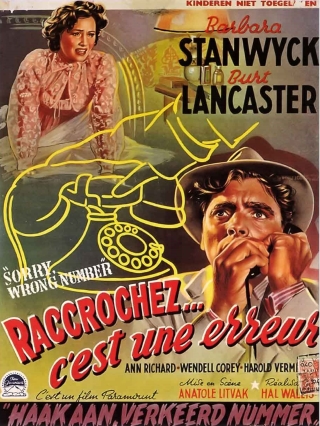
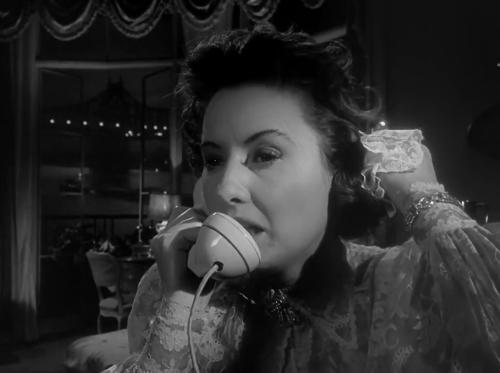
The film was adapted from a radio play and summarising the plot is not so easy without giving away too much, and thus ruining it for anyone who hasn’t seen it. Almost all of the action is played out via a series of telephone conversations involving Leona Stevenson (Barbara Stanwyck). Leona is introduced as a rich, pampered invalid who lives in luxury in Manhattan and, alone and bed-ridden, has only her telephone as a means of communicating with the outside world. As a result of a crossed line, she overhears a conversation between two unknown men as they finalise the details of a murder soon to be committed. Naturally alarmed, Leona first tries to tip off the police but they profess an inability to act given the sketchy information available. Her next thought is to get in touch with her husband Henry (Burt Lancaster), but that proves more difficult. Her attempt to contact him results in a series phone calls (and accompanying flashbacks) which gradually build up a complete picture of Leona, Henry and their life together. With each call another piece of the puzzle falls into place, and Leona slowly arrives at a horrifying realization.

Barbara Stanwyck has come to be regarded as something of a noir icon, largely through her icy portrayal of Phyllis Dietrichson in Double Indemnity. Where that film cast her as the archetypal femme fatale, Sorry, Wrong Number has her play the helpless woman in distress. She does well here with a character that starts off as an unsympathetic figure. As Leona moves from an initial petulance, through frustration to panicked terror, she manages to avoid the temptation to overact. All the emotions on display fit in with the type of woman revealed over the course of the film. Burt Lancaster was in the middle of a series of noirs, or noir tinged movies, at this point and he’s pretty convincing in the role of Henry. He begins as a blue-collar bit of rough who catches Leona’s fancy, becomes her pet plaything, and finally allows his simmering frustration and innate greed to draw him into criminality. There are also plenty of good turns from a support cast which boasts Wendell Corey, Ed Begley, Leif Erickson and William Conrad. While this is a movie full of flawed and unsavoury characters, the one sympathetic figure is Harold Vermilyea’s Waldo Evans. He’s the soft-spoken little chemist who dreams and saves in the hope of owning a farm where horses can roam free. When Henry spins him a tale that promises enough cash to realise this dream, the poor sap falls for it and his fate is sealed.

Sorry, Wrong Number fits the noir bill by delivering a story where there are no winners and no happy endings. We have a roster of characters whose greed, selfishness and weakness set them on a path towards their own self-destruction. The moody photography of Sol Polito is another essential ingredient, and it’s at its most effective in the scenes on Staten Island. This desolate setting, especially the decrepit 20 Dunstan Terrace, is a place where you just know darkness lurks.

The film has long been available on DVD in R1 from Paramount, and it’s a pretty good transfer. The print used is clean but it does display very heavy grain, particularly in the darker scenes. As usual from Paramount there’s not much in the way of extras, just a theatrical trailer. Still, the disc can be picked up for very little and the quality of the movie alone is more than enough reason to justify a purchase.

The Killers

I did something wrong…once.

So says the Swede (Burt Lancaster) as he lies in bed bereft of all hope, and calmly awaits his end. I love that scene near the beginning of the 1946 version of The Killers. It is one of the great moments of film noir and says so much about the genre – if you can even call it a genre. A good deal of its bleak power comes from the fact that it seems to run contrary to all normal human instincts. If someone were to burst into your room and breathlessly inform you that a couple of mean-looking hitmen had just rolled into town with the express aim of rubbing you out, most people would take the opportunity to make tracks fast. But Lancaster just remains prone in the shadows and delivers that line in the detached tone of a man already dead; when fate pays that last call there’s no ducking out.

Robert Siodmak’s film takes Ernest Hemingway’s short story (and it’s a very short story) and uses it merely as the jumping off point. The rest of the movie follows insurance investigator Reardon (Edmond O’Brien) as he tries to find out why the Swede ended up in a small New Jersey town waiting passively to greet a hail of bullets. The story is revealed by a succession of characters who had known the Swede, and a number of flashbacks gradually piece together all the events that brought about his demise. The Swede starts off as a medium grade fighter who, after breaking his hand and ending his career, begins the slow descent into the criminal underworld. This culminates in a payroll heist, the aftermath of which leads to the eventual downfall of just about everybody involved. The character of the Swede is basically a good-natured oaf whose desire for easy money allows him to be dazzled and duped by the grasping and predatory Kitty Collins (Ava Gardner). In a sense the whole film is as much about Kitty as anyone else; as we see her manipulations provide the catalyst for the betrayals that litter the story.

The Killers marked the screen debut of Burt Lancaster and his tough vulnerability is shown to good effect in the movie. There’s enough innocence in the Swede for you to genuinely sympathise with him and despair at the big lug’s stupidity as Kitty plays him for the ultimate sucker. Ava Gardner’s Kitty gets the classic femme fatale intro; we first see her as the Swede does – seductively clad in black satin and vamping for all she’s worth in a night club. Her character is rotten all the way through – effortlessly hooking the smitten Swede, playing the gang off against each other, and finally, tearfully begging a dying man to save her neck by damning himself. The role of Edmond O’Brien is to offer perspective and lead the viewer through the labyrinth of deceit; he’s really the linking device between all the small episodes that make up the whole. O’Brien’s own guide along the way is police lieutenant Lubinsky (Sam Levene from the Thin Man movies) and there is good support from gang members Albert Dekker, Jack Lambert and Jeff Corey. However, two of the most memorable turns come from William Conrad and Charles McGraw as Max and Al, the killers of the title. Their roles don’t extend much beyond the first ten minutes of the film, but those are ten truly magical minutes. They get some of the choicest dialogue (and deliver it perfectly) as they simultaneously mock and menace the occupants of the Brentwood lunch counter.

Robert Siodmak made some of the best noirs of the forties and I feel The Killers is his standout work. This is one of those films where plot, direction, characterization and photography all seem to come together harmoniously. Deep, dark shadows are everywhere and only the policeman’s terrace, where the ideal wife serves lemonade on a hot day, seems to rise above the murkiness. I should also say a word about the powerful score by Miklos Rozsa which is especially effective whenever Messrs Conrad and McGraw make an appearance.

The Killers is out on DVD from Criterion in R1 and from Universal in R2. I can’t comment on the presentation on the R2 disc as I haven’t seen it but bitter experience has taught that Universal’s UK releases are a hit and miss affair, with a high proportion of misses. The Criterion is everything you would expect from them with a beautiful, clean transfer to show off those deep, black shadows. As you would expect, the film comes packed with useful and informative extras – and, best of all, it is paired with Don Siegel’s 1964 remake (and Andrei Tarkovsky’s student film version). All in all, this represents the definitive presentation of what is probably my favorite film noir.