Cry Danger

The frame up and revenge are classic noir ingredients, saps suckered into taking a fall and then looking to square it with those responsible have kept the motors humming on many a dark crime drama. Cry Danger (1951) is based on these themes, with thoughts about loyalty and love tossed into the mix as well. The movie is a bit like an old friend in the sense that it is packed to the rafters with familiar elements, and like an old friend I’ve visited it a few times over the years. I guess that’s another characteristic that applies to most films noir; they never seem to wear out their welcome no matter how many times they’ve been viewed, the setups and situations becoming something akin to reminiscences among acquaintances.
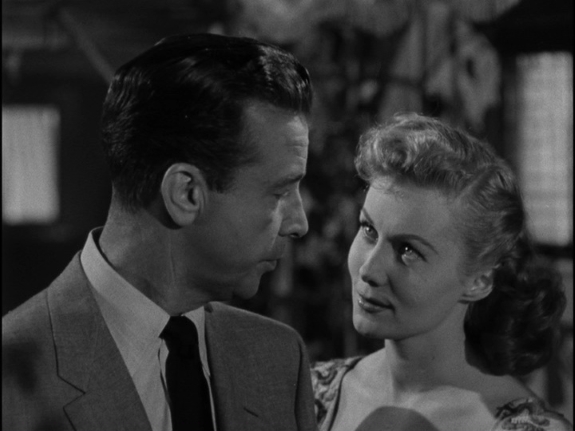
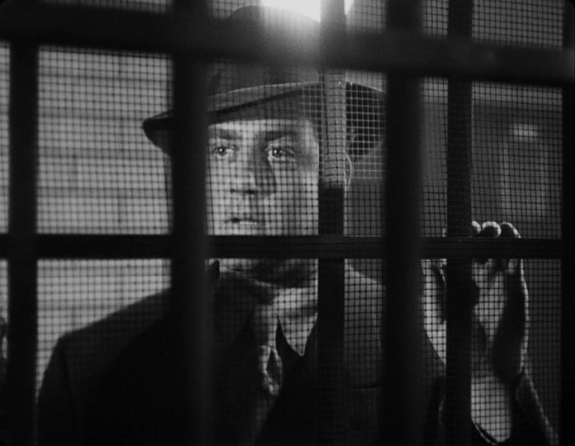
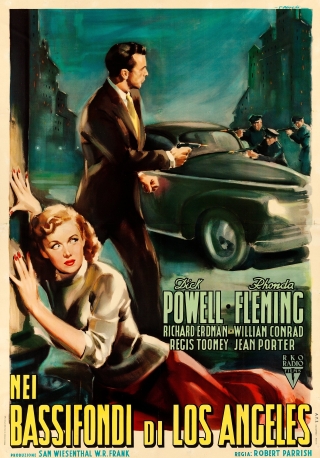
I mentioned revenge in the opening sentence, but the fact is that Cry Danger is more concerned with a quest for justice than anything else. Rocky Mulloy (Dick Powell) has just caught a break, even if he’s not thinking of it in those terms as he steps off the train in Los Angeles. He’s fresh out of prison, having served five years of a life sentence for his part in a killing and robbery. Why is he back on the streets so soon? Well aside from the fact he knows he was not guilty of the crime, a witness has just turned up who could corroborate his alibi from all those years ago. Delong (Richard Erdman) is a one-legged ex-serviceman who is only now able to back up Mulloy’s claims that he was drinking in a bar with a group of Marines when the heist was going down. Mulloy is naturally sore that he’s essentially lost those years but he’s also keen to find the real perpetrators, both for his own vindication and to secure the release of a friend who has also been jailed for the crime. In a neat twist, it’s revealed very early on that Delong never spent the evening drinking with Mulloy, never even met him before. He’s just a guy on the make who reckons that helping out like this will mean he can come in for a cut of the $100,000 take which was never recovered. Mulloy’s search for justice takes him to the trailer park where his friend’s wife and his own former fiancée (Rhonda Fleming) is living, and then back into the murky world inhabited by crooked bookie Castro (William Conrad). By the end, after more crosses than there are factors to describe them and some gratuitous violence on the side, Mulloy digs his way to an unpalatable truth.
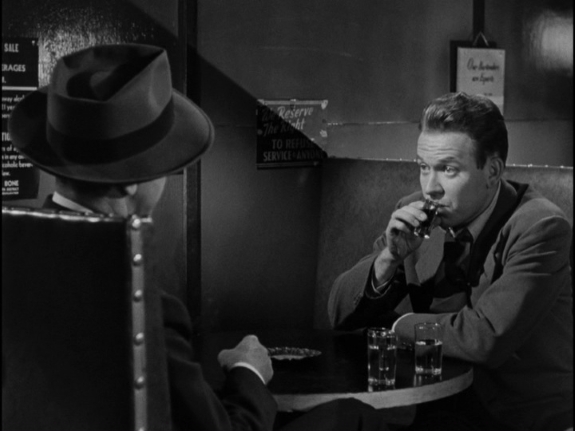
Cry Danger was the first movie directed by Robert Parrish. He’d served a long apprenticeship in the editing and sound departments and worked on a number of films for John Ford. By 1951 he was therefore in a strong position to take what he’d learnt and craft his own pictures. Cry Danger saw him off to an impressive start and he made a series of mostly good, and in a handful of cases truly excellent, films throughout the decade. This was also the first of four productions for Parrish where William Bowers was involved in the writing. And the script here is one of the strengths, tightly paced and twisty without becoming unnecessarily complex, it benefits from some marvelously snappy dialogue that catches the flavor of the hard-boiled idiom. Unlike a lot of films noir, there isn’t a great deal of overt social commentary. There’s not, for instance, much if any background provided for Mulloy, nothing to hint at how this man got himself tied up with bookies and crooks in the first place. The one concession to the consequences of life in the post-war world is the portrayal of Delong. This disabled veteran makes only the briefest reference in passing to the loss of his leg, but there is a suggestion that his prodigious drinking has its roots in that injury. A good deal of that too is treated in a light and offhand manner, though there is one point where the possibility or advisability of his trying to quit is raised. The wistful look, one tinged with a shadow of desperation, that passes over Delong’s face alludes to some inner suffering. Nothing much is made of this but it is there for the viewers to take on board should they wish to do so.
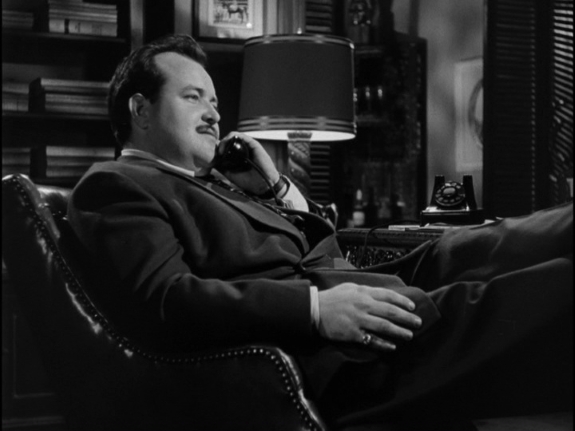
Dick Powell had grown confident and comfortable in roles such as this, a tough and smart guy who has some blind spots when it comes to friends. The clever patter rolls of the tongue easily and he has an excellent foil in Richard Erdman who was just as quick on the quip. Rhonda Fleming is arguably too attractive to be entirely believable as someone living out of a trailer park, though the fact her husband is doing time kind of justifies this. The path of her relationship with Powell’s character is complicated and, bearing in mind how everything is resolved in the end, it’s quite a subtle piece of acting on her part. As such, Cry Danger is certainly one of those movies where repeated viewings help to emphasize just how carefully she played the role. I’ve already referred to Erdman and it will probably suffice to say that his deadpan wit adds considerably to the film and makes it all the more enjoyable. In support, William Conrad never looks like someone trustworthy although he never comes across as all that menacing either – corrupt and devious, but not all that threatening. Regis Toomey was born to play cops and did so on numerous occasions. He had that weary practicality about him that felt authoritative and he uses it effectively as Powell’s ever present shadow.
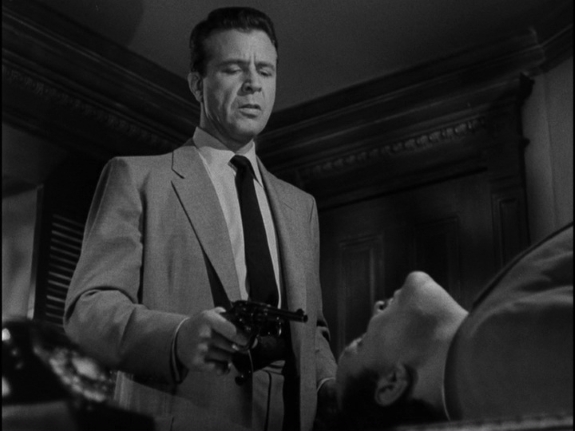
Olive Films released a restored print of Cry Danger well over a decade ago now and it still looks fine. It’s a slick and pacy noir with the kind of plot that avoids overdoing the complications yet offers Powell the type of cool but tough part he excelled at playing. Highly watchable.
Pitfall

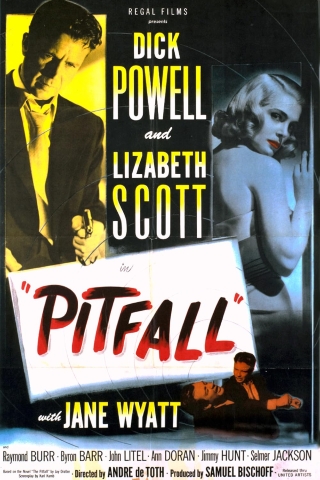
The daily grind, routine and repetitious. This is something most people can relate to, an integral part of all our lives just as much as sunrise and sunset. What does it represent though? Is it boon or bane? Well it certainly encapsulates the concept of security, and not just in a financial sense. That familiarity, that precise knowledge of where one is going to be at a given hour, perhaps even a given minute, of any day of the calendar offers reassurance. Yet reassurance is necessarily wedded to restrictiveness and at some point the balance between those two points of reference might just start to slip. That’s what happens in Pitfall (1948), a frank analysis of the way post-war suburban security and comfort could start to smother. Everything about it characterizes the classic film noir setup, the slow drift into dissatisfaction, the allure of the forbidden, the unwise choices and the way rapidly snowballing consequences threaten to smash everything in their path.

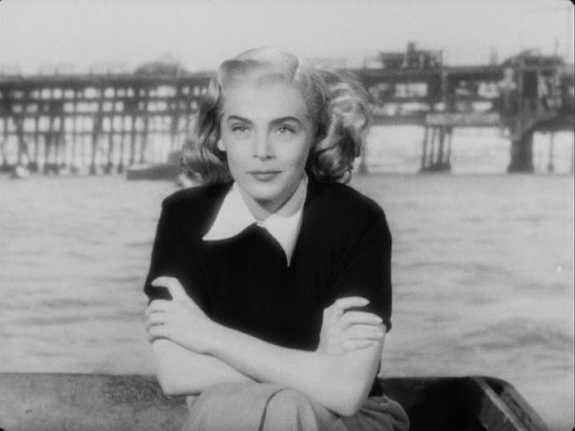
Johnny Forbes (Dick Powell) is a man who ought to be happy with his lot in life. He’s got a devoted wife (Jane Wyatt) and a bright young son. He’s got what appears to be a successful career in insurance and lives in a neat and attractive suburban home. What could be better than waking up to a breakfast that has been prepared and laid out before him, with his family around him, the sun pouring through the window and the promise of another relatively carefree day ahead. That’s how it should be, but the pain of predictability is etched into the hangdog features of Johnny Forbes as he contemplates it all. Both his demeanor and his conversation betray a man ripe for rebellion, a guy who has wearied of respectable averageness, of being part of the backbone of society. Such a man is just a step away from recklessness, he’s practically sleepwalking into peril. A visit to an embezzler’s ex in order to see how much can be recovered is all it takes. The ex in question is Mona Stevens (Lizabeth Scott), a model in a dress store. The hook that snags Forbes comes in the form of a trip to the marina to see the boat Mona’s boyfriend bought her with the money he stole. Just a smile from the girl and then a quick ride in the speedboat are enough – Forbes is soon asking her out for drinks, and it doesn’t take much imagination to realize where all this is heading. The affair itself only goes so far though, and not necessarily due to any moral qualms on the part of Forbes at this stage. A bigger issue is the fact that the private eye employed by the insurance firm to track down Mona Stevens in the first place (Raymond Burr) is besotted with her to the point he not only roughs up Forbes, but is also prepared to destroy anyone who stands in the way of his desires.

André de Toth made a handful of films noir and I think this is the best of them, although a strong case can be made for Crime Wave too. He perfectly captures the sheer ordinariness and regularity of suburban life, its bright and brisk order imparting a feeling of living on a well maintained social conveyor belt. Everything operates like clockwork, including the people. Dick Powell perfectly captures the ennui of a man gradually becoming just another obedient automaton. Everything about him screams normality, his quiet tailoring, his discreet briefcase, and the inevitable slow slide towards middle-aged and middle-class mediocrity that accompanies all that. This is no disillusioned veteran either – he was no decorated war hero like the father of his son’s friend, he rode out the war in Denver, Colorado – just an everyday guy who has come to the appalling conclusion that this is all he’s ever going to be. When he wrinkles his nose at the comic books he reckons have given his son nightmares it’s hard not to see a bit of resentment in it for not being one of those colorful figures himself. It is to De Toth’s credit that there is never any overt call to pass judgement on this man, no nudge towards any moral superiority or cheap finger pointing. Film noir works best when characters are portrayed as people with flaws who sometimes makes poor choices that the audience get to witness. Navigating life can be an ambiguous business at best and the better noirs seek to capture that incertitude rather than encourage self-righteousness.

The portrayal of the two female characters in Pitfall is interesting, and the movie offers good roles for both Jane Wyatt and Lizabeth Scott. There are those who say film noir must have a femme fatale, that it’s one of the vital ingredients. I’m not sure that’s true, and I’m also not sure if Lizabeth Scott’s Mona Stevens should be characterized as such. Yes, she draws the men in the movie into danger, fatally in one case at least and the ending leaves it open as to whether or not that’s going to apply to another as well. Still, if she is a femme fatale, she is surely a reluctant one and arguably a victim of both her own weakness and the limited options open to a woman like her at that time. She acts as a magnet for negative forces, drawing danger to her without actively wanting to. Jane Wyatt as the wife is a tougher, more grounded and practical creation. All the way through she remains focused on the security of the family unit. It’s quite a clinical piece of work by Wyatt and the cool way she appraises the benefits and drawbacks of each new development that assaults her existence contrasts with the reckless opportunism of Powell and the emotional helplessness of Scott. Raymond Burr gets the creepy obsessiveness of his character across well, manipulating everybody and maneuvering them like chess pieces towards an endgame that will profit only him. The scene where he stalks Scott in the salon where she works is masterly in the way he humiliates her in plain view yet maintains a wholly innocent air. His bulk and physicality is employed effectively too, filling and almost overwhelming Powell’s office when he visits.

1948 was a particularly strong year for film noir in Hollywood, maybe one of the strongest, and Pitfall sits comfortably among the leading pack. Nobody puts a foot wrong in this movie and the script has no flab or slackness about it. It is a tight, direct story that asks plenty of questions but offers up no easy answers. In short, it’s a good movie and one worth watching.

Rogues’ Regiment

With a variety of matters vying for my time and attention these days, I’m grateful to have this opportunity to put up a piece on another of those relative rarities that Gordon Gates thrives on. So, read on…

Rogues’ Regiment (1948) is one of a number of post WW2 noir dealing with escaped Nazi war criminals. Notorious, Cornered and The Stranger would be several of the more well known.
In this one, Dick Powell is an army intelligence agent on his way to French Indo-China. He is on the trail of a high-ranking SS officer who had escaped the roundup at the end of the war. The trail leads Powell to the French Foreign Legion camp in Saigon. (The French used large numbers of ex-German soldiers in their war with the Viet-Cong).
Powell’s main problem is that there are no known photos of the man he wants. He joins the Legion himself in order to try and identify the swine. Said swine, Stephen McNally, is very careful about his identity and bumps off everyone he thinks is a danger.
Helping Powell out on his case is French Secret Service agent, Marta Toren. Toren poses as a singer in a cabaret frequented by off duty Legion members of the German type. Of course Powell and Toren are soon drawn to each other.
Also in the mix here is Vincent Price as an antique dealer who supplements his income with a little gun running for the Viet-Cong. Philip Ahn and Richard Loo play Viet Cong types who are buying said weaponry from Mister Price.
McNally, who picked Saigon and the Legion thinking it would be the least likely spot to be recognized, finds the opposite true. One of his ex-staff officers, Henry Rowland from Dachau concentration camp happens to be in the same unit. While out on patrol the men become involved in a fire-fight with the Viet-Cong and McNally applies a few rounds to the man’s back. Problem solved.
Not quite it seems. Old Vincent has tumbled to McNally’s identity and figures a bit of blackmail is in order. He knows McNally has a large cache of jewels and gold taken from his camp victims. Price wants most of it. McNally agrees as long as Price can supply him with a passport and some American dollars so he can leave the country.
Both of course plan to double cross the other when the deal is completed. Powell and Toren who have been one step behind finally clue in and quickly pick up their pursuit. The meeting between  Price and McNally needless to say has turned ever so bloody. Who wins?
The director here is Robert Florey. His work included Meet Boston Blackie, Dangerously They Live, The Beast With Five Fingers, Danger Signal, The Crooked Way, and the very under-rated The Face Behind the Mask. He was also the helmsman on hundreds of television episodes.
Screenplay was by one time Oscar nominee, Robert Buckner. He did the story or screenplays for Deported, A Prize of Gold, Yankee Doodle Dandy, Santa Fe Trail, Virginia City, Dodge City and Love Me Tender.
Powell and Toren are okay with their roles, But it is McNally here as the Nazi louse, and Price as the blackmailing snake in the grass who steal the show.
Toren, who died at age 31, managed to work the film noir  Deported, Mystery Submarine, Spy Hunt, Illegal Entry, One Way Street, Paris Assignment and Sirocco into her 4 year Hollywood career. The d of p was Maury Gertsman whose noir included Blonde Alibi, Inside Job, Singapore, One Way Street, The Glass Web and Johnny Stool Pigeon.
Well worth a watch if you can find it. Needless to say it is another UNIVERSAL-INTERNATIONAL Release.
Gordon Gates

The Bad and the Beautiful

Don’t worry. Some of the best movies are made by people working together who hate each other’s guts.

Seeing as Kirk Douglas celebrates his 100th birthday today I wanted to make a point of featuring one of his movies to mark the occasion. With one of the great movie stars I figured it would be appropriate to choose a movie about movie-making, not only one of the best of that little sub-genre but one of the best Hollywood has produced. The Bad and the Beautiful (1952) is a carefully crafted piece of work, episodic in structure but with an organic, flowing quality that ensures scenes and sequences segue naturally to provide us with a portrait of a man both shaping and simultaneously being shaped by the cinema. Sounds like a perfect role for Douglas, doesn’t it?

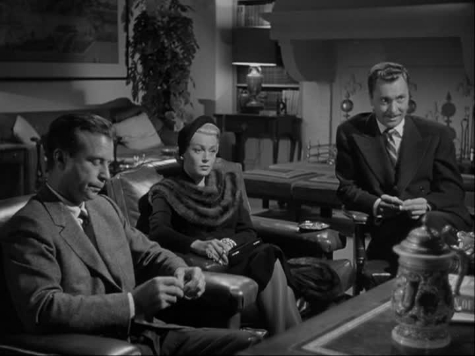
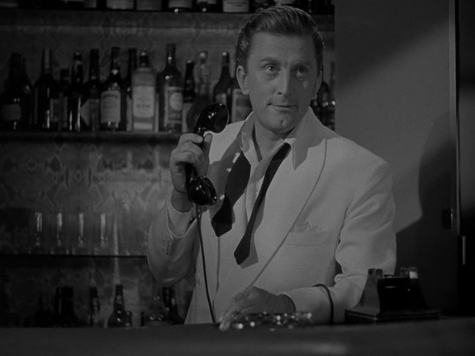
If one wanted to be glib, it could be said the film is the story of a phone call. In fact, it  starts with  a series of telephone calls, three to be exact and each one is rejected with something approaching relish. Three calls to three Hollywood figures, all of whom take pleasure in telling the party at the other end of the line to take a running jump. That guy at the other end of the line is Jonathan Shields (Kirk Douglas), once a big-time producer but now reduced to hearing casual brush-offs across a long distance line. So we’ve got a good hook right here, you do tend to wonder why a man should be summarily dismissed in this fashion. Curiosity is such that we want to know what a man like this has to say, and by the end of the picture those on the screen clearly share this feeling too. In the meantime, we have the build-up, where studio executive Harry Pebbel (Walter Pidgeon) tries to persuade the director (Barry Sullivan), the leading lady (Lana Turner) & the writer (Dick Powell) to at least take Shields’ call and give their collective answer on whether or not they are prepared to work with him one more time.  So, this trio gathers in Pebbel’s office while he, through flashbacks, recalls the way their lives and careers became entwined with that of Shields, and why they feel the way they do about him.

Hollywood thrives on narcissism, it loves to look at itself and can’t resist encouraging us to look at it while it indulges in this introspection. You could say that’s indicative of the all-consuming vanity of the movies, the conviction that audiences will be fascinated by the chance to peek behind the cameras and glimpse the artists and technicians at work and play, that there’s no drama as compelling as the everyday lives of the filmmakers themselves. And I guess they’re right, there’s always been a market for celebrity watching and this has shown no sign of abating any time soon, if anything it’s more intense than ever these days. We sometimes hear about stripping away the glamor but the classic Hollywood exposés didn’t really do that, sure they showed the less savory side of the business and those involved in it but even so they couldn’t help making it look good. As the title of this film suggests, there are some rotten people on screen but they and the world they inhabit remain beautiful and captivating. The Oscar-winning Charles Schnee screenplay focuses on the ruthlessness, the lack of scruples of Shields, the way he’s consistently used and manipulated his colleagues to attain success. Yet, for all that, despite the duplicity and the betrayals, the milieu holds our attention and we’re never allowed to forget that Shields brought success even to those he hurt.

Director Vincente Minnelli clearly enjoyed turning the cameras around since he, and Douglas, would return to the theme 10 years later when they made Two Weeks in Another Town, again scripted by Schnee and produced by John Houseman. He’s always going to be best remembered for his musicals but it has to be said he had a marvelous talent for well-judged melodrama – this movie, the aforementioned Two Weeks in Another Town, Home from the Hill and the dazzling Some Came Running are significant artistic achievements and add up to a highly impressive mini-filmography by themselves.

Kirk Douglas was second billed in The Bad and the Beautiful behind Lana Turner and earned himself his second Oscar nomination. He didn’t win (losing out to Gary Cooper in High Noon that year) and claims in his autobiography to have been surprised by the nomination, believing his roles in Wyler’s Detective Story or Wilder’s Ace in the Hole were more worthy of such an honor. I think this says something about the way Douglas views his own work, seeming to prefer the more driven and less sympathetic parts. While there is much to dislike about Jonathan Shields, it’s said that Minnelli worked on Douglas to bring out the nicer side of the character and tone down the more explosive and less likeable aspects. Which is not to say he doesn’t explode at any point – he does have two fairly intense, in-your-face scenes opposite Lana Turner, but it probably wouldn’t feel like a proper Kirk Douglas film if they weren’t there.

Lana Turner wasn’t an actress who ever impressed me all that much, meaning she was always someone you noticed in a movie (her looks kind of demand that) but whose roles were frequently less memorable, with a few notable exceptions. I think The Bad and the Beautiful ranks as one such exception. The fact she was playing an insecure, alcohol dependent star was an advantage as it required a degree of fragility and vulnerability that Turner was able to convey successfully. In terms of awards though, the big winner among the actresses was Gloria Grahame, who scooped the Oscar for best supporting actress. Grahame was a terrific screen presence, sexy and credible in just about everything I’ve seen her in. Her part in this film is a small one, confined to the section with Dick Powell, yet she doesn’t waste a moment of the time she has. Powell was fine too as her cynical husband, adding an intellectual spin to the kind of insolence he had down pat by this stage. I generally like Barry Sullivan, he was one of those guys who could be a hero or villain (or even something in between) quite effortlessly. He was good enough as the director who sees his idea stolen but it’s an undemanding and perhaps a bit of a thankless part under the circumstances. And there’s plenty of depth in the cast – Walter Pidgeon, Leo G Carroll, Gilbert Roland and Paul Stewart all make contributions.

This is a movie where some people like to see if they can pick which cinema personality each of the main characters was based on – Douglas’ lead appears to be a composite of sorts with the characteristics of at least two producers (one of whom is a cult favorite) on view. Of the others, some are pretty obvious (Lana Turner’s part, for example) while others (like Barry Sullivan) are less so. I won’t go naming any names here – it might spoil a little bit of the fun for some and anyway the curious can easily search online for clues/opinions. That’s just trivial stuff though, the movie provides a masterclass in professionalism and polish where there’s next to nothing to fault in the direction, writing, photography (another Oscar there for Robert Surtees) and acting. The Bad and the Beautiful is an extremely smooth and classy piece of filmmaking, Hollywood writing its own lore and having a good time doing it. The film is easy to find and looks good too, at least my old Warner Brothers DVD does. Viewed for the first or the fiftieth time, it still satisfies.

It’s a rare thing to be able to post something on the occasion of the 100th birthday of a living screen legend, a bona fide star of the Golden Age of cinema, and it gives me a real kick to be able to do so on the day Kirk Douglas hits three figures – congratulations to him and may he see many more.

The Tall Target

I’ve mentioned before that I’m a big fan of thrillers taking place in isolated or self-contained settings such as old dark houses, ships or trains. The restrictions necessarily imposed are a marvelously effective way of maintaining focus, both for the filmmakers and the viewers. It also makes for effortless suspense as the options open to the characters involved are narrowed down, and a tense, claustrophobic atmosphere is easily achieved. The bulk of the action in The Tall Target (1951) takes place on a train, and the movie uses this cramped stage to enact its dramatic events to great advantage. What makes the film all the more impressive in my view is the fact that there’s not much of a mystery to solve. Nevertheless, what unfolds on the screen holds the attention from beginning to end.

The story is one inspired by a real event – a plot to assassinate Lincoln before his inauguration coud take place. It’s 1861 and the president-elect is due to make a short stop in Baltimore, Maryland before heading on to Washington to take power. Naturally, these are troubled times and talk of secession and war is on everyone’s lips. With Lincoln’s elevation to the highest office in the land it’s only a matter of time before the South declares independence, and war has to be the next logical step. As such, there are those with a vested interest in seeing that the man never gets to Washington. John Kennedy (Dick Powell) is a detective who feels sure he’s stumbled onto a plot to assassinate Lincoln as soon as he sets foot in Baltimore. The problem is no-one wants to believe him, and his chief even goes so far as to threaten him with dismissal if he insists on pursuing the matter. Unfazed by this stonewalling, Kennedy turns in his badge and hotfoots it to the station. His intention: to board the Baltimore train, foil the conspiracy and discover the identity of the ringleaders. However, he immediately hits a snag; his contact, along with his ticket, has disappeared and someone else is claiming to be the real John Kennedy. A quick inspection reveals that the detective’s friend has been murdered, but there’s no way he can prove this. Such an inauspicious start would give most men pause for thought, but Kennedy is nothing if not resourceful and he turns to an acquaintance to back him up. Colonel Jeffers (Adolphe Menjou) is the one man aboard the train who can identify Kennedy and vouch for his credentials. So the soldier and the policeman form an uneasy alliance – Jeffers is no lover of Lincoln’s politics – in the hope of flushing out the would-be killers. The list of suspects is a relatively short one: Jeffers himself, a blowhard industrialist (Will Wright), a young brother and sister apparently traveling on to Georgia (Marshall Thompson & Paula Raymond). Although the villain’s identity is revealed around the halfway mark, I’m not going to spoil things for any people who have yet to see the movie. Anyway, that’s not the point of the film. The greatest anxiety is generated by the doubts over whether Kennedy can prevent the assassination from taking place. Now anyone with even the most rudimentary knowledge of American history knows the answer to that one, but where the script really triumphs is in its ability to leave you hanging on the edge of your seat in spite of this.

Although Anthony Mann had already embarked on his western phase by this time, The Tall Target harks back to the tight little noir thrillers with which he had made his name throughout the preceding decade. Instead of the wide open spaces of the frontier where the drama was played out against a harsh landscape, this film is a closed affair that was shot on sound stages. The actors don’t have a lot of room to move around freely, and that’s entirely fitting for a story where the characters’ capacity for manoeuvre in any sense is severely limited. There are also a lot of typically disconcerting low-angle shots and close-ups of strained faces. Mann seemed to be blessed with good cameramen through most of his career, and Paul Vogel did some excellent work on this movie. Vogel had already shot a number of noir pictures – Lady in the Lake, High Wall, Dial 1119 – and brought that sensibility to The Tall Target. This couldn’t be termed a film noir yet it has the look and feel of one. What we get is primarily a suspense thriller, and it’s a combination of good writing and characterization, as well as atmospheric direction and photography, that ensures it remains gripping. When Kennedy finds himself facing the twin dilemma of being pursued by both the assassins and the suspicious authorities, Mann gets a lot of mileage from such a simple setup as the search for a berth to hide in. Time and again he draws the maximum degree of tension from situations that the viewer knows deep down are going to be resolved favourably. It’s no mean feat to deftly turn potentially trite circumstances into something that has you biting your nails – in fact, I’d say it’s one of the factors which sets the artist apart from the mere journeyman.

Compared to the kind of stuff he’d been doing before, Dick Powell took his career in a completely different direction when he was cast in the role of Marlowe in Murder, My Sweet in 1944. I like the way he worked on the tough guy persona in the following years and carved out a little niche for himself. The Tall Target was one of his last cinema roles before he turned his attention to directing and TV, and he handles the part just fine. Playing a professional detective meant he had to do a bit of a balancing act, conveying the increasing desperation of a lone cop in a race against time yet still keeping just the right side of panic. He got some excellent support from Adolphe Menjou as the newly commissioned colonel. He adds some of his trademark polish to his performance and has the kind of ambiguous quality that helps round out his character. Will Geer brought a lightness of touch to the part of the frustrated conductor, and it’s a welcome contribution amid all the severity. I was also impressed by the sensitivity that Ruby Dee displayed as the slave girl torn between loyalty to her owners and a natural sympathy for Powell’s cause. Paula Raymond and Marshall Thompson were less effective, the former having the misfortune of being handed pretty much a nothing role, while the latter just seemed wooden. To be honest, I’ve never been all that taken with Thompson in anything I’ve seen him in; he always appeared too stiff and repressed for my liking. The cast was filled out with a whole host of character actors who should be familiar faces, including Florence Bates, Will Wright and Percy Helton.

To the best of my knowledge, the only DVD of The Tall Target is the MOD disc available via the Warner Archives. The transfer on that disc isn’t bad; it doesn’t appear to have had any work done on it but it’s in reasonable condition. There are the usual cue blips and the like to be found on unrestored movies though the image is satisfactorily sharp. With MOD discs you generally don’t get any extra features, but this one has the trailer included. I’m a great admirer of Anthony Mann’s work and The Tall Target is a good, solid effort. It has to be said that it’s neither as famous nor as complex as his best films. The lack of complexity shouldn’t be taken as any criticism of Mann, that’s just the way the characters are written, but it may partly explain why it’s not better known. Anyway, it’s a finely crafted little thriller that moves at a good pace and offers plenty of entertainment value. I have no complaints.

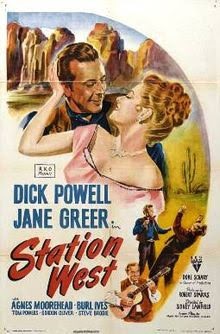
Station West

220px-station_west_poster_small

What an oddball little western this is. It opens with Dick Powell’s stranger riding into town and checking into a hotel run by a guitar strumming (and uncredited) Burl Ives who just happens to be singing about a stranger riding into town. At this point we’re not seeing any western conventions being stretched. However, as soon as this slight figure crosses the street, enters the saloon and starts to throw out the kind of wise cracks and casual insults that would surely earn anyone the ass-kicking of a lifetime, we can be sure this is no average oater.

Powell is not really your average western hero, and here this is explained by his being an undercover army intelligence officer. Mind you, I’m not suggesting that Powell isn’t tough enough to be a westerner (a brutal and well photographed brawl with Guinn “Big Boy” Williams leaves that in no doubt) but he doesn’t sound like a cowboy. In truth, this is a lot of what makes the picture so entertaining. If you are familiar with Powell’s role in Murder, My Sweet then this film will conjure images of Marlowe riding the range.

Another thing the movie has going for it is the cast. In addition to Powell we have Jane Greer, playing another dangerous vamp, who seems to own the whole town. Agnes Moorehead is Powell’s contact with the army, and Raymond Burr is the town lawyer with a gambling problem – all wide-eyed weakness and far removed from Perry Mason. The aforementioned Williams doesn’t have much to do here except look mean, but (as with Ward Bond) I find something reassuring about the presence of his familiar mug in a film. Burl Ives’ small role as “either the town poet or the village idiot” is also most welcome.


The plot revolves around hijacked gold shipments but, in a Chandleresque way, it doesn’t seem so important. The real joy here is the fusion of hard-boiled noir dialogue with western locales. If you are seeking an authentic and gritty representation of the Old West, then look elsewhere. On the other hand, if you are a fan of westerns and noir and want to see the best elements of both working in tandem, then Station West is worth a look.

The film is available on DVD from France in a transfer that is just adequate. It’s an RKO picture so it may get a R1 release from Warner one day, although the company seems to show little appetite for westerns right now.