Deadline – U.S.A.

“…the right of the public to a marketplace of ideas, news and opinions. Not of one man’s, or one leader’s, or even one government’s.”

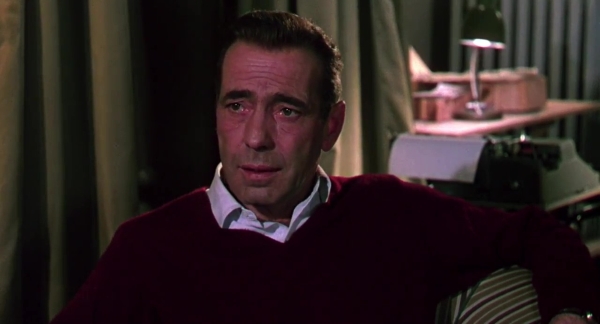
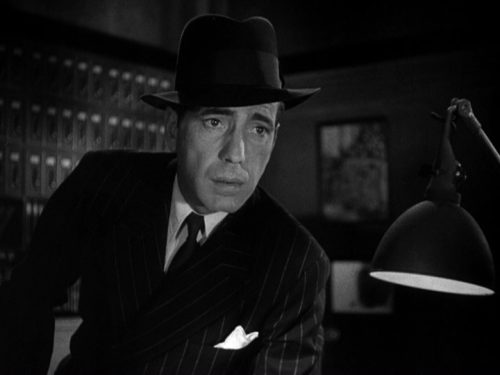
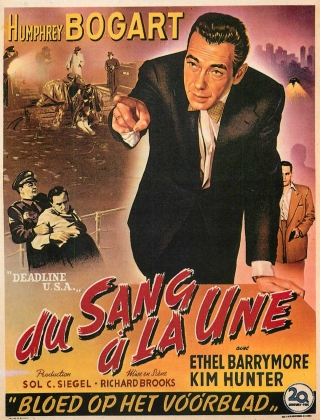
That eulogy to the Fourth Estate, not merely to its desirability but to its necessity as a vital pillar of a functioning democracy is delivered relatively late on in Deadline – U.S.A. (1952) by Humphrey Bogart’s committed and conscientious editor. It might come late in the movie yet everything has been building towards that and the narrative would already have led us to that conclusion even if the script had not spelled it out. If this point needed to be made back in 1952, it is arguably even more essential now where the current era of demagoguery sees the foundations of democracy chipped away at on a daily basis.
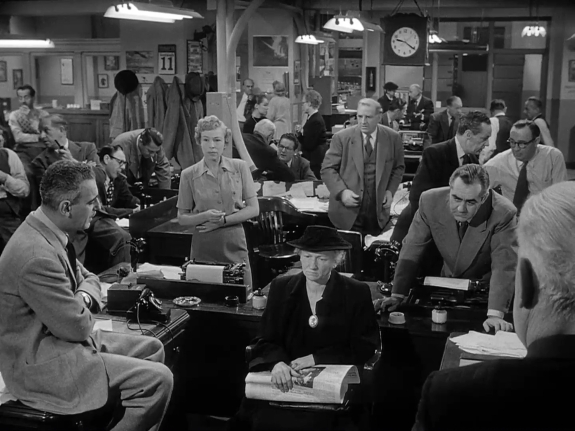
On various occasions throughout the film various characters refer to a murder, a wake and a funeral. It’s as though the shadow of death hangs heavily over the entire project. However, it’s not the death of person, even though there are a handful of those folded into the plot, but instead the demise of a newspaper which is alluded to. This sense of a paper as a living entity, with as much conscience and soul as a human being, pervades the movie. To be perfectly frank, the newspaper in question could be said to have more human characteristics than some of the individuals portrayed. Anyway, this anthropomorphism is key to understanding Deadline – U.S.A. and the points writer and director Richard Brooks seeks to hammer home. The paper in question is The Day, a publication which prides itself on its standards and its history. The editor Ed Hutcheson (Humphrey Bogart), as well as the staff, regards it as a newspaper as opposed to a purveyor of sensationalist yellow journalism. Despite that noble intent, or a cynic might posit because of it, The Day is on its way out. Life support is about to be unplugged and the owners, the detached and disinterested heirs of the founder, are in the process of selling off the carcass to a competitor whose primary interest is buying it in order to close it down and thus corner the market. The viewer is invited to follow the final days of this venerable institution where regardless of the sense of inevitability, there is also a resilience on show. Maybe it’s a losing battle but Hutcheson isn’t going down without a fight and the battlefield he’s chosen for the paper to stage its last stand is one reigned over by Tomas Rienzi (Martin Gabel).
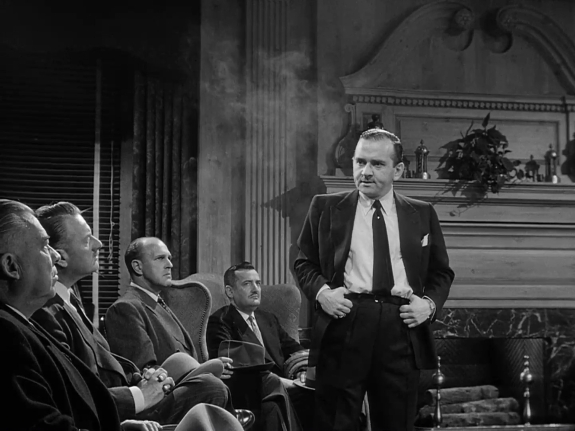
Rienzi is an old school hood, one of those guys where the patina of civilization is especially thin. He’s been investigated for corruption and graft but nothing seems to stick. This time may be different though – the body of a mink clad good-time girl has been fished out of the river and gradually a trail leading back to this Teflon don becomes apparent. In essence, a race takes place to see whether all the connections can be made before the courts put the seal on the sale of the paper, or before Rienzi’s enforcers can make enough witnesses and whistleblowers disappear. While there are other subplots touched on to varying degrees, it is here that the movie sets out its stall. Brooks wants to make the point that real journalism serves a vital civic purpose – “to comfort the afflicted and afflict the comfortable” if you like. Personally, I think his argument is both valid and worthwhile, maybe even more pronounced now than it was all those decades ago. If the printed press has gone into near terminal decline, the voice, function and long established ethics of the legacy media remain essential, even as they come under attack from a range of chiselers and charlatans.
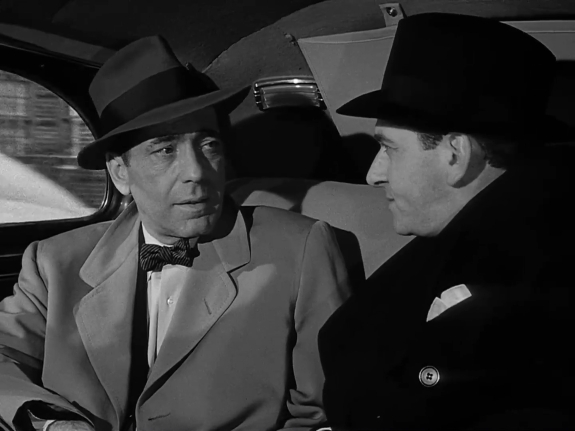
Movies about journalism, indeed the same could be said for that other subset movies about the movies themselves, seem to have their own  special energy. That such productions should exhibit a vitality ought not to be much a surprise when one stops to think how many writers and filmmakers had a background in journalism. The accepted wisdom is to write about what you know and there’s plenty of evidence to suggest that this kind authenticity does lend an added touch of passion to proceedings. Richard Brooks was one of those writer/directors who started out working as a reporter and the latent respect for the trade colors what he puts up on the screen in Deadline – U.S.A.  – that said, I do seem to recall seeing an interview he gave many years later where he expressed dissatisfaction with the title, feeling that it was meaningless in itself. Well if the title is somewhat awkward, the arguments underpinning the plot are not. Brooks keeps it moving along, capturing the noise and urgency of both the newsroom and the press room. There are a couple of instances of less convincing back projection but Milton Krasner has it looking attractive for the most part. Outside of the newspaper building itself, the most effective scene is that inside Rienzi’s car, where he and Hutcheson spar and both Bogart and Gabel make the most of Brooks’ snappy dialogue.
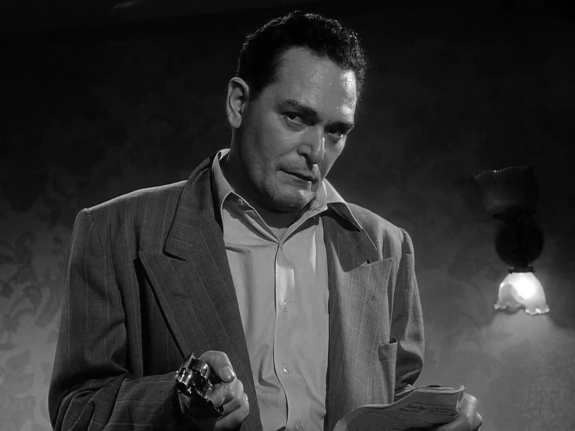
By this stage Bogart was an old hand at either playing it tough and cynical or tough and noble. He goes down the latter path here and his conviction is never in doubt whether he’s trading threats with a mobster or arguing ethics in the boardroom. The only less convincing aspect is his attempt to rebuild his marriage with his ex-wife Kim Hunter. She was an accomplished actress with successful work in A Streetcar Named Desire and A Matter of Life and Death behind her yet there’s a certain listlessness to her performance in this film which weakens that plot strand. On the other hand, Martin Gabel is a fine adversary for Bogart, desperate to convey respectability – “I’m in the cement and contractin’ bu’iness” – while his rough edges keep poking through the facade. There’s plenty of menace on display from Gabel, a man I’ll always associate with the role of Strutt in Hitchcock’s Marnie, but who also directed the atmospheric The Lost Moment.
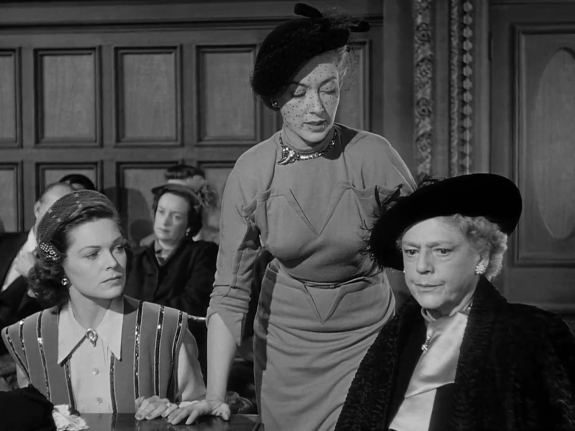
As is frequently the case with big studio productions of the era, there is strong support from a deep cast of familiar faces. Ethel Barrymore rolls out her wise old owl act once more, but she does it so well and so attractively that it’s a pleasure to watch. Ed Begley is comfortably solid, and Paul Stewart (someone else who could shift with ease between villainous and sympathetic parts) casts alternately weary and wary looks from beneath his ever expressive brows. Joseph De Santis has a ball as the scumbag brother of the murder victim, smirking and sweaty as he chisels his way to an undeserved payday before making a spectacular exit where he literally becomes front page news. Jim Backus, Tom Powers, Warren Stevens, Fay Baker, Joe Sawyer and Willis Bouchey among others drift in and out. Apparently, James Dean had a small uncredited part but I’ve never been able to spot him even after numerous viewings.
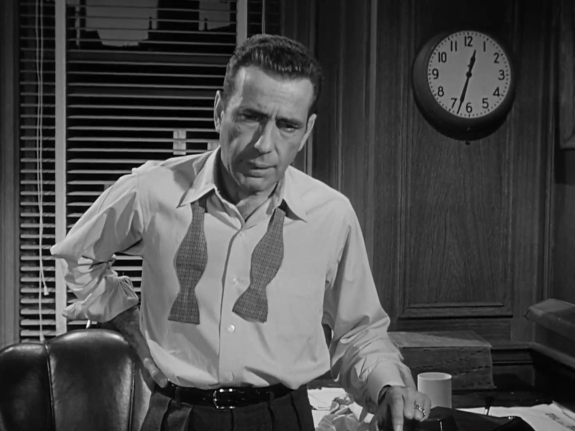
I’m not sure how well regarded Deadline – U.S.A. is or what kind of reputation it has. I do know I’ve always liked it, it has one of those roles which feel tailor-made for Bogart and the sentiments of the script appeal. I guess I’m something of a sucker for movies focused on newspapers and reporters. It should be easy enough to access in good quality these days; this was not always the case but there are high grade Blu-rays and DVDs of the movie available in most territories now – I have the German DVD myself. While the more venal sections of society endeavor to undermine public trust in the integrity of the mainstream media, it’s good to remind oneself of how important it was and is to all of us.

As an Amazon Associate I earn from qualifying purchases made through links on this page. 
 

To Have and Have Not

“Was you ever bit by a dead bee?”

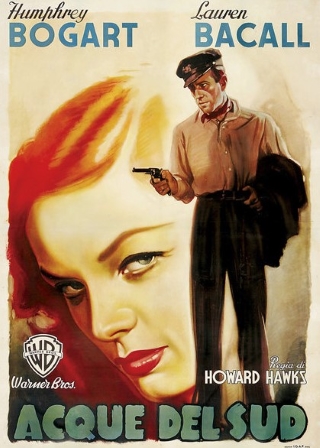
It’s tempting to use the more familiar, suggestive lines about matches, whistling and so on as an opener to the Howard Hawks adaptation of To Have and Have Not (1944). However, that business with the bee, uttered several times by Walter Brennan’s craftily befuddled rummy and later parroted by a smokily seductive Lauren Bacall feels like a better way in. Howard Hawks favored movies about tight knit groups, like-minded types who were bound together by a commitment to do whatever has to be done as well as holding some shared notion of personal honor. They should be people who live by their own code, and who recognize almost instinctively those who belong in their club. Well any such club ought to have a code word or phrase, one known to or capable of being interpreted correctly by their comrades. And so it is with Brennan’s bee shtick – the select band of “right guys” is neatly delineated as those who see the question for what it really represents and who in turn just know how to respond. There’s a lot of Hawks in that line and what it signals. As such, it seems apt to use it to lead into a movie which has more of Hawks in it than Hemingway.

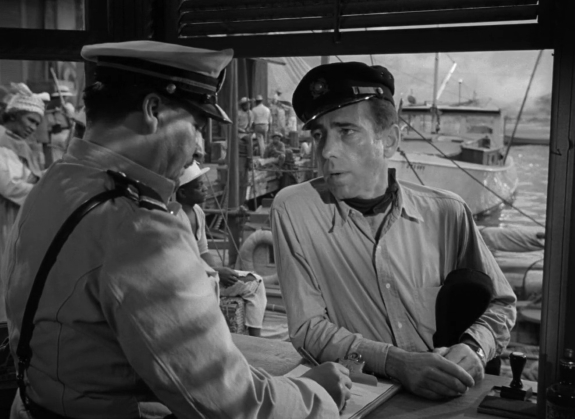
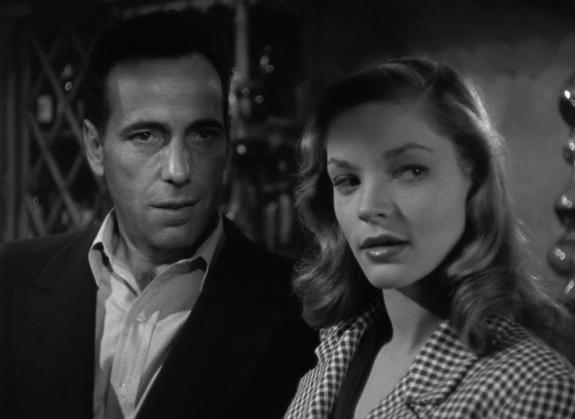
Is it noir? Is it a romantic thriller? Is it a slice of polished wartime propaganda? I guess To Have and Have Not is a little of all of these, but not only is it recognizably a Howard Hawks film, it’s also the movie that introduced Bogart to Bacall and the movie watching public to a cinematic partnership that transcended the silver screen. All of this would make it an important piece of work even if the film itself had been less than satisfactory. Fortunately though, that’s not the case as the whole concoction succeeds in checking every box. From the moment Franz Waxman’s instantly memorable score, dripping intrigue and danger, segues into the caption that informs us we’re about to descend on a delightfully ersatz  Warner Brothers approximation of wartime Martinique we are hooked as fast as one of the marlins Harry Morgan’s clients pay big bucks to pursue. Morgan (Humphrey Bogart) is skipper of a charter fishing boat and our first glimpse of the man kind of sums up the classic Bogart persona – insolent, sardonic and independent, openly contemptuous of the pettiness of officialdom yet careful not to push what luck he has left too far.

Hemingway’s novel was a dark tale of a down on his luck man running anyone and anything that looked like turning a buck out of Cuba in the pre-war years. The story is that Hawks once told Hemingway that he reckoned he could make a successful movie out of the author’s worst book and he settled on To Have and Have Not to prove his point. Now I don’t know whether or not this was in fact Hemingway’s worst book – I tend to think nothing he wrote could be termed as objectively bad – but I can say it’s the one I enjoyed less than any of the others. It’s a short book, but the tone is largely grim and dour and I’ve not felt the urge to revisit it since I last read it perhaps a quarter of a century ago. Hawks’ movie, with a script that was worked on first by Jules Furthman and then later by William Faulkner, uses the novel as a jumping off point at best, where Morgan gets gypped out of a fee by a slippery client and a stray bullet fired by a Vichy gunman. It leaves him out of pocket and, having just made the acquaintance of fellow drifter Marie Browning (Lauren Bacall), of a mind to stick one in the eye of the Vichy collaborators.

From this point on there’s not much of Hemingway in it but lots of Hawks, and of course the electric central pairing. It develops into a romantic adventure with a hint of Casablanca about it all – a totemic yet rather bland freedom fighter complete with attractive wife trying to stay a step ahead of the fascists, Axis villains, and a reluctant and essentially isolationist hero who comes to realize that this is an unsustainable position. Aside from an interlude on Morgan’s boat involving a near fatal encounter with a gunboat on a foggy night, most of the action takes place in the hotel, shifting from bedrooms to bar to cellar, all punctuated by a succession of provocative quips, as well as the shared ritual of lighting cigarettes and intermittently moody visuals, while Hoagy Carmichael tinkles away at How Little We Know in the background. There is that deeply satisfying feeling of convergence about it, watching an essentially ill-assorted group draw closer together and gel when faced with a common enemy. This was always attractive to witness, but nowadays it’s difficult not to feel even more wistful about a time when it was widely believed that the only decent thing to do was to oppose rather than lionize authoritarian bullies.

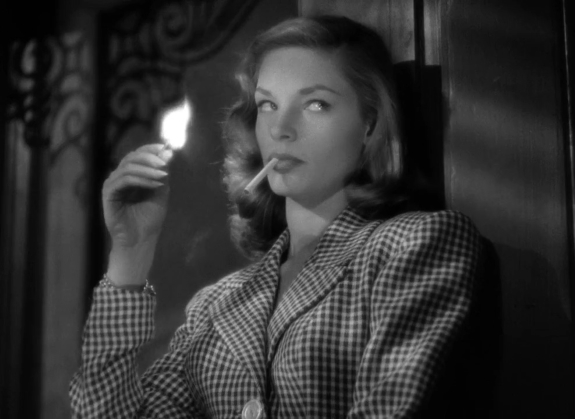
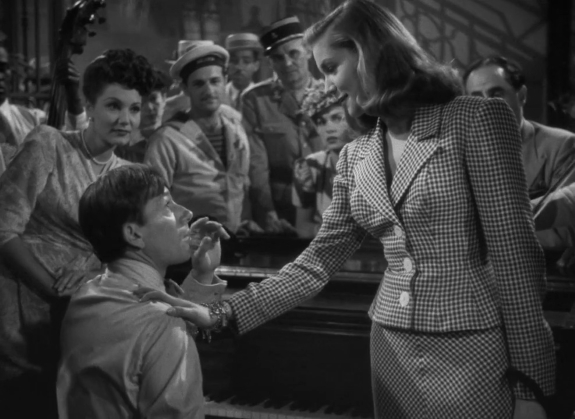
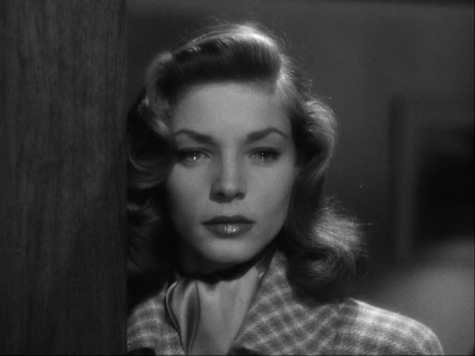
Bacall was, by her own admission, awed by the whole business and apparently hit on the “chin down, eyes up” pose she makes such effective use of as a means of holding those jitters in check. If so, it was a remarkably successful piece of improvisation and goes a long way to kindling those sparks struck whenever she shares the screen with Bogart. Her introductory scene, smouldering in the doorway, is as good as any actress ever got and I think it’s fair to say it followed her around for the rest of her life. Bogart was right at the top of his game at this point and probably at the height of his fame too. He displays such ease and composure in the front of the camera in this movie, every gesture timed to perfection, every beat of his dialogue struck  – tough, lonesome and noble in spite of himself, this as much and maybe even more than Rick Blaine is his signature role.

The A pictures of the classic era all benefited enormously from the hugely experienced crews that worked behind the cameras. It’s one thing to have someone like Hawks in the director’s chair, but having people like Furthman and Faulkner working on the script, Franz Waxman providing the score, and safe hands such as Sidney Hickox looking after the cinematography provide a solid base. And then there were the character players, moving from picture to picture, largely unsung but helping to hold it all together. Walter Brennan was one of the greats, a three time Oscar winner, and his twitchy rummy, veering from wide-eyed wonder to something approaching a sly worldliness makes for a terrific foil to Bogart’s slouching hero. Marcel Dalio as the hotelier with underground connections feels like a first cousin of the harried croupier he played in Casablanca. Another alumnus from that movie, Dan Seymour, plays the secret police boss Renard as though Sydney Greenstreet had swallowed Conrad Veidt, sinister, bulky and malignant. The frequently loud and boorish Sheldon Leonard is more subdued as Seymour’s lieutenant, tossing in the odd line but mostly alternating between glowers and leers in the background. Hoagy Carmichael is a memorable presence too, the wonderfully named Cricket forever chewing soulfully on a toothpick and dispensing tunes and philosophical advice as the mood strikes him.

As this will be my last entry for 2024, I wanted to finish the year with a look at a movie that never gets old for me. Surely there are few better ways to spend one’s time than hanging round a waterfront bar in Martinique learning how to whistle. So thanks for stopping in over the last twelve months and here’s hoping everyone has a good 2025.

Other posts I have written on the Bogart & Bacall movies can be found here:
The Big Sleep
Dark Passage
Key Largo

The Barefoot Contessa

“I suppose that when you spend most of your life in one profession you develop what could be called an occupational point of view.”

Write what you know. Isn’t that the classic line of advice offered to all budding scribes? When Humphrey Bogart’s character speaks those words above as the camera pans on the opening scene of The Barefoot Contessa (1954) there is at the very least a flavor of that sentiment on display.  And if Hollywood knows anything, it surely knows about the path to fame and about each and every pothole mining the route that leads there. Self-awareness, so long as it’s kept on a short enough rein to prevent its spinning off into self-indulgence, can be healthy; it grants perspective and that along with what I can only term soul are the essential ingredients of creativity. So “Hollywood on Hollywood” has been a productive sub-genre over the years, permitting the movies and their makers to take a look at themselves and inviting the viewer to peel back a corner of the mask for a glimpse of what lies behind. Such films generally fall into two categories, ranging from the celebratory to the acerbic. The Barefoot Contessa lands somewhere in the middle, perhaps because it is itself a story pitched halfway between Hollywood exposé and a meditation on fate.

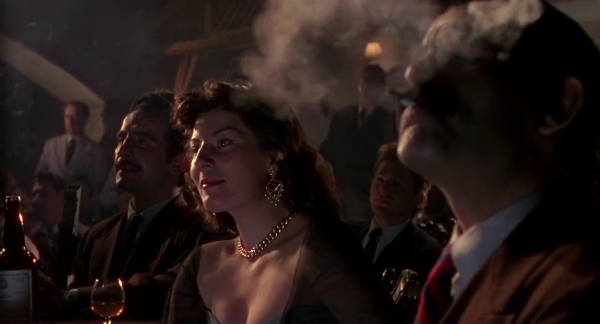
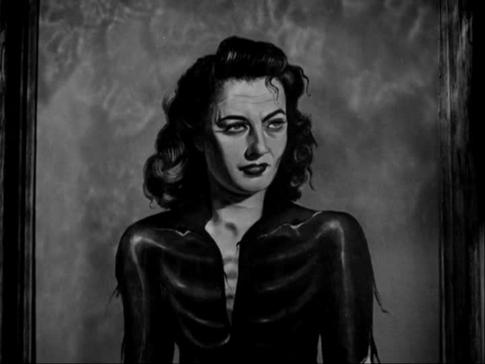
That air of fatalism pervades the movie, right from the rainswept introduction in an Italian cemetery, where a pensive Harry Dawes (Humphrey Bogart) casts his mind back over the few short years when he came to know the titular character. He stands a little apart, slightly detached from the other assorted mourners, although all of them are separated from each other in pairs and little clusters. This detachment is somehow appropriate, as fitting in its own way as the low key setting of this last farewell. These people have gathered to pay their respects to Maria Vargas (Ava Gardner), a one-time flamenco dancer from the back streets of Madrid who would later find fame on the screen as Maria D’Amato, before ending her life as the Contessa Torlato-Favrini. It’s appropriate because although the movie traces the brief rise and fall of Maria Vargas everything that is shown is filtered through the perceptions of others, those who tell her story to the viewer. Harry Dawes does the lion’s share of the telling, he was the one who was credited as having “discovered” her or mentored her in any case. As we segue into a flashback to the club in Madrid where Maria dances by night, the tone is set with great deftness. Her dancing is never observed, only the reactions of the audience provides a sense of her. While the camera roves around the assorted patrons, it becomes clear the woman who holds them all rapt is offering a reflection of what they all feel – the responses vary from frank admiration to surreptitious desire, as love, passion, frustration and shame flash across the screen and the faces of the assembled watchers in waves. And then it’s over, the dance is done and the star vanishes back to her own privacy as the beaded curtain swings back into position.

In what might be taken as a subtle dig at Hollywood forever playing catch-up with regard to popular trends, no sooner has the main attraction vacated the stage than the people from the movies arrive. The aforementioned Harry Dawes is tagging along with Kirk Edwards (Warren Stevens) a buttoned up producer reminiscent of Howard Hughes, Oscar Muldoon (Edmond O’Brien) whose glittering eyes and glistening face speak of perspiration and PR, and a burnished blonde courtesan by the name of Myrna (Mari Aldon). Kirk Edwards is a mean vulgarian, a shell of a man high on his own sanctimony and motivated only by the manipulative power of the dollar. He has flown his entourage all the way to Spain to see Maria Vargas dance and maybe offer her a contract. And now he has arrived too late, but such a man cannot countenance this kind of ill-fortune. He orders, savoring the humiliation the whole process entails, first Oscar and then Harry to fetch the aloof dancer to his table. While Oscar sweats and schmoozes Maria out of agreeing to a screen test, Harry is left with literally no option but to track down and persuade her to change her mind. Where Oscar’s sweat failed, Harry’s sincerity triumphs and Maria is on her way to stardom.

Exit Harry, temporarily. And enter Oscar, the vacuous nature of the publicity man firmly to the fore as he takes up the narration, charting the course of a life and spirit he freely admits he could never quite fathom. Of course Oscar doesn’t do depth, he does his master’s bidding. Partially due to the liberating effect of being around a woman who has no time for the fakery and front that stardom seems to demand, he sees his world view shifting ever so slightly. His remit is to guide us through the downfall of Kirk Edwards and Maria’s move on to the next phase of her life as the principal exhibit of Alberto Bravano (Marius Goring), a Latin playboy with no discernible character. This is a shorter interlude, a stepping stone on the way to Maria’s ultimate destination. Soon, the tale is taken up by Vincenzo Torlato-Favrini (Rossano Brazzi), the tortured aristocrat who is tragically incapable of real love, able only to venerate and deify. It is he who commissions the marble statue of Maria that will ultimately mark her final resting place, a cold approximation of beauty that is as cold and blank as his own helpless passivity.

Ava Gardner’s Maria Vargas drifts through the movie, and I use that term quite deliberately. As I said, at the beginning, the story is deeply fatalistic. Both by her words and her actions the lead character is presented as a woman unable to, or perhaps unwilling to, completely break from the past and take command of her destiny. The whole barefoot business ties into this, an explicit acknowledgment that the past is an integral part of oneself, functioning either as a brake on ambitions and aspirations or as a means of grounding one in reality. I don’t say this is a philosophy I particularly sympathize with, but it is there, it defines the whole mood of the piece and is well realized. Ava Gardner’s performance here is key to that realization and is almost a subversion of her typical screen persona. Earthy is the word that  frequently springs to mind when I think of her rather than ethereal yet it is the latter quality which she conveys throughout much of the film. Sure she has her moments of fire, but she never allows her natural vigor to overshadow that acceptance of a life directed by the golden threads of the Moirai.

The Barefoot Contessa is not a film that works for everybody, maybe due to that air of languor that grows out of its core fatalism. Then again it might be the wordiness of the script that bothers some, but I’d argue that anyone knowingly approaching a Joseph L Mankiewicz film and finding that aspect an issue ought to know better in the first place. Personally, I’m inclined to think that the third act, that beautifully shot and achingly poignant Italian interlude is most problematic. It is not a question of where the film is going or even where it ends up that hurts it, rather it is the playing of Rossano Brazzi that I think takes the edge off it all. Although I’ll concede he gets the futile desperation of his character across, I don’t think Brazzi was ever the most magnetic presence at the best of times and that becomes an issue here. It is undoubtedly a tricky part to carry off, but I just do not see him as the object of Gardner’s grand passion, the man who has that something which she never found elsewhere. Without that, one of the main props of the story is seriously weakened.

Bogart’s name was top of the bill and his bookending of the narrative is nicely judged. His later films weren’t always all they could have been, even if his own work was as strong as ever for the most part. His peak years were often characterized by that tough insolence that has spawned so many imitators, but he had more to him than that when he wanted or was allowed to show it. The Barefoot Contessa lets him reveal a warmer side than usual. Even if it’s tempered by the weariness and regret that came easily to him, there is an empathy on display which is very attractive. In support Edmond O’Brien sweet talked his way to an Oscar playing Oscar; there’s a degree of showiness as there nearly always is with award winning turns and he makes what is on paper a pretty miserable character more appealing than he probably ought to be, still it’s an engaging and memorable bit of work. Warren Stevens achieves an almost reptilian stillness as the soulless tycoon and it’s fun seeing him face off against a very theatrical Marius Goring in their big confrontation scene. Valentina Cortese, Elizabeth Sellars and Mari Aldon all have their moments even though their parts are relatively minor.

The Barefoot Contessa got a Blu-ray release in the US from the now defunct Twilight Time and then later in the UK via Eureka. I have that UK BD which now appears to have gone out of print and it’s a fine looking transfer of the movie that makes the most of Jack Cardiff’s beautiful cinematography. I don’t always mention scores or soundtracks, which I know is remiss of me, and so I want also to take the opportunity to draw attention to Mario Nascimbene’s evocative work on the movie. I wouldn’t want to claim The Barefoot Contessa is a flawless work as I am aware that it has its weaknesses and doesn’t appeal to all. However, it is and has long been a favorite of mine, ever since I stumbled on an early evening TV broadcast nearly forty years ago.

Well, that about wraps it up for 2023. I’d like to say thank you to everybody who came along for the ride over the last twelve months. Here’s to 2024 and here’s hoping it brings peace and happiness to us all. Happy New Year!

They Drive by Night

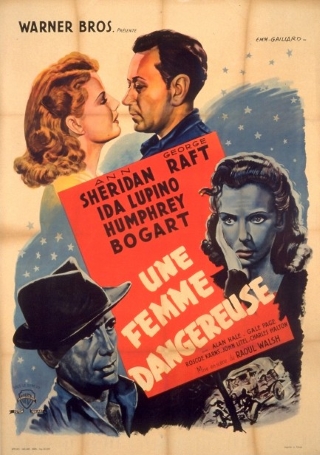
Warner Brothers made some of the most socially aware movies of the classic era, not in a preachy or even a condescending sense but in a way that was both matter of fact and humanitarian at the same time. This aspect of the studio’s output was particularly apparent throughout the 1930s and it provided a sound base on which to establish their characteristic gangster films. That classic gangster cycle was effectively brought to a close by Raoul Walsh’s magisterial The Roaring Twenties.  The following year Walsh cast two pivotal figures from those seminal crime movies in major roles in They Drive by Night (1940), a film whose very structure represents something of a bridge between the strong social conscience material of the previous decade and a smoother kind of melodrama that hinted at a noir sensibility.

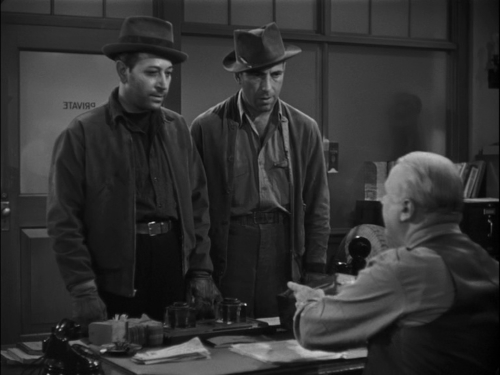
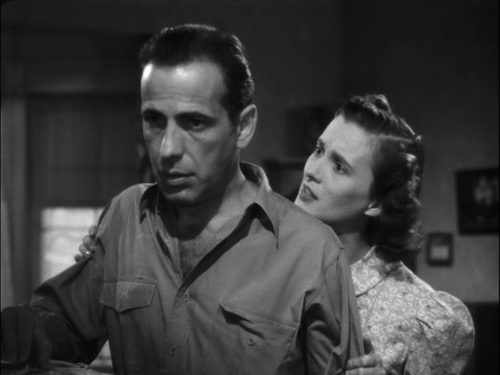
Movies based around the exploits and experiences of truck drivers are pretty common, from Racket Busters to Thieves’ Highway, The Wages of Fear and Hell Drivers to The Long Haul. That last movie, a British picture with Victor Mature and Diana Dors, shared the same title, but nothing more, as the A I Bezzerides novel from which They Drive by Night was adapted. There is a certain in-built romance to any kind of road movie, the notion of man and machine blazing trails and running into crime, corruption, or maybe just lousy luck has plenty of storytelling potential. There’s also the opportunity to examine the hardships involved, all the mundane little trials that come with such a typically working class job. That’s how this movie starts out, following the exhausting, insecure and poorly rewarded toil of two brothers trying to eke out a living hauling whatever loads are handed to them. They are Joe and Paul Fabrini (George Raft and Humphrey Bogart respectively), bleary-eyed, grimy, short of cash and never more than a tip-off or a fast dodge ahead of their creditors. Even so, there’s a tough integrity to their poverty, the wisecracks serving as a cloak of modesty for the determination and ambition honed and tempered by long years on the road.

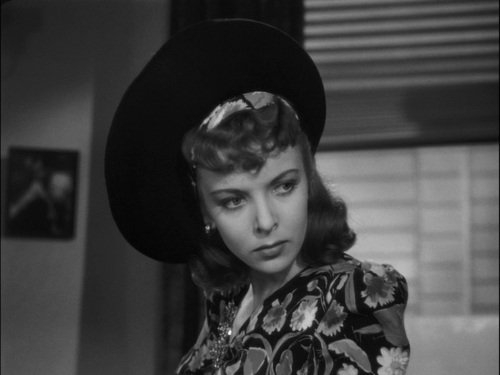
The first half of the movie traces a true but bumpy and incident strewn path towards Joe Fabrini’s ultimate goal, with just the same steely focus as the character himself shows as he hugs that white line night after night. It feels like one long ride, broken occasionally by stop-offs at cheap boarding houses, gas stations and roadside diners peopled with braggarts, lechers and brawlers, quick with a quip yet as close knit and proud as only the downtrodden can be. This section is dominated both by the to and fro over what might be termed the work-life balance between the Fabrini brothers, and also a burgeoning romance between Joe and Cassie (Ann Sheridan), a short order waitress. Two other major characters, restless vamp Lana Carlson (Ida Lupino) and her rambunctious and incorrigible husband Ed (Alan Hale), are introduced. Ed is an old friend of Joe’s who has made good and is living in the kind of luxury he hasn’t yet managed to get a handle on. Lana also knows Joe from way back, and she’s very keen on not only renewing the acquaintance but on seeing it develop into something much more intimate. However, this strand is only fully explored in the latter half of the film.

Everything changes dramatically, the direction of the story and the whole tone of the movie, after a serious accident quite literally takes the Fabrinis off the road. It opens up an opportunity for Joe to strike out on an alternative route to success, and it also presents an opportunity for Lana as she gets to thinking she might be able to rid herself of the husband she’s grown to despise and simultaneously sate her desire for Joe. In an ironic twist, the trappings of wealth and prosperity that Ed has surrounded himself with to facilitate the high life are shown to be capable of bringing that life to a swift and premature end. After another evening of boozing and ribaldry, Lana feels humiliated and frustrated enough to act – it only requires her to take a short walk on a quiet night and thus commit murder by remote control. Could this be the perfect crime?

Walsh handles the story with typical vigor, bridging the stylistic divide over the course of the movie with aplomb so that the changing circumstances feel authentic. The early scenes have a real flavor of the 30s about them, full of Depression-era energy and snappy, wisecracking dialogue, while Raft, Bogart and Sheridan get the lived-in feel of their characters down pat. Raft is very assured, arguably his Joe Fabrini is too sure of himself, to the point where it is going to come back and bite him. Sheridan is at her best in the diner sequence, tough and sassy, trading one-liners with the customers and more than holding her own. Bogart could always play it soulful when necessary and he’s good value till the script sees him effectively sidelined. The second part of the story looks ahead to the type of movie that would become increasingly common in the 1940s, and it is this section where Ida Lupino comes into her own. She switches smoothly from acid to sugar depending on the person she happens to be dealing with and her desperation to conceal a trashy background and move in more genteel circles is almost a living thing. That barely disguised dissatisfaction grows steadily, driving her to crime and ultimately consuming her body and soul. The physical transformation she achieves by the time of the famous courtroom meltdown is quite remarkable.

The movie, or its latter stages at any rate, see it flagged as an early film noir by some. Admittedly, there is a touch of that about it, but there’s no more than a suspicion really. It’s a solid melodrama with a crime and jealousy angle and there is no need to hang any other labels on it. The triangular romance and the betrayal this provokes, those illicit, murderous passions stirred into life amid a tough working environment are said to be an echo of the earlier Bordertown, a film I have not seen, and there are points of similarity to be discerned in the later Blowing Wild. Leaving aside genre descriptors and links to other movies, They Drive by Night is a fine picture, an involving, well-crafted piece of work that showcases the ease with which Raoul Walsh seemed to make great films. It is unmistakably a Warner Brothers production, a first rate Raoul Walsh movie and a genuine classic.


Conflict

Film noir meets Freud, presented as an inverted mystery. I suppose that just about sums up what viewers can reasonably expect to take away from Conflict (1945). It might also be helpful to keep in mind that this is a movie where plausibility is going to be stretched. In short, if you are the type of person who balks at the unashamed use of contrivance, who yearns for grit and realism, then this almost certainly is not the film for you. On the other hand, those looking for a relatively undemanding confection that plays around the periphery of film noir will probably enjoy themselves.

There is something quintessentially noir about rain. Perhaps it’s down to the heavy, brooding skies, swollen and sullen with the weight within, or that sense of some indefinable force lashing at us. Or maybe it’s just the way the cinematic version seems to smear and blur the lens, leaving our perception of characters and situations, and indeed the entire ethical universe laid out before us, a little unclear. Such is the case as the credits roll, just before the camera zeroes in on the finishing touches being added to a letter of invitation to Richard and Kathryn Mason (Humphrey Bogart and Rose Hobart). It’s from their friend Mark Hamilton (Sydney Greenstreet) on the occasion of their fifth wedding anniversary. Even if it’s a couple of years early, Richard Mason is already starting to feel that famed extramarital itch, in this case prompted by the presence of his wife’s younger sister Evelyn (Alexis Smith). This unsavory fact has just been hauled out in the open and so it’s with a certain sourness that the couple, and the unsuspecting sibling, head off for a night of food, drink and the kind of brittle civility that only the well-heeled and dissatisfied can carry off with aplomb. Well, having dined under a cloud of charmingly concealed bitterness, the drive back home is interrupted by an accident that segues into one of those sequences that has the protagonist’s thoughts and experiences reflected through the images and words of others, spinning as a vortex before the camera, drawing both him and us ever deeper.

On awakening, as the faces of doctor and nurse swim into view, we learn that Richard was the only one who suffered any significant injury. While recuperating from the broken leg that everybody believes has left him temporarily incapacitated, he hatches a plan to rid himself of his wife and leave himself free to pursue Evelyn. It’s no spoiler to point out that this is where the inverted mystery kicks in. We see Richard Mason go about the plotting of his wife’s demise and then get to see the gradual chipping away at his confidence, the doubts that circle and creep ever nearer till, finally, he can no longer be entirely sure how firm his grip on reality or sanity is. It is somehow fitting that he is drawn down into the darkness and despair of a literal and figurative abyss to confront his guilt and culpability before heading back towards the light, back to the fate he richly deserves.

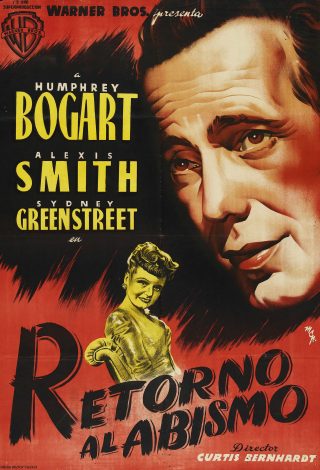
Conflict is derived from a story entitled The Pentacle, co-written by Alfred Neumann and Robert Siodmak. Siodmak’s name is enough to catch my attention, although I suppose it was mainly the casting of Bogart that drew me to the movie when I first saw it some time back in the mid-1980s. As with most inverted mysteries, much of the enjoyment lies in seeing how the best laid plans can unravel, and the clue that first sets the hounds on Mason’s trail grows out of a delicious slice of hubris. Curtis Bernhardt would have a very strong run of melodramas and films noir from My Reputation right through to Payment on Demand, although I reckon Sirocco (also with Bogart) is a misfire. His direction here is impressive at times, with a few showy tracking shots to pulls the audience into the picture, and of course the set piece of the murder on the twisty and mist shrouded mountain pass.

It has been said that Bogart was not keen on the film and was actually reluctant to make it, but he gives a fairly solid performance for all that. He is good at getting across the abrasive and impatient aspects of his character, and the transition from cocksure killer to desperate paranoiac is well realized. The only point at which I felt he hammed it up and lost some credibility was the scene where he tries to emotionally browbeat Alexis Smith, and even there one could perhaps argue that the whole point was to highlight the driven creepiness of Mason. Alexis Smith seems a bit wasted in a role that asks her to do little more than wring her hands on cue and prevaricate, none of which is the fault of the actress herself. Conversely, Rose Hobart is given a juicier part with at least some wounded pride and suspicion to sustain her, but her screen time is necessarily limited. Sydney Greenstreet is never less than a joy to watch in anything and his sympathetic part as the avuncular doctor with a piercing, probing intelligence and a penchant for cultivating roses feels like a dry run for his later role on radio as Rex Stout’s Nero Wolfe – just remove the avuncular aspect and swap out the roses for orchids. Charles Drake would go on to do better things in the 1950s at Universal-International but his young suitor in Conflict never rises much above the level  of “aw shucks” guilelessness.

Conflict ought to be easy enough to track down for viewing, either from the Warner Archive or from various European labels. It isn’t the best example of Bogart’s work but he’s good enough in it and he is always watchable anyway. Sure the plot is contrived and the whole thing is loaded with the cod psychology which was popular at the time. However, for those happy to embrace these features and just go with the flow there is quite a lot of pleasure and entertainment to be had.

The Two Mrs Carrolls

Every once in a while it’s good to indulge oneself in something which is not overly taxing, which is largely escapist and, in this guy’s opinion anyway, with enough entertaining features to diminish the concomitant flaws. In short, I’m talking about the type of movie to take one’s mind of “stuff” in general. And let’s be honest, current events are leaving all of us in need of a bit of distraction. With that in mind I turned to The Two Mrs Carrolls (1947) the other night. My impression is that this movie  doesn’t enjoy a great reputation but for one reason or another, which I’ll have a go at articulating later, I’ve always had a bit of a soft spot for it.

The relationship between art and commerce has always been an uneasy one and it feels somehow apt that Hollywood, home to many a tempestuous real-life marriage itself, should train a glass on this dichotomy. Maybe it’s down to a familiarity with the inherent duality within itself that has led the film industry to occasionally cast a dubious glance in the direction of artists in general. Geoffrey Carroll (Humphrey Bogart) is certainly a case in point; before the first scene has ended the audience is left in no doubt whatsoever that here is a man who is a clear stranger to emotional stability. He’s been romancing his latest muse Sally (Barbara Stanwyck) while, initially unbeknownst to her, trying to figure out a way to extricate himself from his marriage. In short order we learn that he achieves that by the simple expedient of popping a dose of poison into his unwanted spouse’s milk. This leaves him free to marry the conveniently wealthy Sally. You might imagine that a new life in idyllic surroundings for himself and his young daughter (Ann Carter) would have chased away the demons. However, it becomes clear that the creative juices are drying up again, and then an attractive socialite (Alexis Smith) arrives on the scene…

As I said at the top of this piece, I don’t believe The Two Mrs Carrolls is regarded all that well. In fairness, there are problematic areas, the script and direction allows the story to sag a little in the middle, and both tone and performances can be uneven. On the other hand, the film is, for me anyway, an enjoyable slice of domestic suspense/melodrama. What’s more, it has that attractive visual aspect that I’ve noticed before in the work of director  Peter Godfrey (who has a cameo role as a racetrack chiseler) – both Christmas in Connecticut and Cry Wolf have a visual aesthetic which really appeals to me – and this boosts the pictures stock considerably. Allied to this is that studio recreation/imagining of a kind of fairy tale England (and Scotland in the brief opening scene) which either works for you or doesn’t. Personally, I’m a big fan of the artistry that goes into conjuring up that kind of illusion.

A final reason for my own fondness for the movie, and one I will freely admit is wholly dependent on the individual, relates to the time it is first seen. While I can’t put my finger on the exact time, it would have been somewhere in the mid-1980s when I came across this picture on TV. I would have been in the process of broadening my experiences of cinema (something which I can happily say continues to this day) and was on the lookout for as many Bogart features as I could find. The point is I caught this one at a time when it just clicked for me, and that feeling has never really deserted me ever since.

The Two Mrs Carrolls appears in the middle of an especially strong run of post-war movies starring Bogart. Looked at in comparison to some very strong and memorable work for Hawks, Huston and Daves, it’s perhaps not surprising that the movie is seen less favorably. That said, the star’s performance is inconsistent; the romantic interludes are handled just fine, as are the handful of incidences of hard-boiled insolence, while the manifestations of instability are seriously overcooked. Stanwyck, who rarely gave a sub-par performance at any point in her career,  fares better overall and handles the melodrama with greater assurance.

Alexis Smith had already played opposite Bogart in Conflict and vamps attractively here, trading barbs effectively in a memorable introductory scene. I guess most movie fans will recall Ann Carter chiefly, and quite rightly too, for her excellent playing in the haunting and rather touching Val Lewton/Robert Wise picture The Curse of the Cat People. She’s very good again in The Two Mrs Carrolls and her calm composure offers a neat contrast to some of the adults around her. Irish actors Pat O’Moore and Anita Sharp-Bolster are solid (and amusing) in support, and of course few performers ever bumbled quite so endearingly as Nigel Bruce.

The Two Mrs Carrolls was given a DVD release in the US via the Warner Archive, and clones later appeared  on the European market. As far as I’m aware it’s not been given the Blu-ray treatment as  yet, and I’m not sure  it has a high enough profile to warrant that anyway. Generally, it looks fairly strong in standard definition and I’m pleased just to have it and be able to watch it. Objectively speaking, it’s not one of Bogart’s or Stanwyck’s best movies and I’m not about to sell it as such. It does have its positives though, as is true for almost anything with these stars. Frankly, it’s a welcome piece of cinematic fluff at any time, and especially so at the moment.

Dark Passage

Lie still. Hold your breath and cross your fingers.

I’m not a great believer in coincidences; sure they occur from time to time but too many of them all together tend to make me suspicious if anything. That’s in real life. In the movies the rules are a little different and I’m prepared to suspend my disbelief in circumstances that might normally give me pause. Film noir, especially its more paranoid and nightmarish examples, frequently thrives on the convenient coincidence. Dark Passage (1947) really piles the unlikely chance occurrences on top of each other to the point where the plot feels extraordinarily contrived and reality appears skewed. And yet it all ultimately works, because of the chemistry of the leads and also the sensitive and assured direction of Delmer Daves.

Amid the rising wail of sirens a truck speeds towards San Francisco, its load bouncing and rattling as it goes. Inside one of the barrels is a man, a man who’s just  broken out of San Quentin. This is Vincent Parry (Humphrey Bogart) and he’s been serving time for the killing of his wife. Parry insists he was framed and seems to have some vague notion of finding the real killer, but first he has to make it into the city. His first attempt, hitching a lift with a weaselly character (Clifton Young) in a roadster, is less than successful and could easily have led to his undoing. However, fate steps in and takes over at this point when a young woman, Irene Jansen (Lauren Bacall), happens along and smuggles the fugitive past the police roadblocks. And here we have the first of the long series of coincidences that dominate this story. Irene followed Vincent’s trial religiously, seeing parallels with the wrongful conviction of her late father, and even wrote letters to the press in his defense. It’s just by chance that she was passing that stretch of road on the very day Vincent decided to make his bid for freedom, but that’s only the start of it. Vincent seems to be stalked by alternating bouts of good and bad luck, almost everyone he encounters is acquainted with one another on various levels, and then there’s the lonely cabby (Tom D’Andrea) with a very useful contact. I won’t go into the various twists and turns the plot takes here – suffice to say Vincent acquires a new face, learns the truth and has at least the possibility of a new beginning dangled before him. Does he grasp that possibility? Well I suggest each viewer make up their own mind on that one – I feel the ending has the kind of ambiguous quality that allows you to interpret it as you wish.

Dark Passage was adapted from a David Goodis novel (I haven’t read it but I do have a copy sitting on my shelves) by director Delmer Daves and offers up an appetizing slice of noir, where an apparently hapless protagonist finds himself sliding ever deeper into circumstances over which he has little control. Daves indubitably did his best work in westerns but this film also provides plenty of scope for the optimism that runs as a common theme throughout his filmography. Film noir tends to focus on the sourer aspects of existence so it probably sounds a little odd to speak of such a positive characteristic in this context. However, it is there – not only in the solidly hopeful central relationship between Vincent and Irene, but also in the little vignettes that add a human face to the tale. Sam the cabby and his willingness to give a guy a break just because he reckons he has a good face, Irene’s would-be suitor who ought to be bitter but shows understanding instead, the hash slinger in the diner who regrets shooting off his big mouth, and the lonely strangers in the bus station all nudge the story forward in their small ways and afford glimpses of a world where decency hasn’t yet been fully eclipsed by greed and jealousy.

At the heart of it all are Bogart and Bacall, their real life love affair as apparent as ever in their comfort around each other. The fact that Bogart isn’t actually seen for the first half hour, the camera telling the story from a first person perspective up that point, doesn’t harm the inherent chemistry either as it’s all there in the voices and gestures that we do witness. With so many unlikely events coming at us hard and fast, it’s vital that there’s a solid center to hold it all together. The two leads ensure that everything remains grounded by their honest and affecting performances. And of course there’s the ending, an aspect I was unsure how to take for a long time. The noir purist may dismiss the coda as a mere sop to those longing for a traditional Hollywood ending, and it can be viewed in those terms. It could also be read as Vincent’s dream after the emotional phone call in the bus terminal. Personally, I’ve come to see it as a nice touch, open to whatever interpretation one cares to favor depending on mood, and entirely appropriate for a director like Daves.

Dark Passage has been available on DVD from Warner for ages now and the transfer still holds up pretty well. The image is quite crisp and shows off the interior and location photography of Sid Hickox just fine. One could criticize the fact that so many aspects of the plot are that bit too convenient, and the way Daves injects his optimism into the story may leave hardcore noir fans somewhat frustrated. Overall, I find it a very satisfying experience though – it offers plenty of thrills and suspense, and lets you walk away with a big smile on your face at the end.

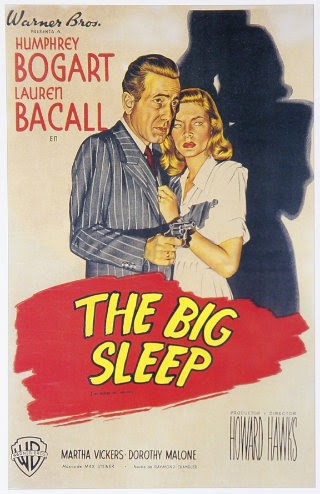
The Big Sleep

But down these mean streets a man must go who is not himself mean, who is neither tarnished nor afraid. The detective in this kind of story must be such a man. He is the hero, he is everything. He must be a complete man and a common man and yet an unusual man. He must be, to use a rather weathered phrase, a man of honor, by instinct, by inevitability, without thought of it, and certainly without saying it. He must be the best man in his world and a good enough man for any world. I do not care much about his private life; he is neither a eunuch nor a satyr; I think he might seduce a duchess and I am quite sure he would not spoil a virgin; if he is a man of honor in one thing, he is that in all things. (Raymond Chandler, The Simple Art of Murder, 1950)

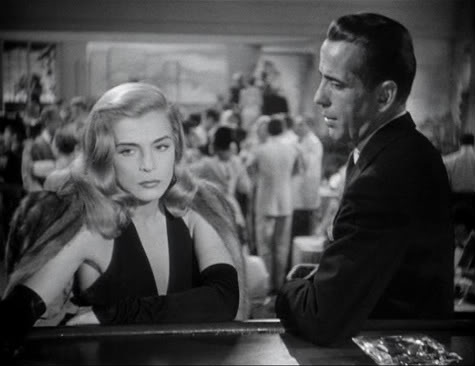
That quote from Chandler is a distillation of what he felt were the characteristics of the fictional private eye, and it’s a view that continues to endure. The reason for the popularity of this particular representation is understandable enough: not only does it portray the detective as the classical hero, it also allows the audience to identify with him, to see in him the kind of man they’d probably like to be themselves. Chandler’s knight errant Philip Marlowe has appeared on screen a number of times with varying degrees of success, but the incarnation that I, and I guess a lot of other people too, have the highest regard for is Humphrey Bogart’s take in Howard Hawks’ The Big Sleep (1946).

Some aspects of the plotting of The Big Sleep are notoriously complicated – the story goes that screenwriters William Faulkner and Leigh Brackett, along with director Hawks, were so confused about who committed one of the murders that they contacted Chandler for clarification. Apparently, the author found himself similarly stumped. The thing is that the murders, motives and twists of the plot pile up so relentlessly that it does take a fair bit of concentration on the part of the viewer to keep up with it all. However, that’s not really the point of the movie and the basic thrust of the narrative is easy enough to follow in itself. Philip Marlowe (Humphrey Bogart) is the private detective engaged by the ailing General Sternwood (Charles Waldron) to take care of a blackmailer who is putting the squeeze on Carmen (Martha Vickers), the younger and wilder of his two daughters. In the course of his investigation, which rapidly descends into a murder case, Marlowe finds that the elder sister, Vivian (Lauren Bacall), appears to be tangled up in things too. Vivian’s a cooler, more composed customer than her sister, yet her involvement with a shady gambler, Eddie Mars (John Ridgely), indicates that she too is keeping dangerous company. I’m not going to go into the labyrinthine twists and turns of the plot here, firstly to avoid spoilers, and secondly because it will likely serve to do nothing more than confuse readers. Suffice to say the stories of General Sternwood’s two girls eventually dovetail and all the various plot strands are drawn together satisfactorily. Yet, as I said before, you don’t watch The Big Sleep just to find out who did what to whom, when and for what reason. This is truly one of those movies where the journey is far more important than the destination. As we follow Marlowe around a moody and threatening Los Angeles, we go on a tour of the seedy underbelly of the city. Even though the time is spent in the company of high rollers and the glamorous set, it’s all merely a glittering veneer for a world of pornography, drugs, deviance, betrayal and violence.

Vivian: I don’t like your manners.

Marlowe: And I’m not crazy about yours. I didn’t ask to see you. I don’t mind if you don’t like my manners, I don’t like them myself. They are pretty bad. I grieve over them on long winter evenings. I don’t mind your ritzing me or drinking your lunch out of a bottle. But don’t waste your time trying to cross-examine me.

One of the great pleasures of The Big Sleep is the dialogue. Most of the memorable lines and passages, such as the little sample above, are lifted almost directly from the pages of Chandler’s novel. However, Brackett, Faulkner and Jules Furthman did have to make some alterations to turn in a workable script, both for storytelling reasons and to ensure the finished product was going to get past the Hays Office. Therefore, the more overt references to the unsavory nature of the blackmailer’s racket had to be toned down for example. The infamous production code is often criticized, and with good reason, for imposing draconian and logic-defying restrictions on what could be shown on the screen. The thing is though, a good deal could be implied if not directly stated, and clever writers could exploit this loophole. In a sort of perverse way, the very restrictiveness of the code meant that filmmakers were forced to be more creative in their efforts to circumvent it; I think The Big Sleep stands as an excellent example of this apparent paradox. The two houses in which much of the tale plays out are the Sternwood mansion and the home of Geiger, the blackmailer. Hawks and his crew succeed in bathing both locations in such an atmosphere of decadence and iniquity that it needs little imagination to appreciate the depravity lurking beneath the surface. Perhaps Hawks’ greatest triumph in the picture is the way he manages to ensure that style rises above substance throughout and he creates a crime story where the crimes and their resolution become secondary to our enjoyment of the ride through Chandler’s twilight world.

While The Big Sleep benefits enormously from a snappy script, strong source material and a first class director, what helps elevate it to true classic status is the casting. The second collaboration of Bogart and Bacall builds beautifully on the foundations already laid in To Have and Have Not. The movie took their on and off-screen courtship to new and more sophisticated levels, and the air fairly crackles whenever they share a scene. I think Bogart was born to play Marlowe, he perfectly encapsulates the weary nobility of Chandler’s creation like no other actor before or since. The part can be seen as an extension or refinement of Hammett’s Sam Spade from The Maltese Falcon, but there’s a greater sense of honour and less aggressive smugness this time. I already mentioned this in an earlier post, but Bogart’s delivery of his lines is perfect, so much so that it’s very hard to read the novel and not hear him saying the words. On the receiving end of much of Bogart’s wise-cracking, and pitching back every bit as good as she got, was Bacall. Watching her performance today, it’s hard to believe that Bacall wasn’t much past twenty years old when the movie was shot. There’s an air of assurance and worldliness about her that belies her years, the hard-boiled dialogue flowing smoothly as though from a woman who’d been around a long time and had seen all there was to see. In truth, the whole cast does excellent work, but the women in particular stand out. Martha Vickers is all coy treachery, and there are fine and memorable bit parts for Dorothy Malone and Sonia Darrin. Of the men, I feel Elisha Cook Jr deserves a mention for another of his characteristic turns as an unfortunate fall guy. I guess the only real weakness was John Ridgely, it’s not that he gives a poor performance but he never fully convinces as a dangerous mobster – having said that, he does get one fantastic send off.

The US R1 DVD of The Big Sleep contains two versions of the movie (as far as I know the R2 doesn’t offer this choice) – the preview version and the theatrical cut. I mention this mainly because there are some notable differences in the two cuts. I’m not going to laboriously list all the changes here, that information is readily available elsewhere online, but I will say that they change the feel of the movie significantly. In short, the preview cut is an altogether blander affair, although it helps to make the plot more comprehensible. The theatrical version is much more stylish, placing more emphasis on the Bogart/Bacall dynamic while sacrificing some of the narrative coherence. Personally, I far prefer the theatrical cut, and not just because it’s the more familiar of the two. While the preview version does offer more exposition, it throws the pacing off balance and fails to fully capitalize on the chemistry of the star pairing. It’s nice to have it available for comparison purposes but that’s about it for me. The transfer is reasonable enough, maybe not up there with the best that Warner Brothers have done in the past but it’s certainly not poor. The disc also offers a short feature on the differences between the versions of the movie, and is useful in giving an overview if you don’t feel inclined to watch both cuts all the way through. This movie and The Maltese Falcon helped cement Bogart’s image as the archetypical private eye. Others have played the part of Marlowe, and others have taken on the role of various private detectives, but Bogart nailed it. The film as a whole, can be viewed as a film noir (although of the lighter variety), a crime/detective story, or simply as an outstandingly well-crafted piece of classic Hollywood filmmaking. It comes most highly recommended.

Ten of the Best – Noir Stars

Seeing as 2012 is drawing to a rapid close, this is likely going to be my last article of the year. It’s been the first full year blogging on the new site and I have to say it’s all turned out far better than I could have anticipated. I consider myself very fortunate to have built up a loyal little band of followers and the feedback that I’ve been consistently receiving is both gratifying and informative. My last entry, on western stars, offers ample evidence of that, turning out to be the most popular piece I’ve posted by some considerable margin. I’d mentioned that I was intending to do something similar on my other great cinematic passion, film noir, and so it’s time to make good on that. Again, I’ve deliberately restricted myself to ten stars who made an impact on cinema’s shadowlands. Film noir isn’t a genre like the western; it’s a more nebulous form where the convergence of melodrama, crime and fate all become bound up in the creation of a cinematic demimonde that defies definition yet is immediately recognizable. To be honest, I had a hard time deciding on only ten men and women who portrayed so many memorable cops and private eyes, grifters and chiselers, dames on the make and hoods. Anyway, here’s my selection.

Robert Mitchum


Mitchum’s omission from my western list sparked a good deal of comment. He started out playing cowboys, and there’s a case to be made that his western roles are by and large superior to his noir ones. A number of his noirs are weak or flawed productions, particularly those made when Howard Hughes was running the show. However, even when a film was less than successful, it would be difficult to single Mitchum’s performance out for criticism. Besides that, he took the lead in two of the finest noirs: as the classic dupe in Tourneur’s Out of the Past, and as the evil killer in the oneiric The Night of the Hunter.

Burt Lancaster


Lancaster made his debut in what I reckon is one of the top three film noirs, Robert Siodmak’s The Killers. This flashback reconstruction of what led one man to lie in a darkened room, calmly awaiting those who have come to murder him showed that Lancaster had the kind of soulfulness and sensitivity that can be used to such great effect in film noir. He would return to the dark cinema frequently, producing fine work in the likes of Criss Cross and Sweet Smell of Success.

Barbara Stanwyck


One of the best known features of film noir is the figure of the femme fatale. Not every picture has one, but if you asked the average film fan to list the characteristics of noir you’d likely hear the name. Barbara Stanwyck has the distinction of playing arguably the greatest deadly woman of them all in Billy Wilder’s Double Indemnity. She did a lot of work in noir, and I’m very fond of her turn as the panicked and bedridden heiress in Sorry, Wrong Number, Anatole Litvak’s study in mounting paranoia.

Edward G Robinson


This mild and cultured man made his name in the early 1930s in Warner Brothers gangster pictures, most notably as Rico in Little Caesar. He worked successfully in a variety of genres throughout that decade but really hit his stride in the 40s with two films for Fritz Lang (The Woman in the Window and Scarlet Street) and one for Wilder (Double Indemnity). While those three roles are quite different, they do share one common feature – Robinson was playing men who, in one way or another, are trying to close off their minds to unpleasant realities, and all of them are ultimately tragic figures. This actor was among the best Hollywood ever produced, and his efforts in the world of noir are highly significant.

Robert Ryan


With some actors, it’s fairly easy to pick their best work. When it comes to Robert Ryan though, I find myself so spoiled for choice that it’s nearly impossible. His 40s and 50s output is peppered with excellent performances in noir pictures made for Dmytryk, Renoir, Wise and Ray. Even a piece of flummery like Beware, My Lovely benefits from Ryan’s intense presence. However, I’m going to single out Robert Wise’s tight and economical The Set-Up for attention. Ryan’s portrayal of a washed up fighter (he was once a boxer himself) determined to bow out with dignity, even if it kills him, gave him a break from playing the heavies he’s so often remembered for.

Gloria Grahame


Gloria Grahame has always been a favorite with noir fans, her unique brand of sexuality managing to blend quirkiness and vulnerability with a hint of inner steel. Perhaps her part as the good time girl deformed by an enraged Lee Marvin in Fritz Lang’s The Big Heat sums up that aspect of the actress best. She also brought something special to her role in Nicholas Ray’s In a Lonely Place, opposite a fiery and abusive Humphrey Bogart – I’ve heard it said that the relationship depicted had parallels with her marriage to Ray at the time.

Glenn Ford


Another guy who had strong claims for inclusion on my recent western list, Glenn Ford started out strong in film noir playing off Rita Hayworth in Gilda. Ford had that everyman quality and, as I’ve remarked when discussing some of his roles on other occasions, a vague sense of discomfort with himself that was ideal for noir pictures. I think Lang brought out the best in him in The Big Heat; his avenging cop is almost a force of nature and his barely contained rage is something to behold in a film that’s got a real mean streak running through it.

Dana Andrews


A little like Ford, Dana Andrews was another actor with whom you could almost see the wheels going round just below the surface. He too seemed to exude some of that inner dissatisfaction that translated into fatalism and disillusionment on the screen. His series of movies with Otto Preminger in the 1940s represent his noir work best. Laura may well be the best known, but Where the Sidewalk Ends offered him a meatier part and stretched him more as an actor. That movie, along with The Big Heat and On Dangerous Ground would make an interesting triple bill on violently unstable lawmen.

Marie Windsor


The queen of the B noirs, Marie Windsor had good roles in both Force of Evil and The Narrow Margin. She had a real knack for playing the cheap schemer better than anyone else I’ve seen, and her role in Kubrick’s The Killing was a perfect fit. As Sherry, the wife of everybody’s favorite sap and loser Elisha Cook Jr, her greed sees her trying to play everybody off against each other and is instrumental in bringing a tragic end to the heist.

Humphrey Bogart


And so I come to the last, but by no means the least, of this brief selection. After a long apprenticeship in supporting roles, High Sierra and The Maltese Falcon saw Bogart define the noir lead for the next decade and a half. Tough, chain-smoking and moody, he seemed to encapsulate all the weary cynicism that the war and its aftermath ushered in. His portrayal of Sam Spade was, and remains, hugely influential, and then he went one further and truly nailed the essence of the private detective in The Big Sleep. In fact, I find it impossible to read Chandler’s text now without hearing Bogart’s distinctive delivery in my mind.

So there we have it. When I made that western list I made the point that I wasn’t claiming it as any kind of definitive one. I’ll say the same again here – these are just the ten names that I feel offered something of worth and value to film noir over the short span of its classic period. In their different ways, I think these people helped sum up what noir was all about and shaped its development. I’ll admit I struggled to decide on ten actors for westerns, and this was actually tougher. The fact that I included both actors and actresses meant that my options were increased while the overall parameters remained the same. Of course I could easily have split this into two sections, or expanded it to twenty. However, in the end, I decided to stick to ten as it forced me to apply a more ruthless approach, and give it all a lot more consideration, than I might otherwise have done. Once again, all comments, arguments and protests are most welcome.

Dead Reckoning

I guess when you watch enough films it’s almost inevitable that a certain degree of familiarity with plot and characters creeps in. Leaving aside the matter of remakes and such, this is often simply a false perception on the viewers part. However, every once in a while, a movie like Dead Reckoning (1947) comes along where familiarity is not just a case of perceived similarity but a clear rehash of characters, themes and even dialogue from earlier works. This picture borrows heavily from two previous Bogart vehicles – The Big Sleep and The Maltese Falcon, the latter being the most obvious with lines of dialogue getting recycled by the very man who made them iconic in the first place. Although Dead Reckoning never manages to attain the heights of its source of inspiration, it remains an entertaining (if slightly cheesy) film noir.

It opens strongly with a battered and desperate Captain Murdock (Humphrey Bogart) dodging the cops along the dark, rain slicked pavements of Gulf City. Symbolically seeking sanctuary, he slips into a Catholic church and melts into the protective shadows. Recognising the returning priest as a former army padre, he takes the opportunity to unburden himself and tell his tale in an improvised confession. This introduces the flashback structure that dominates the bulk of the film’s running time. In brief, Murdock is now running scared in Gulf City as a result of his attempt to locate an old army pal who decided to take a powder rather than face exposure as a wanted man when he learns that he is to be awarded the Medal of Honor. The plot follows Murdock’s efforts to clear the name of his friend for a murder that he believes was out of character. The friend in question ends up burnt to a crisp in a car wreck before Murdock even has a chance to contact him, so he must feel his way in the dark in a strange town and among an assortment of shady figures. The closest link to his friend, and the person most likely to hold the key to his fate, is a husky voiced cabaret singer by the name of Coral Chandler (Lizabeth Scott). Murdock’s innate distrust of women means he starts off sceptical of the sincerity of this lady, and her apparent closeness to the smoothly repellent night club owner and gambler Martinelli (Morris Carnovsky) merely serves to heighten his suspicions. Throughout the movie Murdock blows hot and cold in relation to Coral, his attitude varying from doubt to acceptance and back again, even as he finds himself increasingly attracted to her. It’s only after Murdock turns Martinelli’s office into a raging inferno that the truth behind his friend’s demise finally comes to light.

£7

Bogart’s character in Dead Reckoning is a detective in the Spade/Marlowe mold in all but name; he frequents the same kind of places, mixes it with the same mobsters and duplicitous types and speaks in the same hard-boiled idiom. He even brings matters to a head in a way we’ve seen before – as he tosses the deadly incendiary grenades around Martinelli’s office to loosen tongues you almost expect to hear him snarl “That’s one, Eddie…”, and the climactic scene with Lizabeth Scott borders on a pastiche of the payoff in The Maltese Falcon. Despite the lack of originality in the script (I’ve also read that the movie was initially planned as a kind of follow-up to Gilda) it still stands up as a medium grade noir. A lot of this is due, I think, to Bogart’s strong performance, his cynicism and toughness papering over the weaknesses in other aspects of the movie. The short scene in the morgue – the one cool place in town – highlights this through its combination of smart-ass dialogue and implied violence. In fact, there’s a good deal of violence in the movie, although much of it takes place off screen. The savage beating Murdock receives from Marvin Miller’s sadistic thug, all carried out to the accompaniment of dance time music, is never shown but the damage to the hero’s face makes it clear enough what’s been going on. Morris Carnovsky’s Martinelli makes for an interesting villain, reminiscent of George Macready’s Ballin Mundson in the aforementioned Gilda, as a lowlife with a veneer of sophistication and mock delicacy. The weakest link in the whole chain is ironically the one person who’s presence ties all the strands together – Lizabeth Scott. She was clearly supposed to act as a kind of surrogate Bacall, a sultry foil for Bogart’s two-fisted protagonist. She looks the part and pitches her voice low enough to promise heaven and honey, but her overall performance is a poor one. At one point she spins Bogart one of those hard luck yarns so beloved of femme fatales and then, not reading the result she wanted in his features, asks if he doesn’t believe her. And that’s the problem; there’s a lack of conviction and credibility when she delivers some of the most crucial lines in the movie. Leaving aside the performers, John Cromwell’s direction is mostly effective and there are some darkly moody scenes. The tense opening and the subsequent flashback power things along, but the return to “normal” time lets the momentum slow a little, and a little too early, before the final reveal.

The R2 DVD from Sony/Columbia is reasonably good but not without some faults. The transfer is generally clean, but there are moments of softness and a few occasions when scratches and light damage prove mildly distracting. The only extra feature offered is a gallery consisting of a few posters. Generally, this is a pretty respectable noir, though not quite top flight material. The script is too much by the numbers and unquestionably derivative of other pictures. Still, it does hold one’s interest and has rewatch value if only to enjoy again some fine, snappy lines. That, and a typically gritty Bogart performance, earns it a recommendation.