Key Largo

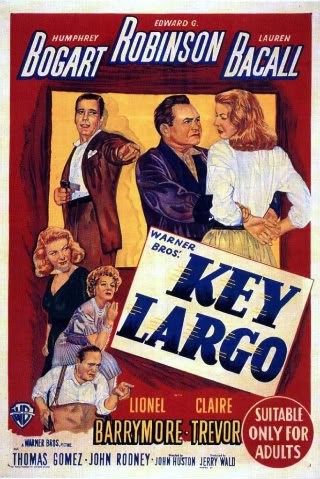
It’s hard to watch a film like Key Largo (1948) without being reminded of endings; it represented the final screen collaboration of Humphrey Bogart with both Lauren Bacall and Edward G Robinson, and it was one of the last movies he would make for Warner Brothers. Not only that, but it was also one of the last hurrahs for the old style gangster picture – but more about that later. It’s also a production that can be viewed from a number of angles: as a character driven drama, a gangster/noir mash-up, a commentary on the situation facing returning veterans, or as an allegory on fascism. Now this kind of multi-faceted approach can either lead to an unfocused piece or add to the rewatch value. I think the latter wins out here.

If the title and written prologue weren’t enough then the opening helicopter shot establishes the fact that the action takes place along the Florida Keys. As the camera zooms in on a bus making its way along the linking causeway we get our first glimpse of Frank McCloud (Bogart), a WWII veteran paying a visit to the relatives of a fallen comrade. McCloud’s destination is a hotel that, owing to the fact it’s the off-season, is virtually closed down. There is, however, one group of guests in residence when he gets there. None of these people seem especially friendly or anxious to welcome another visitor, and one of thier number, a Mr Brown, is conspicuous by remaining closed in his room. By and by, it emerges that McCloud’s companions are actually criminals, although that fact was unknown to the hotel owner, Temple (Lionel Barrymore), and his daughter-in-law Nora (Bacall). If McCloud had any suspicions, they are confirmed by the appearance of Mr Brown. Mr Brown isn’t his real name of course – he is one Johnny Rocco (Robinson), a one-time mob kingpin bent on rebuilding his criminal empire. At this point the already oppressive atmosphere grows heavier, both figuratively and literally, as an approaching hurricane threatens to tear up everything in its path. In the midst of all this, a duel develops between Rocco and McCloud – one that will finally be resolved on a motor launch bound for Cuba.
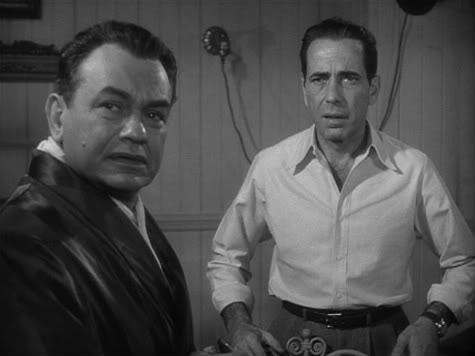
Key Largo was made at what was arguably the height of John Huston’s career, and its success is due to a combination of top class scripting (with Richard Brooks), photography, and acting. Bogart and Robinson occupy centre stage and their war of wills is what drives the whole thing forward. Eddie G’s Rocco is a devious and bullish creation, yearning for past glories that he must surely know in his heart are unattainable. Rocco and his cohorts are seen cowering before nature’s primal force and attempting to brass it out with a show of transparent bravado, pronouncing with unconvincing confidence that prohibition must surely come back and how things will be different this time. But these men are aware that they’re living out of time and it’s interesting to note that Al Capone, on whom Rocco was clearly based, was dead a year at that point. Bogart’s weary vet is one of his more complex characters, and could be compared to his Rick from Casablanca. Both men are initially reluctant to get involved or “stick their neck out” but do so eventually for the right reasons. The difference, however, is that Rick’s passivity was motivated by considerations of profitability whereas McCloud’s was the result of a deep disillusionment. That should have struck a chord with contemporary audiences: a whole generation of young men had marched off and risked their lives (and seen others lose theirs) in order to rid the world of oppression and fascism, only to return home and be confronted by a domestic version.

There are two key scenes that help define McCloud’s character. The first is a wonderfully photographed series of close-ups that show Rocco whispering suggestively into Nora’s ear (not a word is heard, but the inference is clear enough) before she spits contemptuously into his outraged face. With an unspoken dignity, McCloud moves across and quietly puts an arm around her shoulder before gently leading her away. I remember hearing Richard Brooks refer to this scene in a documentary as a moment of simple decency that everyone would like to emulate, and that’s hard to argue with. A similar situation takes place when Rocco humiliates his woman (Claire Trevor) by forcing her to sing unaccompanied as the price for the drink she craves. When he then goes back on his word, McCloud again does the right thing by pouring a whisky for the devastated woman despite the danger to himself. This is not a man who avoids confrontation due to cowardice or fear of personal injury but one who has grown apathetic and merely needs a prod to show his true colours. The aforementioned Claire Trevor deservedly won an Oscar for her role as the faded, alcoholic singer whose pride and self respect have been pushed into the background. That scene where she degrades herself in front of strangers through desperation is toe-curlingly effective and probably clinched the award for her. Lauren Bacall, in the only other significant female role, is much more subdued and is called on to do little more than gaze soulfully at Bogart. Of the four films Bogart and Bacall made together, this one is markedly different. The two Howard Hawks pictures had that director’s breezy playfulness about them, while Dark Passage was almost a study in bizarre coincidence. Key Largo has a grim, downbeat tone throughout that may surprise, or even disappoint, those hoping for a rerun of the couple’s previous work together.

Key Largo has been out on DVD for a long time now but the transfer still holds up well enough. I have the Warner UK version and the image is hard to fault, being pretty crisp all the way. I thought the dialogue levels were a little low but that’s probably just a feature of the film as there are a number of hushed conversations, and anyway Max Steiner’s atmospheric scoring doesn’t suffer. Extras are almost non-existent and are limited to the film’s trailer. The movie itself is a good example of how well Bogart and Huston worked together (it may come up wanting for those seeking out another Bogart/Bacall pairing though) and is the kind of picture that rewards multiple viewings. It gets the thumbs up from me.

Virginia City

£18

When Errol Flynn’s first stab at a western, Dodge City, proved to be a financial hit Warners wasted no time in casting him in another. They reassembled as many of the cast and crew from the previous movie as possible and threw in a few more stars for good measure. The result was Virginia City (1940), and although this one wasn’t in technicolor the sweep of the narrative was every bit as epic as its predecessor. It’s not quite the movie of Dodge City but it does come close, only let down by a couple of questionable casting decisions which I’ll look at later.

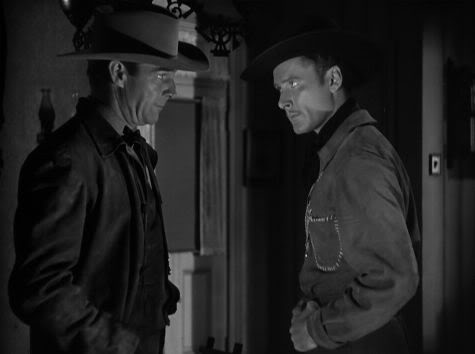
The story of Virginia City takes place towards the end of the Civil War, and deals primarily with a last ditch attempt by the Confederacy to secure a bullion shipment which would allow them to fight on. Four years of warfare, and the accompanying blockade, have left the South on the verge of bankruptcy and staring defeat in the face. Their one chance of survival hangs on obtaining the necessary funds to keep them afloat. Virginia City was the site of some of the richest mines in the country and provided the Union with untold wealth. Of course some of those same mines were owned by Confederate sympathisers who had managed to raise $5 million to aid the cause. The difficulty for the South was to get that money out of Nevada and safely into their own territory. Enter Vance Irby (Randolph Scott), a Confederate officer who has the requisite knowledge of the territory to head up an expedition to bring the contraband through. In the film’s opening scenes Irby is in charge of a military prison which counts a certain Captain Kerry Bradford (Errol Flynn) among its inmates. When Irby foils Bradford’s attempt to escape it sets up a personal rivalry between the two men that is added to later on when they meet again in Nevada and find themselves competing for the attentions of saloon singer Julia Hayne (Miriam Hopkins). Although both Bradford and Irby find themselves on opposing sides in the war they have a good deal in common, and indeed end up fighting shoulder to shoulder against a mutual threat in the closing stages. Since both of the leads were cast in essentially heroic roles it meant that another, more obvious, villain was needed. That’s where Humphrey Bogart comes in, playing the mustachioed Mexican bandit John Murrell.

£3

Flynn and Scott both play their parts well and it’s hard not to find yourself rooting for both. However, it has to be said that Scott comes off the best. He was the better actor but that’s not the only reason; his mission was also more romantic, and the fact you know it’s doomed from the outset lends more pathos to his character. In fact, the northerners of the film (with the exception of Flynn and perennial sidekicks Hale and Williams) are generally an unpleasant bunch who are difficult to sympathise with. Douglass Dumbrille’s Major is a straight-backed martinet and other pro-Union characters are shown in a highly unfavorable light. It’s notable that many films of this period tended to side with the Confederacy and painted the Yankees as the villains. Only in the closing moments, when Lincoln (appearing as no more than a shadow cast on a document) makes an appeal for national reconciliation, does the film show the Union in a positive way. If Flynn and Scott give a good account of themselves the same cannot be said for Bogart and Miss Hopkins. Bogie just didn’t belong in westerns; he was too eastern and urban, and he gives a stiff and unconvincing performance that borders on pantomime. Miriam Hopkins also looks all at sea belting out old standards in a can-can dress in a rough saloon. There is a bit of back-story for her character to show that she came from an altogether higher class of family, but it still fails to hide the fact that she was a poor choice for the part. Most of the time she appears uncomfortable and too old for her role. It’s a pity Olivia De Havilland couldn’t have been given the part for, although she wasn’t exactly the saloon girl type either, she at least had chemistry on the screen with Flynn.

Michael Curtiz did another fine job of directing and every shot is professional and well framed. The movie benefits a lot from the extended use of locations that are especially important for westerns. He created plenty of excitement in the action scenes, in particular the sequence where Bogart escapes from the runaway stagecoach. That scene also features a repeat of master stuntman Yakima Canutt’s patented under-a-moving-vehicle manouevre that he first used in John Ford’s Stagecoach. It’s also worth mentioning that Max Steiner provided another thundering score to match the on-screen action, and it adds a great deal to the film’s atmosphere.

Virginia City is available on DVD from Warners in R1 in their set of Flynn westerns. The transfer is excellent and Sol Polito’s black & white photography positively glows. There’s the usual array of extra features, including a commentary track by Frank Thompson that provides plenty of detail on the film’s production. Warners have also released a set of Flynn’s westerns in the UK, but omitted this title. I’m not sure why this happened but I have to wonder if it may not have something to do with some of the horsefalls; there’s one particularly brutal shot that would surely cause a problem with the BBFC. I would rate this film at just a notch below Dodge City, but it’s still pretty good. The plot is strong and Flynn and Scott’s characters have enough depth to keep you watching, but the miscasting of Hopkins and Bogart does damage the picture. Coming next, Santa Fe Trail.


Sirocco

ndcvzcm

Just think of the concept: Humphrey Bogart, an exotic location, gun-runners, freedom fighters, black marketeers, a love triangle, and a beautiful femme fatale. Sounds like a sure fire winner, right? I mean, it should be a given that throwing all these elements into the mix would produce a memorable movie, maybe even a bona fide classic. Superficially, it may seem like I’m referring to Casablanca; unfortunately, I’m not. No, what I’m talking about is Sirocco (1951), a poor, distant relation of Michael Curtiz’s much loved film. Now I count myself a big fan of Bogart, I even like those one dimensional thugs and heavies he played during the late 1930s, but Sirocco is a movie I really struggle to take anything positive from.

The story takes place in Damascus in 1925, during the period of French control. The end of WWI saw the carving up of the old Ottoman Empire, with modern day Syria being governed by France under a mandate from the League of Nations. But these are troubled times, and the nights are filled with the sounds of sporadic small arms fire as the Syrians launch periodic attacks against the occupying army. In the wake of one such attack, which has wiped out yet another patrol, the French military commander decides to crack down hard on the insurrection. Despite a tight blockade, shipments of weapons are making their way into the rebels’ hands. It is the task of Intelligence chief Colonel Feroud (Lee J Cobb) to halt this traffic, and this means rounding up the top black marketeers. Harry Smith (Bogart) is an American with a chequered past who uses his food imports as a cover for the more lucrative business of running guns into Damascus. While Feroud stalks Smith through the serpentine passages and subterranean catacombs of the ancient city, the relationship between the two men becomes further complicated by the fact that both have fallen under the spell of the beautiful, yet shallow and self-obsessed, Violette (Marta Toren). With the French troops hot on his heels, Smith finds himself a fugitive in a city of curfews and hastily organized ambushes. Just when escape to Egypt and safety seems within his grasp, Harry Smith finds that fate has one more twist to serve up.

£7

Throughout the ’40s Bogart was the very epitome of weary cynicism, the poster boy of film noir. Those hangdog features and his lisping delivery were perfect for expressing the pessimism and disillusionment of the time. However, his portrayal of Harry Smith is almost too weary and cynical for its own good. For the first hour or so we see a man without a shred of decency, a man who would sell out anybody or anything as long as the price was right. In itself, that’s not a problem, although there is only the vaguest hint given of what led him to this. The bigger problem is that in the final twenty minutes the viewer is expected to buy the notion of this self-serving profiteer undergoing a change of heart, and laying everything on the line in order to save the life of the man who has hounded him. In short, it doesn’t work; the character shift is too great and too abrupt to be believable. Lee J Cobb does better as the soldier whose conscience drives him to place his life in danger, and whose honor and bravery contrasts sharply with the venal amorality of Harry Smith. Marta Toren certainly looks good as the faithless Violette, but her character is a deeply unattractive one; after a horrendous bombing incident in a crowded bar, her only concern is for the damage inflicted on her dress and stockings. In truth, her role doesn’t serve any particular purpose except to add an edge to the rivalry between Smith and Feroud. In supporting parts, there’s some good work done by Everett Sloane, Zero Mostel and Nick Dennis. Curtis Bernhardt directs competently enough but the story plods in places and is only lifted by the camerawork of Burnett Guffey, who creates some atmospheric shots in the shadowy alleys and catcombs. It’s in these scenes that the film is most effective and they save it from being a complete failure.

Sirocco is available on DVD from Columbia in an excellent transfer. The print used doesn’t seem to have any damage and there’s a healthy, but not excessive, amount of natural looking film grain. Extras are limited to galleries of promotional material. The film was made for Bogie’s own production company Santana, which he set up after leaving Warners. The company made only a handful of pictures and, with the exception of In a Lonely Place, none of them set the world alight. Sirocco isn’t so much a bad film as a run of the mill one, a formula piece that’s never especially involving. One for real Bogart fans, and even they will likely endure it rather than enjoy it.

The Desperate Hours

Humphrey Bogart’s penultimate film offered him the chance to have one final crack at the kind of role that had catapulted him into the public consciousness two decades earlier. The Petrified Forest (1936) gave Bogie his big break, but it also led to his being typecast as the one dimensional heavy. For the next five years he wasn’t called on to do much more than sneer at the camera and get shot by James Cagney. Playing Roy Earle in Raoul Walsh’s High Sierra would be the turning point for him – sure it was another doomed gangster part but at least this one had a human face. With one exception, he avoided any more underworld roles until we come to 1955 and The Desperate Hours.

The story concerns Glenn Griffin (Bogart) who, in the company of kid brother Hal (Dewey Martin) and lumbering sociopath Kobish (Robert Middleton), has just broken out of prison. Needing somewhere to lay up until Glenn’s girl can reach them and deliver their money, the trio take over the suburban home of Dan Hilliard (Fredric March) and hold the family hostage. There is also a side matter of Griffin holding a grudge against a local cop (Arthur Kennedy), but this is never really developed as the movie chooses to focus on the clash of those cinematic titans Bogart and March. What we get is a war of will and wits between Bogart’s career criminal, struggling to maintain control over both his companions and the family, and the steadfast and respectable March. The film was adapted from a stage play and much of the drama is played out within the confines of the family home. This both points up the contrast between the snug domesticity of the Hilliards and the violent Griffin gang, and helps highlight the claustrophobic sense of entrapment felt by all the principals. As the balance of power seesaws back and forth, the atmosphere of tension never lets up until the film reaches its satisfying climax.

Films which are adapted from plays almost always give actors a chance to show what they’ve got. Such is the case with The Desperate Hours, where two of the heavyweights of classic era Hollywood get to slug it out and ultimately share the spoils. By this stage in his career Bogart could play this type of role in his sleep. Glenn Griffin is a man on the edge, battling to maintain control over those around him and his own personal demons. It is his failure to control either his cohorts or his own thirst for vengeance that finally bring him down. In contrast, March’s Dan Hilliard is the epitome of middle American stoicism, never allowing any overt signs of weakness or doubt to be witnessed by his family. Where Griffin’s dependence on violence and threats leads to fatal blunders, Hilliard’s self discipline and decency allow him to coolly wait for his chance. Of the support cast, the parts of Arthur Kennedy and Gig Young are thanklessly underwritten; the former having little to do except show his dogged professionalism and the latter his devotion to the Hilliard’s daughter. Robert Middleton fares best as the stupid and dangerous Kobish. He brings a genuine sense of menace to the film as his character literally crashes around like a bull in a china shop. There are also small yet welcome parts for character specialists Whit Bissell and Ray Teal.

The Desperate Hours is available on DVD in both R1 and R2 from Paramount. The disc is a totally barebones affair but the widescreen anamorphic transfer is fantastic and, at the time of writing, can be picked up for less than a fiver. All in all, it’s a worthwhile and recommended movie.