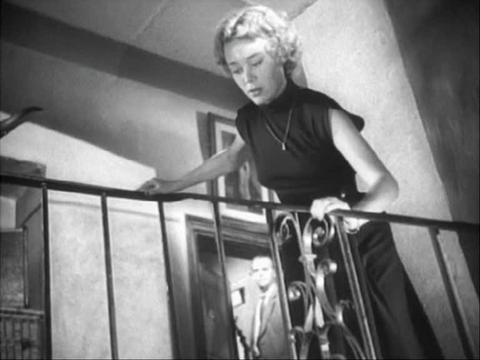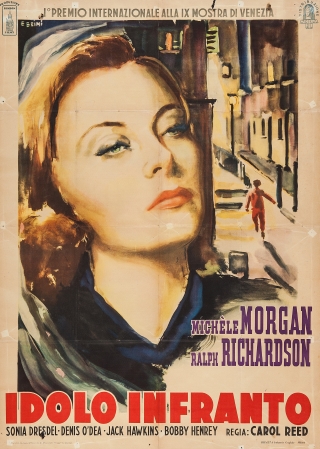
The Fallen Idol

Is it possible to encapsulate the cinema of a nation in just a word or a phrase? I guess received wisdom, or maybe some sense of deference to the depth and breadth of most cultures, would nudge many people towards a negative answer. Still and all, I think that sometimes the essence of a nation’s approach to filmmaking (and the artistic temperament that lies back of that) can be neatly summarized thus. While this idea has occurred to me before, it was while I was revisiting Carol Reed’s The Fallen Idol (1948) the other day that I found myself mulling it over again. The movie itself is one of the director’s finest, a study in suspense and longing, a powerful melodrama observed primarily through the eyes of a fanciful child and shaded accordingly. And so it was that as I watched the drama play out the word “quiet” floated insistently into my thoughts. Somehow that quietness, or restraint if one prefers, that pervades the film felt like it was actually a byword for the best offerings of British cinema.
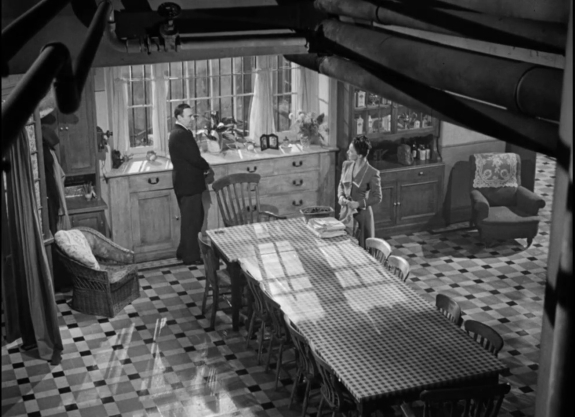
Belgravia, a location that exudes solidity, tradition and indeed diplomacy. Those imposing structures with their sense of permanency and the home to many an embassy have something of that quiet dignity I referred to about them. There’s an orderliness to it all, and what better way to put a human face on that concept than to represent it in the shape of a very proper English butler. Such a figure is familiar to almost everyone via literature, film and television if not in the flesh. He exists as a link of sorts, offering a vague connection between the present and some distant semi-feudal past, between high born aristocrats and the ordinary citizen. He is, in short, soft-spoken, impassive, dignified and authoritative, a paragon of decorum. Or is he? Is it right or reasonable to label any man a paragon of anything other than the mass of foibles and feelings that make up his inner self? Baines (Ralph Richardson) is the butler in the household of the ambassador of some unnamed nation. He is efficient and intelligent, diligent and charming. And his private life is a tangled mess of bitterness, betrayal and seemingly impossible passion. His marriage is a barren and loveless wasteland, a stale and frequently argumentative co-existence with a wife (Sonia Dresdel) who has grown suspicious and discontented. On the surface, his relief from this emotional desert comes via the whimsical and easy-going rapport he has developed with Philippe (Bobby Henrey), the lonely and over-imaginative son of the ambassador.
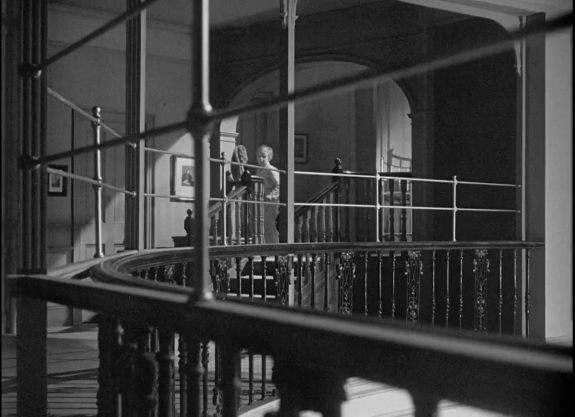
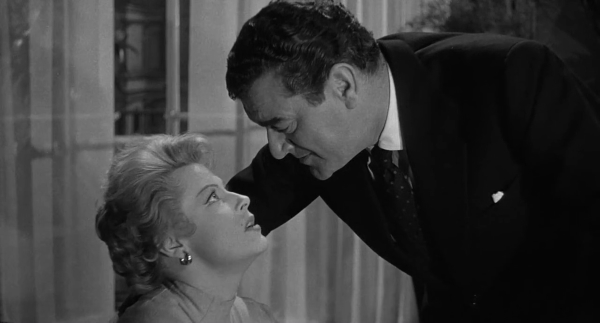
Nevertheless, as is so often the case in life, the image presented to the world at large tells only half of the tale. The Baines who ensures the smooth and comfortable running of his employer’s home, the spinner of yarns for the eager ears of a credulous and adoring Philippe has another outlet for the emptiness he experiences. He is quietly and discreetly engaged in an affair with Julie (Michele Morgan), a typist at the embassy. This fact is revealed by accident when Philippe innocently follows his hero one day and chances upon the lovers meeting quietly in the mundane setting of a nearby tea shop. Such is the simplicity and ingenuousness of childhood that the nature of the relationship is lost on the youngster and he happily and unquestioningly accepts that Julie is Baines’ niece. Still, the complications of the adult world must inevitably intrude as suspicion and desperation lead to confrontation. In that adult universe, jealousy and longing make for an explosive combination as the truth is inexorably brought to light. The audience see the argument between Baines and his wife all the way through and know how it resolves, but the boy (reflecting the half-understood perceptions of the very young) witnesses only part of it, fascinated and frightened by the heightened emotions laid bare before him. As he scrambles up and down the fire escape, peering in dread through the windows while the argument rages within, he misses out on the crucial moment and sees only the lethal consequences. Carol Reed’s direction is superb not only during these set piece scenes, but all the way through. The subsequent investigation, the possibilities that gradually emerge, the doubts and fears of all concerned are conveyed with marvelous subtlety. The master stroke of course is the way the entire thing is viewed and presented through the prism of a child’s faltering awareness and mounting despair.
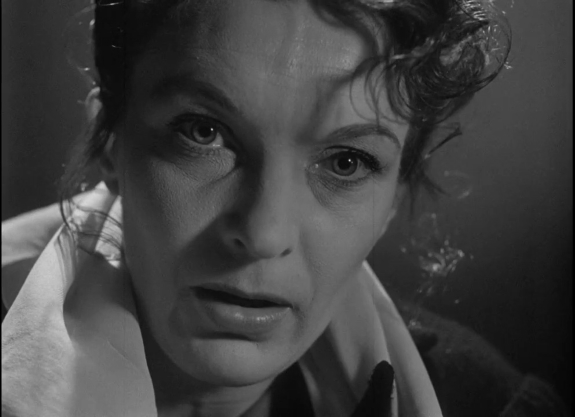
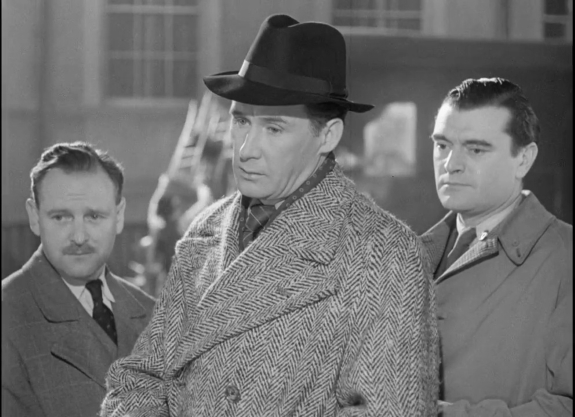
Aside from that marital spat that leads to tragedy, the quietness of it all dominates. While I feel this is a quality that pervades British cinema of the era, it is clearly a deliberate stylistic choice on the part of the filmmakers here. Many key exchanges are only half heard, uttered softly and intimately, with the kind of discretion that is the specialty of lovers or close confidantes, or indeed professionals who live by a code of caution. The conversations are frequently sotto voce, heard in snatches and presented with the contrived nonchalance adults sometimes adopt to shield the very young from the harsh complexities of life. This air of calculated concealment sets the mood for the picture precisely because it is a story seen from the standpoint of a small boy. It’s evident in the interactions of the trio of policemen, not least Denis O’Dea’s gently probing inspector, though ably supported by a watchful Jack Hawkins and a humorous turn from Bernard Lee as the interpreter whose talents appear questionable.
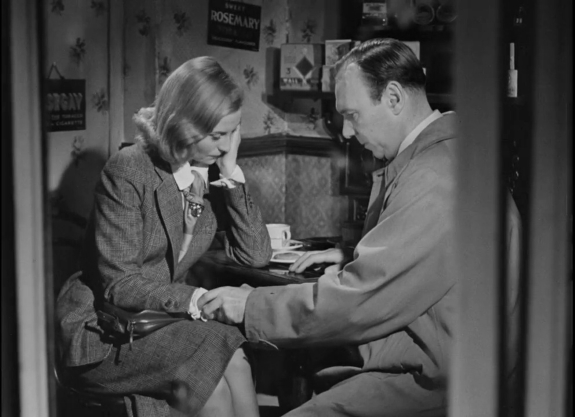
Ralph Richardson delivers a performance that is that is wholly authentic, displaying an outward bounce and buoyancy to charm and beguile a wide-eyed Philippe – so memorably portrayed by Bobby Henrey. Richardson sails rather close to eccentricity in these moments but he does so in such an attractive fashion that it doesn’t especially matter. He layers the character beautifully too and that sad little scene played out in the tea shop is heartbreakingly poignant in its restraint, and arguably because of it. It’s not just some stiff upper lip pose either but rather it’s a barely suppressed emotional crisis held in check largely due to the presence of the young boy who couldn’t possibly comprehend or grasp the powerful passions ebbing and flowing across the table before him were they to be let loose. Michele Morgan does fine things with her eyes and voice to supplement all this but it’s Richardson who owns the scene, who wrings truth out of the simplicity and ordinariness of the setting; that turning away when Julie exits, the fiddling with the newspaper, the shuffling round the shop his eyes downcast as he struggles to master the despair that threatens to overwhelm him is suffused with gut-wrenching pathos. But so very quietly.
The Fallen Idol was the first of three adaptations of works by Graham Greene that Carol Reed brought to the screen. The Third Man is undoubtedly the most highly regarded of those, but The Fallen Idol is every bit as good in its own way. Actually, when one pauses to remember that those two movies preceded by Odd Man Out were all made one after another between 1947 and 1949, it really does serve to highlight Reed’s greatness as a filmmaker. I don’t believe there’s any doubt that this is a movie everybody should make the time to see.
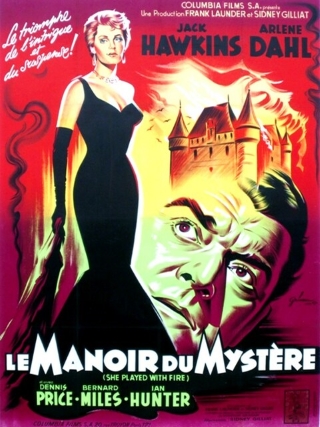
She Played With Fire

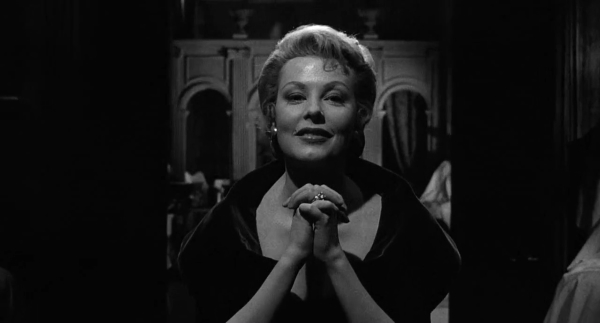
I sometimes think I spend far too much time on associations, images that recall other images, movies that bring to mind other movies, or names that automatically start me thinking of other people. Such is the case with Frank Launder and Sidney Gilliat, mention of whose names inevitably sparks thoughts of Alfred Hitchcock as a result of their having produced the script for The Lady Vanishes. That association feels a little stronger when viewing She Played With Fire (1957), which is also sometimes referred to as Fortune is a Woman, as it derives from a story by Winston Graham and he of course wrote the novel which  formed the basis of Hitchcock’s last great film Marnie. This all sounds as though the movie has a wonderful pedigree, which I suppose it has even if the attractively packaged end product isn’t quite as satisfying as one might hope.

Some premises hook viewers early or even immediately in exceptional cases. Personally, I struggle to work up a huge amount of enthusiasm over plot devices like insurance fraud, a swindle can clearly make for an engaging and involving storyline but it’s usually when a human face is seen to suffer. That said, a good movie ought to be able to rise above the potentially mundane aspects of its plotting – it’s a visual medium after all and a touch of style in that area can gloss over a lot. She Played With Fire does display a degree of visual panache and the opening blend of dreams and reality by way of art sets everything up nicely. In brief, Oliver Branwell (Jack Hawkins) is an insurance man, one of those post-war types who has spent a good deal of his time overseas and always comes across as a bit of a square peg in the round hole he’s chosen to lodge himself in. An investigation into a fire and the resultant damage to some pictures at a stately pile in the country brings Branwell abruptly and unexpectedly face to face with his own past. The claimant is Tracey Moreton (Dennis Price), a vaguely decadent asthmatic, but the surprise from Branwell’s perspective is Moreton’s wife Sarah (Arlene Dahl). She is the woman he once romanced and then lost in the Far East and the embers of that fling have evidently not quite cooled. Everything remains very proper though despite the ever present temptation. In time however, the pair are drawn closer together, and then the possibility of a clever bit of fraud comes accidentally to the attention of Branwell. Without going into too many details, he is soon questioning the good faith of Sarah and then finds himself plunged into a truly messy affair as a nighttime investigation of the Moreton mansion coincides with a massively destructive conflagration and the discovery of the owner’s corpse just before everything goes up in flames. This all leads to some foolhardy deceit, a whirlwind romance, blackmail and the uncomfortable possibility that a supposedly dead man might actually be still alive.

I have seen this movie labeled a film noir and while I can see how some of Gerald Gibbs’ striking high contrast cinematography, as well as the convoluted deceptions and tangled interpersonal relationships, are suggestive of this, I wouldn’t describe it as such myself. I can’t say I object to anyone categorizing the movie as noir but I tend to regard it as a classic mystery with a smattering of noir tropes. Does it succeed on those terms? To a point it does yet there’s an unevenness to it as a whole that weakens it. The tension arising out of the blackmail strand is dropped or allowed to slacken too early and this robs it of suspense and urgency. A bigger issue though is the fact the whole fraud and murder mystery which ought to underpin the film is frankly nowhere near as compelling as it needs to be.

What does keep it all afloat is a combination of Gibbs’ lighting and some evocative composition and framing from director Gilliat. In short, this is a movie that looks good all the way through. The acting helps matters along too, especially from the ever reliable Hawkins. He could generally be depended on to produce a pained stoicism, earnest and honest but leavened with something of a twinkle in the eye that prevented everything from sliding into dourness. Arlene Dahl was highly decorative and has a hint of duplicity about her, enough to generate some suspicion though perhaps not enough to sustain it all the way through to the end. Dennis Price was born to play wastrels and does so effortlessly here, it’s just a pity he’s not given more screen time. Bernard Miles is a touch theatrical as the seedily adenoidal would-be extortionist, but it’s a memorable turn for all that. Greta Gynt seemed to be enjoying herself immensely as an incorrigible good time girl, a lovely piece of light comedic acting, while Christopher Lee pops up in a blink and you’ll miss him cameo as one of her unfortunate conquests. It was also a nice touch to cast father and son Malcolm and Geoffrey Keen as two generations of the insurance firm Hawkins is working for.

She Played With Fire was a Columbia film which was released first on DVD in the US by Sony as part of their MOD line and then later it was licensed out to Kit Parker Films and appeared on Blu-ray in one of the company’s multi-title film noir collections. I’ve often wondered why the film never made it to Blu-ray in the UK, especially when Indicator were releasing a lot of Sony/Columbia product not to mention the fact they like to highlight British cinema titles where possible. Perhaps the slightly odd fact the movie has the kind of plot that is simultaneously too convoluted and too slight discouraged them? Still, the deep cast of familiar British character actors and the inevitable if incidental links to Hitchcock would seem to invite the kind of analysis to be found among the supplementary features of many Indicator discs. All told, an enjoyable albeit imperfect movie.

State Secret

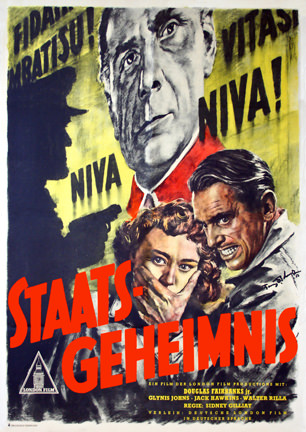
Political thrillers can be a bore; long-winded affairs that can be equally long on sanctimony have a tendency to turn me off. For me, anything which is given this designation works best when the political aspects are sidelined as far as possible and the thriller elements are brought unashamedly to the fore. Even better is the film were the politics are of the entirely make-believe variety, serving only as a light frame upon which to drape a tale of intrigue. In 1938 Frank Launder and Sidney Gilliat turned out such a screenplay and in the process played a significant role in shaping the success of The Lady Vanishes, one of Alfred Hitchcock’s best British movies. A dozen years later would see Gilliat both contributing to the script of and directing another British “political” thriller called State Secret (1950) – a neglected piece of hokum which remains highly entertaining.

Middle Europe and non-existent countries (and in this particular case featuring what appears to be a specially created language that is used throughout the film) are the kind of ingredients which effortlessly draw me in. In this case it’s Vosnia, the undisputed realm of one General Niva (Walter Rilla). Frankly, I find it hugely refreshing that there is a deliberate vagueness about the leanings of this dictatorship; whether Niva is a leftist or rightist demagogue is never addressed, and the simple fact is it’s of no relevance whatsoever. When eminent surgeon John Marlowe (Douglas Fairbanks Jr) is persuaded to travel to Vosnia to demonstrate his pioneering new technique, it’s not important to know the color of intolerance and repression that holds sway within its borders – both the hero and the viewers are off on a pacy adventure, where the only thing that matters is the threat and not the philosophy supposedly driving it.

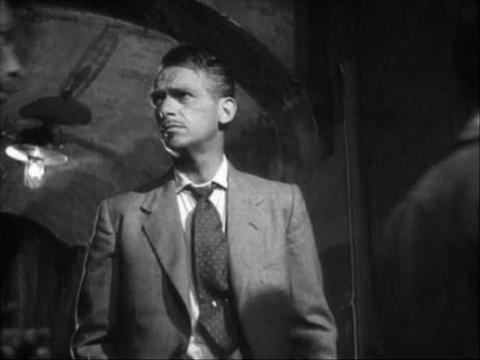
So, Marlowe finds himself enjoying the kind of luxurious hospitality only the best totalitarian regimes can offer while he shows off his new procedure and collects what he’s been told is a prestigious award. Naturally, in a movie of this type, the whole scenario  is merely a blind, an elaborate charade designed to conceal the fact Marlowe is actually operating on the seriously ill head of state. Perhaps a wiser man might have considered this possibility, and certainly would have made sure  any suspicions he may have had were kept strictly to himself. But Marlowe isn’t such a man, and of course if he were, we wouldn’t have a film to enjoy. As it is, he makes a point of finding out who his patient is, and then finds that countries like Vosnia have a host of other feature to offer when patients whose identity it really would be better not to know don’t survive the procedure. What follows is a relentless pursuit across an alien landscape as Marlowe, with the initially reluctant assistance of showgirl Lisa (Glynis Johns), tries to elude the urbane but deadly Colonel Galcon (Jack Hawkins) and all the forces at his command.

With location shooting in Italy, State Secret is an attractive looking British thriller, a fast-moving and exciting thriller which owes a debt to the writer/director’s previous collaboration with Hitchcock. The concept of the regular guy on the run, pursued across the country by shady types in the employ of a ruthless foe, is a familiar trope. And, in addition, there are scenes, such as the attempt to seek sanctuary in a theater and hide oneself among a crowd as the enemy closes in, all of which recall the likes of The 39 Steps and Saboteur, and also look ahead to North by Northwest and Torn Curtain. Gilliat’s script here is adapted from a novel by Roy Huggins (of The Fugitive fame), which I have yet to track down and read so I can’t say how much derives from that source.

Fairbanks makes for a personable and sympathetic hero in State Secret, making me wish he’d done more of this kind of stuff. His was a rich and varied life and it seems sometimes that acting was only a small part of it all – he’ll probably remain best known, and probably deservedly so, for his roles as the amoral Rupert of Hentzau in the 1937 version of The Prisoner of Zenda and also as a soldier in Gunga Din two years later. Personally, I’d love to be able to see another of his movies, Green Hell, made available at some point as I remember it as being quite a lot of fun. Glynis Johns, daughter of Mervyn Johns, was in the middle of a productive run of work at this point and is an appealing and credible partner for Fairbanks. Jack Hawkins was one of the greats of British cinema; equally at home as either hero or villain, or any variation floating between, he lent class to any film he appeared in and here (bearing in mind the caliber of his co-stars) he consolidates an already distinguished cast. If I had a complaint to make, it would be that we don’t get to see more of Hawkins, and the same could be said for the always accomplished Herbert Lom.

In the same year, Richard Brooks would make the similarly themed Crisis – with Cary Grant finding himself pressured into operating on a dictator and running the attendant risks – but that’s a slower, duller picture that tries harder to make a philosophical point but ends up losing its way as a piece of cinema. State Secret, on the other hand, is upfront about its aims as a piece of entertainment first and foremost and winds up being a better film as a result. Sadly, there don’t appear to be any strong versions of the movie available to buy. I have a Spanish DVD which is just about acceptable in terms of quality, but I couldn’t really endorse it. There’s also an Italian disc on the market and I suspect it’s probably from a comparable source. As such, all I can say is I hope the film gets a release somewhere that does it justice. Anyway, it’s a fine British thriller that is worth keeping one’s eyes open for – and perhaps it will come in for the treatment and attention it deserves.

EDIT: The film has since been released in a very attractive Blu-ray edition by Network in the UK.