Riding Shotgun

Ever watch a movie and find yourself struggling to quite get a handle on it? I don’t mean in terms of following the plot, rather the direction in which the plot wants to lead your thoughts. Frankly, I’ve seen lots of films where the storyline has meandered all over the place and the focus seemed to shift continually. But it’s a whole different matter when we start talking about a small, tightly structured production, one where there’s an essentially simple story being told, yet where the theme and tone appear to vary almost from scene to scene. As I watched Riding Shotgun (1954) the other day I was struck by tonal shifts throughout, a kind of capriciousness in the scripting that meant a potentially interesting little movie fell short of what it might have been.

As soon as the credits roll there’s a sense that we’re going to get one of those noir-tinged westerns that can prove so satisfying, Firstly, we get a voice-over narration by the hero, Larry Delong (Randolph Scott), which lets us know that he took the job riding shotgun for the stagecoach line, and traveling all over the west as a result, for a very special reason – to find one particular man, and to kill him. The man in question is Dan Marady (James Millican), a notorious road agent or outlaw, and he’s well aware of the fact his nemesis is dogging his tracks. I don’t think I’m giving too much away here, as the following all occurs in the first 10 minutes or so of the film, by saying that Marady has a plan in place to lure Delong away from the stagecoach and then fake a raid on it to draw a posse out from the neighboring town. With the law off chasing the apparent attackers of the stage, the town will be left wide open so Marady and his men can enter at their leisure and pick off all they want in safety. That’s the plan, but a little carelessness means Delong remains alive and free, and in a position to warn the defenseless settlement of the impending raid. It’s at this point that the movie takes a turn off into more unusual territory – instead of being greeted as a savior, Delong first becomes the object of suspicion and distrust, and later an outright threat who has to be eliminated.

Coincidence, misfortune and misunderstanding provide the impetus for the plot of Riding Shotgun, the kind of circumstances that make for good drama,and can add to that sense of noir fatalism I alluded to earlier. With the revenge motif, the narration and the sight of Randolph Scott grimly determined to kill a man as opposed to, let’s say, bring him back for trial, everything appears to be in place for a solid B western suspenser. And yet it doesn’t really come off, and the reason is the uneven or uncertain tone I spoke about. For a story like this to work as it should, to be truly effective, it needs to be tackled as a straightforward and straight-faced yarn. The setting and build-up are suitably minimalist and claustrophobic, and director André de Toth frames some excellent compositions. As Scott’s character finds himself increasingly isolated and literally backed into a corner, there’s tension in abundance. However, we also get humorous undercurrents – the over-cautious and ever-hungry deputy (Wayne Morris), the grotty saloon keeper fretting about his costly mirror and addressing his son in Spanish while getting answered in German, and the (seemingly) deliberately obtuse townsfolk. The net result of it all is that the film is neither fish nor fowl, shying away from full-on suspense and flirting with the comedic elements, we end up with a film which feels slightly arch.

I wonder how this movie was received on release since, even now, I find it a little odd to see Randolph Scott so hell bent on killing off his enemy. I know he went to similarly dark places in a couple of the Budd Boetticher films a few years later but it still gives me pause. While I have reservations about the script I can’t fault Scott’s performance, but he rarely gave an unsatisfying performance by this stage in his career anyway. It’s nice to see James Millican, who often got cast in smaller but always memorable roles, handed a more substantial part as the chief villain; it doesn’t call for any great subtlety but there’s plenty of opportunity for some solid snarling and meanness. Millican’s principal sidekick is played by a young Charles Bronson (still being billed as Buchinsky) and his presence and potential can be clearly seen at this point. OK, I’m harping on the (not all that successful and also unnecessary) comic aspects again but I feel Wayne Morris is ill-served as a result. His conflicted deputy is an important character in the film, providing a lot of balance and accessibility. But the way the part is written undermines him at every turn and diminishes the role considerably, a great shame. There’s a good supporting cast featuring the likes of Joan Weldon, James Bell, Joe Sawyer, Frank Ferguson, Vic Perrin and John Baer, although many of them are given very little to do.

Warner Brothers put Riding Shotgun out on DVD years ago as part of a triple feature set with Man Behind the Gun and Thunder Over the Plains. Scott’s westerns were harder to find back then and only few were available to buy compared to now, and I remember being very pleased to see these films come on the market. The presentation is as basic as it gets with no bonus features included. Still, the film looks reasonably good with nice colors and no major print damage. I’ve spent a fair bit of time highlighting what I see as the deficiencies of this film but I feel I should also point out that even a relatively weak Randolph Scott western benefits greatly and is elevated by his presence alone. I don’t think I’ve seen a Scott western I didn’t enjoy on some level at least, which is a testament to the man’s talents. If I seem unduly critical of this one, then it’s mainly because I can see how a few minor tweaks to the script could have left us with a far stronger picture. Nevertheless, and despite its faults, it’s still worth a look.

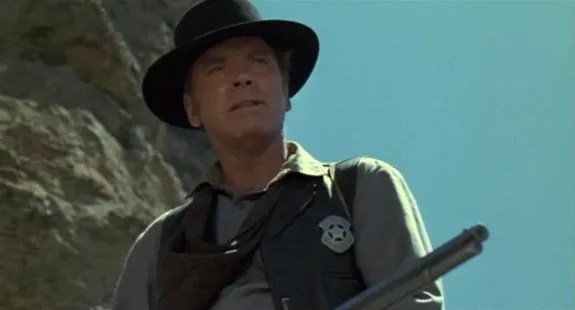
Lawman

It’s always the same. If you post a man, he has to come into town to prove he’s a man. Or you kill a man, he’s got a friend or kin – he just has to come against you… and for no reason… no reason that makes any sense. And it don’t mean a damn to the man already in the ground. Nobody wins.

Nobody wins – that quote taken from Lawman (1971) is a bit downbeat, but it does sum up the mood surrounding the film and maybe also feeds into the sentiments which would become increasingly common in the western in the 1970s. Last time out I was looking at a western, and at the same time musing about the genre itself, from the late 60s, a restless and hard to define era. The decade of the 70s followed on from that and gradually developed its own character – when we speak of the westerns of the 50s we often find ourselves referring to redemption, by the time we reach the 70s we’re more likely to encounter resignation.

The figure of the lawman is integral to the western, the constant expansion of the frontier and the subsequent attempts to bring and maintain civilization via the rule of law is a constant factor, if not the underlying theme in itself. A bunch of weary cowboys let loose and whooping it up is another common sight, and the result of such celebrations was frequently violence. Such was the case in the town of Bannock, where the hands employed by Vincent Bronson (Lee J Cobb) had a little too much to drink, let their good sense abandon them and left a dead man lying on the street. And so the marshal of Bannock, Jared Maddox (Burt Lancaster), comes to Bronson’s patch with the goal of returning the guilty men to stand trial for the killing. Bronson is one of the old style pioneers, that tough breed who tamed a land and bent it to their will through the force of their personality, backed up by a loaded gun. Men like this are accustomed to getting their own way or, where that’s more difficult, to buying individuals who can smooth things out for them. Bronson has already bought and paid for his own marshal, Cotton Ryan (Robert Ryan), and believes that Maddox or those he represents have their price. In a way, he’s right as Maddox admits that he’s really only going through the motions – acquittals can be purchased in all likelihood. Yet Maddox’s own price isn’t quite the same; he might draw his wages from a corrupt source but he owes personal loyalty to another more idealistic paymaster – justice. So the drama and conflict therefore grow out of two situations: the reluctance of Bronson, or at least that of his men, to comply with Maddox’s wishes, and also the lawman’s own battles with  himself and the code he’s stuck by all his life.

The 60s was a decade when many questions were asked, the 70s kept at it and got some answers, but those answers weren’t always the ones people wanted to hear. Disillusionment was creeping in and many ideals seemed to be tarnished when dragged out into the cold light of day. Lawman dealt with that now familiar theme of changing times – clearly articulated by Lee J Cobb’s character – and the need to adapt, bend or be broken.The message seems to be that when all around you has been corrupted and debased by greed and self-interest, then the only sure or true thing one can hold onto is your personal code of honor. Maddox is the lawman, the one who has lived by that code refused to compromise. It raises him above the other characters, friends and enemies, colleagues and lovers, but isolates him too. Maddox questions the value of this, understands the fact it has sustained him through the years, but ultimately betrays it (and by extension himself) when confronted by the rank and venal behavior of the man who, in some respects, replaced him. It’s as though the knowledge of what he could become, if he were to submit to his desires, is too much for him and so must be banished.

Lawman was directed by Michael Winner, a man not noted for his subtlety either as a filmmaker or in any other area of life. It became fashionable to dismiss his work as crass and lacking in substance, but blanket judgements are rarely worthwhile and best avoided, in my opinion. Winner will never be regarded as a great filmmaker, which is fair enough, but it’s unjust to simply brush him aside as a hack. Some of his early work is very good – for example, West 11 is a neat little movie – and it wasn’t until  mid-70s that a significant decline in quality could be discerned. Lawman does have too many needless zooms and close-ups yet it also has pace and a kind of raw, brutal honesty that’s quite attractive.

Once again, we have a film whose stars hark back to the golden era of the genre – Lancaster, Ryan and Cobb were all involved in some of the finest westerns made and worked with the most talented directors, writers and cameramen. To browse their filmographies is to contemplate the heights cinema was capable of attaining, and their class is readily apparent in even the smallest gestures. There’s real pleasure and delight to be had from seeing these seasoned pros playing off each other and enjoying the nuances they could bring to parts effortlessly. Although that trio of heavy hitters would be enough to hold our interest by themselves there’s a terrific supporting cast to savor too – Albert Salmi, Joseph Wiseman, John McGiver, Richard Jordan, Robert Duvall, Robert Emhardt, J D Cannon, John Beck, Ralph Waite and more. It should be noted that the film is light on female representation; Sheree North is the only woman to play a part of any importance, but it’s a good role and one that impacts on the ultimate resolution.

Lawman is one of those United Artists titles released on DVD by MGM ages ago now. It’s typical of many such releases in that it’s just about passable but should look an awful lot better. On the plus side, the film is presented in the correct widescreen ratio and enhanced for 16:9 screens. On the other hand, there’s a softness about it and the usual artifacts and instances of print damage that need to be tidied up. The UK version I have has no extra features and I think the same can be said for the US edition too. Generally, I find I get on better with many (though not all) 70s westerns than the late 60s variety – it seems the genre settled down somewhat and made up its mind where it wanted to go by that stage – and I feel Lawman is deserving of a bit of attention. While it has suffered a bit due to the lackluster reputation its director earned over the years, it’s a good film and one that’s worth checking out.

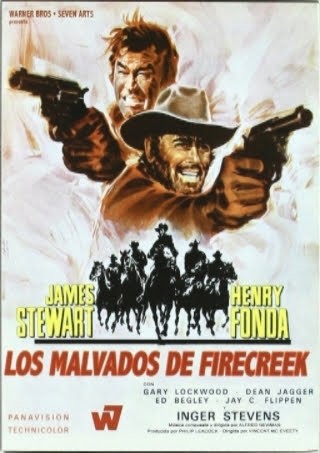
Firecreek

poster29_zpsd0ov1c8g

Somewhere in the mid-60s the western began to be less attractive, both in terms of the look and the mood. It’s something which seemed to creep into the genre gradually as the decade wore on. You could even say it made occasional forays before retreating again, but it seemed to visit more frequently and stay a little longer each time. What I’m speaking about here is difficult to put my finger on exactly; it’s got to do with images which haven’t got quite the snap that was once the case, and an attitude of weariness and melancholy. Firecreek (1968) comes close to encapsulating the point I suppose I’m trying to make here – not a bad film by any means, but not an especially attractive one either.

Firecreek is a quiet town, a place where nothing all that important happens and people just go about their daily business without much serious worry. And yet it’s a place lacking something else, something vital whose absence is soon to be highlighted by the arrival of a handful of men. Larkin (Henry Fonda) is gunman, an enforcer for hire who has spent his life roaming the frontier plying his trade, and that of the ragtag bunch of followers he attracts, in the service of the highest bidder. A gunshot wound, the need to rest up and the suggestion of pursuit by unnamed figures has brought him and his men to Firecreek. And it’s here that they run into Johnny Cobb (James Stewart), farmer and family man, and part-time sheriff if or when the need arises. Cobb displays none of the characteristics or indeed the trappings one might normally associate with a lawman, and when this role is eventually revealed it represents as much a surprise to Larkin’s band of toughs as it does to the viewer. These new arrivals profess no interest in hanging around any longer than is necessary while Cobb, and indeed virtually the entire population, takes the view that confrontation is to be avoided at all costs. However, any place where drink is available as well as the presence of that other genuine rarity on the frontier, women, trouble has a habit of turning up too. When violence does burst onto the scene and shatters the tranquility of Firecreek, Cobb in particular finds himself driven towards confrontation. On the surface, he’s forced to face off against the men who have threatened the security of his town, but it’s really a challenge posed by the passive mood of the settlement itself and the withdrawal from life he’s been hitherto happy to embrace.

Firecreek was directed by Vincent McEveety, a man who worked extensively on television (most notably on Gunsmoke) but whose work I’m not very familiar with. Personally, I found the pacing of the movie a bit too leisurely, taking a long time to set up the central situation and then slacking off again before racing towards the resolution. The idea of a group of dangerous men resting up in a small and isolated settlement, while their leader tries to recuperate, and subsequently causing mayhem recalls de Toth’s Day of the Outlaw in some respects. However, Firecreek never reaches those dramatic heights, nor does it have the tight focus of that picture. Aside from the community in peril aspect, it attempts to blend in too many other themes and thus weighs itself down. The main ideas seems to be that of a town which has become a kind of repository for those who have lost their way or lost their nerve in life, a sort of limbo state on the western frontier. That’s an interesting enough concept, the antithesis of the thrusting pioneer spirit typically portrayed in the genre, but it’s introduced late in the day and the back stories of the characters are sketched too lightly to bear it out successfully. Alongside this there are allusions to the conflict between civic duty and one’s responsibilities to family, questions about race and miscegenation, and a whole range of powerful emotions from desire and jealousy through loss and bitterness – yet none of them feel all that fully developed. In addition to all this, much of the plot unfolds within the drab confines of the town and there’s therefore limited scope for cinematographer William H Clothier to show off his unquestioned skills behind the camera.

Fonda and Stewart were big names in cinema and both had their fair share of important westerns behind them, each having worked with the likes of Ford and Mann in the past. Stewart got the meatier role, one which afforded him the chance to progress from his characteristic down-home humility to something approaching the emotional pain Mann so expertly coaxed from him. Although the transformation his character undergoes in the third act doesn’t reach the intensity of those tortured souls he gave us in the previous decade there’s still a touch of that inner rage and frustration he was so adept at tapping into. Fonda’s villain is one of those men who senses the end of the line nearing, a throwback to wilder days who sees he’s fast becoming an anachronism yet can’t envision himself doing anything else. The supporting cast is impressive even though some of the members aren’t used as effectively as they might have been. Of the women, Inger Stevens has the most to do and gets to play a decisive part in the final resolution. Conversely, Barbara Luna and an exceptionally sour Louise Latham play potentially interesting characters whose backgrounds are never fully explored. Gary Lockwood makes for an extraordinarily dangerous henchman with a tinderbox temperament and James Best nails both callous and dumb. As is so often the case, Jack Elam is more or less wasted as the senior member of Fonda’s gang but he’s always a pleasure to watch all the same. With the likes of Dean Jagger, John Qualen, Ed Begley and Jay C Flippen all contributing turns of varying significance, it shouldn’t be hard to appreciate the depth of talent involved in this movie.

Firecreek was released on DVD in the US many years ago, on a disc which has The Cheyenne Social Club on the flip side, by Warner Brothers. The scope image is presented anamorphically and looks fine for the most part. Colors look reasonable to my eye but, as I said at the beginning, it’s not what I’d term a handsome looking movie. The only extra feature is the theatrical trailer. Despite the excellent cast and a plot that offers plenty to mull over, I can’t say I like this movie a lot. The tone, look and central message are all downbeat, and relentlessly so. Films of this era can, at times, leave me with that vaguely dissatisfied feeling. I have a hunch that filmmakers then were striving to achieve what they hoped would be another layer of realism but it’s possible to lose some of that magical and almost indefinable quality that can make cinema such an alluring form of art and entertainment. All told, Firecreek is a film which doesn’t quite work for me – others may react differently of course.


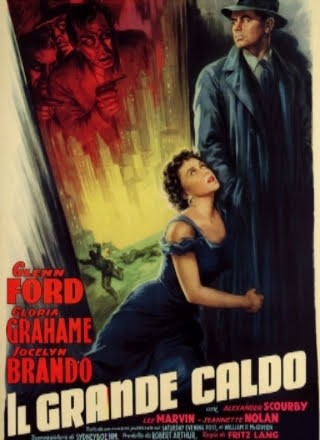
The Big Heat

poster52_zpsuu5u64gu

Over the years I’ve spent a fair bit of time talking about film noir, musing over what it is or isn’t and, perhaps inevitably, looking at quite a few borderline cases. I’m still not sure I could articulate exactly what constitutes film noir – although not being able to do so is hardly a big deal – but I do recognize a clear-cut example when I see it. Fritz Lang’s The Big Heat (1953) comfortably fits the bill with its harsh portrayal of a cruel and corrupt world and the merciless way it treats those who would resist it.

The first thing we see is a man reaching for a revolver and then calmly blowing his brains out as he sits at the desk in his front room. His wife (Jeanette Nolan) is alerted by the gunshot and appears shocked, but not too much and certainly not overcome by grief. If anything, she’s drawn more to the document her late husband left behind. The recently deceased was a cop, a dirty one who had been bought and paid for by the mob, and also smart enough to have retained some insurance. As the investigating officer, Bannion (Glenn Ford), remarks, when a cop takes his own life the department is always interested to find out the reason. Initially, there’s no reason to doubt the widow’s claims that her husband was suffering from ill-health and the case looks to be an open and shut one. Even when a girl in a clip joint makes allegations about a less than satisfactory private life, there’s nothing to prove it’s anything other than talk. It’s only after Bannion starts to get gently warned off that he grows more suspicious. As the underworld flexes its muscles and reveals the violence that has been lurking behind the thinnest of veils the full extent of official corruption becomes apparent. Had Bannion been prepared to play the game, matters would have ended there. However, his persistence, and perhaps recklessness or naivety, brings tragedy right into his own parlor. With the whole fabric of his being torn down around him, Bannion moves himself out to the fringes of society where he allows himself to become consumed with hatred, frustration and an unquenchable desire for vengeance.

£2

I’ve never made any secret of the fact I’m a big fan of Fritz Lang, and I’m especially fond of his Hollywood movies. Towards the end of his time in the US the budgets he operated under seemed to shrink but he always had a talent for economy in his storytelling anyway. The Big Heat exemplifies this neatly in the no-nonsense way it plunges headlong into the tale from the very first shot. The whole movie is a lean affair, pared down to its essentials visually, thematically and in terms of dialogue too. There’s no waste – not a word nor a gesture appears which doesn’t serve to drive the narrative on. Even the central idea (that of institutional corruption, an increasing staple of 50s film noir) is addressed in direct, matter-of-fact terms.

One of the most interesting aspects, for me at least, was the contrasting portrayal of family life on view. We’re introduced to Bannion’s domestic setup early on and it’s an attractive one, defined by the affection and banter between the detective and his wife (Jocelyn Brando) and the simple yet wholesome way they’re living. Later, when we’re introduced to the chief mobster, Lagana (Alexander Scourby), it’s a very different world which is presented. Where Bannion’s home is a relaxed place filled with informal conversation, Lagana’s mansion feels like a mausoleum of respectability, a soulless place where no hint of “dirty” talk is tolerated.

The other notable point to be made about The Big Heat is the frank way that violence is depicted. There’s real brutality in the actions of the mob and its principal enforcer (Lee Marvin), a sadistic pleasure derived from the infliction of pain and suffering. The film came along quite early in Marvin’s career and gave him the kind of role that was something of a gift for a young actor. In another of those instances of mirroring Ford’s honest cop is driven right to the brink of sanity and morality – he comes to embrace violence with almost the same gusto as Marvin’s sociopath. The crucial difference here though is that Ford draws himself back before he fully succumbs to his basest instincts. Actually, it’s a very solid part for him, requiring him to exercise a fair bit of range as his character travels along the painful arc from contented family man, through heartbreak and loss, to cold avenger. He’s partially saved or redeemed by his own innate decency, but an even more significant influence is provided by Gloria Grahame’s unfortunate moll. It’s her actions and what happens to her that breaks everything wide open, giving Ford his first real leads and also reawakening his ability to identify and empathize with people again. Ultimately, while The Big Heat is a film which sees very bad things happen to people, its message is a positive one about human nature. Sure society has its share of rottenness and violence may be lurking just round the corner, but decent people remain so at heart and there are always those willing to lay it on the line to help others.

£3

There was a time when it was difficult to see all of Fritz Lang’s films, although that’s no longer the case. Even back in the days when one had to search around for his stuff The Big Heat was one of the more accessible titles – I think it may actually have been one of the first films by the director I ever saw, at a time when his name wouldn’t have registered with me. Now there are a variety of DVDs and Blu-rays available from different territories so there should be no problem finding a suitable copy of the movie to view. I would imagine that most people with even a passing acquaintance with Lang will be aware of this film – it’s generally well regarded and the casting probably helps. Needless to say, it’s highly recommended for anyone who has yet to view it.


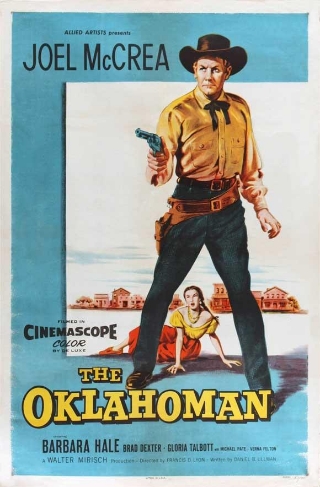
The Oklahoman

poster59_zpsdhd3643v

Allied Artists Pictures grew out of Poverty Row specialists Monogram and produced and distributed movies from the late 40s through to the 70s. The brainchild of Walter Mirisch, the studio aimed to produce what he termed B+ movies, promising a step up from the lower production values Monogram had been associated with. What resulted was a range of films from the instantly forgettable to the memorable, and everything in between. For this blogathon celebrating the work of the studio I’ve chosen a late 50s western, The Oklahoman (1957) starring Joel McCrea, one of the genuine icons of the genre. It’s a brisk tale of love, race and oil, charging home at just under 80 minutes and never pausing for breath.

It’s 1870 in the Oklahoma Territory and a couple of wagons bound for California have stopped off, the reason being that a baby is on the way. Tragically, the mother dies in childbirth and leaves the grieving father, John Brighton (Joel McCrea), with an infant girl and a tough choice to make. The experience has sapped his pioneering spirit and, being a doctor, he decides to stay put in the small town and set up in practice. We jump forward a few years and the child is growing up, reaching that stage where she needs a maternal figure in her life. Brighton finds himself in the enviable position of having two attractive women vying for his affections – the first is the young Indian girl, Maria (Gloria Talbott), he’s hired to look after his daughter, while the other is a widowed rancher, Anne Barnes (Barbara Hale). Thus we’re presented with a romantic triangle with the somewhat bemused doctor as the focal point. Westerns tend to use change as the engine to drive their dramatic content, sometimes it’s changes to the social structure or the spread of civilization and the establishment of the rule of law. In this case, the evolution of society is underway with the absorption of the native people into the community already in progress. That theme is addressed of course but there’s also the matter of shifting economic priorities at play, providing the motivation for the actions of the villains and in the process threatening to cast a shadow over the native-settler relationship. When leading rancher Cass Dobie (Brad Dexter) becomes aware of the large oil deposits on the neighboring land owned by Maria’s father (Michael Pate) he sees the direction the economic wind is blowing. If he can’t get the land by buying it, he’s quite prepared to resort to whatever means are necessary, regardless of who gets in his way or what social damage is caused.

While the oil angle is interesting and a little unusual for a western, it’s the treatment of the racial aspect which stands out particularly in this film. Right from the beginning the Indian characters are shown to be working at integration into white society and, even more notably, being accepted on those terms. The conflicts of the past haven’t been forgotten of course, as a conversation among a few town residents on the boardwalk one evening demonstrates, but they’re spoken of in a philosophical and progressive way – there’s an explicit admission of wrongdoing and an awareness that the fighting had justifications from both sides. What’s more, the question of racial tension only rears its head when the villains force it onto the agenda, and even then those who would seek to reopen old wounds and exploit the resulting hostility remain in the minority; there are as many and perhaps more voices expressing support for the Indians.

The Oklahoman came from the pen of Daniel B Ullman, who had a long list of writing credits to his name. Latterly, he wrote extensively for television but also contributed a significant number of western scripts, including Canyon River, Wichita, At Gunpoint and Face of a Fugitive, to name just a few. The cameraman was another vastly experienced guy, Carl Guthrie, and he helps give the whole thing a look which at least partially belies the modest budget. Director Francis D Lyon started out as an editor and did the bulk of his work for TV. His feature credits are limited (he did take charge of the rather nifty Escort West though) but he does fine with this movie and certainly keeps everything moving at pace.

All too often, the romantic elements can feel like a superficial adjunct, something bolted on to pad the running time or broaden the appeal of a movie. However, with The Oklahoman that’s not an issue; the romance, and the jealousies and confusion arising from it fold neatly into the plot and are integral to the picture. Joel McCrea plays what might be termed a typical McCrea role, that of a stolid and upright individual maneuvered by circumstance into a conflicted position. I think the key to McCrea’s success and enduring popularity among western fans is the smoothly professional way he handled such parts. As he aged he grew in courtliness and took on a more introspective air. That served him well in his scenes with both Gloria Talbott and Barbara Hale, the respectful reserve striking the right tone for a character who has long lived alone and has perhaps come to accept that his path is destined to lie in that direction – the gradual uncoiling of this stiffness adds a whole lot of charm and poignancy to the film. Brad Dexter had an unctuous quality to him, a slippery lack of sincerity, which again is used to good effect here. The ready smile is never any more than a paper-thin facade and you can almost see the self-absorbed computations going on behind it. In support there are nicely written parts for Michael Pate, Anthony Caruso, Verna Felton and Esther Dale. Furthermore, we get to see genre stalwart Ray Teal in a rare sympathetic role.

The Oklahoman is available on DVD in the US as part of the Warner Archive line and there’s also a European edition, which I own. The film is part of a 2-disc set from Spain, paired up with Jacques Tourneur’s Wichita. The transfer is good enough without being especially noteworthy. Presented in anamorphic scope and boasting generally strong colors, it can look a bit soft from time to time but is in reasonable shape for all that. The disc is a very basic one with no extra features whatsoever and the Spanish subtitles are optional and can be disabled either through the setup menu or on the fly via the remote. I’m very fond of these short, punchy westerns from the late 50s and anything with Joel McCrea in the lead ought to be recommendation enough in itself. Check it out, if you get the chance.

This piece is offered as part of the Allied Artists Blogathon hosted by Toby at 50 Westerns from the 50s. I’d like to suggest readers visit the site and check out the other contributions to this blogathon dedicated to the films of Allied Artists by following the link above. Alternatively, feel free to click on the badge below, which will take you to the same destination.


Apache Rifles

poster39_zpsbyx9bpfr

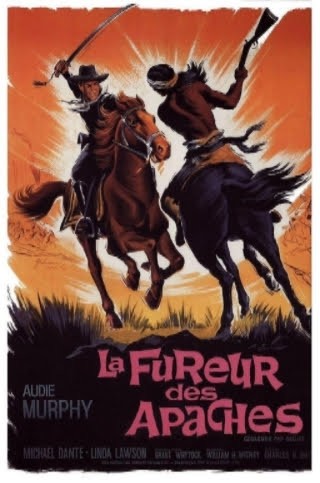
One of the great pleasures of blogging about movies is the way it has a habit of altering one’s plans in a positive way. Recent discussion put me in the mood to watch more William Witney, and the always fascinating tangential comments mentioned Audie Murphy and one of his films I hadn’t gotten round to. Apache Rifles (1964) is a film I’ve had sitting unwatched on my shelves for a while now and it’s one of the later films of both Witney and Murphy and has the added appeal, for me at least, of fitting into that transitional era for the western that has always interested me. The timing, casting and style are all noteworthy in any examination of this period of film history, and the picture itself is a tight and entertaining affair.

This highly fictionalized account sees Apache chief Victorio (Joseph Vitale) break out of the San Carlos reservation in protest at, among other things, the exploitation of the land and breaking of the treaties by unscrupulous gold miners. And so the hunt is on to bring these miscreants back, in this case led by a Captain Stanton (Audie Murphy), a soldier whose driven and implacable reputation precedes him, both among the troops under his command and the Apache he’s pursuing. Reputations are invariably won, and on occasion lost, for a reason; with Stanton, it all stems from his past and what he believes was his father’s misplaced trust in the word of the Indian. Embittered and determined not be played for a sucker in the same way, Stanton has taken a different path to his forebear and fully embraced his hatred for his enemy. In his eyes, the Apache is essentially sub-human, little more than an animal to be brought to heel by whatever means are necessary. Yet just as he achieves success in persuading Victorio to return to San Carlos, the seeds of self-doubt are sown by his encounter with Dawn Gillis (Linda Lawson), a missionary who has opted to live among the despised Apache. What’s worse, from Stanton’s point of view, is the attraction he feels towards this woman, especially in view of the fact she’s of mixed blood with a Comanche mother. Here we have the basis for an internal conflict, one that’s exacerbated by the unexpected shift in circumstances which takes place. At the precise moment when this unapologetic racist is on the point of questioning his own prejudice the carpet is whipped from beneath him. As ever, economic considerations influence political direction and Stanton finds himself pitched into something of a moral and emotional quandary.  Stripped of his command, he can only look on as the scene is set for a bloody conflict between the wronged Apache and the manipulated cavalry, with his own moral and emotional well-being at stake.

Apache Rifles was made at the same time Sergio Leone was turning out A Fistful of Dollars and only a year before Sam Peckinpah would give us Major Dundee. In short, the western genre was in a state of flux at this point, and here we have a movie which is a reflection of that. The central theme of a man coming to terms with his own preconceptions and the reassessment of White/Indian relations harks back to the golden age of the 50s, while the tone and casting straddles the divide. As the 60s progressed, and the spaghetti western gained an ever stronger foothold on the consciousness of the audience, cynicism and a more casual attitude to violence would take root. Apache Rifles isn’t a cynical picture yet there’s a certain bitterness on show that presages what was looming over the horizon. Witney was an action director, an advocate of pace and punch, and there’s a frankness to his depiction of violence that would be built upon (or some might argue exploited) in the years to come. While there’s no explicit gore on display, there’s an acceptance of cruelty – a crucifixion and the torture of an a captive Apache. The film is by no means graphic compared to what would be the case in the future but there is a hard edge to it all the same. The location shooting, in Red Rock Canyon and Lone Pine, similarly recalls the classics of the 50s while simultaneously grounding it in realism.

All of which lead us on to the casting. Once again, there’s that sense of transition, particularly with the presence of Audie Murphy and L Q Jones. It’s impossible to think of Murphy without recalling the 50s, his wholesome persona fitting neatly into that more hopeful and optimistic time. But Murphy was far from simplistic, his war record and increasingly complex performances being proof of that. Given the right material, he was capable of the kind of brooding moodiness that grabs the attention. I think he was a fine actor who grew in stature with each successive picture, bringing a kind of coiled self-awareness to his roles. Taking the part of the principal villain is L Q Jones, a man who had already worked with Boetticher and Scott in Buchanan Rides Alone but who would go on to achieve greater fame in his films with Sam Peckinpah. His is a marvelously weaselly part, one with no redeeming features whatsoever. It’s also worth mentioning Michael Dante, who plays Victorio’s son and heir, a stoic and honorable figure throughout if perhaps a little too noble.

Apache Rifles is readily available on DVD, both in the US and the UK. The US edition comes via VCI – I imagine the Odeon UK disc replicates the transfer – and presents the film in its native 1.85:1 ratio. Overall, this is a good presentation of the film that is colorful and free of major distractions and damage. Happily, there are some worthwhile extra features included: there’s a gallery and trailers for some other VCI titles as well as some short featurettes. There are brief pieces on the Lone Pine museum and Michael Dante discussing his work with Witney, and then a more substantial piece on the position Apache Rifles occupies in the evolution of the genre. The latter includes some interesting information on the cast and crew of the movie. All told, this is an entertaining film, one of the last of what might be called the classic westerns. It’s certainly worth a look for anyone keen on the genre and the direction it was taking in the 1960s.


Santa Fe Passage

poster38_zpsjrkweqfg

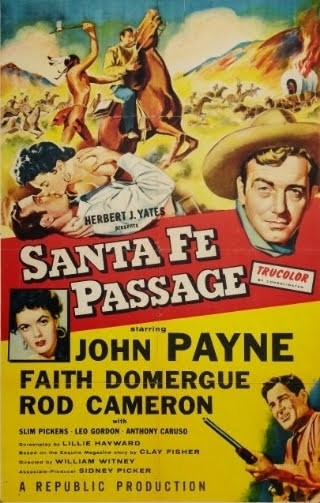
All westerns are about journeys. In some cases this journey is explicit and external, involving some pioneering trip along or beyond the frontier. At other times it’s implicit, an internal or spiritual quest which the hero embarks on leading to the discovery of some truth or a better understanding of himself. As much as anything it’s the setting of the western which lends itself to stories of this type – if you’re going to tell such a tale, then what better time or place to do so than one on the fringes of civilization amid a harsh and primal landscape. For me, when the two concepts of the journey, the external and the internal, coincide the results are almost always satisfying. Santa Fe Passage (1955) is one of those movies, a case of seeing the hero strike out into the wilderness and simultaneously (impelled by circumstances) delving into his own consciousness to confront his preconceptions and prejudices.

It’s always nice to see a movie come charging out of the starting blocks, and that’s precisely what happens here. Two riders are driving their mounts hard over the baked Utah landscape, one clearly in hot pursuit of the other. The quarry, a Kiowa, is soon overtaken and savagely clubbed to the ground with the butt of his pursuer’s rifle. This is Sam Beekman (Slim Pickens), a wagon train scout, and he hauls his captive back to where his partner, Kirby Randolph (John Payne), is waiting with the westbound travelers. With the Kiowa evidently on the warpath, Randolph hits upon what he thinks is a clever ploy, namely distracting the war party with an offer to trade while the wagons roll ahead to safety. However, he miscalculates badly and only discovers later that those he’s responsible for end up massacred and the few survivors left mutilated. If the guilt for this piece of poor judgment weighs heavily on his soul, it’s as nothing compared to the near universal revulsion and hatred the mere utterance of his name invokes. Randolph becomes an outcast among his own and virtually unemployable. Despite all this, he’s presented with a second chance, an opportunity to redeem himself, when a freight outfit needs a scout. Jess Griswold (Rod Cameron) and Aurelie St Clair (Faith Domergue) are taking a shipment of arms to sell in Santa Fe and, even though the latter voices strong objections based on his tarnished reputation, decide to hire Randolph to see them through safely. The trip will be an eventful one, filled with physical dangers and peril, though none quite as challenging as the psychological hurdles the scout is going to have to negotiate along the way.

Over the years, I’ve managed to feature the work of most of the major figures from the classic era of cinema, particularly those who worked in westerns. A notable exception though is William Witney, a director whose critical reputation has gradually grown, no doubt helped by the fact that people like Tarantino have spoken of his work with admiration. Early in his career, Witney worked extensively on serials before moving on to features and thereafter alternating between those and a significant amount of television work. His output was so substantial that I’m sure most people with an interest in classic cinema or TV will have come across examples of his directing at some point. Unsurprisingly, given his background, action and pace were his forte, and Santa Fe Passage certainly packs plenty into its hour and a half running time. There’s a kind of brutal honesty to this movie, something I recall noticing in one of Witney’s later productions Arizona Raiders too, and is particularly noticeable in the scenes depicting the chilling aftermath of the early wagon train massacre. It’s also to be found in the frank presentation of uncomfortable attitudes and how they are addressed and overcome, which I’ll touch on presently, although this aspect probably has its roots in Clay Fisher’s original story. Additionally, the harshly beautiful Utah locations, where the bulk of the action plays out, provide yet another layer of realism to it all.

What raises this picture above the straightforward adventure variety, not that there’s anything wrong such movies of course, is the characterization of the leads. In particular, the roles undertaken by John Payne and Faith Domergue offer a fascinating insight into guilt, bitterness and self-loathing, all sparked by racial stereotyping and the fear of miscegenation. Both characters carry their burden of guilt for different reasons and this threatens to consume them whole. In Payne’s case, the guilt appears to have twisted around and turned in upon itself; the bitterness stemming from his awareness of mistakes made manifests itself in a violent distrust of the Indian, or even anyone of mixed blood. It sets up a wonderful dramatic conflict as it seems to me that his character is galled by his own prejudice even as he indulges in it. One could argue that the resolution, when it comes around, is too pat and convenient but it’s fitting for all that and it does complete the journey the filmmakers have been on. The whole thing also serves to blur the line between hero and villain, especially when Rod Cameron is cast in such an ambiguous role – he’s more understanding and tolerant than Payne yet behaves treacherously, although his motivations in that regard are not entirely ignoble. The net result of all this is that the viewer is forced to think and weigh up the good and bad in all concerned, and that’s never a bad thing.

I think there may be a commercial DVD of Santa Fe Passage available in Italy, though I wouldn’t be too sure about its quality, and it can be viewed easily enough online. So far, it doesn’t appear to have been granted an official release anywhere and, once again, I’m indebted to John  Knight for his kind assistance in ensuring I was able to watch a good print of the film. As has been noted before, too many of John Payne’s films remain unavailable and this is one of the best examples, in my opinion. This is a fine mid-50s western, the kind that typically offers plenty of food for thought alongside strong entertainment value. Check it out if you get the chance.


Backfire

All right. What’s certain? Two things… death and taxes…

There aren’t too many films noir set in and around the holiday season, Christmas Holiday and Lady in the Lake probably being the best known, as it’s clearly more marketable to focus on the upbeat and cheerful rather than the dark or cynical side of life. Backfire (1950) isn’t strictly speaking a seasonal noir but a number of its key events do play out over the festive period. As such, I thought it would be an appropriate choice for what ought to be my last full review piece for this year.

It’s November of 1948, the war’s been over a few years now but the scars haven’t fully healed. In a veterans hospital in California Bob Corey (Gordon MacRae) is still recuperating from his wounds, a serious back injury which has required thirteen operations. Still, he’s on the road to recovery and has hopes of going into the ranching business with his old army pal Steve Connelly (Edmond O’Brien), and also of marrying the nurse, Julie Benson (Virginia Mayo), who’s tended him. The holidays are rapidly approaching and Bob is growing anxious that his buddy hasn’t been around of late. Then, late on Christmas Eve as his medication is just kicking in, he has a visit from an unknown woman, a foreigner whom none of the hospital staff can subsequently recall seeing. As he lies in a narcotic haze, she tells him that Steve is in serious trouble, laid up with a shattered spine and desperately in need of help. What’s a guy to do when he learns his best buddy is in such dire straits? As soon as his discharge comes through in the New Year, he resolves to track down the mystery woman and, by extension, Steve. In the world of noir nothing’s quite that simple though, and he finds himself picked up by a squad car upon leaving the hospital. Ferried to the homicide department, our bewildered hero fears the worst, but instead discovers that Steve is top of the police wanted list for the murder of a prominent gambler. And so begins a twisting quest for the truth which dips in and out of the past, a winding path that’s driven by gambling and jealousy, and has death as its final stop.

The problems faced by returning veterans, particularly the difficulty of establishing one’s place back in civilized society, was a recurring theme (perhaps one of the most prominent in truth) in film noir and was arguably the factor which gave greatest momentum to the post-war boom in that genre. Backfire comes at this on three fronts, focusing on the physical, social and psychological barriers to be overcome. While the latter aspect is the one which acts as the catalyst for the violence and tragedy in the plot, its causes are hinted at rather than fully explored – although it does at least make an effort to acknowledge the matter and avoids going down the road that led to such an unsatisfactory conclusion to The Blue Dahlia a few years before. Speaking of which, I have a hunch the coda of the movie here was tacked on as a softening touch – I hasten to add I have no evidence to suggest this is so beyond a feeling that the fade out preceding it may have been deemed a bit too much of a downer.

Vincent Sherman was one of those studio directors who made mainly professional if not wholly memorable pictures. Generally, I’d say I enjoy his work well enough  – Lone Star was quite disappointing but I think Nora Prentiss, The Garment Jungle, The Unfaithful and The Damned Don’t Cry all have worth. The plot does become pretty complicated as it goes along but Sherman uses the flashbacks intelligently and keeps the pace up. There’s some good use of the Los Angeles locations and Carl Guthrie lights the interiors nicely to create the requisite atmosphere.

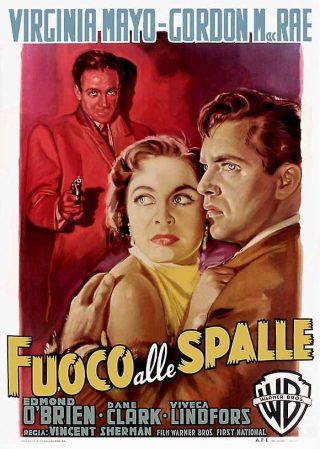
The poster art is a little misleading, although understandably so in the wake of White Heat. It gives the impression that Virginia Mayo is playing the kind of vampish femme fatale so beloved of noir. The fact is, however, that she’s cast as that other staple of the form, the Girl Friday who lends support to the hero. She’s fine in this role and I think it’s a pity she didn’t get to feature a bit more. Gordon MacRae is the everyman figure who leads us through the complexities – he was primarily a musical star and seems an odd choice at first for this type of film but actually works out OK as the innocent cast into a world which is clearly alien to him. Edmond O’Brien, on the other hand, was very much at home in film noir and does great work (tough, weary but fundamentally decent) in his flashback scenes. While the presence of a femme fatale  – and that doesn’t have to be a “bad girl”, just one whose sexuality leads men into danger – isn’t always necessary, it never hurts either. Viveca Lindfors fits the bill in Backfire, positively smouldering at times and always convincing as a woman unconsciously capable of tempting men to risk it all for. Dane Clark was always busy as an actor but never seemed to really make it as a star; he was excellent in Borzage’s Moonrise and I thought he did well in a number of crime/noir films he made in Britain. His role here is a vital one and he handled it very capably in my opinion. Notable support is provided by the always reliable Ed Begley and John Dehner pops up in an uncredited bit part.

A Warner Brothers production, Backfire is available on DVD as part of that studio’s Film Noir Classics Collection Vol. 5. It’s paired up on disc with Deadline at Dawn and looks good throughout. The transfer is mostly clean with very little damage visible and a nice level of detail. There are no extra features offered. Although this isn’t one of the better known films noir it’s a solid movie with some good performances. The script maybe tries to be a tad too clever at times and I did notice one plot hole which irritated me somewhat (I won’t go into it here as I don’t want to get into spoiler territory) but it remains enjoyable overall. A reasonably entertaining thriller then with a tangential connection to the holidays.

City of Bad Men

poster2022_zps3xgrqrcz

A lot of you all rode into this town, but you are the only one who saw anything. You noticed the change. The others don’t look past the end of their guns. You saw the handwriting on the wall. They don’t even see the wall because their backs are against it. Their days are over. They don’t know it.

Sometimes I like to open with a quote that in some way sums up the tone, mood or message of a given movie. In this case, those lines above represent more of what I feel the film could have been as opposed to what we actually end up with. City of Bad Men (1953) is a title which left me feeling not entirely satisfied when I first saw it and so I thought I’d give it another go to see if my reaction would be any different this time. The answer is a kind of yes and no: yes in that I enjoyed it all a little more, but I still came away with that nagging sense of having seen an opportunity missed, or at least not fully grasped.

On St Patrick’s Day 1897 in Carson City, Nevada, a fight for the world heavyweight championship (actual footage of the bout can be viewed on YouTube) took place between Bob Fitzsimmons and “Gentleman” Jim Corbett. This event forms the backdrop to and also constitutes a major plot element of the film. Returning from an unsuccessful trip south of the border as soldiers of fortune is a group of weary men led by Brett Stanton (Dale Robertson). With little of worth to show for their time and effort, they are heading for Carson City with the hope of knocking over the bank in what they believe to be a perennially sleepy town. However, the town they ride into has undergone a transformation, partly due to the changing nature of the times but also as a result of the upcoming prize-fight. Yes, civilization and the trappings of the modern age – the motor car and luxuries like the shower – are slowly creeping westward. While his men gaze upon these alien sights with a kind of detached bemusement, Stanton’s calm features mask the fact that the seeds of an opportunistic plan have been sown in his mind. Crowds like this mean money – money which can be made or stolen. Yet Stanton isn’t the only one to entertain such thoughts; other gangs of unscrupulous men, most notably those led by Johnny Ringo (Richard Boone), have been drawn by the prospect of easy pickings. The local lawmen realize the volatility of such a situation and hit on the novel idea of appealing to the mutual suspicion of these various desperadoes and convincing them that the best way to keep the peace (and thus protect their own mercenary interests) is by keeping an eye on each other. Stanton is smart enough to see the advantages of such an arrangement, but he’s also aware of the complications and obstacles ahead of him: the need to come up with a viable plan to pull off a spectacular heist, the latent jealousy of his brother Gar (Lloyd Bridges), and the feelings he still nurses for the girl (Jeanne Crain) left all those years ago.

As I see it, there are four major themes at play in the movie – the noir-tinged heist plot, the classic idea of changing times, the sibling rivalry, and the notion of redemption earned through love. Lots of material to chew over yet only one, the heist aspect, is realized fully and successfully. The fact the script allows this to develop naturally and then the way Harmon Jones directs its execution, cutting between the fight, the collection of the takings and the way the money is subsequently lifted, is a fluid and assured piece of filmmaking. It makes for a fitting climax to the picture, but also highlights the deficiencies in the handling of the other facets. The early scenes give the impression that the “men out of time” part will be of greater importance, but it’s something the film only pays lip service to in reality. Similarly, the tension between Brett and Gar is never fully explored and its resolution feels rushed in the end. As for redemption, which ought to form the centerpiece of a western of this era, I was left feeling that it’s achieved a touch too easily, and the means by which it’s linked to Brett’s reconciliation with his old flame is weakened by its abruptness. I guess what I’m trying to say here is that the film has a strong foundation with a number of rich veins running through it, only few of which are mined and even then not to their full extent.

When called upon to do so, Dale Robertson was good at conveying cold intensity but that wasn’t really a requirement in this role. He displays the necessary toughness to hold the whip hand over his own bunch of ne’er do wells and to keep his rivals in check. Essentially though, the part of Brett Stanton is all about calmness, a kind of melancholy thoughtfulness. His air of regret and his flexible morality tie in with, and feel like an extension of sorts of, the type of disillusioned veterans so common in film noir, bewildered by and isolated from the new world they find themselves confronted with. For me, Robertson’s quietness and restraint is one of the major strengths of the picture. Ranged against that is the restlessness and impatience of Lloyd Bridges and, more significantly, the rattlesnake charm of Richard Boone. If anything, Boone is underused in the movie, lighting up the screen every time he appears while leaving you disappointed he’s not there more. Which brings us to Jeanne Crain – her character is a vital one through the effect she has on Robertson, but the script doesn’t treat her well. She’s placed in a conflicted position that’s loaded with dramatic possibilities yet her character arc isn’t wholly convincing and the resolution, which forms the core the film’s resolution in itself, is just a little too convenient for my liking. In support, we have Carole Mathews, Rodolfo Acosta, James Best, Leo Gordon, John Doucette and, in blink and you’ll miss them parts, Frank Ferguson and Percy Helton.

City of Bad Men is a 20th Century Fox production and was released on DVD in Spain some years ago by Impulso, licensing the title from Fox. That disc offers a passable transfer which is clearly unrestored. There are a number of instances of print damage and the colors tend to look faded throughout. Having said that, it’s perfectly watchable – there was subsequently a US release by Fox itself, but I have no idea how that transfer compares. The Spanish DVD offers the original English soundtrack along with a Spanish dub and optional Spanish subtitles. Of the Harmon Jones westerns I’ve seen, I’d say this is probably the least of them. I’d certainly rank it below his other two with Robertson, The Silver Whip and A Day of Fury. All told, there are some positive points and the film remains briskly enjoyable. Nevertheless, I can’t shake that feeling that it had more to offer than it ultimately delivered. In the final analysis, a medium effort.


Two Weeks in Another Town

poster202_zpseeehnr2s

Introspection can be both self-indulgent and revealing, turning the gaze inward in search of some truth that seems elusive in the outside world can bring rewards, perhaps most notably for those whose business it is to present a facade for public consumption. It shouldn’t be all that surprising then that Hollywood, where dreams and illusion are daily spun from the dancing lights of the projector, periodically turns the cameras around to focus on itself. There’s something almost perverse about the industry’s need to pick away at its own glamorous veneer, as though it were prodding us in the ribs and daring us to confront the artifice at its heart. Two Weeks in Another Town (1962) was Vincente Minnelli’s second bite at the hand which fed him, following the previous decade’s The Bad and the Beautiful.

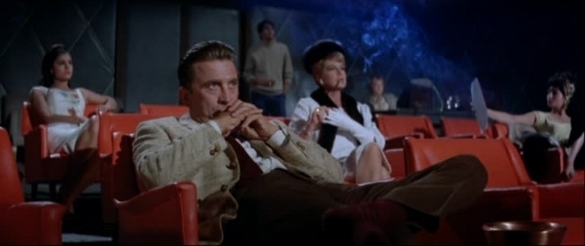
Jack Andrus (Kirk Douglas) is a movie star, one of that glittering breed idolized and worshiped by so many. Although it’s perhaps more accurate to say the Jack Andrus we see at the beginning was a movie star, a subdued figure strolling ineffectually round the grounds of the psychiatric clinic where he’s staying. The scar on his face, a memento of the events that led him to his current abode, has healed. However, it’s as nothing compared to the raw wounds he still carries around inside. His doctor says he feels Andrus is fit to leave, not necessarily cured but able to leave all the same. And there’s a hint of hope for the future too, a cable from his old director asking him to fly out to Rome for a small part in his latest production. But we’re talking about the movies here, where nothing and nobody can be taken at face value, and the truth is that Andrus is essentially washed up. The director, Maurice Kruger (Edward G Robinson), doesn’t really have any intention of using him on screen. Basically, it’s a ploy, partly as a kind of sop for Kruger’s guilt over his involvement in Andrus’ breakdown. If our star has hit bottom, then the once great director is headed in the same direction, although his decline is slightly more graceful and a little less dramatic. The picture represents something of a last bid for glory for Kruger, and it’s in danger of being derailed by the ruthlessness of his hard-headed Cinecittà producer. Standing between him and the prospect of failure and humiliation is Andrus, the man he first built up and then destroyed. So what does he do? He tosses this one-time star a few crumbs from his table, hoping that the hunger of a starving man will prove his salvation. To Andrus, the vital but seemingly demeaning task of supervising the post-production dubbing is like a slap in the face initially. Still, the lure of the movie business, and maybe more importantly, the chance to prove himself capable of doing anything of worth again is strong. And then there’s the figure of Carlotta (Cyd Charisse), the woman he tried to love and lost his mind over. She flits in and out of proceedings, simultaneously taunting Andrus with reminders of what he’s lost and holding out the promise of new adventures ahead. What it all boils down to is a two-week sojourn in a town where he may either drown in the heady atmosphere or, if he can see through the showbiz smokescreen, have the chance to regain the mastery of his soul once again.

£6

While I still think Two Weeks in Another Town is a very good film, it could potentially have been a great one. Charles Schnee wrote the script from a novel by Irwin Shaw, and the score was provided by the great David Raksin. With Milton Krasner shooting Minnelli’s beautiful nighttime setups just about all the ingredients were in place for a stone cold classic. But then, and ironically mirrored by the plot itself, came the interference from the studio. In his autobiography (The Ragman’s Son, Pan Books 1989,  pp 342-344), Douglas claims the movie was recut and edited when Joseph Vogel became the new head of MGM, stripping out some of the racier and more dramatically satisfying elements. I think that much can be seen in the somewhat sketchy development of a few of the characters. What we’re left with is the core of the story, of a man desperately seeking personal and spiritual redemption and the peace that comes with it. In addition, there’s the unmistakable stamp of Minnelli, the careful framing of whose shots create the kind of tableaux that approach visual poetry on occasion. It would be remiss of me not to mention his masterful use of color – the whole film is drenched in the deep, saturated hues which often characterize his work. Perhaps he falls short of achieving the dramatic and visual intensity of his sublime Some Came Running, but there are moments when he gets within striking distance at least.

Kirk Douglas was making his third appearance in a Minnelli production and he’s well cast in a role that calls for the type of mood swings which range from ebullience through manic intensity by way of brooding melancholy.  While the focal point of the story is on Andrus’ journey of self rediscovery, and the necessary laying to rest of old phantoms along the way, there’s room too for some interesting observations and musings on the nature of the actor, that wearer of masks. A wistful, early morning conversation with a besotted Daliah Lavi sees Douglas reflecting on the contradictory nature of the actor, the retreat from reality and submergence of the self in the character of others which actually runs counter to the overwhelming desire to better understand one’s own sense of being. Ultimately, it’s the reconciliation of these seemingly incompatible urges which lies at the heart of his character’s motivation.

£7

Robinson’s aging director is also notable, both in itself and as a commentary on the corrosiveness of the movie-making business. The essential insecurity of the man is demonstrated though the need to reaffirm himself through his notorious affairs with leading ladies  – which has had such an adverse effect on his relationship with his wife, an exceptionally acidic Claire Trevor – and also his desperation to prove once again his worth as an artist. It’s his fear of losing control, both personally and creatively, which drives him and finally twists his soul towards bitterness and distrust. The person who links (and divides) Douglas and Robinson is Carlotta as played by Cyd Charisse. Apparently a good deal of her part ended up on the cutting room floor, which is a shame as she is very good based on what we do see of her. Whether it was intentional or not from the outset, she comes across as a blend of the enigmatic and the alluring, leaving a trail of emotional devastation in her wake while attempting to seduce her former lover back onto the same self-destructive path. The contrast comes in the form of Daliah Lavi’s Roman ingenue (demurely clad in simple and pure white throughout as opposed to the arch and lurid costumes of Charisse) whose understated charm and innocence helps restore Andrus’ perspective. I was less impressed by George Hamilton’s troubled young star, never feeling all that convinced by the struggle he’s supposed to be waging against his personal demons. In support, there are small parts (virtual cameos in truth) for George Macready and James Gregory.

Two Weeks in Another Town is available on DVD as part of the Warner Archive in the US and there’s also an Italian release available. I have that Italian disc and it presents the film in the correct anamorphic scope ratio. The transfer is good, clean one with no notable instances of damage. Colors are generally well reproduced, something very important in a film such as this, and the image is pleasing overall. The disc offers the original English soundtrack and an Italian dub, and there are no subtitle options of any kind. As for extras, there’s the theatrical trailer and some galleries. Frankly, I like this movie, but films about films always interest me anyway, and I feel it’s a great pity that parts of it were excised at the behest of the studio boss at the time. Nevertheless, the movie that we have available to view, in spite of its imperfections, is never less than fascinating for the peek behind the facade of filmmaking it affords us and also the central story of a man battling to come to terms with himself and the choices he’s made in life. I recommend it.

Kirk Douglas reaches the grand age of 99 today and I thought I’d take the opportunity to post this piece on that occasion to draw attention not only to this great actor’s birthday but also to just one of the countless strong performances he’s delivered over a long career.