The Stand at Apache River

poster7_zps8995170c

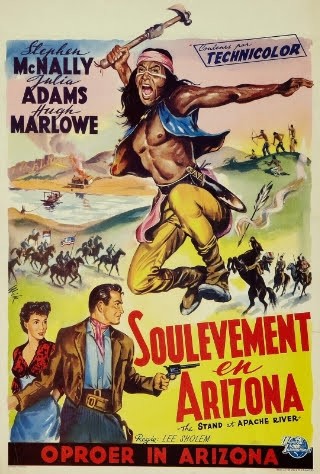
Something I like to do on this site is feature a mix of the better and lesser known films. When it comes to the latter category there’s no shortage of candidates to be found among the output of Universal studios. Second features or programmers are of course a varied bunch in terms of quality, but it has to be said that Universal, of all the Hollywood studios, had a real knack for producing entertaining westerns on the cheap. These small-scale, unpretentious movies had a polish and tight professionalism to them that’s very attractive. There’s no doubt that these films were constrained by their budgets but that was often turned into an advantage in itself. The Stand at Apache River (1953) is a fair example of a western which both exploits its limitations and simultaneously suffers from them too.

The opening sees a horseman striking out across an expanse of barren country, nervously checking his back trail for signs of pursuit before heading for the rocky high ground and the promise of safety. This man is Greiner (Russell Johnson), a thief and murderer desperate to avoid a date with the hangman. Hot on his heels is Lane Dakota (Stephen McNally), a driven lawman with a personal interest in running down his quarry. When an unexpected skirmish with a couple of Apache leaves Greiner badly wounded, and Dakota without his much needed proof, the sheriff has no option but to seek temporary shelter until the prisoner is well enough to be brought back to face justice. And this brings us to the location where the remainder of the drama will play out – the Apache River ferry station. Dakota’s arrival coincides with that of a stagecoach carrying Valerie Kendrick (Julie Adams) and Colonel Morsby (Hugh Marlowe), the former being an uncertain bride-to-be on her first trip west while the latter is a veteran Indian fighter with a fearsome reputation. No sooner has this little band of travelers gathered at the isolated station than it’s revealed that a group of 50 Apache warriors has broken free from the San Carlos reservation and may be heading their way. This external threat is exacerbated by a number of internal conflicts, among which are Greiner’s eagerness to elude his captor and the friction that arises between Dakota and Morsby over matters of justice and their respective attitudes towards the Apache. When the station finds itself under siege and repeatedly attacked by the Apache all the tensions within are exposed and add to the danger.

While I was watching this movie I found it difficult not to be reminded of Apache Drums for a number of reasons. Firstly, there’s the presence of Stephen McNally in the lead and the fact that the title and credits play over the same footage and images as the earlier film. Additionally, both movies have a similar structure, gradually narrowing in focus and confining themselves to a single set as the story progresses. The Stand at Apache River also tries hard to recapture some of the terrifically claustrophobic atmosphere that characterized and elevated the Lewton/Fregonese film but director Lee Sholem doesn’t quite get there. The lighting and cinematography are similar but the same sense of menace isn’t achieved. Where Lewton and Fregonese kept the Apache largely unseen and thus built them up into frightening bogeyman figures, this movie presents them, or at least their leader, as more rounded characters. While this dissipates the threat somewhat, it does offer the opportunity for some consideration of the nature of the conflict between the settlers and the Apache, deftly highlighting the grievances of and injustices towards the latter group. However, this also feeds into what I see as the main weakness of the movie – essentially there is too much going on. You cannot have drama without conflict but it’s also possible to overdo it. The movie only runs for an hour and a quarter and tries to pack in a siege, commentary on settler/native relations, the problems faced by women in isolated frontier settings, and a love triangle to name just a few. In the end, there are too many themes and too little development – arguably, there’s enough material for a couple of movies here.

Stephen McNally and Julie Adams get the most screen time and both of them turn in perfectly acceptable performances. However, the overstuffed plot which I mentioned does work against them and means that their character development is necessarily limited. This is a shame as both of them have interesting back stories, and the acting chops to take advantage of them, but there’s just not enough time to explore it all further. Hugh Marlowe is fine too as the rigid martinet although his role is fairly one-dimensional. There’s also a nice intense turn by Jaclynne Greene as the frustrated and frightened owner of the river station. Russell Johnson (who passed away just last month) and Hugh O’Brian both play potentially interesting characters, though once again it has to be said they really don’t get the chances to show what they were capable of. The only disappointment for me was Edgar Barrier, who I found pretty unconvincing as the Apache chief.

I guess The Stand at Apache River has to count as a bit of an obscure film these days, and it certainly hasn’t been widely available for home viewing. However, there is a nice DVD out in Spain. Many Universal titles from the 50s seem to be in reasonably good shape and The Stand at Apache River is no exception. The print used isn’t perfect but it’s not at all bad either. While there are a handful of instances of age-related damage, they are few and I wouldn’t refer to them as a particular distraction. Generally, the transfer is smooth, colorful and acceptably sharp. The disc doesn’t offer anything in the way of extras but there’s no problem with subtitles either – there’s the option of French, Spanish or none. All in all, the movie provides plenty of entertainment and excitement. With its short running time it moves along briskly and, leaving aside the matter of the crowded plot, should satisfy those into westerns of this era.


The Black Book

poster30_zps96df903b

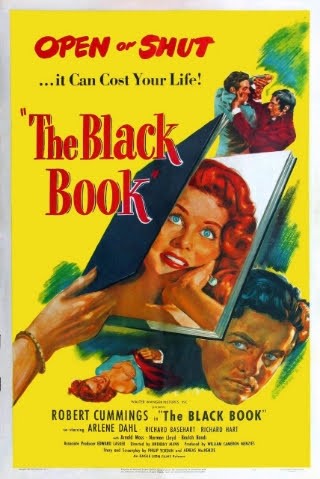
Recently, I’ve been watching a fair bit of film noir, and indeed mulling over and discussing exactly what does or does not constitute noir. And that brings me to a borderline case, a movie that flirts with the notion of film noir, has some of its recognizable characteristics, yet stops short of fully satisfying the criteria. The Black Book (1949) was among the handful of movies Anthony Mann made just before he embarked on his influential and complex cycle of westerns. The film is a historical piece, a mystery/espionage thriller whose visual style is pure noir but whose theme lacks the ambiguity to allow me to comfortably place it in that category.

1794 – France is gripped by revolutionary fervor and the Reign of Terror, presided over by Robespierre (Richard Basehart), is at its zenith. The series of bloody purges have led to an atmosphere of distrust, insecurity and instability. With Robespierre on the verge of absolute power, plans are afoot to overthrow him while there’s still time. But that time is short; within days Robespierre will have maneuvered himself into an unassailable position and the opportunity will have passed. Enter Charles D’Aubigny (Robert Cummings), an agent acting on behalf of the exiled and imprisoned Lafayette. D’Aubigny’s mission is to infiltrate Robespierre’s inner circle, by means of impersonation, and see that the voices of dissent are provided with the means to remove the would-be tyrant before he has them silenced forever. This task is both aided and complicated by two unexpected factors. Firstly, there’s the presence of Madelon (Arlene Dahl), D’Aubigny’s former lover and his principal contact with the anti-Robespierre faction. And then there’s the black book of the title: Robespierre’s death list, a sinister little volume containing the names of those marked down for execution as and when the whim strikes him. It’s this book which forms the basis of Robespierre’s power, it’s impossible to be sure whether one’s name is included and that uncertainty weakens any potential opposition. However, the book has gone missing and the hunt is on to retrieve it before a critical meeting of the ruling Convention. Whoever gains possession of the black book holds the balance of power – able to install Robespierre as absolute dictator or to destroy him completely.

£4

Personally, I feel The Black Book functions well as an allegory for the time it was made. WWII had ended a few short years before and the memory of the terror and slaughter was still fresh in the minds of everyone. It’s no great stretch to see the film as a warning against the dangers of dictatorship; even as the world had witnessed the end of one hateful regime another has risen up to take its place. The purges and sham trials depicted in the film bring to mind the repression and fear of the Stalinist eastern bloc. However, I think too that the critique of the cult of personality and the atmosphere of betrayal and backstabbing can also be viewed as a subtle reminder that even stable democracies can be manipulated by political opportunists under certain circumstances – the paranoia accompanying the red scare of the post-war years was already rearing its head in the US.

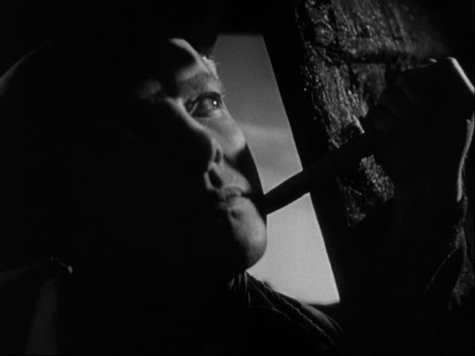
Anthony Mann built his reputation on his crime and noir pictures and that influence was carried through to a greater or lesser extent in most of his subsequent films. Thematically, his westerns continued to be psychologically complex even though the visuals (once he began to work in color) moved in a different direction. The Black Book, photographed by John Alton, is much more straightforward when it comes to theme and characterization. The hero is simply heroic; there’s no internal conflict struggling for dominance of the character and no sense that fate has the odds stacked against him. From the viewer’s perspective it’s always very clear who the good guys and the bad guys are, even if some of the motives aren’t quite so apparent. Still, the movie looks like a textbook example of film noir. Mann’s composition and Alton’s lighting create a dark and dangerous world for the characters to inhabit: high overhead shots suggestive of detachment, low angle ones bringing ceilings into focus and emphasizing a cramped, restrictive world, deep and impenetrable shadows slicing menacingly across faces or threatening to consume them totally.

£5

Robert Cummings is generally thought of as a lightweight lead and sometimes dismissed on those grounds. I’ve always liked his crime/mystery roles though  – The Chase, Sleep, My Love, Saboteur, Dial M for Murder – and have rarely found him disappointing. If anything, I feel his natural charm lends a touch of vulnerability to his characters. I have no complaints about Cummings’ performance in The Black Book, he handles the tense, suspenseful scenes well and is convincing enough when the need for action arises. Arlene Dahl is good too as the former lover who now has to work closely with the man she once abandoned. A rekindled romance does develop but it never has that tacked on feel that can make such plot devices tiresome. That this aspect works is largely down to Dahl, her coquettish insolence is both refreshing and attractive. Richard Basehart too is very effective as Robespierre; there’s a stillness and calm about him that becomes quite unnerving, only the glittering eyes hinting at the murderous zealot lurking within. As good as the leads are, Arnold Moss steals practically every scene he appears in as Fouché, the oily, Machiavellian politician who’s naked self-interest is a wonder to behold. In support, there are nice turns delivered by Charles McGraw, Beulah Bondi and Norman Lloyd.

For a long time the only way to see The Black Book was via ropey transfers of battered prints. However, Sony put out a MOD disc in the US that seemed to far surpass all previous releases. I never picked up that disc but when Koch in Germany announced their own pressed release of the title I decided to bite. I don’t know if the Koch disc is derived from the same source as the US edition but I can certainly say that I’ve never seen the movie looking better. There are isolated speckles but the print used is in pretty good shape and shows off Alton’s photography to very good effect. Additionally, this disc has the full, uncut version of the movie (as does the US MOD edition) restoring the censored scene that was absent from many of the earlier releases. There are no subtitles offered, just the original English soundtrack and a German dub. Having suffered through some appalling transfers of this film in the past, it’s a real pleasure to be able to see it looking crisp and clean. It may not be proper film noir, but any fan of that style of cinema should get a lot out of this movie – Mann and Alton present some stunning and memorable images. Bearing in mind there’s a satisfying and exciting story here too, I have no hesitation in recommending the film.

Man in the Saddle

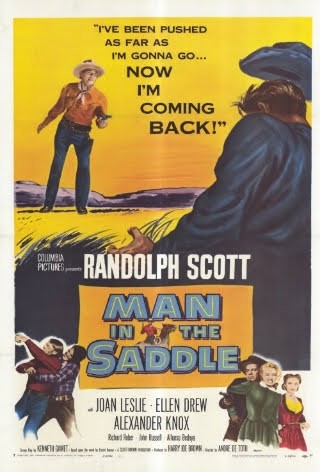
The collaboration of actors and directors is a favorite area for analysis by film critics – Ford and Wayne, Mann and Stewart, Huston and Bogart readily spring to mind. That attention tends to get focused on these cinematic partnerships is I think understandable; they offer a reasonably self-contained block of work which can be examined easily. Mention Randolph Scott to western fans and the name that will probably come to their lips is that of Budd Boetticher, again understandable enough given the reputation their series of films together has deservedly earned. However, Scott also made a group of westerns with another director, Andre de Toth, just before he hit his late career peak with Boetticher. Man in the Saddle (1951) was the first, and arguably the best, of a half-dozen movies featuring de Toth and Scott.

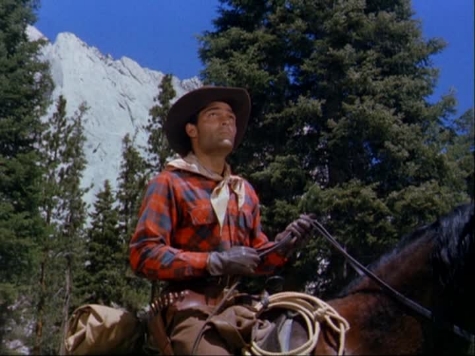
The overall framing device is the classic western staple of the range war, the conflict over land and the need for expansion. But that’s actually the least interesting aspect of a story that involves a number of overlapping and obsessive relationships. Owen Merritt (Randolph Scott) is a man under pressure on two fronts; having already lost his woman, Laurie (Joan Leslie), to his powerful neighbor Will Isham (Alexander Knox), he’s now in danger of seeing his ranch go the same way. Isham is one of those typical western expansionists, a man never satisfied with owning half of anything and ruthless enough to use whatever means are necessary to get what he wants. Standing in the path of this irresistible force is the immovable object of Merritt. The only possible outcome of such a paradox is conflict, even though Merritt does his level best to avoid it for as long as possible. What makes this apparently simple tale fascinating though is the way these characters, and those around them, interact. Merritt clearly retains strong feelings for the ambitious and mercenary Laurie, yet he buries them deep, while Isham is fighting an internal duel with his own jealousy and self-doubt. Matters are further complicated by the presence of another neighbor, Nan (Ellen Drew). She quietly pines for Merritt and in turn is herself desired by Clagg (John Russell), a taciturn loner of brooding temperament. When Isham’s hired gunmen up the ante by stampeding Merritt’s herd and killing one of his men all the passions and obsessions of the principals are unleashed. Merritt is forced into taking a stand against his enemies, even those he was hitherto unaware of.

If one views the westerns of de Toth and Scott in relation to the work both director and actor did independently and with others, then it’s possible to undervalue them. But I think such comparisons, even if they’re inevitable, are unfair. Movies really ought to be evaluated on their own terms – do they achieve what they set out to do? Placing them within a wider context does of course serve some purpose but it ultimately does the films a disservice too. What all that’s leading up to is my belief that Man in the Saddle succeeds in telling its tale. Firstly, de Toth’s direction and Charles Lawton’s cinematography combine well and the tension builds nicely. Visually, it’s an interesting movie with a number of scenes taking place at dawn or dusk (perhaps using the half-light to underline the murky, shifting nature of the relationships) and the location work in Lone Pine and Thousand Oaks particularly enhances the latter half. The climax too is notable for the use of a dust storm as an accompaniment to the action and is suggestive of the elemental, swirling emotions of those involved. The only downside of the film, for me at least, was the slightly clumsy way the comedic parts were integrated. Generally, I have no objection to the introduction of a little comedy to lighten the load, but I’m not sure it’s handled all that successfully in this case.

By the end of his career Randolph Scott had almost elevated the depiction of the stoic acceptance of loss and regret to an art form in itself. One of the more rewarding things about watching those films leading up this is the ability to observe how that persona gradually evolved over the years. As Merritt, Scott touches on this idea of losing the woman he loved. That loss isn’t as fully defined or as final as would be the case in the later movies with Boetticher, but it’s there all the same. Alexander Knox isn’t an actor normally associated with westerns, making only three throughout his career, yet he’s fine as Scott’s rival. He’s very convincing as an emotionally repressed man and this is even more effective when he actually lets loose all his pent-up rage. In truth, all the main players acquit themselves very well: Joan Leslie as the hard-edged pragmatist, Ellen Drew as the calm Girl Friday, and John Russell as the outsider twisted by his unrequited passion. My only complaint is that Richard Rober is underused as the smiling gunman.

Man in the Saddle is readily available on DVD and has been for many years. The US disc from Sony/Columbia presents the film nicely in its correct Academy ratio. This older transfer comes from a good print and boasts strong, vibrant color with plenty of detail. The disc doesn’t have much in the way of extra features, just a standard preview reel for other Sony/Columbia movies available. However, the movie is the main thing and the presentation here should give no cause for complaint. The westerns that Randolph Scott made with de Toth have been overshadowed to a large extent by the later Ranown cycle, yet they’re enjoyable in their own right. Aside from allowing viewers to fill in some gaps in tracing the development of the Scott persona, these movies are good examples of the professionalism to be found in the Hollywood western of the 50s. Man in the Saddle may not be the best thing Scott or Andre de Toth ever did but it’s still a pretty good film and is worthy of the talents of all involved.

Night Has a Thousand Eyes

poster33_zpsef9a4e94

I’d become a sort of a reverse zombie. I was living in a world already dead, and I alone knowing it.

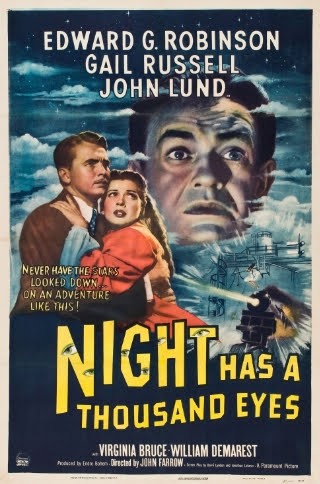
Film noir is at heart a fatalistic genre. Greed, stupidity, desire and deceit all play a significant part to be sure, but back of it all is the implication that human beings are locked on a predetermined path which circumstance or fate has chosen for them. Whether or not one subscribes to such a theory is neither here nor there; it’s enough to know that it underpins much of film noir. But what if we already knew what lay in store? Would it be possible to cheat fate and regain control of our lives? That’s the basic premise of Night Has a Thousand Eyes (1948), a noir with a quasi-supernatural slant.

The film opens dramatically with Jean Courtland (Gail Russell) about to take her own life by throwing herself in front of a train. The suicide bid is thwarted at the last moment by Elliott Carson (John Lund), her fiance. But why would a beautiful young woman such as this want to end it all? The answer to this is provided by John Triton (Edward G Robinson), once a small-time mind reader and now a virtual recluse, a prisoner of his own unique talent. Via a series of flashbacks Triton reveals his connection to Jean and the odd events that have shaped his life. Depending on one’s point of view, Triton has either been blessed or cursed with the ability to foretell the future. As his weary narration points out, there were initial advantages to this, such as the knack of predicting how best to make money. Despite these indisputable benefits, Triton gradually came to see that prior knowledge of various tragedies had a corrosive effect on the soul. Slowly, the feeling began to eat away at him that he might be in some way responsible for some of the things that happen. His first reaction was to ignore the premonitions in the hope that doing so might avert them. When that doesn’t work he settles on an alternative course of action; he will actively try to prevent the outcomes that periodically flash before his eyes. And it’s this which leads him into the life of Jean Courtland. Jean is the daughter of his late fiancée, a woman he left and let marry his best friend. That sacrifice failed to save the life of his former love, but a vision of Jean’s imminent death routs him out of self-imposed exile. For twenty years Triton has hidden himself away from the world, shunning human contact. Now however, he decides to take on fate directly. It’s a duel of sorts between a desperate man and the mysterious force that seems to determine all our futures. The prize at stake: the life of a young woman, and the chance for Triton to shake off the unwelcome curse bestowed upon him.

John Farrow is a director I’ve always had a lot of time for. He was extremely versatile, working in a variety of genres and turning out a handful of highly entertaining and well crafted noir pictures. Night Has a Thousand Eyes is a brisk piece of work, yet there’s also a dreamy, melancholic feel to it. The first half is taken up with the flashbacks that explain how Triton’s gift mutated into a curse, and Robinson’s voice-over adds to the noir atmosphere. The latter section sees the focus narrow and is largely confined to Jean’s home, as the police, various retainers and Triton all gather to see if the predictions come true. The fusion of noir motifs and supernatural overtones is unusual and quite successful in my view. While film noir was grounded in at least a superficial reality, there was also an element of the fantastic running through it. I guess the fact this movie was based on a Cornell Woolrich novel, given that writer’s penchant for outrageous and sometimes bizarre plot twists, accounts for this mix. Another point of interest is the sympathetic or tolerant stance adopted towards the whole issue of spiritualism. Generally, film and literature of the 30s and 40s tended to be downright hostile when it came to examining the spiritualist craze that grew out of the aftermath of WWI. Most books and movies focused on debunking the techniques of the fake mediums and phony spiritualists, exposing them for the charlatans they were.

While Farrow’s direction is solid and Woolrich’s material is always interesting, it’s the performance of Edward G Robinson that really powers the film. By his own admission, Robinson possessed an air of menace that was often used to great effect. Yet, in reality, Robinson was a highly cultured man and could impart great sensitivity when he was afforded the opportunity. The role of Triton was such an opportunity, a tortured soul robbed of the love of his life and endowed with a terrible gift. Robinson had wonderfully expressive features and it’s a real joy to see him tuck into a meaty and complex part like this. Although he’s the unquestioned star of the movie, he gets good support from John Lund and Gail Russell. Lund’s role is a bit of a thankless one as the stoical, skeptical romantic lead, but he does all that’s required of him. Russell had that tragic, ethereal beauty that works so well on screen and there’s a vague air of confusion about her, a sense of one lost in the world. Somehow, her magical presence seems entirely appropriate in such a film.

Night Has a Thousand Eyes is a movie that’s just crying out for a decent DVD release. The film can be viewed online quite easily and there’s a DVD available from Italy but neither option shows the movie in the best light. I have that Italian disc and it has to be said the print used is pretty beat up. It’s taken from an Italian source, the titles and credits are presented in that language, and it’s a dirty, scratchy affair. Despite the poor condition and lack of restoration it does remain perfectly watchable throughout. The disc offers the choice of either the original English soundtrack (no subtitles) or an Italian dub. The theatrical trailer and a text essay (in Italian) comprise the extra features. This was originally a Paramount production so, given the lack of any word of Olive releasing it, I’m guessing the rights now reside with Universal. I can only hope that it gets a stronger release somewhere in the future – it deserves it. Regardless of any complaints about the current presentation and availability of the movie, it remains an intriguing film noir. A neglected little gem, ripe for rediscovery.

EDIT: Laura also wrote a piece on the movie here, which I only just noticed.


A Day of Fury

poster29_zps36678c4a

That man is a creature of hell. If he stays here, he’ll turn this town into a hell.

Quite a few westerns have served as social commentaries, using their frontier setting to focus the spotlight on a whole range of issues, as frequently acting as an allegory for the era in which they were made as much as a critique of the old west itself. A Day of Fury (1956) is an interesting case in that it’s less of a social commentary than an examination of human nature, and the less savory side of it at that. I think part of the beauty of the adult-oriented westerns of the 50s lies in the way programmers with modest budgets could tackle complex themes successfully while also telling entertaining stories. It sometimes feels like  current filmmakers have lost this once commonplace skill, either overtly preaching at the audience or veering sharply in the opposite direction and rolling out mindless popcorn fare where you’re required to check your brain at the door. As such, it’s genuinely refreshing to watch a movie like this where the makers have sufficient respect for their audience to present an entertaining film while simultaneously crediting them with a modicum of intelligence.

A Day of Fury opens by telling the audience that the Civil War has ended, the frontier is closing, and civilization is advancing. As such, the implication is that we’re in for another end of the trail western, another look at the passing of a way of life. Well that’s true enough up to a point, and yet A Day of Fury is good deal more than that. It’s neither an ode to lost innocence nor a celebration of a brighter future ahead. Instead the movie operates on a more spiritual level, holding up a mirror to the human soul and daring us to take a long hard look at what may be lurking within. Everything starts off in a fairly straightforward manner with a lone horseman, Jagade (Dale Robertson), stumbling into an ambush being set up. The proposed victim is Burnett (Jock Mahoney), the local marshal. When Jagade saves the lawman’s skin it looks like a lead in that’s been seen on many occasions. However, there is also a sense that this film is going to head off in a different direction, the terse dialogue between Jagade and Burnett hinting at something darker and less predictable. Jagade rides ahead into town, ostensibly to tell Burnett’s bride-to-be (Mara Corday) that her man has been delayed, but his real motives gradually become apparent. If there was a tension or edge to the initial meeting between Jagade and Burnett, it’s ramped up considerably as soon as the former sets foot in town. Jagade is a gunfighter, a lethal killer whose reputation precedes him. In fact everything about Jagade harks back to a rapidly disappearing era: from his own violent skills to his acquaintance with the marshal’s betrothed and her time as a saloon entertainer. For Jagade, this represents a last stand of sorts; the changing world around him has left him with no other place to go and he seems keen to turn the clock back. Still, that only amounts to a superficial interpretation of the film. We all know that the past is nothing more than a memory which, despite the strongest yearning, can never be recaptured. And so it is with Jagade; his true function is to confront the facade of respectability and gentility that the town has constructed. The pious righteousness is simply a veneer, and one so thin that it starts to crumble when the slightest pressure is applied. Jagade could, I suppose, be viewed as a kind of malignancy that will have to be cut out at some point, but he could reasonably be seen as the cure as much as the illness. Over the course of one Sunday, and there is significance to the fact that the Sabbath is chosen, the townsfolk begin to regress and descend into the type of amoral thuggishness they had frowned upon only a few hours before. And that’s what I feel the movie is all about – the question of whether our civilized values are so cheap they can be bought or traded away, or whether the roots are deeper and stronger.

£26

Aside from the first five minutes, director Harmon Jones keeps the action of A Day of Fury confined to the backlot western town. While I’m in no doubt budgetary considerations played a big part in that decision, I think it works well on an artistic level too. Everything is contained within a series of tightly controlled locations, heightening the tension and dread that grows as the story progresses. Recently, Toby published a fascinating article in which he revealed that Dale Robertson viewed his character in the movie as an incarnation of the Devil. As I said earlier, the film does have a definite spiritual element running through it and Robertson’s reading of the role is in line with that. Personally, the notion of the movie as a religious allegory makes sense and works: the initial meeting in the desert-like surroundings between Burnett and the left-handed Jagade, and the subsequent temptations that are variously succumbed to, resisted, and overcome. If I had any criticism of this approach, it would only be that I think the final shot of the film arguably lays the symbolism on a little too heavy, and that the message had already been successfully imparted without it. To return to the point I made in my introduction, besides all the ideas and food for thought offered up, the filmmakers never lose sight of the primary goal of presenting an entertaining and well-told tale.

£25

A Day of Fury boasts a strong cast of western players. Dale Robertson’s Jagade is clearly the center of attention, the catalyst for all that takes place. And it’s a marvelously ambiguous part, a character who provokes and toys with those around him. The fact that it all works so well is partly down to the scripting of course, but Robertson’s skill cannot be discounted. There’s an air of authority about the man, a calm self-confidence, tinged too with a touch of distaste both for himself and the weakness all around him. In the opposite corner is Jock Mahoney, stoic, reserved and cool. One could say there’s a passivity to Mahoney’s playing here, but it’s a vital aspect of his character – the only serious rival to Robertson’s satanic influence and the solid rock to whom the town must ultimately turn. And lying somewhere between these two is John Dehner as the preacher. Always a welcome face as far as I’m concerned, Dehner represents the most easily identifiable figure in the town, a man who’s not above weakness but who is also able to recognize that fact and actively work to resist it. As for the others, Mara Corday has a showy part as the former saloon girl whose past returns to haunt her and threaten her future happiness. I thought her weary acceptance of the fragility of so-called respectability was very well realized. In support, Jan Merlin had a pivotal role as the fawning, rat-faced acolyte whose actions finally cause the tide to turn while Carl Benton Reid, James Bell and Howard Wendell all turn in small but noteworthy performances.

A Day of Fury isn’t that difficult to see these days. There’s a Blu-ray available from France, although I’m unsure what the subtitle situation is seeing as it’s a Sidonis release. As a result, I ended up buying the Italian DVD. This may well come from the same source as the image is of excellent quality: the movie is presented in a 2.00:1 anamorphic transfer and comes from a print that exhibits little or no damage. The disc offers the movie either with the original English soundtrack or an Italian dub, subtitles are optional and can be deselected via the setup menu. Extra features consist of the trailer along with poster and photo galleries. The film itself is one I was eager to see as I had heard a lot of things about it from people whose opinions I greatly respect. I was delighted to discover it was every bit as good as I’d been led to believe. I’ve always enjoyed focusing some attention on pictures that are not so well-known, and I guess this one fits that description. I reckon this is a terrific little movie and should provide plenty to appeal to genre fans and those who simply like smart, well-made films.


The Man with a Cloak

poster29_zps06a02646

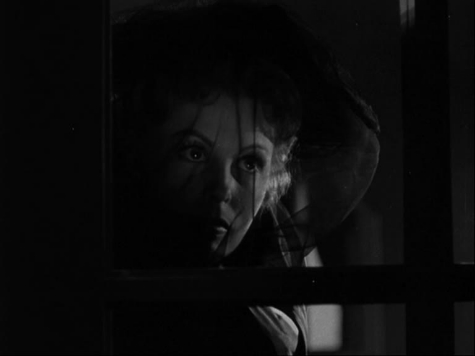
Lots of different things draw us to movies. Personally, I’ve always been a fan of Gothic mysteries, particularly those where the Hollywood majors cooked up that special atmosphere that could only exist within the carefully crafted confines of a studio set. Add in a rare adaptation of the writings of John Dickson Carr and I’m hooked. The Man with a Cloak (1951) combines both of these elements, and it was a film that had intrigued and eluded me for years. It’s been quite some time since I read Carr’s short story The Gentleman from Paris, but I remember enjoying it and was keen to see how the film version worked.

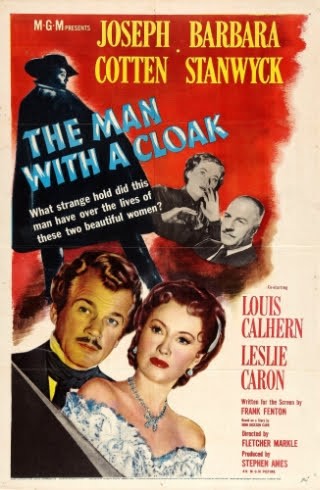
It’s 1848 in New York, the year that saw revolutions breaking out in so many parts of the world. Against this turbulent backdrop a young woman arrives in the US seeking help. She is Madeline Minot (Leslie Caron), a somewhat unlikely fundraiser for a political cause. Her mission is to seek out the assistance of her fiance’s uncle, Charles Thevenet (Louis Calhern), now living in dissipated and debauched exile in the wake of Napoleon’s downfall. Madeline had been expecting to be introduced to a distinguished gentleman, instead she finds a half-crippled drunkard seeing out his days in decaying splendor. Thevenet’s alcohol sodden existence is being overseen by a trio of servants and retainers under the supervision of Lorna Bounty (Barbara Stanwyck). Two things are clear right away: Madeline’s presence is unwelcome in this household, and Thevenet’s protectors are no more than vultures patiently circling their dying master. And so it all comes down to money, Thevenet’s got it and everybody else wants it. While Madeline cannot prove that Lorna and her cohorts are actively plotting to murder the old man, she knows that it’s clearly in their best interests to see that he doesn’t hang around long enough to make any changes to his will. Into this little circle of greed and deceit steps Dupin (Joseph Cotten), the mysterious poet of the title who spends his days cadging free drinks from a sympathetic barkeep. Dupin isn’t motivated by the promise of money, though he’s clearly badly in need of it, rather he’s drawn to the simple faith in life of Madeline and a desire to see an injustice averted. It’s Dupin’s arrival that forces Lorna’s hand and brings the two mysteries of the film center stage: the puzzle of Thevenet’s will, and the real identity of the enigmatic poet.

The Man with a Cloak was directed by Fletcher Markle, a man who is probably better known for his television work. There are some highly effective scenes and a handful of noteworthy visual flourishes, and yet I can’t help feeling that the potential of the story and its setting weren’t fully exploited. The film has that polished look that MGM typically brought to its productions, and the studio sets are faultless. Still, the tension is allowed to slacken too often and that’s partly down to the failure to make the most of the visual opportunities. As for the plot, it’s solid enough but it’s perhaps overly dependent on building up an aura of mystery around the character of Dupin. While it’s adapted from a reasonably entertaining Carr story, it’s not one that highlights the author’s real strengths. In short, there’s arguably too much emphasis on who Dupin actually is – the film is liberally sprinkled with clues and it shouldn’t prove all that difficult to work out for any fairly literate viewer.

While the direction and scripting of the movie are always competent, they are nothing exceptional either. What does give the film a boost though is the acting. Both Stanwyck and Cotten were seasoned professionals, capable of tackling a variety of roles. Cotten spends most of his time hovering around the borders of sobriety, and gets to deliver some witty and telling lines. His character displays a weary cynicism, a sort of metaphorical cloak for the unnamed sadness he carries within himself. Against this is ranged the steely pragmatism of Stanwyck. Her outer gentility and polish masks a barely repressed sensuality and a deep streak of bitterness – after all, we’re talking about a woman who feels she has been robbed of ten of the best years of her life. While Cotten and Stanwyck rarely put a foot wrong, Louis Calhern almost effortlessly steals just about every scene. I sometimes think that if you want to capture a visual representation of regret for a life of unfulfilled promise, then you need only watch one of Calhern’s performances from around this time. In the face of such stiff competition, Leslie Caron fades into the background most of the time. It’s not that her portrayal of a frightened and confused ingenue is especially poor, just that she lacks the presence to make her mark among these heavy hitters. It’s a rare film that doesn’t benefit from a strong supporting cast, and The Man with a Cloak is no exception. Margaret Wycherly looks like she had a ball as a cackling old crone, and Jim Backus is a delight as the Irish bartender trading philosophical jibes with Cotten.

The Man with a Cloak was until recently another of those films that I began to think I was fated never to see. However, it became available via the Warner Archive, and shortly afterwards was given a pressed disc release in Spain via Llamentol. I watched the Spanish disc the other day and, judging from some screen captures I’ve seen, it looks like a clone of the US disc. Generally, the transfer looks pretty clean and sharpness and contrast are quite acceptable. This release offers no extra features whatsoever, just the film with its original soundtrack and the option to watch it with or without Spanish subtitles. I’ve seen people allude to the film’s noir credentials before but I feel the link is tenuous at best, and it’s not a title I’d be comfortable labeling in this way. For me, The Man with a Cloak is simply a Gothic mystery with a generous dollop of melodrama added. Overall, I found this an enjoyable and entertaining movie, though it’s not without its faults. I guess the presence of some big name stars and the fact it was sourced from a John Dickson Carr tale raised my expectations perhaps a tad too high. Nevertheless, I couldn’t say I was especially disappointed. If the direction is a little flat at times, the performances do compensate. Anyone who enjoys these studio bound mysteries, likes Carr’s writing, or is a fan of Stanwyck and Cotten should find enough to satisfy them here.

Those seeking another take on the film should pop over to Paul’s place at Lasso the Movies.


The Mask of Dimitrios

poster7_zps3ff62743

To me the most important thing to know about an assassination is not who fired the shot – but who paid for the bullet.

The passage of time can have a nasty tendency to cloud the memory, to cast a kind of nostalgic haze over things and distort reality. On occasion I’ve found this to be the case with films, where fondly remembered movies, those which have earned themselves a special place in the heart over the years, fail to live up to their promise. It’s quite a crushing disappointment to discover that a film we thought was wonderful long ago falls far short of the stellar image we’ve built up in our imagination. Happily though, that’s not always the case, and sometimes it just happens that the film we saw all those years ago really is the little gem we’ve been yearning to see again ever since. The Mask of Dimitrios  (1944) is one such movie; I caught it once on a late night TV broadcast at some point during my teenage years and it made a big impression on me. However, it never seemed to show up again no matter how carefully I scoured the TV listing pages in the papers. It also remained stubbornly absent from DVD release schedules to the point I began to despair of ever seeing it again. In the interim I’d read the Eric Ambler novel from which it had been adapted, and that actually just served to increase my frustration. Anyway, when I finally learned of its DVD release this year I experienced a rush of excitement tinged with a hint of trepidation. Fortunately, the latter feeling turned out to be misplaced as I realized my memory hadn’t been cheating me. Ah, the ups and downs of being a movie fan!

It’s 1938 and the uncertainty and upheaval of the inter-war years will soon be swept aside by the approaching conflict. In Istanbul a group of children run happily along the shores of the Bosphorus. They halt abruptly, shocked by the gruesome sight before them. The body of a murdered man has washed up and now lies carelessly on the sand. The clothing and papers identify the remains as belonging to one Dimitrios Makropoulos, a Greek national and a man not unfamiliar to the authorities. Later that evening, at a party, the Turkish security officer in charge of the investigation falls into conversation with Cornelius Leyden (Peter Lorre), a mystery writer vacationing in the Levant. The tale of the shady character now lying on a mortuary slab intrigues Leyden and piques his writer’s interest. Armed with only a handful of dates and locations, Leyden takes it upon himself to satisfy his curiosity and make a stab at tracing the movements of this notorious figure. Leyden therefore sets out on a journey that will take him first to Athens, then on to Sofia, Belgrade, Geneva and finally Paris. Along the way, via a series of flashbacks narrated by an assortment of middle European types, he begins to piece together a picture of the mysterious and ruthless Dimitrios (Zachary Scott). At every turn though, Leyden’s path seems to cross that of Mr Peters (Sydney Greenstreet), a man whose interest in  Dimitrios surpasses that of the diminutive writer. It soon becomes apparent that the threat posed by men such as Dimitrios doesn’t end with death, and that his malignant influence may even extend beyond the grave.

£23

The Mask of Dimitrios is one of those pictures that sails awfully close to the boundaries of film noir; the fates of Dimitrios’ victims certainly moves it in that direction as does the shadowy photography and multiple flashbacks employed. However, despite the presence of these persuasive factors, it’s the mystery/espionage elements that dominate for the most part. The story comes from Eric Ambler’s finest novel (high praise indeed as the man rarely wrote anything weak) and I reckon the film stands as the best adaptation of his work to date. Generally, Ambler’s stories dealt with men who found themselves drawn unwittingly into the murky world of spying and underground politics. By having the bulk of the action play out in the Balkans, that hotbed of intrigue and shifting loyalties, The Mask of Dimitrios captures the mood of betrayal for profit beautifully. Both Ambler’s writing and Jean Negulesco’s atmospheric direction leave the viewer in no doubt that we’re being taken on a tour of a world of secrets, memories and confidences cherished for emotional and material value. For me there are two standout sequences in the movie. The first is the framing story in a cheap night club in Sofia. Faye Emerson is wonderfully weary and faded as she recounts her past with Dimitrios: the air is thick with a kind of smoky decadence, Emerson’s near lifeless eyes and drawn expression speak volumes, and the band plays Perfidia in the background. The other noteworthy episode is an extended flashback to an elaborate sting in Belgrade, where a minor government official has his own weakness manipulated in order to suck him into committing treason. The combination of Dimitrios’ cold slickness and Steven Geray’s portrayal of the poor dupe whose fragile ego, thwarted ambition and desperate desire to rise in his wife’s estimation makes it quite affecting.

Of the half-dozen or so movies that Greenstreet and Lorre made together in the 40s, The Mask of Dimitrios was the one that gave them the greatest opportunity to shine. Something like The Maltese Falcon handed them fascinating roles, but they were still only there to provide support for Bogart and Astor. This film, on the other hand, places the two men front and center and it’s their partnership as much as anything that carries the whole thing. As Peters, Greenstreet has the more ambiguous part, and gets to indulge in his patented trick of switching from jovial bonhomie to dark menace in the blink of an eye. Lorre acts as the viewer’s guide, half leading and half stumbling his way through the twisting tale. Zachary Scott is of course the true villain of the piece, and the movie offered him one of his best parts. He always had an oily charm that could be used to strong effect when necessary, but this time that quality remains largely buried beneath a cold, calculating facade. As the story progresses the full extent of Dimitrios’ foul character is gradually revealed, and Scott manages to convey very successfully just how dangerous this man truly is.

£24

As I said at the beginning of this short piece, The Mask of Dimitrios was a difficult film to see for a long time. Earlier this year though, it appeared on DVD via the Warner Archives. At the time I felt ambivalent about this fact; I wanted to get my hands on the film but I’ve never managed to completely overcome my aversion to buying DVD-R products. When I learned over the summer that Absolute in Spain were putting out their own pressed disc version of the movie, I decided that was the one I’d go for. Absolute can generally be relied on to produce solid, attractive releases, and this is no exception. The image doesn’t display any noticeable damage and has nice contrast levels to show off the noirish photography. As usual with this company, subtitles are no issue and can be deselected from the setup menu. Extra features consist of the theatrical trailer and a booklet (in Spanish naturally) containing notes on the film and a good selection of stills. OK, so I had been a little fearful that the film wouldn’t prove as entertaining as I hoped, but it ended up being every bit as satisfying as I recalled. Personally, I think it’s a terrific example of the magic that studio bound B thrillers could conjure up when the right cast and crew were handed promising material. Do yourselves a favor folks and check this one out – it comes highly recommended.


Saddle the Wind

poster20_zps613c7860

It’s a hell of a thing, killing a man. Take away all he’s got and all he’s ever gonna have. – Unforgiven (1992)

I decided to open with the above quote to prove a point of sorts. It’s a point about perception, the way cinema tricks us into believing certain things, or at least the way those who write about cinema shape our views. There are plenty of people who point to Eastwood’s Unforgiven and hold it up as the ultimate myth buster. I like the movie well enough but it does bring a wry smile to my face when I hear it lauded as a film which highlighted the corrosive effects of violence on men who lived by the gun. It’s easy to see how those unfamiliar with the genre, or even those with only limited exposure to it, could buy into the theory that Unforgiven is a bigger game changer than it really is. There is a tendency among some, probably fueled by the influence of the spaghetti western, to imagine the genre was all about cool, trigger-happy gunslingers prior to 1992. Somehow, the perception arose that the western shied away from or glossed over the consequences of violence and killing. Yet if one goes back to the golden decade of the 50s, it’s clear that the genre had already faced such themes head on. Saddle the Wind (1958) is a film about killing, a painful and probing examination of the repercussions of pulling a trigger and taking a life.

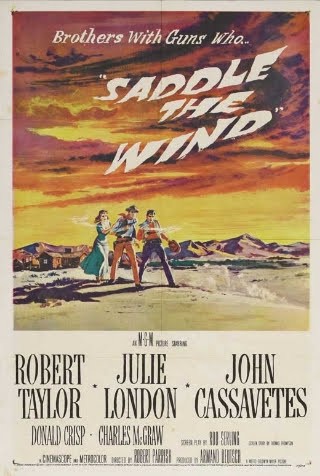
The opening sees a stranger (Charles McGraw) riding into town. He’s one of those bristly, hard-bitten types, the kind of guy who oozes insolence and aggression, who demands rather than asks. Men like this have a swaggering confidence born of the knowledge that they’re tough, mean and fast enough to carry it all off. Anyway, he makes it clear that he’s looking for a man, Steve Sinclair (Robert Taylor), and guys such as this don’t come looking for men just to be sociable. Steve Sinclair is now a respected rancher but he has a murky past that he’s trying to live down, having once been a famed gunman and killer. So what’s new, you may ask. Thus far the scenario is one that ought to be familiar to anyone who’s seen more than a handful of westerns. Well Steve is a man who has learned from the sins of his youth, he’s become a reformed character and has rejected violence. However, Steve has a younger brother, Tony (John Cassavetes), who appears to have inherited the worst traits of his elder sibling. Tony is more than just a cocksure kid with a gun and a point to prove; he’s a damaged human being, a walking stick of dynamite without a hint of remorse and a lust for killing. We first see Tony as he arrives home with a girl he intends to wed, former saloon singer Joan (Julie London), and a new gun. It’s immediately clear that there’s something itching away under Tony’s hide: he deposits his betrothed in the house, introduces her to all, and then proceeds to indulge his real passion. Where a normal guy would fawn and fuss over his newly acquired fiancée, Tony instead gets straight to work honing his shooting skills with his new six-shooter. Not only that, but there’s a manic, obsessive edge to his practice, rounded off by his blasting away at his own reflection in the water – which of course foreshadows the film’s climax. And this, more than anything else, is what the whole movie is really about, two very different brothers and their attitude to violence. The more Steve tries to rein in the excesses of his brother, the more Tony strains against that moderating influence. What finally brings the conflict to a head is the arrival of a former Yankee soldier (Royal Dano) bent on claiming his family’s legacy and stringing the dreaded barbed wire on the open range. Tony’s overreaction and stubborn refusal to heed Steve’s call for calm leads to a tragic confrontation. His neglect of Joan has already irritated Steve, but it’s his determination to usurp the authority of the local land baron (Donald Crisp) which finally forces the two brothers into a situation where only one can walk away.

£35

Robert Parrish isn’t a director whose name will be familiar to many these days. However, he made a string of fine films throughout the 50s, culminating in the truly excellent The Wonderful Country. I recall reading somewhere that Parrish was unhappy that he wasn’t given full control over the final cut of that movie; I don’t know if that’s true but the fact remains his career as a director appears to have slumped dramatically after hitting that peak. Anyway, Saddle the Wind (with its screenplay by Rod Serling of The Twilight Zone fame) comes awfully close to being his best work – I reckon The Wonderful Country just about pips it to the post but there’s not a lot in it – with some memorable visuals and an extraordinarily powerful theme. Pitting brother against brother always makes for good drama. When you mix in the simmering resentment left over from the Civil War, and a scathing critique of machismo and the culture of violence then it all adds up to something quite special. It’s that last point which I mentioned in my introduction, and I’d like to explore it a little further here.

Others have pointed out that the scene where Jack Palance gunned down Elisha Cook Jr in Shane was a pivotal moment in the development  of the western, and I’m not going to argue with that. That proved that gun play and violence was a mean, dirty business. Saddle the Wind follows on from that and literally hammers  the point home: apart from the heartfelt speeches delivered by Taylor and Crisp at various times, the killings that take place in the film, and there aren’t actually that many, are grim and brutal. No-one dies easily; as the bullets tear into bodies, the victims clearly suffer, twitching, kicking and coughing to the bitter end. And then there’s the aftermath, the consequences of taking a life. Two of the characters (Crisp & Taylor) bear the psychological scars of a violent past and their world view is shaped by that. For me, it’s this mature consideration of the effects of violence on the souls of men that marks Saddle the Wind out as one of the great westerns of the greatest decade of the genre.

£36

The more often I watch Robert Taylor’s westerns, particularly those of the late 50s, the more I come to view him as one of the most significant figures in the genre. I didn’t include him in my list of the top ten western stars which I compiled at the tail end of last year, and I tend to think now that it may have been a major omission. I guess Taylor is never likely to attain the status of Stewart, Scott or Wayne but his finest western roles made a big contribution to the genre. In Saddle the Wind he achieved a marvelously quiet dignity, a kind of pained courage that projected all-round masculinity as opposed to juvenile machismo. Taylor’s calm awareness of his own strengths and weaknesses contrasts well with the strutting bravado of Cassavetes. Now there’s a figure one wouldn’t normally associate with the west. Cassavetes had a very urban and modern air about him, a guy who it’s hard to imagine outside of a big city environment. Yet that otherness, that discomfort with his surroundings, works under the circumstances. Cassavetes’ character is a young man at war with himself, and by extension with the whole world around him. If Cassavetes doesn’t truly belong in this frontier setting then it’s merely a reflection of the character whose psychological flaws and displaced morality set him apart from those around him. He honestly comes across as some unbridled force of nature, and Taylor’s futile efforts to tame him could easily be seen as a fruitless attempt at saddling the wind. These two men unquestionably dominate the film but it’s also important to mention the work done by Donald Crisp and Royal Dano. Crisp was always good in patriarchal roles and his benign presence in this movie is every bit as touching and influential as the rather different yet comparable part he played in Anthony Mann’s The Man from Laramie. Royal Dano was one of those character actors who seemed to pop up all over the place, and his halting delivery and hunted look tend to stick in the mind. Saddle the Wind offered him a role to get his teeth into, a desperate man driven on by his private sense of honor and justice. And that brings me to Julie London. Her fame today derives from her singing (and she provides a beautiful version of the theme song of this film) but she also starred in three exceptional westerns around this time: The Wonderful Country, Man of the West and the film under discussion.

Saddle the Wind was an MGM production and so it was released on DVD by Warner Brothers a few years ago in their Western Classics box set. The film has been given a very good transfer to DVD, the anamorphic scope image looking bright, clean and colorful. The location photography in Colorado looks quite stunning in places and the audio is also strong with the gunshots packing a considerable punch, and Elmer Bernstein’s brooding score sounding rich. The only extra feature offered on the disc is the theatrical trailer. I believe this is a very fine western, although nowhere near as well-known as it deserves to be. I see it as further proof of how far the western had progressed by the late 50s. However, the fact that thoughtful films like this are only infrequently mentioned can also be regarded as evidence of the regression the genre experienced through the following decade. Anyway, next time someone claims that a film such as Unforgiven broke entirely new ground in terms of its critique of violent lifestyles, you can simply point them towards this production and tell them it’s not as new a concept as they first imagined.


Shake Hands with the Devil

The conflict in Ireland has provided the backdrop for a number of quality movies over the years, and I’ve covered a few of them on this site: Odd Man Out & The Gentle Gunman. Those two films dealt mainly with the smaller mid-century campaigns in Northern Ireland or around the border. Shake Hands with the Devil (1959) steps a little further back to the early 20s and the War of Independence, concentrating on the south of the country. The “Tan War”, so named after the involvement of the British irregulars recruited to strengthen the RIC, remains an emotive subject in Ireland due to the atrocities perpetrated against the civilian population. I can clearly remember people of my grandparents’ generation, who lived through those turbulent and violent times, speaking with undisguised venom about the Tans. The film under examination here reflects that hostility, but doesn’t shy away from depicting the implacable fanaticism that characterized some elements within the Irish rebel movement at that time either.

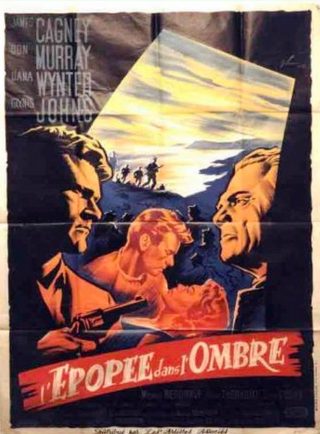
The prologue makes it clear that the Ireland of 1921 was a country in a state of war. The opening then takes place in a Dublin cemetery where a solemn funeral procession makes its way along paths lined with tombstones. Suddenly, a squad of Black and Tans appear and the cortege scatters amid the jarring sound of gunfire, leaving behind an upturned coffin spilling its load of rifles. This brief scene succinctly illustrates the nature of the war being fought: a covert organization facing off against a determined and ruthless enemy. The most interesting films dealing with the Irish conflict feature those caught somewhere in the middle, dragged into the fighting in spite of themselves. Kerry O’Shea (Don Murray) is such a man, an Irish-American studying medicine in Dublin in fulfillment of his late mother’s wishes. O’Shea happens to be visiting his parents’ grave when the Tans’ raid takes place, and he will find himself drawn deeper into the war as the story progresses. O’Shea’s father had been an old-time republican and he had fought in WWI himself; as such, we see a young man who has had his fill of killing. Still, circumstances don’t always allow a man to follow the path he would prefer – sometimes just being in the wrong place at the wrong time alters the course of a life. This is what occurs with O’Shea; he is walking along a street when an IRA ambush leads to the shooting of his friend and the subsequent leaving behind of his notebook at the scene during his flight from the violence. A direct consequence of this is the revelation that O’Shea’s lecturer and eminent surgeon Sean Lenihan (James Cagney) is a commandant in the IRA. As O’Shea, now regarded as a suspected terrorist, goes on the run, the combination of the brutality of the Black and Tans and the fact that Lenihan once saved his father convinces the young student that his place is standing shoulder to shoulder with the rebels. Yet despite O’Shea’s belief in the essential nobility of his cause, he becomes increasingly disturbed by the harsh, fanatical side of Lenihan. This feeling of unease is further strengthened when Lenihan’s customary dislike for and distrust of women is magnified after the taking of an important hostage; Jennifer Curtis (Dana Wynter), the daughter of a high British official, is abducted in reprisal for the imprisonment of an elderly republican sympathizer. Lenihan’s near pathological hatred of the young woman, and his keenness to see her executed, may prove the ultimate test of O’Shea’s loyalty.

Politically, Shake Hands with the Devil wears its heart on its sleeve, and makes no bones about its critical appraisal of the role of the Black and Tans in Ireland. The Tans are explicitly cast as the villains of the piece, their commander being portrayed as a quasi-fascist figure with a strong sadistic streak. The way O’Shea’s interrogation and beating is photographed, in a highly subjective manner, emphasizes the cold brutality of his tormentor. However, if there is a sustained effort to romanticize the rebels – most notable in the characterizations of Cyril Cusack, Michael Redgrave and Sybil Thorndike – it needs to be pointed out that we’re not looking at a whitewash job either. The internal discipline mechanisms of the IRA are shown in all their toughness, and the unyielding aspect of what would become the anti-Treaty forces – as represented by Cagney – is one of the major themes of the film.

Michael Anderson was a director capable of great visual flair – I’ve commented in the past on the Hitchcock-style touches present in a couple of his films – and Shake Hands with the Devil offers further evidence of his eye for interesting compositions. Aside from having a knack for capturing the correct mood, he staged and shot the action sequences very fluidly.  The early part of the movie was shot on location in a mean and moody Dublin, all expressionistic shadows and dripping in noir atmosphere. Later, the action moves out of the city to Bray and the coast, and again Anderson, aided by cameraman Erwin Hillier, makes the most of the windswept seaboard. The use of the lighthouse, where the rebels have set up a makeshift headquarters, gives a nice claustrophobic feel to the scenes where Dana Wynter is held captive. Generally, the authentic locations contribute to the sense of realism and, while the script does meander a little in the middle, Anderson’s assured and inventive direction holds the attention throughout.

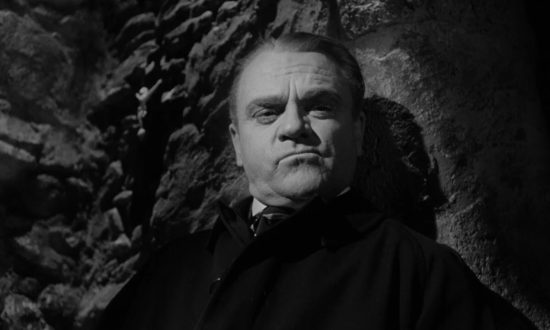
What can one say about James Cagney? From gangster to song and dance man, and just about everything in between, he was and remains one of the greatest Hollywood stars ever. Shake Hands with the Devil was one of his last films before entering a retirement that he refused to be persuaded out of for over twenty years. The film saw him surrounded by top class performers and expert scene stealers, yet it’s Cagney who carries it and he’s the one who sticks in your mind. The tough little New York Irish pug had been strutting and swaggering across the screen for thirty years by that time and his presence was such that it positively demanded you sit up and pay attention. He was always an actor capable of great intensity, although there was always a liberal sprinkling of charm and humor just below the surface too, and he honed and perfected that quality over the years. The part of Sean Lenihan gave Cagney a chance to flex his not inconsiderable acting muscles; it’s a complex role where the character alternates between a sympathetic, gutsy figure and a dangerous obsessive with deep and dark personal issues.

Cagney was certainly the name at the top of the bill, but there was a long list of talented and big name performers filling the other roles. Michael Redgrave was credited simply as The General, a character who seems to have been based on the real life Michael Collins. Aside from a moment of ruthlessness, Redgrave imbues this man with a sense of dignity, nobility, and just the appropriate touch of tragedy. There’s also an excellent turn from Cyril Cusack as the poet turned revolutionary who befriends the lead; it’s a thoughtful performance and a pivotal one, anchoring the film and acting as a bridge between the driven Cagney and the more reluctant Murray. Frankly, Don Murray was handed something of a thankless task when he had to square off against such a battery of talent. Having said that, Murray is good enough and, while he hadn’t the same depth of experience as some of his co-stars, acquits himself very well indeed. Richard Harris would of course go on to great things and his part as one of the more thuggish and self-absorbed rebels was an early opportunity to show what he was capable of. As for the women, Glynis Johns and Dana Wynter have the meatiest parts. Johns was the loose and brassy barmaid while Wynter was the demure and well-bred gentlewoman. Both actresses were convincing and quite touching in these contrasting roles, coaxing the best and worst from the male characters. As has already been stated, the supporting players in this movie makes for impressive reading: Sybil Thorndike, Niall MacGinnis, Harry H Corbett, William Hartnell, Ray McAnally, John Le Mesurier, Allan Cuthbertson and Noel Purcell.

Shake Hands with the Devil is available on DVD in the UK via Metrodome. The film is presented in Academy ratio, which can’t be right for a 1959 production. I did try zooming to around 1.66:1 at a number of points and the image generally looked fine so I guess we’re looking at an open matte transfer here. Leaving aside the matter of the aspect ratio, the transfer isn’t bad in other respects – print damage is minimal and contrast levels and sharpness all look acceptable. The only extra features on the disc are a handful of trailers for other Metrodome releases. Regular visitors to this site will be aware that I try to highlight movies that aren’t always widely acclaimed. Naturally, some are of better quality than others and I feel comfortable in asserting that Shake Hands with the Devil really is something of a forgotten gem. It’s an interesting film from a historical perspective, focusing on a conflict and period that doesn’t get a lot of attention. Michael Anderson’s smooth direction is very attractive with the imagery frequently reminiscent of film noir. Add in some excellent acting and complex characterization, especially from Cagney, and we’re talking about a first-rate thriller.

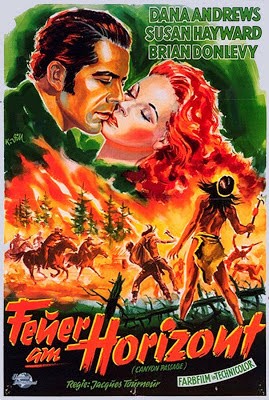
Canyon Passage

poster10_zps537a0a41

The western is a genre which, although it’s certainly not the only one, is sometimes accused of being overburdened by clichés.  This is understandable enough; genre pictures by definition have to feature elements that are immediately recognizable to viewers. Canyon Passage (1946) could be said to contain its fair share of these well-worn tropes (crooked financiers, restless wandering types, hostile natives) but part of what raises this film up among the best examples of the genre is the way they are handled. There’s an  air of authenticity about it all, and that filters through into some stock characters and situations, bestowing on them an originality that sets the whole production apart.

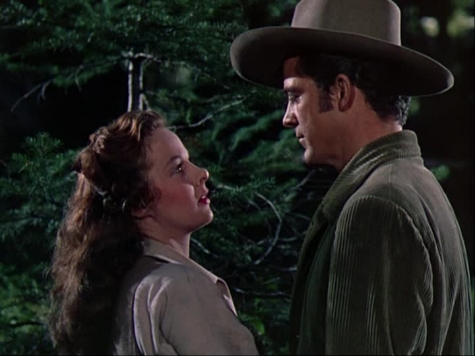
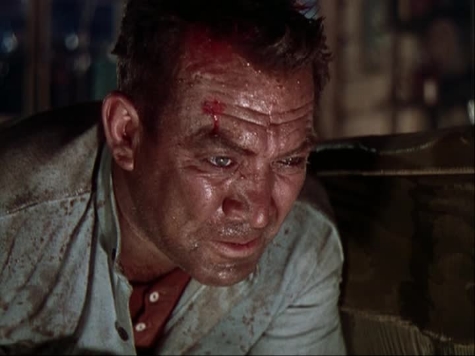
While I don’t have any statistics at hand to prove this one way or the other, I reckon it’s safe to say most westerns take place within a rough thirty year period beginning at the outbreak of the Civil War. Sure you’ll get examples set both before and after these dates, but they do appear to be slightly thinner on the ground. Canyon Passage tells a tale of Oregon in 1856, a time of growth and expansion before conflict engulfed the nation. Logan Stuart (Dana Andrews) is one of those thrusting, entrepreneurial types, never satisfied with what he has and always on the lookout for new opportunities to add to his fortune. Still, he’s not a greedy or grasping man; his ambition is just an integral part of his character, a restless need to range further and in some ways a reflection of the pioneering spirit of his country. Stuart is a man who is going places in every sense: his business is booming, he’s respected within the community and he’s courting Caroline Marsh (Patricia Roc), a beautiful English settler. However, there’s almost always a fly in the ointment, two in this case. The biggest and ugliest comes in the shape of the brutish Honey Bragg (Ward Bond), a muscle-bound giant of a man and an amoral counterpoint to Stuart. A further source of anxiety is George Camrose (Brian Donlevy), the local banker and Stuart’s best friend. Camrose is a compulsive gambler, a dangerous trait in a financier in any circumstances but doubly worrying when he’s caught in a run of spectacularly bad luck. While Camrose attempts a precarious balancing act his fiancée, Lucy Overmire (Susan Hayward), is increasingly  attracted to Stuart. Granted none of this is making his life any easier, but it pales into relative insignificance in comparison to the physical threat represented by Bragg. The hulking bully is borderline obsessive in his rivalry with Stuart, further enraged and embittered by his knowledge that his foe had (and passed up) the opportunity to see him hang. Fueled by hate and frustration, Bragg gives in to his animal instincts and thus imperils not only Stuart but the whole community when his base behavior sparks off a tragic Indian uprising.

£3

Adapted from a novel by prolific western author Ernest Haycox (Stagecoach, Union Pacific, Bugles in the Afternoon, Man in the Saddle etc) Canyon Passage was the first foray into the genre for director Jacques Tourneur. The versatile Frenchman took to westerns right from the beginning, crafting an intimate portrait of frontier society that comes close to the affectionate and mythic vision of John Ford. Cameraman Edward Cronjager captured some truly beautiful and breathtaking Technicolor images that Tourneur then directed with an expert touch. The sequence of the cabin raising is an ode to communal effort and gives a real sense of how inextricably linked the lives of these people were to those of their neighbours. Everything in the movie – the texture of the buildings, the condition of the streets, the language and attitudes of the characters – smacks of a realism that isn’t always present. However, the movie is more than a celebration of pioneering spirit and the social dynamic of the time. Above all, Tourneur was a master of atmosphere and an extraordinarily subtle, understated director. There is plenty of rousing action accompanying the narrative, and again the authentic feel comes across in the depiction of the violence. No doubt Tourneur’s experience working in Val Lewton’s horror unit at RKO shaped his approach to filming the more horrific scenes. There is very little explicit violence shown on screen, the director preferring to cut away or obscure the more visceral moments. Yet the effect, as was the case in those Lewton movies, is to force the viewer’s imagination to take over. In my opinion anyway, having to visualize the acts just off screen is more unsettling than seeing some unconvincing mock-up.

With strong source material and first class people operating behind the cameras, the final vital ingredient is the performers. Dana Andrews produced another of those deceptively quiet turns as Logan Stuart. Initially, you’d be forgiven for thinking this man was no more than a hard-nosed and pragmatic businessman. However, as the story progresses, Andrews, as he so often did, reveals new layers to the character. His early scenes with Patricia Roc hint at a tenderness of heart not apparent from his stoic visage, and this aspect is further developed as his relationship with Hayward grows. But really it’s his loyalty to Donlevy that proves how deep his humanity runs. Although Donlevy was of course a great heavy in countless movies, I wouldn’t actually class his George Camrose as a fully fledged villain. Despite some thoroughly reprehensible behavior, Donlevy brought a weakness and frailty to the role, a touch of corrupt romanticism if you like, which helps explain why Andrews stuck by him all the way. No, the real bad guy here comes courtesy of Ward Bond’s portrayal of the monstrous Honey Bragg. Bond did a fantastic job in capturing the physical power, the depravity and animal cunning of this figure. The two main female roles – those of Patricia Roc and Susan Hayward – are careful studies of contrasting women. Roc had the right kind of brittle gentility for an Englishwoman suddenly thrust into a new and dangerous world; her dazed and distant reaction to the aftermath of the Indian massacres struck just the right tone. Hayward, on the other hand, was feisty, tough and earthy – a true frontier gal. In supporting roles, there is some good work from Lloyd Bridges, Andy Devine, Onslow Stevens, and the wonderful Hoagy Carmichael.

£4

Canyon Passage is a Universal film, and there are plenty of DVD editions on the market from a variety of territories. I have the version included in Universal’s Classic Western Round-Up Vol. 1 which was released a number of years ago. The film shares disc space with The Texas Rangers but I can’t say I was aware that the presentation suffered from any compression issues. For the most part, the image is very strong with the Technicolor cinematography looking frankly spectacular at times. There are no extra features whatsoever available on the disc, something I think is disappointing as the movie is most certainly deserving of a commentary track at the very least. Regardless of that, this movie remains among one of the very best westerns made in the 1940s. Jacques Tourneur would go on to make a number of high quality pictures in the genre, though I feel this represents him right at the top of his game. There’s a complexity and maturity to the characters and their interactions that help distinguish the movie. Not only would I recommend Canyon Passage to anyone with an interest in westerns, I would go so far as to say it’s essential viewing.