The Wild Geese

twg

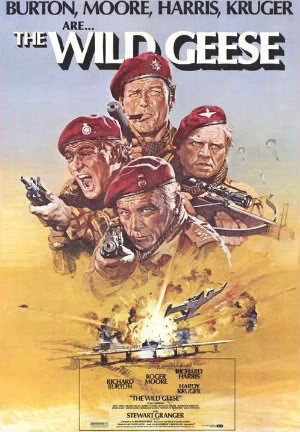
As a boy I used to positively devour westerns and war movies. My friends were pretty much the same, and I can still see us, in the schoolyard or on the way home, re-enacting the action scenes from whatever movie we had seen on the telly the night before; this was back when there were only three channels (actually four in Northern Ireland) so what one had seen, all had seen. Every once in a while you got lucky and you had the chance to go to the cinema and see a big new movie. That afforded you a certain kudos as you were then in the enviable position of being able to relate all the gory details to your mates. What we all yearned for were movies with plenty of guns, explosions, daring escapes and as little mushy romantic nonsense as possible. Such was the case with The Wild Geese (1978), a film that seemed just perfect when I first saw it on release. Looking back on it now, I no longer think it’s perfect but it still retains the power to charm me, and the passing of time hasn’t made it any less fun to watch.

The story has Colonel Faulkner (Richard Burton), an ageing mercenary soldier, arriving in London for a clandestine meeting with millionaire businessman Sir Edward Matherson (Stewart Granger). The purpose of the meeting is to arrange a raid into a fictitious African nation to free from prison a deposed leader who is facing imminent death. This will require the recruitment of the necessary personnel and the formulation of a viable plan for a rapid extraction. Too much focus on the behind-the-scenes stuff can easily scupper this kind of movie, but the finding and hiring of the officers (Roger Moore, Richard Harris and Hardy Kruger) and men is carried off in an entertaining way and never slows down the pace. Soon the action has moved to the training camp in Africa, where the RSM (Jack Watson) gets to deliver some marvellously insulting language to the biggest names in 1970s cinema as he kicks, bullies and cajoles his out-of-condition squad into shape. The mission itself starts off well and everything looks like it may run according to schedule, but some devious machinations back in London ensures that the mercenaries will be abandoned to the tender mercies of a ruthless dictator and his Simba battalion. With their rescue flight aborted, and facing certain death, they have no choice but to trek across hostile country with the vague idea of maybe stirring up civil unrest on the way. Under constant attack, Faulkner leads his ever diminishing force south to an abandoned airfield where their last chance for salvation appears in the form of an old, beat-up, twin-engine Dakota. The climax is pure blood and thunder stuff, with Faulkner’s men making their desperate dash for freedom as the air is filled with lead and the ancient plane chugs and sputters in the background.

Andrew McLaglen was arguably at his best when directing this kind of Boy’s Own adventure, and he managed some quite effective scenes here. The action set pieces are all well handled, the stand outs being the scene where a jet strafes and bombs the mercenary column while it’s stalled on an exposed bridge, the parachute jump sequence, and the bloody but exciting climax. The movie runs well over two hours but McLaglen controlled the pace so well that it seems a lot less. The stars of The Wild Geese were all getting a bit long in the tooth for this kind of exertion but the four leads give amiable enough performances and seem very comfortable around each other. While Burton definitely looks the worse for wear, that weary quality kind of fits the role he’s playing. The old-time soldier of fortune looking for a last big score in a world that’s changing around him plays like an amalgam of Burton’s own character and that of Mike Hoare, who served as technical adviser on the film. Neither Harris nor Moore really have to stretch themselves in the acting department but both at least give the impression they were having a hell of a lot of fun. Hardy Kruger gets a bit more to do as the crossbow wielding Afrikaaner who has his preconceptions challenged and finds himself rethinking his position and prejudices. Stewart Granger has only a small part yet he brings an oily condescension to the part of the duplicitous Matherson that makes for a great screen villain.

The Wild Geese has been out on DVD for a while now, and the R2 disc from Mosaic presents the film pretty well. The transfer is anamorphic and quite clean. There’s an entertaining commentary track featuring Roger Moore and producer Euan Lloyd, and a documentary on Lloyd’s career. All told, it’s not a bad package and provides good value. There is a new edition slated for release in March but I doubt if it will add anything new, we’ll see. This isn’t a very deep or serious movie, but it is entertaining, and if you want something that will recall memories of far-off schooldays and more innocent times The Wild Geese is just the ticket.
 

The Long Night

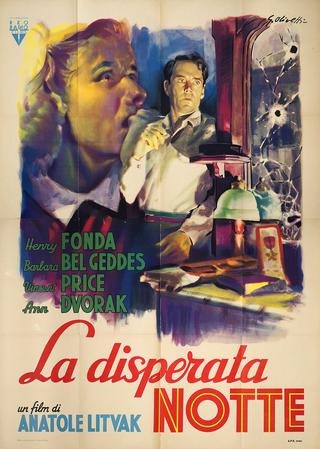
Hollywood has always been in love with the remake, not only of its own domestic product but those originating in other territories too. In the ’40s and ’50s a number of French movies were revisited, Lang’s Scarlet Street and Human Desire being prime examples, with a fair degree of success. Frequently these re-imaginings were (as in the previous examples) the work of directors and crews who had learned their craft in the French and other European cinema industries. Such was the case with The Long Night (1947); a remake of Le Jour Se Leve carried out by emigre director Anatole Litvak. Now I’ve never seen  the original, but a quick scan of the comments at the IMDb tell me that a number of people regard the Hollywood film as inferior. I’ve always been of the opinion that there are both good and bad remakes, and that there are those who display a knee-jerk reaction whenever the term is used. You pretty much have to judge any movie on its own merits and, as such, I think The Long Night stands up well enough.

It’s late in the day in a nameless town and a blind man taps his way up the stairs to his room in a boarding house. His ascent is interrupted as a shot rings out. On the top floor a door bursts open, and a mortally wounded man stumbles out before pitching headlong down the staircase. This was The Great Maximilian (Vincent Price), a second rate conjurer plying his trade in a succession of low rent night clubs across the country. Now he lies dead on a seedy landing in a tenement, gutshot by factory worker Joe Adams (Henry Fonda). That’s how The Long Night opens, and before the end we will learn just how these two men came to this point. For the most part the story is told in flashback from the point of view of Adams, although at one stage there is what you might call a double flashback. Sound confusing? Well, it’s not really, since the story recounted is a fairly simple one. Naturally, there’s a woman involved who acts as the catalyst. She is Jo Ann (Barbara Bel Geddes), a virginal young innocent for whom both Adams and Maximilian fall – figuratively and literally. With Maximilian persisting in his attempts to seduce the girl and Adams simmering resentment growing, events slowly build towards the only possible outcome. Along the way, other characters flit in and out of the story, most notably Maximilian’s former assistant and lover Charlene (Ann Dvorak). Her streetwise presence serves both to provide a contrast to the gullibility of Jo Ann and to highlight just what a piece of work Maximilian is. His deceitful pursuit of Adams’ girl is one thing, but it’s a rare kind of S.O.B. who shaves the paws of puppies and burns the skin red raw in order to train them to perform.

Made at a time when noir pictures were beginning to move towards a wider use of locations and a more documentary approach, The Long Night is something of a throwback. Shot entirely in the studio and making extensive use of miniatures and forced perspective, the film takes on a dreamlike, otherworldly quality. This works pretty well since Joe Adams spends the film holed up in a bullet-riddled room living within his own mind and memories. Fonda does well in a role that demanded he be breezy and cheerful in the flashbacks, all the while growing more uneasy until he finally starts to lose his grip on reality. He always excelled in his portrayals of average guys who are put upon, and he manages to work in some post-war angst which must have struck a chord with the recently returned WWII vets. In contrast, Vincent Price hams it up in a bombastic performance as the villain who is sly, snide and sneering while retaining a certain pathos. Barbara Bel Geddes, in her debut role, was well cast as the youthful Jo Ann. Superficially, she doesn’t seem to fit the stereotypical image of the femme fatale, but her character certainly has a fatal effect on the men in the picture. Ann Dvorak’s wisecracking dame who’s seen it all is is a joy to behold as she picks away at Maximilian’s carefully arranged image, and seems to be having a ball casually humiliating him whenever and wherever the opportunity arises.

The Long Night was an RKO picture but it has been released on R1 DVD by Kino. While the film clearly hasn’t had any significant clean-up done it remains in pretty good shape. There are a variety of damage marks present but, with a few exceptions, the print is clear and very watchable. As is often the case with films like this, the audio can be a bit inconsistent but I can’t see anyone forking out for a full blown restoration so this is probably as good as it’s going to look and sound. The disc does boast some nice extras in the form of a text based feature detailing the meticulous work that went into the production design which gives the film its unique atmosphere. Alongside that, there are  a  couple of clips which compare scenes in the movie with virtually identical ones in the French original. All told this is a fine movie that should please anyone with a taste for noir.

Five Graves to Cairo

poster90

I suppose it goes without saying that war movies made while WWII was still in progress are inevitably going to be propaganda pieces. The more routine ones can lay the flag waving and speech making on so thick as to appear more than a little stodgy when viewed from a distance of over sixty years. The more memorable examples, at least from a present day perspective, are those that manage to tell a story that goes beyond merely depicting heroic resistance, a story that remains absorbing and exciting in its own right. Such is the case with Billy Wilder’s Five Graves to Cairo (1943). Naturally, the film was conceived and produced with the aim of assisting the war effort, but it avoids beating the viewer over the head with its message – at least until the final minutes. What we get instead is a tight, suspenseful yarn where the propaganda is served up sparingly and, for the most part, with subtlety.

Corporal Bramble (Franchot Tone), the sole survivor of a tank crew after the fall of Tobruk, stumbles out of the desert and into a battered, run down hotel. With the British in full retreat the only occupants are the owner (Akim Tamiroff) and a French maid by the name of Mouche (Anne Baxter). While the owner panics, Mouche is openly hostile to the new guest due to her bitterness over what she regards as Britain’s desertion of France at Dunkirk. However, the arrival of the Afrika Korps, and their illustrious chief Rommel (Erich von Stroheim), signals a softening of her attitude; not by much mind, but she can’t bring herself to betray Bramble. Therefore, Bramble assumes the identity of the recently deceased waiter Davos who, it turns out, was actually a Nazi agent sent on in advance. As such, Bramble finds himself in the dangerous yet privileged position of having Rommel’s confidence as the Field Marshal prepares for his assault on Cairo. That task would seem an impossible one given the demands made on his lines of supply. Yet Rommel’s ebullient self-assurance suggests he holds a trump card, which is hinted at via references to five graves and a mysterious professor. Bramble/Davos now faces the challenge of discovering the identity of the professor and the significance of the five graves before his cover is blown. None of this is made any easier by the continued ambivalence of Mouche, who is determined to “do business” with either Rommel or his aide (Peter van Eyck) in order to secure the release of her brother from a Nazi concentration camp.

Directing only his second feature in Hollywood, Billy Wilder was already showing signs of his trademark style. Bleak is a word that has been used to characterize Wilder’s world view, and that’s certainly in evidence in the opening shots which show a tank trundling remorselessly across the vast desert, manned by its crew of dead men. There are lots of inventive little touches throughout the movie, such as the point of view shot seen through the intricate lattice work of the hotel desk, or the zoom cut to the transom as it snaps shut and knocks a concealed weapon into plain view. Alongside this is the sharp dialogue and strong characterization one typically associates with a Wilder picture. There’s a nice contrast of acting styles on show from both von Stroheim and Tone; von Stroheim is all swaggering Germanic confidence while Tone underplays his role as the ingratiating and obsequious waiter/spy. Anne Baxter does well enough as the conflicted maid, but it’s a tough slog with all the showmanship going on around her, not to mention the scene stealing comedic turn of Akim Tamiroff. The other supporting roles are well filled out by a young Peter van Eyck, Fortunio Bonanova, and Miles Mander’s British colonel, who bears more than a passing resemblance to Field Marshal Montgomery.

Five Graves to Cairo was a Paramount picture so the rights now reside with Universal who, in association with Madman, have released this on DVD in R4, at least both of their logos appear on the cover and on the disc itself. The transfer is a particularly fine one and is crisp and sharp throughout. There are some occasional damage marks but I can’t say I found them to be very distracting. The disc also has a 25 minute documentary on Anne Baxter, and there’s a nice 15 page booklet on the movie by Adrian Danks inside the case. This was one of the few Billy Wilder films I hadn’t seen before and I enjoyed it immensely. There’s so much going on that the 90 minutes seemed to fly by yet the pace never feels forced, save the ending which is a bit rushed. If you count yourself a fan of Wilder, or you just like war/spy movies, then Five Graves to Cairo is well worth seeking out.


Rawhide

$5

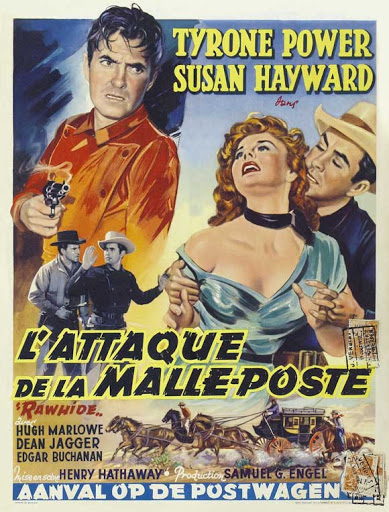
No, we’re not talking about the TV series featuring Clint Eastwood and Frankie Laine’s memorable theme song. This is Henry Hathaway’s claustrophobic western from 1951 with Tyrone Power and Susan Hayward. It’s one of those pictures that seems to have fallen through the cracks and is rarely talked about. I think the reason Rawhide doesn’t enjoy a better reputation can be traced to one essential weakness in the script, or more accurately the characterization, which I’ll look at later.

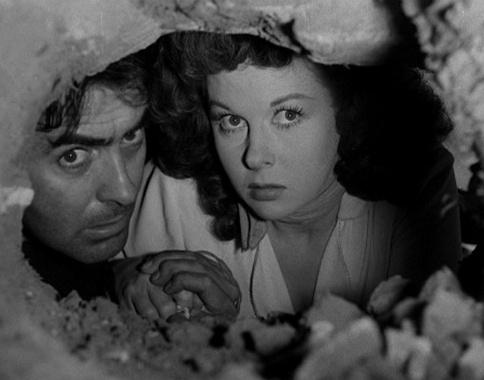
Tom Owens (Power) is a man with a lot to learn; he’s the son of the stagecoach owner and has been sent west to learn the business. With his apprenticeship nearing its end he’s eager to escape the confines of the isolated swing station which he’s been sharing with stationmaster and ‘tutor’ Edgar Buchanan. The first whiff of danger comes with the news that a notorious outlaw called Zimmerman (Hugh Marlowe) has broken out of prison and has already committed a murder. The first consequence is that Owens now finds himself saddled with task of putting up a disgruntled female passenger (Susan Hayward) and her child, since company policy dictates that the stage can’t carry them in these circumstances. It should come as no surprise that Zimmerman and his men duly arrive and take control of the station. So far this is all fairly standard fare, but the second half of the film really cranks up the tension as Owens has to play a cat and mouse game with Zimmerman to ensure not only his own survival but that of the woman and child also. The real surprise is who comes to dominate proceedings and gains the upper hand in the end.


$6

Susan Hayward was one of those strong women who seemed to dominate the screen effortlessly. From her first appearance in Rawhide, she grabs hold of the viewer’s attention and never lets go until the credits roll. People often use, and indeed overuse, the term powerhouse performance but it’s no exaggeration to say that Hayward delivers one here. She proves herself tough and resourceful enough to be a match for any of the male characters. However, if this is one of the great strengths of the film it’s also the factor that damages it. While it’s no criticism of Hayward, both Power and Marlowe pale in comparison. Power’s character is a weak one from the outset and remains so for the duration. In certain films that’s not necessarily a bad thing, but westerns tend to suffer when the male lead appears ineffectual. There is a similar problem with Hugh Marlowe’s villain, who is a bit colorless and just doesn’t appear to have the steel required to control a band of desperadoes. In fact, Marlowe looks completely out of place in this setting, although he is given a backstory to help explain the cultured nature of Zimmerman. Now, this kind of thing could hamstring a film, but it’s saved by the performances of Zimmerman’s sidekicks, particularly Jack Elam and Dean Jagger. Elam was an actor who was prone to hamming it up and devouring the scenery, and his turn as the depraved Tevis does just that. However, given Marlowe’s shortcomings, this adds some much needed meat to the outlaws’ threats.

Fox put Rawhide out on DVD in R1 last spring in a box which bundled it together with Garden of Evil and The Gunfighter. Typical of much of Fox’s output, the transfer is excellent and the disc has some nice extras, including a short featurette on Susan Hayward and another on the Lone Pine locations. All told,  Rawhide is a fine western with some very tense and genuinely dramatic moments. It’s not quite in the top tier, largely for the reasons I mentioned above, but is well worth an hour and a half of anyone’s time. It’s been suggested to me that there are some similarities to Boetticher’s The Tall T, and I can see where that may be the case. However, the similarities are really only plot points and both the characterization and direction mark them out as quite different films. Having said that, I do think that those who enjoyed Boetticher’s spare tales of tight knit groups in a tense situation would definitely take something positive from Rawhide.

The Westerner

poster85

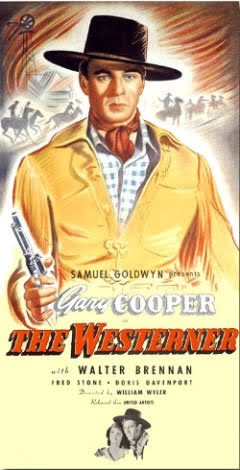
One of the recurring themes of the western is the conflict between the cattlemen of the open range and the fence-building homesteaders, or sodbusters. In truth, this clash (freedom, as represented by the range, and the slow encroachment of civil society from the east) lies near the very heart of the genre. It is this which forms the framework of The Westerner (1940), but the film really revolves around the relationship between two very different men. As such it eschews action in favour of character development, and slots nicely into the group of more mature westerns that were starting to appear at the time.

The film’s prologue sets the scene in the years following the Civil War when the westward expansion was in full swing. Judge Roy Bean (Walter Brennan) has established himself as the self-styled “Law West of the Pecos” in his own remote corner of Texas. He is shown dispensing his own brand of justice from his saloon/courtroom in the case of a man accused of committing one of the most serious of all crimes, that of murdering a steer. Having tried, convicted and carried out the sentence personally, he comes face to face with his next defendant. Cole Harden (Gary Cooper) is a drifter and saddle tramp who’s had the misfortune of buying a stolen horse. This is another capital crime and the case looks to be an open and shut one. When the jury retires to back room to play cards and down some liquor before delivering the inevitable guilty verdict, Harden takes the only path open to him. Noticing that the saloon has been made up as a virtual shrine to Lily Langtry, Harden claims to have made the acquaintance of the judge’s beloved actress and to have a lock of her hair in his possession. Well, clearly such a man can’t simply be hauled out and hanged so the sentence is suspended and the two men form an uneasy alliance. However, Harden finds himself drawn to Jane Ellen Matthews (Doris Davenport), daughter of a local settler, and is soon caught between the two rival factions.

Gary Cooper was a highly deceptive actor. There are those who would claim that his laconic style was wooden and that he couldn’t act, but to say that is to ignore the subtlety of the man’s craft. There was no expansiveness to Cooper but everything was communicated through his face and small unpretentious gestures. There is a marvellous example of this during the trial scene in this movie where fear, calculation and, ultimately, triumph are all readable just from his eyes. He’s at his best in the scenes he shares with Walter Brennan but, perversely, has every one of those scenes stolen right from under his nose. I don’t think it would be too much of a stretch to say that Brennan was the finest character actor American cinema has ever produced. He turned in performances which ranged from fine to excellent in anything I’ve seen him in. His Judge Roy Bean is a multi-layered character who goes from mean and ornery to endearingly childlike and back again. It’s no mean acting feat to make this figure sympathetic, but Brennan managed it and picked up his third Oscar for his troubles.

Visually, the film looks great, due in no small part to the photography of Gregg Toland. With all this talent at his disposal, director William Wyler marshals it with his typical professionalism. He offers up some fine cinematic moments, such as the attack on the homesteaders. In the midst of a thanksgiving ceremony, as the camera surveys a rich, tranquil and fertile land to the accompaniment of noble words, the idyll is abruptly shattered by a murderous arson raid. As flames sear the screen, the settlers paradise is transformed in a matter of minutes into a scorched, desolate landscape. Those smouldering, blackened ruins of former homes pointing accusingly towards the heavens are an eloquent reminder of the fickle and dangerous unpredictability of frontier life.

The Westerner was reissued on DVD in R1 late last spring by MGM/Fox and the transfer is a very fine one. I can’t say I noticed any significant damage marks or signs of manipulation, just a crisp, clean B&W image. Previous MGM releases were no more than adequate but the distribution deal with Fox seems to have led to an improvement in quality. The only criticism is the lack of any extra content, but I guess you  can’t have everything. I’d rate The Westerner as a good example of a ’40s oater for grown-ups; it has drama and it’s moving but it also has a vein of sly, dark humour running through it. Recommended.


Buchanan Rides Alone

poster80

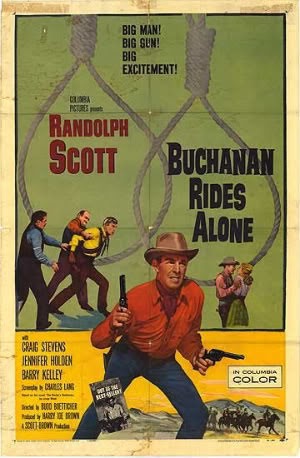
When one thinks of the Boetticher/Scott films the image that generally springs to mind is that of a tough loner haunted by a past hurt and struggling to make his peace with the present. The drama is typically played out against a sparse backdrop with a small cast, among whom there is a woman who has a significant role. Buchanan Rides Alone (1958) dispenses with all these elements, and stands out as a unique entry in the series. It has a lighter, almost comedic tone, women barely figure, and Randolph Scott’s character has no back-story to speak of. For all these reasons I deliberately left it to the end of this short series of pieces on the recently released Ranown titles. I think that, for anyone planning to watch these movies as a group, it is probably better to save Buchanan Rides Alone for last. After the sombre, and sometimes tragic, mood of the other pictures it rounds things off in an upbeat fashion.

The movie derives from a story entitled The Name’s Buchanan, and the line is used by the hero (Randolph Scott) when he rides into a small border town on his way back to west Texas, having made his money fighting in the Mexican revolution. The town in question has effectively been sewn up by the three Agry brothers, who hold the positions of sheriff, hotel proprietor and judge respectively. The most powerful is the judge, Simon Agry (Tol Avery), although they’re all equally corrupt, grasping and manipulative. The killing of the judge’s son by a young and wealthy Mexican sees Buchanan wrongly accused of complicity, and he finds himself drawn into the machinations of the brothers who pragmatically view the family tragedy as a means of extorting a hefty ransom. What follows is a series of crosses and double-crosses as the members of the Agry clan jockey for position and try to gull each other out of said ransom. It is this greed and sibling rivalry, rather than any especially adept maneuvering on Buchanan’s part, that finally brings about their downfall during a botched prisoner exchange. Unlike Boetticher’s other westerns, the motivation for Scott’s character is not based on any grudge but merely on his efforts to secure the release of the Mexican and recover his own money.

£6

Buchanan Rides Alone afforded Scott the opportunity to put in his most amiable performance of any of the Ranown series. There’s an element of self parody in the way he acknowledges his own ineptitude at being unable to formulate a coherent plan of action, and he even quips about his lack of progress when he ends up behind bars for a second time. The film is full of dry humour, courtesy of Charles Lang’s pithy script; some of the best coming when L Q Jones delivers a memorable eulogy over a body he’s just laid to rest atop a tree. The three Agry brothers are almost caricatures although Barry Kelley brings a more malevolent streak to his role as the profiteering sheriff. No Ranown western would be complete without a charming villain, and Craig Stevens supplies that ingredient as the black-clad enforcer with a stronger sense of honour than his reptilian employer. Boetticher uses a good combination of exteriors and interiors for this film and it works pretty well. The town has a more authentic feel and you don’t get that cheap, artificial look that weakens Decision at Sundown. Taylor Hackford points out on the accompanying featurette that the idea of a lone stranger riding into a corrupt town and presiding over the destruction of its rival factions could be seen as a kind of forerunner for A Fistful of Dollars. However, even granting that Leone was admittedly influenced by the style of Boetticher, I’m not sure I’d want to go too far down that road.

Well, that brings me to the end of this brief series, and I have to say that getting the chance to watch these films one on top of the other has been an enormous pleasure. I had seen them all at various points over the years, but watching them as a group allows one to better appreciate them as a body of work. The themes running through them seem to blend together, as Scott’s character evolved and Boetticher’s style became more apparent. They may have been B films in terms of budget, but they’re A films in terms of style and execution. Furthermore, they’re important films for those interested in the development of the western. In his book Horizons West (named after a Budd Boetticher movie, incidentally), Jim Kitses makes the point that the evolution of the western can be traced in a direct line from Ford and Mann, through Boetticher and Peckinpah, right up to Leone and Eastwood. That in itself should tell you that these films form an essential link. If anyone has been following these pieces and toying with the idea of picking up this set, then I can only say that you should do so; your western collection is incomplete without them.

Decision at Sundown

poster84

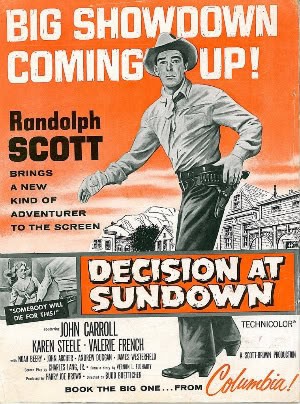
The Ranown westerns that I’ve looked at so far all made ample use of their Lone Pine locations and Burt Kennedy’s sublime scripting. Decision at Sundown (1957) is a bit of a departure in that those two ingredients are absent. In their place we get a tense town based tale from the pen of Charles Lang; as a result, it ranks lower than The Tall T, Ride Lonesome and Comanche Station. However, even a lesser Ranown film is a cut above most movies and, despite some shortcomings, Decision at Sundown has much to recommend it.

Once again Budd Boetticher and Randolph Scott offer up a story about revenge, but this one has an unexpected sting in the tail. Bart Allison (Scott) arrives in the town of Sundown with the aim of killing a man. The man in question is the local big shot Tate Kimbrough (John Carroll), and it just happens to be his wedding day. Given a situation like this it’s hard not to be reminded of High Noon, but the roles appear to be reversed here. Before long Allison and his friend Sam (Noah Beery) find themselves holed up in the livery stable and under siege from Kimbrough’s cronies. As the day wears on, a whole series of developments forces the viewer to radically re-evaluate his assumptions. Gradually, it is revealed that nothing is quite as clear cut as would seem to be the case at the beginning of the picture. The result of this is the shifting of the viewer’s sympathy as Allison and Kimbrough, both now stripped of friends and allies, stride out to face one another at the climax. The film ultimately highlights the pointless and self-destructive nature of revenge, but it also has things to say about the consequences of apathy and the need for communities to face up to their collective responsibilities. By the end, everybody involved has learned some hard lessons and nothing can ever be the same again for them.

£5

Scott plays a highly complicated man in this film, a far cry from the basically decent and honourable characters one expects from him. Essentially, he’s a hollow man whose only reason for existing is to settle the score for a wrong he feels was done to him. At the end of the movie, when his own folly finally dawns on him, he seems a slightly pathetic figure. As the dishevelled and bewildered man shambles off the screen it’s hard not to feel pity for him. One suspects he has allowed his desire for a reckoning to consume him to the point that he no longer has a reason to go on; a sombre ending indeed. John Carroll is another of those personable villains that people Boetticher’s films. He may have strong-armed his way into a position of power, and held on to it ruthlessly, but there’s a lot to admire in the manner in which he swallows his own fear and doubts to finally face off man to man with Scott. The two female characters (Karen Steele and Valerie French) are of the typically gutsy variety favoured by the director, and Miss French gets to have a significant hand in the resolution of the story. Of the support players, Noah Beery and Ray Teal (who gets to play a good guy for a change) stand out, but there’s also some good work from Andrew Duggan as the amoral sheriff.

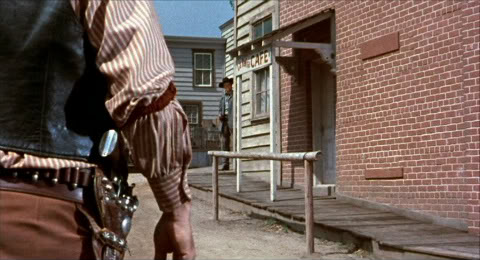
Boetticher moves things along at a fair lick once again, with not a shot wasted. The setting lends a claustrophobic feel to the events on screen, but this is also one of the weaknesses of the picture. Location shooting was able to paper over the lack of cash available for the other Ranown productions whereas the reliance on interiors here tends to emphasise it. However, there are still plenty of Boetticher’s trademark shots on view, such as the screencap above. Knowing that Sergio Leone voiced his admiration for the Ranown films, it’s easy to see where he got the inspiration for some of his own set-ups. While Charles Lang’s script offers an interesting alternative take on the usual Scott persona I feel that it still comes out second best compared to Burt Kennedy’s efforts, perhaps because it lacks the latter’s memorable dialogue.

Decision at Sundown is yet another excellent presentation on DVD from Sony. There’s no commentary track on this disc, but there is the usual short featurette on the film. Although it only runs for around six minutes, Taylor Hackford manages to provide a few interesting observations. So, even if the movie is a touch below the standard set by some of the other Ranown titles it’s still a fine piece of work. Seeing Scott in anti-heroic mode should be enough of a recommendation on its own.

Ride Lonesome

A man needs a reason to ride this country…

In Ride Lonesome (1959) the reasons are vengeance, bounty and amnesty. The penultimate Ranown western serves up all three but the focus remains firmly on the first. The notion of a lone man driven on by the pain of a past trauma is a recurring theme in Boetticher’s westerns, and is explored in depth in Ride Lonesome. Of the seven films Boetticher and star Randolph Scott made together, I would say this is the best; the plot, dialogue, imagery and performances all mesh to perfection. Nothing is wasted in this picture, where every shot, every gesture and every word is loaded with significance.

The viewer is immediately pitched into the action from the opening shot of the starkly familiar rocky landscape of Lone Pine, and the tension and pace never let up until the final credits roll. Ben Brigade (Scott) is introduced as a lone bounty hunter, and within minutes of appearing on screen has captured a young outlaw. Moving on to the nearest stagecoach swing station, with the outlaw’s brother in pursuit, he finds himself in another dangerous situation. The only occupants are the station master’s wife (Karen Steele) and two wanted men, Boone and Whit (Pernell Roberts and James Coburn), looking to find a way out of their current situation. Turning in the young prisoner would allow them to take advantage of an offer of amnesty, but that also necessitates their disposing of Brigade. The lone hero now finds himself part of an uneasy group and facing threats from three fronts; his new companions, the chasing pack of outlaws and a rampaging Mescalero war party. As the story progresses it becomes apparent that Brigade’s determination to see his captive to Santa Cruz, and an appointment with the hangman, is only part of his motivation. It’s fairly clear that the boy is merely the bait with which Brigade hopes to hook a bigger and more personal catch, although the exact reason for this isn’t revealed until the climax. In these moments, as Brigade stands and gazes impassively at the twisted hanging tree, the full power of the tale strikes home. The cold, unemotional hunter of men is no longer just a bounty killer but a figure lifted straight from classical tragedy.

Ride Lonesome offered Scott one of his harshest characters in Ben Brigade. There’s very little humour on display and even in those moments when he shows some modicum of tenderness towards Karen Steele it’s of the gruff and brusque variety. However, this is absolutely in keeping with a man who’s carrying around deep scars. Burt Kennedy supplied him with his finest, most distinctive dialogue and Scott delivers it in a suitably terse fashion. Pernell Roberts and James Coburn (in his screen debut) are excellent as the bad men who aren’t all bad – the real villain of the piece is Lee Van Cleef, and the only complaint that could be made about him is that he gets so little screen time. Karen Steele looks good and plays the typically tough and stoical Boetticher heroine whose only moment of weakness comes when she learns the fate of her missing husband. This was the director’s first film in cinemascope and he employs the wide lens to great effect. The action takes place exclusively outdoors and once again highlights Boetticher’s gift for disguising the limited budget he had to work with. There’s a Fordian quality to the tiny figures dwarfed by an expansive landscape which mirrors the scripts nods to the old master. Isn’t there something vaguely familiar about that story of the embittered, driven man on a vengeful quest only to find himself alone and apart from society at its end? There’s also a degree of religious symbolism in the climactic scenes with Scott standing before the hanging tree which resembles a crude cross. It’s as though he has borne his own cross for years and now returns to his personal Golgotha to lay the past to rest before the final cathartic act of burning the tree.

Ride Lonesome is another strong DVD transfer by Sony. Like the other titles in the Films of Budd Boetticher set, the colours are strong and true, and the picture looks suitably filmic. There  is a commentary track provided, and another of those short featurettes with Martin Scorsese. As I said earlier, I think this is the best of the lot – Boetticher’s finest film, and a real treat for western fans.

The Tall T

Some things a man can’t ride around…

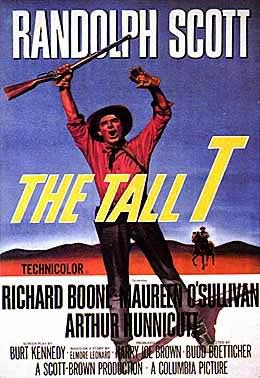
The first official entry in the Budd Boetticher / Ranown cycle of westerns is The Tall T (1957). The story here was adapted by Burt Kennedy from an Elmore Leonard short story called The Captives. That makes for an impressive set of credits and, in truth, the end result is a near perfect film. Once again Boetticher and Kennedy boil the western down to its absolute essentials, and the bulk of the action involves just five people and how they all relate to one another. Everything from location and plot to dialogue is pared right down and the film is all the better for that. What is left is a raw and visceral western with a strong moral current running through it and characters who we actually care about.

For a film with a short running time – under 80 minutes – it’s really a story with two distinct parts. The opening section introduces the character of Pat Brennan (Randolph Scott), a happy-go-lucky type in the process of building up his newly acquired ranch. He comes across as a gently charming sort who stops off on his way to town to pass the time of day with the local stationmaster and his young son. He even takes the time in town to pick up some candy for the boy as he had promised to do. When he visits his former employer, and loses his horse in an ill-judged wager, you start to wonder how such a hapless innocent could survive in a harsh environment. It is from this point on though that the depth of Brennan’s character begins to become apparent. Hitching a ride on a private stagecoach, hired for the honeymoon of Mrs. Mimms (Maureen O’Sullivan) and her gold-digging chiseller of a husband, he stops off to deliver the candy to the stationmaster’s boy. The station has been taken over by outlaw Frank (Richard Boone) and his two sidekicks (Henry Silva and Skip Homeier) with the aim of holding up the regular stage. Faced with the horror of what has just taken place, and the likely fate awaiting him and the other hostages, the character of Brennan undergoes a sea change. Almost immediately the easy-going ex-ramrod is transformed into a cool, calculating avenger who knows he must now play for time while waiting for the opportunity save himself and the woman. It’s a credit to all involved that this transition appears so natural as to be nearly seamless.

Scott’s flinty features once again blend in with the bleak Lone Pine locations which dominate the picture. The character shift I mentioned is magnificently achieved in the scene where the fate of the stationmaster and his boy is revealed in cold, matter-of-fact fashion by Henry Silva. Scott’s face hardens almost imperceptibly yet the meaning is all too clear. This kind of thing makes for great screen acting and the lead was a pastmaster in the art of underplayed emotion. Richard Boone was always interesting to watch, and in Frank he gives a fascinating performance as the outlaw you want to sympathise with. When he dispatches Mrs. Mimm’s husband, whose craven character offends his own personal morality, it’s difficult not to feel some grudging admiration. The two subsidiary villains are of less interest, but Silva manages to tap into a vaguely detached psychosis that works very well. Maureen O’Sullivan has an unglamorous role which offers her the chance to play something which is a cut above the standard damsel in distress. The fact that we get such well rounded characters in a short run time speaks volumes about the writing skills of Burt Kennedy. Boetticher again excels at making a cheaply produced picture look far more expensive. The framing and camera placement are miles away from the usual point and shoot style employed in low budget fare; this man had a real flair for the quirky and the unexpected. His handling of the action scenes is again exemplary, and they have both a frankly brutal quality and an odd humanity that make them stand out from other pictures of this vintage. There’s something deeply satisfying about Randolph Scott turning to the sobbing woman at his side, after the violent climax, and quietly intoning: Come on now, it’s gonna be a nice day.

Sony’s presentation of The Tall T on DVD is another excellent one. Some may carp at the amount of grain on view but I don’t regard that as a bad thing. The anamorphic widescreen picture is bright and colorful throughout. The disc also carries a short featurette with Martin Scorsese praising the film. Best of all, there’s the feature length documentary Budd Boetticher: A Man Can Do That. So, we get a great movie which is presented with care and respect – what more could you ask for.

Comanche Station

Lean and spare are the words often used to describe the westerns of Budd Boetticher and I won’t argue with that. Of course, budgetary constraints were generally the reason for the minimalist approach but Boetticher was masterful at disguising that fact. Burt Kennedy’s drum tight scripting and Boetticher’s control of the camera mean that you never stop to think that what’s on the screen was originally shot as a B picture. Between 1956 and 1960 the director made seven westerns with star Randolph Scott, all but the first produced by Scott’s Ranown. Shooting for the most part around Lone Pine gave these films a distinctive look and feel in much the same way that Monument Valley defined the westerns of Ford. Comanche Station (1960) was their last collaboration and Scott’s penultimate movie.

The plot is quite simple really, and that’s generally the strength of all the Ranown westerns; there’s no excess baggage, and the viewer only sees and hears what is absolutely necessary. Cody (Scott) is a lonely man, a former soldier, who has spent years wandering the west in search of his abducted wife. Whenever he hears a rumor of a white captive he sets off with a mule loaded with trade goods hoping that this time his quest may end. It is said that he’s rescued countless captives but it’s never the right one for Cody. This time will be no different. He trades with the Comanche for the freedom of one Mrs. Lowe (Nancy Gates) and aims to see her safely back to her husband. However, before he can do so, three men turn up and throw a spanner in the works. Lane, Frank and Dobie (Claude Akins, Skip Homeier and Richard Rust) are running from the Comanche, and Cody suspects it’s because they’re scalphunters. Cody’s distrust of Lane dates back to their years in the army, when he had the latter court-martialed for his role in an Indian massacre. It turns out that Mrs. Lowe’s husband has offered a $5000 reward for her return, dead or alive. While the viewer is immediately aware that Cody knew nothing of this, no-one else believes it. The challenge now is for him to save his own skin and that of the woman from both the Comanche and his new companions. As the story progresses it becomes very obvious where the greatest threat lies.

Randolph Scott’s lean and craggy appearance compliments both the landscape and Boetticher’s sparse morality tale. He looks every inch the laconic westerner who’s spent years scouring the scorched, barren land with only his pain and loss for company. The older he got the more adept he became at conveying a kind of buttoned-up emotion combined with an iron sense of personal honor. He was the first actor to draw me to the western as a child, and now I’m more convinced than ever that he may have been the greatest cowboy, surpassing even Wayne and Cooper. In fact all five actors in this film play off each other perfectly, and much of that comes down to the writing of Burt Kennedy. Everyone gets something to get their teeth into and it’s difficult not to feel even some sympathy for all of them. None of the villains in Boetticher’s westerns were ever one dimensional and Kennedy always managed to provide them with enough backstory or characteristic dialogue to keep the viewer interested. Boetticher does a fine job of moving his camera around to offer some unexpected shots and angles, and his use of the wide screen makes what is essentially a small picture look very big indeed.

After what seems like an eternity of waiting, Sony have finally released the five Ranown westerns in their possession onto DVD as The Films of Budd Boetticher. All the films come on their own discs and Comanche Station looks just wonderful. Like the other titles in the set, it boasts a healthy amount of film grain and sports a fine anamorphic transfer with good, strong color. The disc also carries a short featurette with Clint Eastwood offering a few thoughts on the movie. Sony have done a bang up job with this set – I have no hesitation in saying it’s the release of the year for me.