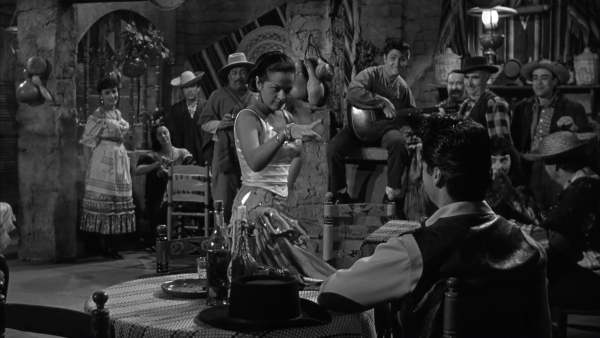
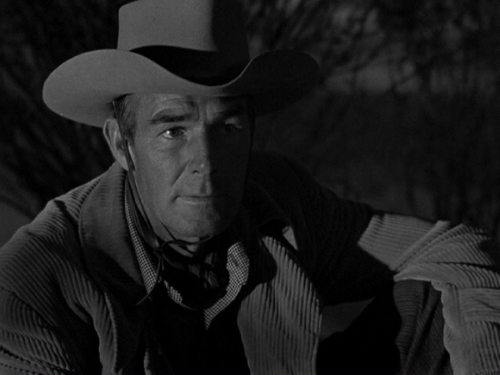
Time Lock

The simplest stories can sometimes be the most absorbing. Having just spent a very rewarding hour and a half viewing Time Lock (1957), I reckon it would also be fair to say such films can be among the most suspenseful too. In this case it really is down to the quality of the story itself. The budget must have been slight, the cast is limited and has no especially big names, and the direction is not particularly showy. However, the subject matter is such that it grabs the attention and then holds it in a steely grip right up to the moment the end credits roll.
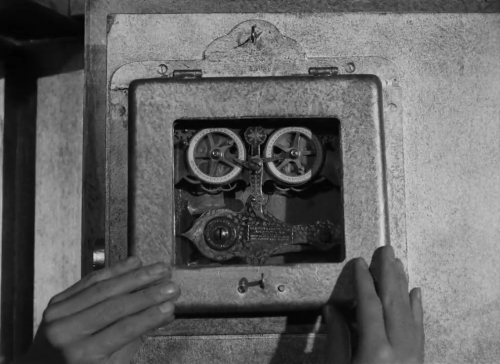
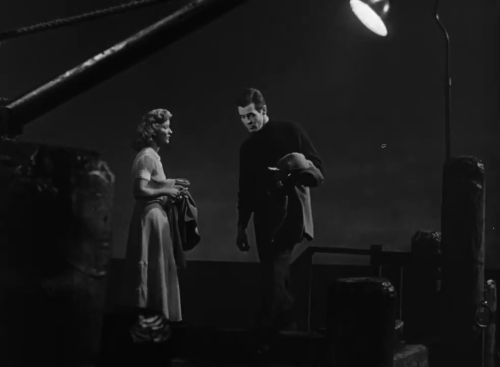
Toronto on a sleepy Friday afternoon in the middle of July. It’s a time when most people will be thinking of the days ahead, pleased to have left the trials and pressures of another working week behind them. In a sense, all the danger signs are present in that period of time, a soporific blend of relief at what’s been relegated to the past and anticipation for what the future may hold leading to casualness or indeed carelessness in the present. It should come as no surprise then that the arrival of Lucille Walker (Betty McDowall) at the bank where her husband Colin (Lee Patterson) works is accompanied by a degree of laxness on the part of everyone there. Pretty much all of the staff, the manager (Alan Gifford) included has at least half an eye on something other than work. It’s also the Walkers son’s sixth birthday and he’s naturally being treated with even more indulgence than usual.  As he scampers around the bank clutching his new flashlight and seeking out various nooks and crannies to test its effectiveness, there is the sound of a collision on the street outside. It draws the attention of everyone, even the manager and Colin Walker, who are in the process of setting the time lock on the vault. A quick glance through the windows shows that nothing serious has occurred, not outside anyway. And then the vault door is swung shut and the locks activated. Just as the heavy, unyielding steel seals itself, an even heavier realization descends on those in the bank – the boy is nowhere to be seen, and has clearly been shut up tight in a strongroom that cannot be opened till Monday morning. Disbelief is soon shooed aside by panic, which in turn finds itself chased away by a gnawing sense of desperation. The air supply is finite, the vault virtually impenetrable, and the only man who might know how to get in (Robert Beatty) is off for a weekend of fishing.
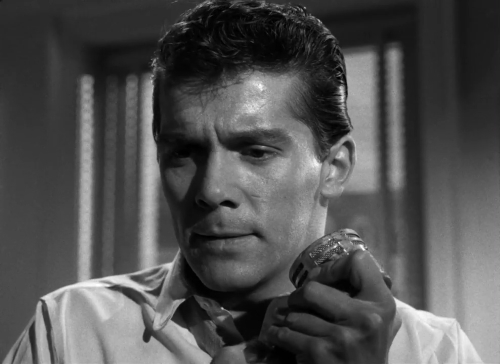
It’s a very simple and uncomplicated story, a small boy trapped in a vault and a race against time to free him. However, it is the simplicity that makes it work so well. It is a situation that is both unthinkable yet also entirely credible. These two factors add an edge to the suspense that grows naturally from any race against the clock tale. At first, I was a little surprised to see that the script was derived from a play by Arthur Hailey. There is the temptation to see his bestselling novels and their adaptations for the big and small screen as large scale, sprawling affairs – Airport and Hotel certainly spring to mind.  Yet even those are quite contained in a sense, and there’s no getting away from the fact that his subject matter favored scenarios where unexpected drama was wrought from essentially mundane circumstances.

Perhaps more surprising is the production team behind Time Lock. When the credits announce that the feature is directed by Gerald Thomas and written and produced by Peter Rogers, well one would be forgiven for jumping to the conclusion that a ribald comedy was on the cards. After all, those two were responsible for the long running Carry On series of movies. You’d never know that from a viewing of this film though, the tone remaining deadly serious all the way through as befits such a tense premise.

Looked at from today’s perspective, the movie had one big star – Sean Connery. However, this was right at the start of his career and his role is small, as one of the workmen called in to see if there was any chance of their oxyacetylene cutting gear making an impression on the vault door. The main parts are filled by Lee Patterson and Betty McDowall as the helpless parents who are unable to anything other than wait and hope and pray. Alan Gifford, who shared the screen with Patterson the same year in the rather good The Flying Scot, gets a reasonably juicy part as the guilt-ridden bank manager. Robert Beatty heads the cast, even though he only enters proceedings about half way through, as the expert on safes. When he does appear he ushers in a sense of even greater urgency, brisk and brusque in his management of a situation whose margins of error have by then been shaved right down to the bone.

I don’t think Time Lock has ever had a DVD release in the UK, although it has appeared in the US, included in one of Kino’s British Noir sets, and in Australia in the past. It would have been a good title for Network’s British Film line, but the company’s sad and sudden demise means that will never happen now. Anyway, it remains a terrific little suspense yarn that manages to do a lot with limited resources. I definitely recommend the film to anyone who is not yet familiar with it.
So Evil My Love

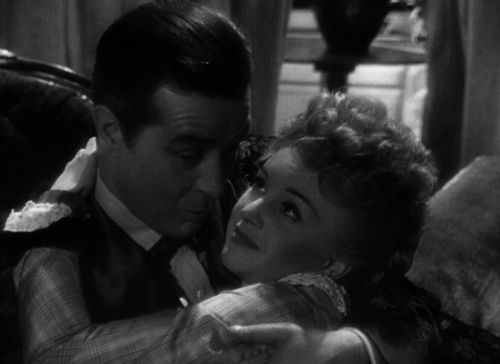
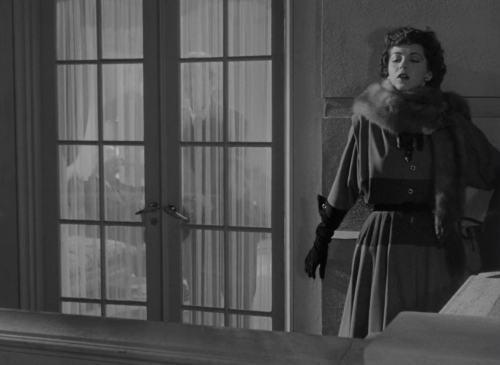
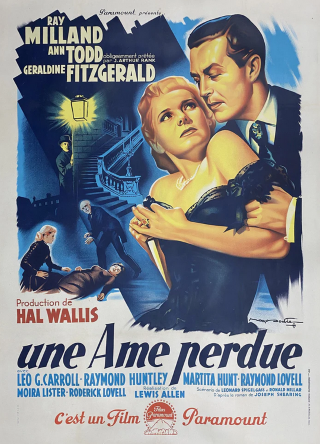
Guilt, corruption and obsession. That’s a heady mix for any movie, though it could be said to be nothing out of the ordinary for film noir. So Evil My Love (1948) is a kind of film noir, more Gothic melodrama I suppose yet it’s still dark and fatalistic enough, both visually and thematically, to just about make the cut as far as I’m concerned. It is something of a hybrid in more ways than one. Leaving aside any discussion of its noir credentials, the movie is one of those Hollywood funded and produced pictures that were made on location in the UK, and in this case making use of a cast of largely British and Irish actors – although all of the principals were working mainly in the US at this point. While there is much to enjoy and admire in the movie, there is a weakness which I feel ought to be mentioned. It has a marvelous visual sheen and well judged sense of atmosphere, but there’s also one central performance that I regard as deeply problematic, though fortunately it’s not as harmful overall as the issue that blighted Caught for me.

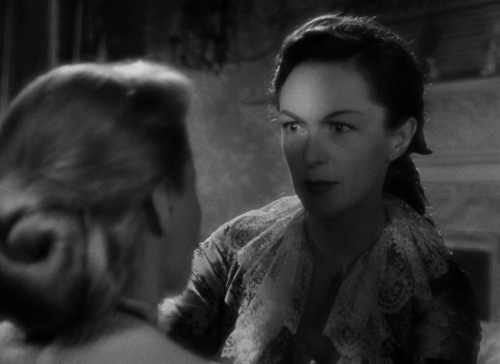
On a ship carving its way across the ocean from Jamaica to England a lone figure stands on deck, either oblivious to the spray on her face and the pitching deck beneath her or perhaps enjoying the experience. Olivia Harwood (Ann Todd) has been recently widowed, the death of her missionary husband leaving her with no option but to return home. She allows herself to be reluctantly coaxed into ministering to the ill on board the ship, chiefly one Mark Bellis (Ray Milland). On arrival in Liverpool it is immediately apparent to the viewer that Mark Bellis is perhaps not all he seems. He is ostensibly a painter, but his cautious probing to discover what, if anything, he revealed while in the throes of fever and then his determination to avoid the authorities set the alarm bells ringing. The fact is Mark Bellis (though that is merely one of the wide range of names he makes use of) is a genuine good-for-nothing, a swindler, a thief, a master manipulator, and apparently a murderer too. To such a man, a lonely, vulnerable and most likely gullible widow provides tempting game. And so it is he goes to work on Olivia Harwood, slowly worming his way into her heart while he sets about organizing his next robbery. However, the failure of that endeavor sees him altering his plans, and the beginning of his methodical and relentless corruption of Olivia. Under his tutelage, she finds herself not only taking advantage of an old friend, but also betraying and undermining her, taking a path that will inexorably lead to blackmail and murder.

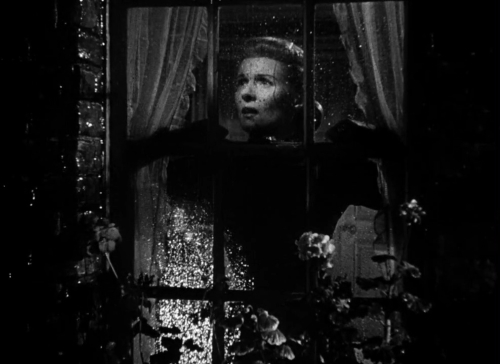
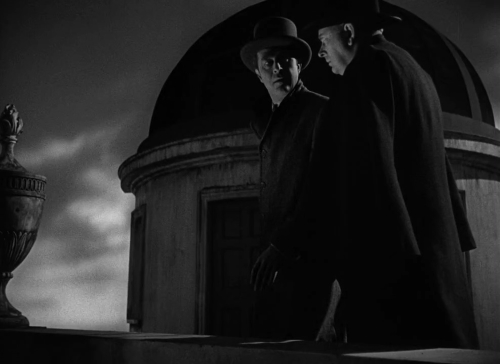
The film has bags of atmosphere, with ponies clipping along cobbled thoroughfares, discharging their silken passengers outside addresses that might be mean and unforgiving or forbidding in their splendor. Wherever the characters go, their surroundings seem to crowd them regardless of whether they are immense or cramped. Somehow there is a sense of all the hypocritical baggage of the late Victorian era forever pressing and suffocating. This feeds into or fuels the feeling of fatalism that pervades the movie. Right from that first scene on the deck of the ship there is an unmistakable air of characters trapped or hemmed in by a destiny shaped by their own weakness and frailty. Mark Bellis is unquestionably a bad lot and that is never in doubt, but it is Olivia’s downward spiral that is the focal point of it all. Director Lewis Allen made only a relatively small number of movies (just 18 over a period of fifteen years) but there are some real gems in among them – The Uninvited, The Unseen, Desert Fury, Suddenly and Another Time, Another Place are all good or better in my opinion.

This is was a fairly productive and successful period for Ray Milland, coming only a couple of years after his Oscar winning turn for Billy Wilder in The Lost Weekend and he would follow this up with a pair of strong films noir for John Farrow in The Big Clock and Alias Nick Beal. This type of role, an oily and calculating charmer, was a good fit for Milland. He had the polish to carry it off convincingly and was also able to tap into a rich seam of desperation when the whispers of his typically dormant conscience grew more insistent. Geraldine Fitzgerald is characteristically fine too as Olivia’s ill-fated friend, brittle and foolish, quick to trust in her hunger for companionship and kindness, and touchingly meek in her willingness to accept her guilt.

Nevertheless, as I alluded to above, there is an issue that damages the movie seriously. The behavior of Ann Todd’s character simply fails to convince me. She is right at the center of things, the heart of the movie in truth, and both her actions and the core characteristics need to ring true for it all to work. And for me this does not happen. I can accept that obsession and infatuation is capable of driving people to places they would not normally go, but I find Olivia’s sudden decision (remember, this is the widow of a Victorian missionary we’re talking about here) to betray her friend’s confidence and the consequent acceptance of the necessity for extortion to be so abrupt as to defy credibility. What’s more, there is then far too much inconsistency on display, the character’s morality and motivation shifting almost from scene to scene. This is a writing issue of course rather than an acting matter – the script is adapted from a story by Joseph Shearing (a pseudonym used by Marjorie Bowen) who also provided the source material for Blanche Fury and Moss Rose. The latter film does have some contrived or unrealistic elements, but there’s not that inconsistency which troubles me here.

On the other hand, there are some excellent supporting turns to help restore the balance. Martita Hunt is chillingly intense as the overprotective grande dame. It is a bit of a stretch to see Raymond Huntley as her son – he was only four years her junior after all – but his cold lack of compassion is neatly done. Moira Lister sashays in and out of the tale as a trashy model whose vanity and vulgarity bring matters to a head. Leo G Carroll’s low-key detective lurks around and does his bit to draw the net tighter. And Maureen Delany, Hugh Griffith and Finlay Currie all have small yet memorable parts.

All told, So Evil My Love is a movie that works in places. There is no doubt that it has style, and some of the acting is excellent – Geraldine Fitzgerald rarely fails to impress me, for example. Still, Ann Todd’s role is an issue. That zigzagging from demure respectability to coquettish scheming and back again on the way to grim vengeance is something I just can’t buy into. Others may well regard this as less problematic. As it stands, I guess it amounts to two thirds of a good movie, or maybe three quarters if I’m in a more generous frame of mind.

Caught

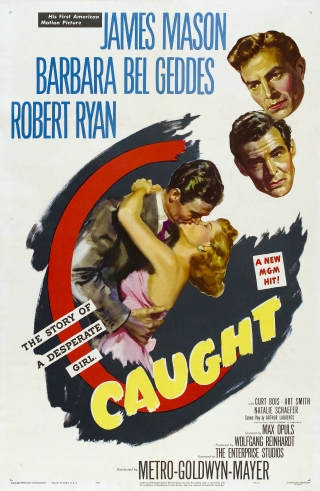
Seeing as Max Ophuls came up in some of the comments on the previous post, I decided to go back and have another look at one of his movies that I have struggled with in the past, namely the 1949 production of Caught. As a rule, I have enjoyed what I have seen of the director’s work, but this film has never worked for me. Anyway, with his name fresh in my mind, as well as the knowledge that the movie seems to be well regarded by many other viewers, I thought I should give it another chance. In brief, and this will be one of my shorter posts, I still have major issues with the movie. To be honest, the fact that I made it to the end was as much through a sense of obligation as anything.

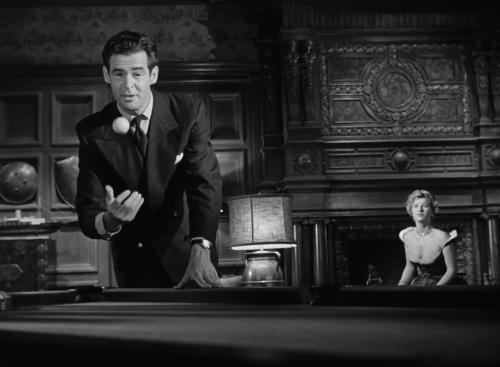
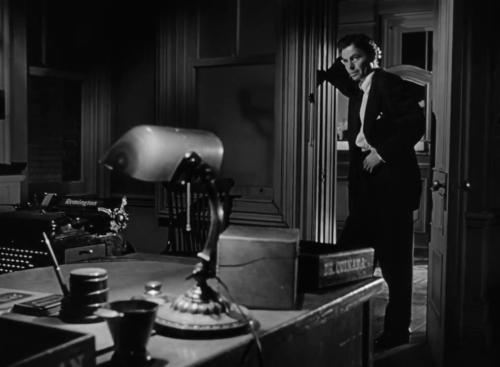
The whole thing is an examination of wish fulfillment and the consequent importance of being very careful indeed of what one wishes for. It opens with two sisters in a shabby tenement mooning over glossy magazines and browsing for dreams, a gem encrusted necklace here, a platinum bracelet there, and so on. As ever, money and the power it bestows matters very much to those who have little of it. Leonora (Barbara Bel Geddes) wants the security and the comfort that comes with wealth, and it does come her way as the result of an invitation to a party on a yacht, an invitation she very nearly turns down. This is the thing with Leonora – she wants things and then doesn’t want them when their real cost becomes apparent. When she makes the acquaintance of Smith Ohlrig (Robert Ryan), a tycoon with a deeply disturbed character, she is soon on the fast track towards the high life on Long Island. However, this is where it all goes wrong for just about everyone involved. Ohlrig is a domineering, controlling and cruel man, an obsessive soul at war with himself and the world in general. Leonora soon comes to see the stew she’s landed herself in and, wisely one would say, moves out and ends up working as a receptionist in a slum neighborhood for Dr Quinada (James Mason). From here the movie devolves into a series of sorties back and forth for Leonora as her indecision along with a deep-seated conviction that she has to “improve herself” at all costs winds up being a good deal more expensive in emotional and physical terms than she’d bargained for.
Max Ophuls’ direction is a pleasure – his camera swooping, swinging and panning, following his characters and sometimes sweeping past them to draw attention to the variously opulent or cheap surroundings while they debate, argue or simply muse out of shot. It’s a distinctive style and Lee Garmes’ cinematography adds to the eye-catching visuals. Attractive as all this may be, it’s not enough to paper over the paucity of genuine character at the heart of the movie. Robert Ryan’s Howard Hughes inspired sociopath is a showy piece of work, neurotic and foul and yet also somehow pitiful in his inadequacy. However, there’s a big hole in the middle of it all for me, and that’s the result of the role played by Barbara Bel Geddes. I started off feeling for her as she struggled to dig herself out of the poverty trap. The fact is though that she’s a playing a woman with essentially no character, a whiny, vacillating type who seems to revel in helplessness and indecision. This is the person who is the main focus and it’s very hard to like a movie where the central role presents such a moral vacuum. And the less said about the “happy ending” we’re asked to buy into, the better. James Mason’s first Hollywood starring role is fair, but he’s given little to do to stretch him –  he does have at least one good scene in the garage confrontation with Ryan and Bel Geddes. The support is mainly an attractively homespun turn from Frank Ferguson and a well observed peek at degradation and dissipation by Curt (“Tough, darling, tough.“) Bois.

Max Ophuls made far better films than this – The Reckless Moment, again with Mason, came shortly afterwards and is superior in every respect, and there are his great French movies such as  The Earrings of Madame de… and La Ronde. I honestly wish I could like this film more, but it just does not do it for me.

River Lady

Movies that exist at the periphery regularly catch my attention. They may be movies that occupy a place on the margins of a particular genre, they may be transitional efforts that straddle different eras, or they may even be a bit of both. Such is the case with River Lady (1948) a film which is not entirely successful, partly as it’s difficult to pin down the genre – a hint of the western, a dash of riverboat melodrama, and a pinch of the frontier adventure – and partly due to the time it was made. While it might not be the kind of movie that broke new ground or made a strong enough impression to encourage frequent revisits, it is still engaging in the way so many of George Sherman’s titles are.

I’ve lost count of how many westerns have turned a spotlight on the encroachment of civilization on the frontier. Sometimes it’s a matter of the railroad hammering out an iron clad tattoo across the plains and relentlessly shoving the old world to one side. At other times it is the stringing of the telegraph line, or the gradual extension of the reach of the law itself. River Lady concerns itself with the expansion of organized business interests, in particular the conflict between small, independent logging outfits and the hungry syndicates. Nevertheless, corporate kerfuffles of any type have a limited appeal at best and it’s always advisable to bring the human drama and the human faces of the players and antagonists to the fore. So it is that attention is focused on a roughneck logger called Dan Corrigan (Rod Cameron) and Sequin (Yvonne De Carlo), the owner of the titular paddle boat and undisclosed boss of the syndicate which is buying up all the struggling outfits on the river. This allows for a double-edged conflict, both the tangled business affairs and the romantic tug-of-war between a hardheaded free spirit such as Corrigan and the ambitious and manipulative Sequin. And any time the mixture looks like drifting off the boil the silky and stealthy Beauvais (Dan Duryea) is on hand to stoke it up once again.

As has been stated, in terms of genre, there’s a fluidity to the movie that mirrors the flow of the timber down the river. I guess that could be seen as versatility in the script, or even as a determination to resist the imposition of boundaries on the part of the filmmakers. However, it makes it hard to get a handle on the movie, a situation I’ve found can crop up from time to time in mid to late 1940s westerns, where it’s possible to detect elements of breezier B pictures rubbing shoulders with themes that carried a bit more weight. One could even say something similar about George Sherman’s career trajectory itself at this point. The rights to the story drifted around Universal for many years before the movie was finally made and perhaps this fairly lengthy gestation period has something to do with the feeling that the finished product imparts.

Rod Cameron is third billed but has the leading role. He provides a strong physical presence, although he does end up on the receiving end of a terrific beating meted out by Duryea at one stage. His acting is adequate overall, but the way his character is written is problematic. I think it’s clear enough that the intention is for a redemptive arc to be traced, which is fine as far as it goes. The thing is though that, as written, Corrigan isn’t really a likeable figure for much of the film’s running time. He’s not just a man who is on a learning curve, he’s downright unpleasant to the women in his life and comes across as spoiled and petulant instead of grittily independent. Duryea, as the villain of the piece, actually brings more nuance and therefore more interest to his part. I suppose it comes down to the fact that Duryea, even when we was showboating shamelessly or backstabbing with the worst of them, had a soulful air about him. Top billing went to Yvonne De Carlo but she is off screen for far too long and her role ends up largely undeveloped. Helena Carter is her romantic rival for Cameron’s affections and actually gets the more rewarding part. In support, John McIntire, Florence Bates and Jack Lambert all have their moments.

As a Technicolor production, River Lady might be expected to look better than it does. I have a German DVD that is acceptable all told, but there is a certain muddiness to it too. Perhaps the fact the movie is part of a George Sherman box that has it packaged alongside solid Blu-ray versions of The Last of the Fast Guns and Red Canyon serves to draw attention to its weaknesses.

Viewing notes – in brief

Just a few very brief comments to ensure the place doesn’t stagnate completely, which I’ve posted elsewhere, all on some movies I’ve been revisiting lately. Normal service should be resumed soon. I hope.


The Magnificent Seven (1960)

God knows how many times I’ve seen this over the years. Even so, as soon as Bernstein’s famous score kicks in there’s that same tingle of excitement and anticipation I first experienced as a child. Even though John Sturges is almost certainly best remembered for his longer movies such as this and The Great Escape, I think he did his most effective work on the shorter and more tightly structured films he made in the previous decade. While the first half of this one has some terrific scenes and moments – Calvera’s initial appearance, the ride up to Boot Hill and back etc – there is padding there too.
Something else I’ve become aware of over time is the way Steve McQueen’s “look at me” performance has lost a lot of its appeal. I find it very self-conscious, mannered and less satisfying every time I see it. On the other hand, Brynner’s work stands up well while Bronson is crafty, subtle and quite affecting.
 

The 39 Steps (1935)

Donald Spoto reckoned this movie improved with age and familiarity and I fully agree. It’s the best version of Buchan’s story (not the most faithful by any means, but that’s neither here nor there) and I consider it the best of Hitchcock’s British movies. The Lady Vanishes might run it close, but it’s the little moments, what John Ford would refer to as grace notes, such as Peggy Ashcroft’s aching wistfulness or Lucie Mannheim’s doomed spy that elevate it.
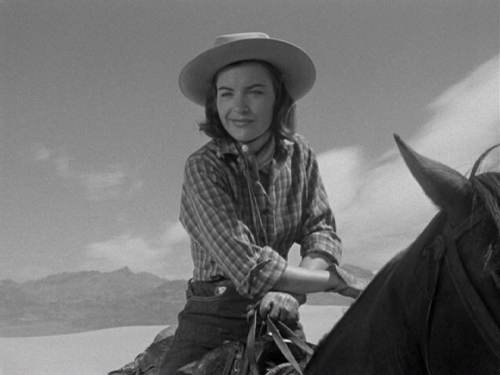
 

The Wrong Man (1956)

More Hitchcock and this time a man trapped in the relentless and merciless machine that is the justice system. I’ve a hunch I only saw this film once before, and that was a very long time ago. In some ways it is atypical Hitchcock, stylistically anyway – measured, sober, with a gritty realism. In another sense, thematically, it’s very characteristic with the title itself telling us that and it’s also very Catholic, even more so than I Confess.
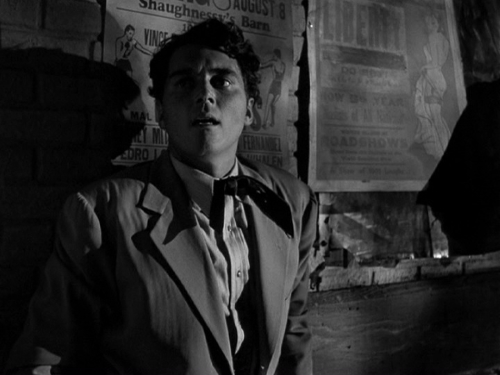
My memory was of a rather harsh and decidedly grim picture and that’s exactly what it is, and it’s possibly the reason why it’s so long since I revisited it. Still, it’s a terrific movie which is held together by two fine, understated performances. Henry Fonda was always an immensely dignified actor, even down to his posture and gait, that quality adding much to his portrayal of a shell-shocked regular guy. Of course the real gut punch comes from what happens to Vera Miles, something which can’t be easy to convey in such a controlled way.

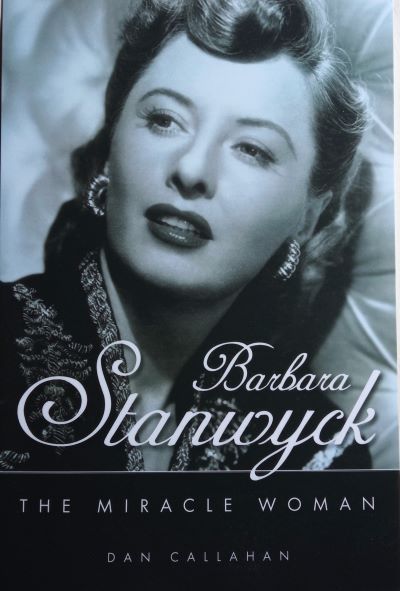
Barbara Stanwyck – The Miracle Woman

There was a time when writing on the cinema was a bit thin on the ground. Then movie writing, criticism, and frankly anything related to the screen seemed to explode. Genres were hashed, rehashed and dissected, sometimes in celebration and sometimes in condemnation, theories were propounded and expounded, and reputations were analyzed, constructed and dismantled. That issue of reputations was and indeed is most noticeable in the writing of biographies. The movie biography, with its focus on those who have lived out their lives under the typically remorseless and unforgiving glare of publicity can prove problematic. Let’s face it, everyone writing a book wants people to read it and in the field of movie biographies the temptation to angle for readers using the promise of juicy personal revelations as bait must be a powerful one. Personally, I’m not all that interested in how well or badly individuals behaved in their personal lives – it is the public persona, or the screen work to be more accurate, which would have drawn my attention in the first place. As such, I often approach biographies with caution – too much gossip and too little appraisal of someone’s body of work doesn’t really appeal to this reader. Happily Dan Callahan’s book on Barbara Stanwyck, first published in hardback in 2011 and recently reissued in paperback by the University Press of Mississippi, does not go down that route , although there are some other issues present.

The book is not a standard bio, it’s an examination of the person via their screen, and to a lesser extent, their stage work. Callahan divides his study into seventeen chapters, each focusing on a different aspect of Stanwyck’s career. While it’s not a strictly chronological journey the chapters themselves do look at her performances and projects in that way. It begins with a short look at the star’s beginnings in life itself and her first steps as a performer. Callahan devotes separate chapters to the films she made for Frank Capra, Preston Sturges, Billy Wilder, Douglas Sirk, to her appearances in films noir, in westerns and in screwball comedies. There is also an in depth look at what the author sees as one of her defining roles in King Vidor’s Stella Dallas. This is an approach which I think makes sense as it attempts to unravel common threads running through movies that, either as a result of the genre or the filmmakers involved, tend to have a shared sensibility. All the major films receive attention and Callahan offers his own take on their strengths and weaknesses.

In terms of structure and organization, the book is very appealing. Added to that is the fluid style of writing, one which is largely engaging and never overburdened with jargon or the kind of impenetrable formality that tends to afflict more academic texts. These are all positive aspects. However, as was mentioned above, there are other points which I have a few reservations about. I think the easiest way to express this is to note that the book is the work of someone who is clearly a fan of the actress. People may be wondering why that’s used as a lead-in to some of the book’s weaknesses, so let me expand a little. I feel the author is a fan of the actress above all, to the extent where he is frequently dismissive, or at least ungenerous with regard to some of the films she appeared in and the people she collaborated with. Frank Capra and Peter Godfrey both come in for some strong criticism, the former for his approach or vision, and the latter for his filmmaking in general. Those are just a couple of examples, but the writer regularly praises the quality of Stanwyck’s work, occasionally drawing inferences from events in her personal life and how they may have affected her screen work. In itself, that’s fine, but, more often than I feel is necessary, I detect a strong tendency to denigrate films and some other performers and artists in order to highlight his subject’s talents. The films that are slated and those which earn praise seem to be selected on a puzzling basis too. I was pleased to see only one chapter dedicated to her personal life, and at least some effort made to tie that into her career development as well. Stanwyck’s first husband Frank Fay comes off quite badly; it has to be said I’ve never heard anyone have a good word to say about the man so that’s hardly surprising. I did find it odd though to see the author take such a virulent dislike to Robert Taylor, both as an actor and as a person.

So, I found Callahan’s book a bit of a mixed bag. It is informative and offers some detailed analysis of Stanwyck’s movies, is organized and presented in a satisfying way, comes with a complete filmography and an index, but I would have preferred if he could have reined in or disciplined his fandom and enthusiasm and allowed more fairness in certain assessments.

Barbara Stanwyck – The Miracle Woman by Dan Callahan

252 pages. Paperback edition published 2023 by University Press of Mississippi

Take One False Step

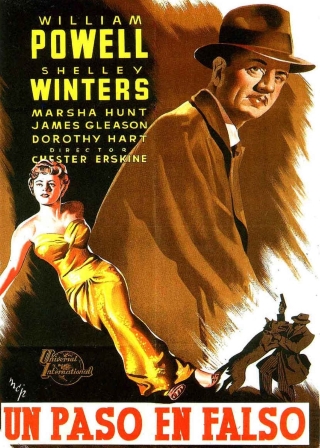
Any time I come across a mention of William Powell the name of Nick Charles springs to mind. The Thin Man and the series of sequels he made alongside co-star Myrna Loy represent only a fraction of his output, but it came to be something of a signature role for him. Those movies were enormously entertaining and Powell was perfectly cast in a part that allowed him to be smart, debonair and funny. Take One False Step (1949) came along much later, long after he had left Nick Charles behind, yet there is a hint of those light and stylish mysteries about it, easily as much as the film noir elements that its recent reissue might encourage one to believe to be dominant.

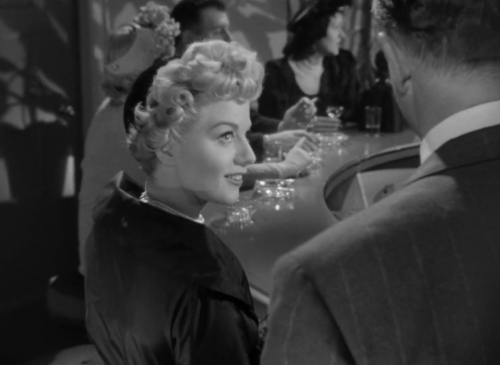
How much store should one set by the superficialities surrounding a film? I’m referring to the title, the credits, perhaps even the promotional material. The reason for posing that question is the fact that the opening credits for Take One False Step, and maybe the title itself, are strongly suggestive of some kind of late era screwball comedy. Of course all of this is emphasizing the need to remain vigilant, lest some major or minor catastrophe should befall one. The opening shot proper continues this theme, keeping the focus on a man’s feet as he enters a bar to order a drink before being addressed by some female counterparts. Well, it catches the attention. The man in question is Andrew Gentling (William Powell), a professor in the process of getting a new university off the ground. The woman who hails him from the bar is Catherine Sykes (Shelley Winters), an old flame he hasn’t seen in years, not since the war when both parties were unmarried and less burdened by life’s more mundane concerns. Should old acquaintances share a cup of kindness, or a couple of martinis at any rate? This pair do so and then part, as befits respectably married people. That ought to be the end of the matter, but Catherine is a restless type, pining for the immediacy of those dangerous wartime years, a woman prone to acting on her impulses. She calls Andrew up and invites him to a party, twisting his arm in a sense, but in a jokey, lighthearted way. Poor judgment, or momentary weakness, has been the undoing of many a noir protagonist and there is a whiff of that to Andrew’s acquiescence.

He soon discovers that he’s not only the guest of honor at this bash, but essentially the only guest. There’s nobody else present aside from another mutual friend Martha (Marsha Hunt) and she’s only there because her house happens to be the venue. Andrew is no longer the swashbuckler or adventurer Catherine remembers and perhaps he never really was, but he’s got a good heart and takes it upon himself to see the lady back home. She’s not so keen on this and he ends up taking a short stroll to let the fact sink in that there is to be no rekindling of lost romances on the agenda. Returning, he sees Catherine totter unsteadily back along the sidewalk towards her own place. However, that is only the beginning of the tale – the following morning brings news of Catherine’s disappearance, with only a bloody scarf, his scarf, left behind. Rather than go directly to the police, Andrew listens to some questionable advice and sets out to look into the business himself first. This leads to more trouble, with the cops, Catherine’s shady husband, a potentially rabid dog, and a race against time from Los Angeles to San Francisco.

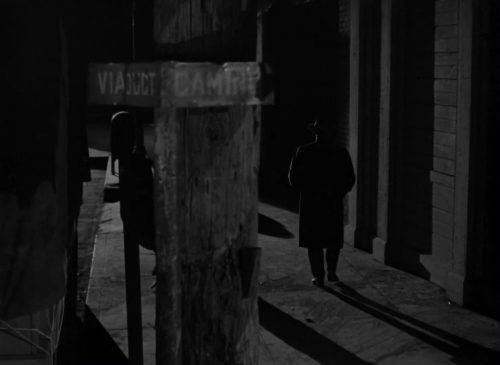
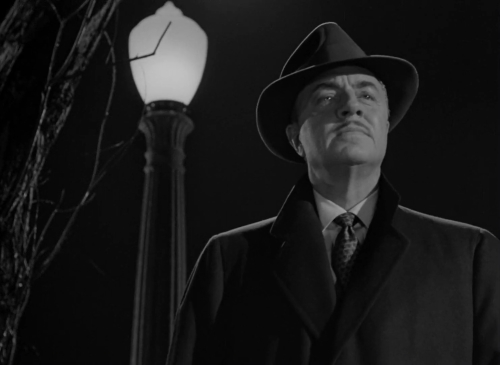
Is it reasonable to say Take One False Step is a film noir? I wouldn’t use the term myself, though I understand how parts of the movie could attract such a legend. The setup does point in that direction, with the innocent man finding himself in over his head very quickly, and his actions and their effects achieving a nightmarish quality. Franz Planer’s cinematography fits the bill too, getting some real value from the everyday and unremarkable. In truth though, this is a straight up mystery, not that far removed from the kind of material William Powell was headlining back in the 30s when he was playing Nick Charles or Philo Vance. There is a touch of humor in it too, as that credit sequence suggests. It’s not overwhelming, simply lightening the mood on occasion and I can’t say I found it unwelcome. Those going in looking for an uncompromising noir picture may find it grating, but as I said that’s not the way to approach this movie. Chester Erskine was the director and he does good work, conjuring up some attractive compositions and keeping a handle on the pacing. Nevertheless, I think it would be fair to say his credits as a writer (Angel Face, Split Second) and as a producer (The Wonderful Country) are more significant than his assignments as a director.

William Powell simply oozed sophistication, ever graceful and charming regardless of how difficult a situation might threaten to become. This was his stock-in-trade, the foundation of his screen persona and he made use of it in almost every genre he appeared in. Yet he carried along with it a kind of wry awareness of the fact this was a persona, enabling him to look at himself, his fellow characters and the circumstances in which they find themselves with a knowing air. This worked well in classy comedies and he was able to blend it into his mystery roles too. I mentioned the part of Nick Charles at the top of this piece as I have a hunch that characterization will be more familiar to many readers, which is not meant to suggest it was his only notable role. I also referred in passing to Philo Vance and I imagine those who have seen him play that part might agree he was an ideal fit. Personally, I find that any time I read Van Dine I have the image of Powell in mind. As the hapless professor he is less in control of events than he was in some of those mysteries, but this affords him the opportunity to exploit those characteristics that made him attractive to viewers – that smoothly polished exterior with a hint of panic stirring beneath, but with good manners and restraint holding it in check. There is one particularly effective scene, full of grim humor, around the mid-point, where the professor is seriously concerned about a bite he suffered and has sought medical assistance from a grouchy doctor (Houseley Stevenson) who tests his patience, and that of the viewer, to the limit.

Shelley Winters was in some excellent movies around this time, in what I think of as her dissatisfied vamp period, before A Place in the Sun saw her get nudged towards playing more needy types. She brings a lot of energy to the early scenes before Marsha Hunt steps into the spotlight. Hunt, who passed away last year at the ripe old age of 104 and who was one of those almost hounded out of the business during the shameful HUAC episode, is the faithful best friend, a classic Girl Friday part which she embraces and excels at. As the lawmen on the trail of Powell’s fugitive academic, Sheldon Leonard and James Gleason are responsible for most of the humor. Leonard is his usual loud self, forever on the brink of exasperation, while Gleason provides another variation on that hard-bitten but likeable cop that he brought to both the Miss Withers and The Falcon series. Another notable supporting part is filled by the instantly recognizable Felix Bressart, in his last role. He had appeared with William Powell years before in the rather good, if rarely mentioned, Crossroads and specialized in playing the kind of quirky middle European types he takes on here.

Kino has been instrumental in rescuing a whole raft of Universal crime, noir and mystery pictures, titles that were hitherto either impossible to see or only available in dreadful beat up prints. Take One False Step has been included in one of their film noir boxes and while I see how there are traces of noir to be found, it really is more of a straight mystery with a few comedic touches here and there. I have to say I thoroughly enjoyed this film, it’s of a type that I find most appealing and the cast are uniformly excellent. I strongly recommend checking it out.

Mister Cory

Another day, another movie that appears to defy categorization. Of course, there is no good reason why anyone ought to feel it is necessary to categorize a movie, but it is a pastime that we film fans like to indulge in.  Mister Cory (1957) does not comfortably wear any of the labels I’ve seen hung on it, not that there are many people who have actually commented on the film one way or another. It has been referred to variously as a crime picture, a drama, even as a film noir. I guess there are elements of all those genres and styles to be found there, but none of them are entirely satisfactory. Perhaps one could call it a Blake Edwards film. However, I’m not sure I would be able to define that either, certainly not for something coming at this early stage of his career as a director/writer. So what is it? There is a hint of The Great Gatsby about the setup, it maybe even casts a glance in the direction of Dreiser’s An American Tragedy (and Stevens’ adaptation A Place in the Sun), and there is too a touch of the humor that Edwards brought to so many of his films. If anyone can produce a convenient label out all that, I salute them. Frankly, I’m happy enough to just think of it as a good movie that is not as well known as it might be.

The first view of Cory (Tony Curtis) is of a young man making his way along a heaving sidewalk in Chicago, one of those tenement slums where all human life is to be found, the kind of place where hope can all too often wither or where the seeds of all-consuming ambition can take hold. Cory is a man with ambitions, and the first steps towards realizing them are going to see him keep right on walking out of the neighborhood he grew up in. They carry him out of the city to one of those exclusive lakeside resorts where only those with blue blood, deep pockets and an Ivy League education can afford to lunch and lounge with poise. Now Cory may not have any of the usual qualifications to hang out in such environs, but he does have poise, even if his is borne of audacity. He’s hired as a busboy, right down at the bottom of the pecking order. However, he has no intention of remaining in that lowly position and employs a combination of cunning and chutzpah to hobnob with the cream of society and keep an eye on the main chance. To be precise, he has set his sights on Abby Vollard (Martha Hyer), an ice cool society blonde, and for a time it looks as though he might just pull off the deception and bag the prize he so craves.

However, that would be too simple and dramatically, not to mention ethically, unsatisfying. No, a tale requires a twist if it’s not to become too predictable. So, with his imposture revealed and his scheme shattered, Cory is forced to move on. He does so, and moves far and wide, returning to his roots in a way as he falls back on the skills as a gambler he acquired early in life. All of which segues into the second part of the story, the rise of Cory as a slick and smooth front for Ruby Matrobe (Russ Morgan), a big man in the Chicago underworld. With money no longer an object, prestige and deference (even from those who once demanded the same of him) his constant companions, he would appear to have fulfilled his ambitions. Yet there is still the ever present itch that he yearns to scratch – Abby. That he is now in a position to woo her successfully is complicated by both the need to conduct the business and romantic equivalent of a high wire act. Her long time fiancé (William Reynolds) is the son of a man with significant political clout, capable of delivering a knockout blow to Cory’s backers and by extension to Cory himself. And then there is the sneaking suspicion he begins to have that maybe Abby’s now grown up sister Jen (Kathryn Grant) is the one he should have been pursuing.

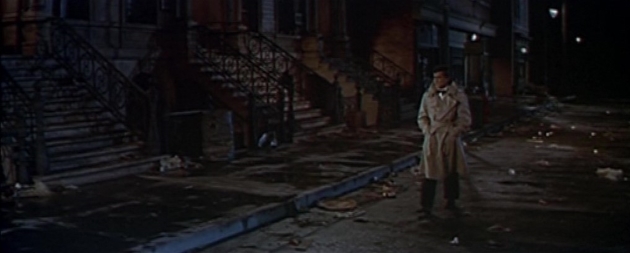
Mister Cory was adapted from a Leo Rosten novella, which Tony Curtis bought the rights to and had Blake Edwards adapt for the screen. It has a classic “rise and fall” structure that makes for good drama. There is a lot of emphasis placed on the nature of ambition, the old exhortation to be careful what one wishes for never being far from the surface, as well as other maxims regarding all that glitters and so on. This is all very well, but not that compelling at the same time. On the other hand, the movie is on much firmer ground when it posits the theory that human nature is immutable, rendering notions of grasping ambition, social climbing, and all the deceit and falseness that tend to accompany those wraiths redundant. At the heart of the story is the belief that running away from one’s true self, denial of one’s nature in essence, is a doomed enterprise. Sooner or later, this dawns on pretty much every character. It can be seen in Charles Bickford’s veteran gambler, a man who intuitively knows when the game has grown stale. Cory may be one of the last to fully grasp this, though it does grow on him gradually; there is a terrific scene where, with success won, he wanders back to the old neighborhood where he grew up, strolling down the middle of the empty nighttime street, gazing at the building he was born in, the locations that spelt loss and tragedy and the places he learnt his trade. Lost in the cool solitude of reminiscence, surrounded by the echoes of voices long gone and words drifting across time, his past and present knit together in a moment that marks the beginning of his acceptance of self.

Curtis deftly captures the many facets of the character, the roguish charm that never really deserts him, the drive concealed behind this, and the awareness that all the polish and front is simply that, a veneer that does nothing to shrink the distance between the one-time street urchin and the elegantly clad dream merchant he has cast himself as. Again, I’m drawn back to that scene I mentioned above, so much of the character is encapsulated in it after all, with Russell Metty’s camera tracking the lone figure via a crane shot that shifts from cool objectivity to intimacy and serves to highlight the contrast between the slick facade Cory has adopted and the grimy background that produced him. With the lens focused on his troubled features, it’s clear to see that he hasn’t traveled so very far. Martha Hyer was an actress who flirted with true stardom yet never quite broke through. Around this time she had roles in some good movies – Battle Hymn for Douglas Sirk, and she earned an Oscar nomination for her work in Minnelli’s Some Came Running. The part of Abby called for someone who was able to convey chilly snobbery in tandem with a weakness for slumming  and hypocrisy, which Hyer gets across successfully.

Kathryn Grant graced some fine films throughout the 1950s and she brings a liveliness that is quite infectious to the part of the younger Vollard sister. Playing the third arm of a romantic triangle frequently proves to be something of an unrewarding task, but William Reynolds takes it on manfully and achieves a degree of pathos as the flawed fiancé. The reliably crusty Charles Bickford brings dry humor coupled with down to earth wisdom to the table and acts as a stabilizing influence on his often hot-tempered protégé. Another interesting piece of casting is band leader Russ Morgan as the Chicago hood, something which sounds like an odd choice but which ends up working out just fine. Finally, a word for Henry Daniell, a man whose long career saw him regularly playing highly cultured villains. He brings great suavity to his work here, insisting on good manners and propriety at all times, the very personification of moral rectitude. And then he gets to deliver a genuinely killer punchline to wrap up the climactic confrontation in the casino.

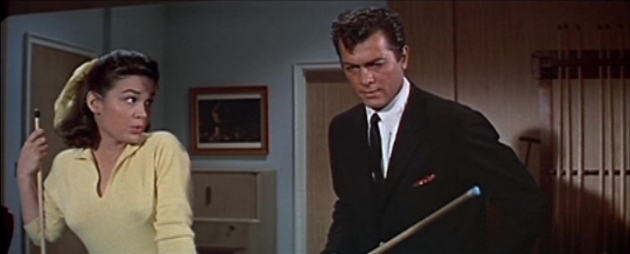
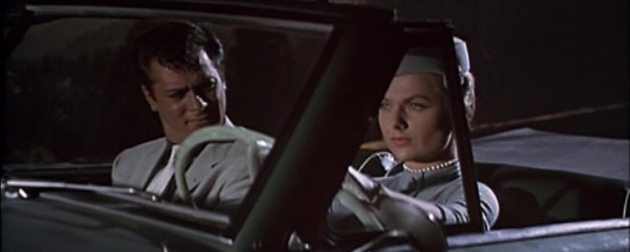
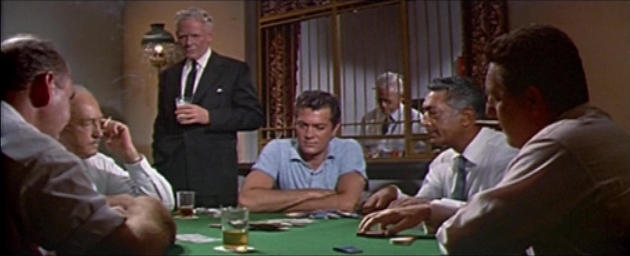
Mister Cory has had DVD releases in France, Spain and Italy, and I strongly suspect all of them will be using the same source. I have the Italian release, which presents the movie in the correct ‘Scope ratio. It’s a colorful if rather soft transfer though and the images I’ve added above should give some idea of how it looks. I would love to see this film get a brush up because it really deserves better treatment. I hadn’t seen it before and I’ve never heard anything much about it either. Every year brings a few new discoveries for me and I feel this movie rates as the most enjoyable and worthwhile of them so far in 2023.

Domino Kid

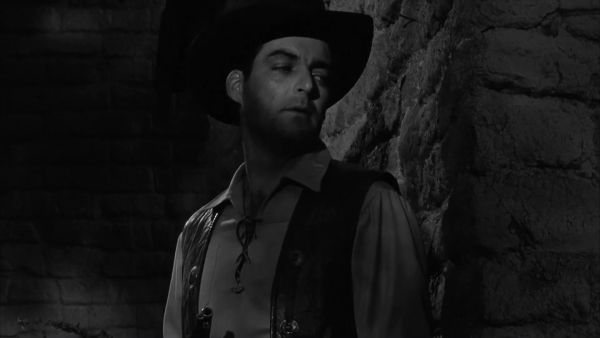
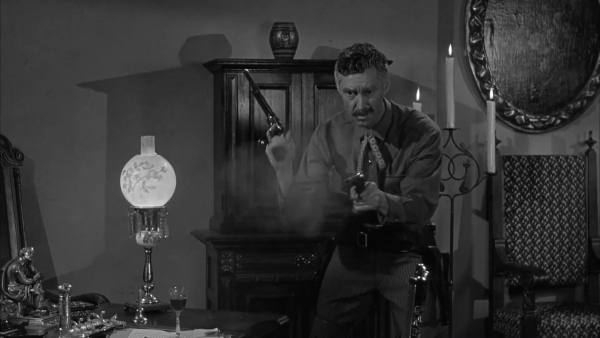
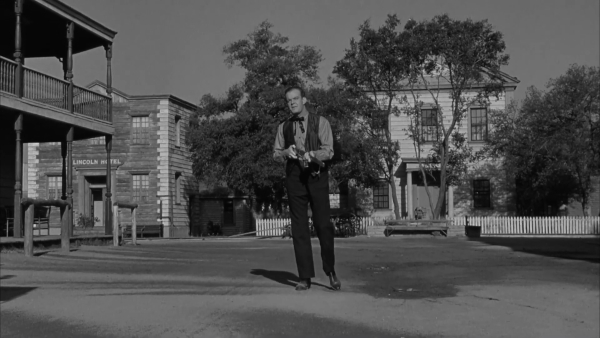
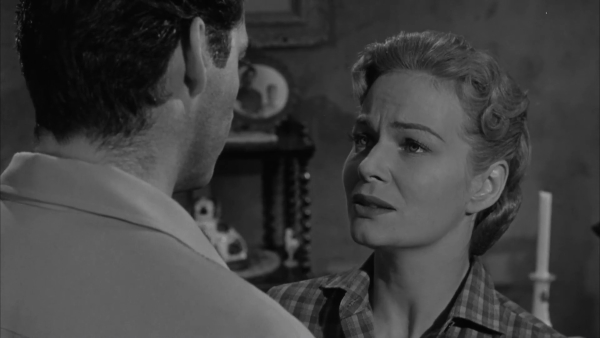
Domino Kid (1957) is a small movie, the kind of picture that that was relatively inexpensive to make and could be relied on to fill the bottom half of a bill. Somehow, probably due to the wealth of industry experience the people working on such features were able to bring to them, these films often managed to be briskly entertaining while at the same time there was a solid core that explored, to a limited extent at least, the themes one would anticipate from a bigger budget, more ambitious production. In this case, the theme that provides the backbone for the story is revenge, the ethical chasm it represents and the hollowness of the reward it promises those who would pursue it.

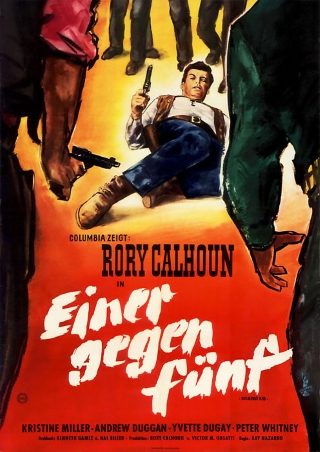
Domino Kid is a sparse movie, never putting more people on screen at any one time than is strictly necessary. And there is an urgency to it too, the opening shot is quite literally a shot, one delivered from one anonymous figure in a saloon bar and fatally received in the belly of another. The very abruptness of this beginning, its unsentimental, businesslike violence is an indication of the mood or tone of the story itself. Domino (Rory Calhoun) is a man with a powerful appetite for revenge. Having returned from the Civil War to find his family dead and his home raided, he lives now to visit retribution on those responsible. The first reel has a whiff of what was to come in the western genre about it: those bleakly deserted streets in mean looking towns, the lone avenger clad in a low profile black and white outfit, chewing on a cheroot and with a manner that is largely taciturn yet still capable of the occasional dry witticism, the succession of cold and calculated killings – isn’t there something suggestive of the early spaghetti westerns to that? Sure I may be reaching here, but the imagery and mood evoked had my mind drifting off in that direction, and of course nothing appears out of the blue in filmmaking, trends and styles evolve and are picked up on and adapted gradually, even from the unlikeliest of sources. Still, this feel doesn’t go much beyond the early scenes. It thereafter develops along more traditional lines, with Domino returning to the town of his birth and youth and realizing his reputation has preceded him, disconcerted to find himself greeted with open suspicion as opposed to open arms.

The story plays out as a personal conflict, Domino’s own struggle with his conscience, at once pulling him towards seemingly irreconcilable poles representing a cold and unnourishing revenge on the one hand and the warmth of acceptance and civilization on the other. The whole business is further complicated by the reemergence of his feelings for old flame Barbara (Kristine Miller), and the hostility he runs foul of in the shape of the newly arrived financier, and rival for Barbara’s affections, Wade Harrington (Andrew Duggan). There are a few unforeseen developments and detours before the end, but the point about the ultimately unpalatable nature of revenge, be it served hot or cold, is clearly and justifiably made.

Rory Calhoun had recently made the excellent Red Sundown with Jack Arnold at Universal-International but was keen to branch out on his own. He formed his own production company Rorvic in partnership with Victor Orsatti, and Domino Kid was one of the movies that came from that venture. The Rorvic productions I have seen, a number of which were directed by Ray Nazarro, were entertaining enough, but I still think they lacked something of what the bigger studio pictures could offer and I feel that a look at The Saga of Hemp Brown, which was made when Calhoun went back to work for Universal-International, highlights that. Nevertheless, Calhoun does put in a good performance in the lead here, blending the positive and negative sides of his character skillfully and endeavoring to present us with a fairly rounded individual.

A few months ago, I watched Kristine Miller playing the leading and pivotal role in Joseph M Newman’s remarkably ethereal war film Jungle Patrol. This movie doesn’t offer her such a memorable part, but she does bring a classy and effective presence to proceedings and Calhoun was obviously impressed enough to have her cast in a couple of episodes of his TV show The Texan. Andrew Duggan has an interesting and quite an ambiguous role as the newcomer who makes little effort to conceal his resentment of Domino. His career would see him cast as all kinds, and he had that ability to essay characters who could leave audiences guessing. James Griffiths turns up very briefly and bows out just as rapidly, but even so it’s never a chore to watch him on screen. Other supporting roles are filled by Yvette Duguay (The People Against O’Hara), the recently deceased Eugene Iglesias , Robert Burton and the hulking Peter Whitney. For a film with such a brief running time, Domino Kid offers opportunities for each one of those performers to make not only an impression, but an important contribution to the development of the story.

To the best of my knowledge, Domino Kid has never been released on DVD anywhere – of course, if anyone reading this knows otherwise, I should be delighted to be proved wrong. Fortunately though, it is not hard to track it down online, and it can be viewed in very good quality, from a nice widescreen print that displays little or no damage. To tell the truth, there are still a number of Rory Calhoun movies which have not been released on any form of disc. I’d like to think there’s still a chance to see a few of those gaps plugged, but even if we don’t I am pleased that the majority can be accessed. Domino Kid is, without question, a modest production that doesn’t try to overreach itself or aim too high. In spite of its inherent limitations, it takes a common western theme, indeed one which is very familiar from all types of drama, and uses it well. It’s worth remembering that B movies don’t have to be bad movies, and this is an example of one that is actually rather good.

The Walking Hills

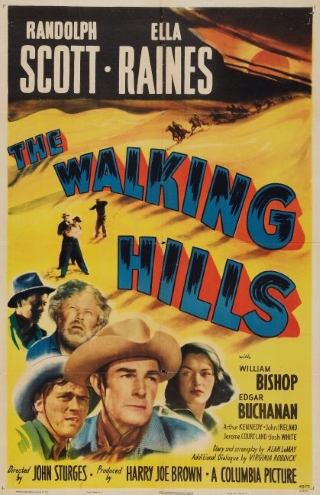
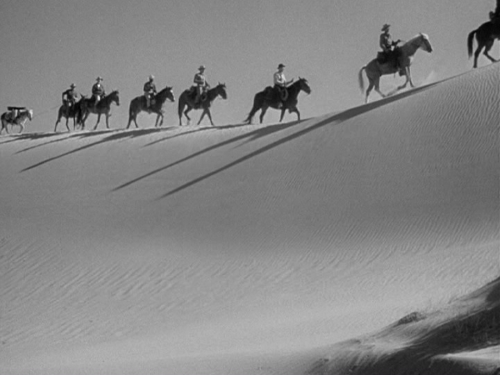
In 1948 John Huston had a small yet ill-assorted bunch of fortune hunters looking for gold and finding it paved the way to something far darker in The Treasure of the Sierra Madre. A year later, John Sturges took another disparate group from the back room of a cantina in Mexicali and had them cross the border into the US on a quest for the yellow metal. The Walking Hills (1949) is a less ambitious picture, smaller in scale but using that same lure of gold to trigger a range of reactions among his treasure seekers, and in so doing to offer a commentary on people and what makes them tick. Where Huston finished off with the dry desert winds blowing away the remnants of a tarnished dream to the accompaniment of a fatalistic laugh, Sturges uses his dust storm to scour away the mendacity and suspicion which has dogged his characters and to hold out the possibility of renewal.

A chance remark during a card game in a cantina sets it all off. The men around the table had been musing and joking over the fate of a wagon train said to have been loaded with gold that had vanished in the wilderness almost a hundred years earlier. Then one of them mentions seeing what looked like an old wagon wheel sticking out of the ground on his last trip. Just as he says those words, a silence descends. A silence pregnant with meaning, as each person in that room thinks the same thought at the same moment, and then they realize that this shared knowledge binds them all together in an uneasy alliance of greed and distrust. They are an odd cross-section of humanity, dreamers and fugitives, drifters and grifters, the kind of people who have nothing much in common save a yearning for something better than the life they are currently leading. Most notable among them is Jim Carey (Randolph Scott), a horse breeder with a mare in foal to worry about – that foal acting as an overt symbol of rebirth and a new beginning and quite literally carried by Scott right to the end of the movie – and then there is Shep (William Bishop), who is a cowboy with a secret he is keen to keep, especially from the brash Frazee (John Ireland). So this diverse band sets out to cross the border back into the US and into the desert, where fates and loyalties shift as suddenly and unpredictably as the sands beneath them. No sooner have they left civilization behind than another rider appears on the horizon, having followed them from Mexicali. This is Chris (Ella Raines), a woman with past ties to both Jim and Shep.

With the sun beating down and the trappings of the modern world stripped away, something approaching truth is gradually revealed. Hasn’t the concept of entering the desert, the wilderness, represented the confrontation of temptation and the attainment of spiritual renewal from Biblical times on? The desert of this movie serves a similar purpose, bringing the secrets of the past out into the open and finally laying out the prospect of a new beginning for those whose resolve is strong enough to withstand the siren call of greed. Is it too convenient that there are so many potential suspects all brought together, and that all of them should be tormented by the prickly discomfort of a guilty conscience? Perhaps there is convenience too in the neat way the hunter proves himself to be little better, and in some senses arguably worse, than the hunted. Yes, all of this can be taken as contrivance, but it is a story after all, a parable with a lesson to impart, and not a factual entry in a diary. So long as it all leads to the resolution writer Alan Le May and director Sturges desire and the realization they wish to encourage, then it ought to be permissible to bend credibility a little.

Once again,  we see a movie which underscores the steps Scott was taking towards the full flowering of his screen persona, one which would reach its apogee in the Ranown cycle. There’s the air of charm and civility cloaking a steely core that was so characteristic. Added to that is the wounded nobility that is his guiding principle. There is something heartfelt about the way his pride prevents him from correcting Chris when she misinterprets his motives and berates him – just the use of body language and the terseness of his tone is enough to convey how holding oneself to a high standard can be tough, and that expecting others to be capable of comprehending that is an even bigger ask. Then there is the climax, where his generosity of spirit is admirable. It is clear how much it costs him emotionally to grant Shep the facility to redeem himself. Still, he does so, that innate sense of nobility or propriety nudging him to sacrifice his shot at personal fulfillment in order to present others with that same prize.

It has been said that The Walking Hills has noir overtones, but they are really only incidental, Charles Lawton casts some captivating shadows at times and the use of flashbacks to fill in the backstory for William Bishop and Ella Raines is suggestive, but nothing more. Bishop makes good use of the restlessness and ambiguity he brought to his better roles and keeps everyone guessing for a long time. Ella Raines is always a welcome sight and she offers some much needed empathy and selflessness to leaven the greed and antagonism that threatens to boil over in that raw and searing environment. In the small cast everyone gets to contribute something, Arthur Kennedy only really coming into his own as a delightfully sniveling ne’er-do-well towards the end. John Ireland displays his customary air of menace in a largely unsympathetic part, while Russell Collins, Edgar Buchanan, Jerome Courtland and Josh White all have their moments to shine, the latter via some terrific blues songs.

The Walking Hills got a DVD release as part of a Randolph Scott box from Sony years ago – I don’t know whether it has been upgraded to Blu-ray in the interim – and looks generally fine, highlighting Lawton’s cinematography and Sturges’ confidence shooting outdoors on location. Personally, I enjoy what could be termed contemporary westerns, especially something like The Walking Hills where it feels as though the classic west is within touching distance, easily accessible by simply riding beyond the city limits yet with a spectral, intangible quality too.  It is one of those tight, compact pictures that Sturges excelled at and is well worth seeing.