Lightning Strikes Twice

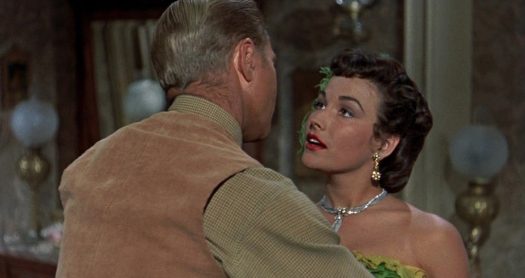
Melodrama is essentially just emotionally supercharged drama. Somehow it has garnered if not a bad reputation over the years then at the very least one which attracts a degree of critical sneering. Its defining characteristics, those heated and indeed often overheated passions and emotions, seem to embarrass a lot of cultural commentators, leaving them unable to assess the strengths and the draw of melodrama with any sense of proportion, something that rarely occurs with other genres. Would it not be odd to kick a western for featuring gunfights, a horror movie for including monsters, or a comedy for having the effrontery to raise a laugh? Yet there is no shortage of critics jostling for a prime place in the line formed up to sling brickbats at melodrama. As a result, few people want to associate their names or their company’s names with melodrama, preferring to slap another label on the product, one which is perceived as having more marketing clout and thus greater respectability. Lightning Strikes Twice (1951) is without doubt a melodrama, with all the heightened atmosphere and feeling that one would expect. However, I have seen it labeled film noir, which is both a disservice to the movie itself and a misleading descriptor for potential viewers.

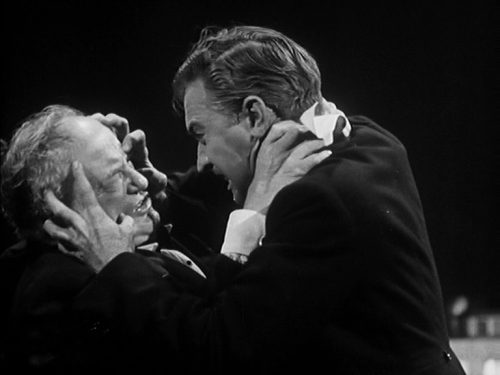
The opening scene leads us to Death Row where a man, pacing his cell like some caged beast, awaits the hour of his execution after having been convicted of the murder of his wife. Then right at the last moment, following an oddly flipped situation which sees a priest seeking forgiveness from the condemned man, word comes through that a stay of execution has been granted in order to permit a retrial. It is soon learned that the new trial has ended with a jury split right down the middle and unable to reach a verdict. So Richard Trevelyan (Richard Todd) walks free, and promptly drops out of sight. It is here that the main point of view character is introduced: Shelley Carnes (Ruth Roman) is an actress on sabbatical for health reasons and riding a bus through Texas on her way to a dude ranch. By chance and coincidence, for no melodrama would be worth its name without a liberal sprinkling of both mechanisms, she runs into a middle-aged couple who are keen to extend help and hospitality, for reasons which will be revealed later. The upshot is Shelley winds up on a remote desert road in the middle of a huge downpour and is forced to seek temporary refuge in the first house she spies. The one person in residence, and he has only just arrived, is Trevelyan. As he tells his tale to Shelley, she is not unsympathetic. The story is incomplete though and the viewer, as well as the characters on the screen, is left unsure of exactly what happened.

So is this a film noir? Well no it’s not, and the fact is that, despite some gloriously inky cinematography by Sid Hickox, the script is not so much dark as muddy. It plunges the viewer into a dizzyingly complex set of interlocking, interlinking and interdependent relationships where jealousy, infidelity, despair and yearning all jockey for position. The screenplay by Lenore J Coffee packs in as much emotional tumult and turbulence as possible and the stark, broiling desert setting is a fitting location for it all. The ghost of Trevelyan’s late wife is ever present, haunting both the past and present of everybody involved. As in Hitchcock’s Rebecca, our never seeing this character lends her a power in death that is every bit as malignant as her influence in life is said to have been.

Perhaps there is a bit too much doubt or ambiguity injected into proceedings. The truth is that once one strips away the admittedly well rendered atmospherics the mystery at the heart of the film is not that hard to crack. Still,the direction of King Vidor (Duel in the Sun, Man Without a Star, Ruby Gentry) is a visual delight, exhibiting great style and creativity. He frequently captures characters either in reflection or in frames within frames. The effect here is that the full picture is never allowed to emerge, with something always obscured or placed strategically out of sight. This serves to heighten the sense of unease and suspicion, leaving viewers and characters unsure and feeling forever at a loss.
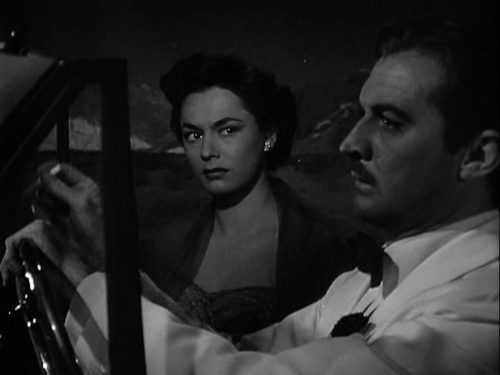
Both Richard Todd  and Ruth Roman were riding high at this point and getting some plum roles. Todd had just recently received great acclaim for The Hasty Heart and had taken the lead in Hitchcock’s Stage Fright. His career saw him take on a variety of square-jawed heroic parts but he was equally effective in more ambivalent roles too. Coincidentally, Ruth Roman was working with Hitchcock around this time as well, as the leading lady in the superlative Strangers on a Train. I’ve always felt she had an air of toughness about her, and while that quality is discernible here she never allows it to override the innate vulnerability which is essential for her role to make sense. If the careers of Todd and Roman were in the ascendancy, then the same cannot be said for Zachary Scott. His star was on the wane and this would be the  last movie he made at Warner Brothers. His part reflects this decline too, a supporting role at best which sees him only appear in the latter half of proceedings and with just one notable scene – an edgy nighttime drive across the desert with Roman. Mercedes McCambridge gives another masterclass in twitchy, quivering frustration as the owner of the dude ranch  – surely no other actress has been as accomplished at portraying dissatisfied, self-loathing types.
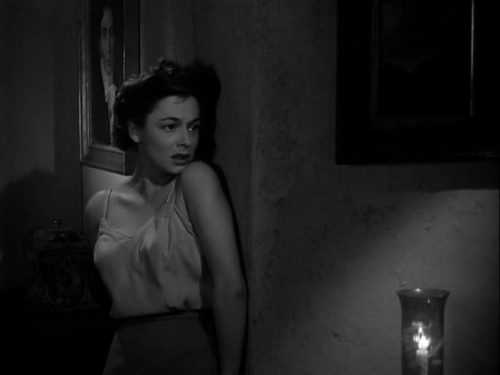
Lightning Strikes Twice is available on DVD via the Warner Archive and the transfer looks quite strong. Personally, I like this movie – the stars, director, genre and overall look and vibe appeal to me. However, I realize this type of thing is not going to work for everybody. Again, I feel it is a real stretch to call this a film noir and anyone approaching it on those terms is likely to come away feeling disappointed and short-changed. Sure it has the look of noir at times and one could say it does pause to light up a smoke and cast a glance down those murky cinematic alleys on occasion but it is melodrama all the way, and an enjoyable example of that genre for those who are happy to embrace it.
Drums Across the River

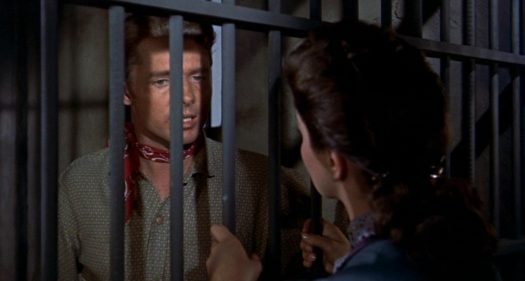
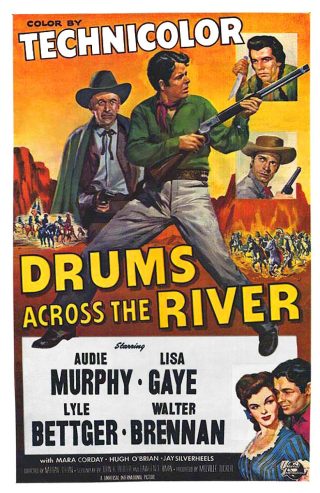
Revisiting Universal-International westerns is never a chore. While some are undoubtedly more challenging and engaging than others, there is a strong and distinctive visual aesthetic to them all. Add in the polish and pace of a well-oiled production system and there is usually much to savor. Drums Across the River (1954) was the last of three movies Audie Murphy made for director Nathan Juran and it is an enjoyable picture that blends a number of worthwhile themes into the action, although one could argue that there are too many of those themes for a sub-80 minute movie, too many to do full justice to at any rate.

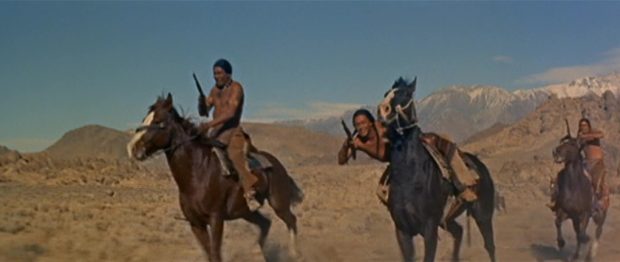
Gary Brannon (Audie Murphy) and his father Sam (Walter Brennan) run a freight business in Colorado, one which is beginning to feel the pinch economically as the mines that had previously been the life blood of Crown City are yielding less and less. Desperate men naturally snatch at whatever straws of hope appear before them and in this case it is the neighboring land occupied by the Ute tribe, land which is known to be rich in gold reserves. This presents the main source of potential conflict in the movie and it is here that we dive into the action as Gary Brannon is about to defy his father and take part in an excursion onto Ute territory organized by Frank Walker (Lyle Bettger). Walker fully expects to encounter trouble, in fact he welcomes and pushes for it as his ultimate goal is to provoke a war with the Utes that will force the army to intervene and deliver the gold into his hands. Well, a skirmish does occur, despite the best efforts of Brannon Sr to broker peace, and the taking of captives by both sides means an exchange is going to have to take place.

It is at this point that another source of conflict arises, one that is crammed with potential. Sadly, this is only partially fulfilled though, as the fact that Gary’s mother was killed by a Ute warrior in the past comes to light. This explains his hatred for the Indians and introduces a needling note between father and son since the older man has come to terms with his loss and grown to respect the tribe and the Chief (Morris Ankrum) who atoned for the killing at great personal expense. The exchange, negotiated by Gary as his father is nursing a wound, sees him alter his perspective and thus the ethical and philosophical sea-change he experiences is effected a little too quickly and too soon. That is not to say it is unconvincing, merely that it robs the picture of the opportunity to delve deeper into a strong and involving theme. What follows is more standard albeit entertaining fare as the focus shifts to a more direct confrontation between Walker and Brannon Jr, where the former is increasingly determined to remove the stone in his shoe that the latter now represents. As such, we get kidnapping, blackmail and a frame-up all interspersed with copious action sequences as we wind our way towards a satisfying if not altogether unexpected conclusion.

Westerns that lean heavily on subterfuge as plot devices need the right people in the villainous roles. Under the circumstances, it is hard to think of anyone better suited to the part of arch puppeteer than the unctuous and Machiavellian Lyle Bettger. His shifty, slippery persona is ideal for the role of Walker and contrasts well with Murphy’s clear countenance and upright demeanor. Murphy himself is never overtaxed but does well, as one would expect, in the action scenes and brings that edgy intensity of his to some of the tougher moments. Walter Brennan is sympathetic as the older man who has made peace with himself and his environment. If anything, he is absent, or held captive by Bettger and his henchmen, for too long and his character’s measured wisdom and innate decency is therefore only sporadically highlighted. And speaking of characters who are not on screen as much as I would like, there is Hugh O’Brian’s sardonic and sadistic black-clad gunslinger. He brings a real sense of stylish menace to his scenes and it is a genuine pity he wasn’t given more to do. Jay Silverheels fares well as the Ute warrior who grows into responsible leadership and his stoic sense of right and justice contrasts markedly with the venality of the villains.

It has been suggested before that women in westerns do not always get as many opportunities to shine or make their mark. Now I’m not convinced that is really true, or least not true enough to be presented as a blanket statement. There are many examples of interesting and pivotal roles for women in the films of Ford, Hawks, Daves, Mann and Boetticher, and this is frequently true of second tier productions as well. Sadly though, this cannot be said for Drums Across the River, where neither Mara Corday as a saloon girl nor Lisa Gaye as the insipid and unnecessary love interest for Murphy are given any chance by the script.

Nathan Juran’s direction of the movie is fine in that he keeps it tight and it’s what I’d term a solid and professional piece of work. Still, it feels a little impersonal. He makes ample use of the studio backlot, which typically looked attractive in most of the movies where it was employed and this is certainly true of the sequence featuring the gallows in the rain, but does get to head out to Red Rock Canyon and San Bernardino for a bit of welcome location work too.

Drums Across the River has had multiple releases on DVD over the years so it ought to be easy enough to track down a copy. I watched the UK release by Simply Media, which has the film looking handsome and colorful in its correct widescreen ratio. Overall, this is a good Audie Murphy western that offers food for thought on Indian-settler relations and presents the Ute as more than just convenient bogeymen. I guess my only complaint would be the fact that the script moves so fast and tries to pack in so much that some the more interesting and worthwhile themes do not have much chance to breathe. Nevertheless, this is a movie that works hard to please and hits the target most of the time.

Ruthless

Shakespeare expressed reservations about the worth of comparisons, of course he was talking of summer days while I’m thinking of movies here. Relying on comparisons to provide a taster or sampler for those unfamiliar with a movie is often a tempting expedient. However, I’m not sure it’s a fair approach, frequently doing injustices to filmmakers and perhaps misleading audiences too. Ruthless (1948) is a title which I have heard a few commentators liken to Citizen Kane. Welles’ most talked about work is accompanied by a weighty reputation, one which some viewers reckon it struggles to live up to itself, so it feels especially unjust to thrust Edgar G Ulmer’s movie into its shadow. Aside from the matter of reputations, which ebb and flow anyway, such comparisons have the effect of distracting one from the themes to be found within each discrete work. For me, Ruthless is at heart a story of loss, which need not necessarily be as pessimistic as it sounds.

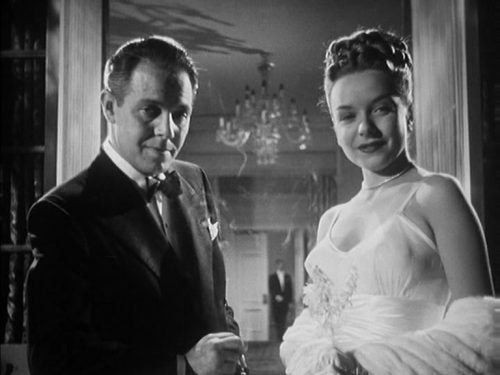
The opening features one of those glorious matte shots, the type that so often grace classic movies and immediately envelop us in the cinematic miasma of imagination and fantasy. A car is toiling up a winding grade, up from the dim depths of the valley below towards the glittering sprawl of the house perched high on the hill. And on that journey up to the light are two passengers: Mallory (Diana Lynn) is pert, bold and more than a little curious about the man she will soon encounter while Vic (Louis Hayward), who is well aware of what awaits, is in a different mood, not quite cynical but somehow haunted and weary. The story that unfolds is one where the characters confront their shared past, looking at it with a clear eye to see exactly how they all arrived at the place where they currently find themselves and, with luck, discovering a way to move on. That Vic is dogged by what went before is indicated by his choice of companion, a woman who is a literal doppelganger of a long lost love. So much of his life has been shaped by his association with Horace Vendig (Zachary Scott) that it is almost as though he is trapped in some fatalistic orbit, drawn by his gravitational pull. The evening that lies ahead will involve a series of sorties and excursions into the past, virtual pit stops for the memory related via flashback and adding up to a tale of loss told in three acts.

There are a number of early shots which have the audience looking up, which is understandable enough given the elevated social and economic levels of the characters but it is suggestive of people somehow apart from the viewer in other ways too. Vendig is seen right from the off as a chilly, remote figure, even as he hands out wealth and plays the philanthropist. Then when he is is introduced in more intimate surroundings, face to face with Vic and Mallory, there is an almost zombie-like demeanor about the man, as though he had already been emptied of everything vital. It is like watching a man devoid of the naturally arising emotions and desires, although a glimmer of humanity does shine through the polish and cool as he is struck by Mallory’s similarity to a woman now relegated to his fading memory. So we segue into that past and the first flashback, drifting back to the world of a child, to a time when Vendig was about to take his first steps on the road to what he supposed was betterment. This section deals with what I’d term the loss of Martha. Martha was Vendig’s first conquest (played as a child by Ann Carter and then later, as part of her dual role, by Diana Lynn) and we get to observe the first stirrings of that titular ruthlessness. The young Vendig learns how he can use people, or rather how he can use the hold over them he seems naturally able to acquire. It is here in his youth that he begins his apprenticeship in the ugly art of manipulation.

When I spoke of the loss of Martha I was not implying that Vendig lost her; the fact is he discarded her in his clinical and calculating fashion as her purpose had been served and the next rung of the social ladder had presented itself to him. The loss is felt more by Vic, the man who loved her first and loved her truly. His obvious effort to revive that love or make peace with it by forming a relationship with her double bears testament to the depth of his feelings. Vendig, on the other hand, has displayed that characteristic which can be said to rule him – both the character and the viewer come to realize that the things Vendig wants are chiefly desirable to him not only on account of their existing just beyond his reach but, crucially,  due to the fact that they are possessed by others.

If the events of those early years caused some reservations to spike in the mind of Vic, then what followed cemented them and drove a firm wedge between the two former friends. As such, I figure the second act is best summed as the loss of Vic. This section focuses on the affairs of two men, the first being McDonald (Charles Evans), a financier who gambles on the rising Vendig and backs him to the hilt only to see himself abandoned and doomed when he is no longer of use. Then there is Mansfield (Sydney Greenstreet), the rival tycoon with both  a business empire and a ripe young wife to capture the attention of of the insatiable Vendig. What we witness is the death of McDonald and the robbery and ruin of Mansfield, Vic witnesses it too and is sickened. Vendig’s covetousness is consuming him, driving and motivating him to reach ever further, but even his wanting lacks soul. The most appalling part of the man’s character is in fact the absence of character, his essential unawareness of true value. The truth is that whenever he attains that for which he has been grasping and scheming he no longer desires or values it. This is the case with people, financial assets and material possessions alike. Vendig’s wanting is simply an illusion in that it only exists as a result of what others have. His is ambition, lust and craving without a basis, the hollow yearning of a man who exists merely as a shell. Could such a bleak vision of the human soul not be said to represent the very essence of film noir?

On to the last act then, wherein we can observe the loss of illusion, and the liberation which flows from it. This is where everyone gets to see themselves and those around them as they really are, the point at which the gloves are torn off decisively. And it is the point where the sense of loss that I feel pervades the entire movie shows itself as potentially positive. From the earliest moments we’ve been guided along by Vic and have seen him as a man who needs to shake off the all the disappointment of a past overshadowed by his connections to Vendig. Here he achieves the release he so badly needs, partly pushed along by fate, partly as a result of his own determination to see matters through to the bitter end, and partly via the steadfastness and quiet self-confidence of Mallory. In the end he loses that aura of distaste and disgust which has pursued him and threatened to infect him with misplaced guilt.

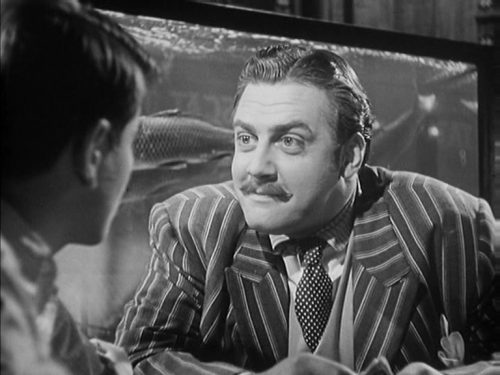
The movie gave the main cast an opportunity to play to their individual strengths. Zachary Scott frequently excelled in roles requiring emotional detachment and self-obsession so he convinces as Vendig. Louis Hayward (who made a handful of movies with Edgar G Ulmer, including the stylish The Strange Woman)  is all chilly dignity, with just the necessary hint of insecurity nicely conveyed in the climactic scene on the pier, masked by a superficial cheeriness. Sydney Greenstreet starts out bluff, gruff and domineering and then flips it all rather effectively in the moment when he fully comprehends his rejection by the woman he loves. As he looks at his reflection in the mirror and sees himself as she truly perceives him, he practically withers and deflates before our eyes. Diana Lynn deals with the dual role just fine, especially so as the assured Mallory. In support Martha Vickers and Lucille Bremer do well as women used and then cast off by Vendig. In addition, there are small yet entertaining turns by Raymond Burr and Dennis Hoey.

Edgar G Ulmer is justly praised for the visually arresting, thematically depraved and wholly unforgettable masterpiece of 1930s creepiness The Black Cat with Karloff and Lugosi. He is also lauded for Detour, arguably the most highly regarded B grade film noir. I have to confess, however, that it is a movie I’ve never warmed to, possibly due to my antipathy towards Tom Neal. If that means I have to forfeit my noir club membership, then so be it. I can only say I much prefer the broader and more ambitious canvas he tackles here in Ruthless.
The film has been released in the US by Olive and it’s a fine looking transfer. It features an attractive and well chosen cast who all produced very creditable performances.  The grim tale of the rise and fall of a heartless individual is a compelling watch, and the way it ends by extending the possibility of spiritual salvation to one of its characters makes it rewarding too.

The Purple Plain

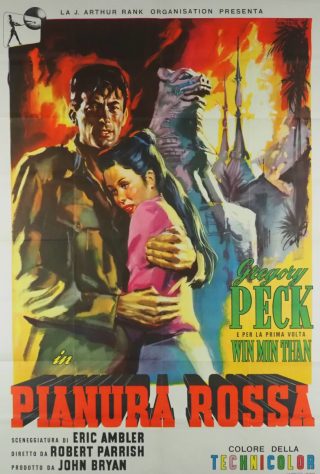
One of my reasons for starting up this blog in the dim and distant past was to try to drum up a  bit of interest in films that had been neglected to some extent. The passage of time has seen me broaden those aims of course, but I like to think I still focus sporadically on the kind of movies that don’t always get so much attention.  One such movie is The Purple Plain (1954) from Robert Parrish, a director whose work I find very appealing for the most part. It is a story of war, of survival, and of unexpected romance and has at its heart notions of renewal, rediscovery and rebirth, themes which have enriched so many classic westerns yet which are used skillfully and successfully here.

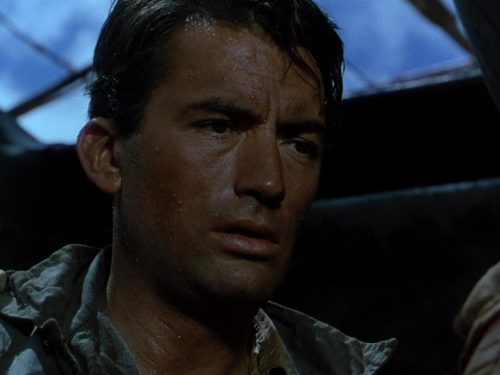
The on screen caption informs us that it’s Burma in 1945, the latter stages of WWII. Of course the war has not yet ended and the mental strain of the long years of combat and the attendant losses is brought into sharp relief by the opening scene. A man is shocked into wakefulness by the sounds of an imminent air raid. Startled, he darts out into the night, pounding along the primitive airstrip towards his plane, determined to get it aloft and to stand at least a fighting chance. His crew seem unaware of the danger though and as he struggles to sense this into them it becomes apparent that his grip on reality is tenuous. This man is Forrester (Gregory Peck), a Canadian pilot who is clearly suffering from PTSD.

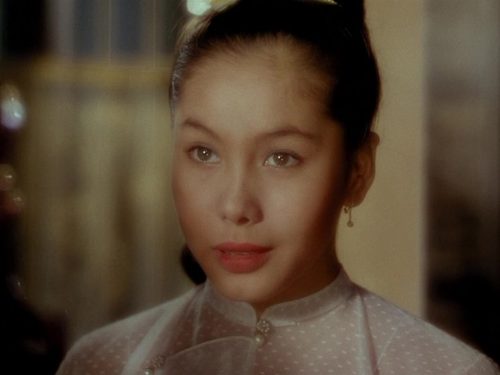
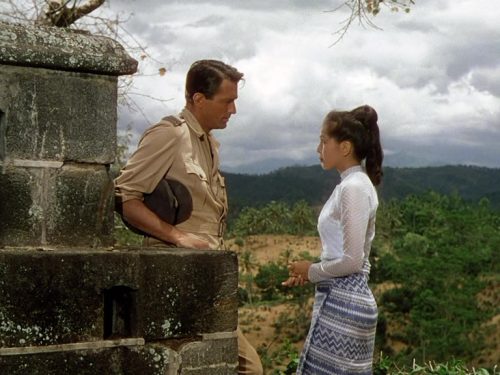
This is further highlighted when his moodiness, disassociation and recklessness are seen to alienate almost everyone he comes into contact with, all but two people anyway. The first is the medical officer Harris (Bernard Lee), a thoughtful, humanitarian type who regards Forrester as a challenge as opposed to some hopeless lost soul. It is through the efforts of Harris to encourage Forrester to establish contact with others again that he encounters the other person who is able to reach him. Anna (Win Min Than) is a resident of a local Christian mission and it is she more than anyone else who manages to penetrate the tortured cocoon which Forrester has constructed around himself.

Here we have the emotional hub around which the movie revolves, and it is a powerful one. It needs to be too because Forrester is shown to be a man who has abandoned life itself, who has not only been scarred by the war but has dedicated himself to dying. In short, Forrester is about to plunge into a spiritual abyss. For a man to haul himself back from such a precipitous position requires both iron resolve and an all-consuming motive. That motive is the simple love he has inspired and in turn been touched by. This has to be credible, credible enough to make a man start to regain an appetite for living, and credible enough too to sustain him when he finds himself cast into the wilderness and facing the twin trials of not merely surviving but ensuring the salvation of those dependent on him. In The Purple Plain it feels wholly credible at all times.

Given the right material, Robert Parrish was a director capable of great sensitivity, able to tap into some deep humanist reserve to produce works that linger in the memory. For me, The Purple Plain is one of those movies where direction, writing, cinematography and performances all mesh perfectly. Working from a story by H E Bates, Eric Ambler (one of the finest thriller/espionage novelists of the 20th century) fashions a script that is compact, accessible and absorbing. Geoffrey Unsworth’s photography is lush and evocative, using nighttime filters attractively (which is no mean feat), while future director Clive Donner edits the whole thing in such a way as to disguise the limitations of the budget. Parrish brings all of this together with great assurance and skill. The visuals have a style and economy that is is admirable, a case in point being an early flashback sequence, a fast cut montage combining love, chaos, destruction and loss. We are swept along from intimacy to devastation in just 90 seconds, the director concisely conveying all we need to know about the bleak despair of Peck’s character in that brief burst of action. Visually, Parrish captures and communicates the prevailing mood with aplomb throughout though, from the softness and warmth of the moments Forrester and Anna share to the stark and spartan atmosphere of the wilderness whether by day or by night.

Peck does remarkably good work as a man existing on the periphery of desperation, thrown a lifeline and offered a chance to rebuild his life. He moves effortlessly from the remote detachment at the beginning to a halting, uncertain awareness of a fresh opportunity and then finally on to a grim determination to maintain a hold on life and hope. Underpinning all this is Win Min Than as the soft spoken Burmese with an unshakeable faith and devotion. Perhaps her contribution is even more remarkable given the fact she wasn’t really an actress and this would be her only film role. She brings what I can only describe as intense serenity to her part and the result is that her scenes with Peck have a power and tenderness that is very moving, attaining an almost oneiric quality that builds up to that final shot which is all the more satisfying for its subtlety.

Frankly, the movie is all about those two, which is not to say that Bernard Lee, Maurice Denham, Lyndon Brook or Brenda De Banzie should be overlooked. Each one of them brings something vital to the film and each one lays down a spiritual marker to assist Peck’s character on his path back to fulfillment.

I understand the US Blu-ray of The Purple Plain is presented in a 1.66:1 widescreen ratio. My own copy is the UK DVD, which is 1.33:1, and I can’t say it looked poorly framed. The colors are well rendered and it is sharp and clear. To reiterate what I said at the top of this piece, this is a film that I believe has been afforded less attention than it deserves. It is a fine effort, touching on some eternal themes and presented in a way that is positive, affirmative and cinematic.

The Tall Stranger

Thematically, what is the western all about? That’s a big question, bearing in mind the breadth and endurance of the genre. So many themes have been encompassed over the decades and plots have woven all types of ideas into the fabric of the genre. I frequently return to the notion of redemption and it naturally crops up time and again, but I’m inclined to think the western is all about searching. Sure John Ford made one of the greatest movies of all time with that word and idea helping to form its title, but the concept of groups and individuals forever ranging towards a mythical west in search of something is at the root of so many stories. Even that is a nebulous comment and open to all kinds of interpretations so I’ll try to nail it down a bit. I reckon the western is primarily about seeking out a place of one’s own, either a spiritual or physical promised land, somewhere for characters to fulfill themselves, to add that last elusive piece to the puzzle of their own existence. For one reason or another, I found myself mulling this over the other day as I watched The Tall Stranger (1957), a decidedly modest western and one which I doubt the filmmakers actively thought of in those terms. Still, just because a theme may not have been foremost in the minds of those making a movie does not mean it is not there, or that is any less relevant as a consequence.

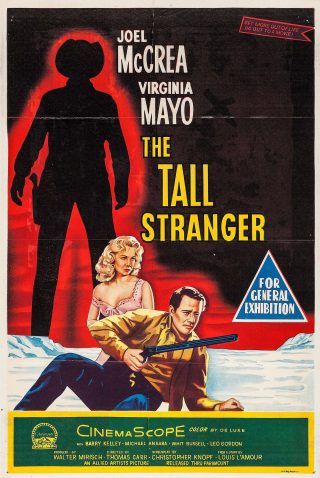
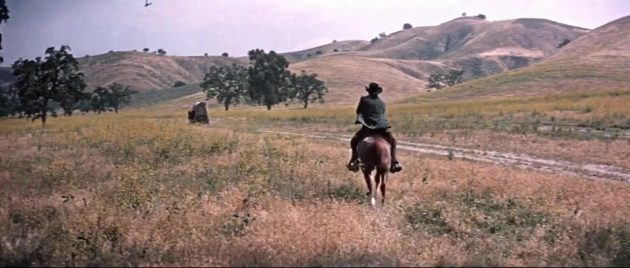
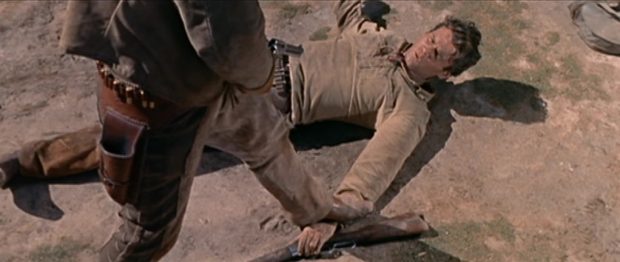
From feuds and fights to romance and reputations, The Tall Stranger has no shortage of ideas to bulk out its 80 minute running time. The opening image is a staple of the genre, with a lone rider making his way across the wilderness, his eyes probing the horizon and beyond, searching for something. Ned Bannon (Joel McCrea)  chances upon a group of men riding herd on some cattle and, out of curiosity, pauses to take a better look. That proves to be a mistake, costing him his horse and almost his own life at the hands of an unseen sniper. As he lies on the ground seriously wounded and at the edge of consciousness, he glimpses the gold-plated rifle and fancy spurs sported by his assailant. However, Bannon is a lucky man and is rescued and nursed back to health by a wagon train of former Confederates heading west and hoping for a fresh start in California. In among those is Ellen (Virginia Mayo), a woman bringing up a little boy on her own. These two people find themselves drawn to each other, perhaps as a result of their shared status as outsiders, Bannon’s having been a Union officer adding to his otherness next to the Southerners. A few of those plot elements are therefore seeded quite early, but the depths of the feuding and conflict are mined later. We first learn that Bannon is headed back to the ranch run by his half-brother, a man who has sworn revenge on him for the death of his only son during the war, then there is another layer of conflict to come as the settlers, under the influence of a manipulative opportunist, make their minds up to stake out a piece of the sprawling ranch for themselves. As such, everything is set up for a showdown between these competing forces and personalities, all of them looking to carve out and lay claim to a little corner of the world to call their own.

While The Tall Stranger is not a particularly ambitious movie, or certainly not one which sets out its stall to deal head on with big themes, it manages to incorporate some of those core ingredients of the genre into its compact form and structure. The concept of competing factions in conflict over the land itself is timeless, one that underpins not just the western but so much human drama. That the events on screen take place in the immediate aftermath of a war over control of the country emphasizes the never ending nature of this struggle among men for mastery of the land, of the hunger to make it theirs. Yet it is the more personal need to achieve a sense of belonging and permanence that is of greater interest. Bannon is a man made rootless by his personal feuds and the scars of battle. He is, however, an optimist in the best western tradition, forever looking ahead to greener pastures and better times. In Ellen he discovers someone else cast adrift in the world, a self-confessed fugitive from tutting puritanism. The need of these two lonely people for something as simple as a home, a place to lay down their own roots and tend to them quietly, provides the heart of the story, and in its own way is an unpretentious reflection of the perennial appeal of the western.

Joel McCrea was one of the linchpin actors of the western, as essential to its development as John Wayne, James Stewart, Randolph Scott or Gary Cooper. All the great western actors brought something unique and special to the table, and in McCrea’s case it was that sense of dignified and courtly decency. He shares some fine moments with Virginia Mayo, not least an early scene where he rides off, perhaps never to return as far as the two of them are concerned at that stage, and the unspoken regret and hurt of both is palpable. Later, there is the scene outside the ranch house, where Mayo tells of her past with raw frankness and McCrea perfectly encapsulates the innocent bewilderment of his character. Both Mayo and McCrea had starred in Raoul Walsh’s marvelous Colorado Territory almost  a decade earlier and The Tall Stranger reunited them. While the relationship in this movie may not have the hot and tragic passion of that in Walsh’s work, their quiet, understated yearning is every bit as powerful and compelling.

The supporting cast is deep and strong, with Leo Gordon and Michael Pate in rare sympathetic roles and Barry Kelley providing plenty of meaty bluster as McCrea’s hardheaded half-brother. The villains of the piece are a flashily dangerous Michael Ansara and George Neise as the chief pot stirrer. Ray Teal and Whit Bissell have small parts and their presence is as welcome as ever.

With a script by Christopher Knopf (Hell Bent for Leather) from a Louis L’Amour novel, The Tall Stranger packs a lot into its relatively brief running time. Director Thomas Carr has it looking reasonably good and uses the ‘Scope frame well, but there is, in my opinion anyway, an over-reliance on day-for-night filters. I don’t believe the movie has had a release on disc anywhere which respects the aspect ratio. However, it can usually be viewed in the correct ‘Scope format online, and in very good quality too.

Sometimes the least likely places harbor the clearest truths, pared down modesty serving to draw attention to the essentials where intricacy and ambition can perhaps end up obscuring them – Sir Isaac Newton once made a similar point in much more elegant terms when he said: “Truth is ever to be found in simplicity, and not in the multiplicity and confusion of things.” So, to finish up, The Tall Stranger will never make anyone’s list of top westerns yet it contains within it, and maybe even in spite of itself, a lot of what makes the genre work.

From Hell to Texas

“The best revenge is to be unlike him who performed the injury.” – Marcus Aurelius, Meditations

Revenge is a motif that is popular in the western, driving and challenging heroes, anti-heroes and villains. The better, or perhaps it would be closer to the mark to say the more thoughtful, westerns of the 1950s mined this theme extensively. The conclusion reached by these films is a virtually universal rejection of the concept of vengeance, an acknowledgment that nothing positive can ever be achieved by sitting down to dine with the Furies. Henry Hathaway’s From Hell to Texas (1958) makes this point very clearly by highlighting not only the corrosive effects of such a self-defeating quest on those who seek revenge, but also by presenting a hunted man who is both innocent of what is alleged and morally appalled by the violent situation in which he becomes mired.

It is all about pursuit and discovery. Tod Lohman (Don Murray) is a hunted man, first glimpsed leading his lame pony to water and some brief respite. He’s running from the sons and riders of Hunter Boyd (R G Armstrong), a local bigwig who has decided that Lohman must pay for the death of one of his sons. That the death was an accident and no fault of Lohman’s is irrelevant for Boyd is of that implacable and inflexible frontier breed, hard men who conquered lands and thrived by having no dealings with frivolities such as self-doubt. So Lohman’s only hope is to run and keep running. When his attempts to avert a deliberately engineered stampede leads to the fatal injury of the second of Boyd’s three sons, it looks as though Lohman has merely driven another nail into that coffin others seem hell bent on fashioning for him. So he’s off again, soon reduced to making his way on foot and feeling his energy sapping all the time. A short stop to rest up sees him making the acquaintance of Amos Bradley (Chill Wills) and his tomboyish daughter Nita (Diane Varsi). This represents a turning point for Lohman. Up to this point, he has been a man alone, one half step ahead of danger and dependent only on his wits. His meeting with Nita offers an ally and a sense of hope too, serving to open the character up in the eyes of the audience as well. Perhaps it isn’t too difficult to tell where the story is going but that’s not what matters. While the ultimate destination proves to be a satisfying one, the real reward is to be found on the road we follow in the company of these characters.

The pursuit I mentioned is present right from the beginning, stark and relentless and powering the narrative. However, there is the matter of discovery which develops in tandem, and which brings another layer of interest, a very welcome one. Lohman is portrayed as something of an innocent in the ways of the world, or at least in the machinations of those inhabiting it. Even as he’s running from Boyd and his would-be revengers, he too is searching for someone. His mother has passed and he sustains himself on a memory, a photo and an old Bible, all of which comprise her sole legacy to her son. His father had left to seek something  – perhaps fortune, maybe freedom, who can say? – while Lohman was still a boy. Now the boy has become a man and is casting around to find this absent father in order to make sense of his past. It is somehow fitting that his flight from the present towards the mysteries of the past actually brings him face to face with his future. Hence the discovery, that the closure attained with regard to what is over and done helps to open a young man’s eyes to how he can deal with the challenges of the here and now, and so move on to a better place.

All told, From Hell to Texas is an extraordinarily positive movie, as a result of the writing of Wendell Mayes and Robert Bruckner, and of course the performance of Don Murray too. The actor brings what I can only term a credible credulity to the role, that hard to define quality of a man grown big in a vast and unforgiving land yet remaining possessed of a simple faith in people. This is a tricky balance to achieve if it is not to ring false. To Murray’s great credit, the open-heartedness of his character is never in doubt, nor are his capabilities as a frontiersman. That he has skill with a gun is clear and it is demonstrated on a number of occasions, but his abhorrence of violence and its consequences is every bit as apparent. The first time that we see him placed in a position where he has been left with no option but to kill a man makes for a powerful if understated scene. The shock and disgust at how he was forced to act, and ultimately at himself for doing so, is conveyed perfectly by Murray. Then in the immediate aftermath among the familiar rocks of Lone Pine as he finds himself unable to take another life, that of the victim’s horse, the effect is crystallized. In fact, running all through this movie is an innate respect for the sanctity of life. It’s there in the heart of Lohman, it’s there in the selflessness of the Bradley family, it’s there in the way a priest tends to the memory of a man who was essentially a stranger to him, and it reaches its zenith in the fiery cathartic climax.

Diane Varsi worked well with Murray and their scenes together have a frankness and simplicity that is touching. Her star soared quickly after she made her debut in Peyton Place but the pressures of stardom saw her step back from the movies quite soon. She would return later but, sadly, her career wouldn’t be the same again. On screen, R G Armstrong often had an air about him of a man who would not be turned, and he brings that ruthless determination to bear on the part of Hunter Boyd. Sure he is a man in the wrong but his idiosyncratic concept of justice and the fact he also embarks on a journey leading to personal revelation (a journey that while different is just as important as that undertaken by Murray) makes him much more than a one-dimensional cutout villain. Chill Wills is, well, Chill Wills, but that really isn’t a bad thing. Jay C Flippen pops up for a time, looking crafty and faintly untrustworthy. Dennis Hopper, fresh off Giant and Gunfight at the O.K. Corral is a bit mannered as the last of Boyd’s sons and plays a pivotal role in how matters are eventually resolved. It has been said he had a less than harmonious relationship on set with Hathaway, which seems very possible given their markedly different approaches to filmmaking, although they would work together again on The Sons of Katie Elder and True Grit. John Larch, Rodolfo Acosta and Harry Carey Jr all make appearances as henchmen, however, their screen time is limited.

From Hell to Texas ought to be relatively easy to access these days. The old German Koch Media DVD I purchased over a decade ago appears to be long out of print but there are a range of other options available in other European markets as well as in the US. The image, on my copy at least, is softer than I’d like but I have to say Hathaway used the ‘Scope lens very effectively, and Daniele Amfitheatrof’s score sounds wonderful. To my mind, this is a fine western all round, albeit not one that is talked about much. Do check it out if you are not familiar with it.

The Four Horsemen of the Apocalypse

While literary adaptations come up for discussion on this site all the time, remakes of earlier movies are less common. The Four Horsemen of the Apocalypse (1962) is both an adaptation of the novel by Vicente Blasco Ibáñez and a remake of the silent film directed by Rex Ingram and starring Rudolph Valentino. In the interests of full disclosure, allow me to get it out of the way from the get go that I have neither read the novel nor have I seen Ingram’s movie. As such, I won’t be indulging in any comparisons here, which is something I try to avoid where possible anyway. After all, a work ought to be assessed on its own merits, to do otherwise is to rob it of its integrity.
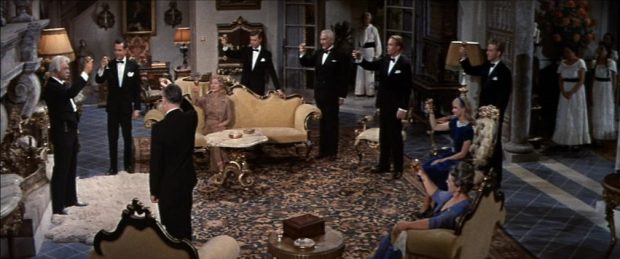
This is a tale of family, war and division yet, in the final analysis, I think it is also a film about unity. The opening is celebratory, packed with dancing, music and, above all, color. It is 1938 in Argentina and Madariaga (Lee J Cobb), in a brazen repudiation of his years, is reveling in life, for its own sake and also in anticipation of the coming together of the two branches of his family. Madariaga has two daughters, one married to Karl (Paul Lukas), a German, and the other to Marcelo (Charles Boyer), a Frenchman.  The offspring of these two couples will all be present after a long absence, so it should be an occasion for joy. However, it is, as has been noted, 1938 and joy is about to take a long vacation. During the course of the evening, Karl’s son Heinrich (Karl Boehm) comes clean about his involvement in the Nazi cause, provoking outrage in his grandfather. To the accompaniment of elemental furies within and without, the old man has visions of the horsemen of the title, representing conquest, war, pestilence and death, charging across a lightning ripped sky. And then he dies. The story moves to Paris, seen largely through the eyes of Julio (Glenn Ford), the dissipated and pleasure-seeking son of Marcelo. That storm which toppled the head of the family half a world away has followed and has lost none of its strength on the long journey. Julio is a self-absorbed wastrel, quick to seduce the wife (Ingrid Thulin) of one of his father’s friends, complacent and secure in the apathy afforded by his neutral status. When the war finally breaks out and engulfs everyone, he gradually learns the value of love, of loyalty, of sacrifice and, crucially, of what it means to be part of a family, even a divided one.

War, love and hate, but family above all. We follow the fate of the two conflicting branches of the family, one half seduced by darkness and the other coddled by decadence. The war cleaves them, tearing the younger generation in particular apart and setting them at each other’s throats. Yet by the end, when the horsemen have done their worst, the intangible and eternal core of the family remains intact, in spirit if nothing else. That finale, with those lords of chaos riding triumphantly across the sky, has an unquestionably grim quality, an ancient malignancy pressing on in a relentless continuum. Still, there is a grain of hope there too – there are, it seems, two slightly different endings and it’s possible the viewer’s perceptions may shift depending on which one is seen – hinting at the ultimate resilience of the concept of family. Both sides of Madariaga’s clan have been devastated yet even in the moment of their greatest loss those who remain have been drawn back together. Perhaps that is the message running through it all, that family in its broadest possible sense, that of society of which we are all members, still endures. The rampaging horsemen may be forever with us, but so too are those unshakeable familial bonds that hold everything in place.

The Four Horsemen of the Apocalypse was poorly received on release, with a disappointing box office and a critical drubbing. Bosley Crowther of the New York Times, who never seems to have met a picture he liked, kicked the movie good and hard. Opinions are always varied and no more than an individual’s reaction to what is offered up, and of course there’s no getting away from the fact that I am simply presenting my own take here, but it is generally both poor form and somehow worthless to criticize a work for what it is not as opposed to what it is. Should anyone feel like seeking out Mr Crowther’s hatchet job on the film, it will be clear that he appeared most offended by a remake and adaptation not being a carbon copy of what came before. That type of criticism feels utterly redundant. However, what struck me as even more wrong-headed were the barbs aimed at Vincente Minnelli’s direction. To quote from that review:

“…most of it reeks of the sound stages and the painted sets of a Metro-Goldwyn-Mayer studio These, on wide screen in color and lighted like a musical show, convey no more illusion of actuality than did “Snow White and the Seven Dwarfs.”That much is the fault of the screen play, garbled grossly by Robert Ardrey and John Gay, and the staging of Mr. Minnelli, who should have looked at a couple of neo-realist films.”

That comment indicates to me that the writer either ignored or fundamentally misunderstood the director and his intentions. The artist is concerned with truth first and foremost. In order to address this, he searches for, he explores, and if he is truly fortunate, he finds himself in a position to present that truth via his chosen medium. Minnelli was an artist. For him, the quest for truth took precedence over any thoughts of adherence to realism. Cinema allows for the incorporation of a broad range of techniques and approaches, and there are those who try to reconcile artistic truth and realism. Minnelli, on the other hand, sought to achieve a separation, happily sacrificing the illusion of realism – and excepting documentaries, what appears on the screen can never be anything other than illusion – in order to break down those barriers which would stifle artistic expression.

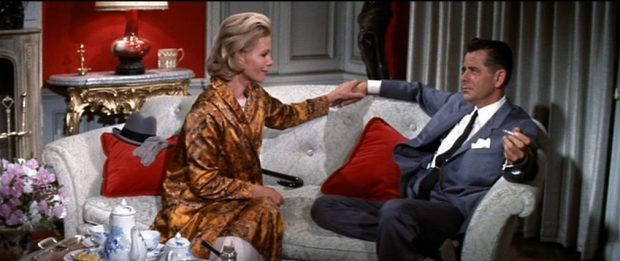
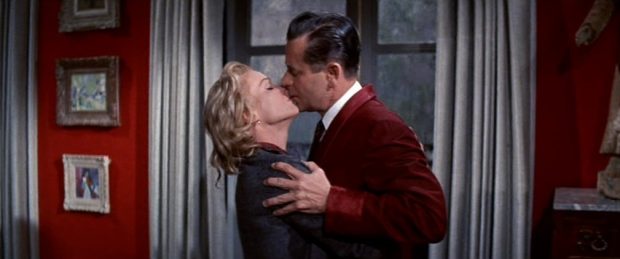
All of those elements which have been pointed out as flaws or weaknesses are deliberate choices on the part of the director.  While Minnelli might have had some reservations with regard to aspects of the script and casting, the staging and presentation feel very characteristic of his work. He was a very visual director, making bold choices when it came to color and that balletic sense he brought to set piece scenes: the debauched Parisian parties, the Latin nightclub, the riot that leads to the initial arrest of Yvette Mimieux. There is a oneiric quality to all of this, heightened sensations brought to life on the screen in order to stimulate the viewer’s emotions. The striking colors are very effective too; the predominance of red is notable, from the drenched and saturated newsreel footage, suggesting danger and violence, to the decor of Glenn Ford’s apartment. The contrast of red and grey is marked in that set, and also in the costuming in one key scene. The color scheme of the apartment is reflected in the intense, passionate red of Ford’s smoking jacket and the cooler, more practical grey of Ingrid Thulin’s suit, mirroring their contrasting characters when they reluctantly acknowledge that circumstances have left them no alternative but to part.

In terms of casting, the most widespread complaint seems to relate to that of Glenn Ford, mainly due to his age. Admittedly, he is old for the part, in his mid-40s at the time. The early scenes in Argentina, and also pre-war Paris, where Ford is supposed to be gliding along fueled by youthful hedonism, feel a bit forced. However, the role of Julio is one which requires the character to mature fast as the war takes an increasingly heavy personal toll and the option of simply sitting on the fence becomes no option at all. It is here that Ford grows into the role, or it could be said the role grows around him. Either way, that internalized dissatisfaction which the actor was able to exploit so well in his classic western and noir roles in the preceding decades serve him well. As the character of Julio begins to live a double life, so Ford gets the requisite psychological squirming across. Minnelli is said to have initially wanted Alain Delon for the part and it’s interesting, if not especially productive, to speculate on how he would have handled the part. Ingrid Thulin (dubbed by Angela Lansbury) has a certain Scandinavian aloofness about her – Ava Gardner is said to have been the first choice for the role – but she plays well off Ford and their relationship feels credible.

Charles Boyer’s turn as the head of the French side of the family is nicely judged. He is as suave as one would expect of a man in his position, but there is discomfort too, and it comes out in two scenes with Ford, one where he confesses to the cowardice which has hounded him all his life, and then on a rain-soaked Parisian bridge, racked with grief after the death of his daughter, as he begs his son to be a braver and better man than he had ever been himself. Boyer also shares a poignant moment with Paul Lukas, where both men are screaming at each other in bewilderment as the horror of their personal tragedies mounts. Paul Henreid is simultaneously chilling and stoic as the hero of the resistance, slowly being destroyed, physically by the attention of the Gestapo and mentally by  the loss of his wife’s love. As for the others, Yvette Mimieux is fine as the impassioned younger child of Boyer, while Karl Boehm is a textbook Nazi. Finally, Lee J Cobb plays it large in the  opening scenes. Is it all too affected? Well, that is something the viewer will have to decide. For me, in a movie where many aspects are heightened and intensified with the aim of raising the dramatic temperature, Cobb’s performance can be considered to be just another dab of color.

The Four Horsemen of the Apocalypse can be found on DVD in the US as part of the Warner Archive, and editions are available in France, Italy and Spain. This is a film I came to relatively recently and one which I quite like. It has its flaws and it drifts in places but there are enough of Minnelli’s characteristic flourishes to draw me in, and Glenn Ford is someone I can always watch. It is not perfect but the pluses outweigh the negatives for me and I reckon it is a good deal better than some of the criticism leveled at it would have us believe.

Slattery’s Hurricane

Many of the movies that wind up being featured on this site are borderline or peripheral affairs in terms of genre, drifting in and out of that shadowy, hard to define area, which is almost, but not quite, film noir. André de Toth’s Slattery’s Hurricane (1949) is a case in point, mixing in crime, melodrama and adventure in a tale of trust and betrayal that unfolds largely in flashback. In a sense though, this is a movie which more or less defies genre and classification, but perhaps that is no bad thing as it allows viewers to approach it from multiple angles.

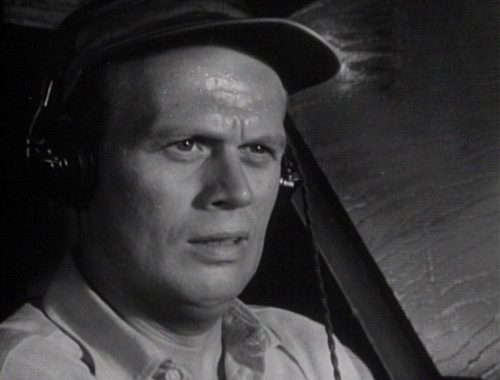
After some newsreel footage and a brief opening narration on the subject of hurricanes and their devastating power, the movie proper begins with pilot Will Slattery (Richard Widmark) arriving at an aircraft hangar lashed by torrential rain and high winds. It’s Miami and a beast of a hurricane is bearing down on the coast as he first grapples with and then lays out cold one of his employer’s servants. Slattery is a man every bit as driven as the raging elements around him yet his path will take him not away from danger but straight into its heart, right into the eye of the storm. As he takes the plane up and charts a course that will lead him to whatever place fate has reserved for him the flashback begins. It leads us back to a point before Slattery had fully committed his life to a downward spiral. There’s a roguishness to him, a hint of the irresponsible and the reckless, but even if he’s not as attentive to the needs of his girlfriend Dolores (Veronica Lake) as he ought to be, it doesn’t feel like a major flaw. That’s before Aggie (Linda Darnell) appears on the scene though. While she may be his old flame, she is also the new wife of his friend Lt. Hobson (John Russell). If Hobson is initially unaware of any previous connection between these two and equally blind to the heat the pair are generating every time they come near, the same cannot be said for Dolores. She smells a rat right from the get go and Slattery duly lives down to expectations. As he sets about seducing his friend’s new bride, Dolores is showing signs of fragility. Everything comes to a head when a quick spot of island hopping sees Slattery’s employer succumb to a heart condition, leaving the flyer in possession of the stash of narcotics he had been carrying. With the dead man’s partner threatening him, Dolores suffering a breakdown, Hobson finally cottoning on to what’s been happening behind his back, and a major tropical storm about to tear across Florida, Slattery could be said to be facing a crisis. When it suddenly dawns on a man that all he is and all that he has done has shattered not only his own existence but that of those closest to him, it is perhaps understandable that he might seek out some form of redemption. And so we circle back to the starting point, where a desperate individual buffeted and torn by poor choices and his own weakness has opted to flee the emotional maelstrom he has fallen into and instead tackle the wrath of nature head on.

Director André de Toth has Slattery confined within the perspex and metal of the aircraft’s cockpit for the bulk of the running time, and just as he is bound on all sides by the dimensions of his plane, so is the plane itself held in the fickle and destructive grasp of the great storm. In a sense, everything and everybody in this pared down universe is at the mercy of somebody and something else. Slattery’s hurricane is both a test for the man and a kind of isolation chamber allowing and forcing him to confront himself and his past actions and by so doing try to regain some modicum of self respect.

De Toth had a knack for using weather conditions as a reflection of the emotional states of his characters and the stories built around them. Day of the Outlaw is as chilling and sparse as its frozen setting, and even the ultimately disappointing Dark Waters uses its steamy Louisiana plantation as an effective representation of its overheated and oppressive tale. Essentially trapping his lead in the cockpit of his plane for the duration and only allowing the illusion of escape via the flashbacks takes it a step further. It is here, deep within the roaring darkness which Slattery’s world has become, that he sees himself and his life with the greatest clarity. Those flashbacks to the sun drenched days by the ocean reveal the deceptions and ploys played out in the full light of day. It is in this surface brightness that the dishonesty is presented with the most audacity: Slattery’s careless flirtations with Aggie in front of everyone, the relaxed opulence of the wealthy “candy manufacturer” hiding his drugs operation in plain sight, and of course the medal ceremony where Slattery, in dazzling whites, receives the honor his subsequent actions have now tarnished and Dolores’ ultimate collapse is triggered. Conversely, the enclosing and enveloping darkness and shadows serve to squeeze the less palatable truths out into the open.

Slattery’s Hurricane appears to have been a film that drew a fair bit of attention from Joseph Breen and the Hays Code. Obviously, the entire adultery/cheating thread had to be dealt with obliquely, but filmmakers were well versed in how to get the essentials of such affairs across subtly by the late 1940s. In short, the viewer is always fully aware of what is going on between the characters even when it’s not spelt out explicitly. More guile had to be used, however, in relation to the breakdown undergone by Dolores. Not only is the character in the employ of a couple of drug traffickers, but it turns out she is an addict herself. This kind of development was well beyond the pale though and thus there’s a deliberate woolliness about the nature of her problem and admission to a psychiatric clinic. Nevertheless, the filmmakers did show a degree of inventiveness in slipping in a close up of her doctor’s notes which make it clear that she has a drug problem. What’s more, my impression is that the affluent dope smugglers masquerading as candy merchants are a gay couple, but that too somehow got past Breen’s enforcers.

Slattery’s Hurricane came along just two years after Richard Widmark’s stunning debut in Kiss of Death and I still find it extraordinary just how assured he was even in the very early stages of his career. It was a good role for him at this point, exploiting the shady persona which had been so successful for him but emphasizing the ambiguous rather than the villainous aspects. The film, from a Herman Wouk story, was originally shot and screened with a much more downbeat ending but was then altered before its general release. It would be fair to say that the changes watered down the noir credentials considerably, but I don’t think this damages the film too much. The whole thing  is at heart Slattery’s journey to redemption and, regardless of which way it ends, that goal is attained. The finished film allows for the character’s salvation in addition to his redemption, both of which are earned. If one bears in mind that Veronica Lake was playing an addict, then her drabness and shakiness make some sense. Even so, there is no getting away from the fact that she looked spent or that her film career was nearing its end. She was not yet 27 years old and was struggling with her own substance abuse issues. Linda Darnell had the bigger part and got more screen time. While she is good enough with what she is given, it’s not a terribly taxing role and there is a passivity to it that leaves it not all that interesting. John Russell does not get that much to do either, although he is afforded the opportunity to rough up Widmark some for his betrayal. Gary Merrill is in there too, but mostly spends his time smoking and sweating in the control tower.

Slattery’s Hurricane is a 20th Century Fox production and was released in the US as part of the studio’s MOD line. That may be out of print now but there have been versions available in both Italy and Spain, possibly ports of the US disc. The movie could use a clean up and a sharper transfer, but it’s not a high profile title so that is probably unlikely to happen. It really is Widmark’s show all the way although there’s a lot to enjoy in de Toth’s direction too. All told, this is a well made nearly noir that I recommend checking out.

Carson City

Sometimes I have vague memories of when I first saw certain movies. On occasion, these memories relate to cinema visits, which tend to stand out more of course, but more frequently they are of movies I caught on TV. Saturday afternoon broadcasts introduced me to many films and stars, cementing them in my consciousness largely due to the fact that I came upon them at the right age to allow lasting impressions to form, and also because of the random way I encountered them. As I said, there is a vagueness to all this, and yet I can say that on the afternoon of Saturday January 29th 1977 I was watching Randolph Scott in Carson City (1952). And I am able to state this with confidence due to the wonder of the BBC Genome service, which makes it  possible to discover exactly when any movie was broadcast on its channels. That had been my only viewing of the film till I finally managed to pick it up on DVD over thirty years later. Of course I didn’t recall details but those Randolph Scott westerns that I adored as a youngster worked their way into my memory and played a defining role in shaping my love of cinema. Looked at now, over 45 years on from that weekend spent in front of the family TV, it may not represent the finest work Scott did, but it is a good movie. Perhaps even more importantly, it evokes for me a little of that magic I first experienced all those years ago.

If some movies are capable of transporting viewers like myself back to particular points in time, it is probably fair to say that the western, arguably more than any other genre, succeeded in doing something similar to society itself, encouraging the audience to cast its collective mind back to the that pivotal point where progress butted heads with freewheeling lawlessness and ushered in the modern age. Carson City, as is the case with countless other genre entries, kicks off with a hold-up of a stagecoach. It is such a familiar and well worn trope, but it serves its purpose for all that by drawing viewers into the action immediately. It plays out in a quirky fashion, the bandits laying out a feast before the passengers, a spread attractively presented and accompanied by bottles of champagne. The tone is light for the moment, larceny served with courtesy and style with only the bankers left feeling sore. Yet just as the genre itself was firmly focused on those final years of the open frontier, the fences were popping up in the west and the gate would soon be closed on such Robin Hood romanticism. The juggernaut driving this relentless march toward modernity was the railroad, the unstoppable iron horse that would punch its way through from coast to coast. The townsfolk of Carson City are fearful of what may follow in the wake of the railroad, hoping to cling for as long as possible to the familiarity of the stagecoach lines despite their vulnerability in the face of determined raiders. Jeff Kincaid (Randolph Scott) is the engineer hired by the rail bosses to build the line through the rugged mountainous terrain and add another link in the chain of civilization gradually snaking its way across a continent.

Where does Carson City rank in relation to the other films André de Toth made in collaboration with Randolph Scott? Well, it is neither the best nor the worst of those half dozen pictures so I would have to place it comfortably in the middle. It isn’t an especially complex story, it doesn’t ask its star to dig too deep within and the villains are simply villainous and no more. Still, it is what could be termed an easy watch, with a plot which develops in a straightforward manner that is satisfying even if it’s never especially surprising. De Toth has the scenes in town looking good and the Bronson Canyon and Iverson Ranch locations feel like the well recognized landmarks one passes on the way to a visit with an old friend. It’s colorful, pacy and full of incident – stagecoach and train robberies, a couple of brawls, several shootouts and an atmospheric mine rescue – and the shift in tone from the light, airy beginning to something darker and more dangerous later on is effected seamlessly.

Randolph Scott’s more memorable parts saw him exploring layers of his own private morality, but Carson City is a much more straightforward assignment. The character of Kincaid is one of his clear-eyed and uncomplicated adventurers. Scott could play that kind of noble westerner practically blindfolded and he sails through the movie with a graceful assurance. I am unsure how many on screen railroads he built or how many miles of telegraph wire he strung down the years but it must have been a lot. The only hint of personal conflict comes via his increasingly strained relationship with his young half-brother played by Richard Webb. Even here the envy and resentment grows out of Webb’s own sense of inferiority rather than anything in Scott’s character. The villains are a perpetually scowling and dangerous James Millican and an extremely buttery Raymond Massey, the latter suckering everyone into believing his soft geniality is genuine and not just a smokescreen to conceal his icy ruthlessness. In one of her few dramatic parts, singer Lucille Norman is the newspaperwoman driving a wedge between Scott and Webb. She does fine and, on this showing anyway, I reckon it’s a pity she didn’t make more movies.

Carson City can be found on DVD via the Warner Archive and there are Spanish and Italian editions available as well. Even if it doesn’t labor the point or dwell on the implications to any extent, the story is part of that fairly large body of westerns dealing with the drive towards civilization, modernity and the rule of law. All of that may underpin the story but this is a piece of entertainment first and foremost and it certainly delivers on that. So, while Carson City is not the weightiest of Randolph Scott’s westerns, it does highlight the appeal of the star and consequently offers plenty of enjoyment.

The Revolt of Mamie Stover

I want to start by saying I have never read the book by William Bradford Huie which The Revolt of Mamie Stover (1956) is adapted from. In fact, it’s only recently that I had the opportunity to see the movie itself. I point this out because I understand some critics were displeased with the film on release due to its failure to stick as closely to the source as they would have liked. Yes, this is an area of discussion which has arisen before now on this site, and I imagine it will come up again. Personally, I am backing no horse in this race and am simply looking at the movie as a work of cinema in its own right.

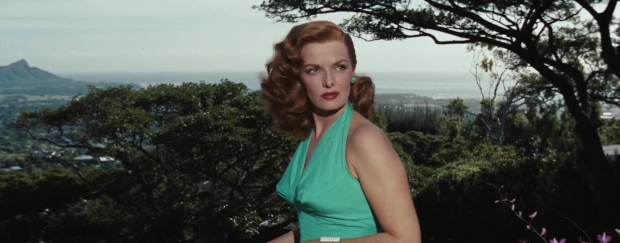
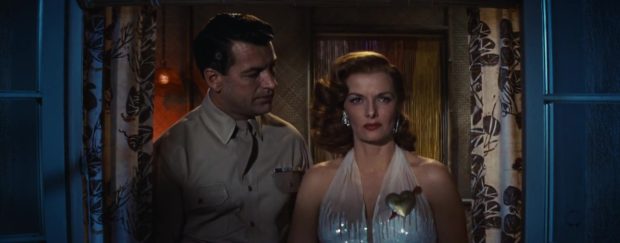
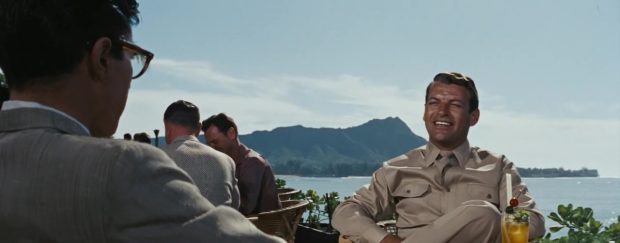
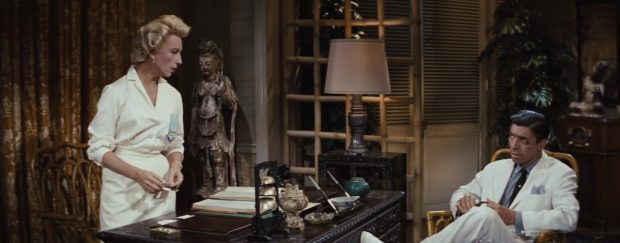
It’s 1941 in San Francisco and the USA has yet to enter the Second World War. Mamie Stover (Jane Russell) is on her way to the docks to catch a boat to Honolulu and she’s headed there with an escort, a nice shiny police car is dropping her off and making sure she doesn’t miss the sailing. As Hugo Friedhofer’s sensually jazzy score kicks in, it is apparent that she has, in essence, been declared persona non grata by the authorities and invited to leave town. The reason is never spelled out, but the lewd references made about her on board, and of course her subsequent employment when she reaches her destination, imply that she is a prostitute of some notoriety. Speaking of destinations, this is an aspect which goes to the heart of the movie in many ways. The voyage to Hawaii sees Mamie making the acquaintance of Jim Blair (Richard Egan), a writer headed home to the islands after selling the rights to his book in Hollywood. In a sense, both of these characters are on their way home, although Mamie’s path there is the more circuitous of the two. There follows an almost inevitable shipboard romance and an equally predictable parting of the ways as soon as the ship docks. Jim is going back to his life high on the hill, with a well-bred girl (Joan Leslie) waiting for him. Mamie is off to work as a ‘hostess’ in the dance hall and clip joint run by Bertha Parchman (Agnes Moorehead). Just as surely as Jim and Mamie drift apart, fate’s long and winding road has it in mind for these two to meet again. With the storm clouds of war gathering, and their respective ambitions suggesting they have no business being together, the spark of attraction is still alive. However, with the bombing of Pearl Harbor and all that follows, they look to be taking separate roads again – Jim is off to war and Mamie seizes the opportunity to buy up as much property as she can afford at rock-bottom prices. And so it goes, back and forth for a while, patriot and profiteer drawn to each other by sheer animal attraction and yet always moving towards different destinations.

Raoul Walsh makes great use of the wide screen in The Revolt of Mamie Stover, switching between telling close-ups and carefully selected medium shots, only rarely crowding the frame and maintaining the intimacy of the story at all times. Leo Tover’s cinematography is frankly stunning, from the breathtaking backgrounds of the Hawaiian locations to the rich and sumptuous color in Bertha’s house of ill-repute. Sydney Boehm’s script is a characteristically strong one, keeping within the boundaries of the production code but still ensuring the adult themes are not watered down any more than necessary. A bit of reading around here and there tells me that the source novel presents more of a critique of society than the movie does. Not having read it, I can’t comment on that, but I can say that the focus of the film is very much on the people, on the individuals, how they grow and what they learn along the way, something which tends to make a film more involving.

Once again, Walsh defies his reputation as a macho director and demonstrates how well he dealt with films which placed women right at the heart of the story. The melodrama that drives it all  is liberally laced with humor, both broad and subtle, and there is a distinctly humanistic feel to the way the characters are drawn and observed. Neither Walsh nor Boehm are interested in handing out some trite moralistic message. The movie looks at people, warts and all, neither excusing nor explaining them, and the ending, in that classically cyclical fashion, brings us right back to the point where it all began, but the crucial difference is that these characters whose lives have been traced on the screen have grown and developed.

Jane Russell was making some varied and interesting movies around this time, including The Tall Men (also for Walsh) and Foxfire. However, she was soon to move to television and only later drift back to the movies for a cameo playing herself in Ralph Nelson’s rather good Fate is the Hunter and then a couple of pretty depressing A C Lyles westerns.  Mamie Stover offered her a good part as a woman juggling her love for money and material success with her love for Jim Blair, and winning something entirely different and unexpected in the end. Richard Egan brings a tough confidence to his role, and achieves a quiet dignity that is very admirable in the climactic scene. Agnes Moorehead is a highlight as the cunning and hard as nails proprietress, displaying as much burnished brass as her startlingly blonde hair. Joan Leslie was another who was about to move to television after a long and successful career on the big screen but, like her character, she is largely sidelined. And last but not least, Michael Pate scowls most effectively as the bespectacled thug using heavy-handed tactics to keep Bertha’s girls in line.

The Revolt of Mamie Stover was handed a Blu-ray release some years ago by Twilight Time. I never managed to pick up a copy and I don’t believe it has come out anywhere else on that format. However, there are copies to be had from Spain, not ideal copies but watchable enough and in the correct aspect ratio. It took me a long time to catch up with this film and I enjoyed seeing it at last. Walsh, Tover and Boehm combine well behind the cameras, and the cast doesn’t disappoint in front either. This is an entertaining and grown-up movie that sidesteps the typical sugar-coated Hollywood ending yet still manages to tie everything up very satisfactorily.