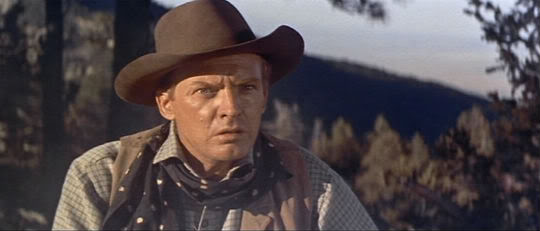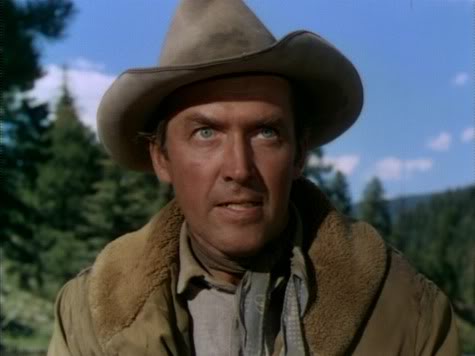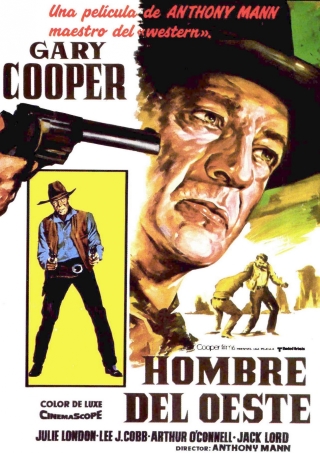
Man of the West

The western, when it hits the heights of its artistic potential, traces the route of its characters along a path that leads them to salvation, redemption, fulfillment or any combination thereof. When this is achieved then the audience gets to follow, to catch a glimpse of, and thus on some level share vicariously in those rewards – this is one of the riches of cinema and it’s to be found in abundance in the very best of the classic era of the western, not least as it approached the zenith of its power. And for directors who could be said to have had a clear view of what they wanted to do within the genre this same progression towards a destination marked fulfillment can also be discerned. Anthony Mann started making westerns at the beginning of the 1950s with Devil’s Doorway and Winchester ’73 and, particularly in that great cycle with James Stewart, dug deep into the heart of the genre. His work laid bare the tormented souls of his characters yet also applied a kind of spiritual healing balm that meant the harsh journeys he took them on finished up at a place that promised them peace. Man of the West (1958) follows this template and while it wasn’t the last of Mann’s westerns, it does represent the apogee of his work in the genre.
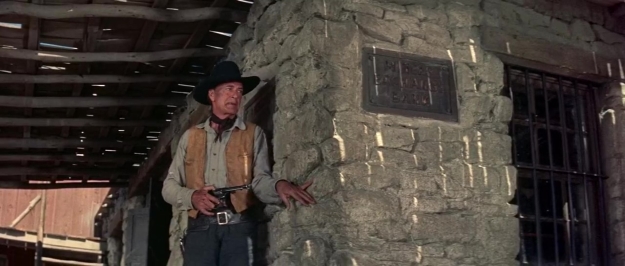
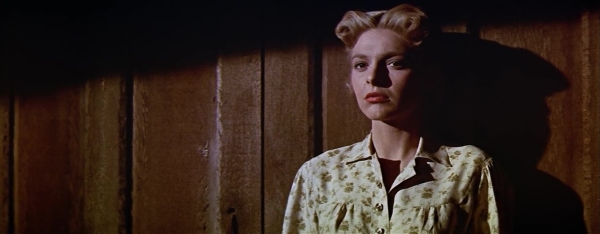
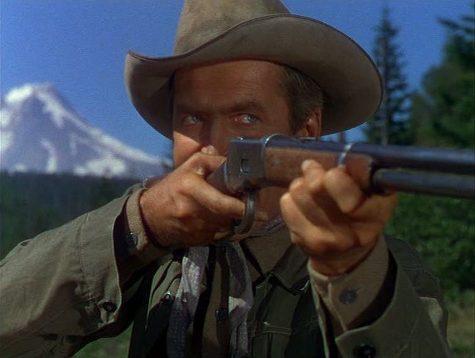
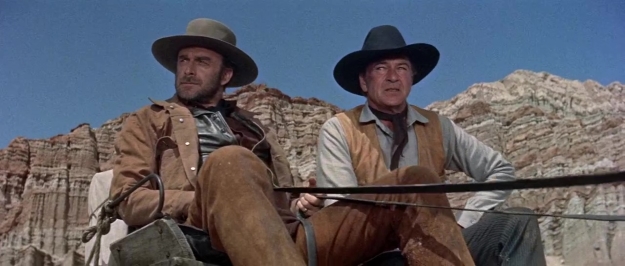
On the surface, the plot of Man of the West is a simple and straightforward one. Link Jones (Gary Cooper) is a man clearly out of his element, a true man of the west who is spooked by his first view of a train and bemused by civilization’s apparent determination to squeeze him into the smallest space manageable. Still, the west of his past is never far away and a neatly executed raid sees him relieved not only of his luggage (and the money he’s been carrying to hire a teacher for his town’s new school) but also the discomfort of his poorly designed seating. Stranded in the middle of nowhere in the company of garrulous card sharp Sam Beasley (Arthur O’Connell) and  saloon singer Billie Ellis (Julie London), he has no option but to set out in search of shelter. The thing is though, Link is no helpless hick – he evidently knows where he’s headed as he soon comes upon an old homestead that he seems familiar with. In short, this is very definitely a man with a still unrevealed history, one who thought he had outrun that past only to find it catching up with him and drawing him back into its unwelcome embrace. There had been hints of that in his shifty avoidance of the law back at the train halt, but it’s here that the full extent of his involvement with criminality is dragged out into the light, or into the flickering shadows of a dank and dangerous cabin to be precise. The gang who robbed the train are taking orders from Dock Tobin (Lee J Cobb), the notorious uncle who brought up and shaped – or perhaps twisted – the character of the younger Link. His delight at having his protégé back is matched by Link’s carefully concealed disgust at being snared once again by the kind of people he thought he had escaped for good.
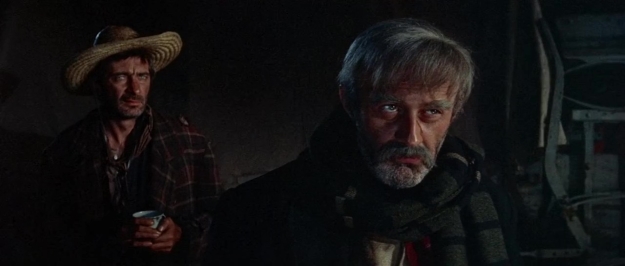
The tone of the movie shifts radically at this point. Link’s caginess grows and is clarified at the same time, and the worthlessness and utter inhumanity of Dock and his gang increases by the minute. The cabin itself is hugely oppressive, shot by Mann in the shadowy menace of guttering flames with a heavy and smoke darkened ceiling regularly in view, its narrow and tight dimensions seem to press from every side. As Dock raves and booms about a past steeped in blood and brutality, Link’s burgeoning despair is just about held in check. He had set out to recover the money entrusted to him by poor and trusting people and now finds himself responsible for both his own well-being (he has a dependent wife and children relying on his safe return) and that of two helpless people he has led into danger.
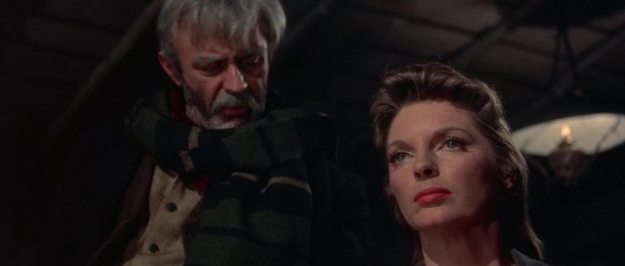
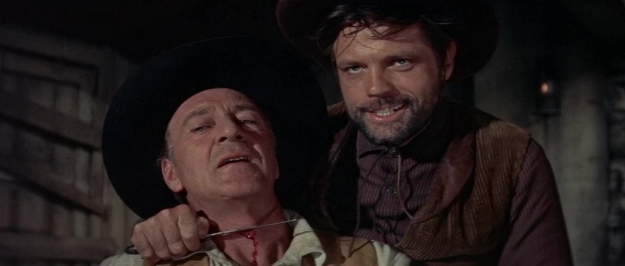
This long sequence in the cabin gradually takes on the feel of a visit to one of the deeper circles of Dante’s Inferno, where depravity is let loose and one starts to wonder if light will ever be permitted in again. Dock resides here, a malignancy at the center of a web he has spun around himself,  goading his companions to ever greater excess. When the degenerate Coaley (Jack Lord) demands that Billie strip for their amusement and holds the outraged Link captive, a knife cutting into the flesh of his throat, there is a real sense of terror on show. This entire section is impossibly tense, dark and forbidding, so much so that there is a palpable sense of relief when events move the characters out, when a new dawn breaks and the possibility of getting into the open beckons.
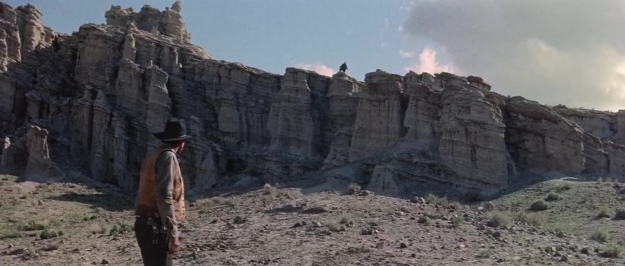
Here, in the closing act of Mann’s beautifully shot tragedy, those classic themes of revenge, redemption and renewal are played out against a dusty and sun-bleached backdrop that is as unforgiving as it is honest. Link is handed the opportunity to avenge the indignity and barbarity of Coaley, meting out a retribution that is chilling in its bleakness and also unsatisfying as a result of the further hurt it unwittingly inflicts on the innocent. The message of course is that revenge never achieves anything of value, a theme that Mann revisited time and again throughout his career. By the time it all draws to a conclusion with a sudden gunfight high up on one of the director’s characteristic elevated spots, more horror has been confronted and further pain endured. For all that harshness and violence and loss, Mann’s essential commitment to the durability and resilience of humanity, to the ultimate triumph of decency over malice never falters. When the damaged survivors come together briefly at the end before the inevitable parting, making their peace with themselves and the challenges posed by life itself, there is no doubt that catharsis and renewal have been earned and won. This holds true of the characters, maybe it can be said of the director, and it brushes off on the viewer too .
I know the casting of the movie has not met with universal approval, but I find it works fine for me. Sure Cooper was probably too old for the part as written but his work here allows me to ignore that. The fact he had such a natural affinity for western roles is a terrific boon in itself and then there is that minimalist approach to acting he had perfected over the years. Those eyes that dart like fugitives while the face remains taut, that guarded catch in the voice, the pauses and the silences all add up to wonderful screen acting and I find it hard to see how anyone else, regardless of their age, could more convincingly impart the mix of caution, fear and guts required. Does Lee J Cobb crank it up too high? Maybe so, but as I see it his character is a monstrous creation, deluded and demented by his own turpitude. Dock Tobin lives in an unreal cocoon and surrounds himself with lowlife sycophants so it’s arguably a valid interpretation on the part of the actor to play him with such studied bombast.
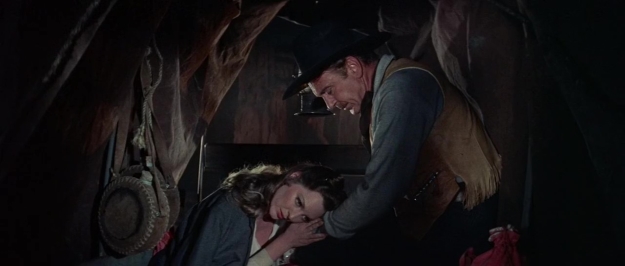
Julie London’s lonely saloon girl is well realized and she deftly captures the precarious position occupied by a woman in such circumstances. All her western roles were fine but this one presents her with a number of challenges – the natural toughness of the saloon singer is neatly juxtaposed with her innate vulnerability and she handles the scenes where she’s subjected to both physical and psychological assault with sensitivity and grace. She excels in her scenes in the cabin and barn, playing effectively off Cooper’s reticence and reserve, and then has two other memorable scenes with her leading man in the wagon, the first tender and bittersweet while the second exposes the full horror of Tobin’s bestial character. In support John Dehner plays it tightly coiled as Cooper’s cousin, coolly disgusted by the decline he sees in Tobin and never once deceived by Link’s maneuvering. Royal Dano is memorably manic as the mute Trout, Robert J Wilke sneers and threatens on cue while Arthur O’Connell is all blather and blarney till he stops a bullet at the end of one of the film’s most shocking scenes.
Man of the West saw Anthony Mann take the western to the place he wanted it to be. All the themes he’d touched on and explored throughout the preceding decade are on view and placed under the microscope. Having won acclaim as a director of film noir, his westerns hold onto some of that darkness – the visual aesthetic may have gradually become less pronounced as he moved to frontier tales but the fascination with the less savory aspects of humanity remained. What separates his westerns from his earlier noir work though is the focus on reaching for something finer, the scramble towards redemption and an escape from the darkness both within and around the characters. By the time he made Man of the West he had discovered how to set those characters firmly on that path.

The Last Frontier

“Civilization is creepin’ up on us…”

There’s a similar sentiment, and indeed similar words, expressed at the start of Raoul Walsh’s The Tall Men. Indeed it could be said that variations on this theme run all through the western genre. Can it be said then that the western is at heart an unfolding elegy? One would certainly be justified in applying that label to many of those movies made in the late 1960s and on into the following decade, what have come to be referred to as revisionist works. Yet the roots of that can be found in the classic era, the golden age of the genre in the 50s, when the spirit of celebration, of hope and redemption, were just beginning to be tinged with a hint of regret at the gradual drift away from an ideal. Even the title of Anthony Mann’s The Last Frontier (1955) catches a flavor of that crossing of the Rubicon. Granting that the notion of the Old West as some pastoral idyll was as much myth as reality, it seems fitting that the process which plays out before the viewer is not framed in terms of tragedy, although there are clearly tragic elements woven into it all, but is instead presented as a natural and perhaps desirable step towards the inevitable.

The opening of The Last Frontier presents an image of perfect wilderness, of a land largely untouched by man. Yet we see three men making their through the rocks and trees. This is Jed Cooper (Victor Mature) and his two companions Gus and Mungo (James Whitmore and Pat Hogan), and before long the earth around them seems to take on another form as an encircling band of Sioux rise up from the grass and scrub as though they were children of the soil itself. The thing is both groups, the trappers and the Sioux alike, give the impression of being just another natural extension of their environment. Nevertheless, the trappers are made aware of the fact they have come to represent the intruder, are promptly deprived of their weapons, horses and bearskins and warned to stay clear of the forests. Why? In brief, the arrival of the army and the construction of a fort has altered the way the Sioux now perceive them. Indignant and resigned yet still alive, Cooper makes for the fort in search of some form of compensation for the loss of a year’s worth of hides. What he gets, however, is the offer of employment as a scout under the young acting commander Captain Riordan (Guy Madison). Despite the reservations of his friends, Cooper is beguiled by the thought of a blue tunic with brass buttons and wonders if he might not get to wear one at some point. Thus he begins to fall under the spell of civilization, a feeling further enhanced when he makes the acquaintance (albeit in a drunken and rambunctious state) of Mrs Marston (Anne Bancroft), the wife of the absent senior officer. Colonel Marston (Robert Preston) is at that point on the other side of Red Cloud’s Sioux, which by Cooper’s calculation means he’s probably dead.

As it turns out he’s very much alive and Cooper’s efforts to guide him and what remains of his command back to the safety of the fort earn him little in the way of gratitude. Marston is far from being a well man, psychologically at least. He carries the scars of shame and defeat, haunted by the ghosts of the 1500 souls he led to their graves at Shiloh. The western is full of men in desperate need of redemption, though as often as not the wounds they seek to heal are neither so deep nor so raw as those which afflict Marston. His goal is to excise the pain of defeat through victory over Red Cloud. Unwittingly, Cooper’s growing need to embrace civilization and all he perceives it as offering leaves him pinned at the center of both an emotional and military crisis that Marston is hell bent on engineering. Ultimately, all the elements will be drawn together in a swirling maelstrom of dust and death.

The westerns of Anthony Mann are among the greatest of the classic era. They typically feature driven and obsessive heroes, and of course the concept of redemption is never far from the surface. That sense of redemption, of restoring oneself spiritually, of paying one’s debts and regaining one’s rightful path in life is a powerful one and Mann spent a decade exploring it. In The Last Frontier the character most noticeably driven is Marston, a man who has hounded himself to the brink of sanity and even of humanity. He is not the hero of the piece, though one could say that if he doesn’t quite redeem himself he does get to earn his peace, although it comes at a considerable cost to others. Cooper is the undoubted hero, a crude and unfinished product of nature, one who doesn’t need redemption in the sense of making atonement but rather one who has reached a critical point in life and requires guidance. I guess there’s something ironic in the figure of the pathfinder in the wilderness threshing around at the gates of civilization and needing help to regain his course. Yet that is what happens.

I think that the message of this movie is that no state or situation is to be sought in itself, that the myth of the free and open west is only sustainable and valid if it’s viewed as a stage in a process, an attractive stage in many ways but not a permanent destination. Marston’s relentless drive toward confrontation comes to the only end that it can, and of course history leaves us in no doubt that the staunch resistance to change of Red Cloud was similarly doomed. So what then of the other options? There is a strong feeling that the settler can only go so far till the siren call of civilization drowns out the pull of the untamed land. There is a pivotal moment late on when Mature, having abandoned the fort in the wake of one of those brutal fights so typical of a Mann film, must confront the fact that he can go no further. His journey is going to have to continue along a different path, one which leads back to civilization or whatever form of it he cares to shape for himself. Mungo, the native, is not restrained in the same way and is thus free to proceed on his own trek, one which is expressed in Mann’s characteristic cinematic language as a journey forever upwards, always ascending and always seeking to attain some higher place. Maybe both are heading for the same destination, just taking different routes to get there?

I haven’t given a lot of attention to the performances in this movie, which is a bit of a departure from my usual formula. That’s mainly due to my choosing to focus more on the themes and ideas underpinning the movie, as well as the fact that all of the principals are uniformly excellent. However, I would like to single out some remarkable work from the often maligned Victor Mature – he really gets into the character of the unpolished trapper, investing the part with a passion and raw energy that is wholly convincing as he cannons back and forth between confusion, wonder and enthusiasm. I think it’s a terrific performance. A word too for the cinematography of William C Mellor, where he and Mann fashion a neat juxtaposition of dark and claustrophobic conditions within the (confining, civilizing or both?) walls of the fort and the bright, open airiness of the surrounding landscape. As far as I know, the only Blu-ray release of The Last Frontier is the German edition. It is a good if not great transfer, certainly a step up from the rather indifferent DVD but I must say I’m mystified why this interesting Anthony Mann film remains unreleased in the US or UK with the kind of supplementary material it surely warrants.

As an aside, and for what it’s worth, yesterday marked sixteen years to the day since my first uncertain blog entry.

Desperate

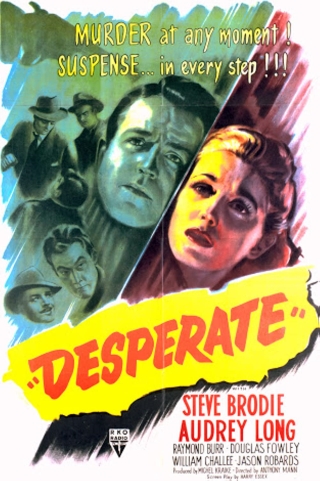
With a title like Desperate (1947) and a lead character who is a veteran striving to make a success of both his new marriage and his job, it might be reasonable to expect the focus to be on the desperation related to difficulties in settling back into civilian life. What we get, however, is a classic film noir scenario based on some dubious choices and flawed judgement. It is often said that the kind of maladjustment that appeared to dominate the post-war landscape was a major driver of film noir in the mid to late 1940s. I guess the initial poor call by the protagonist that sets everything in motion could be regarded as being tangentially influenced by that, but it’s really just a matter of a guy looking to make a bit of extra cash and how that draws him into one of those spiraling nightmares where it seems virtually impossible to catch a break.

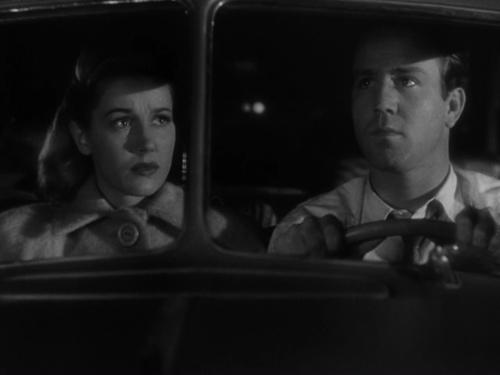
Steve Randall (Steve Brodie) is trying to make a go of it as a trucker and makes what turns out to be a fateful decision to accept a job offer from an anonymous caller. He could have been enjoying a celebratory dinner with his new wife Anne (Audrey Long), and she could have broken the happy news that there was a baby on the way. However, a man just starting out needs money and so the prospect of some easy cash for an evening’s work is too alluring to pass up. That this is the first of Randall’s poor choices becomes abundantly clear when he turns up for the job only to be greeted by a shady old acquaintance, Walt Radak (Raymond Burr). He then discovers that he is expected to haul away the spoils of a warehouse heist. That would be bad enough in itself, but a bungled escape bid by Randall stirs up the thieves and leads to the shooting of a cop and Radak’s brother getting arrested.

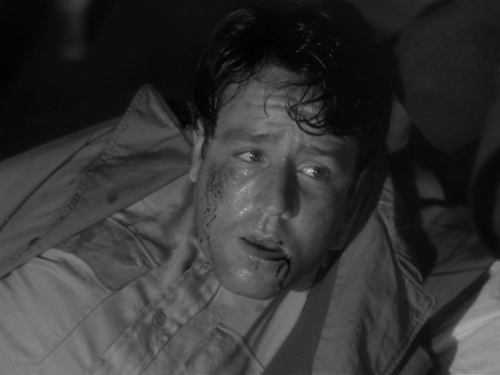
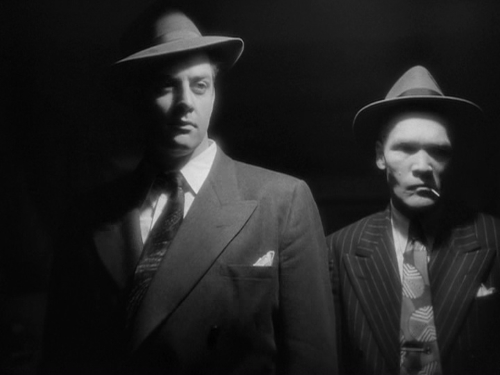
Radak is, not unnaturally, sore, sore enough to have his hoods hand out a brutal beating along with a warning that Randall’s wife will suffer too unless he is prepared to take the rap and by doing so exonerate the brother, who is now looking at a date in the death house on a murder rap. Now a smart guy would take the chance to go to the police at this point, say his piece, and let them provide the protection. However, Randall doesn’t do that; he proceeds to make the next of his poor choices and goes on the run, not to save himself but to find a sanctuary where he can stow his wife till the increasingly tangled skein can be unraveled.

So the story follows Randall as he tries to keep at least half a step ahead of the vengeful Radak, and to avoid further run-ins with the law. In a sense, everybody, all of the main characters anyway, grow progressively more desperate as the plot unfolds. Randall fears for his and for his family’s safety, Anne’s anxiety for her husband and child is a constant, and Radak’s hunger for retribution against the man he holds responsible for his brother’s plight becomes almost monstrous.


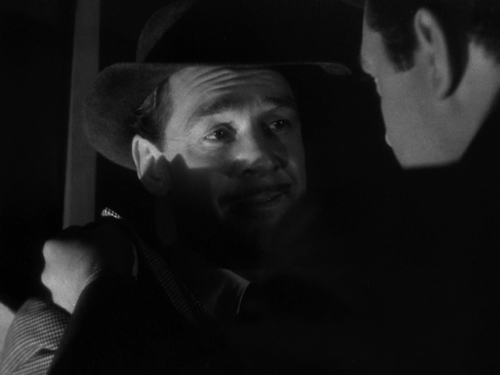
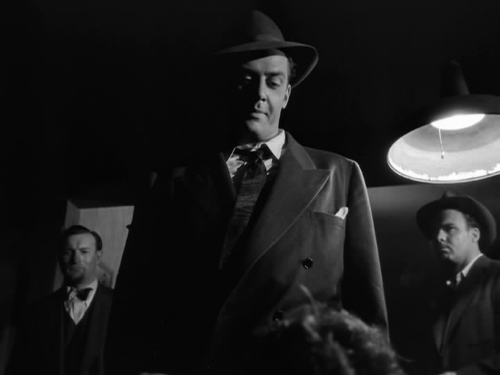
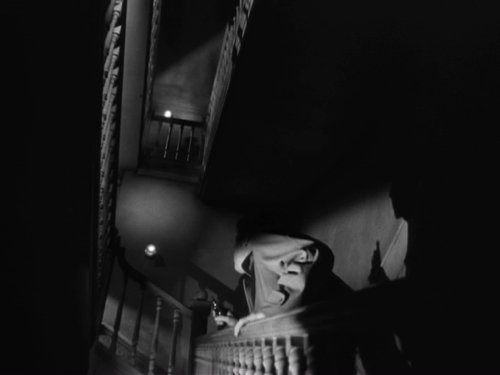
The tendency is to think of Anthony Mann’s films noir in terms of his work at Eagle-Lion in collaboration with cinematographer John Alton. However, Desperate was made for RKO and was shot by George E Diskant. Alton or not, Eagle-Lion or not, this is without question an Anthony Mann movie. Visually, it is inventive and disorientating – the beating of Randall, as the overhead lamp swings ominously like a blade slicing through the shadows as the hoodlums’ fists slice up the hero, has Radak dipping in and out of darkness like some malign bogeyman. Characters are frequently either squeezed by the frame or shot from unexpected angles, everything highly suggestive of people under pressure and facing circumstances that are fraught with peril and insecurity. Mann has a credit for the story, from which Harry Essex wrote the screenplay, and it is an incident packed affair. If anything though, the movie is probably overloaded with incident, something that becomes even more noticeable when one takes into account the brief hour and a quarter running time. That said, it does contribute to the sense of urgency of the production and perhaps could be seen as going some way toward explaining Randall’s questionable judgement on many occasions. Thematically too, there is much that we associate with Mann on display, notably the violence and brutality the characters must endure, and that typical sense of movement and direction, not so much forward as upward, that ever present striving to reach some high place, which in this case culminates in the shootout on the tenement stairway.

Steve Brodie was a perennial supporting player, a name and a face that will be familiar from countless movies and TV shows. That he never got the lead outside of Desperate is no slight on his acting abilities, he simply wasn’t the type physically to be cast in headline roles. What he had, however, was a recognizably everyman quality with the features and demeanor of a regular guy. As such, he was well chosen to play Steve Randall – it is easy to accept him as a man who can be worked over, one whose decisions will be flawed from time to time. Raymond Burr plays Radak as a relentless and driven figure, and Mann makes good use of his bulk, having him crowd and dominate the frame on multiple occasions. Audrey Long spends much of her time fending off a gnawing anguish and the script offers her little or no opportunity to do anything beyond that. In support, Douglas Fowley, another familiar face from countless movies as well as a recurring role as Doc Holliday on The Life and Legend of Wyatt Earp, is superbly seedy as an ill-fated private eye, while Jason Robards Sr playing the detached detective with the singsong delivery is unusual enough to make his relatively small role memorable.

Desperate came out on DVD from Warner Brothers on one of their later film noir sets and it looks very well. The films Anthony Mann made for Eagle-Lion from around this time draw more critical attention and their profile is correspondingly higher. I reckon the script is a little crowded and busy, but the movie is a good one overall with a strong sense of momentum and it stands as a solid example of the director’s noir work.

The Far Country

And so I come to the last western made by James Stewart and Anthony Mann, not the last they did together but rather the last one to be featured on this site. For a long time I tended to look upon The Far Country (1954) as the least of the Mann/Stewart westerns but, having been challenged on that view in the past, I asked myself to reassess it. On reflection, I feel my initial stance was both unfair and even lacked a certain logic – after all, there really is no such thing as a lesser Mann/Stewart western. I also think I know why I once undervalued the film, and it’s essentially for the same reason I was sightly ambivalent at one time about the collaboration between actor and director that never was: Night Passage. In short, the film doesn’t have what I can only term the sustained intensity of the other westerns these two men made. Yet to latch onto that aspect is to do the film a huge disservice; where the other films have that sustained intensity The Far Country has more isolated instances of it, and this actually fits the development of the plot and theme perfectly.

Perhaps the most noticeable motif in the films of Anthony Mann is the way his characters are forever driving themselves upwards, striving to attain a higher place and sometimes overreaching themselves in the process. In The Far Country Jeff Webster (James Stewart) is pushing himself further up the globe from the off, from Wyoming to Seattle and on to the north – the Yukon. Webster is a trail boss, a man with a herd of cattle to bring to market. That he’s a hard and uncompromising man is evident from the first scenes where it’s plainly stated that he shot and killed two cowboys who tried to desert him on the way – although it’s later revealed that the deceased had also planned to take his herd with them when they left. Webster’s partner is Ben Tatum (Walter Brennan), a man of milder temperament whose ambitions stretch only as far as a ranch in Utah and a plentiful supply of coffee. One would have thought that having got this far, the worst of their trials lay behind these two men. However, that’s not to be. Gannon (John McIntire) is one of those conniving opportunists one often finds in border areas – he’s a man who uses the law, his version of the law that is, to ensure all profits accrue back to him. He seizes on the chance to confiscate Webster’s herd on a legal technicality that’s little more than a whim. However, Webster is no fool and when he’s offered the job of leading saloon owner Ronda Castle’s (Ruth Roman) outfit into Canada he turns it to his advantage. While Gannon is under the illusion that Webster is content to try his luck in the Canadian gold fields the latter snatches his herd from under his nose and jumps the border. So all’s well that ends well? Not exactly – Webster is a hard-nosed individualist, one of those men who look after themselves and leave the others to their own devices. However, the move north sees that isolationist position challenged. New friendships are forged – Rube (Jay C Flippen) and more especially the freckle-faced tomboy Renee (Corinne Calvet) – and with those come obligations, something Webster has assiduously avoided thus far. As first Ronda and then later the malignant Gannon set their sights on a piece of the action in the lucrative gold fields, Webster is forced to take stock of his previous philosophy of exclusively looking out for number one.

The other Mann/Stewart westerns were mainly concerned with individuals haunted by their past, tales of revenge and redemption earned the hard way. The Far Country differs in the sense that the Stewart character isn’t a man directly dogged by a painful history. There is an allusion to a woman who wounded him emotionally, perhaps partially explaining his remoteness from those around him. However, there isn’t that sense of someone running from himself. Instead what we get is a representation of total detachment, a man who places self-interest above all else. For most of the movie Jeff Webster really isn’t all that nice a guy, he cares not a jot who gets hurt so long as his own interests are best served. And so the theme here is more one of renewal and rediscovery, setting it a little apart from the other revenge focused films. The Stewart character isn’t at war with himself, as so often seemed to be the case, although he is eventually forced to question his previous attitude. This is what, for me anyway, makes the film a bit different – the moments of intensity occur in brief flashes, at least until Webster’s hand is forced by Gannon’s cruelty. Of course the threat of brutality and abrupt violence that characterizes the Mann/Stewart westerns lurks just below the surface – it’s this (and also the warmth that springs from the feeling of community) which finally provokes Webster, and consequently allows him to get back in touch with his own humanity.

The Far Country gave Stewart the chance to display more of his trademark affability than his other westerns with Mann, though it remains of the slightly hard-edged variety. Those other films concerned themselves more with a reconciliation with the circumstances and situations arising out of a damaged past whereas here Stewart has to gradually come to terms with his own failings as a human being. As such, the characterization is quite different yet no less interesting. In place of a deep psychological trauma which colors his actions, Stewart has to confront an ingrained emotional detachment instead. The catalyst, as usual, is violence and humiliation, and the transformation – the path towards renewal – is no less dramatic.

Naturally, everything revolves around Stewart’s character, but there’s plenty of good support from a fine cast. Walter Brennan had the lovable old coot thing nailed down by this stage in his career, and his turn as the coffee-obsessed partner provides a nice counterpoint to Stewart’s coolness. Brennan is the human face of the pair, the one audiences can most easily relate to and feel sympathy for. Corinne Calvet fulfills a similar function; there’s an amusing sweetness to this ingenue of the wilderness, although it lessens her impact as one half of the romantic interest. Ruth Roman, on the other hand, is a knowing, worldly figure – she’s arguably a better match for Stewart’s profit-minded cynic, but loses some of her allure as Stewart later finds himself examining his motives and allegiances. She’s actually one of the most interesting figures in the movie, retaining a degree of ambiguity throughout. However, there’s nothing at all ambiguous about John McIntire’s Gannon – he’s the real villain of the piece and positively glories in his iniquity and callousness. McIntire, along with Brennan, was one of the finest character actors of the golden age and it’s a genuine pleasure to see him sink his teeth into a role like this. Anthony Mann clearly liked working with Jay C Flippen – he used him often in his movies – and gave him another good role in The Far Country as the kind-hearted Rube with a fondness for the whiskey bottle. Already were looking at a pretty impressive battery of seasoned performers but when you bear in mind that the film also found parts for Robert J Wilke, Royal Dano, Harry Morgan, Chubby Johnson and Steve Brodie it ought to give an idea of the depth of talent involved.

The Far Country has long been available on DVD and really is due an upgrade to Blu-ray by now. Early editions in the US presented the film open-matte, but later pressings were in the correct widescreen ratio. I have the UK DVD, which was always the widescreen version, and it looks pretty good. William Daniels’ photography of the beautiful Canadian locations looks terrific while colors and sharpness are quite satisfactory. As I said at the beginning, there was a time when I tried to rate the Mann/Stewart westerns against each other but that’s a pointless exercise really. Over time I’ve come to understand that all of these films are great in their own ways – to try to compare them or view them as competing productions is to pick away at their greatness, and I honestly don’t want to do that. I held off writing about this film for ages, and for reasons which may appear foolish to others. Although I’ve seen all the Mann/Stewart westerns countless times I kind of liked the idea that there was still another one I had yet to feature. I didn’t like the feeling that I wouldn’t have the chance to write about another one – I got that same sense when I finished writing up the Boetticher/Scott pictures too – so I kept putting it off. Anyway, there it is. These films are among the finest the western genre has to offer – maybe I won’t be writing about them again but I’ll surely enjoy watching them, and I wholeheartedly recommend them to anyone who has yet to experience them.

Winchester ’73

The Naked Spur

The Man from Laramie

Bend of the River

The Black Book

poster30_zps96df903b

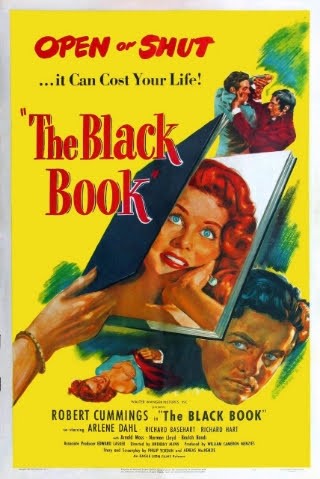
Recently, I’ve been watching a fair bit of film noir, and indeed mulling over and discussing exactly what does or does not constitute noir. And that brings me to a borderline case, a movie that flirts with the notion of film noir, has some of its recognizable characteristics, yet stops short of fully satisfying the criteria. The Black Book (1949) was among the handful of movies Anthony Mann made just before he embarked on his influential and complex cycle of westerns. The film is a historical piece, a mystery/espionage thriller whose visual style is pure noir but whose theme lacks the ambiguity to allow me to comfortably place it in that category.

1794 – France is gripped by revolutionary fervor and the Reign of Terror, presided over by Robespierre (Richard Basehart), is at its zenith. The series of bloody purges have led to an atmosphere of distrust, insecurity and instability. With Robespierre on the verge of absolute power, plans are afoot to overthrow him while there’s still time. But that time is short; within days Robespierre will have maneuvered himself into an unassailable position and the opportunity will have passed. Enter Charles D’Aubigny (Robert Cummings), an agent acting on behalf of the exiled and imprisoned Lafayette. D’Aubigny’s mission is to infiltrate Robespierre’s inner circle, by means of impersonation, and see that the voices of dissent are provided with the means to remove the would-be tyrant before he has them silenced forever. This task is both aided and complicated by two unexpected factors. Firstly, there’s the presence of Madelon (Arlene Dahl), D’Aubigny’s former lover and his principal contact with the anti-Robespierre faction. And then there’s the black book of the title: Robespierre’s death list, a sinister little volume containing the names of those marked down for execution as and when the whim strikes him. It’s this book which forms the basis of Robespierre’s power, it’s impossible to be sure whether one’s name is included and that uncertainty weakens any potential opposition. However, the book has gone missing and the hunt is on to retrieve it before a critical meeting of the ruling Convention. Whoever gains possession of the black book holds the balance of power – able to install Robespierre as absolute dictator or to destroy him completely.

£4

Personally, I feel The Black Book functions well as an allegory for the time it was made. WWII had ended a few short years before and the memory of the terror and slaughter was still fresh in the minds of everyone. It’s no great stretch to see the film as a warning against the dangers of dictatorship; even as the world had witnessed the end of one hateful regime another has risen up to take its place. The purges and sham trials depicted in the film bring to mind the repression and fear of the Stalinist eastern bloc. However, I think too that the critique of the cult of personality and the atmosphere of betrayal and backstabbing can also be viewed as a subtle reminder that even stable democracies can be manipulated by political opportunists under certain circumstances – the paranoia accompanying the red scare of the post-war years was already rearing its head in the US.

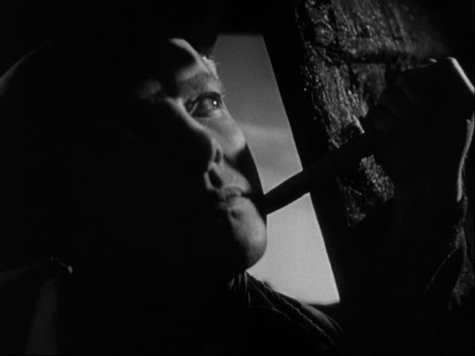
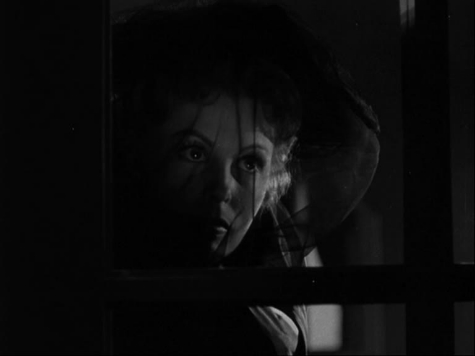
Anthony Mann built his reputation on his crime and noir pictures and that influence was carried through to a greater or lesser extent in most of his subsequent films. Thematically, his westerns continued to be psychologically complex even though the visuals (once he began to work in color) moved in a different direction. The Black Book, photographed by John Alton, is much more straightforward when it comes to theme and characterization. The hero is simply heroic; there’s no internal conflict struggling for dominance of the character and no sense that fate has the odds stacked against him. From the viewer’s perspective it’s always very clear who the good guys and the bad guys are, even if some of the motives aren’t quite so apparent. Still, the movie looks like a textbook example of film noir. Mann’s composition and Alton’s lighting create a dark and dangerous world for the characters to inhabit: high overhead shots suggestive of detachment, low angle ones bringing ceilings into focus and emphasizing a cramped, restrictive world, deep and impenetrable shadows slicing menacingly across faces or threatening to consume them totally.

£5

Robert Cummings is generally thought of as a lightweight lead and sometimes dismissed on those grounds. I’ve always liked his crime/mystery roles though  – The Chase, Sleep, My Love, Saboteur, Dial M for Murder – and have rarely found him disappointing. If anything, I feel his natural charm lends a touch of vulnerability to his characters. I have no complaints about Cummings’ performance in The Black Book, he handles the tense, suspenseful scenes well and is convincing enough when the need for action arises. Arlene Dahl is good too as the former lover who now has to work closely with the man she once abandoned. A rekindled romance does develop but it never has that tacked on feel that can make such plot devices tiresome. That this aspect works is largely down to Dahl, her coquettish insolence is both refreshing and attractive. Richard Basehart too is very effective as Robespierre; there’s a stillness and calm about him that becomes quite unnerving, only the glittering eyes hinting at the murderous zealot lurking within. As good as the leads are, Arnold Moss steals practically every scene he appears in as Fouché, the oily, Machiavellian politician who’s naked self-interest is a wonder to behold. In support, there are nice turns delivered by Charles McGraw, Beulah Bondi and Norman Lloyd.

For a long time the only way to see The Black Book was via ropey transfers of battered prints. However, Sony put out a MOD disc in the US that seemed to far surpass all previous releases. I never picked up that disc but when Koch in Germany announced their own pressed release of the title I decided to bite. I don’t know if the Koch disc is derived from the same source as the US edition but I can certainly say that I’ve never seen the movie looking better. There are isolated speckles but the print used is in pretty good shape and shows off Alton’s photography to very good effect. Additionally, this disc has the full, uncut version of the movie (as does the US MOD edition) restoring the censored scene that was absent from many of the earlier releases. There are no subtitles offered, just the original English soundtrack and a German dub. Having suffered through some appalling transfers of this film in the past, it’s a real pleasure to be able to see it looking crisp and clean. It may not be proper film noir, but any fan of that style of cinema should get a lot out of this movie – Mann and Alton present some stunning and memorable images. Bearing in mind there’s a satisfying and exciting story here too, I have no hesitation in recommending the film.

Bend of the River

bend-of-the-river1_zpshdbfrbte

You’ll be seeing me. You’ll be seeing me. Every time you bed down for the night, you’ll look back to the darkness and wonder if I’m there. And some night, I will be. You’ll be seeing me.

If you watch enough westerns, from almost any era, it soon becomes apparent that certain themes and subtexts crop up time and again. The one that I feel is the most constant, that seems to almost define the genre as a whole, is the concept of change. It literally pervades the genre: changes to the landscape, control of the country, the law, social organization, transport, the notion of freedom and opportunity, and so on. Of course some of these aspects either increased or decreased in popularity in relation to the time at which they were produced. So it’s no accident that the 50s, with that decade’s frequent meditations on the idea of personal redemption, should see a tendency to focus on changes in the hearts of men. Bend of the River (1952) concerns itself with atonement for the sins of the past and the desire to change the course of one’s life, along with the associated obstacles and prejudices that need to be overcome.

The Civil War has ended and the westward push is on, the drive to roll back the frontier and build something new and fresh. Over the opening credits a wagon train makes its way through the unspoiled beauty of Oregon. The settlers, headed up by Jeremy Baile (Jay C Flippen), are full of hope and a determined pioneering spirit. There’s a kind of wholesome enthusiasm that radiates from these people, and it’s reflected too in the man who’s guiding them, Glyn McLyntock (James Stewart). When he rides ahead to scout the trail we get the first indication that McLyntock isn’t the unsullied character his traveling companions believe. Topping a rise, he stumbles upon a nasty little scene in the clearing below. There’s a lynching in progress for a horse thief. Seeing as a man’s horse was often his most valuable possession and could mean the difference between survival and death in a hostile environment, frontier justice dictated that the rope was all one could expect for such a heinous crime. Still and all, lynching is a dirty little business, and it’s no surprise that McLyntock intervenes and saves the life of the condemned man. No, that in itself is entirely understandable – what is telling though is the reaction of McLyntock just before he draws his gun. His features register violent revulsion but there’s something of the hunted man that flashes briefly from his eyes. It transpires that the man at the end of the rope is Emerson Cole (Arthur Kennedy), a former border raider whose name is familiar to McLyntock. It’s soon revealed that Cole has also heard of McLyntock, both of them having been in the same line of business so to speak. While these two men with a dark past may have some things in common, there is one crucial difference. The devil-may-care Cole has no regrets about his actions whereas McLyntock is a deeply troubled figure, a man trying to bury his unsavory deeds and make a new beginning among people who trust him. When the wagon train rolls into Portland Cole and McLyntock bid each other farewell – Cole thinking only of how best to make his fortune while McLyntock is bound for the clean air and anonymity of the high country. However, these two are destined to cross paths again. The settlers need supplies shipped to them to see them through their first winter and have paid for delivery in advance. As is often the case though, circumstances change dramatically when greed rears its ugly head. A trip back to Portland sees McLyntock and Cole renewing their acquaintance. But theirs is an uneasy relationship, their friendship balanced rather precariously at all times. The shadows of the past are never far away, beckoning enticingly to Cole while pointing accusingly at McLyntock. On the run from new enemies in Portland, it remains to be seen how fast the friendship of these men will be, and whether McLyntock will be allowed to prove to his companions and himself that a man can truly change his ways.

bend-of-the-river2_zpspgtwuziy

Bend of the River was Anthony Mann’s second western with James Stewart, continuing what was to become a highly influential cycle of movies and further developing the persona of the tortured lead. One of the key visual motifs in Mann’s work was the continual striving upwards of his characters, the drive to rise above base instincts and cares. Although this feature isn’t quite as pronounced in Bend of the River as it is in some of his other movies, it is still there. The wagon train, and most especially McLyntock, view the mountain country as a kind of promised land where social and spiritual rebirth are possible. Irving Glassberg photographed the stunning Oregon locations beautifully, and the contrast between the crisp freshness and purity of the mountains is contrasted strongly with the darker, more restrictive and corrupt feeling of the town gripped by gold fever. The central theme of a man desperate for change and redemption is well handled by Mann, working from a Borden Chase script. Additionally, there’s a fairly complex notion of duality at work too. In essence, Cole and McLyntock are mirror images. The inevitable confrontation represents McLyntock squaring off against his own darker nature as much as anything else.

bend-of-the-river3_zps1bxsqtei

I think it’s impossible to overemphasize how instrumental Mann was in shaping James Stewart into one of the major post-war movie stars, although both Hitchcock and Capra had a hand in the process too. For much of the time Stewart is, superficially at least, in amiable mode, yet there’s always an unease there. This of course is entirely appropriate as his character is burdened by a tremendous sense of guilt and also a sort of slow burning dread that his past will be revealed and lead to his being rejected. As usual Mann managed to get Stewart to dig deep within himself and draw on his reserves. There are three notable occasions where Stewart’s consuming rage threatens to overcome him. The first is the momentary rush of emotion at the sight of the lynching. The next occurs when the rebellious laborers hired in Portland drop the full weight of a jacked up wagon on Baile – the startling intensity of Stewart’s fury rendering him speechless and inarticulate. However, it’s the final outpouring that carries the greatest impact. With the mutiny complete and Cole having shown his true colors, the emotionally distraught Stewart delivers those lines which I featured at the top of the article. Written down in black and white, they lack the power with which Stewart invests them in his cold, calculated and measured way. With his voice threatening to crack under the strain of maintaining self-control, no-one is left in any doubt that the gloves are off, the Rubicon has been crossed and there’s no going back.

Arthur Kennedy proved a splendid foil for Stewart; where Stewart was all inner conflict and suppressed emotion, Kennedy was a man very much at ease with his own villainy. However, that’s not to say his performance was one-note or lacking in nuance. He starts off as something of a rogue, but not an entirely unattractive one. It’s his innate greed and an inability to rise above his own self-interest that sees him develop into a fully fledged villain. As such, we don’t get the same shock as would be the case a few years later when Kennedy again teamed up with Stewart and Mann to make The Man from Laramie. Here, Kennedy’s character is clearly morally corrupted from the beginning and it’s only the extent that’s in question. The supporting cast in Bend of the River is a remarkably strong one starting with Julia Adams, Rock Hudson and the great Jay C Flippen. This was one of the star making roles for the rising Hudson, a vigorous, heroic part as the young gambler who signs on with the wagon train. Hudson’s good enough at what he’s asked to do, but really it’s not very demanding stuff and he makes only a limited impression. Julia Adams’ beautiful presence graced many a movie for Universal during the 50s and I always like to see her name in the credits. This film offered her a good part as the girl who initially falls for Kennedy’s charm before finally seeing him for what he is and switching her affections to Stewart. And there’s no shortage of familiar faces to add to the villainy ranged against Stewart – Howard Petrie, Royal Dano, Jack Lambert and Harry Morgan all put in good performances. And then there’s Stepin Fetchit, an actor whose characterizations remain controversial to this day. I think it’s worth noting that both Scott Nollen (whose latest book I reviewed last week) and Joseph McBride have interesting things to say about this performer, namely the way John Ford and he tried to actually subvert racial stereotypes in their work together.

I think Bend of the River is available on DVD pretty much everywhere these days – it’s certainly been out in both the UK and the US via Universal for many years now. The UK disc I have is a completely bare bones affair with nothing at all in the way of extra features. However, the transfer of the film is very good indeed, with excellent color and no print damage worth mentioning. In the past I’ve tried broadly rating or comparing the westerns that Mann and Stewart made together, but it’s essentially a pointless exercise. These are all strong and rewarding movies that can be watched repeatedly without losing any of their power or freshness. Let’s just say that this is one of the top-tier westerns from a great team and leave it at that.

I would just like to add a brief postscript here to let anyone who’s interested in such things know that this has been the 250th film which I’ve had the pleasure of writing about on this site.

The Furies

fur1

You’ve found a new love in your life, haven’t you Vance? You’re in love with hate.

In some earlier pieces I wrote about the westerns of Anthony Mann, the matter of the order of production of his first few efforts came up. One of this site’s regular visitors, Blake Lucas, was kind enough to clear up what is often a confusing issue. Anyway, in connection with that, we also touched on the evolution of Mann’s style as he settled into his western period. The Furies (1950) was his second foray into the genre, and it seems to me at least that the film bears the hallmarks of a transitional picture. Mann started out making noir thrillers, and polished, highly regarded ones at that, before changing tack and moving west. His first three westerns, partially as a result of the use of black and white photography, retained some of film noir’s mood and sensibilities. The Furies is a very dark film, visually and thematically, yet suffers from a fault that shouldn’t be all that surprising when we consider its place within Mann’s filmography. I think it’s fair to say the director hadn’t fully found his feet in the genre, the upshot of which being a film that’s something of a mash-up of genres and styles, perhaps a reflection of a filmmaker who had not fully decided on the direction he wanted to follow.

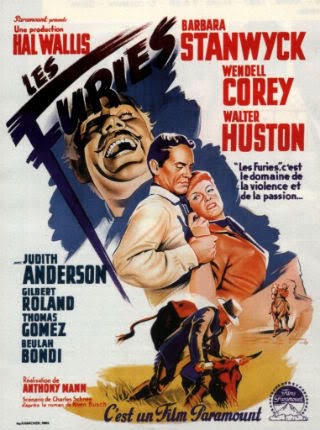
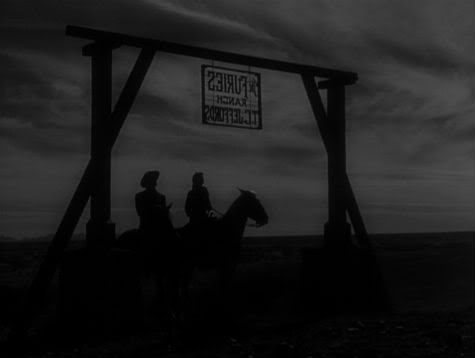
The Furies is a ranch, a vast New Mexico spread presided over by the flamboyant T.C. Jeffords (Walter Huston). Jeffords is one of those self-made men so common to the western, a latter-day empire builder who has stamped his authority on the section of the frontier that he seized, tamed and held. Such men are frequently given to expansiveness in word and gesture, I guess we could say they earned the right, yet are also prone to all the petty weaknesses that afflict lowlier individuals: jealousy, vanity, loneliness and greed. Of these, perhaps vanity is the most treacherous, for powerful men have the means and ruthlessness to indulge it. Tellingly, Jeffords has a grand portrait of himself dominating the entrance hall of his home, and sits in his study flanked on one side by a bust of Napoleon and on the other by his own likeness. He’s lord of all he surveys, even going so far as to issue his personalized local currency. But a man like this can only extend his authority so far, and in Jeffords’ case the one person capable of challenging him is his daughter. Vance (Barbara Stanwyck) is a wilful and headstrong young woman, cast in the same reckless mold as her father. She is first seen, on the eve of her ineffectual brother’s wedding, brazenly trying on her late mother’s gown in the bedroom her father has forbidden all to enter. There, in a nutshell, we have a neat summation of the relationship between Vance and Jeffords; she has, to all intents and purposes, taken on the role of her departed mother. However, any such relationship is fundamentally flawed for the simple reason that the parties involved must naturally look outside for genuine fulfillment. In Vance’s case it appears that she is drawn to the roguish Mexican, Juan Herrera (Gilbert Roland), who has been a squatter on the Furies from way back. Still, this isn’t a tale where anything can be taken for granted, and it turns out that another man is vying for her affections. Rip Darrow (Wendell Corey) is a professional gambler with a grudge against Jeffords based on the dispossession of his family. If Jeffords feels some dissatisfaction at his daughter’s choice of suitors, it’s as nothing compared to the violent dislike she feels for the woman he brings into their home. Flo Burnett (Judith Anderson) is a self-confessed adventuress, trading her political influence for a share of Jeffords’ wealth. Such a charged situation is almost bound to tip over into violent confrontation, and does so in highly melodramatic fashion. A memorable and disfiguring assault with a pair of scissors leads to a hanging, and the die is cast. Father and daughter are pitted against one another in a struggle for ultimate control of the Furies.

£6

The Furies derives from a novel by Niven Busch and, like Pursued and Duel in the Sun, mixes in a lot of dark Freudian themes. Personally, I like this kind of stuff but I guess it can come across as a little too ripe for some tastes. The confused relationships that constitute the core of the story are all based on a warped blend of love and hate that reach near mythical proportions. Of course the title itself has its roots in the classical myths – the Furies being the three snake-haired goddesses charged with handing out punishment and retribution – and is highly appropriate given the personal trials all the main characters are destined to suffer at one another’s hands. I think Busch is probably the most melodramatic writer to work within the western genre, but this quality works well enough with films of the period. It also tended to attract directors who had experience of film noir and the kind of off-centre psychology that such pictures often dealt with. Anthony Mann’s noir roots are very much in evidence here, with an abundance of low angle shots picking out ceilings in the interiors to emphasise the tense and restrictive aspects of the story. There’s also an unremitting darkness about it all; much of the action takes place either at night or in the half-light of dusk or dawn, with figures frequently shot in shadow or silhouette. I see this film as a hybrid noir/melodrama/western, a halfway house for Mann if you like. Still, there are plenty of examples of the visual motifs he would later develop as he grew more comfortable with the genre. He draws attention to the stark, barren landscapes dominated by rocks. And then there’s the trademark focus on high places and the struggles that take place there. The film’s key scene, where Jeffords and Vance’s fates are sealed, occurs during the siege of the Herrera home high atop a forbidding rock formation.

The Furies really showcases the talents of both Walter Huston and Barbara Stanwyck. Huston had a distinguished career on both stage and screen and this was to be his last role – he passed away shortly after completing the film. As it happens, the part of T.C. Jeffords was a fitting one to sign off on. Huston drew on all his vast experience to give a well-rounded portrait of a complex man. Jeffords is neither hero nor villain; he’s capable of hanging a man out of pure spite, of blackmailing another to achieve his ends, yet he’s also charming, resourceful and philosophical enough to accept his own limitations. Even though we see him behave selfishly and ruthlessly towards those who cross him, it’s impossible not to admire him and feel sympathy too. In short, Huston presented the viewer with a flesh and blood man, a real person whom we ultimately judge on those terms.

£7

Stanwyck too got her teeth into the part of Vance, and transformed what initially seems something of a caricature into a woman the audience could respect. As someone who could move easily in both the noir and western worlds, Stanwyck was ideally cast. You never feel there’s anything affected about her toughness, and her rage, when provoked, is as raw and livid as the disfiguring wounds she leaves on her rival. Gilbert Roland didn’t have a huge part in the movie, but it is a significant one in relation to the plot. I’ve always enjoyed the swaggering, swashbuckling machismo that came naturally to him, and as Juan Herrera he had ample opportunity to show that off. He also brought a real sense of dignity to his character, especially as prepared to meet his fate. When I looked at Pursued, I commented on how well Judith Anderson handled herself. The Furies saw her taking on an entirely different character and she demonstrated just how versatile she could be. Flo Burnett starts out as someone whose obvious insincerity does grate, but the transformation she undergoes, as a result of her physical trauma, is well realized. By the end, she commands your sympathy. In the midst of all these strong performances, Wendell Corey suffers somewhat. He was never the kind of actor to grab the attention at the best of times, possessing a quiet, understated quality, and I’m not sure westerns were his ideal environment. Mind you, it doesn’t help that he had to play a pretty obnoxious character whose cocksure smarm feels a little misplaced. In addition to the leads, there were nice supporting turns from Albert Dekker, Thomas Gomez and Beulah Bondi.

The Furies is out on DVD in the US from Criterion, and it’s one of their usual, very professional packages. The image is in good shape, although I have seen more sparkling transfers from the company, but it does have one irritating issue. Criterion went through a stage of issuing Academy ratio movies in pictureboxed format (essentially, a black border running around all four sides) supposedly to compensate for overscan on CRT sets. I never liked this practice; the gain is minimal, the resolution is lessened, and the whole idea is increasingly redundant as HD and HD ready sets become more common. In terms of extras, this is a pretty stacked edition. Firstly, the movie comes in an attractive slipcase that also includes a copy of Niven Busch’s novel. Then there’s a 36 page booklet containing an article on Anthony Mann by Robin Wood, and a translation of an interview with the director carried out for Cahiers du Cinéma by Charles Bitsch and Claude Chabrol. On the disc itself, the highlights are a commentary by Jim Kitses, a 1967 interview with Mann, a 1931 interview with Huston, and a video interview with Nina Mann, the director’s daughter. As I said earlier, I regard The Furies as the work of a director in transition. I hope that doesn’t appear to be a negative assessment of the film as there’s a lot to admire in it. Still, I do feel I ought to point out that the blending of styles isn’t always as smooth as it could be. Overall, I think the performances and visuals carry the day and point towards even more accomplished work to come. Even if it’s not Mann’s best movie it makes for interesting and rewarding viewing.


The Tall Target

I’ve mentioned before that I’m a big fan of thrillers taking place in isolated or self-contained settings such as old dark houses, ships or trains. The restrictions necessarily imposed are a marvelously effective way of maintaining focus, both for the filmmakers and the viewers. It also makes for effortless suspense as the options open to the characters involved are narrowed down, and a tense, claustrophobic atmosphere is easily achieved. The bulk of the action in The Tall Target (1951) takes place on a train, and the movie uses this cramped stage to enact its dramatic events to great advantage. What makes the film all the more impressive in my view is the fact that there’s not much of a mystery to solve. Nevertheless, what unfolds on the screen holds the attention from beginning to end.

The story is one inspired by a real event – a plot to assassinate Lincoln before his inauguration coud take place. It’s 1861 and the president-elect is due to make a short stop in Baltimore, Maryland before heading on to Washington to take power. Naturally, these are troubled times and talk of secession and war is on everyone’s lips. With Lincoln’s elevation to the highest office in the land it’s only a matter of time before the South declares independence, and war has to be the next logical step. As such, there are those with a vested interest in seeing that the man never gets to Washington. John Kennedy (Dick Powell) is a detective who feels sure he’s stumbled onto a plot to assassinate Lincoln as soon as he sets foot in Baltimore. The problem is no-one wants to believe him, and his chief even goes so far as to threaten him with dismissal if he insists on pursuing the matter. Unfazed by this stonewalling, Kennedy turns in his badge and hotfoots it to the station. His intention: to board the Baltimore train, foil the conspiracy and discover the identity of the ringleaders. However, he immediately hits a snag; his contact, along with his ticket, has disappeared and someone else is claiming to be the real John Kennedy. A quick inspection reveals that the detective’s friend has been murdered, but there’s no way he can prove this. Such an inauspicious start would give most men pause for thought, but Kennedy is nothing if not resourceful and he turns to an acquaintance to back him up. Colonel Jeffers (Adolphe Menjou) is the one man aboard the train who can identify Kennedy and vouch for his credentials. So the soldier and the policeman form an uneasy alliance – Jeffers is no lover of Lincoln’s politics – in the hope of flushing out the would-be killers. The list of suspects is a relatively short one: Jeffers himself, a blowhard industrialist (Will Wright), a young brother and sister apparently traveling on to Georgia (Marshall Thompson & Paula Raymond). Although the villain’s identity is revealed around the halfway mark, I’m not going to spoil things for any people who have yet to see the movie. Anyway, that’s not the point of the film. The greatest anxiety is generated by the doubts over whether Kennedy can prevent the assassination from taking place. Now anyone with even the most rudimentary knowledge of American history knows the answer to that one, but where the script really triumphs is in its ability to leave you hanging on the edge of your seat in spite of this.

Although Anthony Mann had already embarked on his western phase by this time, The Tall Target harks back to the tight little noir thrillers with which he had made his name throughout the preceding decade. Instead of the wide open spaces of the frontier where the drama was played out against a harsh landscape, this film is a closed affair that was shot on sound stages. The actors don’t have a lot of room to move around freely, and that’s entirely fitting for a story where the characters’ capacity for manoeuvre in any sense is severely limited. There are also a lot of typically disconcerting low-angle shots and close-ups of strained faces. Mann seemed to be blessed with good cameramen through most of his career, and Paul Vogel did some excellent work on this movie. Vogel had already shot a number of noir pictures – Lady in the Lake, High Wall, Dial 1119 – and brought that sensibility to The Tall Target. This couldn’t be termed a film noir yet it has the look and feel of one. What we get is primarily a suspense thriller, and it’s a combination of good writing and characterization, as well as atmospheric direction and photography, that ensures it remains gripping. When Kennedy finds himself facing the twin dilemma of being pursued by both the assassins and the suspicious authorities, Mann gets a lot of mileage from such a simple setup as the search for a berth to hide in. Time and again he draws the maximum degree of tension from situations that the viewer knows deep down are going to be resolved favourably. It’s no mean feat to deftly turn potentially trite circumstances into something that has you biting your nails – in fact, I’d say it’s one of the factors which sets the artist apart from the mere journeyman.

Compared to the kind of stuff he’d been doing before, Dick Powell took his career in a completely different direction when he was cast in the role of Marlowe in Murder, My Sweet in 1944. I like the way he worked on the tough guy persona in the following years and carved out a little niche for himself. The Tall Target was one of his last cinema roles before he turned his attention to directing and TV, and he handles the part just fine. Playing a professional detective meant he had to do a bit of a balancing act, conveying the increasing desperation of a lone cop in a race against time yet still keeping just the right side of panic. He got some excellent support from Adolphe Menjou as the newly commissioned colonel. He adds some of his trademark polish to his performance and has the kind of ambiguous quality that helps round out his character. Will Geer brought a lightness of touch to the part of the frustrated conductor, and it’s a welcome contribution amid all the severity. I was also impressed by the sensitivity that Ruby Dee displayed as the slave girl torn between loyalty to her owners and a natural sympathy for Powell’s cause. Paula Raymond and Marshall Thompson were less effective, the former having the misfortune of being handed pretty much a nothing role, while the latter just seemed wooden. To be honest, I’ve never been all that taken with Thompson in anything I’ve seen him in; he always appeared too stiff and repressed for my liking. The cast was filled out with a whole host of character actors who should be familiar faces, including Florence Bates, Will Wright and Percy Helton.

To the best of my knowledge, the only DVD of The Tall Target is the MOD disc available via the Warner Archives. The transfer on that disc isn’t bad; it doesn’t appear to have had any work done on it but it’s in reasonable condition. There are the usual cue blips and the like to be found on unrestored movies though the image is satisfactorily sharp. With MOD discs you generally don’t get any extra features, but this one has the trailer included. I’m a great admirer of Anthony Mann’s work and The Tall Target is a good, solid effort. It has to be said that it’s neither as famous nor as complex as his best films. The lack of complexity shouldn’t be taken as any criticism of Mann, that’s just the way the characters are written, but it may partly explain why it’s not better known. Anyway, it’s a finely crafted little thriller that moves at a good pace and offers plenty of entertainment value. I have no complaints.

The Man from Laramie

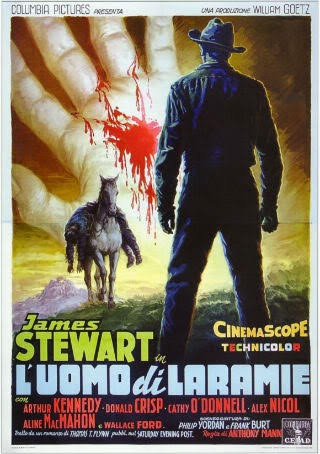
In 1950 James Stewart and Anthony Mann embarked on a series of groundbreaking and influential westerns that would play a significant role in shaping the evolution of the genre. Mann’s visual and narrative sense, honed by years spent producing tight and economical noir thrillers, and the painful angst that Stewart seemed to tap effortlessly into following his wartime experiences combined to push the western in new and exciting directions. Within five years though, this rich partnership had run its course and both men would go their separate ways. The Man from Laramie (1955) was to be the last picture they completed together, and it both built upon and expanded on the themes explored in their earlier collaborations. All of Mann and Stewart’s films exhibit a powerful intensity in the characterization, but The Man from Laramie adds a touch of violent sadism to the mix to achieve an even more potent result.

Once again we have a saga of a man seeking revenge, recompense for a loss he has suffered at the hands of others. Will Lockhart (James Stewart) is the titular character, a man whose real background is only revealed gradually throughout the course of the story and never fully even by the end. He’s first seen hauling a load of freight from Laramie to the small town of Coronado, but a brief stop on the way lets us know that his real purpose is something else. This short, early scene is a fine example of how a skillful filmmaker can impart vital plot details economically and with resorting to dialogue-heavy exposition. We’re shown Lockhart wandering round the burnt out remains of an army patrol that was ambushed and massacred by the Apache. All this information is gleaned from the visual clues and the telling use of some music cues. The way Lockhart gazes wistfully at the charred hat of a fallen soldier makes it clear that the events which unfolded at that lonely spot have some deep, personal significance for him. In time, it’s revealed that Lockhart’s younger brother was among the slain, and his reason for coming to Coronado is to find the man or men who brought about his death by supplying the Apache with repeating rifles. Before he can make any progress with his investigation, he finds himself drawn into conflict with the most powerful man in the territory. An unexpected and violent encounter with Dave Waggoman (Alex Nicol), the petulant and vindictive son of a local rancher, appears to temporarily distract Lockhart from his primary goal. However, as he’s drawn deeper into the complex relationship between Dave, his father (Donald Crisp) and top hand Vic Hansbro (Arthur Kennedy), it begins to dawn on Lockhart that this curious family arrangement may be connected to his own quest. Again in a 50s western, there’s an examination of the father/son dynamic and how men interact with other men. Alongside all this, there’s the inclusion of quasi-religious symbolism through the suffering and humiliation Lockhart has to endure – being bound and dragged through flames, and then the brutal mutilation of his hand that invokes overtones of crucifixion and the stigmata.

Philip Yordan and Frank Burt’s screenplay is beautifully constructed, with three strands playing out simultaneously and then folding neatly together to form the whole. Lockhart, Vic and Dave are all essentially men in search of some anchor in their existence, all homeless creatures to some extent. Lockhart never says where he comes from, claiming that home is wherever he finds himself; Vic has been taken in by old Alec Waggoman and treated like a surrogate son, but he’s aware that he’s an outsider and never quite comfortable or sure of his place in the world; and Dave is the overgrown boy who knows in his heart that he’s fallen far short of his tough father’s expectations. For both Lockhart and Vic, there appears to be the possibility of salvation or some grounding in the person of Barbara Waggoman (Cathy O’Donnell), but Dave is essentially a lost cause. These three also share a common character trait in that all of them are given to extremes of emotion under the right circumstances. At various times during the picture we get to see all of these men driven into situations where their balance is tested, and ultimately their ability or lack of it to rein in their feelings is the factor which will determine who emerges victorious.

Anthony Mann’s typical motifs are again in evidence in The Man from Laramie, particularly the idea of characters climbing and driving themselves to ever higher places. The structure of the movie follows this pattern, with the early scenes played out in the lowlands (especially the salt flats where Lockhart has his initial run in with Dave) before reaching its climax high among the barren rocks. Mann used this visual metaphor time and again to indicate both the struggle of his characters to reach up for something just beyond their grasp and to let the audience know when the point of redemption has been achieved. It also has the effect of distancing the men from the mundane, seeing them rise above the everyday concerns to do battle in lofty and remote locations. In fact, almost all the significant confrontations take place in isolated spots (the exception being the brawl in Coronado) which emphasises the private nature of their conflict. Mann, with cameraman Charles Lang, makes the most of both the New Mexico locations and the CinemaScope lens to blend character and landscape into a tough, lonely vision of the west. The only concessions to civilization come in the interior scenes in the homes of Barbara and Kate (Aline MacMahon), where the feminine influence softens the ruggedness that dominates elsewhere.

The Man from Laramie saw James Stewart taking another turn around the darker corners of his own personality. Where The Naked Spur had him portray a man filled with self-disgust at what he had become, this movie concentrates less on the negative aspects of the character. Lockhart is another lonely and driven figure but the anger and hatred that simmer just below the surface aren’t directed inwards. As such, this is a more straightforward and traditional characterization, albeit an especially intense one. The sudden outbursts of violence that punctuate the movie act as the trigger that sees Lockhart’s emotional balance tilted. I don’t know what demons Stewart let loose at these moments but the result is certainly mightily effective on film. There’s something quite startling about the way his eyes take on a desperate, maniacal cast and his voice fails him at these moments. In the middle of the brawl with Dave and later when his hand is mercilessly maimed, Stewart almost appears a man possessed. In contrast, Arthur Kennedy starts out as a much more composed character, tough but always in control. However, as the story progresses, and the pressure on all concerned mounts, cracks begin to appear too. Kennedy was playing a man who was much more self-absorbed than Lockhart, yet an equally volatile one given the right circumstances. He’s very good at channeling the kind of guilt and shifty paranoia that’s entirely appropriate for a character deeply uncertain about his position in life. No matter how many times I watch the film I can never make up my mind about Alex Nicol’s Dave. At times I feel he’s indulging in a piece of shouty overacting, and at others I’m convinced he’s really nailed the spoiled and perverse nature of his character – an odd yet interesting performance. Donald Crisp was a seasoned old pro who could handle a part like the aging and weakening Alec Waggoman in his sleep by this stage in his career. And now to the women in the movie: Aline MacMahon and Cathy O’Donnell. The former takes on the maternal duties in the film, ministering to men who have been damaged both physically and psychologically. O’Donnell, on the other hand, represents what would normally be termed the love interest, but this isn’t much of a romance. The only love that’s on view is the rough paternal kind that has warped both Vic and Dave. I think the roles of both MacMahon and O’Donnell, whose spinster lifestyles mirror each other, exist mainly to emphasise the emptiness of lives wasted waiting on men who are unattainable.

The UK DVD of The Man from Laramie from Columbia/Sony has been on the market for a long time now. The movie is presented in anamorphic scope and it’s a reasonable enough transfer, but a revisit wouldn’t hurt as I feel the colour can be a little inconsistent at times. The film saw Stewart and Mann’s partnership end on a high note and it’s one of the best of their collaborations. Some may claim it is their strongest work together, but I’m undecided. I still feel that The Naked Spur is difficult to surpass – it’s a tighter story, smaller and more self-contained, with greater depth and realism to Stewart’s character. Nevertheless, The Man from Laramie remains one of the great westerns to come out in the 50s and it’s capable of standing shoulder to shoulder with any of its rivals. It’s a fantastic piece of work, rich in drama and complexity, that never loses its appeal and encourages analysis. Very highly recommended.

The Naked Spur

Anthony Mann and James Stewart – one of the three great director/actor partnerships (the others, of course, being John Ford and John Wayne and Budd Boetticher and Randolph Scott) that made such an impact on the western and how it was to develop. The importance and the legacy of their collaborative body of work is undeniable; I think it’s safe to say there’s consensus on that. A thornier issue, or at least a more subjective one, is attempting to settle on their best work. When it comes to Stewart and Mann I reckon a case could be made for any one of their westerns – although I do feel that The Far Country is probably the least of them – which is a testament to the consistency of their quality. However, having given it a good deal of consideration, I feel The Naked Spur (1953) just about gets its nose in front. There are two major, interdependent, factors for this: the obsessive and relentless tone that never lets up, and a lead performance by Stewart that I can only describe as magnetic in its intensity.

That this is going to be a dark and tense affair is evident right away as Bronislau Kaper’s moody score plays over the blood red credits. A solitary rider slowly dismounts and ever so cautiously picks his way towards some target he’s spotted up ahead. This is Howard Kemp (James Stewart), a man who’s been doggedly pursuing a wanted murderer all the way from Kansas. On this occasion he doesn’t have his man, it’s merely an old prospector, Tate (Millard Mitchell), he’s stumbled upon. However, the two men strike a bargain to track what may be Kemp’s quarry. Before they can run down their man though they’re joined by another traveller: a flashy young man, Lt Anderson (Ralph Meeker), who’s just been drummed out of the army with a dishonourable discharge. Immediately, the viewer is caught a little off guard as there’s no clearly identifiable hero figure: Kemp is a driven, secretive man who’s exhibiting signs of instability; Anderson is a vain, amoral criminal; and Tate is a sly opportunist. When we finally see the fugitive, Ben Vandergroat (Robert Ryan), he’s all smiles and affability, and he’s even got a beautiful young girl called Lina Patch (Janet Leigh) as company. Who are we to root for here? As the story progresses it does become clearer where our sympathies are being drawn. Nevertheless, at no point does it become a simple black hat vs white hat exercise. Apart from one short skirmish with a party of faceless Blackfeet, it’s these five, disparate characters who dominate proceedings as they trek across a breathtakingly beautiful landscape towards Kansas. The real conflict of the picture is contained within this tight group, and more specifically within the heart of Howard Kemp.

Anthony Mann’s direction is tight as a drum, never slackening the pace for more than a moment or two at a time and maintaining the high pressure atmosphere right to the end. He keeps the viewer on edge throughout with a bombardment of disorienting high and low angle shots and extreme close-ups, yet intersperses these with enough long range views to ensure that the geography of the action remains apparent. Even here though, where William C Mellor’s camera showcases the natural beauty of Colorado, the binding together of the five travellers is highlighted – simultaneously dwarfed by the towering mountain backdrops and still hemmed in by their need keep each other as close as possible at all times. There are also examples of what Jim Kitses refers to as Mann’s visual motif of a man straining to scale a high place. Kemp is the one who struggles, and fails initially, to reach that higher ground. By the end he succeeds, he’s no longer overreaching himself and consequently achieves the redemption he’s been searching for all along.

It’s the redemptive quest that marks The Naked Spur out as a genuine classic western, but what ensures its successful execution is the power of James Stewart’s performance. Stewart’s wartime experiences gave him a quality that’s very difficult to define but very easy to discern. He could still draw on and display the old geniality of his earlier years, yet there’s an edge there too. His eyes could suddenly fill up with doubt and paranoia, and that “aw shucks” drawl could just as easily strangle itself into a choked stammer. Both Anthony Mann and Alfred Hitchcock got him to tap into this and coaxed performances from him that are almost painful in their honesty. Stewart’s Howard Kemp is a real three dimensional character, a man who marched off to war to do his duty yet finds that in so doing he has ended up at war with himself. He’s driving himself to reverse the mistakes of the past while also loathing the kind of man he’s forced himself to become in the process. In contrast, Robert Ryan’s Vandergroat is a man at peace with himself; he knows he’s no good, he feels no regret for his past actions, and has no hesitation in turning any situation to his own advantage. Ryan was usually best when he was bad, and in this movie he turns on the charm as the unscrupulous student of human weakness to whom manipulation is second nature.

It’s always disappointing when a top movie is handed a less than ideal presentation. The R1 DVD of The Naked Spur from Warner Bros is not a terrible transfer, but it is weak. Clearly, there was no restoration done on this title, and while there isn’t any significant print damage visible there is a softness and lack of detail in the image. These muted visuals are especially noticeable in the long shots. Extras on the disc are confined to a couple of shorts and the theatrical trailer. Anyway, I feel this film remains the pick of the Mann/Stewart westerns, although that’s not to be taken as a criticism of the other films they made together. I’d just place it at the top of an already highly elevated group of films.