The Blue Gardenia

poster128

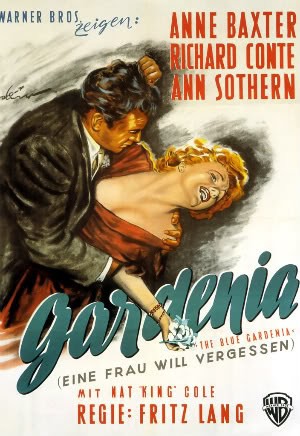
There are lots of sub-categories within film noir, and one of my favourites is what is sometimes termed nightmare noir. Fritz Lang’s The Blue Gardenia (1953) fits this description by presenting a protagonist whose world gets turned upside down after making one ill-judged decision. This kind of story offers all sorts of opportunities for some of the staple ingredients of noir – paranoia, suspicion, the idea that bad luck is waiting just around the corner, and the fact that the course of one’s life can hinge on something as simple and inocuous as a mix up over a phone call.

Norah Larkin (Anne Baxter) is a switchboard operator who leads a fairly humdrum life, sharing an apartment with two other single women and biding her time till her lover comes back from Korea. However, it doesn’t take long for things to start to unravel and for life to hand her the first in a series of unexpected kicks in the teeth. She’s just bought herself a new dress, cooked a special meal, and plans to sit down and share it with her absent G.I. boyfriend. So, with his photo propped in front of her, she opens his latest telegram and starts to read. It’s a brush off, he’s met a nurse, fallen in love and plans to marry her. Norah is naturally distraught and more than a little bitter, so when she takes a call meant for one of her flatmates she makes that one bad decision. On the rebound, she agrees to a date with the slightly sleazy ladies man Harry Prebble (Raymond Burr). During the course of dinner Prebble ensures that Norah gets well and truly tanked on cocktails before taking her back to his apartment. When he starts to get a little too friendly, Norah struggles with him but quickly blacks out. On awakening, she finds Prebble dead on the floor, his head smashed in with a poker. Panicking, and with only the haziest of memories of what went before, she flees the scene of the crime but leaves a few clues behind. The rest of the movie involves Norah’s attempts to evade the law, while playing a cat and mouse game with smooth newspaperman Casey Mayo (Richard Conte). The only real problem I had with the film was the fact that the element of doubt doesn’t really work for the viewer. While Norah and the characters around her cannot be sure of her guilt or innocence, it’s fairly clear to us. For this kind of story to work properly it’s preferable if the viewer experiences the same level of uncertainty the lead feels.

£14

Anne Baxter takes centre stage as the haunted and hunted Norah, and does a pretty good job of conveying her mounting sense of paranoia and isolation without resorting to histrionics. Richard Conte is reliable as usual in the role of the reporter who has his doubts. Raymond Burr was still at that stage of his career where he seemed to play nothing but heavies, but he did it well and his Harry Prebble has a nice touch of the sinister about him. However, while those three turned in fine performances, the picture really belongs to Ann Sothern. Her sassy turn as Norah’s seen-it-all-before flatmate is the highlight, and she walks away with just about every scene she appears in. Lang’s direction is as classy as one would expect, and the themes involved are right up his street. He seemed to have a thing for artists and reporters, and both play a prominent part here – although his most biting critique of the media, the ascerbic While the City Sleeps was still a few years down the road. There are strong noir credentials throughout the movie with Vera Caspary (Laura) providing the source material and Nicholas Musuraca working his magic behind the camera – the shadowy shots of the deserted newsroom at night being especially atmospheric.

The R1 DVD from Image is generally quite good, although there are a few damage marks here and there. It’s a totally barebones disc but should be available fairly cheap. The Blue Gardenia was originally distributed by Warner Brothers but is thankfully no longer controlled by them – I couldn’t imagine writing that just a few months ago, but this is the kind of film that might well be consigned to the appalling Archive programme now. All in all, it’s a fine noir that I’m happy to recommend.
 

The Woman in the Window

poster13

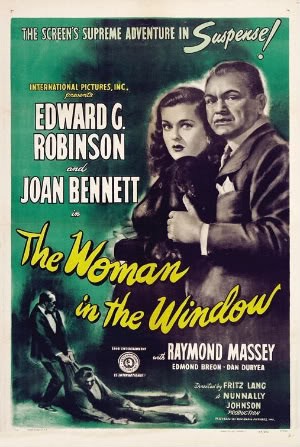
In many ways Fritz Lang’s The Woman in the Window (1944) plays like a dress rehearsal for his production of Scarlet Street the following year. Both films feature the same three stars – Edward G Robinson, Joan Bennett and Dan Duryea – and tell the story of a married, middle-aged man whose chance meeting with a young woman leads him into a vortex of murder, blackmail and ruin. However, where Scarlet Street is relentlessly grim, The Woman in the Window is a paler shade of noir – and not just because of its ending.

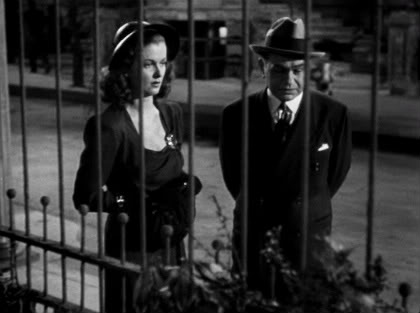
Richard Wanley (Robinson) is an assistant professor at a New York college whose wife and family have gone off on a trip, leaving him to his own devices. After an evening spent at his club with a couple of friends, including the District Attorney (Raymond Massey), he pauses on his way home to admire a portrait of a woman in the window of an adjacent art gallery. As he’s gazing through the window, the subject of the portrait, Alice Reed (Joan Bennett), appears by his side and, one thing leading to another, he ends back at her apartment. Up to this point everything seems innocent enough, but the abrupt and violent arrival of Reed’s lover sends the situation spiralling out of control. Although Wanley is left with no alternative but to kill his assailant out of self defence, he is also aware that his story is unlikely to be accepted and, even if it is, his life will be ruined. The solution – dump the body, destroy all the evidence and make like it never happened. Naturally, all of Wanley’s well laid plans start to unravel before his eyes as the police investigation starts to build up a body of forensic evidence that may soon cast suspicion on the hapless professor. The greatest danger, however, is posed by a shady ex-cop (Dan Duryea) with blackmail on his mind. The plot builds inexorably towards a suitably downbeat climax, yet this film has one last sting in its tail. I won’t spoil things for anyone who hasn’t seen this, but suffice to say that this ending has led some to question the noir credentials of the movie. Personally, I don’t share this view but I can see why it remains a bone of contention with some.

£37

As I said above, The Woman in the Window comes off as a lighter form of noir than Scarlet Street, and a good deal of this, aside from the ending, comes down to the portrayal of the characters. It is much easier to sympathise with Robinson’s character here, somehow his decisions, while questionable, seem more understandable. Bennett, too, is much less repugnant than would be the case in Scarlet Street. She is clearly a kept woman and a femme fatale, in the sense that she leads the protagonist into a dangerous, doomed situation, yet her motives are neither malicious nor wholly selfish. It’s only Dan Duryea, in another trademark role as a smirking villain, who fails to endear himself to the audience. There was something about the man – I think it relates to the casually mocking note in his voice – that led to his being typecast in such parts. There’s lots of noir imagery on show with a good deal of the action taking place at night and on rainy city streets. One recurring motif throughout the film is the number of shots which follow events through a series of open doors, symbolising (I suppose) the characters’ deepening crisis. The more I watch and re-watch Lang’s American films, the higher he grows in my estimation – I’d definitely rank him up among my top five directors.

The film was released on DVD last summer, along with a few other noir titles, by MGM in R1. The disc is totally barebones but the transfer is very good, maybe a little soft. There is a R2 available from Spain (I’m not sure about other countries) which, despite an English soundtrack and removable subs, is nowhere near this in terms of picture quality – fortunately, I managed to offload my copy on a friend who remains stubbornly locked into region two. If you’re a fan of noir or Lang then the R1 is the way to go, and I have no hesitation in recommending the movie.


Ministry of Fear

poster60

The ‘entertainments’ of Graham Greene have provided a rich source of material for makers of Film Noir. The Third Man, This Gun for Hire and Brighton Rock have all been derived from his works and, if you want to stretch the point, a case could also be made for the inclusion of The Fallen Idol and Confidential Agent. This all goes to prove that there is enough darkness and pessimism in Greene’s writings for them to lend themselves to the shadowy world of noir. And so we come to Fritz Lang’s 1944 adaptation of Ministry of Fear, where a frightened Ray Milland blunders through the bombed out streets of wartime London in pursuit of fifth columnists.

Stephen Neale (Milland) has just been released from an asylum after having been confined for the mercy killing of his wife and, naturally, is anxious to avoid any further entanglements with the law. As he waits to catch a train to London, he wanders into a charity fete where a palmist helps him to guess the weight of a cake and win it. With this seemingly innocuous incident Neale finds himself drawn into a nightmare world of murder and espionage. It turns out that the fake spiritualist had mistaken Neale for a Nazi agent (Dan Duryea) and that the cake contained something worth killing for. Neale’s curiosity leads him to follow up the matter in London where he attends a seance in the company of, among others, the aforementioned agent. When the spy is murdered Neale is falsely accused.  He believes that due to his past conviction no one will believe him innocent of the murder and so he goes on the run. His only assistance comes from an Austrian refugee (Marjorie Reynolds), and while the pair try to seek out the truth they are all the time dogged by a shadowy figure in a bowler hat.

Ray Milland’s star was in the ascendancy at this point and he would win an Oscar for his performance in The Lost Weekend the following year. His role here allows him to get in a bit of practice in psychological anguish and the natural affability of the man means that it’s easy to sympathize with the plight of his character. Marjorie Reynolds is fine as his Girl Friday but the forced Austrian accent does begin to grate a little at times. Dan Duryea is always good value as a villain and the only complaint that could be made is that his character is not given nearly enough screen time. Indeed the same could be said for much of the support cast who seem to breeze in and out of the picture, but all leave lasting impressions. A notable feature of so many films of this period is the marvellous gallery of eccentrics that cropped up time and again. These people, whose faces are immediately recognizable yet whose names escape us, were character specialists who usually played similar parts in every movie and their presence added enormously to the enjoyment.

Fritz Lang’s background in expressionist film-making serves him well here and is most notable in the early scenes of the picture. The charity fete provides that slightly surreal quality that continues throughout the film. The parts with the fake blind man on the train and the ensuing chase over the fogbound moor are also beautifully photographed. Everything seems to have been shot on studio sets but this is no criticism as it helps heighten the unreal, otherworldly feel of the movie.

Optimum released Ministry of Fear on DVD in R2 last year. The transfer is not bad but it could use a clean up. All in all, this is a highly enjoyable mix of noir and espionage and it’s always good to see more of Fritz Lang’s movies making it out onto the market.

The Return of Frank James

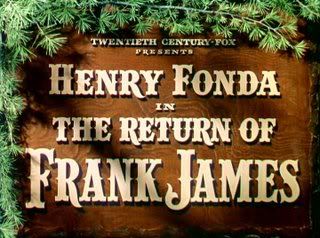
 Titles

It is, and always has been, common for a highly successful film to spawn a sequel. In 1939 Fox produced Jesse James and, riding on the wave of the reinvigorated western genre, found themselves with a hit on their hands. Of course, it’s a little difficult to continue a story when you have just killed off your main character. However, Hollywood rarely finds itself at a loss for long and the solution was to pick up the story where the first film left off and concentrate on the surviving brother, Frank James (Henry Fonda). The only problem was that, after Jesse’s death, Frank’s life wasn’t the stuff of dramatic, action-packed blockbusters. Therefore, the truth needed to be manipulated to present audiences with a story of revenge and redemption.

In the aftermath of the ill-fated raid on the Northfield bank Frank James had gone to ground. We find him living under an assumed name and it would seem that he has renounced his outlaw ways. On receiving news of the death of his brother he is content to let the law run its course, believing that Bob and Charlie Ford will be tried and duly hanged for the murder. It is only when he learns that, despite their conviction, the Fords have been granted a full pardon that he decides to take matters into his own hands and straps on his guns again. There follows a pursuit across the country to Colorado as Frank attempts to track down the Fords and mete out the justice he feels the courts have denied him. By the end of the film all the loose ends have been tied up and we get a traditionally happy ending. The problem with this is that the production code of the time dictated that a killer should not be presented as the hero – or at the very least that he should be punished for his deeds. The way around that issue was to present Frank James as an essentially honorable man hounded into infamy by circumstances and big business. So while the Fords get their comeuppance it is not Frank who is shown to kill them (which is historically true at least). In fact, the film is at pains to point out the innocence and decency of our hero throughout – even having one of the characters declare indignantly that Frank James never killed anyone. All of this is vaguely unsatisfactory since a man setting out on a mission of vengeance should, to my mind, be allowed to achieve some measure of it directly.

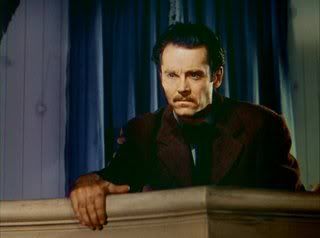
A grim Frank James (Henry Fonda) watches Bob Ford re-enact the murder of his brother.

As I said, Henry Fonda plays the lead very much in the style of the classic romantic hero. Throughout his long career Fonda was most frequently cast as the everyman who was the very epitome of human virtue. Almost thirty years later Sergio Leone would give Fonda the opportunity to finally play a character (also named Frank, as it happens) of pure evil in Once Upon A Time In The West. Gene Tierney (in her debut role) provides some eye-candy and romantic interest as a newspaper reporter, but not much else. Much of the rest of the cast is filled out with actors from the previous film, with John Carradine reprising his part as Bob Ford. Once again, Donald Meek is the conniving railroad boss and Henry Hull chews up every piece of scenery in sight as the editor of the local paper and friend of the family. Hull’s best scenes come towards the end of the film in a flamboyant courtroom defence of Frank on a charge of murder. This scene mirrors reality, where Frank James stood trial for robbery and murder and whose character was attested to by an old Confederate officer. In truth, the film spends a good deal of time on the lingering animosity between north and south in the years following the Civil War. All in all, director Fritz Lang’s first foray into the western genre is a pleasant and entertaining one.

Fox’s DVD release of The Return of Frank James is an improvement on the transfer of Jesse James, but not by much. The image is a good deal more consistent here but darker scenes are still quite murky and washed out. Generally, the outdoor scenes fare the best with stronger colour and sharpness. 

Western Union

pxsblta

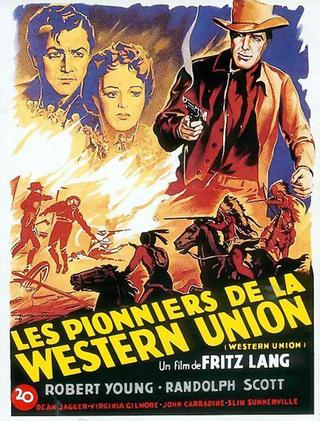
If you mention Fritz Lang’s name to most film fans they are most likely to think of expressionism, thrillers, and films such as M and Metropolis. It is not so typical to associate the German director’s name with classic Hollywood westerns but he did make a handful of these. To be exact, he made three westerns: The Return of Frank James (1940), Western Union (1941) and Rancho Notorious (1952). I think it would be fair to say that Western Union is the least known of them, but perhaps it deserves better. It is quite representative of 1940s westerns in that it tries to avoid some of the more juvenile aspects of the previous decade’s output but lacks the psychological depth that would come in the 50s. Although it may not bear the hallmarks of classic Lang, it does contain those of the classic western.

It’s not for nothing that the building of the railroad has figured so prominently in so many great westerns, from Ford’s The Iron Horse through to Leone’s Once Upon A Time In The West. It was this massive undertaking that at once opened up the west and also signalled the closing of the frontier way of life. For some film-makers it represented the advance of law, order and civil society; for others it stood only for the gradual encroachment of the corrupt influences of the east. Western Union deals not with the railroad but that other piece of progress that would drag America into the modern world and relegate the Old West to the realm of mythology – the laying of the transcontinental telegraph wire.

The film opens with outlaw Vance Shaw (Randolph Scott) attempting to outrun a posse and happening upon telegraph boss Edward Creighton (Dean Jagger). Creighton has been injured and is barely able to move with a busted ribcage. Shaw is desperate to evade capture and is on the point of taking Creighton’s horse and leaving the stricken man to his fate. However, his conscience pricks at him and he decides to take a risk and bring the helpless man along. That proves to be the turning point for Shaw, for when he later finds employment with the telegraph company as a scout it is Creighton who offers him the chance to go respectable. The other main character is the dandified easterner, Blake (Robert Young). Blake has come west to work for the telegraph, and soon enters into a rivalry with Shaw over Creighton’s sister. The movie, like the characters themselves, has a lot of ground to cover and is played out against the back-story of the Civil War. It includes a well-staged battle with some drunken Indians and a confrontation with a gang of renegade confederate raiders led by Shaw’s own brother.

£2

Randolph Scott is excellent as a man torn between a lingering loyalty to his brother and the old ways, and a desire to turn over a new leaf. If you’re under the impression that Scott would not come into his own until a decade later in the films of Budd Boetticher then think again – this is definitely one of his better performances. Dean Jagger’s part doesn’t call for much more than stoic determination and he does that just fine. As for Robert Young, he’s never been an actor that I’ve cared much for and this showing did little to change my opinion. The support cast features some great and familiar faces, not least Barton MacLane (who seemed to appear everywhere in the thirties and forties) as Scott’s thoroughly good-for-nothing brother. Add in an impossibly young looking Chill Wills as a tobacco-chewing (and spitting) telegraph man, and John Carradine as the company doctor and there’s not much to complain about. As I said above, there isn’t much to distinguish this as a Fritz Lang film, but he still delivers a polished, professional picture and does include a few typically dark moments – particularly the ‘shock’ climax.

The film is out on DVD in R2 from Optimum in their Western Classics line. The transfer is mediocre at best and has clearly undergone no restoration, with the colours looking quite washed out. Having said that, the movie is worth seeking out, but I can’t help wishing that Fox would see their way to releasing it in R1 with an improved transfer.