Nevada Smith

poster246

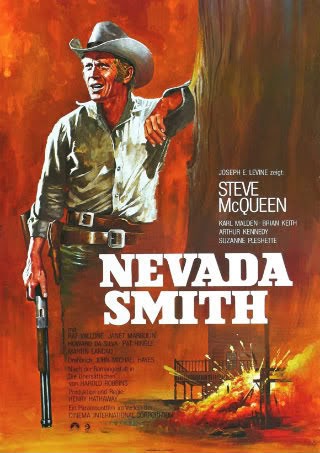
The theme of revenge has always been one of the staples of the western genre and, despite a slightly bloated running time, Nevada Smith (1966) is a fairly standard example of this. Perhaps one of the most interesting aspects of the movie is its focus on a mixed race protagonist. However, while this lends a different slant to the usual quest for vengeance, the casting dilutes it a little and it’s easy to forget the whole racial angle for extended periods, except when the characters on screen make explicit reference to it.

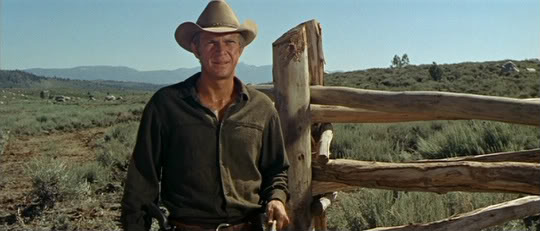
Max Sand (Steve McQueen) is the half-breed son of a white man and a Kiowa woman, and the story opens with him innocently directing three men (Karl Malden, Arthur Kennedy and Martin Landau) who claim acquaintance with his father to the family home. These men aren’t paying any friendly call though and Max realizes this sobering fact too late. By the time he makes his way back home the men have fled, but there’s a horrifying sight left behind for Max to find. In a vain attempt to extort money the father has been cut, burned and shot to death, while the mother has been skinned alive. Mercifully, none of this is shown on screen but the reactions of Max and his subsequent burning to the ground of his home and all that it contains still add up to a powerful scene. With his whole world literally reduced to ashes, he sets out to track down the torturers of his family and kill them. If the casting of McQueen as a half-breed is a bit of a stretch then it’s even less credible to see him as a callow youth with no real world experience. Still, that’s how we’re supposed to take it, and his green foolishness almost ends his quest before he’s even got properly started. It’s his chance encounter with a travelling arms dealer, Jonas Cord (Brian Keith), that turns things around for him. Cord takes the young man under his wing, teaching him the rudiments of gunfighting and giving him some basic education. From here on, the film is divided into three distinct sections, each focusing on how Max (he only adopts the Nevada Smith alias in the final segment) locates his man and goes about his reprisals. The first and third sequences work best, the former for its brevity and the latter for its tension. The middle of the movie (the part dealing with Arthur Kennedy’s comeuppance) is much more problematic though. The way it’s set up – Max having himself jailed to get close to his victim – strains believability in the first place. But the real problem is the way it goes on too long and virtually turns into a separate movie within the main narrative. It slows things down terminally and results in the entire production having a disjointed feel. Such is the draining effect of this sequence that the superior final part has some of its impact lessened by the time we get round to it.
£22

Nevada Smith is a prequel to The Carpetbaggers, a movie I’ve never seen so I can’t comment on whether it holds up in terms of continuity. Henry Hathaway can usually be counted on to deliver tight, economical movies that rarely outstay their welcome. However, with a filmography as long and varied as his there will inevitably be some that turn out better than others. In this case, I think Hathaway suffered from the episodic nature of the script he had to work with. The narrative ends up bolted together rather than flowing seamlessly from one situation to another. As I already said, the mid section is where it stumbles and the impetus is lost. In fairness, this part does serve to illustrate the development and progression of McQueen’s character. The thing is it’s not actually a weak section on its own; the problem, for me at least, is that it doesn’t quite gel with either the tone or pace of what precedes and follows. Of course Hathaway is aided enormously by having Lucien Ballard shooting the picture for him, the outdoor scenes in particular being beautifully rendered. The miscasting of McQueen is especially noticeable when you consider his age – he was in his mid-thirties, and looked it, and was being asked to play the part of someone at least fifteen years younger. The only saving grace lay in the fact that McQueen had the ability to project a kind of childlike innocence when he wanted. While this cannot entirely paper over the incongruity, it does go some way towards compensating for a major weakness. Karl Malden, Arthur Kennedy and Martin Landau were a fine trio of villains, and there’s a good deal of satisfaction to be derived from seeing them get what’s coming to them. Malden easily has the best role and he does a good job of portraying a man descending into terrified paranoia as a result of the relentless pursuit by his faceless nemesis. The only female role of any substance was handed to Suzanne Pleshette, as the girl who falls for McQueen and aids him in his escape from the swamp ringed prison, and she manages to be both sexy and tragic.

Back when Paramount were still in the business of issuing catalogue titles on DVD it was rare to come across a poor transfer. Nevada Smith is no exception in that respect, the anamorphic scope image on the R1 disc being strong, detailed and colourful. It’s a totally barebones affair though with no extras whatsoever. So, to recap, we have a fairly standard western tale of revenge – and the ultimate futility of it all – that’s reasonably satisfying. Apart from the odd central casting, I feel the movie could have been improved a good deal by a bit of judicious editing to strip away some of the flab in the script. Still, the end product is entertaining enough and I’d give it a qualified recommendation.


Man in the Shadow


vfsg98e

Another modern western, and another message film. Man in the Shadow (1957) treads a similar path to Bad Day at Black Rock by having a lone individual take a stand against a racially motivated murder. The main difference is that this time the hero is not an outsider who’s swooped down on an alien world seeking justice. In this movie our protagonist is a familiar face in his small community but whose sense of personal and professional honour bring him into direct conflict with with those he’s known all his life.

Ben Sadler (Jeff Chandler) is the sheriff of a sleepy western town. The routine and mundane nature of his job is highlighted early on when he opens up the cells to release the town drunk who’s been sleeping off a heavy one. He hands him a stern warning, which we know is really only for show, and then bids the old timer good day. That’s the kind of town we’re in – one where crime is generally confined to manageable, petty affairs that tend not to represent a major threat to the community. Within moments however, a much more serious matter is to be laid before Sadler, one which is not only reprehensible in itself but also, as a result of what any investigation will entail, poses a threat to the finances and, by extension, the very viability of this small backwater. Sitting huddled and almost forgotten in the office is an old Mexican with a story to tell that’s about to present the sheriff with a moral and professional dilemma. The old man has witnessed the murder of a young friend by two cowboys at a nearby ranch. He doesn’t really expect anyone to take his tale seriously, partly because of his lowly immigrant status and partly due to the identity of his employer. Virgil Renchler (Orson Welles) is a big man, both physically and financially, and his ranch is the life blood of the town. Without the patronage of his sprawling ranch the businesses would quickly wither and even the railroad stop might fall into disuse. Sadler is aware of the clout wielded by Renchler but, unlike his slovenly and skulking deputy, he’s also conscious of his duties as the representative of the law. So, it’s with some reluctance that he gives his word to the old man and begins to tentatively look into the allegations. Renchler, though, is a throwback to the old cattle barons, a man whose self-sufficiency and power has led him to believe in his own infallibility. When he tells Sadler that he has no business asking questions of him and dismisses the killing as nothing more than an insignificance, the sheriff’s indignation is aroused. Thus we have one of those perennial western themes, the clash between the laws of civilization and the moneyed big shots who see themselves as being above such naive concerns. The thing is though that Sadler isn’t merely up against a powerful rancher, the influence and fear that Renchler inspires in the country is such that virtually the entire population of the town turns against their lawman. Sadler’s only allies are Renchler’s disgruntled daughter, Skippy (Colleen Miller), and the Italian immigrant barber – not exactly a pair of heavy hitters. Still, in spite of the enmity of his former friends, an attempt on his life and a public humiliation, Sadler presses ahead with the investigation that nobody wants.

£14

Although the racism implicit in the murder is acknowledged and explored, that’s not the real issue of the movie. The primary concern is the corrupting influence of business and how entire communities can be effectively blackmailed into abandoning their awareness of right and wrong for the sake of financial gain. While this moral issue remains at the forefront throughout, Jack Arnold’s direction ensures that it’s conveyed dramatically rather than by means of noble speeches and the like. The pace is brisk and the development direct so there’s not much room for complex characterisation; we know where we stand as regards the principals right from the beginning and that doesn’t change much by the close. Welles does manage to elicit some slight sympathy as the man whose blustering independence has painted himself into a corner. That’s one of the things about Welles as an actor – even when he played villains it was hard not to feel a little for him. He does lay it on a little thick at times, but complaining about Welles’ tendency to ham it up is akin to decrying John Wayne for his machismo – it’s part of the package and you know that when you go in. Jeff Chandler is pretty good too as the isolated sheriff who knows full well that he’s probably biting off more than he can chew, but whose own personal code precludes his backing down. The main weakness lies in the script, not that it’s poorly executed but that it’s themes are too familiar. There’s nothing especially new or groundbreaking in the plot and although it’s carried off professionally there is a certain unavoidable staleness to it all.

Man in the Shadow is available on DVD from a number of sources: from Germany, France and a recent DVD-R from Universal in the US. I have the German release from Koch Media and it’s a very nice presentation. The movie is in anamorphic scope with very crisp black and white images and obviously came from a clean, strong print. There are no forced subtitles on the English track and there are some attractive extras too. Apart from the trailer and gallery, there’s a 14 minute interview with Jack Arnold where he talks about his memories of working within the studio system and the changes in filmmaking he observed down the years. The movie is an entertaining and pacy one that has a point to make. I found the performances and direction all up to scratch, and the only problem was the lack of originality in the story. Still, it’s not a bad way to spend an hour and a quarter or so – and anything that involves Orson Welles’ participation has to be considered worthwhile.


Bad Day at Black Rock

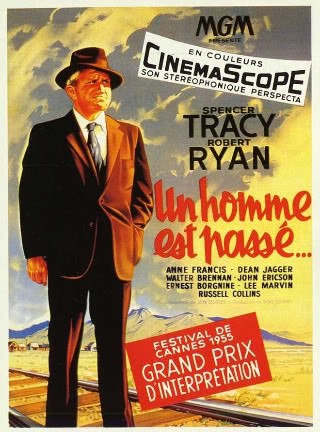
Bad Day at Black Rock (1955) is what’s termed a modern western. Of course, from a strictly purist point of view, the western really ought to take place within a narrow time period and location. This film is certainly set in the correct location – the arid southwest – but the events take place not in the late nineteenth century, but immediately after the end of WWII. Still, even if the trappings belong to a later era, the basic themes of the classic western are present: a simple tale of good vs evil wherein a lone, righteous figure grapples with the hostility of both the environment and his fellow men. Despite the apparently straightforward nature of the plot, the film is a powerful one that tackles at least two major themes; one of which is very obviously presented, the other is less explicit and takes something of a back seat but it’s there all the same.

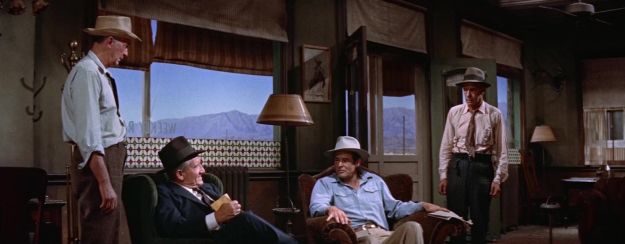
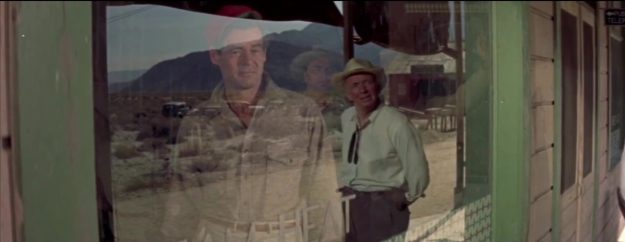
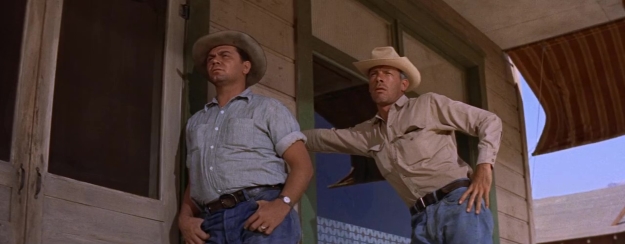
The opening is aggressive and dramatic, with a mean-looking black engine, hauling blood red carriages, hurtling through the desert to the accompaniment of Andre Previn’s ominous score. As this impressive and relentless juggernaut grinds to a halt outside the tiny, desolate town of Black Rock, it’s as clear to the viewer as it is to the awestruck locals (the train hasn’t stopped there in four years) that something important is about to happen. The figure that alights is an incongruous one, a middle-aged man with a stiff arm, clad in an austere, black business suit. He could be a businessman, a government man, a gangster – what he’s not is local. This man is John J Macreedy (Spencer Tracy), and the reactions provoked by his unexpected arrival progress from incredulity to suspicion and finally open hostility. Everybody he encounters is consumed with curiosity regarding his errand in their midst. However, this is not the normal sense of wonder that would occur in any small, isolated community when its members are confronted with the presence of a stranger. There’s fear in the air, fear of the man and what he might discover. As Macreedy finds himself repeatedly stonewalled when requesting even the most basic kind of assistance, he’s also on the receiving end of questions from the locals. But these questions have an edge, they’re of the cagey variety where the asker doesn’t really want to know the answer. What all this means is that fear has a companion in Black Rock – guilt. A great sin has been committed in this community and Macreedy has descended upon the residents like some instrument of judgement or retribution. It’s soon made apparent exactly what has happened, a Japanese farmer has died in mysterious circumstances, and who bears the responsibility. Reno Smith (Robert Ryan) is the big man around town, and the one Macreedy must deal with. Perhaps more important than the violent climax is the verbal face-off between these two men outside the gas station. This scene highlights the two principal themes in the movie: the first is the ugly matter of racism, the second is the nature of the west itself. Of the two, I find the latter more interesting, mainly because it’s approached in a much more subtle manner. When Smith points out that suspicion of the unfamiliar is just a natural throwback to the old days, Macreedy observes that he always thought the old west was characterised by hospitality. And there’s the point, that the myth of the old west was subverted through time into the kind of small-minded defensiveness represented by Black Rock. To Smith, this new west has been neglected and forgotten, of interest only to academics or businessmen seeking a quick buck. Although it’s never explicitly stated, the inference is that the responsibility for the death of an innocent Japanese doesn’t rest merely on the shoulders of the bunch of ignorant rednecks who dealt the final blow. The suggestion is that these people have been bypassed by progress (the train that never stops) and abandoned to their own prejudices – an embarrassing by-product of the apathy in wider society.

This is another of John Sturges’ tightly-paced, economical works, stripped down to the basics and direct. From the moment the train thunders into view at the beginning, until the circle is completed eighty minutes later with the same locomotive making another rare stop at Black Rock, the pace never slackens. Additionally, Sturges’s camera uses the wide lens to excellent effect, the dearth of close-ups serves to keep the characters at a distance and accentuates the isolation of both them and the setting. Despite the high proportion of outdoor shots, there’s still a claustrophobic atmosphere about the whole thing. It’s as though the frontier has shrunk and this western drama is played out within the stifling confines of a town that has ceased to look outwards and has turned its gaze in upon itself. The only time a sense of space is apparent is during the credits sequence, and when Macreedy drives out to the ruins of the Japanese property – the railroad and a murdered foreigner representing the openness that was once the mark of the west. Besides the visuals, this is also a film of words, and although it’s dialogue heavy there’s a snap and colour to the lines that make them instantly memorable. I’ve seen some criticism of Andre Previn’s score, citing its intrusiveness, but I feel that the urgent, driving quality of the music is the ideal accompaniment for the threatening uncertainty that unfolds on screen.

Spencer Tracy’s naturalistic style of acting was greatly admired at one time, but the rise of the method saw it fall out of favour and opinions are likely to remain divided to this day. Personally, I like it; there’s always the feeling that you’re watching a real person reacting in much the same way you might do yourself to the circumstances. The passage of time, and drinking, weathered his features and the bristling aggression that he displayed as a younger man gave way to middle-aged gravitas. Tracy could be seen as the face of moral America, not in a narrow, disapproving or prudish sense, rather the slightly imperfect conscience of everyman. As such, he was ideally cast as John J Macreedy – a man who’s trying to do one last decent thing before bowing out of life. There’s a certain ambiguity about what he means by that of course, I’ve seen it claimed that the character had been contemplating taking his own life until the challenge of exposing the rotten little secret of Black Rock reawakened his appetite. I’ve also come across the suggestion that Macreedy could be taken for a supernatural figure, the fact that Smith’s detective can find no evidence of his existence is the reasoning behind this. It’s an interesting idea, reinforcing the notion of his being the embodiment of a higher justice, but I’m not convinced that it’s actually the case.

As Macreedy’s chief opponent, Robert Ryan represents a kind of distorted reflection – another craggy individual, but one whose motives are far from admirable. If Tracy stands for the kind of fundamentally right man we’d like to be, then Ryan is the total antithesis; a bullying, bigoted braggart who’s become twisted by his own inadequacy and a country that has rejected him on every level. Reno Smith is a man to be both pitied and despised in equal measure, and Ryan nailed that quality. Caught somewhere in the middle, like most ordinary people I suppose, are the supporting players: Walter Brennan’s Doc (I feel for you, but I’m consumed with apathy) and Dean Jagger’s sheriff might be jaded but still retain some ethical sense, while Lee Marvin and Ernest Borgnine are suitably menacing as the loutish sidekicks interested only in doing their master’s bidding. The latter pair refer to themselves as cowboys but there’s no sign anywhere of any ranching taking place – Black Rock isn’t so much a one horse town as a no horse town.

The R1 DVD from Warner Brothers has Bad Day at Black Rock looking great. The anamorphic scope transfer is clean and crisp, and the colours are rich and strong. The extras are a commentary track by Dana Polan and the trailer for the movie – it’s not what you’d call a stacked edition but there’s no reason for complaint either. The film is a very strong effort from John Sturges, both entertainingly tense and thought provoking. He did some of his best work through the 50s and this is right up near the top – a definite and easy recommendation.

Spellbound

I’ve heard Alfred Hitchcock’s Spellbound (1945) described as a tale of the lunatics taking over the asylum, and that’s actually not a bad summation. Despite sounding like a glib dismissal, it neatly encapsulates the basic premise of this movie. Exploiting the then fashionable trend for psychoanalysis, and enthusiastically supported by firm believer David O Selznick, it’s a romantic mystery served up as a kind of Freudian stew – and a very tasty one at that. Like all of Hitchcock’s films made for Selznick the producer’s fingerprints are visible everywhere, but there are plenty of instances of that familiar visual flair to ensure that you never forget who directed it.

Amnesiacs always make good protagonists in any movie, the blanked out memories that need to be recovered before any sense of order can be restored automatically generate mystery, and so it is with Spellbound. Our hero (Gregory Peck) is referred to variously as Dr Edwardes, JB, and finally as John Ballantyne (I’ll stick with JB for the purposes of this piece as that’s the moniker he carries for most of the running time) while he struggles to find out his real identity, and more crucially whether or not he’s a murderer. His arrival at a New England psychiatric hospital posing as the new director is initially taken at face value. There are a few comments passed regarding his relative youth for such a responsible position, but there are no other eyebrows raised. What it does spark though is an unsuspected passion in the emotionally repressed Dr Constance Petersen, thus providing JB with one priceless ally. Such a deception cannot hope to endure long though and, sure enough, it’s inevitably revealed that the real Dr Edwardes is in fact dead and the impostor taking his place is very likely his killer. So, still in search of who he is and what he did, JB goes on the run with Constance joining him after a short interval. It’s here that the picture comes into its own, as Constance, with the aid of her old tutor Dr Brulov (Michael Chekhov), employs Freudian psychoanalytic techniques in a race against time to probe the depths of JB’s subconscious and discover the truth. It all culminates in the famous dream sequence, designed by Salvador Dali, whose interpretation lays bare all the secrets. The whole thing is pure, escapist hokum but it’s executed with such style and conviction that you’re completely drawn in. It’s a good illustration of how, apart from his technical achievements, Hitchcock was masterful at taking stories that were essentially tosh and coaxing the viewer into accepting their credibility for the duration of the movie.

I mentioned earlier Selznick’s enthusiasm for the subject matter, and I’d say that’s directly responsible for the film’s biggest weakness. Such was the producer’s zeal that he insisted on the involvement of an adviser on all things psychoanalytical. The result is an overly pious attitude towards the science depicted, from the cloyingly reverential foreword to the kind of mangled dialogue that even Ben Hecht was hard pressed to shape into something presentable. The contrast between the kind of clumsy exposition that Selznick wanted and Hitchcock’s talent for economical storytelling is clear to see in one scene near the end. In the space of a thirty second montage, consisting only of close-ups of Ingrid Bergman’s increasingly desperate features and a few imploring lines, the the trial, conviction and sentencing of JB is dealt with fully. Similarly, the whole, lengthy sequence at Brulov’s house could have proven intolerable in the hands of a lesser director. Instead, through the combination of a wonderfully idiosyncratic performance by Michael Chekhov, Hitchcock’s arresting visual style and the scoring of Miklos Rozsa (alternating between lush romanticism and the unnerving strains of the theremin), it stands as the strongest section of the entire film. Of course, in other places, some of the bravura touches could be said to serve no better purpose than to draw attention to their own inventiveness: the revolver discharged directly into the camera at the end springs to mind, but that’s such a memorable shot that it feels uncharitable and unnecessarily sniffy to complain about it.

It’s said that Hitchcock originally wanted Cary Grant for the lead, and Peck’s performance has been criticized for being a touch too aloof. I can understand where that’s coming from, Peck had yet to find his feet fully in cinema, although I also feel he was actually right for the part. Had Grant been cast I have a hunch he would have brought too much of himself, that innate self-confidence, to the role and thus rendered it less believable. As it stands, Peck had just the right measure of insecurity about him to get across the edginess of a man who doesn’t even know his own name let alone whether or not he’s a criminal. Whatever reservations anyone may have about Peck, it’s hard to fault Ingrid Bergman’s Constance Petersen. She brings real charm and innocence to the part of the slightly uptight academic who gradually learns that there’s a vast gulf between theory and practice when it comes to matters of the heart. There’s nothing the least bit goofy about her, she’s clearly a highly intelligent and capable woman but there’s also a touching vulnerability as a result of her sheltered lifestyle. Aside from the principal performers, there are a couple of excellent cameos in the mix too – the middle-aged cop and his partner discussing the issues he’s having with his mother who are in some ways reminiscent of the travelling salesmen in The 39 Steps, and Wallace Ford as the persistent pest in the hotel lobby – these don’t add anything at all to the narrative but they do enrich the whole experience.

Spellbound has had a variety of releases on DVD in different territories; my copy is the old Pearson release from the UK, which I think has been repackaged and subsequently issued by Prism. I guess there may be better versions out there but that old UK disc is pretty good to my eyes. There aren’t any problems with the transfer, which is clean, sharp and free from damage. There are a range of extras, from text bios and trivia to a gallery and a few clips of Hitchcock interviews etc – I’m pretty sure the latter is replicated on the other Hitchcock titles from Pearson. The movie itself is one of Hitch’s better than average 40s offerings, not as good as Notorious or Shadow of a Doubt but still technically accomplished and very entertaining. There are the familiar motifs (the wrong man on the run and the blonde Girl Friday) and the psychoanalysis angle is quite enjoyable. Like most of the director’s films, it has a high rewatch value regardless of how familiar the plot may be – recommended.

Diplomatic Courier

poster236

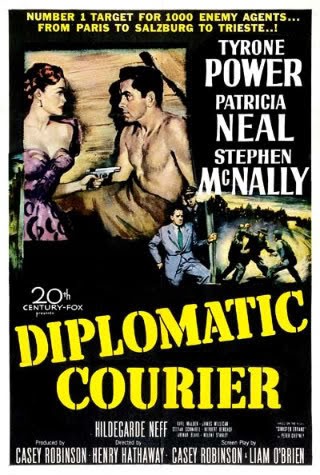
In the past I’ve done a few write-ups on those thrillers that take advantage of the devastated world of post-war Europe. The uncertainty evoked by time and place, the dreams of a better future coupled with the knowledge that the dangers of the past are no further away than a glance over the shoulder, is a strong foundation on which to build tales of intrigue and deception. In the late 40s and early 50s, as the chill of the Cold War was spreading, there was an abundance of such movies. I think the appeal of these pictures, despite the patriotic trappings required by the contemporary political climate and the inevitable loss of immediacy with the passage of time, lies in their ability to tune into the despair and disillusionment of those displaced and damaged by war and the subsequent carving up of a continent. Diplomatic Courier (1952) is one of the lesser known examples of this sub-genre, despite its boasting a strong cast. This film is not without its flaws but, taken as a whole, it remains a slick and atmospheric espionage thriller.

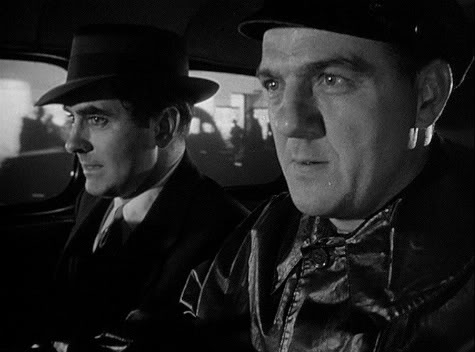
It starts off with one of those voice-of-God narrations, extolling the virtues of dedicated government agencies, which I tend to find irritating but quickly settles down to telling the story in a more traditional way. In short, a coded document originating in Romania needs to be passed to a courier in Salzburg for transportation back to the US. Sounds simple enough in itself, and thus our courier, Mike Kells (Tyrone Power), is promptly dispatched to do the business. Of course, things don’t quite run according to plan and Kells’ contact winds up dead on the railway line outside the city, without having completed the exchange. The circumstances leading to the murder aren’t clear as they were preceded by a series of cat and mouse shenanigans aboard the train involving a couple of heavies (one of whom is Charles Bronson in a blink and you miss him role) and an unidentified blonde. Kells now finds himself high and dry, and his only lead is the blonde, a Czech refugee called Janine Betki (Hildegard Knef), on her way to Trieste. His only option is to travel to the Italian city, track down Janine, and hope that she can lead him to the missing document. Again, the errand seems uncomplicated yet Trieste is a nest of spies and assassins, with danger lurking and ready to pounce within its ruins and darkened courtyards. Trying to run down one female in an unfamiliar and hostile locale ought to be problem enough, but Kells faces the added complication dealing with the attentions of an amorous American pleasure seeker, Joan Ross (Patricia Neal), who he met after falling asleep on her mink clad shoulder en route to Salzburg. What emerges is that both these women have a central role to play in the mystery, the question though is which one, if either, can be trusted.

£11

The whole thing moves along at a brisk pace under Henry Hathaway’s direction, but I do feel the script could have used some tightening to cut down on the kind of disposable dialogue that just serves to slow the momentum. Also, there are a few too many convenient arrivals at crucial moments. Having said that, Hathaway, aided by cameraman Lucien Ballard, creates some nice images and takes full advantage of the European locations. The best scenes are those with Kells blundering around Trieste following up clues that frequently leave him even more confused than ever. By this time, Tyrone Power had left his swashbuckling days behind him and was exploring more varied roles. I thought he was pretty good as the messenger boy thrown in at the deep end and unsure of who’s really on his side, apart from a faithful but hyperactive Karl Malden. Both Patricia Neal and Hildegard Knef gave strong but very different performances – the former oozing a kind of feline sexuality, while the latter tapped into a credible blend of vulnerability and grit. Of the two, I’d say Knef produced the the better work, probably due to her character benefiting form greater depth. I mentioned earlier a fleeting appearance by Charles Bronson, and it’s also worth pointing out that’s there’s a small part for Lee Marvin in there too.

Diplomatic Courier is available on DVD from Fox in Spain – the only release of the movie anywhere that I know of – in a pretty good edition. The print is quite clean and crisp, but there is a fair bit of grain in evidence early on. Actually, I can’t work out if it’s genuine film grain or some kind of digital noise; I have a hunch it’s the latter but I’m not expert enough to call it for sure one way or the other. Whatever, it fades after the first ten minutes or so. The Spanish subs are removable via the set up menu, and the extras are limited to a gallery and some text based cast and crew info. This was my first viewing of the film, a total blind buy, and I enjoyed it a lot. I did have some issues with the script, but the acting is good overall and the direction and location photography are very stylish. Yet another picture that deserves a wider audience.


So Long at the Fair

poster220

We spend a lot of time these days bemoaning the lack of originality in cinema, citing the number of remakes and the fondness for rehashing plots and concepts. However, the truth is that this isn’t an especially new phenomenon; it’s been going on for almost as long as people have been going to the movies. So Long at the Fair (1950) is an example of a film that’s based on a hoary old tale, an urban myth if you like, which has been used in a number of productions – The Lady Vanishes (1938), Dangerous Crossing (1953), and an early episode of Alfred Hitchcock Presents, to name a few, have all borrowed to a greater or lesser extent from the same basic idea. The point I’m trying to make here is that a perceived lack of innovation in the central plot theme is not necessarily always a bad thing – the real test is in the execution of the script. Even the most familiar of stories can still grip the viewer as long as they are presented in an interesting way.

Events in the film revolve around the Paris Exhibition of 1889, and a young brother and sister, Johnny and Vicky Barton (David Tomlinson and Jean Simmons), who happen to be visiting the capital. Thinking themselves lucky to have secured accommodation when all the city is awash with tourists, they proceed to enjoy their first night out on the town. The bustling, thronged atmosphere is nicely conveyed through scenes of cafe life on the pavements of Montmartre, and later at the Moulin Rouge. These two young people, having sampled the cosmopolitan night life, return exhausted to their hotel to get some rest and prepare for further excitement the next day. However, that’s not to be. When Vicky awakes she finds herself confronted with a situation that at first arouses puzzlement, but soon descends into despair and fear. What has happened is that Johnny has disappeared, but that’s only the half of it. As soon as Vicky starts to ask questions she’s presented with the even more perplexing problem that not only does nobody seem to remember seeing her brother but they insist, to a man, that he was never there in the first place. As if that’s not bad enough, there’s the downright chilling discovery that the room Vicky remembers her brother occupying doesn’t even exist, despite her having visited him in it. The unfolding of this nightmare scenario is nicely handled, with each new shock being added incrementally and the girl’s panic growing accordingly. Finding no solace at the hotel, Vicky turns to the authorities, the consulate and the police, who both display sympathy but also a healthy, and understandable, dose of scepticism. While the distraught girl witnesses one possible avenue of inquiry after another relentlessly closed to her, and her belief in her own sanity being stretched to the limit, the viewer is made subtly aware that something dark and inexplicable is taking place behind the scenes. Enter George Hathaway (Dirk Bogarde), an artist struggling to make a go of his new-fangled impressionist works and an unlikely but welcome ally for the increasingly desperate Vicky. With the backing of someone who’s willing to take her story at face value our heroine now has the opportunity to get to the heart of the mystery. The solution, when it comes, may seem a little contrived but it is logical and ties up all the loose ends in a very satisfactory manner. Added to that, and perhaps most importantly, the whole thing is achieved both stylishly and without any relaxation of the tension.

£10

Terence Fisher shared the directing credits with Antony Darnborough, and the sumptuous and stylised sets bring to mind the look of the Hammer films that the former would go on to make his name in. Despite a number of outdoor scenes, there’s a real sense of claustrophobia to the whole production that emphasises the shortage of options open to Vicky. When the action returns to the ornate, overdecorated interior of the hotel this stifling feeling is heightened even further – the intricacy of the decor being highly suggestive of unpalatable secrets that need to be disguised by an opulent exterior. There are also two fine set pieces that grab the attention, the first being a horrific accident that befalls a hot air balloon carrying the one person who may be capable of corroborating Vicky’s unlikely story. The other is an extended sequence that sees Hathaway stealing through the hotel by night in an effort to secure evidence that will convince the authorities to act. Fisher really piles on the suspense as the young artist slips in and out of shadow along corridors and staircases, narrowly avoiding the staff as they go about their regular nightly rituals, to get his hands on the tell-tale receipt books.

Jean Simmons was asked to carry the picture for long stretches, and she brought it off very well. She had that doe-eyed innocence that almost guarantees sympathy and used it to maximum effect. However, there’s more to her performance than mere pouting for the camera; her mounting feeling of hopelessness as one door after another slams shut in her face is always believable. Dirk Bogarde’s role was a good deal more straightforward, but he too played it to perfection. There’s a nice mix of the gauche and the determined in his portrayal of an unexpected knight in shining armour. As for the supporting cast, there are welcome turns from familiar faces such as Felix Aylmer, Andre Morell and a young Honor Blackman. The strongest work though is done by Cathleen Nesbitt as the forbidding hotel manageress, whose sour features are perfect for conveying a very subtle menace.

So Long at the Fair has just recently been released on DVD in the UK by new label Spirit, although they are an affiliate of ITV/Granada. The transfer is a reasonable one without being especially remarkable. The film doesn’t appear to have undergone any restoration and there are the usual age related artifacts to be seen, but they’re never particularly distracting. If anything, the image is a little too soft but I wouldn’t call it a fatal flaw either. The disc itself is completely barebones, no trailer, no subtitles, just the movie. Despite that, I think the film is very entertaining; even if the plot is one that you’re largely familiar with it still holds the attention throughout. For those who have no acquaintance whatsoever with the story it ought to prove even more gripping. In brief, there’s a genuine puzzle plot, fine performances, and tight, smooth direction. I give it my recommendation.

Vera Cruz

poster243

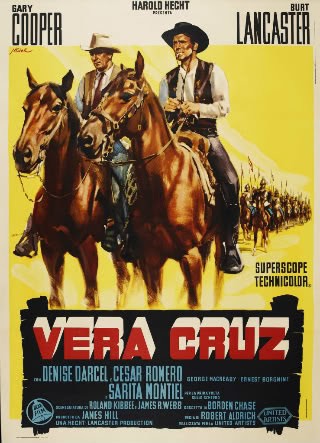
Reputations are a strange thing. They tend to wax and wane as the allegiances of critics shift over time and fashions change. Some directors have seen their stock rise dramatically while others have toppled from once lofty positions. There are those though who never seem to be celebrated excessively nor wholly forgotten, they simply exist in that shadowy periphery where both praise and criticism are always heavily qualified. One such man is Robert Aldrich, a director who made some memorable and stylish films yet continues to be granted only a kind of grudging respect. Vera Cruz (1954) was one of his early efforts and has traditionally been viewed as a good action picture, but that’s about it. It’s also been cited as the inspiration for the following decade’s spaghetti westerns, and I fully agree with that assertion. I see it as occupying an odd place among the westerns of the 50s; it doesn’t probe dark psychology like an Anthony Mann film, and it has none of the sparse leanness of Boetticher’s work. Instead it leaps over all of this and presents, or maybe even glorifies, the kind of amoral characters who would come to populate the western from the mid-60s onwards.

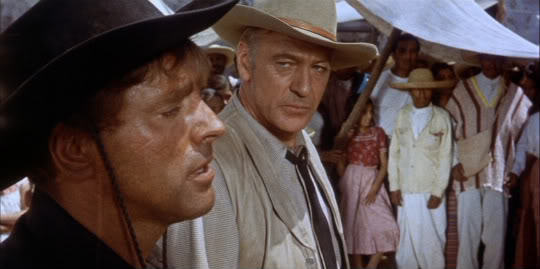
The story takes place in 1866, during the Franco-Mexican war, when the followers of Juarez were struggling to wrest control of their country back from those forces loyal to the puppet Emperor Maximilian. The focus is on two Americans who, as the prologue informs us, are among those who have drifted across the border after the Civil War to sell their services to the highest bidder. These men are Ben Trane (Gary Cooper), a southern gentleman ruined by the war and Joe Erin (Burt Lancaster), a reckless adventurer and a stranger to the notion of ethics. The early scenes where Erin sells Trane another man’s stolen horse set the tone for the rest of the picture, where double-crosses, lies, betrayals and greed come thick and fast from every side and no one seems to spare a thought for anybody but himself. When it looks as though Maximilian’s people offer the better chance for profit, both men throw in their lot with them. This sets up a nice sequence at the Imperial palace as Erin’s men show themselves up for the uncouth, rag-tag bunch they are. Of course, the aristocrats that they casually offend and outrage are seen to be no better, displaying no qualms whatsoever as they calmly scheme to dispose of their new employees as soon as their purpose is served. The purpose in question is to escort, and ensure the safe passage of, a French Countess (Denise Darcel) and her coach from Mexico City to the port of Vera Cruz. Finally, it would seem that there’s some honour to be seen. After all, risking one’s neck to ensure a woman is able to travel unmolested through treacherous country infested with Juarista rebels on the rampage is not an unworthy enterprise. However, at no point in this story is anything really as it appears on the surface. The whole mission is nothing but a blind on the part of the monarchists to smuggle a shipment of $3 million in gold out of Mexico to buy military aid and , by extension, some time for the crumbling regime. Naturally, everyone wants the money for themselves – Erin, the Countess, Trane and even the Juaristas in order to further their political aims. The fact is that of all those eyeing the fortune, the only one (barring the Juarista general) who has even a shred of decency motivating them is Trane. He sees the money – or at least as much of it as he can bargain for – as a means of restoring his devastated plantation and those who have grown dependent on it. After a succession of ambushes, broken promises and a desperate assault on the Emperor’s forces, everything comes down to a simple duel between two very different men in a dusty Mexican courtyard.

£20

As I said earlier, I’d have to agree with those who claim that Vera Cruz is a major influence on the spaghetti western. In fact, it’s a virtual template for the flood of Euro westerns that hit cinemas within ten years. The south of the border setting is the first thing that comes to mind, and when you factor in the strife torn political background the parallels become more apparent. The difference of course is that in Aldrich’s movie the politics really only forms a backdrop to facilitate the narrative without impacting directly on it. The film isn’t making any particular ideological point, except perhaps that greed overrides everything and corrupts everyone, but concentrates on entertainment albeit with a cynical twist. The main characters, Erin and Trane, profess to have no interest in anything beyond money when they start out. However, as the story progresses, Trane does exhibit something approaching a conscience. Both Cooper and Lancaster’s roles can be viewed as a blueprint for the upcoming anti-heroes from Europe. In a way, the Italians ended up presenting a kind of hybrid of these two men; a mercenary figure who hasn’t abandoned himself totally to amorality, a taciturn man with a personal code of honour (Cooper) who retains a sort of capricious flamboyance (Lancaster). It’s Lancaster’s grinning, black-clad rogue who has the greatest impact, but Cooper’s steadiness plays a significant part in keeping the film balanced. For all Lancaster’s scene stealing bravado, Cooper still holds the attention – his little grimaces at key points have a great understated quality to them. As for Aldrich’s direction, his handling of the action scenes is exemplary. The climactic assault is a well executed sequence that’s perfectly paced with just enough establishing shots to ensure the geography remains clear throughout. Aside from the big set pieces, he uses the wide screen well and mixes up the long, medium and close shots to good effect. He also throws in a variety of angles, and the final duel between Trane and Erin is yet another example of the film’s influence on the likes of Leone. While the lingering, operatic quality is missing, the basic iconography that would become so familiar is certainly present in the angles and the cutting.

Vera Cruz was shot in 2:1 Superscope and the UK DVD from MGM retains that ratio. The anamorphic transfer is a reasonable one, colours are strong and there’s no serious damage to the print. The only extra provided is the theatrical trailer. The film is due out on BD this coming June and it’s the kind of production that ought to benefit from the upgraded picture quality. As a movie, it’s not exactly a typical 50s western; in tone, it almost bears comparison to a 60s WWII extravaganza – big, brash, colourful and noisy. While it may not have the depth of the best from its decade, it is still an influential piece of work. Moreover, it offers an hour and a half of first class entertainment. I like it a lot and think both the film and its director deserve some renewed attention.


Born to Be Bad

£2

Strange how a title can prove misleading, isn’t it? Then again, it’s not always just the title. Take Born to Be Bad (1950) – directed by Nicholas Ray, photographed by Nicholas Musuraca, starring Robert Ryan and appearing in a few noir lists. When you bear all that in mind it’s not unreasonable, I think, to expect to see a good solid noir picture, maybe even a neglected gem. However, appearances are all too often deceptive and that’s certainly the case with this one. I’ll grant that the plot follows a noirish theme and strays towards that elusive dark style at times, but it never quite gets there and remains rooted firmly in melodramatic territory – and soapy melodramatics at that.

The story concerns Christabel (Joan Fontaine) and her determined climb to the top of the social ladder. We first see her after her arrival at the apartment of Donna (Joan Leslie), one of her wealthy uncle’s employees, who’s about to throw a party. Christabel is to attend business school with a view to later working in the uncle’s publishing firm. The first impression we get is of a shy, socially naive woman who’s slightly overwhelmed by the sophisticated and opulent world she’s suddenly arrived in. This feeling is further heightened when she encounters the cocksure and worldly Nick Bradley (Robert Ryan), an author who’s recently returned from China. This initial meeting sets the tone for the subsequent relationship between those two characters; Bradley all wisecracks and confidence and Christabel holding him off, but not too far off. The apparent innocence of Christabel is nothing but a sham to facilitate her own scheming though. From the moment she comes across her new flatmate’s wealthy and patrician fiance Curtis Carey (Zachary Scott) she gradually reveals her true nature (to the audience at least) as she sets her sights on displacing Donna and ensuring her own comfortable future. There are no surprises in the way the plot develops and it’s this predictability that weakens the movie most. While the story has an inherently noir theme it can’t escape being a study of social manners and hypocrisy, and all the cliches that involves. It’s also not helped by the light tone that seems to pervade it, with the jokey, mocking ending doing nothing to dispel that.

£3

Nicholas Ray’s directing career was highly unpredictable and could veer wildly from the brilliant to the mediocre. It’s hard to believe that this sudsy concoction came from the same man who produced dark masterpieces like In a Lonely Place and On Dangerous Ground. Of course, Howard Hughes’ notorious tampering may have had something to do with the flat and apathetic feel that Ray’s work here inspires. When the plot is a humdrum affair then you look to the visuals to add some life but neither Ray nor Musuraca manage to create anything especially memorable and I caught myself checking out the counter a couple of times while watching, never a good sign. The casting is generally good, although I have to admit I’ve never been a particular fan of Ms Fontaine’s work outside of Rebecca and Suspicion, her two collaborations with Hitchcock. I wouldn’t say I dislike her performances as such, but I’d rarely seek out a film due to her presence – that innocent vulnerability she projected could be used to good effect but it’s also a characteristic that tends to be restrictive. In Born to Be Bad the kind of duality the role calls for isn’t altogether successful as Fontaine’s “bad girl” moments are never entirely convincing. Joan Leslie, on the other hand, is much better as the spurned Donna. She brings a far more believable quality to her playing, and her growing suspicion of Christabel’s motives progresses naturally. Robert Ryan and Zachary Scott were both handed fairly typical parts for them, and they do all that’s asked satisfactorily. Ryan has that familiar swagger that suggests something hidden deeper inside, but his character doesn’t get the chance to develop much and kind of tails off as the picture goes on. Scott got the better written role and thus his Curtis Carey comes across as more rounded, although Ryan delivers the best of some fairly ripe dialogue.

The French DVD from Montparnasse is quite typical of their RKO titles, a little soft and thick in places but generally clean and I wasn’t aware of any damage to the print. As with all their releases the subs aren’t forced on the English track and extras are non-existent, apart from the usual introduction. I can’t say I got much pleasure from this movie; there are some nice performances but that’s about it as far as I’m concerned. Maybe I went in expecting something different – correction, I did go in expecting something different – and the film I got fell short. If you’re after an undiscovered noir then this isn’t the place to look, but if you want some social melodrama with a touch of darkness it may just fit the bill.

Breakheart Pass

poster233

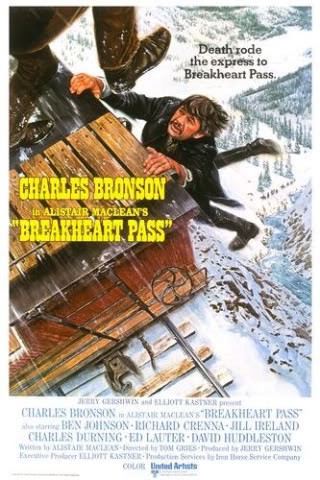
A Charles Bronson western written by a Scotsman and combining elements of a whodunnit and an espionage thriller sounds very much like a recipe for disaster. Despite that, Breakheart Pass (1975) actually works quite well; it’s never going to be considered a classic but it is wonderfully entertaining and looks great. A fine cast and some first class talent behind the camera have a lot to do with this of course. For me, the fact that a significant part of the action takes place aboard a train adds to the pleasure, as I’m a huge fan of anything that exploits the dramatic possibilities of having a group of suspicious characters all cooped up together and denied the opportunity to escape.

A military train carrying reinforcements, and medicines is bound for Fort Humboldt, where a diptheria epidemic is raging out of control. Aside from soldiers, there’s a number of civilian passengers aboard, all with official reasons for being there. Their numbers are swollen right at the beginning though when Marshal Pearce (Ben Johnson) muscles his way through the protocol in order to get both himself and his newly acquired prisoner, a wanted murderer and arsonist, John Deakin (Charles Bronson) a couple of berths. Before the train has even pulled away from the halt two army officers have mysteriously vanished, and it’s clear from the shifty behaviour of practically every passenger that nothing is quite as it seems. While the locomotive chugs its way towards the stricken fort the unexplained incidents, and the bodies, start to pile up ominously. The senior army officer, Major Claremont (Ed Lauter), is growing uneasy while the Marshal and the most prominent passenger, Governor Fairchild (Richard Crenna), seem reluctant to treat matters as anything more than ill fortune and coincidence. All the while, Deakin moves surreptitiously from carriage to carriage pursuing some undefined agenda of his own. It’s only when the troop cars are sheared off and sent careening away into mid-air and subsequent carnage that it becomes clear to everyone how grave the danger is, and that a ruthless killer is in their midst. The movie trades heavily on the fact that all the passengers are potential suspects; it’s a constant guessing game for the viewer to try to figure out who’s behind the ever increasing mayhem. Just about everyone appears to have something to hide yet it’s difficult to see how any individual could wreak such havoc. Of course all is eventually revealed before a slam bang finish draws the curtain on an hour and a half of solid entertainment.

Most of Alistair MacLean’s books which were adapted for the big screen have something to keep you interested. While his writing was fairly formulaic, it’s not hard to see why so many of his stories ended up being filmed; they tend to have a cinematic quality in that the plots are definitely to the fore and the characters usually have a shadowy aspect that’s only gradually revealed. The biggest failing tends to be in the dialogue, his later work suffering especially. Breakheart Pass has a few such instances, when characters come out with lines that just don’t ring true in any way. Director Tom Gries had already directed a couple of very enjoyable westerns, the one of particular note being Will Penny with Charlton Heston. His shooting of the action scenes is hard to fault and, apart from the free-for-all finale, the fight atop the moving train is one of the best parts of the movie. Bronson and former light-heavyweight champion Archie Moore get to slug it out in an excellently choreographed scene that’s tense, exciting and real looking – no doubt the presence of the great Yakima Canutt, as stunt coordinator had something to do with it too. Of course, the aforementioned crash of the runaway troop cars is another of the big set pieces that’s both mesmerizing and horrifying. Furthermore, Lucien Ballard was on lens duty and, as you would expect, the photography of the outdoor scenes is quite spectacular. And rounding out the crew is Jerry Goldsmith, who provided another of his memorably upbeat scores that draws you in from the moment the title credits roll.

As far as the acting’s concerned, Bronson is his usual laconic self, speaking only when there’s a need to but holding off on the physical stuff for long stretches. His character is no brainless lug and he plays him with restraint and enough thoughtfulness to make him believable. Although the wife was also in the cast there’s, mercifully in my opinion, no contrived romance to take the attention away from the twisty plot. Ben Johnson is always a pleasure to watch and just got better and better with age. His character isn’t the best defined one that he played but he still manages to make his mark on the movie – all his little gestures and his characteristic delivery keep reminding you that you’re watching a genuine westerner in action. Richard Crenna and Ed Lauter, as the Governor and the Major, have just enough oily charm and nervy anxiety respectively to keep the viewer guessing about their motives too.

MGM’s UK DVD of Breakheart Pass is a reasonably good effort. The anamorphic transfer is the kind that’s not especially remarkable but doesn’t have any major issues either. The colour looks true enough to my eyes and there’s no notable damage to the print – the image doesn’t pop off the screen but nor does it disappoint. The only extra included is the trailer, along with a variety of subtitle options. So, we’re talking here about a movie that’s best described as good, competent entertainment. It doesn’t offer anything groundbreaking but there are far worse ways to spend an hour and a half. It’s the kind of film that will obviously grip the viewer more the first time it’s seen, however, there’s enough in the action scenes, acting and visuals to ensure it’s worth revisiting.


Ramrod

Range wars have always been a favorite backdrop for westerns, men struggling over a piece of land upon which they have built their dreams being an ideal source of conflict. It’s not so common though to see a woman as one of the aggressors, and certainly not one as petite and vulnerable looking as Veronica Lake. However, if there’s a lesson to be learned from Ramrod (1947) it’s surely that one should never be taken in by appearances.

This is a lean, brisk movie where things happen fast and no time is wasted. Within minutes of the opening the main protagonists of the story are introduced and their motivations laid out. Everything revolves around Connie Dickason (Veronica Lake), a headstrong young woman hell bent on establishing herself in her own right and independent of her rancher father. We’re pitched immediately into the middle of a potentially explosive situation where Connie’s betrothed, a sheepman, is about to confront her father and his enforcer, Frank Ivey (Preston Foster). Ivey is the man Connie’s father would like to see her paired off with and he’s not averse to the idea himself. When the the sheepman decides that he values his hide more and thus backs down Connie turns her attention to a drifting cowboy and former drunk, Dave Nash (Joel McCrea). Nash has no interest in involving himself in the Dickason’s affairs at first, but a run-in with the bullying Ivey leads to a change of heart. He decides to sign on with her as her foreman, or ramrod, and face down her father and Ivey. Nash wants to use the law to secure Connie’s rights but she has other ideas on how to go about things. At the heart of the picture are Connie’s machinations, seductively playing the men off against each other to achieve her own ends. All of this deceit inevitably leads to tragedy and the loss of many innocent lives, although Connie blithely dismisses the bloodshed as a necessary if distasteful step on the road to fulfilling her ambitions. It’s only at the end, when her dreams are almost within her grasp, that this scheming puppeteer realises that her self-absorbed ruthlessness has driven away the very thing she desired most.

Joel McCrea’s portrayal of Nash is spot on, his calm and inner strength fitting for a man who has come face to face with personal tragedy and dragged himself back from despair. His honest, straight shooting persona is also ideal for a man who finds himself duped and manipulated by Connie. In fact, every man in the film falls prey to her deceptions at one point or another. Lake was clearly trading on her film noir credentials as she plays what is essentially a femme fatale out west. Her diminutive stature obviously rules out the possibility of her involving herself directly in any of the violence but her awareness of and confidence in her own femininity, and its attendant power, ensures that she calls the shots at almost every point. Director Andre de Toth was married to Lake at this time and he handles not only her scenes but the whole film very well. While he couldn’t be classed as one of the great directors, de Toth was certainly competent and made enough good films to be worthy of more attention. Aside from a number of very enjoyable collaborations with Randolph Scott, he also made the superior Day of the Outlaw and a handful of quality noirs. He was especially good at shooting action and the stalking by night of McCrea’s friend is particularly well done. It’s also worth noting the tough edge he brought to proceedings with a cigar ground into a man’s hand to provoke a gunfight and a savagely brutal beating being some of the highlights.

While there are plenty of good things to say about Ramrod the film, unfortunately, that not the case with the DVD. The only edition that I’m aware of is the Suevia release from Spain, and it’s pretty poor stuff. The master looks to be taken from an old VHS cassette and all the expected faults are present in the transfer. The image is scratchy, dirty and lacking in definition, and the audio is weak too. Despite that, it remains quite watchable, although there is an especially bad section beginning on the hour mark and continuing for about two minutes. In terms of quality it’s reminiscent of a mid-range PD title. However, as things stand, it’s the only version available – I’m not sure where the rights for this reside but I have a hunch it could be with MGM. On the plus side it can be had for very little money and there are no forced subs on the English track. I think this is a neglected little western with noir undertones that is well worth a look; anything starring McCrea and directed by de Toth deserves that at least. I’d imagine a decent release would go some way towards elevating its status.