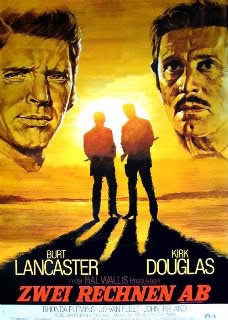
Gunfight at the O.K. Corral

poster8

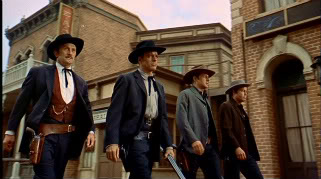
With Gunfight at the O.K. Corral (1957) John Sturges took his turn at putting Wyatt Earp’s story on the screen. When this film is compared to those which went before, there can be no doubt that it does come closer to the truth. There are more characters represented who actually played a part in the real events, small incidents which have a basis in fact are shown, and a little back story is provided. Having said all that, there are still lots of inaccuracies with names being changed and things not happening as they really did. Still, this is not a documentary, it’s a movie – and a highly polished and entertaining movie at that.

Frankie Laine’s rendition of the title song opens the movie as Wyatt Earp (Burt Lancaster) rides into Fort Griffin, Texas in pursuit of Ike Clanton. During his stay he meets Doc Holliday (Kirk Douglas), whom he subsequently saves from an angry mob intent on lynching him. This places Holliday in his debt and provides the basis for the two men’s friendship. As the film proceeds we see Earp and Holliday cross paths again in Dodge City before moving on to Tombstone, and the famous showdown. The fact that each segment is both punctuated and linked together by the theme song gives the film a slightly episodic feel. Mind you, that’s not a criticism; Laine’s vocals work almost as well as Tex Ritter’s do in High Noon (both of which, coincidentally, were scored by Dimitri Tiomkin). There are romantic sub-plots thrown in for the two leads – the one involving Earp and a lady gambler (Rhonda Fleming) is mostly superflous, while the stormy, abusive relationship between Holliday and Kate (Jo Van Fleet) works better since it does serve to drive the narrative forward.
£38

Gunfight at the O.K. Corral was the second film that Lancaster and Douglas made together and they work well in tandem, each playing nicely off the other. Lancaster’s Wyatt has more of a hard, grim edge to him than was seen in previous incarnations. At one point Holliday tells him, “You know Wyatt, you and I are pretty much alike actually. Both of us live with a gun – the only difference is that badge.” However, Sturges doesn’t explore this side of things too much, and it would be left to later films to point out the fact that Earp’s badge might have been used as a mere convenience. Kirk Douglas’ Doc Holliday follows the usual pattern of presenting him as a tortured and volatile soul, but his self-loathing has a greater pathos than either Romero or Mature brought to the role, and it’s a vast improvement. John Ireland makes his second appearance in an Earp film, playing Johnny Ringo (he was Billy Clanton in My Darling Clementine) and again comes to a sticky end. In fact there are lots of familiar faces: Dennis Hopper, Kenneth Tobey, DeForest Kelley (Star Trek’s ‘Bones’), Lee Van Cleef, Jack Elam etc.

Now a word about those items the movie got right, and those it didn’t. On the plus side we get a full complement of Clantons and McLaurys, Doc’s woman Kate is present, and Bat Masterson appears in Dodge City. Earp and Holliday are shown to meet in Fort Griffin and later in Dodge, where Doc saved Wyatt’s life as he attempted to stop a fight in a saloon. There’s also a brief reference to Old Man Clanton being shot dead as a result of his rustling activities. As for the negatives, James Earp is again falsely portrayed as the youngster of the family whose death is the catalyst for the gunfight – in truth he was the eldest and lived to a ripe old age. Ike Clanton and Johnny Ringo didn’t die at the O.K. Corral, Ringo wasn’t even there. Also, the corrupt County Sheriff has his name changed from Behan to Wilson.

The film is out on DVD from Paramount in R1 in a wonderful looking widescreen transfer. I haven’t seen the R2 to compare but I imagine it uses the same transfer. There is only very minor damage to the print and the colors are strong. Unfortunately, the disc is utterly barebones with not even a trailer present. The lack of supplements aside, this a great example of a 50’s western and one of the better movies about Wyatt Earp.


Winchester 73

Down through the years there have been a number of significant collaborations between directors and actors, such as Ford and Fonda, Ford and Wayne, and Huston and Bogart. In 1950 another such partnership was born, that of Anthony Mann and James Stewart. Their work together was to change the direction of both their careers, and produce some of the best cinema of the decade. Anthony Mann had made his reputation with a series of fine noirs in the last half of the 40s, but he had never done a western. James Stewart’s name had been built on the light leading man roles he excelled in before the war; with the exception of the comedic Destry Rides Again he was another relative stranger to the Old West. However, as a result of the success of Winchester 73 the names of both men would be forever linked to the oldest genre of them all. They went on to make eight films together, five of them westerns.

The story concerns Lin McAdam (Stewart) who arrives in Dodge City on July 4th 1876 and enters a sharpshooting contest presided over by none other than Wyatt Earp (Will Geer), Virgil Earp and Bat Masterson. The contest’s first prize is the famous rifle of the title, and it soon comes down to a run-off between McAdam and Dutch Henry Brown (Stephen McNally). There’s clearly a history of bad blood between the two men, and when McAdam wins it’s not long before Dutch Henry robs him and makes off with the gun. The film then chronicles McAdam’s search for his stolen rifle, and his pursuit of the man who took it. But that’s really only a plot device, a kind of Hitchcockian McGuffin – something of greater significance to the characters than it is to the audience. While the gun is admired, valued and coveted by everyone who comes across it, it is not the sole, nor even the most important reason for McAdam’s dogged quest. This is a dark tale of revenge and the settling of old scores and, despite the dropping of a number of hints, the cause is not stated explicitly until the end.

James Stewart’s pre-war career consisted mainly of Mr Nice Guy roles, while the years following his return found him floundering around in search of a niche. Although It’s a Wonderful Life and Rope offered him roles with a greater complexity, Lin McAdam was a complete departure for him. This part, and subsequent ones with Mann, allowed him to display a cold ruthlessness that the public hadn’t seen before. In addition, he seems so completely at home in the saddle that it’s hard to believe this was his first serious western character. The film boasts a marvellous cast of character actors and up and coming talent: Stephen McNally and Dan Duryea (playing Waco Johnny Dean – lots of exotic character names in this movie) as villains, Shelley Winters as a luckless saloon girl, Millard Mitchell, John McIntire, Jay C. Flippen, and early parts for Tony Curtis and Rock Hudson.

The character of Wyatt Earp is really only incidental to the story here. His appearance is limited to the first twenty minutes or so and doesn’t add much to the narrative. Earp was an assistant marshal in Dodge at around the time the story takes place but the film suggests he was the principal lawman in the city. Will Geer portrays him as a folksy, down home type which seems at odds with the popular conception of the man. When McAdam challenges his authority early on, he fumbles around in his vest pocket for his tin star before almost sheepishly revealing his identity. One would have expected the real Earp to have kicked the upstart’s butt up and down the street.

Winchester 73 is a Universal release on DVD in R1 and R2, and it’s a fine looking disc. Not only is the transfer clean and tight, but there’s one fantastic extra. The film comes with a feature length scene specific commentary by James Stewart. I’m not usually one who gets too excited by extras in general, especially commentaries – but this kind of stuff is cinematic gold dust. Most of the stars of this period were long gone by the time the idea of recording commentaries occurred to anyone, so this is one to be treasured.


My Darling Clementine

poster7

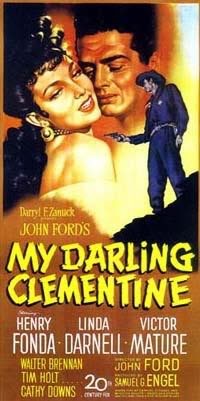
John Ford always maintained that his version of the events at the OK Corral was based on conversations that the director had had with Wyatt Earp himself. While Ford probably did know Earp (the old lawman reputedly spent a lot of time on and around the early Hollywood sets in his later years) and likely talked with him about what happened in Tombstone, the story played out in My Darling Clementine (1946) is most assuredly not the truth. Despite Ford’s grandiose claims of authenticity, his film is really a remake of Dwan’s Frontier Marshal. Both movies were based on the Stuart N. Lake book, and both are highly romanticized accounts. The difference is that, where Dwan’s film is a workmanlike effort, Ford’s take has all those little artistic touches that move it onto another level. Of course Ford was known for spinning the most outrageous yarns when it suited him, but the huge historical errors don’t change the fact that his film is still the best version by far of the famous story.

The Earp brothers actually feature in this film unlike the earlier version from Dwan. Wyatt (Henry Fonda), Morgan (Ward Bond), Virgil (Tim Holt) and James (Don Garner) stop off outside of Tombstone while on a cattle drive. On the recommendation of Old Man Clanton (Walter Brennan) they take a trip into town, leaving little brother James to stand watch over the herd. On their return the three older brothers find their cattle have been rustled and James killed. Suspecting the Clantons of perpetrating the crime, Wyatt accepts the position of town marshal. What follows is a picture of the emergence of civilization (most notably represented by the founding of the town’s first church), and the effects it has on the characters.

Wyatt is transformed from a dusty, unshaven trail hand into the coiffed and suit-wearing face of the law and civic respectability. The scene where Wyatt primly escorts Clementine Carter (Cathy Downs) along the main street of Tombstone towards the new church, with the strains of ‘Shall we gather at the river’ playing in the background, is deservedly famous and remains one of the most touching and romantic sequences ever put on film. This contrasts sharply with the Clantons, who are shown as a bunch of barely human barbarians. A marvelously sadistic moment takes place when Old Man Clanton savagely horse whips his sons before berating them : “When you pull a gun, kill a man.” The bridge between the two extremes is provided by Doc Holliday (Victor Mature) – a man with a cultured background (at one point quoting from Hamlet to help out a drunken actor) who is consumed with self loathing at the knowledge of what he has become.

Henry Fonda plays Wyatt with nobility and that quiet dignity that he seemed to bring to all his roles. The self-conscious diffidence he shows fits perfectly for a man who has been more accustomed to living rough in the wilds. It’s no bad thing either that Fonda always seemed comfortable in a western setting, able to mount and sit a horse naturally. I wish I could say the same thing for Victor Mature but, however hard I try, I just cannot accept him in western roles. I’ve seen Mature in many other genre films and thought him fine, but when it comes to westerns – no thanks. I know this is just a personal prejudice but, for me, his casting doesn’t work at all*. Walter Brennan’s Old Man Clanton makes for a wonderful villain, a figure of pure evil who has molded his sons in his own image – especially the leering Billy (John Ireland) and the slow-witted, and vaguely psychotic, Ike (Grant Withers). Linda Darnell’s Chihuahua is something of a caricature of the typical Mexican spitfire, but she does elicit a lot of sympathy as a woman passionately in love with a man who repeatedly spurns her.

Since the bulk of the story takes place in and around Tombstone, Ford makes less use of Monument Valley than he would in other pictures. However, there are a few scenes that feature his favorite location and they look magnificent as always. Much attention is paid to the town, to all the little rituals of frontier life, and the variety of characters who inhabit it. The celebration of community is pure Ford and you get the feeling he enjoyed recreating this much more than he did the action scenes. Having said that, the inevitable shootout at the OK Corral, though wildly inaccurate, is both stylish and excitingly executed.

My Darling Clementine has been available for some time now on DVD from Fox, but has recently been reissued with the addition of Frontier Marshal as an extra. The transfer is exactly the same on the new disc, but that’s not a criticism since there wasn’t much that needed improvement anyway. You get to choose between the final release version of the film and the pre-release cut, and I’m not really sure which I prefer. I feel the edited version is tighter but I also think Ford’s original cut of the farewell scene between Wyatt and Clementine is better. I suppose we should be grateful that we have both versions to compare. Either way, this is a special film and one that does reward repeated viewings.

*EDIT – Sometimes we speak dismissively of hindsight, but sometimes now I look back on pieces I wrote many years ago and see that old adage about the viewers changing but not the movies as gaining in truth all the time. I now feel that I was overcritical of Mature, and quite unfair in my assessment of his performance here,  when I first put this up well over a dozen  years ago.

Dangerous Crossing

How many people are familiar with the name John Dickson Carr? I suspect the answer is very few, yet from the 1930s through the 1960s he was one of the best known writers of mystery fiction. In the decades since he has faded into relative obscurity while his contemporary Agatha Christie has remained a recognizable commodity with the general public. Both of these writers specialized in detective stories that were notable not for their strong characterization but for their clever, and sometimes ingenious, plotting. However, one has remained highly marketable and the other has not – why? The changing taste of the reading public is no good as an explanation since the work of both of them is very much a product of its time. No, the answer may lie in the fact that, at least from the 1970s on, Christie’s writing has been regularly adapted for both television and the big screen. So, as a big fan of Carr, it’s refreshing to see a film available that was sourced from his work.

A newlywed bride (Jeanne Crain) stands on the dock waiting for her husband (Carl Betz). When he arrives they both board the transatlantic liner that will carry them off on their honeymoon. Their happiness, though, is destined to be a short-lived affair. While the husband goes off to see the purser, the wife agrees to meet him in the bar and waits there. It’s a long wait, and when she tries to find him it appears that no one else on the ship has ever laid eyes on the groom. As an increasingly paranoid Crain roams the fog bound ship in an effort to trace her missing spouse, and prove that she’s not some nut job, the characters whom she encounters range from the suspicious to the downright untrustworthy. That, in a nutshell, is the plot of Dangerous Crossing (1953), and the result is a neat and professional little mystery that reaches a satisfying conclusion in its short running time.

Since this is essentially a B picture, there are no major stars on view and the focus is firmly on Crain, and Michael Rennie (TV’s Harry Lime) as the seemingly sympathetic doctor. Crain’s best scenes come towards the beginning of the movie as it slowly dawns on her that her husband is not to be found on the ship and everyone, both crew and fellow passengers alike, treat her with what could be best described as indulgent scepticism. There are also enough doubts sown in the minds of the viewer as to whether the heroine is delusional or the victim of an elaborate plot to keep things interesting. Michael Rennie is solid, as always, playing the one character who may believe Crain’s story. The support cast doesn’t feature too many faces that would be immediately recognizable, but Willis Bouchey (who graced many a John Ford picture) has a nice turn as the ship’s captain.

While Dangerous Crossing has been released as part of the latest wave of noirs from Fox it does not, in my opinion anyway, really belong in that category. It is most assuredly a mystery, albeit one with a few noir touches such as the paranoid atmosphere and the shadowy photography of Joseph LaShelle. There are some nice sequences on the foggy nighttime decks, a tense cat-and-mouse scene in the baggage hold and a chase through a crowded ballroom. This is all handled competently, if unspectacularly, by director Joseph M. Newman. In the hands of someone more imaginative, Hitchcock for example, these set pieces could have been much more memorable. As it is, they seem a little flat – not bad, just not as good as they could have been.

For a fan of his work, it’s great to see some of John Dickson Carr’s work on the screen. Carr was a hugely prolific writer (he also worked under the pseudonym Carter Dickson since his output was so prodigious that he needed two publishers to handle it) yet few of his works have appeared  on film and I’m not sure why this is. I had been of the opinion that the tricky nature of his plotting might not translate well to film but I’m not so sure of that now. Anyone familiar with the TV series Jonathan Creek (certainly inspired by the locked room and impossible crime puzzles of Carr) will know that this kind of material can work successfully if approached in the right way. Whatever, fans of the master of detection – a kind of mix of Christie, Chesterton and M.R. James – will have to settle for this for now.

The DVD of Dangerous Crossing, part of the recently revived Fox Noir line, is fantastic looking and I’d be hard pressed to find any fault with it. Fox have been doing great work in offering rare and surprising titles in very nice and affordable editions. In addition to the film, there’s a commentary track, an isolated score from Lionel Newman, trailer etc. We also get a short featurette on the film with info on Jeanne Crain and on Fox’s recycling of their sets; I suggest watching the movie first, though, as the featurette does contain a spoiler. So, you get an entertaining, if minor film in a fine presentation from Fox – just remember, it’s not really noir.

The Desperate Hours

Humphrey Bogart’s penultimate film offered him the chance to have one final crack at the kind of role that had catapulted him into the public consciousness two decades earlier. The Petrified Forest (1936) gave Bogie his big break, but it also led to his being typecast as the one dimensional heavy. For the next five years he wasn’t called on to do much more than sneer at the camera and get shot by James Cagney. Playing Roy Earle in Raoul Walsh’s High Sierra would be the turning point for him – sure it was another doomed gangster part but at least this one had a human face. With one exception, he avoided any more underworld roles until we come to 1955 and The Desperate Hours.

The story concerns Glenn Griffin (Bogart) who, in the company of kid brother Hal (Dewey Martin) and lumbering sociopath Kobish (Robert Middleton), has just broken out of prison. Needing somewhere to lay up until Glenn’s girl can reach them and deliver their money, the trio take over the suburban home of Dan Hilliard (Fredric March) and hold the family hostage. There is also a side matter of Griffin holding a grudge against a local cop (Arthur Kennedy), but this is never really developed as the movie chooses to focus on the clash of those cinematic titans Bogart and March. What we get is a war of will and wits between Bogart’s career criminal, struggling to maintain control over both his companions and the family, and the steadfast and respectable March. The film was adapted from a stage play and much of the drama is played out within the confines of the family home. This both points up the contrast between the snug domesticity of the Hilliards and the violent Griffin gang, and helps highlight the claustrophobic sense of entrapment felt by all the principals. As the balance of power seesaws back and forth, the atmosphere of tension never lets up until the film reaches its satisfying climax.

Films which are adapted from plays almost always give actors a chance to show what they’ve got. Such is the case with The Desperate Hours, where two of the heavyweights of classic era Hollywood get to slug it out and ultimately share the spoils. By this stage in his career Bogart could play this type of role in his sleep. Glenn Griffin is a man on the edge, battling to maintain control over those around him and his own personal demons. It is his failure to control either his cohorts or his own thirst for vengeance that finally bring him down. In contrast, March’s Dan Hilliard is the epitome of middle American stoicism, never allowing any overt signs of weakness or doubt to be witnessed by his family. Where Griffin’s dependence on violence and threats leads to fatal blunders, Hilliard’s self discipline and decency allow him to coolly wait for his chance. Of the support cast, the parts of Arthur Kennedy and Gig Young are thanklessly underwritten; the former having little to do except show his dogged professionalism and the latter his devotion to the Hilliard’s daughter. Robert Middleton fares best as the stupid and dangerous Kobish. He brings a genuine sense of menace to the film as his character literally crashes around like a bull in a china shop. There are also small yet welcome parts for character specialists Whit Bissell and Ray Teal.

The Desperate Hours is available on DVD in both R1 and R2 from Paramount. The disc is a totally barebones affair but the widescreen anamorphic transfer is fantastic and, at the time of writing, can be picked up for less than a fiver. All in all, it’s a worthwhile and recommended movie.

Rio Bravo

wayne1

“A game-legged old man and a drunk. Is that all you got?”

“That’s what I’ve got.”


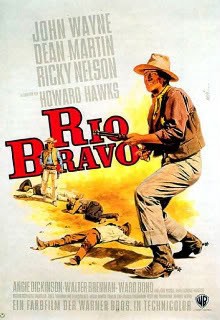
When Sheriff John T Chance (John Wayne) hands that laconic reply to the question from his friend Pat Wheeler (Ward Bond), it more or less sums up what the whole film is trying to say. Anybody who has ever seen a few Howard Hawks movies will know just how much store he set by the idea of professionalism. The small group of self-contained professionals is a recurrent theme in his work, and Rio Bravo may be the best example of this.

I won’t go into the plot in great detail here since it is, frankly, a little thin for a film with a running time creeping up towards two and a half hours. Chance arrests Joe Burdette (Claude Akins) for murder and must hold him in the town jail until the Marshal arrives. All the time, the town is under a virtual state of siege from the hired gunmen of Joe’s brother, Nathan (John Russell). Throw in a typically Hawksian romance between Chance and a poker playing drifter called Feathers (Angie Dickinson), and that’s it. However, this is really a character driven movie, and the plot functions mainly to provide the necessary circumstances to allow the characters to interact. It is this interaction that elevates Rio Bravo to the status of one of the great westerns. I’d challenge anyone to sit through this and not feel for these people by the end; more than that, you actually get the sense of coming to know them. Think about Chance’s coolly competent lawman who’s reduced almost to an awkward schoolboy when confronted with a sassy, attractive woman; Dude’s (Dean Martin) drunken deputy who must face down his personal demons if he’s ever to retrieve his self-respect from the whiskey bottle where he left it; and let’s not forget Stumpy (Walter Brennan), the trigger-happy cripple whose cackling and complaining adds so much warmth and humour to it all.

John Wayne gives one of his most relaxed performances in this film and while this has been criticised by some, I think it fits the pace of the piece. The acting is understated and just plain likable from a man whose talents many are quick to criticise and slow to acknowledge. It’s hard to imagine any other actor playing this part with the natural confidence displayed by Wayne. Dean Martin’s Dude remains convincing as the character gradually transforms himself from a pitiful rummy fishing for drink money in spittoons into a man proud enough to enter by the front door once again. When the doubts and temptations assail him and threaten to haul him back into oblivion, you can’t help rooting for him. The great Walter Brennan has a high time with his role as Stumpy and manages to steal nearly every scene he appears in. The only weak performances come from Angie Dickinson and Ricky Nelson. But if you remember that Dickinson was meant to provide eye candy, Nelson was there to draw in contemporary youth, and that the real focus was on Chance, Dude and Stumpy then it doesn’t seem so important.

While most western directors liked to get out into the wide open spaces, Hawks opted to shoot the entire film within the confines of the town. This has the effect of creating both a claustrophobic tension and a comfortable coziness. In keeping with the theme of professional lawmen, the film itself exudes a slick professional feel. The maturity of Hawks direction can be seen in the first five minutes of the movie, when the status of the main characters and the basis of the plot are presented clearly and explicitly without one word of dialogue being spoken. The script by Jules Furthman and Leigh Brackett may develop at a leisurely pace, but it’s always logical and it’s packed full of memorable lines. Mention should also be made of the score by Dimitri Tiomkin; it complements the action perfectly and the use of the Deguello is yet another of the joys the film has to offer.

I can’t finish this piece without referring to the fact that Rio Bravo was Howard Hawks’ riposte to High Noon. Hawks took exception to the idea of a lawman running around town desperately seeking help from a scared and apathetic citizenry. This was anathema to a man who worshipped at the altar of the professional ethic. To Hawks, a man ought to play the cards dealt to him regardless of the odds stacked against him. Now I have no interest in discussing the politics, either implicit or explicit, of these two films but I do find myself drawn more often to Rio Bravo. While I like and admire High Noon, it concentrates on the selfish fears of men where Rio Bravo celebrates the camaraderie and warmth of humanity – I know which I find more appealing.

For a long time Rio Bravo was only available on DVD on a bare-bones edition. Last year saw the release of a 2-disc SE with a commentary and lots of special features. Initial reports were that the transfer was significantly darker than the old version and I was wary of the upgrade. However, I eventually decided to take a chance and was pleasantly surprised. The new transfer is darker but then the old one was too washed out and faded anyway. It’s not perfect but I do feel it’s an improvement on the original and I have no regrets whatsoever about purchasing it. Maybe Rio Bravo isn’t the best western ever made but, if not, it’s only a few paces behind. Over the years, I’ve probably viewed this film more than any other and I continue to enjoy it – that’s as good a recommendation as I can offer.


The Killers

I did something wrong…once.

So says the Swede (Burt Lancaster) as he lies in bed bereft of all hope, and calmly awaits his end. I love that scene near the beginning of the 1946 version of The Killers. It is one of the great moments of film noir and says so much about the genre – if you can even call it a genre. A good deal of its bleak power comes from the fact that it seems to run contrary to all normal human instincts. If someone were to burst into your room and breathlessly inform you that a couple of mean-looking hitmen had just rolled into town with the express aim of rubbing you out, most people would take the opportunity to make tracks fast. But Lancaster just remains prone in the shadows and delivers that line in the detached tone of a man already dead; when fate pays that last call there’s no ducking out.

Robert Siodmak’s film takes Ernest Hemingway’s short story (and it’s a very short story) and uses it merely as the jumping off point. The rest of the movie follows insurance investigator Reardon (Edmond O’Brien) as he tries to find out why the Swede ended up in a small New Jersey town waiting passively to greet a hail of bullets. The story is revealed by a succession of characters who had known the Swede, and a number of flashbacks gradually piece together all the events that brought about his demise. The Swede starts off as a medium grade fighter who, after breaking his hand and ending his career, begins the slow descent into the criminal underworld. This culminates in a payroll heist, the aftermath of which leads to the eventual downfall of just about everybody involved. The character of the Swede is basically a good-natured oaf whose desire for easy money allows him to be dazzled and duped by the grasping and predatory Kitty Collins (Ava Gardner). In a sense the whole film is as much about Kitty as anyone else; as we see her manipulations provide the catalyst for the betrayals that litter the story.

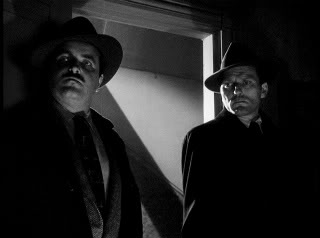
The Killers marked the screen debut of Burt Lancaster and his tough vulnerability is shown to good effect in the movie. There’s enough innocence in the Swede for you to genuinely sympathise with him and despair at the big lug’s stupidity as Kitty plays him for the ultimate sucker. Ava Gardner’s Kitty gets the classic femme fatale intro; we first see her as the Swede does – seductively clad in black satin and vamping for all she’s worth in a night club. Her character is rotten all the way through – effortlessly hooking the smitten Swede, playing the gang off against each other, and finally, tearfully begging a dying man to save her neck by damning himself. The role of Edmond O’Brien is to offer perspective and lead the viewer through the labyrinth of deceit; he’s really the linking device between all the small episodes that make up the whole. O’Brien’s own guide along the way is police lieutenant Lubinsky (Sam Levene from the Thin Man movies) and there is good support from gang members Albert Dekker, Jack Lambert and Jeff Corey. However, two of the most memorable turns come from William Conrad and Charles McGraw as Max and Al, the killers of the title. Their roles don’t extend much beyond the first ten minutes of the film, but those are ten truly magical minutes. They get some of the choicest dialogue (and deliver it perfectly) as they simultaneously mock and menace the occupants of the Brentwood lunch counter.

Robert Siodmak made some of the best noirs of the forties and I feel The Killers is his standout work. This is one of those films where plot, direction, characterization and photography all seem to come together harmoniously. Deep, dark shadows are everywhere and only the policeman’s terrace, where the ideal wife serves lemonade on a hot day, seems to rise above the murkiness. I should also say a word about the powerful score by Miklos Rozsa which is especially effective whenever Messrs Conrad and McGraw make an appearance.

The Killers is out on DVD from Criterion in R1 and from Universal in R2. I can’t comment on the presentation on the R2 disc as I haven’t seen it but bitter experience has taught that Universal’s UK releases are a hit and miss affair, with a high proportion of misses. The Criterion is everything you would expect from them with a beautiful, clean transfer to show off those deep, black shadows. As you would expect, the film comes packed with useful and informative extras – and, best of all, it is paired with Don Siegel’s 1964 remake (and Andrei Tarkovsky’s student film version). All in all, this represents the definitive presentation of what is probably my favorite film noir.

The True Story of Jesse James


Almost twenty years after scoring a hit with Jesse James Fox tried to repeat their success in 1957. With a screenplay based on and crediting Nunnally Johnson’s 1939 effort, the studio tagged ‘The True Story’ onto the title and director Nicholas Ray was handed the task of trying to offer a fresh perspective on this oft-told tale. So, does this one actually tell the true story? Well, not exactly since the time-line is more than a bit suspect, although it does get quite a few things right which the earlier version didn’t.

The film pitches the viewer straight into the action as it opens during the raid on the Northfield bank. After the dramatic escape of Jesse (Robert Wagner) and brother Frank (Jeffrey Hunter) the film proceeds to narrate events via a series of flashbacks which lead up to the climactic and doomed heist. The True Story of Jesse James, as I said, manages to correct a few of the errors of the earlier version. In this film the James gang are, more accurately, shown to be driven towards a life of crime as a result of the conditions that prevailed after the Civil War. The treatment of the other characters is also a good deal closer to reality. The 1939 film had the James home being bombed by railroad agents, resulting in the death of Jesse’s mother. Nicholas Ray’s movie has the attack being carried out by Pinkerton men (referred to here as Remington agents) and causing not the death of the old woman but the loss of her arm – again this is pretty much as it happened. It is no bad thing either that the Younger brothers are actually portrayed here, although the emphasis on them is slight.


The biggest weakness of the movie lies in the casting, and particularly that of the lead. While earlier incarnations showed Jesse James as a lovable rogue (Tyrone Power) or a saintly, avuncular type (Reed Hadley), here he has evolved into more of a trigger-happy glory seeker. The trouble is that Robert Wagner just doesn’t have the necessary edge or grit to carry this off successfully. Although he does give a pleasant enough performance he is simply too lightweight. Jeffrey Hunter, on the other hand, is excellent as Frank; so much so that it seems a pity he wasn’t given the lead. Agnes Moorehead adds some class as the mother but her scenes are few. Even though Alan Hale’s Cole Younger is played mostly for comic relief it lends a touch of realism to see the character appear and be shown as a figure of some influence within the gang. John Carradine turns up again (how many  movies did this man make?), not as Bob Ford but as the preacher who baptises Jesse.

While I generally enjoyed this movie there were a few things that did get up my nose. These mostly involved the inclusion of footage from the 1939 Henry King film. The train robbery sequence blends in fairly seamlessly but another example proved especially distracting to me. During the well filmed Northfield raid, as the lead flies and men are falling all around, Frank and Jesse take the time to ride into an alley and divest themselves of their long dusters. Why, you might well ask, would two men caught in a firefight pause to do this? Well, the answer is that we’re about to see recycled footage of Power and Fonda riding through a plate glass window and later jumping their horses off a cliff – and our heroes hadn’t been wearing dusters in the ’39 film! Now those scenes were great the first time round but it smacks of a certain cheapness to wheel them out here again. Another problem I had was at the end of the film. You know that Bob Ford is going to shoot Jesse as he stands on a chair to straighten that picture. Well, here Ford gives it to him in the back of the head at point blank range – and instead of dropping to the floor like a sack of potatoes, Jesse swivels around to glare reproachfully at his assassin before succumbing to his wound. Bah!

The True Story of Jesse James is available on DVD from Fox in R1 and Optimum in R2. I watched the R1 and the presentation of this scope film is excellent with no major faults worth mentioning. I can’t comment on the quality of the R2 disc but I would imagine that it has been cut by the BBFC for the aforementioned scene of the jump off the cliff – I understand one of the animals was killed during the filming of that stunt. So, despite some quibbles, I would say this is not a bad movie – just not a great one.

I Shot Jesse James

jesse_james0

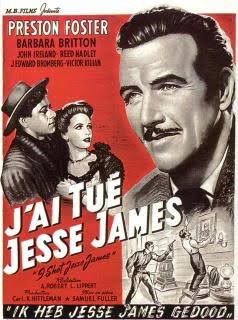
Sam Fuller made his directorial debut in 1949 with this take on the old story. I Shot Jesse James, as the title suggests, keeps the focus squarely on Bob Ford (John Ireland) and shows him in a more sympathetic light than usual. Like most film representations of these characters, there are some elements of the truth woven into the story. This film comes a little closer to reality in depicting the demise of Bob Ford than was the case with The Return of Frank James; here the name of the killer, the location and the means are broadly correct. Where the story drifts off into total fiction is the inclusion of the romantic triangle as the centrepiece of the drama.

The story opens with a botched bank robbery that leaves Bob Ford wounded and forced to lay up at the James home in Missouri. As he recuperates, he has the opportunity to visit the love of his life Cynthy Waters (Barbara Britton) who is an actress in a travelling theatre company. This meeting lays the groundwork for all that is to follow. When Ford arrives to see his woman he also meets a man called Kelley (Preston Foster) – a prospector who is clearly smitten with Cynthy. And thus the aforementioned triangle is set up. Cynthy begs Ford to abandon his outlaw ways and settle down to a decent life, thereby providing the motive for the subsequent murder of his friend. The rest of the movie is a portrait of guilt and a man trying to make good on his promise to go straight, yet foiled at every turn by his past and a love destined to remain unfulfilled.

In many ways I Shot Jesse James is a slight film, no more than a B movie really. What makes it notable is the way it tries to show Ford as a real person and not the greed driven caricature of earlier versions. I can’t say I was bothered by the playing around with historical facts since the reason for this was clearly the need to provide the character of Ford with a motive that might be understood. John Ireland does a pretty good job in showing us a man who is left bewildered when his actions draw not only the scorn of strangers but drive away the very woman whose heart he’d hoped to capture. Barbara Britton is good enough too as her character goes from love for Ford, through disgust at his actions, and finally to fear of what he has become. Preston Foster, as Kelley, isn’t called on to do much more than be the strong, dependable, moral anchor but he does it capably enough.

Sam Fuller would go on to make more famous, and better films than this but there are some memorable scenes. The climactic shootout has Ford framed in inky blackness – maybe signifying the moral void he now inhabits. There’s also a great scene in a saloon where Ford listens to a travelling minstrel sing about the murder of Jesse James. This was mirrored in the recent film by Andrew Dominik, but I prefer the way it was done here. After introducing himself, Ford insists that the singer complete his ballad as he stares implacably at him. You can almost taste the man’s fear as he chokes his way through the song, and struggles to utter the words ‘the dirty, little coward’ to Bob Ford’s face.

Criterion put this out on DVD in the ‘First Films of Samuel Fuller’ set, and it’s not available separately. This is part of the Eclipse line, and hasn’t had the careful restoration commonly associated with Criterion releases. However, it still looks good enough and I didn’t find the damage marks present to be particularly distracting. All in all, I Shot Jesse James is an interesting, if minor film.


Ministry of Fear

poster60

The ‘entertainments’ of Graham Greene have provided a rich source of material for makers of Film Noir. The Third Man, This Gun for Hire and Brighton Rock have all been derived from his works and, if you want to stretch the point, a case could also be made for the inclusion of The Fallen Idol and Confidential Agent. This all goes to prove that there is enough darkness and pessimism in Greene’s writings for them to lend themselves to the shadowy world of noir. And so we come to Fritz Lang’s 1944 adaptation of Ministry of Fear, where a frightened Ray Milland blunders through the bombed out streets of wartime London in pursuit of fifth columnists.

Stephen Neale (Milland) has just been released from an asylum after having been confined for the mercy killing of his wife and, naturally, is anxious to avoid any further entanglements with the law. As he waits to catch a train to London, he wanders into a charity fete where a palmist helps him to guess the weight of a cake and win it. With this seemingly innocuous incident Neale finds himself drawn into a nightmare world of murder and espionage. It turns out that the fake spiritualist had mistaken Neale for a Nazi agent (Dan Duryea) and that the cake contained something worth killing for. Neale’s curiosity leads him to follow up the matter in London where he attends a seance in the company of, among others, the aforementioned agent. When the spy is murdered Neale is falsely accused.  He believes that due to his past conviction no one will believe him innocent of the murder and so he goes on the run. His only assistance comes from an Austrian refugee (Marjorie Reynolds), and while the pair try to seek out the truth they are all the time dogged by a shadowy figure in a bowler hat.

Ray Milland’s star was in the ascendancy at this point and he would win an Oscar for his performance in The Lost Weekend the following year. His role here allows him to get in a bit of practice in psychological anguish and the natural affability of the man means that it’s easy to sympathize with the plight of his character. Marjorie Reynolds is fine as his Girl Friday but the forced Austrian accent does begin to grate a little at times. Dan Duryea is always good value as a villain and the only complaint that could be made is that his character is not given nearly enough screen time. Indeed the same could be said for much of the support cast who seem to breeze in and out of the picture, but all leave lasting impressions. A notable feature of so many films of this period is the marvellous gallery of eccentrics that cropped up time and again. These people, whose faces are immediately recognizable yet whose names escape us, were character specialists who usually played similar parts in every movie and their presence added enormously to the enjoyment.

Fritz Lang’s background in expressionist film-making serves him well here and is most notable in the early scenes of the picture. The charity fete provides that slightly surreal quality that continues throughout the film. The parts with the fake blind man on the train and the ensuing chase over the fogbound moor are also beautifully photographed. Everything seems to have been shot on studio sets but this is no criticism as it helps heighten the unreal, otherworldly feel of the movie.

Optimum released Ministry of Fear on DVD in R2 last year. The transfer is not bad but it could use a clean up. All in all, this is a highly enjoyable mix of noir and espionage and it’s always good to see more of Fritz Lang’s movies making it out onto the market.