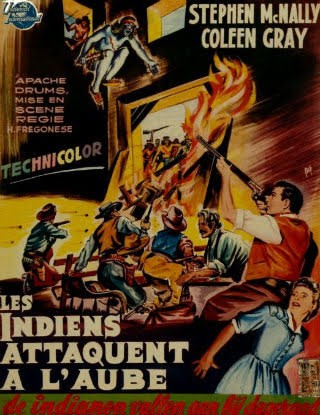
Apache Drums

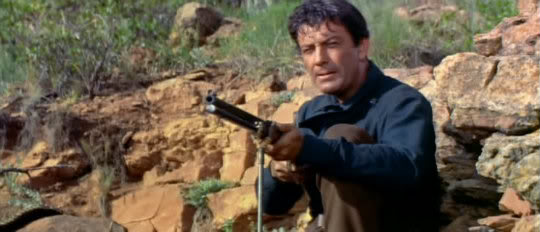
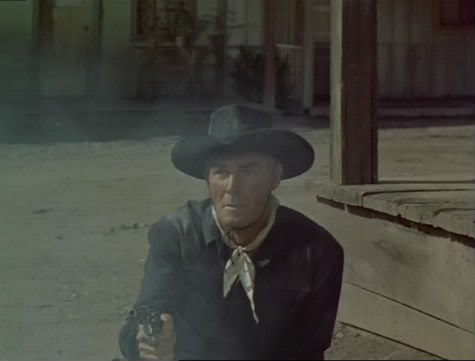
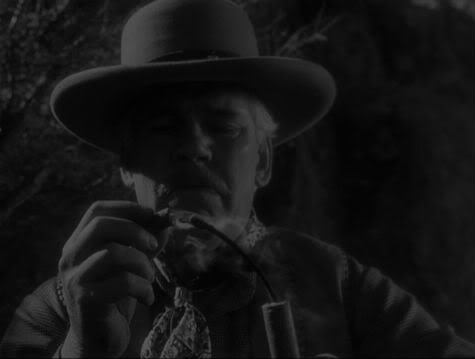
Filmmakers assigned to B movie projects always faced an uphill struggle at the outset: inflexible and restrictive shooting schedules, budgets pared right down to the bone, and scripts that, as often as not, lacked any spark of originality. Still and all, there were a select few who seemed to thrive under such circumstances, who had the vision or the maybe even the guts to shape something worthwhile out of the modest resources before them. Fans of classic horror are familiar with, and hold in high regard, the name of Val Lewton. This was the man whose specialist unit at RKO managed to produce a series of classy, polished little nightmares that not only transcended their frugal budgets but actually succeeded because there was so little money available. Apache Drums (1951), made at Universal, was Lewton’s last feature as producer before his untimely death from a heart attack. The film is the only western he was involved in, and it’s such an effective and atmospheric little picture that I can’t help but wonder how he might have fared within the genre had his life not ended so prematurely.

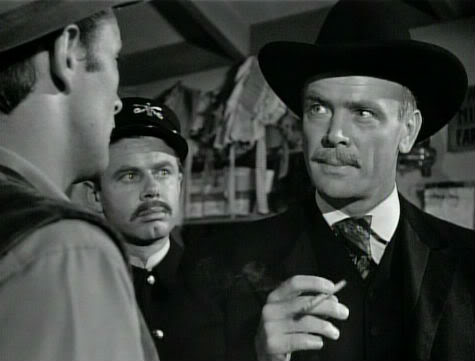
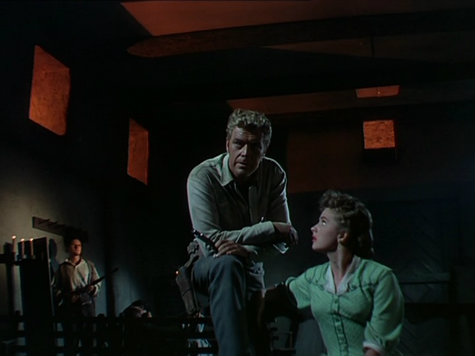
The story is derived from Harry Brown’s Stand at Spanish Boot, and it tells a fairly standard tale. Sam Leeds (Stephen McNally) is a gambler, a seemingly incorrigible ne’er-do-well (he’s even earned himself the unwelcome nickname “Slick”) who quite literally opens proceedings with a bang, shooting dead a rival card player in the stark saloon in the town of Spanish Boot. I found it a particularly nice touch that the shooting takes place off-screen as it immediately lends a sense of ambiguity to Sam’s character. He says it was self-defense and no-one seriously doubts that, still the seeds of suspicion are planted in our minds right from the off. The shooting comes at a bad time from Sam’s perspective: the mayor/blacksmith Joe Madden (Willard Parker) has been talked into a kind of moral crusade by the Welsh (the nationality has some significance later in the movie) parson Griffin (Arthur Shields) and Sam is given his marching orders. The fact that Madden is Sam’s rival for the affections of local girl Sally (Coleen Gray) rubs further salt into his wounds but he has no alternative. The dance hall girls have just been sent packing, and Sam is the next undesirable to be ejected. Thus we have the classic western staple of the outcast, shunned by the decent folk and driven out beyond the bounds of civilization. However, Sam’s exile is a short-lived one; he soon caches up with the wagon of girls, or rather their massacred remains. With his dying breath, the freshly scalped piano player who had been accompanying the spurned ladies tells of a formidable Apache raiding party appearing ghostlike and descending upon them. Sam gives his word to hightail it back to Spanish Boot and warn the solid citizens of the impending attack. The thing is he’s neither welcome nor trusted in his former home, the residents, with the tacit support of Madden, being on the point of riding him out of town on a rail before the arrival of a shot-up stagecoach bears out his words. It’s at this stage that the tension starts to build, as the Apache threat draws ever closer. Eventually, the net closes in to the point where all the survivors are holed up and under siege in the old church. Here, in the latter half of the movie, the camera never leaves the interior of the building and so heightens the feeling of helplessness and suspense, as the drums pound throughout the night and the defenders wait and watch for the Apache to leap howling through the high windows.
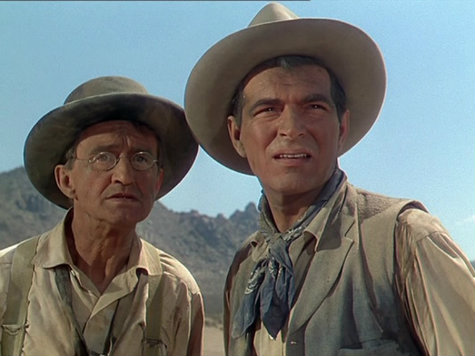
In writing about a lot of 50s westerns, one word crops up again and again – redemption. There’s no getting away from it; it quite literally pervades the genre throughout the decade, with even relatively humble and unpretentious efforts like Apache Drums having the concept at their core. All of the three main characters – Sam Leeds, Griffin and Madden – redeem themselves before the final fade out. Madden initially comes across as a vaguely priggish figure, allowing his preconceptions of Sam to colour his judgement and using his authority as means of furthering his own personal desires. But through enforced confinement with the man he regards as his opponent, he’s able to rise above his own inherent pettiness to attain a kind of nobility by the end. Griffin is a moral and religious absolutist, quick to judge and condemn all those who he considers to have strayed from the path of righteousness. Again, the circumstances he’s forced into lead to a reassessment of his former stance. There’s a marvelous little moment during the siege, where the preacher who had previously spoken in the most derogatory and disparaging terms about the Apache scout in their midst, Pedro-Peter (Armando Silvestre), moves across to kneel beside him. With the shadows of death creeping ever nearer, these two men pray to their respective deities side by side. And finally there’s Sam Leeds. He starts out expressing nothing but casual contempt for all those poor saps who slave away trying to earn an honest living and build a community. He’s of the opinion that he’s too smart for all that guff, that his only concern is his own welfare and comfort. Yet, he too (perhaps more than the others) finds that the threat from without carries a lesson for him. By putting aside his selfishness and obsession with self-preservation, he grows visibly as a human being. In their roles, Parker, Shields and McNally all manage to create rounded characters that are believable due to their respective weaknesses and prejudices. When you’re dealing with a low budget production such as this, good characterization, and the performers capable of achieving it, is a huge plus.

While the acting is important if you’re counting the pennies, it’s all likely to come to nothing if the technical expertise isn’t present behind the cameras. As I said in the introduction, producer Val Lewton was a past master at wringing the maximum out of limited resources. His RKO chillers all had a very distinctive look and feel, regarding shadow, darkness and the unseen and unknown as assets rather than obstacles. Such is the case with Apache Drums. Some of the most effective sequences follow on from events that the audience never get to see: both Sam’s deadly gunplay and the massacre of the saloon girls happen off-screen and the viewer only gets to witness the consequences of these events. The final section of the movie, which leaves the audience with no choice other than to view the action from the perspective of the terrified townsfolk means that we share in their sense of helplessness and dread. Of course Lewton was either clever or fortunate enough to work with talented directors on his projects. Between them the producer and director Hugo Fregonese work wonders in this section of the film: the image of garishly painted warriors springing through the high windows, backlit by the flames of the burning town, is like a vision out of hell, and retains a powerful shock value. I made brief mention earlier of the fact that Arthur Shields played a Welsh preacher. The reason for my drawing attention to his character’s nationality relates to a passage which takes place during the climactic siege. As the incessant beating of the war drums outside the walls begins to take its psychological toll on those inside, the decision is made to do something in an attempt to boost morale. Shields, playing a Welshman, leads the defenders in a chorus of Men of Harlech. In itself it’s a nice moment, but it’s also significant in that the scene would be mirrored in Cy Endfield’s Zulu over a decade later.
Apache Drums is a film that seemed quite difficult to see for many years. I caught a television broadcast back when I was a teenager and it stuck in my mind, probably because of the imagery as much as anything. At the moment, there are three DVD editions available: from France, Spain and Germany. From various comments I’ve seen, I get the impression they are all derived from the same source, though the French release will have forced subtitles. I have the Spanish DVD from Llamentol, which presents the film in the correct Academy ratio, and boasts a fine overall transfer – it’s sharp, colourful and well-defined. Subtitles are not an issue and can be turned off on the setup menu. The disc also offers the original theatrical trailer for the film, but that’s it in terms of extra features. I really like the film; it’s pacy, well structured and exciting. Aside from that, it looks good, with the kind of visual flair that’s typical of a Lewton production. A low budget sleeper that I happily recommend.

The Last Hunt

Westerns, especially the classics of the 50s, tackled just about every theme imaginable, often passing comment on universal concerns that transcend the genre itself. That of course is one of the western’s great strengths, it’s ability to resonate widely. However, the genre has also dealt with what might be termed more direct concerns too, actions and events that impacted  on the shaping of the frontier and the course of US history. Bearing in mind that the old west was essentially a wilderness, it’s no surprise that animals occupied such an important place in the minds of those who lived there. There are countless examples on film highlighting the importance to the native people and settlers alike of the horse. How many times have we witnessed the contempt and hatred directed towards horse thieves? In a primal landscape covering vast distances, the theft of a man’s sole means of transport was naturally one of the foulest crimes. However, the horse wasn’t the only animal which played a significant role in the development of the frontier. The buffalo, that great beast which sustained and dominated the lives of the plains Indians, was every bit as vital in its own way. As such, it’s perhaps surprising that The Last Hunt (1956) is one of the few westerns that concentrates on the fate of those creatures which once roamed in huge numbers across the continent.

The Last Hunt is the story of two quite different men, Sandy McKenzie (Stewart Granger) and Charlie Gilson (Robert Taylor), who enter into an uneasy partnership. Sandy is a famed buffalo hunter, but he’s also a man sickened by killing and has abandoned his old profession to turn his attention to the cattle business. However, fate has other ideas and, when a buffalo stampede wipes out his herd, a chance meeting with war veteran Charlie leads him reluctantly back to hunting. While Sandy has seen more than enough bloodshed, Charlie has something approaching an obsession with death. Charlie’s wartime experiences have clearly left a mark, and he seems to live to kill. The contrasting approaches of the two  men is highlighted during one of the hunt scenes. Having established a stand, the camera switches between this pair as they go about the slow, methodical business of picking off the buffalo herd. Charlie’s features are fixed in a mask of sadistic delight as one animal after another drops and breathes its last. Conversely, Sandy is stricken by conscience and is on the verge of breaking down and weeping at the thought of the devastation he’s participating in. If the radically different perspectives of the partners weren’t a great enough source of conflict, their rivalry is further complicated when Charlie captures a young Indian girl (Debra Paget) and takes her as his woman. Along with his wide sadistic streak, Charlie is also an unashamed racist with a deep suspicion and hatred of the Indian. He considers the girl to be his personal property, one of the spoils of war if you like, to be used or abused as he pleases. Not only does Sandy regard this kind of boorishness as an affront  to his sense of morality and civilized behaviour, but he also finds himself developing feelings for the girl himself. Charlie’s mounting paranoia and Sandy’s growing self-disgust, fueled both by their slaughter of the buffalo and the presence of the girl in their midst, see the tensions rise inexorably. Sooner or later, these two will have to face off and settle their scores, and the climax of the movie is a memorably chilling one in every sense as the final confrontation takes place during a freezing blizzard.

Richard Brooks started out as a writer, scripting films such as Brute Force, Crossfire and Key Largo before moving into directing with the Cary Grant suspenser Crisis in 1950. He didn’t work much within the western genre, making only Bite the Bullet, The Professionals and The Last Hunt. As a writer, he tended to tackle complex and controversial subjects and his first western as director (with a script credit too) saw him continue in a similar vein. The Last Hunt works in the theme of racism alongside its ecological message; the systematic elimination of the buffalo was essentially a government sponsored programme once the realization set in that the army wasn’t going to defeat the Indians through conventional military tactics. The buffalo had a special place within Indian culture, providing not only a source of food but also many of the essentials of life. The Indians used almost every part of the animals to make clothing, shelter, and tools. Therefore, it’s impossible to overestimate the status of these creatures as far as the native people were concerned. Brooks highlights the mysticism involved when he features a white buffalo, a sacred figure. This device also serves to draw attention again to the differences between Charlie and Sandy: Sandy is entranced by the sight of such a rarity, while Charlie sees only profit and immediately slays it. Although this is, superficially at least, a fairly simple tale, there’s a lot going on and Brooks blends it all together very successfully, ensuring that a brisk pace is maintained without sacrificing any of the necessary character development.

Robert Taylor is an actor whose work I’ve featured regularly on this site and The Last Hunt offered him one of his very best roles, maybe even the best. Generally, he played heroic figures but this film saw him take on the persona of an irredeemable rogue. I’ve read comments in the past which indicated Taylor had  doubts about his own abilities as a performer, but roles such as Charlie Gilson prove that there was no basis for such harsh self-criticism. I always feel the best and most effective movie villains have the knack of drawing a degree of sympathy or pity from the viewer, and that’s the case with Taylor’s portrayal here. There’s no question that Charlie is a bad lot, but Taylor brought a certain fragility to the part and that adds an interesting variation to what could have been a bland and routine character.

Stewart Granger might seem an odd choice for a western hero but here, in his second genre picture, he’s both comfortable and convincing. Apparently, Granger took to the whole western experience off-screen too and was well thought of by the crew. He’s very effective as the conscience-stricken counterbalance to Taylor’s killing machine and the two actors play well off each other. The Last Hunt is another of those movies with a small central cast; they’re usually quite successful at rounding out the characters and offering some more depth. In this case, the two protagonists benefit more from the increased focus though. Debra Paget as the captive Indian girl is never named and remains a slightly colourless presence throughout, albeit a strikingly attractive one. After appearing in Broken Arrow, this was Paget’s third outing as an Indian maiden and it must have looked like she was going to be permanently typecast at this point. Whatever you say about Paget, I don’t think anyone could mistake Russ Tamblyn for a native American. Nevertheless, he was cast as the half-breed hired by Sandy and Charlie, and his sympathetic presence is used to emphasize the blind bigotry of the latter and the relative enlightenment of the former. Best of all among the supporting players though is Lloyd Nolan, another initially questionable choice for a western. Nolan had a very  urban air about him and I tend to think of quick talking cops and the character of Michael Shayne whenever I see him. Still, he really embraced the part of the one-legged buffalo skinner and turned in a very  memorable performance.

For a long time The Last Hunt was only available on DVD in Europe. However, the film has recently made its US debut via the Warner Archive. I can’t comment on the quality of that particular transfer though as I don’t own a copy. I have the French release by WB, which looks reasonable although the scope image is letterboxed and non-anamorphic. In common with the majority of Warner titles released in Europe, it’s a bare bones affair with optional subtitles that can be deselected on the setup menu. The movie itself is a real keeper, a bit of a neglected gem that looks good, has fine performances, and makes a number of interesting points about man’s impact on the environment and race relations. The wider availability of this title on DVD may hopefully raise the profile of a film that’s well deserving of some renewed attention.

The Bounty Hunter

Obviously, perceptions of a lot of things change and evolve over time, and characters in movies are no exception. To modern viewers, it comes as no surprise to see a lead who makes a living pursuing criminals for the simple reason that it pays well. That attitude comes, of course, from familiarity with the concept, but it may also say something about the way opinions of certain occupations have shifted. The Bounty Hunter (1954) has a title which is pretty much self-explanatory. All told, it’s a fairly routine western, but one of its most interesting aspects is how it underlines the way audience expectations and judgements have altered in the half century since it was made. If this were a 2012 production viewers would simply take the lead’s profession at face value, not requiring justification of his choice in order to build up his heroism, whereas that wasn’t the case back in 1954. At that time, and especially in westerns, the idea of the anti-hero hadn’t been so firmly established; leads had to earn the sympathy of the audience, and doing an honorable job (as opposed to a merely profitable one) was one of the criteria.

Jim Kipp (Randolph Scott) is the bounty hunter of the title, with a fearsome reputation as a tracker and killer of men. Our first glimpse of him comes as he picks his way through the barren landscape, seeking out water for himself and his mount. This opening scene deftly establishes both the nature of the man and the risks his line of work entails. As Kipp prepares to drink, a figure lurking in the rocks takes aim and fires on him. Kipp’s lightning reflexes, his rapid outflanking and merciless disposal of the would-be assassin, all shot without dialogue, make it clear that we’re looking at a hardened professional killer. There are countless westerns of the classic era which feature such tough individuals hunting wanted men. The crucial difference though is that characters of that type usually had some personal motivation; those they pursued had wronged or injured them in some way and what they were generally seeking was revenge. Kipp is a different breed: in conversation with the sheriff, who’s partially in awe and partially contemptuous of him, Kipp makes no bones about the fact he does his job for money. This is a refreshingly honest admission but it’s also one that sits a little uneasily, and the various characters we’re introduced to throughout the movie react with a mixture of fear and suspicion to the presence of this ambiguous figure in their midst – although there is a dryly humorous moment when the only man sorry to see him leaving town is revealed to be the undertaker. While the plot of The Bounty Hunter does highlight the morally dubious actions of men like Kipp, the story is mainly concerned with a mystery. Kipp’s talents have earned him a strong reputation, strong enough to attract the interest of Pinkerton agents. When the famed detective agency draws a blank in its attempts to bring a gang of train robbers to justice, it turns to Kipp. He reluctantly (although there’s ample reward promised if he succeeds) agrees to set out in search of the criminals. The trail leads to the boom town of Twin Forks, where it seems likely the fugitives stopped off. The structure of the movie now resembles that of a classic detective story (although the disquiet among the townsfolk caused by Kipp’s presence also seems to foreshadow the anxiety generated by a similarly unwelcome visitor in No Name on the Bullet) as the hero tries to determine which of the many recent arrivals might fit the bill. There are plenty of red herrings, and a romantic subplot that’s blended fairly seamlessly into the tale, to keep the viewer guessing as the film rattles along towards a pretty satisfying conclusion.

Andre de Toth made a half a dozen westerns with Randolph Scott, starting in 1951 with Man in the Saddle and culminating with The Bounty Hunter. Generally, these are modest, B-grade movies that eschew pretension and aim to entertain first and foremost. The film does take a look at the frowned upon profession of bounty hunting and, as I said earlier, that’s probably what’s most noteworthy about it. Unlike later representations, particularly the Leone-inspired spaghetti westerns, there is a concession made to traditional genre expectations. As the story progresses, it’s revealed that Kipp does have a personal reason for choosing his career, although it’s not directly related to his investigation in Twin Forks. At this point, the western was still at the stage where complexity of characterization and motivation was acceptable, but an essentially amoral lead was still beyond the pale. As the credits roll, we see that Kipp has abandoned his solitary existence on the fringes of society and the law, and opted instead for convention and respectability. These days, de Toth is probably best known for shooting House of Wax in 3-D, and this movie was also produced with that format in mind. Even though I understand the film was never shown any other way than flat, there are a number of instances of shots that were clearly composed for 3-D projection: a rifle barrel pointed directly into the lens, champagne corks popped in our faces, and a hat which is shot off and then sails almost languidly in our direction. This is all gimmicky stuff that actually only distracts, and that’s one of my main gripes with 3-D in general. It’s also worth noting that the script for The Bounty Hunter was written by Winston Miller, who penned Ford’s My Darling Clementine nearly a decade earlier. Now I’m not going to try anything so foolish as comparing the two films, but it is worth mentioning that The Bounty Hunter features a couple of moments which certainly bring Ford’s great work to mind: there’s the scene of the community gathering at the church, and even more marked is the image of Kipp reclining on the boardwalk in the style of Henry Fonda.

I don’t think I’ve ever seen Randolph Scott give a poor performance in a western, even when the material he had to work with was nothing special, and he’s the best thing in The Bounty Hunter. It’s been discussed before on this site how Scott was gradually building and working towards the complex and often bitter characterizations he perfected in his later films. The role of Jim Kipp was another step along that road; there’s the kind of easy charm that was never far from the surface, but there’s a darker side too. Kipp is a man who’s living very much in the shadow of a wounded past, and Scott always had a wonderful way of delivering dialogue, modulating that distinctive drawl in such a way that half expressed feelings are easily understood. A very young Dolores Dorn was cast as his romantic interest, and she is quite capable in the role. However, perhaps unsurprisingly, she is overshadowed by Marie Windsor in another of her typically eye-catching parts. Windsor had a kind of knowing allure, an earthy attractiveness that’s hard to define yet mightily effective. There’s a strong supporting cast too, with Ernest Borgnine, Harry Antrim, Howard Petrie and Dub Taylor all turning in fine performances.

As far as I know, the only DVD release of The Bounty Hunter at present is the Spanish edition from Warner/Impulso. The film is presented in Academy ratio (1.33:1) but I’m not sure if that’s how it ought to be seen – IMDB suggests 1.75:1 for what it’s worth. The transfer is so-so, there is a bit of brief roughness visible in the opening few minutes – which also feature some sloppy editing – but it settles down after that. The film was shot using the WarnerColor process and it looks faded in places – in fact, there’s a definite greenish cast to the image most of the time. Despite that, there’s no serious damage to the print. The menu claims the English soundtrack comes with Spanish subtitles, but they don’t display as long as the subtitle option on the player is disabled. Anyway, the movie is a fast paced and entertaining programmer with pleasing performances and direction. The mystery elements of the plot are handled well and hold the interest – the fact that we get an early portrayal of a bounty hunter is an added bonus. I won’t claim this is a great western, and I don’t imagine it was ever envisioned as such, but it is a good example of the mid-50s variety.

The Furies

fur1

You’ve found a new love in your life, haven’t you Vance? You’re in love with hate.

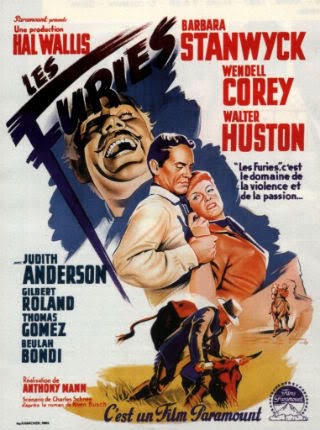
In some earlier pieces I wrote about the westerns of Anthony Mann, the matter of the order of production of his first few efforts came up. One of this site’s regular visitors, Blake Lucas, was kind enough to clear up what is often a confusing issue. Anyway, in connection with that, we also touched on the evolution of Mann’s style as he settled into his western period. The Furies (1950) was his second foray into the genre, and it seems to me at least that the film bears the hallmarks of a transitional picture. Mann started out making noir thrillers, and polished, highly regarded ones at that, before changing tack and moving west. His first three westerns, partially as a result of the use of black and white photography, retained some of film noir’s mood and sensibilities. The Furies is a very dark film, visually and thematically, yet suffers from a fault that shouldn’t be all that surprising when we consider its place within Mann’s filmography. I think it’s fair to say the director hadn’t fully found his feet in the genre, the upshot of which being a film that’s something of a mash-up of genres and styles, perhaps a reflection of a filmmaker who had not fully decided on the direction he wanted to follow.

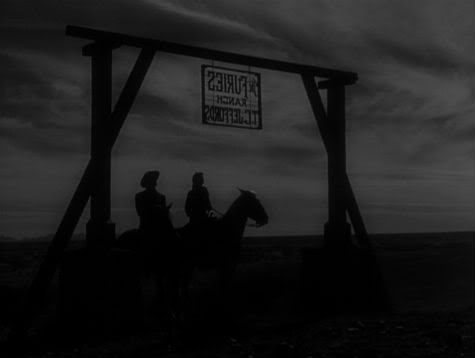
The Furies is a ranch, a vast New Mexico spread presided over by the flamboyant T.C. Jeffords (Walter Huston). Jeffords is one of those self-made men so common to the western, a latter-day empire builder who has stamped his authority on the section of the frontier that he seized, tamed and held. Such men are frequently given to expansiveness in word and gesture, I guess we could say they earned the right, yet are also prone to all the petty weaknesses that afflict lowlier individuals: jealousy, vanity, loneliness and greed. Of these, perhaps vanity is the most treacherous, for powerful men have the means and ruthlessness to indulge it. Tellingly, Jeffords has a grand portrait of himself dominating the entrance hall of his home, and sits in his study flanked on one side by a bust of Napoleon and on the other by his own likeness. He’s lord of all he surveys, even going so far as to issue his personalized local currency. But a man like this can only extend his authority so far, and in Jeffords’ case the one person capable of challenging him is his daughter. Vance (Barbara Stanwyck) is a wilful and headstrong young woman, cast in the same reckless mold as her father. She is first seen, on the eve of her ineffectual brother’s wedding, brazenly trying on her late mother’s gown in the bedroom her father has forbidden all to enter. There, in a nutshell, we have a neat summation of the relationship between Vance and Jeffords; she has, to all intents and purposes, taken on the role of her departed mother. However, any such relationship is fundamentally flawed for the simple reason that the parties involved must naturally look outside for genuine fulfillment. In Vance’s case it appears that she is drawn to the roguish Mexican, Juan Herrera (Gilbert Roland), who has been a squatter on the Furies from way back. Still, this isn’t a tale where anything can be taken for granted, and it turns out that another man is vying for her affections. Rip Darrow (Wendell Corey) is a professional gambler with a grudge against Jeffords based on the dispossession of his family. If Jeffords feels some dissatisfaction at his daughter’s choice of suitors, it’s as nothing compared to the violent dislike she feels for the woman he brings into their home. Flo Burnett (Judith Anderson) is a self-confessed adventuress, trading her political influence for a share of Jeffords’ wealth. Such a charged situation is almost bound to tip over into violent confrontation, and does so in highly melodramatic fashion. A memorable and disfiguring assault with a pair of scissors leads to a hanging, and the die is cast. Father and daughter are pitted against one another in a struggle for ultimate control of the Furies.

£6

The Furies derives from a novel by Niven Busch and, like Pursued and Duel in the Sun, mixes in a lot of dark Freudian themes. Personally, I like this kind of stuff but I guess it can come across as a little too ripe for some tastes. The confused relationships that constitute the core of the story are all based on a warped blend of love and hate that reach near mythical proportions. Of course the title itself has its roots in the classical myths – the Furies being the three snake-haired goddesses charged with handing out punishment and retribution – and is highly appropriate given the personal trials all the main characters are destined to suffer at one another’s hands. I think Busch is probably the most melodramatic writer to work within the western genre, but this quality works well enough with films of the period. It also tended to attract directors who had experience of film noir and the kind of off-centre psychology that such pictures often dealt with. Anthony Mann’s noir roots are very much in evidence here, with an abundance of low angle shots picking out ceilings in the interiors to emphasise the tense and restrictive aspects of the story. There’s also an unremitting darkness about it all; much of the action takes place either at night or in the half-light of dusk or dawn, with figures frequently shot in shadow or silhouette. I see this film as a hybrid noir/melodrama/western, a halfway house for Mann if you like. Still, there are plenty of examples of the visual motifs he would later develop as he grew more comfortable with the genre. He draws attention to the stark, barren landscapes dominated by rocks. And then there’s the trademark focus on high places and the struggles that take place there. The film’s key scene, where Jeffords and Vance’s fates are sealed, occurs during the siege of the Herrera home high atop a forbidding rock formation.

The Furies really showcases the talents of both Walter Huston and Barbara Stanwyck. Huston had a distinguished career on both stage and screen and this was to be his last role – he passed away shortly after completing the film. As it happens, the part of T.C. Jeffords was a fitting one to sign off on. Huston drew on all his vast experience to give a well-rounded portrait of a complex man. Jeffords is neither hero nor villain; he’s capable of hanging a man out of pure spite, of blackmailing another to achieve his ends, yet he’s also charming, resourceful and philosophical enough to accept his own limitations. Even though we see him behave selfishly and ruthlessly towards those who cross him, it’s impossible not to admire him and feel sympathy too. In short, Huston presented the viewer with a flesh and blood man, a real person whom we ultimately judge on those terms.

£7

Stanwyck too got her teeth into the part of Vance, and transformed what initially seems something of a caricature into a woman the audience could respect. As someone who could move easily in both the noir and western worlds, Stanwyck was ideally cast. You never feel there’s anything affected about her toughness, and her rage, when provoked, is as raw and livid as the disfiguring wounds she leaves on her rival. Gilbert Roland didn’t have a huge part in the movie, but it is a significant one in relation to the plot. I’ve always enjoyed the swaggering, swashbuckling machismo that came naturally to him, and as Juan Herrera he had ample opportunity to show that off. He also brought a real sense of dignity to his character, especially as prepared to meet his fate. When I looked at Pursued, I commented on how well Judith Anderson handled herself. The Furies saw her taking on an entirely different character and she demonstrated just how versatile she could be. Flo Burnett starts out as someone whose obvious insincerity does grate, but the transformation she undergoes, as a result of her physical trauma, is well realized. By the end, she commands your sympathy. In the midst of all these strong performances, Wendell Corey suffers somewhat. He was never the kind of actor to grab the attention at the best of times, possessing a quiet, understated quality, and I’m not sure westerns were his ideal environment. Mind you, it doesn’t help that he had to play a pretty obnoxious character whose cocksure smarm feels a little misplaced. In addition to the leads, there were nice supporting turns from Albert Dekker, Thomas Gomez and Beulah Bondi.

The Furies is out on DVD in the US from Criterion, and it’s one of their usual, very professional packages. The image is in good shape, although I have seen more sparkling transfers from the company, but it does have one irritating issue. Criterion went through a stage of issuing Academy ratio movies in pictureboxed format (essentially, a black border running around all four sides) supposedly to compensate for overscan on CRT sets. I never liked this practice; the gain is minimal, the resolution is lessened, and the whole idea is increasingly redundant as HD and HD ready sets become more common. In terms of extras, this is a pretty stacked edition. Firstly, the movie comes in an attractive slipcase that also includes a copy of Niven Busch’s novel. Then there’s a 36 page booklet containing an article on Anthony Mann by Robin Wood, and a translation of an interview with the director carried out for Cahiers du Cinéma by Charles Bitsch and Claude Chabrol. On the disc itself, the highlights are a commentary by Jim Kitses, a 1967 interview with Mann, a 1931 interview with Huston, and a video interview with Nina Mann, the director’s daughter. As I said earlier, I regard The Furies as the work of a director in transition. I hope that doesn’t appear to be a negative assessment of the film as there’s a lot to admire in it. Still, I do feel I ought to point out that the blending of styles isn’t always as smooth as it could be. Overall, I think the performances and visuals carry the day and point towards even more accomplished work to come. Even if it’s not Mann’s best movie it makes for interesting and rewarding viewing.


Hell Bent for Leather

hbl1

You know, the more westerns I watch, and discuss with others, the more convinced I’ve become that the smaller, less ambitious productions actually offer a better representation of the strengths and weaknesses of the genre. The leaner budgets mean that the writing, shooting and performances are more honed, less indulgent, and therefore maybe a little more honest and direct. Hell Bent for Leather (1960) is what is known as a programmer; the B western had disappeared and been absorbed by television, but there was still a place for those movies which weren’t going to open as headline A features. The movie is a fine example of economy filmmaking; it demonstrates the benefits of a simple yet tight plot, a small and experienced cast, and a director capable of making the most of his locations.

The story is a very simple one, a case of mistaken identity leading to a desperate manhunt. At the risk of overselling it, Hell Bent for Leather tells a kind of Kafkaesque tale of senseless persecution, the reasoning behind it all only gradually becoming apparent as the narrative unfolds. It opens starkly, with a lone figure staggering out of the wilderness, clutching a shotgun. It’s clear the man is dehydrated and nearing exhaustion, but salvation is at hand – he spies a horseman who has just stopped to eat and rest. This is Clay Santell (Audie Murphy), a horse dealer travelling on business. No sooner has Santell extended the hand of hospitality to the bedraggled figure who’s stumbled upon his camp than that gesture backfires spectacularly. Finding himself viciously clubbed to the ground and his mount stolen in payment for his kindness, Santell only has time to loose off a single shot, winging his assailant and causing him to drop his distinctive shotgun. Santell is now in a similar fix to the man he foolishly tried to help, forced to make his way on foot to the nearest settlement. After this shock beginning, the plot slowly takes on a surreal, nightmarish quality. That shotgun Santell picked up has a history; it belonged to a notorious outlaw who’s been terrorizing the area, in fact most of the townsfolk are at that moment burying his latest victims. However, descriptions of the wanted man are vague, vague enough to fit a lot of men, someone like Santell for instance. There does remain one hope though, the marshal who’s been on the killer’s trail and knows him by sight. Incredibly though, when this lawman, Deckett (Stephen McNally), turns up, he immediately identifies Santell as his quarry. In the face of such a predicament, Santell takes the only option open to him: he makes a break for it with a local girl, Janet (Felicia Farr), as hostage and heads for the hills. What remains to be seen is whether Santell can stay one step ahead of the relentless posse, convince anyone of his innocence and, crucially, discover what motive lies behind Deckett’s seemingly inexplicable actions.

£2

It’s difficult to watch any western from this period that is shot in and around Lone Pine, featuring a limited central cast and a minimalist plot, and not be reminded of Budd Boetticher. I wouldn’t go so far as to suggest Hell Bent for Leather measures up to the quality of Boetticher at his best (there are issues with the script, which I’ll come back to, preventing such comparisons) but it certainly treads a nearby path. The film was presided over by George Sherman, one of those journeymen directors whose work, in spite of a long and varied career, tends to be glossed over if not wholly neglected. However, a look at his credits for the late 40s and on through into the 50s reveals a number of quality genre pieces. Sherman shot the bulk of this film outdoors on location, and made the most of Lone Pine’s distinctive rock formations. These serve both as the backdrop and also the main stage upon which the drama is played out. Whether the camera was positioned at ground level, the viewers’ gaze straining upwards to pick out the tiny figures scrambling over the sun-baked surface, or high above and aimed down through the narrow gaps with cold objectivity, the primal, treacherous nature of the terrain is always apparent. Also, for a movie that involves comparatively little gunplay, Sherman maintains the sense of danger and menace, both through the expert handling of his locations and by ensuring that the pace is never allowed to flag.

As I mentioned, the biggest problem with this film comes from the writing, or at least one aspect of it. When you look at a Boetticher movie, especially those written by Burt Kennedy, you’re immediately struck by the quality of the characterization. Those films all provide the leads with plausible and relatively full backstories. Now, Hell Bent for Leather is essentially a three-hander, revolving around Santell, Janet and Deckett. The details concerning the latter two are filled in as the story goes along, quite deftly too, but Santell’s background is not. By the end of the movie, we don’t know any more about this man than we did in the opening minutes. As a result, the lead, the man with whom we must sympathize, is left as a kind of cipher, a guy to whom bad things happen just because – very existentialist but not entirely satisfactory.

Given the lack of assistance from the script, it says a lot for Audie Murphy’s abilities that he was able to make the part of Clay Santell work. Murphy rarely gets much credit for his acting, but he could turn in a decent enough performance when the film was of some quality. Even though his part is provided with virtually no background, he still makes Santell a man worth rooting for in Hell Bent for Leather. Being cast in what’s essentially the role of the underdog naturally helps to garner sympathy but he also managed to keep the character real, remaining convincing as he moved from bemusement and disbelief through panic and determination.

£3

Felicia Farr had already shown she could handle the role of a western heroine with some accomplishment in a series of films with Delmer Daves, and continued that trend here. Her character is fleshed out as the movie progresses, and she does come across as a woman with an inner strength that keeps her going in the face of adversity. The best, or most interesting, part in the movie was handed to Stephen McNally, an actor who was always a strong supporting player. He really gets under the skin of the driven, slightly unhinged Deckett. At first, this might appear to be a fairly one-dimensional character, but he develops further towards the end. By the time we reach the climax, there’s been enough revealed about Deckett to explain his actions and even create a touch of pathos.

At the moment, Hell Bent for Leather is available on DVD in three countries: Spain, France and Germany. The German release comes via Koch Media, and it’s another of their strong efforts. The film is presented in anamorphic scope, with good levels of detail and rich colour. As for extras, there’s the theatrical trailer, a gallery and booklet of liner notes in German. The disc offers both the original English soundtrack and a German dub, there are no subtitles at all. It’s also worth mentioning that Pegasus in the UK are rumoured to have this movie lined up for release so, bearing in mind the high quality transfers of Universal titles they have recently put out and their competitive prices, it may be worth holding off on this one for a bit. I feel this film is a superior little programmer that’s well acted and directed, and looks very attractive. It’s one of Audie Murphy’s most enjoyable pictures and also highlights the directorial skills of the underrated George Sherman. All in all, this is a solid, nicely crafted western that represents the genre well and shows what can be achieved with a limited budget and a bit of imagination.


Johnny Guitar

jg1

“You know, some men got the craving for gold and silver. Others need lots of land, with herds of cattle. And then there’s those that got the weakness for whiskey, and for women. When you boil it all down, what does a man really need? Just a smoke and a cup of coffee.”

So says the eponymous hero of Johnny Guitar (1954) Nicholas Ray’s overwrought, subversive western. This is a simple philosophy, espoused by a deceptively simple man. And yet, the film itself is rich, complex and fascinating, both visually and thematically. Over the years, it’s come to be regarded as a cult item, a film so loaded with allegory and subtext that it positively demands analysis. For all that though, it’s a difficult film to try to analyse; there’s so much going on, both on and below the surface, that it’s hard to do it justice. I’ve toyed around with the idea of featuring this movie for a long time now and kept putting it off for one reason or another. However, after a recent viewing, I’ve decided to finally have a go at presenting my take on one of the most startling westerns to come out of the 50s, or any other decade for that matter.

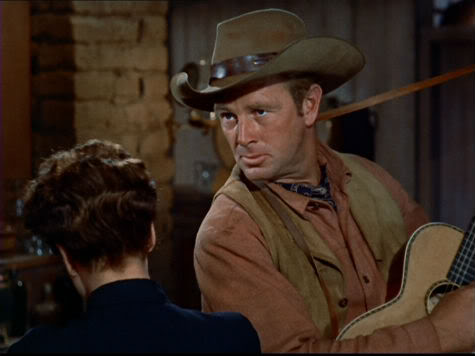
The action opens with a bang, literally. Johnny Logan (Sterling Hayden) – although using the pseudonym Johnny Guitar – rides along the base of a hill which the railroad company are in the process of blasting away. As he tops a ridge, his attention is drawn by the sounds of more violent activity; down below, a stagecoach robbery is taking place. Johnny merely watches passively, turning his mount away and continuing on his journey. His destination is an isolated saloon and gambling house, standing alone in the Arizona wastelands. He arrives right in the middle of a ferocious dust storm, the desert winds whipping the red earth up into a furious maelstrom. As he bursts through the doors of the saloon, he finds himself in a curiously still and peaceful world. But this is a brooding, intense stillness, like that found at the eye of the storm. In truth, that’s where we are, right at the centre of a devastating and destructive emotional storm that’s about to sweep across the screen and lay waste to all in its path. This incongruous establishment is run by the equally unusual Vienna (Joan Crawford), a gun-toting woman in jeans and boots who, in the words of one of her employees, thinks like a man and acts like a man.

It’s clear enough that Johnny and Vienna have a history, and it’s later revealed that they were once lovers before he abandoned her. However, things have changed now that Vienna’s in trouble and in need of protection: she’s built her saloon in anticipation of the arrival of the railroad and the business it will bring in tow, but elements in the neighboring town are hell-bent on ensuring that won’t happen. Vienna’s chief rival is Emma (Mercedes McCambridge), a repressed and frustrated spinster, backed up by the blustering and bullying McIvers (Ward Bond). Superficially, this opposition is based on a desire to prevent the railroad moving in and the hordes of new settler it must surely bring. In reality though, there’s an entirely different desire driving Emma on; it’s a potent and unpleasant mix of jealousy and hatred, jealousy of Vienna and the passions she’s capable of stirring and hatred of her own emotional vulnerability. Radically, from the point of view of the classic western, it’s these two women who are the active protagonists at the heart of the drama. It’s the actions and reactions of Vienna and Emma which power the narrative and shape events. And ultimately, in a complete reversal of the conventions of the genre, it will all come down to a face-off between two determined and driven women.

£2

Nicholas Ray made some pretty good films, but I reckon he was responsible for three great ones: In a Lonely Place, Bigger Than Life and Johnny Guitar. These movies are markedly different in terms of genre and theme, but they do all share an emotional intensity and feature obsessive lead characters. Johnny Guitar is the most self-consciously stylized, and therefore probably the most misunderstood, of the three. Ray wasn’t aiming for any kind of realism, rather he deliberately played up the heightened sense of unreality (what the critics usually refer to as the baroque aspects) to complement the fantastic nature of the story and characterization. With Harry Stradling operating the camera, Ray used the interiors, especially the main set of Vienna’s place where the back wall seems to be hewn from the living rock, to create an otherworldly feeling. A similar effect is achieved through the use of colour, particularly when it comes to the costumes. Vienna always appears in strong primary colours (scarlets, greens, yellows and whites) and contrasts sharply with the subdued tones of those around her. This is most notable in the case of Emma, who appears in all but one scene clad in funeral black, where the drabness of her dress emphasizes not only her pinched and cruel features but also marks her out as the visual antithesis of Vienna. The men in the film all appear in softer, less striking colours too, which serves to draw attention both to the softness of their character and to the subsidiary roles they play. Aside from the skewed representations of gender, Ray and writer Philip Yordan take a swipe at the McCarthyite politics of the time. The posse led by Emma gradually morphs into an implacable panel of self-appointed judges, contemptuous of the rule of law, using betrayal and deceit as a means to punish guilty and innocent alike. The masterstroke here was the ironic casting of Ward Bond (a prime mover in the Motion Picture Alliance for the Preservation of American Ideals) as Emma’s chief ally.

This leads me to the casting in general, an area where I can’t honestly find any fault. Joan Crawford is hardly a figure one would normally associate with the western, and Johnny Guitar represents one of her few forays into the genre. Crawford’s career can be roughly divided into three phases: her siren/starlet years up to the end of the 30s, her reinvention of herself as a noir/melodrama heroine in the 40s, and finally as a fixture of schlock horror pictures in the 60s. This movie came towards the end of her second phase, and it forms a kind of bridge between the tough post-Mildred Pierce roles and the gallery of grotesques still to come. While the western environment may seem an odd place to find Crawford, the feeling of otherness she brings is entirely appropriate in context. In addition, the years had hardened her looks and seen them take on that almost masculine aspect that fits the role of Vienna; I can’t think of another actress of the period who could have been plausibly been cast in the part. As Emma, Mercedes McCambridge was another ideal choice. She possessed the shrillness of voice and sharpness of features to perfectly embody a woman barely in control of the raging and conflicting emotions boiling away within her. I think it’s fair to say that no other actress has thus far managed to quite nail the corrosive, consumptive effects of twisted and repressed sexuality to such terrifying effect.

£3

Sterling Hayden in the title role, as the only man who displays anything approaching strength or dignity, made good use of both his physical presence and craggy face to impose himself upon all those around him. However, there’s more than just muscle and machismo to his playing; the scene where he and Crawford mull over their past reveals a sensitivity and shows him to be a fully rounded character, perhaps the only one in the film. Scott Brady as The Dancing Kid was the figure at the heart of Vienna and Emma’s rivalry, an essentially feminine role, and he gets across the kind of inherent weakness demanded. His cocksure confidence is basically a front to mask his essential impotence – he’s no match for Hayden’s easy assurance when the chips are down. Among Brady’s sidekicks, Ernest Borgnine remains the most memorable. His performance as the untrustworthy blowhard can be viewed as something of a dry run for a similar part in Bad Day at Black Rock.

To date the best DVD release of Johnny Guitar is the version available throughout continental Europe via Paramount. I have the French DVD and it’s a very pleasing transfer, a vast improvement on the UK release by Universal. There’s no noticeable damage to the print, sharpness is acceptable and, crucially for such a film, the colour is well rendered. Subtitles are not a problem, a range of languages are available and can be disabled on the original soundtrack via the setup screen. There are no extra features at all offered. The title will shortly be made available in the US by Olive Films on both DVD and Blu-ray, as a result of that company licensing the Republic catalogue, and I would imagine the same print will be used as a source. If so, it should look pretty good in high definition. Johnny Guitar is one of those movies that viewers are likely to either love or loathe; it’s too heady a cocktail to elicit a lukewarm response. I count myself among the former, and it’s a film I never tire of revisiting. This article I’ve written really only scratches the surface of what’s on offer and tries to give a flavour of this very rich concoction – I haven’t even gone into the resemblances the plot bears to Leone’s Once Upon a Time in the West, or the matter of the expansion of the railroad and the clash between progress and tradition. Like all the best pieces of cinema, Johnny Guitar reveals new things on each viewing. I’d say it’s a must for any serious western fan.


Pursued

Anyone who has visited this site a few times must be aware of my fondness for both film noir and westerns, and it shouldn’t therefore come as any surprise to learn that I find myself drawn to what we might call crossover movies. The noir influence that can be detected in so many 40s films is especially noticeable in a number of westerns, and Raoul Walsh’s Pursued (1947) is one example where this is very evident. Now this is by no means a perfect movie; I’m not convinced that the basic premise of the story, which isn’t fully revealed until the end, is all that logical or capable of bearing too much close scrutiny. However, film noir, regardless of its setting, was never heavily dependent on wholly logical motivation or reactions. In terms of appearance, tone and mood, Pursued is a very stylish piece of western noir that emphasises and revels in its more melodramatic aspects.

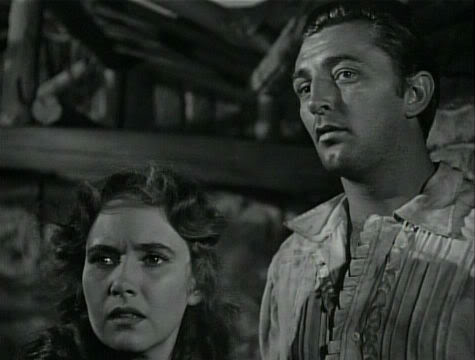
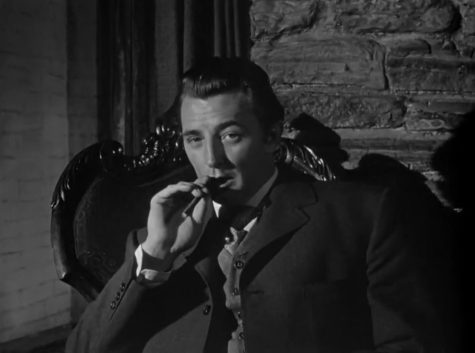
The opening has an edgy, breathless quality with Jeb Rand (Robert Mitchum) holed up in the ruins of a New Mexico homestead, waiting for some inevitable showdown. With the arrival of his girl, Thor (Teresa Wright), Jeb begins delving into their shared past in order to try to make sense of their current predicament. It’s abundantly clear that Jeb is in a heightened emotional state, and the lengthy flashback which occupies the bulk of the running time seems to take on the dizzying, disorienting characteristics of a fever dream at some points. The story traces Jeb’s life from childhood, from the point where he was found cowering and confused by Ma Callum (Judith Anderson) in his deserted home. She adopts the youngster and raises him as her own along with her two natural children, Thor and Adam (John Rodney). Young Jeb has no memory of his life before the night Ma Callum discovered him, and it’s clear that this is the result of some deeply traumatic events that occurred. The practice of employing Freudian theories about the roots of psychological issues and the whole process of memory recovery was woven into the plot strands of many a regular film noir, but it’s something of a departure to see it play such a prominent role in a western. Right from the beginning Jeb is seen to be a victim; not only does he feel a gnawing sense of self-doubt over his failure to fully recall his past, but his life is threatened on numerous occasions. Early on we learn that the principal danger is posed by Ma Callum’s brother-in-law, Grant (Dean Jagger), but the reasons for his apparent determination to see Jeb in his grave are only vaguely hinted at. Grant’s animosity stems from the existence of a vendetta between the Rand’s and the Callum’s and, like Jeb, the viewer has to wait and discover the meaning as the story unfolds. This element of mystery serves the twin purpose of maintaining our interest and also of emphasising the fatalistic nature of Jeb’s life – a man continually stalked by phantoms lurking in the shadows of his childhood.

The movie’s title is highly appropriate, in both a literal and figurative sense, as Jeb spends almost all of his screen time on the run from a variety of perils. Raoul Walsh’s direction, helped enormously by the masterly photography of the great James Wong Howe, hammers the point home by reducing the wide open spaces of the frontier to a series of dark, claustrophobic compositions. Even the exteriors have a tight, constricted quality to them – the ruins of the Rand homestead with broken and burnt rafters clawing despairingly at the lowering sky, and the huge, featureless rock formations that seem to dwarf the tiny riders scampering across their face. In addition, the cramped interiors are often filmed from low angles and bathed in expressionistic shadows, thus enhancing the mood of doom and paranoia. The action scenes, for which Walsh earned a lot of praise throughout his long career, are infrequent but well-shot and jarringly effective. All told, Pursued is arguably one of Walsh’s most artistic and stylized pieces of work. I think the director’s own macho dismissal of pretentious theorizing about subtexts or the artistic value of his vision goes some way towards explaining why he remains an underrated figure, although his reputation has seen some steady growth and reappraisal. The only major weakness I can detect lies in the script, or the resolution to be more precise. Niven Busch’s writing holds out the possibility of a big reveal that ought to shock, although close observers should more or less work things out for themselves anyway, yet fails to deliver on that promise. As I mentioned above, there’s a certain lack of logic to the climactic revelations that I found mildly disappointing.

Pursued is probably the movie that saw Robert Mitchum really hit his stride as an actor, and his star was in the ascendancy from this point. His tough, laconic persona had already been put to use in westerns, and the underlying hint of vulnerability meant that he could move comfortably within the shadowy and uncertain world of film noir. This movie’s artful blending of the two filmmaking styles was therefore an ideal showcase for Mitchum’s talents. The sleepy-eyed passivity that he was able to project fits in with the fatalistic character who appears to have grown to accept the fact that life has and will continue to kick dirt in his face. As the architect of the ill-fortune that has dogged Mitchum’s footsteps, Dean Jagger makes for a formidable rival. He gives an electrifying performance as the driven man, consumed with hate for the Rand’s, who thought nothing of losing an arm to even up a score. There’s something chilling about the manic gleam that comes onto his eyes whenever the opportunity arises to compromise Mitchum further. Judith Anderson ought to be a cinematic legend if only for her turn as Mrs Danvers in Hitchcock’s Rebecca, and she’s very good here too. She didn’t feature in too many westerns – this and Anthony Mann’s The Furies being the most notable – but her role as Ma Callum represents another memorable characterization. She’s a pivotal figure in the development of the story and brings a strong sense of believability to her part. I have to say I was less impressed by Teresa Wright, whose evolution from Girl Friday to femme fatale and back again lacked both consistency and plausibility. Again, this may be more the fault of the leaps in logic demanded by the script than any particular deficiency on the part of the actress.

The R1 DVD of Pursued from Artisan is a middling effort at best. The disc carries a note that the film was restored by the UCLA but there’s inconsistency in the presentation. Early on, there’s a short section that’s noticeably weaker than the rest of the movie, and the sharpness and clarity varies throughout. There are no extra features offered. The film belongs in the Republic library, the recent acquisition of which by Olive in the US has seen the announcement of a number of titles on Blu-ray. I don’t know if this movie is seen as a candidate for a future release in the HD format but it would need to undergo some additional work for that to be a viable option. All in all, I see Pursued as an interesting attempt to fuse the western with film noir and throw some Freudian psychoanalysis into the mix. Personally, I like it and I reckon it should offer something to fans of both types of movie.

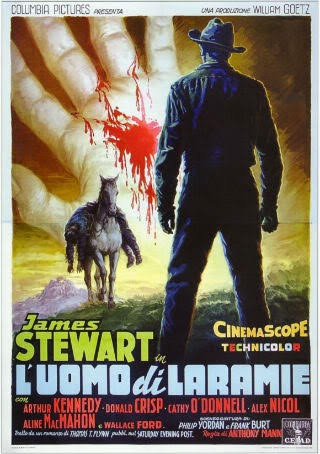
The Man from Laramie

In 1950 James Stewart and Anthony Mann embarked on a series of groundbreaking and influential westerns that would play a significant role in shaping the evolution of the genre. Mann’s visual and narrative sense, honed by years spent producing tight and economical noir thrillers, and the painful angst that Stewart seemed to tap effortlessly into following his wartime experiences combined to push the western in new and exciting directions. Within five years though, this rich partnership had run its course and both men would go their separate ways. The Man from Laramie (1955) was to be the last picture they completed together, and it both built upon and expanded on the themes explored in their earlier collaborations. All of Mann and Stewart’s films exhibit a powerful intensity in the characterization, but The Man from Laramie adds a touch of violent sadism to the mix to achieve an even more potent result.

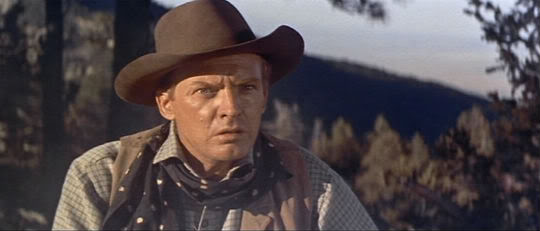
Once again we have a saga of a man seeking revenge, recompense for a loss he has suffered at the hands of others. Will Lockhart (James Stewart) is the titular character, a man whose real background is only revealed gradually throughout the course of the story and never fully even by the end. He’s first seen hauling a load of freight from Laramie to the small town of Coronado, but a brief stop on the way lets us know that his real purpose is something else. This short, early scene is a fine example of how a skillful filmmaker can impart vital plot details economically and with resorting to dialogue-heavy exposition. We’re shown Lockhart wandering round the burnt out remains of an army patrol that was ambushed and massacred by the Apache. All this information is gleaned from the visual clues and the telling use of some music cues. The way Lockhart gazes wistfully at the charred hat of a fallen soldier makes it clear that the events which unfolded at that lonely spot have some deep, personal significance for him. In time, it’s revealed that Lockhart’s younger brother was among the slain, and his reason for coming to Coronado is to find the man or men who brought about his death by supplying the Apache with repeating rifles. Before he can make any progress with his investigation, he finds himself drawn into conflict with the most powerful man in the territory. An unexpected and violent encounter with Dave Waggoman (Alex Nicol), the petulant and vindictive son of a local rancher, appears to temporarily distract Lockhart from his primary goal. However, as he’s drawn deeper into the complex relationship between Dave, his father (Donald Crisp) and top hand Vic Hansbro (Arthur Kennedy), it begins to dawn on Lockhart that this curious family arrangement may be connected to his own quest. Again in a 50s western, there’s an examination of the father/son dynamic and how men interact with other men. Alongside all this, there’s the inclusion of quasi-religious symbolism through the suffering and humiliation Lockhart has to endure – being bound and dragged through flames, and then the brutal mutilation of his hand that invokes overtones of crucifixion and the stigmata.

Philip Yordan and Frank Burt’s screenplay is beautifully constructed, with three strands playing out simultaneously and then folding neatly together to form the whole. Lockhart, Vic and Dave are all essentially men in search of some anchor in their existence, all homeless creatures to some extent. Lockhart never says where he comes from, claiming that home is wherever he finds himself; Vic has been taken in by old Alec Waggoman and treated like a surrogate son, but he’s aware that he’s an outsider and never quite comfortable or sure of his place in the world; and Dave is the overgrown boy who knows in his heart that he’s fallen far short of his tough father’s expectations. For both Lockhart and Vic, there appears to be the possibility of salvation or some grounding in the person of Barbara Waggoman (Cathy O’Donnell), but Dave is essentially a lost cause. These three also share a common character trait in that all of them are given to extremes of emotion under the right circumstances. At various times during the picture we get to see all of these men driven into situations where their balance is tested, and ultimately their ability or lack of it to rein in their feelings is the factor which will determine who emerges victorious.

Anthony Mann’s typical motifs are again in evidence in The Man from Laramie, particularly the idea of characters climbing and driving themselves to ever higher places. The structure of the movie follows this pattern, with the early scenes played out in the lowlands (especially the salt flats where Lockhart has his initial run in with Dave) before reaching its climax high among the barren rocks. Mann used this visual metaphor time and again to indicate both the struggle of his characters to reach up for something just beyond their grasp and to let the audience know when the point of redemption has been achieved. It also has the effect of distancing the men from the mundane, seeing them rise above the everyday concerns to do battle in lofty and remote locations. In fact, almost all the significant confrontations take place in isolated spots (the exception being the brawl in Coronado) which emphasises the private nature of their conflict. Mann, with cameraman Charles Lang, makes the most of both the New Mexico locations and the CinemaScope lens to blend character and landscape into a tough, lonely vision of the west. The only concessions to civilization come in the interior scenes in the homes of Barbara and Kate (Aline MacMahon), where the feminine influence softens the ruggedness that dominates elsewhere.

The Man from Laramie saw James Stewart taking another turn around the darker corners of his own personality. Where The Naked Spur had him portray a man filled with self-disgust at what he had become, this movie concentrates less on the negative aspects of the character. Lockhart is another lonely and driven figure but the anger and hatred that simmer just below the surface aren’t directed inwards. As such, this is a more straightforward and traditional characterization, albeit an especially intense one. The sudden outbursts of violence that punctuate the movie act as the trigger that sees Lockhart’s emotional balance tilted. I don’t know what demons Stewart let loose at these moments but the result is certainly mightily effective on film. There’s something quite startling about the way his eyes take on a desperate, maniacal cast and his voice fails him at these moments. In the middle of the brawl with Dave and later when his hand is mercilessly maimed, Stewart almost appears a man possessed. In contrast, Arthur Kennedy starts out as a much more composed character, tough but always in control. However, as the story progresses, and the pressure on all concerned mounts, cracks begin to appear too. Kennedy was playing a man who was much more self-absorbed than Lockhart, yet an equally volatile one given the right circumstances. He’s very good at channeling the kind of guilt and shifty paranoia that’s entirely appropriate for a character deeply uncertain about his position in life. No matter how many times I watch the film I can never make up my mind about Alex Nicol’s Dave. At times I feel he’s indulging in a piece of shouty overacting, and at others I’m convinced he’s really nailed the spoiled and perverse nature of his character – an odd yet interesting performance. Donald Crisp was a seasoned old pro who could handle a part like the aging and weakening Alec Waggoman in his sleep by this stage in his career. And now to the women in the movie: Aline MacMahon and Cathy O’Donnell. The former takes on the maternal duties in the film, ministering to men who have been damaged both physically and psychologically. O’Donnell, on the other hand, represents what would normally be termed the love interest, but this isn’t much of a romance. The only love that’s on view is the rough paternal kind that has warped both Vic and Dave. I think the roles of both MacMahon and O’Donnell, whose spinster lifestyles mirror each other, exist mainly to emphasise the emptiness of lives wasted waiting on men who are unattainable.

The UK DVD of The Man from Laramie from Columbia/Sony has been on the market for a long time now. The movie is presented in anamorphic scope and it’s a reasonable enough transfer, but a revisit wouldn’t hurt as I feel the colour can be a little inconsistent at times. The film saw Stewart and Mann’s partnership end on a high note and it’s one of the best of their collaborations. Some may claim it is their strongest work together, but I’m undecided. I still feel that The Naked Spur is difficult to surpass – it’s a tighter story, smaller and more self-contained, with greater depth and realism to Stewart’s character. Nevertheless, The Man from Laramie remains one of the great westerns to come out in the 50s and it’s capable of standing shoulder to shoulder with any of its rivals. It’s a fantastic piece of work, rich in drama and complexity, that never loses its appeal and encourages analysis. Very highly recommended.

Gunman’s Walk

I guess one of the most typical features of the western genre, both implicitly and explicitly, is the way it places the whole concept of masculinity under the microscope. The rugged nature of the environment and living conditions in the old west meant that traditionally male qualities were highly regarded, as such it’s only to be expected that western movies should frequently analyze and comment upon these. Even the humblest programmers tackled this theme, although not always in the subtlest of ways. Phil Karlson’s Gunman’s Walk (1958) approached the issue head-on using the framework of a family drama, and also worked in some interesting and important comments on evolving race relations and changing perceptions of law and civilization on the frontier.

Lee Hackett (Van Heflin) is an old-time rancher of tough frontier stock, one of that hard breed that carved out a niche for themselves in a hostile environment. Like many people who have had their character forged by adversity, Lee can’t quite let go of the past. Times have changed, the world has moved on, and Lee has risen to become a respected man in his community, yet he still retains an affinity for the rough and tumble days of his youth. The two sons, Ed (Tab Hunter) and Davy (James Darren), who he’s brought up alone – he appears to be a widower – have learned to address him by his first name, a clear attempt by this man to hang onto the identity he possessed in earlier times. On the surface, Ed seems closest in character to his freewheeling father, while Davy is gentler and more considerate. The story naturally deals with the contrast between Ed and Davy, but the real thrust of it all is the relationship both brothers have with their hard-as-nails father. Lee is a man of rigid principles, his own principles mind, and very firm ideas about the way a man ought to behave, and thus how he should raise his boys. Lee’s whole philosophy is built around the idea of standing on one’s own feet and accepting favours from no man; early on he berates Ed for accepting the ranch foreman’s offer to rub down his horse. This kind of tough individualism is an almost constant feature of the western, and it’s an admirable enough trait as far as it goes. Yet, taken too far, this tends to result in a degree of alienation and social isolation, particularly as the advance of civilization gradually renders the notion less desirable. If Lee has trouble getting to grips with this, then the problem is multiplied tenfold when it comes to Ed. In his eagerness to emulate the past glories of his illustrious father, Ed has both absorbed these teachings and twisted them around in the process. The result is that courage, determination and independence of spirit have distorted themselves into bravado, violence and cruelty. In his quest to outstrip his father’s achievements Ed is driving himself beyond the bounds of acceptable behaviour. We get to see examples of his arrogance, insensitivity and casual racism from he beginning, and it’s not long before this unsavoury combination leads to the killing of a half-breed hireling. From this point on, the movie charts Ed’s inexorable moral descent as his father and brother look on, powerless to haul this increasingly uncontrollable young man back from the edge.

Phil Karlson spent the majority of his directing career overseeing B movies, and made a number of very classy crime and noir films throughout the 50s. Therefore, it should come as no surprise that he brought some of that dark moodiness and pessimism to Gunman’s Walk, thematically, if not visually – although there is a sequence in the jail towards the end that has a look straight out of the classic film noir handbook. The emphasis on these fractured family relationships has a relentlessly downbeat tone that sets the movie a little apart from the usual genre pieces. It’s been stated before that the classic westerns of the 50s were guided by the idea of redemption for the protagonists. It could be argued that this is achieved in some small measure by the end, but the traumatic nature of the developments leading up to this point suggest to me that it will be short-lived. The way I see it, the character of Lee is left so emotionally devastated by the end of the movie that he’s essentially finished and washed up as a man. The final image does indicate that progress has been achieved, but only by reaching closure and burying the past and those associated with an outmoded way of life. As such, this is very much a bittersweet triumph; the next generation (Davy and his half-Sioux sweetheart) setting off to face the future and the final nail hammered into the coffin of the closing frontier.

Understandably enough, this movie is dominated by two strong central performances, those of Van Heflin and Tab Hunter. Of the two, Van Heflin had the more complex role and probably did the better work. He had to convey a range of emotions throughout, and also maintain a level of control and discipline consistent with playing a man of such iron resolve as Lee Hackett. As I alluded to earlier, his was not an altogether sympathetic part – the ingrained racism of his character, and his belief that he’d earned the right to be above the laws and conventions of lesser men is a bit hard to swallow. However, by the time we get to the final scene, and are confronted with a man whose spirit has been comprehensively broken, it’s difficult not to feel for him. The fact that the viewer is able to regard Lee in this light, after he’s displayed such negative traits, says much about the skills and abilities of Van Heflin. Angry and confused young men were very much in vogue in Hollywood in the 50s, and Tab Hunter’s role slots neatly into that category. The cause of this rebel is to be as big a man as his father, to surpass him in every way he can. Hunter seemed to be having a good time with the excesses of his character and did well with the sudden mood swings and violent outbursts. In retrospect, some of the era’s representations of misunderstood youth can be toe curlingly self-conscious and quite painful to watch, but Hunter managed to avoid the inherent pitfalls and created a convincing portrait of a guy with a hair-trigger temper struggling to emerge from the massive shadow of his father. As the younger brother, James Darren isn’t bad, although the script doesn’t call on him to take an especially active part and he’s pushed into the background somewhat. Kathryn Grant was the only woman in the movie and she too is mostly sidelined by the conflict between father and son that’s at the heart of the story. She does get one good scene though, at the hearing into her brother’s death. She hits just the right note when she demonstrates her indignation at the travesty of justice by flinging Lee’s blood money on the courtroom floor, and the contempt in her voice is palpable as she speaks contemptuously of the pervading racist attitudes of all those around her. The supporting cast also features a notable turn from perennial western lowlife Ray Teal; his small role as a chiseling horse dealer with a strong line in unctuous treachery is pivotal to the development of the plot.

Unfortunately, the two current DVD editions of Gunman’s Walk are problematic. Sony first released the film in Spain and, although it’s not a bad transfer, the disc is a non-anamorphic letterboxed affair. Shortly afterwards, Sidonis in France put the title out with an improved anamorphic scope transfer. However, and this is a major black mark as far as I’m concerned, the disc forces Spanish subtitles on the English language track. The only way around that issue is to make a backup copy with the subtitles disabled. This is particularly irritating when you bear in mind that the presentation is satisfactory in every other respect. Anyway, the movie is a very strong addition to the long list of quality westerns that came out of the 50s. All of the themes it touches on have been addressed in other productions but this picture handles them in a measured and mature way. Furthermore, Phil Karlson’s tight direction, anchored by two fine performances, ensures that everything blends together seamlessly. It’s an enjoyable and thoughtful western that pays off with a powerful emotional punch. I strongly recommend that genre fans give it a go – I can’t see it disappointing anyone.

Rancho Notorious

Hate, murder and revenge…

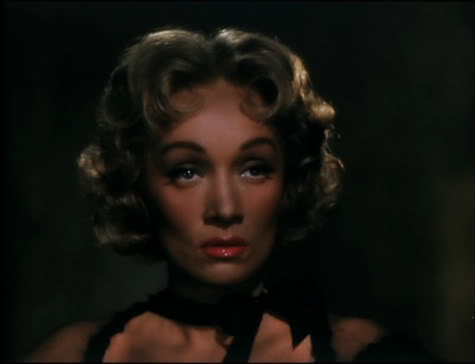
Those three powerful words succinctly describe what Fritz Lang’s Rancho Notorious (1952) is all about. It’s a curiosity – a western that seems to take pride in overturning genre conventions and defying viewer expectations. It’s also a highly stylized melodrama, bordering on parody in fact, a kind of baroque noir picture dressed up in western garb. Over the years I’ve seen the movie come in for some criticism, largely based on the atmosphere of artificiality or cheapness. Still, that’s a big part of what attracts me to it; the anti-realism of the film gives it a theatrical feel, and heightens the sense of watching a morality piece played out on an elaborate stage.

The plot is a fairly straightforward revenge yarn although, perhaps unsurprisingly with Lang occupying the director’s chair, it’s given a twist to keep it fresh. Vern Haskell (Arthur Kennedy) is an ordinary cowboy who sees his world turned upside down when a couple of outlaws ride into town, raid the assayer’s office where his fiancée works, and rape and murder the girl in the process. Inevitably, Vern wants justice and sets out with the hastily assembled posse to track down the criminals. However, the traumatic event has caused cracks to appear in the apparently mild exterior of this man, and an obsessive streak begins to emerge when the posse refuses to continue what looks like a fruitless pursuit. Having scornfully dismissed his former friends, Vern sets out alone in search of a reckoning. The first third of the film is thus played out in typically noir fashion, as we follow Vern’s painstaking combing of the country for a clue that will lead him to those responsible for the death of his girl. His progress is charted through interviews and flashbacks, as he slowly pieces together the clues and draws ever closer to his quarry. The final piece of the puzzle, or at least the piece that will bring him within striking distance of the murderer, comes when he contrives to have himself thrown in prison with notorious outlaw Frenchy Fairmont (Mel Ferrer). Along the way, Vern has learned that the key to the mystery lies with a woman by the name of Altar Keane (Marlene Dietrich) and a place called Chuck-A-Luck. His acquaintance with Frenchy, and his part in making good their jail break, ensures Vern’s smooth entry to the semi-mythical Chuck-A-Luck. This is a ranch, run by Altar, serving as a front for an outlaw refuge where no questions are asked so long as the proprietress is paid 10% of any and all takings. Vern is now in a position to work through a shortlist of possible candidates who may be the murderer. Yet, there is a price to be paid; his initial quest for justice has evolved into a thirst for vengeance and has transformed his character in the process. By the end, the hero has become as violent, manipulative and ruthless as the man he set out to find.

£2

Rancho Notorious was the last of three westerns that Fritz Lang made, and it’s arguably his most interesting. The idea of the ordinary guy overtaken by events and thrown into a world of violence and deceit that’s alien to him is one that can be found throughout Lang’s work. The central theme of how a desire for revenge can twist a formerly decent man and leave him on a par with the criminals he’s pursuing would be further, and more competently, explored when the director returned to it in The Big Heat a year later. Although all of Lang’s westerns contain elements of his trademark noir sensibilities, Rancho Notorious displays them most prominently. I’ve mentioned the use of the flashback in the first half hour of the picture, but the mood and photography all the way through help to cement the fatalistic and pessimistic sense that pervades the movie. One could, I suppose, complain about the overuse of painted backdrops and the ever-present ballad that serves as a stylized voiceover narration for the unfolding plot, but I prefer to see these as tools that Lang used to create his own vision of a dark frontier. The film is less concerned with showing any accurate portrayal of the west than it is with detailing the downward spiral of an essentially good man into a world of corruption and violence.

Marlene Dietrich had already played the archetypical bad saloon girl over a decade before in Destry Rides Again, and her role as Altar Keane comes off as an older but only slightly wiser version of that same character; between these two films she created the template against which all such portrayals would subsequently be judged. Dietrich apparently disliked the film and the reasons for that are detailed in a fine post by Toby at 50 Westerns here. Despite all the discord on the set, she turns in a fine performance as a woman who’s gained a lot of experience but little personal fulfillment. She may well rule the roost at Chuck-A-Luck, but there’s a weary, resigned air about her that indicates happiness has passed her by. Mel Ferrer was an actor I’m generally not that fond of, but I thought the mournful passivity that he possessed was used to good effect here, a nice counterbalance to Arthur Kennedy’s twitchiness. Kennedy wasn’t really a leading man at any point in his career – his best and most memorable work was usually done when he was playing the villainous supporting role – yet that actually makes his casting here more successful. His nondescript, everyman quality is suited to the role of Vern Haskell and he really taps into the obsessive, driven nature of his character as the movie progresses. As an aside, I’ve often seen it stated that Vern falls for Altar after his arrival at Chuck-A-Luck, but I’ve never thought that was the case at all. To me, he’s become so consumed by hate at this stage that he’s incapable of loving anyone and is merely feigning attraction to get nearer to his ultimate goal.

For a long time I had the UK DVD release of Rancho Notorious from Optimum, and it was never particularly satisfying – soft and with washed out colours. The movie then came out in the US as part of the Warner Archive series, sporting an altogether stronger transfer. Since then, I picked up the French release by Films Sans Frontieres which I’m very happy with. It’s a significant improvement on my old Optimum disc and, judging from screencaps, looks very close to the quality of the Archive disc. It’s sharper and more colourful but there’s still some print damage on view. Forced subtitles on the English track are always a concern with French releases but this disc allows them to be disabled via the setup menu. Rancho Notorious isn’t one of Fritz Lang’s better regarded films and tends to be criticised quite a lot. I think this is a little unfair; while it may not be his best work it’s still very entertaining. Much of the problem may come down to a question of expectations, with the film suffering from viewers approaching it with the thought that they will be getting a standard oater. If you accept that you’re in for a piece of high melodrama in a stylized western setting then the movie is unlikely to disappoint.