The Indian Fighter

poster322

Films like Broken Arrow and Devil’s Doorway broke new ground for the western by offering up portrayals of Indians which were more three-dimensional than had traditionally been the case. Andre de Toth’s The Indian Fighter (1955) treads a similarly sympathetic path, showing the Sioux in a generally positive light. Few of the white characters are shown to be particularly admirable, even the nominal hero is not without his faults, succumbing easily to prejudice and greed. In addition, the film has a pro-ecology subtext that’s blended into the story in a way that’s refreshing and unobtrusive. This is not as powerful a film as the examples by Delmer Daves and Anthony Mann which I mentioned, yet it still manages to get its message across without resorting to the po-faced piety of more recent revisionist pieces.

Johnny Hawks (Kirk Douglas) is the Indian fighter of the title, an army scout recently returned to the west after the Civil War. He’s been sent along to guide a wagon train bound for Oregon through potentially hostile country. Before he ever reaches his posting though, he’s distracted by two events that are to shape the story that follows. The first is a sighting of Onahti (Elsa Martinelli), the beautiful daughter of Sioux chief Red Cloud, bathing naked in a river. The second is when he stumbles upon a botched deal between two white men, Todd and Chivington (Walter Matthau and Lon Chaney Jr), and a Sioux warrior exchanging whisky for gold. Both of these occurrences illustrate Hawks’ inherent sympathy for his old enemies. The former, naturally enough, arousing his romantic instincts, while the latter emphasises his willingness to side with the Sioux when confronted with the exploitative behaviour of his fellow whites. What draws Hawks to the Sioux is the respect he shares with them for the land which they occupy. Red Cloud’s principal objection to white men on his land is based on his belief that their greed for the gold it contains will wreak environmental havoc on the unspoiled paradise. Although Hawks doesn’t voice such fears specifically, there’s a telling moment later on when he confides in a photographer that the reason he doesn’t share his evangelical zeal to publicize the beauty of the frontier is his knowledge that attracting more settlers, and the trappings of civilization that they will inevitably bring in their wake, will spell the end of the west he loves. Even so, Hawks agrees to guide the wagon train through Sioux territory. However, the presence of Todd and Chivington among the settlers soon leads to trouble and puts the lives of everyone in jeopardy. While Hawks’ desire for Onahti drives him to neglect his duty, the equally strong desire of Todd and Chivington for the yellow metal sparks off a Sioux uprising. Faced with suspicion and hostility from both sides, Hawks is desperate to find some way of averting an impending massacre, and the terrible consequences it will have for the Sioux.

£41

By the time he made The Indian Fighter, Andre de Toth had a string of westerns behind him (half a dozen starring Randolph Scott), and he’d developed into a highly competent genre director. He used the wide cinemascope lens to highlight the natural beauty of the Oregon landscapes where the picture was shot. These stunning images make it very easy to see why both Hawks and the Sioux want to do all in their power to preserve the land. The rich visuals are probably the biggest selling point for this picture, but de Toth was no slouch when it came to filming action scenes and his talent in this area is shown to great effect in the climactic Sioux attack on the besieged fort. Not only are the tactics employed innovative and surprising, but the way it’s shot gets across the excitement and danger too. Many of de Toth’s films display a matter of fact approach to physical violence and this one is no exception. Early on, we get to see two victims of Sioux justice strung up by the heels, though the camera mercifully avoids zooming in to focus on the exact nature of their demise. Then later, as the body of a cavalry officer is removed from the mount he’s been strapped to, his hat drops away to reveal the gory aftermath of his scalping.

The Indian Fighter came from Kirk Douglas’ own production company and, as was the case with Man Without a Star, he tends to overindulge himself a little. Generally though, Douglas manages to keep his vigor and enthusiasm within acceptable bounds this time. That is to say, he plays the role of Johnny Hawks with the level of energy that’s not unreasonable for the character. The outdoors nature of the shoot, and the degree of action involved, offered ample opportunity for him to show off his physical powers, which is just as well since Ben Hecht’s script never puts serious demands on his acting abilities. In the role of Onahti, Elsa Martinelli hasn’t a great deal to do beyond looking attractive, and she accomplishes that without too much effort; her introductory swimming scene is one of the more memorable openings for a western. Walter Matthau and Lon Chaney Jr are moderately effective as the heavies, the former faring best, but never pose any direct threat to the hero. The nature of this pair’s villainy comes from the repercussions of their actions rather than the actual menace they generate. Matthau is now best known for his comedic roles but he did make a handful of westerns at the beginning of his film career. He uses that calculating, scheming quality which came so naturally to him, and which he built up in subsequent years, to compensate for the absence of any real physical threat. Chaney’s career, on the other hand, was in decline by this time, and the truth is he cuts a rather shambling figure.

The Indian Fighter is widely available on DVD from MGM. I have the UK release, which I understand is a step up in terms of picture quality from the lacklustre US version. Although the disc offers nothing in terms of extra features, the image is quite pleasing. The anamorphic scope transfer is acceptably sharp, without noticeable damage, and represents the colours very nicely. A film that relies as heavily on its scenic views as this one does needs to look good, and I have no complaints about the presentation. Generally, this is a good and well-intentioned movie, although the villains are a little weak. Having said that, the action and the cinematography make up for such deficiencies. It’s interesting to note that with the exception of Douglas’ skittish lead and the thoughtful cavalry commander, the whites are portrayed as either grasping, prejudiced or duplicitous. The only truly honourable figures are the environmentally aware Sioux. which gives the movie a strangely contemporary feel. I liked it.


Hangman’s Knot

I just realized the other day that I’ve reached a small landmark as far as this site is concerned – this post will be the 100th western that I have written about. I had to think about what movie I ought to feature to mark the occasion, and it left me with something of a dilemma. My first instinct was to go for a big, important, genre defining picture, one which has stamped its authority all over the western landscape. But then I paused and thought again: is that really representative of the kind of movies I usually turn my attention to? Well not really. For the most part, I’ve written up the films that don’t always draw the attention of the critics, that don’t get ranked high in the “Best of” lists. Sure there are a few heavyweights in there, but they tend to be the exception. So in the end, I opted for something low-key, a bit of a sleeper and an imperfect work – Hangman’s Knot (1952). This might seem an offbeat choice but it reflects what I’d like to think of as the spirit of this site by being a movie from my favourite decade in cinema and featuring two of my favourite performers.

The plot concerns a dreadful mistake and its consequences for those involved. Major Stewart (Randolph Scott) is in charge of a small band of Confederate soldiers who we see setting up an ambush for a squad of Union troops. The aim is to relieve the Yankees of the gold shipment they’re guarding and thus shore up the war effort. The plan goes almost like clockwork and Stewart’s men wipe out the enemy. The sting in the tail though comes in the form of the dying words of their victims’ commanding officer – the war has been over for weeks. In that moment Stewart sees himself transformed from heroic military tactician into common criminal. A discussion with the surviving troops, and the reckless killing of the one man who could be made to testify to their innocence, leads to the decision to head home with the spoils in tow. However, gold is always a powerful draw, and it’s not long before others are on their trail. A self-appointed posse, bounty hunters in reality, have caught the scent and are in pursuit of Stewart’s little party. In desperation, a stagecoach is hijacked and the fugitives head for the temporary shelter of an isolated swing station. It’s here that the second part of the drama is played out, as Stewart and his men find themselves holed up in the stage halt and under pressure from both without and within. The posse have hemmed them in with little hope of a clean escape, while the atmosphere is growing ever more poisonous as both the hostility of the hostages and the men’s own personal differences raise tensions.

Roy Huggins is most famous as the writer of some highly successful and influential television shows (including The Fugitive and The Rockford Files), but his solitary effort as a cinema director plays out like a rehearsal for the Boetticher/Scott pictures that would come later in the decade. The theme, casting, locations and structure of Hangman’s Knot all contribute to the feeling that you’re watching a kind of unpolished Budd Boetticher movie. The opening scenes of the ambush shot around Lone Pine, with their bleak, fatalistic tone, immediately evoke such thoughts. This is especially true when the gung-ho mood abruptly turns into one of horrified realisation. Then there’s the theme of greed and it’s corrupting influence that is gradually expanded upon as the story progresses. With the second act, comes a change of location – the restrictive, almost suffocating, confines of the swing station – where the pressurized atmosphere brought on by greed for gold intensifies for those trapped inside and those laying siege outside. These rising tensions are further exacerbated by the presence of Donna Reed’s Northern nurse, provoking a three-way contest for her affections between Scott, Lee Marvin’s hot-headed subordinate, and Richard Denning’s would-be fiance. This brings to the surface a sentiment that can often be detected in westerns of the period; the contrast between the essential nobility of the southerner (personified by Scott) and the base materialism of the northerner (Denning in this instance), although it’s tempered somewhat by the fact that Marvin is also thrown into the mix to represent the less savoury side of the Confederacy.

It’s hard to find fault with the casting of the movie, though the oversimplified characterization is one of the main weaknesses. I’ve already tried to draw attention to what I see as the parallels between Hangman’s Knot and Scott’s later work with Boetticher, but the reasons why the movie isn’t quite in that class need to be addressed too. One of the features that distinguished the Ranown pictures was the complexity of the characters, both the heroes and the villains. In truth, there was a blurring of the lines defining the good and bad men in those films. That’s not really the case here, where everyone’s development follows a much more traditional path. Apart from a sense of guilt over the ill-timed ambush, Scott’s character carries none of the emotional baggage that made his best roles so memorable. That’s not meant as a criticism of his performance though – an actor can only play a part as it’s written, and the script doesn’t offer much opportunity to add depth. The same problem arises with Lee Marvin; where Seven Men from Now gave him the chance to play a layered and subversively attractive villain, Hangman’s Knot demands a more straightforward, and far less interesting, portrayal. Similarly, the posse in pursuit of Stewart’s band is a collection of stereotypical figures without charm, and lacking the necessary menace too. Perhaps the most successful character is the green youth played by Claude Jarman Jr, whose innocence symbolizes hope for the future and the possibility of a new beginning. Both he and the operators of the stagecoach stop are suggestive of the idea of America as a family torn apart by the Civil War. Of course they also represent the prospect of reconciliation, the offer of “adoption” at the end emphasizing this.

The R1 Columbia/Sony DVD of Hangman’s Knot, which has been available for a long time now, presents the movie in the correct academy ratio, and the image is reasonable although there are some issues with the transfer too. Colours are generally strong throughout but there is some damage to the print. This is most obvious during the indoor scenes in the second half of the movie, the earlier exterior work looks to be in much better shape. Even so, it’s not what I’d term a major distraction at any point. It’s a fast paced film which packs a lot of story into its brisk 81 minute running time and concludes most satisfactorily. I think it’s an underrated western, but I can understand the reasons why that may be so. Still, whatever deficiencies it has, there are plenty of positive points too, not least the way it looks ahead to the Ranown cycle. In fact, and I’m going to stick my neck out here, I think it’s a better and more rewarding movie than something like Westbound – others may disagree of course. Anyway, I recommend any fans of Randolph Scott, or Budd Boetticher for that matter, check this one out if they haven’t already done so.

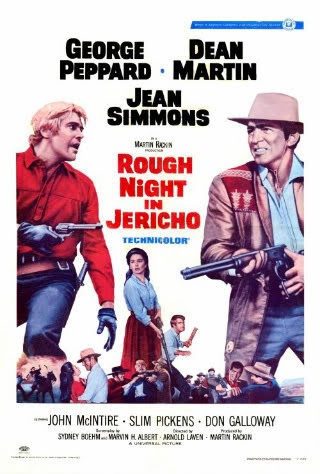
Rough Night in Jericho

poster316-2

My last post looked at a superior little film scripted by Sydney Boehm, and that writer is the common thread linking into this one. Where The Raid was rich and fairly original in terms of theme, Rough Night in Jericho (1967) is an altogether simpler and, ultimately, less rewarding experience. That’s not to say it’s a bad movie, just that the plot treads a more worn path and the characterization has less depth and complexity. Generally, it’s a picture with lower ambitions, aiming for entertainment as opposed to any notions of profundity. What is does have in its favour are unusual casting, some instances of striking photography, and a couple of first class set pieces.

The tale told here is a familiar one: a town which, through weakness, has allowed itself to succumb gradually to the tyranny of one man. The town is Jericho and the man is Alex Flood (Dean Martin), a former lawman who has come to realize that there’s a better percentage (51% to be precise) to be had in simply ruling the roost. Bit by bit, Flood has acquired a controlling interest in just about every enterprise of value in the town. The one business he has yet to muscle in on is the stage line run by Molly Lang (Jean Simmons), twice widowed and Flood’s former lover. Working on the principle of fighting fire with fire, Molly has taken on a couple of partners she hopes will prove capable of facing down Flood. These men are Ben Hickman (John McIntire) and Dolan (George Peppard), two ex-peacekeepers who also want to try and turn a profit. The movie opens with Flood ambushing the new stagecoach driven by his would-be rivals, and establishes the confrontational tone that runs throughout. When the two men limp into town the first view to greet them is a graphic illustration of Flood’s handiwork – the corpse of a man who crossed him strung up from the hanging tree. With Hickman laid up in bed in Molly’s house recuperating from a gunshot wound sustained in the ambush, Dolan is essentially on his own. He’s a gambler, a man who always does the arithmetic in his head before acting, and he dislikes the odds stacked against him. While he neither likes nor approves of Flood and his tactics, he can’t see that anything’s to be gained in taking him on. The first half of the film basically involves these two natural rivals circling each other warily without either one of them wanting to overtly provoke the other. The scales are finally tipped by two factors: Dolan’s inability to crack the stubborn resolve of his aging partner, and a crude assault on Molly by Flood’s henchmen. When the gauntlet is thrown down, Dolan is bound to a path than can only lead relentlessly to a final showdown with Flood.

£10

Director Arnold Laven’s television credits far exceed his movie work, and I think that background is highlighted in certain aspects of Rough Night in Jericho. A large proportion of the action takes place within the confines of the town – particularly Molly’s home and Flood’s saloon – where both the filming and editing have a TV vibe about them. Whenever the characters venture out into the wilderness around Jericho there’s a far more cinematic atmosphere about it all, probably due to Russell Metty’s presence behind the camera. For the most part, Laven’s work on this picture is competent if not spectacular, though the final stalking scene in the brush is both overextended and clumsy in its editing. There are, however, two memorable sequences that raise the quality considerably. The first is a long, brutal fight between George Peppard and Slim Pickens with the weapons of choice ranging from a bullwhip to chains. Even now the scene carries some clout, and I can only wonder how audiences back in 1967 reacted to the savagery on display. The other notable scene comes towards the end when an exciting and well-staged shootout takes place in the saloon, John McIntire’s shotgun creating some particularly satisfying mayhem.

And now to the casting. Dean Martin is, somewhat unfairly I think, never going to lauded as a great actor, but his easy-going charm and natural affability meant he was never an unwelcome addition to any production. His portrayal of Alex Flood turns all expectations completely on their head though. Nearly all traces of the usual Dino persona are washed away as he plays Flood as a man without a shred of common decency. His actions right from the beginning – humiliating a deputy, orchestrating a lynching, sadistically beating a woman, back-shooting –  prove there can be no doubt as to his ruthlessness. While it’s certainly a shock to see him in such an unsympathetic role I think he just about carries it off. George Peppard is also effective as the reluctant hero up against Flood and his hired killers, his mostly sombre clothes and cheroot hinting at a reference to Leone and Corbucci. John McIntire was always a reliable presence in movies, especially westerns, and his cool professionalism acts as a stabilising force here. English actress Jean Simmons had already demonstrated her ability to slot comfortably into the world of the old west with her role in The Big Country, and does so again in this film. Her tough widow is the only significant female part amid all the macho posturing and she’s perfectly credible as a frontier survivor. It has to be said though that she – along with Peppard – is involved in one of the least successful scenes in the whole movie. It’s a comic interlude that sees Molly and Dolan matching one another drink for drink before collapsing into bed. The scene isn’t especially badly played or filmed, but it’s tone is completely at odds with the rest of the picture and it draws attention to itself for all the wrong reasons.

The German DVD of Rough Night in Jericho by Koch Media has the film looking wonderful in anamorphic scope. Colour and detail levels appeared acceptably high to my eyes, and I wasn’t aware of any significant print damage. The disc offers either the original English soundtrack or a German dub – there are no subtitles to worry about. Extras consist of the trailer, a gallery and an inlay card with notes in German. At this point, I ought to mention that the film is due to go in sale in the UK at the end of this month via Pegasus. If the transfer is up to the standard of the company’s other recent Universal releases then it should represent a viable (and more economical) alternative. This is a film whose plot offers nothing new or startling to western fans, who will have seen countless variations on the tale. Nevertheless, there’s a good deal of entertainment to be had along the way, and the cast all do a perfectly satisfactory job. It’s a solid and unpretentious late-60s western whose strengths and weaknesses just about balance each other out.

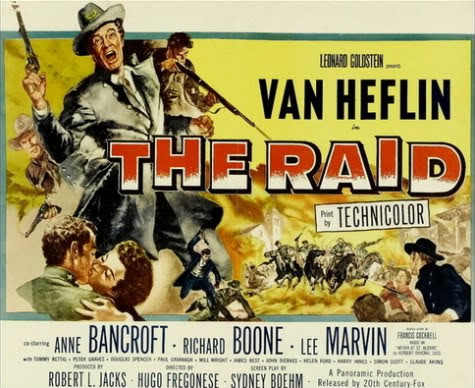
The Raid

poster312

There is no conflict as dirty, socially corrosive and tragic as a civil war. Friends and neighbours, those whose similarities are every bit as pronounced as their differences, suddenly find themselves sworn enemies at one another’s throats. Any story which uses such a conflict as its backdrop automatically has an enormous amount of built-in dramatic potential. Yet despite that, there’s a hazard too – commercial success is by no means guaranteed. Movies based around the American Civil War were traditionally regarded as box office poison, and I don’t think such an aversion is some affectation confined to the United States. There are few nations which haven’t fallen victim to internal bloodletting, and the scars of these events never fully heal in the public consciousness – it’s hard to get past the essential ugliness of a country tearing itself apart from within. However, a movie can still remain compelling, and indeed worthwhile, in the face of these obstacles. The trick is to sidestep the cloying piety that can sink a script and instead focus on the real human effects of a land and people divided. The Raid (1954) is such a film.

The story is based on a real event during the Civil War – one of those peripheral actions that occur in most conflicts. It opens with a small band of Confederate POWs staging a breakout from a Union prison close to the Canadian border. The aim of the fugitives, under the command of Major Benton (Van Heflin), is to cross into neutral territory and reorganise themselves there. Benton has in mind using the neighbouring country as a springboard to attack the North. His plan is to marshal his forces and unexpectedly raid the border towns, both as an act of revenge for Sherman’s pillage of the South and as a means of drawing vital troops away from the front line and thus relieving the pressure on Lee. The target for the first of these incursions is St Albans, Vermont. Benton arrives in town posing as a Canadian businessman looking to invest in local property, but really scouting the lay of the land and paving the way for his comrades to join him. The basic plan is to clean out the banks, providing much needed funds for buying munitions, and then to torch the town and cause as much havoc as possible before beating a hasty retreat back across the border. On paper, this sounds like a viable proposition but complications inevitably arise. There are three troublesome flies in Benton’s jar of ointment: Katy Bishop (Anne Bancroft), the young widow running the boarding house where Benton’s lodging; Captain Foster (Richard Boone), the one-armed veteran in charge of St Albans’ small military force; and Lieutenant Keating (Lee Marvin), whose bitter hatred of the North means he’s something of a loose cannon among Benton’s otherwise highly disciplined force. These three people, and Benton, are a perfect illustration of the effects of civil warfare. All of them have been damaged, either physically or emotionally, by the war and all represent different aspects of the mindset it has created – Keating’s volatile sadism, Katy’s dignified struggle against loneliness, Foster’s self-loathing, and Benton’s juggling of professionalism and sentiment. One key scene highlights the moral dilemma faced by a man in Benton’s peculiar and precarious position. Having just saved the townsfolk from mortal danger (and himself too, as it happens), he returns to his lodgings only to be confronted with that which he least expected – the gratitude and acceptance of the local community. A combination of shock, humility, and horror at his own duplicity briefly flit across Benton’s features. In this moment, everything we need to know about how this kind of war divides loyalties, even internally, is deftly expressed. Still, Benton is a man of principle and, despite any moral qualms he may be experiencing, he forges ahead towards his objective. By the time the actual raid occurs the viewers have been granted a glimpse into the hearts and minds of those from both sides of the divide, making the climax all the more tense and charged.

£9

Argentine director Hugo Fregonese came to Hollywood in 1949 and made a number of films that have largely been forgotten outside of film buff circles. There may not be any masterpieces among his credits but he displayed a very strong visual sense and his work remains interesting at the very least. Apache Drums, produced by Val Lewton, is a little neglected gem that’s ripe for rediscovery, while Saddle Tramp and Harry Black and the Tiger have points in their favour too. The Raid is one of his best efforts, looking handsome and maintaining suspense throughout. The reenactment of the titular raid (a bit of research indicates that the real event resulted in considerably less damage) makes for an exciting climax and it’s well staged by Fregonese and his cameraman, Lucien Ballard. Van Heflin does very well as Major Benton, looking tough and authoritative enough to be believable as the commander of the raiders, and also showing the right degree of sensitivity when necessary. He hadn’t the looks to make a career as a romantic lead but his understated performances generally had a very attractive human quality. Once again, Richard Boone seems to get right into the character he’s playing; the gruffness of Foster initially seems to stem from his bitterness over his war injury but, as the story progresses, it’s apparent that his reserved demeanour has a deeper psychological root. Both actors bring quite subtle nuances to their respective characterizations and there’s nothing one-dimensional about either of them. Personally, I found it refreshing that Anne Bancroft’s widow was used as a softening influence on both Boone and Heflin, and wasn’t there merely to provide an excuse for some superfluous romance. Her presence is integral to the development of the plot and the shifting emotions of the two men staying under her roof, but not as a stereotypical Hollywood siren. Heading up an especially strong supporting cast, Lee Marvin turns in another memorable performance as the vengeful and dangerous Keating. His “bull in a china shop” approach acts as a counterweight to Van Heflin’s measured caution and helps to up the tension.

To the best of my knowledge, the only DVD release of The Raid is the Spanish edition from Impulso/Fox. Generally, whilst apparently unrestored, the disc is one of their reasonable efforts. The film may have been 1.66:1 originally, but this transfer presents it in Academy ratio (1.33:1) – if it’s open-matte it may be slightly zoomed as the framing looks a little tight to my eyes on occasion. However, I wouldn’t say it was seriously compromised. The colour and detail levels are quite strong, and it’s pleasing to look at. The extras are the usual gallery and text items, and the Spanish subtitles can be disabled from the setup menu. The film approaches its subject matter intelligently and avoids forcing judgements on the viewer. The combination of a strong, capable cast, a tight script and professional direction adds up to a pacy and entertaining look at an intriguing episode from the Civil War. Recommended.


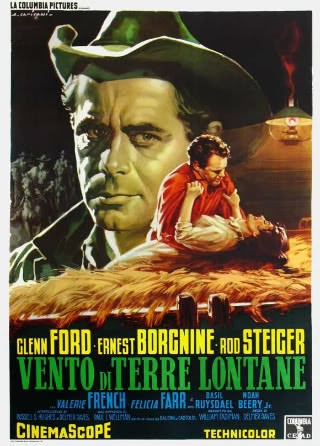
Jubal

Shakespeare and westerns really don’t sound like they go together. However, in the case of the former, the universality of his themes means that the location and period in which the drama takes place is largely irrelevant. And as for the latter, the genre is so flexible that pretty much anything can be tackled within its framework. William Wellman’s Yellow Sky has been described as a reworking of The Tempest, while Jubal (1956) sees the ideas central to Othello transported to a ranch in Wyoming. In a way, the isolated simplicity of the west provides an ideal backdrop for the presentation of such timeless concepts. Like an uncluttered stage, the absence of the trappings of civilization helps to better focus attention on the more important aspects of the story.

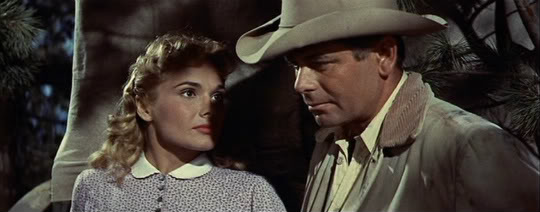
Jubal Troop (Glenn Ford) is a wanderer, a man who has spent his life running; he claims that he’s been trying to escape the bad luck that’s always dogged his steps. In reality though, he’s been running away from himself, or rather his own perceived inadequacies that stem from traumatic childhood experiences. When ranch boss Shep Horgan (Ernest Borgnine) takes him in and offers him a job and a chance to make a fresh start, it looks as though his streak of ill-fortune may be coming to an end. In spite of Jubal’s initial optimism, he soon realizes that he’s actually walked into a highly volatile situation. Shep is one of those salt of the earth types, brimming with hospitality and geniality yet lacking certain social graces. It’s this cheerful disdain for (or ignorance of) the niceties of polite society that has apparently pushed his young Canadian wife, Mae (Valerie French), away from him. I say apparently, because Mae merely uses this as an excuse – it’s clear enough that the remote ranch life and lack of social contact play an equally significant role in shaping her dissatisfaction. Almost as soon as Jubal arrives on the scene Mae begins to show an interest in the newcomer. On top of all this, there’s the problem of Pinky (Rod Steiger), Shep’s current top man and the previous recipient of Mae’s attention. Where Jubal resists Mae’s advances on the grounds that it would be a betrayal of the one man who ever handed him a break, Pinky never displayed such qualms. Now that he’s been sidelined by the new arrival, his resentment and natural antagonism bubble closer to the surface. Due as much to his own petty and spiteful nature as Jubal’s dedication to his job and his boss, Pinky finds himself falling out of favour both as a lover and an employee. It’s this displacement that triggers Pinky’s pent-up jealousy and latent misanthropy. When the opportunity arises, he slyly plants the seeds of doubt in Shep’s mind. And it’s from this point that the classical tragedy at the heart of the story starts to develop fully.

Delmer Daves had a real affinity for the western, his films within the genre all displaying an extremely fitting sense of time and place. In addition, he also had a great eye for telling composition and the use of landscape. His best movies look beautiful, and Jubal takes advantage of the breathtaking vistas that the location shooting in Wyoming offered. The exteriors have a kind of clean, bracing quality to them reminiscent of the mountain air their backgrounds suggest. These wide open spaces are representative both of the freshness of Jubal’s new life and also the remoteness of Shep’s ranch. However, Daves was no slouch when it came to interiors either; he, and cameraman Charles Lawton, create some extremely moody and tense imagery when the action moves indoors. It’s not always easy to achieve effective depth of focus and shadow density when filming in colour, yet Daves and Lawton manage to pull it off time and time again. When you’re telling a story as thematically dark as this it’s vital to keep the mood of the visuals in tune with the plot – Jubal always looks and feels just right at all the critical moments. What’s more, although Daves’ endings had a tendency to be a letdown in comparison to what went before, this movie maintains the correct tone right up to the rolling of the credits.

Glenn Ford was an excellent choice to play Jubal Troop, his edgy affability and that slight unease were well suited to the role. The character has an innate nobility and honesty, but there are demons lurking there too, torturing the man with personal doubt and a devalued sense of self-esteem. Ford had a gift for projecting all these qualities on the screen; perhaps that’s why he seemed at home playing in both psychologically complex westerns and film noir. In the following year’s 3:10 to Yuma, Ford and Felicia Farr played out one of the most touching and affecting romantic interludes it’s been my pleasure to see on film. This picture also features a romance between the two, just not as memorable or emotionally loaded as what was to come. Part of the problem is the weaker role handed to Ms Farr, but she still manages to convey something of that bittersweet tenderness in her scenes with Ford that would prove so effective in their next collaboration. The other, and much more substantial, female role was that of Valerie French. There was certainly nothing likeable about the part of Mae, whose infidelity (both real and imagined) sets three men at each other’s throats. Her frustrated sexiness is well realized and, by the end, in spite of her deceit, it’s hard not to feel some sympathy for her fate. Ernest Borgnine’s cuckolded husband draws even more pity though; the way he positively radiates a love for life means that his betrayal really hits home. His brash good humour makes him a favourite of the men, but also leaves him blissfully unaware of the coldness of his wife. When it suddenly dawns on Shep just how much of a fool he’s been, Borgnine’s highly expressive features show very clearly how deeply Mae’s playing around behind his back has affected him. Rod Steiger was always an extremely showy actor, forever in danger of allowing his intensity to spill over into inappropriate grandstanding. As the scheming and reprehensible Pinky, he just about manages to stay the right side of the line – although his tendency towards showboating does raise its head as the movie nears its climax. Among the supporting cast, Charles Bronson makes a strong impression as a hired hand who befriends Ford, and whose intervention at two critical moments help save the day.

Jubal has been available on DVD for a long time via Columbia/Sony in the US. The disc boasts a very good anamorphic scope transfer that looks rich and colourful. There are no extras offered, unless you count the preview snippets for other western titles from the company. The film remains an excellent example of Delmer Daves’ skill at telling a mature and thoughtful western tale. I think the fact that both the director and the star went on to make the better known 3:10 to Yuma a year later has overshadowed this picture to an extent. I’d say that anyone who enjoyed that movie will also appreciate the work on show here. This is yet another strong entry in the western’s golden decade, and fully deserving of any fan’s attention.

Terror in a Texas Town

poster34-2

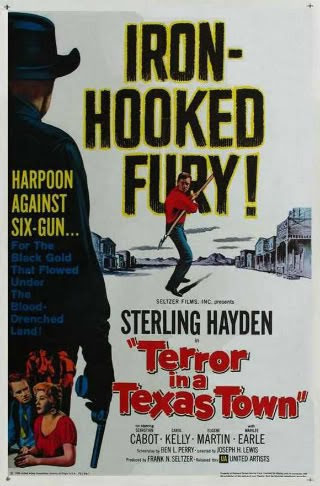
So many westerns have hinged on the conflicts that arise over land: the need to expand settlements, the presence of gold or silver, grazing rights, the relentless progress of the railroad. However, not too many have dealt with oil. Terror in a Texas Town (1958) uses the issue of oil to explain the actions of its characters (especially the villains) yet it’s not this that interests us as viewers. At the heart of the story lies a good old-fashioned tale of justice and revenge. As such, we have a very traditional plot, even one that could become mundane in other hands. Nevertheless, director Joseph H Lewis and uncredited writer Dalton Trumbo between them manage to craft a highly unusual western that probes around the genre’s boundaries.

The entire film is told in flashback, the opening scene cut short at the crucial moment and its resolution only revealed right at the end. The grandly named Prairie City, Texas is one of those typical western towns, dusty, sleepy places where nothing much seems to happen. Be that as it may, the leading citizen, McNeil (Sebastian Cabot), is in the process of shaking things up. He’s engaged in a land grab; having learned that the surrounding area is literally swimming in oil, he has called in an old acquaintance to help him run the homesteaders off their property with a view to seizing it for himself. His henchman of choice is Johnny Crale (Ned Young), an old-school enforcer and gunman who’s had his right hand shot off in the course of his work and who’s fast becoming a relic of a previous era. Crale’s first assignment is to kill a man, a kind of coaxer to encourage the others. As it turns out, this is an unfortunate selection – an old Swede patiently tending the land until his son returns from the sea. The son, George Hansen (Sterling Hayden), cuts an incongruous figure when he arrives, awkwardly dressed in his ill-fitting city clothes and lugging a heavy sea chest on his shoulder. The scene in the saloon, where Crale tells Hansen of the murder of his father (leaving out the crucial detail of who did the deed) is so well filmed – just two guys and a girl sitting around a table in a deserted bar, yet absolutely riveting in its very simplicity. The viewer is a step ahead of the apparently slow-witted Swede in knowing the identity of the killer, and it’s fascinating to watch the movie’s two protagonists, with their contrasting characters, probing for an insight into each other. Of course, Hansen is nowhere near as dumb as his appearance suggests. Before long, he’s got the measure of both McNeil and Crale and finds himself drawn inevitably towards the almost surreal showdown that started the movie.

£39

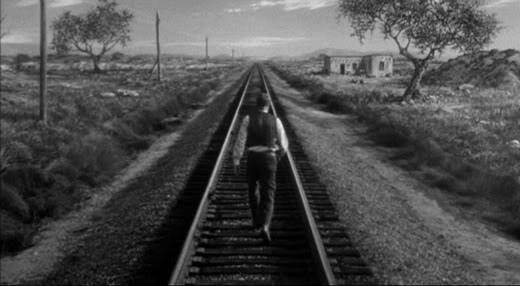
Joseph H Lewis is probably best known for two remarkable noir pictures, Gun Crazy and The Big Combo, yet Terror in a Texas Town (his last movie before moving to TV) is both powerful and individualistic enough to be mentioned in the same breath. It’s an extremely low budget affair, shot on sets with a very limited cast, that turns its lean production into an asset. The dialogue is trimmed down to the bare necessities, thus lending it greater impact, and every shot is loaded with significance. One example is the scene where Hansen returns to find the Mexican settler he’s befriended has been gunned down by Crale. A simple cut to the tight grouping of the man’s grieving widow and children tells us all we need to know about the effect this killing has had, far more eloquent and touching than reams of sentimental dialogue or exposition. The unique set piece that frames the story, the duel between a six-shooter and a harpoon, is more than a mere artistic quirk, it sums up the idea at the heart of the story: a simple outsider with primitive tools taking on the might of the exploiters. Trumbo’s leftist take on events and characterization is one of the key factors that makes the film so compelling.

Sterling Hayden’s sheer physical bulk always ensured he maintained a powerful presence on screen, and he used that attribute to great effect as the stoic and immovable George Hansen. He’s very convincing as the foreigner who has to measure his words carefully and think before he expresses himself. The fact that it’s this Swede, and his Mexican friend, who stands up to the criminal excesses of unchecked capitalism highlights the way America (as Trumbo no doubt perceived it) had become ineffectual and complacent when it came to facing the threat of corporate greed. Ned Young, as the physically deformed and morally confused enforcer, is a marvelously ambiguous figure. He’s clearly a bad man, both his background and the murders he commits during the film attest to that. Still, he remains a multi-dimensional character; he’s a reluctant killer, motivated less by money than a kind of morbid curiosity about the psychology of fear and death. The true villain is Sebastian Cabot’s McNeil, the very embodiment of a corrupted and heartless American society. This bloated figure, exuding a fake bonhomie, is the archetypical avaricious businessman with the law in his pocket – the unattractive face of a new west. Personally, I’m struck by the parallels between McNeil (and his ultimate fate) and Gabriele Ferzetti’s Morton in Leone’s Once Upon A Time In The West.

Terror in a Texas Town has been available on DVD for a long time now from MGM in the US. The movie has been given a strong anamorphic widescreen transfer that does justice to Lewis and cameraman Ray Rennahan’s compositions. I suppose the biggest complaint is the amount of grain visible, not something that generally bothers me but there is an awful lot of it. The disc offers no extras except the theatrical trailer. The film has also been released in the UK by Optimum. I don’t have that disc to compare but being a title licensed from MGM, it’s likely to be broadly similar in terms of quality. I have a lot of time for this movie; I love its low budget urgency and the offbeat style. The involvement of Sterling Hayden, Ned Young and Dalton Trumbo conjures up the ghost of HUAC and the blacklist, while the plotting and characterization are further reminders of a period of US history that remains both fascinating and tragic. This movie seems proud of its own B status and proves that lower budgets don’t have to mean lower quality. It gets a definite thumbs up from me.


A Thunder of Drums

poster316

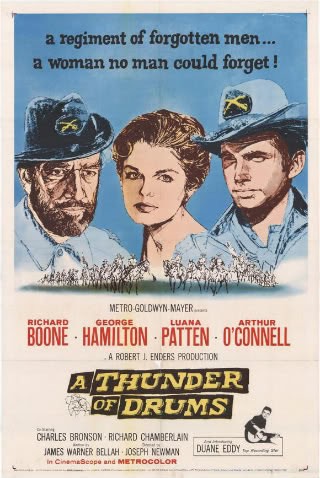
Think of cavalry westerns, or rather, think of the best cavalry westerns and one name tends to spring to mind – John Ford. The famous trilogy (Fort Apache, She Wore a Yellow Ribbon, Rio Grande) forms an integral part of Ford’s building up and subsequent deconstruction of the myth of the west. It’s Ford, and Wayne of course, that we think of as being at the heart of their success. While this is entirely justified, there is, however, another figure who had an influence on the shaping of these films – the author of the source material, James Warner Bellah. Aside from the trilogy, his work also provided the inspiration for A Thunder of Drums (1961), a far less celebrated movie. I’m not going to try to argue here that this is a film deserving of the kind of acclaim accorded to Ford’s work, but it does warrant a little more attention than it ordinarily receives.

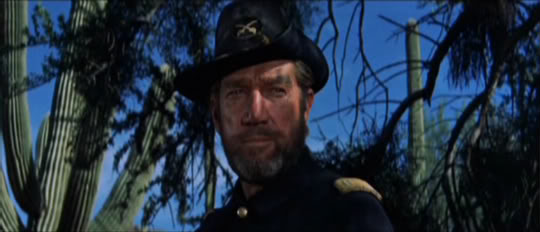
The story takes place in and around Fort Canby, one of those isolated and undermanned outposts on the extremities of the frontier. It opens in hard-hitting and startling fashion with an Indian raid on a homestead, the full horror of which is reflected in the terrified eyes of a child witness and in the grotesque shadows playing across the ceiling. When the awful aftermath is discovered by a passing cavalry troop the sour and downbeat tone is further emphasised by the fact that these men are bringing their own dead back home. So, with their faces already covered to counter the stench of their current cargo, the troops set about the grim task of burying the victims. From this point on the threat of imminent violence never really slackens, although the action moves into the confines of the fort and remains there until the last half hour. The uncompromising beginning serves to set up the brutal realities facing the fort’s commander, Captain Maddocks (Richard Boone), a man whose past has condemned him to a life of thankless soldiering. With the arrival of a green young officer, Lieutenant McQuade (George Hamilton), we start to get hints that something dark, some error made years before, means that Maddocks is doomed to remain at his present rank until retirement or death release him. And so this western version of the ancient mariner has the task of teaching McQuade the skills necessary for surviving on the frontier and becoming a proper professional soldier. In the process, we get to see (as in Ford’s trilogy) the minutiae of life at one of these half-forgotten postings. Despite Maddocks’ bristly and abrasive style keeping things ticking over, the mid-section of the movie gets itself bogged down in a pretty tedious love triangle involving McQuade and the fiancée of another young lieutenant. What rescues the picture is the last half hour. The troops move out in the open to avenge a massacre and hunt down the hostiles who have been harrying them. The cat-and-mouse pursuit leads to a well-staged climactic battle that ensures the whole thing ends on a high note.

£36

Joseph M Newman was no auteur; he was, however, a versatile professional, the type Hollywood depended on to make good, tight movies. Throughout the 1950s he made a succession of films that, though largely forgotten these days, included some highly entertaining and capable stuff. In this one, his best work is at the beginning and at the end of the picture – a little like the situation with Escape from Fort Bravo, where the strong opening and close bookend a flabby middle. The climax is well handled as an action set piece, especially the Apache ambush tactics and their sudden appearance like spirits conjured out of the ether. Besides this, the greatest saving grace is the central performance of Richard Boone. I thought he was ideally cast as the grizzled officer, ageing and passed over for the promotion his experience and talent merits yet not succumbing to the corrosive bitterness you might reasonably expect him to feel. He had the necessary grit, and a kind of weary resignation, to deliver his memorable dialogue  and lend it the weight it deserved – towards the end, he even gets to put his own spin on the Duke’s old line about never apologising as it’s a sign of weakness. In fact, there’s a lot in Boone’s performance that recalls James Warner Bellah’s other cavalry journeymen. In contrast, George Hamilton’s portrayal of McQuade is problematic and represents a major weakness. Firstly, Hamilton just doesn’t look right; there’s too much Hollywood polish and smoothness about him. What’s more, he just didn’t have the acting chops to either compete when sharing the screen with Boone or to carry off the pivotal role that was so vital in shoring up that sagging mid-section. Similarly, the lightweight and not especially convincing work of Luana Patten (as Hamilton’s love interest) and Richard Chamberlain fails to add much to the film. Still, there are good supporting turns to help paper over the cracks. Charles Bronson has a medium-sized part as a devious and dirty-minded trooper who comes good in the end, Arthur O’Connell is entertaining enough in the role of the top sergeant that Victor McLaglen played for Ford, although Slim Pickens’ talents are basically wasted.

A Thunder of Drums is available as an MOD disc in the US. However, as an alternative, there’s a perfectly acceptable release to be had in Spain. Llamentol/Paycom have presented the film in anamorphic scope, and the transfer is generally quite pleasing. There is a little softness in the image but it’s clean enough and the colours are nice and strong. There are no extra features offered, but the Spanish subtitles are optional and can be switched off via the setup menu. I found it interesting to see situations that Ford so skilfully presented taken on by someone else. A Thunder of Drums has none of the artistry or poetry of the old master himself, but it’s a fair enough movie all the same. Considering the inadequacies of some of the performances around him, it’s very much to Richard Boone’s credit that he was able to drive the film as much as he did. I feel that the presence of Boone, and Newman’s handling of the action and exteriors earn this at least a qualified recommendation.


Westbound

In the past I’ve looked at six of the seven westerns Budd Boetticher made in collaboration with Randolph Scott. Somewhat belatedly, I now turn my attention to the one remaining title. Of this little group of films, Westbound (1958) is the least significant. Taken on its own merits and judged as a stand alone movie, it’s actually not a bad little picture. However, what I’ve just suggested is a large part of the problem; the Scott/Boetticher films are so interconnected and so influential that it’s very difficult to weigh them up in isolation. I’m not saying that they should be viewed as essentially one film – although others have certainly put forward that theory – yet there is a thematic pattern running through them. They all share certain identifiable characteristics that mark them out as clearly being the work of Scott and Boetticher in tandem, all but Westbound that is. There’s nothing in the movie that bears the hallmark of this important cinematic partnership. What I mean is that the film might just as well be any one of the westerns that Randolph Scott made throughout the 50s with other directors. Now that in itself isn’t an especially bad thing, but it does result in a weaker effort when viewed in context.

John Hayes (Randolph Scott) is a captain serving in the Union army during the Civil War who finds himself pulled off active duty to undertake a different kind of task. His pre-war business was running a stage line and, with the North needing to ensure the smooth transfer of gold from California to bolster the war effort, he is asked to resume his old trade. This necessitates moving west to Colorado and taking over his old operation. However, on arrival, he discovers that his former associate Clay Putnam (Andrew Duggan) has shut up shop and is unwilling to offer any assistance. Putnam’s reluctance, and barely veiled hostility, stems from two factors: he’s a Confederate sympathizer, and he has married Hayes’ old sweetheart Norma (Virginia Mayo). Throw the involvement of a wounded vet and his wife (Michael Dante & Karen Steele) into the central conflict between Hayes and Putnam, and there’s the plot of Westbound in a nutshell. It’s a brisk, no-nonsense affair that entertains as it goes along, yet something is missing. For me, that something is the personal element, the vital ingredient that underpinned all the other Scott/Boetticher pictures. The whole patriotic angle is far too remote and impersonal to really grab you, and the possibility of emphasising the love of both Hayes and Putnam for Norma is glossed over and underplayed if anything. As the story progresses, the ruthlessness of Putnam, and his chief henchman (Michael Pate), does add a little dash to Hayes’ motives, but the truth is it’s too little and comes too late. The result of all this is a film that feels somewhat shallow and disposable in comparison to the director and star’s other works. As such, we get a piece of passable entertainment, but that’s all that can be said.

For Boetticher, Westbound was really nothing more than a matter of fulfilling a contract. If the storyline has a blandness that sets it apart from his best films, it’s not helped by being shot away from his trademark Lone Pine locations and featuring far too many interiors – never one of his strengths. Having said all that, he does turn in a professional and polished pice of work, and the action scenes have a style to them; the best is arguably the raid on the villains hideout as the climactic shootout, though excitingly staged, is marred by having the conscience-stricken townsfolk join in. Randolph Scott’s performance has the kind of affability that often characterized his western roles. That’s not meant as a criticism of the actor at all, I could happily spend days on end watching his movies, but it does evoke memories of some of his more run of the mill movies as opposed to the depth of feeling associated with his Ranown roles. Virginia Mayo was an actress that, on occasion, was handed underwritten parts. That’s not exactly the problem here, but the script does sell her character a little short by not allowing her to have sufficient impact on events. Despite being billed lower, Karen Steele is much more effective as the tough wife of a disabled soldier – the scene where she delivers a full on punch in the face to one of her husband’s tormentors is one of the most memorable in the whole film. In a sense, Steele was the ideal Boetticher heroine – a beguiling mix of gutsy allure. The casting of the villains highlights another area where this movie underperforms in context. Andrew Duggan was competent enough but there’s no sense of his being any match for Scott when the chips are down. And Michael Pate, despite nailing the mean and heartless aspect, has none of the ambiguous charm that Lee Marvin, Richard Boone or Claude Akins brought to their parts.

Having long sworn that I wouldn’t buy into the whole MOD business, I finally caved and bought a number of titles late last year when Barnes & Noble ran a sale on Warner Archive titles. I’ve since heard that Westbound has been released in Spain, but I haven’t seen it listed by any of the usual online outlets. The Archive disc is a real barebones DVD-R, no proper menu and chapter stops inserted at ten minute intervals. The film has been given an anamorphic widescreen transfer that boasts reasonably vibrant colour but has an overall softness or dullness that leads me to rate it a bit lower than the other Scott/Boetticher titles released by Sony and Paramount. However, it is a fair enough presentation. I realise I’m probably labouring the point here, but an understanding of context is everything when it comes to assessing this picture. If one were new to Randolph Scott movies then Westbound wouldn’t necessarily be a bad place to start. If, on the other hand, you’ve heard about the special place Scott’s work with Boetticher holds in the hearts of western fans and critics alike, then this is definitely not the film to show it off. And that’s as fair as I think I can be.

Track of the Cat

poster310

The terms art house or experimental film don’t often get used when westerns are being discussed. While there are of course countless examples of highly artistic westerns, it’s rarely the kind of self-conscious artistry that those labels suggest. There’s also the matter of audience expectation to take into account; when the genre was at its peak the fans were largely thought to want the kind of movie that didn’t veer too far from the traditional. In order to produce an art piece, particularly within a genre widely regarded as being bound by convention, you need a filmmaker who has confidence, clout, skill and vision. Although a combination of such qualities may be rare it is not unknown, and William Wellman was a director who fulfilled the criteria. His production of Track of the Cat (1954) was a daring attempt to fuse the western and the art house movie. Back when it was made, the film was not considered a success yet looked at now, over half a century later, it can perhaps be appreciated better.

Generally, mainstream audiences like to be clear about what they’re watching, and part of the problem with Track of the Cat is the difficulty in categorizing it. Sure it’s a western, but it can also be approached as an allegorical morality tale, a psychological dissection of a dysfunctional family, or even a horror story. At various points the movie is all of the above and this diversity can have a disconcerting effect on the viewer who comes at it unprepared. The plot itself is straightforward, simple and springs no major surprises. It concerns the Bridges, a ranching family living an isolated, insular existence with a seething mix of conflicting emotions buried beneath the apparent domesticity. The arrival of a guest, the fiancée of the youngest son Harold (Tab Hunter), coincides with the early snows and the appearance of a panther that threatens to devastate the herd. However, it’s suggested that this cat may be no normal beast, the superstitious bent of an ancient Indian (Carl Switzer) has planted the seed in everyone’s mind that this animal is the representation of a greater evil – all the evil in the world in fact. And so the two older sons, Arthur (William Hopper) and Curt (Robert Mitchum), take it upon themselves to weather the elements and head off to track down the cat and slay it once and for all. From this point on the film cuts between scenes of this near classical doomed quest and those back at the Bridges’ ranch, where the heightening emotional tension mirrors the increasing physical dangers out on the mountain. Whether one views it as a masterstroke or a failing – personally, I tend towards the former – the titular cat is never seen on-screen. Instead, it exists as a kind of psychological bogeyman, a malign presence stalking the dark corners of the characters’ awareness. Peeling back the layers, I think it’s possible to draw a parallel between the panther and Harold’s fiancée, Gwen (Diana Lynn), as both appear on the scene simultaneously and both represent a threat to the status quo. The Bridges’ world, like the snowbound landscape they occupy, is a barren one: the relationship between Ma and Pa Bridges is a loveless one where each merely tolerates the others foibles, those of Arthur and his spinster sister (Teresa Wright) are only superficially better – a telling comment early on informs us that both will remain childless – and the family likely to decline, and Curt is nothing but a domineering bully. This leaves only Harold, the repressed and half-forgotten son who has yet to become jaded and bitter. The arrival of Gwen and the cat has the potential to tear asunder the entrenched negativity of the Bridges. Both embody a kind of primal energy that, in their contrasting ways, will violently transform this stale and moribund family.

£7

Track of the Cat was the second time William Wellman filmed one of Walt Van Tilburg Clark’s books (the first being The Ox-Bow Incident a decade before) and he once again produced a notable and memorable piece of work. According to Lee Server’s biography of Mitchum, when Jack Warner learned that the colour movie he was backing had next to no colour in it he was not best pleased. Wellman’s response was simple and to the point:  ” If he doesn’t like it he can go shit in his hat.” It could of course be argued that Wellman’s radical decision to shoot a colour movie using almost exclusively black and white imagery was not much more than a stylistic affectation, an exercise in aesthetics if you like.  However, I believe there’s more to it than that; the colour, or lack of it, used by Wellman, and cameraman William H Clothier, goes a long way towards defining the nature of the characters and their relationships. Black and white infers absolutes, clearly defined parameters. Bearing in mind that the domestic setup is traditionally the province of females, the fact that the decor of the homestead consists of just these two colours reflects the inflexible and puritanical outlook of Ma Bridges (Beulah Bondi). The Bridges inhabit a world where any kind of personal manoeuvrability is severely limited. There are only two notable exceptions to this stark, spartan colour scheme: the red jacket worn by Curt and the yellow blouse of Gwen. Both these colours are indicative of energy, but while Curt’s red conveys the notion of power and aggression, Gwen’s yellow implies warmth and happiness. I think it’s also worth pointing out that when Curt exchanges his jacket for that of his dead brother after the cat’s attack he undergoes a kind of transformation. Now shorn of the symbol of strength and vitality, he dons the cow hide tunic and gradually assumes the characteristics of the prey rather than the predator.

Mitchum managed to capture this character shift very subtly in his performance. There’s a world of difference between the brash, swaggering bully of the first half of the picture and the paranoid, haunted shell of a man he becomes, yet he achieves this switch in a wholly natural and seamless fashion. The role of Curt is very unsympathetic (foreshadowing his work on Night of the Hunter and Cape Fear) but he pulls it off and, in the process, provides evidence of just how versatile and talented he really was. I couldn’t say that any member of the cast struck a false note and everyone involved performed more than competently. However, I do want to single out Beulah Bondi’s turn as the forbidding matriarch. This self-righteous and moralizing figure is the linchpin of the family, binding them all together either in spite of or because of her intolerance. Although there is a terrible quality to this woman, it’s hard not to feel some twinge of pity as she sits in that cold room, waking one dead son, fearing for the life of another and watching the slow disintegration of all she holds dear.

Despite being released theatrically by Warner Brothers, Track of the Cat was made by John Wayne’s production company Batjac and so was put out on DVD a few years back by Paramount in the US, and subsequently elsewhere. The anamorphic scope transfer is good enough, though not perfect. The movie really could use a clean up, but there isn’t anything that acts as a distraction or spoils the enjoyment of the movie. Apart from the main feature itself, where the disc really scores is in the extras department. There’s a commentary track with Tab Hunter, William Wellman Jr and Frank Thompson, a gallery and trailers. Additionally, there’s also a feature on the making of the film which has been divided up into four self-contained featurettes. The film won’t be to everyone’s taste, but it is a remarkable and unique work that deserves to be seen. Aside from the visuals, and they are quite spectacular, it’s one of those multi-layered pictures that rewards repeated viewings. I’ve seen the movie a few times now and there are still things that I’m only just noticing. Whether or not one warms to the film is ultimately down to personal preference, but it certainly refutes the notion that westerns and art house pictures don’t mix. I recommend giving it a chance at least.


No Name on the Bullet

I’ve been watching a lot of short, stripped down movies lately, and enjoying them very much. Apart from the pacing, I’m also fond of the tighter storytelling techniques that shorter running times necessitate. These movies impose a discipline on both writers and directors that often seems to stimulate creativity and artistry rather than restrict them. In a way, the elimination of flab tends to focus the minds of those behind the cameras and, when there is a natural talent present, result in a more vibrant picture. Jack Arnold’s No Name on the Bullet (1959) is a low budget sprinter of a movie that provides its lead with maybe his very best role, tells the audience an absorbing tale, and offers plenty of food for thought.

The story is one of fear – a fear ostensibly sparked by an outside force but, in reality, having its true origin within a community and, more specifically, within the hearts and collective conscience of the residents. When a sombre stranger rides into town the effect on the locals is both remarkable and rapid. What starts out as a kind of smouldering dread soon deepens into panic and, later, outright terror. You see, the stranger in the midst of these fearful townsfolk is one John Gant (Audie Murphy), a hired assassin whose notoriety has taken on near mythical proportions. He is known to get his man without fail, and with sufficient cunning to ensure that no criminal charges can be brought against him. Without doubt, this is a fearsome reputation in itself, but what provokes the atmosphere of unbearable tension is the mystery surrounding the identity of Gant’s intended target. As the shadow of the gunman casts a dark pall over the town the locals’ fevered imaginations take possession of them and, one by one, their dark pasts and guilty secrets start to emerge. The growing sense of terror, and their apparent inability to rid themselves of Gant’s presence, eventually turns the residents upon each other, and the body count rises accordingly. Amid all the mayhem and psychological torment Gant sits inscrutable and unperturbed, while the viewer is left wondering not only who the next victim will be but also whether or not this grim angel of death is the hero or the villain of the piece.

Jack Arnold is best known for his 50s sci-fi work and he brings the paranoia that was such a strong element of the era and genre to the western in No Name on the Bullet. The film is a set-bound affair, confined for the majority of its running time to the centre of the small town. Obviously, budgetary constraints played a significant part in the decision to shoot it thus, but it ends up being one of the strong points. While most westerns benefit from location shooting and evocative landscapes, the fact that the action here rarely leaves the streets of the backlot serves to enhance the feeling of the residents being trapped by fate.

If Arnold’s direction creates the pressure cooker atmosphere the man with his hand firmly clamped on the lid is Audie Murphy. At one point, one of the characters tells him he speaks more like a preacher than a gunman. And that’s indeed the impression he conveys throughout; his expression remains dour and judgmental, and even his clothes have a puritan-like severity. Moreover, it’s entirely in keeping with the notion that Gant is the embodiment of retribution, a seemingly indestructible instrument of justice. Murphy’s baby face features and soft voice, as he sits endlessly sipping coffee and surveying everyone and everything like some malign deity, accentuate the character’s menace – even more so when one considers the real man’s war record. In a way, Gant represents a higher law, the local variety being weak (wounded and ineffectual) when faced with a crisis, eliciting the deeply harboured guilty feelings of all and dispensing punishment to the deserving. Normally, an overt absence of character development would be viewed as a minus, but having Gant remain essentially a cipher feels somehow appropriate – other characters speculate about his past but Gant himself reveals nothing. Murphy’s low key performance is both subtle and powerful, arguably his greatest. By way of conclusion, and I guess this constitutes a mild spoiler, it’s worth noting that this allegedly deadly killer never actually takes a life at any point.

Universal’s UK DVD of No Name on the Bullet is a very basic affair without any extras whatsoever, unless you count the array of language and subtitle options. However, and this is what matters most anyway, the image is excellent. The film has a strong anamorphic scope transfer with honestly negligible print damage on view. For me, the movie is a wonderful example of what a talented director and star can achieve on a budget. All in all, a memorable film with the guts and integrity to avoid any artificially happy ending, and I strongly recommend it.