No Name on the Bullet

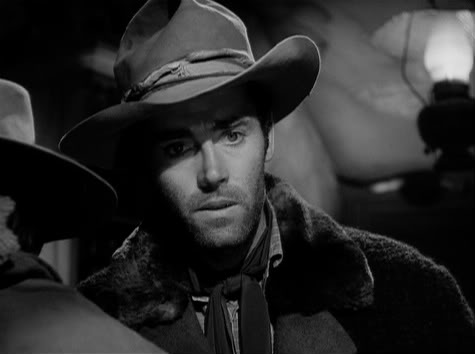
I’ve been watching a lot of short, stripped down movies lately, and enjoying them very much. Apart from the pacing, I’m also fond of the tighter storytelling techniques that shorter running times necessitate. These movies impose a discipline on both writers and directors that often seems to stimulate creativity and artistry rather than restrict them. In a way, the elimination of flab tends to focus the minds of those behind the cameras and, when there is a natural talent present, result in a more vibrant picture. Jack Arnold’s No Name on the Bullet (1959) is a low budget sprinter of a movie that provides its lead with maybe his very best role, tells the audience an absorbing tale, and offers plenty of food for thought.

The story is one of fear – a fear ostensibly sparked by an outside force but, in reality, having its true origin within a community and, more specifically, within the hearts and collective conscience of the residents. When a sombre stranger rides into town the effect on the locals is both remarkable and rapid. What starts out as a kind of smouldering dread soon deepens into panic and, later, outright terror. You see, the stranger in the midst of these fearful townsfolk is one John Gant (Audie Murphy), a hired assassin whose notoriety has taken on near mythical proportions. He is known to get his man without fail, and with sufficient cunning to ensure that no criminal charges can be brought against him. Without doubt, this is a fearsome reputation in itself, but what provokes the atmosphere of unbearable tension is the mystery surrounding the identity of Gant’s intended target. As the shadow of the gunman casts a dark pall over the town the locals’ fevered imaginations take possession of them and, one by one, their dark pasts and guilty secrets start to emerge. The growing sense of terror, and their apparent inability to rid themselves of Gant’s presence, eventually turns the residents upon each other, and the body count rises accordingly. Amid all the mayhem and psychological torment Gant sits inscrutable and unperturbed, while the viewer is left wondering not only who the next victim will be but also whether or not this grim angel of death is the hero or the villain of the piece.

Jack Arnold is best known for his 50s sci-fi work and he brings the paranoia that was such a strong element of the era and genre to the western in No Name on the Bullet. The film is a set-bound affair, confined for the majority of its running time to the centre of the small town. Obviously, budgetary constraints played a significant part in the decision to shoot it thus, but it ends up being one of the strong points. While most westerns benefit from location shooting and evocative landscapes, the fact that the action here rarely leaves the streets of the backlot serves to enhance the feeling of the residents being trapped by fate.
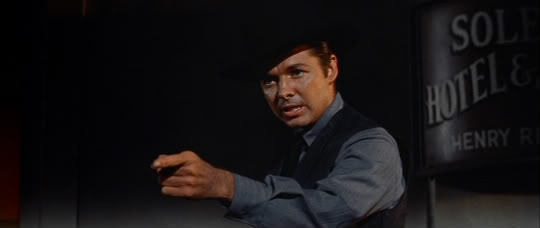
If Arnold’s direction creates the pressure cooker atmosphere the man with his hand firmly clamped on the lid is Audie Murphy. At one point, one of the characters tells him he speaks more like a preacher than a gunman. And that’s indeed the impression he conveys throughout; his expression remains dour and judgmental, and even his clothes have a puritan-like severity. Moreover, it’s entirely in keeping with the notion that Gant is the embodiment of retribution, a seemingly indestructible instrument of justice. Murphy’s baby face features and soft voice, as he sits endlessly sipping coffee and surveying everyone and everything like some malign deity, accentuate the character’s menace – even more so when one considers the real man’s war record. In a way, Gant represents a higher law, the local variety being weak (wounded and ineffectual) when faced with a crisis, eliciting the deeply harboured guilty feelings of all and dispensing punishment to the deserving. Normally, an overt absence of character development would be viewed as a minus, but having Gant remain essentially a cipher feels somehow appropriate – other characters speculate about his past but Gant himself reveals nothing. Murphy’s low key performance is both subtle and powerful, arguably his greatest. By way of conclusion, and I guess this constitutes a mild spoiler, it’s worth noting that this allegedly deadly killer never actually takes a life at any point.

Universal’s UK DVD of No Name on the Bullet is a very basic affair without any extras whatsoever, unless you count the array of language and subtitle options. However, and this is what matters most anyway, the image is excellent. The film has a strong anamorphic scope transfer with honestly negligible print damage on view. For me, the movie is a wonderful example of what a talented director and star can achieve on a budget. All in all, a memorable film with the guts and integrity to avoid any artificially happy ending, and I strongly recommend it.

The Law and Jake Wade

A brief forum discussion the other day on the critical reputation, or lack of it, of John Sturges prompted me to have another look at one of his films that doesn’t usually come in for a great deal of attention. The Law and Jake Wade (1958) was produced in the middle of the director’s most successful period, and the fact that it’s sandwiched between a number of his other better known movies may be partly responsible for its apparent lesser status. On viewing it again, I think it deserves better; it’s beautifully paced, visually arresting, and has a strong central conflict. It’s also one of those sub-90 minute films that I feel suited Sturges so well. The Magnificent Seven and The Great Escape have an epic feel to them, both in terms of casting and running time, and although those two movies feature high among my favourites, I’m still of the opinion that Sturges did his best work when the scale was smaller and the material leaner.

It all starts with a jailbreak, Jake Wade (Robert Taylor) riding into a quiet town to set Clint Hollister (Richard Widmark) free. On the surface, it looks like an outlaw doing right by one of his own. As the story progresses though it becomes clear that there’s more to it. Firstly, Wade’s a lawman, a marshal in another town, and a highly respected one at that. Furthermore, there’s a complex history between the two men; they once rode together, initially as brothers in arms and later as partners in crime, before parting on bad terms. The source of antagonism between Wade and Hollister lies in the latter’s belief that his old friend betrayed him and made off with their takings. Wade doesn’t see it that way though – he’d merely grown weary of his lawless existence and, prompted by a tragic event he holds himself responsible for, decided on a clean break. So he buried the loot and forged ahead with a new life. As far as Hollister’s concerned, Wade crossed him, stole his money and ran out. As such, he wants closure (the jailbreak simply wipes off an old debt in his view), namely the money and a reckoning with Wade. To this end, he tracks down Wade, abducts him and his fiancee (Patricia Owens), and uses the woman as leverage to achieve his ends. I’m not giving too much away as all this happens early on in the movie, the bulk of the story being concerned with the long trek to the ghost town where Wade stashed the money. Along the way, we learn more details about both Wade and Hollister and their soured friendship. The background of the two leads, former border raiders in the Civil War who carried on with their mayhem after the surrender, carries some suggestion of the Jesse James story, but that’s as far as the comparison goes. Wade symbolically buried his past with the cash, but Hollister continues to nurse his bitterness and resentment. There’s also a kind of inadequacy needling Hollister, he knows Wade is the better man but he suspects he’s maybe the better gunman too. While he harps on the betrayal that he claims hurt him, what Hollister really yearns for is the opportunity to pit himself against Wade in classic western fashion.

Of all John Sturges’ westerns, The Law and Jake Wade comes closest to the look and feel of the Randolph Scott/Budd Boetticher films. The majority of the action takes place outside in the desert wilderness (including Lone Pine), featuring a small cast of characters whom we get to know and sympathize with. Wade has a murky past and carries around a deep personal pain while his nemesis, Hollister, has a charming quality that belies his own flaws. And then there’s the secondary characters – the gritty woman who can take the hard going, and the henchmen who are a mixture of the dangerous and the personable. Sturges, as I’ve remarked in the past, was something of an artist with the wide lens and this movie, with its heavy reliance on location work, highlights his skill. The outdoors shots with the peaks of the Sierras forming the backdrop create a sense of vast space, while the interiors (especially when the gang is holed up and under siege in the ghost town) emphasise the stifling and tense atmosphere. Moreover, the Comanche raid on the town is a showcase for his action credentials, where shooting, editing and spatial awareness all play a part in ensuring that the scene remains exciting without losing any of its visual coherence. As for the cast, Richard Widmark was very good in these kinds of roles, his manner suggesting a brittle psychology masked by a cynical sense of humour. This type of villain is always much more interesting than pure, one dimensional evil as there’s usually some sneaking sense of admiration that the viewer feels. In a way, it’s helpful to the hero too, by shouldering some of the burden of satisfying the audience it frees up the lead a little. Robert Taylor was maturing nicely by this time and his experience in westerns meant he had acquired an easy confidence within the genre. His take on Wade is a deceptively laid back one, appearing cool and at ease despite the fact he’s working his wits overtime in an effort to find some way of wriggling out of his predicament. The two most notable supporting turns come from Henry Silva and Robert Middleton, the former as a dangerous psychotic and the latter as the one reasonable and humane member of Widmark’s gang – quite a contrast to his terrifying oaf in Wyler’s The Desperate Hours.

The US DVD of The Law and Jake Wade from Warners isn’t really all that it could be. The image, despite being anamorphic scope, is just too soft and short on detail. It’s not exactly what I’d term a bad transfer but it ought to look better, and the stunning scenery and camerawork on view deserves something better and sharper. The only extra offered is the theatrical trailer – this movie was issued in the Western Classics box shortly before the Archive programme took off and points towards the pared down releases that Warners were moving towards. As such, I now tend to think I should be grateful this film got as good a release as it did, considering how many fine Robert Taylor movies have been shunted into the MOD line. I really like this film; it features good work from both Widmark and Taylor, has a tight script, an even and serious tone, and (thanks to both Sturges and cameraman Robert Surtees) looks wonderful. An easy recommendation, and a strong candidate for reassessment.

As an aside, this blog is 4 years old today. So, a big thank you to all those whose comments, visits and kindness over the years has contributed to its development.

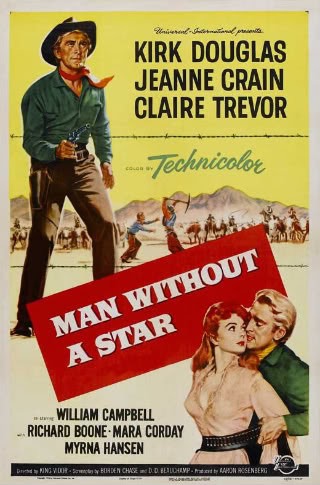
Man Without a Star

poster298

When you think of films about the passing of the old west and the shrinking of the frontier it’s examples from the late 1960s and 1970s that tend to spring to mind. As the western entered its own autumnal phase, the movies, perhaps quite naturally, turned their focus onto the gradual decline of the period they depicted. However, the sense of a way of life passing wasn’t confined to films of this time alone. Man Without a Star (1955) was made during the genre’s heyday, yet it tells the tale of a man driven ever further by the inexorable closing of the open range to seek out a place that offered the kind of freedom he once took for granted. This is a fascinating and emotive theme, and it runs throughout the film, but it’s diluted somewhat by a script that has the hero behaving in a way that, while entirely appropriate within the framework of the classic western, sees him contradicting his own personal philosophy.

Dempsey Rae (Kirk Douglas) is a drifter, as the title suggests, a man who’s lost or perhaps never had a point of reference to guide him through life. His wanderings have taken him ever further from his roots in search of an elusive idyll. He waxes lyrical about the open range that used to allow men to go wherever their fancy took them, and thinks he may have stumbled upon his goal when he finds himself hired on as a hand on an expanding ranch. But that’s not to be; the barbed wire that signals the end of the vast expanses of untamed country are never far behind. No sooner has Rae settled into this comfortable position than the neighbouring ranchers start to string wire and close off the land to protect their grazing from the encroachment of his employer. That employer is Reed Bowman (Jeanne Crain), a hard headed woman from the east who intends to make her fortune no matter what obstacles are thrown in her path. After some initial hostility, she sees Rae as the man on whom she can depend on both a professional and personal level. And so Rae becomes Reed’s top hand, her lover, and her enforcer. That ought to be more than enough to occupy any man, but Rae has also taken on a kind of paternal role for a young man, Jeff Jimson (William Campbell), who has drifted north with him. It’s the arrival, with more cattle to swell Reed’s already substantial herd, of an old acquaintance of Rae’s that tips the balance though. Steve Miles (Richard Boone) is a mean and dangerous figure who’s prepared to take the ruthless steps that Rae baulked at, and will force his rival onto the sidelines. Miles’ actions force Rae’s hand and he has no option but to reconsider his previous prejudices. This, naturally, is par for the course in a western but it does have the effect of making Rae’s character less focused – he smoothly crosses the line to defend those whose methods he once railed against. Here we see a man who has suffered personal loss, whose body is crossed by the scars left behind by the hated wire, yet one who is prepared to forget all that and side with his former enemies as a result of his dislike of Miles and his methods. It builds Rae up into a hero of course, but it also cops out to a degree. I can’t help feeling that the story might have panned out into something more interesting and subversive had the character of Rae been allowed to stick to his guns and go down fighting rather than yield to the advance of progress.

£30

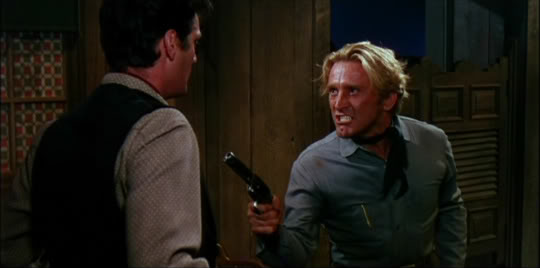
I haven’t seen a huge number of King Vidor’s films, especially not his early output. However, of those I have seen (six or seven pictures I guess), I must admit they all look great. Man Without a Star is no exception in that regard, there’s a richness to the images on show that’s extremely attractive. Clearly, having a top class cameraman like Russell Metty on hand didn’t hurt, and the result is some very well staged sequences. The climactic stampede, leading to the fight between Douglas and Boone, is a good example of this. Kirk Douglas’ performance in the movie is what I’d term a patchy one and not really up there with the best he was capable of. At times, he produces the kind of intensity that marked his more memorable roles, while at other moments he resorts to something akin to a parody of himself. In the same way that his character arc, which I mentioned before, doesn’t entirely satisfy, the jump from brooding, hair trigger moodiness to comedic mugging fails to flow naturally. In fact, the comic interludes are perhaps the least successful aspects of the film. At one appalling point, William Campbell strolls into the saloon done up in the kind of outfit that might have given Bob Hope pause for reflection in The Paleface, leading to some merciless ribbing from Douglas. The thing is though that it doesn’t actually work as it just feels forced and it jars. Scenes such as this don’t blend in with the rest of the movie and seem like they’ve been ported over from an entirely different production. What does succeed is the needling relationship between Douglas and Richard Boone, whose work generated some discussion on this site a few weeks back. Personally, I found myself yearning for more screen time for Boone and considerably less for Mr Campbell. Another positive aspect is the role played by Jeanne Crain. The traditional western template equates the feminine with domesticity, pacifism and a civilising influence. Man Without a Star, on the other hand, sees this truism overturned. Ms Crain exudes a sassy antagonism, sat on her buckboard, skirts hitched high and hat at a provocatively rakish angle. It is she, rather than the meek, male neighbouring ranchers, who takes on the role of aggressor and advocate of the open range that characterised the real wildness of the old west.

As far as I’m aware, Man Without a Star is currently available on DVD from three sources, and all of them bear some imperfections. There’s a French release that presents the movie, I believe, in a 4:3 aspect ratio and forces subtitles on the English track. There are also versions out in Germany and Australia, both of which have the movie in the correct 2:1 ratio. I’ve only seen some screencaps of the German disc but it appears that the colours have been drained and the overall result is a drab and flat looking image. I have the Australian DVD, which offers far richer colours yet looks like it may be interlaced. Despite that, the R4 version is a generally pleasing effort and I can’t say I was aware of any print damage or other distractions. The disc is completely barebones – no extras, no subtitles, not even a menu that I can locate. All in all, Man Without a Star is an imperfect film; it looks good and explores some interesting themes, but there’s an uneven quality to both the writing and lead performance that weaken it slightly. Even so, it’s an above average production that deserves to be seen by anyone with an interest in westerns of the period.


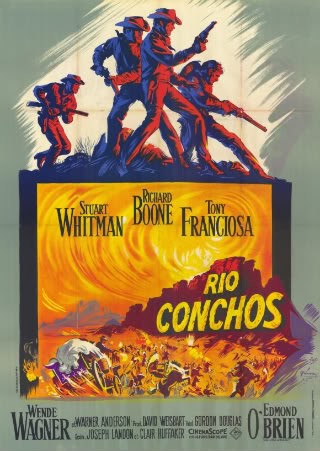
Rio Conchos

poster293

I’ve always enjoyed looking at the way the western evolved over the years. There’s a, fairly common, misconception that the spaghetti western just kind of exploded onto the scene in a genre busting blaze of immorality and violence. However, that’s a superficial reading of things; the foundations were being laid a decade before and the progression isn’t that hard to follow. Anyway, the consensus seems to hold that the spaghettis gave the traditional western a much needed jolt to shake it out of the doldrums it was in danger of slipping into. That’s hard to argue with, but I’m not sure the Hollywood western wasn’t heading in more or less the same direction of its own accord regardless of outside pressure. When you look at some examples of genre pieces from the mid-60s there are already indications of their straddling the two, seemingly irreconcilable, eras. Rio Conchos (1964) makes for interesting viewing in this context, having the trappings and look of the traditional oater but displaying an attitude and sensibility closer to the emerging European westerns.

At the heart of Rio Conchos lies revenge – there’s essentially no nobility on show, nor very much in the way of finer feelings of any kind. The main character is Lassiter (Richard Boone), a former confederate Major who’s almost totally consumed with a killing rage sparked by the torture and murder of his wife and child by the Apache. This man hunts down and disposes of his enemy with a ruthless precision. The opening shots are of Lassiter calmly massacring an Apache burial party, before heading back to the ruins of his former home to get drunk amid the personal and physical devastation. He would appear content to spend the remainder of his existence extracting his pound of flesh every time the opportunity arose. But that’s not to be, as he finds himself coerced into participating in an army plan to recover a shipment of stolen rifles thought to be over the border in Mexico and soon to be sold to an eager Apache warlord, Bloodshirt (Rodolfo Acosta). Lassiter’s motivation, apart from a desire to get out of the army guardhouse, is the chance to even his personal score with Bloodshirt and he has no particular sympathy for the two cavalrymen, Captain Haven (Stuart Whitman) and Sergeant Franklyn (Jim Brown), that he’s guiding. Haven’s on a mission of vengeance too, being the man in charge of the original arms shipment that’s gone missing. His quest may be dressed up in the guise of duty, but there’s no hiding the fact that he too is seeking some form of recompense for the slight to his reputation. The party is completed by a Mexican rogue, Rodriguez (Tony Franciosa), whose involvement is quite simple: he’s out to avoid the hangman’s rope and hopefully line his pockets in the process. In the more traditional scenario, this ill-assorted group bound together by a common objective would include at least one member driven by some higher moral sense. Not in this case though; all (with the possible exception of the cipher-like Franklyn) are pandering to their own base instincts. Everything builds towards a surreal climax on the banks of the titular river, where a demented Colonel (Edmond O’Brien) twisted by the bitterness of defeat in the Civil War plots merciless retribution for his conquerors.

£27

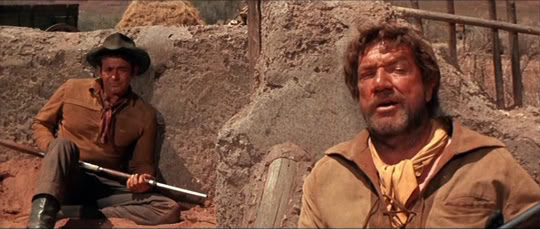
Director Gordon Douglas made a lot of so-so films but he had it in him to produce something of real quality when the conditions were right. Rio Conchos is among his best movies (and Only the Valiant is another little dark gem tucked away in his filmography) due largely to the tough and cynical script and an uncompromising performance by Richard Boone. To Douglas’ credit, the action scenes are extremely well staged and, along with cameraman Joe MacDonald, he really makes the most of the rugged Utah locations. Still, it’s Boone that carries it all along, playing a mere shell of a man subsisting on hatred and bitterness. His craggy, lived-in features were ideal for westerns, from his iconic Paladin in TV’s Have Gun – Will Travel to a couple of memorable appearances as the villain in two John Wayne pictures, to name just a few. I’ve seen it written that his performance is a bit one note, but I don’t think that’s being entirely fair. One sequence in particular has him showing two vastly different sides to his character within minutes. I’m referring to the scene where the travellers come upon a burned out house containing what one assumes is a tortured and/or violated woman, moaning in agony on her deathbed, while her infant lies neglected in a cot alongside. We can see a series of emotions playing across Boone’s face, but the predominant one is a deep hurt as the terrible vision obviously brings back memories of the fate of his own wife and child. As he puts the woman out of her misery he is close to breaking down totally, the mask of toughness slipping momentarily in the now deserted room. When the raiding party returns to harry the trapped men though, Boone reverts to type almost instantaneously. There is something terrible in his primal joy, the gales of malicious laughter he expels when watching a downed Apache burning to death before his eyes. It could be argued that Lassiter undergoes a change of heart as the quest progresses, seeing that the army mission has some worth in itself that supersedes his own desire for vengeance. Again, I don’t read it that way. The confrontation with Rodriguez seems to me not so much a realization that there are higher issues at stake but more a necessary way of ensuring that his own ambitions are not thwarted.

By the time the climax rolls round, the obsessive nature of Lassiter’s rage seems tame and reasonable when compared to the schemes of the deluded Colonel played by Edmond O’Brien. He only appears late on in the film but he makes a deep and lasting impression. At the outset, O’Brien’s character seems merely eccentric. However, when he opens the door to his reproduction plantation mansion and invites Lassiter to step inside the full extent of his madness is revealed. This castle in the desert is little more than a facade, a half-constructed monument to a world that’s passed away yet he struts around like he’s entertaining company back in Virginia. O’Brien wisely tones down the histrionics and lets his words and outlandish surroundings convey the imbalance of his mind instead. The ending, though it might be termed abrupt and somewhat inconclusive, is a wonderful exercise in nihilism. It’s this, rather than the violent tone of the movie, that persuades me that the Hollywood western was already moving in the direction of the spaghettis. The classic era of the Hollywood western told stories that invariably held out the promise of redemption for one or more of the lead characters. What sets the likes of Rio Conchos apart is the total lack of concern for any kind spiritual salvation. In the end, nobody really triumphs and no higher purpose is achieved – none of the characters, whether living or dead by this point, have advanced much from the stage they were at when we saw them initially.

The German DVD of Rio Conchos from Koch Media treats the film very well. There’s a strong anamorphic scope transfer with rich colours, especially evident in the red clay of the locations. There is no damage worth mentioning present on the print used and detail is again strong. The English soundtrack (with subs that are removable via the main menu) is a nice stereo mix that does justice to the frequent heavy gunshots, and also to Jerry Goldsmith’s powerful, driving score. The disc is nicely packaged in an attractive digibook format with notes (in German) and supplements the trailer and gallery that are provided as extras. The film may not qualify as one of the true greats of the genre, but it’s still a high quality production that marks an important stage in the evolution of the western. If you haven’t seen it, I strongly recommend seeking it out.


Gun for a Coward

poster292

The western is arguably the most masculine genre around, celebrating toughness and highlighting the virtues of honour, pride, independence and courage. As such, it’s ideally suited to the exploration and analysis of what we consider manhood to be. The 1950s, with the predominance of what’s referred to as the psychological western, mined this theme extensively. Gun for a Coward (1957) attempts to nail down the essence of what makes a man and how his courage, or lack of it, defines him. I say “attempts” because I’m not sure it succeeds entirely in what it sets out to do, settling for the easy option at the end and not quite satisfying as a result.

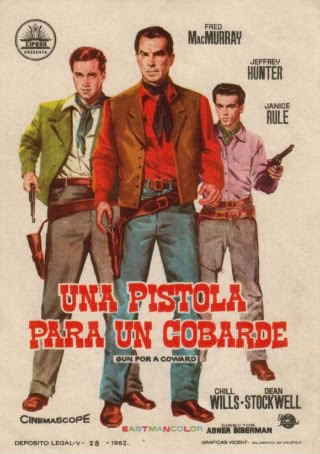
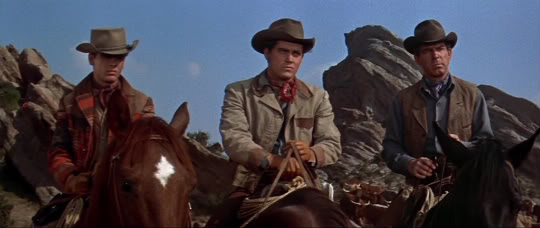
The story centres around the Keough family, their struggle to build up a ranch and the dynamic between three very different brothers. Since the death of their father the paternal role has been adopted by Will (Fred MacMurray), the eldest of the three and a man who’s seen youth pass him by as the burdens of being the head of the family took priority. Still, he’s a man who’s held onto his dreams and hopes to marry the daughter of a neighbouring rancher now that financial success is within his grasp. Of the two other siblings, Hade (Dean Stockwell) is the youngest and the most aggressively reckless. In the middle, and at the heart of the story itself, is Bless (Jeffrey Hunter), the most sensitive of the trio and their mother’s favourite. Bless is the son who’s character is closest to that of his mother; he’s cautious, passive and non-confrontational. The thing is, these are not the traits that garner respect in the rough and tumble world of the west. Bless has earned a reputation as a physical coward, a man who will always back down rather than meet things head on. Later, we learn that the roots of this lie in the past and relate to the fate of his father – although I’m not sure the explanation we get really stands up to a great deal of scrutiny. Matters come to a head during a cattle drive to Abilene, when a series of events all combine to expose Bless to one physical and moral challenge after another. The upshot is that all those around: friends and workers, the other Keough brothers and, most crucially, Bless himself come to question what kind of man he really is. The resolution, when it comes around, conveniently affirms Bless’ physical bravery, but I don’t believe that was ever in serious doubt in the first place. While the perceptions of others may have branded Bless as one who was afraid to go head to head with another in a physical confrontation, the viewer is aware that his evasiveness is based more on a kind of innate knowledge that such grandstanding is ultimately futile. The real issue is Bless’ moral cowardice: his sidestepping a showdown with his mother when she is bent on moving east to take him away from the dangers and hardships of life on the frontier; his failure to do the right thing by the girl he loves; and, related to the previous, his inability to lay the facts on the table with Will. All of these matters are resolved at one point or another, though Bless never really picks up the reins and forces things himself.

£26

Actor-turned-director Abner Biberman worked mostly in television and I think it’s fair to say his handling of his directorial duties on Gun for a Coward are unspectacular. I don’t mean to say that his work is bad, just that it’s fairly anonymous. He knew how to compose a shot and shoot an action scene, yet there’s nothing especially memorable about any of it. What raises this movie up, and it is a good movie, is the script and the acting. The writing is layered and has a great deal of depth (even if it’s not as fully explored as it could be), slotting itself comfortably into place among the many examinations of human complexity that the decade’s western has to offer. Fred MacMurray, as was the case with a number of aging stars, drifted into the western in the 50s and found a degree of success there. He plays the stable, rock-like character, the voice of reason and the point of reference for the viewer. While he may have been a little old for the role of Will (especially when it’s borne in mind that Josephine Hutchinson, as his mother, was only something like five years older) the part does call for a degree of maturity, and MacMurray also had a knack for conveying the necessary quality of quietly wounded dignity. Dean Stockwell’s young hothead is something of a caricature and there’s more than a hint of a James Dean impersonation in there. The honours really belong to Jeffrey Hunter though, who managed to get inside the skin of Bless and create a completely believable figure. Hunter could project a certain vulnerability when called upon to do so, and in Bless he becomes that man who is aware of his own weaknesses and, consequently, has come to question his stature within both his family and the wider community. Of the supporting players I want to single out Chill Wills, not just for his part in this movie but for his all round contribution to the genre. His was one of those immediately recognizable faces and voices that seemed to turn up in every other western, and invariably enriched the viewing experience.

Gun for a Coward is now available from a number of sources on DVD – a US MOD disc, and reportedly less than satisfactory editions in France and Spain. However, when I saw that it was out on pressed disc in Australia from a company called Visual Entertainment Group (who seem to have licensed a number of Universal and Fox titles) I thought I’d give it a go. I have to say that this R4 release presents the film very nicely – it’s a strong anamorphic scope transfer that’s clean and consistent. The only weak section I noticed was a brief insert that appears during the drive to Abilene, and since that looks a lot like a piece of stock footage it’s not really the fault of the DVD presentation. The disc is very basic with no extras whatsoever. Still, the movie itself is presented handsomely, and the cover pleasingly reproduces the original poster art. All in all, I’d rate Gun for a Coward as a respectable entry among the westerns of the 1950s. When you bear in mind that the decade in question is practically bursting at the seams with classics of the genre I don’t think I’m being mean in my assessment. I certainly recommend checking this one out.


The Naked Spur

Anthony Mann and James Stewart – one of the three great director/actor partnerships (the others, of course, being John Ford and John Wayne and Budd Boetticher and Randolph Scott) that made such an impact on the western and how it was to develop. The importance and the legacy of their collaborative body of work is undeniable; I think it’s safe to say there’s consensus on that. A thornier issue, or at least a more subjective one, is attempting to settle on their best work. When it comes to Stewart and Mann I reckon a case could be made for any one of their westerns – although I do feel that The Far Country is probably the least of them – which is a testament to the consistency of their quality. However, having given it a good deal of consideration, I feel The Naked Spur (1953) just about gets its nose in front. There are two major, interdependent, factors for this: the obsessive and relentless tone that never lets up, and a lead performance by Stewart that I can only describe as magnetic in its intensity.

That this is going to be a dark and tense affair is evident right away as Bronislau Kaper’s moody score plays over the blood red credits. A solitary rider slowly dismounts and ever so cautiously picks his way towards some target he’s spotted up ahead. This is Howard Kemp (James Stewart), a man who’s been doggedly pursuing a wanted murderer all the way from Kansas. On this occasion he doesn’t have his man, it’s merely an old prospector, Tate (Millard Mitchell), he’s stumbled upon. However, the two men strike a bargain to track what may be Kemp’s quarry. Before they can run down their man though they’re joined by another traveller: a flashy young man, Lt Anderson (Ralph Meeker), who’s just been drummed out of the army with a dishonourable discharge. Immediately, the viewer is caught a little off guard as there’s no clearly identifiable hero figure: Kemp is a driven, secretive man who’s exhibiting signs of instability; Anderson is a vain, amoral criminal; and Tate is a sly opportunist. When we finally see the fugitive, Ben Vandergroat (Robert Ryan), he’s all smiles and affability, and he’s even got a beautiful young girl called Lina Patch (Janet Leigh) as company. Who are we to root for here? As the story progresses it does become clearer where our sympathies are being drawn. Nevertheless, at no point does it become a simple black hat vs white hat exercise. Apart from one short skirmish with a party of faceless Blackfeet, it’s these five, disparate characters who dominate proceedings as they trek across a breathtakingly beautiful landscape towards Kansas. The real conflict of the picture is contained within this tight group, and more specifically within the heart of Howard Kemp.

Anthony Mann’s direction is tight as a drum, never slackening the pace for more than a moment or two at a time and maintaining the high pressure atmosphere right to the end. He keeps the viewer on edge throughout with a bombardment of disorienting high and low angle shots and extreme close-ups, yet intersperses these with enough long range views to ensure that the geography of the action remains apparent. Even here though, where William C Mellor’s camera showcases the natural beauty of Colorado, the binding together of the five travellers is highlighted – simultaneously dwarfed by the towering mountain backdrops and still hemmed in by their need keep each other as close as possible at all times. There are also examples of what Jim Kitses refers to as Mann’s visual motif of a man straining to scale a high place. Kemp is the one who struggles, and fails initially, to reach that higher ground. By the end he succeeds, he’s no longer overreaching himself and consequently achieves the redemption he’s been searching for all along.

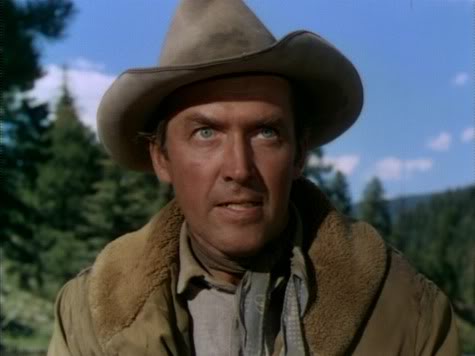
It’s the redemptive quest that marks The Naked Spur out as a genuine classic western, but what ensures its successful execution is the power of James Stewart’s performance. Stewart’s wartime experiences gave him a quality that’s very difficult to define but very easy to discern. He could still draw on and display the old geniality of his earlier years, yet there’s an edge there too. His eyes could suddenly fill up with doubt and paranoia, and that “aw shucks” drawl could just as easily strangle itself into a choked stammer. Both Anthony Mann and Alfred Hitchcock got him to tap into this and coaxed performances from him that are almost painful in their honesty. Stewart’s Howard Kemp is a real three dimensional character, a man who marched off to war to do his duty yet finds that in so doing he has ended up at war with himself. He’s driving himself to reverse the mistakes of the past while also loathing the kind of man he’s forced himself to become in the process. In contrast, Robert Ryan’s Vandergroat is a man at peace with himself; he knows he’s no good, he feels no regret for his past actions, and has no hesitation in turning any situation to his own advantage. Ryan was usually best when he was bad, and in this movie he turns on the charm as the unscrupulous student of human weakness to whom manipulation is second nature.

It’s always disappointing when a top movie is handed a less than ideal presentation. The R1 DVD of The Naked Spur from Warner Bros is not a terrible transfer, but it is weak. Clearly, there was no restoration done on this title, and while there isn’t any significant print damage visible there is a softness and lack of detail in the image. These muted visuals are especially noticeable in the long shots. Extras on the disc are confined to a couple of shorts and the theatrical trailer. Anyway, I feel this film remains the pick of the Mann/Stewart westerns, although that’s not to be taken as a criticism of the other films they made together. I’d just place it at the top of an already highly elevated group of films.

The Ox-Bow Incident

poster48

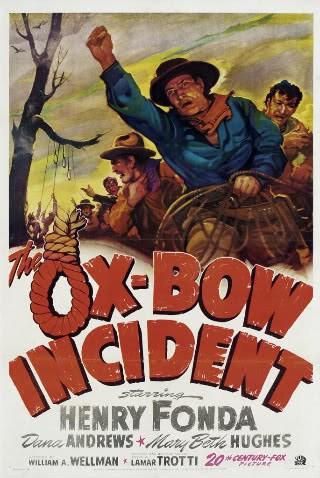
The western is genre that often gets a raw deal in the image stakes. And it’s not just a matter of waning box-office popularity in recent times. It’s rarely afforded the respect that other genres seem to court so easily and instead finds itself weighed down by the notion that it’s somehow unsophisticated. The term oater is applied, I’ve used it myself, in an affectionate way, yet it carries a certain air of condescension when you stop and think about it too. I guess the stereotype of uncouth figures riding horses, firing guns and chasing Indians is such a strong one that it’s managed to sideline the genre in the minds of many people. The paradox is that the western is actually one of the richest forms of cinema around. Leaving aside the frequently breathtaking visuals, the setting offers the opportunity to tell an almost unlimited range of stories and explore as many themes as it’s possible to imagine. The vast geographical expanses and the absence (or at best the bare rudiments) of civilization create a kind of nearly blank canvas onto which a skilled filmmaker can paint, with both bold and subtle strokes, whatever he likes. William Wellman was certainly highly skilled and his westerns are never less than interesting, and usually challenging too. The Ox-Bow Incident (1943) is a powerful and memorable piece of work that stays with you and is one of those films that proves the western is capable of being not only an entertainment but an intellectual stimulant as well.

The plot is a simple one and it’s that lack of complexity in the storytelling that’s one of its greatest strengths. The film has a moral point to impart and too much narrative trickery would only be a distraction and water down the central message. Events begin to unfold in a little backwater settlement where the neighbouring ranchers have been struggling with the perennial problem of cattle rustling. When a youngster comes racing into town to breathlessly announce that one of their own has been apparently murdered and his livestock taken a tragic chain reaction is set in motion. The jaded and bitter populace experience disbelief and outrage and are teetering on the edge, poised to ride out and hunt down like animals the alleged killers of their friend. For a brief moment, it looks like reason and decency may prevail as the aged storekeeper Davies (Harry Davenport) appeals to their better nature. But this is not to be – ex-soldier Tetley (Frank Conroy) soon turns the townsfolk back to their base instincts, and a rag-tag posse is formed. Not wanting to draw the ire of the town upon themselves, two cowboys, Gil Carter (Henry Fonda) and Art Croft (Harry Morgan), reluctantly join the eager hunting party. It’s not long before the posse cut the trail of three men (Dana Andrews, Anthony Quinn and Francis Ford) who seem to fit the bill of the murderers. From this point on the movie becomes a kind of ethical struggle between the ineffectual Davies and the implacable Tetley for the souls of the posse members, with the fate of the three captives hanging in the balance.

£17

The Ox-Bow Incident is based on the novel of the same name by Walt Van Tilburg Clark and, although it’s been quite a few years since I read the book, I recall it as being a pretty faithful adaptation. Wellman’s direction captures the heavy, moody and ultimately tragic tone of the novel very well. There aren’t many true exterior scenes, most of the film seeming to have been shot on sets, and this (along with the high contrast photography) helps to pile on the sense of claustrophobia and doom. While the outcome is fairly predictable, the director still maintains the tension and, crucially, that isn’t lost even with repeated viewings. In fairness, a lot of that comes down to the performances too; Dana Andrews, as the leader of the suspected murderers, was billed below Henry Fonda but his work plays a large part in the success of the movie. His initial disbelief and growing desperation at the nightmare situation he finds himself in is built steadily. He did a fine job of conveying an awkward mix of fear and nobility that positively demands the sympathy of the viewer. In a sense, Fonda plays something of a supporting role in this one, only taking centre stage at a few points. Perhaps his best moment is in the saloon at the end when he reads Andrews’ letter to his illiterate friend. The letter itself is a powerful and emotive one that expertly outlines the author’s twinned concepts of justice and conscience. Fonda’s delivery of the words, as Wellman shot him in extreme close-up – partly obscured at first and then full face – is perfectly timed and enunciated to maximise their impact. However, for long stretches, he’s portraying the confused man in the middle, caught between the opposing ideals of Tetley and Davies. It’s this conflict that’s at the heart of the picture: how reasonable and civilized men can be browbeaten into submission, how the cult of personality can sway the masses and turn them into an unthinking mob, bereft of ethics and robbed of conscience. It’s both an indictment of the failings of the law – the sheriff has left town, the judge is a procrastinator, and the deputy is little more than a barbarian – and a warning that that same law is all we have to prevent our descent into inhumanity.

The R1 DVD of The Ox-Bow Incident from Fox is an excellent presentation of the film; there’s hardly any damage to be seen, the detail level is fine, and the crisp image has the kind of strong contrast necessary for this type of movie. There’s also a fine selection of extras: a commentary track by William Wellman Jr and Dick Eulain, a biography of Fonda, and a gallery  of images. This title is due for a Blu-ray release by Koch Media in Germany in August. Seeing as the extras are to be replicated it’s reasonable to expect that the same film elements will be used, therefore a first class transfer should be on the cards. As I said in the intro, The Ox-Bow Incident is a good example of a thinking man’s western, yet for all that, it never loses sight of the fact that it has to entertain and grip the viewer too. A superb film.


Ulzana’s Raid

poster242

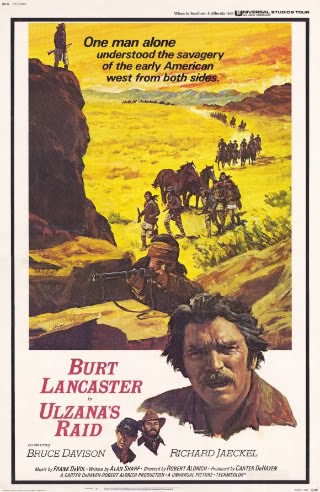
By the 1970s revisionism had hit the western in a big way; it had started the previous decade of course, but the social upheval of the period brought it fully to the fore in those last painful days of the Vietnam War. Conflict and domestic unrest have a way of drawing a nation’s gaze inward and it’s hardly surprising that the most iconic cultural markers are the ones upon which attention is most strongly fixed. Such was the case with the western, that most readily identifiable symbol of America’s heritage, and the brutal campaigns against the Indians provided a rich background to use as a parallel for a contemporary war. Ulzana’s Raid (1972) is frequently cited as an allegory for US involvement in South East Asia, and it’s hard to argue with that – inexperienced soldiers battling a largely faceless foe in hostile and unforgiving territory, exposing strengths and weaknesses, prejudices and virtues in the process.

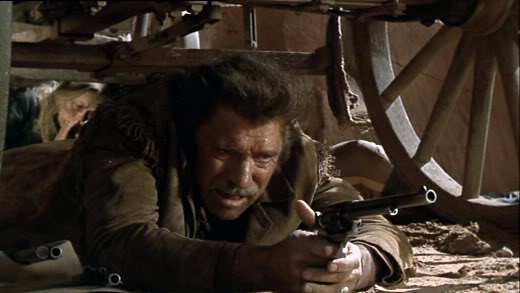
The tale concerns the breakout by a band of Apache led by Ulzana (Joaquin Martinez) from the reservation, and their subsequent rampage across Arizona. In response, the army sends out a detachment under the command of a green officer, Lieutenant DeBuin (Bruce Davison), with orders to capture or kill the fugitives. DeBuin is to be aided in his task by two scouts, an Apache, Ke-Ni-Tay (Jorge Luke), and a white veteran, McIntosh (Burt Lancaster). DeBuin’s initial approach, fuelled by the fact that his father is a clergyman, is an almost evangelical one, wherein he views the Apache as a misguided and misunderstood people who need to be coaxed back to the bosom of white civilisation. The scouts, McIntosh in particular, have no illusions on this score though – to them the runaway Apache are no aspiring white men who have strayed from the flock, they are a dangerous and cunning enemy worthy of both fear and respect. As DeBuin’s troop follow Ulzana’s blood-soaked trail, encountering one horrific atrocity after another, the young lieutenant sees his faith in the essential goodness of humanity challenged. His reactions range from shock, leading him to question a bemused Ke-Ni-Tay about the motivation for such cruelty, to a kind of outraged vindictiveness as he demands his Apache scout bury the mutilated remains of yet another butchered settler. Throughout all this McIntosh remains dryly philosophical, guiding his young charge as best he can and providing the voice of reason when hate and revenge threaten to displace logical action. What we end up with is an examination of white America’s attempts to come to terms with an adversary whose psychology and beliefs are so alien and incomprehensible that they defy conventional means of tackling them. In the end, it’s only by worming his way into Ulzana’s thought processes that McIntosh is able map out a way to defeat him, although the ultimate irony is that it’s another Apache, and not all the might and firepower of the army, that finally brings closure.

£23

I think Ulzana’s Raid might just be Robert Aldrich’s best movie, blending action and harsh visuals perfectly. The cruel and pitiless Arizona and Nevada landscapes are a fitting backdrop for the brutal events that play out on the screen. There’s barely an interior shot in the whole picture, the bulk of it taking place amid the dust, rocks and canyons. Where he was a little coy about trumpeting his politics in earlier works here he indulges in a kind of liberal realism that never patronises or descends into sentiment. There’s clearly sympathy for the deprivation that has driven Ulzana and his band off the reservation in search of the spiritual power they crave, but at no point does Aldrich allow the Apache to be seen as the kind of dippy mystics that is the stuff of caricature. He never shies away from depicting the merciless nature of Ulzana and his men, but nor does he seek to cover it up in politically correct excuses – to paraphrase both McIntosh and Ke-Ni-Tay, the Apache are what they are and that’s how it’s always been. The main focus though is on how the young lieutenant and his men cope with the reality of fighting an enemy that they can neither seem to catch nor even understand. Bruce Davison had suitably innocent and freshly-scrubbed features to portray a man about to have all his high-minded illusions shattered. He matures nicely as the story progresses and McIntosh’s wisdom gradually sinks in. As the grizzled old scout, Lancaster dominates the movie with his wry observations helping to ground it all. He displays a sense of fatalism that befits a man whose years of living on the frontier have exposed him to the brutal nature of men in general. Richard Jaeckel also deserves a mention for his sergeant who’s been through the wars and learnt that while officers need to be obeyed and respected their judgement is not always to be trusted.

Universal’s UK DVD of Ulzana’s Raid presents the film at about 1.78:1 anamorphic. The disc contains no extra features at all, but the movie itself looks very handsome with good detail, sharpness and colour. I should mention that the UK version has a number of mandatory BBFC cuts for horsefalls – these don’t amount to much in terms of time but they do result in slightly jarring editing when they occur. As far as I know, the continental European versions do not have any of those cuts present. As I said, this is probably Aldrich’s best work and it makes for a western that’s both intelligent and engrossing. It casts a cool eye on the old west that refreshingly avoids being either judgemental or romantic – the viewer is expected to be enough of an adult to make up his or her own mind without being led by the nose. Highly recommended.


Nevada Smith

poster246

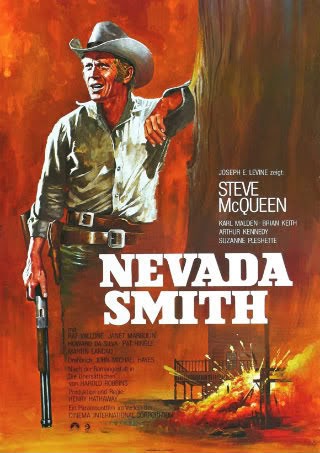
The theme of revenge has always been one of the staples of the western genre and, despite a slightly bloated running time, Nevada Smith (1966) is a fairly standard example of this. Perhaps one of the most interesting aspects of the movie is its focus on a mixed race protagonist. However, while this lends a different slant to the usual quest for vengeance, the casting dilutes it a little and it’s easy to forget the whole racial angle for extended periods, except when the characters on screen make explicit reference to it.

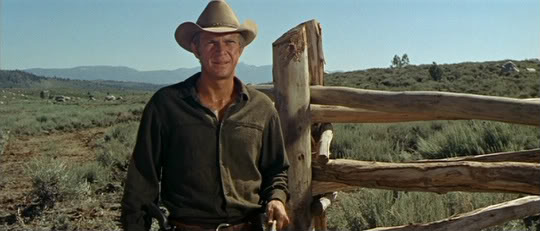
Max Sand (Steve McQueen) is the half-breed son of a white man and a Kiowa woman, and the story opens with him innocently directing three men (Karl Malden, Arthur Kennedy and Martin Landau) who claim acquaintance with his father to the family home. These men aren’t paying any friendly call though and Max realizes this sobering fact too late. By the time he makes his way back home the men have fled, but there’s a horrifying sight left behind for Max to find. In a vain attempt to extort money the father has been cut, burned and shot to death, while the mother has been skinned alive. Mercifully, none of this is shown on screen but the reactions of Max and his subsequent burning to the ground of his home and all that it contains still add up to a powerful scene. With his whole world literally reduced to ashes, he sets out to track down the torturers of his family and kill them. If the casting of McQueen as a half-breed is a bit of a stretch then it’s even less credible to see him as a callow youth with no real world experience. Still, that’s how we’re supposed to take it, and his green foolishness almost ends his quest before he’s even got properly started. It’s his chance encounter with a travelling arms dealer, Jonas Cord (Brian Keith), that turns things around for him. Cord takes the young man under his wing, teaching him the rudiments of gunfighting and giving him some basic education. From here on, the film is divided into three distinct sections, each focusing on how Max (he only adopts the Nevada Smith alias in the final segment) locates his man and goes about his reprisals. The first and third sequences work best, the former for its brevity and the latter for its tension. The middle of the movie (the part dealing with Arthur Kennedy’s comeuppance) is much more problematic though. The way it’s set up – Max having himself jailed to get close to his victim – strains believability in the first place. But the real problem is the way it goes on too long and virtually turns into a separate movie within the main narrative. It slows things down terminally and results in the entire production having a disjointed feel. Such is the draining effect of this sequence that the superior final part has some of its impact lessened by the time we get round to it.

£22

Nevada Smith is a prequel to The Carpetbaggers, a movie I’ve never seen so I can’t comment on whether it holds up in terms of continuity. Henry Hathaway can usually be counted on to deliver tight, economical movies that rarely outstay their welcome. However, with a filmography as long and varied as his there will inevitably be some that turn out better than others. In this case, I think Hathaway suffered from the episodic nature of the script he had to work with. The narrative ends up bolted together rather than flowing seamlessly from one situation to another. As I already said, the mid section is where it stumbles and the impetus is lost. In fairness, this part does serve to illustrate the development and progression of McQueen’s character. The thing is it’s not actually a weak section on its own; the problem, for me at least, is that it doesn’t quite gel with either the tone or pace of what precedes and follows. Of course Hathaway is aided enormously by having Lucien Ballard shooting the picture for him, the outdoor scenes in particular being beautifully rendered. The miscasting of McQueen is especially noticeable when you consider his age – he was in his mid-thirties, and looked it, and was being asked to play the part of someone at least fifteen years younger. The only saving grace lay in the fact that McQueen had the ability to project a kind of childlike innocence when he wanted. While this cannot entirely paper over the incongruity, it does go some way towards compensating for a major weakness. Karl Malden, Arthur Kennedy and Martin Landau were a fine trio of villains, and there’s a good deal of satisfaction to be derived from seeing them get what’s coming to them. Malden easily has the best role and he does a good job of portraying a man descending into terrified paranoia as a result of the relentless pursuit by his faceless nemesis. The only female role of any substance was handed to Suzanne Pleshette, as the girl who falls for McQueen and aids him in his escape from the swamp ringed prison, and she manages to be both sexy and tragic.

Back when Paramount were still in the business of issuing catalogue titles on DVD it was rare to come across a poor transfer. Nevada Smith is no exception in that respect, the anamorphic scope image on the R1 disc being strong, detailed and colourful. It’s a totally barebones affair though with no extras whatsoever. So, to recap, we have a fairly standard western tale of revenge – and the ultimate futility of it all – that’s reasonably satisfying. Apart from the odd central casting, I feel the movie could have been improved a good deal by a bit of judicious editing to strip away some of the flab in the script. Still, the end product is entertaining enough and I’d give it a qualified recommendation.


Man in the Shadow


vfsg98e

Another modern western, and another message film. Man in the Shadow (1957) treads a similar path to Bad Day at Black Rock by having a lone individual take a stand against a racially motivated murder. The main difference is that this time the hero is not an outsider who’s swooped down on an alien world seeking justice. In this movie our protagonist is a familiar face in his small community but whose sense of personal and professional honour bring him into direct conflict with with those he’s known all his life.

Ben Sadler (Jeff Chandler) is the sheriff of a sleepy western town. The routine and mundane nature of his job is highlighted early on when he opens up the cells to release the town drunk who’s been sleeping off a heavy one. He hands him a stern warning, which we know is really only for show, and then bids the old timer good day. That’s the kind of town we’re in – one where crime is generally confined to manageable, petty affairs that tend not to represent a major threat to the community. Within moments however, a much more serious matter is to be laid before Sadler, one which is not only reprehensible in itself but also, as a result of what any investigation will entail, poses a threat to the finances and, by extension, the very viability of this small backwater. Sitting huddled and almost forgotten in the office is an old Mexican with a story to tell that’s about to present the sheriff with a moral and professional dilemma. The old man has witnessed the murder of a young friend by two cowboys at a nearby ranch. He doesn’t really expect anyone to take his tale seriously, partly because of his lowly immigrant status and partly due to the identity of his employer. Virgil Renchler (Orson Welles) is a big man, both physically and financially, and his ranch is the life blood of the town. Without the patronage of his sprawling ranch the businesses would quickly wither and even the railroad stop might fall into disuse. Sadler is aware of the clout wielded by Renchler but, unlike his slovenly and skulking deputy, he’s also conscious of his duties as the representative of the law. So, it’s with some reluctance that he gives his word to the old man and begins to tentatively look into the allegations. Renchler, though, is a throwback to the old cattle barons, a man whose self-sufficiency and power has led him to believe in his own infallibility. When he tells Sadler that he has no business asking questions of him and dismisses the killing as nothing more than an insignificance, the sheriff’s indignation is aroused. Thus we have one of those perennial western themes, the clash between the laws of civilization and the moneyed big shots who see themselves as being above such naive concerns. The thing is though that Sadler isn’t merely up against a powerful rancher, the influence and fear that Renchler inspires in the country is such that virtually the entire population of the town turns against their lawman. Sadler’s only allies are Renchler’s disgruntled daughter, Skippy (Colleen Miller), and the Italian immigrant barber – not exactly a pair of heavy hitters. Still, in spite of the enmity of his former friends, an attempt on his life and a public humiliation, Sadler presses ahead with the investigation that nobody wants.

£14

Although the racism implicit in the murder is acknowledged and explored, that’s not the real issue of the movie. The primary concern is the corrupting influence of business and how entire communities can be effectively blackmailed into abandoning their awareness of right and wrong for the sake of financial gain. While this moral issue remains at the forefront throughout, Jack Arnold’s direction ensures that it’s conveyed dramatically rather than by means of noble speeches and the like. The pace is brisk and the development direct so there’s not much room for complex characterisation; we know where we stand as regards the principals right from the beginning and that doesn’t change much by the close. Welles does manage to elicit some slight sympathy as the man whose blustering independence has painted himself into a corner. That’s one of the things about Welles as an actor – even when he played villains it was hard not to feel a little for him. He does lay it on a little thick at times, but complaining about Welles’ tendency to ham it up is akin to decrying John Wayne for his machismo – it’s part of the package and you know that when you go in. Jeff Chandler is pretty good too as the isolated sheriff who knows full well that he’s probably biting off more than he can chew, but whose own personal code precludes his backing down. The main weakness lies in the script, not that it’s poorly executed but that it’s themes are too familiar. There’s nothing especially new or groundbreaking in the plot and although it’s carried off professionally there is a certain unavoidable staleness to it all.

Man in the Shadow is available on DVD from a number of sources: from Germany, France and a recent DVD-R from Universal in the US. I have the German release from Koch Media and it’s a very nice presentation. The movie is in anamorphic scope with very crisp black and white images and obviously came from a clean, strong print. There are no forced subtitles on the English track and there are some attractive extras too. Apart from the trailer and gallery, there’s a 14 minute interview with Jack Arnold where he talks about his memories of working within the studio system and the changes in filmmaking he observed down the years. The movie is an entertaining and pacy one that has a point to make. I found the performances and direction all up to scratch, and the only problem was the lack of originality in the story. Still, it’s not a bad way to spend an hour and a quarter or so – and anything that involves Orson Welles’ participation has to be considered worthwhile.