Ulzana’s Raid

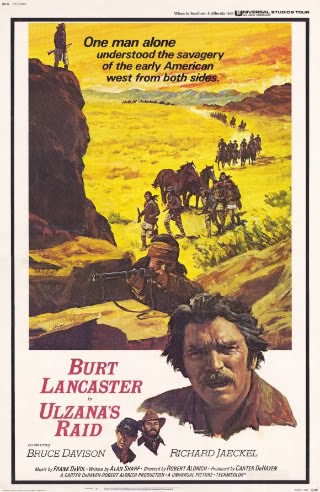
poster242

By the 1970s revisionism had hit the western in a big way; it had started the previous decade of course, but the social upheval of the period brought it fully to the fore in those last painful days of the Vietnam War. Conflict and domestic unrest have a way of drawing a nation’s gaze inward and it’s hardly surprising that the most iconic cultural markers are the ones upon which attention is most strongly fixed. Such was the case with the western, that most readily identifiable symbol of America’s heritage, and the brutal campaigns against the Indians provided a rich background to use as a parallel for a contemporary war. Ulzana’s Raid (1972) is frequently cited as an allegory for US involvement in South East Asia, and it’s hard to argue with that – inexperienced soldiers battling a largely faceless foe in hostile and unforgiving territory, exposing strengths and weaknesses, prejudices and virtues in the process.

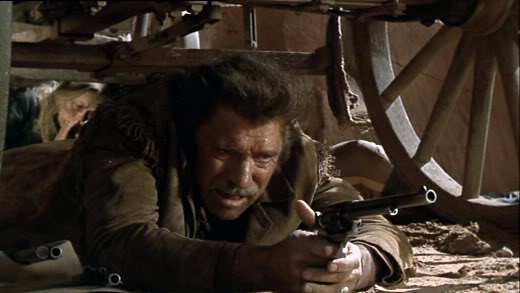
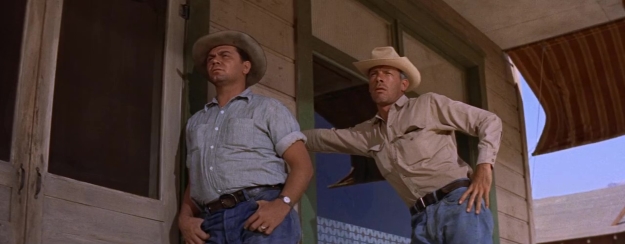
The tale concerns the breakout by a band of Apache led by Ulzana (Joaquin Martinez) from the reservation, and their subsequent rampage across Arizona. In response, the army sends out a detachment under the command of a green officer, Lieutenant DeBuin (Bruce Davison), with orders to capture or kill the fugitives. DeBuin is to be aided in his task by two scouts, an Apache, Ke-Ni-Tay (Jorge Luke), and a white veteran, McIntosh (Burt Lancaster). DeBuin’s initial approach, fuelled by the fact that his father is a clergyman, is an almost evangelical one, wherein he views the Apache as a misguided and misunderstood people who need to be coaxed back to the bosom of white civilisation. The scouts, McIntosh in particular, have no illusions on this score though – to them the runaway Apache are no aspiring white men who have strayed from the flock, they are a dangerous and cunning enemy worthy of both fear and respect. As DeBuin’s troop follow Ulzana’s blood-soaked trail, encountering one horrific atrocity after another, the young lieutenant sees his faith in the essential goodness of humanity challenged. His reactions range from shock, leading him to question a bemused Ke-Ni-Tay about the motivation for such cruelty, to a kind of outraged vindictiveness as he demands his Apache scout bury the mutilated remains of yet another butchered settler. Throughout all this McIntosh remains dryly philosophical, guiding his young charge as best he can and providing the voice of reason when hate and revenge threaten to displace logical action. What we end up with is an examination of white America’s attempts to come to terms with an adversary whose psychology and beliefs are so alien and incomprehensible that they defy conventional means of tackling them. In the end, it’s only by worming his way into Ulzana’s thought processes that McIntosh is able map out a way to defeat him, although the ultimate irony is that it’s another Apache, and not all the might and firepower of the army, that finally brings closure.

£23

I think Ulzana’s Raid might just be Robert Aldrich’s best movie, blending action and harsh visuals perfectly. The cruel and pitiless Arizona and Nevada landscapes are a fitting backdrop for the brutal events that play out on the screen. There’s barely an interior shot in the whole picture, the bulk of it taking place amid the dust, rocks and canyons. Where he was a little coy about trumpeting his politics in earlier works here he indulges in a kind of liberal realism that never patronises or descends into sentiment. There’s clearly sympathy for the deprivation that has driven Ulzana and his band off the reservation in search of the spiritual power they crave, but at no point does Aldrich allow the Apache to be seen as the kind of dippy mystics that is the stuff of caricature. He never shies away from depicting the merciless nature of Ulzana and his men, but nor does he seek to cover it up in politically correct excuses – to paraphrase both McIntosh and Ke-Ni-Tay, the Apache are what they are and that’s how it’s always been. The main focus though is on how the young lieutenant and his men cope with the reality of fighting an enemy that they can neither seem to catch nor even understand. Bruce Davison had suitably innocent and freshly-scrubbed features to portray a man about to have all his high-minded illusions shattered. He matures nicely as the story progresses and McIntosh’s wisdom gradually sinks in. As the grizzled old scout, Lancaster dominates the movie with his wry observations helping to ground it all. He displays a sense of fatalism that befits a man whose years of living on the frontier have exposed him to the brutal nature of men in general. Richard Jaeckel also deserves a mention for his sergeant who’s been through the wars and learnt that while officers need to be obeyed and respected their judgement is not always to be trusted.

Universal’s UK DVD of Ulzana’s Raid presents the film at about 1.78:1 anamorphic. The disc contains no extra features at all, but the movie itself looks very handsome with good detail, sharpness and colour. I should mention that the UK version has a number of mandatory BBFC cuts for horsefalls – these don’t amount to much in terms of time but they do result in slightly jarring editing when they occur. As far as I know, the continental European versions do not have any of those cuts present. As I said, this is probably Aldrich’s best work and it makes for a western that’s both intelligent and engrossing. It casts a cool eye on the old west that refreshingly avoids being either judgemental or romantic – the viewer is expected to be enough of an adult to make up his or her own mind without being led by the nose. Highly recommended.


Nevada Smith

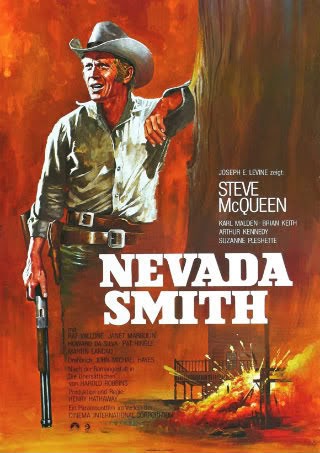
poster246

The theme of revenge has always been one of the staples of the western genre and, despite a slightly bloated running time, Nevada Smith (1966) is a fairly standard example of this. Perhaps one of the most interesting aspects of the movie is its focus on a mixed race protagonist. However, while this lends a different slant to the usual quest for vengeance, the casting dilutes it a little and it’s easy to forget the whole racial angle for extended periods, except when the characters on screen make explicit reference to it.

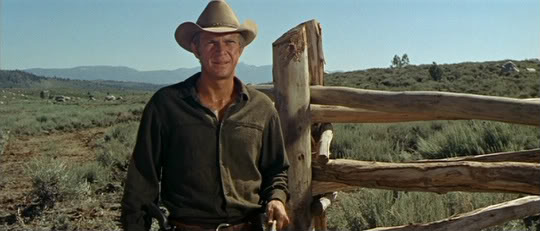
Max Sand (Steve McQueen) is the half-breed son of a white man and a Kiowa woman, and the story opens with him innocently directing three men (Karl Malden, Arthur Kennedy and Martin Landau) who claim acquaintance with his father to the family home. These men aren’t paying any friendly call though and Max realizes this sobering fact too late. By the time he makes his way back home the men have fled, but there’s a horrifying sight left behind for Max to find. In a vain attempt to extort money the father has been cut, burned and shot to death, while the mother has been skinned alive. Mercifully, none of this is shown on screen but the reactions of Max and his subsequent burning to the ground of his home and all that it contains still add up to a powerful scene. With his whole world literally reduced to ashes, he sets out to track down the torturers of his family and kill them. If the casting of McQueen as a half-breed is a bit of a stretch then it’s even less credible to see him as a callow youth with no real world experience. Still, that’s how we’re supposed to take it, and his green foolishness almost ends his quest before he’s even got properly started. It’s his chance encounter with a travelling arms dealer, Jonas Cord (Brian Keith), that turns things around for him. Cord takes the young man under his wing, teaching him the rudiments of gunfighting and giving him some basic education. From here on, the film is divided into three distinct sections, each focusing on how Max (he only adopts the Nevada Smith alias in the final segment) locates his man and goes about his reprisals. The first and third sequences work best, the former for its brevity and the latter for its tension. The middle of the movie (the part dealing with Arthur Kennedy’s comeuppance) is much more problematic though. The way it’s set up – Max having himself jailed to get close to his victim – strains believability in the first place. But the real problem is the way it goes on too long and virtually turns into a separate movie within the main narrative. It slows things down terminally and results in the entire production having a disjointed feel. Such is the draining effect of this sequence that the superior final part has some of its impact lessened by the time we get round to it.

£22

Nevada Smith is a prequel to The Carpetbaggers, a movie I’ve never seen so I can’t comment on whether it holds up in terms of continuity. Henry Hathaway can usually be counted on to deliver tight, economical movies that rarely outstay their welcome. However, with a filmography as long and varied as his there will inevitably be some that turn out better than others. In this case, I think Hathaway suffered from the episodic nature of the script he had to work with. The narrative ends up bolted together rather than flowing seamlessly from one situation to another. As I already said, the mid section is where it stumbles and the impetus is lost. In fairness, this part does serve to illustrate the development and progression of McQueen’s character. The thing is it’s not actually a weak section on its own; the problem, for me at least, is that it doesn’t quite gel with either the tone or pace of what precedes and follows. Of course Hathaway is aided enormously by having Lucien Ballard shooting the picture for him, the outdoor scenes in particular being beautifully rendered. The miscasting of McQueen is especially noticeable when you consider his age – he was in his mid-thirties, and looked it, and was being asked to play the part of someone at least fifteen years younger. The only saving grace lay in the fact that McQueen had the ability to project a kind of childlike innocence when he wanted. While this cannot entirely paper over the incongruity, it does go some way towards compensating for a major weakness. Karl Malden, Arthur Kennedy and Martin Landau were a fine trio of villains, and there’s a good deal of satisfaction to be derived from seeing them get what’s coming to them. Malden easily has the best role and he does a good job of portraying a man descending into terrified paranoia as a result of the relentless pursuit by his faceless nemesis. The only female role of any substance was handed to Suzanne Pleshette, as the girl who falls for McQueen and aids him in his escape from the swamp ringed prison, and she manages to be both sexy and tragic.

Back when Paramount were still in the business of issuing catalogue titles on DVD it was rare to come across a poor transfer. Nevada Smith is no exception in that respect, the anamorphic scope image on the R1 disc being strong, detailed and colourful. It’s a totally barebones affair though with no extras whatsoever. So, to recap, we have a fairly standard western tale of revenge – and the ultimate futility of it all – that’s reasonably satisfying. Apart from the odd central casting, I feel the movie could have been improved a good deal by a bit of judicious editing to strip away some of the flab in the script. Still, the end product is entertaining enough and I’d give it a qualified recommendation.


Man in the Shadow


vfsg98e

Another modern western, and another message film. Man in the Shadow (1957) treads a similar path to Bad Day at Black Rock by having a lone individual take a stand against a racially motivated murder. The main difference is that this time the hero is not an outsider who’s swooped down on an alien world seeking justice. In this movie our protagonist is a familiar face in his small community but whose sense of personal and professional honour bring him into direct conflict with with those he’s known all his life.

Ben Sadler (Jeff Chandler) is the sheriff of a sleepy western town. The routine and mundane nature of his job is highlighted early on when he opens up the cells to release the town drunk who’s been sleeping off a heavy one. He hands him a stern warning, which we know is really only for show, and then bids the old timer good day. That’s the kind of town we’re in – one where crime is generally confined to manageable, petty affairs that tend not to represent a major threat to the community. Within moments however, a much more serious matter is to be laid before Sadler, one which is not only reprehensible in itself but also, as a result of what any investigation will entail, poses a threat to the finances and, by extension, the very viability of this small backwater. Sitting huddled and almost forgotten in the office is an old Mexican with a story to tell that’s about to present the sheriff with a moral and professional dilemma. The old man has witnessed the murder of a young friend by two cowboys at a nearby ranch. He doesn’t really expect anyone to take his tale seriously, partly because of his lowly immigrant status and partly due to the identity of his employer. Virgil Renchler (Orson Welles) is a big man, both physically and financially, and his ranch is the life blood of the town. Without the patronage of his sprawling ranch the businesses would quickly wither and even the railroad stop might fall into disuse. Sadler is aware of the clout wielded by Renchler but, unlike his slovenly and skulking deputy, he’s also conscious of his duties as the representative of the law. So, it’s with some reluctance that he gives his word to the old man and begins to tentatively look into the allegations. Renchler, though, is a throwback to the old cattle barons, a man whose self-sufficiency and power has led him to believe in his own infallibility. When he tells Sadler that he has no business asking questions of him and dismisses the killing as nothing more than an insignificance, the sheriff’s indignation is aroused. Thus we have one of those perennial western themes, the clash between the laws of civilization and the moneyed big shots who see themselves as being above such naive concerns. The thing is though that Sadler isn’t merely up against a powerful rancher, the influence and fear that Renchler inspires in the country is such that virtually the entire population of the town turns against their lawman. Sadler’s only allies are Renchler’s disgruntled daughter, Skippy (Colleen Miller), and the Italian immigrant barber – not exactly a pair of heavy hitters. Still, in spite of the enmity of his former friends, an attempt on his life and a public humiliation, Sadler presses ahead with the investigation that nobody wants.

£14

Although the racism implicit in the murder is acknowledged and explored, that’s not the real issue of the movie. The primary concern is the corrupting influence of business and how entire communities can be effectively blackmailed into abandoning their awareness of right and wrong for the sake of financial gain. While this moral issue remains at the forefront throughout, Jack Arnold’s direction ensures that it’s conveyed dramatically rather than by means of noble speeches and the like. The pace is brisk and the development direct so there’s not much room for complex characterisation; we know where we stand as regards the principals right from the beginning and that doesn’t change much by the close. Welles does manage to elicit some slight sympathy as the man whose blustering independence has painted himself into a corner. That’s one of the things about Welles as an actor – even when he played villains it was hard not to feel a little for him. He does lay it on a little thick at times, but complaining about Welles’ tendency to ham it up is akin to decrying John Wayne for his machismo – it’s part of the package and you know that when you go in. Jeff Chandler is pretty good too as the isolated sheriff who knows full well that he’s probably biting off more than he can chew, but whose own personal code precludes his backing down. The main weakness lies in the script, not that it’s poorly executed but that it’s themes are too familiar. There’s nothing especially new or groundbreaking in the plot and although it’s carried off professionally there is a certain unavoidable staleness to it all.

Man in the Shadow is available on DVD from a number of sources: from Germany, France and a recent DVD-R from Universal in the US. I have the German release from Koch Media and it’s a very nice presentation. The movie is in anamorphic scope with very crisp black and white images and obviously came from a clean, strong print. There are no forced subtitles on the English track and there are some attractive extras too. Apart from the trailer and gallery, there’s a 14 minute interview with Jack Arnold where he talks about his memories of working within the studio system and the changes in filmmaking he observed down the years. The movie is an entertaining and pacy one that has a point to make. I found the performances and direction all up to scratch, and the only problem was the lack of originality in the story. Still, it’s not a bad way to spend an hour and a quarter or so – and anything that involves Orson Welles’ participation has to be considered worthwhile.


Bad Day at Black Rock

Bad Day at Black Rock (1955) is what’s termed a modern western. Of course, from a strictly purist point of view, the western really ought to take place within a narrow time period and location. This film is certainly set in the correct location – the arid southwest – but the events take place not in the late nineteenth century, but immediately after the end of WWII. Still, even if the trappings belong to a later era, the basic themes of the classic western are present: a simple tale of good vs evil wherein a lone, righteous figure grapples with the hostility of both the environment and his fellow men. Despite the apparently straightforward nature of the plot, the film is a powerful one that tackles at least two major themes; one of which is very obviously presented, the other is less explicit and takes something of a back seat but it’s there all the same.

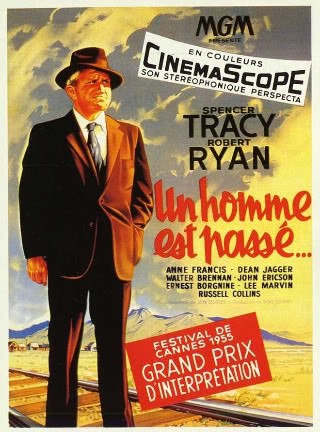
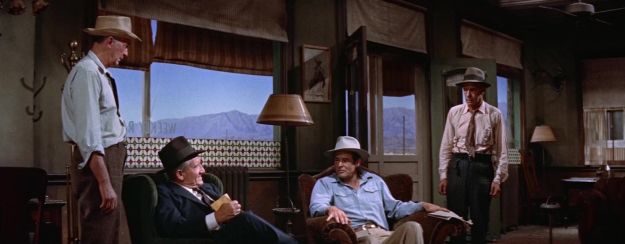
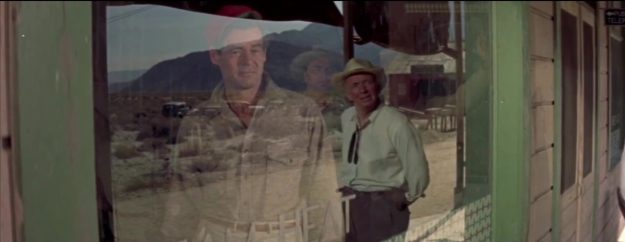
The opening is aggressive and dramatic, with a mean-looking black engine, hauling blood red carriages, hurtling through the desert to the accompaniment of Andre Previn’s ominous score. As this impressive and relentless juggernaut grinds to a halt outside the tiny, desolate town of Black Rock, it’s as clear to the viewer as it is to the awestruck locals (the train hasn’t stopped there in four years) that something important is about to happen. The figure that alights is an incongruous one, a middle-aged man with a stiff arm, clad in an austere, black business suit. He could be a businessman, a government man, a gangster – what he’s not is local. This man is John J Macreedy (Spencer Tracy), and the reactions provoked by his unexpected arrival progress from incredulity to suspicion and finally open hostility. Everybody he encounters is consumed with curiosity regarding his errand in their midst. However, this is not the normal sense of wonder that would occur in any small, isolated community when its members are confronted with the presence of a stranger. There’s fear in the air, fear of the man and what he might discover. As Macreedy finds himself repeatedly stonewalled when requesting even the most basic kind of assistance, he’s also on the receiving end of questions from the locals. But these questions have an edge, they’re of the cagey variety where the asker doesn’t really want to know the answer. What all this means is that fear has a companion in Black Rock – guilt. A great sin has been committed in this community and Macreedy has descended upon the residents like some instrument of judgement or retribution. It’s soon made apparent exactly what has happened, a Japanese farmer has died in mysterious circumstances, and who bears the responsibility. Reno Smith (Robert Ryan) is the big man around town, and the one Macreedy must deal with. Perhaps more important than the violent climax is the verbal face-off between these two men outside the gas station. This scene highlights the two principal themes in the movie: the first is the ugly matter of racism, the second is the nature of the west itself. Of the two, I find the latter more interesting, mainly because it’s approached in a much more subtle manner. When Smith points out that suspicion of the unfamiliar is just a natural throwback to the old days, Macreedy observes that he always thought the old west was characterised by hospitality. And there’s the point, that the myth of the old west was subverted through time into the kind of small-minded defensiveness represented by Black Rock. To Smith, this new west has been neglected and forgotten, of interest only to academics or businessmen seeking a quick buck. Although it’s never explicitly stated, the inference is that the responsibility for the death of an innocent Japanese doesn’t rest merely on the shoulders of the bunch of ignorant rednecks who dealt the final blow. The suggestion is that these people have been bypassed by progress (the train that never stops) and abandoned to their own prejudices – an embarrassing by-product of the apathy in wider society.

This is another of John Sturges’ tightly-paced, economical works, stripped down to the basics and direct. From the moment the train thunders into view at the beginning, until the circle is completed eighty minutes later with the same locomotive making another rare stop at Black Rock, the pace never slackens. Additionally, Sturges’s camera uses the wide lens to excellent effect, the dearth of close-ups serves to keep the characters at a distance and accentuates the isolation of both them and the setting. Despite the high proportion of outdoor shots, there’s still a claustrophobic atmosphere about the whole thing. It’s as though the frontier has shrunk and this western drama is played out within the stifling confines of a town that has ceased to look outwards and has turned its gaze in upon itself. The only time a sense of space is apparent is during the credits sequence, and when Macreedy drives out to the ruins of the Japanese property – the railroad and a murdered foreigner representing the openness that was once the mark of the west. Besides the visuals, this is also a film of words, and although it’s dialogue heavy there’s a snap and colour to the lines that make them instantly memorable. I’ve seen some criticism of Andre Previn’s score, citing its intrusiveness, but I feel that the urgent, driving quality of the music is the ideal accompaniment for the threatening uncertainty that unfolds on screen.

Spencer Tracy’s naturalistic style of acting was greatly admired at one time, but the rise of the method saw it fall out of favour and opinions are likely to remain divided to this day. Personally, I like it; there’s always the feeling that you’re watching a real person reacting in much the same way you might do yourself to the circumstances. The passage of time, and drinking, weathered his features and the bristling aggression that he displayed as a younger man gave way to middle-aged gravitas. Tracy could be seen as the face of moral America, not in a narrow, disapproving or prudish sense, rather the slightly imperfect conscience of everyman. As such, he was ideally cast as John J Macreedy – a man who’s trying to do one last decent thing before bowing out of life. There’s a certain ambiguity about what he means by that of course, I’ve seen it claimed that the character had been contemplating taking his own life until the challenge of exposing the rotten little secret of Black Rock reawakened his appetite. I’ve also come across the suggestion that Macreedy could be taken for a supernatural figure, the fact that Smith’s detective can find no evidence of his existence is the reasoning behind this. It’s an interesting idea, reinforcing the notion of his being the embodiment of a higher justice, but I’m not convinced that it’s actually the case.

As Macreedy’s chief opponent, Robert Ryan represents a kind of distorted reflection – another craggy individual, but one whose motives are far from admirable. If Tracy stands for the kind of fundamentally right man we’d like to be, then Ryan is the total antithesis; a bullying, bigoted braggart who’s become twisted by his own inadequacy and a country that has rejected him on every level. Reno Smith is a man to be both pitied and despised in equal measure, and Ryan nailed that quality. Caught somewhere in the middle, like most ordinary people I suppose, are the supporting players: Walter Brennan’s Doc (I feel for you, but I’m consumed with apathy) and Dean Jagger’s sheriff might be jaded but still retain some ethical sense, while Lee Marvin and Ernest Borgnine are suitably menacing as the loutish sidekicks interested only in doing their master’s bidding. The latter pair refer to themselves as cowboys but there’s no sign anywhere of any ranching taking place – Black Rock isn’t so much a one horse town as a no horse town.

The R1 DVD from Warner Brothers has Bad Day at Black Rock looking great. The anamorphic scope transfer is clean and crisp, and the colours are rich and strong. The extras are a commentary track by Dana Polan and the trailer for the movie – it’s not what you’d call a stacked edition but there’s no reason for complaint either. The film is a very strong effort from John Sturges, both entertainingly tense and thought provoking. He did some of his best work through the 50s and this is right up near the top – a definite and easy recommendation.

Vera Cruz

poster243

Reputations are a strange thing. They tend to wax and wane as the allegiances of critics shift over time and fashions change. Some directors have seen their stock rise dramatically while others have toppled from once lofty positions. There are those though who never seem to be celebrated excessively nor wholly forgotten, they simply exist in that shadowy periphery where both praise and criticism are always heavily qualified. One such man is Robert Aldrich, a director who made some memorable and stylish films yet continues to be granted only a kind of grudging respect. Vera Cruz (1954) was one of his early efforts and has traditionally been viewed as a good action picture, but that’s about it. It’s also been cited as the inspiration for the following decade’s spaghetti westerns, and I fully agree with that assertion. I see it as occupying an odd place among the westerns of the 50s; it doesn’t probe dark psychology like an Anthony Mann film, and it has none of the sparse leanness of Boetticher’s work. Instead it leaps over all of this and presents, or maybe even glorifies, the kind of amoral characters who would come to populate the western from the mid-60s onwards.

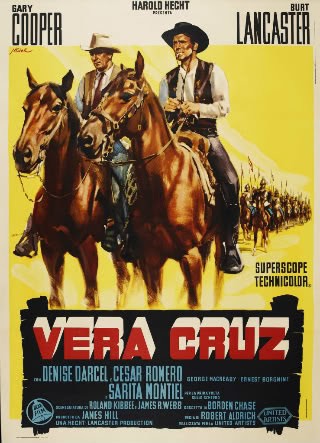
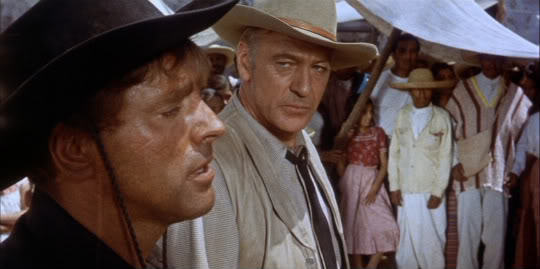
The story takes place in 1866, during the Franco-Mexican war, when the followers of Juarez were struggling to wrest control of their country back from those forces loyal to the puppet Emperor Maximilian. The focus is on two Americans who, as the prologue informs us, are among those who have drifted across the border after the Civil War to sell their services to the highest bidder. These men are Ben Trane (Gary Cooper), a southern gentleman ruined by the war and Joe Erin (Burt Lancaster), a reckless adventurer and a stranger to the notion of ethics. The early scenes where Erin sells Trane another man’s stolen horse set the tone for the rest of the picture, where double-crosses, lies, betrayals and greed come thick and fast from every side and no one seems to spare a thought for anybody but himself. When it looks as though Maximilian’s people offer the better chance for profit, both men throw in their lot with them. This sets up a nice sequence at the Imperial palace as Erin’s men show themselves up for the uncouth, rag-tag bunch they are. Of course, the aristocrats that they casually offend and outrage are seen to be no better, displaying no qualms whatsoever as they calmly scheme to dispose of their new employees as soon as their purpose is served. The purpose in question is to escort, and ensure the safe passage of, a French Countess (Denise Darcel) and her coach from Mexico City to the port of Vera Cruz. Finally, it would seem that there’s some honour to be seen. After all, risking one’s neck to ensure a woman is able to travel unmolested through treacherous country infested with Juarista rebels on the rampage is not an unworthy enterprise. However, at no point in this story is anything really as it appears on the surface. The whole mission is nothing but a blind on the part of the monarchists to smuggle a shipment of $3 million in gold out of Mexico to buy military aid and , by extension, some time for the crumbling regime. Naturally, everyone wants the money for themselves – Erin, the Countess, Trane and even the Juaristas in order to further their political aims. The fact is that of all those eyeing the fortune, the only one (barring the Juarista general) who has even a shred of decency motivating them is Trane. He sees the money – or at least as much of it as he can bargain for – as a means of restoring his devastated plantation and those who have grown dependent on it. After a succession of ambushes, broken promises and a desperate assault on the Emperor’s forces, everything comes down to a simple duel between two very different men in a dusty Mexican courtyard.

£20

As I said earlier, I’d have to agree with those who claim that Vera Cruz is a major influence on the spaghetti western. In fact, it’s a virtual template for the flood of Euro westerns that hit cinemas within ten years. The south of the border setting is the first thing that comes to mind, and when you factor in the strife torn political background the parallels become more apparent. The difference of course is that in Aldrich’s movie the politics really only forms a backdrop to facilitate the narrative without impacting directly on it. The film isn’t making any particular ideological point, except perhaps that greed overrides everything and corrupts everyone, but concentrates on entertainment albeit with a cynical twist. The main characters, Erin and Trane, profess to have no interest in anything beyond money when they start out. However, as the story progresses, Trane does exhibit something approaching a conscience. Both Cooper and Lancaster’s roles can be viewed as a blueprint for the upcoming anti-heroes from Europe. In a way, the Italians ended up presenting a kind of hybrid of these two men; a mercenary figure who hasn’t abandoned himself totally to amorality, a taciturn man with a personal code of honour (Cooper) who retains a sort of capricious flamboyance (Lancaster). It’s Lancaster’s grinning, black-clad rogue who has the greatest impact, but Cooper’s steadiness plays a significant part in keeping the film balanced. For all Lancaster’s scene stealing bravado, Cooper still holds the attention – his little grimaces at key points have a great understated quality to them. As for Aldrich’s direction, his handling of the action scenes is exemplary. The climactic assault is a well executed sequence that’s perfectly paced with just enough establishing shots to ensure the geography remains clear throughout. Aside from the big set pieces, he uses the wide screen well and mixes up the long, medium and close shots to good effect. He also throws in a variety of angles, and the final duel between Trane and Erin is yet another example of the film’s influence on the likes of Leone. While the lingering, operatic quality is missing, the basic iconography that would become so familiar is certainly present in the angles and the cutting.

Vera Cruz was shot in 2:1 Superscope and the UK DVD from MGM retains that ratio. The anamorphic transfer is a reasonable one, colours are strong and there’s no serious damage to the print. The only extra provided is the theatrical trailer. The film is due out on BD this coming June and it’s the kind of production that ought to benefit from the upgraded picture quality. As a movie, it’s not exactly a typical 50s western; in tone, it almost bears comparison to a 60s WWII extravaganza – big, brash, colourful and noisy. While it may not have the depth of the best from its decade, it is still an influential piece of work. Moreover, it offers an hour and a half of first class entertainment. I like it a lot and think both the film and its director deserve some renewed attention.


The Secret of Convict Lake

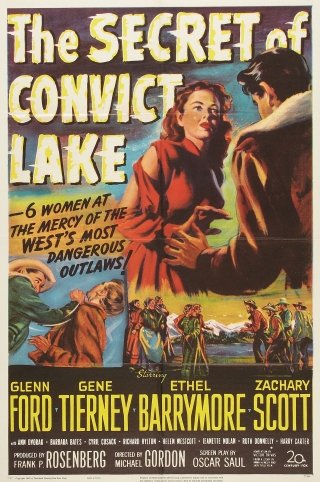
One of the joys of collecting and watching movies is that, from time to time, you chance upon a little neglected gem. Sure, there are the disappointments too but that’s more than balanced out by the buzz of seeing something previously unknown for the first time and liking it. The Secret of Convict Lake (1951) was a movie I’d never heard of before I acquired it. Anyway, I thought I’d give it a go for a number of reasons: the cast was great, the title was evocative, and the cover looked quite cool. Having seen it now, I have no regrets about this particular purchase and it’s a film I can see myself revisiting. It’s a compact little western with noirish undertones and good performances all round.

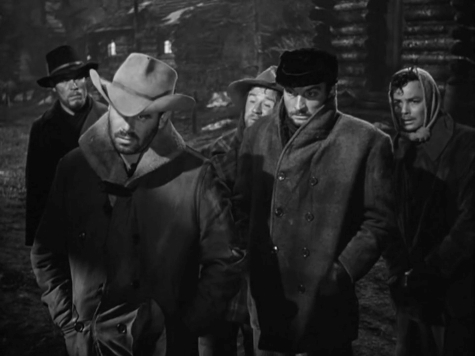
Any western involving snow inevitably gets the thumbs up from me, and this one opens with a group of men fighting their way through a white, mountainous landscape. The voiceover informs us that we’re looking at six convicts (soon to be five as one freezes to death) who have broken out of prison and are trying to keep ahead of the pursuing posse. When a blizzard forces the hunters to abandon the chase, the remaining fugitives find themselves on a ridge overlooking a small settlement. After the hellish trek the collection of small dwellings with soft lights spilling from them look very inviting. A quick reconnaissance reveals that the only inhabitants are women, their men having yet to return from prospecting. Right away the conflict at the centre of the picture is before us: a bunch of frozen and half-starved criminals fresh out of prison are confronted with a community of frontier-hardened females who aren’t shy of guns but nor are they without compassion. An uneasy compromise is struck whereby the convicts are to be fed and lodged long enough to allow them to regain enough strength to continue on their way, but they must keep to their assigned quarters. The women are dominated by a trio of well-defined stock characters: Granny (Ethel Barrymore) is the tough old matriarch, Rachel (Ann Dvorak) a spinster who hears the clock ticking louder every day, and Marcia (Gene Tierney) an outsider with a questionable past who’s engaged to Rachel’s brother. The balance of power among the fugitives rests uneasily between Canfield (Glenn Ford) and Greer (Zachary Scott), with the latter counting on the greed of the others to bolster his position. The thing is that Canfield was convicted of robbery and murder, and the $40,000 he is said to have stolen has never been recovered. Greer wants that money badly but Canfield wants something else, the man whose perjury delivered him to the hangman. The rest of the convicts comprise a thug, a bragging Englishman and a mentally unstable young man with a penchant for killing women. Factor in the added complication that the man Canfield’s seeking happens to be Marcia’s betrothed and the situation bristles with explosive potential. The film’s hour and twenty minute running time packs in a powerful mix of sexual tension and the looming threat of violence before coming to a satisfying conclusion.

£8

The Secret of Convict Lake comes near the mid-point of director Michael Gordon’s career, one derailed by the blacklist. Until then he’d been making B programmers and a few noir pictures, the enforced break would be followed by a move to glossy Ross Hunter/Robert Arthur productions. While this isn’t a straight film noir Gordon’s direction, Leo Tover’s moody photography and Sol Kaplan’s doom laden score all combine to create a darkly atmospheric western. The casting of Ford, Tierney, Scott and perennial heavy Jack Lambert add to the noir feel of proceedings. Glenn Ford was able to play these kinds of uncomfortable outsiders with his eyes closed and Canfield is another in a long line of basically right guys who’ve been screwed over by circumstances. He’s a man who’s been brought face to face with death and has only his quest for justice or vengeance to keep him going. Zachary Scott, on the other hand, is all slime and self interest, prepared to use everyone to get what he wants. His calculating seduction of Ann Dvorak’s frustrated old maid is both creepy and (from her point of view) tragic. Gene Tierney’s natural beauty could never quite mask the demons struggling inside her, but that often worked in her favour on screen. Her Marcia is a similarly troubled soul, a woman with a past she desperately wants to leave behind and who is on the point of marrying a worthless man in order to try to make a fresh start. Canfield’s arrival and his subsequent revelations offer hope and despair in equal measure. Ethel Barrymore gives another variation on her wise old owl turn with a hint of that mischievous eccentricity peeping through – I always appreciate her presence in a movie. A word too for Cyril Cusack, not an actor you expect to see in a western, whose talkative cockney provides Canfield’s ruthless comrades with their most human and sympathetic face.

As far as I’m aware the only release of The Secret of Convict Lake on DVD at the time of writing is the Spanish disc from Fox/Impulso. The film hasn’t had any work done on it but, fortunately, for the most part the image is very strong. There are cue blips and some very minor damage but the elements are generally in good shape leading to a sharp picture with contrast levels that looked fine to me. The downside is that it appears to be interlaced, although I didn’t find that a huge problem to be honest. The mono soundtrack is clear and the Spanish subs are removable by deselecting them via the main menu. Extras are limited to text bios and a gallery. I found the film to be a very entertaining and tightly paced production. There are fine performances all round and, as I mentioned before, a welcome hint of film noir in the script, casting and direction. It’s a strong movie that really ought to be better known, and it gets my approval.

Young Guns II

Poster

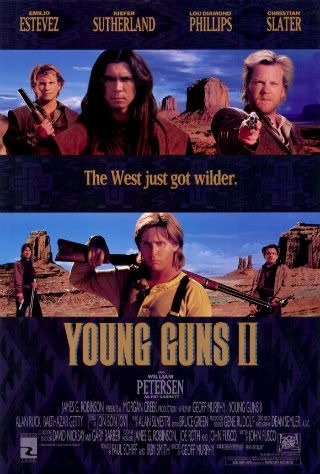
So I’ve come to the last entry in this short series. To be brutally honest, these last two movies have sapped my energy. If anything, I have to say that Young Guns II succeeds in being even more offensive and irritating than its predecessor. The performances are down to, or maybe even lower than, the standards set in the previous film and all semblance of accuracy is cheerfully chucked out the window. I actually reached the point where viewing this became a chore, and that’s a long way from what I regard as the purpose of the movie watching experience.

The story picks up where the first Young Guns left off – the end of the Lincoln County War. The Kid (Emilio Estevez) is now a wanted man by those seeking to put the violent past to bed and get down to the serious business of making money. Billy has taken up with Pat Garrett (William Petersen) and Dave Rudabaugh (Christian Slater) now that his old gang has broken up. However, the powerful men in the region, Lew Wallace and Chisum (James Coburn), want all those involved in the Lincoln County War rounded up and disposed of. To this end, Doc Scurlock (Kiefer Sutherland) is abducted and hauled back to New Mexico to face retribution. Chavez (Lou Diamond Phillips) is there too, biding his time in a pit in Lincoln. When the cocksure Kid sees a deal with Governor Wallace go sour, he takes it on himself to break his buddies out of stir in one of the noisiest and most ludicrous scenes in the film. There’s also a parting of the ways, with Garrett breaking away to find his own path. However, it’s not long before the former outlaw is recruited by Wallace and Chisum, appointed sheriff and tasked with running down his old friends. The rest of the movie plays out the familiar old story of The Kid running and Garrett chasing until both men meet up in Fort Sumner. The climax is supposed to be one of those ambiguous, did-he-or-didn’t-he, type things that folds into the framing prologue and coda. However, after sitting through an hour and a half plus of mindless gunplay and hopeless mugging it’s very hard to care one way or the other. In a way though, it’s somehow appropriate after serving up an unappetising blend of bad history that the film should end by wheeling out yet one more dubious slice of mythology.

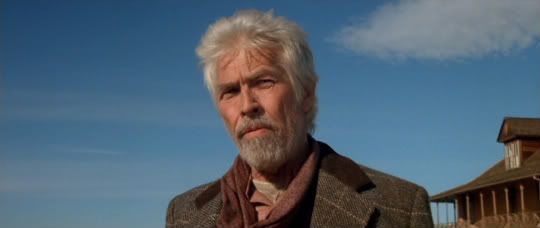
Showing how it should be done - James Coburn as Chisum in Young Guns II

I already listed all the shortcomings of the performances of Estevez, Sutherland and Phillips in my previous review, and I see no need to go over the same ground again here. I will say though that Estevez manages to be even more annoying this time round; his endless whooping and quipping has the effect of leaving the viewer longing for Garrett to put a bullet in him, and that’s surely not the point of any movie about his character. The addition of Slater, Balthazar Getty and Alan Ruck really brings nothing to proceedings, with Slater in particular proving himself in need of a good sound slapping. William Petersen comes off best in the role of Garrett, but even so he has a lightweight quality about him that’s painfully obvious in the scene where he gets himself hired as sheriff. Seeing him seated opposite James Coburn, who played the definitive version of the character, just brings home the deficiencies. While the acting is weak, the jarring soundtrack against which the action takes place is anachronistic and misguided enough to be a major distraction. A very poor effort all round.

One good thing that can be said is that the DVD transfer is fine. The Warners R2 disc presents the movie in anamorphic scope, and it’s clean, sharp and colourful. However, no matter how nice the image is the fact remains that Young Guns II is a turkey and I was relieved when the credits finally rolled.

This series has been something of a roller coaster in terms of quality and entertainment. The high point was most definitely Peckinpah’s Pat Garrett and Billy the Kid, with the two Young Guns features coming in last in every respect. One thing that has become apparent to me is how ill-defined the character of Billy the Kid is, with only Peckinpah’s film really fleshing him out at all. When I did pieces on the Jesse James and Wyatt Earp movies I noticed how much of an impression was generally made by the characters of Frank James and Doc Holliday respectively. The same could be said here; in nearly every movie it’s the figure of Pat Garrett who seems most memorable. I suppose this says something about the way historical figures are portrayed on film but I’m not quite sure what that is, except that it maybe underlines the difficulty of such an undertaking. Anyway, the project’s been a pleasure (mostly) and I hope it’s offered at least a little entertainment for anyone who has been following.

Young Guns

Poster

Such is the nature of this series of reviews that we go from the sublime to…well, Young Guns (1988). To be honest, it’s hard for me to find very many positive things to say about this one. It seems to be touted as the most historically accurate movie dealing with the life and times of Mr Bonney, but that’s really only in a superficial sense – events take place out of order, characters are missing or misrepresented, and people are shown to die in ways and at times they never did. But OK, it’s a film and you have to expect some of that. For me, the biggest problem is the poor acting of the “Brat Pack” stars. There’s nothing the least bit convincing about any of the central performances nor is there any real feel for time and place.

The plot deals with the events leading up to and during the Lincoln County War. It starts off with Billy (Emilio Estevez) being taken in by Tunstall (Terence Stamp) and his integration into the group of Regulators (of course they weren’t actually known as Regulators until after Tunstall’s death) that act as hired muscle. Now, there’s a problem here right away; the Regulators were, by all accounts, a bunch of tough gunmen who were ruthless by nature. What the movie presents us with, however, is a collection of soft looking post-adolescents being tutored by the kindly Tunstall. Mind you, this set up does allow the chief villain, Murphy (Jack Palance), to toss out a loaded line about Tunstall’s interest in “educating” young boys. There’s also an allusion made to the Old World grudges fuelling the rivalry – Murphy being an Irish immigrant and Tunstall a wealthy Englishman – but nothing further comes of that. Such bad feelings weren’t the source of the conflict, but it might have made for an interesting plot device if it had been explored in more depth – after all, the script doesn’t shy away from other departures from the truth. With the assassination of Tunstall, the story gets down to the serious business of depicting as many tit-for-tat killings as can be squeezed into the running time. This gives rise to another scripting issue; the action tears headlong from one manic and confused gunfight to the next, with characters popping up and being dispatched before you get a chance to even realise who they are. There’s never a sense that you’re getting to know anything of substance about the leads, except maybe Chavez (Lou Diamond Phillips) and Doc Scurlock (Kiefer Sutherland). And even then the results are nothing to write home about; the former plays out an embarrassingly bad scene where he explains his motivation, and the latter is handed a horribly tacked on romance in between his poetry writing sessions. So the plot charges its way towards the climactic Battle of Lincoln – one of the better staged sequences – before coming to a pretty dumb conclusion.

All guns blazing - Emilio Estevez as the Kid.

Essentially, this film is trying to pack too many events and people into its running time, leading to clutter and an unsatisfactory lack of development. As the Kid, Emilio Estevez comes across as a kind of giggling fool with no character progression whatsoever from the opening until the ending. I already mentioned the low point of Lou Diamond Phillips getting in touch with his angst, but his “mystic Indian” schtick all through the movie is both dull and cliched. I think Kiefer Sutherland probably fares better than any of the other young stars, though it has to be said that the attempts to portray Doc Scurlock as some kind of sensitive and bookish intellectual feel too much like an affectation. Also the romantic subplot involving the Asian girl really serves no purpose other than to show what a bad man Murphy is. In truth, that’s not even necessary as Jack Palance’s presence should be enough in itself. Sure the old-timer leers and hams it up, but even so he still blows the so-called stars away every time he appears. Which brings me to the only positive aspect of the picture, the older generation of actors who make appearances. Terence Stamp brings a touch of class to Tunstall and it’s a pity he wasn’t given more to do. Brian Keith, as Buckshot Roberts, only has one scene but it says something for the man that it’s so memorable. Even Pat Wayne’s little cameo as Pat Garrett stands out and helps illustrate the gulf in class between the nominal leads and their elders.

The R2 DVD from Lionsgate is acceptable but not particularly notable. The film is given an anamorphic transfer that looks a little soft to me. The only extras are the trailer and some filmographies. I saw Young Guns when it was first released, and I wasn’t very impressed at the time. If I hadn’t been doing this series then I don’t think I would have bothered to watch it again. It represents the kind of western that doesn’t appeal to me at all, telling you more about the time it was made than the time in which the action takes place. I’m afraid it’s not a film that I could recommend.

Pat Garrett and Billy the Kid

When I started this series of reviews about a month ago I mentioned that one of the reasons why I’d avoided doing it for a time was the variable quality of the films involved. Being aware that you’re going to have to sit through and then try to express your thoughts on movies that you already know are mediocre can be a little discouraging. What I didn’t mention, however, was the fact that the opposite is also true. When a film has a particularly strong critical reputation it’s equally daunting, though for different reasons of course. You instinctively wonder whether it’s possible to say anything that hasn’t been said before, and probably been said better. In the case of Pat Garrett and Billy the Kid (1973), Sam Peckinpah’s last western, I don’t promise to offer any startling insights but I do hope that I manage to at least express my own personal appreciation of this flawed masterpiece.

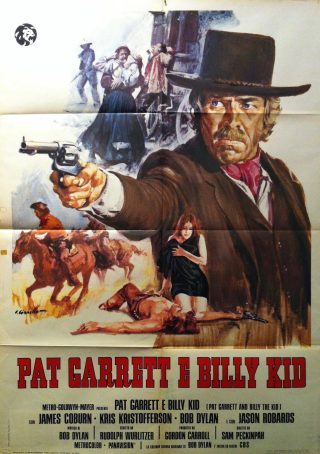
The film can, and I think should, be viewed as the death dream of Pat Garrett as he relives the defining events of his life, even as that life is slipping away. I ought to say right now that this view is dependent on the version of the film that’s watched – I’ll explain what I mean later, but for now I will simply say that it does have an impact on the way viewers approach the story. It’s 1909 and an aging and testy Garrett (James Coburn) is riding a wagon through New Mexico. His terse, snappish conversation with his companions is violently interrupted by the crack of a rifle shot. No sooner has the first bullet struck home than Garrett’s escort proceed to empty their own weapons into his mortally wounded body. As the old lawman tumbles towards the earth for the last time the scene is intercut with events of almost 30 years before, in 1881, when we see Billy the Kid (Kris Kristofferson) getting in a bit of target practice by shooting the heads off live chickens. What follows sets up the mood of the rest of the film and explains the motives for the characters subsequent actions. Garrett has sensed that the wind has changed and is pragmatic enough to know that he must go with it or be swept away. He’s thrown in his lot with a shadowy collection of big cattle men and business interests, and has been appointed sheriff. The Kid, on the other hand, resolutely refuses to bow to the march of progress and is bent on continuing as he’s always done. Garrett points out that part of his remit is to ensure the removal, by whatever means are deemed necessary, of the Kid from the territory. This is one of the few times both men share the screen until their final fateful meeting in Fort Sumner, but the movie charts the movements of both as circumstances inexorably draw them to their predetermined positions. That early scene in the cantina where Garrett and the Kid lay their cards on the table and both are aware that they will have to face off sooner or later is full of the melancholy that dominates the picture, and it’s pure Peckinpah. From this point the hunt is on. Garrett brings the Kid in after a bloody shootout at an isolated shack and has him locked up in Lincoln to await execution. This leads to a wonderfully realized sequence in the stark jail room where the Kid’s flippant disregard for authority (both earthly and divine) goads his manic, evangelical guard Ollinger (R G Armstrong) into taunting and threatening him – again depending on which version you watch there’s a killer line that may be missed. When the Kid effects his escape after blasting Ollinger apart with his own shotgun there’s a very human side of him revealed. He swaggers along the main street and orders up a horse to take him out of town. What he’s presented with is a wild animal that promptly bucks him clear and lands him square on his ass. Instead of avenging his bruised dignity on the old Mexican who embarrassed him by offering a horse he couldn’t ride, he simply smiles ruefully, steals another and rides coolly off as befits a legend.

In truth, the whole film could be viewed as a series of memorable scenes. That’s not to say, of course, that there’s a lack of narrative structure; the story follows a very definite line and draws to a completely natural conclusion. What I’m trying to say is that there are certain characteristics that mark it out as a western that transcends the run-of-the-mill and elevate it to something grander. A prime example is the segment with Slim Pickens and Katy Jurado – it moves things forward by showing how Garrett’s pursuit is progressing but that’s not really the point. If anything, like one of Ford’s grace notes, the scene exists for the sake of its own beauty and and poignancy. I’m not going to spoil things for anyone who has yet to see the movie but I will say that it’s gut wrenching stuff and I’ve still never been able to watch it without a lump in my throat. The characters grow and develop as we move along too, especially Garrett. His cynicism and self-loathing increase the closer he comes to his quarry and the further he moves from the man he once was. By the end of the movie he has sold himself completely and his disgust at what he has become is a painful thing to witness. It’s also interesting to compare the portrayal of Garrett’s principal backer, Chisum (Barry Sullivan), to the one John Wayne offered a few years before. This is no heroic defender of the common man, instead he’s a coldly dedicated businessman who feels no sentimental attachment to those who worked for him in the past. This Chisum regards Billy as nothing more than a liability, both financially and politically, who needs to be exterminated. Those hands in his employ are shown to be similarly heartless, and it’s surely clear to Garrett that he’s only being tolerated so long as he has a role to play in Chisum’s schemes. In contrast to Garrett, the character of the Kid undergoes less of a change, perhaps because he’s the one who clings more firmly to the old ways. He starts out grinning, nonchalant and oozing self-confidence, and meets his fate with that attitude virtually intact. However, for all his free spirited charm there’s a hard edge there too. The first time I saw the film I was slightly shocked at the outcome of the duel that the Kid and Alamosa Bill (Jack Elam) are unable to avoid. Having said that, I’ve grown to appreciate that little scene more and more for showing that shootouts in the old west were rarely the kind of honourable and noble standoffs that they’re traditionally portrayed as.

As I stated earlier, this was to be Peckinpah’s last western and it’s another of his ruminations on the passing of the old west and the dawn of the modern era. It was a troubled production, not least because of the director’s increasingly wayward behaviour, and the end product reflects that in the multiple cuts of the movie down the years. For all that though, it remains very much a Peckinpah film. It’s tempting to think that Sam saw something of himself in both the title characters: the Kid as the wild, anti-establishment figure that he encouraged others to see him as, and Garrett as the disillusioned independent trying to strike some kind of working balance between corporate interests and a free soul that was probably closer to the truth. As such, I think it’s Coburn’s performance as Garrett that drives the film and gives it much of its power. In terms of realism or accuracy he was too old for the part, but in terms of characterization he was perfect. He was of an age where you can easily understand a man’s need to seek out some form of security, that point when you realize that the recklessness of the past is no longer a viable option yet a part of you still yearns for it and rails against the advance of time and the compromises that are involved. Coburn’s lived-in features and grey hair help to get the point across, and the expressive eyes that could flash cold steel one minute and sardonic humour the next see that it strikes home. In contrast, Kristofferson plays the Kid as a devil may care adventurer, but one with a deep sense of fatalism. Even in that early scene in the cantina the twinkle in the eyes cannot disguise the fact that the Kid knows there and then, as surely as the grim faced Garrett does, that there can only be one outcome. Awareness is one thing of course, but the real fatalism is evident in the way the Kid only half-heartedly tries to elude his old friend. He heads for Mexico and safety but it’s clear enough that in so doing he’s hoping to find some excuse to return and play that one last card whatever the consequences. The supporting cast is something like a wish list of western character players and it’s another of the film’s great strengths. I don’t know how this works for those who come to the film without a familiarity with the genre, but for someone like myself it’s akin to meeting up again with a group of old acquaintances and simply revelling in their company. It would be impossible to go through all the people who drift in and out of the story and enrich it with their presence but, as I noted earlier, a special mention must be given to Slim Pickens and Katy Jurado who contribute to one of the finest moments in this picture, or any other for that matter. The only casting decision that doesn’t really work for me is the inclusion of Bob Dylan. I love the way his music blends in and complements the images on screen but his appearance as a character in the story is unnecessary in my opinion and is just too conspicuous.

The DVD release of Pat Garrett and Billy the Kid, not unlike the production itself, has become a source of controversy. Ever since Peckinpah’s clashes with MGM boss James Aubrey led to the movie being taken away from him and hacked down into a theatrical version that he hated there has been no real director’s cut available. The closest thing is the Turner Preview version, derived from Peckinpah’s workprint. The 2-disc DVD from Warners includes both the Turner version and a new 2005 Special Edition that claims to come closer to the director’s wishes. Now the problem is that the 2005 cut adds some material but, most damagingly, removes or alters key scenes and lines of dialogue from the Turner version – the exact changes can easily be found by running an internet search or just sitting down and watching the two cuts to compare for yourself. The fact that both versions are available is good of course, but it should be mentioned that the Turner cut has not undergone restoration whereas the 2005 one has. My own preference is for the Turner version for a variety of reasons, but the strongest one is the fact that the bookending of the story remains intact. Others will have to decide for themselves. Aside from the restoration, or lack of it, the DVD set contains a plethora of supplementary material that’s most welcome. As for the movie, I hope it’s clear that I hold it in high regard. It’s not only a compelling story, but it’s also a study of fading dreams, vanished innocence and bitter regrets. It’s one of Peckinpah’s best and should rate high in any list of top westerns. Very highly recommended.

Chisum

Poster

Of the movies I’ve been looking at so far, and those I’ll feature next, Chisum (1970) is the only one where the Kid is not one of the main characters. That’s not to say he doesn’t play a significant role in the story, just that he’s not the one viewers are asked to focus on. First and foremost, this is a John Wayne film – he plays the title character, one of the prime movers in the Lincoln County War, and the plot revolves around him. I’ve always enjoyed this picture even though I’m aware it’s no classic – it’s solid, entertaining and, for the most part, well made.

The film tells its version of the Lincoln County War and, in particular, the role played by John S Chisum (John Wayne). The title character is presented here as a heroic pioneer whose patriarchal position sees him drawn into conflict with Murphy (Forrest Tucker) over not only the latter’s expansionist plans but also his casual disregard for the livelihoods of Lincoln’s less influential citizens. As the stirring opening credits fade there’s the image of Chisum sitting magisterially astride his mount and surveying all the vast territory he has conquered. All would seem well with the world, despite the dark mutterings of his old friend Pepper (Ben Johnson), as long as this weathered cattle baron holds sway over the territory. However, Murphy’s men are already stoking the fires by masterminding raids on Chisum’s herd. An early confrontation with a group of hired rustlers leads to a shootout and the first contact between Chisum and the Kid (Geoffrey Deuel). Billy’s reputation precedes him and Chisum regards him with wariness in spite of the hearty recommendation of fellow rancher Tunstall (Patric Knowles). Whatever reservations he may have are driven to the sidelines by the continued sniping attacks of Murphy and the corrupt lawmen and hired guns he’s got working for him. More men and guns are drifting into Lincoln and the scene seems set for all out war between the two factions. As the situation deteriorates the Tunstall/Chisum ranks are bolstered by the arrival of an ex-buffalo hunter named Pat Garrett (Glenn Corbett). The movie doesn’t really lay out any specific rivalry between Garrett and the Kid – save for an insipid and wholly unnecessary romantic triangle involving Chisum’s neice – except to show that Garrett’s older and more experienced man has chosen a path that’s governed by caution as opposed to the Kid’s impulsiveness. When Tunstall is murdered by Murphy’s hirelings the fat is very definitely in the fire; Billy embarks on a killing spree to avenge his boss, and Chisum (who’s still shielding the Kid discreetly) sees himself pushed to the limit too. The climax comes with a potted and compressed version of the Battle of Lincoln that’s only brought to an end by the intervention of Chisum and a spectacular cattle stampede that he orchestrates.

Nearing the end of friendship - Garrett (Glenn Corbett) & the Kid (Geoffrey Deuel)

Both the strengths and weaknesses of Chisum can be seen in the casting. Both Wayne and Forrest Tucker butt heads impressively as the two hard men at the centre of the storm. I remember hearing or reading a comment once that Tucker was one of the most graceful riders ever to mount a horse, but he does none of that here. He’s the manipulative businessman quietly pulling the strings and calling in favours, but he does so with a craftiness and cunning that’s a lot of fun to watch. Wayne, in contrast, is the typical outdoors individualist with a simple philosophy and a straightforward approach to dealing with problems. It’s one of Wayne’s most enjoyable late career roles; it may not be his best but his massive screen presence is used to great effect and he does bring real warmth to his character. On the other hand, the younger stars – Glenn Corbett and Geoffrey Deuel – are just about adequate as Garrett and the Kid. Corbett probably comes off better by being on the “right” side and getting the more sympathetic handling whereas Deuel’s Kid is little more than a cypher who flits in and out of the action to knock off whoever’s next in line. Once again the support cast, consisting of a virtual who’s who of western players, comes to the rescue. Ben Johnson’s part is not a huge one but his long acquaintance with the Duke means that the scenes they share have a kind of easy going charm and are full of good-natured humour. For the others, just reading through the list of names – Patric Knowles, Bruce Cabot, Richard Jaeckel, Ray Teal, Hank Worden et al – should give an indication of the depth of talent involved. Like many of Andrew V McLaglen’s pictures, Chisum is a mix of the good and the not so good. The action scenes are generally well handled but the tacked on romance is both poorly conceived and badly executed. There’s also an unwelcome tendency to indulge in cheap looking, TV movie style zooms at inappropriate moments. Having said that, William Clothier’s photography and Dominic Frontiere’s score help offset some of the other technical shortcomings.

The UK DVD of Chisum from Warners offers a nice, sharp anamorphic scope transfer that boasts strong colour and a clean image. The disc has a short feature on the making of the film and a commentary track with the director. The movie itself isn’t one of the great westerns and it has plenty of historical goofs – for example, Chisum’s fictitious stampede to halt the Battle of Lincoln, and the violent deaths of Murphy and Jesse Evans – yet it’s one with a high rewatch value. In fact, it’s one of those pictures that I used to test drive movie guides in the past. Reviews are, by necessity, subjective and it’s hard to lay your hands on those volumes that are likely to suit one’s own tastes. I once hit upon the method of browsing guides to see what they had to say about a selection of films that I knew were no classics but still pleased me. Chisum was almost always among the choices. If the reviewer trashed the movie then it wasn’t for me; if, on the other hand, it got a generally positive but guarded write up then it was probably one I could depend on. As such, that’s still more or less the way I view this picture – an enjoyable and competent mid-range western that’s worth seeing.