
I like westerns. I like writing about them and I like talking about them. And I like good westerns. There of course is the rub, and while it’s not the existential crisis faced by Hamlet it is hard to say with any degree of certainty what precisely constitutes a good western. Is it one which lingers long after we’ve viewed it? Or is that asking too much and are we straying into the territory of the greats? If not, then is it one which has a point to make? Is it a serious affair that provokes equally serious discourse? Or is it a movie which simply seeks to entertain? Perhaps I’m indulging in cakeism here, but I feel it’s all of the above at different times. The Rawhide Years (1956) is not a great nor particularly serious western, but it is a good one.
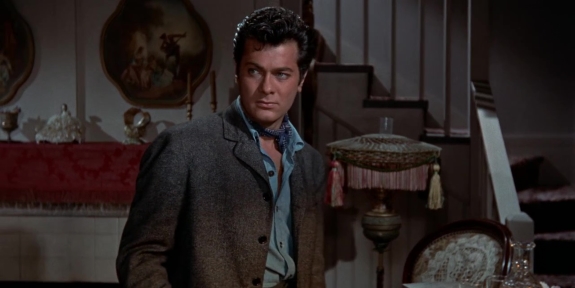
I couldn’t even begin to guess at the number of westerns which have navigated the hard and twisty trail leading to that last stop called redemption. It’s a path which practically defines the genre; if it’s not an essential ingredient, then I think it’s fair to say it enriches any western that features it. There can’t be many instances though of redemption being won early, and won with a smoothness that takes little effort, and then promptly ignored for the duration. Well, that’s basically what happens in The Rawhide Years, where riverboat gambler Ben Matthews (Tony Curtis) quickly realizes the error of his ways after swindling a hopeless dupe out of money he had no right to be playing with. It takes only the stern rebuke of a crusty straight arrow rancher (Minor Watson) and a subsequent invitation to try out honest work that sees Matthews abandon his current trade. His determination to make good is not shaken by the killing of his unexpected benefactor by river pirates, nor by the suspicion that is automatically directed at him and his partner – the latter falling victim to a lynch mob. Instead, he sets out first to make money on the up and up, then to win back his girl, and ultimately to achieve justice both for the man who was murdered and for his own tarnished reputation.
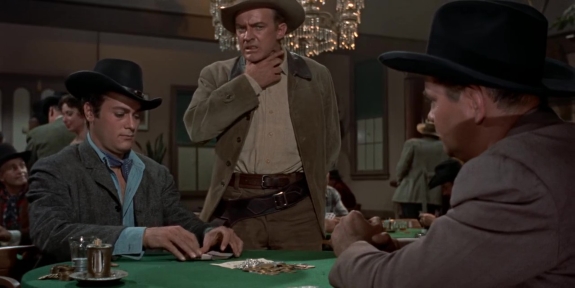
Rudolph Maté made a notable western debut with Branded but his later contributions to the genre were not quite as strong. While The Violent Men is very good it probably should have been even better considering the kind of talent on display, and Three Violent People is patchy, though some of that is down to the writing. What all of those movies have in common is a serious, even sombre, tone. Beyond the western trappings, The Rawhide Years offers a complete contrast in that it’s a very lightweight affair, at least after the opening section is out of the way. It’s tempting, though actually unjust, to attribute that to the presence of Tony Curtis in the lead, a man who is not at all someone one would associate with westerns even though he did appear in a handful right at the start of his screen career. Curtis blends into the genre fine – a phenomenon noted before now is the way westerns had a tendency to absorb actors who, on paper at any rate, appear ill-suited – does not feel out of place and plays it absolutely straight. On the other hand, Arthur Kennedy brings a broad, swashbuckling amorality to his role as the sidekick who is forever on the make and always with an eye on the main chance. He gets some of the best lines and brings a real exuberance to the part, providing much of the momentum to a loose and fast moving plot.

Colleen Miller catches the eye in a showy and relatively uncomplicated part as Curtis’ saloon girl sweetheart. She gets to play a few dramatic scenes but what sticks in the memory are her musical numbers, they never sound like anything that would have been performed in a frontier saloon yet they are colorful and attractively staged with Miller showing off some great looking gowns. Peter van Eyck is another who sounds like an odd choice for a western – he did make a few more later on, the German/Italian Duel at Sundown as well as Shalako for Edward Dmytryk. Again, his casting works surprisingly well and his civilized, urbane air adds polish to his role as the principal villain. William Demarest was no stranger to westerns, or to any genre for that matter, appearing in a fair few throughout his long career. However, the fact he was in all those Preston Sturges movies means I automatically expect to see him produce a comedic turn. As such, it jars a little to have him play a supporting villain – this is not to say he is poor or weak, just an acknowledgement of my own preconceptions. And in his last feature role, the versatile William Gargan appears as the marshal .
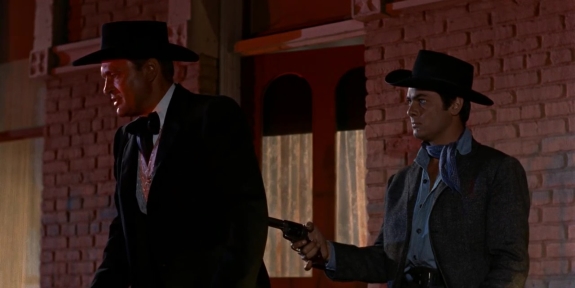
The Rawhide Years was mainly shot on the backlot and on sets, with a few scenes on location at Lone Pine, and cinematographer Irving Glassberg has it looking well for the most part. As a piece of cinema this is pure confection, nicely packaged and hugely enjoyable from beginning to end but with very little substance. Nevertheless, this frothiness isn’t something that should be taken as a demerit or regarded as a criticism. The truth is the strength of the movie derives from the unbridled sense of fun that permeates it. Try it.


I saw this a long time ago and can’t remember it. I was drawn to this thru Rudolph Mate via The Violent Men and The Black Shield of Falworth.
LikeLike
The latter is enormously enjoyable. One of the director’s movies with Curtis I’d give a lot see in a restored/watchable version is Forbidden.
LikeLike
Colin, The Black Shield of Falworth was a minor hit. Curtis’s comedy Boeing Boeing was also a hit here.
LikeLiked by 1 person
Yes, as well as being entertaining, Black Shield looks superb. That’s something else it has in common with this movie same director, same star and the same cinematographer in Irving Glassberg.
LikeLiked by 2 people
Excellent review. Not that familiar with this Tony Curtis Western though I am of his other period films around that time. I think my favorite performances of his are in ‘Some Like it Hot’ and ‘Sweet smell of success’ though I know I’m not going out on much of a limb there.
LikeLike
I’ve probably said it before, but he had very consistent, and diverse top on terms of roles and genres, right up until the mid-60s or thereabouts. That his reputation wasn’t stronger in later years is down to some of the poor choices he made and the kind of roles he played from that point on.
LikeLike
I tend either to love Tony Curtis’s movies or intensely dislike them. I really really dislike Some Like It Hot and The Great Race. I wouldn’t say that he was bad in comedy, just that he often ended up in bad comedies.
But I absolutely love The Midnight Story and Houdini and his performances in both those movies are superb. And I think Trapeze is a wonderful and very under-appreciated movie. One of the great circus movies and I do love circus movies.
LikeLike
Tony Curtis got the role of his career in the TV series The Persuaders. He was apparently a nightmare to work with but once the cameras started rolling he delivered the goods. It’s a series that should have put him right back on top but Roger Moore had been offered the role of James Bond so despite its success it only got one season.
Amusingly Curtis never referred to it as a TV series. He always referred to it as a series of films!
LikeLike
Yes, one of the better ITC series. In a way, they were like brief or truncated TV movies and there were certainly plenty of experienced industry pros involved on both sides of the camera.
LikeLiked by 1 person
Had kind of a hard time with Curtis in his western roles…..not that he didn’t perform well, but just didn’t seem to fit the wearing of a cowboy hat. Ironically enough, every time I saw him after his Hollywood days he was smartly donning a cowboy hat.
LikeLiked by 1 person
He only made a few westerns and this was, I believe, the last one. He made plenty of movies with a period setting, a range of period settings on fact, but his absence from the western after 1956 does perhaps indicate that he wasn’t so keen on making them.
LikeLike
Brand new to me – can’t wait to catch it, thanks Colin.
LikeLike
You’re welcome! There are some solid DVD and Blu-ray releases out there as well as good prints online in the usual places.
LikeLiked by 1 person
This one sounds really good, Colin. Thanks for putting it on my radar! Plus, Tony Curtis in a western? The guy seems to be a chameleon.
LikeLiked by 1 person
He made four westerns all told but you’re right too that he was very versatile in his peak years: noir, westerns, social drama, comedy, swashbucklers and fantasy, war. You name it, he made it.
LikeLiked by 1 person
I don’t think I’ve actually seen a Tony Curtis western.
LikeLike
Actually……there’s a lot of truth to this statement when one thinks about it.
LikeLiked by 1 person
From a purely literal standpoint, a “Tony Curtis western” is obviously one which has Tony Curtis in the cast. However, assuming that what’s being alluded to here is whether such a categorization is artistically valid is a fair point. Arguably, an “insert name” western should indicate more than that kind of simple labeling, perhaps indicating a longer or more influential history in the genre. As such, the film under discussion here is certainly a western with Curtis in the lead and built around him, but it may be debatable whether it ought to be regarded as a “Tony Curtis western.” It’s all semantics of course but interesting to ponder.
LikeLike
Colin you said to “Try it”. So, I did again after first viewing it years ago. Here is my take for what its worth. Even though with the high quality production values Universal-International was releasing at the time, it became obvious the studio was pitting their rising new box-office stars with capable proven veteran actors. It’s a nice formula when the chemistry works. In this case we have Tony Curtis in the lead having the benefit of veteran players in support all around him. Thus at times, seeming to be a fish out of water and to keep the narrative moving, enter the needed injection of a co-starring sidekick role played by Arthur Kennedy (I don’t believe this role was in the source novel). To the credit of Kennedy he played it up to the hilt as if the role was written with Dan Duryea in mind. Dialogue, antics and all. That being said, to me Kennedy only became more annoying where Duryea would have shined. I must say veteran star William Gargan was solid in the role of Marshal helping hold things together by projecting an air of reality.
Okay, back to the Kennedy/Duryea comment. Henceforth, in comes Screenwriter D. D. Beauchamp. To make clear to all you purist I’m only projecting here. D. D. Beauchamp was the Additional Dialogue screenplay co-writer for RIDE CLEAR OF DIABLO (1954). Two-years later Beauchamp was Adaptation co-writer for THE RAWHIDE YEARS (1956). The question is……was there a Kennedy/Duryea screenwriting connection?
The only other connection I found was Cinematographer Irving Glassberg was the Director of Photography for both films.
In closing. My research was sourced from on-line sites.
LikeLiked by 2 people
I hadn’t thought of the way Kennedy’s character taps into something of that quality Dan Duryea often presented. Kennedy was of course a very accomplished performer and while he could play roles which were painted broad when necessary, it’s not the image I have in mind when his name is mentioned. So, you may have something there on the thought process that was going on with regard to how his part was written. That’s not to say it was explicitly written with Duryea in mind, but his persona may have influenced the writing even subconsciously.
LikeLiked by 1 person
Well said Colin. My thoughts exactly.
LikeLike
Speaking of Shalako, that’s a movie I like rather a lot. Yes it’s very much a late 1960s western but it’s more fun that most examples of that breed. Sean Connery and Brigitte Bardot might seem out of place in a western but they have so much star quality that somehow they carry it off. An example of the point you made about the western’s ability to accommodate stars who might have seemed odd choices for the genre.
LikeLike
I remember first seeing that film some time in the late 1970s, when I was very young, and I loved it. I suppose the eclectic nature of plot and casting had a lot to do with this, it felt like a mishmash of everything. I retained a lot of fondness for it, and still do as is frequently the case with things that catch the attention when we’re young. However, last time I viewed it, probably a few years back, I was very aware of all the shortcomings. Connery really doesn’t seem comfortable in a western setting in my opinion. Stephen Boyd, on the other hand, was well cast, his natural villainy given a free rein.
LikeLike
SHALAKO is very oddly cast, with most of them looking out of place on the range’
Boyd is in his element,though.
Talking about “Guilty Pleasure” Euro Westerns I rather like HANNIE CAULDER with Boyd’s man of mystery adding further pleasure. Christopher Lee excels as a master gunsmith.
BTW, Colin-did you see Network are back in business which is very good news.
I hope they can sort out something with ITV Studios so that we can get HD releases of some of those rare Brit Noirs that we crave-it’s always worth making suggestions so they can calculate interest in such films-why not suggest a few titles to them.
LikeLiked by 1 person
It is good news, although I don’t see new titles available at the moment, just liquidation stock so far. It’s to be hoped some more fresh releases along the lines you mentioned will be forthcoming in due course.
LikeLike
They have also mentioned that new releases will take some time, it’s always worth making suggestions, as they suggest to avoid junk like “On The Busses” and “Love Thy Neighbour” appearing on box sets.
They have also invited interest on OOP Network titles;I missed the boat on FORBIDDEN (1949) but it turns up on Talking Pictures TV and I enjoyed it especially the Carny Noir aspects.
LikeLiked by 1 person
Yes, that’s a good movie, one I haven’t seen for a while though. I have an old release of it by Odeon from long ago.
LikeLike
I’ll be happy if the new Network outfit just reissue old Network releases that are now almost impossible to find.
LikeLiked by 1 person
HANNIE CAULDER is one of the tiny handful of truly great westerns from the New Hollywood era. Directed by Burt Kennedy! A revenge western with nuance. You can have revenge but you have to pay a very high price for it. Raquel Welch showing us that given the right role she was a fine actress.
LikeLike
Sadly, they’ve told me they won’t be shipping to Australia at present. They hope to build up to Int’l shipping some time in the future.
LikeLike
Buying directly from distributors can be tricky if they are located in another country. Hopefully, that will be something they can work around, but of course most material on general release can be purchased through international retailers such as Amazon or via EBay etc.
LikeLike
Colin-I noted your interest in Kino’s forthcoming Republic Noir set.
Fans are bemused by the addition of CRY DANGER an RKO title that somehow has ended up in the Paramount/Republic portfolio. In any case I’m interested in this set as I never knew CRY DANGER appeared on a long OOP Olive Films release, an attractive set for me,at least.
LikeLike
Yes, an interesting set, not least for the inclusion of a (new to me) George Sherman title. I think the confusion for some over Cry Danger comes from the fact it was distributed by RKO but produced by Olympic Productions.
LikeLiked by 1 person
Yes, Colin the Sherman title was new to me as well. In the UK it was titled OUTSIDE THE LAW and was I understand Sherman’s first non Western. He again returned to Westerns until producers realised that he was equally adept at Noir & Crime Thrillers (Crime Doctor, Whistler) I hope Sherman’s LONDON BLACKOUT MURDERS (1942) (Title tells all) appears on a future Republic Noir set.
LikeLike