
“I’m fed up. Ever heard that phrase? No, you wouldn’t. You’re not married.”
There’s that unmistakeable air of the mid-life crisis which pervades The File on Thelma Jordon (1949). It is clearly stated that the male lead is just 35 years old, but his attitude, his mindset, the cloud of vague dissatisfaction that dogs him all evoke a sense of middle-aged ennui. This is a classic noir setup, the monotony of finding oneself plowing along a rigidly defined rut, the soul-sapping realization that the adventurous promise of youth has yielded to the safe predictability of a humdrum existence. When a man becomes aware of this then the danger signals start to flash insistently. Maybe it’s a timeless affliction, but the postwar male was particularly susceptible to it. The struggles and sacrifices of WWII were supposed to lead to freedom and certainly something better than a dull and unfulfilling life, weren’t they? And this is the premise that underpins the drama which unfolds, the disillusionment felt by a man who finds himself hemmed in.

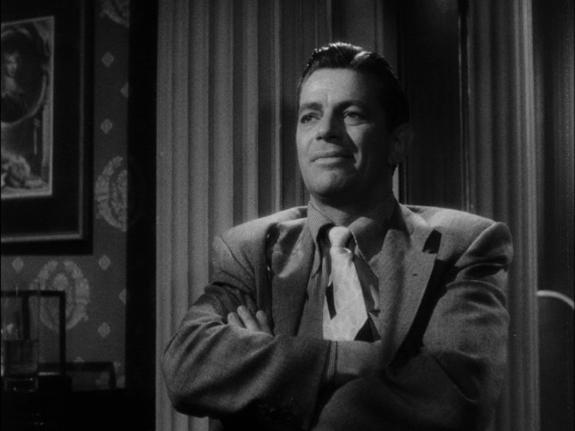
The File on Thelma Jordon works its way through a range of styles and touches on a succession of different genre conventions. It opens in a semi-comedic style, with Assistant District Attorney Cleve Marshall (Wendell Corey) painted in broad, almost farcical, strokes as he ties one on and revels in self-pity on the evening of his wedding anniversary. If he could be said to be unhappily married, it’s not so much that his discontent stems from his feelings (or any lack thereof) for his wife (Joan Tetzel), more that he is overwhelmed by his overbearing father-in-law. When Thelma Jordon (Barbara Stanwyck) stops by the chief investigator’s office to report fears about burglaries at the home of her elderly and extremely wealthy aunt she is mildly amused. Soon though, a romance develops between Cleve and Thelma, an illicit one given his marital status and the gossipy instincts of people in general. At this point, the story has moved on via the furtive intensity of such love affairs to become something of a doomed romance picture, before taking a sharp left turn into thriller territory. This occurs when the old lady is discovered shot dead in her own parlor, with Thelma left in a distinctly tricky position – accused of murder in fact. What follows is a classic courtroom drama, one where Cleve contrives to have himself installed as chief prosecutor in the hopes of sabotaging his own case against Thelma. Finally, the story segues into full throttle melodrama with a truly startling climax.
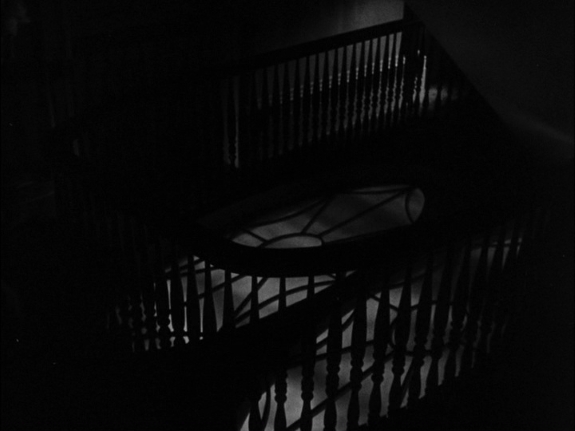
Robert Siodmak could be said to have played one of the most instrumental roles in the development of film noir. One only has to look at the string of superb movies he made through the 1940s, starting with Christmas Holiday and finishing off with Deported, to see the quality of his work and how influential it remains. Even if it does not quite mark the end of that cycle, I think The File on Thelma Jordon counts as his last truly great film noir. As I mentioned in the opening paragraph, the core of the story catches that post-WWII mood neatly: it is shot evocatively with deep chiaroscuro shadows, and plenty of noir visual motifs on show – bars, railings, blinds and tilted angles – and features a marvelously calculating femme fatale in Stanwyck. Siodmak frequently leant into melodrama in his films noir and the tendency is especially evident in this movie. Of course, a good deal of that is likely down to screenwriter Ketti Frings, whose work was notably strong in that direction. Around this time she also wrote the script for The Accused, another noir with a high melodrama quotient, not to mention a plot which is predicated on the notion of poor judgement and questionable choices. As such, visually, thematically and in terms of core concepts this represents a solid basis for a classic film noir.
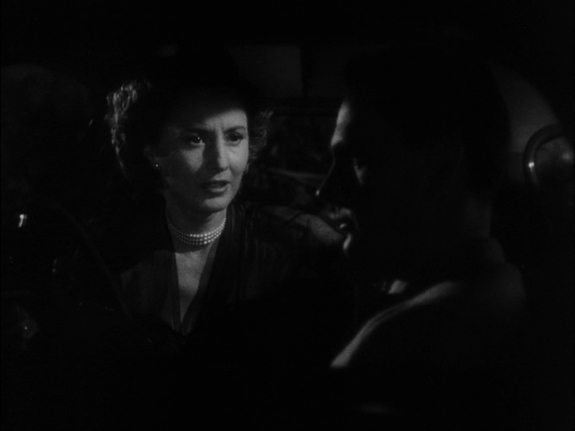
Barbara Stanwyck and Wendell Corey made three films together, all Hal Wallis productions for Paramount: this one, The Furies and Sorry, Wrong Number, the latter being the only one where they were not romantically paired. Does the relationship work? I would say it does as Corey is very successful at tapping into the more gullible or credulous aspects of his character. He is ultimately the dupe in a complex scheme and much depends on his ability to convey the transition from initial naivety, through suspicion, to eventual realization. In a way, the movie, via the characterization of Cleve, traces something of a circle – he starts out frustrated and disappointed and winds up arguably more disillusioned by the end, albeit in a very different way and for different reasons. Stanwyck turns in a performance of great slyness and subtlety, the craftiness with which she carries off her part is something that becomes increasingly apparent with repeat viewings of the film, and therefore adds up to another finely judged piece of work from her.
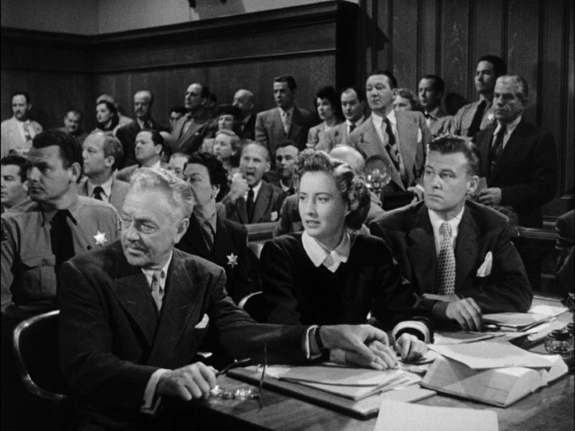
The supporting cast all inhabit their roles satisfactorily too. Paul Kelly essays great sincerity as the investigator who is also Cleve’s friend. Stanley Ridges is deliciously slippery as the defense counsel who has pretty much everyone’s number right from the off. His early consultation with Thelma as both of them fence and dance around their suspicions is played with consummate skill, and again the layering and shading are even more impressive when the movie is viewed more than once. Joan Tetzel (Duel in the Sun, The Paradine Case) ends up slightly overshadowed in a role which is more straightforward than those around her, but she acquits herself well enough. Finally, Richard Rober does another solid job as Thelma’s old flame – he doesn’t get a huge amount of screen time but he was always a convincing noir presence. Without wishing to be glib, I have to to say there’s something almost eerie about the parallel between the shocking demise of his character in this movie and the way his own life was to be cut so tragically short just a few years later.
The File on Thelma Jordon was released on DVD and Blu-ray by the now defunct Olive Films, though it is still available to buy. I bought the DVD myself when it came out years ago and I feel the transfer still holds up well. The only disappointing aspect was the fact there were absolutely no supplements on the disc, which seems unfortunate given the quality of the cast, the director and indeed the movie itself. Even so, this is well worth tracking down if you can lay your hands on a copy. All told, it’s a smooth combination of melodrama and noir where no one comes away unscathed yet also one where the idea of redemption is still present.
As a member of the Amazon Associate program I earn a small commission on any purchases made via clicks on links here.


Siodmak is my favourite noir director. I come back to his films regularly. Hard to pin down but i think Cry of the City is my favourite
LikeLike
David, Siodmak was incredibly consistent during his peak years and he is a great favourite of mine too. Because of that consistency there’s not much to choose between his top films for me but I rate Criss Cross very highly.
LikeLiked by 1 person
I saw The Killers on the big screen this year. That one’s unbeatable. Come to think of it I even like Son of Dracula!
LikeLike
Yes, I tend to think of The Killers and Criss Cross as almost inseparable in terms of quality, the latter just shading it for me.
LikeLike
Son of Dracula is for me the best by far of Universal’s 1940s horror/monster movies. It’s the only one that can match the visual brilliance of the best of their 30s movies. Vampires and swamps – a dynamite combination.
It also features my favourite Lon Chaney Jr performance. He’s not trying to be Lugosi.
LikeLike
The film has a lot going for it, even if I wouldn’t quite rate it alongside the great movies of the early thirties myself. That said, it is good overall. However, although Chaney puts in the work I still feel he’s miscast as Dracula. He gets across some of that inner torment quite successfully but his physical form works against him. For me, his best horror work remains. Larry Talbot.
LikeLike
Colin, Stanwyck is always welcome. Never find Corey acceptable as a leading man, thats why I avoided this.
LikeLike
Yes, I don’t think you are alone in feeling that way about Corey. He had a screen persona that sometimes drifted towards whimsy and vagueness at times and that’s not for everyone. I’d say this quality works in his favour on this film though and makes sense in the context of the character he played.
LikeLike
This is one of the great noir melodramas where the noir elements and the melodrama elements mesh perfectly. And of course Barbara Stanwyck was equally at home in both noir and melodrama.
LikeLike
Yes, and Stanwyck was on a marvelous run of noir and melodramatic roles particularly between 1948 and 1952/53.
LikeLiked by 1 person
Thanks for the excellent review. I need to pick this up as I got on a Stanwyck DVD roll last year and picked up the Warner box set of her, plus ‘Stella Dallas’, ‘Ball of Fire’, ‘Cry Wolf’, ‘Two Mrs Carrolls’, ‘Blowing Wild’, ‘The Violent Men’, ‘Strange Love of Martha Ivers’ and ‘California’. So I’m a bit of a fan and always enjoy your reviews of her films.
LikeLike
That’s quite a haul you’ve acquired there, Chris. And there’s one among that lot I have to own up to never having seen.
LikeLike
Yes, another neat one I meant to mention is the Universal set with six of her films having Wellman’s ‘Great Man’s Lady’ and the films she did with Sirk. Nice variety like Universal did in the DVD era on those sets. In recent years too I discovered how neat her precode work was too with Capra plus ‘Baby Face’ and ‘Night Nurse’.
LikeLiked by 1 person
Agreed, but I’ll cheerfully acknowledge that I’m a bit biased in that I can’t really think of many of her movies I actively dislike. Some are obviously better than others but all are highly watchable, often due to Stanwyck’s presence.
LikeLike
Exactly. I was watching some ‘Big Valley’ on one of the Westerns channels and she was great in that even! Wish she could have lived long enough to see the resurgence of older films with TCM and how beloved as an actress she became with newer generations. She is eternal now.
LikeLike
Barbara Stanwyck’s pre-code movies are worth exploring. Illicit is quite good. And of course Ladies They Talk About which pretty much invented the women-in-prison genre.
LikeLike
Pre-code films in general form a bit of a gap in my cinema knowledge and it’s an area I probably need to work on a bit harder.
LikeLike
As much as I don’t want to contradict you Dee, I feel LADIES OF THE BIG HOUSE (1931) (re?) invented the women’s prison genre,at least for the Pre Code era, I’m sure there were silent versions as well. I favor the 1931 film as I much admire Sylvia Sidney especially her 1930’s work.
Another stellar Stanwyck Pre Code is BABY FACE which oddly enough was remade as WICKED AS THEY COME; the Ken Hughes film is great fun if you know the original.
LikeLike
John, I’ve seen both Baby Face and Hughes’ Wicked As They Come, but not that recently. Regarding the latter, I still haven’t gotten round to opening up the Indicator British Noir set I bought a while back.
LikeLike
One of the best collections of her pre code work is in Columbia’s early Capra set. Also, WAC’s volume 3 pre code that focuses on Wellman.
LikeLike
A wonderful noir from Siodmak, with Stanwyck once again knocking it out of the park.
LikeLiked by 1 person
I’m of a mind to dig out my copy of The Movie Book of Film Noir (ed Ian Cameron) as I recall a fairly substantial chapter on Siodmak by Michael Walker.
LikeLiked by 1 person
Great book. I have that too! I would recommend the Western one that is its companion. Neat essays in both.
LikeLiked by 1 person
Yes, I have that one as well and it also contains some fine writing, including a very welcome entry, again by Michael Walker, on Delmer Daves.
LikeLike