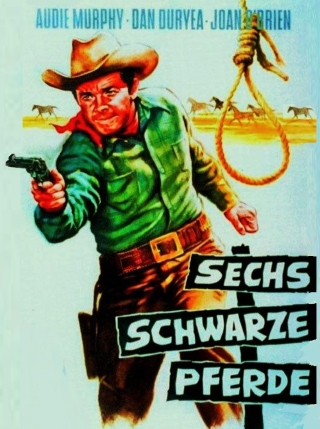
“There are some things a man can’t ride around.“
And there are some lines a writer can’t help revisiting, some setups as well when one thinks about it. Six Black Horses (1962) is about as close as we’re likely to get to a Budd Boetticher western without it actually carrying his name in the credits. Clearly a lot of that is down to the fact it was written by Burt Kennedy, the man who scripted Boetticher’s best films with Randolph Scott. Anyone familiar with those movies will instantly recognize the lines he recycled from those scripts – the one at the top of this piece has undoubtedly embedded itself deepest into most western fans’ consciousness, but there are plenty of others which, with minor tweaks, were first uttered by Scott, Claude Akins, Lee Marvin etc.
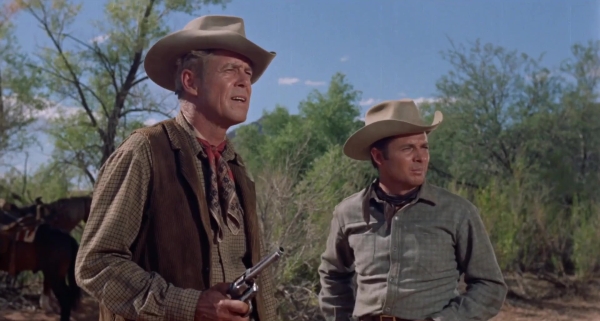
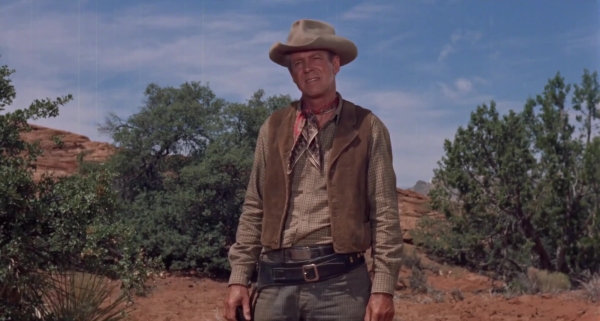
A dusty, sun-baked landscape, a man stoically making his way across it not on horseback but on foot, his saddle hefted on his shoulder. This is the first image on screen as the credits roll. The man is Ben Lane (Audie Murphy) and he’s badly in need of a horse. Just as he pauses to rest it seems as though his luck is in – a group of wild mustangs are approaching and a man in his position would be a fool to pass up the chance to rope and ride one of them. However, every story has a shape to it, and in this case it’s a repeating pattern of deliverance and danger. Every time salvation appears to be at hand its evil twin adversity is but a few paces behind. So it is that he finds himself on the end of a rope, accused of stealing horses and about to pay the traditional frontier penalty. It would be a short movie indeed, or a courageous approach to writing, were the hero to depart so early and unexpectedly. He doesn’t; his neck is quite literally saved by the intervention of Frank Jesse (Dan Duryea), a garrulous and amoral gunman who by his own admission has never done an honest day’s work unless it’s absolutely necessary. Together these two ride to the evocatively named town of Perdido and another brush with death. It is here that they meet a woman named Kelly (Joan O’Brien) who offers them the unimaginable sum of $1000 apiece to escort her on a four day trip across Apache infested badlands to rejoin her husband. With a bunch of thwarted mustangers hot on their heels, this is certainly an offer that’s hard to refuse. Once again though, it’s something of a toss up between prize and peril as the trio head into the desert and, to the viewer anyway, it soon becomes apparent that Kelly has something else on her mind.
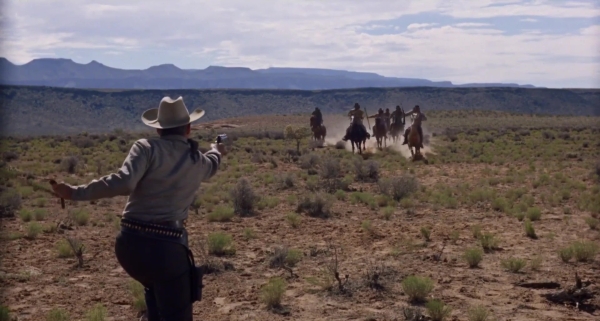
Harry Keller directed a number of movies I like – Quantez, Seven Ways from Sundown, Man Afraid, and served as producer on others such as Mirage. He was comfortable making westerns and he uses the landscape well here, much of the action takes place out in the wild country and it serves to add scale to a story which is really limited to the interactions of just three people. Nevertheless, and despite the script by Kennedy, it never reaches the heights of those classic Scott/Boetticher/Kennedy films. And I think that’s largely down to the writing. Kennedy, as I have noted, borrows extensively from his own armory, as he did on a number of occasions. However, the success of the Ranown movies was due to a combination of Boetticher’s spare style, the laconic yet authoritative presence of Scott, and the way that star’s characters all had a powerful and compelling drive within them. What Six Black Horses lacks is the kind of implacable inner fire of the Scott figure – one could say some of that has been transferred to O’Brien’s character but it doesn’t work in the same way. Murphy’s Ben Lane is the lead after all and he simply is not motivated in the way Ben Stride, Ben Brigade (Kennedy clearly had a thing for the name Ben) or Jefferson Cody were.
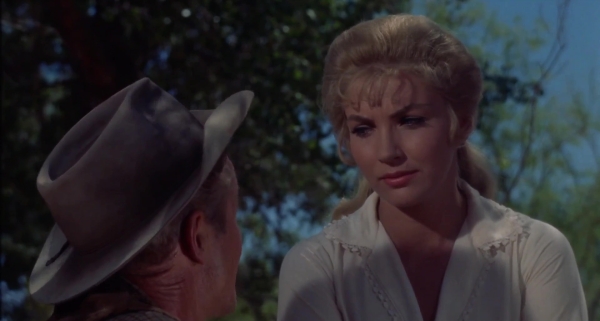
Audie Murphy entered the 1960s in some style. He had done some of his finest work towards the end of the 50s in movies such as The Quiet American and No Name on the Bullet and was looking to build on that. The Unforgiven, Hell Bent for Leather, Seven Ways from Sundown and Posse from Hell certainly did that. In short, he was riding high at this stage and this movie must have looked like a solid way to follow up. He’s as reliable as ever in the lead with that ever present hint of edginess lurking just below the surface, but the fact is the part doesn’t place that many demands on him. He does everything the script asks for, it’s just that the script could have asked for more. Dan Duryea was appearing for the the third and last time alongside Murphy and every one of their collaborations is a pleasure in itself. Both of these men worked well together and their presence alone automatically elevates anything. The role of Frank Jesse was a comfortable fit for Duryea, drawing out that wheedling, weaselly charm he traded on so profitably throughout his career and also affording him the opportunity to dip into the well of pathos – the title itself has more resonance for his character than anyone else after all. Finally, Joan O’Brien holds her own as the third arm of the triangle, maintaining an air of mystery for a long stretch and then presenting a steely core when her true aims are revealed.
For a long time Six Black Horses was almost a lost Audie Murphy picture. I say almost because although it could be viewed the prints available were very poor – faded and frequently cropped. It’s hard to appreciate or even enjoy a movie under those circumstances. However, the film can now be seen as it should be as a result of a recent Blu-ray release in Australia from Via Vision, licensed from Universal. This is not a full restoration and some minor print damage is present, but the movie is in the correct aspect ratio, has strong colors and a sharp image. In brief, it is streets ahead of any of the ropey prints which had previously been circulating. It comes paired on a BD with an equally attractive presentation of Murphy’s The Wild and the Innocent and I heartily recommend it.
As an Amazon Associate any purchases made through links here earn me a small commission.


This was titled as Mission To Del Cobre in the Far East. Found this standard fare.
LikeLike
Yes, that’s a reasonable description. I enjoyed it largely for the location work and the pairing of Murphy and Duryea once more, and the dog (which I completely neglected to mention) was welcome too.
Still, it does feel like Kennedy was reworking old material and achieving only middling results as the passion that powered the Ranown films simply isn’t there.
LikeLiked by 2 people
Completely agree about the comparison with the Ranown work.
LikeLike
There’s some dialogue that’s requested
LikeLike
Dialogue that’s repeated straight out of one of the Scott films.
LikeLike
There are numerous pieces of dialogue either lifted completely or altered slightly from Seven Men from Now, The Tall T, Comanche Station etc. Examples include the quote I used as an intro, the stuff about O’Brien moving like she’s all over alive, Duryea musing on driving another man’s stock, Murphy’s reassurance that O’Brien’s past wouldn’t matter, and so on. If you know the movies where the dialogue originated, it’s quite noticeable.
LikeLiked by 1 person
I saw this one before I watched the Scott films so that’s I heard the lifted dialogue. 🙂
LikeLike
Interesting. Personally, I think the lines are delivered better in the Boetticher movies but the order/sequence in which you experience these things may have an impact on how you react to them. If wonder whether you found them more or less effective in this movie seeing as you were exposed to it first?
LikeLike
It was weird, and somewhat diminished my appreciation for Six Black Horses since the lines were better delivered in the Ranown films. Like, oh, this is not very original now is it?
LikeLiked by 1 person
As long as it is Randolph Scott manning the lines, it all works for me.
LikeLiked by 1 person
Hey! I know this one! It’s a good movie! and there’s a dog! And it’s got a great title that is plot relevant! Although it has the shortcomings you point out, it still has the je nais sa quois of a proper 60’s Western–location shooting, scripts that were written by adults for adults (sometimes), actors who sometimes didn’t have to reach very far to represent their characters because they’d been through similar things in their own past, savage Injuns, chonky fight choreography and wildly anachronistic hairdos on the womenfolk.
IIRC, the clear “movie copying another director/actor combo and also Audie Murphy is in it” would be Night Passage, where James Stewart is existing in another Anthony Mann movie while the rest of the cast…aren’t.
LikeLiked by 1 person
Yes, Night Passage is an odd movie in some respects. I feel a lot better about it now than I initially did. I’ve seen it a few times over the years and last viewed it maybe 12 months ago, or perhaps a little longer. It’s beautiful to look at and I guess I once was bothered more by what it wasn’t (an Anthony Mann movie that he didn’t direct) and didn’t appreciate what it was. Duryea is very loud in it though, a really dialled up performance.
LikeLiked by 1 person
As an Artist I have a large collection of Western Poster Art (on my computer). And that’s a gem. The era of great Western Poster Art seems like long ago.
LikeLike
Generally, the era of great poster art feels a long way off to me. I like digging around for alternatives to the official studio artwork where possible. Some of them, such as this example, really draw the eye.
LikeLike
Pingback: Six Black Horses | Riding the High Country – Audie Murphy Appreciation
The scene of Audie protecting that dog that turned me into an Audie Murphy fan so I’m very fond of this one. Thanks for the information about the Australian Blu-ray,I’d love to see a decent looking copy of this movie.
LikeLiked by 1 person
It really was remiss of me not to mention the dog in the body of the piece – I meant to do so and then I got distracted and wrapped it up a bit faster than expected. Never mind, it’s been referred to a few times now, and it’s an element that does add to the movie so I’m pleased others have brought it up.
LikeLiked by 1 person
I too highly endorse the Via Vision Blu Ray release and I might add that the co feature THE WILD & THE INNOCENT looks stunning.
Also, if I may, I would like to highly recommend the very recent Hansesound Germany release of RIDE CLEAR OF DIABLO on Blu Ray. “Diablo” for me is one of Murphy’s most overlooked Westerns and his first teaming with Duryea.
In “Diablo” Audio dons a tin star to track down the killers of his father and kid brother, and forms an uneasy alliance with famed gunslinger Whitey Kincade (Duryea)
The Hansesound transfer is stellar just like their recent release of GUNSMOKE another superior Murphy Western.
Hansesound Blu Ray’s are region B locked.
LikeLiked by 2 people
I have that BD of Gunsmoke and I agree that it is a fine transfer. Good to know that Ride Clear of Diablo is a solid one as well.
LikeLike
I’m quite a fan of Ride Clear of Diablo. If a movie pairs Audie Murphy and Dan Duryea it becomes a must-watch for me.
The more Audie Murphy westerns I see the more I like him as an actor.
LikeLiked by 1 person
Their onscreen persona pair up quite nicely don’t they?
LikeLiked by 1 person
It’s the contrast that makes it. Murphy’s quietness contrasts with and complements Duryea’s swagger.
LikeLiked by 2 people
That hint of edginess that you mention is what makes Audie Murphy such a great western actor. He can convince you that despite the baby face he could be a whole lot more dangerous than he looks, and that the dangerousness could suddenly kick in at any time.
It’s my impression that the reputation of Audie Murphy’s westerns among western fans has been steadily growing over the past few years. Presumably because so many of them are now available on Blu-Ray.
I can definitely see myself buying that new double-header release. And on the cover it says Volume 1 which is rather exciting.
LikeLiked by 2 people
There is a Volume 2 – here – featuring The Texican and Joe Butterfly.
Re Murphy’s popularity or reputation, I’d say he was always well regarded by western fans but I agree the greater availability of his movies for viewing, especially over the last 10 years or so, has helped to enhance that and possibly widen it too among more general classic movie fans.
LikeLike
I’ve been encountering quite a few classic movie fans on other sites who have either recently discovered him or they’re asking if his movies are worth checking out. Needless to say I always respond with total fanboy enthusiasm and advise them to do so.
There’s been a lot of social media discussion lately on contemporary Hollywood’s hostility to male audiences. Perhaps that’s fuelling increased interest in golden age westerns. There are definitely classic movie fans keen to find movies without crude political messaging. So classic westerns with their emphasis on courage, redemption, honour and justice are seen as quite appealing.
So which of those Audie Murphy Double Features should I buy first?
LikeLiked by 2 people
Volume 1, with The Wild and the Innocent and Six Black Horses, is the better option in my opinion.
LikeLiked by 2 people
Thanks for the heads up on the Via Vision release, Colin. Have just ordered it. I can’t recall having seen either movie before – despite being a big fan of Audie M – so am really looking forward to watching them on Blu. Your site is a gold mine for me!
LikeLiked by 1 person
They are different movies, but both are very enjoyable. I feel sure you’ll be pleased with the BD.
LikeLike
For all Audie Murphy fans who want the full story of his unbelievable life I highly recommend the biography by Don Graham ‘No name on the bullet’. Really a stunning read. There really should be another shot at filming his life especially since we are getting a new film about Jimmy Stewart in WWII and doing ‘It’s a wonderful life’ as Audie’s is very cinematic too.
LikeLiked by 3 people
Thanks. I’m going to keep my eyes peeled for a copy of that Murphy book now that you’ve mentioned it, Chris.
LikeLike