Seven Men from Now

poster161

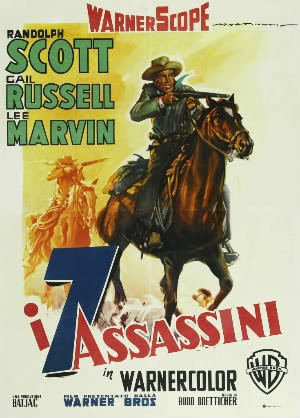
I was just thinking the other day that it will soon be close to a year since I got my hands on Sony’s superlative set of Boetticher/Scott westerns. Those movies were at the very top of my most wanted list for so long, and it still gives me great pleasure to know that I can now pick them off my shelves and enjoy them any time I please. With that thought in mind, I decided to give Seven Men from Now (1956) another view. This film is of course not officially part of the Ranown group of titles, but it was the first to bring together Scott, Boetticher and Kennedy – so it is the movie that kicked off that cycle and it’s also the template for what was to follow.

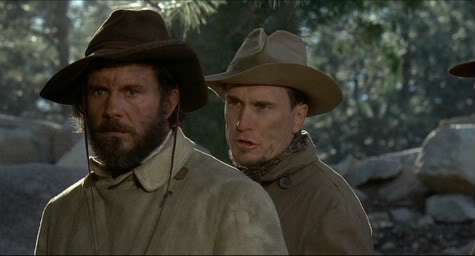
As soon as the title credits have rolled the film immediately kicks into gear. Out of the darkness, and a violent storm, comes the lone figure of a man making his way towards the shelter of a nearby cave. It’s already occupied by two vaguely uneasy men, but they still offer the stranger a cup of coffee and a seat by the fire. A stilted conversation follows, but when a killing in the town of Silver Springs is brought up something snaps. The camera cuts away, gunfire is heard, and only one man will ride off. That man is Ben Stride (Randolph Scott), former sheriff of the aforementioned town and now a driven manhunter. Seven men robbed the Wells Fargo office in Silver Springs, killing Stride’s wife in the process. Now only five are left alive, and Stride spends the remainder of the movie blazing a trail across Arizona in his quest for vengeance. Along the way he runs into a couple of easterners, headed for California and a new life. The couple are Annie Greer (Gail Russell) and her less than capable husband John (Walter Reed). Stride’s inherent decency means that he can’t abandon these two greenhorns to their fate in hostile country, so he rides with them part of the way. By the time they reach a deserted relay station, the last important figure is introduced. This is Masters (Lee Marvin), an man of dubious character who Stride has had occasion to lock up in the past. However, Masters appears to bear him no ill will and makes it clear that his only interest is in finding the gold that was stolen from Silver Springs. When this oddly matched group sets out again the tensions begin to rise, and it seems only a matter of time before Stride and Masters will square off.
£8

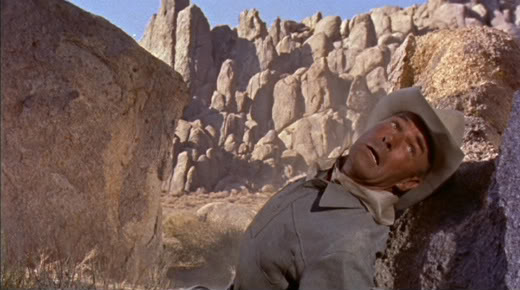
As I said in my introduction, Seven Men from Now was the seed from which the Ranown westerns were to grow. Just about every character, theme and situation would be revisited and honed to near perfection over the course of the next four years. Scott is the classical loner, haunted by the demons of his past and desperate to make up for the character flaws and inadequacies that brought him to his present state. He can be hard and ruthless when the circumstances demand but still retains a sensitivity to those who are dependent on him. Gail Russell was given a shot at a comeback with the reasonably meaty role of a woman who married a weak and ineffectual man but will stick by him for all that. Miss Russell’s story was a tragic one; were it not for a combination of insecurity and alcoholism she might have achieved much more than her appallingly short life permitted. Nevertheless, she plays her part perfectly here and it’s almost as if she was able to channel all the dissatisfaction with her own life into Annie Greer. It has to be said that Walter Reed is pretty colourless as the husband, but that’s not necessarily a bad thing when you’re looking to play a weak willed and essentially passive character. Lee Marvin, on the other hand, is all swaggering bravado and insidious charm. His nonchalant, sneering dandy with the long, green scarf and twin pistols is the perfect counterbalance to Scott’s underplaying. I’d say he actually steals the picture as he dominates every scene he’s in – the real standouts being his taunting provocation of Scott, Reed and Russell in the confines of a storm battered wagon, and the final one on one duel amid the barren rocks of Lone Pine.

Boetticher and Kennedy revisited this premise again and again in their movies: the small isolated group comprised of the obsessive avenger, the strong yet vulnerable woman, the expendable sidekicks and the villain that you half admire. Anyone familiar with Kennedy’s scripts will easily recognise the recurring dialogue, but the beauty of it is that it’s such iconic stuff it never actually sounds cliched. Boetticher’s direction here is first rate, making the most of the familiar Lone Pine locations – the bulk of the action in Seven Men from Now takes place outdoors and that’s a real blessing in any of his movies. There’s the usual mix of telling close-ups interspersed with glorious wide shots. The climax among the labyrinthine boulders creates a great sense of claustrophobia and allows for some marvellously framed images.

Paramount did western fans a real favour when they put Seven Men from Now out on a DVD a few years back. The R1 disc (I’m going to assume the R2 replicates it) is an excellent anamorphic transfer that I couldn’t fault. In addition to the main feature, there’s a boatload of great extras with the commentary track by Jim Kitses and the documentary Budd Boetticher – An American Original being especially worthy of mention. Seven Men from Now stands as a first class western on its own, but what makes it even more special is the knowledge that Boetticher, Scott and Kennedy would go on to produce still classier material in a very short space of time. If you haven’t seen this film then you really owe it to yourself to put that situation right as soon as possible – I can’t recommend it highly enough.

Escape from Fort Bravo

Often a film will stick in one’s mind because of a certain scene or sequence. That’s certainly the case with Escape from Fort Bravo (1953), a movie I first saw many moons ago but whose climax lingered on as a fond memory down through the years. Under such circumstances revisits are a delicate matter, best approached with caution as disappointment is always ready to pounce. When I eventually got the chance to see this western again last year I was pleased to find that my memory hadn’t been playing tricks on me – I enjoyed it immensely. Digging it out and giving it a spin the other day, for the purposes of this piece, allowed me to recognise some of its weaknesses more clearly but still didn’t dilute any of the punch of the ending.

The action takes place in Arizona during the Civil War, where a group of Confederate prisoners are cooped up in the dusty Fort Bravo. Among the jailers is Captain Roper (William Holden), a hard-bitten man who thinks nothing of marching a recaptured prisoner back through the blazing desert heat as an example to the others. While such actions naturally stir resentment among the southerners, his own commander and peers don’t shirk away from expressing their disapproval either. The tensions within the stockade are only one aspect of the problem though, as the fort is right smack in the middle of hostile Mescalero territory. The threat posed by the Apache is an ever present one and is highlighted early on when a detachment is sent out to locate a delayed supply convoy, finding only burned wagons and dead drivers. On the return leg the troop encounter a stage and escort it back to the safety of the fort. This stage contains one Carla Forester (Eleanor Parker), who’s using the cover of a wedding invitation to facilitate the escape of the Confederate OC, Captain Marsh (John Forsythe). This leads into an unconvincing and undeveloped love triangle which, in combination with the less than riveting escape plan, could well have sunk the picture. Fortunately, the addition of some ripe dialogue and good support playing (William Demarest in particular) just about keep things afloat. The resulting escape and pursuit get things back on course again, and by the time Roper, Marsh et al find themselves surrounded by some of the most cunning Apaches ever seen on film the tension has been wound tight. Those scenes in the latter half of the film are worth the price of admission alone. Watching the small, isolated group, huddled in a desert crater, move from defiance to fearful realization and back again is quite powerful stuff. Adversity is said to bring out the best and the worst in men, and the sight of Roper striding out at dawn, a revolver in both fists, to meet fate head on is a marvellous image.

William Holden was arguably in his prime when Escape from Fort Bravo was made (the same year as Stalag 17) and he gave a very strong performance as the practical and ruthless Roper. He was ideally suited to playing tough cynics with a deep set yet true sense of personal honour. Watching Holden’s honest, warts-and-all portrayal of Roper really shows up the inadequacies of his co-star. John Forsythe is a likable enough actor but there’s a lightweight quality about him (it worked well enough in a movie like The Trouble with Harry, and Hitchcock obviously thought enough of him to cast him again in Topaz and in his TV show) that’s not quite right for the part of a tough veteran. I’ve always enjoyed watching Eleanor Parker, she had a sassiness that suggested she could hold her own in any company and give as good as she got. However, she’s poorly served by her role here and the aforementioned “love triangle that really isn’t” is largely responsible for that. It seems odd to refer to a director’s twentieth picture as his breakthrough, but in this case I believe that’s actually the case. John Sturges would go on to make a string of ever more successful films after this and showed that he was highly capable when it came to action. His best work is in the early and latter stages, when he made effective use of the Death Valley locations and avoided the studio mock-ups. It’s also notable that he wisely chose to shoot the key scenes without any musical accompaniment and they’re all the better for it.

When Warner released Escape from Fort Bravo in their Western Classics box there was a good deal of griping about the quality of the transfer. It seemed to be the general consensus that much of the blame could be laid at the door of the poor condition of the Ansco Color elements. In truth, the transfer isn’t that bad and the colour is actually fairly strong. The real problem is that the print used is very dirty and obviously had little or no work done on it. It’s available in the R1 box (probably the best value), and individually in both R1 and continental R2. Escape from Fort Bravo belongs to that small category of westerns, along with Two Flags West and Major Dundee, that has Yankees and Rebs fighting side by side against the Indians. I think it’s a fine little western whose strong opening and blinding finish certainly shore up a slightly sagging middle section. Recommended.

The Stalking Moon

£20

Thanks to the suggestion of a fellow blogger, le0pard13, I decided to dig out and rewatch Robert Mulligan’s 1968 suspense western The Stalking Moon. Although the film contains its fair share of action, it is essentially a slow burning mood picture which builds tension almost imperceptibly yet inexorably towards a conclusion that is both nerve-wracking and satisfying. A good part of its strength comes from the fact that it can be approached from a variety of angles; as the standard chase picture, an examination of race relations, a love story, a tale of friendship, and it even has a suggestion of the supernatural.

Sam Varner (Gregory Peck) is an army scout on the verge of retirement, having already bought a ranch in New Mexico. His last job for the army, helping bring a band of Apaches in to the reservation, leads to the rescue of a white woman who has been held captive for ten years. This woman, Sarah Carver (Eva Marie Saint), has a young half- breed son in tow and manages to persuade Varner to escort her to the nearest coach stop and help her on her way. At first, her eagerness to distance herself from her rescuers might appear to be rooted in some sense of shame at having given herself to the Apache – an idea reinforced by an uncomfortable stopover at a remote swing station. However, it soon becomes apparent that her desire to be on the move is based on an altogether more serious threat. It turns out that her boy is the son of Salvaje, a renegade Apache with a fearsome reputation. So begins a relentless pursuit that leads to Varner’s ranch and, eventually, a one man siege of the log cabin that seems to grow smaller by the second. All the while, the spectral presence of Salvaje lurks in the shadows or flits from rock to rock and the viewer starts to wonder if this man is indeed human. The film’s masterstroke is keeping Salvaje off the screen for so long; he remains a cipher, a kind of bogeyman who is spoken of in hushed tones but never seen. Even when he does appear, we are only given a fleeting glimpse of him before he vanishes again like some terrible force of nature leaving death and chaos in his wake.

£21

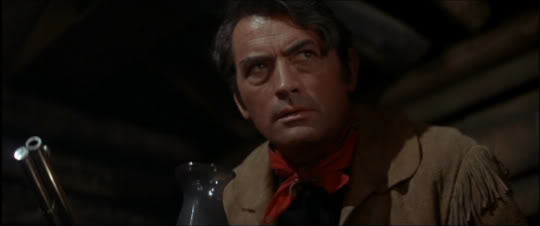
Gregory Peck plays another of his stoical, straight down the line characters in The Stalking Moon. In truth, it’s one of those classic western roles wherein the hero knows that the right thing to do is the unhealthy option but goes ahead with it all the same. In this case Varner has the chance to put Sarah on a train and let someone else deal with the whole mess, but his own sense of honour rules that out. As he toys with his food and gazes repeatedly at the lonely, forlorn figure sitting on the train platform it’s obvious what he’s going to do. Peck was always fine in those parts where his character had to draw on that inner steel to tough out the most hopeless of situations, and the role of Sam Varner might have been tailor made for him. Eva Marie Saint is also good in a difficult part, a woman who has become something of a stranger among her own people and little more than a misplaced possession to the mysterious Salvaje. In a movie that’s short on dialogue she has few lines to speak yet manages to convey the vulnerability of her character without diluting any of the resolve that would have been required to live the way she did. Robert Forster makes an early appearance as Peck’s half breed friend and fellow scout who proves his loyalty right to the end. The Stalking Moon was the only western made by director Robert Mulligan, and that’s something of a shame since he did an excellent job and seemed at home in the genre. He made excellent use of the locations (Nevada standing in for New Mexico) and the widescreen photography to emphasise the isolation of his characters. The open spaces of the first half of the film highlight not only the vastness of the country but also the relentless nature of Salvaje who will follow Sarah to the ends of the earth if necessary. In contrast, the second half becomes claustrophobic with Varner’s cabin, and the encroaching mountains and trees, becoming the focal point.

Warner put The Stalking Moon out on DVD last year in R1 as part of their Western Classics box and it’s also available in much of R2, though not the UK yet, as a stand alone title. It’s been given a fine anamorphic scope transfer with good colour and detail. The disc is as basic as they come without even a scene selection menu, but that seems to be par for the course with WB at the moment. Having said that, it’s a movie that does manage to sell itself on its own merits. There are those who have put forward the theory that Once Upon A Time In The West has a hint of the supernatural about it, with the possibility of Harmonica being an avenging ghost. Eastwood’s High Plains Drifter and Pale Rider also play around with a similar idea and I don’t think it’s too much of a stretch to view Salvaje in The Stalking Moon in that company. Anyway, it’s a damn fine film and one that’s well worth seeing.

The Bravados

There’s something so deeply satisfying about watching 1950s westerns that I sometimes feel I could dedicate an entire blog to them and still only scratch the surface. Just about every star and director of note managed to produce, at the very least, one quality western during those few short years. While the cinematography ran from monochrome and Academy ratio to technicolor drenched scope, one feature remained constant: maturity of theme.

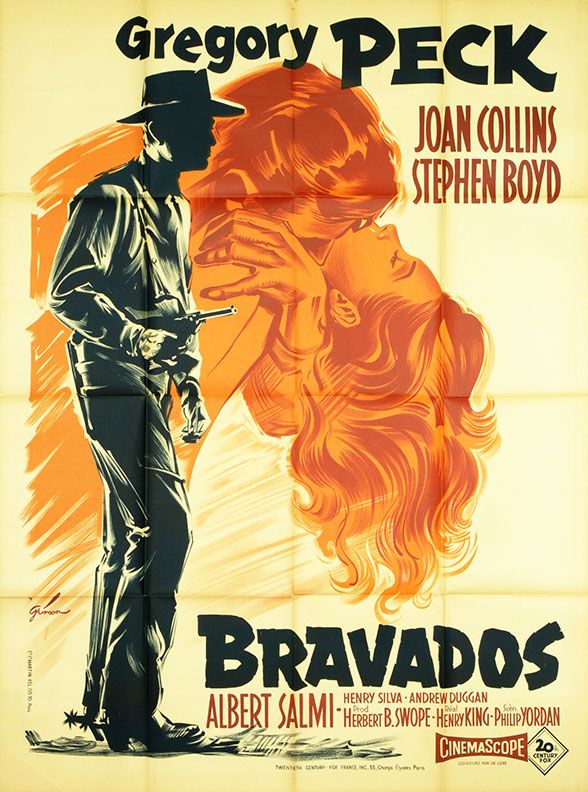
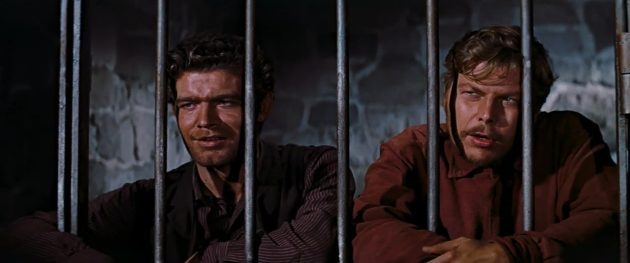
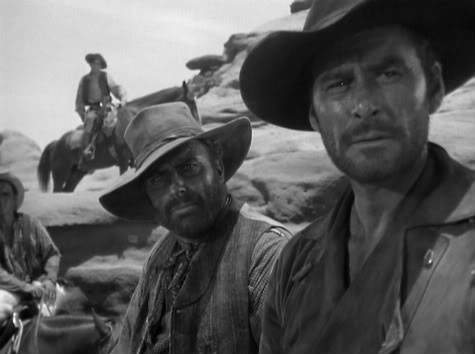
The Bravados (1958) opens in dramatic fashion with a silhouetted rider driving himself on through the night to the accompaniment of Lionel Newman’s pounding score while the blood red titles flash onto the screen. The rider is revealed to be Jim Douglass (Gregory Peck), a man obsessed enough to ride a hundred miles just to witness the execution of four men he’s never seen before (Stephen Boyd, Henry Silva, Lee Van Cleef and Albert Salmi). Initially there’s no explanation offered for Douglass’ desire to see these men keep their date with the hangman. The only thing that’s clear is that he’s nursing a deep and bitter hatred – perfectly realized in a wordless scene in the jail as Douglass walks along outside the bars and rakes each man in turn with a look of such malice that they flinch as though a lash had been applied. It’s only after the four have escaped, taking the storekeepers daughter hostage, that the reason for Douglass’ personal vendetta is revealed. It transpires that his wife has been raped and murdered and he believes that these men are the ones responsible. What follows is a tale of pursuit, revenge, realization, and finally a kind of sour redemption. The only false note in the picture is the introduction of an unnecessary and less than believable romance between Douglass and a Mexican rancher (a woefully miscast Joan Collins). This really adds nothing whatsoever to the film and actually serves to weaken it – the final ten minutes pack a powerful emotional punch but the last shot takes a good deal of the sting out of it. I think it’s also worth mentioning that I was left wondering if The Bravados had any influence on Sergio Leone. Maybe it’s just me but I couldn’t help but notice parallels with For a Few Dollars More: the taciturn anti-hero, the watch with his dead wife’s photo that Douglass carries and shows to his victims before killing them, the grimy and sadistic villains, and the ride along the deserted street of a Mexican pueblo before a showdown.

Gregory Peck gave a remarkably intense performance in a complex role that’s basically a study of bitterness, obsession and false conviction. His playing of a man who has cast aside his soul in the pursuit of vengeance is pitch perfect. As the story progresses the viewer understands that Douglass has become no better than the criminals he is ruthlessly hunting down, but it’s his own final realization of that fact that raises the movie to a higher class. Peck does a fine job of showing the psychological disintegration of a man who has his illusions stripped away and must henceforth look at himself in a new and disturbing light. Stephen Boyd clearly had a ball portraying the chief badman and slipped from smirking charm to menacing brutishness with ease. I’ve always been a big fan of Boyd and have enjoyed his performances in everything I’ve seen him in. His best work was as the villain and when the big lead parts came along he was a touch unlucky – a poorly written role and no chemistry with Sophia Loren in Fall of the Roman Empire, almost becoming James Bond, and having production delays force him to relinquish the role of Mark Antony to Richard Burton in Cleopatra. I was prepared to write some scathing comments about the wooden acting of Joan Collins in this movie but I can’t seem to work up the enthusiasm – although how anyone ever thought it was a good idea to cast her as a Mexican cattlewoman just beggars belief.

Henry King was one of those directors that the studio system seemed to have in abundance, the skilled craftsman who could effortlessly churn out quality pictures in just about every genre. His name is hardly a familiar one today but a glance at his filmography makes for impressive reading and contains far more hits than misses. King’s work on The Bravados is aided immeasurably by Leon Shamroy’s cinematography, which mixes stunning landscape views with moody day for night shooting to great effect.

The Bravados is available on DVD from Fox and their R2 Studio Classics version (I imagine the R1 is broadly similar) is a perfectly fine anamorphic scope transfer with nice colours. There’s not an extra feature in sight (I think the R1 has a trailer) but it is cheap. This is a movie that often gets overlooked and is rarely mentioned, but if you’re a fan of westerns from this era you need to see it. Highly recommended.

The Great Northfield Minnesota Raid

About a year ago I wrote a short series on the depiction of Jesse James in the movies. At the time, I skipped over The Great Northfield Minnesota Raid (1972) for the simple reason that I hadn’t seen the movie in years and didn’t have a copy to hand. Well I eventually got around to watching this a few days ago and thought I’d post my thoughts on it for the sake of completeness. I had recalled the film as being pretty good, but after my recent viewing I’m not so sure. I wouldn’t go so far as to call it bad – it has too many interesting things going for it – but it did leave me feeling disappointed. The performances, and some of the ideas, save it but the direction is the weak point for me. I suppose I really should come clean here and say that Philip Kaufman isn’t one of my favorite directors, so that may have affected my opinion somewhat.

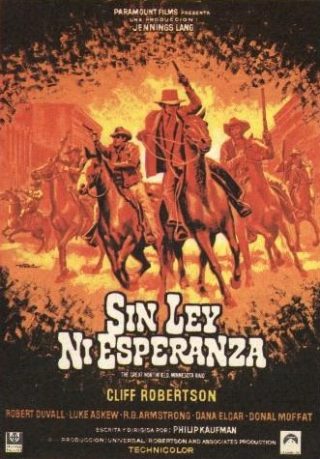
The whole film takes place within a fairly short space of time, concentrating on the lead up to, execution and aftermath of the bank robbery of the title. Mainly it’s a character study of Jesse James (Robert Duvall) and Cole Younger (Cliff Robertson), with the latter getting more screen time and coming across the more sympathetic of the two. With the possibility of an amnesty for their past crimes being granted by the Missouri state legislature, Cole Younger (recuperating after a run in with Pinkerton agents) rides for Northfield with the aim of heading off Jesse before he can raid the bank. Along the way, he learns that the amnesty he was hoping for won’t be forthcoming, so a change of plan is in order. The scenes in Northfield, which make up the central part of the story, represent both the best and worst aspects of the picture. It’s here that the yokel outlaws get their first glimpse of the new technology and customs that will soon change their world forever. Some of these scenes work very well, such as the shock of being confronted by an early motorized vehicle. On the other hand, the almost interminable baseball game, replete with Keystone Kops style pratfalls, comes across as needlessly self-indulgent and slows the whole film down. The idea of including it was sound enough but Kaufman drags it out to the point where it becomes distracting. It’s worth comparing this sequence to the camel race at the start of Ride the High Country as they’re essentially making the same point; the difference, however, is that Peckinpah knew where to draw the line.

Robertson is excellent as the thoughtful and charismatic Cole. He plays him as a man of the world and a realist, a guy who sees change coming and who is smart enough to see that dwelling on the past does no good. Duvall’s Jesse is the complete opposite – an unbalanced psychotic who cannot let go of the past and who treats all who stand in his way with a ruthless contempt. He talks in grandiose terms of having visions and excuses his excesses by referring to the guerrilla action he’s involved in. Both men give strong, believable performances that help ground the film. The supporting cast is also noteworthy with R G Armstrong playing the ill-fated Clell Miller, and old-timers Elisha Cook Jr and Royal Dano getting small but important roles. One other point I’d like to make relates to the way Frank James was portrayed; in every other movie I’ve seen, this character was shown to be a tough, smart but very human figure. In this movie, however, John Pearce plays him as a vaguely simple-minded soul who lives only to carry out his brother’s wishes. I’ve no idea if this closer to reality or not, but it’s a marked contrast to all other portrayals. I said earlier that I wasn’t all that impressed by Kaufman’s direction and, apart from the aforementioned baseball sequence, he also handles the actual robbery poorly. The scenes in the bank are fine, but as soon as the action takes to the streets it falls down. It’s difficult not to compare this to Walter Hill’s superlative filming of the same events in The Long Riders, where I found myself riveted. Kaufman has the camera swooping all over the place, yet there’s none of the intensity or power of Hill’s version. There are some nice shots of landscape and forest but the whole thing has a slightly cheap look, which is odd since he almost perversely manages to evoke an authentic sense of time and place. I don’t know, I think if he could just have changed the emphasis here and there we could have had one of the best cinema versions of these events. As it stands, the movie seems like it’s trying too hard to be an art house representation of what is really a fairly straightforward story.

The R1 DVD from Universal is barebones, save for the inclusion of the trailer, but the picture quality is excellent. I certainly didn’t notice any significant damage and the colours, while subdued, are true. There’s a nice, tight 1.85:1 anamorphic transfer and the disc is available very cheaply. In general this movie has some good ideas and fine performances, but I feel it could have been so much better. Like all other versions it’s littered with inaccuracies (for example, Jim Younger’s facial wound was sustained in Northfield, and not earlier as the film states) but that’s no big deal for me. I’m still of the opinion that The Long Riders remains the best telling of the story of the James/Younger gang, and that Kaufman’s movie is an interesting but flawed addition to the mythology surrounding these men.

Rocky Mountain

Having already made seven westerns, Errol Flynn got into the saddle one last time in 1950 to make Rocky Mountain. The whole tone of the film is different to what went before, and that makes it somewhat atypical. Both They Died with Their Boots On and Silver River had their darker moments but neither was as relentlessly grim as this. From the opening moments, when a weary, unshaven Flynn leads his bedraggled soldiers across a bleak landscape, an air of resigned fatalism hangs over the characters. This makes for a superior little picture, and one entirely in keeping with the era in which it was produced. By 1950 the western was on the cusp of one of its regular periods of transition, about to enter that Golden Age when heroes were less than perfect and endings weren’t always happy.

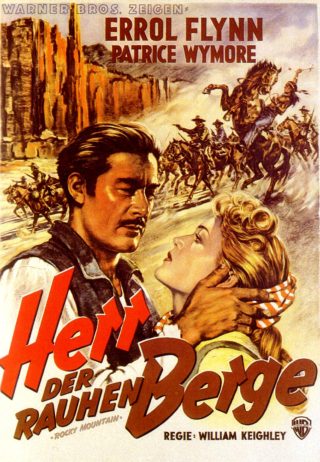
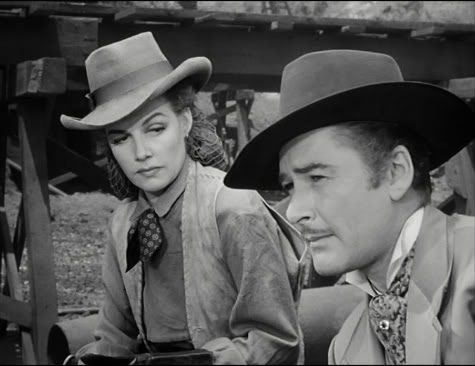
Lafe Barstow (Flynn) is a captain in the Confederate army who, in the dying days of the Civil War, has been sent west to California to raise a guerrilla force which his superiors hope will cause sufficient havoc to take the heat off their forces back east. We get our first sight of the small band of rebels as they near their rendezvous with the bandit warlord who has pledged his men to the cause. From there on the action is confined to the titular mountain and the barren valley below. Things go awry almost immediately when Barstow and his men take it upon themselves to rescue a stagecoach being pursued by a raiding party of hostile Shoshone. This act of gallantry is destined to backfire when it’s revealed that the sole surviving passenger is Johanna Carter (Patrice Wymore), the fiancee of a Union lieutenant stationed nearby. Not only has the secrecy of their mission been compromised but the rebels soon find themselves besieged by the vengeful Shoshone. A tense waiting game ensues and hard decisions will have to be made by all concerned. This is quite a downbeat story and, despite the misleading publicity blurb on the poster, the romantic aspects are largely ignored. There’s also a conspicuous lack of the kind of broad comedic moments that frequently characterize westerns starring Flynn.

I really enjoyed Flynn’s performance as the doomed soldier struggling to choose between duty and human decency. It’s sort of ironic that it should be his last western, and a low budget picture, where he finds a role that he could get his teeth into. Rocky Mountain was to be one of Flynn’s last good parts before he experienced a mini revival in his last years. It proves that the man could certainly act when the right material was offered to him – it’s just a shame that he chose, or had to accept, such poor vehicles thereafter. Patrice Wymore was soon to become the third Mrs. Flynn and she does fine as the reluctant hostage, appearing remarkably assured in what was only her second film. The support cast is generally good and there’s the bonus of seeing Slim Pickens making his screen debut as one of Flynn’s men. Long-standing sidekick Guinn Williams is also prominently featured (looking quite old and weathered, it has to be said) and he indulges in none of the comic pratfalls with which he’s often associated. Director William Keighley shot this sparse movie very professionally; both the action set pieces and the more thoughtful, talky passages work equally well, and he really gets the best out of the New Mexico locations. There’s not one interior in the whole film, and that’s always a good thing when the budget is restricted.

Warner’s R1 DVD of Rocky Mountain is another excellent transfer that shows off the crisp black and white photography to good effect. There’s the usual package of extras with three more of the very welcome western shorts that appeared on the disc for Montana. The film has also been granted a commentary track by Thomas McNulty, which I found both enjoyable and informative. All told, we get a classy presentation of a very fine movie which I’d recommend highly.

So, that brings me to the end of this little series on the westerns of Errol Flynn. I’m not sure how I’d rank them, but Rocky Mountain, They Died With Their Boots On and Silver River would have to be in the top three, with the first two probably sharing the top spot. I’d have no hesitation in placing San Antonio and Montana at the bottom of the pile, with the other three jockeying for position in the middle. Anyway, I’ve enjoyed viewing and writing down my thoughts on these films, and I hope others have taken some pleasure in reading them.

Montana

poster98

After watching Silver River, with it’s strong plot, good cast, and high production values, it’s a bit of a disappointment to view Montana (1950) next. What we have here is a B movie that uses technicolor in a vain attempt to disguise that fact. It’s a real struggle to find anything good to say about this film; the story is flat and unengaging, the cast largely anonymous, and the action (what little there is) is dull and devoid of tension. On the plus side, the colour photography adds a little sheen to a few scenes and it’s mercifully short, clocking in at just 76 minutes.

Montana falls into that small sub-genre of westerns that deals with the conflict between the cattlemen and the sheepmen. Now, there’s a very good reason why such stories never gained much popularity – it’s essentially a dull subject that doesn’t grab you. The plot deals with the efforts of Morgan Lane (Flynn) to drive his herd of little woolly guys into Montana and graze them on the open range. The cattle ranchers, who have already established themselves, are implacably opposed and are prepared to use whatever means are necessary to keep the sheepmen out. The ranchers, in the shape of Maria Singleton (Alexis Smith) and her betrothed Rod Ackroyd (Douglas Kennedy) have the range carved up between them and are preparing for war. Lane manages to trick Miss Singleton into signing over a lease, and the stage is set for a showdown. The problem is that there’s no real tension generated and the on-off romance between Flynn and Smith just feels contrived and serves only to pad out what is basically a lean tale. By the time you get to the appallingly poor climax it’s hard to care what the outcome will be.

This is one of Flynn’s poorest performances and it’s clear his heart just wasn’t in it. He looks tired for most of the running time and even his likability can’t lift this drivel. Worst of all there’s the unedifying spectacle of the star gritting his teeth and warbling along to a godawful ditty in a duet with Alexis Smith. Miss Smith wasn’t really served any better by this material and spends much of her time flouncing around playing a character whose behaviour perpetually alternates between the arch and the petulant. The  rest of the cast is filled up by a bunch of instantly forgettable nobodies giving one flat, one-note performance after another. Oh, S.Z. Sakall makes another of his unwelcome appearances but his character abruptly disappears and no explanation is offered – he’s just there, and then he’s not. This kind of continuity lapse, and the short run time, suggests that portions of this movie ended up on the cutting room floor. Ray Enright was one of those journeyman directors who could produce something passable given the right material, but his point-and-shoot handling of Montana is underwhelming and uninspiring. His filming of the big stampede at the climax is an object lesson in how not to shoot an action scene. We get pointless images of rampaging cattle interspersed with head and shoulder shots of Flynn and others bobbing up and down, pretending to be riding horses, against a painted backdrop!

For such a weak film Montana is presented handsomely on DVD in R1; the transfer is clean and the colours are strong. There’s a good selection of extras from Warners with trailers and shorts – best of all are three western shorts, which I actually found more entertaining than the main feature. Prior to this viewing I hadn’t seen Montana in over twenty years. I had forgotten most of the story and I have to say it really is a forgettable movie. If you’re a Flynn completist, like me, you’ll probably want it just to plug the gaps but I seriously doubt it’s the kind of movie anyone is likely to return to in a hurry. Next will be Flynn’s final western, and the last in this short series of reviews – Rocky Mountain.


Silver River

What a difference a director makes. One of my gripes with San Antonio was the fact that it was made by a man who didn’t seem to be in touch with the genre. The western is one kind of film where such a lack of association is especially damaging. Despite the fact that it encompasses so many themes and types of story, the western has its own look, rhythm and ethos – that’s what makes it unique, in my eyes anyway. Silver River (1948) is an odd mix of western and slightly soapy melodrama but, at heart, it’s really an old-fashioned morality play. Raoul Walsh was very much at home making oaters and his steady hand on the tiller ensures that this movie holds true to its course.

Silver River is a tale of one man’s rise, fall and ultimate redemption. It opens towards the end of the Civil War, when Mike McComb (Errol Flynn) deliberately disobeys an order, for the best of reasons, and is subsequently court martialled and cashiered. This has the effect of hardening his resolve to succeed at all costs in civilian life, and look out solely for number one. The first half of the movie charts his seemingly unstoppable rise both socially and financially, as he acquires capital, transport, a gambling house, interests in the mining business, and another man’s wife in rapid succession. As we follow each step of McComb’s progress, the script throws in one reference to the classical world after another (ranging from Julius Caesar to King David) to draw parallels with the character’s actions. McComb’s ruthless pursuit of power and glory drives him right to the brink of moral bankruptcy, but results in the financial bankruptcy that is necessary if he is to avoid slipping into the abyss. The aptly named Plato Beck (Thomas Mitchell) is on hand all the while to act as the voice of conscience. The drunken lawyer first assists McComb in his meteoric rise and then presides over his downfall, knowing that he must destroy his friend in order to save him.

Silver River is one of those movies that was almost perfectly cast. Flynn, nearing forty and with a few rough years behind him, is fine as the man still young enough for grandiose dreams but tinged with the kind of realism that comes from having lost a few rounds. His own personal troubles and the knowledge of what he was doing to himself at this point must surely have coloured his performance. Some of the scenes in the latter half of the film, where he is confronted with the ugliness of his actions and the prospect of abandonment, really ring true and one can read the resignation and despair in his eyes. Ann Sheridan is wholly believable playing the tough as nails frontier woman who first rails against Flynn before finally succumbing. Sheridan was one of those actresses who brought a lot of honesty to her playing and I thought she was especially convincing in the early scenes where she eschewed all of the usual Hollywood glamour to portray a woman who was the equal of any of the men around her. I always enjoy seeing Thomas Mitchell in anything and, although some may have a problem with his admittedly hammy style, find he brings an enormous amount of pathos and humanity to every part. His role in Silver River is a pivotal one and it’s entirely to his credit that it would be hard to imagine anyone else playing it. As I said earlier, Raoul Walsh holds everything together expertly and succeeds in preventing the melodrama from becoming too suffocating. The outdoor scenes and the action are everything you would expect from a director of Walsh’s calibre, and the more dramatic indoor confrontations are well shot with plenty of emphasis on the actors’ faces – something of a characteristic with this director.

Silver River was a surprise omission from Warners Errol Flynn western package, but it is freely available on DVD from them in France. The image quality looked pretty good to my eyes, save for a little softness in the first ten minutes or so. Thereafter the picture remains clean, sharp and quite consistent. The disc has removable French subs and is completely barebones but, on the positive side, it’s not all that expensive. I think this is a bit of an undervalued film that deserves to be rediscovered, so I’d recommend it. I’ll be looking at Montana next.

San Antonio


poster103It’s often difficult to put your finger on exactly why a film doesn’t work for you. I’ve frequently found that such films suffer from two basic flaws; they can’t seem to make up their minds what style to adopt, and/or the director is someone who has no real affinity or feel for the genre in which he’s working. The existence of one of these factors can easily hamstring a production – when they appear in tandem it’s never good news. I feel that San Antonio (1945) is one of those films that falls into this unfortunate category. There’s actually the makings of a fine film in there, and indeed it contains some well executed sequences, but it ultimately loses its way and winds up as a pretty unsatisfactory experience.

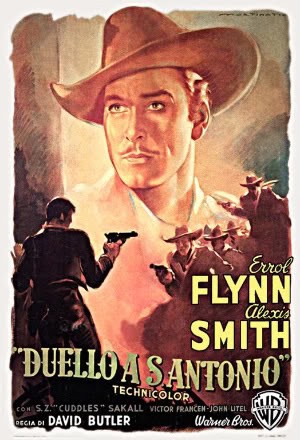
San Antonio is basically revenge western. The prologue places the action in Texas in the 1870s at a time when a struggle is taking place between ranchers and rustlers. Clay Hardin (Flynn) was once a big time rancher who’s been run off his property and left for dead. The early part of the movie finds him holed up in a Mexican pueblo, recovering from his wounds and preparing to return across the border with the hard evidence that will finally doom the rustlers. The plot follows a fairly straightforward line as Hardin tries to bring his enemies to book and they in turn try to find and dispose of his proof. The high point of the movie is the duel that takes place in the ruins of the Alamo between Hardin and the two principal villains (Paul Kelly & Victor Francen). This is a nicely shot sequence that generates a bit of tension but loses much of it’s impact due to the fact the story is allowed to dribble on when it should have ended there at its natural climax. Along the way there’s also time for a romance to develop between Hardin and visiting actress Jeanne Starr (Alexis Smith) – an attempt is made to turn this into a love triangle involving Paul Kelly’s character, but it quickly fizzles out as there’s never any doubt as how the chips are going to fall in this situation. The irritating thing is that all this forms the basis of what could have been a pretty good western. Unfortunately, there are far too many instances of jarringly inappropriate comedy and overblown musical numbers that stop the movie in its tracks. Any dramatic tension that had been building just gets killed stone dead in these moments.

Flynn played his part fairly straight throughout, and gives a generally sound performance. His features  were just starting to show a bit of wear at this point, but I thought that was fitting for a character who has taken a bit of a beating. Alexis Smith made a number of films as Flynn’s co-star and they work well enough together; her character remains believable and she certainly photographed nicely in technicolor. As the villains, Messrs Kelly and Francen are passable if fairly generic – their performances being of the snarling and moustache-twirling variety. One of my biggest problems was the casting of S.Z. Sakall, one of those acquired tastes I’ve never managed to develop. In my opinion, his presence is unnatural and unwelcome, adding nothing of worth to the picture and, most damningly of all, draining the dramatic clout out of a number of scenes. In his defence, he does manage to raise a smile when, early on, upon observing a riderless horse, he slips in a sly dig at fellow English language-mangler Michael Curtiz by announcing: “There goes an empty horse!” Unfortunately, the exact same gag is repeated at the end, just in case the audience were too dumb to catch it first time round. Generally, I’m not one to grouse about the injection of humour in a western, Ford, Walsh, Hawks and others managed to do it effortlessly and successfully. The problem with the jokes in San Antonio is that they come at the wrong time and verge on the surreal – a lime green parrot with a southern drawl and a whisky-drinking cat being conspicuous examples. When you get a script from Alan Le May and W.R. Burnett, it’s not unreasonable to expect something better, so I’d lay the blame at the feet of director David Butler. His western credentials are nearly non-existent and I have to say it shows up in the final result here.

San Antonio was clearly an expensive production and that’s apparent in the technicolor renditions of the lavish sets. Warner’s DVD shows these production values off to good effect, but the clean, sharp picture also highlights a few dodgy painted backdrops for exteriors. Nevertheless, the colours are strong and really pop off the screen, especially some of Alexis Smith’s costumes. All in all, this is an excellent looking DVD that I couldn’t fault – it’s just a pity that the movie itself doesn’t measure up. It’s part of the Flynn western collection but if it were available separately I couldn’t, in all good faith, recommend it. Coming up – Silver River.


They Died with Their Boots On

“What do you Yankees think you are? The only real Americans in this merry old parish are on the other side of that hill with feathers in their hair”

If most old movie fans were asked to name their favorite Errol Flynn picture I think that a significant majority would probably plump for The Adventures of Robin Hood. I couldn’t really fault that choice as it comes in near the top with me too, but it’s still not my favorite. That honor would have to be reserved for They Died with Their Boots On (1941). I don’t know if it’s Flynn’s best film but it is up there and must surely be seen as one of the high points of his career. The character of George Armstrong Custer is one that Tasmania’s most famous son must have seemed ideally suited to playing. When the film was made Custer’s reputation as one of America’s greatest military heroes was only beginning to be reassessed, so there’s no axe-grinding revisionism to be found. Judged as a faithful biopic or character study, the movie is open to all sorts of criticism; but that’s not really what They Died with Their Boots On is all about, and it would be doing it a great disservice to treat it too harshly on those grounds. No, this is a Boys’ Own adventure of romance and daring, of guts and glory – and taken as such, it works perfectly.

There have been numerous portrayals of Custer on screen, dating back to Francis Ford in 1912, but I doubt if any have imbued the man with the glamour that Flynn brought to the part. The film traces his life and career from his entry into West Point up to his final moments at the Little Big Horn. Custer’s arrival at the US military academy, in all his gold-braided glory with a pack of hunting dogs in tow, is largely played for laughs, although it does set up a simmering rivalry with fellow cadet Ned Sharp (Arthur Kennedy) that’s crucial to the plot’s development. In fact, this is a film of two distinct parts; the first hour or so is mostly lighthearted knockabout stuff with only the occasional foray into more serious matters, while the second half takes on a decidedly darker and moodier tone. Therefore, we get to see Cadet Custer as a kind of fun-loving prankster who liked to ride his luck and chance his arm with authority, which, by all accounts, wasn’t too far from the truth. When the Civil War intervenes and necessitates his early graduation, Custer finds himself torn between pursuing his interest in the love of his life, Libby (Olivia De Havilland), and his enthusiasm to get into the thick of the action. Naturally, the pursuit of glory and honor wins out, and this leads to a nice little scene in Washington with General Winfield Scott (Sydney Greenstreet). Interestingly, Custer did have a fortuitous meeting with the Union commander on arrival at the Adjutant General’s office which led to his first active posting – albeit without the business with the creamed onions. The war, which ironically brought enormous fame to Custer, is given only minimal attention but it does show his rapid rise through the ranks. While all this is presented in a highly entertaining fashion, you still get the sense that we’re only marking time until we get to the real meaty stuff – the move west and the Indian Wars.

With the action shifting to Dakota, the whole feel of the film changes and raises it up to a different level. There’s still time for the odd lighter moment but it’s quickly apparent that this new war is no gentleman’s affair. Custer almost immediately clashes with his old foe Sharp who’s running a saloon and trading rifles with friendly Indians from within the fort. The first order of business is to end the drinking and whip the drunken recruits into some sort of fighting force. This is achieved via a wonderful sequence whereby Custer adopts the old Irish drinking song Garryowen and uses it as a means of instilling a sense of pride and unity into his ragtag 7th Cavalry. There’s also the first view of the red men, and in particular their chief Crazy Horse (Anthony Quinn). One notable aspect of this movie is the respect afforded to the Sioux; at no point are they portrayed as anything less than a disciplined fighting force with legitimate grievances. The real villains of the piece are the corrupt officials and their businessmen backers from the east. The point is made very clear that the Sioux are left with no choice but to rise against the whites when treaties are broken and their shrinking homeland is further encroached upon. When Custer leads out his last fateful expedition he does so in the hope of earning more personal glory of course, but it’s also obvious that his political masters and their moneyed allies have left him with no other option. So, he leads his 7th to the Little Big Horn – to hell…or to glory, depending on one’s point of view.

Flynn gave one of his better performances in They Died with Their Boots On, particularly in the second half. You can see the character gradually mature as the story moves along, his youthful optimism giving way first to disillusionment and then, finally, to a perversely jaunty death wish. If you wanted to stretch a point, it’s possible to see parallels in the course of Flynn’s own life. There’s also much more maturity in the relationship between the characters of Flynn an Olivia De Havilland; this would be their last film together and that fact adds considerable poignancy to their farewell scene, which is pitch perfect in its playing. However, even though the film marked the end of one partnership, it would signal the beginning of another – this was the first movie that Flynn made with director Raoul Walsh. If the star’s relationship with Michael Curtiz was a less than happy one, his collaboration with Walsh was much more congenial. These were two men who were much closer in temperament and Flynn seems to have felt a lot more comfortable in the company of the buccaneering old director. Walsh was one of those directors who was always in his element shooting outdoors on location. I’ve already made the point that when the film switches to the west it moves up a gear, and I think that’s due, in part, to Walsh’s affinity with the outdoors. The last half hour or so has a dreamy, poetic quality that’s the equal of some of John Ford’s best work – and that’s no mean feat. It should also be pointed out that the movie benefits enormously from one of Max Steiner’s finest and most memorable scores, which is built around the rousing yet vaguely melancholy Garryowen.

Warner’s R1 DVD (I believe the R2 is the same transfer) of They Died with Their Boots On is quite fabulous, clean and sharp with barely a damage mark in sight. It has a good selection of extras though it lacks a commentary, which I feel this movie deserves. OK, maybe this isn’t the best western you’ll ever see but it’s right up there among my all time favorites – one of those films that unfailingly pushes all the right buttons on every viewing. Next up, San Antonio.