City of Bad Men

poster2022_zps3xgrqrcz

A lot of you all rode into this town, but you are the only one who saw anything. You noticed the change. The others don’t look past the end of their guns. You saw the handwriting on the wall. They don’t even see the wall because their backs are against it. Their days are over. They don’t know it.

Sometimes I like to open with a quote that in some way sums up the tone, mood or message of a given movie. In this case, those lines above represent more of what I feel the film could have been as opposed to what we actually end up with. City of Bad Men (1953) is a title which left me feeling not entirely satisfied when I first saw it and so I thought I’d give it another go to see if my reaction would be any different this time. The answer is a kind of yes and no: yes in that I enjoyed it all a little more, but I still came away with that nagging sense of having seen an opportunity missed, or at least not fully grasped.

On St Patrick’s Day 1897 in Carson City, Nevada, a fight for the world heavyweight championship (actual footage of the bout can be viewed on YouTube) took place between Bob Fitzsimmons and “Gentleman” Jim Corbett. This event forms the backdrop to and also constitutes a major plot element of the film. Returning from an unsuccessful trip south of the border as soldiers of fortune is a group of weary men led by Brett Stanton (Dale Robertson). With little of worth to show for their time and effort, they are heading for Carson City with the hope of knocking over the bank in what they believe to be a perennially sleepy town. However, the town they ride into has undergone a transformation, partly due to the changing nature of the times but also as a result of the upcoming prize-fight. Yes, civilization and the trappings of the modern age – the motor car and luxuries like the shower – are slowly creeping westward. While his men gaze upon these alien sights with a kind of detached bemusement, Stanton’s calm features mask the fact that the seeds of an opportunistic plan have been sown in his mind. Crowds like this mean money – money which can be made or stolen. Yet Stanton isn’t the only one to entertain such thoughts; other gangs of unscrupulous men, most notably those led by Johnny Ringo (Richard Boone), have been drawn by the prospect of easy pickings. The local lawmen realize the volatility of such a situation and hit on the novel idea of appealing to the mutual suspicion of these various desperadoes and convincing them that the best way to keep the peace (and thus protect their own mercenary interests) is by keeping an eye on each other. Stanton is smart enough to see the advantages of such an arrangement, but he’s also aware of the complications and obstacles ahead of him: the need to come up with a viable plan to pull off a spectacular heist, the latent jealousy of his brother Gar (Lloyd Bridges), and the feelings he still nurses for the girl (Jeanne Crain) left all those years ago.

As I see it, there are four major themes at play in the movie – the noir-tinged heist plot, the classic idea of changing times, the sibling rivalry, and the notion of redemption earned through love. Lots of material to chew over yet only one, the heist aspect, is realized fully and successfully. The fact the script allows this to develop naturally and then the way Harmon Jones directs its execution, cutting between the fight, the collection of the takings and the way the money is subsequently lifted, is a fluid and assured piece of filmmaking. It makes for a fitting climax to the picture, but also highlights the deficiencies in the handling of the other facets. The early scenes give the impression that the “men out of time” part will be of greater importance, but it’s something the film only pays lip service to in reality. Similarly, the tension between Brett and Gar is never fully explored and its resolution feels rushed in the end. As for redemption, which ought to form the centerpiece of a western of this era, I was left feeling that it’s achieved a touch too easily, and the means by which it’s linked to Brett’s reconciliation with his old flame is weakened by its abruptness. I guess what I’m trying to say here is that the film has a strong foundation with a number of rich veins running through it, only few of which are mined and even then not to their full extent.

When called upon to do so, Dale Robertson was good at conveying cold intensity but that wasn’t really a requirement in this role. He displays the necessary toughness to hold the whip hand over his own bunch of ne’er do wells and to keep his rivals in check. Essentially though, the part of Brett Stanton is all about calmness, a kind of melancholy thoughtfulness. His air of regret and his flexible morality tie in with, and feel like an extension of sorts of, the type of disillusioned veterans so common in film noir, bewildered by and isolated from the new world they find themselves confronted with. For me, Robertson’s quietness and restraint is one of the major strengths of the picture. Ranged against that is the restlessness and impatience of Lloyd Bridges and, more significantly, the rattlesnake charm of Richard Boone. If anything, Boone is underused in the movie, lighting up the screen every time he appears while leaving you disappointed he’s not there more. Which brings us to Jeanne Crain – her character is a vital one through the effect she has on Robertson, but the script doesn’t treat her well. She’s placed in a conflicted position that’s loaded with dramatic possibilities yet her character arc isn’t wholly convincing and the resolution, which forms the core the film’s resolution in itself, is just a little too convenient for my liking. In support, we have Carole Mathews, Rodolfo Acosta, James Best, Leo Gordon, John Doucette and, in blink and you’ll miss them parts, Frank Ferguson and Percy Helton.

City of Bad Men is a 20th Century Fox production and was released on DVD in Spain some years ago by Impulso, licensing the title from Fox. That disc offers a passable transfer which is clearly unrestored. There are a number of instances of print damage and the colors tend to look faded throughout. Having said that, it’s perfectly watchable – there was subsequently a US release by Fox itself, but I have no idea how that transfer compares. The Spanish DVD offers the original English soundtrack along with a Spanish dub and optional Spanish subtitles. Of the Harmon Jones westerns I’ve seen, I’d say this is probably the least of them. I’d certainly rank it below his other two with Robertson, The Silver Whip and A Day of Fury. All told, there are some positive points and the film remains briskly enjoyable. Nevertheless, I can’t shake that feeling that it had more to offer than it ultimately delivered. In the final analysis, a medium effort.



Two Weeks in Another Town

poster202_zpseeehnr2s

Introspection can be both self-indulgent and revealing, turning the gaze inward in search of some truth that seems elusive in the outside world can bring rewards, perhaps most notably for those whose business it is to present a facade for public consumption. It shouldn’t be all that surprising then that Hollywood, where dreams and illusion are daily spun from the dancing lights of the projector, periodically turns the cameras around to focus on itself. There’s something almost perverse about the industry’s need to pick away at its own glamorous veneer, as though it were prodding us in the ribs and daring us to confront the artifice at its heart. Two Weeks in Another Town (1962) was Vincente Minnelli’s second bite at the hand which fed him, following the previous decade’s The Bad and the Beautiful.

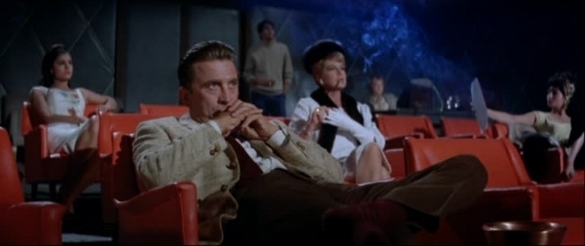
Jack Andrus (Kirk Douglas) is a movie star, one of that glittering breed idolized and worshiped by so many. Although it’s perhaps more accurate to say the Jack Andrus we see at the beginning was a movie star, a subdued figure strolling ineffectually round the grounds of the psychiatric clinic where he’s staying. The scar on his face, a memento of the events that led him to his current abode, has healed. However, it’s as nothing compared to the raw wounds he still carries around inside. His doctor says he feels Andrus is fit to leave, not necessarily cured but able to leave all the same. And there’s a hint of hope for the future too, a cable from his old director asking him to fly out to Rome for a small part in his latest production. But we’re talking about the movies here, where nothing and nobody can be taken at face value, and the truth is that Andrus is essentially washed up. The director, Maurice Kruger (Edward G Robinson), doesn’t really have any intention of using him on screen. Basically, it’s a ploy, partly as a kind of sop for Kruger’s guilt over his involvement in Andrus’ breakdown. If our star has hit bottom, then the once great director is headed in the same direction, although his decline is slightly more graceful and a little less dramatic. The picture represents something of a last bid for glory for Kruger, and it’s in danger of being derailed by the ruthlessness of his hard-headed Cinecittà producer. Standing between him and the prospect of failure and humiliation is Andrus, the man he first built up and then destroyed. So what does he do? He tosses this one-time star a few crumbs from his table, hoping that the hunger of a starving man will prove his salvation. To Andrus, the vital but seemingly demeaning task of supervising the post-production dubbing is like a slap in the face initially. Still, the lure of the movie business, and maybe more importantly, the chance to prove himself capable of doing anything of worth again is strong. And then there’s the figure of Carlotta (Cyd Charisse), the woman he tried to love and lost his mind over. She flits in and out of proceedings, simultaneously taunting Andrus with reminders of what he’s lost and holding out the promise of new adventures ahead. What it all boils down to is a two-week sojourn in a town where he may either drown in the heady atmosphere or, if he can see through the showbiz smokescreen, have the chance to regain the mastery of his soul once again.

£6

While I still think Two Weeks in Another Town is a very good film, it could potentially have been a great one. Charles Schnee wrote the script from a novel by Irwin Shaw, and the score was provided by the great David Raksin. With Milton Krasner shooting Minnelli’s beautiful nighttime setups just about all the ingredients were in place for a stone cold classic. But then, and ironically mirrored by the plot itself, came the interference from the studio. In his autobiography (The Ragman’s Son, Pan Books 1989,  pp 342-344), Douglas claims the movie was recut and edited when Joseph Vogel became the new head of MGM, stripping out some of the racier and more dramatically satisfying elements. I think that much can be seen in the somewhat sketchy development of a few of the characters. What we’re left with is the core of the story, of a man desperately seeking personal and spiritual redemption and the peace that comes with it. In addition, there’s the unmistakable stamp of Minnelli, the careful framing of whose shots create the kind of tableaux that approach visual poetry on occasion. It would be remiss of me not to mention his masterful use of color – the whole film is drenched in the deep, saturated hues which often characterize his work. Perhaps he falls short of achieving the dramatic and visual intensity of his sublime Some Came Running, but there are moments when he gets within striking distance at least.

Kirk Douglas was making his third appearance in a Minnelli production and he’s well cast in a role that calls for the type of mood swings which range from ebullience through manic intensity by way of brooding melancholy.  While the focal point of the story is on Andrus’ journey of self rediscovery, and the necessary laying to rest of old phantoms along the way, there’s room too for some interesting observations and musings on the nature of the actor, that wearer of masks. A wistful, early morning conversation with a besotted Daliah Lavi sees Douglas reflecting on the contradictory nature of the actor, the retreat from reality and submergence of the self in the character of others which actually runs counter to the overwhelming desire to better understand one’s own sense of being. Ultimately, it’s the reconciliation of these seemingly incompatible urges which lies at the heart of his character’s motivation.

£7

Robinson’s aging director is also notable, both in itself and as a commentary on the corrosiveness of the movie-making business. The essential insecurity of the man is demonstrated though the need to reaffirm himself through his notorious affairs with leading ladies  – which has had such an adverse effect on his relationship with his wife, an exceptionally acidic Claire Trevor – and also his desperation to prove once again his worth as an artist. It’s his fear of losing control, both personally and creatively, which drives him and finally twists his soul towards bitterness and distrust. The person who links (and divides) Douglas and Robinson is Carlotta as played by Cyd Charisse. Apparently a good deal of her part ended up on the cutting room floor, which is a shame as she is very good based on what we do see of her. Whether it was intentional or not from the outset, she comes across as a blend of the enigmatic and the alluring, leaving a trail of emotional devastation in her wake while attempting to seduce her former lover back onto the same self-destructive path. The contrast comes in the form of Daliah Lavi’s Roman ingenue (demurely clad in simple and pure white throughout as opposed to the arch and lurid costumes of Charisse) whose understated charm and innocence helps restore Andrus’ perspective. I was less impressed by George Hamilton’s troubled young star, never feeling all that convinced by the struggle he’s supposed to be waging against his personal demons. In support, there are small parts (virtual cameos in truth) for George Macready and James Gregory.

Two Weeks in Another Town is available on DVD as part of the Warner Archive in the US and there’s also an Italian release available. I have that Italian disc and it presents the film in the correct anamorphic scope ratio. The transfer is good, clean one with no notable instances of damage. Colors are generally well reproduced, something very important in a film such as this, and the image is pleasing overall. The disc offers the original English soundtrack and an Italian dub, and there are no subtitle options of any kind. As for extras, there’s the theatrical trailer and some galleries. Frankly, I like this movie, but films about films always interest me anyway, and I feel it’s a great pity that parts of it were excised at the behest of the studio boss at the time. Nevertheless, the movie that we have available to view, in spite of its imperfections, is never less than fascinating for the peek behind the facade of filmmaking it affords us and also the central story of a man battling to come to terms with himself and the choices he’s made in life. I recommend it.

Kirk Douglas reaches the grand age of 99 today and I thought I’d take the opportunity to post this piece on that occasion to draw attention not only to this great actor’s birthday but also to just one of the countless strong performances he’s delivered over a long career.

Comanche

poster53_zpstmnatcfz

So that’s the way it is. Comanches kill Mexicans to get even with the Spanish. And the Mexicans kill Comanche in revenge for that. It’s become a way of life.

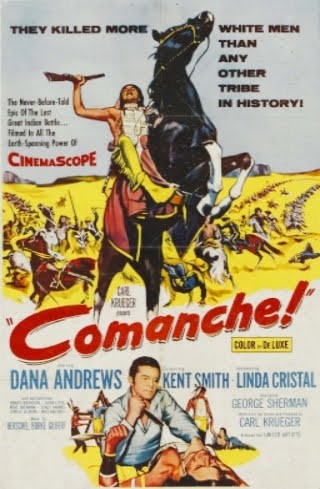
Westerns, naturally enough, have a habit of featuring a fair number of real life historical figures. For the most part, these portrayals are heavily fictionalized since the films are dramas first and foremost. We’ve seen outlaws and lawmen, soldiers and natives transposed to the big screen, and it’s those in the latter category who, despite what some might tell you, actually tend to fare best in terms of sympathetic depictions. Comanche (1956) looks at Quanah Parker, the son of a captive woman, who rose to prominence as a war chief among his tribe, and presents him in a highly flattering light.

The onscreen prologue informs us that in 1875 a bitter and age-old war continues to rage between the Mexicans and the Comanche. The latter raid and massacre the unprotected villages close to the frontier with the US with impunity, while the former still pay out a bounty for Comanche scalps. The result is a brisk trade among the despised scalp-hunters and also pressure from the Mexican government on their northern counterparts to do something about the frequent cross border incursions. The opening sees one of those sleepy villages razed to the ground, its inhabitants largely butchered and the young women taken as captives. The scene then shifts to the land just across the Rio Grande, where part of the raiding party stumble upon a team of scalp-hunters and quickly overpower them. Just as the prisoners are about to be roasted alive, their grisly death is halted by the intervention of a more powerful presence. This is Quanah (Kent Smith), and his actions serve to raise the ire of his subordinate Black Cloud (Henry Brandon) and also to raise questions in the viewer’s mind. Why should this man make such a magnanimous gesture towards those preying on his people and simultaneously risk alienating the more hot-headed types like Black Cloud? The army’s chief scout Jim Read (Dana Andrews) has a hunch it’s a means of sending out signals of peace. When the US and Mexican governments decide to act, it’s Read who suggests heading into Comanche territory to sound out Quanah on his intentions, and maybe open negotiations with him instead of going straight for the military option. We later discover that there’s an intriguing connection between these two men, although both will have to address betrayals from within their own ranks by those with hawkish tendencies if any rapprochement is to be achieved.

What can be termed pro-Indian sentiments are to be found scattered throughout the westerns of the 1950s, and Comanche is yet another example of this trend. Part of the beauty of these movies, for me anyway, is the realistic way this is handled. We’re not presented with some blind diatribe, demonizing one side or the other for the sake of cheap point scoring. Instead, by focusing on a few individuals, there’s a more balanced perspective offered – the rights and wrongs, along with the brutality and cruelty perpetrated by both camps is acknowledged and confronted. As with almost everything in life, it’s only through such consideration of the subtle shadings that a mature appreciation is possible. And remember, it can’t be stated often enough that the 1950s was the decade when the western itself attained full maturity as a cinematic art form.

Comanche was directed by one of this site’s favorites, George Sherman. He was no stranger to the pro-Indian western and his strong visual sensibility is always in evidence too. This is very much an outdoors picture, shot by Jorge Stahl around Durango, and the tough, dusty landscape provides a harsh and bleak canvas upon which the human drama is played out. Sherman frequently makes full use of the wide scope lens, that primal backdrop packed with hordes of Comanche warriors or snaking columns of cavalry, to create an epic feel at times.

The character of the cavalry scout is a pivotal one from the audience’s point of view as the impartial intermediary acts as the eyes through which we view the unfolding events. Such a role needs to be filled by a man who can convey a sense of integrity alongside a stoic quality, yet he must also maintain an air of the outsider about him since he’s essentially got a foot in both camps. Step forward Dana Andrews. If ever an actor was possessed of the aforementioned characteristics, then it must surely be Andrews. He’s obviously best known for his noir parts, particularly those with Preminger and Lang, but he was equally fine in the western too. Kent Smith might seem like an odd choice to play Quanah, still I think he’s satisfactory. You could argue his role is a touch too noble and one-dimensional, I suppose; even so, he invests the part with a great deal of dignity and you get a feeling of the power of the character. The villainous types are played by Henry Brandon (interestingly taking on the part of the enemy of his own son, if you read The Searchers as a loose adaptation of the Parker story), Stacy Harris and Lowell Gilmore. And then there’s the beautiful Linda Cristal, making her Hollywood debut as the traumatized captive girl. She is pretty good although her character doesn’t get quite as much development as it deserves. Anyway, Sherman was obviously sufficiently impressed by her talents to use her again as the female lead in The Last of the Fast Guns a couple of years later.

Comanche has been available on DVD in France and Spain for a while now but I held off buying it as it seemed the picture quality was nothing special and then there was also the forced subtitle issue on the French disc. It’s just been released in the UK by 101 Films, who have put out a number of western title in recent times, and so I thought I’d take a chance. First, the good news: the film is presented in its correct 2.35:1 scope ratio. And now for the bad news: the disc is not anamorphic so the image is surrounded by heavy black bars that can only be reduced by zooming in, with the resultant loss of resolution. Also, the print used is clearly an old one which, although not showing all that much damage, is somewhat faded and lacking in detail. All told, it’s a very disappointing presentation of the film, one which I can’t recommend in good faith. What makes this even more frustrating is the fact that the film itself is a very worthwhile one that deserves far better treatment than it’s been afforded so far.

By way of a postscript, I’d like to add that this blog was eight years old a few days ago. Normally, I like to mark the occasion with a posting but circumstances conspired against me this time. Anyway, I reckon this movie is an appropriate way to celebrate the anniversary, albeit a couple of days late.


Thunder in the East

An exotic locale, a morally dubious lead, and a set of circumstances with all the potential of a powder keg in a raging inferno – this is the kind of scenario which generally grabs my attention effortlessly. Such movies always hold out the promise of adventure, intrigue and, if we’re lucky, maybe a little something extra to spice it all up. Thunder in the East (1951) is a film that could have sold itself to me on the basis of the cast alone, and the aforementioned plot elements simply ramped up the appeal.

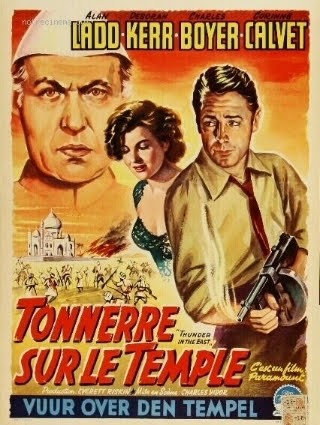
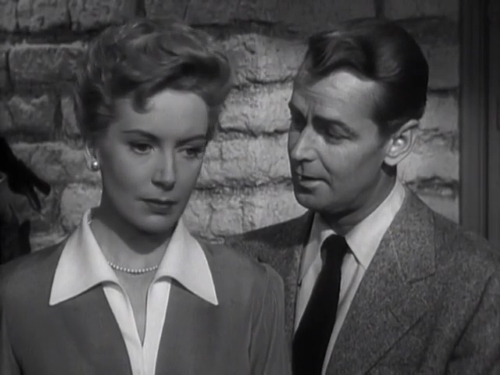
India, in the period just after independence, and a plane lands in the fictional province of Ghandahar. The pilot is Steve Gibbs (Alan Ladd), one of those rootless Americans so beloved of films of the period. He claims to have an appointment with the Maharajah, and positively exudes the kind of cockiness that is the preserve of men confident of making a quick and substantial profit. We never learn much about what made Gibbs the man he is beyond the fact he once was a member of the Flying Tigers, but that’s not really important. He’s in Ghandahar to sell a shipment of arms to the head man and the unstable political situation thereabouts leaves him feeling pretty sure of his chances of success. Regardless of all that, our man is riding for a fall as he’s failed to count on the presence of the Maharajah’s right hand man, and the real power in the province, Singh (Charles Boyer). The latter is a man of rigid principle, one who has seen what can be achieved without resort to violence and is thus determined to be rid of Gibbs and his cargo of munitions. Before he knows what’s hit him, this flyer finds his wings clipped and his weapons impounded. Still and all, a man like Gibbs is naturally inclined to sniff out the chance of making a deal wherever and whenever the opportunity arises. If that means selling his wares to the rebel opposition in the surrounding hills and later topping up his take by evacuating the Europeans he’s placed in greater danger, then so be it. But fate, or perhaps destiny if one’s mind runs in that direction, has a habit of intervening and toying with such schemes. Few men are truly devoid of conscience or feelings, and the apparently innocuous presence of a blind woman (Deborah Kerr) stirs memories of such sentiments within Gibbs. What remains to be seen is how this mercenary character will respond, and indeed how others will similarly address their own preconceptions, as the militia relentlessly burns and butchers its way towards the practically defenseless palace.

Thunder in the East was directed by Charles Vidor, a man whose work I’m not all that familiar with. Gilda is clearly his standout title (Ladies in Retirement is one I intend to get round to as I work my way through my unwatched pile) and ought to mark him out for attention even if he’d never shot another picture. His work on here is fine although it flags a little in the middle as the tension drops off slightly. The film was photographed by Lee Garmes, who was in the middle of a fine run at this point, and his touch is particularly evident in the second half. While it never reaches the heights of exoticism or atmosphere to be found in von Sternberg’s Shanghai Express there’s much to admire in the filming of Ladd’s drive through the sacked town and the tense climax in the besieged palace grounds.

For me, the theme underpinning a film is the aspect which stimulates or interests me most. Even the most casual viewer to this site will be aware that I’m an unashamed fan and champion of the western, that purest and most beautiful of all cinematic genres. The classic western theme is that of redemption and spiritual rebirth, yet it’s by no means confined to that genre and can be found throughout cinema, particularly in the classic period. Thunder in the East is therefore no exception in this respect, and I think it’s this which is its greatest strength. The intrigue and suspense have a part to play of course but the heart of it all, that which gives it life and artistic value, is the redemptive journey undertaken by Steve Gibbs. Allied to this, and bolstering it all, is the focus on the restorative power wrought by the faith of others in the inherent decency and humanity of even the most jaded of souls; just as Ladd becomes the eyes of Kerr by proxy, so she becomes the small voice whispering persuasively within his mind to kindle the embers of half-recalled ideals.

Alan Ladd seemed to make a habit of starring in a string of movies located in the East around this time – Calcutta, Saigon, China – and this provided a pretty good role for him. He had the laconic toughness down pat and was generally at his best when he used that quality to disguise his inner pain. I think the best acting always derives from the search, either within or without, for fulfillment and the peace which accompanies it, and Ladd was a fine exponent of that. For such a quest to take place it’s necessary for a tangible and credible motive to exist. If Ladd is the tarnished knight, then his grail is represented by Deborah Kerr. She was always a classy performer, alluring yet also pure. I alluded to the western above, and I shall do so again as Kerr’s role illustrates just how significant the female frequently is in both spurring and completing the spiritual odyssey of the hero. Playing blind, or indeed any physically challenged, characters can be problematic, the potential for descent into cliché being ever present. In my opinion Kerr avoids that danger and gives a portrayal of a fully rounded character who never strays towards the pitiful nor the superhuman. Boyer is also fine as the conflicted and idealistic Singh, embarking on a philosophical journey of his own over the course of the story. In support, Corinne Calvet is perhaps somewhat wasted as the fearful courtesan and I think more could have been made of her part. In smaller roles, John Williams and Cecil Kellaway are welcome faces in fairly typical, but highly enjoyable, character turns.

As a fan of Alan Ladd I’ve always been on the lookout for his films and Thunder in the East has been one of the more elusive titles. It’s recently been released on DVD in Italy and I was keen to sample it. The transfer is what I’d term as OK, a little soft and muddy with occasional instances of print damage visible. Having said that, this Paramount film is not widely available and I can’t say the overall presentation was a major disappointment under the circumstances. The soundtrack is offered in both the original English and also an Italian dub and there are optional Italian subtitles. The disc features the theatrical trailer and a selection of galleries as extras. I should perhaps point out that the movie offers up a critique of the philosophy of passive resistance, building towards a resolution that may or may not appeal – I leave that judgement to each individual, and it’s not my intention to pass comment on it either way. On the whole, I liked the film. Some may regard the ending as being a little rushed but I can’t say it bothered me too much. Recommended to those who enjoy Ladd and Kerr, and who appreciate the kind of themes often found in westerns of the era.

I Walked with a Zombie

poster38_zpscnqfhfse

Everything seems beautiful because you don’t understand. Those flying fish, they’re not leaping for joy, they’re jumping in terror. Bigger fish want to eat them. That luminous water, it takes its gleam from millions of tiny dead bodies. The glitter of putrescence. There is no beauty here, only death and decay.

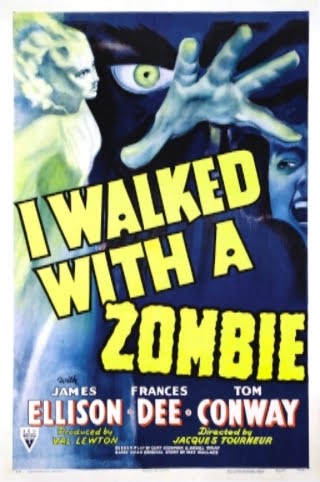
From time to time I like to revisit the films of Val Lewton, those nine macabre tales he made as head of his own production unit at RKO and upon which his reputation rests. I can’t say it’s ever an especially arduous task, they all have brief running times and I rank them among my favorite works since I first made their acquaintance as a young boy, alternating between fascination and fear during those late night TV screenings. One of the first I saw was I Walked with a Zombie (1943), a title guaranteed to fire the imagination of any young viewer. As with all of Lewton’s pictures, it’s not so much a shock-filled horror film as a dreamy study of unease and dread, where suggestion and atmosphere creep up behind you and softly whisper “Boo” in your ear.

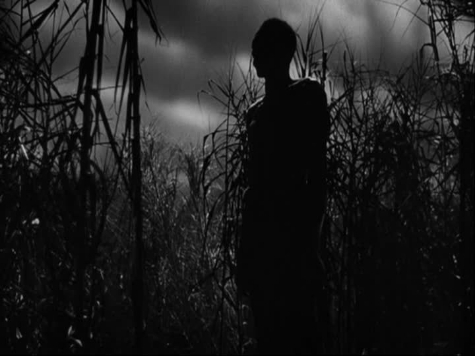
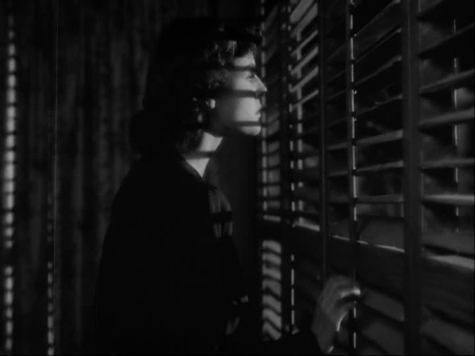
It all starts out bright and crisp, like the snow falling outside the window of the Ottawa office where Betsy Connell (Frances Dee) accepts the job of nursing an invalid woman on a West Indian island. It’s only when she’s aboard the ship that will transport across the sea to her new appointment that Betsy’s new employer Paul Holland (Tom Conway) makes that little speech which I used as an intro that darkness, along with its faithful companions doubt and suspicion, extends its shadowy fingers. Holland owns a sugar plantation and shares his home there with his half-brother Wesley Rand (James Ellison) and his wife Jessica (Christine Gordon), the zombie of the title. Jessica exists in a semi-catatonic state, awake but no longer aware of the world around her, apparently the result of a bad bout of fever. Holland is keen to impress on Betsy the melancholy history of the island, a place where the inhabitants, all descended from slaves, still live in thrall to the Voodoo religion. She finds herself fascinated by the reserved and withdrawn Holland, sympathetic to the hard-drinking Wesley, and simultaneously repelled and intrigued by the shattered beauty of the listless Jessica. As her attraction to her employer grows, the young nurse gradually learns more of the tragic history of this family residing on an island which itself is no stranger to suffering. In that contrary way that love often manifests itself, Betsy resolves to do all in her power to haul Jessica back to the living. That will involve putting her faith in the mysterious beliefs of the islanders and taking a nighttime walk through the cane fields that take on an eerie complexion in the twilight cast by a warm Caribbean moon. What she finds at the end of it will answer some of her questions but, paradoxically, raise as many more.

£9

Producer Val Lewton was tasked with running a low budget horror unit at RKO and it’s often said that his low-key approach and reliance on atmosphere and the inherent creepiness of the unknown was fueled by the lack of funds and the subsequent desire to avoid being seen as a cut-price version of Universal with its gallery of monsters and freaks, the only concession being the pulpy and frequently lurid titles of the pictures. I’ve no doubt this played a significant part in the process but I’d also like to think that Lewton’s own artistic sensibility entered into the equation too. For there is a high level of artistry involved in these movies, which beguile and chill the viewer in equal measure. The horror movie can be a rather obvious genre, only rarely restraining itself from the temptation to provide instant gratification via visual shocks and, as time has gone on the audiences more jaded, an over-reliance on gore. But that wasn’t Lewton’s style; he worked with three fine directors over the course of his nine RKO  horrors – Mark Robson, Robert Wise and Jacques Tourneur. All those films are good, but I feel that it’s with the latter that the best work was done. As far as I’m concerned, this is no coincidence as Tourneur was a master of subtlety. He was fully aware of the power of his camera and his compositions and pacing have a smoothness that belongs only to the truly talented. In truth, there’s not a bad shot in the whole movie, but the highlight has to be the trek through the cane fields, the recreation of which is a tribute to the art department, with the sense of dread and foreboding ever present but always that crucial step short of overwhelming.

The cast is led by Frances Dee and her performance hits exactly the right tone, vulnerable enough to make the threatening atmosphere believable yet grounded by a practicality that befits one charged with the task of caring for an essentially helpless woman. The film and role calls for a degree of nobility, or perhaps selflessness is a better term, and that’s not an easy thing to pull off successfully; there’s always the risk of it appearing somehow insufferable and it takes a fair bit of skill to dance around that particular pitfall. In short, it’s a balancing act and one which I feel Ms Dee negotiated with aplomb. Similarly, Tom Conway (who had the distinction of appearing in three of Lewton’s very best productions) plays it cool and keeps away from the histrionics. Like his brother George Sanders, suave and debonair were second nature to Conway and I’ve always enjoyed seeing him work – The Falcon movies are among my absolute favorites when it comes to series detective fare. However, a love story, and this is certainly as much a romance as a horror film, needs some overt passion to be displayed. That is provided by James Ellison as the volatile half-brother, an unpleasant part in many ways but well performed all the same. The supporting players are rounded out by Edith Barrett, James Bell, Sir Lancelot, Theresa Harris and the wonderfully spooky Darby Jones as the sinister, bug-eyed Carrefour.

£8

I Walked with a Zombie is pretty easy to see – I bought it years ago as part of the excellent Val Lewton box set released by Warner Brothers in the US, but there are a range of European editions on the market too. The US version has it paired on DVD with The Body Snatcher, and the transfer is reasonable. RKO titles can prove problematic and there are instances of print damage visible but I can’t honestly say I’ve been overly troubled by them – the film just kind of sweeps you along. The disc also includes a commentary track by Kim Newman and Steve Jones. Halloween is a good time of year to wheel out these kinds of movies but a classic tale like this is really timeless and works its magic regardless of the season – after all, I first saw it and fell in love with it on a July evening way back in 1981. Anyone wondering what to view as the witching hour draws ever closer could do worse than give this a spin, and those who have yet to experience the delightful art of Lewton and Tourneur should rectify that as soon as possible.


The Last Posse

poster29_zpsbmfn5fua

Small films with big themes, that’s perhaps as good a summation of the successful B movie as any. Low budget films were always capable of using a superficially simple tale to disguise layers of depth and complexity, the smarter and more skillful efforts using standard cinematic techniques to do so. The Last Posse (1953) is all about the past, both the recent and distant forms, and how the events which occurred drive the actions of men in the present, and indeed have shaped how they and others view themselves.

A posse is usually a group of residents sworn in as temporary deputies, charged with upholding the law via the pursuit of criminals. The film opens with one such group, tired, dusty and disheveled, making their way home to a small New Mexico town. Among them is one man who is clearly in considerably worse shape than his fellow riders. John Frazier (Broderick Crawford) is the town sheriff, a man  of once mighty reputation who is now gut-shot and dying. The drawn faces of the men, the mortally wounded lawman, and the tension writ large on the countenances of the townsfolk leave no doubt that something went badly wrong out there in the desolation of the desert. As the remainder of the posse head off to clean up we can see by their furtive manner and whispered conversation that all may not be the way they’re telling it. Their story has it that the fugitives died after a shootout which also claimed the leader of the posse and, most tellingly, that the $105,000 of stolen money was nowhere to be found. While these leading citizens reappear freshly scrubbed and suitably spruced up there’s no hiding the fact that there are other stains, those on the conscience, which can be neither washed away nor wished away. So what did happen out there in the wilderness? It seems wholly appropriate that a film which concerns itself so much with the past should be told and find its ultimate resolution by means of three lengthy flashback sequences seen from three separate perspectives. The Last Posse was directed by Alfred Werker, and it was the strong endorsement of both the filmmaker and this title by regular contributor John Knight which led me to view it. I was already familiar with a number of Werker’s other movies (The Adventures of Sherlock Holmes, He Walked by Night, Shock, Three Hours to Kill and At Gunpoint to name just a few) and I’m keen to see more, Repeat Performance in particular. He was a director capable of packing a good deal of atmosphere and tension into what were, for the most part, small productions. Here we get another fine piece of work, an hour and a quarter of sustained suspense delivered at a smart pace from a smooth script by Seymour Bennett, Connie Lee Bennett and Kenneth Gamet. In the best tradition of western filmmaking, the layers of hypocrisy and faux civilization are gradually stripped away to allow the truth to be revealed as the action moves away from the town, out into the desert and the rocks of Lone Pine. It’s here in this harsh and sparse landscape (beautifully shot by Burnett Guffey) that the illusions and cant are burned away by the merciless sun, and the deceit of the past collides with the brutal reality of the present.

Broderick Crawford is one of those actors I can take or leave, often depending on the kind of role he’s playing. He could have a loud, almost mechanical quality leading to some one-note performances. However, there was also something bruised and lived-in about him, I suppose you could call it the weariness of his years. Whenever he tapped into that, as he certainly does in The Last Posse, he had a lot more to offer. It could be argued that a few characters in the film are somewhat underwritten, more on that shortly, but Crawford doesn’t suffer in that respect. Frazier is a man who has been almost broken by life, propping himself up mainly with alcohol, and with little regard for the quality of men he now has to associate with. What comes across most powerfully is a sense of guilt and regret for a life badly lived, and a good deal of that seems connected to the relationship with Charles Bickford’s Sampson Drune character. The exact nature of the men’s hostility and enmity becomes slowly apparent the deeper they move into the desert but it also highlights one of the weaknesses in the script. Bickford always shone in villainous parts, those craggy features and penetrating eyes were ideal, and he’s suitably arrogant and cruel as Drune. The problem, as I see it though, is that the writing of his character allows for little else; it’s heavily alluded to that he’s also driven by fear and a kind of warped paternal instinct, but the script permits little if any of that to be actively shown. As a result, the vital backstory – the actual core of the movie – is of course ever-present yet lacks a little due to the presentation of the character.

John Derek is one of those actors whose contribution to the movies tends to be underrated or glossed over. I think I first saw him in his breakout role in Nicholas Ray’s Knock on Any Door and I’m of the opinion he was a perfectly competent performer. He recently came to my attention again during the Republic blogathon when The Outcast was featured, a film I’ve since acquired for future viewing. Derek’s role in The Last Posse is an important one within the context of the picture but he’s overshadowed for much of the running time by both Crawford and Bickford. Much of the cast is made up of familiar character players: notably Henry Hull, Warner Anderson, Will Wright and, as one of the trio of fugitives, Skip Homeier. This is very much a film dominated by the men and the only female role of note goes to Wanda Hendrix, although it’s really a nothing part – I was actually more intrigued by the uncredited Hispanic girl, the one with her eye on Anderson’s blowhard editor, as her two brief appearances hinted at an altogether more fascinating relationship.

The Last Posse is available as a MOD disc from Sony in the US, it was a Columbia production, and looks good. The film has been given a nice clean transfer and the crisp black and white photography is very attractive. Overall, this is a solid, pacy little western with plenty of depth, even if all aspects of that aren’t explored as fully as they might have been. Definitely worth checking out if the opportunity arises.


Day of the Outlaw – Coming on Blu-ray

This marvelous western, which I reckon may well be Andre de Toth’s finest movie, and which I’ve written about here in the past, is to be released on dual format DVD/Blu-ray by Eureka! as part of their Masters of Cinema line on December 7. I’ll definitely be picking it up and I have no hesitation recommending it. Here’s the press release info:

Eureka Entertainment to release DAY OF THE OUTLAW,the last western made by Andre De Toth set in a snowed-in Wyoming town and starring Robert Ryan and Burl Ives,available for the first time in the UK and on Blu-ray in a Dual Format edition for the first time anywhere in the world on 7 December 2015.

As in George Stevens’ Shane, the place of action of Andre De Toth’s demented Western Day of the Outlaw is once again the state of Wyoming and the contested land of the homesteaders. Day of the Outlaw was one of Westerns at the twilight of the studio era in which anything might go, and director De Toth, the creator of two infamous idiosyncratic films — the groundbreaking 3D House of Wax and the naturalistic Sterling Hayden-starring noir Crime Wave — here firmly established his pedigree as one of the maverick directors such as Nicholas Ray for whom boundaries proved only elastic consequence.

The magnificent Robert Ryan portrays Blaise Starrett (surname itself an evocation of the family in the earlier Stevens film Shane) who comes between a landowner (Alan Marshal) and his wife (Tina Louise). But after a band of outlaws ride into town headed by Jack Bruhn (Burl Ives), Starrett must rise to the occasion and defend the hostage townsfolk while redeeming his own advances towards the landowner’s wife.

Filmed on a shoestring budget, Day of the Outlaw proved to be an enduring touchstone for the directors of the French New Wave; it came to exemplify De Toth’s resourcefulness around budgetary limitations and the (here often snow-strewn) difficulties of the shoot. The Masters of Cinema Series is proud to present Andre De Toth’s Day of the Outlaw in a Dual Format edition for the first time in the UK.

Watch what happens to the woman… Watch The West explode!

SPECIAL FEATURES including:

· Glorious 1080p presentation of the film on the Blu-ray

· A video appreciation by filmmaker Bertrand Tavernier

· Optional English subtitles for the deaf and hard-of-hearing

· 24- PAGE BOOKLET containing a new essay, vintage writing on the film, the words of De Toth, rare archival imagery, and more!

EDIT – December 4 2015: The DVD Beaver review shows the film looking very nice indeed.

Dakota Incident

poster1_zpsmd225wky

Republic Pictures was in business between 1935 and the late 50s, primarily concerned with producing B features or programmers the studio nevertheless produced its share of prestige vehicles too with the likes of John Ford, Orson Welles and Nicholas Ray making movies introduced by the famous eagle logo. Still, these were the exception rather than the norm, and Herbert J Yates’ studio generally contented itself with lower budgeted fare. Dakota Incident (1956) was one of he later offerings, made as Republic was beginning the slow wind down towards closure. One of the paradoxes frequently found in cheaply made movies is the way the financial constraints sometimes led to unusual results. And that’s certainly the case here; a well-worn central story drawing in a number of plot strands, not all of them successfully of course, and ending up as an intriguing study of the vagaries of human nature.

Dakota Incident starts out tense and sparse and continues in the same vein right up to its conclusion. The low-key score which plays over the credits, showing a trio of riders driving hard across barren country, sets the tone for what follows. These men are John Banner (Dale Robertson), Frank (Skip Homeier) and Largo (John Doucette), and it’s clear enough they’re running away from something or someone. The fact is they’re outlaws, making off with the proceeds of their latest robbery, and each distrustful of the other. Banner seems to be the leader, but his authority is suffered rather than accepted amicably. The lie of honor among thieves is quickly exposed as both Frank and Largo conspire to shoot down Banner, the latter actually doing so, before riding away with his share of the money. However, the victim isn’t really hurt, only playing possum, and sets off in pursuit of his duplicitous friends. He’ll track them down in a soon-to-be ghost town, a frontier settlement shrinking and dying under the constant threat of Indian attack. While Banner is settling scores others are preparing to leave town when the next stagecoach arrives. This section of the film, a reasonably lengthy one, establishes the identities of the main characters, and helps define the nature of their interconnected relationships. There’s a verbose senator from the east (Ward Bond), a cool and poised showgirl (Linda Darnell) and her mandolin-strumming minstrel companion (Regis Toomey), and a mysteriously taciturn gentleman (John Lund). All these people will board the stage bound for Laramie, all keen to leave their current location behind and all searching for something at the end of the line. What is sought becomes apparent as the journey gets underway, but what they actually find, holed up in a dry river course after an ambush, may not necessarily be the same.

Stories such as Dakota Incident concern themselves with the gradual stripping away of the layers of civilization with which we cloak ourselves, the shift of location from town to wilderness often being implemented as a visual signifier of the process. As soon as the stagecoach moves out into the desert the true characters which have only been superficially explored beforehand become more apparent. The most overt example of this is the way the attitudes to the Indian threat are articulated. It’s the senator who consistently tries to express sympathy and understanding for the native point of view, something which meets with increasing hostility and belligerence from the other passengers as the danger grows more intense. As such, the redemptive aspect (which must necessarily be present in almost any western of the period) applies much less to the senator than it does to the others. One could say that the senator’s journey is one of vindication while his fellow passengers are on the path to redemption. Banner experiences this on two fronts: the final erosion of his racial prejudice going hand in hand with a form of reconciliation with, and arguably atonement for, his criminal past and the consequences that has had for those around him.

Dakota Incident was directed by Lewis R Foster, a man whose career I’m not all that familiar with, although I do have a copy of another of his movies, Crashout, in my to-watch pile. While the town based section of the film has its moments, Foster does much better work when he takes things outside – the brief opening and then the long siege in the desert. The script, by Frederick Louis Fox, concentrates on the pressures the various characters come under and how they react to them. That siege in the dry riverbed has the result of turning the picture into a kind of claustrophobic chamber piece, the cast now limited to the principals and their lack of an escape route turning their thoughts and emotions inward. Director of photography Ernest Haller was behind the camera on a number of highly regarded films noir and brought a touch of that sensibility to his work here, the darker nighttime scenes being especially effective.

Dale Robertson was good value as conflicted or ambiguous western heroes – A Day of Fury and The Silver Whip are other examples of this – and the role of John Banner was a suitable one for him. For much of the movie’s running time he’s hardly what you’d call a likeable guy, he’s self-assured and capable but not in a pleasant way. Playing off his swaggering machismo is Linda Darnell, an actress who was always sultry and possessed of her own brand of self-confidence. She goes from cool composure, a relaxed awareness of her feminine power, to borderline hysteria and naked hatred as the tension of the siege and the lack of water gnaws away at her – a strong performance. John Lund turned in a study in enigmatic passivity (but with an undercurrent of justified aggression bubbling just below the surface) for much of the movie before finding himself sidelined to an extent in the latter stages. The honors, however, belong to Ward Bond in my opinion. Bond was a master of bluster, a solid physical presence who could be a figure of fun or a serious threat depending on circumstance. In Dakota Incident he’s just about tolerated by his fellow passengers, although his speeches on racial harmony and his amorous advances towards Darnell are, for the most part, treated with ridicule and disdain. The net result of this treatment is that the viewer feels a good deal of sympathy for the man, the sentiments he expresses are hardly what I’d call objectionable. Given Bond’s real life hawkish tendencies, his casting as such an outspoken liberal works remarkably well and his character comes off as having a lot more integrity than practically anyone else.

I don’t think Dakota Incident has been released on DVD anywhere to date. The lack of availability is a shame as it’s definitely worth seeing for the cinematography of Haller and also the casting. I wouldn’t say it’s an overlooked classic or anything of that kind, but there’s a good deal to take from it if you appreciate 50s westerns. In fact, I think that’s a comment which could be applied to a lot of Republic’s output – films which are imperfect in many ways yet different enough, with their own look and sensibility, to deserve a little more attention.

This piece is offered as part of the Republic Pictures Blogathon hosted by Toby at 50 Westerns from the 50s. I’d like to suggest readers visit the site and check out the other contributions to this blogathon dedicated to the films of Republic by following the link above. Alternatively, feel free to click on the badge below, which will take you to the same destination.

Walk a Tightrope

poster2017_zpswordvshh

The B movie tends to get a bad press, attention is often drawn to the cheapness, caliber of stars or sometimes just out and out trashiness. Such criticisms can certainly be justified on many occasions but blanket dismissals are unwise generally and cinema has a habit of throwing out plenty of exceptions to muddy things. The thing is a B movie can work very well so long as certain elements are in place. The lack of funds can encourage economy not only in the nuts and bolts of production but also in the storytelling and pacing. And of course the presence of one or two good actors is able to overcome shortcomings elsewhere. Walk a Tightrope (1965) is very much a B picture, but its two stars and a reasonably intriguing plot help to elevate it considerably.

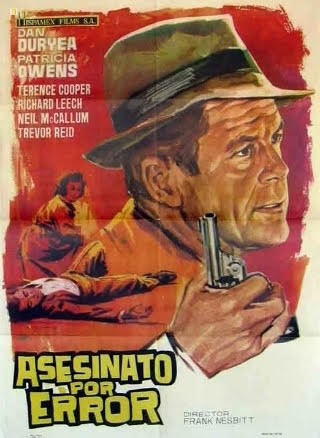
Carl Lutcher (Dan Duryea) is obviously a man down on his luck, living in a decrepit bedsit with a naive woman (Shirley Cameron) and slightly bemused as to why she should profess to love him. Later we learn that Lutcher is a dockworker by trade but when he heads off to complete a job it’s work of an entirely different nature he has in mind. Lurking opposite a movie theater, he watches Ellen Sheppard (Patricia Owens) bidding farewell to a couple of girlfriends and then follows her as she walks off towards a nearby pub. Ellen’s behaviour seems a little odd – she’s aware of someone tailing her, and then there’s the panic attack she succumbs to upon accidentally running into her new husband (Terence Cooper) and his business partner (Richard Leech). All of this leads to the two men insisting on escorting her home, although she clearly dislikes the idea. Shortly afterwards the doorbell rings and Lutcher forces his way in. To Ellen’s horror, he pulls a silenced pistol and calmly fires three rounds at her husband at point-blank range. Lutcher behaves as though it had all been arranged while Ellen is verging on hysteria due to the shock. So why would a man like Lutcher assassinate a man he’s never met and then ask the victim’s wife to pay him? Everything points to a contract killing but Ellen’s reaction doesn’t fit. Lutcher will have to be tracked down and a trial will need to take place before any indication of what’s really going on becomes apparent, and even then we’re still talking suspicion and surmise until a final twist reveals all.

£7

Frank Nesbitt has few credits as a director, and only a few more as assistant director but he made two thrillers with Dan Duryea, Walk a Tightrope and Do You Know This Voice?, both written by actor Neil McCallum. I haven’t seen the latter but, despite Nesbitt’s rather anonymous direction, I’m quite keen to do so now. McCallum, who also pops up as the prosecutor in the trial sequence, produces a tricky little thriller here which ensures the story develops steadily and at a satisfying pace. Of the other crew members, cinematographer Basil Emmott should be familiar to anyone with a fondness for post-war British thrillers.

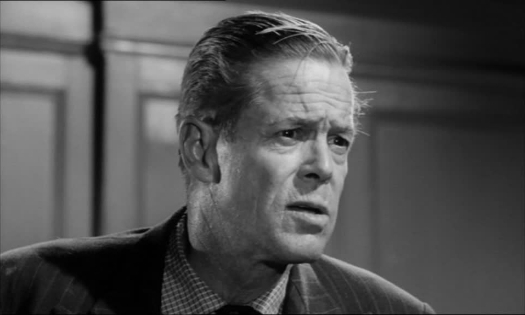
I said at the beginning of this piece that a couple of good actors can make a significant contribution to the success of even a modest production, and that’s precisely what happens with Walk a Tightrope. Both Dan Duryea and Patricia Owens were experienced Hollywood performers and it’s their work that adds interest to this thriller. Frankly, I like seeing Duryea taking a leading role in any movie, regardless of whether it’s heroic, villainous or something in between. I think what made him such a fascinating actor was his ability to put a genuinely human face to whatever part he played. His role in this film isn’t an attractive one, he’s a killer after all and nothing we learn about him suggest he has too many redeeming features. However, we do care about him, especially during the trial which dominates the last half, and his turn in the witness-box as he makes no attempt to deny his guilt but becomes increasingly frustrated and desperate to convince the court of the fact he wasn’t acting alone. Patricia Owens appeared in a number of films which I admire, The Law and Jake Wade and The Gun Runners among them, and I think she did excellent work here as well. Her part called for a good deal of subtlety and some fairly complex emotional shifts as the plot weaves its way towards the conclusion, the kind of performance which demands skillful playing in order to remain credible. I feel she nailed the enigmatic aspect of her character and her acting at the climax carries extra punch as a result. Absorbing as the story is, I don’t believe it would be anywhere near as effective were it not for Duryea and Owens.

£6

UK company Network’s releases in their The British Film line continue to impress me, both the selection of titles and the quality of their transfers. Walk a Tightrope is presented in the 1.66:1 ratio and looks very nice. The image is crisp and clean and doesn’t display any particularly distracting damage. The sole extra feature is a gallery but it should be remembered these films are all very competitively priced and represent excellent value for money. This may well be a B movie but it’s also a solid example of a pared down and well paced crime thriller. OK, perhaps it’s not a classic of the genre but it never aspires to that anyway. I enjoyed the basic plot and the two lead performances give it a bit of class – definitely worth checking out.