The Iron Curtain

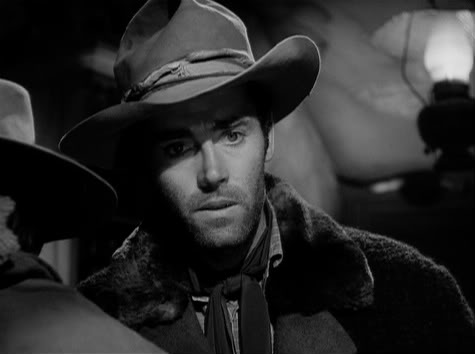
The 50s saw the red scare, fanned by McCarthyite rhetoric, blaze into life in Hollywood. With the HUAC inspired blacklists casting a dark pall over the movie capital, there was a kind of desperation in the air, a need to prove one’s patriotism and simultaneous rejection of the evils of communism. This meant the decade saw the production of a number of films directly addressing the issue and sending out a message to the witch-hunters that the industry was aware and prepared to play ball. Whatever contemporary reactions may have been, these films, by and large, not only seem lousy when viewed today but they also remind us of all those careers and lives left in tatters by the taint of the blacklist. From a purely artistic standpoint, the ham-fisted presentation of political dogma and the judgemental tone adopted both bog down the narrative and, in the worst cases, leave a very sour taste. However, there are always exceptions, and William Wellman’s The Iron Curtain (1948) is one of the more polished and less hysterical pieces of work from a generally unsavoury interlude in cinema history. I think this is partly due to the skills of Wellman as a filmmaker, and partly as a result of the production taking place right at the beginning of HUAC’s reign of terror, before it’s raging paranoia had fully matured.

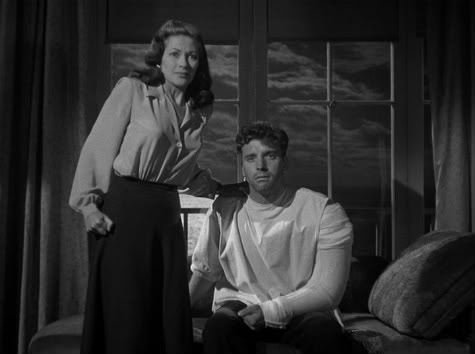
In keeping with a lot of Fox movies of the time, the film opens with a declaration that what we’re about to see is a true story, shot on real locations. The cool, authoritative tone of the narrator further enhances the sense that this is something more than mere Hollywood fantasy. I’ve often found that there’s a tiresome quality to some of these earnest eulogies to the dedication and responsibility of various government agencies remaining ever vigilant in the face of multiple threats from without and within. What sets the introduction of The Iron Curtain apart is its location if nothing else. The entire film takes place in Ottawa, Canada, so we are spared yet another hymn to the efficacy of the FBI, Treasury agents or other assorted G Men. Instead, the plot follows the establishment of a Soviet fifth column in Canada during the war and its subsequent dismantling as the big freeze of the Cold War set in. As I said, the movie doesn’t takes us behind the scenes of one of those complex government sting operations that were much favoured by contemporary filmmakers, but concentrates on telling the tale of how one man brought a spy ring to its knees off his own bat. The man in question is Igor Gouzenko (Dana Andrews), a cipher clerk freshly assigned to the Soviet embassy in Canada. The first third of the film goes to great pains to establish how loyal Gouzenko was to his own country and political system, one of those resolute, unthinking servants of the state with clear and direct convictions. As we observe the steadfast Gouzenko going manfully about his duties, we’re also afforded a view into the closed world of the Soviet diplomatic mission. And it’s a drab, forbidding world at that, peopled with stony-faced officials and dripping an atmosphere of suspicion and secrecy. There’s also a glimpse at the careful construction of the spy network, whose eventual unravelling provides the dramatic backdrop for the latter stages of the story. It’s Gouzenko who brings the whole thing crashing down, and his motivation for doing so is a slow realization that he’s serving a flawed master. The catalyst for his decision is the arrival in Canada of his wife Anna (Gene Tierney), and the birth of a son. The presence of this human element greatly strengthens the story and adds to the dramatic tension of the final third. By doing so, the political aspects necessarily take a back seat to the unfolding drama of a family suddenly cast into a perilous situation.

Even if it’s viewed purely as a propaganda piece, then I think The Iron Curtain is remarkably successful. The reason for that is the script and Wellman’s ability to sidestep the trap of sensationalism and instead adopt a more matter of fact tone, letting the events and their inherent drama speak for themselves. Of course, the air of quiet dread that seems to hang over the scenes in the embassy emphasises the stifling lack of personal and intellectual freedom, but this is quite subtly achieved. The ever-present music from Soviet composers, the inclusion of which in the score apparently caused something of a minor international incident at the time, has the effect of building up the brooding, sinister feel. The only time we take a detour into the realm of direct political preaching is when one of the Soviet residents (Eduard Franz) seals his own fate by getting drunk and lamenting the betrayal of the ideals of the revolution by the apparatchiks who have risen to prominence in Moscow. As a thriller, the film really comes into its own in the final third, as Gouzenko decides to take that leap of faith and defect. Wellman, and cameraman Charles G Clarke, employ classic film noir techniques of lighting and shooting angles to ratchet up the tension during Gouzenko’s theft of incriminating documents from the embassy, and then again in the climactic standoff in his apartment. Another notable aspect of the film is how the government agencies – I’m guessing the Canadian setting facilitated this slight subversion – are conspicuous by their lack of involvement. In fact, there’s initially a downright refusal on the part of the authorities to become involved in what they take to be the ravings of a lunatic.

Dana Andrews was never one of the most emotive or demonstrative of actors, the kind of guy who tended to keep it all inside and bottled up. Such characteristics can unfairly lead to accusations of woodenness when the truth is it’s simply another, and no less effective, style of performing. As it happens, that tight-lipped anxiety that he had a talent for fits the character of Gouzenko to a tee. After all, this is a man who’s been trained to exert self-control in the first place and who then finds himself in a situation where both his own and his family’s survival depends on the maintenance of a facade. Still, Andrews conveyed more than a blank countenance when he had to, the eyes in particular registering the mounting pressure Gouzenko was subjected to. Gene Tierney was making her fourth film alongside Andrews, the most successful being their partnership in Laura a few years earlier, and was good enough in a fairly undemanding role. Her main purpose was to act as a softening and humanizing influence on her previously stiff and determined husband, and that’s how she comes across. However, arguably the most memorable work is produced by the supporting cast. Berry Kroeger was making his screen debut as the shadowy head of Canada’s communists and carries off the part of the principal villain with aplomb. Playing such a Machiavellian puppet master required a good deal of restraint combined with implicit menace. Kroeger was blessed with the features and voice that were ideally suited to this kind of role and he makes a very strong impression. Stefan Schnabel also shines as the head of the NKVD, masking a dangerous ruthlessness with an outwardly reasonable persona. And finally, June Havoc appears as the embassy secretary with a wandering eye and a special brief to vet the reliability of all new staff.

I think the only DVD edition of The Iron Curtain to date is the one issued in Spain by Fox/Impulso. In terms of picture quality, it’s one of their mid-range efforts. There hasn’t been any restoration work done, as can be seen from the cue blips and so on, but the print used is in generally good condition and doesn’t display noticeable wear. Extras are limited to the usual gallery and text data on the cast and crew. The disc offers English and Spanish soundtracks – the Spanish subtitles are optional and can be deselected via the setup menu. While I certainly don’t think this film represents Wellman at his best, it is an interesting addition to his body of work. The main attraction of The Iron Curtain though lies in its historical significance, coming as it does near the beginning of the red scare. It’s interesting to observe the comparatively restrained approach it takes to its emotive subject matter in contrast to some of the more hyperbolic and offensive offerings that the following decade would eventually produce. Generally, this is worthwhile viewing for fans of Wellman and for providing a snapshot of early Hollywood reactions to the HUAC assault.
Criss Cross

poster319

“From the start, it all went one way. It was in the cards, or it was fate or a jinx, or whatever you want to call it.”

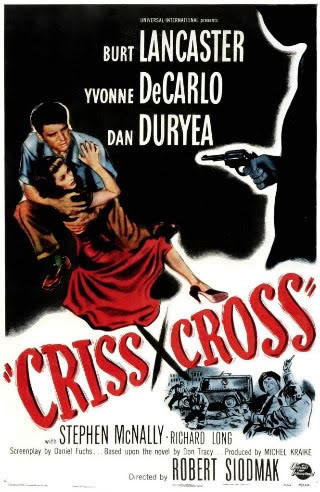
Burt Lancaster, Robert Siodmak, a heist, a hero doomed by fate and his own stupidity, and a rotten to the core femme fatale – all of this sounds a little like a brief synopsis of The Killers. In fact, it refers to Criss Cross (1949), a near relative of that earlier work and a film that vies with it for the honor of being hailed Siodmak’s best movie. Apart from the pairing of director and star, both these films share a similar theme and structure, and I find it almost impossible to decide which is the better one. Ultimately, it doesn’t matter – I like them both and they are two of the strongest noir pictures to come out of the 1940s.

The title of this movie is a highly appropriate one for a tale where the paths of all the main characters are continually intersecting in a web of deceit and betrayal, each crossing up the other at the first opportunity. At the centre of it all are three people – Steve Thompson (Burt Lancaster), Anna (Yvonne De Carlo) and Slim Dundee (Dan Duryea) – bound together by an unholy combination of love, lust and greed. The opening shot, with the camera swooping ominously down from the night skies of LA, sees Anna and Steve caught in a clinch in the parking lot of a nightclub. As the lights suddenly pick them out, their startled and guilty reaction indicates that this is an illicit rendezvous. The fact is further underlined by the terse, tense dialogue – this couple is planning something dangerous, and the possibility of discovery holds a terrifying threat for them. Anna is married to local hood Slim Dundee, but she and Steve were once wed too. Their passionate embrace makes it clear that they have rekindled their old relationship, with the flame burning brightest for Steve in particular. And it’s from the point of view of Steve that the story is primarily seen, with the others moving in and out of the picture at various intervals. He’s a classic noir protagonist, a fairly ordinary guy with limited prospects and a blind spot where no-good females are concerned. A lengthy flashback sequence, accompanied by a suitably weary and resigned voiceover by Steve, spells out exactly how the lives of these three characters converged and the complex ties that continue to bind them together. In short, Steve’s job as a guard for an armored car company has led to his conspiring with Dundee to raid one of the secure vehicles. However, in the noir universe there’s no such thing as honor among thieves and everyone has his own hidden agenda. Steve is the only one of the trio whose motives have some semblance of decency – he’s driven by a kind of desperate love for Anna – and the aftermath of the heist shows just how deep the fault lines of treachery run in this uneasy alliance.

£5

Apparently the untimely death of Mark Hellinger meant that the original script was revised and certain aspects of the story were changed. Be that as it may, the movie that we ended up with is almost impossible to fault and Daniel Fuchs’ script successfully blends the heist and Steve’s obsessive love to powerful effect. Flashback structures can sometimes be confusing or upset the mood of a film but in this case it works perfectly, coming at precisely the right point and filling in the background details that are vital to understanding the nature of Steve and Anna’s relationship. With a tight script, and Franz Planer’s photographic talents, in place, director Robert Siodmak was free to put it all together with his customary visual flair. The opening, which I referred to earlier, pitches the viewer headlong into this complex tale of dishonor and betrayal in incredibly stylish fashion. And it never really lets up from that moment, with one memorable and superbly shot scene following hard on the heels of another. Siodmak uses every trick up his sleeve to manipulate the mood and perspective, from coldly objective overheads to disconcerting low angles and close-ups, interspersed with fast cuts and dissolves. For me, the real stand out scenes, although there’s hardly a poor moment throughout, are the ones in Union Station and in the hospital. The former not only gives a fascinating glimpse of contemporary LA bustle, but also shows the director’s skill in composing a complex series of shots in a crowded environment while retaining control of the geography. In the latter, he uses the reflection from the mirror in Steve’s room to break up the static nature of the setup and extract the maximum amount of tension at the same time.

If the technical aspects of the film are straight out of the top drawer, then the same can also be said for the acting. Burt Lancaster kicked off his career with some finely judged playing as the doomed Swede in The Killers, and Siodmak got him to tap into that same vibe to coax another wonderfully nuanced and sensitive performance from him. Once again he hits all the right notes as the big palooka whose dark romanticism sees him suckered by the machinations of a conniving woman. Every emotional state the script calls on him to display is carried off convincingly, from fear and disenchantment right through to the calm acceptance of his fate at the end – from the dumbfounded look of a guy who’s just had his guts kicked out by the woman he loves to the cloying sense of panic of a man under sentence of death and trapped in an anonymous hospital ward.

£4

Yvonne De Carlo didn’t have to go through quite as many stages, yet she’s still excellent alternating between the sassy, sensual broad that forms her public persona and the nervy, desperate woman she becomes in private. When she drops all pretense in the climax and reveals her true character to Steve and the audience there’s a tangible shock to be felt. Dan Duryea was an old hand at taking on the role of the slimy villain, and to that he adds a layer of menace as Slim Dundee. He manages this so well that it’s easy to understand the level of fear and trepidation he provokes in Steve when he contemplates the consequences of crossing him. While these three actors carry the movie, there’s real depth in the  supporting cast too. Stephen McNally is solid and sympathetic as the cop whose friendship for Steve leads him to inadvertently push him into crime. In fact, there are lovely little cameos all through the movie: Percy Helton’s chipmunk featured barman, Joan Miller’s garrulous barfly, Griff Barnett’s kindly and lonely father figure.

Criss Cross has been out on DVD for many years now, and the US disc from Universal is an especially strong effort. It offers a near perfect transfer of the film with clarity, sharpness and contrast all at the high end of the scale. My only disappointment comes from the absence of any extra features, bar the theatrical trailer, for such a quality movie. One shouldn’t really complain, in these days of bare bones burn on demand discs, but this film does deserve a commentary track at the very least. Still, we have got an excellent piece of the filmmaker’s art looking great. Criss Cross is a highly rated production that occupies a prominent position in the noir canon, and it has earned that honour. It’s one of those rare films that checks all the boxes and never puts a foot wrong from its dramatic opening until it’s darkly cynical final fade out. Those who are familiar with the picture will know exactly what I’m talking about, and those who are not owe it to themselves to discover this little treasure. This is unquestionably one of the real jewels of film noir.


The Bribe

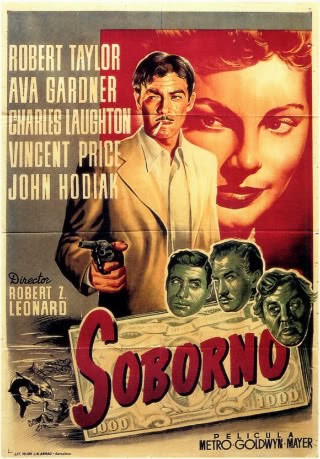
The last non-western I looked at had Ava Gardner suffering in an exotic setting. The Bribe (1949) sees the same actress back sweating it out in a far-flung place, but the results are much more satisfying this time. The film is a borderline noir that employs some of the staples of the form to excellent effect. There’s also a first-rate cast who work hard, yet it’s not a movie without some problems. It opens and closes very strongly; the issue is the overpadded mid-section which ought to have had some of its excess fat trimmed off in the editing room. Even so, the finished product is still worthwhile viewing, largely due to some highly memorable visuals and a couple of fine performances.

Rigby (Robert Taylor) is a federal agent investigating a racket involving smuggled war surplus engines. He’s first seen on the balcony of his hotel room on a steamy Central American island, one of those places where even the lethargic ceiling fans seem worn down by the oppressive heat. There’s a violent storm brewing outside while an internal one is already in the process of churning up the hero’s emotions. As Rigby sweats and smokes, his weary voiceover leads us into a flashback sequence that will occupy the first half of the picture. It all starts off with one of those earnest briefings by the Feds, so beloved of post-war noir, which establishes Rigby’s undercover role. He’s been sent to the island of Carlotta to nail a gang of smugglers and his only lead is a couple of suspects, a married couple in fact. Tug Hintten (John Hodiak) and his wife Elizabeth (Ava Gardner) are two down on their luck expatriates scratching out a living on the island; he’s an ex-pilot with a drink problem, reduced to slumming it as a bartender, while she sings in the same night club. Almost inevitably, Elizabeth is drawn to Rigby, his quiet assurance contrasting sharply with the drunken pessimism of her weak and ineffectual husband. The problem is that the feeling is mutual and Rigby slowly finds himself torn between his sense of professionalism and his desire for Elizabeth. To further complicate matters, it’s soon apparent that Hintten is not working alone. Carwood (Vincent Price) has the appearance of just another tourist but he’s awfully keen on making Rigby’s acquaintance, and Bealer (Charles Laughton) is one of those rumpled chisellers who always have an angle to pitch. Suddenly, Rigby’s life has become very complicated – he knows these four are all bound together as conspirators and he knows his duty, but his attraction to Elizabeth is skewing his judgement and is also being used by the villains as a lever to encourage him to turn a blind eye. As the storm breaks and the flashback leads us to the present, it’s clear that we’ve reach the critical moment. Rigby stands at a moral crossroads; does he take the path of honour and do his job or does he follow the call of his heart? If he’s to choose the former then he has to find some means of doing so without damning the woman he’s falling in love with. Now this is an interesting setup, but the development of the romance slows the pace of the film badly. It’s only in the second half, when matters are forced to a head, that the movie picks up speed again and coasts along towards a quite literally explosive finale amid the carnival celebrations on the island.

For a man with such an extensive filmography, Robert Z Leonard is a director whose work I’m not familiar with. A quick glance through his credits explains that though – he specialized in movies which hold little or no interest for me. However, he, along with cameraman Joseph Ruttenberg, does a fine job of blending classical noir iconography with a melodramatic crime story. Even some decidedly turgid romantic moments are made all the more bearable by the clever use of shadows and light filtered through louvred doors. The fact that The Bribe was an MGM production might give one pause for though too. It may well have been the studio that best typified the heyday of Hollywood, but I wouldn’t rank it among my favourites. The house style usually demanded a kind of populist gloss that tended to preclude any notion of realism or grit. In the case of this movie though, the artificiality that marked out MGM actually works in its favour, that heightened sense of unreality adding to the exotic flavour of the setting. From a purely visual perspective, The Bribe looks splendid. The biggest issue is the way the script allows the essentially uneventful middle of the story to drag on for far too long.

I mentioned in the introduction that there are a couple of fine performances, but I’ll work up to that gradually. I found John Hodiak’s work the weakest of the five main players. His first scene where he’s supposed to be drunk felt amateurish and unconvincing, like a guy who never touched a drop doing an impression of a lush. However, he spends most of the remainder of the movie laid up in his sick-bed so there’s no opportunity to see whether he could have added another dimension to his role. It has to be said that Robert Taylor and Ava Gardner made for an extremely attractive leading couple, and they do have a certain chemistry on-screen. Gardner looks breathtakingly beautiful in some shots and it’s clear that this was a woman capable of making any man reappraise his ethics. Taylor was an actor who I think gets slated too often by critics. His looks often meant that he was underestimated, but age and maturity came to his rescue. His post-war work gets better with each passing year as his tough reserve was increasingly reflected in his features. I reckon his western roles bring out the best in him but he also made some first class noir pictures too; The Bribe may not be his finest, but it’s not bad either. Vincent Price was another who improved as the years passed, and his role as the slimy and conniving Carwood represents a step along that path. Right at the top of the heap though is Charles Laughton, giving a performance that’s slyly captivating. His perpetually unshaven Bealer is a clever combination of the sleazy and the pitiful. In a role that could easily have become deeply unattractive, his expressive features and carefully modulated voice create a character who pulls off the not inconsiderable feat of being simultaneously repulsive and sympathetic.

A while back, I was on the point of ordering the Warner Archive version of The Bribe, but then noticed that the film was also available on pressed disc from Spain. So, I ended up buying the release from Absolute. From reading online comments and looking at screencaps, I think the Spanish release is broadly comparable to the R1 disc. The film hasn’t undergone any restoration and there are minor scratches and marks on the print. Still, there are no serious issues and the contrast and clarity are generally strong. Absolute provide the theatrical trailer and the English soundtrack only; the Spanish subtitles can be disabled via the setup menu. There’s also a booklet of viewing notes included, in Spanish of course, that features the original poster art and lots of attractive stills. The film is an entertaining  yet imperfect slice of noir exotica. Ultimately, the characters, with the possible exception of Carwood, revert to traditional morality and thus dilute the darkness that the script flirts with. It may not be full-blown noir and the script could use a bit of tightening but it’s well worth seeing, if only for Gardner’s beauty and Laughton’s low-life charm.

Singapore

relx40f

Sometimes it’s hard to know how to categorize a movie; it may have certain familiar and identifiable features that one associates with a particular genre, yet either fails to capitalize on these or mixes in the traits of another type of movie. Of course that’s not necessarily a bad thing, and a touch of the unexpected can enliven a stale formula. But not always. Singapore (1947) has many of the trappings that are associated with film noir: dark, shadowy imagery, a flashback, a voiceover narration, a slightly unscrupulous protagonist, a mysterious woman. Still, it’s not a noir picture; there’s too much melodramatic romance and half-hearted adventure tossed in there. Ultimately, it’s a movie that flirts with a handful of genres and suffers a bit of an identity crisis as a result. Besides that, it’s just not very good.

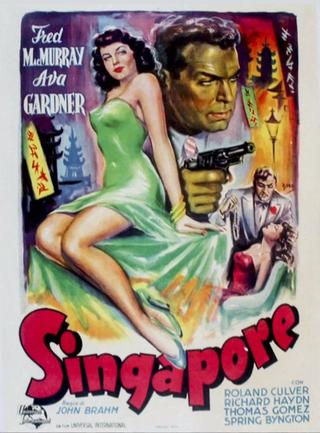
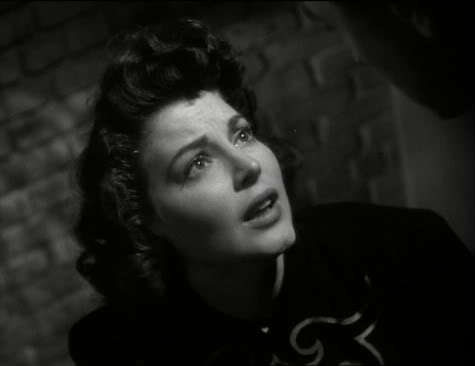
Matt Gordon (Fred MacMurray) is a pearl smuggler – we learn this when he’s pulled in to the custom’s office the moment his plane touches down in Singapore. With the war over, he’s returning to his old haunts and the authorities suspect that he’s likely to return to his old trade too. As Gordon wanders through the hotel where he formerly resided, he’s suddenly assailed by memories. A flashback sequence sees him in the days leading up to the Japanese attack and introduces the old lover whose loss still preys on his mind. Gordon and Linda Grahame (Ava Gardner) had one of those whirlwind romances that are often found in wartime movies. Just as the couple are about to tie the knot the bombing raids commence, and he races back to his hotel to recover the fortune in pearls he has stashed there. Failing to recover his treasure, he returns to find the chapel in ruins and Linda missing presumed dead. And so we’re up to speed – Gordon has come back to Singapore hoping his pearls may still be retrievable. As he awaits the opportunity to check out his old quarters and see if the loot is still there, he spies Linda. The woman he thought had perished in the bombed out chapel is alive and well, but has no recollection of who he is. Amnesia – we’re back in noir territory, right? Wrong. Loss of memory can serve as a great plot device when it involves blanking out secrets that carry a threat or danger. In Singapore, that’s not the case at all and the story becomes bogged down in a soapy love triangle that really only has two sides. Sure, there’s an attempt to milk some suspense and intrigue from the secondary business of two cartoon villains (Thomas Gomez and George Lloyd) also seeking the elusive pearls, but again the absence of any real threat hamstrings that element.

PDVD_001-45

Casablanca struck gold when it placed its two eternal lovers in an exotic locale, but a movie needs more than that to succeed. Lots of films have tried to tap into that vibe (Macao, Calcutta, Saigon etc.) but the results have been variable at best. For me, Singapore fails on two levels; the central romance and half-hearted mystery just aren’t engaging, and the leads don’t have any spark together. Although both MacMurray and Gardner are good enough in their respective roles they have no chemistry whatsoever, and that’s a major issue when the script revolves around an apparent grand passion. As if that weren’t enough, the chief stumbling block preventing the couple from picking up where they left off – Gardner’s post-amnesia marriage to a planter – rings hollow and utterly fails to convince. As the villain, Thomas Gomez is surprisingly toothless and his character’s borderline incompetence means that we never seriously doubt MacMurray’s ability to get the upper hand. Director John Brahm made a number of noir-tinged melodramas that have much to recommend them, but Singapore is certainly among his weaker efforts. I’m generally a fan of his work and he does his best to inject some style into this humdrum production. The angles are varied and the sets are cleverly lit to enhance the atmosphere as far as possible. Still, apart from a short sequence which sees MacMurray struggling to extract his hidden pearls while avoiding the attentions of the law next door, there’s precious little tension on view.

As far as I’m aware, the only current commercial release of Singapore is the recent DVD from Universal in France. Generally, the film has been presented well; the transfer does exhibit some dirt and speckles but this is really only noticeable right at the beginning. The image is satisfactorily sharp and contrast is consistent throughout. There are no extra features offered and the French subtitles are optional and can be disabled via the setup menu – burnt-in captions do appear though on a handful of occasions when text is displayed, but this is too rare and minor to be regarded as a black mark. I guess I’ve made it clear enough that this isn’t an especially good or memorable movie. Singapore was later remade as the Errol Flynn vehicle Istanbul and while that’s no great shakes either, it’s arguably a stronger film. This one is attractively shot and Ava Gardner looks wonderful as always, but that’s about it. I can’t say I got much out of the movie and it’s not one I’d recommend tracking down.


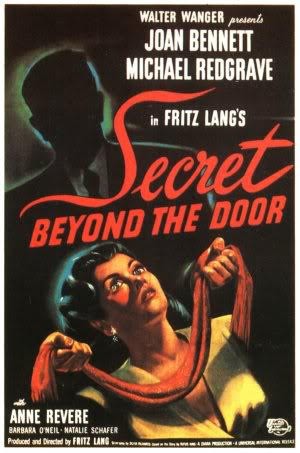
Secret Beyond the Door

poster302

In the past I’ve written about a few Freudian thrillers from the 40s, Spellbound and The Dark Mirror for sure. The decade has many examples though as it was such a fashionable subject and seemed to blend effortlessly into the world of film noir. Looked at now, from a modern perspective, the cod psychological mumbo jumbo of these films is fairly risible. However, films are first and foremost an entertainment medium; we don’t watch them to gain, for example, a deeper insight into psychoanalysis. So, when a movie like Secret Beyond the Door (1947) presents us with a dubious scientific explanation for the odd behaviour of its characters it’s not really fair to criticize it too heavily on that score. Fritz Lang’s film really is an exercise in style over substance – the look, feel and mood of the picture is what carries it, not the plausibility (or lack of it) of the story or the questionable motives of the main characters.

The basic premise is a familiar one, various forms having been used over the years in a variety of films. There’s a young woman on vacation who meets a mysterious yet attractive stranger, falls in love, marries and, after a time, discovers that all is not what it initially seemed. The woman in this particular movie is Celia (Joan Bennett), an heiress who’s recently found herself alone in the world and has taken off on a trip to Mexico before returning to the States and settling down to a life of bland respectability. However, Celia is not the usual, run-of-the-mill innocent abroad. Contrary to appearances, there’s a darker, almost perverse, side to her nature that soon becomes apparent. Quite by chance, she witnesses the flare-up of a knife fight between two local men. This isn’t some matter of slighted honour, more a duel of passion; the men are vying for the affections of a woman. Instead of doing the sensible thing and walking away, Celia is rooted to the spot, fascinated by the events before her. The viewer isn’t the only one struck by the hungry, predatory look in Celia’s eyes as she absorbs this primitive ritual – another bystander’s attention is drawn to her. He is Mark Lamphere (Michael Redgrave), an architect of patrician background.

To cut to the chase, Celia and Mark fall in love, marry and move back to his out-of-town home in the States. Even before they leave Mexico though, it’s apparent that all isn’t well with Mark; he has a tendency to withdraw from intimacy without explanation. As the couple embark on their new life the skeletons begin to rattle in the family cupboard and, bit by bit, secrets and hints of a dark past start to emerge. Celia’s husband is a deeply troubled man who appears to have a morbid obsession both with historical murders and the rooms in which those crimes took place, while questions linger over the death of his first wife. The true roots of the problem are not immediately obvious but, even so, the new bride slowly comes to suspect that her own life may be in danger.

The script calls for a good deal of irrational behaviour on the part of the main characters, enough to sink many a movie. Despite that, the film still works and is pretty successful as a piece of highly strung noir melodrama. This is largely due to the work of director Lang and cameraman Stanley Cortez, between them creating a stylish and stylized visual experience. The opening segment in Mexico has a dreamy, unreal quality that perfectly fits the mood of the lovestruck Celia. As soon as the action switches to the Lamphere estate the look and feel alters too, the uneasy romanticism of the south of the border scenes switches to something more akin to the gothic nightmare that begins to unfold in Celia’s shadowy and threatening new home. It’s this aspect of the film that leads to comparisons being drawn between it and Hitchcock’s Rebecca. On the surface, there are parallels: newlyweds haunted by the spectre of the husband’s murky past, a family home where unwelcome memories seem to lurk in every shadow, and a distinctly odd household.

£6

For all that, the two movies are really quite different in essence, chiefly as a result of Joan Bennett’s characterization of Celia. Unlike Joan Fontaine’s second Mrs DeWinter, Joan Bennett is a tougher and more worldly woman. I’ve already mentioned the dark side of Celia that’s apparent from early on, but the perverse side of her character is further developed as the story progresses. A weaker, and maybe a saner, woman would likely hightail it back to the safety of the city when her husband first begins to exhibit signs of serious psychological imbalance. But not Celia; she chooses to stand her ground, whether through raw courage or her own fascination with danger, and stick it out to the bitter end. One of Bennett’s great strengths as an actress, and very likely the reason Lang chose to work with her so often, was her ability to combine feminine allure with the grit necessary to hack it in a grim world. I found Michael Redgrave’s performance much less satisfactory though. My biggest issue was that I never felt entirely convinced by his transition from the cool aristocrat to bug-eyed loon. However, in all fairness, this kind of thing is rarely especially easy to pull off. His best moment occurs in the short fantasy scene where he imagines himself on trial for murder. With a jury of literally faceless men looking on, Redgrave plays both prosecutor and defendant in the ultimate trial of conscience.

For a long time Secret Beyond the Door was one of Lang’s most elusive titles on DVD, at least in an acceptable form. As the rights in the US now appear to reside with LionsGate it’s probably not a good idea to hold your breath waiting for anything to appear from that source. There’s been a French disc available for a while but it suffers from the old problem of forced subtitles. However, last year saw two releases that fit the bill: a budget disc from Italy and a nicely packaged edition from Exposure in the UK. Both seem to use the same transfer for the movie, but the UK release sees more effort put into overall presentation. The movie gets a nice remastered transfer with very good contrast (vital for a film like this) and only the odd speckle here and there. For extras we get an extensive gallery and filmographies. There’s also a 12 page booklet that reproduces the original poster art on the cover and contains three separate articles by David Hughes, James Oliver and Claudette Pyne. In this era of cost-cutting MOD programmes, it’s a credit to a small outfit like Exposure that they have both the will and ability to produce a thoughtful edition like this. Anyone interested in collecting classic movies really ought to consider putting a bit of business their way and support such efforts. This film tends to be glossed over somewhat when Lang’s work is discussed, probably due to the absurdity of certain aspects of the plot, but it’s actually very enjoyable. Joan Bennett gives a good performance in the lead and Lang directs with great skill and style. Anyone who is interested in film noir, Fritz Lang, or just classy 40s movies should have a copy of this in their collection.

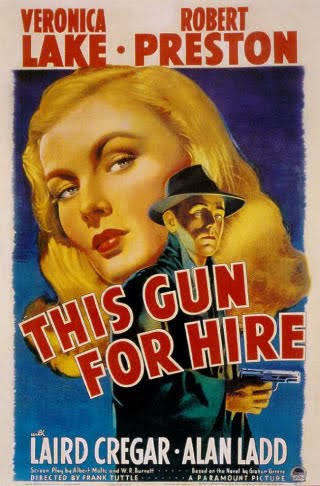
This Gun for Hire

poster301

The MacGuffin: a plot device that’s of the utmost importance to the characters in a film, shaping their decisions and driving them on, yet of only marginal interest to the viewer. Hitchcock used the term to refer to various objects and motives in his movies – the uranium in Notorious, the stolen money in Psycho and so on. Of course, it appears in lots of other films apart from Hitchcock’s: the letters of transit in Casablanca for example, and the espionage/blackmail letter in This Gun for Hire (1942). Just as the aforementioned movies have nothing to do with nuclear weapons, loot or visas, except on the most superficial level, neither is This Gun for Hire a spy story. Instead, it’s the tale of a sociopathic contract killer and his gradual transformation into something resembling humanity.

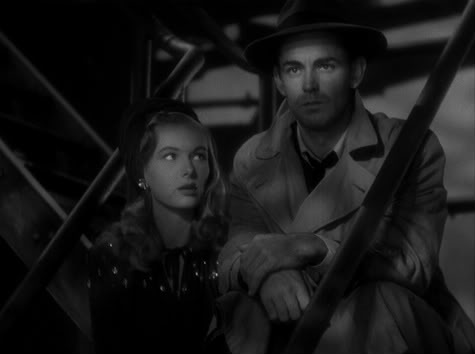
The strong and stylish opening introduces Raven (Alan Ladd), as a solitary and taciturn individual existing on the fringes of society. He lives alone in a beat up boarding house, avoiding human company whenever possible and barely tolerating it when necessary. His casual contempt for a slatternly chambermaid and contrasting affection for a stray cat eloquently points out where his fellow men rank in his estimation. So, if it’s not any empathy with the people around him just what is it that makes Raven tick? If anything, it’s his cool, unemotional professionalism; his whole sense of self is bound up in the way he calmly goes about dispatching those he’s been paid to kill. As he ventures out to fulfill a hit we get a fleeting glimpse of conscience. He unexpectedly runs into a disabled young girl sat alone on a flight of stairs. and pauses briefly. We’re unsure what exactly he’s thinking about this unwelcome witness to his presence, but he passes on. Having done his grisly work on the floor above, Raven again encounters the same girl on his way out. This time she asks him to retrieve a lost toy for her, and for one heart stopping moment it looks like he might just finish the girl off rather than risk identification. Ultimately he doesn’t, leaving her to her lonely games – it’s as though the weak (the cat, the crippled child) stir a feeling of kinship somewhere inside; he has a deformed wrist, the result of a childhood punishment. This suggests that, despite the passive mask he adopts, there is some decency lurking within, and it develops further when he happens to meet a girl on a train. The girl is Ellen Graham (Veronica Lake), a night club performer who’s travelling with a dual purpose; she’s been recruited as a federal agent in order to dig up some evidence of her new employer’s suspected espionage activities. It’s here that the tale takes on a twisting, complex quality – the girl’s employer is Willard Gates (Laird Cregar), and he also happens to be the go-between who double crossed Raven after his last job. So, both Ellen and Raven are on the trail of the same man, but for different reasons, and with different goals in mind. One wants to expose him, while the other merely wants to kill him.

£31

The opening credits “introduce” Alan Ladd, but he’d been playing small parts in movies for some time by this point. The nominal lead was Robert Preston, as Ellen’s policeman fiance, but it’s Ladd’s show all the way. In Raven he creates a memorable anti-hero, one who acts as a template for the many hitmen who have graced the screen since, and who fits in as one of Graham Greene’s tormented souls. His set features have a chilling calm to them that impart a real threat far more effectively than a more emotive performance would have done. Everything is contained within the eyes and the voice, the quick spark and slight quaver hinting at the seething emotions which he refuses to allow his expression to betray. The only time he cuts loose is in the railroad yard with Ellen when he recounts the recurring dream of an abusive childhood that haunts him. Veronica Lake, in her first (and possibly best) pairing with Ladd, is fine if unremarkable as the resourceful and faithful Ellen. She wasn’t a great actress by any means, but her work with Ladd in this movie and their subsequent collaborations show her at her best. While Ladd is the dynamo at the heart of the picture, Laird Cregar is also memorable as his squeamish paymaster. Before his untimely death, Cregar was one of those menacing “big men” who seemed to populate so many 40s movies. Unlike the tougher and brasher Sydney Greenstreet, Cregar (and maybe Raymond Burr too) could not only easily convey a threatening presence but also hint at a more vulnerable, weaker side. Director Frank Tuttle isn’t noted for his noir pictures but he captures that elusive spirit on This Gun for Hire. The film may be an early example of noir but it contains many of the characteristic visual motifs, low angles and shadows bisecting the actors’ features in particular. Of course, he’s aided enormously by the photography of John Seitz, and the Graham Greene source novel adapted by W R Burnett. The story benefits greatly from the reduced emphasis on the espionage elements in favour of focusing instead on Raven’s personal quest for vengeance. It’s also refreshing that Raven, even when he does the “right” thing, acts out of what he sees as personal obligation as opposed to falling back on anything as crass or facile as a sudden realization of patriotic duty.

This Gun for Hire was released on DVD years ago by Universal in the US as part of their film noir line. The transfer remains a top notch effort with excellent contrast and clarity. The print has no significant damage or distractions on show. The disc itself is of the very basic variety with no extras whatsoever offered – a pity when you consider the quality of the movie. This is a fine, tightly paced film with a powerful central performance by Alan Ladd and a stylish look. If that’s not enough in itself then it deserves a viewing for being the first teaming of Lake and Ladd, and the influential nature of its characterization. Highly recommended.


The Leopard Man

poster294

Seeing as Halloween is only a matter of days away I thought I’d feature something with a seasonal flavour to mark the occasion. A casual glance would suggest that The Leopard Man (1943) ought to be a slice of classic horror. Bearing in mind the title, and the fact it was produced by Val Lewton and directed by Jacques Tourneur, one might expect to get another anthropomorphic chiller along the lines of Cat People. However, it’s the source material, a story by Cornell Woolrich, that dictates the kind of movie that’s ultimately delivered. Woolrich wasn’t a horror writer, though his darkly fatalistic tales do border on the macabre at times, instead he concentrated on bleak and pessimistic crime stories. So, the combination of director, producer and writer here results in a moody crime picture that bears the trappings, atmosphere and feel of a horror movie.

This compact thriller takes place in a border town in New Mexico and, like a good deal of Woolrich’s material, sees a tragic train of events set in motion by a foolish mishap. In this case the event in question is brought about when a night club performer, Kiki (Jean Brooks), goes along with the suggestion of her manager/publicist, Jerry Manning (Dennis O’Keefe), that she should make a dramatic entrance with a black leopard on a leash. The idea is to draw the spotlight and simultaneously upstage her rival, flamenco dancer Clo-Clo (Margo). Not a bad plan, as far as it goes. The trouble arises when Clo-Clo, in a fit of pique, startles the beast with the clacking of her castanets, causing it to bolt and and slip away into the shadowy streets of the town. This leads to one of the most celebrated sequences in producer Lewton’s movies. A young girl, a bit of a dreamer and slacker if the truth be known, is sent on a shopping errand by an impatient and exasperated mother. The girl tries to beg off, citing her fear of the wild animal roaming the surrounding countryside, but the mother is having none of it. To her, her daughter has too fanciful an imagination and too little sense of responsibility. The girl’s trip to the only store open at such a late hour, and more especially the return, is an exercise in how to draw tension tight through the use of suggestion and shadowy visuals. What makes this succeed is the fact that the growing panic and dread of the girl match perfectly what the viewers feel as we accompany her on her journey. The tragic outcome, playing on the old fable of the boy who cried wolf, is all the more effective as a result of our experiencing the same emotions as the girl. Suddenly, this sleepy backwater is transformed into a community stalked by fear and suspicion as the apparent victims of the escaped cat start to mount up. As I said in the introduction, this is not a real horror movie in the true sense of the word. There is nothing of the supernatural involved, unless you count Isabel Jewell’s gypsy fortune teller, yet the sense of menace is palpable throughout.

£28

In all honesty, the plot of The Leopard Man is fairly unremarkable, and the mystery story it’s built around isn’t so difficult to figure out. The strength of the movie derives from the mood evoked by the tale, and maybe more importantly, the way Lewton and director Jacques Tourneur go about presenting it. What they put on screen is every bit as morbid as the best of Poe. Lewton and Tourneur’s shadowy, expressionistic style play a significant part in creating the sense of doom and fatalism that seems to dog the characters. The flamenco dancer played by Margo is superficially in love with life, and her jaunty sashaying through the town streets, castanets always at the ready, appears to reinforce this. Yet, her thoughts are never far from darker matters, borne out by her near obsessive need to consult the fortune teller at every opportunity, despite the latter’s repeated discovery of death in the cards. Aside from the sequence with the girl on her late night errand that I already referred to, there are two other especially noteworthy passages. The first involves a lovelorn girl who visits a cemetary on her birthday to keep a date with her beau. Surely it’s only in a Lewton film where two youthful lovers would think it appropriate to pick a graveyard as the backdrop for a romantic assignation. This scene heightens the melancholic, oneiric quality that permeates the movie and comes close to the idea of horror being essentially a fairy tale for adults. The second takes place during the climax, where the real killer is pursued and finally cornered amid the hooded and solemn members of an historical/religious procession. All of these sequences serve as something of a definition of the characteristics of horror moviemaking. Cinematic horror is not so much about gore or actually scaring the audience – that has a limited, juvenile impact which rarely stands the test of time – as instilling a sense of dread and foreboding. After all, it’s the moody atmospheric stuff that lingers in the memory long after the cheaper shocks have worn off or been superseded by something more daring.

In the US Val Lewton collection form Warners The Leopard Man shares space on a disc with The Ghost Ship. The film has a reasonably good transfer, although there are certainly a number of speckles and scratches on show. The image is acceptably sharp and the contrast is good enough – particularly important in a movie such as this. Extras consist of a commentary by William Friedkin and the theatrical trailer. As I said, this is a crime story – with a noir sensibility, it should be added – dressed up as a horror film. I think it may be this hybrid quality that’s led to it’s being less celebrated than some of Lewton’s (or Tourneur’s for that matter) other pictures. Regardless, it remains a classy chiller that works well on both levels, and is a fine example of how to make a good movie on a shoestring budget.


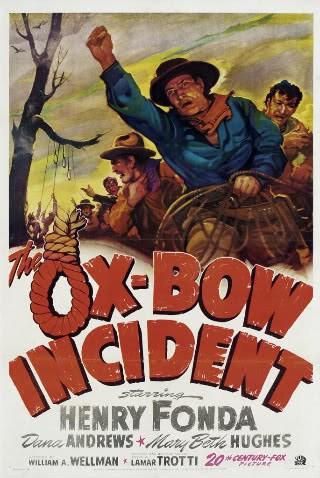
The Ox-Bow Incident

poster48

The western is genre that often gets a raw deal in the image stakes. And it’s not just a matter of waning box-office popularity in recent times. It’s rarely afforded the respect that other genres seem to court so easily and instead finds itself weighed down by the notion that it’s somehow unsophisticated. The term oater is applied, I’ve used it myself, in an affectionate way, yet it carries a certain air of condescension when you stop and think about it too. I guess the stereotype of uncouth figures riding horses, firing guns and chasing Indians is such a strong one that it’s managed to sideline the genre in the minds of many people. The paradox is that the western is actually one of the richest forms of cinema around. Leaving aside the frequently breathtaking visuals, the setting offers the opportunity to tell an almost unlimited range of stories and explore as many themes as it’s possible to imagine. The vast geographical expanses and the absence (or at best the bare rudiments) of civilization create a kind of nearly blank canvas onto which a skilled filmmaker can paint, with both bold and subtle strokes, whatever he likes. William Wellman was certainly highly skilled and his westerns are never less than interesting, and usually challenging too. The Ox-Bow Incident (1943) is a powerful and memorable piece of work that stays with you and is one of those films that proves the western is capable of being not only an entertainment but an intellectual stimulant as well.

The plot is a simple one and it’s that lack of complexity in the storytelling that’s one of its greatest strengths. The film has a moral point to impart and too much narrative trickery would only be a distraction and water down the central message. Events begin to unfold in a little backwater settlement where the neighbouring ranchers have been struggling with the perennial problem of cattle rustling. When a youngster comes racing into town to breathlessly announce that one of their own has been apparently murdered and his livestock taken a tragic chain reaction is set in motion. The jaded and bitter populace experience disbelief and outrage and are teetering on the edge, poised to ride out and hunt down like animals the alleged killers of their friend. For a brief moment, it looks like reason and decency may prevail as the aged storekeeper Davies (Harry Davenport) appeals to their better nature. But this is not to be – ex-soldier Tetley (Frank Conroy) soon turns the townsfolk back to their base instincts, and a rag-tag posse is formed. Not wanting to draw the ire of the town upon themselves, two cowboys, Gil Carter (Henry Fonda) and Art Croft (Harry Morgan), reluctantly join the eager hunting party. It’s not long before the posse cut the trail of three men (Dana Andrews, Anthony Quinn and Francis Ford) who seem to fit the bill of the murderers. From this point on the movie becomes a kind of ethical struggle between the ineffectual Davies and the implacable Tetley for the souls of the posse members, with the fate of the three captives hanging in the balance.

£17

The Ox-Bow Incident is based on the novel of the same name by Walt Van Tilburg Clark and, although it’s been quite a few years since I read the book, I recall it as being a pretty faithful adaptation. Wellman’s direction captures the heavy, moody and ultimately tragic tone of the novel very well. There aren’t many true exterior scenes, most of the film seeming to have been shot on sets, and this (along with the high contrast photography) helps to pile on the sense of claustrophobia and doom. While the outcome is fairly predictable, the director still maintains the tension and, crucially, that isn’t lost even with repeated viewings. In fairness, a lot of that comes down to the performances too; Dana Andrews, as the leader of the suspected murderers, was billed below Henry Fonda but his work plays a large part in the success of the movie. His initial disbelief and growing desperation at the nightmare situation he finds himself in is built steadily. He did a fine job of conveying an awkward mix of fear and nobility that positively demands the sympathy of the viewer. In a sense, Fonda plays something of a supporting role in this one, only taking centre stage at a few points. Perhaps his best moment is in the saloon at the end when he reads Andrews’ letter to his illiterate friend. The letter itself is a powerful and emotive one that expertly outlines the author’s twinned concepts of justice and conscience. Fonda’s delivery of the words, as Wellman shot him in extreme close-up – partly obscured at first and then full face – is perfectly timed and enunciated to maximise their impact. However, for long stretches, he’s portraying the confused man in the middle, caught between the opposing ideals of Tetley and Davies. It’s this conflict that’s at the heart of the picture: how reasonable and civilized men can be browbeaten into submission, how the cult of personality can sway the masses and turn them into an unthinking mob, bereft of ethics and robbed of conscience. It’s both an indictment of the failings of the law – the sheriff has left town, the judge is a procrastinator, and the deputy is little more than a barbarian – and a warning that that same law is all we have to prevent our descent into inhumanity.

The R1 DVD of The Ox-Bow Incident from Fox is an excellent presentation of the film; there’s hardly any damage to be seen, the detail level is fine, and the crisp image has the kind of strong contrast necessary for this type of movie. There’s also a fine selection of extras: a commentary track by William Wellman Jr and Dick Eulain, a biography of Fonda, and a gallery  of images. This title is due for a Blu-ray release by Koch Media in Germany in August. Seeing as the extras are to be replicated it’s reasonable to expect that the same film elements will be used, therefore a first class transfer should be on the cards. As I said in the intro, The Ox-Bow Incident is a good example of a thinking man’s western, yet for all that, it never loses sight of the fact that it has to entertain and grip the viewer too. A superb film.


Black Angel

poster248

Time for another neglected and half-forgotten gem, one of those movies that seem to slip beneath the radar of even the most ardent movie buffs. Black Angel (1946) is a great little film noir that doesn’t get a lot of attention but really delivers the kind of perversely satisfying payoff that the genre is noted for. There are plenty of familiar noir names in the cast, but none of them are or were exactly “stars” and the director was a man who spent his time on B programmers, so that may go some way towards explaining the relative obscurity of the film.

The opening is very self-consciously stylised, showing a lone figure on the sidewalk before panning up an artificial looking building exterior and in through the window to establish an overhead shot of a woman in her bedroom. The woman, Mavis Marlowe (Constance Dowling), is a singer and, as we soon learn, a blackmailer. While she prowls her apartment waiting for a caller to arrive, the man on the street below is revealed to be songwriter and pianist Martin Blair (Dan Duryea), the estranged husband who still carries a torch and hopes to see her since it’s their anniversary. Although the lovesick Blair gets stiff armed by the concierge, on his wife’s orders, the audience gets to witness two different men entering the building to see Miss Marlowe. One is night club owner Marko (Peter Lorre), and the other is a mark called Kirk Bennett (John Phillips). It’s the latter who discovers the strangled body of Marlowe and, despite protestations of innocence, is arrested, tried and sentenced to the gas chamber for her murder. As viewers, we know that Bennett is innocent – we can’t be positive who the murderer was but suspicion casts a very long shadow over Marko. The rest of the movie is essentially a race to try and nail the true culprit before the wrong man is executed. Blair and Bennett’s wife, Catherine (June Vincent), form an alliance to track down the clues the police have either missed or ignored in the course of the initial investigation. This curiously matched duo naturally focus their attention on the sinister Marko but, as the old saying goes, there’s many a slip twixt the cup and the lip, and the outcome is far from certain.

£23

Director Roy William Neill is hardly a household name, and he’s probably best known for helming some of the better entries in the Rathbone/Bruce Sherlock Holmes series for Universal. In those movies he showed a real talent for conveying atmosphere and suspense on a budget. He brought that same sense of dark foreboding to Black Angel, which unfortunately proved to be his last picture, and delivered a pacy and stylish thriller. The script derives from a Cornell Woolrich story and has that twisted, nightmarish quality that characterised his work.

In a rare opportunity to take on the lead role, Dan Duryea excels as the down and out loser who looks like he’s been given a second chance in life and grasps it, only to see his dreams slide away. Duryea was always a first rate villain but here he shows he had more range when necessary, and he creates a character in Martin Blair who’s actually quite touching and affecting. June Vincent, as the loyal wife, is the principal female lead but it’s such a stock role, and one devoid of anything in the way of complexity, that she fails to make much of an impression. The same can’t be said of Constance Dowling though – despite having her character killed off right at the beginning, the spectre of this striking looking woman haunts the rest of the film. Peter Lorre isn’t asked to do anything spectacular as Marko except play his standard variation on the slimy underworld type. Still, he had a nice line in menace that few could rival and he’s quite effective as the chief suspect. The supporting cast is rounded out by veteran Wallace Ford, as Blair’s friend, and a very restrained Broderick Crawford as the dubious detective.

Universal’s R1 DVD of Black Angel presents the film quite well. The transfer’s not exactly pristine but there’s no major problems either and it’s nice and sharp. The only extra on the disc is a trailer for the movie. More than one film noir has been let down by a weak or contrived ending, but this picture finishes up with a real kick in the guts that ensures none of the power is diminished. Don’t let the lesser known credentials put you off, this is a good one.


Spellbound

I’ve heard Alfred Hitchcock’s Spellbound (1945) described as a tale of the lunatics taking over the asylum, and that’s actually not a bad summation. Despite sounding like a glib dismissal, it neatly encapsulates the basic premise of this movie. Exploiting the then fashionable trend for psychoanalysis, and enthusiastically supported by firm believer David O Selznick, it’s a romantic mystery served up as a kind of Freudian stew – and a very tasty one at that. Like all of Hitchcock’s films made for Selznick the producer’s fingerprints are visible everywhere, but there are plenty of instances of that familiar visual flair to ensure that you never forget who directed it.

Amnesiacs always make good protagonists in any movie, the blanked out memories that need to be recovered before any sense of order can be restored automatically generate mystery, and so it is with Spellbound. Our hero (Gregory Peck) is referred to variously as Dr Edwardes, JB, and finally as John Ballantyne (I’ll stick with JB for the purposes of this piece as that’s the moniker he carries for most of the running time) while he struggles to find out his real identity, and more crucially whether or not he’s a murderer. His arrival at a New England psychiatric hospital posing as the new director is initially taken at face value. There are a few comments passed regarding his relative youth for such a responsible position, but there are no other eyebrows raised. What it does spark though is an unsuspected passion in the emotionally repressed Dr Constance Petersen, thus providing JB with one priceless ally. Such a deception cannot hope to endure long though and, sure enough, it’s inevitably revealed that the real Dr Edwardes is in fact dead and the impostor taking his place is very likely his killer. So, still in search of who he is and what he did, JB goes on the run with Constance joining him after a short interval. It’s here that the picture comes into its own, as Constance, with the aid of her old tutor Dr Brulov (Michael Chekhov), employs Freudian psychoanalytic techniques in a race against time to probe the depths of JB’s subconscious and discover the truth. It all culminates in the famous dream sequence, designed by Salvador Dali, whose interpretation lays bare all the secrets. The whole thing is pure, escapist hokum but it’s executed with such style and conviction that you’re completely drawn in. It’s a good illustration of how, apart from his technical achievements, Hitchcock was masterful at taking stories that were essentially tosh and coaxing the viewer into accepting their credibility for the duration of the movie.

I mentioned earlier Selznick’s enthusiasm for the subject matter, and I’d say that’s directly responsible for the film’s biggest weakness. Such was the producer’s zeal that he insisted on the involvement of an adviser on all things psychoanalytical. The result is an overly pious attitude towards the science depicted, from the cloyingly reverential foreword to the kind of mangled dialogue that even Ben Hecht was hard pressed to shape into something presentable. The contrast between the kind of clumsy exposition that Selznick wanted and Hitchcock’s talent for economical storytelling is clear to see in one scene near the end. In the space of a thirty second montage, consisting only of close-ups of Ingrid Bergman’s increasingly desperate features and a few imploring lines, the the trial, conviction and sentencing of JB is dealt with fully. Similarly, the whole, lengthy sequence at Brulov’s house could have proven intolerable in the hands of a lesser director. Instead, through the combination of a wonderfully idiosyncratic performance by Michael Chekhov, Hitchcock’s arresting visual style and the scoring of Miklos Rozsa (alternating between lush romanticism and the unnerving strains of the theremin), it stands as the strongest section of the entire film. Of course, in other places, some of the bravura touches could be said to serve no better purpose than to draw attention to their own inventiveness: the revolver discharged directly into the camera at the end springs to mind, but that’s such a memorable shot that it feels uncharitable and unnecessarily sniffy to complain about it.

It’s said that Hitchcock originally wanted Cary Grant for the lead, and Peck’s performance has been criticized for being a touch too aloof. I can understand where that’s coming from, Peck had yet to find his feet fully in cinema, although I also feel he was actually right for the part. Had Grant been cast I have a hunch he would have brought too much of himself, that innate self-confidence, to the role and thus rendered it less believable. As it stands, Peck had just the right measure of insecurity about him to get across the edginess of a man who doesn’t even know his own name let alone whether or not he’s a criminal. Whatever reservations anyone may have about Peck, it’s hard to fault Ingrid Bergman’s Constance Petersen. She brings real charm and innocence to the part of the slightly uptight academic who gradually learns that there’s a vast gulf between theory and practice when it comes to matters of the heart. There’s nothing the least bit goofy about her, she’s clearly a highly intelligent and capable woman but there’s also a touching vulnerability as a result of her sheltered lifestyle. Aside from the principal performers, there are a couple of excellent cameos in the mix too – the middle-aged cop and his partner discussing the issues he’s having with his mother who are in some ways reminiscent of the travelling salesmen in The 39 Steps, and Wallace Ford as the persistent pest in the hotel lobby – these don’t add anything at all to the narrative but they do enrich the whole experience.

Spellbound has had a variety of releases on DVD in different territories; my copy is the old Pearson release from the UK, which I think has been repackaged and subsequently issued by Prism. I guess there may be better versions out there but that old UK disc is pretty good to my eyes. There aren’t any problems with the transfer, which is clean, sharp and free from damage. There are a range of extras, from text bios and trivia to a gallery and a few clips of Hitchcock interviews etc – I’m pretty sure the latter is replicated on the other Hitchcock titles from Pearson. The movie itself is one of Hitch’s better than average 40s offerings, not as good as Notorious or Shadow of a Doubt but still technically accomplished and very entertaining. There are the familiar motifs (the wrong man on the run and the blonde Girl Friday) and the psychoanalysis angle is quite enjoyable. Like most of the director’s films, it has a high rewatch value regardless of how familiar the plot may be – recommended.