Caught

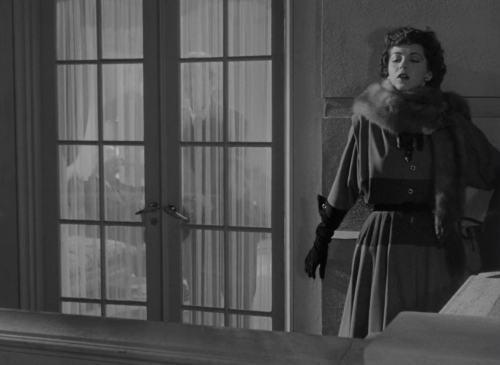
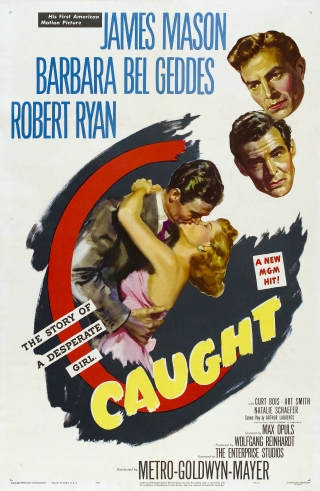
Seeing as Max Ophuls came up in some of the comments on the previous post, I decided to go back and have another look at one of his movies that I have struggled with in the past, namely the 1949 production of Caught. As a rule, I have enjoyed what I have seen of the director’s work, but this film has never worked for me. Anyway, with his name fresh in my mind, as well as the knowledge that the movie seems to be well regarded by many other viewers, I thought I should give it another chance. In brief, and this will be one of my shorter posts, I still have major issues with the movie. To be honest, the fact that I made it to the end was as much through a sense of obligation as anything.
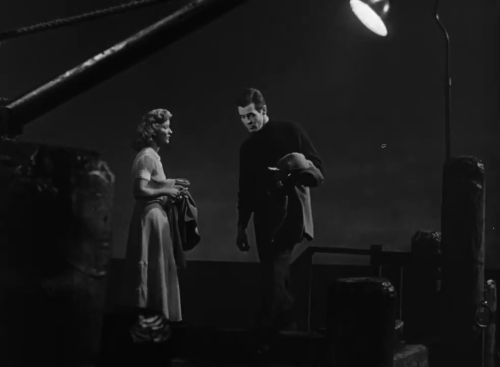
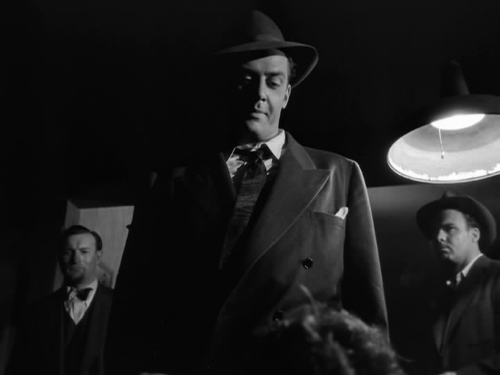
The whole thing is an examination of wish fulfillment and the consequent importance of being very careful indeed of what one wishes for. It opens with two sisters in a shabby tenement mooning over glossy magazines and browsing for dreams, a gem encrusted necklace here, a platinum bracelet there, and so on. As ever, money and the power it bestows matters very much to those who have little of it. Leonora (Barbara Bel Geddes) wants the security and the comfort that comes with wealth, and it does come her way as the result of an invitation to a party on a yacht, an invitation she very nearly turns down. This is the thing with Leonora – she wants things and then doesn’t want them when their real cost becomes apparent. When she makes the acquaintance of Smith Ohlrig (Robert Ryan), a tycoon with a deeply disturbed character, she is soon on the fast track towards the high life on Long Island. However, this is where it all goes wrong for just about everyone involved. Ohlrig is a domineering, controlling and cruel man, an obsessive soul at war with himself and the world in general. Leonora soon comes to see the stew she’s landed herself in and, wisely one would say, moves out and ends up working as a receptionist in a slum neighborhood for Dr Quinada (James Mason). From here the movie devolves into a series of sorties back and forth for Leonora as her indecision along with a deep-seated conviction that she has to “improve herself” at all costs winds up being a good deal more expensive in emotional and physical terms than she’d bargained for.
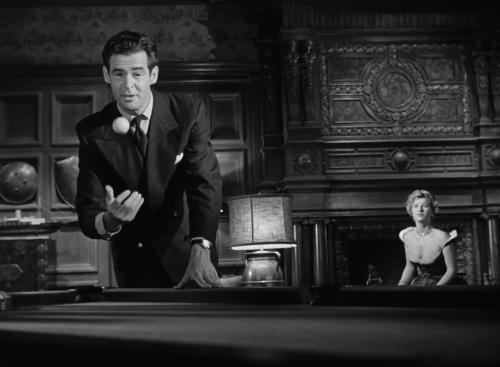
Max Ophuls’ direction is a pleasure – his camera swooping, swinging and panning, following his characters and sometimes sweeping past them to draw attention to the variously opulent or cheap surroundings while they debate, argue or simply muse out of shot. It’s a distinctive style and Lee Garmes’ cinematography adds to the eye-catching visuals. Attractive as all this may be, it’s not enough to paper over the paucity of genuine character at the heart of the movie. Robert Ryan’s Howard Hughes inspired sociopath is a showy piece of work, neurotic and foul and yet also somehow pitiful in his inadequacy. However, there’s a big hole in the middle of it all for me, and that’s the result of the role played by Barbara Bel Geddes. I started off feeling for her as she struggled to dig herself out of the poverty trap. The fact is though that she’s a playing a woman with essentially no character, a whiny, vacillating type who seems to revel in helplessness and indecision. This is the person who is the main focus and it’s very hard to like a movie where the central role presents such a moral vacuum. And the less said about the “happy ending” we’re asked to buy into, the better. James Mason’s first Hollywood starring role is fair, but he’s given little to do to stretch him –  he does have at least one good scene in the garage confrontation with Ryan and Bel Geddes. The support is mainly an attractively homespun turn from Frank Ferguson and a well observed peek at degradation and dissipation by Curt (“Tough, darling, tough.“) Bois.
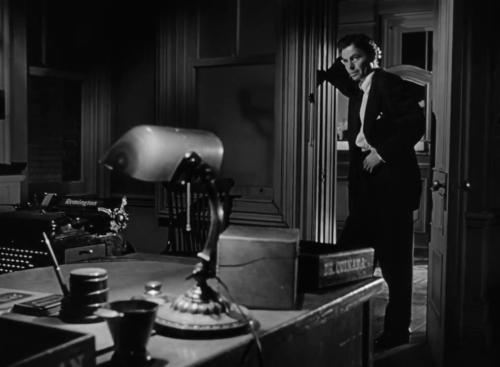
Max Ophuls made far better films than this – The Reckless Moment, again with Mason, came shortly afterwards and is superior in every respect, and there are his great French movies such as  The Earrings of Madame de… and La Ronde. I honestly wish I could like this film more, but it just does not do it for me.

River Lady

Movies that exist at the periphery regularly catch my attention. They may be movies that occupy a place on the margins of a particular genre, they may be transitional efforts that straddle different eras, or they may even be a bit of both. Such is the case with River Lady (1948) a film which is not entirely successful, partly as it’s difficult to pin down the genre – a hint of the western, a dash of riverboat melodrama, and a pinch of the frontier adventure – and partly due to the time it was made. While it might not be the kind of movie that broke new ground or made a strong enough impression to encourage frequent revisits, it is still engaging in the way so many of George Sherman’s titles are.

I’ve lost count of how many westerns have turned a spotlight on the encroachment of civilization on the frontier. Sometimes it’s a matter of the railroad hammering out an iron clad tattoo across the plains and relentlessly shoving the old world to one side. At other times it is the stringing of the telegraph line, or the gradual extension of the reach of the law itself. River Lady concerns itself with the expansion of organized business interests, in particular the conflict between small, independent logging outfits and the hungry syndicates. Nevertheless, corporate kerfuffles of any type have a limited appeal at best and it’s always advisable to bring the human drama and the human faces of the players and antagonists to the fore. So it is that attention is focused on a roughneck logger called Dan Corrigan (Rod Cameron) and Sequin (Yvonne De Carlo), the owner of the titular paddle boat and undisclosed boss of the syndicate which is buying up all the struggling outfits on the river. This allows for a double-edged conflict, both the tangled business affairs and the romantic tug-of-war between a hardheaded free spirit such as Corrigan and the ambitious and manipulative Sequin. And any time the mixture looks like drifting off the boil the silky and stealthy Beauvais (Dan Duryea) is on hand to stoke it up once again.

As has been stated, in terms of genre, there’s a fluidity to the movie that mirrors the flow of the timber down the river. I guess that could be seen as versatility in the script, or even as a determination to resist the imposition of boundaries on the part of the filmmakers. However, it makes it hard to get a handle on the movie, a situation I’ve found can crop up from time to time in mid to late 1940s westerns, where it’s possible to detect elements of breezier B pictures rubbing shoulders with themes that carried a bit more weight. One could even say something similar about George Sherman’s career trajectory itself at this point. The rights to the story drifted around Universal for many years before the movie was finally made and perhaps this fairly lengthy gestation period has something to do with the feeling that the finished product imparts.

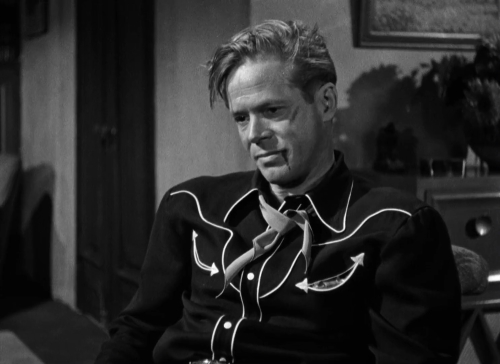
Rod Cameron is third billed but has the leading role. He provides a strong physical presence, although he does end up on the receiving end of a terrific beating meted out by Duryea at one stage. His acting is adequate overall, but the way his character is written is problematic. I think it’s clear enough that the intention is for a redemptive arc to be traced, which is fine as far as it goes. The thing is though that, as written, Corrigan isn’t really a likeable figure for much of the film’s running time. He’s not just a man who is on a learning curve, he’s downright unpleasant to the women in his life and comes across as spoiled and petulant instead of grittily independent. Duryea, as the villain of the piece, actually brings more nuance and therefore more interest to his part. I suppose it comes down to the fact that Duryea, even when we was showboating shamelessly or backstabbing with the worst of them, had a soulful air about him. Top billing went to Yvonne De Carlo but she is off screen for far too long and her role ends up largely undeveloped. Helena Carter is her romantic rival for Cameron’s affections and actually gets the more rewarding part. In support, John McIntire, Florence Bates and Jack Lambert all have their moments.

As a Technicolor production, River Lady might be expected to look better than it does. I have a German DVD that is acceptable all told, but there is a certain muddiness to it too. Perhaps the fact the movie is part of a George Sherman box that has it packaged alongside solid Blu-ray versions of The Last of the Fast Guns and Red Canyon serves to draw attention to its weaknesses.

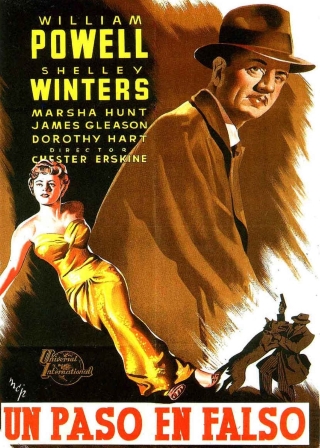
Take One False Step

Any time I come across a mention of William Powell the name of Nick Charles springs to mind. The Thin Man and the series of sequels he made alongside co-star Myrna Loy represent only a fraction of his output, but it came to be something of a signature role for him. Those movies were enormously entertaining and Powell was perfectly cast in a part that allowed him to be smart, debonair and funny. Take One False Step (1949) came along much later, long after he had left Nick Charles behind, yet there is a hint of those light and stylish mysteries about it, easily as much as the film noir elements that its recent reissue might encourage one to believe to be dominant.

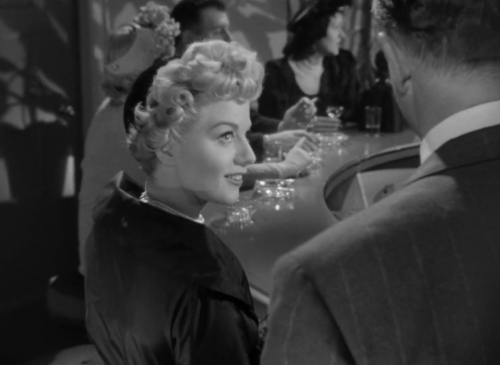
How much store should one set by the superficialities surrounding a film? I’m referring to the title, the credits, perhaps even the promotional material. The reason for posing that question is the fact that the opening credits for Take One False Step, and maybe the title itself, are strongly suggestive of some kind of late era screwball comedy. Of course all of this is emphasizing the need to remain vigilant, lest some major or minor catastrophe should befall one. The opening shot proper continues this theme, keeping the focus on a man’s feet as he enters a bar to order a drink before being addressed by some female counterparts. Well, it catches the attention. The man in question is Andrew Gentling (William Powell), a professor in the process of getting a new university off the ground. The woman who hails him from the bar is Catherine Sykes (Shelley Winters), an old flame he hasn’t seen in years, not since the war when both parties were unmarried and less burdened by life’s more mundane concerns. Should old acquaintances share a cup of kindness, or a couple of martinis at any rate? This pair do so and then part, as befits respectably married people. That ought to be the end of the matter, but Catherine is a restless type, pining for the immediacy of those dangerous wartime years, a woman prone to acting on her impulses. She calls Andrew up and invites him to a party, twisting his arm in a sense, but in a jokey, lighthearted way. Poor judgment, or momentary weakness, has been the undoing of many a noir protagonist and there is a whiff of that to Andrew’s acquiescence.

He soon discovers that he’s not only the guest of honor at this bash, but essentially the only guest. There’s nobody else present aside from another mutual friend Martha (Marsha Hunt) and she’s only there because her house happens to be the venue. Andrew is no longer the swashbuckler or adventurer Catherine remembers and perhaps he never really was, but he’s got a good heart and takes it upon himself to see the lady back home. She’s not so keen on this and he ends up taking a short stroll to let the fact sink in that there is to be no rekindling of lost romances on the agenda. Returning, he sees Catherine totter unsteadily back along the sidewalk towards her own place. However, that is only the beginning of the tale – the following morning brings news of Catherine’s disappearance, with only a bloody scarf, his scarf, left behind. Rather than go directly to the police, Andrew listens to some questionable advice and sets out to look into the business himself first. This leads to more trouble, with the cops, Catherine’s shady husband, a potentially rabid dog, and a race against time from Los Angeles to San Francisco.

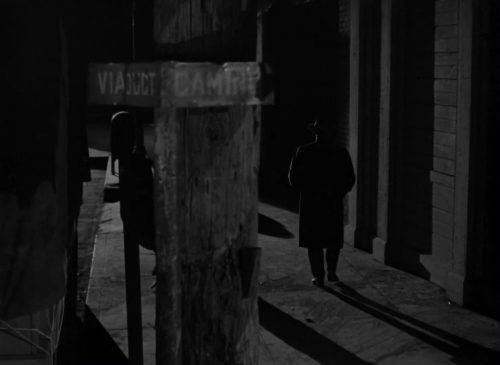
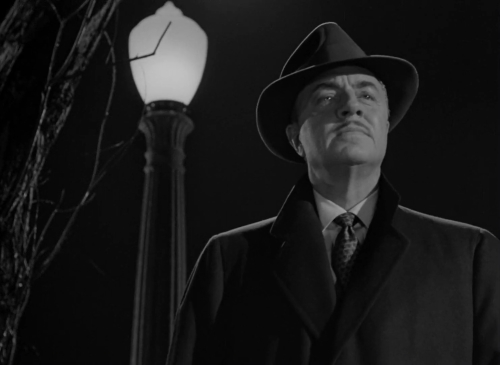
Is it reasonable to say Take One False Step is a film noir? I wouldn’t use the term myself, though I understand how parts of the movie could attract such a legend. The setup does point in that direction, with the innocent man finding himself in over his head very quickly, and his actions and their effects achieving a nightmarish quality. Franz Planer’s cinematography fits the bill too, getting some real value from the everyday and unremarkable. In truth though, this is a straight up mystery, not that far removed from the kind of material William Powell was headlining back in the 30s when he was playing Nick Charles or Philo Vance. There is a touch of humor in it too, as that credit sequence suggests. It’s not overwhelming, simply lightening the mood on occasion and I can’t say I found it unwelcome. Those going in looking for an uncompromising noir picture may find it grating, but as I said that’s not the way to approach this movie. Chester Erskine was the director and he does good work, conjuring up some attractive compositions and keeping a handle on the pacing. Nevertheless, I think it would be fair to say his credits as a writer (Angel Face, Split Second) and as a producer (The Wonderful Country) are more significant than his assignments as a director.

William Powell simply oozed sophistication, ever graceful and charming regardless of how difficult a situation might threaten to become. This was his stock-in-trade, the foundation of his screen persona and he made use of it in almost every genre he appeared in. Yet he carried along with it a kind of wry awareness of the fact this was a persona, enabling him to look at himself, his fellow characters and the circumstances in which they find themselves with a knowing air. This worked well in classy comedies and he was able to blend it into his mystery roles too. I mentioned the part of Nick Charles at the top of this piece as I have a hunch that characterization will be more familiar to many readers, which is not meant to suggest it was his only notable role. I also referred in passing to Philo Vance and I imagine those who have seen him play that part might agree he was an ideal fit. Personally, I find that any time I read Van Dine I have the image of Powell in mind. As the hapless professor he is less in control of events than he was in some of those mysteries, but this affords him the opportunity to exploit those characteristics that made him attractive to viewers – that smoothly polished exterior with a hint of panic stirring beneath, but with good manners and restraint holding it in check. There is one particularly effective scene, full of grim humor, around the mid-point, where the professor is seriously concerned about a bite he suffered and has sought medical assistance from a grouchy doctor (Houseley Stevenson) who tests his patience, and that of the viewer, to the limit.

Shelley Winters was in some excellent movies around this time, in what I think of as her dissatisfied vamp period, before A Place in the Sun saw her get nudged towards playing more needy types. She brings a lot of energy to the early scenes before Marsha Hunt steps into the spotlight. Hunt, who passed away last year at the ripe old age of 104 and who was one of those almost hounded out of the business during the shameful HUAC episode, is the faithful best friend, a classic Girl Friday part which she embraces and excels at. As the lawmen on the trail of Powell’s fugitive academic, Sheldon Leonard and James Gleason are responsible for most of the humor. Leonard is his usual loud self, forever on the brink of exasperation, while Gleason provides another variation on that hard-bitten but likeable cop that he brought to both the Miss Withers and The Falcon series. Another notable supporting part is filled by the instantly recognizable Felix Bressart, in his last role. He had appeared with William Powell years before in the rather good, if rarely mentioned, Crossroads and specialized in playing the kind of quirky middle European types he takes on here.

Kino has been instrumental in rescuing a whole raft of Universal crime, noir and mystery pictures, titles that were hitherto either impossible to see or only available in dreadful beat up prints. Take One False Step has been included in one of their film noir boxes and while I see how there are traces of noir to be found, it really is more of a straight mystery with a few comedic touches here and there. I have to say I thoroughly enjoyed this film, it’s of a type that I find most appealing and the cast are uniformly excellent. I strongly recommend checking it out.

The Walking Hills

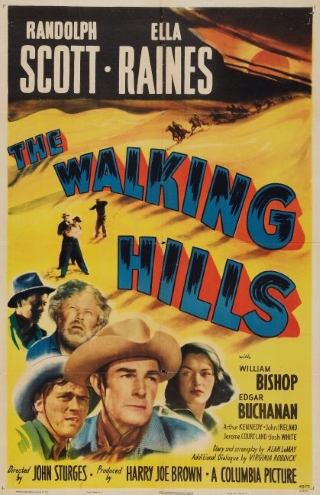
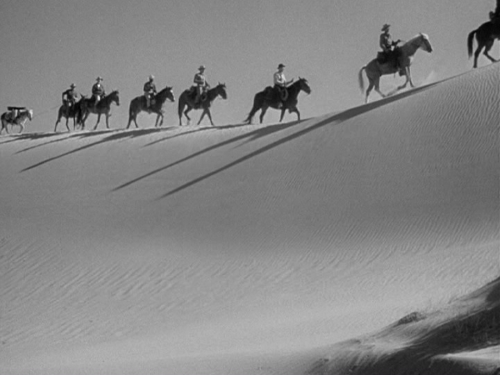
In 1948 John Huston had a small yet ill-assorted bunch of fortune hunters looking for gold and finding it paved the way to something far darker in The Treasure of the Sierra Madre. A year later, John Sturges took another disparate group from the back room of a cantina in Mexicali and had them cross the border into the US on a quest for the yellow metal. The Walking Hills (1949) is a less ambitious picture, smaller in scale but using that same lure of gold to trigger a range of reactions among his treasure seekers, and in so doing to offer a commentary on people and what makes them tick. Where Huston finished off with the dry desert winds blowing away the remnants of a tarnished dream to the accompaniment of a fatalistic laugh, Sturges uses his dust storm to scour away the mendacity and suspicion which has dogged his characters and to hold out the possibility of renewal.

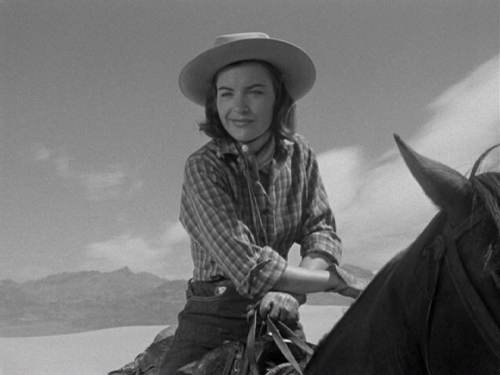
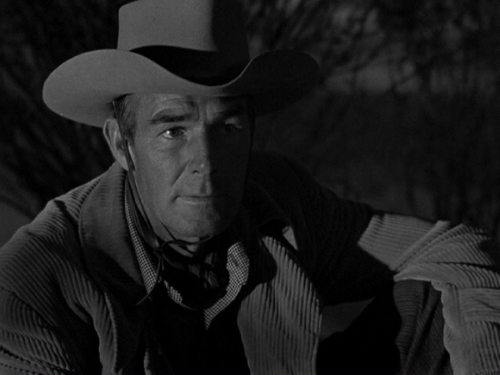
A chance remark during a card game in a cantina sets it all off. The men around the table had been musing and joking over the fate of a wagon train said to have been loaded with gold that had vanished in the wilderness almost a hundred years earlier. Then one of them mentions seeing what looked like an old wagon wheel sticking out of the ground on his last trip. Just as he says those words, a silence descends. A silence pregnant with meaning, as each person in that room thinks the same thought at the same moment, and then they realize that this shared knowledge binds them all together in an uneasy alliance of greed and distrust. They are an odd cross-section of humanity, dreamers and fugitives, drifters and grifters, the kind of people who have nothing much in common save a yearning for something better than the life they are currently leading. Most notable among them is Jim Carey (Randolph Scott), a horse breeder with a mare in foal to worry about – that foal acting as an overt symbol of rebirth and a new beginning and quite literally carried by Scott right to the end of the movie – and then there is Shep (William Bishop), who is a cowboy with a secret he is keen to keep, especially from the brash Frazee (John Ireland). So this diverse band sets out to cross the border back into the US and into the desert, where fates and loyalties shift as suddenly and unpredictably as the sands beneath them. No sooner have they left civilization behind than another rider appears on the horizon, having followed them from Mexicali. This is Chris (Ella Raines), a woman with past ties to both Jim and Shep.

With the sun beating down and the trappings of the modern world stripped away, something approaching truth is gradually revealed. Hasn’t the concept of entering the desert, the wilderness, represented the confrontation of temptation and the attainment of spiritual renewal from Biblical times on? The desert of this movie serves a similar purpose, bringing the secrets of the past out into the open and finally laying out the prospect of a new beginning for those whose resolve is strong enough to withstand the siren call of greed. Is it too convenient that there are so many potential suspects all brought together, and that all of them should be tormented by the prickly discomfort of a guilty conscience? Perhaps there is convenience too in the neat way the hunter proves himself to be little better, and in some senses arguably worse, than the hunted. Yes, all of this can be taken as contrivance, but it is a story after all, a parable with a lesson to impart, and not a factual entry in a diary. So long as it all leads to the resolution writer Alan Le May and director Sturges desire and the realization they wish to encourage, then it ought to be permissible to bend credibility a little.

Once again,  we see a movie which underscores the steps Scott was taking towards the full flowering of his screen persona, one which would reach its apogee in the Ranown cycle. There’s the air of charm and civility cloaking a steely core that was so characteristic. Added to that is the wounded nobility that is his guiding principle. There is something heartfelt about the way his pride prevents him from correcting Chris when she misinterprets his motives and berates him – just the use of body language and the terseness of his tone is enough to convey how holding oneself to a high standard can be tough, and that expecting others to be capable of comprehending that is an even bigger ask. Then there is the climax, where his generosity of spirit is admirable. It is clear how much it costs him emotionally to grant Shep the facility to redeem himself. Still, he does so, that innate sense of nobility or propriety nudging him to sacrifice his shot at personal fulfillment in order to present others with that same prize.

It has been said that The Walking Hills has noir overtones, but they are really only incidental, Charles Lawton casts some captivating shadows at times and the use of flashbacks to fill in the backstory for William Bishop and Ella Raines is suggestive, but nothing more. Bishop makes good use of the restlessness and ambiguity he brought to his better roles and keeps everyone guessing for a long time. Ella Raines is always a welcome sight and she offers some much needed empathy and selflessness to leaven the greed and antagonism that threatens to boil over in that raw and searing environment. In the small cast everyone gets to contribute something, Arthur Kennedy only really coming into his own as a delightfully sniveling ne’er-do-well towards the end. John Ireland displays his customary air of menace in a largely unsympathetic part, while Russell Collins, Edgar Buchanan, Jerome Courtland and Josh White all have their moments to shine, the latter via some terrific blues songs.

The Walking Hills got a DVD release as part of a Randolph Scott box from Sony years ago – I don’t know whether it has been upgraded to Blu-ray in the interim – and looks generally fine, highlighting Lawton’s cinematography and Sturges’ confidence shooting outdoors on location. Personally, I enjoy what could be termed contemporary westerns, especially something like The Walking Hills where it feels as though the classic west is within touching distance, easily accessible by simply riding beyond the city limits yet with a spectral, intangible quality too.  It is one of those tight, compact pictures that Sturges excelled at and is well worth seeing.


Desperate

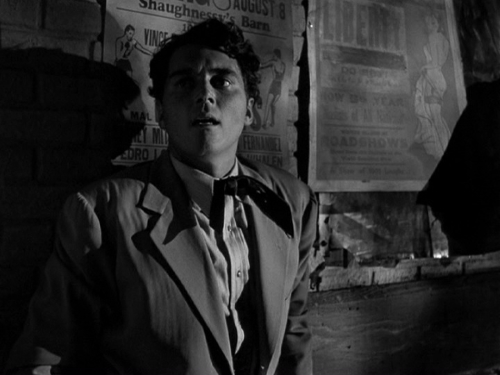
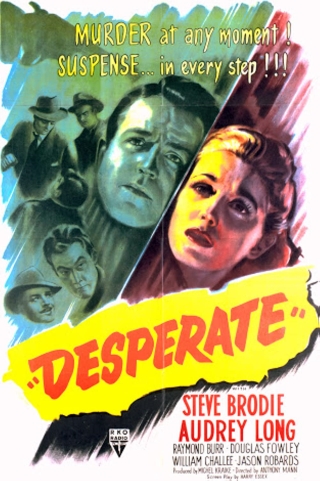
With a title like Desperate (1947) and a lead character who is a veteran striving to make a success of both his new marriage and his job, it might be reasonable to expect the focus to be on the desperation related to difficulties in settling back into civilian life. What we get, however, is a classic film noir scenario based on some dubious choices and flawed judgement. It is often said that the kind of maladjustment that appeared to dominate the post-war landscape was a major driver of film noir in the mid to late 1940s. I guess the initial poor call by the protagonist that sets everything in motion could be regarded as being tangentially influenced by that, but it’s really just a matter of a guy looking to make a bit of extra cash and how that draws him into one of those spiraling nightmares where it seems virtually impossible to catch a break.

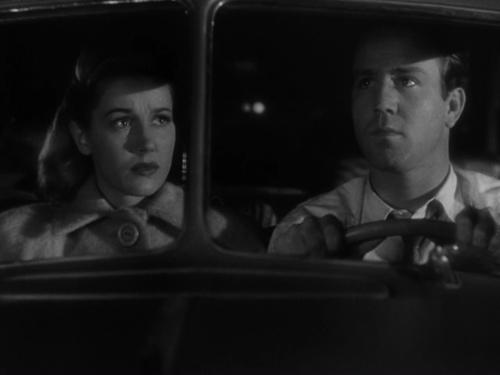
Steve Randall (Steve Brodie) is trying to make a go of it as a trucker and makes what turns out to be a fateful decision to accept a job offer from an anonymous caller. He could have been enjoying a celebratory dinner with his new wife Anne (Audrey Long), and she could have broken the happy news that there was a baby on the way. However, a man just starting out needs money and so the prospect of some easy cash for an evening’s work is too alluring to pass up. That this is the first of Randall’s poor choices becomes abundantly clear when he turns up for the job only to be greeted by a shady old acquaintance, Walt Radak (Raymond Burr). He then discovers that he is expected to haul away the spoils of a warehouse heist. That would be bad enough in itself, but a bungled escape bid by Randall stirs up the thieves and leads to the shooting of a cop and Radak’s brother getting arrested.

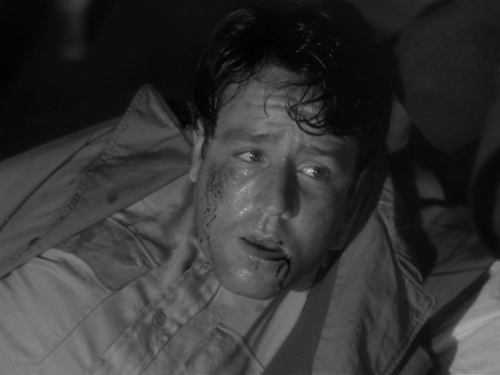
Radak is, not unnaturally, sore, sore enough to have his hoods hand out a brutal beating along with a warning that Randall’s wife will suffer too unless he is prepared to take the rap and by doing so exonerate the brother, who is now looking at a date in the death house on a murder rap. Now a smart guy would take the chance to go to the police at this point, say his piece, and let them provide the protection. However, Randall doesn’t do that; he proceeds to make the next of his poor choices and goes on the run, not to save himself but to find a sanctuary where he can stow his wife till the increasingly tangled skein can be unraveled.

So the story follows Randall as he tries to keep at least half a step ahead of the vengeful Radak, and to avoid further run-ins with the law. In a sense, everybody, all of the main characters anyway, grow progressively more desperate as the plot unfolds. Randall fears for his and for his family’s safety, Anne’s anxiety for her husband and child is a constant, and Radak’s hunger for retribution against the man he holds responsible for his brother’s plight becomes almost monstrous.


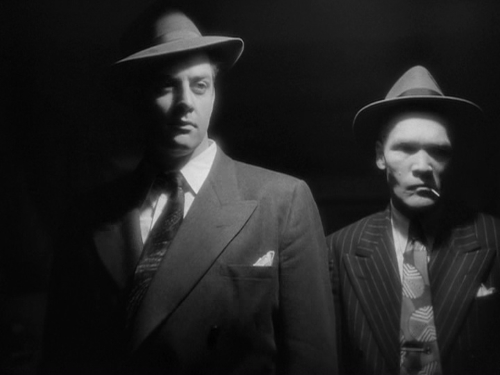
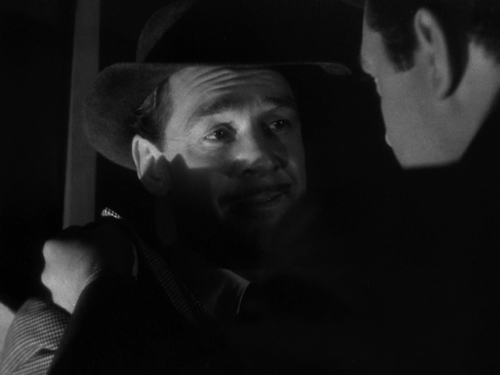
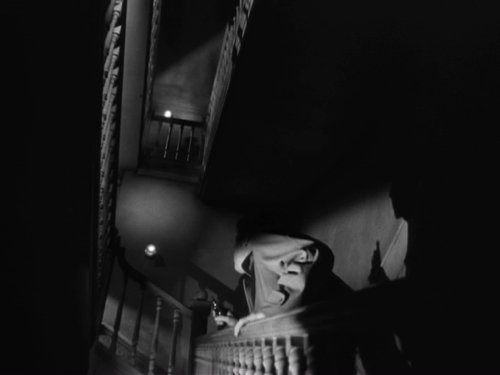
The tendency is to think of Anthony Mann’s films noir in terms of his work at Eagle-Lion in collaboration with cinematographer John Alton. However, Desperate was made for RKO and was shot by George E Diskant. Alton or not, Eagle-Lion or not, this is without question an Anthony Mann movie. Visually, it is inventive and disorientating – the beating of Randall, as the overhead lamp swings ominously like a blade slicing through the shadows as the hoodlums’ fists slice up the hero, has Radak dipping in and out of darkness like some malign bogeyman. Characters are frequently either squeezed by the frame or shot from unexpected angles, everything highly suggestive of people under pressure and facing circumstances that are fraught with peril and insecurity. Mann has a credit for the story, from which Harry Essex wrote the screenplay, and it is an incident packed affair. If anything though, the movie is probably overloaded with incident, something that becomes even more noticeable when one takes into account the brief hour and a quarter running time. That said, it does contribute to the sense of urgency of the production and perhaps could be seen as going some way toward explaining Randall’s questionable judgement on many occasions. Thematically too, there is much that we associate with Mann on display, notably the violence and brutality the characters must endure, and that typical sense of movement and direction, not so much forward as upward, that ever present striving to reach some high place, which in this case culminates in the shootout on the tenement stairway.

Steve Brodie was a perennial supporting player, a name and a face that will be familiar from countless movies and TV shows. That he never got the lead outside of Desperate is no slight on his acting abilities, he simply wasn’t the type physically to be cast in headline roles. What he had, however, was a recognizably everyman quality with the features and demeanor of a regular guy. As such, he was well chosen to play Steve Randall – it is easy to accept him as a man who can be worked over, one whose decisions will be flawed from time to time. Raymond Burr plays Radak as a relentless and driven figure, and Mann makes good use of his bulk, having him crowd and dominate the frame on multiple occasions. Audrey Long spends much of her time fending off a gnawing anguish and the script offers her little or no opportunity to do anything beyond that. In support, Douglas Fowley, another familiar face from countless movies as well as a recurring role as Doc Holliday on The Life and Legend of Wyatt Earp, is superbly seedy as an ill-fated private eye, while Jason Robards Sr playing the detached detective with the singsong delivery is unusual enough to make his relatively small role memorable.

Desperate came out on DVD from Warner Brothers on one of their later film noir sets and it looks very well. The films Anthony Mann made for Eagle-Lion from around this time draw more critical attention and their profile is correspondingly higher. I reckon the script is a little crowded and busy, but the movie is a good one overall with a strong sense of momentum and it stands as a solid example of the director’s noir work.

They Drive by Night

Warner Brothers made some of the most socially aware movies of the classic era, not in a preachy or even a condescending sense but in a way that was both matter of fact and humanitarian at the same time. This aspect of the studio’s output was particularly apparent throughout the 1930s and it provided a sound base on which to establish their characteristic gangster films. That classic gangster cycle was effectively brought to a close by Raoul Walsh’s magisterial The Roaring Twenties.  The following year Walsh cast two pivotal figures from those seminal crime movies in major roles in They Drive by Night (1940), a film whose very structure represents something of a bridge between the strong social conscience material of the previous decade and a smoother kind of melodrama that hinted at a noir sensibility.

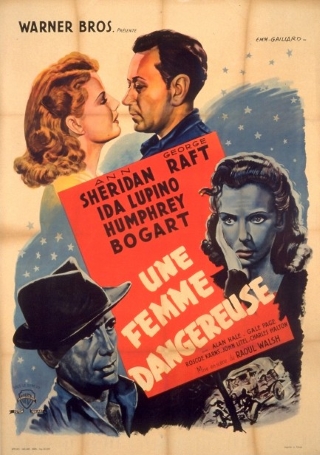
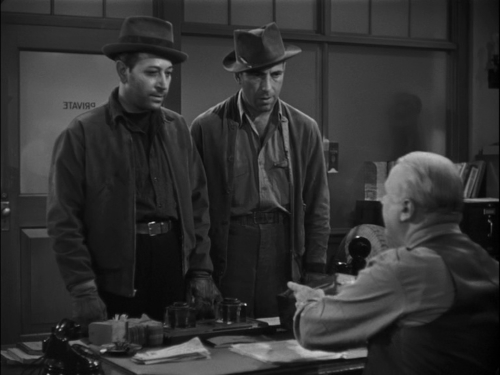
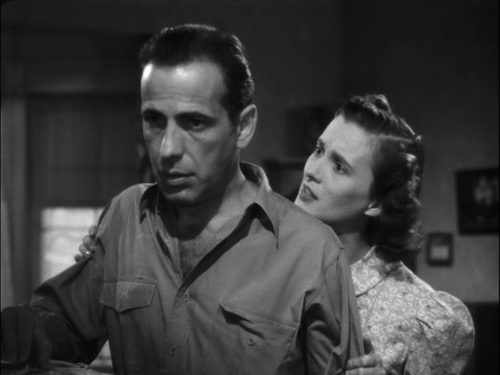
Movies based around the exploits and experiences of truck drivers are pretty common, from Racket Busters to Thieves’ Highway, The Wages of Fear and Hell Drivers to The Long Haul. That last movie, a British picture with Victor Mature and Diana Dors, shared the same title, but nothing more, as the A I Bezzerides novel from which They Drive by Night was adapted. There is a certain in-built romance to any kind of road movie, the notion of man and machine blazing trails and running into crime, corruption, or maybe just lousy luck has plenty of storytelling potential. There’s also the opportunity to examine the hardships involved, all the mundane little trials that come with such a typically working class job. That’s how this movie starts out, following the exhausting, insecure and poorly rewarded toil of two brothers trying to eke out a living hauling whatever loads are handed to them. They are Joe and Paul Fabrini (George Raft and Humphrey Bogart respectively), bleary-eyed, grimy, short of cash and never more than a tip-off or a fast dodge ahead of their creditors. Even so, there’s a tough integrity to their poverty, the wisecracks serving as a cloak of modesty for the determination and ambition honed and tempered by long years on the road.

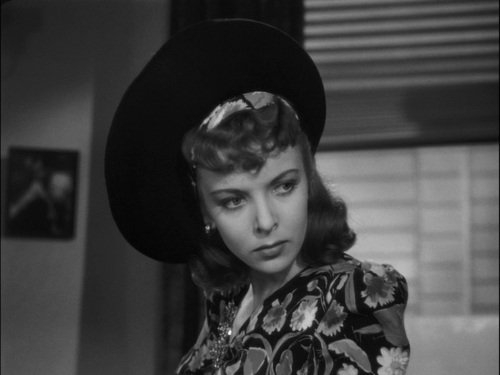
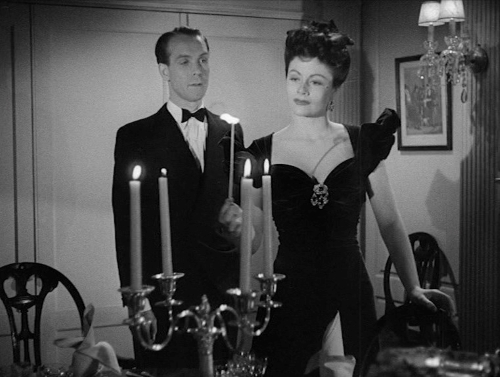
The first half of the movie traces a true but bumpy and incident strewn path towards Joe Fabrini’s ultimate goal, with just the same steely focus as the character himself shows as he hugs that white line night after night. It feels like one long ride, broken occasionally by stop-offs at cheap boarding houses, gas stations and roadside diners peopled with braggarts, lechers and brawlers, quick with a quip yet as close knit and proud as only the downtrodden can be. This section is dominated both by the to and fro over what might be termed the work-life balance between the Fabrini brothers, and also a burgeoning romance between Joe and Cassie (Ann Sheridan), a short order waitress. Two other major characters, restless vamp Lana Carlson (Ida Lupino) and her rambunctious and incorrigible husband Ed (Alan Hale), are introduced. Ed is an old friend of Joe’s who has made good and is living in the kind of luxury he hasn’t yet managed to get a handle on. Lana also knows Joe from way back, and she’s very keen on not only renewing the acquaintance but on seeing it develop into something much more intimate. However, this strand is only fully explored in the latter half of the film.

Everything changes dramatically, the direction of the story and the whole tone of the movie, after a serious accident quite literally takes the Fabrinis off the road. It opens up an opportunity for Joe to strike out on an alternative route to success, and it also presents an opportunity for Lana as she gets to thinking she might be able to rid herself of the husband she’s grown to despise and simultaneously sate her desire for Joe. In an ironic twist, the trappings of wealth and prosperity that Ed has surrounded himself with to facilitate the high life are shown to be capable of bringing that life to a swift and premature end. After another evening of boozing and ribaldry, Lana feels humiliated and frustrated enough to act – it only requires her to take a short walk on a quiet night and thus commit murder by remote control. Could this be the perfect crime?

Walsh handles the story with typical vigor, bridging the stylistic divide over the course of the movie with aplomb so that the changing circumstances feel authentic. The early scenes have a real flavor of the 30s about them, full of Depression-era energy and snappy, wisecracking dialogue, while Raft, Bogart and Sheridan get the lived-in feel of their characters down pat. Raft is very assured, arguably his Joe Fabrini is too sure of himself, to the point where it is going to come back and bite him. Sheridan is at her best in the diner sequence, tough and sassy, trading one-liners with the customers and more than holding her own. Bogart could always play it soulful when necessary and he’s good value till the script sees him effectively sidelined. The second part of the story looks ahead to the type of movie that would become increasingly common in the 1940s, and it is this section where Ida Lupino comes into her own. She switches smoothly from acid to sugar depending on the person she happens to be dealing with and her desperation to conceal a trashy background and move in more genteel circles is almost a living thing. That barely disguised dissatisfaction grows steadily, driving her to crime and ultimately consuming her body and soul. The physical transformation she achieves by the time of the famous courtroom meltdown is quite remarkable.

The movie, or its latter stages at any rate, see it flagged as an early film noir by some. Admittedly, there is a touch of that about it, but there’s no more than a suspicion really. It’s a solid melodrama with a crime and jealousy angle and there is no need to hang any other labels on it. The triangular romance and the betrayal this provokes, those illicit, murderous passions stirred into life amid a tough working environment are said to be an echo of the earlier Bordertown, a film I have not seen, and there are points of similarity to be discerned in the later Blowing Wild. Leaving aside genre descriptors and links to other movies, They Drive by Night is a fine picture, an involving, well-crafted piece of work that showcases the ease with which Raoul Walsh seemed to make great films. It is unmistakably a Warner Brothers production, a first rate Raoul Walsh movie and a genuine classic.


High Wall

Many a film noir has traded heavily on mistrust, betrayal, isolation. These are themes that breed doubt and underpin anxiety, and what better way to highlight doubts and anxieties than to tell a tale through the eyes of an amnesiac. Even partial loss of memory becomes a type of betrayal of self, a descent into the classic inky nightmare of the noir universe where a person can no longer feel confident in their own being, where awareness is forever tempered by a gnawing fear that there may be something contemptible lurking within one’s own heart. This notion of the unreliable narrator has enjoyed sporadic popularity and saw something of a revival in crime fiction and its adaptations a few years ago. High Wall (1947) toys with this concept, but it doesn’t really pursue it. Depending on the viewer’s own tastes, that may or may not be regarded as a strength.

We open on a club scene, one of jazzy music, well-heeled revelers clustered round tables or taking a turn on one of those characteristically small dance floors. The camera glides along, drinking it all in and then pauses on a figure at the end of the bar, perched there with his own drink in front of him. His entire demeanor screams disquiet, the cultured, patrician features rumpled and strained by some inner turmoil. He is Willard Whitcombe (Herbert Marshall), a publisher of virtuous literature. After establishing his identity, we cut to the interior of a speeding car, the driver’s countenance set and grim, hurtling down the highway while the lifeless body on the seat beside him lolls obscenely. And then he ploughs off the road, seeking to join the departed passenger who’s been keeping him company. This is Steven Kenet (Robert Taylor), one of those damaged veterans, a man not really recovered from a head injury suffered during the war. That corpse he had been taking on a ride across his own version of the Styx belonged to his wife, and his addled brain has convinced him he must have strangled her before blacking out.

Well, that’s not how things work out, and Kenet finds himself rescued and sent to a psychiatric hospital for assessment. This is the point where the plot kicks in properly, where the patient’s despair gradually transforms into doubt, partly due to the almost complete disintegration of his family and partly as a result of the efforts of Dr Lorrison (Audrey Totter). As we follow Kenet’s painfully slow quest for enlightenment regarding those lost hours, there is another strand unspooling in parallel. While our protagonist might be assailed by fear and uncertainty, there hasn’t been a great deal of doubt in the minds of the viewers as to who the guilty party really is. I don’t think it would amount to a significant spoiler to reveal the identity here  – allusions aside, the truth is explicitly spelt out on screen before long anyway – but I’ll refrain from doing so. Of course people can feel free to do so in the comments below if they wish.

Seeing as the script by Sydney Boehm and Lester Cole does reveal the culprit quite early, it is probably fair to assume that the intention was to make this less of a mystery or whodunit and more of a suspense picture. The viewer is not invited to follow a detective figure as he ferrets out leads to corner the killer. We already know who this is, and we also know that the hero is just that and not some cleverly disguised bogeyman waiting to spring a surprise. Somewhat similar to the inverted mystery, the suspense derives from our being a hop, skip and a jump ahead of everyone on the screen, knowing more than they do yet unsure of how or when they will acquire that knowledge. As a premise, this certainly has its merits, but my feeling is that it tends to draw some of the sting out of the amnesia plot, perhaps diluting the potency of the noir scenario in the process.

Curtis Bernhardt had a flair for both film noir and melodrama, and that strong run he embarked on from the mid-1940s, starting with Conflict and extending through to Payment on Demand, saw some of the sensibilities and trappings of both styles bleed into each other. While I have a few reservations about some of the scripting decisions, that is not to say the film is weak overall. Bernhardt’s atmospheric direction is a big part of what makes it work, elevating even the most mundane situations through sheer visual bravado. He manages to elicit tension and the hint of needle from something as simple and prosaic as two people squeezed into a phone booth in a diner, and then juxtaposes hope and despair by having the hero escape a full on deluge by taking a shortcut through a virtually deserted church on his way towards ultimate salvation. Brief, throwaway moments that employ the visual language of the cinema with wonderful eloquence.

There are a good many high points in the post-war career of Robert Taylor, and the quality of his work was remarkably consistent up till at least the start of the 1960s. Pretty much all of his films noir are enjoyable and High Wall is one of the better ones – personally, I’d place Rogue Cop and Party Girl ahead of it but that still leaves it occupying a very respectable third place. He gets the hunted intensity of the amnesiac, the primal guilt that the condition provokes, across very successfully. When this movie was made it seemed as though Audrey Totter was destined to be cast in nothing but film noir, which can be taken as a testament to how comfortably she slotted into that murky style. As a rule, I think I prefer her in unsympathetic roles where her pouty petulance can be so effective. However, she is very much the Girl Friday figure in High Wall, somewhat severe and sober, but loyal and resourceful too. Regardless of the part he was playing, be it hero, villain or anything in between, Herbert Marshall brought what I can only describe as an air of reassurance to the screen. His presence alone could typically be taken as proof that the movie would be a good one.

High Wall has been available on DVD for years as part of the Warner Archive, looking quite strong but sadly devoid of any supplementary material. It is a good, solid noir that falls just short of the very top flight, probably due to the nature of the script. However, it fits neatly into that tantalizing sub-genre of Freudian-influenced dramas and thrillers that flourished in the mid to late 1940s. While it has a few flaws, the direction of Curtis Bernhardt and the strong central performances of Robert Taylor, Audrey Totter and Herbert Marshall easily compensate. Highly recommended.

Bedelia

The movie industry has always been keen to capitalize on what is perceived to be a winning formula, one glance at the franchise-heavy roster of movies that get approved these days ought to provide ample evidence of that. When Otto Preminger’s adaptation of Laura proved successful, it should not comes as any surprise that another novel by Vera Caspary with a single word title derived from a woman’s name soon caught the attention of filmmakers. So it was that Bedelia (1946) came to the screen, not via Hollywood this time though, but through Rank in the UK. It is an interesting yet not wholly successful work, partly due to the fact that inverted mysteries such as this tend to be tricky subjects at the best of times, and partly as a result of a cast that, the leading lady excepted, feels a little lackluster.

The opening plays out over a portrait of Bedelia (Margaret Lockwood), with a narrator leading the viewer into the story, placing the opening scene in pre-WWII Monte Carlo. The narrator is a man by the name of Chaney (Barry K Barnes), ostensibly a painter but it’s clear enough that this is not his real profession. He’s a hunter of sorts, I suppose, and it is apparent that the title character is his quarry. She is on her honeymoon, having just married the older and decidedly staid Charles Carrington (Ian Hunter). Chaney quietly finagles his way into making the acquaintance of this couple of newly-weds. Carrington is a man in love, starry eyed and besotted in the myopic way that only those caught up in the romance of a late spring can be. Chaney has no such illusions to trouble or dazzle him and he, as do we the viewers, sees that Bedelia has constructed an elaborate cocoon of deceit around her, a shell of deception to hide her true motives and character. I don’t think it constitutes a major spoiler if I state outright that this woman is what we would now refer to as a serial killer, one who collects well-to-do if not explicitly wealthy husbands in order to dispose of them and cash in on the insurance. Carrington has become her latest acquisition, and by the time they return to his home in England, his fate has effectively been sealed. It only remains to be seen whether, or indeed how, her scheme will succeed, or whether Chaney, her husband or those in their social circle will manage to put paid to it.

Vera Caspary’s source novel was set in the US, but the film saw the action shifted to the UK. Like all inverted mysteries, it is essentially a tale of suspense, relying on the viewer becoming absorbed in the process of following a criminal who is planning out what they hope will be an undetectable crime. The suspense arises from our being that half step ahead, knowing what the ultimate goal is, and juggling hope and frustration as we will the would-be victim to shake the sleep from their eyes, and wonder how or if the inevitable can be sidestepped. In a sense, it is hard to avoid comparing this film to Laura, although I dislike doing so in general and on principle – I reckon if a writer or filmmaker has taken the trouble to produce a work for our entertainment, then the least we can do is try to appreciate it or assess it as a discrete entity. As I say though, the temptation is there, and I feel the film comes up a little short under the circumstances. The story is good enough, Lance Comfort’s direction is smooth and suitably stylish, and Freddie Young’s cinematography contains some attractive flourishes, although it’s not difficult to see where it’s all headed.

Margaret Lockwood was one of the biggest stars of British cinema in the 1940s, courtesy of her work for Hitchcock, Carol Reed and the Gainsborough melodramas. She is fine as the title character, a deeply disturbed woman who successfully buries her greed and duplicity beneath a poised and polished exterior. We are onto her right from the beginning, those petty lies and that odd reluctance to be photographed or even have her portrait completed sending out strong signals of the presence of a wrong ‘un. Yet she displays a kittenish charm that serves to dilute the evil we know lurks beneath the surface, and adds the kind of layering to the character that allows the viewer to care about her even as we hope to see her machinations foiled. I won’t go into details here as I think that would be straying too deep into spoiler territory, but it’s worth noting that a separate and radically different ending was shot for US audiences. I’ve only seen the British ending myself, and I feel it is both appropriate and satisfying in the context of all that went before.

Ian Hunter had a long an varied career, starring in a number of early films for Hitchcock before heading to Hollywood and working with the likes of Frank Borzage and John Ford. By the mid to late 1940s he was back in Britain and Bedelia presented him with a worthwhile role. There is a good deal of high octane melodrama in this picture and his calm, slightly wounded stoicism acts as a counterweight to Lockwood’s more highly strung central performance. He grounds it all and provides the sympathetic figure the audience needs to identify with. This is all the more important as Barry K Barnes invests the character of Chaney with a rather colorless and oddly fey quality, somewhat remote and chilly. As for the others, Anne Crawford probably has the other fairly significant part yet, as with most of the supporting players, there is a sense of someone flitting in and out of proceedings without really making a lasting impression.

Bedelia was released on DVD in a very nice print from Odeon/Screenbound a few years ago, but it looks as though it has since drifted out of print. It’s a solid mystery/melodrama with a hint of film noir about it and definitely worth checking out should the opportunity arise. The inverted structure may not work for everybody and the cast, apart from Lockwood and Hunter, feel a bit anonymous. That said, it does look good and the resolution is bleakly satisfying.

Johnny Stool Pigeon

It’s interesting to watch movies that might be described as halfway house efforts, they have an air about them of remote outposts on clinging on at the frontier of genres, one eye fixed on a particular set of circumstances and the other looking in a different direction like a sort of cinematic Janus. Johnny Stool Pigeon (1949) has a touch of that, casting ahead to the rapidly approaching decade where the focus would shift firmly to tales of a society under threat from shadowy but large scale criminal organizations while still retaining a concern for the battered and bruised individuals who represent the life blood of the genre.

A federal sting aimed a netting a drugs courier just off a boat in San Francisco leads to the suspect taking a bullet during a chase through a dockside warehouse. The agent who had been hoping to make an arrest is Morton (Howard Duff) and he’s the insistent type. Running down the man who did the shooting is easy enough, but picking him up in order to apply a bit of pressure proves trickier. Organized crime is dependent on tip offs and betrayals, and so it is that word filters through of what the authorities have in mind. The result? Another mouth silenced and another link cut out of the chain leading back to the narcotics suppliers. This is all routine stuff so far, but the apparent brick wall confronting Morton calls for some creative thinking, and enlivens the story as a consequence. His reasoning is that if the organization can’t be broken from the outside, then it will have to be done from the inside. The problem of course is how to get in. The key to unlocking that particular door rests in the hands of Johnny Evans (Dan Duryea), a hood and gangster serving time in Alcatraz thanks to the efforts of Morton, and nursing the kind of deeply felt grudge one might expect. Conveniently, from Morton’s standpoint at any rate, Evans’ wife has recently died from the effects of drug addiction so there’s plenty of emotional leverage on hand. Forming an uneasy alliance, Morton (now going under the name of Doyle) and Evans head first to Vancouver in Canada and then back down south to Arizona on the trail of the head of the syndicate. While all this is taking place, there is an added complication provided by Terry (Shelley Winters), a girl keen to escape the clutches of the mob.

Frankly, the gangbusters element of the story is by the numbers stuff, well enough executed but hardly riveting. Any plot that makes use of the lawman going undercover trope naturally generates suspense and tension, and that is certainly true here. I guess the involvement of a potentially hostile figure such as that portrayed by Duryea adds a touch of uncertainty, although there aren’t really any jaw-dropping twists in store. For all that, the movie is entertaining in the way so many Universal-International crime pictures are. It displays a brisk lack of pretension, a utilitarian stylishness that is alluring. William Castle is best known these days for those horror and thriller movies he concentrated on from the late 1950s onward. However, his credits in the preceding years show the breadth of his body of work. He worked in many genres and deserves more recognition for the frequently tight and fast-moving westerns, adventures and crime movies he cut his teeth on. When Johnny Stool Pigeon was made he had just moved to Universal-International after spending years working on a number of series for Columbia, such as Crime Doctor (somebody please release a set of these enjoyable B pictures!) and The Whistler. The economical shooting and storytelling style of these low budget movies would stay with him and inform much of his subsequent work.

I have  seen and enjoyed so many Dan Duryea performances over the years. Broadly speaking, he tended toward two characteristic types. On the one hand, there was the sly, wheedling good-for-nothing, slouching from one cheap subterfuge to another. On the other hand, he could be a loud, booming braggart, a strutting peacock daring all to challenge his brashness. His role in Johnny Stool Pigeon is something of a hybrid, with a couple of real firecracker scenes that have him cutting loose and barking at Barry Kelley and Howard Duff respectively, as well as more subtle, yet paradoxically more powerful and affecting, moments such as his visit to the morgue to identify the body of his wife. Threaded trough the whole performance though is that air of tough melancholy he always wore. He had about him the aura of a man assailed by wry bitterness and relentlessly pursued by some nameless regret.

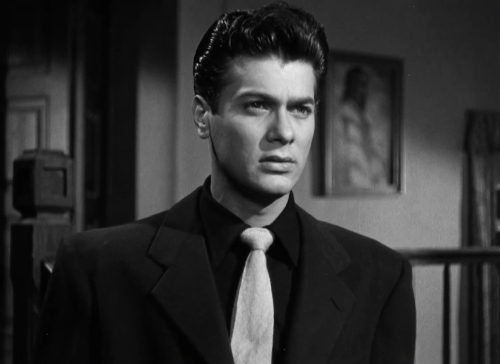
Howard Duff enjoyed a fairly successful run from the late 1940s till the middle of the next decade as a lead of the square -jawed variety. I wouldn’t say he had great range but he was an agreeable screen presence. He is rather aloof in Johnny Stool Pigeon, distant and frankly stiff in many scenes. In his defense, the role he was playing was that of a man in an especially precarious position, one who would have needed to maintain a cool and icy grip on himself at all times. Still, the contrast with Duryea’s full-blooded performance is marked. Shelley Winters weighs in with a credible mixture of street-smart and vulnerable, and her character’s influence on both her co-stars and the eventual resolution of the story is noteworthy. In support, John McIntire is typically impressive, his back-slapping bonhomie masking a dry, cold core. Tony Curtis, in one of his earliest appearances, has the role of a mute assassin. He may not have had any dialogue but he gets plenty of screen time to glower and brood.

Johnny Stool Pigeon was another movie that was impossible to view in anything other than the crummiest condition until Kino released it recently. It’s not going to make anyone’s list of the best films noir, and just about everyone involved would make stronger movies. Nevertheless, it is very watchable and enjoyable, brief and pacy and possessed of that appealing Universal-International vibe this viewer generally finds irresistible.

Thunderhoof

“There’s a story they tell that whoever catches him gets what’s coming to him, his judgment right here on earth.”

I think that one of the great delights of the cinema is its ability to be surprising, to reveal gems we the viewers had previously been unaware of.  I can’t see myself ever tiring of the movies for it seems that when I’m not revisiting old favorites to bask in the comforting warmth of their presence I’m reassessing those which I’d thought less successful to see what positives I may have missed. Then there are the discoveries, those new viewing experiences that remind me of the vein of riches yet to be mined. Thunderhoof (1948) is an example of the latter, although it may sound more than a little odd to think of a production that is over 70 years old as a new discovery. Still, from my perspective, that is exactly what it is, a title I only came to after some recent discussion about the work of director Phil Karlson brought it to my attention. A number of people whose judgement I trust sang its praises and, having now had the chance to see it for myself, I can only echo those sentiments.

Thunderhoof is a film that never misses an opportunity to wrong-foot the viewer, tempting you to think one thing before deftly showing you how neatly your own expectations have allowed you to be deceived. That is how it opens, with Scotty Mason (Preston Foster), a man engaged in a tight race between his own encroaching middle-age and his desire to start a horse ranch, one which will permit him to offer his much younger wife Margarita (Mary Stuart) the type of life he wants for her. That opening has Margarita watching over a remote and deserted camp in the wilderness, rifle poised to fire in the face of any threat. Out of the desolate night comes a rider with what looks like the figure of a lifeless man slung across his saddle, and up goes the rifle to challenge him. There is no danger here though, it is only Scotty coming back and bringing with him The Kid (William Bishop), the nameless young man he rescued and raised. For a moment we’re encouraged to think The Kid is dead, but he’s merely dead drunk.

This film is at heart a study of proprietorship, both on a personal level and in a wider context. Scotty has ridden out in the night to find and restore The Kid to the triangular family unit formed by these characters. There is that old old proverb from the East claiming that to save a life means taking on responsibility for it thereafter and that is certainly the philosophy Scotty appears to adhere to; whether The Kid likes it or not, his mentor and former guardian intends to see to it that he’s taken care of. For his part, The Kid is consumed with the restlessness of youth, the need to break out and break away, although he too would not be averse to laying claim to Margarita’s affections. Powering all of this is Scotty’s ambition to own and later to breed a line sired by the fabled mustang Thunderhoof. When the chance to rope this wild beast arises, both men, who were at that very moment in the process of trying to kill each other, put their differences to one side temporarily. Thunderhoof’s capture comes at the cost of a broken leg for Scotty, a major impediment to survival in such a hostile environment. Scotty wants the horse and he also wants his wife, The Kid is set on Margarita alone, and she seems unsure of what she hungers for bar some nebulous and ill-defined notion of fulfillment. However, the only way for these disparate characters to have a shot at attaining their desires is by keeping the others alive and kicking.

Thunderhoof was written by Hal Smith, whose credits include the lesser known film noir Night Editor as well as The River’s Edge, The Defiant Ones and Inherit the Wind. That script is a marvelously tight affair with its focus firmly on the interactions and rivalries of the three characters. It takes a fairly simple scenario and spins as much suspense and doubt from it as possible. The small cast and spartan setting allow the themes of desire, trust and betrayal to be thoroughly examined, and the conclusions reached, as the three travelers discover their true natures, are remarkably satisfying. Karlson’s direction is smooth and refuses to shy away from the tougher aspects of the story and the less savory sides of its characters. A good part of it is shot at night, meaning cinematographer Henry Freulich gets to show off some superbly evocative shadow painting as Scotty, The Kid and Margarita play out their subtly shaded roles.

Preston Foster had a long career playing all kinds of characters. I enjoyed the ambivalence he brought to his role in Karlson’s Kansas City Confidential and he also did good work for De Toth in Ramrod. As Scotty Mason he had the chance to take on a fully rounded individual, one of those fascinating characters who spend their time chasing dreams while they are simultaneously doing their level best to outrun the relentless clutches of time. Superficially, it is a big, booming performance, earthy and rambunctious and indomitable. Yet in his quieter moments, there is doubt and a niggling fear of life or his own failings – the cold desperation we see writ large upon his shadow drenched features as he lies drifting in and out of fever, while The Kid and Margarita sing and laugh in the next room, is beautifully realized.

Mary Stuart is someone I know I’ve seen in a few movies but who hadn’t made much of an impression on me. Her greatest success came on television in a long-running role in daytime soap opera. I cannot comment on that aspect of her career but I do know that she was excellent in the part of former saloon singer Margarita. She juggled the loyalty she felt toward Scotty with the temptation to run off with The Kid and achieved the perfect balance in the process. Of course such a role is a plum one but it is to her credit that she carried it off so convincingly. Her climactic stumbling through the nighttime desert, abandoned, desperate and bereft till the figure of the man she truly loves rides into view to offer both physical and spiritual salvation is poetically shot and movingly played. William Bishop’s life was cut tragically short but he made a number of fine movies in the time he had. The role of The Kid presented him with what I think is the best, or most nuanced, part I’ve seen him play. I’m now keen to catch up with Lorna Doone, another movie he made with Phil Karlson. This piece would of course be incomplete without some mention of the title character. Dice was a horse that also appeared in Duel in the Sun and he was used well in this movie, first as the prize to be won and then later as savior. The scenes of his capture and of his breaking are excitingly filmed and I am of the opinion that the image of horses being broken tends to act as a metaphor for the taming of the West itself – something wild, beautiful and untamed that must be carefully and patiently brought under control, that is gradually transformed from a source of peril into a symbol of support and a means of ensuring survival.

Thunderhoof was a Columbia picture and was released on DVD some years ago by Sony as part of the now defunct Choice Collection MOD program. It looks solid throughout, sharp, clean and attractive. Part of me wishes I’d been aware of this movie years ago, but I’m pleased to have been guided towards “discovering” it recently. I am also grateful to be in the position now where I can recommend this rather wonderful little film to others.