The River’s Edge

Some movies are especially difficult to define or categorize. Allan Dwan’s The River’s Edge (1957) is certainly such a film; it’s a blend of modern western, noirish thriller, and lush and lusty 50s melodrama. While it’s possible to argue over which one of those labels comes closest to summing it up, it’s clear enough that this is a B movie which was given the glossy treatment. As such, this is an impressive piece of budget film production, dealing with those classic themes of money, greed, jealousy, love, and there’s a level of casual brutality not usually found in films of the period.

The story concerns three people: Ben Cameron (Anthony Quinn), his new wife Meg (Debra Paget), and Meg’s former lover Nardo Denning (Ray Milland). Right away we can see that Cameron’s relationship with his wife is not all it should be; she’s tottering around his ramshackle ranch house in high heeled slippers, struggling with the lack of modern conveniences, while he’s struggling with steers outside. The thing is Meg is a city girl, actually she’s con artist on the lam, while Cameron is a salt of the earth type whose greatest ambition is to make something out of his fledgling ranch. These two have hooked up together and are trying to make a go of it, but it’s starting to come unravelled. At the critical moment, who should turn up at Cameron’s door but his wife’s old flame Denning, apparently looking to hire a guide to take him on a hunting trip into Mexico. Meg takes off with Denning, at least as far as the nearest motel, and it’s unclear at this point whether she truly means to leave her husband for good. At any rate, she never gets to fully decide as a car ride results in Denning killing a border patrol man in a fairly shocking manner. With Meg now implicated in the crime, and with the knowledge that Denning is carrying a suitcase stuffed full of cash, Cameron has a change of heart and decides that he’ll take the two former partners over the border to safety. The rest of the film charts the shifting nature of the characters’ relationships and motives. At the begining none of them act out of anything but naked self interest: Denning just wants an out and doesn’t especially care who he has to buy or kill to achieve it, Meg wants to escape from the drudgery and dullness of the remote ranch, and Cameron has his hungry eyes on the cash. Everything is complicated by the fact that both men are still love with Meg, and she has no qualms about playing one off against the other and flitting back and forth between them. The real turning point, for her character at least, comes after she gets a serious infection from a cut arm. When Cameron hacks away the poisoned flesh in a storm ravaged cave it’s as though some of the poison also drains away from Meg’s heart. From then on, the positions are clearly defined and the only question remaining is who will survive the hazards of the wilderness and walk away with the money.

In the latter years of a very long career Allan Dwan specialised in churning out slick little B movies on a budget, and The River’s Edge is a good example of this work. He packs a whole lot of story into less than 90 minutes and makes it all look a good deal more expensive than it has any right to. The combination of location shooting and studio sets blends together well and the use of colour is stunning in places. He also displays what might be termed a more modern approach to violence and death than was normally the case at the time; the three killings which take place, although not graphic in the current sense, occur with an abruptness that retain the ability to shock. The three leads are very professional and do their level best to lift the movie above its pulp roots. Ray Milland was of course in his twilight years as a leading man but just about pulls it off, his charming sadist who may yet have a small grain of decency buried deep is effective enough to distract you from the fact that he was probably too old for the part. Debra Paget (with a flaming red hairdo) is a fine femme fatale who’s by turns calculating, ruthless and affectionate. Her character arguably goes through the greatest arc of the three, and she handles the move from a scheming bitch to a woman who’s regained some sense of honour quite capably. Anthony Quinn starts off as a basically weak loser who can’t even summon up the will to hang onto his woman, but by the end he comes good and redeems himself somewhat. I say somewhat because there’s still an element of doubt and a shadow of greed hanging over him.

The River’s Edge came out on DVD in the US a few years ago from Fox in a very attractive edition. The transfer is anamorphic scope and the print used is very clean and colourful. The disc has a commentary track from James Ursini and Alain Silver, and a few trailers and a gallery. This is the kind of movie that probably wouldn’t stand a cat in hell’s chance of seeing a DVD release in the current climate, all the more reason to appreciate its availability. There is no way that The River’s Edge could ever be termed a classic movie, but it is a tight and entertaining little thriller given a highly professional polish. Everything moves along at a lick and there are far worse ways of spending an hour and a half. All in all, it serves as a pretty good introduction to the later works of Allan Dwan.

Westward the Women

Trailblazing epics depicting the dangers and hardships that went hand in hand with the expansion of the frontier are far from uncommon among westerns. Westward the Women (1951) fits comfortably into that category, but there’s one important difference that sets it apart from others of that ilk: this movie tells its tale from an almost exclusively female perspective. This fact alone means that the film is pretty much unique; there have, of course, been other examples of westerns that focused on women, but they tended to be more of the exploitation or novelty variety. Westward the Women is certainly no exploitation picture, instead it’s a gritty attempt to celebrate the courage and the trials experienced by those early pioneer women, without whom the west could not have advanced.

The plot is a fairly simple one, essentially being a chronicle of a pre-Civil War overland trek. It’s 1851 and California landowner and visionary Roy Whitman (John McIntire) has realised that, despite having overcome a hostile land and prospered, his dreams will amount to nothing if there are no women to pair off with his settlers. In order to address this problem he hires Buck Wyatt (Robert Taylor) to assist him in first recruiting 140 mail order brides, and then escorting them on the gruelling trip from Chicago all the way back to California. The women who make up this matrimonial caravan are a disparate and, in some cases, a desperate bunch. The film doesn’t fully analyse the reasons why these women would readily agree to subject themselves to the harshest of conditions and potentially fatal circumstances just to marry a man they’d never so much as laid eyes on. For the most part, they are looking for a change in their lives and a new beginning (one has gotten herself pregnant out of wedlock, another is a widow, and there a couple of former good-time girls), and that’s about as deep as it goes. The full extent of the task ahead of them doesn’t really become apparent until the dozen or so men Whitman has hired decide to desert after Wyatt’s brand of iron discipline leaves two of their number dead. From this point on there are only four men left (Wyatt, Whitman, a comedic Japanese cook and a green youth) and the women must put aside their femininity and work harder than any man in their efforts to overcome the myriad obstacles the wilderness throws at them. Before they reach their promised land their numbers will be whittled down by accidents, nature and hostile Indians. However, this pruning simply stiffens their resolve and, by the time they reach the end of the trail, those who have survived emerge stronger than ever. In fact, it’s only at the very end that any concession to sentimentality is made – the surviving women meeting their selected partners to the accompaniment of the first notes of music heard since the opening credits rolled.

William Wellman was one of the hardest driving, most demanding and macho directors working in Hollywood. This was a guy who quit acting because he felt it was too soft and no fit profession for a man. Bearing all this in mind, it may seem surprising that he was able to produce a film that was so celebratory of the achievements of women. Of course his hard-bitten outlook is stamped all over the movie, and he has absolutely no qualms about killing off just about any of the characters. While the death toll is fairly high there isn’t an enormous amount of onscreen violence – the big Indian attack takes place while Wyatt is away chasing after the runaway, firebrand Frenchwoman that he finally falls for – and it’s frequently the tragic aftermath that the viewer gets to see. At times the film becomes seriously grim and there are one or two moments that are actually quite shocking, though I don’t intend to spoil it for anyone by identifying them. Nevertheless, Wellman knew his trade well enough to realise that he had to toss in the odd moment of comedy to avoid proceedings becoming relentlessly dour. The least successful of those lighter moments were provided by Henry Nakamura’s Japanese hash slinger and general dogsbody. Much more effective was the imposing Hope Emerson, in a role that was in complete contrast to the kind of threatening ones she was frequently associated with.

Robert Taylor also did some excellent work as the hard as nails trail boss who knows that he must push everyone to the limits of their endurance if they are to have even a slim chance of survival. The character of Wyatt grows along the way though, going from a kind of contemptuous dismissal of the green females he has to look out for to deep admiration for the courage and determination these same charges display time and again. There is a romance along the way between Taylor and Denise Darcel, though it’s a hard edged affair too – he even gives her a crack of the bullwhip at one point! All the women in the supporting parts were quite satisfactory, although the majority of their characters were only developed very slightly. I don’t believe that needs to be too heavily criticised though as the scale of the story and the constraints of the running time (just a little shy of two hours) meant deeper analysis was impractical.

Westward the Women is currently only available on DVD in R2, and there are two choices. There are editions out in both France and Spain from Warner Brothers. I have the French disc (chances are the Spanish release is from the same master) and the transfer is mostly pretty good, academy ratio and not much in the way of damage. There are moments when the image looks a little soft but nothing too distracting. There’s no extra content whatsoever and you get a choice of English or French audio – subtitles are optional with the English track. This is a good western from a director with a respectable pedigree in the genre (Wellman was of course proficient in many types of film, and you can browse an excellent series of articles on his early work at Judy’s blog here) and a star who got better with the years. If you think you’ve seen all the trail western has to offer then this is a film worth checking out. John Ford, another extremely macho director, never shied away from highlighting the vital role played by women in the settling and ultimate conquest of the frontier, and Wellman added his own song of praise to feminine grit with this unusual and very rewarding western.

The Man Who Watched Trains Go By

£3

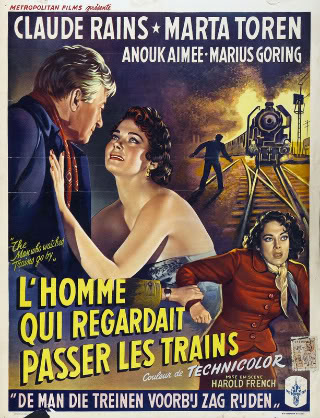
The Man Who Watched Trains Go By (1952) is a film that I’d imagine few people are aware of. Apart from the fact that it’s not well known, those who have seen it tend to be ill-disposed towards it. I think part of the problem is that the tone seems to change abruptly about half way through and that can have a jarring effect on the viewer. It is, of course, a film that has faults and it’s far from perfect, but I’m quite fond of it for all that. Despite being shot in colour, and not appearing in any listings that I’ve seen, I would categorise this as film noir, checking almost every one of the required boxes as it goes along.

Kees Popinga (Claude Rains) is a chief clerk for an old established Dutch firm, both the man and his employers appearing to be veritable monuments to respectability, integrity and honesty. Popinga is close to the epitome of middle-class values and circumspection, moving exclusively between his family and the workplace he’s dedicated his life to – in fact, he’s even gone so far as to invest all his savings in the company. However, Popinga is man who’s not really taken seriously, at least not as seriously as he takes himself, and cuts a vaguely comic figure cycling to work in his winged collars and homburg, pausing only to clock the passing of trains on their way to Amsterdam or Paris and romance. This is a man for whom accuracy and order are paramount, although even his children snicker secretly behind his back at his fastidious nature. Popinga’s employer, De Koster (Herbert Lom), is another paragon, albeit a more inflexible one for he dismisses out of hand the idea of hiring a man whose former company went bankrupt lest any whiff of scandal should attach itself to him. Of course two such pillars of moral rectitude cannot possibly exist without a few fault lines being present.

The first crack appears when a visiting Paris policeman, Lucas (Marius Goring), asks to view the company’s books as part of an investigation into a currency racket. From this point on Popinga’s strictly ordered life begins to unravel, though not because of any impropriety on his part yet. He first happens to see De Koster in a compromising position with a woman that Lucas asks about, and then later finds his boss burning all the company records. It turns out that De Koster has run the company into the ground to finance his affair, and the time has now come to cut and run. For Popinga, this is the ultimate betrayal; he’s given eighteen years of devoted service to De Koster and sacrificed his dreams in the process. When he sees this man whom he’s looked up to exposed as no more than a weak-willed embezzler who has ruined him, something snaps inside him. A minor scuffle sees De Koster dead, and Popinga in possession of a case of stolen money. Having repressed his desires for so long, Popinga now gives full rein to them. He catches the express to Paris with every intention of living the life he let slip away from him. However, he’s lived so long in his safe and proper world that he’s ill-prepared for the dangers that await and, as the Parisian sharks begin to circle around the little Dutchman, Lucas is now faced with a race against time to catch him and haul him back before it’s too late.

£2

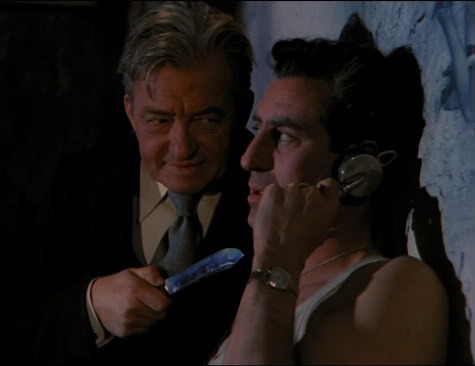
Harold French isn’t a name that would be familiar to many, and I’ll have to say I’ve only seen a mere handful of his films myself. His direction of The Man Who Watched Trains Go By is fairly standard stuff, unremarkable but competent. There is a nice build up of suspense in the first half of the film, and a fine scene aboard the Paris train where Claude Rains and Marius Goring engage in some verbal fencing while playing a game of chess on top of the case of stolen money. The second half, the action having moved to Paris, is weaker due to the melodramatic turn of events but it remains gripping all the same.

Claude Rains really throws himself into the part of Popinga and creates a tragic figure who is both slightly ridiculous and sympathetic. He could be criticised for going over the top at times but then again he was playing a man whose whole world was brought down around him, whose very existence was rendered absurd by the criminal actions of his employer. Since the character of Popinga loses his equilibrium, becoming unhinged and irrational, it’s hard to see how Rains could have done much else with the role. Marius Goring is there as the counter to this descent into madness, making the calm and collected Lucas into a kind of guardian angel for the tortured Popinga. Marta Toren had a plum role as the archetypal femme fatale, displaying bucket-loads of seductiveness, insolence and dangerous contempt. Her manipulation of De Koster, Popinga and all the doomed men around her keep this firmly in noir territory. The support cast all do a fine job and include (among others) Herbert Lom, Ferdy Mayne, Eric Pohlmann and a very young Anouk Aimee.

The Man Who Watched Trains Go By has been released on DVD in the UK by Metrodome. It’s a pretty good 1.33:1 full frame transfer that has excellent colour. There is a little softness here and there but no notable damage. The disc itself is totally barebones, perhaps unsurprising given the obscurity of the movie. Otto Heller’s glorious technicolor photography might lead some to question the noir credentials of this movie but pretty much everything else about it remains relentlessly dark. The theme of fate causing the downfall of an unsuspecting man, the presence of a bona fide femme fatale and the bleak ending are all factors that nudge it towards film noir for me anyway. I haven’t seen many positive reviews of this film (in fact I haven’t seen many reviews of it at all) and I think that’s a bit unfair. It’s by no means a classic but it’s no turkey either. If nothing else it’s worth a rental (actually it can be bought pretty cheap too), and it may even prove to be more entertaining than expected.

Chase a Crooked Shadow

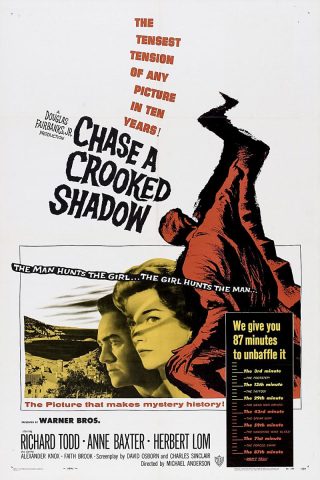
Throughout the 60s Hammer produced a smattering of what have come to be referred to as “mini-Hitchcocks”, due to the acknowledged influence of Psycho. Broadly speaking, these movies usually featured a damsel-in-distress plot where all was not quite as it seemed at first glance. While it’s undeniable that Hitchcock’s 1960 shocker played a significant part in bringing about these films it seems to me that they also owe something to Michael Anderson’s 1958 suspenser Chase a Crooked Shadow: there’s a small cast, an isolated and endangered woman with a question mark over her psychological state, and men whose motives and loyalties are not always clear.

Kim Prescott (Anne Baxter) is a wealthy heiress living in a sprawling villa in Spain. Her father was a victim of suicide and her brother has perished in a road accident in South Africa – or so it would appear. After a late night gathering at the villa, when all the guests have departed, a stranger turns up claiming to be the brother back from the dead. Ward Prescott (Richard Todd) alleges that he was turned over by a guy he gave a lift to, and that the thief was the one who died in the smash-up. Kim remains unconvinced, determinedly so in fact, and calls in the police. Vargas (Herbert Lom), the local police chief, can find nothing wrong with Ward’s credentials and is powerless to do anything. Within a disconcertingly short period of time, Ward has taken up residence in the villa, hired his own new staff, and is causing Kim to question her mental state. She maintains both her hostility and her disbelief yet is unable to convince anyone else that this man in her house is an impostor. The viewer is left to wonder who is telling the truth and, if Ward is indeed merely an impersonator, what the purpose of the subterfuge and masquerade is. There are plenty of clues and red herrings sprinkled throughout, but it’s not until the very end that everything is revealed – all I’ll just say is that it’s unwise to jump to any premature conclusions.

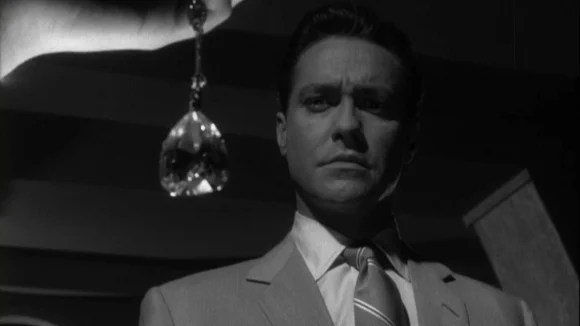
Director Michael Anderson brings Chase a Crooked Shadow in at a tight 84 minutes and judges the pace well. The plot never has a chance to sag and there are some nicely staged sequences – in particular, there’s a well shot and hair-raising scene involving a high speed race around a picturesque mountain road with precipitous drops flashing into view. Anderson does indulge in a bit of flashiness here and there: low angle shots and some slightly self-conscious focusing on foreground objects (like the screencap above), but they generally serve to add to the suspense and feeling of unease. Aside from the twisty plotting, the film depends heavily on the performances of the three leads, and they hold up well. Both Richard Todd and Anne Baxter bring an ambiguous quality to their respective characters which this kind of “is he or isn’t he” drama calls for. Baxter is just brittle enough as the woman under pressure and avoids descending into hammy histrionics. The recently deceased Richard Todd was always a solid performer and his inherent reserve is used to good effect to keep the viewer guessing. In contrast, Herbert Lom’s policeman plays the anchor role in a movie where no one else can really be trusted. It’s not a showy part in any way, but it is a vital one as it helps provide a necessary point of reference.

Chase a Crooked Shadow is available on DVD in the UK via Optimum, and it’s not a bad transfer. The image is 1.33:1, although 1.66:1 would seem a more likely ratio for British movies of the period, and is quite clear and detailed. There are vertical lines and scratches that appear intermittently all the way through, and the blacks could be a little blacker at times. However, none of this is seriously distracting and shouldn’t count heavily against the transfer. Once again Optimum have added nothing to the disc, no subs and no trailer but it can be bought very cheap. This is the kind of movie that’s very appealing to those who enjoy tense British thrillers and it’s a highly competent production. Anyone familiar with the Hammer movies I alluded to at the beginning will recognise the parallels – but that’s no bad thing.

Warlock

Warlock (1959) is a movie that could be approached on a number of levels: as a psychological piece, an early example of revising the myth, an allegory and even as an apology. It’s an exceedingly complex film, which is paradoxically both its strength and its weakness, and also one that remains consistently fascinating. Essentially, this is a variation on the “town tamer” western – almost a sub-genre in itself – but the dense plotting takes it off in a number of directions.

The town of Warlock has become one of those wide open places where the law can only lurk in the shadows, hoping not to draw any unwelcome attention to itself. It has turned into a stamping ground for a band of murderous cowboys, referred to as San Pabloites, who have imposed a reign of terror on the seemingly ineffectual citizens. When one of their number is murdered and the sheriff humiliatingly run out of town the residents decide that the time has come for a positive response. A decision is taken, albeit grudgingly, to hire the services of one Clay Blaisedell (Henry Fonda) for the position of de facto town marshal. Blaisedell, a thinly disguised version of Wyatt Earp, arrives in town along with his friend Tom Morgan (Anthony Quinn) and sets about restoring law and order on his own terms whilst also overseeing the establishment of a gambling house and saloon. The no-holds-barred tactics of the new marshal soon see him in conflict not only with the San Pablo outlaws but also with those who have employed him, and by extension with the newly appointed sheriff. This man is Johnny Gannon (Richard Widmark), formerly one of the San Pabloites but now a reformed character – and in truth the film is as much about him as anything else. While all this is going on, Morgan is quietly scheming away in the background and manipulating events for his own ends. Sooner or later, a showdown (or more accurately a series of showdowns) will have to occur before matters can be resolved.

Warlock is a film with a whole lot going on, arguably too much for its own good. The parallel with the Wyatt Earp story is an interesting one in that it was, up to that point anyway, much closer to the reality of the situation. Blaisedell’s marshal is no shining hero bent on bringing law to the territory; he’s a professional gunman, ”handy with colts” in his own words, seeking out another pay day and raking in a little extra on the side via his saloon. If the relationship between Blaisedell and Morgan is supposed to hold up a mirror to that between Earp and Doc Holliday then it’s a skewed image that’s presented. Morgan is a crippled soul, both literally and physically, and considerably more dangerous than his partner. So far so good, but Morgan has taken friendship and loyalty to the extreme – to the point that it has twisted itself into a kind of jealous worship. Many commentators have stated that Morgan’s feelings for Blaisedell border on the homoerotic, and I can see where that notion comes from, but I don’t buy into it myself. For one thing, the director Edward Dmytryk said that that wasn’t a correct reading of the film. While Morgan’s obsessiveness towards his friend is clearly off-centre it seems to me more a product of his insecurities and self-loathing than anything else. The other main point of interest is the pivotal figure of Johnny Gannon. It’s hard not to see Dmytryk (one of the Hollywood Ten who became a “friendly witness”) projecting himself onto this character who turns his back on friends, family and associates to follow what he views as his own righteous path. Gannon’s conversion seems justified in a particularly intense scene where he confronts his old comrades in their lair in an attempt at conciliation. This gesture is spurned and results in the kind of brutal sadism that rivals James Stewart’s mutilation in The Man from Laramie.

This was Edward Dmytryk’s last good film, but that doesn’t mean it’s not without its problems. As I said, Warlock is a movie rich in plot but such richness can bring about a slightly hamstrung end product. The fact that there are so many plot strands, and the necessity to tie them all up, means that the film has three separate climaxes. The effect of this is to lessen the impact of all of them. That, of course, is more a problem with the scripting than Dmytryk’s direction, which is solid enough and contains some well thought out camera angles. The action, when it comes along, is handled competently and the gunfights are all suitably dramatic.

The three leads turn in good performances, with Henry Fonda putting a different spin on the part of the lawman to that which he created with John Ford the previous decade. Anthony Quinn keeps things fairly controlled as Morgan, though he does sail perilously close to the kind of scenery chewing that he was prone to lapse into on occasion. Richard Widmark is also especially good as the outlaw-turned-sheriff who visibly grows in stature and confidence as the story progresses. His faltering romance with a worldly Dorothy Malone (playing the fabulously named Lily Dollar) has enough realism to prevent it from merely being the kind of extraneous padding that is often the case.

As far as I can tell, Warlock should be available on DVD pretty much everywhere. Optimum’s UK disc presents the film in a very fine anamorphic scope transfer. It’s generally sharp as a tack throughout and the colours really do justice to Joe MacDonald’s classy cinematography. Unfortunately, there’s not a thing on the disc in the way of extras, but that’s about par for the course with Optimum releases. OK, this film may not be one of the front line classics in the western genre but it does help its development along. The movie’s greatest flaw is trying to pack in too much story, thus throwing itself off balance. However, there are still a lot of positives to take away from it.

Along the Great Divide

78_zpszloc5xwd

-You’re new in the territory.

-The law isn’t.

That exchange takes place during the tense standoff that opens Raoul Walsh’s Along the Great Divide (1951). This is a film that examines notions of law and justice and, like any quality western, also looks into the hearts of the characters and their motivations. The framework of the story is a fairly standard pursuit through vast open spaces but the fact that it’s got a relatively small cast allows time for the psychology of each of the main players to be thoroughly probed.

When Len Merrick (Kirk Douglas), a US Marshal, chances upon a mob of angry cattlemen bent on a lynching he’s duty bound to call a halt to proceedings. His dogged determination to see the law run its prescribed course will plunge him into a tangled mess of jealousy, revenge and violence. The man on the end of the rope is Pop Keith (Walter Brennan), a homesteader whose fondness for rustling has landed him in deep trouble. Keith has been accused of the murder of the local cattle baron’s son, and the father is keen to visit justice on the old man personally. With the reluctant help of his two deputies (John Agar and Ray Teal) Merrick takes the prisoner into custody and sets about escorting him back to what passes for civilisation, and a fair trial. However, the relentless pursuit of the lynch mob means that the lawmen, with Keith’s daughter Ann (Virginia Mayo) in tow, need to alter their plans. If their prisoner is to be delivered into the hands of the proper authorities then the only way to do so is by traversing the unforgiving desert in high summer. This punishing trek is further complicated by ambush, treachery and the psychological taunting of the marshal. Keith has stumbled upon a dark secret in Merrick’s past relating to his father, and baits him mercilessly every step of the way. The situation isn’t made any easier when Merrick not only finds himself becoming attracted to the daughter but he also realizes that his doubts regarding Keith’s guilt are growing by the day. By the time the climax rolls round, Merrick will have to face down both his enemies and the demons of his past before he can make peace with his own conscience.

£6

Along the Great Divide is typical Raoul Walsh fare, with hard men braving a hostile environment and battling both the elements and themselves. For the most part, the movie was shot outdoors on location at Lone Pine and the director made the most of what the landscape had to offer. The ambush among those familiar rock formations is skilfully handled, and the desert crossing has a realistically dusty and arduous feel. This was the first western role that Kirk Douglas took on and he seemed to slip very naturally into the genre. He portrays Merrick as a complex yet competent man who tries his best to do the right thing, even though he’s not always sure what that is. Walter Brennan is as reliable as usual as the wily old timer whose amiability and charm are undercut by a streak of malice that he freely indulges at Merrick’s expense. In the role of the tomboyish daughter Virginia Mayo is also highly effective, with her tough and feisty character giving a grittier edge to the romantic angle. As for the support cast, John Agar and Ray Teal are fine as Merrick’s deputies, the former loyal and steadfast while the latter is conniving and slippery.

This movie has made an appearance in R1 as part of the Warner Archive programme, but there’s an excellent pressed disc available in R2 from France. Warner obviously had a strong print to work with for that R2 disc presents the film very appealingly. The image is sharp and highly detailed (with the exception of a few zoom shots which are softer and have heavier grain) with little in the way of damage. Bearing in mind the short running time and the total absence of extras, it seems a bit odd that the movie has been granted a dual layer disc. However, this means that there’s no issue with compression. As with all Warner French releases I’ve seen, the subtitles are optional and can be switched off via the main menu. It’s hard to go wrong with a western directed by Raoul Walsh, and Along the Great Divide is one of his usual polished and well-crafted works. Recommended.


Backlash

poster150

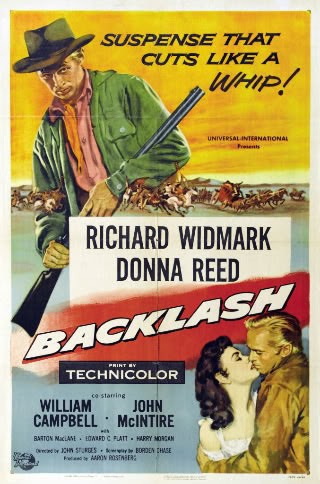
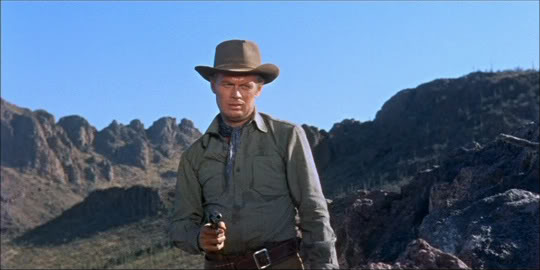
Backlash (1956) is one of those films that seems to have slipped through the cracks. I’m not sure if it would be correct to call it a forgotten film, but it’s certainly not one that you hear mentioned much when the genre’s notables come up for discussion. It fits neatly into the “psychological western” category due to its less than perfect hero and mature themes. At first glance it may appear to be just another tale of a man seeking revenge (not that that’s a bad thing in itself), but as the story develops it becomes clear that this is a film which is going to dig a little deeper.

The opening shots of the film, with a lone rider traversing a rugged landscape to come upon a man filling in a grave, set the tone for the movie and establish the isolation of the two principal characters. The fact that both of them are soon under attack from a gunman perched in the rocks high above underlines the danger of the quest they are about to set out upon. There is also an undercurrent of suspicion and mistrust that will follow them now as neither one can be sure that the other isn’t responsible for setting the ambush. The rider is Karyl Orton (Donna Reed) and the gravedigger is Jim Slater (Richard Widmark); both are in search of the truth, and maybe $60,000 in gold. Years before, five men died at this spot at the hands of the Apache but one other escaped with his life and the gold, leaving his partners to their fate. Slater believes the father he never knew was one of the five, and Karyl believes her estranged husband to be another. With Slater seeking vengeance and closure, and the woman with her eyes on the gold they set out to identify and track down the mysterious sixth man. The manhunt pitches both these characters into one perilous situation after another, from a murderous Apache raid to a range war. Along the way their relationship slowly develops, although it’s no smooth ride for either of them – at one point Slater hauls off and belts Karyl full in the face for putting his life in danger, and she later takes an almost perverse pleasure in sealing up his wounds with a heated blade. By the end of the movie both these people will have to face down their own personal demons and maybe take something of real value away from the experience.

£11

Backlash was made at a time when Sturges’ and Widmark’s stars were on the rise. John Sturges had just come off the magnificent Bad Day at Black Rock and would shortly go on to make Gunfight at the O.K. Corral. He was close to his peak at this point and handled just about every aspect of the picture perfectly. Action and suspense blend seamlessly together and the Arizona locations look particularly fine through the wide lens. Widmark was also doing some of his best work around this time and this film must have helped him along nicely. His bony features and distinctive nasal giggle had landed him plenty of villainous roles but they were also ideally suited to playing the kind of damaged men that psychological westerns thrived on. He turns in a great performance here, obsessively digging into the past, searching for the truth and searching for himself – all the while fearing what he might learn yet unable to stop himself. Conversely, Donna Reed’s movie career was soon to end and she was close to moving into a successful run on television. With an impressive list of credits behind her she does well as the feisty, courageous woman-with-a-past. The support cast are solid too with Barton MacLane and an eye-rolling John McIntire standing out especially. A good screenplay is key to the success of any film and having Borden Chase’s name attached never hurt any. It struck me that the episodic structure and the underlying theme bore at least a passing resemblance to the writer’s earlier Winchester 73. 

Backlash has had a number of releases on DVD in R2 but the UK disc appears to be the only one with a proper widescreen image – there’s a R4 available but I’m not sure how it’s presented. Optimum’s UK disc has the movie looking very nice in a 2:1 anamorphic transfer, and I’ve been reliably informed that this is indeed the correct ratio for the film. There’s very little damage to be seen and colors and detail all looked excellent to my eyes. Surprisingly, for an Optimum release, the theatrical trailer is included but that’s it as far as extras go. However, when the main feature is there in OAR and looking good then I’m not about to complain. Backlash is a good example of a high quality mid 50s western – one that I rate and recommend.


Footsteps in the Fog

poster93

Victorian London, murder, illicit relationships, blackmail – Footsteps in the Fog (1955) has all the ingredients of a classic turn of the century potboiler. It’s the kind of lush, polished production that’s beautiful to look at, yet you know it conceals a bitter little heart that’s hard as a diamond. British cinema always had the knack of capturing the spirit of gothic tales, and this would reach its zenith a year or two later when Hammer really hit their stride.

In fact, Footsteps in the Fog opens almost like a Hammer production, with a clergyman solemnly intoning over a fresh grave in a rain drenched cemetery. Stephen Lowry (Stewart Granger) has just become a widower and his wife is being laid to rest. As his friends drop the pale, grief-stricken figure off at the sombre gates of his home, we see him make his lonely way up the drive and on into the empty house. As he pauses on the threshold of the drawing room, the camera remains focused on the back of this dejected man who stands gazing at the portrait of his dead wife above the fireplace. The shot now switches to a close-up of Lowry’s face as a slow smirk spreads across his features. Thus we learn of the two faced nature of the protagonist, a man that we soon discover has poisoned his wife for her money. This dark secret is also uncovered by the young maid, Lily Watkins (Jean Simmons), who has been harbouring a passion for her employer. Rather than being horrified or repulsed by the knowledge, Lily sees in it the opportunity to blackmail her way, first into the position of housekeeper, and then (she hopes) into her master’s heart. But nothing is ever that simple; Lowry is in love with the wealthy sweetheart of a young barrister and regards Lily as an irksome obstacle in the way of his future advancement. The question is how he will deal with Lily, and what his real feelings towards her are. The plot takes numerous twists and turns before reaching a conclusion that manages to be bleak, ambiguous and satisfying all at the same time.

The plot of Footsteps in the Fog is an engaging and absorbing one, but the film’s real strength lies in the performances of the two leads. Stewart Granger and Jean Simmons were a married couple at the time and they were able to bring some real chemistry to their more intimate scenes together. Granger was an old hand at playing in these kinds of period pieces, and seemed to effortlessly make a frankly despicable character charming – one who I caught myself rooting for at times despite his loathsome actions. However, good as Granger is, the real star of the show is Jean Simmons. It is her Lily Watkins that’s the driving force behind the story with her beguiling mix of trusting devotion and ruthless amorality. With a tight, solid plot and classy lead performances any director should be on fairly  safe ground. Arthur Lubin was mainly a journeyman director, with a string of Abbott and Costello and Francis the Talking Mule pictures behind him, but he does a good enough job and uses some nice low angle shots to help generate suspense and atmosphere. The movie is neatly paced (coming in at under an hour and a half) and really only lags in a few scenes – mainly those with Belinda Lee.

Footsteps in the Fog has been out on DVD in the UK for a bit over a year now as a Sony release exclusive to MovieMail. The film is presented anamorphically at 1.78:1 and the transfer is generally a good one with nice colours and really only suffers in one short segment. A little after the twenty minute mark the image takes on a very dupey appearance and there’s some colour bleeding. Fortunately, this only lasts for five minutes or so and I think it would be unfair to criticise the overall presentation based on that. There’s not much in the way of extras, save for the trailer and hard of hearing subs, but the film is something of a rarity and I’m just glad it’s available at all. I think it’s a cracking little movie and it should be a real pleasure for anyone who enjoys stylish gothic thrillers.

The Man Between

Having successfully treated audiences to the story of an innocent abroad in a war ravaged European city in The Third Man, director Carol Reed attempted to recapture some of that magic four years later with The Man Between (1953). That he didn’t quite manage to do so shouldn’t be seen as too harsh a criticism; while this film never achieves the consistency of style or suspense of his earlier work it still rates as a very fine movie.

Susanne Mallison (Claire Bloom) arrives in a devastated post-war Berlin to visit her brother Martin, a British army officer, and his new German wife Bettina (Hildegard Knef). Right from the beginning there is a sense that something is not quite right in this relationship, although the overworked husband appears blissfully unaware of any problems. With Bettina receiving mysterious telephone calls and messages Susanne’s suspicions are aroused. When the two women take in a visit to the Eastern zone (this was in the days before the wall went up), and just happen to run into an old acquaintance of Bettina’s, Susanne becomes convinced that her sister in law is having an affair. Ivo Kern (James Mason) is a charming yet ambiguous figure who has emerged from Bettina’s past and threatens to sabotage her future. However, despite early indications, the story is not some hackneyed love triangle with Ivo as the man between Bettina and her husband. That somewhat slow and predictable build-up is swept aside when the altogether more stylish second half of the film reveals itself to be a tense Cold War thriller that had merely been lurking in the shadows. As we learn who and what Ivo really is the movie develops into a cat and mouse chase through a bleak and menacing East Berlin.

Carol Reed had just made two bona fide masterpieces in Odd Man Out and The Third Man prior to The Man Between. The fact that this film featured the star of the former and a theme and setting similar to the latter often lead to its being judged more harshly than might normally be the case. Placed next to those two great works it does pale, but then most movies would. However, taken on its own terms, this film has much to recommend it. All the way through there is the distinctive visual style of Reed – tilted angles and deep shadow. The second half in particular takes the viewer on a tour of the city at night, a dark, dangerous place where friends are few and those deceptively close border crossings are always just out of reach. What saves the film from growing moribund in the first half, and adds to the tension and poignancy of the second half, are the performances of the two leads. Mason was a pastmaster at playing flawed and tarnished heroes, and his Ivo Kern is a fine creation. He is a man caught between past and present, East and West, self interest and honour. Claire Bloom, in a very early role, takes a character who starts out as a portrait of middle class primness and gradually develops her into a young woman on the cusp of maturity, learning bit by bit that her preconceptions about both herself and the world around her might not be as clear cut as they first appear. I’d also like to give a mention to the frankly excellent score by John Addison; it has a melancholy romanticism that lingers long in the memory.

If you’re looking to find The Man Between on DVD there are two choices available at the moment. I have the German edition from Kinowelt and it provides a very good transfer with optional subs that are removable via the main menu. The print is in fine condition with good contrast and blacks and no noticeable damage. The film is presented in Academy ratio and, although I’m certainly no expert on such matters, that looks correct to me. I mention this because the other option is the edition available in the UK from Optimum in their James Mason Icons set. While I don’t own that disc I do know that it presents the film in widescreen format, and I’m not convinced that that’s how it should be seen. It is notoriously difficult to pin down the correct aspect ratio for British films of this vintage as the UK wasn’t quite up to speed with the US in adopting widescreen. Apart from that, the framing on the German DVD just looks right, with no apparent cropping at the sides and no extraneous space at the top or bottom. Looked at in context, The Man Between is lesser Reed but, if you can put aside comparisons with his more celebrated works, it still makes for entertaining and rewarding viewing.

Fixed Bayonets!

22gbjrc

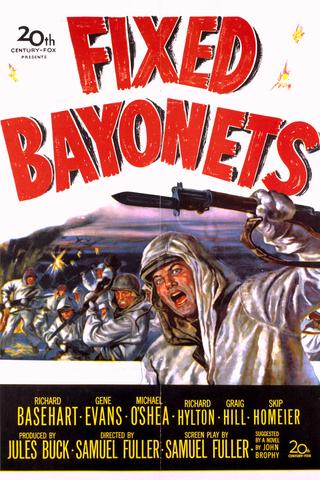
As I (not so) patiently wait for the new Sam Fuller box to roll up to my door I thought I might as well have a look at one of his other films to pass the time. It turned out to be a toss up between Forty Guns and Fixed Bayonets! (1951). Since I’ve been watching a lot of westerns lately and haven’t posted anything about war movies for a while it was the latter that won out in the end. This was Fuller’s first film for Fox, and it makes a nice companion piece to his earlier study of men in war The Steel Helmet – they’re both lean, unglamorous portrayals of the trials of enlisted men in Korea.

The plot is a very simple one – to cover the retreat of the division, a small detachment is left behind in the frozen wastes of Korea to carry out a rearguard action. This luckless group find themselves holed up in a narrow mountain pass, hoping to trick the Chinese into believing that they’re actually an advance party for the division. The focus is on Denno (Richard Basehart), a reluctant corporal who dropped out of officer training school because he didn’t want the responsibility. Not only that but he also has to deal with the fact that he finds himself unable to pull the trigger whenever he gets an enemy target in his sights. None of this would necessarily present a huge problem if it weren’t for the fact that Denno now has only three men between him and his greatest horror, the burden of command. In contrast to the sensitive, introspective corporal is Sergeant Rock (Gene Evans), the tough old pro who has stayed in the army but can’t quite put his finger on the reasons why. While the rest of the platoon have their doubts about Denno, Rock keeps faith with him as he feels he knows his man. As the Chinese press ever closer, and the casualties steadily mount, it’s obvious that sooner or later Denno will find himself the top man – the Ichiban Boy – and the only real question is how he’s going to handle it.

Gene Evans basically reprises his role from The Steel Helmet, but it’s almost the kind of part he was born to play. He really brings the battle-hardened Rock to life, full of fatalistic humour as he bullies and cajoles the grunts into doing what has to be done. If Rock is the beating heart of the platoon then Denno is the conscience, and Richard Basehart was well cast in that part. His quiet, dignified tone stands out among the casual slang of the other dog-faces around him. He was capable of that intense, repressed look that is ideal for a man being eaten up by inner turmoil. Some of the best scenes in the movie take place in the quiet moments in the cave when Rock and Denno chew the cud over the nature of soldiering and responsibility. Fuller directs these claustrophobic scenes with apparent ease, using a full 360 pan at one point to show the whole platoon (or what remains of it) looking on as the reluctant medic performs surgery on himself. He punctuates such scenes with bursts of jarring, unexpected violence and moments of incredible tension, such as Denno’s walk through a minefield at night to rescue a mortally wounded NCO. His sense of pacing and economy are spot on, with not a shot wasted as we rattle along to the climax.

The R1 DVD from Fox is a frugal affair with little in the way of extras but it does boast a generally strong transfer. Fixed Bayonets! is a fine early example of Fuller’s honest, no nonsense approach to film-making and has his unsentimental machismo stamped proudly all over it. I enjoyed it a hell of a lot – now if only that Sony boxset would turn up!