Payroll

poster96_zpsmeo0wngl1

As British cinema entered a new decade in the 1960s it was possible to discern a shift in attitude, a gradual move away from the style that been dominant in the post-war years. Previously, films had concentrated largely (though by no means exclusively) on the middle classes and the concerns that occupied them. That aspect had been especially noticeable in crime pictures and thrillers; and while it’s not without its attractions and merits, it did impose certain restrictions and sometimes led to an oversanitized or slightly twee form of storytelling that set it apart from the grittier fare that US audiences were exposed to. Naturally, there were exceptions, but they were fairly thin on the ground. However, a film like Payroll (1961) fixed the spotlight squarely on the professional criminals of the lower classes, and the result was a much more explicit portrayal of violence and sexual relations than had been the case before.

Payroll is a heist movie and develops according to the usual formula for such films: planning, execution, and the inevitable unravelling of everything. The story follows three interconnected strands, all of which are vital in bringing about the final resolution. Thus, we see the tale of the criminals, the accomplice, and an unfortunate victim all become bound together in a heady mix of violence, sex and double-cross. The opening has plans being laid to snatch the payroll of a Newcastle factory. The four man gang engaged in this little conspiracy is headed up by Johnny Mellors (Michael Craig), who acts as both the brains and the muscle of the quartet. What initially appears to be a straightforward job is complicated by the decision of the management of the factory to alter their procedure. Abandoning their old methods for having cash delivered, they choose to employ a new security firm with a seemingly impenetrable armoured car at its disposal. Naturally, this necessitates a change of tack on Mellors’ part, and so he puts the squeeze on his inside man, Pearson (William Lucas), to seek out the specs of the armoured car in order to establish its weaknesses. The reason behind Pearson’s involvement with these types is an old and familiar one – a desire to make a quick buck. His wife, Katie (Francoise Prevost), is a war refugee and a greedy woman, frustrated by her nondescript husband’s failure to make good on the potential she thought he had. A weak man living in the shadow of a sneering woman’s disapproval is a prime candidate for corruption, and so Pearson bows to the pressure brought to bear on two fronts. When the subsequent robbery turns sour and leaves two men dead, one of whom is the driver and boss of the security firm, the cracks in Mellors’ plan start to show themselves. Pearson finds himself facing the dual threat of a duplicitous and adulterous wife while also being stalked by a vengeful and suspicious widow (Billie Whitelaw). At the same time, Mellors is struggling to hold in check the increasingly volatile forces within his spooked gang. Ultimately, the sour combination of murder, illicit relationships and plain rotten luck bring matters to a head, and a bleakly satisfying conclusion.

£38]

One of the pleasures of watching British thrillers of this vintage is the glimpse we get of cities and landscapes now transformed. The location filming around Newcastle adds to the gritty and realistic feel of the piece by placing the characters in the down at heel urban world that the genteel classes didn’t inhabit. It’s not hard to see why these men and women might find themselves driven by their desire to escape the drab surroundings. Director Sidney Hayers shot a lot of the movie around run down businesses and decaying lockups, all of which add to the aura of despair. He also did fine work when it came to dealing with the action scenes; the heist itself, a brutal street mugging, and a grotesque double murder in a swamp all reveal an urgent and dispassionate style that’s highly effective.

The casting was also spot on, with Michael Craig displaying the kind of machismo and edgy charm that fits right in with his role as the ruthless gang boss. Of the others making up the criminal foursome, Kenneth Griffith probably comes off best as the jittery, conscience-stricken weak link. Of course, William Lucas is arguably even more successful in conveying human frailty as Pearson; a thoroughly beaten man who’s driven to the very edge of reason by his own guilt and the provocation of his grasping spouse. Francoise Prevost really nailed her portrayal of a latter-day femme fatale, goading her husband into crime before betraying him sexually, and finally crossing up her lover for profit. The other female role, that of Billie Whitelaw’s avenging widow, is equally powerful. The mask-like set of her features takes on a terrible aspect as her relentless quest for righteous retribution drives one man out of his mind and another to his death.

Payroll has been released on DVD in the UK by Optimum and it looks very good. The film is presented in a progressive and anamorphic transfer at 1.66:1, and the print used is in particularly good shape. The image is clean and sharp, and I can’t honestly say I was aware of any significant damage. As usual with Optimum titles, there are no extras offered and no subtitles. However, the movie itself is a genuine keeper. If you’re looking for a hard-edged British thriller with steel in its guts then you won’t go far wrong with Payroll. It has that post-noir feel to it that’s enormously attractive, and I strongly recommend checking it out.


A Thunder of Drums

poster316

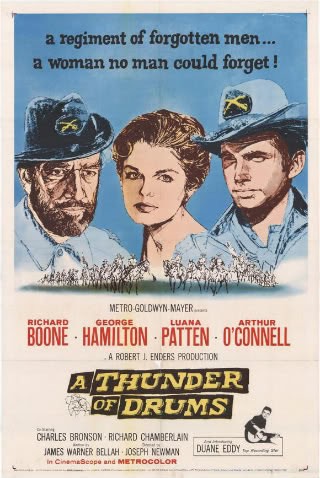
Think of cavalry westerns, or rather, think of the best cavalry westerns and one name tends to spring to mind – John Ford. The famous trilogy (Fort Apache, She Wore a Yellow Ribbon, Rio Grande) forms an integral part of Ford’s building up and subsequent deconstruction of the myth of the west. It’s Ford, and Wayne of course, that we think of as being at the heart of their success. While this is entirely justified, there is, however, another figure who had an influence on the shaping of these films – the author of the source material, James Warner Bellah. Aside from the trilogy, his work also provided the inspiration for A Thunder of Drums (1961), a far less celebrated movie. I’m not going to try to argue here that this is a film deserving of the kind of acclaim accorded to Ford’s work, but it does warrant a little more attention than it ordinarily receives.

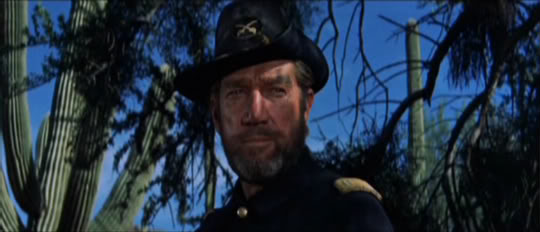
The story takes place in and around Fort Canby, one of those isolated and undermanned outposts on the extremities of the frontier. It opens in hard-hitting and startling fashion with an Indian raid on a homestead, the full horror of which is reflected in the terrified eyes of a child witness and in the grotesque shadows playing across the ceiling. When the awful aftermath is discovered by a passing cavalry troop the sour and downbeat tone is further emphasised by the fact that these men are bringing their own dead back home. So, with their faces already covered to counter the stench of their current cargo, the troops set about the grim task of burying the victims. From this point on the threat of imminent violence never really slackens, although the action moves into the confines of the fort and remains there until the last half hour. The uncompromising beginning serves to set up the brutal realities facing the fort’s commander, Captain Maddocks (Richard Boone), a man whose past has condemned him to a life of thankless soldiering. With the arrival of a green young officer, Lieutenant McQuade (George Hamilton), we start to get hints that something dark, some error made years before, means that Maddocks is doomed to remain at his present rank until retirement or death release him. And so this western version of the ancient mariner has the task of teaching McQuade the skills necessary for surviving on the frontier and becoming a proper professional soldier. In the process, we get to see (as in Ford’s trilogy) the minutiae of life at one of these half-forgotten postings. Despite Maddocks’ bristly and abrasive style keeping things ticking over, the mid-section of the movie gets itself bogged down in a pretty tedious love triangle involving McQuade and the fiancée of another young lieutenant. What rescues the picture is the last half hour. The troops move out in the open to avenge a massacre and hunt down the hostiles who have been harrying them. The cat-and-mouse pursuit leads to a well-staged climactic battle that ensures the whole thing ends on a high note.

£36

Joseph M Newman was no auteur; he was, however, a versatile professional, the type Hollywood depended on to make good, tight movies. Throughout the 1950s he made a succession of films that, though largely forgotten these days, included some highly entertaining and capable stuff. In this one, his best work is at the beginning and at the end of the picture – a little like the situation with Escape from Fort Bravo, where the strong opening and close bookend a flabby middle. The climax is well handled as an action set piece, especially the Apache ambush tactics and their sudden appearance like spirits conjured out of the ether. Besides this, the greatest saving grace is the central performance of Richard Boone. I thought he was ideally cast as the grizzled officer, ageing and passed over for the promotion his experience and talent merits yet not succumbing to the corrosive bitterness you might reasonably expect him to feel. He had the necessary grit, and a kind of weary resignation, to deliver his memorable dialogue  and lend it the weight it deserved – towards the end, he even gets to put his own spin on the Duke’s old line about never apologising as it’s a sign of weakness. In fact, there’s a lot in Boone’s performance that recalls James Warner Bellah’s other cavalry journeymen. In contrast, George Hamilton’s portrayal of McQuade is problematic and represents a major weakness. Firstly, Hamilton just doesn’t look right; there’s too much Hollywood polish and smoothness about him. What’s more, he just didn’t have the acting chops to either compete when sharing the screen with Boone or to carry off the pivotal role that was so vital in shoring up that sagging mid-section. Similarly, the lightweight and not especially convincing work of Luana Patten (as Hamilton’s love interest) and Richard Chamberlain fails to add much to the film. Still, there are good supporting turns to help paper over the cracks. Charles Bronson has a medium-sized part as a devious and dirty-minded trooper who comes good in the end, Arthur O’Connell is entertaining enough in the role of the top sergeant that Victor McLaglen played for Ford, although Slim Pickens’ talents are basically wasted.

A Thunder of Drums is available as an MOD disc in the US. However, as an alternative, there’s a perfectly acceptable release to be had in Spain. Llamentol/Paycom have presented the film in anamorphic scope, and the transfer is generally quite pleasing. There is a little softness in the image but it’s clean enough and the colours are nice and strong. There are no extra features offered, but the Spanish subtitles are optional and can be switched off via the setup menu. I found it interesting to see situations that Ford so skilfully presented taken on by someone else. A Thunder of Drums has none of the artistry or poetry of the old master himself, but it’s a fair enough movie all the same. Considering the inadequacies of some of the performances around him, it’s very much to Richard Boone’s credit that he was able to drive the film as much as he did. I feel that the presence of Boone, and Newman’s handling of the action and exteriors earn this at least a qualified recommendation.


Rio Conchos

poster293

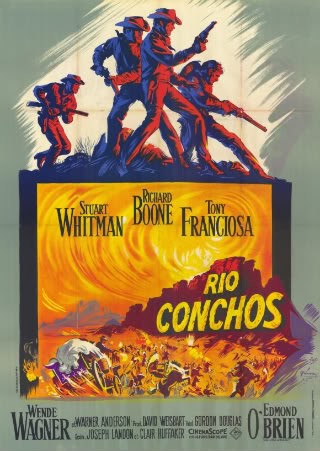
I’ve always enjoyed looking at the way the western evolved over the years. There’s a, fairly common, misconception that the spaghetti western just kind of exploded onto the scene in a genre busting blaze of immorality and violence. However, that’s a superficial reading of things; the foundations were being laid a decade before and the progression isn’t that hard to follow. Anyway, the consensus seems to hold that the spaghettis gave the traditional western a much needed jolt to shake it out of the doldrums it was in danger of slipping into. That’s hard to argue with, but I’m not sure the Hollywood western wasn’t heading in more or less the same direction of its own accord regardless of outside pressure. When you look at some examples of genre pieces from the mid-60s there are already indications of their straddling the two, seemingly irreconcilable, eras. Rio Conchos (1964) makes for interesting viewing in this context, having the trappings and look of the traditional oater but displaying an attitude and sensibility closer to the emerging European westerns.

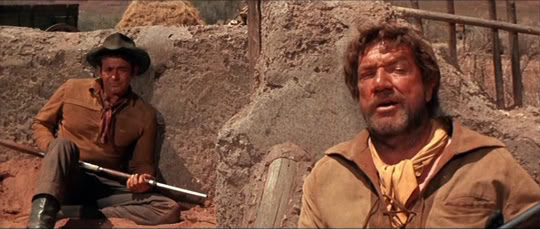
At the heart of Rio Conchos lies revenge – there’s essentially no nobility on show, nor very much in the way of finer feelings of any kind. The main character is Lassiter (Richard Boone), a former confederate Major who’s almost totally consumed with a killing rage sparked by the torture and murder of his wife and child by the Apache. This man hunts down and disposes of his enemy with a ruthless precision. The opening shots are of Lassiter calmly massacring an Apache burial party, before heading back to the ruins of his former home to get drunk amid the personal and physical devastation. He would appear content to spend the remainder of his existence extracting his pound of flesh every time the opportunity arose. But that’s not to be, as he finds himself coerced into participating in an army plan to recover a shipment of stolen rifles thought to be over the border in Mexico and soon to be sold to an eager Apache warlord, Bloodshirt (Rodolfo Acosta). Lassiter’s motivation, apart from a desire to get out of the army guardhouse, is the chance to even his personal score with Bloodshirt and he has no particular sympathy for the two cavalrymen, Captain Haven (Stuart Whitman) and Sergeant Franklyn (Jim Brown), that he’s guiding. Haven’s on a mission of vengeance too, being the man in charge of the original arms shipment that’s gone missing. His quest may be dressed up in the guise of duty, but there’s no hiding the fact that he too is seeking some form of recompense for the slight to his reputation. The party is completed by a Mexican rogue, Rodriguez (Tony Franciosa), whose involvement is quite simple: he’s out to avoid the hangman’s rope and hopefully line his pockets in the process. In the more traditional scenario, this ill-assorted group bound together by a common objective would include at least one member driven by some higher moral sense. Not in this case though; all (with the possible exception of the cipher-like Franklyn) are pandering to their own base instincts. Everything builds towards a surreal climax on the banks of the titular river, where a demented Colonel (Edmond O’Brien) twisted by the bitterness of defeat in the Civil War plots merciless retribution for his conquerors.

£27

Director Gordon Douglas made a lot of so-so films but he had it in him to produce something of real quality when the conditions were right. Rio Conchos is among his best movies (and Only the Valiant is another little dark gem tucked away in his filmography) due largely to the tough and cynical script and an uncompromising performance by Richard Boone. To Douglas’ credit, the action scenes are extremely well staged and, along with cameraman Joe MacDonald, he really makes the most of the rugged Utah locations. Still, it’s Boone that carries it all along, playing a mere shell of a man subsisting on hatred and bitterness. His craggy, lived-in features were ideal for westerns, from his iconic Paladin in TV’s Have Gun – Will Travel to a couple of memorable appearances as the villain in two John Wayne pictures, to name just a few. I’ve seen it written that his performance is a bit one note, but I don’t think that’s being entirely fair. One sequence in particular has him showing two vastly different sides to his character within minutes. I’m referring to the scene where the travellers come upon a burned out house containing what one assumes is a tortured and/or violated woman, moaning in agony on her deathbed, while her infant lies neglected in a cot alongside. We can see a series of emotions playing across Boone’s face, but the predominant one is a deep hurt as the terrible vision obviously brings back memories of the fate of his own wife and child. As he puts the woman out of her misery he is close to breaking down totally, the mask of toughness slipping momentarily in the now deserted room. When the raiding party returns to harry the trapped men though, Boone reverts to type almost instantaneously. There is something terrible in his primal joy, the gales of malicious laughter he expels when watching a downed Apache burning to death before his eyes. It could be argued that Lassiter undergoes a change of heart as the quest progresses, seeing that the army mission has some worth in itself that supersedes his own desire for vengeance. Again, I don’t read it that way. The confrontation with Rodriguez seems to me not so much a realization that there are higher issues at stake but more a necessary way of ensuring that his own ambitions are not thwarted.

By the time the climax rolls round, the obsessive nature of Lassiter’s rage seems tame and reasonable when compared to the schemes of the deluded Colonel played by Edmond O’Brien. He only appears late on in the film but he makes a deep and lasting impression. At the outset, O’Brien’s character seems merely eccentric. However, when he opens the door to his reproduction plantation mansion and invites Lassiter to step inside the full extent of his madness is revealed. This castle in the desert is little more than a facade, a half-constructed monument to a world that’s passed away yet he struts around like he’s entertaining company back in Virginia. O’Brien wisely tones down the histrionics and lets his words and outlandish surroundings convey the imbalance of his mind instead. The ending, though it might be termed abrupt and somewhat inconclusive, is a wonderful exercise in nihilism. It’s this, rather than the violent tone of the movie, that persuades me that the Hollywood western was already moving in the direction of the spaghettis. The classic era of the Hollywood western told stories that invariably held out the promise of redemption for one or more of the lead characters. What sets the likes of Rio Conchos apart is the total lack of concern for any kind spiritual salvation. In the end, nobody really triumphs and no higher purpose is achieved – none of the characters, whether living or dead by this point, have advanced much from the stage they were at when we saw them initially.

The German DVD of Rio Conchos from Koch Media treats the film very well. There’s a strong anamorphic scope transfer with rich colours, especially evident in the red clay of the locations. There is no damage worth mentioning present on the print used and detail is again strong. The English soundtrack (with subs that are removable via the main menu) is a nice stereo mix that does justice to the frequent heavy gunshots, and also to Jerry Goldsmith’s powerful, driving score. The disc is nicely packaged in an attractive digibook format with notes (in German) and supplements the trailer and gallery that are provided as extras. The film may not qualify as one of the true greats of the genre, but it’s still a high quality production that marks an important stage in the evolution of the western. If you haven’t seen it, I strongly recommend seeking it out.


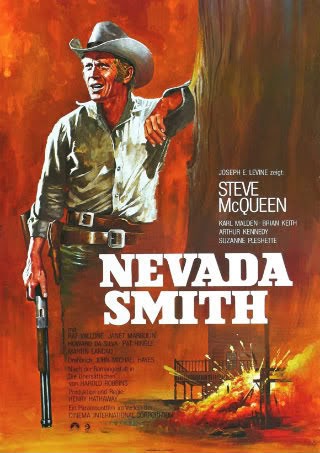
Nevada Smith

poster246

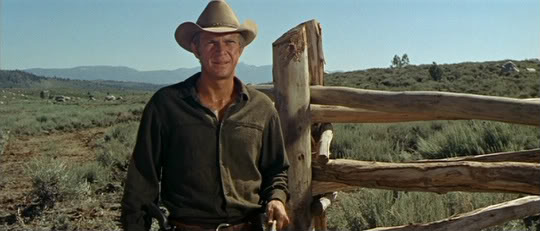
The theme of revenge has always been one of the staples of the western genre and, despite a slightly bloated running time, Nevada Smith (1966) is a fairly standard example of this. Perhaps one of the most interesting aspects of the movie is its focus on a mixed race protagonist. However, while this lends a different slant to the usual quest for vengeance, the casting dilutes it a little and it’s easy to forget the whole racial angle for extended periods, except when the characters on screen make explicit reference to it.

Max Sand (Steve McQueen) is the half-breed son of a white man and a Kiowa woman, and the story opens with him innocently directing three men (Karl Malden, Arthur Kennedy and Martin Landau) who claim acquaintance with his father to the family home. These men aren’t paying any friendly call though and Max realizes this sobering fact too late. By the time he makes his way back home the men have fled, but there’s a horrifying sight left behind for Max to find. In a vain attempt to extort money the father has been cut, burned and shot to death, while the mother has been skinned alive. Mercifully, none of this is shown on screen but the reactions of Max and his subsequent burning to the ground of his home and all that it contains still add up to a powerful scene. With his whole world literally reduced to ashes, he sets out to track down the torturers of his family and kill them. If the casting of McQueen as a half-breed is a bit of a stretch then it’s even less credible to see him as a callow youth with no real world experience. Still, that’s how we’re supposed to take it, and his green foolishness almost ends his quest before he’s even got properly started. It’s his chance encounter with a travelling arms dealer, Jonas Cord (Brian Keith), that turns things around for him. Cord takes the young man under his wing, teaching him the rudiments of gunfighting and giving him some basic education. From here on, the film is divided into three distinct sections, each focusing on how Max (he only adopts the Nevada Smith alias in the final segment) locates his man and goes about his reprisals. The first and third sequences work best, the former for its brevity and the latter for its tension. The middle of the movie (the part dealing with Arthur Kennedy’s comeuppance) is much more problematic though. The way it’s set up – Max having himself jailed to get close to his victim – strains believability in the first place. But the real problem is the way it goes on too long and virtually turns into a separate movie within the main narrative. It slows things down terminally and results in the entire production having a disjointed feel. Such is the draining effect of this sequence that the superior final part has some of its impact lessened by the time we get round to it.

£22

Nevada Smith is a prequel to The Carpetbaggers, a movie I’ve never seen so I can’t comment on whether it holds up in terms of continuity. Henry Hathaway can usually be counted on to deliver tight, economical movies that rarely outstay their welcome. However, with a filmography as long and varied as his there will inevitably be some that turn out better than others. In this case, I think Hathaway suffered from the episodic nature of the script he had to work with. The narrative ends up bolted together rather than flowing seamlessly from one situation to another. As I already said, the mid section is where it stumbles and the impetus is lost. In fairness, this part does serve to illustrate the development and progression of McQueen’s character. The thing is it’s not actually a weak section on its own; the problem, for me at least, is that it doesn’t quite gel with either the tone or pace of what precedes and follows. Of course Hathaway is aided enormously by having Lucien Ballard shooting the picture for him, the outdoor scenes in particular being beautifully rendered. The miscasting of McQueen is especially noticeable when you consider his age – he was in his mid-thirties, and looked it, and was being asked to play the part of someone at least fifteen years younger. The only saving grace lay in the fact that McQueen had the ability to project a kind of childlike innocence when he wanted. While this cannot entirely paper over the incongruity, it does go some way towards compensating for a major weakness. Karl Malden, Arthur Kennedy and Martin Landau were a fine trio of villains, and there’s a good deal of satisfaction to be derived from seeing them get what’s coming to them. Malden easily has the best role and he does a good job of portraying a man descending into terrified paranoia as a result of the relentless pursuit by his faceless nemesis. The only female role of any substance was handed to Suzanne Pleshette, as the girl who falls for McQueen and aids him in his escape from the swamp ringed prison, and she manages to be both sexy and tragic.

Back when Paramount were still in the business of issuing catalogue titles on DVD it was rare to come across a poor transfer. Nevada Smith is no exception in that respect, the anamorphic scope image on the R1 disc being strong, detailed and colourful. It’s a totally barebones affair though with no extras whatsoever. So, to recap, we have a fairly standard western tale of revenge – and the ultimate futility of it all – that’s reasonably satisfying. Apart from the odd central casting, I feel the movie could have been improved a good deal by a bit of judicious editing to strip away some of the flab in the script. Still, the end product is entertaining enough and I’d give it a qualified recommendation.


Cash on Demand


poster224

Well it’s almost that time of year again. Therefore, it’s also time to feature a few films that in one way or another relate to Christmas. Aside from the big, traditional crowd pleasers it’s always nice to give a bit of attention to those other movies that can sometimes get lost in the mix. Cash on Demand (1961) is a good example – an obscure little Hammer production whose reputation ought to rise now that it’s finally available to view on DVD. It’s a tight and incredibly suspenseful little thriller that skilfully weaves a seasonal message into the tense plot and leaves the viewer feeling satisfied.

It’s December 23rd and a small provincial bank is opening up and preparing to welcome the first customers of a wintry day. The staff arrive one by one and greet each other in the familiar and informal way of those long accustomed to working together. Thoughts run to the upcoming staff party and the atmosphere is warm and cosy. However, the arrival of the branch manager, Fordyce (Peter Cushing), causes a definite chill to settle over the establishment. Fordyce is a fastidious and uptight man, almost to the point of caricature. His overwhelming sense of propriety not only dampens the pre-Christmas humour of his subordinates, but leaves them feeling both threatened and vulnerable. A minor error on the part of one of the staff is latched onto and blown out of all proportion. Fordyce even goes so far as to declare that he’ll have to seriously consider the future of this long serving employee. The whole dynamic changes, however, with the unexpected arrival of an insurance company representative, Colonel Gore Hepburn (Andre Morell). Hepburn explains he is on a tour of the banks covered by his company in order to inspect their security arrangements due to the increased risk of robberies. In fact, Hepburn is not all he claims to be, and it soon transpires that he is merely using this cover story as a means to gain access to the bank and carry out a raid on the well stocked vault that is both audacious and ruthless in its execution. From this point on the story turns into a psychological duel between Fordyce and Hepburn, with the latter rarely relinquishing the upper hand. This all plays out both as a straight thriller and a new spin on the Scrooge story, with Hepburn’s tormenting of Fordyce serving the dual purpose of facilitating his co-operation while also teaching the fussy branch manager an object lesson in the importance of charity towards his fellow man. It could be argued that the ending cops out, but I’d say that were it not to finish up the way it does then the story’s whole point would be lost – and with it much of the magic that distinguishes the movie from countless other heist pictures.

£21

Although director Quentin Lawrence made a handful of cinema features the bulk of his work was in TV, and that background actually serves him well here. The tighter pacing and limited sets common to the small screen are to the fore in this movie. The action (which is essentially played out in real time) is for the most part confined to the bank, and particularly Fordyce’s office and the underground vault. While I wouldn’t exactly call it claustrophobic, it does have the effect of focusing the attention on the actors. Not wishing to take anything away from the support cast, but this is basically a two-hander between Cushing and Morell. The pair had formed a successful partnership two years earlier in Hammer’s The Hound of the Baskervilles and this film gave them the opportunity to team up again, albeit in very different roles. Cushing’s portrayal of Fordyce is really spot on, all icy efficiency and repressed emotion at the beginning but gradually cracking under the enormous pressure to reveal a lonely soul who elicits genuine sympathy. There’s nothing fake about the transformation in Fordyce’s character, the change of perception coming about slowly and convincingly as Hepburn mercilessly strips away the veneer to expose the true man. If anything Andre Morell just about trumps Cushing’s work in this one. He plays Hepburn as suave, smart, hearty, calculating, ruthless and wry – often all within a single short scene, and always with absolute conviction. The result of all this is that the viewer’s sympathy is continually being toyed with to such an extent that it’s almost impossible to decide who you’re really rooting for. It’s a treat to watch these two old pros holding the floor for virtually the whole movie, and doing so in such a mesmerizing fashion.

Currently, Cash on Demand is only available on DVD as part of the Hammer- Icons of Suspense set from Sony in the US. The film has been transferred at 1.66:1 anamorphic, and it’s very clean, sharp and detailed. Since all the titles in the set come two to a disc it may be that the bit rate suffers a little, but that’s not an issue that I can say I noticed when I watched it. There are no extra features at all, although the highly attractive price and the fact that the whole set offers six extremely rare Hammer thrillers offsets any complaints on that score. This is a film that I first saw at least twenty years ago when it got a TV showing, and then not again until I picked up this set. It’s one of those unusual movies that sticks in the mind once viewed, and it was high up on my list of wants for a long time. The Icons set is one of my favourite releases from 2010 and the presence of Cash on Demand is a large part of the reason. It’s well worth tracking this one down.


Coogan’s Bluff

Poster

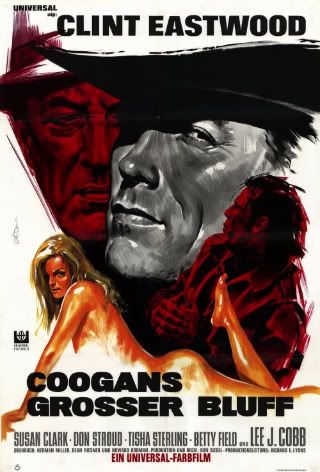
As the 60s were drawing to a close the western (at least the traditional variety) was a genre in decline. By the mid-70s it had been more or less supplanted by the hard-nosed urban cop movie. At first glance you might think there’s little common ground, but scratch the surface a little and the similarities are there – men operating alone with their own brand of personal integrity, a hostile and lawless environment, a society that is simultaneously repelled by and in desperate need of the services of those accustomed to violence. Strip away the time and place and those themes could be applied to any number of westerns and 70s cop films. Coogan’s Bluff (1968) can be viewed as a bridge between these two genres, not least because of the presence of Clint Eastwood.

Coogan (Eastwood) is an Arizona deputy who we first see running down a fugitive from a Navajo reservation. This opening establishes not only that he’s a capable and ruthless hunter of men, but he’s also master of his harsh desert environment. A temporary slip on his part lands him in hot water with his superiors and he’s dispatched to New York to complete the seemingly mundane task of escorting an extradited prisoner back home. The thing is though that Coogan is very much a man of then west, and he’s plunged into a world that’s entirely alien to him. When he gets his hands on his prey he allows himself to be duped into a situation that leaves him hospitalized, and without either the prisoner or his gun. His pride refuses to let him take this lying down, and there follows a relentless man hunt through the city’s mean streets. Along the way, Coogan clashes with the local police in the person of Lt. McElroy (Lee J Cobb), and encounters an assortment of hippies, junkies, freaks and low-lifes that are as dangerous as they are strange. Coogan’s the product of a hard place, but the grimy streets he finds himself roaming are every bit as lethal as his desert home. While the scenes of our hero pursuing his quarry through the night spots of the counter-culture offer up a snapshot of the hedonistic late-60s, they also date the film quite badly. Those paisley-shirted kids passing round the spliff, talking in riddles, and chilling to Indian music in psychedelic apartments with beaded curtains seem as far away in time now as the west that Coogan is supposed to embody. In the end, of course, he gets his man, and there’s a nice little coda on the helicopter back home that suggests he may have learned something during his trip to the big city. Where he callously ground his cigarette into the dirt before the imploring eyes of the shackled fugitive at the beginning, he now seems to have learnt a little pity and offers a smoke to his latest prisoner.

The Man With No First Name - Clint Eastwood in Coogan's Bluff.

Eastwood’s Coogan is very much a halfway house between The Man With No Name and Harry Callaghan – in the early scenes the trademark squinting eyes are hidden behind black RayBans and a simple cigarette stands in for the cheroot. However, the western sensibility remains and has not yet been wholly replaced by the full scale urban brutality. Mind you, although he’s playing a fish out of water, there’s no wide eyed innocence about Coogan. Eastwood plays him as a man with quick wits who learns life’s lessons fast. He’s also no superman, taking two beatings in the course of his investigation – the second being particularly rough – yet has the requisite toughness to survive unarmed for the most part. While Eastwood almost always brings some of his dry humour to his roles he pretty much meets his match in Lee J Cobb. The veteran actor deadpans his way through the movie as the world weary cop who recognizes Coogan’s presence as just the source of another headache. Don Siegel’s direction is as lean and efficient as usual, capturing the seedy atmosphere of the inner city perfectly and handling the action scenes like the old pro he was – the pool hall fight being especially well done.

Universal’s UK DVD of Coogan’s Bluff is a very basic affair, with not one extra in sight. The transfer is anamorphic 1.78:1 but it’s a very grainy one, and I’m not usually given to griping too much on the grain issue. Still, it’s very much a budget release so I suppose we can’t expect too much. The film itself remains entertaining throughout, though it’s really only in the mid-range of both Eastwood’s and Siegel’s work. It was the first film the director and star made together, and they would both go on to better things individually and collaboratively. Generally, we’re looking at a good solid piece of filmmaking that acts as an interesting link between genres.

El Dorado

poster208

A while back I mentioned directors remaking their own movies, citing Hitchcock and Walsh at the time. However, they’re not the only ones; Howard Hawks reworked the same material that he originally used for Rio Bravo no less than three times. In this case, I think the law of gradually diminishing returns applies – although I’m aware that there are those who might disagree. Hawks’ second trip to the well resulted in El Dorado (1966), a film that improved on its predecessor in one or two ways but ultimately remains a less satisfying work. Ok, it’s not a straight remake of Rio Bravo since it opens the story up a little more in terms of people and locations but it does use the same core situation and characters. There’s the tough professional, the drunk, the old coot and the green kid all holed up in a dingy jailhouse and under siege.

Cole Thornton (John Wayne) is a professional gunman who hires his skills out to the highest bidder. After accepting an invitation from one of the parties involved in a range war he discovers that the job would mean facing off against an old friend. Sheriff J.P. Harrah (Robert Mitchum) is the lawman caught between the feuding factions, and it’s his presence that dissuades Thornton from signing any contract. However, before Thornton can take his leave an accidental shooting leads to an ambush that results in his getting a bullet lodged perilously close to his spine. When he returns some months later he finds that Harrah has taken to the bottle in the wake of an ill-judged love affair. To make matters worse, the nearly incapacitated sheriff is in no position to cope with the ongoing range war that’s about to come to a head. Therefore, it’s left to Thornton to take charge of a rapidly deteriorating situation provoked by an attempted murder and the subsequent arrest of one of the feud’s main players. Up to this point the plot has its own reasonably unique slant. However, once Thornton, Harrah et al find themselves barricaded in the jail it’s Rio Bravo all over again. Where the original had a gentle humour, a gradually built sense of camaraderie and a frisson of sexual tension (thanks to Angie Dickinson), El Dorado rushes things a bit and lays the humour on too thick. Actually, it’s the comedic elements that do the most damage in my opinion. Much of this is based around the character of Mississippi (James Caan) – in particular, his incompetence around firearms and his questionable taste in hats. What’s worse, though, is a cartoonish fight between Thornton and a drunken Harrah that wouldn’t have looked out of place in a Three Stooges short. The climax is also disappointing, the pyrotechnics of Rio Bravo being replaced with a contrived showdown that’s not much more than a damp squib.

In a sense, if you’ve seen one Howard Hawks picture you’ve seen them all. The same themes crop up again and again, namely professionalism and loyalty to one’s comrades. El Dorado is no exception in this respect, we have the tight knit group defying the odds and getting moral support from no-nonsense women. However, there’s a certain flatness to El Dorado, both in the visuals and the reworking of a tried and tested story. The areas where it does score over Rio Bravo are a few of the performances. I can’t honestly fault Dean Martin’s Dude, but Mitchum does bring more weight to his take on the broken down drunk if only because he’s Robert Mitchum. The biggest improvement is the casting of James Caan as the young man taking his first steps in the presence of the big boys. Although the forced jokiness of his character does tend to grate a little after a while he is certainly an actor, something that couldn’t be said for Ricky Nelson. Wayne, of course, is Wayne and it matters not a jot whether he’s playing the sheriff or the hired hand, his star quality ensures that he dominates proceedings. It is interesting to note though that the plot device concerning the bullet in his back was a convenient way to make allowances for the effects of the passage of time and the major health problems he had endured. As for the others, let’s just say that Arthur Hunnicutt, Charlene Holt and Ed Asner were no match for Walter Brennan, Angie Dickinson and Claude Akins. While I’m drawing comparisons, I might just add that Nelson Riddle’s score isn’t a patch on Tiomkin’s – although the title song played over Olaf Wieghorst’s paintings is very memorable.

El Dorado got a 2-disc release not long ago in the US as part of Paramount’s Centennial Collection. I never bothered to pick that one up so I can’t comment on the picture quality, but I do know it offered a variety of extras. The old UK R2 that I have presents the film 1.78:1 anamorphic and it’s not a bad transfer. The image could, I suppose, be a little sharper but there’s really not much to complain about. Image quality aside, the big difference between the old and new releases relates to bonus features, with the earlier disc boasting nothing but a theatrical trailer. Reading back through this, I might seem a little hard on El Dorado. The truth is it’s not at all a bad western and makes for entertaining viewing – the problem is that it’s damned near impossible not to compare it to Rio Bravo, and that’s where it comes up short.

The Last Sunset

poster188

The Last Sunset (1961) is a film that seems to have all the credentials, all the ingredients that go towards making a top flight production: a highly talented director, a fine cast, and a script by a top writer. In spite of all this the final result is a movie that doesn’t quite gel and one that delivers a lot less than it initially promises. As is usually the case when a film proves disappointing, the fault lies with the script. There are some interesting elements which are introduced and then disposed of before they’ve had a chance to play out fully. Generally, this leads to both clutter and a lack of focus. In the end, we’re left with a film that’s not exactly bad but one that could and should have been a whole lot better.

The opening credits play over a dogged pursuit across a southwestern landscape, down into Mexico where the bulk of the action will unfold. O’Malley (Kirk Douglas) is the black clad fugitive, a killer who carries a derringer instead of a six-shooter. Hot on his trail is Dana Stribling (Rock Hudson), a lawman with a personal interest in seeing his quarry brought back to Texas to hang. O’Malley is heading for a ranch run by a faded Virginia gentleman with a fondness for the bottle. The rancher, Breckenridge (Joseph Cotten), happens to be married to O’Malley’s old sweetheart Belle (Dorothy Malone) and it’s soon evident that he’s continued carrying a torch for her for years. The two men strike a deal whereby O’Malley will help Breckenridge drive his herd up to Texas, but he also claims he’s going to take his new partner’s wife off him. That in itself could have provided an interesting scenario, but the script has no intention of remaining so simple. Stribling’s arrival leads to an uneasy truce with hunter and hunted agreeing to pool their talents in order to ensure the success of the cattle drive before settling their own scores. With both newcomers being clearly interested in the charms of Belle the scene looks set for a juicy three-way contest for her affections. However, that’s not to be for Breckenridge soon departs the scene after being gunned down in a cheap cantina. What’s even more frustrating is the fact that moments before his death the audience is treated to revelations about Breckenridge’s shameful past. So, two potentially rich plot veins are left unmined. Instead we’re treated to the seemingly interminable drive to Texas with too much talk and too few sparks. It seems that the producers were aware that they were in danger of bogging the plot down, so three shifty and unscrupulous cowboys, who plan to get in on the white slavery racket, are introduced (Jack Elam, Neville Brand and James Westmoreland) to try to spice up proceedings. Again the opportunity is lost as these characters are killed off before they have the chance to make an impression. The script still has one hole card in reserve though, and it’s a real stinger. Nevertheless, in keeping with the rest of the picture, this gets handled poorly too. The problem is not with the nature of this final reveal, it’s suitably shocking, but the fact that we learn about it too soon. I won’t go into details here lest I spoil things for anybody, but the timing really draws all the tension and drama out of the climactic duel and leaves us with a flat and predictable ending.

£25

With a combination of Robert Aldrich directing and Dalton Trumbo writing, I don’t think it’s unfair to have high expectations. For whatever reason, neither man was at the top of his game on The Last Sunset. Trumbo’s script meanders all over the place and flatters to deceive, with too many plot turns and too many undeveloped ideas. Aldrich allowed the momentum to flag after the first half hour or so and he never really recovered it after that. There are some nice shots, a well filmed sequence during a dust storm, and an attempt to claw back some tension in the climax through quick cutting but none of it adds up to enough to save the film. On top of all this the performances of the two leads are nothing to write home about either. Douglas seemed to be trying for the kind of deadly rascal that Burt Lancaster pulled off in Aldrich’s Vera Cruz but it doesn’t really work for him. Hudson just didn’t convince at all as the driven lawman and he comes across as merely bland. Dorothy Malone and Joseph Cotten were altogether more successful as the Breckenridges; the former exuding a worldly sexuality that made the attention of her various suiters highly credible, while the latter provided a fine portrait of a broken and guilty man. Maybe if Hudson’s character had been the one to snuff it in the cantina we would have got a more compelling film. It’s also a shame that Jack Elam and Neville Brand had to disappear so soon since such character actors were capable of raising the quality of any production.

The Last Sunset was given a release a few years back by Universal in R1 in the Rock Hudson – Screen Legend set. The transfer is a fine anamorphic one and, apart from the odd speckle, there’s not much wrong with it. Colour and sharpness are both strong with good detail. There’s a trailer for the film provided but that’s it as far as extras go. This movie couldn’t be classed as anyone’s finest hour but it’s not a complete dud. There are a handful of worthy performances and the adult theme that becomes apparent as it draws to a close mean that it deserves a look. Let’s just say that it wouldn’t be an ideal introduction to the work of any of the principals


Hell is for Heroes

Poster

Don Siegel’s Hell is for Heroes (1962) is one of those small scale, low budget war movies that bears comparison with some of the stuff Sam Fuller knocked out at the beginning of his career. It’s the kind of film that keeps the focus firmly on the guys at the bottom of the ladder, and thus manages to address the futility and brutality of war while still acknowledging the courage of the lowly, ordinary grunts who find themselves having to be extraordinary just to stay alive. War movies in the 1960s would increasingly move towards the big budget spectacular, but this one is almost a throwback to the previous decade due to the small cast and character driven plot.

The story here concerns a battle weary squad of US soldiers on the fringes of the Siegfried Line in 1944. Although their fighting strength has been severely weakened the troops aren’t overly anxious as they figure they’re on the point of being shipped out and finally heading back home. Their meagre ranks are added to with the arrival of a replacement, Reese (Steve McQueen). He’s a former master sergeant, busted back to private for flaking out and stealing a jeep. In fact, Reese is a man dangerously near the end of his tether; his distinguished service record has saved him from falling further but he keeps on chipping away at the corners of army discipline. An evening’s visit to the nearby town’s off limits bar would probably have done for him if it hadn’t been for the intervention of Sergeant Pike (Fess Parker), an old acquaintance. When news comes through that there will be no welcome departure, just a move back onto the line, the only man not to show dismay is Reese. For these men the news is about to get even worse, as they are to be left behind as a temporary rearguard while the bulk of the force move on. The challenge is for the isolated squad to fool the Germans into thinking that they’re a much bigger force. To this end the troops devise a number of ingenious ploys, from running a backfiring jeep in low gear to simulate the sound of a tank to stringing ammo boxes full of rocks through the bushes so the enemy might take their rattling for the movements of patrols. This is all well and good but a brutal assault by a German patrol (which sees Reese in his element, even savagely hacking one man to pieces with a butcher knife) renews the danger. With no guarantee when the main force will return to back them up, the squad need to decide between sitting it out in hope or taking the initiative and trying to knock out a pillbox. Reese urges action while the cautious Sergeant Larkin (Harry Guardino) counsels patience. In the end, a stray shell makes their decision for them and Reese gets to lead a tense sortie through a minefield. There are no happy endings in this movie, just sudden and graphic deaths, hard decisions, and harder consequences. Even the final scene offers no real respite; the army surges on amid fallen bodies and there’s no end in sight – more positions will have to be taken and more men will have to give their lives.

Close to the edge - Steve McQueen in Hell is for Heroes.

The part of Reese was ideal for Steve McQueen who must have relished playing the moody loner unburdened by excess dialogue, and it had the added bonus of handing him the opportunity to show off all those twitchy mannerisms that audiences have come to associate with him. It’s really McQueen’s picture from beginning to end and it’s always a pleasure to watch him keep all that angst and bottled up machismo raging just below the surface. He gets some good support from Fess Parker and Harry Guardino, as the respectively sympathetic and exasperated sergeants, and from a bespectacled James Coburn – the squad’s technical jack-of-all-trades. The novelty casting of Bob Newhart and Bobby Darin is altogether less satisfying, but it’s not enough to do any serious damage to the film. Don Siegel’s direction is as tight and professional as could be, and he works wonders on what must have been a small budget. The stark monochrome photography adds just the right touch of bleakness and, while this is essentially a character study, Siegel’s handling of the action scenes is urgent, exciting and realistic. 

Paramount’s R2 DVD of Hell is for Heroes offers an excellent transfer. The movie is presented 1.78:1 anamorphic and looks in very good shape all the way through. There’s not an extra to be found on the disc, which is the only black mark against it for me. This isn’t one of the best known war movies, nor is it likely to be one of the more familiar works of either McQueen or Siegel. However, for fans of the genre, star or director it does deserve to be seen. It’s a powerful little movie that doesn’t try to manipulate the viewer or preach – it simply presents a dispassionate view of war and the men involved.

The Unforgiven

poster120

John Huston has to be one of my favourite directors but I’ve only just realised that, before today, I hadn’t written up any of his films on this blog. A quick browse through his lengthy and wide ranging filmography also drew my attention to the fact that he only made two westerns – I’m not counting The Misfits or The Treasure of the Sierra Madre, although some probably would – and I thought that seemed a little odd. The Unforgiven (1960) is a movie that doesn’t get talked up very much (the director professed a dislike of it which may have hurt its reputation some) but I believe it’s worthy of a bit of attention. The movie derives from a story by Alan Le May (The Searchers) and, perhaps unsurprisingly, concerns the fate of captives. What makes The Unforgiven a little different is the fact that the abduction that forms the background is a reversal of the usual white child spirited away by Indians one. In this case the settlers have taken a Kiowa baby and adopted her as one of their own. This storyline offers the opportunity to examine the effects of racism not only within the community but within the confines of the family as well.

The Zachary’s are a close knit frontier family who, with the father dead as a result of a Kiowa raid, are held together by eldest son Ben (Burt Lancaster). He, with the help of brothers Cash (Audie Murphy) and Andy (Doug McClure), has been putting together a herd of cattle to send to Wichita and make their fortune. The family’s future looks secure and there is a chance of marrying the only sister, Rachel (Audrey Hepburn), into a neighbouring family of fellow ranchers, thereby cementing their partnership. However, the Zacharys’ dreams are built on shaky foundations and are soon to be swept away. Into their midst rides a mysterious old man (Joseph Wiseman), clad in a decaying Civil War uniform complete with sabre. In between quoting scripture he tosses out casual innuendo relating to a dark secret held by the Zacharys. Before long, Ben and Cash find themselves having to hunt down this otherworldly figure, knowing as they do that he intends to destroy them. This leads to one of the most memorable scenes in the film, as the two brothers chase their ghostlike quarry through a swirling dust storm – the old man seeming to appear and disappear at will, and then rushing out of the clouds of windswept sand with his sabre swinging murderously. Nevertheless, despite their best efforts, their nemesis evades them and poisons their neighbours and former friends against them. By the time the Kiowa turn up outside the sod covered family home demanding the return of what they claim belongs to them the Zacharys are about to tear themselves apart. Cash is an unashamed racist haunted by visions of his father’s death at the hands of the Kiowa, and barely able to contain his contempt and hatred for the red men. Therefore, Ben must prove himself the rock upon which the others can depend in order to weather the gathering storm.

£3

I’ve read that John Huston may have been displeased with the final product due to the fact that Audrey Hepburn later suffered a miscarriage, possibly as a result of a fall during production, not to mention that Audie Murphy almost drowned etc. Be that as it may, the film remains a solid, professional piece of work from Huston. He and DOP Franz Planer made excellent use of the wide angle lens to capture the scenery around Durango, and it contrasts well with the dark and claustrophobic interiors of the Zachary home. Apart from the aforementioned dust storm, the action scenes during the climactic siege are quite impressive.

The cast as a whole acquit themselves very well, with Lancaster displaying his customary stoicism interspersed with the occasional witticism. Audrey Hepburn would hardly rank as anyone’s idea of a western heroine but I thought she was pretty convincing in a difficult role. Audie Murphy never gets a lot of credit as an actor but this movie, probably more than any other, shows just how capable he was. He invests the character of Cash with a simmering mix of conflicting emotions that enables him to steal almost every scene he’s in. Lillian Gish also has a high old time as the tough matriarch with a steely resolve, and has a wonderful scene where she sits playing the piano outside at night to counter the music of the Kiowa medicine men. Joseph Wiseman chews up everything in sight as the spectral (no pun intended) Abe Kelsey, a genuinely scary yet pitiful husk of a man driven insane by grief and a desire for vengeance on those he deems responsible for past wrongs.

Given the indifferent treatment MGM often handed their catalogue releases the R2 DVD of The Unforgiven is actually quite pleasing. It’s given a handsome anamorphic scope transfer that has little damage on show save for a bit of light speckling here and there. Since this film is not widely regarded as one of Huston’s greatest it’s no real surprise that the only extra available is the theatrical trailer. I think this movie has been unjustly maligned by many and, even if it never comes to be seen as vintage Huston, it does work well as a mature western that at least tries to tackle a complicated issue. All in all, I like it and feel the performances and photography are ample reasons to give it a go.