The Unforgiven

poster120

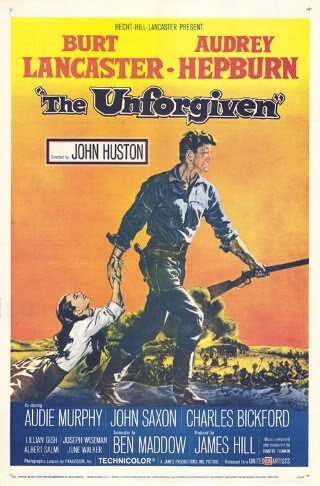
John Huston has to be one of my favourite directors but I’ve only just realised that, before today, I hadn’t written up any of his films on this blog. A quick browse through his lengthy and wide ranging filmography also drew my attention to the fact that he only made two westerns – I’m not counting The Misfits or The Treasure of the Sierra Madre, although some probably would – and I thought that seemed a little odd. The Unforgiven (1960) is a movie that doesn’t get talked up very much (the director professed a dislike of it which may have hurt its reputation some) but I believe it’s worthy of a bit of attention. The movie derives from a story by Alan Le May (The Searchers) and, perhaps unsurprisingly, concerns the fate of captives. What makes The Unforgiven a little different is the fact that the abduction that forms the background is a reversal of the usual white child spirited away by Indians one. In this case the settlers have taken a Kiowa baby and adopted her as one of their own. This storyline offers the opportunity to examine the effects of racism not only within the community but within the confines of the family as well.

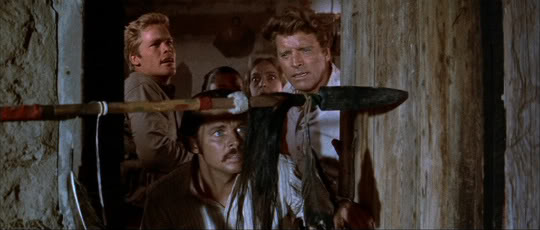
The Zachary’s are a close knit frontier family who, with the father dead as a result of a Kiowa raid, are held together by eldest son Ben (Burt Lancaster). He, with the help of brothers Cash (Audie Murphy) and Andy (Doug McClure), has been putting together a herd of cattle to send to Wichita and make their fortune. The family’s future looks secure and there is a chance of marrying the only sister, Rachel (Audrey Hepburn), into a neighbouring family of fellow ranchers, thereby cementing their partnership. However, the Zacharys’ dreams are built on shaky foundations and are soon to be swept away. Into their midst rides a mysterious old man (Joseph Wiseman), clad in a decaying Civil War uniform complete with sabre. In between quoting scripture he tosses out casual innuendo relating to a dark secret held by the Zacharys. Before long, Ben and Cash find themselves having to hunt down this otherworldly figure, knowing as they do that he intends to destroy them. This leads to one of the most memorable scenes in the film, as the two brothers chase their ghostlike quarry through a swirling dust storm – the old man seeming to appear and disappear at will, and then rushing out of the clouds of windswept sand with his sabre swinging murderously. Nevertheless, despite their best efforts, their nemesis evades them and poisons their neighbours and former friends against them. By the time the Kiowa turn up outside the sod covered family home demanding the return of what they claim belongs to them the Zacharys are about to tear themselves apart. Cash is an unashamed racist haunted by visions of his father’s death at the hands of the Kiowa, and barely able to contain his contempt and hatred for the red men. Therefore, Ben must prove himself the rock upon which the others can depend in order to weather the gathering storm.

£3

I’ve read that John Huston may have been displeased with the final product due to the fact that Audrey Hepburn later suffered a miscarriage, possibly as a result of a fall during production, not to mention that Audie Murphy almost drowned etc. Be that as it may, the film remains a solid, professional piece of work from Huston. He and DOP Franz Planer made excellent use of the wide angle lens to capture the scenery around Durango, and it contrasts well with the dark and claustrophobic interiors of the Zachary home. Apart from the aforementioned dust storm, the action scenes during the climactic siege are quite impressive.

The cast as a whole acquit themselves very well, with Lancaster displaying his customary stoicism interspersed with the occasional witticism. Audrey Hepburn would hardly rank as anyone’s idea of a western heroine but I thought she was pretty convincing in a difficult role. Audie Murphy never gets a lot of credit as an actor but this movie, probably more than any other, shows just how capable he was. He invests the character of Cash with a simmering mix of conflicting emotions that enables him to steal almost every scene he’s in. Lillian Gish also has a high old time as the tough matriarch with a steely resolve, and has a wonderful scene where she sits playing the piano outside at night to counter the music of the Kiowa medicine men. Joseph Wiseman chews up everything in sight as the spectral (no pun intended) Abe Kelsey, a genuinely scary yet pitiful husk of a man driven insane by grief and a desire for vengeance on those he deems responsible for past wrongs.

Given the indifferent treatment MGM often handed their catalogue releases the R2 DVD of The Unforgiven is actually quite pleasing. It’s given a handsome anamorphic scope transfer that has little damage on show save for a bit of light speckling here and there. Since this film is not widely regarded as one of Huston’s greatest it’s no real surprise that the only extra available is the theatrical trailer. I think this movie has been unjustly maligned by many and, even if it never comes to be seen as vintage Huston, it does work well as a mature western that at least tries to tackle a complicated issue. All in all, I like it and feel the performances and photography are ample reasons to give it a go.

Two Rode Together

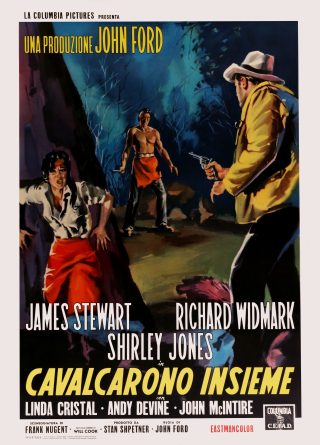
“The worst piece of crap I’ve done in twenty years.” Those were John Ford’s own words when assessing Two Rode Together (1961). Even now, critics never seem to have anything very positive to say about this film. Ford’s work in the 60s was certainly patchy, even more so when it’s held up for comparison against his earlier movies. I’m not sure this is as much of a dog as its reputation suggests; it’s a weak John Ford film for sure, but even a lesser work from the great man always had some points to recommend it.

Two Rode Together is frequently referred to as a rehash of themes explored in The Searchers, and that’s one of the problems identified right away. Where the earlier classic had depth, gravity and passion this film feels superficial and, at times, cartoonish. However, I’m not convinced the two movies ought to be compared too closely. For one thing, The Searchers focused on the quest and those involved in it, whereas Two Rode Together is really about the consequences of rehabilitation for the rescued captives. Guthrie McCabe (James Stewart) is a marshal in the town of Tascosa, an enviable position in that it entitles him to a 10% cut of everything in the place. His idyllic lifestyle is interrupted, however, when Lt. Jim Gary (Richard Widmark) and his troops arrive to escort the dissipated lawman back to the fort. The army intend to press the reluctant McCabe into acting as a scout/intermediary in order to make contact with the Comanche Quanah Parker (Henry Brandon) and trade for the release of white captives. McCabe is nothing if not a coldly realistic man, and he knows full well that what the army is asking is basically a fool’s errand. Although his cynicism is viewed with contempt by the soldiers, subsequent events will prove that it’s his assessment that’s more grounded in reality. Lt. Gary is sent along to keep a watchful eye on McCabe (he’s regarded as an amoral mercenary at best), and in so doing has his eyes opened and his preconceptions challenged. When it becomes apparent that the surviving captives have been so deeply integrated into Comanche life as to be unrecognizable the decision is taken to return with only two captives: a teenager, Running Wolf, and a Mexican woman, Elena (Linda Cristal). Instead of being greeted as heroes and saviors, both McCabe and Gary find themselves viewed as being partly responsible for the tragedy that ensues. The fear, hatred and suspicion of the Comanche are so deeply ingrained in the whites that there can be no happy homecoming for anyone, and McCabe’s cynicism and skepticism that were initially painted as repugnant are now seen to be vindicated.

John Ford’s penchant for broad, knockabout comedy is very much an acquired taste, and you’re either OK with it or you’re not. I mention this because Two Rode Together is liberally laced with instances of trademark Fordian humor. A good deal of this is centered around Andy Devine’s grossly overweight Sgt. Posey and it’s of the hit and miss variety. What’s altogether more successful is the gentle jibing that takes place between Widmark and Stewart as it helps to flesh out and humanize their characters. Ford’s direction is unaccountably flat in general, and really only strikes home in the scenes that focus on the desperation and emotional pain of the homesteaders who yearn for news of their loved ones. Even the landscapes look dull and uninspiring, which is atypical for a Ford film. Of course, news came through during shooting of the passing of the director’s old crony and frequent collaborator Ward Bond, and that may go some way to explaining the slightly detached feeling that permeates the whole picture. If it weren’t for the performances of Widmark and Stewart then this movie would be a real tough slog. Their scenes together constitute the core of the film and help keep it afloat. Widmark is good enough but I didn’t get the impression that he was operating at full throttle, whereas Jimmy Stewart throws himself into the part completely. By this time Stewart had mastered the art of icy indignation and half-suppressed emotion, and it serves him well in the later scenes where he confronts the ugly face of naked racism back at the fort. Of the female characters Shirley Jones received third billing but her part is an undeveloped one and seems to peter out just when it should have taken center stage. Linda Cristal fares much better as the former captive who’s deeply unsure of her place in society; her discomfort is nearly tangible when she’s paraded in front of the army wives, and she visibly wilts before their prying eyes.

Two Rode Together remains absent on DVD in the US but it’s widely available in R2. Sony’s UK disc offers an anamorphic widescreen transfer that’s goodish without being in any way exceptional. It could use a bit of a clean up but there aren’t any serious flaws. Both colors and sharpness are reasonable enough but, like the movie itself, don’t exactly pop off the screen. There are absolutely no extras at all but this title can be picked up very cheaply, so one shouldn’t complain too much. Well, this is a long way from classic Ford but the playing of the two leads does raise it above the mundane and lends some class. The truth is it’s not a bad little western – it’s just not a great John Ford western.

Gambit

Poster

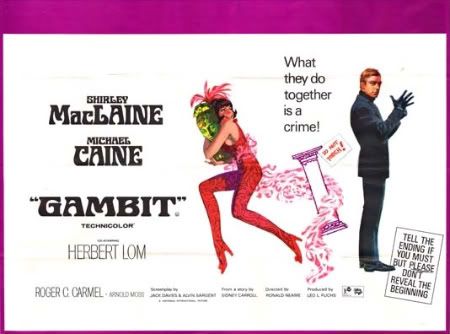
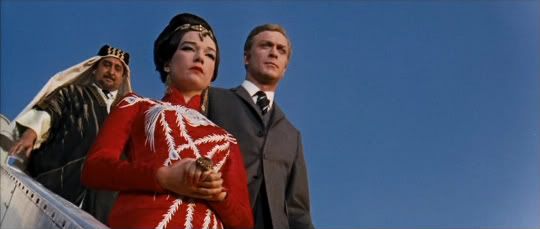
I’m not sure if the caper movie could be referred to as a genre in itself. It’s basically an offshoot of the heist movie, which in turn has its origins in the world of thrillers. To me a caper should be a humorous take on a criminal enterprise and it should have a certain gloss or stylishness about it. As such, the 1960s were arguably the ideal period for these films, and I’m of the opinion that the best examples are to be found in that decade. Gambit (1966) checks all the boxes as far as I’m concerned: it’s got a couple of glamorous stars in the lead roles, a slightly convoluted plot that never takes itself too seriously, pretty locations, and an abundance of charm and style.

The structure of the film is one of its major assets, with the first half hour showing Harry Dean (Michael Caine) meticulously setting up the perfect crime before everything falls to pieces. Our hero has his sights on a priceless sculpture owned by a reclusive billionaire, Ahmad Shahbandar (Herbert Lom), and has planned what he thinks is a foolproof method of snatching it. For the final pieces of his scheme to fall into place he needs a woman to play the part of his wife. Of course it can’t be just any woman, he needs someone who closely resembles Shahbandar’s late wife. Enter Nicole Chang (Shirley MacLaine), an exotic dancer of Eurasian stock who just happens to be a ringer for the former Mrs Shahbandar. This is the leverage Harry hopes to use to get near enough to both the billionaire and his precious artifact. I don’t want to give away too much of the plot for anyone who hasn’t seen this, so I’ll stick to saying that the humour and suspense come not only from watching how the best laid plans come unstuck but how they can be pasted back together again.

Shirley MacLaine & Michael Caine 

Michael Caine had just done Alfie and The Ipcress File before this movie and had pretty much cornered the market for mouthy cockneys. It’s a lot of fun watching his Harry Dean go from the assured, smooth operator of the opening to the increasingly flustered and shouty blunderer of the rest of the film. Shirley MacLaine is probably even better as the would-be pawn who ends up bailing Harry out of a succession of uncomfortable situations. When one remembers that the actress doesn’t even open her mouth for the first half hour or so it just proves what a classy performer she is. Herbert Lom was another piece of great casting and always gave a memorable performance in every thing I’ve seen him in. He more or less plays two roles in this film and does so with the greatest of ease. Ronald Neame directed fluidly and kept the pace tight throughout. He also handled the combination of humour and suspense with a deft touch, maintaining a nice balance all the way. It’s also worth mentioning that this gentleman celebrated his 98th birthday last year since he’s one of the few remaining links to the golden age of cinema – here’s hoping he gets to celebrate many more.

Gambit is on DVD in the UK via Second Sight and they’ve done an excellent job on the presentation. The anamorphic scope transfer looks fantastic with strong, bright colours and a clean, sharp image. The disc has the added bonus of carrying a commentary track with the director, something I always appreciate on the rare occasion it’s available for older movies. This film is also now available in the US via Universal’s burn on demand programme – currently exclusive to Amazon. I have no idea how the editions stack up against each other but I will say that I managed to pick up my R2 on sale before Christmas for an absolute pittance. It remains to be seen whether the R1 counterpart will drop significantly in price. All told, I enjoyed the film enormously. It’s a delightful and fun piece right from the start, and I can’t say it disappoints on any level. The perfect tonic for those bleak evenings in the depths of winter – highly recommended.

55 Days at Peking

£10

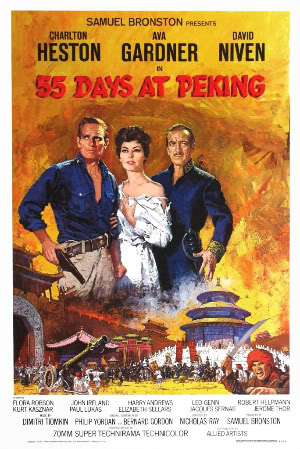
I generally steer clear of writing about huge sprawling epics on this blog, but that’s not to say I don’t like them. As it happens I’m extremely fond of such films and often feel that it’s a near impossible task to do them justice in a relatively short write up. When I was growing up the Samuel Bronston movies were always a source of marvellous entertainment to me, and represented some of the most spectacular scenes ever put on film. So, when I realised this would be my hundredth post here I thought maybe it was time to turn my attention for once to a genuinely big film. I could have chosen El Cid or The Fall of the Roman Empire but opted instead for one of the so-called lesser Bronston’s, 55 Days at Peking (1963).

The action takes place in the summer of 1900, during the latter stages of the Boxer Rebellion, when the foreign legations in Peking came under siege. Without wanting to get mired in historical detail, it seems safe to say that the Boxers found their roots in a sense of unease over the growing foreign influence in China. At the time this influence was most apparent in the area of religion, with Christianity usurping the local variety. The movie opens with a brief voiceover narration to the accompaniment of a cacophony of national anthems assaulting the eardrums. After a little more exposition in the Forbidden City, the camera cuts to the arrival of a column of dusty and weary US marines. At their head is the swaggering figure of Major Lewis (Charlton Heston), no mean feat while still on horseback. That the situation in China is spiralling out of control is immediately obvious when we see an English priest, strapped to a water wheel, being slowly tortured to death. Lewis’ attempts to buy the priest fail and the only thing he and his men accomplish is the killing of a Boxer. From here events move inexorably towards the inevitable crisis. Despite the best efforts of the British minister, Sir Arthur Robertson (David Niven), a state of war is fast approaching. In the midst of the mounting chaos Lewis finds himself drawn into a romance with a Russian aristocrat of dubious reputation (Ava Gardner). This slow build up occupies the first half of the film and it is quite heavy going. However, there are some visually impressive set pieces, such as the confrontation with a Boxer “theatrical” group during the Queen’s birthday celebrations, to keep it from becoming totally bogged down.

It’s only with the murder of the German envoy that things start to heat up on the screen. This is the point where the real action and spectacle take centre stage. Lewis’ romance starts to fade into the background as all attention is focused on the ever more desperate attempts to defend the foreign compound from wave after wave of attacks from the fanatical Boxers. It’s these marvellously choreographed scenes of pitched battles along the ramparts that really breathe life into the movie. The maniacal determination of the Chinese to breach the foreign defences forces the besieged men to come up with ever more ingenious ways to repel them. When the Boxers wheel a massive tower laden with explosives up to the perimeter, and proceed to bombard the exposed compound below, there’s a wonderful scene wherein a French priest (Harry Andrews) with a suspiciously strong Irish brogue supervises the construction of an improvised mortar to lob fireballs back at them. While this all sounds slightly deranged on paper it’s filmed and performed with enough style and conviction to remain gripping and tense throughout. Even though the seemingly endless assaults and counterattacks make for great cinema in themselves, there’s also a well filmed sequence of a night time raid on the Chinese arsenal which concludes with a magnificent and explosive payoff. The only false note is having the British minister tool up and join the raiding party on their sortie – although I’m guessing it was done to give David Niven the chance to get away from pottering fretfully around his study.


£2

One of the pleasures of watching the epic movies from this era is the knowledge that the sheer scale of the production wasn’t anything but real. Nowadays, in the age of CGI, the thought of something as financially prohibitive as building a full size replica of the besieged compound and filling it with literally thousands of swarming extras would be enough to give the average studio executive palpitations, if not an outright seizure. However, the fact that what you see on the screen in a movie like this is real and has actual physical mass adds something indefinable, a quality that’s now been lost. Somehow the very knowledge that you can now create pretty much any image imaginable on screen rubs away a little of the magic for me. To all intents and purposes 55 Days at Peking was Nicholas Ray’s last film, having walked away leaving it incomplete after one argument too many with Bronston he suffered a heart attack. It’s not his best work by any means and I don’t believe he was ideally suited to these kinds of large scale productions. Still, the striking use of colour throughout does seem to bear his hallmark. As far as the performers are concerned it’s Heston’s film all the way. Chuck was in the middle of that purple patch that would last another decade and he stamps his authority all over this picture. Though to be fair, while the film doesn’t develop his character to any meaningful degree it does offer ample opportunity for the kind of iconic posing only he could pull off convincingly. David Niven’s quiet, gentlemanly dignity is a welcome contrast (his casual flicking aside of the kneeling cushion when summoned before the Dowager Empress is a beautifully understated moment), and he even manages to make some fairly trite dialogue sound credible by adopting just the right amount of earnestness – a true professional. Ava Gardner was nearing the end of her days as a leading lady at this point and her performance is adequate but nothing more. I understand that she didn’t get along particularly well with Heston (they certainly don’t have a lot of on screen chemistry) so that may be part of the problem. Finally, a word about Dimitri Tiomkin’s score; his style is not to everyone’s taste and he’s sometimes criticised for being excessively bombastic, but I like it a lot and think it’s perfectly suited to this kind of larger than life movie.

55 Days at Peking is available on DVD from a number of sources worldwide, and the edition I have is one I picked up in Greece years ago. It was released on the PCV label and it’s got a fine anamorphic scope transfer that doesn’t suffer from any major damage or colour fading. The image is progressive and doesn’t look to me like it’s been manipulated excessively. I’ve had a look at the screencaps on the Beaver’s site and I’m fairly confident that my copy looks a good deal stronger than the Japanese one featured there. It’s R2 PAL, of course, and runs at 156 minutes including the overture, intermission, entre’acte and exit music. It’s a shame that reports of poor sales seem to have halted further releases in R1 of the Miriam Collection since the Bronston titles already out in that line are probably the best on the market. This is a movie that’s been neglected in more ways than one over the years and critics have rarely had many positive things to say about it. It is probably overlong and could use a little trimming in the first half, the use of Caucasian actors in the major Chinese roles is possibly a source of annoyance for some, but I still enjoy the movie immensely. Perhaps the fact that it’s a throwback to that vanished era of large scale, no holds barred filmmaking adds to its charm for me. I recommend it if you can get your hands on a decent copy.

The Stalking Moon

£20

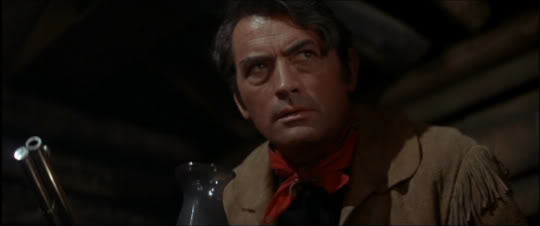
Thanks to the suggestion of a fellow blogger, le0pard13, I decided to dig out and rewatch Robert Mulligan’s 1968 suspense western The Stalking Moon. Although the film contains its fair share of action, it is essentially a slow burning mood picture which builds tension almost imperceptibly yet inexorably towards a conclusion that is both nerve-wracking and satisfying. A good part of its strength comes from the fact that it can be approached from a variety of angles; as the standard chase picture, an examination of race relations, a love story, a tale of friendship, and it even has a suggestion of the supernatural.

Sam Varner (Gregory Peck) is an army scout on the verge of retirement, having already bought a ranch in New Mexico. His last job for the army, helping bring a band of Apaches in to the reservation, leads to the rescue of a white woman who has been held captive for ten years. This woman, Sarah Carver (Eva Marie Saint), has a young half- breed son in tow and manages to persuade Varner to escort her to the nearest coach stop and help her on her way. At first, her eagerness to distance herself from her rescuers might appear to be rooted in some sense of shame at having given herself to the Apache – an idea reinforced by an uncomfortable stopover at a remote swing station. However, it soon becomes apparent that her desire to be on the move is based on an altogether more serious threat. It turns out that her boy is the son of Salvaje, a renegade Apache with a fearsome reputation. So begins a relentless pursuit that leads to Varner’s ranch and, eventually, a one man siege of the log cabin that seems to grow smaller by the second. All the while, the spectral presence of Salvaje lurks in the shadows or flits from rock to rock and the viewer starts to wonder if this man is indeed human. The film’s masterstroke is keeping Salvaje off the screen for so long; he remains a cipher, a kind of bogeyman who is spoken of in hushed tones but never seen. Even when he does appear, we are only given a fleeting glimpse of him before he vanishes again like some terrible force of nature leaving death and chaos in his wake.

£21

Gregory Peck plays another of his stoical, straight down the line characters in The Stalking Moon. In truth, it’s one of those classic western roles wherein the hero knows that the right thing to do is the unhealthy option but goes ahead with it all the same. In this case Varner has the chance to put Sarah on a train and let someone else deal with the whole mess, but his own sense of honour rules that out. As he toys with his food and gazes repeatedly at the lonely, forlorn figure sitting on the train platform it’s obvious what he’s going to do. Peck was always fine in those parts where his character had to draw on that inner steel to tough out the most hopeless of situations, and the role of Sam Varner might have been tailor made for him. Eva Marie Saint is also good in a difficult part, a woman who has become something of a stranger among her own people and little more than a misplaced possession to the mysterious Salvaje. In a movie that’s short on dialogue she has few lines to speak yet manages to convey the vulnerability of her character without diluting any of the resolve that would have been required to live the way she did. Robert Forster makes an early appearance as Peck’s half breed friend and fellow scout who proves his loyalty right to the end. The Stalking Moon was the only western made by director Robert Mulligan, and that’s something of a shame since he did an excellent job and seemed at home in the genre. He made excellent use of the locations (Nevada standing in for New Mexico) and the widescreen photography to emphasise the isolation of his characters. The open spaces of the first half of the film highlight not only the vastness of the country but also the relentless nature of Salvaje who will follow Sarah to the ends of the earth if necessary. In contrast, the second half becomes claustrophobic with Varner’s cabin, and the encroaching mountains and trees, becoming the focal point.

Warner put The Stalking Moon out on DVD last year in R1 as part of their Western Classics box and it’s also available in much of R2, though not the UK yet, as a stand alone title. It’s been given a fine anamorphic scope transfer with good colour and detail. The disc is as basic as they come without even a scene selection menu, but that seems to be par for the course with WB at the moment. Having said that, it’s a movie that does manage to sell itself on its own merits. There are those who have put forward the theory that Once Upon A Time In The West has a hint of the supernatural about it, with the possibility of Harmonica being an avenging ghost. Eastwood’s High Plains Drifter and Pale Rider also play around with a similar idea and I don’t think it’s too much of a stretch to view Salvaje in The Stalking Moon in that company. Anyway, it’s a damn fine film and one that’s well worth seeing.

Comanche Station

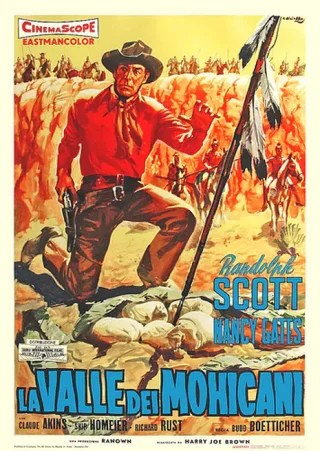
Lean and spare are the words often used to describe the westerns of Budd Boetticher and I won’t argue with that. Of course, budgetary constraints were generally the reason for the minimalist approach but Boetticher was masterful at disguising that fact. Burt Kennedy’s drum tight scripting and Boetticher’s control of the camera mean that you never stop to think that what’s on the screen was originally shot as a B picture. Between 1956 and 1960 the director made seven westerns with star Randolph Scott, all but the first produced by Scott’s Ranown. Shooting for the most part around Lone Pine gave these films a distinctive look and feel in much the same way that Monument Valley defined the westerns of Ford. Comanche Station (1960) was their last collaboration and Scott’s penultimate movie.

The plot is quite simple really, and that’s generally the strength of all the Ranown westerns; there’s no excess baggage, and the viewer only sees and hears what is absolutely necessary. Cody (Scott) is a lonely man, a former soldier, who has spent years wandering the west in search of his abducted wife. Whenever he hears a rumor of a white captive he sets off with a mule loaded with trade goods hoping that this time his quest may end. It is said that he’s rescued countless captives but it’s never the right one for Cody. This time will be no different. He trades with the Comanche for the freedom of one Mrs. Lowe (Nancy Gates) and aims to see her safely back to her husband. However, before he can do so, three men turn up and throw a spanner in the works. Lane, Frank and Dobie (Claude Akins, Skip Homeier and Richard Rust) are running from the Comanche, and Cody suspects it’s because they’re scalphunters. Cody’s distrust of Lane dates back to their years in the army, when he had the latter court-martialed for his role in an Indian massacre. It turns out that Mrs. Lowe’s husband has offered a $5000 reward for her return, dead or alive. While the viewer is immediately aware that Cody knew nothing of this, no-one else believes it. The challenge now is for him to save his own skin and that of the woman from both the Comanche and his new companions. As the story progresses it becomes very obvious where the greatest threat lies.

Randolph Scott’s lean and craggy appearance compliments both the landscape and Boetticher’s sparse morality tale. He looks every inch the laconic westerner who’s spent years scouring the scorched, barren land with only his pain and loss for company. The older he got the more adept he became at conveying a kind of buttoned-up emotion combined with an iron sense of personal honor. He was the first actor to draw me to the western as a child, and now I’m more convinced than ever that he may have been the greatest cowboy, surpassing even Wayne and Cooper. In fact all five actors in this film play off each other perfectly, and much of that comes down to the writing of Burt Kennedy. Everyone gets something to get their teeth into and it’s difficult not to feel even some sympathy for all of them. None of the villains in Boetticher’s westerns were ever one dimensional and Kennedy always managed to provide them with enough backstory or characteristic dialogue to keep the viewer interested. Boetticher does a fine job of moving his camera around to offer some unexpected shots and angles, and his use of the wide screen makes what is essentially a small picture look very big indeed.

After what seems like an eternity of waiting, Sony have finally released the five Ranown westerns in their possession onto DVD as The Films of Budd Boetticher. All the films come on their own discs and Comanche Station looks just wonderful. Like the other titles in the set, it boasts a healthy amount of film grain and sports a fine anamorphic transfer with good, strong color. The disc also carries a short featurette with Clint Eastwood offering a few thoughts on the movie. Sony have done a bang up job with this set – I have no hesitation in saying it’s the release of the year for me.

Duel at Diablo

duelatd

The Hollywood western in the mid-60s was at a crossroads. Television had effectively saturated the market with oaters and the whole genre was becoming filled with cliches. In Europe, the spaghetti westerns of directors like Leone and Corbucci were posing other challenges by taking a new approach to genre conventions and increasing the levels of violence. The dilemma faced by Hollywood was whether it should stick with the traditional formula or borrow from the Europeans. The initial result was a kind of compromise or halfway house. Ralph Nelson will be best known for his brutal cavalry western Soldier Blue; in a way it’s slightly ironic for a man who really only dabbled in the genre. Soldier Blue isn’t all that good a film, and much of its fame derives from the revisionist depiction of the violent excesses of the US cavalry. However, a few years earlier, Nelson made his first western, Duel at Diablo (1966), which offered a similarly bloodthirsty view of the Apache. Taken together, it could be said that the two films balance each other out, although Duel at Diablo is much closer to the traditional western in execution.

The opening of the film gives some indication of what’s to come, as the screen is sliced open by a bloodied knife to reveal a charred corpse suspended over a slow burning fire. From a distance, cavalry scout Jess Remsberg (James Garner) watches  and grimaces. Almost immediately, a rider comes into view pursued by two mounted warriors. This is Ellen Grange (Bibi Andersson), a white woman trying to make her way back to the Apache camp from which she has recently been rescued. The film is essentially an examination of race relations within the framework of the conventional revenge western. It is later revealed that Mrs. Grange bore a son while a captive, and this is a large part of her desire to return. However, that’s not her only reason; her husband Will (Dennis Weaver) cannot bring himself to come to terms with what has happened and rejects her. In her husband’s opinion, any decent woman would have killed herself rather than relinquish her honour. The attitude is widespread and is highlighted when Remsberg has to step in and save her as she is assaulted by a group of men convinced of her easy virtue. Remsberg is the only person to show any real compassion towards Mrs. Grange, and that’s because he too has placed himself on the fringes of white society. The second plot thread running through the movie concerns Remsberg’s quest to hunt down the man responsible for the murder, and subsequent scalping, of his Indian wife. While, eventually, the two threads merge and a measure of closure is achieved, the racial issue remains unresolved and the future awaiting both Remsberg and Mrs. Grange is far from certain.

James Garner may not be everyone’s first choice to play a hardened army scout but he acquits himself well. If anyone doubts his ability to play tough and gritty western characters I can only suggest they check out his performance a few years later in John Sturges’ Hour of the Gun. In truth, the casting in general is a little unorthodox, but it works for the most part. The exception would be Sidney Poitier’s dandified ex-soldier, who appears totally out of his element and never truly convinces. Swedish actress Andersson does well as the woman caught between two worlds and her odd accent actually serves to emphasise both her isolation and the outsider status of her character. Bill Travers was another piece of bold casting as the Scots cavalry lieutenant who dreams of promotion. Again I had no real problem with this since it seemed to blend into the overall scheme of highlighting the racial diversity of frontier life.

Ralph Nelson performs the director’s chores competently enough, even managing a few visually evocative shots of the cavalry column which recalls the great John Ford. His best work, however, is most apparent in the action scenes; the clashes between the cavalry and the Apache are well staged and exciting. He also displays a taste for the gruesome that he would indulge further in Soldier Blue; there are a number of scenes of Apache torture that, though tame by today’s standards, must surely have been regarded as strong stuff at the time. Nevertheless, I don’t believe he had any real feel for the western and fails to draw in the viewer in the way  the genre’s masters could. Another problem is the score by Neal Hefti, whose jazzy compositions work extremely well in the context of The Odd Couple and How to Murder Your Wife, but tend to grate a little in a western.

Duel at Diablo comes to DVD from MGM in both R1 and R2. The R2 is a typically ordinary transfer from this company (I’m not sure, but I’d imagine the R1 fares about the same) that’s neither all good nor all bad. On the plus side, the image is anamorphic 1.78:1 and there’s a theatrical trailer available, but it tends to be too soft in places. Even though it’s no classic I’d say the film is well worth a view for the interesting casting and storyline.


Mackenna’s Gold

£2

Well, time to roll out one of my guilty pleasures. Mackenna’s Gold (1969) is one of those movies I saw as a youngster and which has entertained me ever since. Everyone knows that the age at which you first see a film is a major factor influencing how much you appreciate it. When I was a little boy this film seemed like the best western I’d ever seen. It had everything you could ask for: a strong hero, a roguish villain, cavalry, Mexican bandits, menacing Apaches, and lots of action. I’m a good deal older and more jaded now and I no longer think it’s a great western, but it is a great fun western. Sure, I can see all it’s shortcomings now and, if I wanted to be coldly objective, I could probably savage it. But I  don’t feel like being objective; this movie was a genuine childhood pleasure and I intend to hang on to the memory.

There’s a great opening sequence with Joe MacDonald’s camera swooping and soaring over a primal western landscape to the accompaniment of Victor Jory’s narration and Jose Feliciano’s theme song. Ancient buttes and mesas rise up from the parched desert floor before the circling camera locks onto a lone figure and zooms in on an equally ancient Indian on horseback. This old man, Prairie Dog (Eduardo Ciannelli), is carrying a map that reveals the location of a mythical canyon of gold. Before dying he passes on the map to Marshal MacKenna (Gregory Peck), but the marshal has little faith in such tall tales and promptly burns the document. When he is subsequently captured by an outlaw band led by Omar Sharif, he is forced to lead them to the canyon whose whereabouts he has memorized. As the treasure hunt progresses more people are drawn in, notably a number of the leading citizens of the nearest town. There are ambushes, Indian attacks, betrayals and more before the whole thing wraps up with a psychedelic sunrise and a massive earthquake. And let’s not forget there’s the very welcome sight of Julie (Catwoman) Newmar stripping off for a swim in among all that.

dlcvhmz

The acting tends to come second in a piece of fluff like this, and that’s pretty much the case here. Gregory Peck is as stoic (those who wish to be unkind might say wooden) as usual in a part that doesn’t call for much more than that. Leaving aside the Egyptian cowboy and the Italian Indian, the best bits come from the starry citizenry of the town (Lee J. Cobb, Edward G. Robinson, Anthony Quayle, Burgess Meredith, Raymond Massey and Eli Wallach) although they have little more than cameo roles and don’t last too long before being massacred. Telly Savalas was generally worth watching when he got to play a villainous part and he’s not bad as a greed fuelled cavalry sergeant.

The direction of J. Lee Thompson, and Carl Foreman’s script keep things moving along fast enough to paper over many of the plot holes and gaps in logic. The action scenes are well filmed, but then you would expect that from Thompson. There’s also some fantastic location photography from veteran cinematographer Joe MacDonald but, despite that, there’s too much reliance on obvious back projection. The only real complaint I have is one shockingly bad effects shot which involves a rope bridge and what looks like an Action Man tied to a toy horse.

OK, this is no masterpiece of cinema but, as I said, it is a movie that I have fond memories of and I’m willing to overlook or forgive many of its faults. Perhaps others who came to it later in life would not be so generous. Sony’s DVD of Mackenna’s Gold is a reasonable transfer. I have the R2 which is anamorphic scope (I have heard that the R1 may be a pan and scan effort – if I’m wrong, feel free to correct me) and it is generally clear but the process shots do stick out like a sore thumb.

Dark of the Sun

poster020

There haven’t been too many movies based around the modern mercenary trade – The Wild Geese, The Dogs of War, The Last Grenade and, if you stretch the point, the recent Blood Diamond are the ones that spring to mind. There are, of course, lots of examples of mercenary characters in westerns but that’s not really the same thing. Of those mentioned, The Wild Geese isn’t much more than a Boy’s Own adventure, albeit a fairly enjoyable one. The Dogs of War spends way too much time on behind the scenes machinations and The Last Grenade is just not a very good film. Jack Cardiff’s 1968 production Dark of the Sun is a cut above all these and is arguably the best movie in this small sub-genre.

The story is set during the Simba revolt in the Congo in the mid 60s, when that vast, former Belgian colony was on the point of implosion. A mercenary group, under the command of Curry (Rod Taylor), are engaged to drive a train into the interior and evacuate the European inhabitants of an isolated mining town which is threatened by the advance of the Simba rebels. The reason this particular town is on the fast track for relief is because there happens to be a fortune in uncut diamonds waiting around for whoever arrives first. Curry, and comrade in arms Ruffo (Jim Brown), sets out with his hastily assembled group in the hope of beating the Simbas to the chase. Everything zips along at a good pace, packing in a chainsaw fight, a confrontation with the U.N. forces, and the rescue of a massacre survivor (Yvette Mimieux) before the train arrives at its destination. At this point the tension rises, as the diamonds are in a vault whose time lock won’t open for another three hours, and the rebels are inching ever closer.

Rod Taylor gives one of his best performances as the hard as nails soldier of fortune and there’s none of the phony posing so prevalent in more modern action heroes. Taylor seems genuinely tough and the climax, where he gives full rein to his outraged fury at the fate of his best friend, is powerful stuff indeed. Jim Brown was no great shakes as an actor but his calm, reasonable Ruffo provides an acceptable counterweight to the simmering Curry. Peter Carsten makes for a great villain as an unapologetic ex-Nazi, and there’s good support from the seasoned Kenneth More and Andre Morell. This is pretty much a man’s movie so there’s not a lot for Yvette Mimieux to do, but she does look sexy and appealing and that’s good enough for me.

If you’ve ever seen a movie photographed by Jack Cardiff you will know how effortlessly good everything looks. Although he is the director here, the movie remains visually pleasing and is only occasionally spoiled by some poor rear projection. The score by Jacques Loussier (I don’t believe I’ve heard anything else by him) is another major plus; it’s a jazzy, downbeat effort that enhances the mood of the picture perfectly. The source material was a novel of the same name by Wilbur Smith. Smith knocked out some good, tight action thrillers early in his career before sliding into the (probably more lucrative) field of the bloated, historical soap opera. I don’t know who provided the inspiration for Smith’s characters but I suspect he may have been thinking of Mike Hoare. Either way, I believe the film’s makers had one of Dublin’s less celebrated figures in mind – if you can get your hands on a copy of ‘Mad’ Mike’s own memoirs, Congo Mercenary, you ought to notice some parallels.

As far as I know, Dark of the Sun remains unavailable on DVD anywhere but there was some talk of Warner giving it a release in R1. It has turned up on TCM in the past but I would love to see it get a proper release – it’s a very good movie whose stock should rise if only it were more readily available.

EDIT January 2012 – The movie has now been given two official releases. The first is the Warner Archive MOD from the USA which I haven’t seen. It’s also been issued in Spain by Suevia, a company whose output is variable in quality. However, I’m pleased to say the Spanish disc is more than acceptable. It’s been transferred progressively in anamorphic scope and looks generally sharp. The colours are rich and there’s no problem with subs – the disc offers the option of French, Spanish or no subtitles on the English track. Extras are limited to the trailer. All in all, it’s a very satisfactory release.

A Dandy in Aspic

poster19

Anthony Mann’s career as a director could be divided into three broad phases; his noirs of the forties, his westerns of the fifties, and his epics of the sixties. I think it’s fair to say that he mastered all of these and brought something new to each. A Dandy in Aspic (1968) would be his first Cold War spy thriller, although ironically it would also be his last film and he died before it was completed. Had he lived, I think it’s unlikely that he would have embraced the genre if this film is anything to go by. All told, it’s a tired, glum effort which offers nothing fresh; it falls back on endless cliches and tries to be too clever for its own good.

It opens brightly enough with a nice credits sequence featuring a puppet dancing on a string to the accompaniment of a cool Quincy Jones score. Alex Eberlin is a British spy who we are informed is a remote, sexless snob. Personally, I found this tidbit of information superfluous as the part was being played by Laurence Harvey, and those are the very words that spring to mind when I think of him. It turns out that Eberlin is really a double agent and a KGB assassin who has been living in Britain for twenty years but longs to return home. However, his controllers don’t want him to return just yet since he’s been performing well enough for them. A bigger problem for him, though, is the fact that his superiors in British Intelligence want him to take on a new task. They have grown weary of their operatives being knocked off and Eberlin is handed the job of eliminating the assassin, in other words eliminating himself. To this end, he is packed off to Berlin in the company of another agent, the openly hostile Gatiss (Tom Courtenay). There follows a series of confusing double-crosses, shot against a drab looking Berlin cityscape, until everything winds down to a vaguely unsatisfying twist ending. Along the way, there is time for a romance with an English photographer, Mia Farrow. I’m not quite sure what purpose this relationship is supposed to serve other than to add some swinging sixties atmosphere – if it’s supposed to help the viewer to connect with these characters in some way, then it fails.

The movie is essentially hamstrung with the casting Harvey and Farrow. Harvey’s role is hardly a sympathetic one to begin with as he shows no remorse for his betrayals, and he kills and uses people simply to preserve his own hide. On top of this, he was the kind of actor who could make the furniture around him seem interesting, those pinched facial reactions conveying all the intensity of a mild case of indigestion. Farrow is just vacant, although, in all fairness, she’s handed such a non-role that there’s no real opportunity to do anything with it. Tom Courtenay’s embittered, and belligerent Gatiss is better but it’s still pretty much a one note performance. He gets to stump around on his cane (which doubles as a rifle – shades of Bond amid all the dourness) and spit out his lines with a perpetual scowl on his face but there’s never any explanation for his anger. Lionel Stander has a clownish part as the cigar chomping KGB man in Berlin, and John Bird does his patented mugging act that will be familiar to anyone who’s ever seen a Rory Bremner show. Oh, and Peter Cook (who always seemed to find himself funnier than I ever thought he was) pops up for a small yet irritating role. One of my biggest regrets was that Harry Andrews wasn’t given more to do than chair a claustrophobic briefing session.

There are some interesting shots in the film which illustrate Anthony Mann’s good eye for strong composition, and there’s a nice set piece climax at a motor circuit, but they’re not enough. The plot is close to incomprehensible with all the twists and turns it takes and, in the end, it falls between two stools by trying to marry the grim aspects with too much contrived buffoonery. I think one’s fondness or lack of it for this film may come down to one’s level of tolerance for the performers involved, and I think I’ve made it clear enough where I stand. Basically, I feel I’ve seen all this done before and better but, if you’re a fan of this type of story or any of the actors, it is worth a look. For myself, I only wish Anthony Mann had signed off on a better note.

A Dandy in Aspic is available on DVD in R2 from Sony in a barebones edition, but it does have a pretty good anamorphic scope transfer.