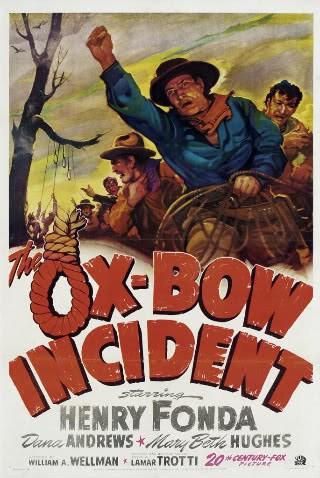
The Ox-Bow Incident

poster48

The western is genre that often gets a raw deal in the image stakes. And it’s not just a matter of waning box-office popularity in recent times. It’s rarely afforded the respect that other genres seem to court so easily and instead finds itself weighed down by the notion that it’s somehow unsophisticated. The term oater is applied, I’ve used it myself, in an affectionate way, yet it carries a certain air of condescension when you stop and think about it too. I guess the stereotype of uncouth figures riding horses, firing guns and chasing Indians is such a strong one that it’s managed to sideline the genre in the minds of many people. The paradox is that the western is actually one of the richest forms of cinema around. Leaving aside the frequently breathtaking visuals, the setting offers the opportunity to tell an almost unlimited range of stories and explore as many themes as it’s possible to imagine. The vast geographical expanses and the absence (or at best the bare rudiments) of civilization create a kind of nearly blank canvas onto which a skilled filmmaker can paint, with both bold and subtle strokes, whatever he likes. William Wellman was certainly highly skilled and his westerns are never less than interesting, and usually challenging too. The Ox-Bow Incident (1943) is a powerful and memorable piece of work that stays with you and is one of those films that proves the western is capable of being not only an entertainment but an intellectual stimulant as well.

The plot is a simple one and it’s that lack of complexity in the storytelling that’s one of its greatest strengths. The film has a moral point to impart and too much narrative trickery would only be a distraction and water down the central message. Events begin to unfold in a little backwater settlement where the neighbouring ranchers have been struggling with the perennial problem of cattle rustling. When a youngster comes racing into town to breathlessly announce that one of their own has been apparently murdered and his livestock taken a tragic chain reaction is set in motion. The jaded and bitter populace experience disbelief and outrage and are teetering on the edge, poised to ride out and hunt down like animals the alleged killers of their friend. For a brief moment, it looks like reason and decency may prevail as the aged storekeeper Davies (Harry Davenport) appeals to their better nature. But this is not to be – ex-soldier Tetley (Frank Conroy) soon turns the townsfolk back to their base instincts, and a rag-tag posse is formed. Not wanting to draw the ire of the town upon themselves, two cowboys, Gil Carter (Henry Fonda) and Art Croft (Harry Morgan), reluctantly join the eager hunting party. It’s not long before the posse cut the trail of three men (Dana Andrews, Anthony Quinn and Francis Ford) who seem to fit the bill of the murderers. From this point on the movie becomes a kind of ethical struggle between the ineffectual Davies and the implacable Tetley for the souls of the posse members, with the fate of the three captives hanging in the balance.
£17

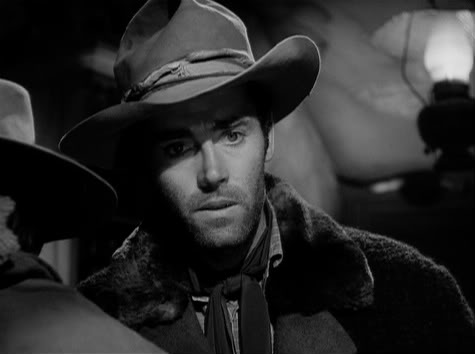
The Ox-Bow Incident is based on the novel of the same name by Walt Van Tilburg Clark and, although it’s been quite a few years since I read the book, I recall it as being a pretty faithful adaptation. Wellman’s direction captures the heavy, moody and ultimately tragic tone of the novel very well. There aren’t many true exterior scenes, most of the film seeming to have been shot on sets, and this (along with the high contrast photography) helps to pile on the sense of claustrophobia and doom. While the outcome is fairly predictable, the director still maintains the tension and, crucially, that isn’t lost even with repeated viewings. In fairness, a lot of that comes down to the performances too; Dana Andrews, as the leader of the suspected murderers, was billed below Henry Fonda but his work plays a large part in the success of the movie. His initial disbelief and growing desperation at the nightmare situation he finds himself in is built steadily. He did a fine job of conveying an awkward mix of fear and nobility that positively demands the sympathy of the viewer. In a sense, Fonda plays something of a supporting role in this one, only taking centre stage at a few points. Perhaps his best moment is in the saloon at the end when he reads Andrews’ letter to his illiterate friend. The letter itself is a powerful and emotive one that expertly outlines the author’s twinned concepts of justice and conscience. Fonda’s delivery of the words, as Wellman shot him in extreme close-up – partly obscured at first and then full face – is perfectly timed and enunciated to maximise their impact. However, for long stretches, he’s portraying the confused man in the middle, caught between the opposing ideals of Tetley and Davies. It’s this conflict that’s at the heart of the picture: how reasonable and civilized men can be browbeaten into submission, how the cult of personality can sway the masses and turn them into an unthinking mob, bereft of ethics and robbed of conscience. It’s both an indictment of the failings of the law – the sheriff has left town, the judge is a procrastinator, and the deputy is little more than a barbarian – and a warning that that same law is all we have to prevent our descent into inhumanity.

The R1 DVD of The Ox-Bow Incident from Fox is an excellent presentation of the film; there’s hardly any damage to be seen, the detail level is fine, and the crisp image has the kind of strong contrast necessary for this type of movie. There’s also a fine selection of extras: a commentary track by William Wellman Jr and Dick Eulain, a biography of Fonda, and a gallery  of images. This title is due for a Blu-ray release by Koch Media in Germany in August. Seeing as the extras are to be replicated it’s reasonable to expect that the same film elements will be used, therefore a first class transfer should be on the cards. As I said in the intro, The Ox-Bow Incident is a good example of a thinking man’s western, yet for all that, it never loses sight of the fact that it has to entertain and grip the viewer too. A superb film.
 

While the City Sleeps

poster226

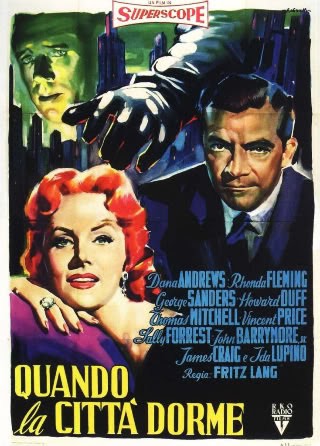
Crime, betrayal, duplicity and grasping, ruthless ambition. All these are ideal ingredients for any film noir, and when you throw in the hard-bitten and cynical milieu of the newspaperman it serves merely to add a little extra kick to an already potent cocktail. While the City Sleeps (1956) contains all of the above and boasts a cast that’s packed to the rafters with heavy hitters. As if that weren’t enough, it’s directed by a genre specialist whose pre-Hollywood influence on the look and mood of film noir is immense.

The plot involves two parallel stories that slowly converge – the first being an investigation of a serial killer on the loose in New York, and the second a cold appraisal of the backstabbing world of the media. What draws both strands together is the contest engineered by Walter Kyne (Vincent Price) to find a new administrator for his recently inherited media empire. Kyne is a spoiled and idle incompetent who hasn’t a clue how to run the business his father left him. But he’s no fool, and he hits on the idea of playing his top men off against each other with the prize of a newly created executive post up for grabs. Whoever can run down and nail the so-called “Lipstick Killer” will take the honours and the top job. Three men are desperate for this promotion: Mark Loving (George Sanders) – head of the wire service, John Day Griffith (Thomas Mitchell) – editor of the newspaper, and Harry Kritzer (James Craig)  – picture editor. The company’s star TV newscaster, Ed Mobley (Dana Andrews), also finds himself roped into this race to find a murderer and thus capture the spoils. The actual investigation of the crime takes a back seat – the audience knows who it is from the pre-credits sequence – and the main thrust is how these media types are prepared to tear each other, the ones they love, and their already slightly tarnished morals apart for the sake of professional advancement. To further complicate matters, the personal relationships of Mobley, Kyne, Loving and Kritzer all become hopelessly entangled as the pressure mounts and the killer remains at large and active. The hunt for the murderer draws to an exciting close in the subway tunnels below the city, but the question of who will walk away with the promotion remains unclear until the very last scene. Along the way, the audience is treated to a marvellous dissection of not only the flexible ethics of journalism, but also the mercenary nature of humanity.

£7

After spending twenty years making movies in Hollywood, Fritz Lang was nearing the end of his American career. In terms of look and style While the City Sleeps may seem like a watered down version of his previous noir pictures. However, what it lacks in visuals and budget is made up for in cynicism and sourness. None of the main characters behave in an honourable way either in their private lives or their professional ones. Many newspaper dramas down through the years have used the device of the story being everything, but this time not even that old chestnut holds sway. Everybody marches to the tune of ambition and they’re all ready to go to whatever lengths are necessary to achieve it. Dana Andrews, in between drinks, even sinks so low as to use his own fiancee as bait to smoke the killer out. He is the character the audience is supposed to identify most closely with, being persuaded to take part in the grotesque contest (at least initially) as a favour to a friend. However, he’s a shabby kind of hero who really only redeems himself at the end by finally speaking the truth regardless of the consequences. George Sanders very much conforms to type as the smooth and vaguely caddish wire service boss who knows all the right people but struggles to get to grips with the seedier characters likely to hold the key to this case.

Ida Lupino does great work as the gossip columnist and occasional girlfriend of Sanders, who agrees to do his spade work for him. She has some nice scenes with Andrews where they both let their wandering eyes off the leash while simultaneously trying to pump each other for information. In truth, there was far better chemistry between Andrews and Lupino than was the case with Sally Forrest, who played his fairly insipid girl. Vincent Price’s role is all effete indolence without any of the menace that he was capable of conveying. Right up to the end he’s blissfully unaware that his faithless trophy wife, Rhonda Fleming, is carrying on an affair with James Craig’s slippery picture editor. Out of this large ensemble cast, the most sympathetic performance came from Thomas Mitchell – the old school editor/reporter who chomps away on cigars and lacks only the press pass jammed into his hat band. Sure he’s every bit as consumed as the others, but back of those slightly wild eyes there remains a flicker of decency – and it’s him you find yourself really rooting for. The only seriously weak link is provided by John Barrymore Jr as the mother’s boy killer with some major issues. One of the best scenes in the movie – him watching the telecast where Andrews profiles the then unknown murderer in disparaging and insulting terms – is very nearly scuppered by Barrymore’s appalling mugging and overacting.

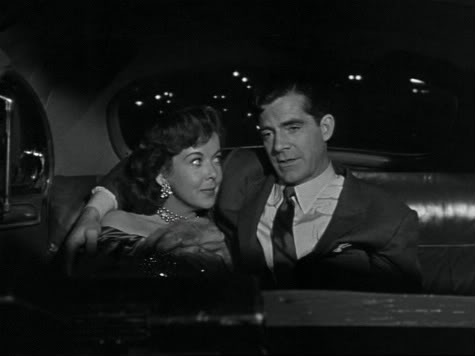
While the City Sleeps has finally made an appearance on DVD courtesy of Exposure Cinema in the UK. The film is presented in 1.33:1 ratio, and according to the distributors this decision was taken due to the condition of the elements – i.e. the image would have been too soft to matte and blow up for widescreen. It’s an open-matte presentation, the film should have been presented flat 1.85:1 in the US (and probably 2:1 Superscope in Europe), and was clearly protected for possible academy ratio showings. There is plenty of extraneous space top and bottom, which should be apparent from the screencap above, but it’s not seriously distracting. Apart from that, the image is quite clean and pleasing to look at and doesn’t display any major faults. The original trailer is included along with a selection of galleries. All told, the package is a worthy one, and it should be mentioned that while the title is rumoured to be in the pipeline from Warners in the US the chances are it will find it’s home in the Archive. This movie has long been one of my favourite Lang pictures and I’m pleased to have it at last in a worthwhile edition. I’ve heard it said that the film suffers from too much focus on the so-called soapy elements of the story, but I disagree. The real strengths of the film are to be found in those newsroom and bar scenes – the character interaction is what drives everything forward and it would be a poorer piece of cinema without them. I have no problem recommending this one.