Undertow

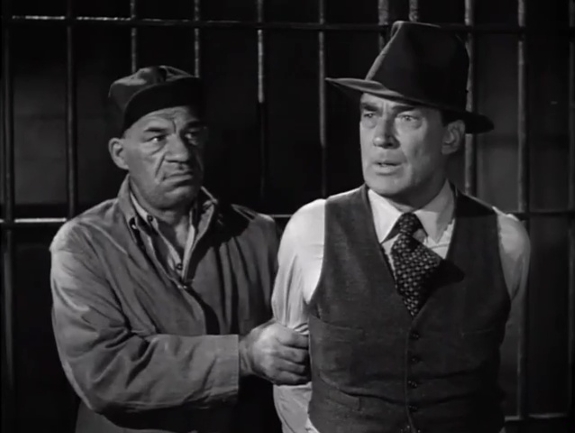
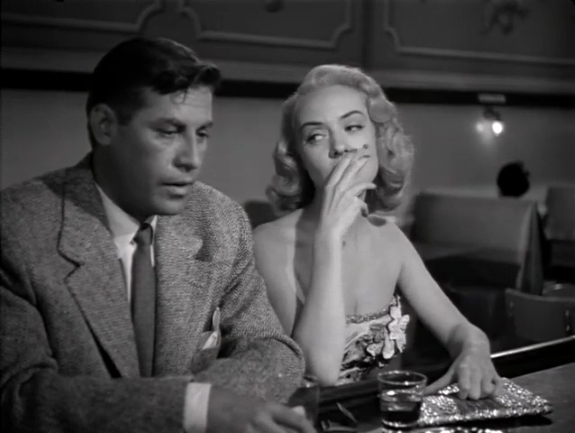
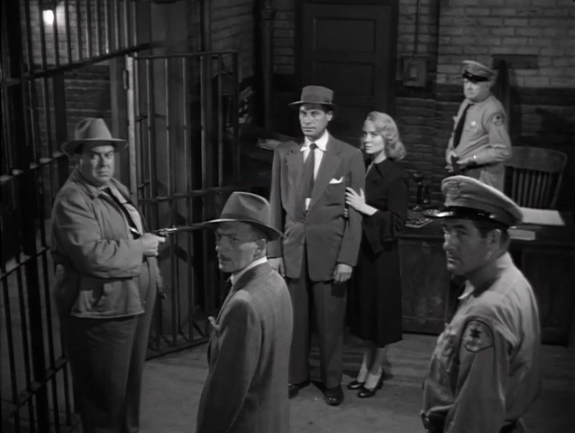
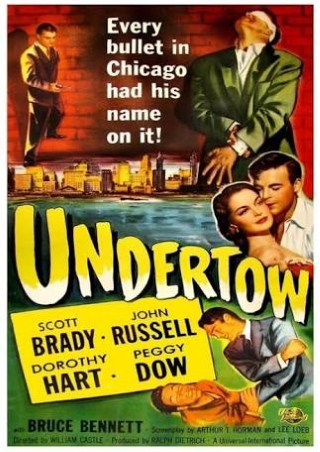
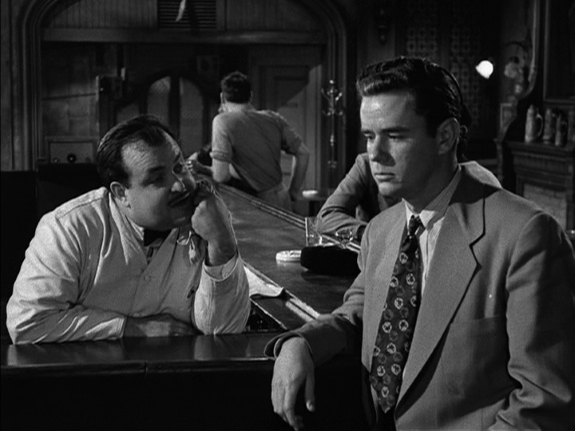
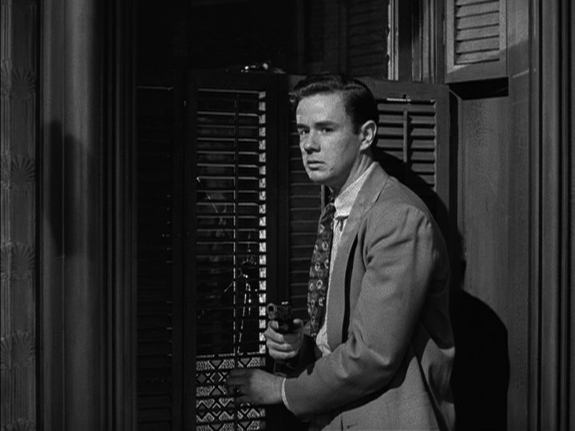
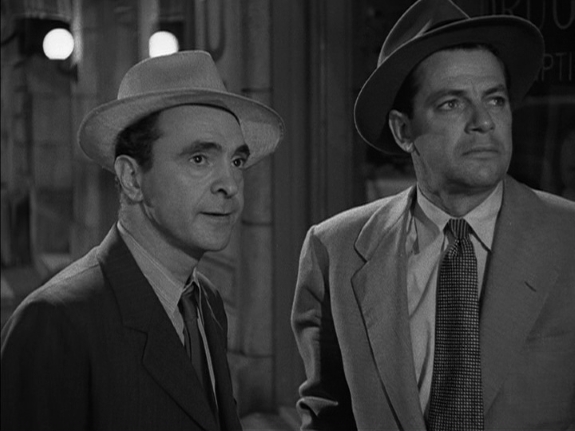
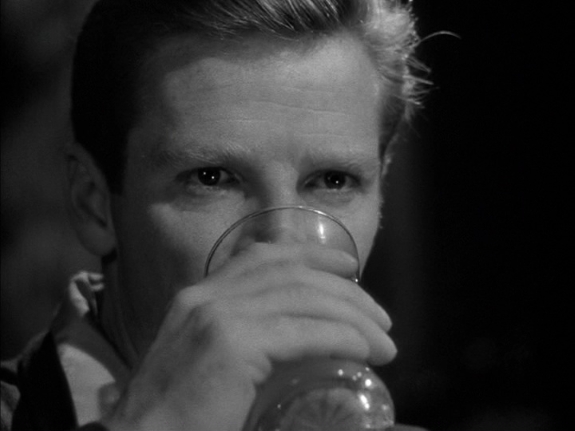
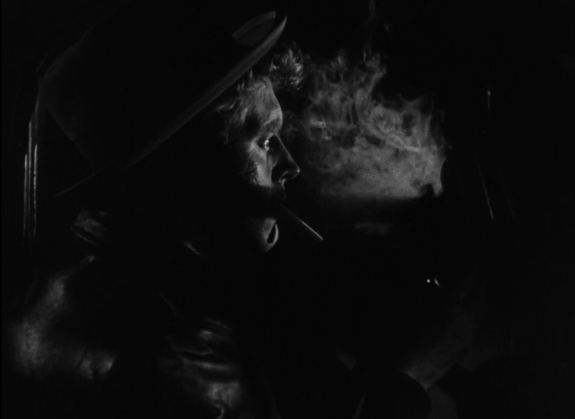
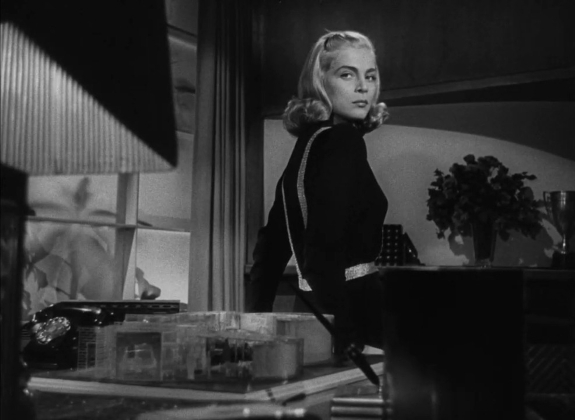
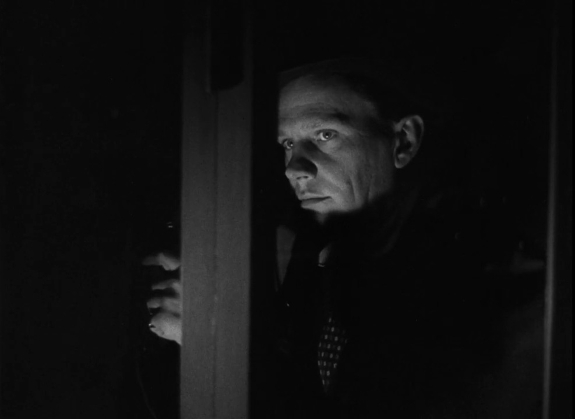
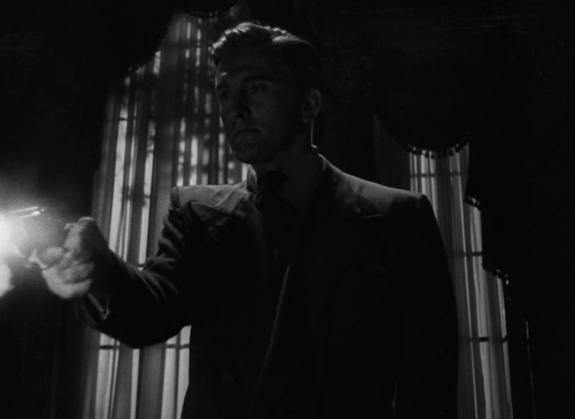
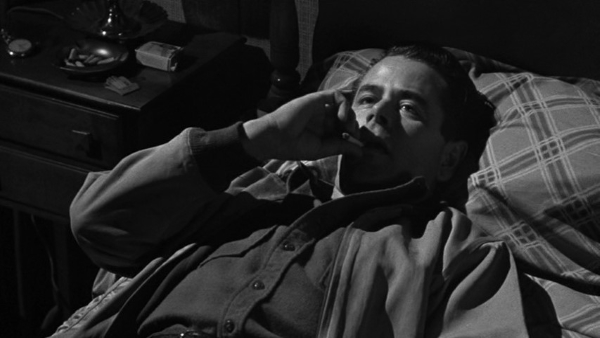
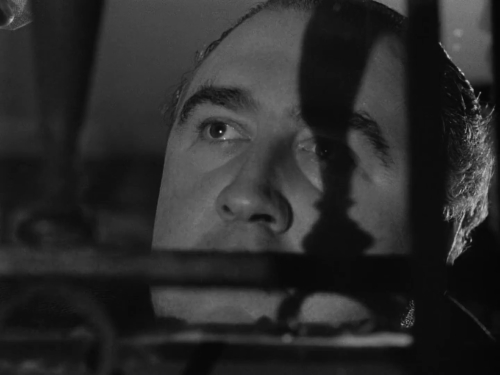
In an era where entertainment gives the impression of becoming ever more bloated and unwieldy, where books seem to be sold by the page count and thus by weight like some indigestible stodge, where even movies which tell essentially pulp stories have running times that defy both logic and the endurance of the human body, it is a true joy to watch a film which is tight and trim enough to take care of business in just an hour and ten minutes. That ought to be a recommendation in itself yet Undertow (1949) has the added bonus of being a remarkably entertaining film noir, William Castle’s best effort in the genre/style in fact.

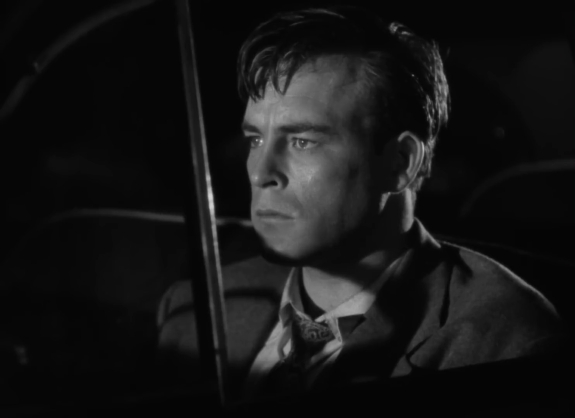
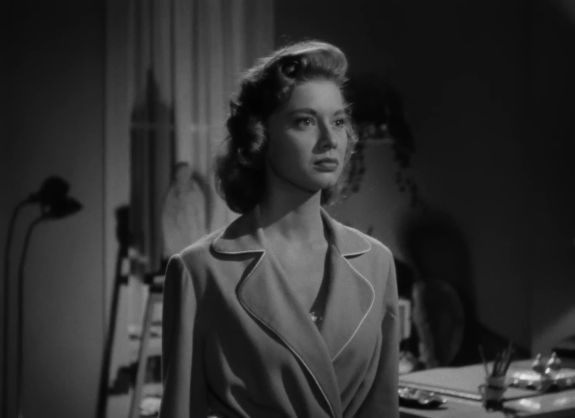
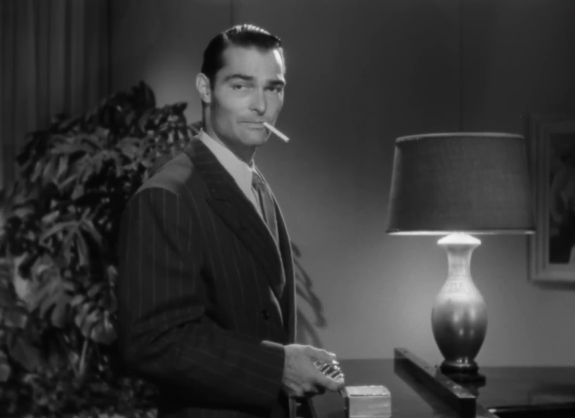
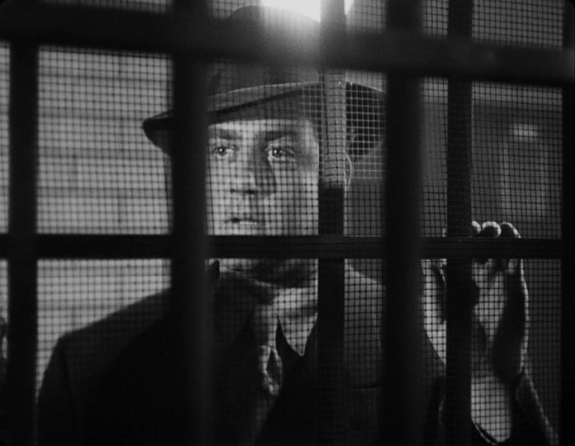
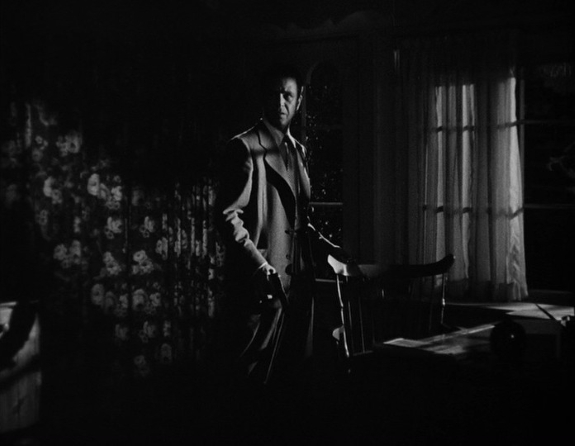
The war as a watershed – how many times has one come across that particular bromide? Yet its essential truth is undeniable. The image of the returning veteran, those men who dreamed of better days amid the waking nightmare of their years of service, is one familiar to the noir audience. Such men immediately draw sympathy by virtue of the sacrifices they made and this adds an edge to the dangers and depravities they confront on their return home. By 1949 the war was already slipping back into the misty corners of the past, the world was rushing ahead and wasn’t necessarily in any mood to slow down and wait for men trying to catch up with events that had bounded four years and more ahead of them. Tony Reagan (Scott Brady) is introduced as a classic postwar character. He’s a veteran with a vaguely shady past who has grown as a result of his experiences and is now focused on cementing a future for himself and the woman he hopes to make his wife. He has just bought a share in the hunting lodge business of a fallen comrade in arms, and is on his way to Chicago to propose to his fiancée Sally (Dorothy Hart). His last evening in Reno sees him briefly hooking up with a pal from his gambling past Danny Morgan (John Russell), as well as making the brief acquaintance of vacationing schoolteacher Ann McKnight (Peggy Dow). All of these people will cross his path when he lands in Chicago and also lands in deep trouble.  The classic noir protagonist frequently finds himself skewered on the horns of a dilemma, trapped somewhere between the pull of his past and typically bad choices going forward. This certainly fits Tony Reagan, a man who was told by crime boss, and Sally’s uncle, Big Jim Lee to stay out of Chicago and away from his niece.

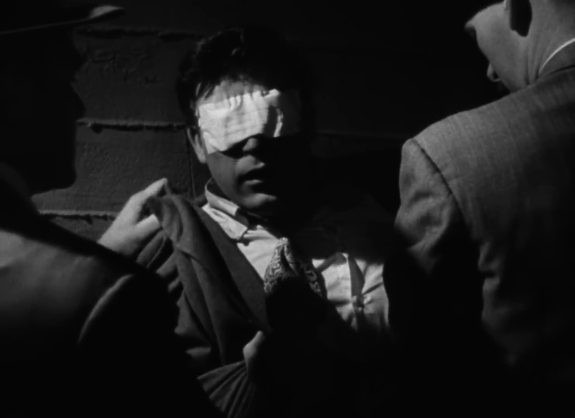
There’s to be no hero’s welcome for Reagan; on his arrival at the airport he’s met by cops who run him downtown for a bit of friendly advice from the precinct captain, namely that he shouldn’t waste any time unpacking. That he ignores this tip shouldn’t come as any surprise, nor should the fact that he is soon slugged, blindfolded and shot, all as a prelude to a frame that looks like fitting him very snugly. If the movie has a weakness it stems from the way it sets itself up as a kind of whodunit where there’s no great mystery with regard to the actual culprit. In this case certain character traits as well as the way a vital piece of information was only available to one person don’t so much point the finger at as turn the spotlight full force on one individual, and when you see who that is then the rest of it kind of falls into place. Still, none of that really matters as much of the pleasure derived from following Reagan on his nighttime odyssey through Chicago trying to keep a half a step ahead of the cops, calling in favors and only realizing the full extent of his peril at the last moment.

William Castle, like all studio era directors, worked in just about every genre but the bulk of his work fell into three categories: horror, crime and westerns. The horror movies have traditionally gained more attention from critics and fans alike, which arguably says as much for the enduring popularity of that genre as it does for the movies themselves. If I’m being honest, I don’t believe the quality of Castle’s films overall is commensurate with the level of attention they have received down the years. That may come across as somewhat curmudgeonly yet it’s not my intention to do so – I like Castle’s films for the most part and find the majority of them entertaining, just not necessarily always that good. Still, his better work does stand out and I’d have no hesitation in placing Undertow among those better pictures. At this stage in his career there was none of the gimmickry and clowning that would come to be seen as characteristic of the man. Instead, what we get is a compact and atmospheric piece of budget filmmaking that punches well above its weight.

Shakespeare had Caesar remark that Cassius had a lean and hungry look and was therefore dangerous. Perhaps John Russell ought to have been cast as Cassius then at some point in his career for he surely fitted that description. Even though he had heroic leading roles on TV  in both Soldier of Fortune and then Lawman, his villainous parts on the big screen tend to be memorable and carry an edge of authenticity to them. He turned in a strong performance in De Toth’s Man in the Saddle and I watched him a while back in Hell Bound and was again impressed. The latter has that typical mean streak that can be found in Bel-Air movies and Russell managed to embody that successfully. Scott Brady was a suitable pick for the lead too, only a few years out of WWII service himself, he had the right combination of toughness and sympathy to be believable as someone with underworld connections but also with the nous to realize his future lay in a different direction. Bruce Bennett’s reassuring presence as the conflicted friend adds solidity to the supporting cast; his well played scenes with his boss and particularly the short interlude in the basement workroom of his home help to ground the story. The two female roles were filled by actresses who had very short screen careers. Peggy Dow appeared for a mere three years between 1949 and 1952 , while Dorothy Hart stretched it out a little longer, running from 1947 to 1952 in features and a couple more on TV. Both had a number of good movies to their credit with Dow possibly squeezing more memorable work in during her brief time as an actress.

Undertow acts as a noteworthy example of the kind of well crafted crime and noir movies Universal-International was capable of producing. It’s gratifying that so many of these are now accessible and can be viewed in good quality, something fans of the studio’s output could only dream of a few years ago. Already released in the US in one of Kino’s box sets, the movie is getting an individual release here in the UK ( Amazon linkAs an Amazon Associate I earn from qualifying purchases) with plenty of supplementary features via Powerhouse/Indicator in January.

Dial 1119

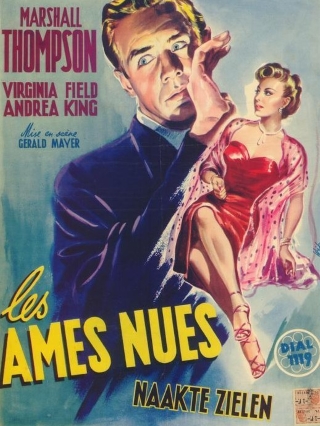
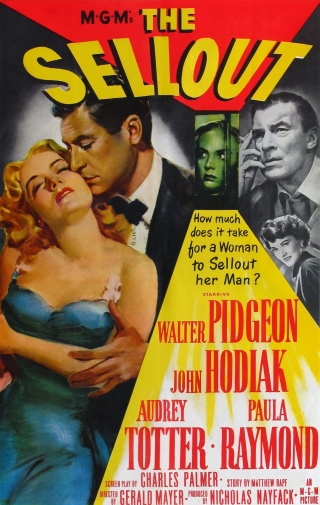
Give me a small cast of characters, ideally a cross-section of humanity, from the happy and hopeful to the hapless and despairing, lock them into some confined space in a way that shouldn’t be too contrived and I’m generally satisfied. Those limits and restrictions imposed by the situation tend to bring about some excellent drama. So it is with Dial 1119 (1950), something of a low budget sleeper which generates a good deal of suspense and tension from its simple premise. It demonstrates what can be achieved by a smart and focused script allied with a professional lineup devoid of big name stars.

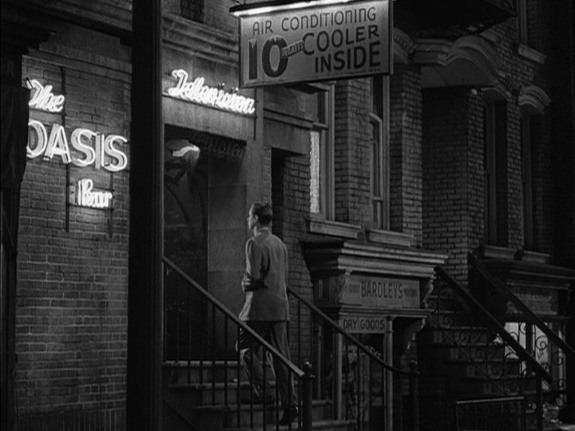
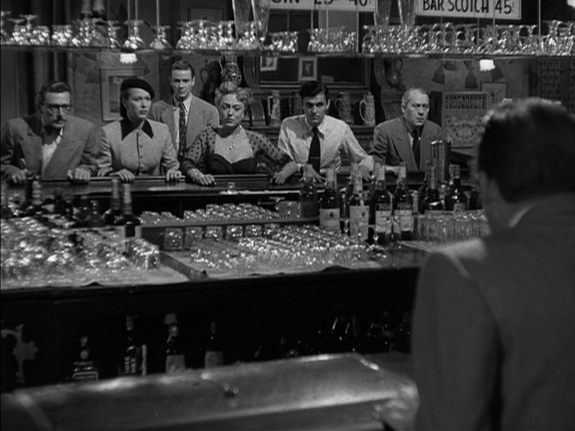
Think of an oasis and the notion of growth and fertility, of life itself, tends to spring to mind. It’s the name of the bar in which perhaps 90% of the action in Dial 1119 takes place, though this particular bar is in reality something of a dead end in more ways than one. Aptly enough, one of the first characters we see is a reporter (James Bell) who has arrived at the weary middle-aged conclusion that his job has indeed led him up a blind alley, that the place he’s at is all it’s ever going to be. He talks of quitting, of throwing in the towel on the whole business, but as a colleague tells him he’s not really serious about it, and payday is just around the corner after all. No, he decides to go round the corner, in a manner of speaking, and drop into his local bar for a drink on the way home. And there’s the woman (Andrea King) drifting toward the dispiriting prospect of spinsterhood at the ripe old age of 28. She’s getting ready to try to stave off that blank future by heading out to meet a man (Leon Ames), although she tells her (off screen) mother that she’s going away on a trip with a girlfriend. She too is headed for that same bar. Then there is the bar itself, a walk up place that claims to offer all the luxuries of the day, from air-conditioning to one of those newfangled TV sets. It’s a dour spot though, with a barman going by the name of Chuckles (William Conrad) who looks like he’s not cracked a smile since he grew his first tooth and who carps about the cheap clientele he’s saddled with. As the small group of customers drifts in and sets about tackling whatever drowsy numbness dulls their particular senses another joins them, an intense young man called Gunther Wyckoff (Marshall Thompson).

The viewer has already seen what Wyckoff is capable of since it’s been made clear that he’s on the run from a psychiatric hospital and we’ve seen him calmly shoot down a bus driver just because he got in his way. While we catch glimpses of the lives of the others in the bar, in addition to those mentioned there is also the alcoholic good time girl (Virginia Field) and the expectant first-time father (Keefe Brasselle), the TV in the background starts to broadcast news of a fugitive who has just killed a man. As the bartender grows uneasily aware that this killer looks a lot like the neurotic young guy who is stationed at the far end of the counter, we too have realized that the situation is poised on a particularly sharp knife’s edge. Before long more violence takes place and a state of siege develops with Wyckoff barricading himself and his ill-starred hostages in the saloon while the police wait outside and weigh up the pros and cons of allowing the killer’s shrink in to talk to him.

Aside from the drama inherent in this kind standoff situation, the film deftly notes the growing and evolving role of the media, especially the broadcast media, at the time. The film opens with a radio announcer telling the time and introducing a dance music show before cutting to a newsroom where the aforementioned disgruntled reporter is tapping out a would-be resignation letter. Soon, after Andrea King’s desperate romantic dreamer has been presented, the action segues into the screen of the TV mounted above the bar of the Oasis. In this way the three major sources of information of the era are shown in succession, and it is the latter which will have the most powerful influence on how matters develop. It provides the means by which Wyckoff’s identity is established by the bartender and then it offers live coverage of the siege from right outside the door, allowing the hostages inside the opportunity to watch the world on the outside watching them, simultaneously highlighting the gradual subordination of the traditional print media in the process. Somehow this feels appropriate given the fact the movie was directed by Gerald Mayer (nephew of MGM supremo Louis B Mayer), a man who made only a handful feature films himself and who would go on to work on a long list of successful TV shows over the following four decades.

Marshall Thompson was top billed as the delusional Wyckoff and he is suitably detached, a dangerous man with a vaguely sullen baby face, killing coolly and with no apparent regrets. Without wanting to delve too deep into spoiler territory for anyone who hasn’t seen the movie, I found the neat subversion of the classic noir scenario of a returning veteran traumatized by his experiences and struggling to adapt to post-war life to be most interesting. Should anyone wish to comment on or make any observations on that aspect, they are welcome to in the comments section below, but I’m going to refrain from doing so myself in the body of the piece here. Small films with correspondingly small casts frequently operate as ensemble pieces and I think this is generally true of Dial 1119. Even if everyone gets an opportunity to hold the spotlight at some point, the one who most consistently draws the attention is Virginia Field. It’s something of a foolproof role as written but still needed a capable actress to pull it all together. Field comes over as faded, jaded yet incorrigibly sassy at the same time and she also gets to make the pivotal move during the climactic scene. Andrea King’s part offers less scope,  but it’s well played. Leon Ames is superbly insincere in a fairly standard part, while the ever reliable James Bell carries around the quality of watchful intelligence that has bolstered many a movie. Sam Levene could play any role under the sun – though for some reason I tend to visualize him mainly as a cop – and he’s suitably earnest as the doctor. Noir stalwart Richard Rober played the actual cop while William Conrad, as usual, managed to do quite a lot with very little.

Dial 1119 was an MGM production, not a studio generally noted for its contributions to film noir. It was released on DVD years ago by Warner Brothers in one of the later film noir collections, paired on disc with Phil Karlson’s The Phenix City Story. A lot of WB sets from around that time have proven to be unreliable, but so far my own copies of this noir box all remain functional, thankfully. It might not be all that well known yet it is a terrific little tough luck chamber piece which packs a lot into its hour and a quarter running time. Highly recommended.

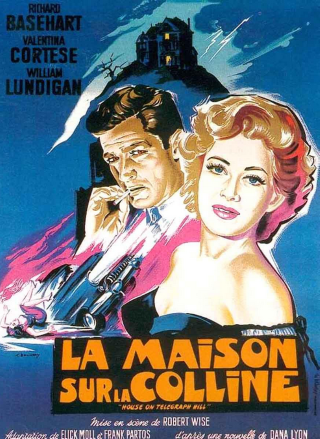
The House on Telegraph Hill

The fact that it is not a proper genre, per se, means film noir is in the fortunate position of being able to cross over all kinds of boundaries. This allows it to shift from its most characteristic low-rent, modern urban milieu to various points in history as well as a wide range of locales. In short, it is versatile enough to hook up with just about any genre one cares to mention. The woman in peril picture is a sub-genre that has a strong connection to the Gothic romance of literature. It typically sees a young woman, often of humble background, who is suddenly thrust into an alien situation or environment, one where the initial attractions are soon stripped of their charm only to reveal some ugly threat beneath. Both in visual and thematic terms, there is ample opportunity to apply the classic noir setup and The House on Telegraph Hill (1951) does so very attractively.

The story has its roots in a very understandable desire to escape the past, to eke out a more promising future, and to do so by assuming a totally different identity. Everything begins in Europe, in the death camp of Belsen to be precise. A young Polish woman Viktoria (Valentina Cortese) endures the horrors and deprivation of the camp and when liberation arrives she impulsively grabs at the chance to make a new start. She takes on the identity of her dead friend Karin in the hope that this will facilitate her move to the USA, where that friend’s young son is being raised by relatives. Since the boy was too young to have any memory of his real mother and no other direct family members are still alive, the deception looks like it may succeed. It seems even more likely when she ends up marrying the child’s guardian Alan Spender (Richard Basehart) and moving to San Francisco to live in the titular mansion overlooking the city by the bay. After the living hell of Belsen this opulent life in California seems almost too good to be true, and so it proves to be as the realization gradually dawns on her that someone is determined to kill her.

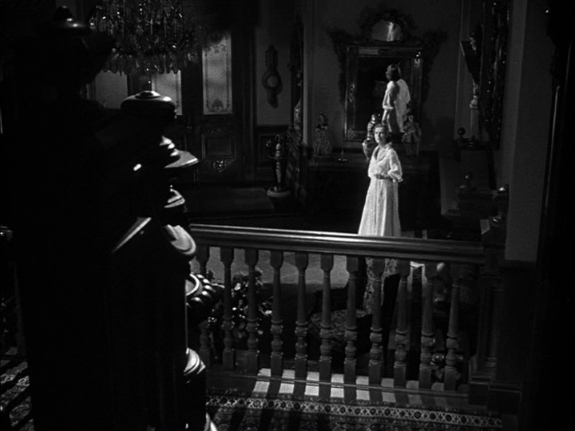
A Gothic mystery, or romance, conjures images of the past, of imposing and isolated houses under lowering skies that serve to confine as much as protect. So it is with The House on Telegraph Hill, where despite the contemporary setting the residence itself feels like it is an extension of a bygone age. This is the source of both its allure and its peril – the house is wonderfully realized, ornate and oozing old world luxury within while the exterior has a brooding aura. It draws Karin, and the audience too, with the promise of comfort and security and simultaneously acts as a trap of sorts, a jail with expertly carved balustrades and pillars standing in for the more customary stark iron bars. The location work on the streets of San Francisco add a touch of modern realism to the movie – especially in the excellent sequence where Karin’s car races uncontrollably down those steep hills after the brakes have been tampered with – but those interior scenes are the most atmospheric.

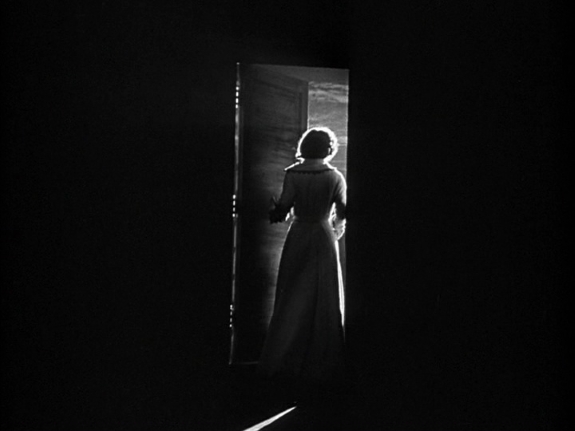
Robert Wise had cut his teeth and learnt his craft at RKO editing for Welles and then getting his chance to direct a couple of dark fairy tales under the supervision of Val Lewton. By the time he made The House on Telegraph Hill he had almost a dozen movies as director under his belt. The opening scenes at Belsen have a suitably grim and gritty tone, similar to what he had captured in the prison sequence in Two Flags West a few years earlier. The pace does flag a little after that and while the build up to Karin and Alan’s marriage needs to be shown, and is done reasonably briskly, it still slows things down somewhat. Nevertheless, once we move to San Francisco both the tone and pace remain remarkably consistent and focused. Lucien Ballard’s cinematography is used to great effect here and he evokes suspicion and unease from such normally mundane images as a branch tapping against a window pane at night or a figure silhouetted in a doorway. Sol Kaplan delivers what I would term a muscular score, admittedly one which some may find overbearing a times.

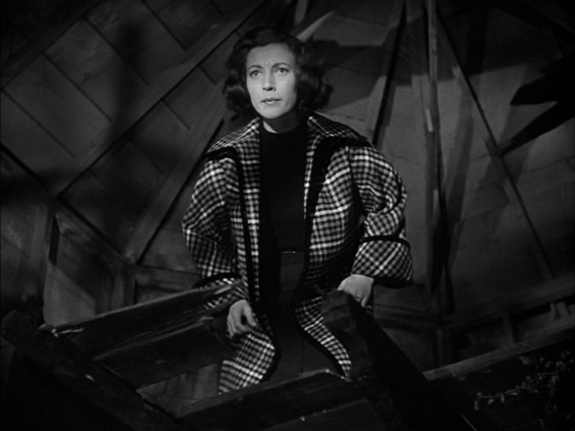
Hitchcock liked to use the generally innocuous glass of milk – see Notorious or Suspicion – as a conduit for something altogether less wholesome, as did Peter Godfrey in The Two Mrs Carrolls for that matter. Wise opts for a glass of orange juice and gets some mileage out of a game of chicken as a result. Richard Basehart started out playing vaguely unhinged types and the fact is he had a certain look about him that encouraged that. There was something about his fair features and impenetrable eyes in those early years that was slightly unsettling and that business with the orange juice, which allowed for and demanded close-ups, leaned into that quality. I believe The House on Telegraph Hill was the film where Basehart and Valentina Cortese met, and they subsequently married. She excels in the concentration camp scenes and their aftermath, touching on the right blend of determination and despair. All told, she does good work and convincingly grows into the part of woman whose increasing confidence is continually being undermined by her fear and a gnawing sense of guilt over the deception she is engaged in. William Lundigan was an actor I have always felt was a bit colorless – that said, he did appear very creditably in Richard Fleischer’s hugely enjoyable noir Follow Me Quietly. Robert Wise had already directed him in the slight but fun Mystery in Mexico and uses his grounded, modest air well in this film. He provides a kind of equilibrium amid all the melodrama. Fay Baker is someone I feel might have had a better or more prominent career based on her work as the nanny/housekeeper, but for one reason or another it wasn’t to be.

The House on Telegraph Hill was a 20th Century Fox movie and has the characteristic gloss of the the studio’s output at that time. It was released years ago on DVD as part of the Fox Noir line and while I’m not sure if it ever made it to Blu-ray there really is nothing to complain about in terms of quality with that old disc. It’s a professional and atmospheric piece of filmmaking and if it’s one of Wise’s less celebrated movies it deserves to be better known.

Cry Danger

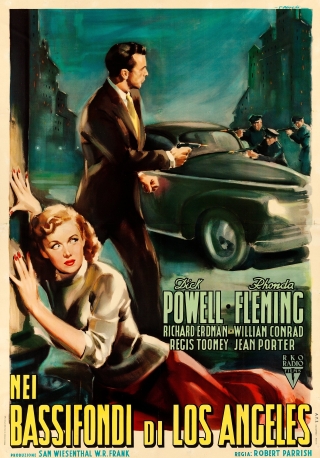
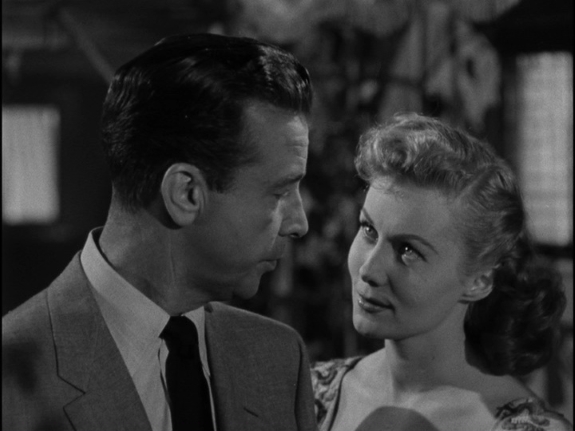
The frame up and revenge are classic noir ingredients, saps suckered into taking a fall and then looking to square it with those responsible have kept the motors humming on many a dark crime drama. Cry Danger (1951) is based on these themes, with thoughts about loyalty and love tossed into the mix as well. The movie is a bit like an old friend in the sense that it is packed to the rafters with familiar elements, and like an old friend I’ve visited it a few times over the years. I guess that’s another characteristic that applies to most films noir; they never seem to wear out their welcome no matter how many times they’ve been viewed, the setups and situations becoming something akin to reminiscences among acquaintances.

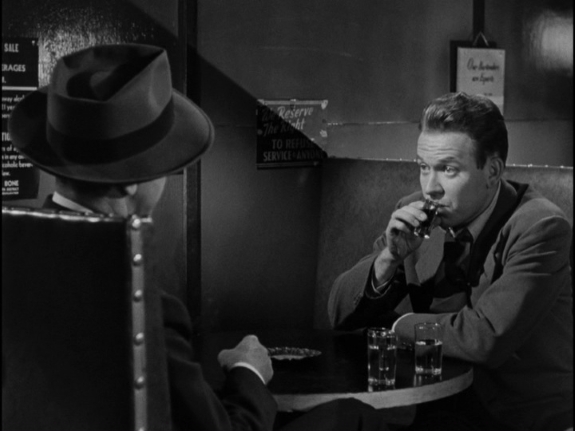
I mentioned revenge in the opening sentence, but the fact is that Cry Danger is more concerned with a quest for justice than anything else. Rocky Mulloy (Dick Powell) has just caught a break, even if he’s not thinking of it in those terms as he steps off the train in Los Angeles. He’s fresh out of prison, having served five years of a life sentence for his part in a killing and robbery. Why is he back on the streets so soon? Well aside from the fact he knows he was not guilty of the crime, a witness has just turned up who could corroborate his alibi from all those years ago. Delong (Richard Erdman) is a one-legged ex-serviceman who is only now able to back up Mulloy’s claims that he was drinking in a bar with a group of Marines when the heist was going down. Mulloy is naturally sore that he’s essentially lost those years but he’s also keen to find the real perpetrators, both for his own vindication and to secure the release of a friend who has also been jailed for the crime. In a neat twist, it’s revealed very early on that Delong never spent the evening drinking with Mulloy, never even met him before. He’s just a guy on the make who reckons that helping out like this will mean he can come in for a cut of the $100,000 take which was never recovered. Mulloy’s search for justice takes him to the trailer park where his friend’s wife and his own former fiancée (Rhonda Fleming) is living, and then back into the murky world inhabited by crooked bookie Castro (William Conrad). By the end, after more crosses than there are factors to describe them and some gratuitous violence on the side, Mulloy digs his way to an unpalatable truth.

Cry Danger was the first movie directed by Robert Parrish. He’d served a long apprenticeship in the editing and sound departments and worked on a number of films for John Ford. By 1951 he was therefore in a strong position to take what he’d learnt and craft his own pictures. Cry Danger saw him off to an impressive start and he made a series of mostly good, and in a handful of cases truly excellent, films throughout the decade. This was also the first of four productions for Parrish where William Bowers was involved in the writing. And the script here is one of the strengths, tightly paced and twisty without becoming unnecessarily complex, it benefits from some marvelously snappy dialogue that catches the flavor of the hard-boiled idiom. Unlike a lot of films noir, there isn’t a great deal of overt social commentary. There’s not, for instance, much if any background provided for Mulloy, nothing to hint at how this man got himself tied up with bookies and crooks in the first place. The one concession to the consequences of life in the post-war world is the portrayal of Delong. This disabled veteran makes only the briefest reference in passing to the loss of his leg, but there is a suggestion that his prodigious drinking has its roots in that injury. A good deal of that too is treated in a light and offhand manner, though there is one point where the possibility or advisability of his trying to quit is raised. The wistful look, one tinged with a shadow of desperation, that passes over Delong’s face alludes to some inner suffering. Nothing much is made of this but it is there for the viewers to take on board should they wish to do so.

Dick Powell had grown confident and comfortable in roles such as this, a tough and smart guy who has some blind spots when it comes to friends. The clever patter rolls of the tongue easily and he has an excellent foil in Richard Erdman who was just as quick on the quip. Rhonda Fleming is arguably too attractive to be entirely believable as someone living out of a trailer park, though the fact her husband is doing time kind of justifies this. The path of her relationship with Powell’s character is complicated and, bearing in mind how everything is resolved in the end, it’s quite a subtle piece of acting on her part. As such, Cry Danger is certainly one of those movies where repeated viewings help to emphasize just how carefully she played the role. I’ve already referred to Erdman and it will probably suffice to say that his deadpan wit adds considerably to the film and makes it all the more enjoyable. In support, William Conrad never looks like someone trustworthy although he never comes across as all that menacing either – corrupt and devious, but not all that threatening. Regis Toomey was born to play cops and did so on numerous occasions. He had that weary practicality about him that felt authoritative and he uses it effectively as Powell’s ever present shadow.

Olive Films released a restored print of Cry Danger well over a decade ago now and it still looks fine. It’s a slick and pacy noir with the kind of plot that avoids overdoing the complications yet offers Powell the type of cool but tough part he excelled at playing. Highly watchable.

Pitfall

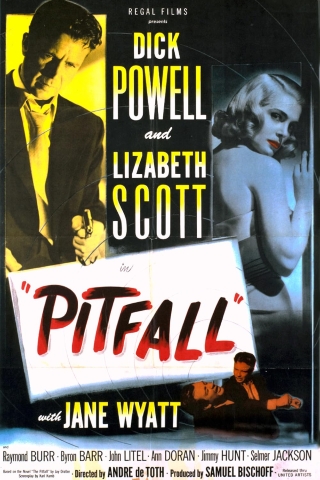
The daily grind, routine and repetitious. This is something most people can relate to, an integral part of all our lives just as much as sunrise and sunset. What does it represent though? Is it boon or bane? Well it certainly encapsulates the concept of security, and not just in a financial sense. That familiarity, that precise knowledge of where one is going to be at a given hour, perhaps even a given minute, of any day of the calendar offers reassurance. Yet reassurance is necessarily wedded to restrictiveness and at some point the balance between those two points of reference might just start to slip. That’s what happens in Pitfall (1948), a frank analysis of the way post-war suburban security and comfort could start to smother. Everything about it characterizes the classic film noir setup, the slow drift into dissatisfaction, the allure of the forbidden, the unwise choices and the way rapidly snowballing consequences threaten to smash everything in their path.

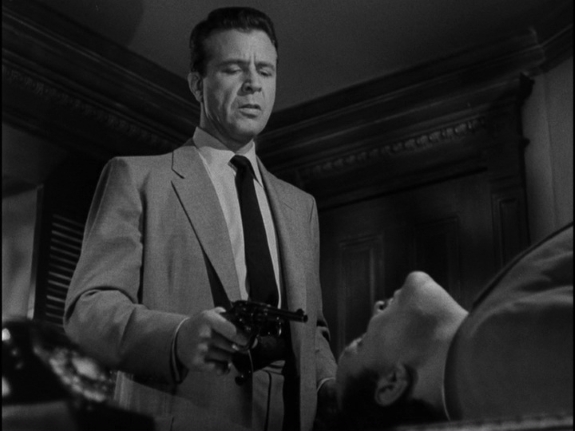
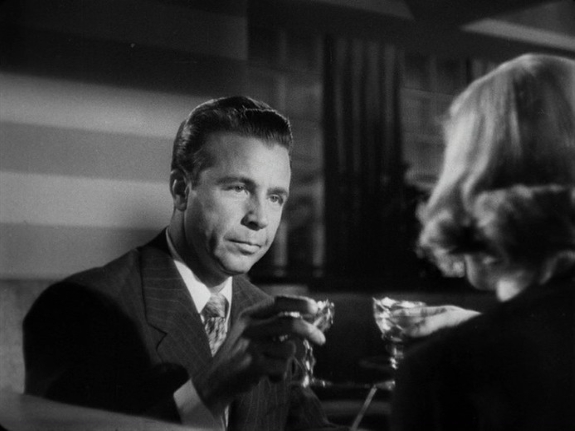
Johnny Forbes (Dick Powell) is a man who ought to be happy with his lot in life. He’s got a devoted wife (Jane Wyatt) and a bright young son. He’s got what appears to be a successful career in insurance and lives in a neat and attractive suburban home. What could be better than waking up to a breakfast that has been prepared and laid out before him, with his family around him, the sun pouring through the window and the promise of another relatively carefree day ahead. That’s how it should be, but the pain of predictability is etched into the hangdog features of Johnny Forbes as he contemplates it all. Both his demeanor and his conversation betray a man ripe for rebellion, a guy who has wearied of respectable averageness, of being part of the backbone of society. Such a man is just a step away from recklessness, he’s practically sleepwalking into peril. A visit to an embezzler’s ex in order to see how much can be recovered is all it takes. The ex in question is Mona Stevens (Lizabeth Scott), a model in a dress store. The hook that snags Forbes comes in the form of a trip to the marina to see the boat Mona’s boyfriend bought her with the money he stole. Just a smile from the girl and then a quick ride in the speedboat are enough – Forbes is soon asking her out for drinks, and it doesn’t take much imagination to realize where all this is heading. The affair itself only goes so far though, and not necessarily due to any moral qualms on the part of Forbes at this stage. A bigger issue is the fact that the private eye employed by the insurance firm to track down Mona Stevens in the first place (Raymond Burr) is besotted with her to the point he not only roughs up Forbes, but is also prepared to destroy anyone who stands in the way of his desires.

André de Toth made a handful of films noir and I think this is the best of them, although a strong case can be made for Crime Wave too. He perfectly captures the sheer ordinariness and regularity of suburban life, its bright and brisk order imparting a feeling of living on a well maintained social conveyor belt. Everything operates like clockwork, including the people. Dick Powell perfectly captures the ennui of a man gradually becoming just another obedient automaton. Everything about him screams normality, his quiet tailoring, his discreet briefcase, and the inevitable slow slide towards middle-aged and middle-class mediocrity that accompanies all that. This is no disillusioned veteran either – he was no decorated war hero like the father of his son’s friend, he rode out the war in Denver, Colorado – just an everyday guy who has come to the appalling conclusion that this is all he’s ever going to be. When he wrinkles his nose at the comic books he reckons have given his son nightmares it’s hard not to see a bit of resentment in it for not being one of those colorful figures himself. It is to De Toth’s credit that there is never any overt call to pass judgement on this man, no nudge towards any moral superiority or cheap finger pointing. Film noir works best when characters are portrayed as people with flaws who sometimes makes poor choices that the audience get to witness. Navigating life can be an ambiguous business at best and the better noirs seek to capture that incertitude rather than encourage self-righteousness.

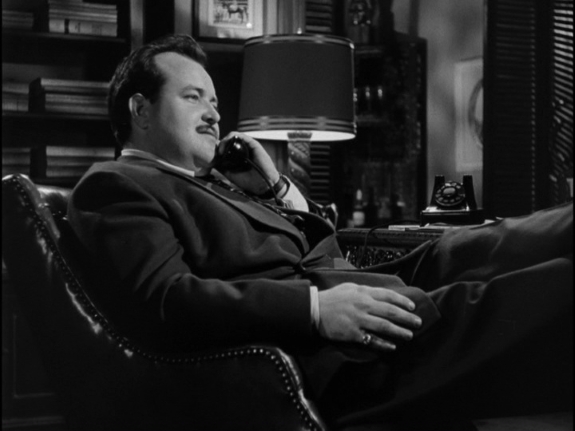
The portrayal of the two female characters in Pitfall is interesting, and the movie offers good roles for both Jane Wyatt and Lizabeth Scott. There are those who say film noir must have a femme fatale, that it’s one of the vital ingredients. I’m not sure that’s true, and I’m also not sure if Lizabeth Scott’s Mona Stevens should be characterized as such. Yes, she draws the men in the movie into danger, fatally in one case at least and the ending leaves it open as to whether or not that’s going to apply to another as well. Still, if she is a femme fatale, she is surely a reluctant one and arguably a victim of both her own weakness and the limited options open to a woman like her at that time. She acts as a magnet for negative forces, drawing danger to her without actively wanting to. Jane Wyatt as the wife is a tougher, more grounded and practical creation. All the way through she remains focused on the security of the family unit. It’s quite a clinical piece of work by Wyatt and the cool way she appraises the benefits and drawbacks of each new development that assaults her existence contrasts with the reckless opportunism of Powell and the emotional helplessness of Scott. Raymond Burr gets the creepy obsessiveness of his character across well, manipulating everybody and maneuvering them like chess pieces towards an endgame that will profit only him. The scene where he stalks Scott in the salon where she works is masterly in the way he humiliates her in plain view yet maintains a wholly innocent air. His bulk and physicality is employed effectively too, filling and almost overwhelming Powell’s office when he visits.

1948 was a particularly strong year for film noir in Hollywood, maybe one of the strongest, and Pitfall sits comfortably among the leading pack. Nobody puts a foot wrong in this movie and the script has no flab or slackness about it. It is a tight, direct story that asks plenty of questions but offers up no easy answers. In short, it’s a good movie and one worth watching.

I Walk Alone

You know, Noll, I think you’re afraid now. And I’m not. Frankie with his bootleg liquor, me with those checks I forged, you with this set-up here. Everyone trying to get something for nothing. Frankie paid, I paid. It’s your turn now…

Checks and balances, adding a bit here, taking away a bit there. The books and the by-laws, a new post-war landscape where the sheen of legality is little more than a patina, a glossy veneer to add on top of the old rackets to create the illusion of respectability. I Walk Alone (1947) trades heavily on that highly polished hypocrisy, presenting a world of glamorous nightclubs where sharp suits and elegantly gowned ladies in superficially smooth surroundings seem to have taken the place of the rough and tumble hoods of Prohibition. Still, the high class tailoring and drapery only offer a limited disguise for the muscle, corruption and decadence. The world depicted here, at least that which is seen through the eyes of the protagonist, is one which has been flipped on its head, where none of the old certainties hold any longer and hoods hide and mask their actions with a web of financial chicanery. Plus ça change…

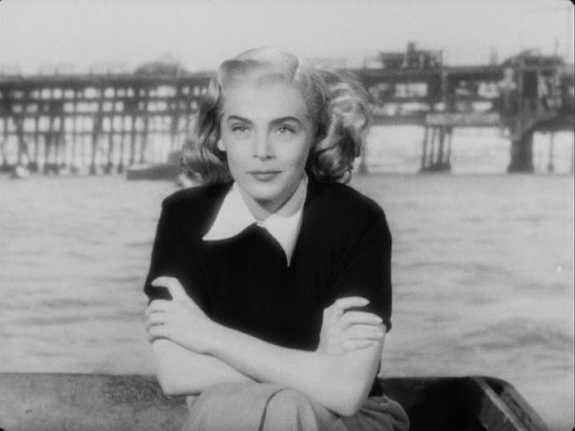
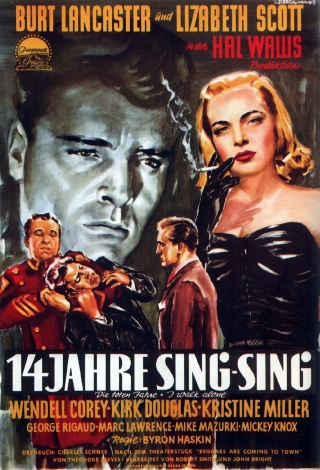
Frankie Madison (Burt Lancaster) is just out of prison and he’s sore. He has served 14 years and now he’s looking to collect on what he feels is his due. To that end he heads to the glitzy Regency, an upmarket nightclub run by his old partner in crime Noll Turner (Kirk Douglas). The fact is Frankie and Noll made a deal just before the former was picked up and sent up the river to split their profits straight down the middle. However, in all those years the only thing Frankie ever received from his old partner was a carton of cigarettes every month, not even one visit. He figures he’s owed, and there’s a little voice just starting to murmur insistently that maybe Noll plans to gyp him out of the rich pickings that have since come his way. Why? Well for one thing there’s the nervy attitude of his friend Dave (Wendell Corey), a man who has been becoming gradually more neurotic over the years and who visibly pales whenever any mention of the unfortunate fates of those who had crossed up old acquaintances crops up. Then there is Noll himself, genial and velvety in his solicitude yet watchful and calculating at the same time. When he arranges for his torch singer mistress Kay Lawrence (Lizabeth Scott) to charm Frankie and coax information from him over a carefully staged intimate dinner all the pillars of a setup have been put in place. Slowly the full extent of Noll’s self-serving duplicity dawns on Frankie, and he’s soon to discover that the, arguably more honest, strong-arm tactics he would once have relied on to get results are now hopelessly inadequate when faced with an updated criminality, one that subverts the law to serve his purposes.

I Walk Alone offers a classic noir framework: a man who has been away for an extended period of time returning to a world that is recognizable on the surface but which has in fact been radically altered at the core. If one is to see mature film noir as an artistic reflection of the post-war perceptions of the returning veterans, then this is something of a textbook example. It’s hardly a stretch to see parallels between Frankie Madison’s sense of being frozen out and the struggles of a whole generation to rediscover its place and role in a society that must now have felt odd and alien. There are two scenes which takes place in Noll’s office underlining the societal shifts that have taken place and the frustration of trying to deal with this.

First up, there is Frankie’s confrontation with Noll when he learns how he’s been stiffed and is getting the brush off. He resorts to his old two-fisted approach, laying one on his former buddy and storming out fired up with indignation and plans for retribution. Then later, having cobbled together a ragtag bunch of would-be enforcers courtesy of another old confederate (the instantly recognizable pockmarked Marc Lawrence), he sets about muscling what he’s owed out of Noll. However, this is the point where he comes face to face with what can only be viewed as a corporate minefield, an impenetrably complex series of cutouts that serve only to emphasize the absolute inefficacy of Frankie’s brute force methods in this brave new world. To witness his enraged impotence is akin to watching a bull elephant in its death throes, and the humiliation is compounded and completed when Mike Mazurki’s hulking doorman hauls him out to the back alley to hand him the beating of a lifetime.

Nevertheless, this acts as a catalyst, striking the scales from the eyes of Dave and Kay and helping to galvanize Frankie into taking genuinely effective action. As such, the movie tosses a lifeline of sorts to those ruing the passing of a more straightforward age. There is the hope held out that the conmen and the chiselers would get their comeuppance, that some sort of justice would prevail, which may be considered as diluting the noir sensibility. Maybe, or maybe the late 1940s didn’t fully encapsulate, or not as fully as we’re led to believe at any rate, the kind of existential despair that is frequently cited as the basis of noir. Perhaps the world today where gaslighting fraudsters and incompetents sit unchallenged at the top of the heap is the real noir era. Perhaps.

I Walk Alone was the first collaboration between Burt Lancaster and Kirk Douglas, and the fact they played so well off each other makes it easy to see why they appeared together with such regularity over the following four decades. Lancaster’s star rose faster and he was receiving top billing at this stage whereas Douglas was still working his way up, albeit strongly, in supporting roles. Lancaster uses his physical presence very effectively, and there is that vulnerability too beneath it all that was brought out very successfully in these early Hal Wallis productions. Douglas is less imposing in physical terms but he has that menacing air, principally via his voice and those sharp eyes. Lizabeth Scott is fair but that’s about it, her smoky-voiced allure is always welcome though and she was made for slinking around nightclubs singing throaty odes to ill-starred romances. Wendell Corey did a nice line in whey-faced fear, that and indignation were his strengths and he gets to exercise both as the guilt-ridden bookkeeper.

After a few early efforts as director Byron Haskin spent two decades as a cinematographer and effects man. I Walk Alone signaled his return to directing and from that point on, barring a few blips, he embarked on a remarkably solid run right up until Robinson Crusoe on Mars in 1964.  It is a very entertaining movie, well cast and beautifully shot by Leo Tover. It both links to and contrasts with the old 30s gangster movies and the film noir mood and aesthetic of the time. Until Kino brought the movie out some years ago it was one of those titles that appeared to be destined to remain mostly talked about or featured in books on noir rather than actually seen. Happily, that is no longer so and I recommend giving it a look.

The Midnight Story

“Nothing is more wretched than the mind of a man conscious of guilt.”
 Titus Maccius Plautus

Guilt, doubt and suspicion are some of the key ingredients of dramatic tragedy. One of Aristotle’s four pillars of tragedy is suffering and the aforementioned features can certainly be said to form the basis of that. The concept of guilt runs all the way through The Midnight Story (1957), every major character is assailed by this feeling as it hounds, worries and tears at them insistently. Of course all tragedy really only has a point if it follows its natural path towards a sense of catharsis, a relief or clearing up granted to the characters, not to mention the audience, a lightening of the dramatic load. If guilt and all its gnawing associates can be viewed in a classical context, it can also be seen in religious terms too, especially from a Catholic perspective. In such cases the catharsis we move towards is frequently expressed as a form of redemption. The Midnight Story manages to fuse all of these ideas into a beautifully constructed film noir that draws the viewer deep into dark and despairing places before finally emerging in a brighter, more hopeful landscape.

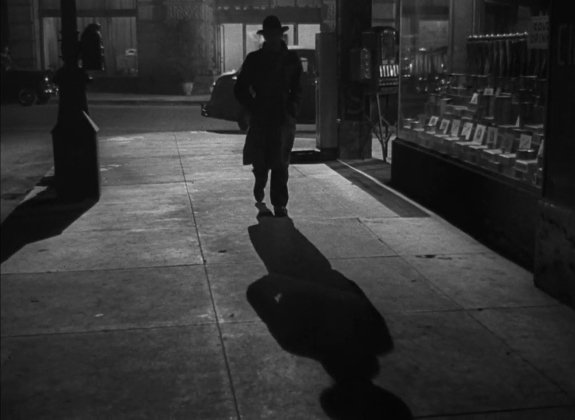
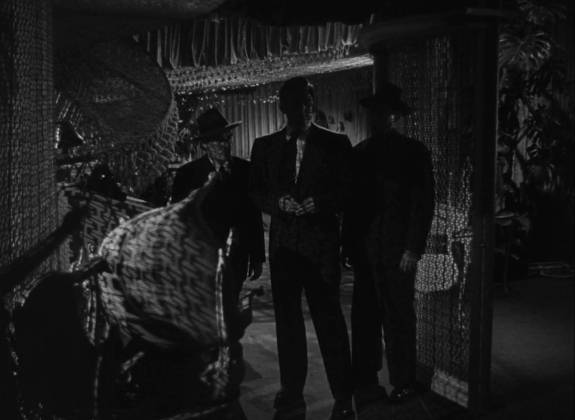
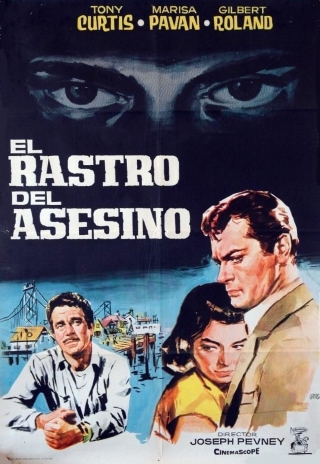
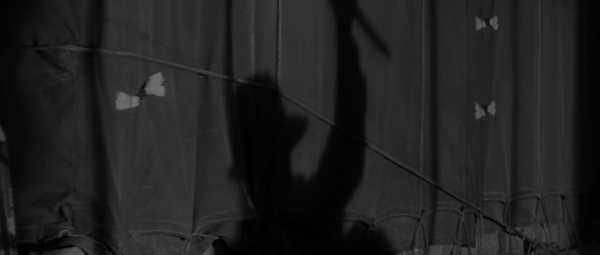
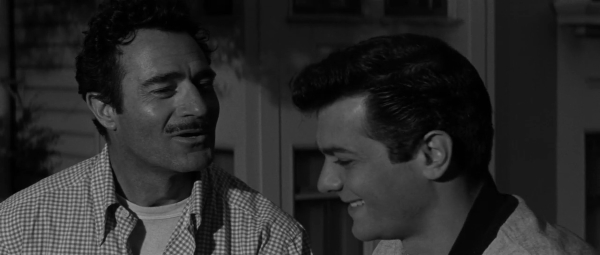
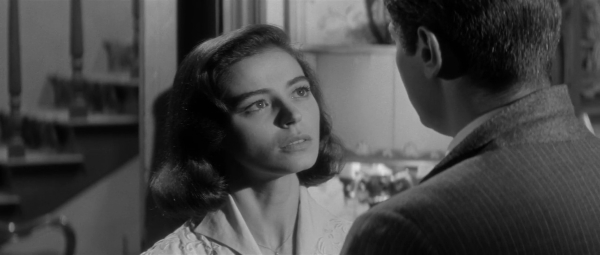
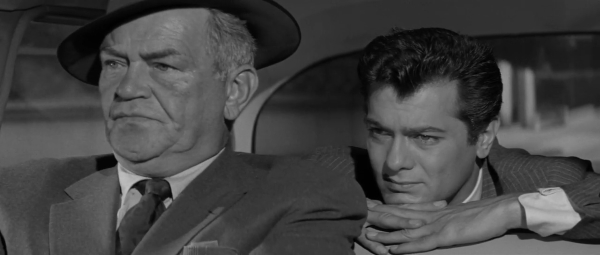
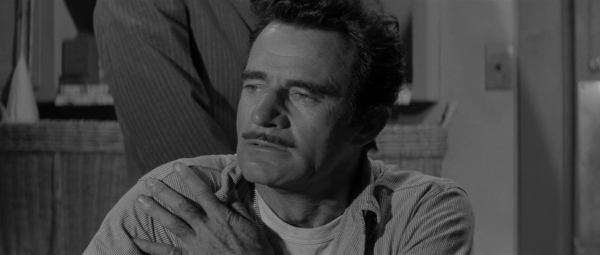
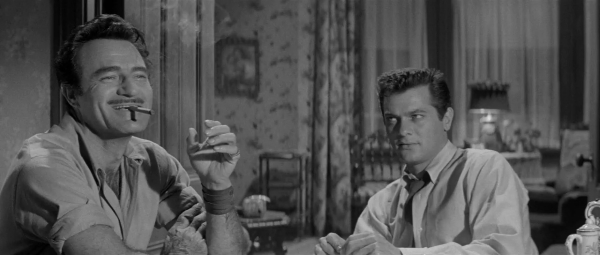
The opening is stark and shockingly abrupt, the caption informing us that the studio set represents an approximation of a side street on the San Francisco waterfront. A priest strolls out of the shadows towards the camera, his attention suddenly caught by a voice softly calling his name. We zoom in on his eyes as they register curiosity, maybe recognition and a touch of fear. This is  Father Tomasino and we’re witnessing his final moments as a knife-wielding assailant, seen only as a shadow cast against the tarpaulin of a truck, strikes him down. It’s one of those crimes that outrages people, particularly those who knew and respected the victim. One such person is Joe Martini (Tony Curtis), a young traffic cop who grew up in an orphanage and owes his job and much besides to the murdered priest. Martini wants the killer and he vainly presses his superiors to let him in on the investigation. At the funeral he notices a man who seems to be more deeply affected, tormented even, than the other mourners. There is something about the intensity of this man’s grief that gives Martini pause and indeed leads to him temporarily turning in his badge in order to pursue his own inquiries. The person who has attracted his attention is Sylvio Malatesta (Gilbert Roland), the owner of a seafood eatery and a familiar figure on the waterfront. Deftly and swiftly, Martini inveigles his way into Sylvio’s life, becoming a friend, employee and even a guest in his home.

Guilt haunts the characters from start to finish. There is obviously the overarching guilt that stalks whoever the killer may be, but Martini carries it with him too all the way. As has been stated, he owes almost everything to Father Tomasino and there is surely a sense of guilt that, despite his job as a protector of society, he was unable to be there to ensure the safety of this man. One of the orphanage nuns he speaks to advises against going around with hate in his heart, but I’d argue that his guilt and shame, a feeling of inadequacy (albeit misplaced) due to his not being there at the crucial time, is his true motivation. Then that same feeling steals over him as he works his way into the affections of not only Sylvio but his family too. This is exacerbated by his falling for Anna (Marisa Pavan), the niece from Italy, and her clear devotion to him. All of this is further heightened by the accompanying doubts and suspicions: suspicions about Sylvio that ebb and flow with the depressing regularity of the ocean tides, and those corrosive doubts about the propriety of his own actions, the dubious morality of exploiting the love and trust of innocents regardless of the cause which is supposedly served. Soon every look and gesture is brought under the microscope, no word or comment is so trivial as to be discarded, no alibi can be relied upon or taken at face value. Everything has to be questioned, everyone suspected in some way. And still the guilt persists.

Besides probing its central theme, The Midnight Story functions both as an engrossing whodunit and as a snapshot of working class family life. There is irony in the fact Martini has only been able to achieve the bonding and acceptance that grows out of membership of a family though deception. In seeking justice for the death of his mentor and friend, not to mention a quest to make amends for imagined failings, Martini risks the loss of all that he most desires. The notion of only being able to win by losing everything is a sour-tasting one indeed. Consequently, there are moments of genuine, heartbreaking darkness in this movie, although it does aim for a redemptive quality, and I think it succeeds in that respect. The crushing burden of guilt is finally lifted in the end by the confession and then the quiet nobility of the final scene, where the feelings of the innocent are spared, absolving them of further undeserved shame, Martini simultaneously washing away his guilt for the deceit perpetrated.

I think it’s fair to say The Midnight Story is Joseph Pevney’s best film. Working from a story and script by Edwin Blum (The Adventures of Sherlock Holmes, Stalag 17), he clearly had an affinity with both the themes explored and the subtle blend of film noir and melodrama. Those intimate little scenes in the Malatesta home, often around the dinner table, but not exclusively, reveal some fine character work from a hard-working cast. The spiritualism inherent in the story and its development is never far from the surface, sometimes overtly but frequently buried a bit deeper in the rambunctious and passionate instances of simple family interaction where the real sense of redemption resides and thrives. The final fade out encapsulates that eloquently as inner strength, belonging and renewal all collide and give meaning to everything that has gone before on screen.

Once again, Tony Curtis is given the chance to prove how adept he was at straight drama and he carries it off successfully. I have probably mentioned this before, but I think it’s worth restating: when actors gain a reputation as skilled light entertainment or comedic performers they seem to get stuck with that label and regarded as capable of only that type of work. Sure some play up to it, and Curtis did choose poorly in his later roles yet it seems a pity that his dramatic work, which is generally very strong, is neglected or at best downgraded as a result. The sincerity and determination of his character is never in doubt and he handles the ups and downs experienced, depending on how his investigation happens to be progressing, most convincingly. Marisa Pavan, who only passed away last December, is very soulful and controlled as Anna. It is this control and emotional caution she displays that gives added fire to the scene where she succumbs to her true feelings as the dangerous game her betrothed appears to be playing is laid bare. There is solid support from Ted de Corsia and Jay C Flippen as the senior cops, the former typically bullish and aggressive while the latter gives another of his slightly dyspeptic avuncular turns.

And that leaves only Gilbert Roland. His was long career and one which saw him get better as the years passed. The leading roles were not to be his at that stage but the presence of the man lent gravitas and truth to many a film. The part of Sylvio Malatesta was an extraordinarily difficult one to carry off, but he does so with considerable aplomb. While there is plenty of scope for his trademark bravura, the part is in fact complex and multi-layered, gradually revealing itself in increments over the course of the movie. The inner torments of the man, the history he hauls around inside himself, are subtly presented, held carefully in check and only occasionally allowed to make their presence known. Frankly, he gives a beautifully judged performance that is fully three dimensional – his work here is the rock which anchors the movie and provides real substance to the story.

This brings me to the end of my trawl through a selection of Joseph Pevney directed movies this summer. It’s something I’ve been wanting to put together for a while now and I’m pleased to have finally done so. I only hope it’s been as enjoyable for visitors to follow along as it has been for me watching and writing about these titles.

Human Desire

Fate and free will, two philosophical concepts that go to the heart of the human condition and form the basis of a good deal of religious thinking and debate. They loom large in the world of film noir too, though that shouldn’t come as any great surprise since art and our perception of our place in the scheme of things are inseparably linked. Fritz Lang’s Human Desire (1954), made as he was approaching the end of his time in Hollywood, posits both fate and free will as drivers of his characters and invites viewers to make up their own minds on which exerts the more powerful influence. I’m of the opinion that Lang himself regards both of these concepts as being in play simultaneously and that there are certain points at which individuals have the opportunity to exercise their free will in order to determine which path of fate they will lock themselves into.

If one were to seek a visual metaphor for fate as a fixed and predetermined path, then a railway line is as good a one as any. Sleek and clean, indicative of precision and order, the lines forge the way ahead, carrying their passengers to a destination that lies at the end of the track as sure as a compass needle points to north. Yet the lines run in more than one direction and points do exist where it’s possible to shunt from one to the other. Human Desire opens with those railroad lines and the locomotives that carry all kinds of people to all kinds of places, starting and ending with absolute certainty at predefined locations that can no more be avoided or cheated than birth and death themselves. In between though, the choices are available, laid before the driver as he advances and by extension before those he brings along with him on the journey. Jeff Warren (Glenn Ford) is an engineer on the railroad, back home and back in his old job after serving in the Korean War. He is very much a regular guy doing a regular job, following those clearly defined lines in life in many ways. There’s nothing particularly special about him, he’s no medal adorned hero nor does he profess to have any ambitions beyond the desire for an uneventful life. However, a movie with this title must necessarily focus on desires affecting all kinds of people and even changing according to circumstances. Carl Buckley (Broderick Crawford) is an old acquaintance, a man who has risen to assistant yard master while Warren was off at war. He’s a blunt, brutish character, loud of mouth and quick of temper who manages to get himself fired for quarreling with his supervisor.

Desperate to get his job back – he’s only got a few more years to do before he qualifies for a pension after all – he badgers his wife into interceding on his behalf with a big city businessman who he figures has sufficient clout to see him reinstated. His wife Vicki (Gloria Grahame) is much younger and it’s immediately clear from her reaction that there is some history involving herself and the corporate bigwig that goes beyond the fact her mother was once his housekeeper. This is the catalyst for the snarl up in the lives of all concerned that follows. It’s made clear that Vicki gets Carl his job back by offering sexual favors. Even though he brought about this situation and essentially forced his wife into a compromising position, Carl is affronted, savagely beating her and making her an unwilling accessory to murder. A sordid business all round and one whose spreading ripples draw in Jeff Warren, who just happens to be riding the same train when the killing takes place and subsequently finds himself fatally attracted to Vicki.

Does one slaying inevitably lead to another? Do abusive, dehumanizing relationships become habit forming and addictive? Are the patterns woven by rotten choices and poor judgement indelible? Or can a virtual lever be pulled at the crucial point and send a life back onto a track that hauls it away from destruction? All of these questions are posed during the course of Human Desire and are answered at least in part by the close. While I’ve no wish to take any credit away from scriptwriter Alfred Hayes, adapting Jean Renoir’s own adaptation of an Émile Zola novel, it seems clear enough that these are themes Lang addressed on multiple occasions and thus carry the director’s imprint too.

Glenn Ford’s everyman qualities are to the fore in Human Desire. He plays Jeff Warren with a directness and simplicity that befits an uncomplicated working man who is unexpectedly snared in a web of temptation and desire. He is faced with the dilemma of succumbing to the vagaries of fate or using his free will to chart an alternative course. Ford’s ability to present frankness alongside a hint of personal dissatisfaction and discomfort works well under the circumstances. I see a touch of resentment early on in his realization that men like Buckley have prospered while he was doing his duty in Korea, it’s just barely there but I think it helps color some of his subsequent actions and decisions. In contrast, Gloria Grahame’s mistreated femme fatale is anything but straightforward, veering from victim to manipulator, cowering one moment and goading the next, and effortlessly alluring throughout. Her work alongside Ford here makes for an interesting companion piece to their previous collaboration with Lang in The Big Heat. Crawford too is neatly cast, by turns shambling and violent he’s a doomed figure haunted by his inadequacy and too ineffectual to challenge his own fate. On the other hand, Edgar Buchanan and Diane DeLaire as Ford’s landlord/colleague and his wife provide an alternative take on marriage. Their affectionate devotion in effect represents the other route available to Ford, in stark contrast to the dysfunctional dynamic of the Grahame-Crawford mismatch.

Human Desire ought to be easy enough to view these days. I have the UK Blu-ray from Eureka, a dual format release that looks terrific, and there is a Kino version available in the US as well. The main supplemental feature on the Eureka Blu-ray consists of an interview with Tony Rayns which fills in some background information on the making of the movie as well as comments on scriptwriter Hayes. I’m not sure the contributor fully gets the film though and he raises a number of points I found myself taking issue with, not least that tiresome critical gambit of looking at movies in terms of what they are not rather than what they are. Anyway, his is an interesting perspective, even if I don’t share all his conclusions. Personally, I’ve always been fond of Human Desire for its thoughtful exploration of themes and motifs that frequently grace Fritz Lang’s movies. Well worth checking out.

Night and the City

“I just want to be somebody… “

Why does film noir continue to resonate? Why does it continue to pull in viewers, beguiled by its shadow drenched nightmares? That is does exert a draw on audiences is beyond question and part of it is maybe down to the look, the attitude, the charm of something at once recognizable yet lost in time. Still, I feel there’s something else at play for film noir is a very human form of filmmaking; it is predicated on the frank acknowledgment of weakness and frailty, perhaps growing out of character flaws, ill fortune, poor choices, or even some unholy trinity of them all. In a way, there is something about the lack of definition regarding film noir that points to its core appeal. There has been decades worth of conversation and controversy over when noir began, when it ended, what it actually is and whether it can even be referred to as  a genre. And at the end of it all, there remains no definitive answer, just schools of thought one might subscribe to. As such, is it possible that film noir is in essence a cinematic expression of uncertainty and confusion, mentally, morally and spiritually? Somehow it feels appropriate that the main character of Night and the City (1950) should say those words quoted at the head of this piece, struggling to articulate an ambition that he cannot fully visualize, much less define with clarity.

Movement and position matter. Anthony Mann frequently had his characters striving to rise, forging a path upward with mixed results, while Abraham Polonsky famously had John Garfield racing down from the heights. The characters in Jules Dassin’s Night and the City, on the other hand, start off at the bottom and remain resolutely anchored there. In a sense, nothing really changes throughout, at least not as far as Harry Fabian (Richard Widmark) is concerned. The opening and closing sequences see him racing through the streets of a broken post-war London, a grandiose chiseler with danger hot on his heels and the hope of sanctuary and salvation, even if it’s only temporary in nature, awaiting him in the form of Mary Bristol (Gene Tierney).

Harry Fabian is what can only be termed a dark dreamer, immature both emotionally and ethically. Mary loves him, that much is clear, not so much for what he is as what she imagines he could be, and Harry in a way is also in love with that projection of what he dreams he could be. The problem though is that neither Mary nor more importantly Harry himself is quite sure of who or what he might be. He is, as his neighbor observes, an artist without an art. We encounter him first as a strictly small time operator, a tout steering mugs to the clip joint where Mary sings, scratching around in the detritus of a city still partly bewildered in the wake of its wartime pummeling for any scheme that might turn a fast buck. Human nature being what it is, he’s not the first nor will he be the last person with his eye on the quickest way to reach easy street. The problem with this approach to life lies in the fact the route there is typically mined. Thus when Harry happens upon what seems like the perfect opportunity to muscle his way into the world of professional wrestling he fails to anticipate the the traps awaiting him. Blinded by his enthusiasm and unaware of how his smug efforts to play all of his rivals off against each other is actually weaving a Gordian knot of epic proportions, Harry is doomed by his own slickness.

It feels kind of appropriate that Jules Dassin would make Night and the City just as the appalling HUAC episode was reaching its peak. Zanuck had dispatched Dassin to London to shoot the movie where he would be beyond the reach of those congressional committees. By the time the movie was completed, the director was firmly on the blacklist and could no longer take any part in the editing process. Nevertheless, the result is portrait of bleak romanticism, where passion, ambition and duplicity all charge headlong towards an emotional intersection and the resulting collision leaves few survivors standing. I have seen assessments of the movie, both contemporary and subsequent, that lament the dearth of sympathetic characters, citing this aspect as a weakness. Such evaluations leave me wondering if I was watching the same movie. Perhaps it’s just me, but I’ve never seen the need to conflate admirable with sympathetic. I’ll concede that there are few truly admirable figures on show, but that does not mean there are none who are sympathetic. If anything, I would assert that almost all of the principals earn some sympathy.

Widmark’s role is almost as difficult to categorize as film noir itself. Fabian is neither hero nor villain in the proper sense of the words, nor would I be entirely comfortable referring to him as an anti-hero. Right up to the tragic moment which precipitates the climactic hunt, he does some contemptible things as he attempts to plug the leaks suddenly appearing in his plan, but the people he’s deceiving are no saints themselves so it’s hard to condemn him too much for that. As the various threads of his schemes become ever more entangled it’s a bit like watching an accident unfold in slow motion. Aside from his mounting desperation, a few moments such as the early scene in Tierney’s flat where the frustration of both  is emphasized, as well as the later exchange with an implacable hotel manager serve to add layers to the character and knock off some of the corners. I don’t believe either Dassin or screenwriter Jo Eisinger had any intention of passing judgment on Fabian and certainly don’t encourage the viewer to do so – he is merely presented as he is. His maneuvering does bring about tragedy, but that occurs indirectly. By the end, when he lies spent and bereft the appearance of Tierney framed in a doorway like some angel of the dawn affords him the opportunity to seek a form of redemption through personal sacrifice. Whatever one may make of the gesture, it does indicate a man who is not merely self-absorbed. What’s more, even though he may be abandoned and betrayed by almost everyone, there’s no getting away from the fact this woman loves him in spite of all his flaws – that in itself places the character on a different level.

That said, Tierney’s part is a relatively small one. Her important scenes bookend the movie and she’s only on screen intermittently in between. It seems that Zanuck was keen to have her in the cast and her role is a pivotal one despite the lack of screen time overall. By humanizing Harry Fabian and adding another dimension to his character, Tierney helps to ground the movie and give it greater emotional depth. The other major female role is that of Googie Withers, the discontented nightclub hostess who is trapped in a relationship for purely financial reasons, something which would not have been uncommon for a woman at the time. Sure she is underhanded and motivated by selfishness, but it’s not so difficult to understand how circumstances have driven her in that direction, nor do I believe it should be so hard to empathize with her efforts to extricate herself from a wholly unsatisfactory marriage. Her husband, played by the oppressively bulky Francis L Sullivan, is another figure who is far from perfect. Insecure despite his clout and dominance in the way such large men often are, he pulls strings and manipulates Harry Fabian like some malign puppeteer out of a desire to see him brought low and in so doing maybe hold onto the woman he so badly needs. It’s a performance that manages to be simultaneously dangerous, vindictive and pitiful.

Many of the other supporting players are portraying characters who are associated in one way or another with the wrestling world. This milieu is appropriate even if it’s not an area that has been extensively featured in film noir – Ralph Nelson’s Requiem for a Heavyweight is the only other notable example that I can think of off hand. Boxing tends to be the go-to sport and I find the choice here a telling one. Boxing might be susceptible to certain abuses,  it may attract corruption, but it still retains some inherent nobility, similar to the way Greco-Roman wrestling retains a link to the classicism of the ancient world and something finer. On the other hand, the crass vulgarity of professional wrestling exists on a much lower plane, a true moral wasteland. It’s that very cheapness, that sense of debasement which lies at the heart of Fabian’s flawed scheme and also forms the basis of the conflict between Herbert Lom’s shady underworld promoter and his scrupulously honest and dignified father. It’s highlighted too in the contrast between the easy superiority of that old athlete (Stanislaus Zbyszko) and the barely articulate coarseness of Mike Mazurki’s hulking and murderous pro.

Night and the City had two cuts, the shorter US version, which Dassin seems to have preferred, and a slightly longer British version. The UK Blu-ray from the Bfi, which now appears to be out of print and consequently is rather expensive, offered both cuts – I think the US Criterion also has both versions too though. I don’t know how popular a view this is, but I find I prefer the longer British cut of the film; perhaps the noir credentials are slightly weakened or some might say compromised yet I like the way it shades the character of Harry Fabian in another light. I find it provides another layer of tragedy and thus heightens the ambiguity of the experience. Nevertheless, this is prime film noir regardless of the version one favors and top filmmaking in anyone’s book. Widmark was only about a half dozen or so movies into his career at this point, already in the middle of a remarkable run of performances in very fine films while Dassin had just come off a short streak of excellent films noir. Under the circumstances, it’s hard to see how this one could miss. A first class movie all round.

Viewing Notes – Woolrich

Cornell Woolrich was the king of nightmare noir, his fables of fate and downright rotten luck, where everything than can go wrong does go wrong,  follow his hapless characters on a perpetual downward spiral. The accompanying sense of dread and doom makes for first rate film noir and a fair number of his novels and stories have been adapted for the screen over the years. I’ve featured a few on this site:

The Leopard Man

Phantom Lady

Black Angel

Night Has a Thousand Eyes

No Man of Her Own

Recently, I found myself viewing a handful of other screen versions of his work and thought I’d just post a few brief comments on them rather than full scale write-ups of the individual titles.

The Guilty (1947)

Jack Wrather was an oilman who decided to try his hand at producing films. While working on The Guilty he met and then married the leading lady Bonita Granville, a former child star who had drifted into B movies. She played identical twins in The Guilty, one of whom is a good girl while the other is most certainly not. The lead was taken by Don Castle, an old friend of Wrather’s whose career didn’t seem to be going anywhere after he’d returned from WWII service. Castle had what I’d term an effective noir persona, a slightly weary charm that felt as though it were only a step or two ahead of desperation. Granville is good enough in her dual role, and the ever reliable Regis Toomey makes for a credible cop. Director John Reinhardt makes the most of the budget and flashback heavy story, wrapping the whole thing up in little over an hour.

I Wouldn’t Be in Your Shoes (1948)

A year later both Castle and Toomey would appear together again in this adaptation, scripted by Steve Fisher and directed by William Nigh, for Monogram Pictures. The flashback technique features once more in this doom-laden tale that opens in the death house with Castle portraying another lucked out type, a dancer who can’t seem to catch a break. He spends his last few hours before that last lonely walk thinking back over how he got where he is. Meanwhile, on the outside his wife lurches between hope and despair as she tries to use what time is left to prove his innocence. Cats, shoes and obsessive love all figure strongly in a satisfying little movie.

Street of Chance (1942)

This movie opens with the main character getting clobbered by some debris falling from a building site. He’s not badly hurt but he does black out temporarily and subsequently discovers he’s not the man he thought he was. In brief, he’s suffering from amnesia and has been living a double life with two very different women, Claire Trevor and Louise Platt. In itself, this is hardly an ideal situation but it takes on that nightmare quality characteristic of Woolrich stories when he comes to realize he’s a wanted man, hiding out and on the run for a murder he has no recollection of committing. This is a strong premise (adapted from the novel The Black Curtain) and directed by Jack Hively, a man who called the shots with  George Sanders as The Saint on a number of occasions. Amnesia generally makes for an intriguing basis for noir and typically offers up lots of possibilities for drama and tension. Any picture with Claire Trevor is usually worthwhile too so the ingredients are undeniably promising. Overall, this is an enjoyable film although I have to say I don’t believe Burgess Meredith was leading man material – while I enjoy his work in character parts, I find he’s too quirky and frankly strange to be the lead. This same story was adapted again for television as part of The Alfred Hitchcock Hour and directed by Sydney Pollack. That version had Richard Basehart in the lead, another figure with strong noir credentials and I think he’s actually a better fit for the role.

There was a time when it was practically impossible to see these movies, and the thought of being able to do so in good quality was almost the stuff of fantasy. However, thanks to the efforts of Flicker Alley, Warner Brothers and Kino respectively all of them can now be enjoyed with excellent transfers. None of them could be classed as major films, but they are all very enjoyable and entertaining detours into the world of Woolrich.