Cry Wolf

poster55

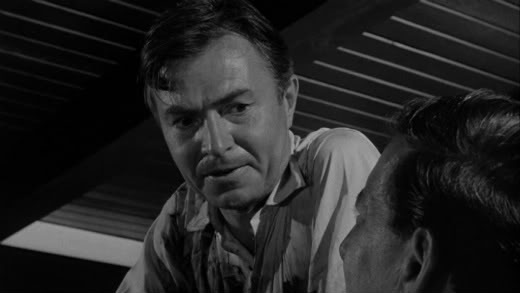
The popularity of certain genres, or perhaps sub-genre is more accurate in this case, is always subject to change. Old dark house movies seem to have lost a lot of their appeal; I think they would have to be accompanied by significant quantities of gore to generate a lot of interest these days. Such films rely heavily on atmosphere and a sustained level of tension that is hard to achieve in the age of lightning editing and a succession of jump-cut shocks. Cry Wolf (1947) is one of these vaguely old-fashioned yarns where mood and setting play a major role in maintaining the suspense. I would term it a moderately or intermittently successful vehicle; the plot is serviceable without being particularly remarkable, but the look of it all and the unexpected casting makes for interesting viewing.

The opening has a breathless, intense quality: a black automobile hurtles along winding rural roads while a rider on horseback tracks along and ahead. As the horse clears a boundary wall, the car pulls up in front of an imposing mansion. Two figures, a man and a woman, alight and are admitted by the help. These two people are Senator Caldwell (Jerome Cowan) and Sandra Marshall (Barbara Stanwyck), and they’ve been racing through the countryside to attend a wake. An interview with Mark Caldwell (Errol Flynn), the senator’s brother and head of the house, establishes the fact that Sandra has arrived at this place of mourning to pay her respects to her late husband. Sandra claims that she was married to the deceased, the nephew of Mark and the senator, and has come to see the instructions he left in his will are carried out. It transpires that the dead man was extremely wealthy, his fortune held in trust and administered by Mark until he should turn 30 or marry. His sudden departure means that Sandra now stands to inherit a substantial fortune, providing her claims bear scrutiny of course. Mark is naturally suspicious of this unexpected widow, but that feeling is reciprocated. The death of Sandra’s husband is accounted for in fairly vague terms, the casket has been sealed, and the entire household appear to be held in the grip of some nameless dread. If Mark wants to find out a little more about Sandra’s assertions then that’s as nothing compared to her determination to dig deeper into the Caldwells’ past. She instinctively knows that something doesn’t ring true; there are little details that niggle, but the main issue is the sinister atmosphere that hangs over everybody and everything. The presence of a fragile, neurotic niece, the mysterious laboratory where Mark works late at night, and the awful, unacknowledged screams that echo along the corridors in the darkness all combine to drive Sandra to investigate further. It’s tempting to try to predict the outcome of this story and the trail is littered with clues and allusions, but there are various red herrings present too. By the time the tale twists its way to the climax I reckon it would take a very savvy viewer to step around the pitfalls and reach the correct conclusion.

I haven’t seen too much from director Peter Godfrey apart from the Bogart/Stanwyck feature The Two Mrs Carrolls. This movie shares the same feeling of overheated melodrama, and both films tend to disguise a mediocre script through the use of heavy atmosphere. I don’t usually comment on matters such as set design, but Cry Wolf, with its predominantly indoor setting, relies quite a lot on this. The sprawling Caldwell mansion and estate becomes almost a character in itself, a kind of brooding edifice that’s full of secrets and menace. Godfrey and cameraman Carl Guthrie use the architecture well to build mood – shooting from below and through the balustrades to achieve the classic noir imagery of characters pinned in place by shadows and bars, and mix this up with high angle shots from the gallery that coldly objectify the small figures milling about below. Even the outdoors scenes, with their matte paintings as backgrounds, blend in well. Theoretically, this ought to give the movie a cheap, B picture vibe but it actually adds to the air of unreality, heightening the sense of the characters inhabiting a world apart in much the same way that Hitchcock employed such techniques.

Errol Flynn rarely gets a lot of credit for his acting abilities. He even admitted in his (fantastically entertaining) autobiography that, especially in the post-1942 years, he was often just going through the motions, basically churning out pictures simply to cover his expenses. He was always at his most memorable in swashbuckling action roles, yet he was capable of more subtle performances whenever the opportunity arose. Cry Wolf offered him something quite different, a calmer, more thoughtful and genuinely ambiguous part. Perhaps some thoughts of his own father came into play when he assumed the role of the slightly aloof, pipe-smoking scientist. While he could be criticized here for a certain stiffness, I think he hit the right note under the circumstances; the character of Mark Caldwell is, after all, a man living under intense pressure with a lot of skeletons rattling around the family closet. I guess it could be said though that he doesn’t bring a strong enough sense of menace or threat to his performance to make it as convincing as possible. In something of a reversal of roles it’s Barbara Stanwyck who gets to do all the proactive stuff in the movie: riding horses, clambering across rooftops, dangling through skylights and generally toughing it out. As such, this was a perfect piece of casting since Stanwyck was one of the few actresses of the period who could credibly pull off this kind of thing. She was enormously versatile, at home in most any genre, yet particularly suited to playing gritty heroines who remained unfazed by physical danger. I’ll also give a mention to Geraldine Brooks who was highly effective and quite moving, in her debut role here, as the emotionally brittle and highly strung niece.

As far as I know, the only way to get Cry Wolf on DVD at the moment is via the Warner Archives disc. I remember buying this title on VHS way back in 1989 and I have to say that it looks very much like the same master has been used for the DVD. That’s not to say the image is poor, but there are plenty of speckles and damage marks, not to mention a general lack of crispness, that betray an unrestored source. The disc, as is usual with these MOD products, is very basic: no extra features whatsoever, a generic menu and standard ten minute chapter stops. I’ve tagged this picture as a film noir, but the truth is that it’s a borderline entry at best. The plotting has more in common with a Mary Roberts Rinehart style of mystery – a gutsy heroine blundering into a perilous situation. However, the dark mood and the atmospheric photography do earn it a place on the periphery of the noir world. Personally, I’m a fan of both the stars and I like the fact that it has Flynn playing against type for a change. It’s by no means a perfect film though it is a lot of fun – therefore, it earns my qualified recommendation.


I Wake Up Screaming

“I’ll follow you into your grave. I’ll write my name on your tombstone.”

It’s hard to pin down exactly when film noir came into being, almost as hard as defining the term itself. Some argue that Stranger on the Third Floor kicked it all off, others point to John Huston’s version of The Maltese Falcon, and there are those who reckon it was even a year or two after that. So where does that leave I Wake Up Screaming (1941)? Well it came out around the time of The Maltese Falcon, so it falls into that early/proto-noir grouping. Unlike Huston’s film, there is a degree of unevenness to the tone; it veers between some broadly farcical moments and a darker, shadowy world of danger and complex psychology. In fairness though, the latter aspect does dominate and, even if one concedes that it’s not fully fledged noir, there is some wonderful photography and imagery on show.

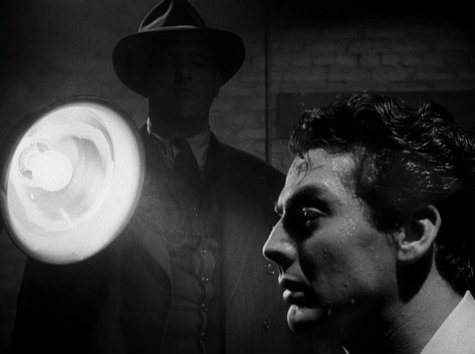
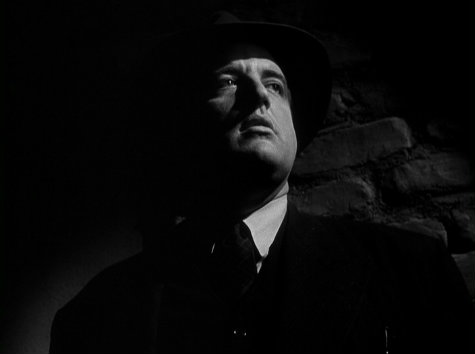
The opening is a dramatic one, with a newspaper seller announcing the murder of Vicky Lynn (Carole Landis) as the camera invites us into police headquarters. Inside, over the course of two interrogation sessions, we learn who this girl was and how she came to meet her end. Both Frankie Christopher (Victor Mature), a promoter, and Jill Lynn (Betty Grable), the victim’s sister, are under the spotlight and – via flashback –  filling in the background for the audience. It’s shown how Frankie and two friends (Alan Mowbray & Allyn Joslyn) make a Pygmalion style bet to turn waitress Vicky into a celebrity. Seeing as they have quality material to work with, things turn out fine. Maybe too fine though, since all three men have romantic designs on their muse, while she has plans to move to Hollywood. Anyway, Vicky winds up murdered and Frankie is sweating it out in the interrogation cell as suspect number one. The investigation is being headed up by an unusual cop, the soft-spoken and slow-moving Ed Cornell (Laird Cregar). Cornell seems sure Frankie’s the killer and is determined to break him. This immense and vaguely sinister figure becomes Frankie’s shadow, teasing and menacing him. On one memorable occasion, Frankie wakes suddenly from a bad dream only to find the Buddha-like figure of Cornell sitting in a chair in his room, just watching him. As Jill and Frankie join forces to trace Vicky’s killer, they draw closer together and it also starts to become apparent that the motives behind Cornell’s obsessive determination to nail his prey may not be quite as clear cut as they first seem.

I Wake Up Screaming, adapted from Steve Fisher’s novel, is as much a whodunit as a film noir. It’s the behaviour of a couple of the characters and the chiaroscuro lighting and imagery that earn it a place in the noir lineup. I mentioned the uneven tone, and that’s perhaps most evident in the opening segment, where the action alternates between the interrogations and the flashbacks. The latter tend to be bright and have a light, jokey feel about them as the three friends go about making Vicky over. This is where the transitional nature of the film is noticeable, as those scenes are reminiscent of the screwball style of the 30s. It also reflects something of the director’s background. H Bruce Humberstone is maybe best remembered for his handling of a few of the best Charlie Chan movies, and those flashback scenes recall that kind of mood. Cameraman Edward Cronjager had worked with Fritz Lang, and would do so again, and it’s tempting to wonder if this association may have had some influence over the look of the interrogation scenes. These are pure noir, full of harsh key lights, deep shadows and threatening, disorienting camera angles. In fact, this style dominates the remainder of the film and results in some strong visual imagery. I don’t often spend a lot of time discussing the musical scores in these pieces, but I’ll do so here as I feel there’s some added significance in this case. The movie’s main theme is Alfred Newman’s Street Scene, which would become something of a staple in Fox crime pictures. However, another very famous melody, Over the Rainbow, also features prominently throughout the film, and it’s that I particularly want to focus on. Initially, this might seem an odd choice for a noir/crime movie, being so closely associated with The Wizard of Oz. Nevertheless, it not only works but is also highly appropriate – that half-hopeful, half-melancholic song perfectly captures the nature of two important characters, both striving and straining to reach something that must forever remain unattainable.

In retrospect, there’s something incredibly sad about I Wake Up Screaming, and it’s not just the fate of some of the characters. Within a few short years, both Carole Landis and Laird Cregar would be dead. Landis would die by her own hand, and Cregar would bring on a fatal heart attack as a result of extreme dieting. Landis was pretty good in the role of the victim, seen only in flashback and in a clip of film her character made as a screen test. Although her screen time is limited, she still conveyed the ambition and single-mindedness of the character well enough. Cregar is phenomenally good, the best thing about the whole picture in my opinion. Despite the fact he may not have thought so himself, his bulk was one of his greatest assets as a performer. He dominates the frame whenever he appears, and his mock joviality comes across as nothing more than a veneer to cover up something much more sinister below. But there’s more than that, something about the eyes or voice had a soulful quality, a hint of regret maybe. By the end of the movie, Cornell (apparently Steve Fisher named the character after fellow writer Cornell Woolrich) develops into an extremely poignant figure. I always thought Cregar was great in anything I’ve seen him in, and his passing away at such an early age was a real tragedy. There’s also a small but pivotal role for cinema’s favourite runt, Elisha Cook Jr; the man was born to play losers and victims, and his plaintive, bewildered persona is put to good effect in this film. Which brings me to the two leads, Betty Grable and Victor Mature. Grable was essentially a musical star, not the kind of person you expect to see in a hard-boiled crime movie. Having said that, she does fine as the sister of the victim and is quite credible in a serious dramatic role – there was a short musical number shot for inclusion but this was, quite sensibly, cut and is presented as one of the extras on the DVD. If I have any quibbles about her it’s only that her relationship with Mature seems to grow too quickly to be realistic – still, that’s a scripting rather than an acting issue. Victor Mature featured in a fair number of noirs, and I have no problems with his work on this one. However, it has to be said, and again this really relates to the writing, that both Mature and Grable’s characters are a little too straight and square. Noir always works best when there’s a touch of ambiguity or doubt surrounding the protagonists, and that’s never convincingly achieved with either of these characters.

I Wake Up Screaming is on DVD from Fox in the US as part of their noir line, and looks great. The transfer is very clean and sharp, and the contrast is strong. The disc also offers a fair selection of extras, the commentary track by Eddie Muller and the aforementioned deleted scene being the most notable. As I’ve tried to make clear throughout, the film is not full-blown noir. Cinematic genres and styles are all about evolution, things don’t arrive fully formed out of the blue. As the world, and the US in particular, plunged further into crisis and war,  cinema would gradually reflect the darkness and disillusionment more. Even if films like I Wake Up Screaming don’t quite go the full distance, they’re still not too far off. Either way, it remains a classy movie that is recommended viewing.

Gilda

Hate can be a very exciting emotion. Very exciting. Haven’t you noticed that?

I guess one of the defining characteristics of film noir is its subversive nature. It tends to take traditional scenarios and situations and casts its dark and cynical shadows over them, carrying the audience along on a journey into a murky and unfamiliar world. This subversion can apply to the legal system, social matters, or affairs of the heart. Gilda (1946) concentrates on the latter category, spinning its tale of three people locked into a romantic triangle, unable to decide if they love or hate each other and apparently unaware of the distinction between these powerful and conflicting emotions.

The story begins in Argentina at some unspecified point towards the end of WWII. But there’s a timeless, otherworldly quality to it all – the end of the war and the ensuing celebrations are mentioned in a throwaway fashion that’s surely meant to emphasize the detachment of the lead characters from the real world and the more mundane concerns of most people. These people seem to exist and operate within their own self-contained universe, a glamorous yet nightmarish demi-monde, where the bigger picture of world-changing events are relevant only as a kind of Hitchcockian MacGuffin. The opening shot of the movie introduces Johnny Farrell (Glenn Ford), a down on his luck grifter rolling dice on the waterfront and looking for easy marks. His strategy is a high risk one, not just because he’s a gambler but because his loaded dice are sure to attract the attention of disgruntled suckers sooner or later. When the inevitable happens, and Johnny finds himself the victim of a shakedown on a dark and forbidding wharf, his hide is saved by the intervention of a suave gentleman with a handy sword stick. This is Ballin Mundson (George Macready), a casino owner with an interest in shadier and even more profitable ventures. Johnny is nothing if not an opportunist and soon talks himself into employment, and a position of trust, with Ballin. For a time this mutually beneficial arrangement works and everything is sailing along smoothly on calm waters, until a woman appears and brews up a storm. Gilda (Rita Hayworth) is a sexual powerhouse, a woman whose passionate nature and provocative insolence seems to radiate from within. Her sudden and dramatic appearance as Ballin’s wife, after a whirlwind courtship, throws Johnny for a loop and irreversibly alters the dynamic of the relationship between the two men. Gilda’s arrival on the scene has an immediate and profound effect on Johnny – their introduction is a charged affair, and the confusion that Johnny’s barely able to disguise is shared by the audience. The rippling undercurrent of hostility gives rise to all sorts of questions about these people. I’m not giving away much here when I point out that it’s soon revealed that Gilda and Johnny were once lovers, before he walked out on her. And there we have our triangle: a cagey, duplicitous affair where the three protagonists circle each other warily and seem bent on mutual destruction. While it all develops nicely, I’ve always thought that the ending is weak – a little too abrupt and not all that convincing.

In my opinion, the reason Gilda is classified as a film noir is down to the theme more than the look. Cameraman Rudolph Maté does create some characteristically noir images – the waterfront opening, some of the nighttime casino scenes, and the way Ballin seems to blend and merge with the shadows – but much of the movie features bright, flat lighting. The edgy, darker tone stems largely from the setting and plot twists. A casino has a built-in sense of fatalism to it anyway, a place where fortune quite literally depends on the turn of a card or a throw of the dice. When this is combined with the South American setting, and the allusions to ex-Nazis involved in political and economic intrigue, it conjures up that sense of exotic danger that was very much in fashion in the mid to late 40s. Of course all this really only amounts to Casablanca style escapism; the key element that tips it over into the world of noir is the sadomasochistic relationship at the centre of the tale. The film is essentially a love story, but there’s a vicious, unpleasant side to the romance. Everything revolves around the title character, as she punishes both Johnny and Ballin, but in so doing she incurs arguably greater punishment at their hands in return.

The unquestionable star of the show is Rita Hayworth, the role becoming the one with which she would remain most closely identified for the rest of her life. Hayworth herself acknowledged this and it seems she had mixed feelings about it – her frank admission that the men in her life went to bed with Gilda and woke up with her is very telling. Whatever the personal legacy may have been, Hayworth certainly breathed life into what, in other hands, could have been a cardboard cutout character. She was excellent at getting across the contrast between the vivacious bravado that characterized Gilda’s public facade and the uncertainty and self-loathing she felt in more private moments. Her big scene, the one that is endlessly referenced in books and retrospectives, where she tries to provoke a reaction from Johnny with a knowing parody of a public striptease is justly famous. However, it also tends to overshadow the good work she did all through the movie.

While Rita Hayworth is the one most people will remember from the movie, Gilda worked wonders for the career of another of its stars. Glenn Ford, like a number of other actors, had seen service during the war, and Gilda was the film that gave him the boost he needed and raised his profile. Wartime experiences affected a lot of performers, it gave them a different air, a toughness and a touch of weariness too. Ford went on to work in some pretty good noir pictures, Lang’s The Big Heat being the best of them, and he did seem to belong in that world. As he did in his numerous western roles, Ford brought a kind of dissatisfaction with himself to his noir parts. Johnny Farrell has a veneer of cockiness and self-assurance to him, but Ford could always invest his characters with a nervy, slightly uncomfortable quality too. These may be little things yet they add up and make characters more believable and realistic. Although both Johnny and Gilda are flawed individuals, they’re not villainous. But a movie like this needs a bogeyman, and George Macready was a fine choice for the role of Ballin. Right from the beginning there’s a sinister air about him, and Macready’s innate charm and culture accentuates that. The repressed manner and wonderfully distinctive voice add to his calm menace – you honestly get the feeling that crossing this man would be an extremely foolish move. Of the supporting cast, I find Steven Geray the most memorable. This washroom attendant whose contempt for just about everyone, apart from Gilda, sees him making one flip comment after another seems to be given a lot of slack. I especially like the way we never find out exactly what leverage he has – the one time he’s about to reveal it he’s interrupted, and we’re left wondering.

I actually drafted this piece back in July, after I’d seen it one balmy Saturday night in an outdoor cinema in Athens – always a great way to enjoy a classic movie. However, I realized my holidays were fast approaching and so I decided to hold off publishing it. I though I might want to go back and tweak it some, but I’ve decided to leave it just as I’d written it a few days after watching the film. I’ve seen Gilda many times over the years and always enjoyed its dark romance. I wouldn’t say it’s one of those movies that reveals too many new things on repeated viewings yet it’s not the kind that grows stale either. It’s earned its classic status, and it’s well worth visiting or revisiting.

The Big Combo

bc1

First is first and second is nobody.

As classic film noir moved into the 1950s, one noticeable change was the increased emphasis on stories involving mafiosi and various syndicates. If you consider that the movement was born out of changing moods and social circumstances in the US in the early 40s, then this shift is not altogether surprising. The whole issue of organized crime was back in the headlines and this concern seemed to have overtaken the more personal, individual angst that had dominated tales in the preceding decade. The Big Combo (1955) is based around such a premise, although it doesn’t really reveal any startling or particularly deep insights into the workings of the mob. But then that’s not the point of the movie, this being principally an examination of two obsessive men and the woman who stands between them; the fact that one is a cop and the other a mobster is mostly by the by.

Where more traditional crime sagas tend to chart the evolution of an investigation, The Big Combo eschews the slow build up and instead plunges right into the story at crisis point. The opening shot has a frantic Susan Lowell (Jean Wallace), long time companion of mob luminary Mr Brown (Richard Conte), running through the anonymous and shadowy corridors of a boxing venue. This woman is obviously in a highly emotional state, and it’s no real surprise to learn that she has tipped a bottle of pills down her throat in a desperate suicide bid. This draws in the third figure in the triangle at the heart of the movie, Lt Leonard Diamond (Cornel Wilde). Diamond’s a driven man, his expenditure of time and money in a quest to bring Brown to book has brought censure from his superiors. However, Diamond isn’t merely a crusader against crime in the conventional sense; his pursuit of Brown is closely linked to his interest in Susan. So, when news of her hospitalization filters through, Diamond naturally seeks her out. Matters are clearly coming to a head for all concerned, and the root lies in a name – Alicia – that Susan has realized carries some special meaning for Brown. Diamond’s appreciation of this fact affords him the leverage he needs to force the tiny crack in Brown’s armour into something more substantial and damaging. Even so, the path is by no means free of obstacles – after all, he’s got nothing more than a name to go on. Before Diamond can piece it all together he will have to see witnesses conveniently disappear, undergo torture himself and inadvertently allow his lover to be gunned down. All the while though, the focus remains firmly on the personal battle between Brown and Diamond, with the issue of the former’s crimes only acting as something of a blind. In reality, it’s a duel to the finish motivated by both men’s desire to possess Susan.


£46

The final fade out has become one of the most iconic images in film noir, stills derived from it appearing in just about every book dealing with the subject. The two figures frozen in silhouette against a background of glowing fog seems to perfectly capture the look and the essence of noir. This ought not to be any surprise due to the fact The Big Combo was lit and shot by the legendary John Alton. Of course it’s not the only memorable moment, the film is littered with shots that are beautifully composed and realized. Alton and director Joseph H Lewis managed to both disguise and turn to their advantage the small budget they had available. The movie boasts a significant number of basic, stripped down sets, yet the director and cameraman artfully cover these deficiencies through the use of clever lighting and framing. Backgrounds tend to dissolve into inky blackness as the key lights pick out and draw attention to the characters. Alton’s take on the dramatic potential of darkness and light is neatly summed up in this extract from Painting with Light (MacMillan, 1949):


To realize the power of light and what it can do to the mind of the audience, visualize the following little scene: The room is dark. A strong streak of light sneaks in from the hall under the door. The sound of steps is heard. The shadows of two feet divide the light streak. A brief silence follows. There is suspense in the air. Who is it? What is going to happen? Is he going to ring the bell? Or just insert a key and try to come in? Another heavier shadow appears and blocks the light entirely. A dim hissing sound is heard, and as the shadow leaves, we see in the dim light a paper slip onto the carpet. The steps are heard again…This time they leave. A strong light appears once more and illuminates the note on the floor. We read it as the steps fade out in the distance. “It is ten o’clock. Please turn off your radio. The Manager.”

I’ve mentioned the climax in the airport hangar, but there’s another wonderfully judged moment that takes place at the same sparse location earlier on. I guess what follows constitutes a mild spoiler, so anyone reading this who hasn’t seen the film might want to skip over this part. Just as it appears Brown’s empire is crumbling, his subordinate McClure (Brian Donlevy) decides to step in and take advantage of the situation by having his boss assassinated. However, he miscalculates badly and finds the guns of the hitmen turned on him instead. McClure backs up against the wall, stricken with terror, but Brown assures him he doesn’t need to worry, he won’t hear the shots. McClure’s little nervous smile of relief is short-lived though. Brown jerks the hearing aid from McClure’s ear and steps away. The camera cuts to the gunmen and the now silent muzzle flashes of their tommy guns. Very simple and very effective.

£47

Richard Conte was a fine villain in a number of noir pictures, and Mr Brown must surely rank as one of his best roles. He is the absolute epitome of cool arrogance and sadism, wearing a permanent smirk as he raps out Philip Yordan’s slick dialogue. The casual insolence he injects into the delivery is like a contemptuous slap in the face to whoever happens to be on the receiving end. It’s this overwhelming self-assurance and disdain for everyone that ultimately leads to his downfall, but it’s masterfully built up. His first encounter with Wilde in the hospital corridor sets the tone right away; not only does he insult and belittle his nemesis but he does so through an intermediary, not even deigning to address such an inconsequential figure directly. Wilde, on the other hand, plays a repressed and frustrated character. His frustration is twofold: his sense of professional impotence at failing to nail Brown despite investing so much time, money and effort, and his inability to compete on equal terms for the affections of Susan. I thought Wilde carried this off well, his emotions seething just below the surface and only held in check by his dubious morality. He covets Brown’s woman yet is simultaneously repulsed by his knowledge that her purity has been tarnished by her association with the mobster. On top of that, there’s his vaguely puritanical priggishness (note his comment about suicide breaking God’s laws) which is contradicted by his on-off relationship with a showgirl. As the object of Wilde and Conte’s obsession, Jean Wallace didn’t come across so successfully. There’s a blank quality to her performance although, in fairness, that may be intentional as she’s clearly supposed to be a character near the end of her tether psychologically. Wallace was married to Wilde at the time, and it seems he was less than pleased at the infamous scene where Conte starts kissing her neck and then continues working his way down as the camera zooms in on Wallace’s face. This also raised concerns as it was pushing the limits of the production code of the time. When questioned about where Conte went as he descended from view, Joseph H Lewis replied: “How the hell do I know? What does an actor do when you move in on a close-up of someone else? Go sit down somewhere, I guess.” In addition to that, the movie also features a couple of hitmen (Lee Van Cleef & Earl Holliman) who, while it’s never explicitly stated, are clearly involved in a homosexual relationship – strong stuff for a 1955 production.

The Big Combo is one of those films which has been poorly served on DVD. Although none of the available editions are truly awful, they aren’t especially satisfying either. I understand the US release by Image may offer the best transfer but I don’t have that one to comment for sure. I used to own a weak Geneon disc which displayed a fair bit of combing and motion blur but replaced it with a Spanish release by Sogemedia/Regia. This disc doesn’t have the combing issues but it’s still only a low-medium grade transfer. The biggest problem is a general haziness and softness that dilutes the work of Lewis and Alton. I continue to cling onto the hope that someone, somewhere will see fit to release this great film with a restored image and in the correct aspect ratio. Leaving aside the less than stellar DVD presentations, I can’t praise the movie itself highly enough. The dialogue, plotting and photography are all pure noir, and the two strong central performances ensure it’s a film worth revisiting.


The Red House

rh1-1

“Did you ever run away from a scream? You can’t…it will follow you through the woods…it will follow you all your life!”

Last time, I looked at a movie that grafted film noir tropes onto a western story and setting. To the purist, noir really ought to be set in a contemporary, urban location, but there are always examples that prove the exception to the rule. Delmer Daves’ The Red House (1947) has its characters battling their demons in a superficially wholesome and clean rural environment, but it does take place in modern times. The tale also imports some of the elements and trappings of the ghost story, largely for the sake of atmosphere and to create a oneiric quality. However, this is no supernatural affair and the only phantoms on view are those locked away in the subconscious mind.

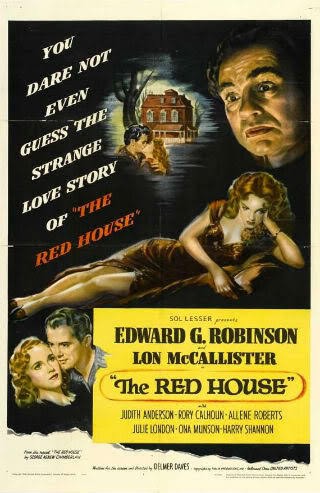
Everything revolves around the reclusive Morgan family: Pete (Edward G Robinson), his sister Ellen (Judith Anderson) and the girl they have adopted, Meg (Allene Roberts). Their self-imposed seclusion has given rise to rumours and wild conjecture about what goes on in their private world. As viewers, we gain entry to this odd household via a young boy, Nath Storm (Lon McCallister), who has been hired to help out with the farm chores. Our first impressions of the Morgans, especially Pete, are positive, and the overall feeling is that this is a simple, kindly family interested only in minding their own business and not overly concerned about the opinions of others. Nevertheless, there is an undercurrent, almost imperceptible at first, that all is not well. Gradually, it becomes apparent that this Garden of Eden houses its own serpent, lurking deep in the shadows of the past and awaiting the opportunity to uncoil itself and strike at the present. The trigger is Nath’s arrival and the refreshing sense of openness that his presence introduces into the musty Morgan home. This impacts most noticeably on Meg, a young girl on the cusp of womanhood and eager to sweep away the cobwebs of superstition woven around her. The root of the mystery and the doom-laden atmosphere is the Red House of the title. Pete’s ominous warnings to Nath to avoid the forest at night and his allusions to the menace emanating from the house within don’t have their intended effect. Nath is a young man brimming with self-confidence and Pete’s urgings, while building up the mythic stature of the Red House, serve only to stir his contempt for what he sees as mere old wives tales. The upshot of all this is a growing determination on Nath’s part, aided by Meg and his girlfriend Tibby (Julie London), to find the house and crack its secret. Yet, the deeper the young people penetrate into the forbidding woods and the closer they come to discovering the elusive house, the more pronounced Pete’s paranoia and desperation become. It’s painfully obvious that we’re not being confronted with just the foolish ramblings of a hick farmer, but rather some dark and shameful event in the past that cannot and will not remain buried.

£55

Delmer Daves took on both the directing and writing duties (although IMDB claims Albert Maltz was also involved) for The Red House so much of what appears on-screen is down to his efforts. The whole film builds slowly and relentlessly towards the solution of the central mystery and, in terms of pacing, rarely puts a foot wrong. The early stages paint a picture of idyllic rural life, with only the odd hint of something unpleasant slumbering below the surface. The first discernible cracks appear when Nath decides to defy Pete’s melodramatic pleas to avoid the woods and the horrors he claims they hide. Daves’ direction, Bert Glennon’s photography and Miklos Rozsa’s lush, haunting score all combine to glorious effect in the sequence that sees Nath stumbling through the woodland in the midst of a gale. What looked like a peaceful, untroubled paradise by day is transformed into a sinister and menacing jungle by night. The howling wind, the groping branches and the darkness all contribute to the creation a nightmarish landscape that threatens to take possession of the boy. Throughout the film Daves and Glennon draw attention to the contrast between the bright cheerfulness of the days where youthful optimism and hope hold sway, and the gloomy nights when the despair of the older generation casts its long shadow. In the last third, the pace quickens, the visuals darken and the revelations come thick and fast. The result is a powerfully affecting climax that offers excitement, tension, revulsion, and tugs a little at your heart. The ending itself, which emphasises the idea that there’s no escaping the past, is both moving and apt.

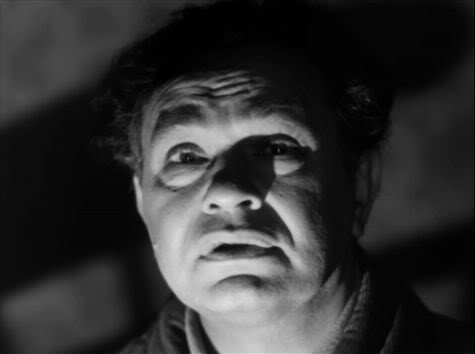
Edward G Robinson came to his part on the back of some sterling work for Billy Wilder, Orson Welles and Fritz Lang. I reckon he was at the peak of his powers at this time, and his role as Pete Morgan is a further illustration of his versatility. His time at Warners may have made him famous, but some of his best and most memorable work was done elsewhere. His turn as the lovesick loser in Lang’s Scarlet Street has justifiably earned many plaudits, and I feel his performance in The Red House makes for a nice companion piece. It’s a complex role that calls for a subtle touch to convincingly achieve the transition from the avuncular figure at the beginning to the guilt crazed shell of a man he becomes by the end. He got some fine support in the shape of Judith Anderson, exercising great restraint as the sister who has repressed and subordinated her own desires to maintain the illusion of a united family – there’s a touching moment where we see her stealing a glance onto the porch at the man whose love she spurned, and thus condemned herself to a life of lonely spinsterhood for the sake of her brother. Julie London and Rory Calhoun both had interesting parts too, as good for nothing wasters, and they seemed to have a bit of chemistry in their scenes together. That’s more than I can say for Lon McCallister and Allene Roberts, who never convince as a couple of burgeoning sweethearts. Individually though, they weren’t bad; McCallister had the right kind of cocksure quality for a young man trying to prove himself, and Roberts managed a nice line in wistful confusion and frustration that befitted a girl brought up in such a murky and secretive household.

£54

The Red House is one of those films that seems to have been a staple of the PD market for as long as I can remember, regularly turning up from a variety of distributors in generally rotten transfers. Until recently, the best edition available was the one included on the Edward G Robinson double feature from VCI, although that too displayed problems such as interlacing and a mediocre soundtrack. Last month, the film was released as a region-free DVD/Blu-ray combi by HD Cinema Classics, and it’s the best I’ve seen the film looking and sounding. However, it’s not a perfect release: the DNR has been liberally applied to achieve a smoother look and the brightness has been boosted too. While this is far from ideal, it has to be said that even this digitally manipulated image is streets ahead of what was previously available. The new release also features a commentary track with William Hare and a before-and-after restoration comparison. Bearing in mind the PD status of the film, this is likely to be about the best we’re going to see. The movie is a great piece of rural noir, a slow-burning melodrama that’s visually impressive and emotionally involving. I guess that the unsatisfactory condition of previous editions of The Red House have contributed to its not getting the attention or respect it deserves, but it’s a wonderful and neglected example of film noir for all that. The excellent performances of Robinson and Anderson, and the moody, assured direction of Daves earns it a solid recommendation from this viewer.


The Asphalt Jungle

Experience has taught me never to trust a policeman. Just when you think one’s all right, he turns legit.

It could be said that John Huston created the template for the private eye movie with his version of The Maltese Falcon; I think the same is also true of The Asphalt Jungle (1950) and the heist movie. In terms of plotting and development, this film lays out the pattern that almost all subsequent efforts have followed. Others have played around with the structure and characterization within this sub-genre, but the basic concept of a group of professional thieves assembling to plan and execute a raid before seeing everything fall apart remains the standard formula to this day. Aside from its influential status, The Asphalt Jungle is also a first-rate film noir and a compelling crime drama. Unlike Criss Cross or The Killers, the gang are not foiled by a scheming femme fatale or by having their judgement clouded by emotion. Instead, their downfall is hastened by mistrust born of greed and the little glitches that even the coolest planner couldn’t hope to foresee.

The credits fade from the screen and are replaced by a bleak, deserted and forbidding cityscape where a cruising patrol car prowls ominously. As it does so, a man keeps to the shadows and flits silently from one piece of cover to the next, like prey being stalked by a relentless hunter. The man is Dix Handley (Sterling Hayden) and at this stage the only thing we can say with any degree of confidence is that he’s anxious to avoid a brush with the law. Later, we learn that Dix is what’s termed a hooligan, a low-class common criminal using violence and brawn rather than brains and finesse. Dix is the man we follow throughout the movie, and it’s by this means that we’re introduced, one by one, to all the major players in the drama: Gus (James Whitmore), the physically deformed wheelman; Cobby (Marc Lawrence), the bookie with connections in both high and low places; Doc Riedenschneider (Sam Jaffe), the ex-con with a big reputation; and eventually Lon Emmerich (Louis Calhern), the big-time lawyer in need of money. When Riedenschneider emerges from prison with an apparently foolproof plan for a headline grabbing jewel heist, the scene is set for the paths of all the main characters to cross in a game of lies, betrayal and violence. By the time the end credits roll, a daring plan is hatched and put in place, enormous wealth is stolen, promises are broken, and men die abrupt and bloody deaths.

One of the more remarkable aspects of the film is the way the career criminals come across in a far stronger light than the traditional representatives of law, order and respectability. The Asphalt Jungle was made by MGM just as Louis B Mayer’s time in charge was drawing to a close. Apparently, the old mogul wasn’t the least bit impressed by what he saw as a movie peopled by a succession of disreputable types. The fact that the police are portrayed as oafish and corrupt, and that the patrician lawyer is in reality an adulterous confidence man must have raised a few eyebrows at the bastion of wholesome, all-American values that was MGM during the Mayer years. The inclusion of a crusading, moralizing police commissioner (John McIntire) looks suspiciously like a sop to silence the protests of the outraged sections of the studio brass. If that was the intention, then I’m not sure it worked out – the almost insufferable, whiter than white sermonizing results in his becoming little more than a cardboard cutout compared to the complex and layered figures ranged against him. Frankly, there’s a lot of John Huston’s fondness for the perverse in this whole setup. The director had a great eye for skewed, noirish imagery throughout his career, and he was also drawn to those dramas that featured characters who were either flawed or were a step or two removed from the mainstream. The film is full up of perfectly realized scenes that highlight the twilight world of these off-centre people: the threatening opening, the charged atmosphere of the planning sessions in Cobby’s back room, and the cool detachment of the heist itself. The latter sequence, with its minimal use of dialogue is a wonderful example of extended tension. In fact, dialogue all through the film is treated as a precious commodity, every word being weighed and delivered to extract maximum effect so that even seemingly throwaway lines are actually loaded with significance. In a similar vein, the use of Miklos Rozsa’s score is rationed too, lending it greater impact when it’s finally allowed to burst forth during Dix’s frantic and fateful drive home.

Sterling Hayden’s performance as Dix is the glue that holds everything together and keeps the narrative focused. Physically, Hayden was ideal casting as the muscle of the gang, and his presence dominates every scene where he appears. His cocksure contempt for the trashy city types that circumstances have forced him to associate with is evident in his arrogant, swaggering manner around the other hoods. The only time he allows the mask of tough insolence to slip a little is when he’s alone with Jean Hagen’s Doll. This fragile woman seems to draw out Dix’s humanity and it’s her presence that encourages him to reminisce with a touching innocence about a happier, cleaner youth growing up on his Kentucky farm. Despite the strident claims of the police commissioner that Dix is a man without conscience or feeling, the viewer can clearly see that he’s an all too human figure. He may be hardened by the necessities of the life he’s had to lead, but the heart of a simple farm boy beats strong below the surface. Although Jean Hagen’s role may have been a small one she is spot on in her portrayal of a lonely and vulnerable woman adrift in the apathetic environment of the big city. The one thing that almost all the characters have in common is their desire to escape the stifling confines of their urban wilderness. Sam Jaffe’s Doc sees the heist as the ideal means to secure a leisured retirement in Mexico and Emmerich views it as an opportunity to dig himself out of the financial and personal wasteland in which he’s mired. Of course both these characters also share a fatal fondness for the company of young women, and that weakness is partly responsible for their coming to grief. Jaffe’s calm inscrutability was well suited to the part of the mastermind who comes to realize that even the most intricate planning and preparation can only take one so far, sooner or later the vagaries of fate step in and throw a spanner in the works. I don’t think I’ve seen Louis Calhern do anything better than his Lon Emmerich, a study in dissipated disillusionment that’s simultaneously sympathetic and repulsive. Huston often shoots him in close-up to catch the shifting emotions and self-doubt that are particularly evident in the eyes – a wonderfully subtle performance. I’d also like to single out Marc Lawrence, whose sweaty turn as Cobby, the real weak link in the chain, is a fine piece of twitchy character acting. Finally, it’s worth mentioning that although she’s prominently featured in the reissue poster I’ve used above, Marilyn Monroe has a relatively minor part in the movie.

The Asphalt Jungle is widely available on DVD from Warner Brothers, and the transfer on the US disc is especially strong. The image is clean and sharp, and the excellent contrast highlights the skills of cameraman Harold Rosson. The disc includes a commentary track by Drew Casper and James Whitmore, along with a short filmed introduction by John Huston. All told, it’s a very nice presentation of the movie and one that I have no complaints about. The film is a highly accessible slice of prime film noir, whose only weakness is the inclusion of the inserts involving John McIntire’s commissioner and his upstanding officers. These bland, colourless figures are an unconvincing addition, however, they do serve to emphasise the authenticity of the playing around them. This one is a great movie that can be viewed time and again without losing any impact. An easy recommendation.

Criss Cross

poster319

“From the start, it all went one way. It was in the cards, or it was fate or a jinx, or whatever you want to call it.”

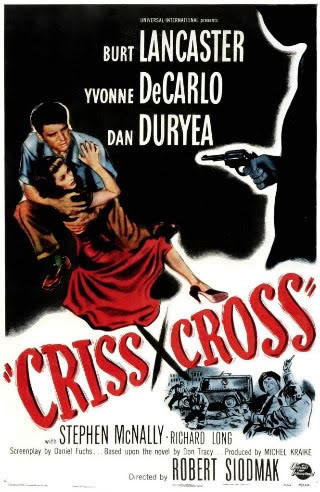
Burt Lancaster, Robert Siodmak, a heist, a hero doomed by fate and his own stupidity, and a rotten to the core femme fatale – all of this sounds a little like a brief synopsis of The Killers. In fact, it refers to Criss Cross (1949), a near relative of that earlier work and a film that vies with it for the honor of being hailed Siodmak’s best movie. Apart from the pairing of director and star, both these films share a similar theme and structure, and I find it almost impossible to decide which is the better one. Ultimately, it doesn’t matter – I like them both and they are two of the strongest noir pictures to come out of the 1940s.

The title of this movie is a highly appropriate one for a tale where the paths of all the main characters are continually intersecting in a web of deceit and betrayal, each crossing up the other at the first opportunity. At the centre of it all are three people – Steve Thompson (Burt Lancaster), Anna (Yvonne De Carlo) and Slim Dundee (Dan Duryea) – bound together by an unholy combination of love, lust and greed. The opening shot, with the camera swooping ominously down from the night skies of LA, sees Anna and Steve caught in a clinch in the parking lot of a nightclub. As the lights suddenly pick them out, their startled and guilty reaction indicates that this is an illicit rendezvous. The fact is further underlined by the terse, tense dialogue – this couple is planning something dangerous, and the possibility of discovery holds a terrifying threat for them. Anna is married to local hood Slim Dundee, but she and Steve were once wed too. Their passionate embrace makes it clear that they have rekindled their old relationship, with the flame burning brightest for Steve in particular. And it’s from the point of view of Steve that the story is primarily seen, with the others moving in and out of the picture at various intervals. He’s a classic noir protagonist, a fairly ordinary guy with limited prospects and a blind spot where no-good females are concerned. A lengthy flashback sequence, accompanied by a suitably weary and resigned voiceover by Steve, spells out exactly how the lives of these three characters converged and the complex ties that continue to bind them together. In short, Steve’s job as a guard for an armored car company has led to his conspiring with Dundee to raid one of the secure vehicles. However, in the noir universe there’s no such thing as honor among thieves and everyone has his own hidden agenda. Steve is the only one of the trio whose motives have some semblance of decency – he’s driven by a kind of desperate love for Anna – and the aftermath of the heist shows just how deep the fault lines of treachery run in this uneasy alliance.

£5

Apparently the untimely death of Mark Hellinger meant that the original script was revised and certain aspects of the story were changed. Be that as it may, the movie that we ended up with is almost impossible to fault and Daniel Fuchs’ script successfully blends the heist and Steve’s obsessive love to powerful effect. Flashback structures can sometimes be confusing or upset the mood of a film but in this case it works perfectly, coming at precisely the right point and filling in the background details that are vital to understanding the nature of Steve and Anna’s relationship. With a tight script, and Franz Planer’s photographic talents, in place, director Robert Siodmak was free to put it all together with his customary visual flair. The opening, which I referred to earlier, pitches the viewer headlong into this complex tale of dishonor and betrayal in incredibly stylish fashion. And it never really lets up from that moment, with one memorable and superbly shot scene following hard on the heels of another. Siodmak uses every trick up his sleeve to manipulate the mood and perspective, from coldly objective overheads to disconcerting low angles and close-ups, interspersed with fast cuts and dissolves. For me, the real stand out scenes, although there’s hardly a poor moment throughout, are the ones in Union Station and in the hospital. The former not only gives a fascinating glimpse of contemporary LA bustle, but also shows the director’s skill in composing a complex series of shots in a crowded environment while retaining control of the geography. In the latter, he uses the reflection from the mirror in Steve’s room to break up the static nature of the setup and extract the maximum amount of tension at the same time.

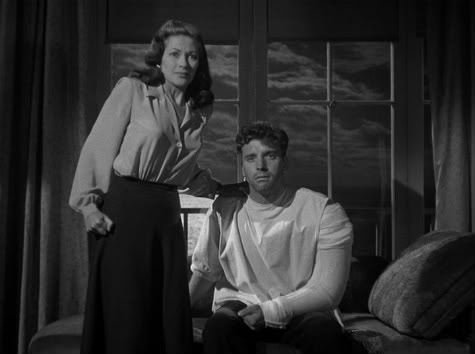
If the technical aspects of the film are straight out of the top drawer, then the same can also be said for the acting. Burt Lancaster kicked off his career with some finely judged playing as the doomed Swede in The Killers, and Siodmak got him to tap into that same vibe to coax another wonderfully nuanced and sensitive performance from him. Once again he hits all the right notes as the big palooka whose dark romanticism sees him suckered by the machinations of a conniving woman. Every emotional state the script calls on him to display is carried off convincingly, from fear and disenchantment right through to the calm acceptance of his fate at the end – from the dumbfounded look of a guy who’s just had his guts kicked out by the woman he loves to the cloying sense of panic of a man under sentence of death and trapped in an anonymous hospital ward.

£4

Yvonne De Carlo didn’t have to go through quite as many stages, yet she’s still excellent alternating between the sassy, sensual broad that forms her public persona and the nervy, desperate woman she becomes in private. When she drops all pretense in the climax and reveals her true character to Steve and the audience there’s a tangible shock to be felt. Dan Duryea was an old hand at taking on the role of the slimy villain, and to that he adds a layer of menace as Slim Dundee. He manages this so well that it’s easy to understand the level of fear and trepidation he provokes in Steve when he contemplates the consequences of crossing him. While these three actors carry the movie, there’s real depth in the  supporting cast too. Stephen McNally is solid and sympathetic as the cop whose friendship for Steve leads him to inadvertently push him into crime. In fact, there are lovely little cameos all through the movie: Percy Helton’s chipmunk featured barman, Joan Miller’s garrulous barfly, Griff Barnett’s kindly and lonely father figure.

Criss Cross has been out on DVD for many years now, and the US disc from Universal is an especially strong effort. It offers a near perfect transfer of the film with clarity, sharpness and contrast all at the high end of the scale. My only disappointment comes from the absence of any extra features, bar the theatrical trailer, for such a quality movie. One shouldn’t really complain, in these days of bare bones burn on demand discs, but this film does deserve a commentary track at the very least. Still, we have got an excellent piece of the filmmaker’s art looking great. Criss Cross is a highly rated production that occupies a prominent position in the noir canon, and it has earned that honour. It’s one of those rare films that checks all the boxes and never puts a foot wrong from its dramatic opening until it’s darkly cynical final fade out. Those who are familiar with the picture will know exactly what I’m talking about, and those who are not owe it to themselves to discover this little treasure. This is unquestionably one of the real jewels of film noir.


Cry Terror!

Hostage dramas usually represent good value as they tend to focus on the trials experienced by the kind of ordinary, everyday people an audience can identify with. Director Andrew L Stone had already explored this theme with The Night Holds Terror, but in Cry Terror! (1958) he mixed in elements of a terrorist/extortion racket too. It’s this aspect which provides the motivation for the whole captive scenario of course, yet it’s also the least plausible part of the story. Thus the whole basis of the drama has a flaw at its heart. Still, the film generally holds together, mainly as a result of an especially strong cast and a couple of extremely well-handled sequences.

Things start off in semi-documentary fashion, detailing a warning delivered to an airline that one of their planes is carrying a bomb on board. This is all seen through the eyes of the airline executives, the FBI and the media before the focus shifts to a television set reporting the breaking story. Jim Molner (James Mason) is watching the broadcast in the shop where he works, and his combined fascination and shock at what he’s hearing makes it abundantly clear that this man has a personal interest in the story. Well, maybe he knew someone travelling on the threatened flight, his frantic dash back home being consistent with that theory. However, his arrival there and the sense of alarm his wife, Joan (Inger Stevens), detects leads to a revelation – Molner was the man who designed and built the sophisticated, high-explosive device. The thing is, Molner is no terrorist or blackmailer; he was suckered into this by Paul Hoplin (Rod Steiger), who intimated that a government position might be available to the designer. Now at this early stage – we’re really only a matter of minutes into the film here – my credibility was stretched. I mean, despite being told of Molner’s military experience, we’re asked to believe that a guy working in a store would be approached out of the blue by a man he once knew in the army with a proposition to build a bomb on this basis alone. Others may not be fazed by this, but I was left scratching my head. Anyway, it’s here that the plot starts to take shape, with the arrival on the scene of Hoplin and his three associates (Angie Dickinson, Jack Klugman and Neville Brand), and the news that another device has been put in place. Having already thrown down the gauntlet, Hoplin intends to extort money from the airline while holding Molner and his family hostage both to ensure his identity remains a secret and to force one of them to act as his courier. So, Molner, his wife and little girl face a twin dilemma: how to wriggle out of the clutches of Hoplin unscathed while averting a disaster. As the Molners cast around for an opportunity to be free of their tormentors, the Feds are painstakingly building up a profile of the criminals from the few scraps of evidence available to them.

As writer and director, Andrew L Stone must take responsibility for both the good and bad parts of the movie. I’ve already mentioned the early strain placed on logic by the script, and there are other instances throughout. There’s also an issue with the tone and focus of the picture: Stone can’t seem to make up his mind whether he wants it to be a documentary style police procedural or something more personal, and the emphasis is continually shifting. Additionally, there are two separate voiceovers used at various points (both Molner and Joan) depending on which character is dominating the scene. All of this has a slightly disorienting effect as it’s difficult to get a fix on any one person for a significant period of time. Leaving aside the duelling voiceovers, the scenes involving James Mason and Inger Stevens are easily the most successful. While I acknowledge that this may be no more than a stylistic prejudice on my part, I found the sections with Kenneth Tobey’s dogged Feds a bit tedious – rather like a 50s version of CSI. Instead of adding to the tension of the story, these parts actively drain it away. It’s only when we cut back to the hostages and their tribulations that the movie finds it feet again. The best sequence involves Inger Stevens in a race against time, having just taken receipt of the ransom money. This is a wonderfully realized piece of filmmaking, where the increasingly distraught woman finds herself mired in New York traffic as the seconds tick away and her husband and child’s lives hang in the balance. Although I was yearning for a release from the suspense another part of me was so taken with the skillful execution of the scene that I wanted it to go on a little longer. While it’s not in quite the same class, Mason also gets to play out a tense escape attempt in a perilous elevator shaft.

James Mason got top billing and he turns in a typically smooth and graceful performance as the man whose lack of foresight has pitched his family into a nightmare. Without criticising his playing in any way, I’d say this is not one of Mason’s most memorable roles, perhaps because he’s handed an essentially passive role until late in proceedings. The more active duties were passed to Inger Stevens, and she handled them very well. Apart from the aforementioned race against the clock, she also had a couple of decidedly uncomfortable scenes where she has to deal with the unwanted attention of Neville Brand’s Benzedrine-addicted rapist. Brand nailed his character’s sleazy creepiness perfectly and the very real threat that he represents brought out both the vulnerability and resourcefulness of Stevens’ harried suburbanite. Rod Steiger’s tendency to chew up the scenery can be a little wearing if it’s given free rein, but he keeps himself under control most of the time here. The calmer face that he displays carries far more menace, in fact I’d say he gets the chilling, calculating quality of Hoplin spot on. Angie Dickinson and Jack Klugman round out the supporting cast nicely as Steiger’s increasingly anxious cohorts.

Cry Terror! is available in the US as a DVD-R from the Warner Archives, but it’s also out as a pressed disc in Spain from Llamentol. The Spanish release boasts a nice tight anamorphic widescreen transfer that’s in pretty good shape. The only extra included is the theatrical trailer, and the Spanish subtitles can be switched off from the main setup menu. On the whole, the film works well enough as a suspense drama. The idea of an ordinary guy being duped into a nightmarish situation that starts to spiral out of his control strengthens its credentials as a late entry into the fading noir cycle. Plot holes and logical inconsistencies can be found in many a movie, so I can live with those. I think the biggest fault is the script’s failure to stick with the plight of the hostage family and instead take regular detours charting the progress of the FBI investigation. It upsets the balance of the picture and lessens the tension at the wrong moments. Even so, the end product is still satisfying enough. Worth checking out, especially if you can get the very reasonably priced Spanish release.

The Bribe

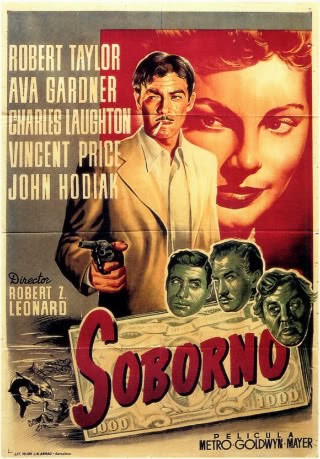
The last non-western I looked at had Ava Gardner suffering in an exotic setting. The Bribe (1949) sees the same actress back sweating it out in a far-flung place, but the results are much more satisfying this time. The film is a borderline noir that employs some of the staples of the form to excellent effect. There’s also a first-rate cast who work hard, yet it’s not a movie without some problems. It opens and closes very strongly; the issue is the overpadded mid-section which ought to have had some of its excess fat trimmed off in the editing room. Even so, the finished product is still worthwhile viewing, largely due to some highly memorable visuals and a couple of fine performances.

Rigby (Robert Taylor) is a federal agent investigating a racket involving smuggled war surplus engines. He’s first seen on the balcony of his hotel room on a steamy Central American island, one of those places where even the lethargic ceiling fans seem worn down by the oppressive heat. There’s a violent storm brewing outside while an internal one is already in the process of churning up the hero’s emotions. As Rigby sweats and smokes, his weary voiceover leads us into a flashback sequence that will occupy the first half of the picture. It all starts off with one of those earnest briefings by the Feds, so beloved of post-war noir, which establishes Rigby’s undercover role. He’s been sent to the island of Carlotta to nail a gang of smugglers and his only lead is a couple of suspects, a married couple in fact. Tug Hintten (John Hodiak) and his wife Elizabeth (Ava Gardner) are two down on their luck expatriates scratching out a living on the island; he’s an ex-pilot with a drink problem, reduced to slumming it as a bartender, while she sings in the same night club. Almost inevitably, Elizabeth is drawn to Rigby, his quiet assurance contrasting sharply with the drunken pessimism of her weak and ineffectual husband. The problem is that the feeling is mutual and Rigby slowly finds himself torn between his sense of professionalism and his desire for Elizabeth. To further complicate matters, it’s soon apparent that Hintten is not working alone. Carwood (Vincent Price) has the appearance of just another tourist but he’s awfully keen on making Rigby’s acquaintance, and Bealer (Charles Laughton) is one of those rumpled chisellers who always have an angle to pitch. Suddenly, Rigby’s life has become very complicated – he knows these four are all bound together as conspirators and he knows his duty, but his attraction to Elizabeth is skewing his judgement and is also being used by the villains as a lever to encourage him to turn a blind eye. As the storm breaks and the flashback leads us to the present, it’s clear that we’ve reach the critical moment. Rigby stands at a moral crossroads; does he take the path of honour and do his job or does he follow the call of his heart? If he’s to choose the former then he has to find some means of doing so without damning the woman he’s falling in love with. Now this is an interesting setup, but the development of the romance slows the pace of the film badly. It’s only in the second half, when matters are forced to a head, that the movie picks up speed again and coasts along towards a quite literally explosive finale amid the carnival celebrations on the island.

For a man with such an extensive filmography, Robert Z Leonard is a director whose work I’m not familiar with. A quick glance through his credits explains that though – he specialized in movies which hold little or no interest for me. However, he, along with cameraman Joseph Ruttenberg, does a fine job of blending classical noir iconography with a melodramatic crime story. Even some decidedly turgid romantic moments are made all the more bearable by the clever use of shadows and light filtered through louvred doors. The fact that The Bribe was an MGM production might give one pause for though too. It may well have been the studio that best typified the heyday of Hollywood, but I wouldn’t rank it among my favourites. The house style usually demanded a kind of populist gloss that tended to preclude any notion of realism or grit. In the case of this movie though, the artificiality that marked out MGM actually works in its favour, that heightened sense of unreality adding to the exotic flavour of the setting. From a purely visual perspective, The Bribe looks splendid. The biggest issue is the way the script allows the essentially uneventful middle of the story to drag on for far too long.

I mentioned in the introduction that there are a couple of fine performances, but I’ll work up to that gradually. I found John Hodiak’s work the weakest of the five main players. His first scene where he’s supposed to be drunk felt amateurish and unconvincing, like a guy who never touched a drop doing an impression of a lush. However, he spends most of the remainder of the movie laid up in his sick-bed so there’s no opportunity to see whether he could have added another dimension to his role. It has to be said that Robert Taylor and Ava Gardner made for an extremely attractive leading couple, and they do have a certain chemistry on-screen. Gardner looks breathtakingly beautiful in some shots and it’s clear that this was a woman capable of making any man reappraise his ethics. Taylor was an actor who I think gets slated too often by critics. His looks often meant that he was underestimated, but age and maturity came to his rescue. His post-war work gets better with each passing year as his tough reserve was increasingly reflected in his features. I reckon his western roles bring out the best in him but he also made some first class noir pictures too; The Bribe may not be his finest, but it’s not bad either. Vincent Price was another who improved as the years passed, and his role as the slimy and conniving Carwood represents a step along that path. Right at the top of the heap though is Charles Laughton, giving a performance that’s slyly captivating. His perpetually unshaven Bealer is a clever combination of the sleazy and the pitiful. In a role that could easily have become deeply unattractive, his expressive features and carefully modulated voice create a character who pulls off the not inconsiderable feat of being simultaneously repulsive and sympathetic.

A while back, I was on the point of ordering the Warner Archive version of The Bribe, but then noticed that the film was also available on pressed disc from Spain. So, I ended up buying the release from Absolute. From reading online comments and looking at screencaps, I think the Spanish release is broadly comparable to the R1 disc. The film hasn’t undergone any restoration and there are minor scratches and marks on the print. Still, there are no serious issues and the contrast and clarity are generally strong. Absolute provide the theatrical trailer and the English soundtrack only; the Spanish subtitles can be disabled via the setup menu. There’s also a booklet of viewing notes included, in Spanish of course, that features the original poster art and lots of attractive stills. The film is an entertaining  yet imperfect slice of noir exotica. Ultimately, the characters, with the possible exception of Carwood, revert to traditional morality and thus dilute the darkness that the script flirts with. It may not be full-blown noir and the script could use a bit of tightening but it’s well worth seeing, if only for Gardner’s beauty and Laughton’s low-life charm.

House by the River

I know everyone won’t agree but I’ve always felt that film noir works well in a gothic setting, where the atmosphere is necessarily thick and crimes (particularly crimes of passion) are a basic ingredient. In addition, the social constraints that govern the characters’ lives and actions help to increase the feeling of pressure, while the ornately forbidding homes where many such stories are played out can be just as menacing in their own way as any rain-slicked urban sidewalk. I think the fact that noir isn’t a real genre is one of its great strengths; this lends it a flexibility allowing theme, mood and look to assume as much importance as time and place. Fritz Lang’s House by the River (1950), dripping in heavy gothic atmosphere, confined for the most part to the titular house, and exploiting the suffocating moral code of its period setting, is most definitely film noir. It’s an interesting and at times visually striking work, but not an entirely successful one. However, I’ll go into the reasons for that later.

Stephen Byrne (Louis Hayward) is a writer, but not an especially successful one. He is first seen seated outside his riverside home and working on a manuscript. When a neighbour comments on a foul animal carcass that the current has been carrying up and down the waterway for days, he remarks that it’s a similar story with his writing – his publisher keeps returning it. Despite the light tone of these comments, the river, and its tendency to return anything tossed into it, plays a significant (and even vaguely supernatural) part in the plot. While his professional shortcomings only serve to hint at a weakness in Stephen’s character, the sly, lustful glances he steals at his attractive housemaid make that flaw obvious. Taking advantage of his wife’s absence, he decides to try his hand at seducing the help. However, his inadequacies manifest themselves again and he botches the attempt. What’s worse is that in an effort to prevent the girl’s cries from alerting the neighbours to his philandering, he accidentally strangles her. These early scenes inside the opulent yet oppressive home, all carved furniture and flock wallpaper, are particularly well staged and shot; the extreme angles and the high contrast photography conveying a sense of claustrophobic menace and terror. Having his brother John (Lee Bowman) stumble on the killing might appear to be just one more calamity to befall this man. Nevertheless, it turns out to be something of a godsend. John, with his stiff leg and retiring manner, is the polar opposite of Stephen, a kind and considerate man whose sense of civic duty is only exceeded by his loyalty to his brother. So, when Stephen begs for his help in covering up what he claims was merely a tragic miscalculation, John agrees to bail him out. With the body of the unfortunate servant bundled into an old wood sack, the two brothers row out on the river at night and dump the evidence. But it’s from this point on that the story begins to twist and turn like the meandering river and continues to do so until the literal and metaphorical tide brings everything back home. As events unfold, the contrasting characters of the two brothers are thrown into sharp relief, John’s stoicism and honour growing as the crisis deepens while Stephen’s venal and deceitful nature gradually consumes him.

Fritz Lang’s films, by his own admission, all deal with human weakness and the criminal actions that follow. House by the River can be viewed as a meditation on moral weakness and its corrosive effects; murder, the destruction of family relationships, and the final descent into madness. The small central cast and Lang’s moody visuals ensure that the tension is never relaxed yet the film doesn’t quite satisfy. When this happens the finger of blame can often be pointed at the writing or direction. However, that’s not the case here; I can’t fault Lang’s work and the story is logical enough in context, although it has to be said the ending is both abrupt and a little too contrived for my liking. No, the problem as I see it is more of focus and characterization. It’s important for any film to have a lead who’s capable of stirring at least some sympathy or sense of identification with the audience. In House by the River the lead is Louis Hayward’s Stephen, and he is such a vile excuse for a man that it’s quite impossible to empathize in any way. In the comments on an earlier post I mentioned that Louis Hayward has never been a favourite of mine, but that’s not the issue. In all honesty, his playing of Stephen is a good piece of work – he really fleshes out the smarmy, snivelling aspect of the man. As I said, it’s a matter of focus; the story is seen primarily from Stephen’s perspective, and it’s more and more difficult as the film progresses to feel anything other than revulsion at the self-serving way he latches onto every opportunity to gain advantage at the expense of those around him. The only “hero” of the piece, although I’m not sure the word’s entirely appropriate, is Lee Bowman’s John. Even if there’s arguably too much of the martyr about him, he does present a human face, a kind of moral compass amid the depravity. However, John’s suffering at the hands of his brother is pushed for the most part to the background, and although we’re rooting for him it’s Stephen’s scheming that remains front and centre. I ought to mention Jane Wyatt’s role as Stephen’s wife as it’s the only other significant part. She does tap into a sort of soulful and vaguely bewildered vibe, but this is essentially a two-man show and she is mainly left to play the puzzled dupe before transforming into the typical damsel in distress.

Over the years I’ve bought House by the River three times on DVD before finding a copy that I consider acceptable. The US edition from Kino is a weak interlaced transfer while the French disc boasts a far stronger image but has forced subtitles that can’t be switched off easily. However, last year’s release by Sinister Films in Italy is an excellent alternative, looking as though it’s been taken from the same source as the French version. The film has been transferred progressively and the image is sharp and detailed with only very minor print damage. The Italian subtitles are optional and can be turned off via the setup menu. By way of extras, the disc also features a conversation between Lang and William Friedkin focusing on the director’s time in Germany and lasts around 45 minutes – a most welcome addition. There’s also an inlay card that folds out into a miniature reproduction of the original poster art. All in all, this is a movie that I’m quite fond of – I’ve highlighted the reasons why I don’t see it as one of Lang’s best efforts, but there’s still a lot to enjoy and admire. For those who don’t yet have the film, or others dissatisfied with the editions they already own, I recommend checking out the Italian disc.