Experiment in Terror

poster286

The common consensus holds that classic film noir came to an end with Orson Welles’ Touch of Evil. Some argue it lasted a little longer, but it’s pretty much universally accepted that the movement was essentially defunct in the 60s. However, film styles rarely have rigidly defined start or stop points; the nature of filmmaking is too fluid for that, and this is especially true of something as nebulous as film noir. So, even if the new decade saw the emphasis shift and other sensibilities start to take hold, there was still some residue of the old noir influence at play. Blake Edwards’ Experiment in Terror (1962) pointed towards the way the thriller movie was to evolve in the coming years yet it still bore some of the hallmarks of the works that preceded it – a dangerous urban environment, a dour and downbeat mood, and ample use of striking, high contrast photography. I’ve always been fascinated by transitional cinema, those pieces which seem to straddle eras, and I enjoy seeing how different styles and movements merge, blend and grow. As such, I think Edwards’ film is an interesting example of the phenomenon.

A nighttime view of San Francisco accompanied by Henry Mancini’s cool and slightly menacing score opens the movie. Gradually the camera tracks in and focuses on one car and its driver; Kelly Sherwood (Lee Remick), a teller in a downtown bank, is making her way home to the suburbs – as it happens, my friend and fellow blogger Michael has just posted a piece on that very opening here on his site It Rains…You Get Wet, and you can check out his full review of the film here. To borrow his words: “…the high contrast images of traffic as lights dancing in the nightfall, beside the luminosity in the landscape of the city by the bay, established its film noir bona fides through pure dark imagery”. As she pulls into her garage a series of quick cuts and close-ups make it clear that something is not quite right. Kelly senses danger and, sure enough, a figure emerges from the shadows to grab the terrified girl and set her nightmare in motion. The intruder’s face is never fully visible but his rasping, asthmatic voice breathes his plans into his captive’s ear. Kelly’s job places her in a somewhat unique position – she has access to money, a lot of it, and  there’s nothing to stop her stashing away a tidy sum and simply walking off with it. And that’s exactly what her assailant wants; Kelly will leave her job with $100,000 in her purse and bring it to him. In return, he promises to cut her in for 20% of the takings, and his generosity even extends to letting her and her kid sister live. As this sinister figure melts back into the night, Kelly slowly starts to regain her senses after the initial trauma. She puts a call through to the FBI and gets connected to an agent, Ripley (Glenn Ford), before the connection’s broken and the wheezing mystery man, pinning her helplessly to the floor, makes it clear that the consequences of any further contact with the authorities will be most unpleasant. However, the Feds are no fools, and once that initial contact has been made it’s only a matter of time before they manage to track its source. Kelly now finds herself in the unenviable position of acting as both bait for the G-men and the stooge for her unseen intruder. What follows is a cat and mouse game with Ripley and his agents lurking the background hoping to use Kelly to draw the would-be bank robber into the open. Kelly’s taking one silkily threatening call after another and relaying them to the FBI, while they in turn are racing against time in an effort to identify and locate the suspect. The first part, the identification, proves reasonably easy – it’s a guy by the name of Red Lynch (Ross Martin) – but tracking him down is another matter entirely. The suspense builds slowly and inexorably as the pressure on Kelly mounts and Ripley’s men scour San Francisco for the whereabouts of Lynch. The tale powers its way along towards a memorable finale at a thronged baseball game at Candlestick Park.

Blake Edwards is arguably most famous for his comedic films, and the bulk of his work as a director lies in that area. Even though he created the iconic TV show Peter Gunn, I don’t believe many people associate him with crime stories. Regardless of that, Experiment in Terror offers strong and convincing evidence that he was more than capable of handling dark, suspenseful movies. The opening scenes of the film pitch the viewer straight into an edgy and unpredictable world where danger seems to lurk in even the most innocuous settings. I think there’s always something very effective about films which highlight the fact that characters can never feel genuinely secure even in their own homes. Here, Kelly Sherwood finds herself under virtual siege, and the proximity of FBI watchers does little to assuage the suspicions of the character, or the viewer, that Red Lynch can get to her any time he pleases. Edwards made great use of real San Francisco locations to help ground the movie but the interior work particularly stands out. There’s a palpable sense of menace throughout, but there are also moments that go beyond that and become positively creepy. I’m thinking mostly of the scenes in the apartment of one of Lynch’s girlfriends – a maker of mannequins whose home is more a chamber of horrors with dummy body parts and impassive visages literally stacked to the rafters. While I guess these scenes could be viewed as a stylistic indulgence that don’t do much to further the plot, they add a lot to the atmosphere of unease. Visually, the film is impressive from first to last and I feel that it’s only a few lapses in the writing that let it down somewhat. I’m referring here to characterization of the villain; Lynch is clearly a bad man, a felon with a long and varied record. Yet, the introduction of a young Asian woman and her son suggests there’s more depth here, another layer to Lynch that’s neither fully explored nor explained. Perhaps the novel from which the film was adapted went further into this aspect but, never having read it, I’m not able comment one way or the other.

Although Glenn Ford gets top billing in this one his is honestly more of a supporting role. He’d started to take on a middle-aged appearance by this time and brought a certain gravitas to the part of Ripley. Movies where menace and hysteria simmer just below the surface need a figure of stability to prevent everything from flying off into melodramatic territory. That’s essentially the function of Ford in Experiment in Terror, and he’s fine as that strong point of reference at the heart of it all. The two most significant roles are those of Lee Remick and Ross Martin, with the former having to do the lion’s share of the work and carry the film for long stretches. Remick didn’t always get the chance to show what she was capable of as an actress and sometimes found herself cast in indifferent roles. Experiment in Terror placed her front and centre though and gave her a meatier part. Rather than going for the easy option and playing it as a stereotypical damsel in distress, Remick brings a lot of welcome resilience to her character. By doing so, she gives a bit more punch to those scenes where she’s in real danger and fearing for her life. Ross Martin’s villain is excellent too, he looks the part and has just the right sinister air about him. Edwards’ decision to shoot his early scenes in a way that concealed his identity works very well and, although the script would have required a major revision to facilitate it, it’s a pity the faceless nature of Lynch couldn’t have been sustained for longer. There’s good support from a very young Stefanie Powers as Remick’s kid sister, one of the main levers Lynch uses to ensure compliance with his plans, and she brings an appropriate sense of innocence to her role. Ned Glass could usually be relied on to add a touch of sleazy charm to any movie he appeared in, and that’s exactly what he does as a chiseling reporter reluctantly helping the Feds. Finally, there’s a touching little cameo from Patricia Huston as Lynch’s ill-fated girlfriend – if nothing else, her presence serves to highlight the ruthless and callous nature of her lover.

Experiment in Terror, as a Columbia picture, is a Sony property. It was long out of print on DVD in the US but has been reissued as a MOD disc and there is a Blu-ray on the way from Twilight Time. I have the inexpensive Sony disc that’s been released in the UK, and I find it more than satisfactory. It’s quite a basic effort with no extra features but the image is very clean and sharp and is presented 1.85:1 with anamorphic enhancement. I think this is a first class example of the evolving nature of crime movies at the time, featuring some of the look and feel of earlier film noir while looking forward to the more explicit realism that was to come. A fine thriller that I strongly recommend checking out.


Gilda

Hate can be a very exciting emotion. Very exciting. Haven’t you noticed that?

I guess one of the defining characteristics of film noir is its subversive nature. It tends to take traditional scenarios and situations and casts its dark and cynical shadows over them, carrying the audience along on a journey into a murky and unfamiliar world. This subversion can apply to the legal system, social matters, or affairs of the heart. Gilda (1946) concentrates on the latter category, spinning its tale of three people locked into a romantic triangle, unable to decide if they love or hate each other and apparently unaware of the distinction between these powerful and conflicting emotions.

The story begins in Argentina at some unspecified point towards the end of WWII. But there’s a timeless, otherworldly quality to it all – the end of the war and the ensuing celebrations are mentioned in a throwaway fashion that’s surely meant to emphasize the detachment of the lead characters from the real world and the more mundane concerns of most people. These people seem to exist and operate within their own self-contained universe, a glamorous yet nightmarish demi-monde, where the bigger picture of world-changing events are relevant only as a kind of Hitchcockian MacGuffin. The opening shot of the movie introduces Johnny Farrell (Glenn Ford), a down on his luck grifter rolling dice on the waterfront and looking for easy marks. His strategy is a high risk one, not just because he’s a gambler but because his loaded dice are sure to attract the attention of disgruntled suckers sooner or later. When the inevitable happens, and Johnny finds himself the victim of a shakedown on a dark and forbidding wharf, his hide is saved by the intervention of a suave gentleman with a handy sword stick. This is Ballin Mundson (George Macready), a casino owner with an interest in shadier and even more profitable ventures. Johnny is nothing if not an opportunist and soon talks himself into employment, and a position of trust, with Ballin. For a time this mutually beneficial arrangement works and everything is sailing along smoothly on calm waters, until a woman appears and brews up a storm. Gilda (Rita Hayworth) is a sexual powerhouse, a woman whose passionate nature and provocative insolence seems to radiate from within. Her sudden and dramatic appearance as Ballin’s wife, after a whirlwind courtship, throws Johnny for a loop and irreversibly alters the dynamic of the relationship between the two men. Gilda’s arrival on the scene has an immediate and profound effect on Johnny – their introduction is a charged affair, and the confusion that Johnny’s barely able to disguise is shared by the audience. The rippling undercurrent of hostility gives rise to all sorts of questions about these people. I’m not giving away much here when I point out that it’s soon revealed that Gilda and Johnny were once lovers, before he walked out on her. And there we have our triangle: a cagey, duplicitous affair where the three protagonists circle each other warily and seem bent on mutual destruction. While it all develops nicely, I’ve always thought that the ending is weak – a little too abrupt and not all that convincing.

In my opinion, the reason Gilda is classified as a film noir is down to the theme more than the look. Cameraman Rudolph Maté does create some characteristically noir images – the waterfront opening, some of the nighttime casino scenes, and the way Ballin seems to blend and merge with the shadows – but much of the movie features bright, flat lighting. The edgy, darker tone stems largely from the setting and plot twists. A casino has a built-in sense of fatalism to it anyway, a place where fortune quite literally depends on the turn of a card or a throw of the dice. When this is combined with the South American setting, and the allusions to ex-Nazis involved in political and economic intrigue, it conjures up that sense of exotic danger that was very much in fashion in the mid to late 40s. Of course all this really only amounts to Casablanca style escapism; the key element that tips it over into the world of noir is the sadomasochistic relationship at the centre of the tale. The film is essentially a love story, but there’s a vicious, unpleasant side to the romance. Everything revolves around the title character, as she punishes both Johnny and Ballin, but in so doing she incurs arguably greater punishment at their hands in return.

The unquestionable star of the show is Rita Hayworth, the role becoming the one with which she would remain most closely identified for the rest of her life. Hayworth herself acknowledged this and it seems she had mixed feelings about it – her frank admission that the men in her life went to bed with Gilda and woke up with her is very telling. Whatever the personal legacy may have been, Hayworth certainly breathed life into what, in other hands, could have been a cardboard cutout character. She was excellent at getting across the contrast between the vivacious bravado that characterized Gilda’s public facade and the uncertainty and self-loathing she felt in more private moments. Her big scene, the one that is endlessly referenced in books and retrospectives, where she tries to provoke a reaction from Johnny with a knowing parody of a public striptease is justly famous. However, it also tends to overshadow the good work she did all through the movie.

While Rita Hayworth is the one most people will remember from the movie, Gilda worked wonders for the career of another of its stars. Glenn Ford, like a number of other actors, had seen service during the war, and Gilda was the film that gave him the boost he needed and raised his profile. Wartime experiences affected a lot of performers, it gave them a different air, a toughness and a touch of weariness too. Ford went on to work in some pretty good noir pictures, Lang’s The Big Heat being the best of them, and he did seem to belong in that world. As he did in his numerous western roles, Ford brought a kind of dissatisfaction with himself to his noir parts. Johnny Farrell has a veneer of cockiness and self-assurance to him, but Ford could always invest his characters with a nervy, slightly uncomfortable quality too. These may be little things yet they add up and make characters more believable and realistic. Although both Johnny and Gilda are flawed individuals, they’re not villainous. But a movie like this needs a bogeyman, and George Macready was a fine choice for the role of Ballin. Right from the beginning there’s a sinister air about him, and Macready’s innate charm and culture accentuates that. The repressed manner and wonderfully distinctive voice add to his calm menace – you honestly get the feeling that crossing this man would be an extremely foolish move. Of the supporting cast, I find Steven Geray the most memorable. This washroom attendant whose contempt for just about everyone, apart from Gilda, sees him making one flip comment after another seems to be given a lot of slack. I especially like the way we never find out exactly what leverage he has – the one time he’s about to reveal it he’s interrupted, and we’re left wondering.

I actually drafted this piece back in July, after I’d seen it one balmy Saturday night in an outdoor cinema in Athens – always a great way to enjoy a classic movie. However, I realized my holidays were fast approaching and so I decided to hold off publishing it. I though I might want to go back and tweak it some, but I’ve decided to leave it just as I’d written it a few days after watching the film. I’ve seen Gilda many times over the years and always enjoyed its dark romance. I wouldn’t say it’s one of those movies that reveals too many new things on repeated viewings yet it’s not the kind that grows stale either. It’s earned its classic status, and it’s well worth visiting or revisiting.

Jubal

Shakespeare and westerns really don’t sound like they go together. However, in the case of the former, the universality of his themes means that the location and period in which the drama takes place is largely irrelevant. And as for the latter, the genre is so flexible that pretty much anything can be tackled within its framework. William Wellman’s Yellow Sky has been described as a reworking of The Tempest, while Jubal (1956) sees the ideas central to Othello transported to a ranch in Wyoming. In a way, the isolated simplicity of the west provides an ideal backdrop for the presentation of such timeless concepts. Like an uncluttered stage, the absence of the trappings of civilization helps to better focus attention on the more important aspects of the story.

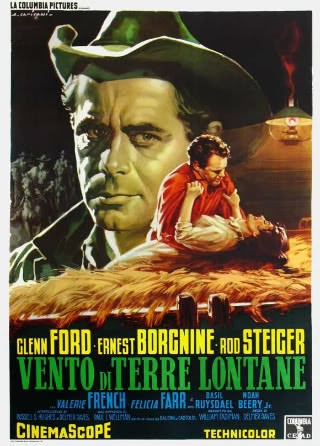
Jubal Troop (Glenn Ford) is a wanderer, a man who has spent his life running; he claims that he’s been trying to escape the bad luck that’s always dogged his steps. In reality though, he’s been running away from himself, or rather his own perceived inadequacies that stem from traumatic childhood experiences. When ranch boss Shep Horgan (Ernest Borgnine) takes him in and offers him a job and a chance to make a fresh start, it looks as though his streak of ill-fortune may be coming to an end. In spite of Jubal’s initial optimism, he soon realizes that he’s actually walked into a highly volatile situation. Shep is one of those salt of the earth types, brimming with hospitality and geniality yet lacking certain social graces. It’s this cheerful disdain for (or ignorance of) the niceties of polite society that has apparently pushed his young Canadian wife, Mae (Valerie French), away from him. I say apparently, because Mae merely uses this as an excuse – it’s clear enough that the remote ranch life and lack of social contact play an equally significant role in shaping her dissatisfaction. Almost as soon as Jubal arrives on the scene Mae begins to show an interest in the newcomer. On top of all this, there’s the problem of Pinky (Rod Steiger), Shep’s current top man and the previous recipient of Mae’s attention. Where Jubal resists Mae’s advances on the grounds that it would be a betrayal of the one man who ever handed him a break, Pinky never displayed such qualms. Now that he’s been sidelined by the new arrival, his resentment and natural antagonism bubble closer to the surface. Due as much to his own petty and spiteful nature as Jubal’s dedication to his job and his boss, Pinky finds himself falling out of favour both as a lover and an employee. It’s this displacement that triggers Pinky’s pent-up jealousy and latent misanthropy. When the opportunity arises, he slyly plants the seeds of doubt in Shep’s mind. And it’s from this point that the classical tragedy at the heart of the story starts to develop fully.

Delmer Daves had a real affinity for the western, his films within the genre all displaying an extremely fitting sense of time and place. In addition, he also had a great eye for telling composition and the use of landscape. His best movies look beautiful, and Jubal takes advantage of the breathtaking vistas that the location shooting in Wyoming offered. The exteriors have a kind of clean, bracing quality to them reminiscent of the mountain air their backgrounds suggest. These wide open spaces are representative both of the freshness of Jubal’s new life and also the remoteness of Shep’s ranch. However, Daves was no slouch when it came to interiors either; he, and cameraman Charles Lawton, create some extremely moody and tense imagery when the action moves indoors. It’s not always easy to achieve effective depth of focus and shadow density when filming in colour, yet Daves and Lawton manage to pull it off time and time again. When you’re telling a story as thematically dark as this it’s vital to keep the mood of the visuals in tune with the plot – Jubal always looks and feels just right at all the critical moments. What’s more, although Daves’ endings had a tendency to be a letdown in comparison to what went before, this movie maintains the correct tone right up to the rolling of the credits.

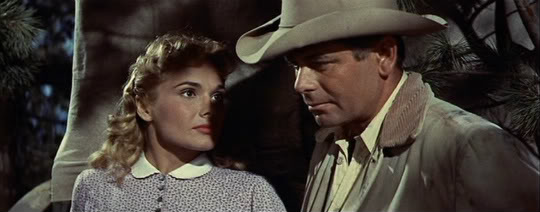
Glenn Ford was an excellent choice to play Jubal Troop, his edgy affability and that slight unease were well suited to the role. The character has an innate nobility and honesty, but there are demons lurking there too, torturing the man with personal doubt and a devalued sense of self-esteem. Ford had a gift for projecting all these qualities on the screen; perhaps that’s why he seemed at home playing in both psychologically complex westerns and film noir. In the following year’s 3:10 to Yuma, Ford and Felicia Farr played out one of the most touching and affecting romantic interludes it’s been my pleasure to see on film. This picture also features a romance between the two, just not as memorable or emotionally loaded as what was to come. Part of the problem is the weaker role handed to Ms Farr, but she still manages to convey something of that bittersweet tenderness in her scenes with Ford that would prove so effective in their next collaboration. The other, and much more substantial, female role was that of Valerie French. There was certainly nothing likeable about the part of Mae, whose infidelity (both real and imagined) sets three men at each other’s throats. Her frustrated sexiness is well realized and, by the end, in spite of her deceit, it’s hard not to feel some sympathy for her fate. Ernest Borgnine’s cuckolded husband draws even more pity though; the way he positively radiates a love for life means that his betrayal really hits home. His brash good humour makes him a favourite of the men, but also leaves him blissfully unaware of the coldness of his wife. When it suddenly dawns on Shep just how much of a fool he’s been, Borgnine’s highly expressive features show very clearly how deeply Mae’s playing around behind his back has affected him. Rod Steiger was always an extremely showy actor, forever in danger of allowing his intensity to spill over into inappropriate grandstanding. As the scheming and reprehensible Pinky, he just about manages to stay the right side of the line – although his tendency towards showboating does raise its head as the movie nears its climax. Among the supporting cast, Charles Bronson makes a strong impression as a hired hand who befriends Ford, and whose intervention at two critical moments help save the day.

Jubal has been available on DVD for a long time via Columbia/Sony in the US. The disc boasts a very good anamorphic scope transfer that looks rich and colourful. There are no extras offered, unless you count the preview snippets for other western titles from the company. The film remains an excellent example of Delmer Daves’ skill at telling a mature and thoughtful western tale. I think the fact that both the director and the star went on to make the better known 3:10 to Yuma a year later has overshadowed this picture to an extent. I’d say that anyone who enjoyed that movie will also appreciate the work on show here. This is yet another strong entry in the western’s golden decade, and fully deserving of any fan’s attention.

The Secret of Convict Lake

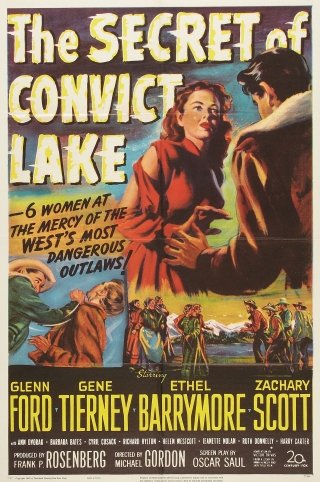
One of the joys of collecting and watching movies is that, from time to time, you chance upon a little neglected gem. Sure, there are the disappointments too but that’s more than balanced out by the buzz of seeing something previously unknown for the first time and liking it. The Secret of Convict Lake (1951) was a movie I’d never heard of before I acquired it. Anyway, I thought I’d give it a go for a number of reasons: the cast was great, the title was evocative, and the cover looked quite cool. Having seen it now, I have no regrets about this particular purchase and it’s a film I can see myself revisiting. It’s a compact little western with noirish undertones and good performances all round.

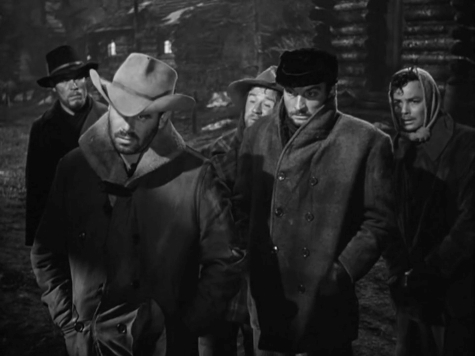
Any western involving snow inevitably gets the thumbs up from me, and this one opens with a group of men fighting their way through a white, mountainous landscape. The voiceover informs us that we’re looking at six convicts (soon to be five as one freezes to death) who have broken out of prison and are trying to keep ahead of the pursuing posse. When a blizzard forces the hunters to abandon the chase, the remaining fugitives find themselves on a ridge overlooking a small settlement. After the hellish trek the collection of small dwellings with soft lights spilling from them look very inviting. A quick reconnaissance reveals that the only inhabitants are women, their men having yet to return from prospecting. Right away the conflict at the centre of the picture is before us: a bunch of frozen and half-starved criminals fresh out of prison are confronted with a community of frontier-hardened females who aren’t shy of guns but nor are they without compassion. An uneasy compromise is struck whereby the convicts are to be fed and lodged long enough to allow them to regain enough strength to continue on their way, but they must keep to their assigned quarters. The women are dominated by a trio of well-defined stock characters: Granny (Ethel Barrymore) is the tough old matriarch, Rachel (Ann Dvorak) a spinster who hears the clock ticking louder every day, and Marcia (Gene Tierney) an outsider with a questionable past who’s engaged to Rachel’s brother. The balance of power among the fugitives rests uneasily between Canfield (Glenn Ford) and Greer (Zachary Scott), with the latter counting on the greed of the others to bolster his position. The thing is that Canfield was convicted of robbery and murder, and the $40,000 he is said to have stolen has never been recovered. Greer wants that money badly but Canfield wants something else, the man whose perjury delivered him to the hangman. The rest of the convicts comprise a thug, a bragging Englishman and a mentally unstable young man with a penchant for killing women. Factor in the added complication that the man Canfield’s seeking happens to be Marcia’s betrothed and the situation bristles with explosive potential. The film’s hour and twenty minute running time packs in a powerful mix of sexual tension and the looming threat of violence before coming to a satisfying conclusion.

£8

The Secret of Convict Lake comes near the mid-point of director Michael Gordon’s career, one derailed by the blacklist. Until then he’d been making B programmers and a few noir pictures, the enforced break would be followed by a move to glossy Ross Hunter/Robert Arthur productions. While this isn’t a straight film noir Gordon’s direction, Leo Tover’s moody photography and Sol Kaplan’s doom laden score all combine to create a darkly atmospheric western. The casting of Ford, Tierney, Scott and perennial heavy Jack Lambert add to the noir feel of proceedings. Glenn Ford was able to play these kinds of uncomfortable outsiders with his eyes closed and Canfield is another in a long line of basically right guys who’ve been screwed over by circumstances. He’s a man who’s been brought face to face with death and has only his quest for justice or vengeance to keep him going. Zachary Scott, on the other hand, is all slime and self interest, prepared to use everyone to get what he wants. His calculating seduction of Ann Dvorak’s frustrated old maid is both creepy and (from her point of view) tragic. Gene Tierney’s natural beauty could never quite mask the demons struggling inside her, but that often worked in her favour on screen. Her Marcia is a similarly troubled soul, a woman with a past she desperately wants to leave behind and who is on the point of marrying a worthless man in order to try to make a fresh start. Canfield’s arrival and his subsequent revelations offer hope and despair in equal measure. Ethel Barrymore gives another variation on her wise old owl turn with a hint of that mischievous eccentricity peeping through – I always appreciate her presence in a movie. A word too for Cyril Cusack, not an actor you expect to see in a western, whose talkative cockney provides Canfield’s ruthless comrades with their most human and sympathetic face.

As far as I’m aware the only release of The Secret of Convict Lake on DVD at the time of writing is the Spanish disc from Fox/Impulso. The film hasn’t had any work done on it but, fortunately, for the most part the image is very strong. There are cue blips and some very minor damage but the elements are generally in good shape leading to a sharp picture with contrast levels that looked fine to me. The downside is that it appears to be interlaced, although I didn’t find that a huge problem to be honest. The mono soundtrack is clear and the Spanish subs are removable by deselecting them via the main menu. Extras are limited to text bios and a gallery. I found the film to be a very entertaining and tightly paced production. There are fine performances all round and, as I mentioned before, a welcome hint of film noir in the script, casting and direction. It’s a strong movie that really ought to be better known, and it gets my approval.

Lust for Gold

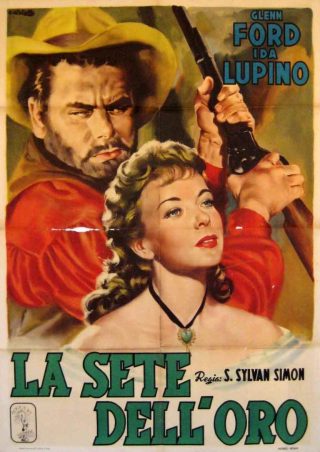
Based on the legend of the Lost Dutchman mine, Lust for Gold (1949) is a hybrid western noir. However, it differs from the handful of other movies in that category on account of its narrative structure. The western part is actually a flashback which takes place within a contemporary mystery story. As far as I’m aware this is a unique approach; I’m fairly sure I’ve never seen the technique used to combine these two styles of film anywhere else.

The film’s opening pitches you right into the action – the snappy voice-over narration gives some brief background information before the latest treasure seeker comes to an untimely end, shot dead by an unseen sniper. There’s a breathless, urgent quality to the narrator’s voice which sets the tone and the pace of the picture. Barry Storm (William Prince) has come to Arizona to try his hand at finding the fabled lost mine that his grandfather, Jacob Walz (Glenn Ford), is reputed to have discovered back in the 1880s. When the explorer he was following perishes at the hands of the unknown assassin, Storm finds himself with two mysteries to solve; one in the half remembered past, and the other much closer in time. While the shadow of death hangs over the present, his research reveals some unpleasant facts about his Grandpa. Walz is shown to be a ruthless and greedy man who has no qualms about murdering three men (including his own partner) to secure possession of an old mine with a blood-soaked history.

Such stories are usually morality plays, and Lust for Gold is no exception; Walz’s fortune is a source of little comfort to him. He starts out as an opportunistic outsider and, though his sudden riches bring the semblance of popularity, he finds himself more alone than ever. The superficial bonhomie of those around him who wish him well masks the envy and disdain they truly feel. This petty begrudgery pales into insignificance though when compared to the scheming and deceit practised by Julia Thomas (Ida Lupino). When this grasping, amoral female sniffs a chance of a fast and easy buck she doesn’t hesitate to dismiss her weak failure of a husband. The only questions are how long she can string Walz along, and how he will react when the truth finally dawns upon him.

Glenn Ford managed well in a role that called for him to be both reprehensible and sympathetic. There’s no doubt that Walz is a cold-blooded killer, but Ford was able to invest a certain childlike innocence in the character. This works especially well in his scenes with Lupino, where buys into her deception because it’s what he wants to believe. However, like any emotionally immature character, his vengeance is terrible to behold. The pleasure he takes in watching his tormentors destroying each other, as they die of thirst among the barren, sun-baked rocks, is akin to that of a small boy pulling the wings off a fly. If Ford is good, Lupino may even be better. Her self-obsessed manipulation of the men around her is the equal of any of the great femme fatales of the noir canon. Her character has not one redeeming feature, and there’s a certain grim satisfaction to be had from seeing her get her comeuppance.

Sony have given Lust for Gold an excellent transfer to DVD. The image is sharp and crisp with barely any damage. The film is out in R1 and is widely available in R2 in continental Europe, though not in the UK; I have the R2 and I believe the R1 is identical. The disc is totally barebones but the quality of the image and the movie itself kind of compensate for that. This is a fine, neglected film that should have crossover appeal for fans of westerns and film noir alike. Both the contemporary and historical parts of the story complement each other, though I feel the western flashback works best. That’s largely due to the aforementioned performances of Ford and Lupino, and the dark, bitter tone. The modern mystery does have a satisfying resolution but it suffers in comparison to the bleakness of what went before. All in all, I recommend it.

3:10 to Yuma

I guess, like everything else, the circumstances in which you view a movie will affect your perception of it. I just rewatched the 2007 3:10 to Yuma the other day having already reacquainted myself with the 1957 version the previous night. Now, I’ve seen the original many times and always held it in high regard although it’s not without its faults. So when I went to see the remake, during its theatrical run, I knew that the central story was a strong one and I was curious to see what it would turn out like. At the time I came away thinking that I had just seen a moderately entertaining but imperfect film. In short, I wasn’t overly displeased. The thing is though, I hadn’t seen the original for a few years at that point. Viewing the two versions so close together has forced me to alter my appraisal of the remake somewhat.

The plot of both films is derived from a short story by Elmore Leonard, and tells of a struggling Arizona rancher Dan Evans (Van Heflin in the original, Christian Bale in the remake) who witnesses a stage robbery carried out by notorious outlaw Ben Wade (Glenn Ford in the original, Russell Crowe in the remake). When Wade is later captured Evans volunteers to escort him to the town of Contention and put him on the titular 3:10 to Yuma state prison. Evans hopes that the money he earns from this will be enough to see him and his family through the drought that’s crippling his ranch. There follows a battle for Evans’ soul as Wade tries to buy, persuade and cajole the desperate rancher into letting him go while the clock counts down and the threat of attack by the outlaw gang draws ever nearer.

Those are the necessarily common elements, but if a remake is to have any purpose it must add to or change certain aspects of the original. Firstly, the 2007 version expands the story and runs about a half hour longer, most of this extra time being used to depict the journey to Contention and introduce more characters. This doesn’t really come off successfully for, despite being crammed with incident, it simply serves to slow down the central thrust of the story: the conflict and relationship between Evans and Wade. Where the original cut straight to the chase, the remake forces the viewer to sit through a lot of implausible action which seems to exist merely to dispose of a few superfluous characters. By the time Evans and Wade reach Contention and hole up in the hotel the momentum has been lost and the tension levels have dropped. The DVD of the 2007 movie contains an extra feature which carries the title An Epic Explored, and that tells a tale. This is essentially a small, intimate story based around two men and covering a short period of time. The 1957 version succeeds admirably in telling this story, whereas the remake has ambitions to be something altogether grander yet falls short of fulfilling them.

The other major difference in the two films is a change in emphasis and tone. The first movie presented Dan Evans as a man in a bad spot and dogged by ill fortune, but there was nothing pathetic or defeatist about him and the viewer can feel for him without ever being asked to. The new Dan Evans is, we are told over and over, a cringing loser who manages to elicit only pity from his captive rather than respect. In fact, even his family are contemptuous of him – Van Heflin’s distraught wife turned up in Contention to beg him to drop the matter and return home while Christian Bale’s other half disappears from the story early on like she just doesn’t give a damn what happens to him, and I’m not sure if I blame her. The ’57 movie showed Evans’ two boys to be a couple of nice respectful kids, while the ’07 one gives us a surly brat who never misses an opportunity to bad-mouth his father, regardless of the company they’re in, and left this viewer yearning to see him on the receiving end of a good hiding. All told, there are far too many jarringly modern touches to the remake; when Bale’s wife upbraids him for not making decisions together and his son throws another insult his way I was taken out of the film completely. Such moments defy all logic in terms of time and place – it’s akin to seeing a bunch of brawling cavemen interrupted by one of their number saying “Wait a minute fellas, surely we can talk this through like civilized men.”

Delmer Daves is a director who I feel has been severely underrated and a comparison of his work with that of James Mangold during two key sequences points this up. Take the scene with Glenn Ford and Felicia Farr first. When they stand on the porch and talk about their former lives there’s a very poignant sense of two lonely people and their sense of loss. As the camera follows Ford back into the saloon there’s a kind of innocent charm about his seduction of Farr, and then the camera zoom and music cue hit the mark perfectly when he asks the colour of her eyes. In contrast, Mangold just has Crowe sidle up behind Vinessa Shaw, grunt in her ear and off they go. The other sequence that highlights Daves’ superior handling of the material is during the lengthy wait in the hotel. While Ford stretches out on the bed he tries to tempt his captor into letting him walk with offers of a bribe. During this exchange the camera cuts back and forth between the faces of the two men, each time the focus zooms marginally closer on Van Heflin and ratchets up the tension. Mangold shoots the same scene mostly static and the result is that the tension doesn’t build and it simply falls flat.  Another problem is the ending of the remake. One criticism of Delmer Daves’ work was that his endings were often a bit of a cop out after what had gone before. The climax of the ’57 3:10 to Yuma was always its weakness but it feels deeply satisfying when compared to the absolute travesty that the remake offers as a conclusion. This is not to say that Mangold doesn’t do anything well. His handling of the action sequences is noteworthy, from the opening stage hold-up (complete with exploding horse) to the climactic gun battle/chase through the streets of Contention. The problem is that these have a comic book, Spaghetti western feel that sits a little uncomfortably with the dour tone of the rest of the picture.

I know Russell Crowe is a fine actor but when I compare his Ben Wade to that of Glenn Ford’s he comes off second best; there’s just not enough charm and too much of his natural oafishness showing through. I also prefer Van Heflin’s Dan Evans to that of Christian Bale but I don’t mean that as a criticism of the latter’s acting skill, rather I would put it down to the writing of the part. Ben Foster certainly outscores Richard Jaeckel as Wade’s henchman Charlie Prince; the role is greatly expanded in the remake and Foster really sinks his teeth into it. I also want to mention Peter Fonda, whose grizzled bounty hunter was one of the best things about the 2007 movie. How can you not admire a man who’s back in the saddle mere hours after being gut-shot and then operated on by a vet – what a guy!

So, I think I can safely say that my preference is for the 1957 3:10 to Yuma. However, people who come upon the remake with no knowledge of or exposure to the original may find it entertaining enough. Sure it’s chock full of implausibilities and boasts an outrageous ending but even I was willing to take these in my stride at first. Watching them consecutively as I did will only throw all those negatives into even sharper relief.

Plunder of the Sun

poster104-1

It is notoriously difficult to pin down what exactly constitutes Film Noir. Everybody seems to have their own list of titles that will variously include or omit a number of marginal entries. This 1953 movie would seem a likely candidate since it has a number of noir characteristics. The action, for the most part, takes place in Mexico, the lead is a down on his luck type drawn into intrigue, and the plot bears more than a passing resemblance to The Maltese Falcon. Furthermore, the director (John Farrow) had a fair noir pedigree, having overseen the likes of Where Danger Lives, Night Has a Thousand Eyes, and The Big Clock. So, does it qualify? I’m inclined to think not, but I can’t quite put my finger on the reason. The upbeat ending crossed my mind, but I don’t really buy into the theory that the style of everything gone before can be negated by the last few minutes – that would rule something like The Woman in the Window out of consideration as noir. Well, let’s just say that I don’t feel comfortable calling it noir – maybe someone else can offer a definitive answer.

The story opens in Oaxaca, Mexico and – via flashback and a noirish voice-over narration – takes us to Havana to introduce the main character, Al Colby (Glenn Ford), as a man on the bum and desperate to find the means to pay his debts and get back to the States. His hopes seem to be answered when he’s approached in a bar by a girl (Patricia Medina) in the employ of a crippled collector of artifacts (Francis L. Sullivan). Colby accepts the offer to book passage on a ship bound for Mexico with the aim of smuggling in a small package containing an old parchment. On board he meets the other main players, a spoiled rich girl (Diana Lynn) and a sinister archaeologist (Sean McClory). From there the action moves to Mexico and a treasure hunt ensues. So, there’s a race to possess a fortune, some dubious history, a fat man and a pair of duplicitous females – like I said, it all sounds like a cousin of The Maltese Falcon.

Glenn Ford is always an enjoyable actor to watch and he handles his fairly undemanding part well enough. Irish character actor Sean McClory looks a little startling with bleached blond hair and sunglasses, but his disbarred archaeologist (can an archaeologist be disbarred?), alternating between between charm and menace, is probably the best thing in the movie. Patricia Medina looks exotic and seductive and certainly fares better than the other female star, Diana Lynn, who has little more to do than impersonate Gloria Grahame.

Much of the film was shot on location in and around Oaxaca and makes good use of the ancient Zapotec ruins and pyramids. Paramount put this out on DVD a while back (before they decided to completely ignore their back catalogue) as part of the Batjac line. It looks very good and boasts a fine selection of extras, including a commentary,  featurettes on Sean McClory and the Zapotec locations, trailer etc. Bearing in mind that the movie clocks in at around 80 minutes, it’s a pleasant enough way to pass the time.