Viewing Notes – A Month with Hitchcock

Without having initially planned to do so, I ended up watching a selection of movies directed by Alfred Hitchcock all through September. I tried to choose those titles I had not seen for quite some time and have been jotting down and recording my thoughts on each in brief as I’ve gone along. Having done so, I figured I might as well assemble them here as an end of month round-up. So here goes:
The Birds (1963)

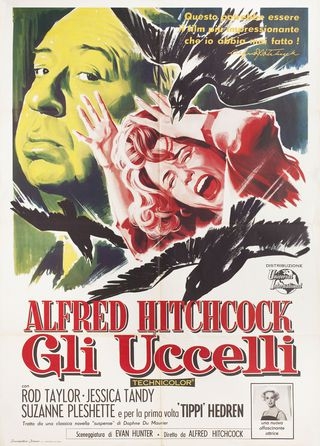
It’s been many years since I last watched this and I’d forgotten just how well constructed it is, not to mention its technical proficiency bearing in mind the era.
That long, slow build-up is the work of a deeply confident filmmaker. It’s never boring or tedious and the gradual, estrogen-fueled tension, with all the cats among the pigeons, is drawn ever tighter in tiny but finely judged increments. When the full chaos is finally unleashed in the apocalyptic latter half Rod Taylor does get to flex bit of muscle, literally and figuratively.
Under Capricorn (1949)

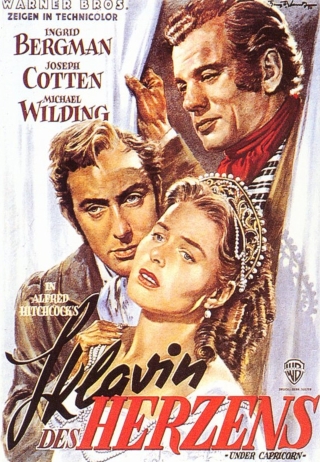
Very much lesser Hitchcock, a movie which barely anyone ever has a good word to say for. Well, I’ll at least say that it is handsomely shot, courtesy of Jack Cardiff, and the acting is fine even if Michael Wilding does lay the whimsy on with a trowel at times.
But yes, it is a problematic movie. And that is largely because it tells a story which is thin, not uninteresting in itself but too thin for its running time. It needed to be trimmed and compressed, which would have been hard to do because of the other great flaw – the director’s insistence at the time on experimenting with long takes. It hamstrung the previous year’s Rope (though that one has other issues dragging it down too) and was a technique that was antithetical to Hitchcock’s style.
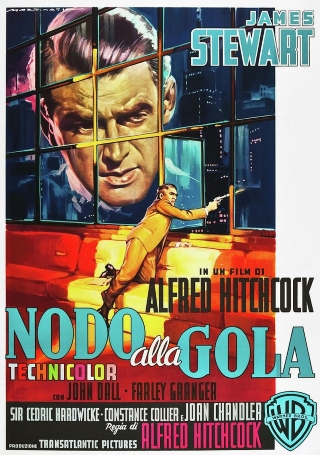
Rope (1948)

I’ve never especially liked this. The technical ambition is admirable, and I’ve always been somewhat hypnotized by the seamless skill involved in the gradual change in the lighting of the studio bound skyline as the tale unfolds in real time. However, the whole continuous take conceit imposes huge limitations on the cast and crew and the process must have been a genuine pain for everyone involved. As with Under Capricorn, the entire business works to undermine the director’s natural strengths.

The biggest problem I have with the movie though is the coldness and indeed the malice at its core. Nobody aside from Cedric Hardwicke’s anxious and compassionate father comes out of it well. That’s not to say it’s badly played of course. Granger could do that weak sister act with his eyes closed and Dall has the clinical and supercilious aspects down pat too – he always seemed to manage that though and there’s a hint of that inherent unlikeability also found in Laurence Harvey in all his parts. James Stewart nails the creeping suspicion that blossoms into horror and then outrage and (self?) disgust. But his character is not really sympathetic either – a man of his intelligence ought to have realized the kind of seeds his intellectual posing was planting.
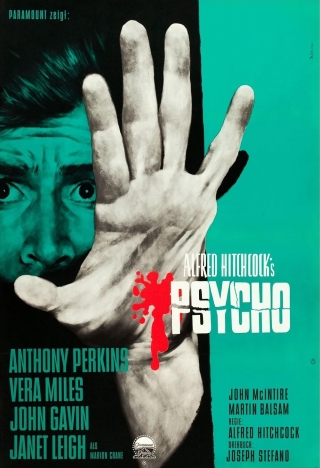
Psycho (1960)

It’s probably 15 years, maybe even more, since I last watched this. The first half always worked best for me and I still feel the same. The paranoia and gnawing guilt of Janet Leigh’s Marion is perfectly encapsulated in the minimalist style of that whole opening section – the rain, the ever more frantic musing, Herrmann’s nervy score and those seemingly permanent close ups of Leigh’s huge, expressive eyes.

And then there’s that frankly sublime sequence in the motel cabin. Cagey and uncomfortable, pathetically flirtatious and taut all at the same time. I reckon it’s the best scene in the entire movie. What follows in the last hour engages me less. It remains visually astounding and technically flawless, but too much of the artful subtlety drains away with the bath water. It still grips and shocks at times, just much more conventionally and it never again approaches the emotional precipice that was teased by the interaction amid stuffed birds, sandwiches and milk.

Nevertheless, it is still undeniably a great piece of cinema, the heights approached and attained in that first hour and the total assurance of a director genuinely in love with his medium are enough to ensure that.
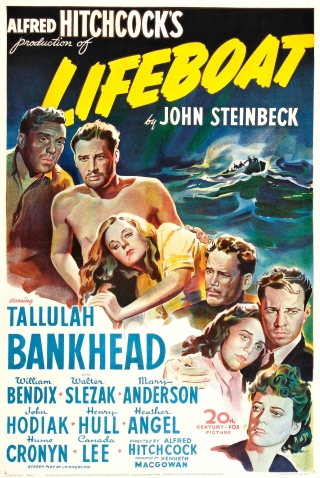
Lifeboat (1944)

A wartime propaganda picture from Hitchcock. Still, being a Hitchcock movie there’s more to it than that – by a circuitous route it winds up as something of a celebration of cohesiveness. Just about every stratum of western society is represented, from Henry Hull’s super rich kingpin to John Hodiak’s blue collar revolutionary, from the stoicism of Canada Lee to the louche decadence of Tallulah Bankhead. All the disparate characters are by turns gulled, threatened and finally drawn together by the malignant presence of Walter Slezak’s cool and cunning Nazi.

It’s another of the director’s challenges to himself, an exercise in the potential of confinement that makes up for in intensity what it arguably lacks in suspense. Alongside the more eye-catching dramatics of those further up the cast list, it’s satisfying to watch the slow development of a gentle romance between fairly regular Hitchcock collaborator Hume Cronyn and Mary Anderson, an actress who never much graduated beyond supporting roles except perhaps in the rarely seen but rather good Chicago Calling.
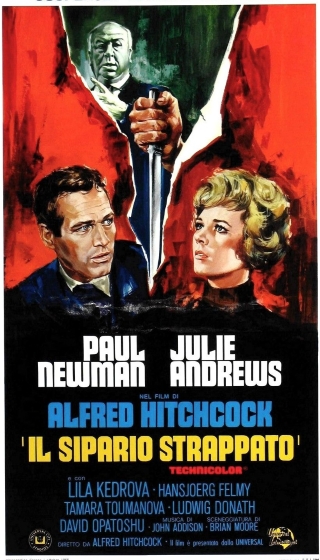
Torn Curtain (1966)

This is the point at which Hitchcock’s decline can be discerned. This Cold War thriller starts out as a double-cross drama where the bluff is drawn out too long before turning into a more successful cross-country chase, the kind of affair Hitchcock could make with his eyes closed.

The first half of the movie misses more than it hits, the brief bookstore scene in Copenhagen errs just on the right side of oddness, but the drab grey/green palate when events move to East Germany reflects the dullness of much of that section, not helped by a listless and detached performance by Paul Newman and an uncomfortable looking Julie Andrews. Some of it does work though – I like the entire build up to the farmhouse scene where the Stasi spook Gromek is laboriously disposed of, and Ludwig Donath is spikily entertaining as a caricatured professor.

The bus ride/pursuit has its moments, helped by John Addison’s slightly eccentric score and an earnest David Opatoshu. There are a few late flourishes too – the hiding among a crowd/creating a distraction ploy is revisited for at least the fourth time – off the top of my head variations thereof are employed in The 39 Steps, Saboteur and North By Northwest if not more.

So, a mixed bag all told. I guess it does more wrong than it does right yet I’ve always had a greater fondness for it than it probably deserves.
Dieterle – Flaws, Fragility & Romanticism

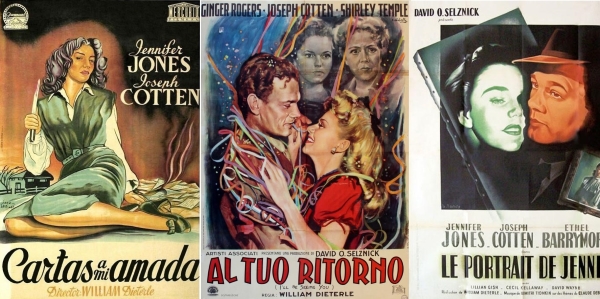
Ford famously labeled himself, somewhat disingenuously perhaps, a director of westerns. Hitchcock styled himself and entered the public consciousness as the Master of Suspense. DeMille cast himself as the consummate showman, the king of the epics. Mann and Boetticher are closely associated with the western, Siodmak with noir. Kramer seemed to want to challenge the viewer’s conscience, Capra went in search of the heart of America. So many filmmakers, so many associations. Watch enough movies and the mere mention of certain names, for better or worse, call to mind particular genres, themes or aims. I found myself reflecting on this recently as I settled down to revisit a trio of William Dieterle movies from the 1940s: I’ll Be Seeing You (1944), Love Letters (1945) and Portrait of Jennie (1948). They are all different movies, they tell different stories in different ways yet they all have in common that overwhelming sense of flawed romanticism which seems to have appealed to the director. Seeing them again in fairly close succession, the impression I was left with, and which I’ve noted before is the compassion and humanism underpinning Dieterle’s work.

Joseph Cotten is the male lead in all three movies and his slightly stiff air that picks at the facade of confidence and nonchalance he presents is routinely on view. In some instances, notably in I’ll Be Seeing You where his character’s PTSD is one of the plot drivers, this vague “otherness” is to the fore. That element is still there in Love Letters, although it is much less pronounced and clearly secondary to the traumatic amnesia of Jennifer Jones’ enigmatic ingenue. And Portrait of Jennie – arguably Dieterle’s masterpiece – raises unresolved questions about his overall grip on reality. There his Eben Adams is an artist whose need for a muse and concomitant quest for a solid basis for his art (reflecting that universal need to seek out a basis for our very existence) plays out as a dreamy fantasy where art, love and time itself are fused magically. Jones again is the fey presence at the heart of it all and it’s interesting to compare her oneiric style of performance to the more grounded approach adopted by Ginger Rogers in I’ll Be Seeing You.

Anyway, watching these films again, thinking about their commonality and the sensibility they share had me assessing my own journey towards ever greater acceptance of the whole notion of the auteur. At one time I was more resistant to the theory, and I know a number of visitors to this site are at least skeptical of it, but I have grown much more comfortable with it over the years. It doesn’t apply to all filmmakers of course and not all had a discernible vision that they impressed upon their pictures. However, when that vision can be detected in a number of major works – as in the case of Dieterle, and this despite the heavy hand of a dominant producer like Selznick in some of those films – then I think the auteur principle deserves to be given serious consideration. I certainly haven’t seen everything by William Dieterle but what I have, regardless of genre, typically touches on that romanticism whose strength lies paradoxically in its imperfection. The three movies I have mentioned here all display this in spades, to such an extent that I find it impossible to ignore.

Duel in the Sun

Deep among the lonely sun-baked hills of Texas the great and weatherbeaten stone still stands; the Comanches called it Squaw’s Head Rock. Time cannot change its impassive face nor dim the legend of the wild young lovers who found heaven and hell in the shadows of the rock. For when the sun is low and the cold wind blows across the desert there are those of Indian blood who still speak of Pearl Chavez, the half-breed girl from down along the border, and of the laughing outlaw with whom she here kept a final rendevous, never to be seen again. And this is what the legend says: a flower, known nowhere else, grows from out of the desperate crags where Pearl vanished. Pearl who was herself a wild flower sprung from the hard clay, quick to blossom and early to die…

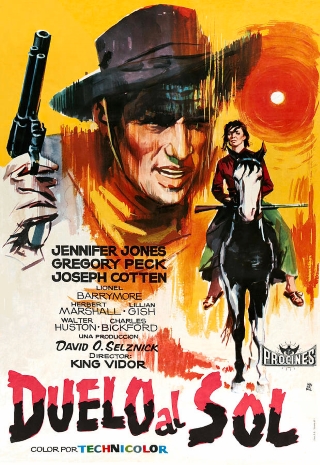
It’s not uncommon to come across critics and writers referring to the operatic qualities of Sergio Leone’s westerns.  I’m not sure I’ve ever seen it applied to other spaghetti westerns, but of course Leone’s films were not really like other spaghettis anyway. Nevertheless, I don’t believe his films were the first westerns this label could legitimately be applied to. To my mind, opera is essentially melodrama set to music; roaring, all-consuming passions explored and exploited with grandeur. Yet excepting a handful of cases, cinematic melodrama tends to get brushed aside somewhat disdainfuly, as though the cranked up passions on display are paradoxically of diminished value. Duel in the Sun (1946) is full-throttle, unapologetic western melodrama, a heady Technicolor cocktail of love and hate, of guilt and desire. It is operatic in scale, mood and ambition, and I feel it must have been an influence on Leone.

The credits roll and segue into an impression of the desert bathed in a twilight glow, Dimitri Tiomkin’s otherworldly score whispers across the sand and rocks, and Orson Welles softly intones those words at the top of this piece. The allusion is towards the epic and the movie, bursting in upon a nighttime street scene, is forever striving to become an epic. There is sweep and scale and spectacle, the frequently breathtaking visuals manfully going toe to toe with a tale which crackles with the power of the emotional currents contained within. This is the story of Pearl Chavez, daughter of a dissipated Creole (Herbert Marshall) and an Indian mother (Tilly Losch). She witnesses her father’s shooting of her faithless mother, and then his subsequent execution for the crime. Before his death though, he sends her on her way to seek out the protection of Laura Belle McCanles (Lillian Gish), his first and perhaps only real love. Laura Belle is married to the wealthy and influential Senator Mc Canles (Lionel Barrymore), a wheelchair-bound bigot whose own family is hardly less dysfunctional than the setup Pearl has just left behind. The idea is to turn Pearl into a lady, a task destined to be thwarted by the girl’s own wilful and untamed nature, the Senator’s undisguised prejudice, and the competing attentions of his two sons.

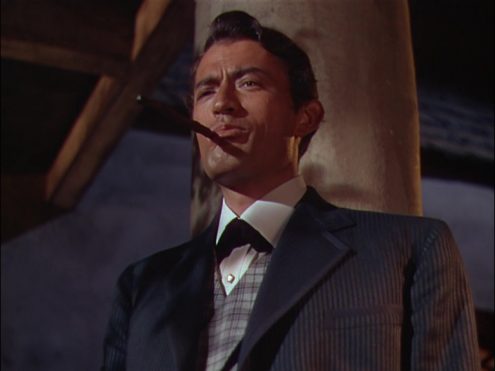
Jesse (Joseph Cotten) is the elder brother, educated and with a broader and more progressive outlook, the latter aspect highlighted especially by his willingness to embrace the arrival of the railroad and the consequent restrictions which will inevitably be placed on the concept of the open range. It’s a common feature in westerns to see the railroad driving back the frontier and pressing ahead with the process of civilization with every sleeper and rail laid. If Jesse can be said to be progressive in this wider, visionary sense, there’s no denying that he also suffers from what might be termed a form of moral idealism, an unfortunate tendency which, at a crucial moment, allows his judgement to be fogged by some latent prudery or sanctimony. Lewt (Gregory Peck), on the other hand, is something of a primal throwback, a reckless man of the moment, impetuous and ruled largely by his instincts and desires. He is his father’s favorite for his full-on machismo and that earthy nature which suggests a greater affinity for the vast and sprawling Spanish Bit ranch. Yet Lewt is as faithless as he is feckless, a self-obsessed man who takes his pleasures where he finds them, spoiled, entitled and lacking any kind of moral compass. He treats his brother with disdain, the world as his private playground, and Pearl as just another glittering toy within it. Pearl herself is every bit as complicated as the men who covet her; she yearns for that illusory respectability her father failed to provide but is too impassioned to ever make the necessary compromises that might attain it. Transplanted into an alien environment, she finds herself assailed on all sides – weighed down by the proprietorial expectations of Laura Belle, shamed and demeaned by the contempt of the Senator, wooed by the decency of Jesse but simultaneously overpowered by her hunger for the no-good Lewt.

Those three points of the dramatic and romantic triangle are brought to life by three well chosen performers. Cotten’s reserve and diffidence is used effectively to show a man capable of professional determination but a more faltering approach to matters of the heart. Peck’s natural confidence is concentrated and twisted into a cocksure egotism. And Jennifer Jones was afforded the opportunity to explore an extraordinarily broad range from barefoot ingenue to abused victim and finally avenging femme fatale.  Generally, it is hard to find fault with the casting of Duel in the Sun. From the decaying patrician weariness of Herbert Marshall to the unvarnished meanness of Lionel Barrymore, the characters who populate the tale neatly capture the flavor of their roles. Lillian Gish had the ability to tap into that fading delicacy that was entirely apposite for a woman whose essential gentility has been broiled by relentless exposure to a husband whose temperament is as caustic and pitiless as the Texas sun. Smaller but by no means insignificant roles are filled by Charles Bickford as the aging and tragic suitor smitten by Pearl, Walter Huston as the larger than life Sinkiller, and Harry Carey as the Senator’s old associate.

Films produced by David O Selznick tend to have a lot of the producer himself in them, his hands on approach practically guaranteeing that. Duel in the Sun saw him producing this adaptation of Niven Busch’s novel and also taking a hand in the writing alongside Oliver H P Garrett and an uncredited Ben Hecht. Somehow the man seemed to be imprisoned by his own success after Gone with the Wind and his struggles to escape and surpass the long shadows cast by that epic production dominate much of his subsequent career. Duel in the Sun has ambition stamped all over it, although it doesn’t always hit the mark. That blend of writers has Lewt appearing too one-dimensional for starters: he’s an out and out villain, self-serving, cold, abusive and murderous. Yet we have to buy into Pearl’s inability to resist him. Sure he ultimately goes too far and pays the price as a consequence, but the fact it takes so long for this to occur is something I find problematic. That said, I guess the overriding theme of the entire piece is that of being trapped by one’s nature. Pearl is in the spotlight more than anyone else, but none of the leading characters seem able to break the bonds built by their own natures either. This is perhaps the real tragedy of it all, a collection of people all fated to live out their lives damaging themselves or those around them.

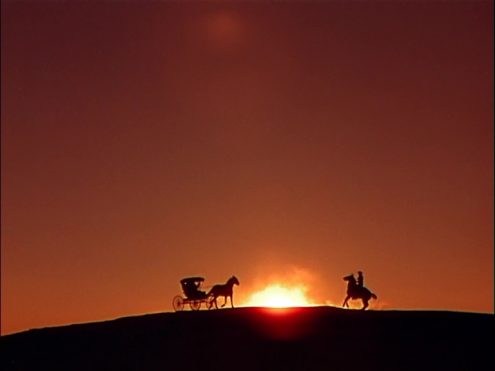
The director’s reins were taken up by King Vidor, who would work with Jennifer Jones again a few years later on Ruby Gentry, and the frustration of working under Selznick apparently drove him off the set. This is one of those movies where a whole raft of people seem to have had a hand, albeit uncredited, in getting it to the screen. Aside from Vidor, Josef von Sternberg, William Dieterle, and Selznick himself, to name just a few, worked on the film. Even the cinematography was shared out by Hal Rosson, Lee Garmes and Ray Rennahan. One might be forgiven for expecting a bit of a disjointed affair as a result of all this but the finished film remains remarkably cohesive. The scenes of the advancing railroad had me thinking of Leone and his similar setups as Sweetwater gradually takes shape in Once Upon a Time in the West. The panache of the various duels that develop as the story progresses leads me to wonder about their influence too – from the barroom confrontation between Bickford and Peck, and that poignant shot of the engagement ring, to the stylized face off between Cotten and a mounted Peck, and of course the final showdown which builds to a truly operatic finale. In among this there are numerous memorable visual flourishes too, the marshaling of the Spanish Bit riders being a good example. However, one of the standout scenes for me is the dawn meeting between Lewt and the Senator as the younger man heads off into hiding. It is shot in silhouette atop a hill with the rising sun in the centre, an almost demonic image as though the flames of the abyss itself were reaching out to reclaim these two scoundrels.

Duel in the Sun has had a number of releases in various territories over the years, with Kino in the US putting it out on Blu-ray. For the present, I’m still relying on my old UK DVD, which generally looks fine and shows off the stunning cinematography well, although there are instances of softness and a few registration problems at times. I am aware this may not be a movie that is to everybody’s taste – it is necessary to tune into those heightened and heated emotions that underpin this type of melodrama in order to appreciate it all – but it strikes me as a title that would be an excellent Blu-ray candidate for one of the boutique labels in the UK. Here’s hoping…

The Halliday Brand

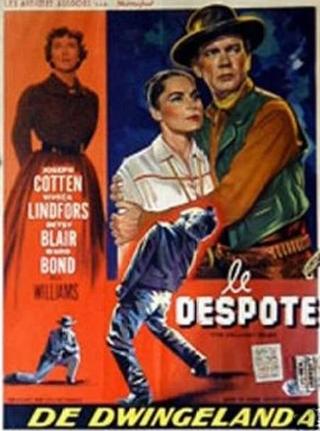
When I started this blog a good many years ago my motivation was to talk about movies, in particular westerns. At the time I felt the genre was somewhat neglected in comparison to others, and that what we might refer to as the medium efforts were passed over with depressing regularity. Films such as The Halliday Brand (1957) were what I had in mind, where a strong cast and crew worked on a project that only a smattering of people seemed to be aware of. This is a movie where the final result isn’t quite up to the level of the filmmakers’ ambition, where you have to admire the stylish execution even as you experience a touch of regret for a promising scenario which doesn’t quite gel.

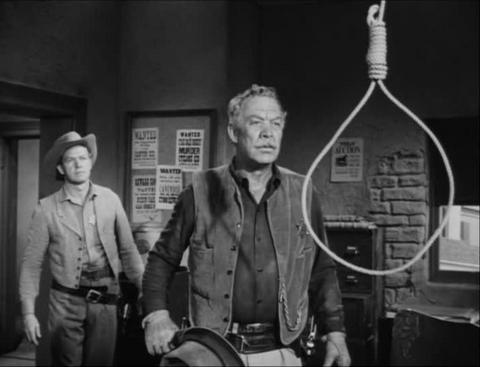
The opening makes it clear that the Halliday family is a troubled one, Clay (Bill Williams) attempting to coax his brother Daniel (Joseph Cotten) back to the homestead at the point of a gun. The reason is Dan senior (Ward Bond), local lawman and hardheaded pioneer, is on his deathbed and keen to see his estranged son while he still has time. Now this is an especially dark tale of familial strife, bordering on film noir in its intensity and tragedy, and it’s therefore only appropriate that its telling should be largely undertaken via flashback. It’s here that we learn how the elder Halliday is so consumed with an unpleasant combination of racial prejudice and stubborn pride that he’s prepared to ignore the advice of his sons and his own inner voice. His inflexibility leads to a lynching that breaks his daughter’s heart, and then a pointless confrontation which drives a powerful wedge between himself and the son who bears his name. And at the center of this emotional maelstrom sits the mystically serene enigma that is Aleta (Viveca Lindfors), the half-Indian girl who has captured the hearts of both Halliday brothers.

I have to say I really like the films of Joseph H Lewis; they may not always be wholly successful but there is an artistic drive and strong visual sensibility at their heart which is hard to resist. The Halliday Brand sets itself up as a classical tragedy played out against a frontier backdrop, which is a noble enough intention and one which has paid off in other productions. Here I think it works only up to a point as it feels as though there are too many themes (or too many facets of themes) competing for the viewer’s attention over its reasonably brief running time. The essence of it all is the Halliday brand of the title – the literal one is the symbol of the buried tomahawk, of conflicts resolved through strength, while the figurative one is the harsh implacability represented by Halliday senior and the barely acknowledged version of the same to be found in the younger generation. One could draw inferences from the casting of arch-conservative Ward Bond as the in such a role but it’s (in my opinion) an optional exercise and the movie still works without doing so – it’s the human drama at the center of it all that counts for more but the layered structure facilitates different levels of appreciation if desired.

Bond is as impressive as ever in his role here, mean and manipulative to the end and an imposing, authentic physical presence. Joseph Cotten is less effective I feel, his natural reserve fits the quieter and more introspective side of his character but his performance feels somewhat mannered at times and could have used a bit more raw passion. Swedish actress Viveca Lindfors sounds like an odd choice to play a half-Indian girl but her striking beauty, photographed with superb skill by Ray Rennahan, works in her favor and I found her credible in the role. In support there is good solid work done by Bill Williams, Jay C Flippen and a virtually unrecognizable Jeanette Nolan.

The Halliday Brand is available on DVD from the US via the MGM Manufacture on demand line. It looks like an older television master was utilized, meaning an acceptable if unspectacular image in terms of clarity and contrast. However, bearing in mind this is a 1957 production, it’s almost impossible to see how the Academy ratio presented on the disc could be correct. That aside, the film is a moderately successful example of western noir – the classical aspirations don’t all hit the mark but the attempt remains a stylish and entertaining one.

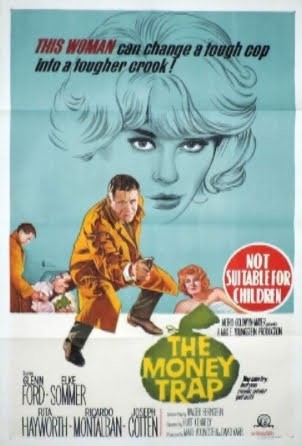
The Money Trap

It isn’t the money, it never is. It’s people, the things they want…and the thing’s they’ll do to get it.

While the consensus is that film noir, weakened and wounded by a shifting media and social landscape, shuffled off into the shadows at the tail end of the 1950s, it occasionally lurched back out of the alley and onto the slick, neon-lit main streets. Wherever tough luck and the fickleness of fate hang out the dark cinema is never far off, and sightings were reported at various times throughout the 60s. The Money Trap (1965) is one of those later versions of the classic form and, to my mind, quite an effective one too.

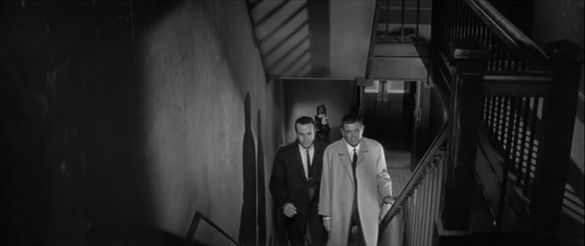
It starts, as it ends, with the aftermath of a killing. The camera is high, observing with cool detachment, the familiar urban setting of streetlights reflecting off wet asphalt. A squad car pulls up to the curb and two detectives alight, crossing swiftly to the ramshackle tenement where the night’s latest offering awaits. Joe Baron (Glenn Ford) and Pete Delanos (Ricardo Montalban) are confronted with the dead body of a young Latino woman, lynched in a bordello by her enraged husband. Although this turns out to be no more than an incidental plot strand, it serves to introduce the seedy and morally skewed world – an “honor killing” such as this is spoken of as being at least partially understandable – where we’ll be spending the next hour and a half. We then move on to see how Baron is living an extremely luxurious existence, far beyond that which a cop’s salary could be expected to pay for. And of course it’s no such a surprise when we learn how the finances are actually down to a rich young wife, Lisa (Elke Sommer), but that supply of cash may not be unlimited. So the need for money is our hook, the line is provided by the main investigation – a burglar shot under slightly dubious circumstances by a well-off doctor (Joseph Cotten) – while the sinker will come in the form of a mini-heist that’s doomed from inception. As it all unfolds Baron, who has been treading a variety of fine lines, runs across Rosalie (Rita Hayworth), an old flame and a reminder of simpler times, and something begins to worry his conscience.

The film has two big themes at work on two levels. In a narrower and more personal sense, there is a yearning for some kind of return to innocence, a desire on Baron’s part to regain some of the purity and promise he once possessed. This plays out in the way he’s drawn repeatedly to seek out Rosalie, yet she’s been bruised and broken by the years and we (and I think the same is true of Baron too) know that he’s really just chasing rainbows on that score. The wider picture is all about front and facade, the flash appearances that ensure nothing is quite as it seems and thus nothing can be depended on. Everybody in the movie is carrying secrets and consequently tell lies to conceal them – policemen are corrupt, wives are potentially faithless, friends may be enemies in waiting and the more respectable the surface, the rottener the core. There are angles everywhere and none of them clean. Should we read something into the fact the one man who speaks of integrity and honesty is a police captain (an uncredited Ted de Corsia) who is only seen  in the morgue?

Burt Kennedy’s great strength was as a writer, especially in those films where he worked with Randolph Scott and Budd Boetticher – even if he had never done anything else outside of those films his cinematic legacy would have been considerable. Nevertheless, Kennedy also worked as a director, albeit with less satisfying results. In that capacity his work tended to be what we might term entertaining without being all that distinguished. A lot of his films have a certain flatness to the visuals, something of the made-for-TV look, although this doesn’t apply to all of them. The Money Trap does suffer from this a little but cameraman Paul Vogel had a sound enough pedigree in classic era noir (High Wall, Dial 1119, Black Hand, A Lady Without Passport, Lady in the Lake etc.) to ensure the right kind of mood was struck when required. Still, I feel there’s some indecisiveness in the overall style of the movie, it’s not a fatal flaw or anything but it is noticeable.

Glenn Ford and Rita Hayworth made five films together, with Gilda probably being the most famous of those. Naturally, both stars had aged in the two decades which had passed but Ford was in better shape, his features reflecting a man with a bit of living behind him and about the appropriate level of weariness for a man who sees the less savory side of life on a daily basis. Hayworth was playing a woman worn down by years of bad luck and booze, and she looked like she knew the feeling only too well. I understand she had something of a drink problem in reality and there’s a degree of authenticity in her performance.

Joseph Cotten could move easily between heroic and villainous parts; he always had a bit of stiffness about him, a distance or remoteness, which lent itself well to darker or more ambiguous roles as the years went by. As such, he was a fine fit for the doctor with connections and he looked like he was enjoying himself as his character slowly reveals himself. Ricardo Montalban had appeared in a couple of quality films noir before this – Border Incident and Mystery Street – and he brought abundant experience to the table as Ford’s partner on the lookout for any get-rich-quick opportunities. And rounding out the principal cast is  Elke Sommer, always easy on the eye and playing a role that has a touch more depth than initially looks like being the case. In fact, it’s Sommer who makes a major contribution to the resolution, which at least hints at something more positive than the build-up might suggest.

The Money Trap is available as a Warner Archive MOD disc, and there are also copies on sale in other territories. The image is generally quite pleasing, black and white CinemaScope usually is and particularly when the print used has no glaring faults. Anyway, I found this an enjoyable piece of post-noir cinema, well acted and, for the most part, nicely shot.

The Third Man

Don’t be so gloomy. After all it’s not that awful. Like the fella says, in Italy for 30 years under the Borgias they had warfare, terror, murder, and bloodshed, but they produced Michelangelo, Leonardo da Vinci, and the Renaissance. In Switzerland they had brotherly love – they had 500 years of democracy and peace, and what did that produce? The cuckoo clock. So long Holly.

And there we have one of the most impish, mischievous pieces of cynicism ever spoken to the camera, essentially a throwaway moment in a movie yet the one that’s most fondly remembered and perhaps best sums up the nature of the character who delivers it. The Third Man (1949) has come to be regarded not only as a classic film noir but one of the true high points of post-war British filmmaking. It remains a dazzling piece of work, urgent, energetic, inventive and beguiling. I’m of the opinion that the greatest films all share one common characteristic: they can be revisited time and again and still manage to reveal different aspects of themselves to the viewer. There’s either a richness of theme or a subtle shading of the characters that allows for a shift in perspective, meaning that as our moods or feelings change over time the films are capable of addressing or coping with that. That’s what struck me as I watched The Third Man for the umpteenth time the other day, the way I found myself responding to the characters in a different light on that occasion.

The story unfolds over a couple of days in Vienna, a city whose Hapsburg splendor has been stripped naked and ravaged by the obscenity of war. Holly Martins (Joseph Cotten), a writer of pulp westerns, arrives in the city breezy and brimming with confidence having been promised a job by an old friend. Holly’s friend is Harry Lime (Orson Welles) and it appears that he’s going to be some kind of publicist for a vaguely defined medical charity. And yet no sooner has Holly set foot in Vienna than he discovers that instead of coming to praise Harry, he’s come to bury him. It appears that Harry met with a sudden accident: crossing the street to speak to a friend he happened to see, Harry is run over by a truck driven by his own chauffeur before being pronounced dead by his personal physician who was passing that way by chance. All very tragic and all very convenient. But coincidence is the preserve of fiction, and it’s not long before Holly realizes that the Harry he knew was really a work of fiction too. Full of righteous indignation, Holly first believes that Calloway (Trevor Howard), the British major, is besmirching his friend’s reputation before changing tack and coming to the conclusion that Harry was actually murdered. It’s during his blundering but well-meaning “investigation” of the circumstances of Harry’s mysterious end that Holly meets his friend’s lover. Anna (Alida Valli) is an actress, beautiful, tragic and enigmatic, almost a metaphor for post-war Europe itself. With his doubts about Harry’s life and death growing larger all the time, Holly begins to fall under the brittle spell cast by Anna. As he becomes more smitten by her charms, he undergoes another change, the ultimate one. The combination of his love for Anna and his understanding of the true character of Harry leads Holly to a betrayal that’s justifiable, perhaps even desirable, on a moral level yet somehow wrong on a human level.

Much has been written about The Third Man over the years, more scholarly and in-depth analysis than I could hope to achieve so I’m not going to attempt to compete with that. The unique locations, the driven direction of Carol Reed, the iconic photography of Robert Krasker and Anton Karas’ distinctive score all blend together to create a masterpiece of unease. Visually the film captures the fragmented nature of the era where everything felt a little skewed and off-center, a hard to define sense that something isn’t quite right, that all is not really what it seems. Of course all this technical and artistic brilliance is immediately apparent the first time one sees the film, and subsequent viewings only serve to underline that quality. However, as I said at the beginning, repeated viewings have drawn my attention to other aspects of the film, namely the characterization. This comes down to the skilful writing of Graham Greene and the performances of Welles, Cotten and Valli in particular. The shadow of Welles and Harry Lime loom large over the whole production, both the character and his interpretation by Welles. For a long time I was very taken by the Harry Lime character, I guess I still am to an extent, and the fact he inspired both a radio show and a TV series proves how widespread that feeling was. But let’s be honest here, Lime was a rotten and reprehensible character, a self-absorbed sociopath without a shred of pity or decency. It’s Welles’ brilliant portrayal – the modulation of voice, the expressiveness of his features and the fleeting twinkle in the eye – that transcends all that. Had anyone else played that role, it wouldn’t have worked. At all.

However, let’s return to those shifting perspectives I alluded to earlier. While Welles and Lime dominate the movie, I’ve found myself paying more attention to the characters of Holly and Anna. Holly is, I suppose, the nominal hero, the everyman through whose eyes we see the story develop. I came to sympathize with him, with Cotten’s no-nonsense portrayal of a guy who has his illusions gradually pared away until he sees things in the cold, clear light of day. I was rooting for him, wanting him to come out on top and get the girl in the end. That masterful long shot that ends the movie used to break my heart. I could imagine myself as the poor schmo getting out of the jeep and waiting for the girl I loved to approach, and then she just walks straight on, eyes fixed ahead and indifferent. And there was Holly, alone and empty, standing awkwardly on an empty road leading to a cemetery. As I watched the film a couple of days ago I caught myself looking at it from a different angle though. This time I was thinking about Anna and the way she is actually the only one of the central trio who displays honor and true integrity. She’s come to understand that her love for Harry was misplaced, even wasted, yet that realization doesn’t invalidate its truth. It was her loyalty right to the bitter end, her implacable refusal to betray her love, both the man and the ideal, that impressed me deeply. So as I say, it’s a film of many layers and every time I see it I seem to peel away another one.

Fortunately, The Third Man is a film which is very easy to see for anyone unfamiliar with it. There are lots of editions available and most of them are attractive. I have the old 2-DVD set released in the UK some years ago which has a very strong transfer and plenty of good extra features to boot. I’ve thought about maybe upgrading to the Blu-ray as it’s a title that gives me a lot of pleasure but I remain undecided. I have a kind of unwritten rule for myself that I won’t upgrade unless I’m honestly dissatisfied with some aspect of the presentation I already own. Watching this one again, I can’t really say that I am particularly dissatisfied, so we’ll see. Anyway, we’re talking about a bona fide classic here, a film which you can return to many times and it never loses any of its freshness. If you haven’t seen it before, then do so at the earliest opportunity. And if you have, watch it again and see what grabs you this time.

The Man with a Cloak

poster29_zps06a02646

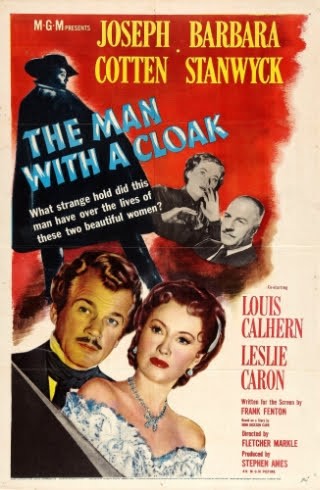
Lots of different things draw us to movies. Personally, I’ve always been a fan of Gothic mysteries, particularly those where the Hollywood majors cooked up that special atmosphere that could only exist within the carefully crafted confines of a studio set. Add in a rare adaptation of the writings of John Dickson Carr and I’m hooked. The Man with a Cloak (1951) combines both of these elements, and it was a film that had intrigued and eluded me for years. It’s been quite some time since I read Carr’s short story The Gentleman from Paris, but I remember enjoying it and was keen to see how the film version worked.

It’s 1848 in New York, the year that saw revolutions breaking out in so many parts of the world. Against this turbulent backdrop a young woman arrives in the US seeking help. She is Madeline Minot (Leslie Caron), a somewhat unlikely fundraiser for a political cause. Her mission is to seek out the assistance of her fiance’s uncle, Charles Thevenet (Louis Calhern), now living in dissipated and debauched exile in the wake of Napoleon’s downfall. Madeline had been expecting to be introduced to a distinguished gentleman, instead she finds a half-crippled drunkard seeing out his days in decaying splendor. Thevenet’s alcohol sodden existence is being overseen by a trio of servants and retainers under the supervision of Lorna Bounty (Barbara Stanwyck). Two things are clear right away: Madeline’s presence is unwelcome in this household, and Thevenet’s protectors are no more than vultures patiently circling their dying master. And so it all comes down to money, Thevenet’s got it and everybody else wants it. While Madeline cannot prove that Lorna and her cohorts are actively plotting to murder the old man, she knows that it’s clearly in their best interests to see that he doesn’t hang around long enough to make any changes to his will. Into this little circle of greed and deceit steps Dupin (Joseph Cotten), the mysterious poet of the title who spends his days cadging free drinks from a sympathetic barkeep. Dupin isn’t motivated by the promise of money, though he’s clearly badly in need of it, rather he’s drawn to the simple faith in life of Madeline and a desire to see an injustice averted. It’s Dupin’s arrival that forces Lorna’s hand and brings the two mysteries of the film center stage: the puzzle of Thevenet’s will, and the real identity of the enigmatic poet.

The Man with a Cloak was directed by Fletcher Markle, a man who is probably better known for his television work. There are some highly effective scenes and a handful of noteworthy visual flourishes, and yet I can’t help feeling that the potential of the story and its setting weren’t fully exploited. The film has that polished look that MGM typically brought to its productions, and the studio sets are faultless. Still, the tension is allowed to slacken too often and that’s partly down to the failure to make the most of the visual opportunities. As for the plot, it’s solid enough but it’s perhaps overly dependent on building up an aura of mystery around the character of Dupin. While it’s adapted from a reasonably entertaining Carr story, it’s not one that highlights the author’s real strengths. In short, there’s arguably too much emphasis on who Dupin actually is – the film is liberally sprinkled with clues and it shouldn’t prove all that difficult to work out for any fairly literate viewer.

While the direction and scripting of the movie are always competent, they are nothing exceptional either. What does give the film a boost though is the acting. Both Stanwyck and Cotten were seasoned professionals, capable of tackling a variety of roles. Cotten spends most of his time hovering around the borders of sobriety, and gets to deliver some witty and telling lines. His character displays a weary cynicism, a sort of metaphorical cloak for the unnamed sadness he carries within himself. Against this is ranged the steely pragmatism of Stanwyck. Her outer gentility and polish masks a barely repressed sensuality and a deep streak of bitterness – after all, we’re talking about a woman who feels she has been robbed of ten of the best years of her life. While Cotten and Stanwyck rarely put a foot wrong, Louis Calhern almost effortlessly steals just about every scene. I sometimes think that if you want to capture a visual representation of regret for a life of unfulfilled promise, then you need only watch one of Calhern’s performances from around this time. In the face of such stiff competition, Leslie Caron fades into the background most of the time. It’s not that her portrayal of a frightened and confused ingenue is especially poor, just that she lacks the presence to make her mark among these heavy hitters. It’s a rare film that doesn’t benefit from a strong supporting cast, and The Man with a Cloak is no exception. Margaret Wycherly looks like she had a ball as a cackling old crone, and Jim Backus is a delight as the Irish bartender trading philosophical jibes with Cotten.

The Man with a Cloak was until recently another of those films that I began to think I was fated never to see. However, it became available via the Warner Archive, and shortly afterwards was given a pressed disc release in Spain via Llamentol. I watched the Spanish disc the other day and, judging from some screen captures I’ve seen, it looks like a clone of the US disc. Generally, the transfer looks pretty clean and sharpness and contrast are quite acceptable. This release offers no extra features whatsoever, just the film with its original soundtrack and the option to watch it with or without Spanish subtitles. I’ve seen people allude to the film’s noir credentials before but I feel the link is tenuous at best, and it’s not a title I’d be comfortable labeling in this way. For me, The Man with a Cloak is simply a Gothic mystery with a generous dollop of melodrama added. Overall, I found this an enjoyable and entertaining movie, though it’s not without its faults. I guess the presence of some big name stars and the fact it was sourced from a John Dickson Carr tale raised my expectations perhaps a tad too high. Nevertheless, I couldn’t say I was especially disappointed. If the direction is a little flat at times, the performances do compensate. Anyone who enjoys these studio bound mysteries, likes Carr’s writing, or is a fan of Stanwyck and Cotten should find enough to satisfy them here.

Those seeking another take on the film should pop over to Paul’s place at Lasso the Movies.


Two Flags West

Civil War films have a reputation for doing poor business, which is probably why the era tends to have been approached somewhat obliquely by Hollywood. There are plenty of movies which feature the war as a kind of background element, something always present in the minds of the characters yet rarely directly shown on the screen. Westerns, perhaps on geographical grounds as much as anything, often used the Civil War and its legacy mainly as a plot device to provide motivation. Students of literature, stretching right back to Aristotle, have recognized conflict as the mainstay of drama – the essential element if you like. Two Flags West (1950) is a film positively brimming with conflict, and not just the obvious Confederate/Union rivalry that is central to the story. That of course is interesting enough in itself, but it’s the personal antagonism among the leads (and indeed within their own hearts) that adds depth and substance.

Two Flags West is one of a small group of westerns – along with Escape from Fort Bravo and Major Dundee – which have soldiers of the Civil War’s two opposing sides forced to co-operate on the frontier. The story here is inspired by the proclamation which allowed Confederate POWs to gain a pardon and have their citizenship restored if they agreed to defend the frontier in the name of the Union. The controversial and divisive nature of this choice is made apparent right from the beginning, when the rebel cavalrymen under the command of Colonel Tucker (Joseph Cotten) are shown to be genuinely torn between the notion of betraying their homeland and remaining true to ideals that are slowly killing them. Faced with the prospect of succumbing to disease and malnutrition, these men narrowly vote to accept the Northern offer and move west to New Mexico where a different war is being fought. Asking a man to turn his back on a cause is one thing, asking him to turn his guns against it is entirely different. Therefore, it’s with the understanding that they will not be forced to take up arms against their former comrades that these men agree to wear the blue tunics of their enemies. The western frontier is virtually defenseless, its outposts manned by a rag-tag bunch of wounded and poorly trained troops. In contrast, the new recruits are skilled cavalrymen and hardened combat veterans.

One would think the presence of such seasoned troops would be welcomed by the men they are coming to reinforce. Indeed, that’s the early impression given by Captain Bradford (Cornel Wilde), the affable liaison officer who makes the initial offer and leads Tucker (now demoted to Lieutenant) and his men west. However, their new commanding officer, Major Kenniston (Jeff Chandler), presents a very different face. Kenniston is a man whose external wounds are as nothing compared to the scars he carries inside. Here is a tortured soul, a man consumed by hatred of the enemy, professional disillusionment and personal frustration. His open animosity towards Tucker and his men, and his frank distrust of their loyalty is immediately apparent. It’s only a matter of time before he forces Tucker’s hand by arranging for the new recruits to carry out the execution of men they later discover were actually Confederate spies. Tucker naturally sees this as a breach of the terms he agreed to, and sets in motion a plan to desert. Now, there’s plenty of dramatic conflict in play at this point, but that’s only one aspect of the story. While questions of loyalty, trust and honor are being thrashed out, there’s also the matter of the Major’s widowed sister-in-law to be considered. Elena (Linda Darnell) is a woman desperate to reach California and her relatives, but that desperation stems from her desire to escape the brooding obsession of her late husband’s brother. To complicate matters further, Bradford is clearly in love with Elena and so has an even more delicate balancing act to master. In short, this isolated fort is like a powder keg waiting to explode, and the fuse that will touch it all off is provided by the mass of hostile Indians raiding beyond its walls.

In writing about Robert Wise’s first western, Blood on the Moon, some time back, I mentioned how his time spent working for Orson Welles and Val Lewton was reflected in the imagery he used. While Two Flags West has fewer overtly noir touches, both Wise and cameraman Leon Shamroy use light and shadow very effectively, especially in the interiors. The opening scenes in the prison camp are enhanced by this technique, although the atmospheric photography can be seen all through the movie. I think the image above is a pretty good example of the artistic lighting and composition which is characteristic of this film: the grim faces of Cotten and the prisoners dominate the frame, while the shafts of sunlight stabbing through the boarded-up windows in the background suggest rays of hope and salvation reaching out to them. However, the film offers more than just moody and suggestive imagery. The climactic Indian assault on the fort is excitingly filmed and gets across the frenzied determination of the defenders facing overwhelming odds, and their consequent sense of hopelessness. Earlier, I referred to Major Dundee as another film whose plot hinged on the uneasy alliance of former enemies facing a common foe. Aside from that similarity in the basic story, it’s also interesting to note that Two Flags West foreshadows Peckinpah’s later picture by featuring scenes where both the Confederate and Union troops sing their respective songs simultaneously. As far as the script is concerned, the writers credited are Casey Robinson, Curtis Kenyon and Frank Nugent. The latter ought to be a recognizable name for anyone who is familiar with the films of John Ford – Nugent was a writer on both Fort Apache and She Wore a Yellow Ribbon. This movie doesn’t paint as intimate a picture of life in an isolated fort as Ford’s cavalry films do, but there are still some parallels to be seen.

Two Flags West is a movie with a very attractive headline cast. Despite stiff competition from his co-stars, I think Jeff Chandler makes the strongest impression. I suppose his early death is a contributory factor but I feel Chandler rarely gets much credit for his screen work these days. He wasn’t a particularly showy actor nor was he one for extravagant displays of emotion. Instead he was another of those brooding types who seemed to keep a lot locked away inside, only rarely letting his feelings bubble up towards the surface. The role of Major Kenniston was therefore an appropriate one for him. Chandler created a very convincing portrait of a man whose personal and professional failings are eating away at his soul, whose own self-loathing is weakening his judgement. Frankly, Kenniston is a martinet and there’s not much to like about him. Having said that, Chandler invests him with great dignity, and his final scene is actually quite moving regardless of how poorly he has conducted himself up to that point. Cast against such an unsympathetic figure, Joseph Cotten’s Confederate officer ought to be the one we’re rooting for. And yet, that’s not really the case either. Cotten had a knack for playing disgruntled, troubled figures, and his portrayal of Tucker taps into that. Yet there’s a kind of sly ambiguity to his role, a slippery irony about him that means we can never be entirely sure of his motives. The result is that while he may be more sympathetic that Kenniston, the viewer can’t fully get behind him. All of this means that the audience is asked to identify most strongly with Cornel Wilde and Linda Darnell. I reckon Darnell’s part is the more successful one, not due solely to her acting talents – both Wilde and Darnell turn in good performances in my opinion – but perhaps as a result of Wilde’s being absent from the screen for long stretches. Among the supporting cast, there’s are nice turns from Jay C Flippen, Dale Robertson and Noah Beery Jr.

As far as I’m aware, the only DVD edition of Two Flags West currently available is this Spanish release from Fox/Impulso. It’s one of the label’s better efforts, boasting a generally strong transfer, although there is some print damage evident, generally confined to a kind of slight ripple or blur that appears sporadically on the right side of the frame. The release is English-friendly with the original soundtrack included and optional subtitles that can be deselected via the setup menu. The extra features consist of a gallery and a few text screens listing cast & crew. Anyone looking to pick up a copy of this movie might do well to hold off a little longer though. Koch Media in Germany are due to put the title out on both DVD and Blu-ray on July 26 – it’s worth bearing in mind that Koch’s products tend to be of very good quality. I like to highlight forgotten and/or neglected films whenever possible, and I think Two Flags West fits the bill. For one reason or another, it’s not a movie one hears about too often and that’s a shame. There’s a good plot with plenty of tension and a fair bit of depth, strong performances and fine visuals. Overall, it’s an enjoyable experience and a title deserving of some renewed attention.

Shadow of a Doubt

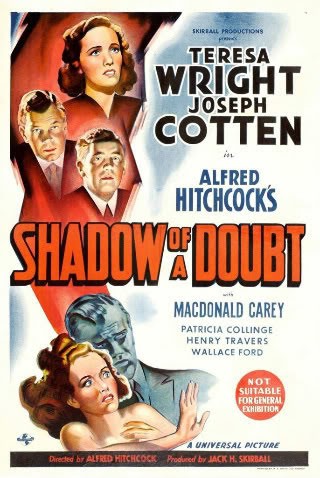
There are people who will tell you that Hitchcock never made a true film noir, and they cite the presence of countless personal motifs littering his work as evidence that what we’re watching is a “Hitchcock movie” as opposed to noir. That’s a point of view I can understand, even sympathize with to some extent, but I still feel that there are a number of Hitch’s movies that do fit snugly into that category. Shadow of a Doubt (1943) is a prime candidate for inclusion due to the dark heart that beats beneath the deceptively bright surface, and the ambiguous attitude it displays towards the villain.

The opening is typical Hitchcock, starting with a cityscape and then zeroing in shot by shot to the window of a grotty tenement. Charlie Oakley (Joseph Cotten) is reclining on his bed, but is interrupted when his landlady comes to inform him that two strangers have been asking for him. It’s made clear that Charlie is being sought in connection with criminal activities. The exact nature of these crimes are only alluded to at first, but the viewers suspicions are allowed to build gradually until it’s finally revealed that Charlie is the killer of a series of wealthy widows – The Merry Widow Murderer. Of course, this isn’t just a standard did-he-or-didn’t-he, hunt-for-a-killer picture; the doubt of the title refers not so much to the viewers as to the villain’s family, and to his niece in particular. In order to find some respite from the relentless manhunt underway, Charlie goes to stay with his sister’s family in Santa Rosa, California. This unexpected arrival is a source of celebration for the sister and especially the niece, also called Charlie (Teresa Wright) in his honour. Young Charlie is on the cusp of adulthood, and bemoaning the fact that her family’s life has descended into a monotonous series of drab non-events. The appearance of the Uncle whom she idolises promises to inject some energy and excitement into her sleepy, small town existence. This certainly seems to be the case at first, as she parades her uncle around town like a trophy or a returning hero. Gradually though, this innocent adulation begins to be eroded by the seemingly insignificant occurrences that begin to pile up. When two detectives masquerading as reporters (Macdonald Carey and Wallace Ford) turn up Young Charlie has her suspicions confirmed. In a marvellously filmed sequence in a deserted public library, the full extent of Uncle Charlie’s crimes is revealed as his niece reads the truth in a newspaper, the camera standing in for her eyes as she has the ground yanked out from under her – the camera pulling back and away to leave her small, isolated and burdened with knowledge in this shrine to learning. The dilemma facing Young Charlie is that she cannot act upon this information without destroying her family, and especially her emotionally fragile mother (Patricia Collinge). The situation is complicated even further when she realizes that her outwardly affectionate uncle can’t afford to let her walk around knowing what she does.

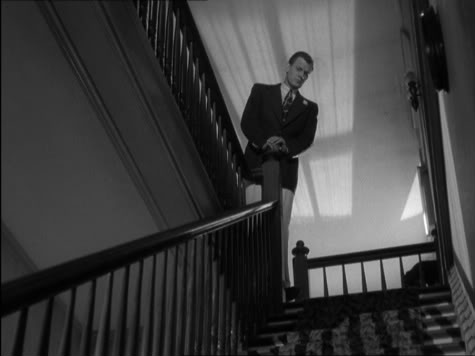
Shadow of a Doubt is commonly referred to as Hitchcock’s favourite film, and it’s easy to see why that would be the case. It’s a dark ode to Americana that’s reminiscent of Capra, an outsider’s view of an idealized world. Hitchcock’s Santa Rosa is not, as I’ve heard it suggested, the home to dark secrets but a wholesome community into which darkness steals (from it’s true origin, the urban center) before being duly expelled. Most of Hitchcock’s trademark visual style is on view, from high tracking shots to zooms and unnerving close-ups. The whole movie is chock full of memorable scenes and shots so it’s hard to pick out favourites. However, two sequences stand out for me: the first is Uncle Charlie’s arrival in Santa Rosa, the train rolling into the spotless station and pumping out a huge cloud of noxious black smoke to represent the evil it carries within; the other (less frequently mentioned) scene takes place when Uncle Charlie has just heard that the authorities have effectively cleared him. As the relieved man struts into the house and bounds up the stairs with a renewed vigour, he pauses halfway up, turns slowly, and sees the slight figure of his niece framed in the doorway below. It’s at this point that we know he’s going to kill her, he has no other alternative – it’s a subtle yet chilling moment that never fails to make the hairs on the back of my neck stand up, even after countless viewings.

Joseph Cotten had that kind of easy charm that meant he wasn’t chosen to play the heavy in too many films. He uses his natural affability to good effect here and is entirely believable as a man who seems to make friends everywhere he goes. It also makes our knowledge of his true nature all the more shocking and adds some real punch to those moments when he lets his mask slide a little. All in all, you can’t help but have a sneaking admiration for him – sure he’s evil, but his evil has such an urbane and attractive sheen that it almost wins you over. Playing against that and holding onto viewer sympathy is a big ask, but Teresa Wright pulls it off. She matures perfectly as the story progresses and the threats to her safety escalate. By the end the viewers are faced with their own dilemma, not really wanting to see harm come to either uncle or niece. The main support comes from Patricia Collinge as the vulnerable and trusting mother. It’s her trust in and deep adoration for her rotten brother that gives real substance to the film, and it’s to her credit that the part retains the requisite emotional pull without becoming cloying. Henry Travers and Hume Cronyn are cast mainly as a kind of macabre comic relief, needling each other of an evening about the best way to bump the other off. If I have any real criticism to make it relates to Macdonald Carey’s detective. It just feels like padding in a film that doesn’t require any; if his budding romance with Teresa Wright was included to strengthen the notion of her growing up then it’s unnecessary, that aspect being more than adequately covered by the meatier sections of the picture.

Universal’s UK release of Shadow of a Doubt on DVD is a very satisfactory one, showing little damage and staying sharp and clear for the most part. There’s a nice selection of extras including the trailer and galleries. Best of all is a half hour documentary on the making of the film that has contributions from Teresa Wright, Hume Cronyn and others. I won’t try and argue that this is Hitchcock’s best film, but it is a very accomplished work. It serves as a study on the loss of innocence and the darkness that lurks behind a polished facade – and it’s a highly entertaining movie.

Journey into Fear

I mentioned recently how films set on trains or in creepy old houses are some of my favorites, I should have also included ships and boats while I was at it. Mysteries and thrillers benefit enormously from these confined settings: the sense of claustrophobia is heightened, and then there’s the knowledge that the hero can only run so far. Journey into Fear (1943) has its hero boxed up on a decaying old freighter in the middle of the Black Sea, surrounded by a gallery of grotesques and living in fear of his life. For a film that runs only a little over an hour it’s packed full of memorable scenes, images and characters that tap into a strong noir vibe.

Howard Graham (Joseph Cotten), an engineer employed by an American armaments company, is in wartime Turkey on business. He’s a typical everyman character and, by his own admission, not a very exciting person. When the company’s local rep decides to take him out for a night on the town, Graham finds himself abruptly swept away into a world of intrigue, assassination and terror. It all begins in a night club where Graham narrowly avoids death. The local man, a fawning and obsequious type by the name of Kopeikin (Everett Sloane), has dragged the reluctant Graham into this slightly seedy cabaret, plying him with liquor and women. During an illusionist’s act, for which he has ‘volunteered’, a shot rings out in the darkness and the magician takes the bullet surely meant for Graham. Before the outraged and confused engineer even has time to draw breath he’s hauled off to a meeting with the chief of the Secret Police, Colonel Haki (Orson Welles), who has him bundled aboard a stinking old tub to spirit him safely out of the country. This is the pattern the movie follows, there’s always someone else making decisions for the increasingly bewildered Graham. Of course he tries to wrest the initiative but, in classic noir fashion, he’s always a victim of fate rather than a master of his own destiny. The scenes aboard the ship are full of menace, emphasised by the low angle shots and the deep, dark shadows that seem to follow Graham everywhere. The threat looms even larger when a short stopover allows the assassin Banat (Jack Moss) to come aboard. This character hasn’t one line of dialogue throughout the film but it’s that chilling silence and the bland countenance masked by pebble glasses and a vaguely ludicrous hat that add to his creepiness. When Graham finally disembarks he makes a break for freedom, but fails to get very far. This does, however, set up a thrilling climax atop a hotel ledge in the pouring rain that ties up most of the loose ends.

Journey into Fear is an adaptation of one of Eric Ambler’s finest novels with the screenplay credited to Joseph Cotten. Being a huge and unashamed admirer of Ambler I’m always pleased to see his work represented on the screen, and this movie retains much of the flavor of his writing. Aside from the scripting credit, Joseph Cotten turns in a good performance as the baffled engineer who’s always on his guard but never quite sure who to trust. His plight is one that’s frankly hard to swallow, and there’s a nice little scene where he tries to convince the ship’s captain of the danger he’s in only to have the grizzled old codger laugh in his face. Dolores del Rio (who had a relationship with Welles) first appears as a leopardskin clad dancer in the early night club scene and maintains that feline aura throughout as she slinks around sexily in pursuit of our hero. The rest of the cast (largely drawn from the Mercury players) mainly turn in small but memorable cameo roles. In particular, Jack Moss, who was in fact Welles’ accountant, turns the blood cold every time his ungainly bulk lumbers into the frame and his impassive assassin remains one of the highlights of the movie. Orson Welles plays another of those larger than life figures that seemed an extension of his own personality to great effect in the few scenes where he appears. His trademark slow-quick-slow delivery and the darting eyes that twinkle mischief one minute and glower thunderously the next are ideal for the shady yet menacing Colonel Haki – incidentally, the character of Colonel Haki is one that showed up again in Ambler’s The Mask of Dimitrios. In truth, Welles’ massive presence dominates the film and his fingerprints are to be found all over the production. Although Norman Foster is credited as director it’s clear to anyone familiar with his work that Welles, at the very least, exerted a huge influence over the shooting. For example, the climactic chase along the slick hotel ledge in the storm uses the kind of dizzying overhead angles that Welles was fond of.

For a number of years now Warners have been promising that a DVD with a restored print of Journey into Fear is on the way in the US, however it still remains a no show. The French company Montparnasse have released the movie in R2 though, and there’s really not much wrong with that edition. The print used is actually in pretty fair shape with good contrast and sharpness, sure there’s the odd scratch and speckle here and there but nothing to fret over. There aren’t any extras save a brief introduction (in French naturally), but if it’s a good print of the movie itself you’re after then the Montparnasse release is very definitely acceptable. Journey into Fear is a stylish little noir film that benefits from the Welles touch and has the quirkiness that’s often found in films he graced with his presence. The pace may feel a little rushed at times but I prefer to think of that as emphasizing the urgency of the situation and the danger the hero finds himself in. It certainly gets my recommendation.