Seven Days to Noon

poster231-1

Tales of terrorists holding civilization to ransom with the threat of weapons of mass destruction have become two a penny. But it wasn’t always so; back in the early days of the Cold War such a concept hadn’t yet been milked for all it was worth. The idea, at that point, was still fresh and perhaps even more terrifying given that the notion of worldwide holocaust was one that people were only gradually coming to terms with. Seven Days to Noon (1950) is a slow burning little picture that adopts a semi-documentary approach, neatly sidestepping gaudy sensationalism in favour of relentlessly rising tension.

The low-key mood is struck from the very beginning, with a postman calmly doing his Monday morning rounds and dropping the day’s correspondence through the mailbox of 10 Downing Street. Among the various items addressed to the Prime Minister is a simple envelope sent by a Professor Willingdon (Barry Jones), and containing an ultimatum that could be either an unpleasant hoax or the stuff of nightmares. The letter in question is passed in due course to the police for further investigation. The man given responsibility for looking into the matter is Superintendent Folland (Andre Morell), and a few simple calls by him establish that this is no leg pulling exercise. Professor Willingdon, the government’s chief atomic research scientist, has disappeared along with a powerful nuclear device. The aforementioned letter lays out his terms: either the government abandons its atomic weapons research or he will detonate the bomb at noon in seven days time, taking half of London with him. That little scene is effectively done with the easy banter between the top policeman and his assistant offering a sense of reassurance, before cutting smoothly but quickly to a close-up of Folland’s suddenly sharpened features as the full import of the words coming down the telephone line dawn on him. With all doubts about Willingdon’s intentions now cleared up, the narrative focus moves to the nondescript little scientist and his trek around the capital. His efforts to remain inconspicuous as the authorities try desperately to locate him make up the bulk of the movie’s running time, intercut with scenes of government departments implementing emergency procedures as discreetly as possible. As Willingdon moves from one seedy lodging to another, all the while agonising over the course of action he’s decided on, there’s a gradual mobilisation underway. The government is in crisis and suspicion is creeping into the minds of a populace still bearing the scars of the recent war. Before panic takes hold the PM addresses the spellbound nation via the radio, and lays the ugly facts before them. It’s interesting that Willingdon finds himself in a museum at the very moment when the government announcement comes. As the PM’s ominous words are broadcast to the grim faced listeners, the little professor stands amid the displays of dinosaur bones – it’s hard to decide whether those old fossils are meant to represent the unyielding determination of the state or the increasingly outmoded humanitarian principles of the troubled scientist pitted against it. The eventual evacuation of the city, as the clock ticks inexorably towards the appointed hour, is an affair of organised chaos, and contrasts with the calm tension of Willingdon as he watches it all in a detached manner with the hapless, tragi-comic woman (Olive Sloane) he’s taken hostage to prevent discovery.

£9

The matter of fact tone of direction adopted by John and Roy Boulting is hard to fault. Even as the situation on screen grows more and more desperate the depiction of it remains steady and never descends into hysteria. The evacuation sequence could easily have fallen victim to an overwrought approach, but instead the cool way it’s shown (with only a few minor concessions to mild panic) adds both urgency and potency. The night scenes of the abandoned city are especially effective; the probing beams of searchlights and the tramping of heavy army boots are the only accompaniment to Willingdon’s final flight across London, dodging down darkened alleys and ducking into shadowy doorways. It’s also a snapshot of a now disappeared world, where crowds gather around communal radio sets to hear the latest government pronouncement and massive wanted posters of the fugitive scientist are plastered everywhere. It reminds us that there was an age before rolling news coverage and instant tweets and texts when panic could be held in check for a time rather than openly encouraged. If aspects of the film hark back to an earlier period, then others remain stubbornly prescient. The moral conundrum at the heart of the picture is every bit as relevant today as it was sixty years ago, and questions about the price of progress are still unresolved. Barry Jones was a fine piece of casting as the figure at the centre of the storm, his gentle features indicating an essentially good man driven to the brink of madness by the colossal responsibility he’s borne, the isolation imposed by that responsibility and the moral uncertainties he feels. He’s no wild-eyed fanatic with a grudge but a man with a conscience who’s allowed his sense of balance and proportion to slip. Similarly, Andre Morell, as the policeman tracking Willingdon, is no two-fisted superhero. Instead, we get an assured and competent professional who knows full well the extent of the threat he’s facing. There’s a wonderful economy to his movements that highlights the pressure he’s under and his features have a controlled expressiveness that get the tension across far more succinctly than any amount of histrionic hamming.

Seven Days to Noon is available on DVD in the UK from Optimum. The film was initially issued in a false widescreen transfer (an impossibility for a production of this vintage) but later withdrawn and replaced with a corrected version presenting the image at 1.33:1, as it should be. The transfer is a clean, sharp affair with good contrast and minimal damage. The disc is, however, totally barebones with only the main menu and scene selection offered. Still, it can be had for a very good price and the film is strong enough to speak for itself. It’s a tight little thriller with an intelligent script, solid central performances and offers an attractive combination of the quaint and the timeless. If you’re looking for some food for thought along with your entertainment then this is recommended.


Cash on Demand


poster224

Well it’s almost that time of year again. Therefore, it’s also time to feature a few films that in one way or another relate to Christmas. Aside from the big, traditional crowd pleasers it’s always nice to give a bit of attention to those other movies that can sometimes get lost in the mix. Cash on Demand (1961) is a good example – an obscure little Hammer production whose reputation ought to rise now that it’s finally available to view on DVD. It’s a tight and incredibly suspenseful little thriller that skilfully weaves a seasonal message into the tense plot and leaves the viewer feeling satisfied.

It’s December 23rd and a small provincial bank is opening up and preparing to welcome the first customers of a wintry day. The staff arrive one by one and greet each other in the familiar and informal way of those long accustomed to working together. Thoughts run to the upcoming staff party and the atmosphere is warm and cosy. However, the arrival of the branch manager, Fordyce (Peter Cushing), causes a definite chill to settle over the establishment. Fordyce is a fastidious and uptight man, almost to the point of caricature. His overwhelming sense of propriety not only dampens the pre-Christmas humour of his subordinates, but leaves them feeling both threatened and vulnerable. A minor error on the part of one of the staff is latched onto and blown out of all proportion. Fordyce even goes so far as to declare that he’ll have to seriously consider the future of this long serving employee. The whole dynamic changes, however, with the unexpected arrival of an insurance company representative, Colonel Gore Hepburn (Andre Morell). Hepburn explains he is on a tour of the banks covered by his company in order to inspect their security arrangements due to the increased risk of robberies. In fact, Hepburn is not all he claims to be, and it soon transpires that he is merely using this cover story as a means to gain access to the bank and carry out a raid on the well stocked vault that is both audacious and ruthless in its execution. From this point on the story turns into a psychological duel between Fordyce and Hepburn, with the latter rarely relinquishing the upper hand. This all plays out both as a straight thriller and a new spin on the Scrooge story, with Hepburn’s tormenting of Fordyce serving the dual purpose of facilitating his co-operation while also teaching the fussy branch manager an object lesson in the importance of charity towards his fellow man. It could be argued that the ending cops out, but I’d say that were it not to finish up the way it does then the story’s whole point would be lost – and with it much of the magic that distinguishes the movie from countless other heist pictures.

£21

Although director Quentin Lawrence made a handful of cinema features the bulk of his work was in TV, and that background actually serves him well here. The tighter pacing and limited sets common to the small screen are to the fore in this movie. The action (which is essentially played out in real time) is for the most part confined to the bank, and particularly Fordyce’s office and the underground vault. While I wouldn’t exactly call it claustrophobic, it does have the effect of focusing the attention on the actors. Not wishing to take anything away from the support cast, but this is basically a two-hander between Cushing and Morell. The pair had formed a successful partnership two years earlier in Hammer’s The Hound of the Baskervilles and this film gave them the opportunity to team up again, albeit in very different roles. Cushing’s portrayal of Fordyce is really spot on, all icy efficiency and repressed emotion at the beginning but gradually cracking under the enormous pressure to reveal a lonely soul who elicits genuine sympathy. There’s nothing fake about the transformation in Fordyce’s character, the change of perception coming about slowly and convincingly as Hepburn mercilessly strips away the veneer to expose the true man. If anything Andre Morell just about trumps Cushing’s work in this one. He plays Hepburn as suave, smart, hearty, calculating, ruthless and wry – often all within a single short scene, and always with absolute conviction. The result of all this is that the viewer’s sympathy is continually being toyed with to such an extent that it’s almost impossible to decide who you’re really rooting for. It’s a treat to watch these two old pros holding the floor for virtually the whole movie, and doing so in such a mesmerizing fashion.

Currently, Cash on Demand is only available on DVD as part of the Hammer- Icons of Suspense set from Sony in the US. The film has been transferred at 1.66:1 anamorphic, and it’s very clean, sharp and detailed. Since all the titles in the set come two to a disc it may be that the bit rate suffers a little, but that’s not an issue that I can say I noticed when I watched it. There are no extra features at all, although the highly attractive price and the fact that the whole set offers six extremely rare Hammer thrillers offsets any complaints on that score. This is a film that I first saw at least twenty years ago when it got a TV showing, and then not again until I picked up this set. It’s one of those unusual movies that sticks in the mind once viewed, and it was high up on my list of wants for a long time. The Icons set is one of my favourite releases from 2010 and the presence of Cash on Demand is a large part of the reason. It’s well worth tracking this one down.


The River’s Edge

Some movies are especially difficult to define or categorize. Allan Dwan’s The River’s Edge (1957) is certainly such a film; it’s a blend of modern western, noirish thriller, and lush and lusty 50s melodrama. While it’s possible to argue over which one of those labels comes closest to summing it up, it’s clear enough that this is a B movie which was given the glossy treatment. As such, this is an impressive piece of budget film production, dealing with those classic themes of money, greed, jealousy, love, and there’s a level of casual brutality not usually found in films of the period.

The story concerns three people: Ben Cameron (Anthony Quinn), his new wife Meg (Debra Paget), and Meg’s former lover Nardo Denning (Ray Milland). Right away we can see that Cameron’s relationship with his wife is not all it should be; she’s tottering around his ramshackle ranch house in high heeled slippers, struggling with the lack of modern conveniences, while he’s struggling with steers outside. The thing is Meg is a city girl, actually she’s con artist on the lam, while Cameron is a salt of the earth type whose greatest ambition is to make something out of his fledgling ranch. These two have hooked up together and are trying to make a go of it, but it’s starting to come unravelled. At the critical moment, who should turn up at Cameron’s door but his wife’s old flame Denning, apparently looking to hire a guide to take him on a hunting trip into Mexico. Meg takes off with Denning, at least as far as the nearest motel, and it’s unclear at this point whether she truly means to leave her husband for good. At any rate, she never gets to fully decide as a car ride results in Denning killing a border patrol man in a fairly shocking manner. With Meg now implicated in the crime, and with the knowledge that Denning is carrying a suitcase stuffed full of cash, Cameron has a change of heart and decides that he’ll take the two former partners over the border to safety. The rest of the film charts the shifting nature of the characters’ relationships and motives. At the begining none of them act out of anything but naked self interest: Denning just wants an out and doesn’t especially care who he has to buy or kill to achieve it, Meg wants to escape from the drudgery and dullness of the remote ranch, and Cameron has his hungry eyes on the cash. Everything is complicated by the fact that both men are still love with Meg, and she has no qualms about playing one off against the other and flitting back and forth between them. The real turning point, for her character at least, comes after she gets a serious infection from a cut arm. When Cameron hacks away the poisoned flesh in a storm ravaged cave it’s as though some of the poison also drains away from Meg’s heart. From then on, the positions are clearly defined and the only question remaining is who will survive the hazards of the wilderness and walk away with the money.

In the latter years of a very long career Allan Dwan specialised in churning out slick little B movies on a budget, and The River’s Edge is a good example of this work. He packs a whole lot of story into less than 90 minutes and makes it all look a good deal more expensive than it has any right to. The combination of location shooting and studio sets blends together well and the use of colour is stunning in places. He also displays what might be termed a more modern approach to violence and death than was normally the case at the time; the three killings which take place, although not graphic in the current sense, occur with an abruptness that retain the ability to shock. The three leads are very professional and do their level best to lift the movie above its pulp roots. Ray Milland was of course in his twilight years as a leading man but just about pulls it off, his charming sadist who may yet have a small grain of decency buried deep is effective enough to distract you from the fact that he was probably too old for the part. Debra Paget (with a flaming red hairdo) is a fine femme fatale who’s by turns calculating, ruthless and affectionate. Her character arguably goes through the greatest arc of the three, and she handles the move from a scheming bitch to a woman who’s regained some sense of honour quite capably. Anthony Quinn starts off as a basically weak loser who can’t even summon up the will to hang onto his woman, but by the end he comes good and redeems himself somewhat. I say somewhat because there’s still an element of doubt and a shadow of greed hanging over him.

The River’s Edge came out on DVD in the US a few years ago from Fox in a very attractive edition. The transfer is anamorphic scope and the print used is very clean and colourful. The disc has a commentary track from James Ursini and Alain Silver, and a few trailers and a gallery. This is the kind of movie that probably wouldn’t stand a cat in hell’s chance of seeing a DVD release in the current climate, all the more reason to appreciate its availability. There is no way that The River’s Edge could ever be termed a classic movie, but it is a tight and entertaining little thriller given a highly professional polish. Everything moves along at a lick and there are far worse ways of spending an hour and a half. All in all, it serves as a pretty good introduction to the later works of Allan Dwan.

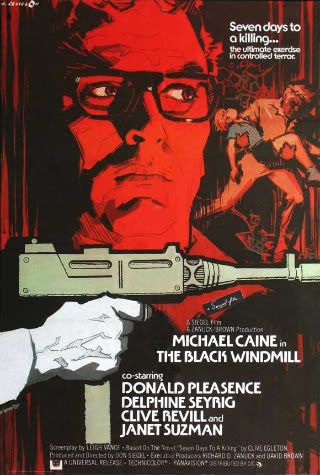
The Black Windmill

Poster

When a film gets panned by critics there can be a number of reasons why; it may just be a bad movie, or it may simply be a step down from the director’s/actor’s previous work. I’d say the latter is certainly the case with The Black Windmill (1974). Don Siegel had just come off a run of high quality films and this slow burning espionage thriller didn’t quite match up. In truth it’s not a bad film, it has moments of real style, but there is a flatness about it that’s hard to explain.

John Tarrant (Michael Caine) is a former army officer who’s now in the employ of MI6, and is shown to be involved in setting up a sting operation to net some international arms dealers. It’s clear that something else is taking shape in the background though – the opening sequence has just shown the kidnapping of two schoolboys by those allegedly involved in the gun running. One of these boys turns out to be the son of Tarrant, and it quickly becomes apparent that the abduction is being used as leverage to extort money from British Intelligence. It’s also clear that those behind the abduction have the kind of inside knowledge (the nature of the ransom demanded) that suggests the presence of a mole. Tarrant’s superior, Harper (Donald Pleasence), suspects that he may even have orchestrated the whole thing himself, while his estranged wife (Janet Suzman) blames him and his job. Thus Tarrant finds himself in the unenviable position of having to cope with both the suspicions of his bosses and the recriminations of his wife as he struggles to retain the composure and coolness needed to effect the release of his son. When it dawns on him that Harper has no intention of meeting the kidnappers’ demands Tarrant chooses the only option that remains open to him – going “rogue” and risking the wrath of his own people.

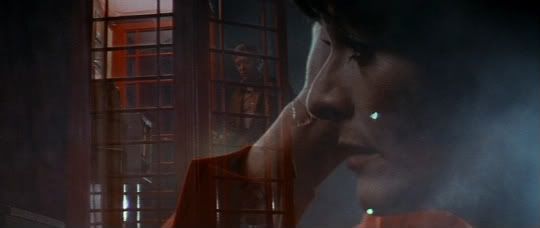
Fading into the shadows - Michael Caine and Janet Suzman.  

Don Siegel made a lot of different kinds of movies but the espionage thriller wasn’t really his strong suit and he struggled to leave his mark on The Black Windmill. A couple of years later he would return to the genre with greater success in the more action driven Telefon, which remains more consistently entertaining. It’s really in the latter half of this movie that you actually become aware of the fact that you’re watching a Siegel picture. The chase through the London Underground and the escape sequence in Paris are well filmed and add a much needed sense of urgency as events build towards the violent climax at the titular windmill. In contrast, the first half unfolds at a fairly leisurely pace as characters are introduced and the groundwork is laid. There’s also a tongue in cheek aspect to these earlier scenes; one inspired moment during an MI6 briefing has a room of stunned bigwigs informed that one of the enemy agents is Sean Connery! There’s another nod to Bond in a scene where Tarrant and Harper watch a demonstration of an exploding briefcase carried out by a Q clone. Much of the film’s humour derives from the performance of Donald Pleasence as the fussy and prissy head of MI6. Michael Caine, on the other hand, plays it straight all the way through and is good enough as the agent who has to keep his emotions under tight control. When he finally gives vent to his frustration at the bureaucratic caution that might lead to his son’s death it comes across as more powerful given the detached facade he’s been presenting up to that point. Janet Suzman is limited to bouts of anxiety and bitterness at the beginning but gets to show off her resourcefulness as the story progresses. The two main villains of the piece are John Vernon and Delphine Seyrig – they’re both suitably ruthless but their characters are ultimately one dimensional.

Universal’s UK DVD presents the film in anamorphic scope, and the transfer is very clean and smooth. This is another fairly basic disc, no extras offered at all, but the the image is pleasing enough and anyway it’s not one of Siegel’s or Caine’s better known movies. All told, The Black Windmill is a middling film; it’s not the best of the director, star or even the genre but it’s still reasonably entertaining. If you make it through the slightly plodding beginning it does pick up the pace and gets better as it goes along. I’d give it a cautious recommendation if you’re into spy thrillers, but those expecting a typical Don Siegel movie would likely be disappointed.

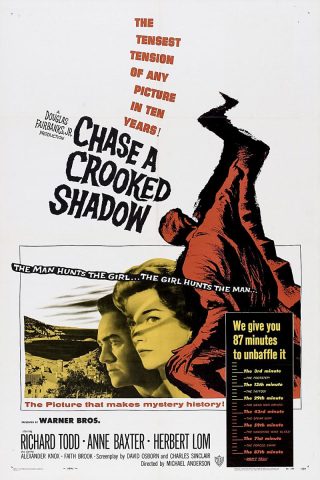
Chase a Crooked Shadow

Throughout the 60s Hammer produced a smattering of what have come to be referred to as “mini-Hitchcocks”, due to the acknowledged influence of Psycho. Broadly speaking, these movies usually featured a damsel-in-distress plot where all was not quite as it seemed at first glance. While it’s undeniable that Hitchcock’s 1960 shocker played a significant part in bringing about these films it seems to me that they also owe something to Michael Anderson’s 1958 suspenser Chase a Crooked Shadow: there’s a small cast, an isolated and endangered woman with a question mark over her psychological state, and men whose motives and loyalties are not always clear.

Kim Prescott (Anne Baxter) is a wealthy heiress living in a sprawling villa in Spain. Her father was a victim of suicide and her brother has perished in a road accident in South Africa – or so it would appear. After a late night gathering at the villa, when all the guests have departed, a stranger turns up claiming to be the brother back from the dead. Ward Prescott (Richard Todd) alleges that he was turned over by a guy he gave a lift to, and that the thief was the one who died in the smash-up. Kim remains unconvinced, determinedly so in fact, and calls in the police. Vargas (Herbert Lom), the local police chief, can find nothing wrong with Ward’s credentials and is powerless to do anything. Within a disconcertingly short period of time, Ward has taken up residence in the villa, hired his own new staff, and is causing Kim to question her mental state. She maintains both her hostility and her disbelief yet is unable to convince anyone else that this man in her house is an impostor. The viewer is left to wonder who is telling the truth and, if Ward is indeed merely an impersonator, what the purpose of the subterfuge and masquerade is. There are plenty of clues and red herrings sprinkled throughout, but it’s not until the very end that everything is revealed – all I’ll just say is that it’s unwise to jump to any premature conclusions.

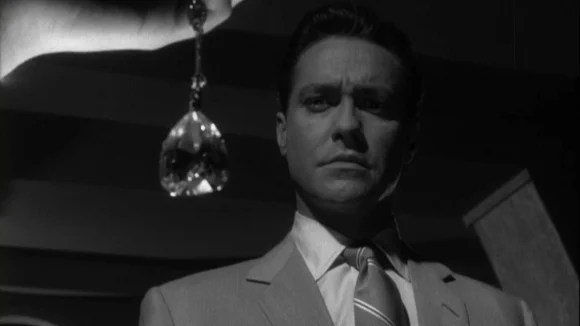
Director Michael Anderson brings Chase a Crooked Shadow in at a tight 84 minutes and judges the pace well. The plot never has a chance to sag and there are some nicely staged sequences – in particular, there’s a well shot and hair-raising scene involving a high speed race around a picturesque mountain road with precipitous drops flashing into view. Anderson does indulge in a bit of flashiness here and there: low angle shots and some slightly self-conscious focusing on foreground objects (like the screencap above), but they generally serve to add to the suspense and feeling of unease. Aside from the twisty plotting, the film depends heavily on the performances of the three leads, and they hold up well. Both Richard Todd and Anne Baxter bring an ambiguous quality to their respective characters which this kind of “is he or isn’t he” drama calls for. Baxter is just brittle enough as the woman under pressure and avoids descending into hammy histrionics. The recently deceased Richard Todd was always a solid performer and his inherent reserve is used to good effect to keep the viewer guessing. In contrast, Herbert Lom’s policeman plays the anchor role in a movie where no one else can really be trusted. It’s not a showy part in any way, but it is a vital one as it helps provide a necessary point of reference.

Chase a Crooked Shadow is available on DVD in the UK via Optimum, and it’s not a bad transfer. The image is 1.33:1, although 1.66:1 would seem a more likely ratio for British movies of the period, and is quite clear and detailed. There are vertical lines and scratches that appear intermittently all the way through, and the blacks could be a little blacker at times. However, none of this is seriously distracting and shouldn’t count heavily against the transfer. Once again Optimum have added nothing to the disc, no subs and no trailer but it can be bought very cheap. This is the kind of movie that’s very appealing to those who enjoy tense British thrillers and it’s a highly competent production. Anyone familiar with the Hammer movies I alluded to at the beginning will recognise the parallels – but that’s no bad thing.

Hustle

37uwwis

I’m unsure how to categorise a film like Hustle (1975). Should I refer to it as neo-noir, post-noir, or use some other unwieldy title? Let’s just put it this way, if the movie had been made twenty years earlier it would have been classed as film noir. It has all the ingredients of classic era noir but it’s just not of the right vintage. As a result we’re left with a stylish 70s critique of a corrupt system and a world that’s lost its way. Incidentally, it’s also a damned fine film.

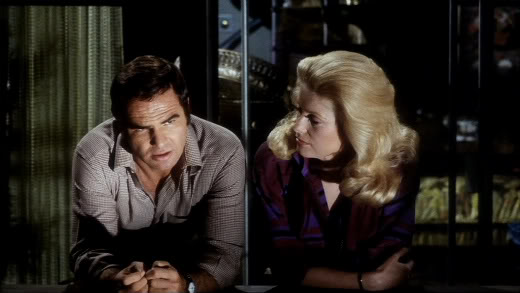
Phil Gaines (Burt Reynolds) is a homicide cop with a long list of things wrong in his life. At first glance everything might seem just dandy since we first see him reclining in bed and being pampered by his beautiful French girlfriend. However, his situation is far from ideal. The girlfriend, Nicole (Catherine Deneuve), works as an upmarket call girl and Gaines is just about dealing with this. The two of them plan and dream of hopping a jet and seeing out their days in Rome but neither one really has the ability to break away from their lifestyles. Nicole’s excuse is the need to earn a living and Gaines keeps putting it on the long finger, preferring to gaze at the fading photographic calender tacked on his office wall whilst indulging in idle fantasy. In addition, his job is increasingly getting on top of him and shows no signs of improving as his next case looms. The body of a young girl is found washed up on the beach and triggers an investigation that will eventually expose corruption in high places and drive Gaines to finally become more than a mere spectator. The girl in question was a hooker/dancer, a runaway whose life descended into seediness instead of the glamour she sought. Everyone appears inclined to write the whole thing off as another pathetic suicide, everyone except the girl’s father that is. Marty Hollinger (Ben Johnson) is a Korean War vet with an axe to grind and an obsessive streak. It’s his unwillingness to let the matter lie that pushes Gaines to dig ever deeper until the truth is exposed. By the end of the movie that truth is laid bare but, as in life, it doesn’t necessarily help anyone. The ending itself is a real choker and unapologetically noir in tone.

£4

Robert Aldrich generally invested his films with a brutal honesty and cynicism, and Hustle isn’t any exception in that regard. He never shies away from the unsavoury and paints a bleak picture of 1970s America, a place where average people are simply nobodies and the wealthy are hopelessly corrupt – in Phil Gaines words, “Guatemala with colour TV.” That rank degeneracy is best exemplified by the villain of the piece, a marvellously sleazy turn by Eddie Albert. In the lead, Burt Reynolds does very well and shows that, when the director and material were right, he was more than capable as an actor. He’s made an excessive number of fairly ropey films but, here and there, the odd gem turns up. He has some excellent moments in this movie, especially when his simmering jealously is dangerously near the surface as he tortures himself listening to Nicole take dirty phone calls from her faceless clients. Catherine Deneuve displayed the right kind of cool detachment that was necessary for her part, and she’s certainly very easy on the eyes. There’s plenty of great support from Paul Winfield, Eileen Brennan and Ernest Borgnine but Ben Johnson rises above them all. He turns in an absolute blinder as the emotionally scarred veteran who feels his country owes him something, and has allowed that massive chip on his shoulder to tear his family apart. The way he forces himself to confront the lifestyle his daughter adopted is as painful for the viewer to watch as it is for him to experience. A real class act was Mr Johnson.

Paramount’s R2 DVD of Hustle offers an excellent image, as was usually the case with that company. The 1.78:1 anamorphic transfer is clean and sharp throughout, and I can see no reason to criticise it. However, there’s absolutely nothing in the way of extra content and that is a little disappointing. Overall, I’d rate Hustle as a very fine example of modern noir from a highly accomplished director and a cast that’s uniformly good.

Footsteps in the Fog

poster93

Victorian London, murder, illicit relationships, blackmail – Footsteps in the Fog (1955) has all the ingredients of a classic turn of the century potboiler. It’s the kind of lush, polished production that’s beautiful to look at, yet you know it conceals a bitter little heart that’s hard as a diamond. British cinema always had the knack of capturing the spirit of gothic tales, and this would reach its zenith a year or two later when Hammer really hit their stride.

In fact, Footsteps in the Fog opens almost like a Hammer production, with a clergyman solemnly intoning over a fresh grave in a rain drenched cemetery. Stephen Lowry (Stewart Granger) has just become a widower and his wife is being laid to rest. As his friends drop the pale, grief-stricken figure off at the sombre gates of his home, we see him make his lonely way up the drive and on into the empty house. As he pauses on the threshold of the drawing room, the camera remains focused on the back of this dejected man who stands gazing at the portrait of his dead wife above the fireplace. The shot now switches to a close-up of Lowry’s face as a slow smirk spreads across his features. Thus we learn of the two faced nature of the protagonist, a man that we soon discover has poisoned his wife for her money. This dark secret is also uncovered by the young maid, Lily Watkins (Jean Simmons), who has been harbouring a passion for her employer. Rather than being horrified or repulsed by the knowledge, Lily sees in it the opportunity to blackmail her way, first into the position of housekeeper, and then (she hopes) into her master’s heart. But nothing is ever that simple; Lowry is in love with the wealthy sweetheart of a young barrister and regards Lily as an irksome obstacle in the way of his future advancement. The question is how he will deal with Lily, and what his real feelings towards her are. The plot takes numerous twists and turns before reaching a conclusion that manages to be bleak, ambiguous and satisfying all at the same time.

The plot of Footsteps in the Fog is an engaging and absorbing one, but the film’s real strength lies in the performances of the two leads. Stewart Granger and Jean Simmons were a married couple at the time and they were able to bring some real chemistry to their more intimate scenes together. Granger was an old hand at playing in these kinds of period pieces, and seemed to effortlessly make a frankly despicable character charming – one who I caught myself rooting for at times despite his loathsome actions. However, good as Granger is, the real star of the show is Jean Simmons. It is her Lily Watkins that’s the driving force behind the story with her beguiling mix of trusting devotion and ruthless amorality. With a tight, solid plot and classy lead performances any director should be on fairly  safe ground. Arthur Lubin was mainly a journeyman director, with a string of Abbott and Costello and Francis the Talking Mule pictures behind him, but he does a good enough job and uses some nice low angle shots to help generate suspense and atmosphere. The movie is neatly paced (coming in at under an hour and a half) and really only lags in a few scenes – mainly those with Belinda Lee.

Footsteps in the Fog has been out on DVD in the UK for a bit over a year now as a Sony release exclusive to MovieMail. The film is presented anamorphically at 1.78:1 and the transfer is generally a good one with nice colours and really only suffers in one short segment. A little after the twenty minute mark the image takes on a very dupey appearance and there’s some colour bleeding. Fortunately, this only lasts for five minutes or so and I think it would be unfair to criticise the overall presentation based on that. There’s not much in the way of extras, save for the trailer and hard of hearing subs, but the film is something of a rarity and I’m just glad it’s available at all. I think it’s a cracking little movie and it should be a real pleasure for anyone who enjoys stylish gothic thrillers.

Charley Varrick

Poster

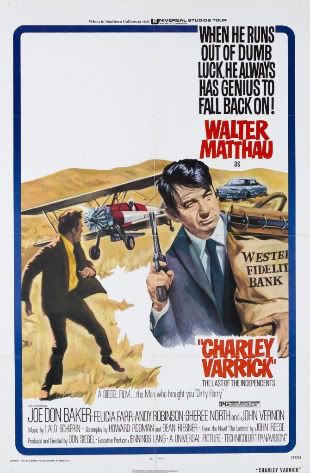
The term “underrated movie” is one that tends to get thrown around with abandon these days and its overuse is in danger of rendering it meaningless. However, there are times when that label is most certainly appropriate, and Charley Varrick (1973) is a prime example. I’ve no real explanation for this, but I do have a hunch that it frequently comes down to other work by the people involved dominating the thoughts of film fans. For most people (if they’ve heard the names at all) Don Siegel is identified with Dirty Harry, and Walter Matthau with comedic roles alongside Jack Lemmon. Without wishing to disparage any of those films, it is a shame that such thinking has lead to what is arguably the best work by both of these men being virtually forgotten.

Charley Varrick (Matthau) calls himself The Last of the Independents, something that’s true on two levels – his crop dusting operation is in terminal decline due to the rise of the conglomerates, and the small-time criminal activities he’s turned to are overshadowed by organised crime. When the botched robbery of a tiny New Mexico bank yields a huge payday Charley realises that something is very badly wrong. His sole surviving partner, Harman (Andy Robinson), can’t believe their luck but Charley’s been around long enough to recognise the stench of mob money and the consequences of stealing it. When an apparently unstoppable hitman (Joe Don Baker) goes to work the chase is on, and Charley has to figure out a way of staying one step ahead of both the law and the mob. What follows is a violent and dangerous game of criminal chess played out amid the hick towns and trailer parks of the southwest. Charley Varrick starts out as a man who shouldn’t be expected to engage our sympathy (after all he is the leader of a gang of murderous thieves), but by the end of the film we’re rooting for him – when the odds are stacked so heavily against a man it’s hard not to find yourself taking his part. Added to this Charley is, almost perversely, the only figure who displays any real honour or integrity – this petty hood is the only honest one in a world of crooked bankers, sadistic killers, lowlife chiselers and sharp suited mafia front men.

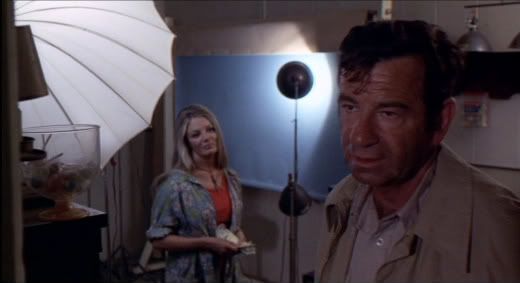
Sheree North & Walter Matthau - Charley Varrick

Although Walter Matthau’s sourpuss features seem destined to remain forever associated with his comic roles he made a trio of tough crime pictures in the early seventies; The Laughing Policeman, The Taking of Pelham 123 and Charley Varrick. The fact that he was able to switch genres so effortlessly and credibly says much for the talent and versatility of the man. While he plays Charley Varrick as a cool and efficient veteran crook he still manages to fit in a few examples of his trademark deadpan humour. I’d have no hesitation in saying that this is the best I’ve seen of Matthau, and his career was by no means characterised by poor performances. The other standout member of the cast was Joe Don Baker as the smiling, heartless contract killer. Having said that, there is no particularly weak playing and John Vernon, Andy Robinson and Sheree North all give good solid support. Don Siegel rarely gets mentioned when top directors are discussed, but the fact remains that he regularly churned out tight intelligent films that eschewed pretension and made everything look deceptively simple. This and The Shootist are his two best films in my opinion, and I’d hate to have to choose between them. And last but not least, there’s a fine score from Lalo Schifrin that’s just about the ideal accompaniment for both the period and the mood.

As for the DVD, Charley Varrick is available in R2 in the UK from Fremantle in a nice anamorphic widescreen transfer (I think the R1 is an open-matte affair). It may not be pristine and it’s an almost barebones disc but there’s no major problems and the price is definitely right. All in all, Charley Varrick is a high class crime movie that really ought to be better known.

The Man Between

Having successfully treated audiences to the story of an innocent abroad in a war ravaged European city in The Third Man, director Carol Reed attempted to recapture some of that magic four years later with The Man Between (1953). That he didn’t quite manage to do so shouldn’t be seen as too harsh a criticism; while this film never achieves the consistency of style or suspense of his earlier work it still rates as a very fine movie.

Susanne Mallison (Claire Bloom) arrives in a devastated post-war Berlin to visit her brother Martin, a British army officer, and his new German wife Bettina (Hildegard Knef). Right from the beginning there is a sense that something is not quite right in this relationship, although the overworked husband appears blissfully unaware of any problems. With Bettina receiving mysterious telephone calls and messages Susanne’s suspicions are aroused. When the two women take in a visit to the Eastern zone (this was in the days before the wall went up), and just happen to run into an old acquaintance of Bettina’s, Susanne becomes convinced that her sister in law is having an affair. Ivo Kern (James Mason) is a charming yet ambiguous figure who has emerged from Bettina’s past and threatens to sabotage her future. However, despite early indications, the story is not some hackneyed love triangle with Ivo as the man between Bettina and her husband. That somewhat slow and predictable build-up is swept aside when the altogether more stylish second half of the film reveals itself to be a tense Cold War thriller that had merely been lurking in the shadows. As we learn who and what Ivo really is the movie develops into a cat and mouse chase through a bleak and menacing East Berlin.

Carol Reed had just made two bona fide masterpieces in Odd Man Out and The Third Man prior to The Man Between. The fact that this film featured the star of the former and a theme and setting similar to the latter often lead to its being judged more harshly than might normally be the case. Placed next to those two great works it does pale, but then most movies would. However, taken on its own terms, this film has much to recommend it. All the way through there is the distinctive visual style of Reed – tilted angles and deep shadow. The second half in particular takes the viewer on a tour of the city at night, a dark, dangerous place where friends are few and those deceptively close border crossings are always just out of reach. What saves the film from growing moribund in the first half, and adds to the tension and poignancy of the second half, are the performances of the two leads. Mason was a pastmaster at playing flawed and tarnished heroes, and his Ivo Kern is a fine creation. He is a man caught between past and present, East and West, self interest and honour. Claire Bloom, in a very early role, takes a character who starts out as a portrait of middle class primness and gradually develops her into a young woman on the cusp of maturity, learning bit by bit that her preconceptions about both herself and the world around her might not be as clear cut as they first appear. I’d also like to give a mention to the frankly excellent score by John Addison; it has a melancholy romanticism that lingers long in the memory.

If you’re looking to find The Man Between on DVD there are two choices available at the moment. I have the German edition from Kinowelt and it provides a very good transfer with optional subs that are removable via the main menu. The print is in fine condition with good contrast and blacks and no noticeable damage. The film is presented in Academy ratio and, although I’m certainly no expert on such matters, that looks correct to me. I mention this because the other option is the edition available in the UK from Optimum in their James Mason Icons set. While I don’t own that disc I do know that it presents the film in widescreen format, and I’m not convinced that that’s how it should be seen. It is notoriously difficult to pin down the correct aspect ratio for British films of this vintage as the UK wasn’t quite up to speed with the US in adopting widescreen. Apart from that, the framing on the German DVD just looks right, with no apparent cropping at the sides and no extraneous space at the top or bottom. Looked at in context, The Man Between is lesser Reed but, if you can put aside comparisons with his more celebrated works, it still makes for entertaining and rewarding viewing.

5 Fingers

£9

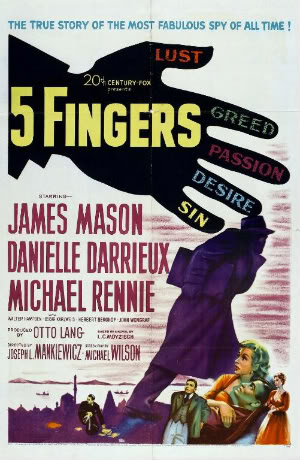
Much as I enjoy all the gadgetry and technology that seems to have become part and parcel of the espionage film over the years it’s refreshing nevertheless to watch something where the spy uses nothing more advanced than a pocket camera to accomplish his goal. 5 Fingers (1952) is just such a film, a slow burning suspense yarn that concentrates on character and the gradual building of tension. The fact that it’s supposedly based on a true story makes the whole, seemingly unlikely, series of events even more intriguing.

The story takes place in Ankara, Turkey during WWII and tells the story of an amazing scam carried out under the noses of the British embassy staff. Diello (James Mason) is an Albanian employed as a valet to the British ambassador, and is a man of intelligence, culture and ambition who realises the unique opportunity afforded him by his current employment. Not only is he the trusted companion of the senior diplomat, but he also has easy access to countless documents of the highest classification that routinely cross his master’s desk. To a patriotic man, or even a man of integrity, this might be regarded as a privilege but nothing more. However, Diello is neither; he is a pragmatist with two aims in life – a) to win the heart of the aristocratic widow of a former employer, and b) to have sufficient funds to emulate the life of a South American gentleman he once caught sight of in Rio. With this in mind, he approaches a German diplomat and makes an offer that’s hard to believe and even harder to turn down. He promises to ensure the delivery of a continual stream of top secret documents, but at his price and on his terms. He thus becomes a privately employed agent of the Nazis, under the code name Cicero, and the money starts to roll in. But, as I said, Diello is a very clever man, clever enough to know that he cannot keep popping around to the German embassy and hope to remain unnoticed. Needing both a partner and a safe meeting place, he strikes a bargain with an impoverished Polish countess (Danielle Darrieux) for whom he’s been carrying a torch. In return for funding her lifestyle Diello gets to use her home as a cover for meeting and carrying out transactions with a variety of high ranking Nazis. Of course such a scheme can’t last indefinitely and Diello eventually finds out that betrayal can be a double-edged sword.

£10

5 Fingers came out a mere seven years after the end of WWII and when you bear that fact in mind it’s quite surprising that the character of Diello is one the viewer actively roots for. Although it’s made clear that Diello is spying out of a desire for money and cares nothing for political ideology, the truth is that it’s Mason who makes the character such an appealing one. Both the British and German authorities are treated with a kind of suave condescension by the man. He always appears the master of his own destiny and, even with the earth falling away beneath him, you never really doubt that he’s the one in control of the situation. I never tire of watching James Mason, and there’s real pleasure to be found here in seeing him toss out casual insults to the Nazis in a marvellously supercilious tone. Danielle Darrieux is an actress I haven’t seen much of, but her fallen Polish aristocrat is a fine mix of allure, earthy sensuality and duplicity. Her scenes with Mason carry a sense of conviction and there’s certainly some chemistry between them. Michael Rennie has a somewhat thankless role as the secret service man hunting Cicero but he does well enough in the circumstances. Joseph L Mankiewicz wasn’t the most prolific director but I’ve always enjoyed his work and he handles this material very stylishly. The use of genuine Turkish exteriors helps lend some authenticity to the film but it’s the interior sequences that have the most power. The scene that leads up to the discovery of Cicero’s identity is a masterclass in the building of suspense – the way the camera follows a cleaner round an embassy corridor, while she tries to work out the source of a power failure and we know what the consequences of her actions will be, is a piece of film-making worthy of Hitchcock himself. And that neatly allows me to point out that the movie also benefits from a score by the great Bernard Herrmann.

5 Fingers is available on DVD in R2 from Optimum in the UK. Unfortunately, it’s one of their weaker efforts with a soft transfer that also suffers from being interlaced. It’s one of the usual barebones discs from this company with no extras whatsoever and no subtitle options. However, the one thing in its favour is that it’s cheap and it’s about the only option if you want to see this title – being a Fox property the chances of a R1 release are not good at present. Anyway, it’s a very classy film that won’t disappoint, and the final scene that fades out to the accompaniment of the kind of hollow, cynical laughter that recalls John Huston is almost worth the price on its own. The Optimum disc is definitely watchable despite its shortcomings and, since the movie itself is just so entertaining, I’d have no hesitation in recommending it.