Man Hunt

poster58

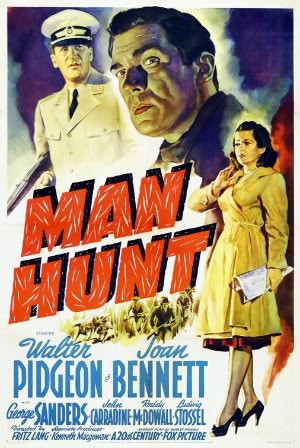
Popular wisdom holds that when a film is adapted from a novel the original source material is inevitably superior. I’m not sure how true that really is though. I suspect that this maxim has come to be as a result of the disappointment felt by a loyal readership when filmmakers have had to alter the material to make it work on the screen. We all naturally form a mental picture of characters and places when we read about them, but when others place their interpretation in front of us it can be an underwhelming and perplexing experience. Man Hunt (1941) is Fritz Lang’s interpretation of Geoffrey Household’s novel Rogue Male. Since I saw the movie first, many moons ago, and only later read the novel, my own preference is for the film version. In truth, I found the book to be a bit of a letdown – not that it’s actually bad or anything, but just because it lacks Lang’s little stylistic touches and the character interaction that helps the film pack a greater emotional punch.

The movie is basically a chase story which utilises that old chestnut of the hunter becoming the hunted. Alan Thorndike (Walter Pidgeon) is a big game hunter of some renown who has grown weary of the traditional prey. In Germany, on the eve of WWII, he finds himself closing in on the “most dangerous game” – man. And not just any man at that. Perched high on a hilltop, he focuses the cross-hairs of his hunting rifle on one Adolf Hitler. With a live round in the chamber, he has only to touch the trigger to forever alter the course of world history. However, for Thorndike this is merely a sporting stalk – an attempt to get close enough to the prey to make the kill itself a purely technical issue, for he has lost his taste for the taking of lives. But fate has other plans for Thorndike; such a simple and unexpected thing as a leaf falling across his telescopic sight causes him to twitch at the wrong moment and thus be discovered by a passing sentry. He is hauled away to be interrogated, tortured and presented with an ultimatum – his life in exchange for a signed confession that he was acting under orders from the British government to effect the assassination of Hitler. Realising the consequences of any such confession, Thorndike refuses and finds himself sentenced to death. Chance, and the natural world, once again comes into play when the faked accident that is supposed to claim his life doesn’t quite come off. From here on Thorndike must run for his life, first to a freighter and then to an England that is positively hiving with Nazi agents and fifth columnists all directed by the suave and sinister Quive-Smith (George Sanders).
hbthrd7

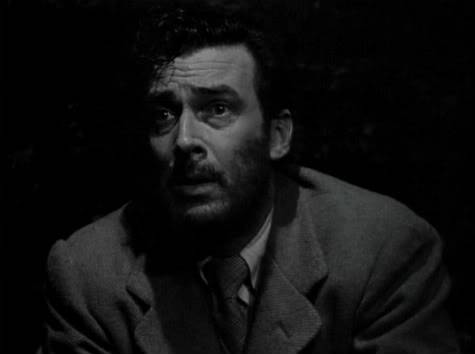
Fritz Lang brought a very noirish atmosphere to what is a fairly standard adventure thriller. The sets that represent London are bathed in deep, dark shadows that promise danger and death for the unwary. He has his hero ruthlessly driven further and further underground, his world shrinking by the minute, until he finally finds himself walled up within the very bowels of the earth. Walter Pidgeon performs well as Thorndike and effortlessly handles the character shift from a man who has achieved a degree of mastery over nature itself to one who becomes desperate, friendless and riddled with guilt. George Sanders made a career out of playing sophisticated and detached villains so the part of Quive-Smith was one he could manage with his eyes closed, but that’s not to take anything away from his performance. Joan Bennett would eventually make three films with Lang, of which Man Hunt was the first. Her role as the prostitute (never explicitly stated but clear enough all the same) who helps Thorndike and falls for him is a large part of what makes the film work, adding much needed humanity and a genuinely touching quality to a very dark tale. John Carradine also deserves a mention for his turn as the cadaverous assassin hounding Thorndike and leading to an excellently filmed confrontation within the London Underground system.

Man Hunt was long absent on DVD until Fox finally released it in R1 last month. The disc is up to the usual high standard from that company, sporting a sharp, clear image with wonderful contrast. There’s a commentary included by Patrick McGilligan along with a short featurette and advertising galleries. The only bad thing to say is that this title looks like it may well be the last classic release we’re going to see from Fox for some time, and that’s all the more galling given the high quality of their product. All told, Man Hunt is a fine film, first rate Lang, and a title that I’m just glad was able to make it out before Fox decided to shut up shop.
The Gentle Gunman

poster51_zpswesskv80

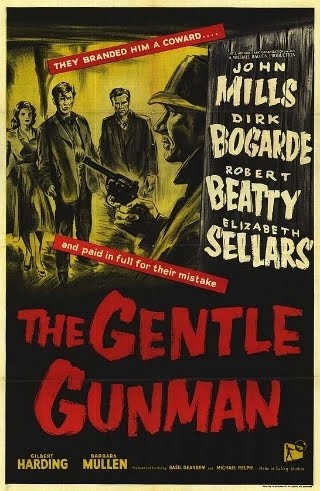
The Irish “Troubles” have gone through many stages of development, and most of those stages have been represented on film down the years. That little island on the periphery of Europe which, despite long absences, I still call home seems to exist in a permanent state of conflict. Although there are sporadic outbreaks of peace, one always feels that it’s only a matter of time before we retreat behind our respective barricades once again. The Gentle Gunman (1952) is set in the border country during WWII, a period of relative calm when compared to the frenzied blood-lust that overtook us in the 70s and 80s, and deals with those themes that go to the very heart of the Irish character – loyalty, betrayal and identity. I suppose it could be said that the film simplifies things a little, but that’s a criticism that can be levelled at a lot of movies. In fact, I always think it’s a bit unfair to fault filmmakers too much in that regard since trying to explain or understand the complexity of the conflict in Ireland, even for those of us who lived through the worst of the horrors, is an almost impossible task. The Gentle Gunman, by boiling the politics down to its essentials and focusing on two brothers, does a fair enough job.

Terry Sullivan (John Mills) is an IRA man who has been living in London for some time. When rumours start to drift back to the old country that Terry may have turned, his younger brother Matt (Dirk Bogarde) decides to pay him a visit and see if such slights on the family honour are justified. To his horror, Matt discovers that what he’s been hearing may well be true – Terry is no longer trusted and, in the aftermath of a botched bombing, seems to have become (that lowest of words in the Irish vocabulary) an informer. The arrest of two gang members is too much for Matt, and he warns his brother that if he values his life he’ll not set foot across the Irish Sea. However, Terry wouldn’t be much of an Irishman if weren’t stubborn and contrary, so he comes back to the land of his birth and the not so welcoming arms of former friends and relations. The roads and lanes along the Irish border have seen more than their fair share of death. The usual outcome of a charge of informing was a brief inquiry and a sentence handed down by a kangaroo court, before a man was taken for his last walk down a lonely road at dawn to get a bullet in the head and be dumped in a ditch. Why, therefore, would anyone take such a risk? The answer in this case is the bond of kinship. Terry sees that his younger brother is being groomed for a life on the run by local commander Shinto (Robert Beatty) and his own former fiancee, the fanatically patriotic Maureen (Elizabeth Sellars). The question is whether Terry can haul his brother back from the brink and prove his own innocence before his comrades in arms decide to dispose of him.

John Mills was at his peak when this film was made and it seemed he couldn’t put a foot wrong. He’d reached the age where he was perfect for the kind of roles that called for an idealism that had been tempered by bitter experience. The ability to convey much while seeming to do very little has always been the mark of the best actors and Mills had it in spades. At his best he was wonderful to watch, the cast of his eye or the fleeting shadow of a smile or a grimace saying so much more than pages of dialogue ever could. His Terry Sullivan is a first class combination of bravado and nervy unease that’s entirely appropriate for a man walking the tightrope of self doubt and political duplicity. Dirk Bogarde, here at the height of his matinee idol period, is less satisfactory as the young man torn between loyalty to his brother and the idealism that has always formed the cornerstone of his existence. In short, he’s a bit wet but that’s as much a criticism of the script as Bogarde’s performance. That same year, Elizabeth Sellars appeared with Mills (again as a former lover as it happens) in The Long Memory, and I was less than complimentary about her. I think her limitations work in her favour here though, her immobile features fitting the character of a woman more in love with an idea than with any man. When Maureen (who’s clearly spent far too much time poring over the writings of Padraig Pearce) speaks with passion of the near sacred act of bloodletting, the only truly apt word to describe her is terrible. As usual in films of this period, the supporting cast does a sterling job. Robert Beatty is very believable as the tough OC with an unshakable self-belief. Joseph Tomelty is just great as the rural doctor dispensing wisdom while he carries on an amicable war of words with his old friend Gilbert Harding. These two add a touch of light humour and get to deliver a great last line that’s pure blarney.

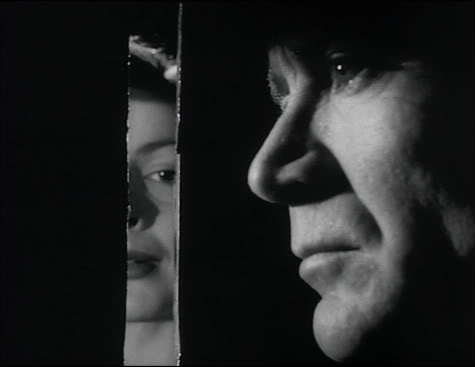
Basil Dearden does fine work as director, moving the camera around enough to help disguise the fact that this is an adaptation of a stage play. The opening scenes in London have a noirish quality with lots of deep shadow and uncomfortable angles. He also handles the attempted Tube bombing well and cranks up the suspense by having a group of kids dart innocently around Dirk Bogarde’s lethal, explosive-laden suitcase – although he does use essentially the same device again during the later ambush in Belfast. For the most part though, the action is confined to the lonely border garage which doubles as the IRA HQ. Instead of letting this be an encumbrance, Dearden turns it to his advantage by using the limited space and some clever lighting to focus on the claustrophobic atmosphere and ratchet up the tension.

The Gentle Gunman has been released on DVD in the UK by Optimum only as part of the John Mills – Screen Icons set. Optimum can be variable in the quality of their transfers, but this is one of their better ones. It’s presented in its correct academy ratio and, despite some speckles and light damage, is mostly clear and crisp with excellent blacks and contrast levels. I’m not sure how much resonance this film would have with viewers unfamiliar with the subject matter. I think it does a good job of telling a very human story and the performances and visuals are hard to fault. Given my own Northern Irish background, I’m probably a little biased in my judgement – but I loved it. There’s a lot of honesty in this little film, and a lot of themes that still hold true over fifty years later. As such, I give it a big thumbs up and recommend it wholeheartedly.


The Hound of the Baskervilles

£17

The Hound of the Baskervilles must surely be the most familiar and famous Sherlock Holmes story of all. With its mixture of mystery and horror elements, and consequent crossover appeal, it’s easy to see why Doyle’s story has attracted so many filmmakers down through the years. My own favourite adaptation of the story remains the Rathbone and Bruce effort from 1939, but Hammer’s 1959 production does come very close to being its equal. There are a number of liberties taken transferring this classic story from the page to film, but I think I’ve said before that this never especially bothered me since I often feel that, for all their classic status, there are aspects of Doyle’s original writings that can be a little tedious. Hammer certainly tweaked the material here and there but the essence of the story remains and, when all’s said and done, that’s as much as anyone should reasonably expect from a literary adaptation.

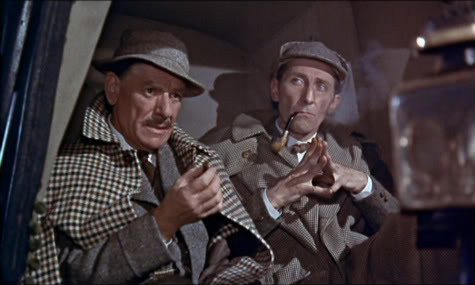
The story, for those unfamiliar with it, concerns the legend of a curse on the aristocratic Baskerville family, wherein the male heirs are doomed to meet a grisly fate visited upon them by the mythical hound from hell. When the penultimate holder of the title dies alone under mysterious circumstances on the bleak moors, the last of the Baskervilles, Sir Henry (Christopher Lee), returns to his ancestral home. Fearing for the safety of the new occupant of Baskerville Hall, a local physician, Dr Mortimer (Francis De Wolff), calls on the world’s greatest consulting detective (Peter Cushing) for advice. Mortimer’s account of the origin of the curse is told in flashback and forms the prologue of the film, setting things off at a storming pace that rarely lets up. The only slackness that occurs, and it’s very slight at that, is when Holmes sends Watson (Andre Morell) off alone to play nursemaid to Sir Henry. At this point Holmes is absent from the screen and the film suffers a little for it. However, this is a feature of the source material that can’t be avoided – anyway it offers the opportunity to see Watson acting on his own initiative for a change, and that alone means that it doesn’t deserve to be criticised too harshly. The scenes on the moors at night have an eerie, supernatural quality (lashings of mist and a soft green glow emanating from ruined buildings) that were the stock in trade of Hammer films and house director Terence Fisher. When Holmes eventually returns to the screen the film immediately gets a new lease of life, with Cushing lending a sense of urgency and energy. The final denouement takes place among the same spooky ruins that provided the backdrop for the opening, and this is the point where the movie disappoints a little. Until then the hound itself had never been as much as glimpsed, the characters only referring to it in hushed and fearful tones and it’s unearthly howls being heard echoing across the moors. Given the anticipation that such a build-up encourages, it’s hardly surprising that the beast struggles to live up to it in the flesh.

£2

The Hound of the Baskervilles is credited as being the first Holmes film in colour, and Hammer certainly did it proud. The opening is a riot of rich, vivid hues that look as pretty as anything the studio ever produced. James Bernard’s typically powerful score adds to the melodramatic atmosphere and Fisher’s direction is suspenseful and pacy (something which he’s occasionally been accused of neglecting in favour of atmosphere). Cushing and Morell were inspired casting, with the former providing one of the finest portrayals of the great detective on screen. He comes as close as anyone ever has to capturing the essence of the character, combining athleticism with erudition, waspish arrogance, and a sly humour. Morell moves Watson away from the bumbling foolishness of Nigel Bruce to offer a more serious sounding board for the wits of Holmes. Lee gives his usual professional performance as the last of the Baskervilles who falls for the sexy and feral Marla Landi, although he does succumb to a bout of the Elmer Fudds at one point (Come on now. Why did you wun away?). The support cast is as good as one would expect from a Hammer picture, with Miles Malleson doing a nice comic turn as a spider-loving clergyman while John Le Mesurier, Ewen Solon and Francis De Wolff lurk menacingly.

The Hound of the Baskervilles is one of MGM’s catalogue DVDs, and that means it’s just about adequate. The studio rarely seemed to consider it necessary to give their 1.66:1 titles an anamorphic transfer, and this release follows that pattern. There are also a variety of damage marks but none of them are seriously distracting. The R2 carries no extras save the theatrical trailer. Generally, this is an excellent Holmes film and, since it’s also one of Hammer’s best, it’s a pity the studio never followed it up and turned it into one of their series. Cushing and Morell had the makings of a fine team and it’s tempting to wonder what they could have done with the characters had they been given an extended run, but I understand the film just didn’t turn a big enough profit for Hammer to keep it going. However, they did leave us with a strong movie that holds up well to repeated viewings.

Murder By Decree

Poster

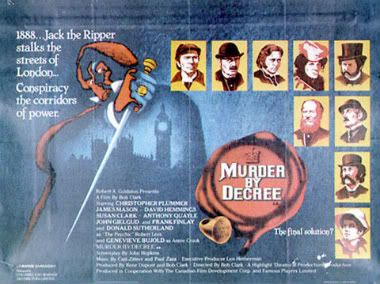
I’ve always been a fan of Sherlock Holmes films. However, strange though it may seem, the stories and novels which inspired them never grabbed me in the same way. This may be due in part to the fact that I was first exposed to the screen Holmes rather than the literary Holmes, or it may be that my subsequent reading of Doyle’s stories left me a little underwhelmed. My earliest memories of the great detective and Dr. Watson were the films with Basil Rathbone and Nigel Bruce. Over the years I’ve seen many more actors take on the role, from Peter Cushing and Andre Morell through to Jeremy Brett and Edward Hardwicke. However, Rathbone and Bruce have remained the definitive screen incarnations – seems to bear out the old saying about first impressions. Murder By Decree (1978) offers Christopher Plummer in the role of Holmes and James Mason as Watson. I found them to be probably my second favorite pairing although the Cushing/Morell combination would run them pretty close.

This film has nothing to do with the Doyle stories (not always a bad thing) but simply takes his characters and transplants them into the Jack the Ripper mystery. This wasn’t the first time Holmes had been called upon to attempt to crack the famous unsolved murders on screen; that distinction belongs to A Study in Terror, made a decade before. While the earlier film was made on a more modest budget, Murder By Decree was an expensive production filled with big names. The plot has Holmes called into the case in its latter stages as a result of an anonymous tip-off. He is met with open hostility from the authorities in the form of Sir Charles Warren (Anthony Quayle). The mysterious informants later turn out to be members of a citizens’ committee (in reality anarchist agitators) who have taken a special interest in the murders. Holmes investigation takes him through the seedy and foggy backstreets of Victorian Whitechapel, where his and Watson’s conversations with the friends of the murdered women draw him closer to an unpalatable conclusion. When he finally visits an asylum to meet an inmate called Annie Crook (Genevieve Bujold), the talk he has not only confirms his suspicion but also leads that monument to logical reasoning to break down and weep. I won’t spoil the ending for anyone who hasn’t seen the film, but I will say that it will scarcely come as a surprise as it involves a fanciful theory that has been frequently expounded.

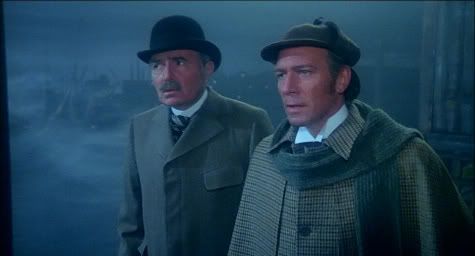
James Mason & Christopher Plummer - The game's afoot!

Christopher Plummer gives a performance as Holmes which brings out the humanity of the man better than anyone else I’ve seen. I’m not going to claim that this is Holmes as Doyle wrote him; by all accounts, Jeremy Brett managed to nail that one. Instead of the aloof character of literature we get a more rounded man and it is genuinely affecting to see him display honest emotion in the scene with Genevieve Bujold. He also gives a fine speech at the end when rails against Lord Salisbury (John Gielgud) and the hypocrisy of the powers that be. James Mason’s Watson is closer to the spirit of Doyle and not the bumbling, yet engaging, buffoon that Nigel Bruce made famous. Having said that, he does have his moments – the “You squashed my pea!” business never fails to raise a smile with me. The film is a very starry one with many good character turns: Anthony Quayle gives a wonderfully distasteful portrait of upper-class arrogance, David Hemmings is a policeman with his own private agenda, Donald Sutherland’s frightened psychic haunted by his own visions, and no Holmes film would be complete without Lestrade (Frank Finlay).

Murder By Decree is out on DVD in both R1 and R2. I have the R2 from Momentum and it has a pretty good anamorphic transfer and includes the theatrical trailer. I’m not sure if the R1 from Anchor Bay tops it but I’m happy enough with what I have. All in all, I think this is a very entertaining Holmes film which positively drips atmosphere. It features some great photography and excellent acting, and successfully blends the characters into a set of real historical circumstances. The resolution doesn’t particularly convince but, given the nature of the events, that’s always going to be the case. Unless you’re expecting a movie that sticks rigidly to Doyle’s characters you shouldn’t be disappointed.

Hell Drivers

The biggest problem with British thrillers of the 40s and 50s was their unfortunate tendency to water down the grimmer aspects of the stories. The result was that too many movies displayed an artificial “niceness”. Hell Drivers (1957), fortunately, avoids this trap by setting the story in a world that was far removed from middle-class respectability. Instead, it deals with men without roots risking their necks for a corrupt employer.

Tom Yately (Stanley Baker) is fresh out of prison and in need of a job to get him back on the straight and narrow. On the recommendation of a friend he approaches a haulage firm that has the reputation of paying good wages. This is a firm that takes on all manner of drifters on a no-questions-asked basis so long as they’re prepared to get the job done, even if it involves bending or breaking the law. Getting the job done means hauling as many loads of stone as possible at breakneck speed along winding provincial roads. The foreman and pacesetter is Red (Patrick McGoohan), an explosive Irish psychopath, who takes an immediate dislike to Tom. These two men’s mutual antipathy is at the heart of the film and leads first to a brutal fistfight, and later to the climactic trucking duel along the rim of a quarry. Along the way we learn the reason for the haulage firm’s insistence on speed, and there’s also a three way romance with Baker, Peggy Cummins and Herbert Lom.

The film provides a snapshot of working-class life of 1950s Britain; cheap rooming houses full of men who have no family and pasts that are perhaps best not dwelt upon. Free time is mostly spent hanging around the greasy spoon cafe, with occasional forays to the pictures or a local dance. In fact, it is in the depiction of one of these dances that we see the contrast between the world of the truckers and the more genteel society that the British film industry of the time frequently portrayed. The drivers don’t belong in this setting and the almost inevitable brawl that breaks out causes the further alienation of Baker’s character – he has to duck out on his companions since he can’t afford another run in with the law.

Hell Drivers is full of familiar faces: from a young Sean Connery, David McCallum and Jill Ireland to regular character actors Sid James, Wilfrid Lawson, Gordon Jackson and William Hartnell. While no-one gives a bad performance, the film really belongs to Baker, McGoohan and Lom in equal measure. Baker has an intense desperation about him as he tries to blot out his past, and assuage his guilt over the injuries he caused his younger brother, by earning an honest living. Yet he seems doomed to fail as his family spurn him and he betrays his only friend. McGoohan plays the kind of hard, aggressive Irishman I became only too familiar with myself, growing up around my father’s scrapyard in Northern Ireland. However, he takes it to a whole different level by giving us a leering psychotic barely able to control his animal instincts. Lom’s Gino is a touching and tragic figure; a former POW who dreams only of marrying Lucy (Peggy Cummins) and returning to his beloved Italy. I would hesitate to classify Hell Drivers as film noir, but these characters bring it close. There are no happy endings for any of them – even Baker’s romance appears to be built on a shaky foundation.

Hell Drivers is out on DVD in R2 from Network, and it’s an excellent anamorphic transfer. In fact it’s an excellent all-round package spread over two discs. The first disc has the film, commentary track, a Stanley Baker interview, a vintage featurette etc. Disc two holds episodes of Thriller and Danger Man, a documentary with Baker and more. There’s also a 24 page illustrated booklet in the case. This is one of the best British thrillers and it’s been treated to a deluxe presentation on shiny disc.

A Dandy in Aspic

poster19

Anthony Mann’s career as a director could be divided into three broad phases; his noirs of the forties, his westerns of the fifties, and his epics of the sixties. I think it’s fair to say that he mastered all of these and brought something new to each. A Dandy in Aspic (1968) would be his first Cold War spy thriller, although ironically it would also be his last film and he died before it was completed. Had he lived, I think it’s unlikely that he would have embraced the genre if this film is anything to go by. All told, it’s a tired, glum effort which offers nothing fresh; it falls back on endless cliches and tries to be too clever for its own good.

It opens brightly enough with a nice credits sequence featuring a puppet dancing on a string to the accompaniment of a cool Quincy Jones score. Alex Eberlin is a British spy who we are informed is a remote, sexless snob. Personally, I found this tidbit of information superfluous as the part was being played by Laurence Harvey, and those are the very words that spring to mind when I think of him. It turns out that Eberlin is really a double agent and a KGB assassin who has been living in Britain for twenty years but longs to return home. However, his controllers don’t want him to return just yet since he’s been performing well enough for them. A bigger problem for him, though, is the fact that his superiors in British Intelligence want him to take on a new task. They have grown weary of their operatives being knocked off and Eberlin is handed the job of eliminating the assassin, in other words eliminating himself. To this end, he is packed off to Berlin in the company of another agent, the openly hostile Gatiss (Tom Courtenay). There follows a series of confusing double-crosses, shot against a drab looking Berlin cityscape, until everything winds down to a vaguely unsatisfying twist ending. Along the way, there is time for a romance with an English photographer, Mia Farrow. I’m not quite sure what purpose this relationship is supposed to serve other than to add some swinging sixties atmosphere – if it’s supposed to help the viewer to connect with these characters in some way, then it fails.

The movie is essentially hamstrung with the casting Harvey and Farrow. Harvey’s role is hardly a sympathetic one to begin with as he shows no remorse for his betrayals, and he kills and uses people simply to preserve his own hide. On top of this, he was the kind of actor who could make the furniture around him seem interesting, those pinched facial reactions conveying all the intensity of a mild case of indigestion. Farrow is just vacant, although, in all fairness, she’s handed such a non-role that there’s no real opportunity to do anything with it. Tom Courtenay’s embittered, and belligerent Gatiss is better but it’s still pretty much a one note performance. He gets to stump around on his cane (which doubles as a rifle – shades of Bond amid all the dourness) and spit out his lines with a perpetual scowl on his face but there’s never any explanation for his anger. Lionel Stander has a clownish part as the cigar chomping KGB man in Berlin, and John Bird does his patented mugging act that will be familiar to anyone who’s ever seen a Rory Bremner show. Oh, and Peter Cook (who always seemed to find himself funnier than I ever thought he was) pops up for a small yet irritating role. One of my biggest regrets was that Harry Andrews wasn’t given more to do than chair a claustrophobic briefing session.

There are some interesting shots in the film which illustrate Anthony Mann’s good eye for strong composition, and there’s a nice set piece climax at a motor circuit, but they’re not enough. The plot is close to incomprehensible with all the twists and turns it takes and, in the end, it falls between two stools by trying to marry the grim aspects with too much contrived buffoonery. I think one’s fondness or lack of it for this film may come down to one’s level of tolerance for the performers involved, and I think I’ve made it clear enough where I stand. Basically, I feel I’ve seen all this done before and better but, if you’re a fan of this type of story or any of the actors, it is worth a look. For myself, I only wish Anthony Mann had signed off on a better note.

A Dandy in Aspic is available on DVD in R2 from Sony in a barebones edition, but it does have a pretty good anamorphic scope transfer.


Dangerous Crossing

How many people are familiar with the name John Dickson Carr? I suspect the answer is very few, yet from the 1930s through the 1960s he was one of the best known writers of mystery fiction. In the decades since he has faded into relative obscurity while his contemporary Agatha Christie has remained a recognizable commodity with the general public. Both of these writers specialized in detective stories that were notable not for their strong characterization but for their clever, and sometimes ingenious, plotting. However, one has remained highly marketable and the other has not – why? The changing taste of the reading public is no good as an explanation since the work of both of them is very much a product of its time. No, the answer may lie in the fact that, at least from the 1970s on, Christie’s writing has been regularly adapted for both television and the big screen. So, as a big fan of Carr, it’s refreshing to see a film available that was sourced from his work.

A newlywed bride (Jeanne Crain) stands on the dock waiting for her husband (Carl Betz). When he arrives they both board the transatlantic liner that will carry them off on their honeymoon. Their happiness, though, is destined to be a short-lived affair. While the husband goes off to see the purser, the wife agrees to meet him in the bar and waits there. It’s a long wait, and when she tries to find him it appears that no one else on the ship has ever laid eyes on the groom. As an increasingly paranoid Crain roams the fog bound ship in an effort to trace her missing spouse, and prove that she’s not some nut job, the characters whom she encounters range from the suspicious to the downright untrustworthy. That, in a nutshell, is the plot of Dangerous Crossing (1953), and the result is a neat and professional little mystery that reaches a satisfying conclusion in its short running time.

Since this is essentially a B picture, there are no major stars on view and the focus is firmly on Crain, and Michael Rennie (TV’s Harry Lime) as the seemingly sympathetic doctor. Crain’s best scenes come towards the beginning of the movie as it slowly dawns on her that her husband is not to be found on the ship and everyone, both crew and fellow passengers alike, treat her with what could be best described as indulgent scepticism. There are also enough doubts sown in the minds of the viewer as to whether the heroine is delusional or the victim of an elaborate plot to keep things interesting. Michael Rennie is solid, as always, playing the one character who may believe Crain’s story. The support cast doesn’t feature too many faces that would be immediately recognizable, but Willis Bouchey (who graced many a John Ford picture) has a nice turn as the ship’s captain.

While Dangerous Crossing has been released as part of the latest wave of noirs from Fox it does not, in my opinion anyway, really belong in that category. It is most assuredly a mystery, albeit one with a few noir touches such as the paranoid atmosphere and the shadowy photography of Joseph LaShelle. There are some nice sequences on the foggy nighttime decks, a tense cat-and-mouse scene in the baggage hold and a chase through a crowded ballroom. This is all handled competently, if unspectacularly, by director Joseph M. Newman. In the hands of someone more imaginative, Hitchcock for example, these set pieces could have been much more memorable. As it is, they seem a little flat – not bad, just not as good as they could have been.

For a fan of his work, it’s great to see some of John Dickson Carr’s work on the screen. Carr was a hugely prolific writer (he also worked under the pseudonym Carter Dickson since his output was so prodigious that he needed two publishers to handle it) yet few of his works have appeared  on film and I’m not sure why this is. I had been of the opinion that the tricky nature of his plotting might not translate well to film but I’m not so sure of that now. Anyone familiar with the TV series Jonathan Creek (certainly inspired by the locked room and impossible crime puzzles of Carr) will know that this kind of material can work successfully if approached in the right way. Whatever, fans of the master of detection – a kind of mix of Christie, Chesterton and M.R. James – will have to settle for this for now.

The DVD of Dangerous Crossing, part of the recently revived Fox Noir line, is fantastic looking and I’d be hard pressed to find any fault with it. Fox have been doing great work in offering rare and surprising titles in very nice and affordable editions. In addition to the film, there’s a commentary track, an isolated score from Lionel Newman, trailer etc. We also get a short featurette on the film with info on Jeanne Crain and on Fox’s recycling of their sets; I suggest watching the movie first, though, as the featurette does contain a spoiler. So, you get an entertaining, if minor film in a fine presentation from Fox – just remember, it’s not really noir.

The Desperate Hours

Humphrey Bogart’s penultimate film offered him the chance to have one final crack at the kind of role that had catapulted him into the public consciousness two decades earlier. The Petrified Forest (1936) gave Bogie his big break, but it also led to his being typecast as the one dimensional heavy. For the next five years he wasn’t called on to do much more than sneer at the camera and get shot by James Cagney. Playing Roy Earle in Raoul Walsh’s High Sierra would be the turning point for him – sure it was another doomed gangster part but at least this one had a human face. With one exception, he avoided any more underworld roles until we come to 1955 and The Desperate Hours.

The story concerns Glenn Griffin (Bogart) who, in the company of kid brother Hal (Dewey Martin) and lumbering sociopath Kobish (Robert Middleton), has just broken out of prison. Needing somewhere to lay up until Glenn’s girl can reach them and deliver their money, the trio take over the suburban home of Dan Hilliard (Fredric March) and hold the family hostage. There is also a side matter of Griffin holding a grudge against a local cop (Arthur Kennedy), but this is never really developed as the movie chooses to focus on the clash of those cinematic titans Bogart and March. What we get is a war of will and wits between Bogart’s career criminal, struggling to maintain control over both his companions and the family, and the steadfast and respectable March. The film was adapted from a stage play and much of the drama is played out within the confines of the family home. This both points up the contrast between the snug domesticity of the Hilliards and the violent Griffin gang, and helps highlight the claustrophobic sense of entrapment felt by all the principals. As the balance of power seesaws back and forth, the atmosphere of tension never lets up until the film reaches its satisfying climax.

Films which are adapted from plays almost always give actors a chance to show what they’ve got. Such is the case with The Desperate Hours, where two of the heavyweights of classic era Hollywood get to slug it out and ultimately share the spoils. By this stage in his career Bogart could play this type of role in his sleep. Glenn Griffin is a man on the edge, battling to maintain control over those around him and his own personal demons. It is his failure to control either his cohorts or his own thirst for vengeance that finally bring him down. In contrast, March’s Dan Hilliard is the epitome of middle American stoicism, never allowing any overt signs of weakness or doubt to be witnessed by his family. Where Griffin’s dependence on violence and threats leads to fatal blunders, Hilliard’s self discipline and decency allow him to coolly wait for his chance. Of the support cast, the parts of Arthur Kennedy and Gig Young are thanklessly underwritten; the former having little to do except show his dogged professionalism and the latter his devotion to the Hilliard’s daughter. Robert Middleton fares best as the stupid and dangerous Kobish. He brings a genuine sense of menace to the film as his character literally crashes around like a bull in a china shop. There are also small yet welcome parts for character specialists Whit Bissell and Ray Teal.

The Desperate Hours is available on DVD in both R1 and R2 from Paramount. The disc is a totally barebones affair but the widescreen anamorphic transfer is fantastic and, at the time of writing, can be picked up for less than a fiver. All in all, it’s a worthwhile and recommended movie.

Plunder of the Sun

poster104-1

It is notoriously difficult to pin down what exactly constitutes Film Noir. Everybody seems to have their own list of titles that will variously include or omit a number of marginal entries. This 1953 movie would seem a likely candidate since it has a number of noir characteristics. The action, for the most part, takes place in Mexico, the lead is a down on his luck type drawn into intrigue, and the plot bears more than a passing resemblance to The Maltese Falcon. Furthermore, the director (John Farrow) had a fair noir pedigree, having overseen the likes of Where Danger Lives, Night Has a Thousand Eyes, and The Big Clock. So, does it qualify? I’m inclined to think not, but I can’t quite put my finger on the reason. The upbeat ending crossed my mind, but I don’t really buy into the theory that the style of everything gone before can be negated by the last few minutes – that would rule something like The Woman in the Window out of consideration as noir. Well, let’s just say that I don’t feel comfortable calling it noir – maybe someone else can offer a definitive answer.

The story opens in Oaxaca, Mexico and – via flashback and a noirish voice-over narration – takes us to Havana to introduce the main character, Al Colby (Glenn Ford), as a man on the bum and desperate to find the means to pay his debts and get back to the States. His hopes seem to be answered when he’s approached in a bar by a girl (Patricia Medina) in the employ of a crippled collector of artifacts (Francis L. Sullivan). Colby accepts the offer to book passage on a ship bound for Mexico with the aim of smuggling in a small package containing an old parchment. On board he meets the other main players, a spoiled rich girl (Diana Lynn) and a sinister archaeologist (Sean McClory). From there the action moves to Mexico and a treasure hunt ensues. So, there’s a race to possess a fortune, some dubious history, a fat man and a pair of duplicitous females – like I said, it all sounds like a cousin of The Maltese Falcon.

Glenn Ford is always an enjoyable actor to watch and he handles his fairly undemanding part well enough. Irish character actor Sean McClory looks a little startling with bleached blond hair and sunglasses, but his disbarred archaeologist (can an archaeologist be disbarred?), alternating between between charm and menace, is probably the best thing in the movie. Patricia Medina looks exotic and seductive and certainly fares better than the other female star, Diana Lynn, who has little more to do than impersonate Gloria Grahame.

Much of the film was shot on location in and around Oaxaca and makes good use of the ancient Zapotec ruins and pyramids. Paramount put this out on DVD a while back (before they decided to completely ignore their back catalogue) as part of the Batjac line. It looks very good and boasts a fine selection of extras, including a commentary,  featurettes on Sean McClory and the Zapotec locations, trailer etc. Bearing in mind that the movie clocks in at around 80 minutes, it’s a pleasant enough way to pass the time.


The Deadly Affair

poster18_zps6df1ef13

The 1960s were the heyday of the spy thriller with the market flooded in the wake of the success of Bond. Now most of these films fall into two broad categories – the glossy, gadget-laden Helm/Flint kind and the more pessimistic, downbeat Le Carre/Deighton kind. For one reason or another my own preferences lean towards the latter. The Deadly Affair is an adaptation of an early John Le Carre novel, and in no way attempts to glamorize the world of espionage. Instead, it focuses on petty betrayals and the slightly dingy suburban surroundings of the protagonists.

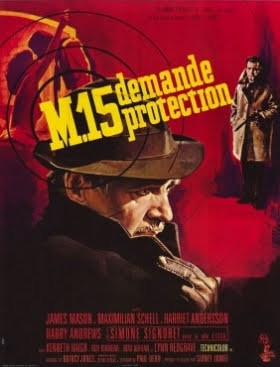
The story, as with many of this type, deals with the investigation of a possible mole in British Intelligence. James Mason plays Charles Dobbs (in the novel it’s George Smiley – I suppose the change of name is understandable enough given how little the character has to smile about here) who is charged with the task of investigating a civil servant. MI5 has received an anonymous letter concerning said civil servant and questions must, therefore, be answered. Dobbs appears satisfied that the letter is nothing more than a hoax, but the apparent suicide of the suspect seems inconsistent. It is the questions raised by this death that drive the rest of the  story along. There is also the secondary plot concerning Dobbs’ tortured domestic life with his nymphomaniac wife (played by Swedish actress Harriet Andersson) and the two strands are woven together successfully enough.

The film was directed by Sidney Lumet and has some nice location work around the vaguely depressing urban and suburban settings. Lumet’s style has never been the most exciting but that fits well enough with the mood – lots of grey skies and rain. Quincy Jones scored the picture and it’s one of the best things about it. The langourous, wistful jazzy music both evokes the mid-60s and reflects the emotional longings of the central characters.

The acting is a mixed bag, with the male characters coming off the best by far. James Mason is excellent and manages to convey the combination of determination, weariness, hopeless romanticism and pathos that the role requires – no mean feat that. To be honest, I don’t think I’ve ever seen Mason give a bad performance on screen and he ranks right up there as one of my favorite actors. There’s good support from Harry Andrews as a tough old retired policeman, and Roy Kinnear excels in a small role as a seedy, bigamous used car dealer. Maximilian Schell is adequate enough playing Dobbs’ old friend and former colleague, but nothing more. The female characters, however, are where the film falls down somewhat. Simone Signoret’s widow is too detached, although that may well be what the part of a concentration camp survivor demanded. The biggest problem, though, is Harriet Andersson. She gives one of the weakest performances I’ve seen in a long time. Given her role, you would have thought that some passion should be on display; but no, she’s ice-cold and blank throughout.

Overall, The Deadly Affair is a satisfying, if unspectacular movie. Currently, it’s available in R2 from Sony in a reasonable 1.85:1 transfer. The disc is a totally bare-bones one – literally. There isn’t even a real menu screen. While I’m grateful that the film is available, it has to be said that the cheap presentation of the disc is quite insulting.