Fixed Bayonets!

22gbjrc

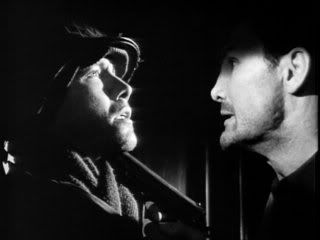
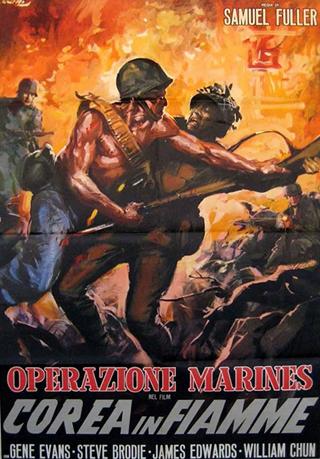
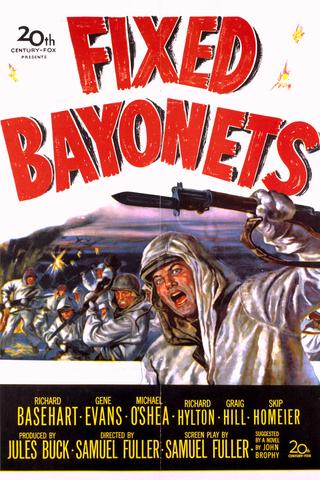
As I (not so) patiently wait for the new Sam Fuller box to roll up to my door I thought I might as well have a look at one of his other films to pass the time. It turned out to be a toss up between Forty Guns and Fixed Bayonets! (1951). Since I’ve been watching a lot of westerns lately and haven’t posted anything about war movies for a while it was the latter that won out in the end. This was Fuller’s first film for Fox, and it makes a nice companion piece to his earlier study of men in war The Steel Helmet – they’re both lean, unglamorous portrayals of the trials of enlisted men in Korea.

The plot is a very simple one – to cover the retreat of the division, a small detachment is left behind in the frozen wastes of Korea to carry out a rearguard action. This luckless group find themselves holed up in a narrow mountain pass, hoping to trick the Chinese into believing that they’re actually an advance party for the division. The focus is on Denno (Richard Basehart), a reluctant corporal who dropped out of officer training school because he didn’t want the responsibility. Not only that but he also has to deal with the fact that he finds himself unable to pull the trigger whenever he gets an enemy target in his sights. None of this would necessarily present a huge problem if it weren’t for the fact that Denno now has only three men between him and his greatest horror, the burden of command. In contrast to the sensitive, introspective corporal is Sergeant Rock (Gene Evans), the tough old pro who has stayed in the army but can’t quite put his finger on the reasons why. While the rest of the platoon have their doubts about Denno, Rock keeps faith with him as he feels he knows his man. As the Chinese press ever closer, and the casualties steadily mount, it’s obvious that sooner or later Denno will find himself the top man – the Ichiban Boy – and the only real question is how he’s going to handle it.

Gene Evans basically reprises his role from The Steel Helmet, but it’s almost the kind of part he was born to play. He really brings the battle-hardened Rock to life, full of fatalistic humour as he bullies and cajoles the grunts into doing what has to be done. If Rock is the beating heart of the platoon then Denno is the conscience, and Richard Basehart was well cast in that part. His quiet, dignified tone stands out among the casual slang of the other dog-faces around him. He was capable of that intense, repressed look that is ideal for a man being eaten up by inner turmoil. Some of the best scenes in the movie take place in the quiet moments in the cave when Rock and Denno chew the cud over the nature of soldiering and responsibility. Fuller directs these claustrophobic scenes with apparent ease, using a full 360 pan at one point to show the whole platoon (or what remains of it) looking on as the reluctant medic performs surgery on himself. He punctuates such scenes with bursts of jarring, unexpected violence and moments of incredible tension, such as Denno’s walk through a minefield at night to rescue a mortally wounded NCO. His sense of pacing and economy are spot on, with not a shot wasted as we rattle along to the climax.

The R1 DVD from Fox is a frugal affair with little in the way of extras but it does boast a generally strong transfer. Fixed Bayonets! is a fine early example of Fuller’s honest, no nonsense approach to film-making and has his unsentimental machismo stamped proudly all over it. I enjoyed it a hell of a lot – now if only that Sony boxset would turn up!
 

The McKenzie Break

Poster

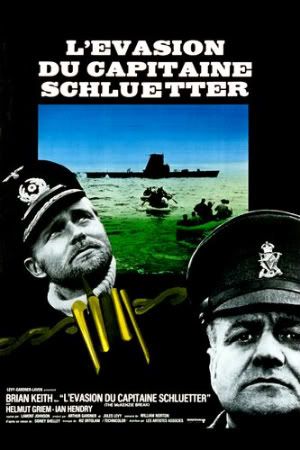
Anyone who’s a fan of war movies will be familiar with the WWII POW/escape variety. One characteristic of such movies is that they rely (by necessity) far less on action than they do on character. The other aspect of note is that they are almost always told from the perspective of the American or British prisoners. I say almost because there are at least two exceptions that I can think of, The McKenzie Break (1970) being one of them. Having German POWs makes for an interesting approach to making a film since this premise automatically challenges the viewers sympathies. Normally, in any kind of prison movie, it’s hard not to find yourself rooting for those who are locked up – but this film turns everything on its head by portraying the leader of the inmates as an unrepentant, amoral and ruthless Nazi.

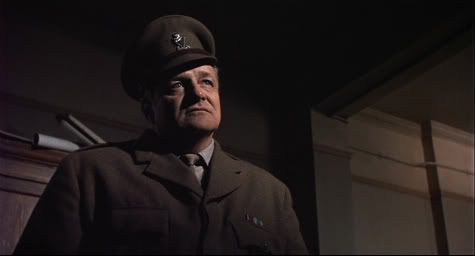
McKenzie is a POW camp situated in a desolate, sparsely populated area of Scotland. Its purpose is to hold captured German officers, principally submariners and flyers. However, right from the opening moments, it’s clear that all is not well. There is a war of wills going on between the camp commander, Major Perry (Ian Hendry), and the prisoners’ leader Schleutter (Helmut Griem). It’s suspected that there’s a reason for the organised disobedience, which goes beyond plain contrariness. In an effort to get to the bottom of it all,  Intelligence dispatches one Captain Connor (Brian Keith) with a brief to establish the cause of the ongoing trouble. Connor is a soft spoken maverick with a penchant for taking risks, and it’s no surprise  that the film soon develops into a duel between him and the charismatic Schleutter. Connor knows full well that Schleutter is planning an escape, he even has a fair idea how it’ll be done, but he hopes to bag bigger game and gambles on giving him enough rope to hang himself. Bar a few action scenes, the film plays out mostly as an espionage/detective story, with Connor doing the hunting and tracking and Schleutter, for the most part, managing to stay one step ahead. It’s  also worth pointing out the tension and rivalry within the camp, both on the German and British sides. Generally, POW flicks tend to portray the inmates as a united group of disparate characters banding together for the common good. Obviously there are  movies, such as Stalag 17, that feature a rotten apple, but off the top of my head I can’t think of another that presents a house so clearly divided. While there’s a mild abrasiveness and a degree of mistrust between Perry and Connor, it’s nothing compared to the sadistic hatred Schleutter displays towards his fellow prisoners from the Luftwaffe.

Brian Keith

Brian Keith was one of those amiable actors who always seemed to make things look very easy. Although he’s getting on a bit, and lays the Oirish accent on a bit thick at times, he still manages to put in a good and believable performance. The best parts of the movie for me were those where Connor and Schleutter faced off and traded blows verbally. There’s an especially good scene that takes place in the hospital in the aftermath of the murder of one of the German prisoners. In a grotesque parody of a wake, the two leads share a whiskey over the body of the dead man while each probes for weak spots in the armour of the other. Helmut Griem had the difficult task of playing a morally repugnant character while at the same time trying to imbue him with enough humanity and charisma to make him believable as someone capable of commanding the respect of all those under him. That he manages to do this and pull off the even neater trick of doing reprehensible things but still retaining a modicum of sympathy from the viewer is a credit to him. The McKenzie Break was directed by Lamont Johnson and it’s his one of his few forays outside of TV work. He handles the material competently but with no great style – the Irish locations, standing in for Scotland, are nicely used in the latter half of the film but the acting and storyline are what carry the film more than visuals.

MGM’s R2 DVD offers a pleasing enough image. The anamorphic 1.85:1 transfer has no damage to speak of and good detail. The colours are on the subdued side but that’s how they’re supposed to look as far as I can tell. The only extra on the disc is the theatrical trailer, but that’s par for the course for MGM catalogue titles. Overall, The McKenzie Break is a well-made suspenseful war movie that offers a different spin on the traditional POW tale.

The Wild Geese

twg

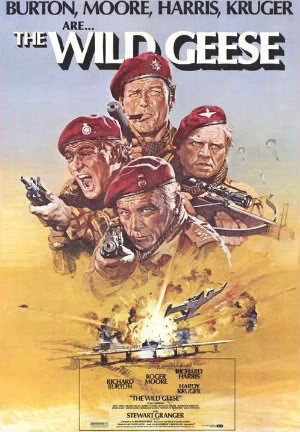
As a boy I used to positively devour westerns and war movies. My friends were pretty much the same, and I can still see us, in the schoolyard or on the way home, re-enacting the action scenes from whatever movie we had seen on the telly the night before; this was back when there were only three channels (actually four in Northern Ireland) so what one had seen, all had seen. Every once in a while you got lucky and you had the chance to go to the cinema and see a big new movie. That afforded you a certain kudos as you were then in the enviable position of being able to relate all the gory details to your mates. What we all yearned for were movies with plenty of guns, explosions, daring escapes and as little mushy romantic nonsense as possible. Such was the case with The Wild Geese (1978), a film that seemed just perfect when I first saw it on release. Looking back on it now, I no longer think it’s perfect but it still retains the power to charm me, and the passing of time hasn’t made it any less fun to watch.

The story has Colonel Faulkner (Richard Burton), an ageing mercenary soldier, arriving in London for a clandestine meeting with millionaire businessman Sir Edward Matherson (Stewart Granger). The purpose of the meeting is to arrange a raid into a fictitious African nation to free from prison a deposed leader who is facing imminent death. This will require the recruitment of the necessary personnel and the formulation of a viable plan for a rapid extraction. Too much focus on the behind-the-scenes stuff can easily scupper this kind of movie, but the finding and hiring of the officers (Roger Moore, Richard Harris and Hardy Kruger) and men is carried off in an entertaining way and never slows down the pace. Soon the action has moved to the training camp in Africa, where the RSM (Jack Watson) gets to deliver some marvellously insulting language to the biggest names in 1970s cinema as he kicks, bullies and cajoles his out-of-condition squad into shape. The mission itself starts off well and everything looks like it may run according to schedule, but some devious machinations back in London ensures that the mercenaries will be abandoned to the tender mercies of a ruthless dictator and his Simba battalion. With their rescue flight aborted, and facing certain death, they have no choice but to trek across hostile country with the vague idea of maybe stirring up civil unrest on the way. Under constant attack, Faulkner leads his ever diminishing force south to an abandoned airfield where their last chance for salvation appears in the form of an old, beat-up, twin-engine Dakota. The climax is pure blood and thunder stuff, with Faulkner’s men making their desperate dash for freedom as the air is filled with lead and the ancient plane chugs and sputters in the background.

Andrew McLaglen was arguably at his best when directing this kind of Boy’s Own adventure, and he managed some quite effective scenes here. The action set pieces are all well handled, the stand outs being the scene where a jet strafes and bombs the mercenary column while it’s stalled on an exposed bridge, the parachute jump sequence, and the bloody but exciting climax. The movie runs well over two hours but McLaglen controlled the pace so well that it seems a lot less. The stars of The Wild Geese were all getting a bit long in the tooth for this kind of exertion but the four leads give amiable enough performances and seem very comfortable around each other. While Burton definitely looks the worse for wear, that weary quality kind of fits the role he’s playing. The old-time soldier of fortune looking for a last big score in a world that’s changing around him plays like an amalgam of Burton’s own character and that of Mike Hoare, who served as technical adviser on the film. Neither Harris nor Moore really have to stretch themselves in the acting department but both at least give the impression they were having a hell of a lot of fun. Hardy Kruger gets a bit more to do as the crossbow wielding Afrikaaner who has his preconceptions challenged and finds himself rethinking his position and prejudices. Stewart Granger has only a small part yet he brings an oily condescension to the part of the duplicitous Matherson that makes for a great screen villain.

The Wild Geese has been out on DVD for a while now, and the R2 disc from Mosaic presents the film pretty well. The transfer is anamorphic and quite clean. There’s an entertaining commentary track featuring Roger Moore and producer Euan Lloyd, and a documentary on Lloyd’s career. All told, it’s not a bad package and provides good value. There is a new edition slated for release in March but I doubt if it will add anything new, we’ll see. This isn’t a very deep or serious movie, but it is entertaining, and if you want something that will recall memories of far-off schooldays and more innocent times The Wild Geese is just the ticket.


Five Graves to Cairo

poster90

I suppose it goes without saying that war movies made while WWII was still in progress are inevitably going to be propaganda pieces. The more routine ones can lay the flag waving and speech making on so thick as to appear more than a little stodgy when viewed from a distance of over sixty years. The more memorable examples, at least from a present day perspective, are those that manage to tell a story that goes beyond merely depicting heroic resistance, a story that remains absorbing and exciting in its own right. Such is the case with Billy Wilder’s Five Graves to Cairo (1943). Naturally, the film was conceived and produced with the aim of assisting the war effort, but it avoids beating the viewer over the head with its message – at least until the final minutes. What we get instead is a tight, suspenseful yarn where the propaganda is served up sparingly and, for the most part, with subtlety.

Corporal Bramble (Franchot Tone), the sole survivor of a tank crew after the fall of Tobruk, stumbles out of the desert and into a battered, run down hotel. With the British in full retreat the only occupants are the owner (Akim Tamiroff) and a French maid by the name of Mouche (Anne Baxter). While the owner panics, Mouche is openly hostile to the new guest due to her bitterness over what she regards as Britain’s desertion of France at Dunkirk. However, the arrival of the Afrika Korps, and their illustrious chief Rommel (Erich von Stroheim), signals a softening of her attitude; not by much mind, but she can’t bring herself to betray Bramble. Therefore, Bramble assumes the identity of the recently deceased waiter Davos who, it turns out, was actually a Nazi agent sent on in advance. As such, Bramble finds himself in the dangerous yet privileged position of having Rommel’s confidence as the Field Marshal prepares for his assault on Cairo. That task would seem an impossible one given the demands made on his lines of supply. Yet Rommel’s ebullient self-assurance suggests he holds a trump card, which is hinted at via references to five graves and a mysterious professor. Bramble/Davos now faces the challenge of discovering the identity of the professor and the significance of the five graves before his cover is blown. None of this is made any easier by the continued ambivalence of Mouche, who is determined to “do business” with either Rommel or his aide (Peter van Eyck) in order to secure the release of her brother from a Nazi concentration camp.

Directing only his second feature in Hollywood, Billy Wilder was already showing signs of his trademark style. Bleak is a word that has been used to characterize Wilder’s world view, and that’s certainly in evidence in the opening shots which show a tank trundling remorselessly across the vast desert, manned by its crew of dead men. There are lots of inventive little touches throughout the movie, such as the point of view shot seen through the intricate lattice work of the hotel desk, or the zoom cut to the transom as it snaps shut and knocks a concealed weapon into plain view. Alongside this is the sharp dialogue and strong characterization one typically associates with a Wilder picture. There’s a nice contrast of acting styles on show from both von Stroheim and Tone; von Stroheim is all swaggering Germanic confidence while Tone underplays his role as the ingratiating and obsequious waiter/spy. Anne Baxter does well enough as the conflicted maid, but it’s a tough slog with all the showmanship going on around her, not to mention the scene stealing comedic turn of Akim Tamiroff. The other supporting roles are well filled out by a young Peter van Eyck, Fortunio Bonanova, and Miles Mander’s British colonel, who bears more than a passing resemblance to Field Marshal Montgomery.

Five Graves to Cairo was a Paramount picture so the rights now reside with Universal who, in association with Madman, have released this on DVD in R4, at least both of their logos appear on the cover and on the disc itself. The transfer is a particularly fine one and is crisp and sharp throughout. There are some occasional damage marks but I can’t say I found them to be very distracting. The disc also has a 25 minute documentary on Anne Baxter, and there’s a nice 15 page booklet on the movie by Adrian Danks inside the case. This was one of the few Billy Wilder films I hadn’t seen before and I enjoyed it immensely. There’s so much going on that the 90 minutes seemed to fly by yet the pace never feels forced, save the ending which is a bit rushed. If you count yourself a fan of Wilder, or you just like war/spy movies, then Five Graves to Cairo is well worth seeking out.


Ice Cold in Alex

What makes a good war film? At its best, the war movie goes beyond mere action, heroism and patriotism. It provides the opportunity to show real human drama and real human frailty under the most extreme circumstances. The small, everyday, mundane struggles between individuals, and within individuals, play against the backdrop of the larger conflict. There is also the matter of character and how its strength or weakness can shape the course of events and the direction of men’s lives. The British film industry has succeeded in producing some fine war movies, and Ice Cold in Alex (1958) is no exception. This is no epic production; it really only deals with the experiences of four people yet it touches on some very big themes, not the least of which are honour and decency.

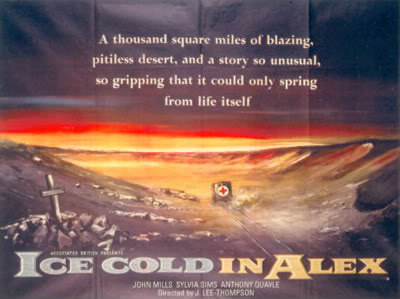
It’s 1942, Rommel’s Afrika Korps are racing across North Africa, and Tobruk is about to be besieged. Captain Anson (John Mills) is a man nearing the end of his tether, both physically and mentally. The unrelenting hardship of the desert war has driven him to drink, and his dependency on the bottle, while superficially steadying his nerves, threatens to undermine his judgment. Having been ordered to take his ambulance out of Tobruk before the siege begins, he finds himself faced with an overland trek to Alexandria accompanied by the phlegmatic Sergeant Major Pugh (Harry Andrews) and two nurses (Sylvia Sims & Diane Clare). Along the way they pick up an Afrikaaner, Van Der Poel (Anthony Quayle) who proves to be an asset in a number of situations. It’s Van Der Poel’s ability to speak German which gets them out of a tricky spot when Anson panics and tries to outrun an enemy patrol. However, the incident leads to the death of one of the nurses and Anson’s subsequent pledge to lay off the liquor until they reach Alex, where he’ll buy them all an ice cold beer.

Reaching their destination will be no easy task though. Rommel’s troops are advancing faster than expected and, as town after town falls, they must race to keep one step ahead. From this point on Anson’s war is no longer against an army; he must instead battle the hostile environment, suspicion and his own weakness. With the ambulance damaged, the water supply diminishing and the temperatures rising, he is forced into taking a route across The Depression, a vast desert quagmire, where one false step would spell disaster. Even as the little group pulls together to overcome each challenge nature throws at them, the seeds of suspicion are growing. Is Van Der Poel all that he claims to be?

Although the fate of the group ultimately depends on the calm resourcefulness of Pugh and the brute strength of Van Der Poel, it is Anson that you find yourself rooting for. It is a tribute to the skill of John Mills that the viewer feels such sympathy for what should be an unsympathetic character. After all, the man’s a drunk and his early recklessness causes the death of one of his charges. Yet, for all that, Mills manages to bring out the finer points of the man. There is a sense of real pain when he sees how his actions have led to tragedy for the unfortunate nurse. Throughout the film he’s all twitches and nerves and doubts and regrets and hopes – in short, a human being. Harry Andrews is all square-jawed grit and resolve; if you found yourself in a tight spot you’d love to have this guy by your side. Anthony Quayle also fits his role perfectly as the ebullient Afrikaaner who relishes every opportunity to show off his physical powers. Yet, all the while, those piggy little eyes dart around and you wonder what’s going on behind them. Sylvia Sims is the epitome of sweetness and practicality as she falls for Mills and, more importantly, believes in him and encourages him to believe in himself. J. Lee Thompson does his usual professional job in the director’s chair and makes good use of the North African locations. He manages to generate real suspense in some set piece scenes such as the navigation of the minefield and the nightmarish struggle in the quicksand. He also gets across the sense of dry, dusty heat and you feel the same relief as the characters do when John Mills sits on the bar stool in Alexandria and eyes that famous glass of Carlsberg.

Ice Cold in Alex is available on DVD in R2 from Optimum as part of their War Collection line. It’s a very nice anamorphic transfer in the correct 1.66:1 ratio. It’s a barebones affair as usual from Optimum but the quality of the film itself is enough to sell it, and it can normally be picked up cheaply. This is no action packed affair, it’s more of a character study and an excellent example of the British war film at its best. It succeeds in delivering a deeply satisfying ending and one that serves to reinforce the basic decency of man. And who better to portray that decency than John Mills.

Dark of the Sun

poster020

There haven’t been too many movies based around the modern mercenary trade – The Wild Geese, The Dogs of War, The Last Grenade and, if you stretch the point, the recent Blood Diamond are the ones that spring to mind. There are, of course, lots of examples of mercenary characters in westerns but that’s not really the same thing. Of those mentioned, The Wild Geese isn’t much more than a Boy’s Own adventure, albeit a fairly enjoyable one. The Dogs of War spends way too much time on behind the scenes machinations and The Last Grenade is just not a very good film. Jack Cardiff’s 1968 production Dark of the Sun is a cut above all these and is arguably the best movie in this small sub-genre.

The story is set during the Simba revolt in the Congo in the mid 60s, when that vast, former Belgian colony was on the point of implosion. A mercenary group, under the command of Curry (Rod Taylor), are engaged to drive a train into the interior and evacuate the European inhabitants of an isolated mining town which is threatened by the advance of the Simba rebels. The reason this particular town is on the fast track for relief is because there happens to be a fortune in uncut diamonds waiting around for whoever arrives first. Curry, and comrade in arms Ruffo (Jim Brown), sets out with his hastily assembled group in the hope of beating the Simbas to the chase. Everything zips along at a good pace, packing in a chainsaw fight, a confrontation with the U.N. forces, and the rescue of a massacre survivor (Yvette Mimieux) before the train arrives at its destination. At this point the tension rises, as the diamonds are in a vault whose time lock won’t open for another three hours, and the rebels are inching ever closer.

Rod Taylor gives one of his best performances as the hard as nails soldier of fortune and there’s none of the phony posing so prevalent in more modern action heroes. Taylor seems genuinely tough and the climax, where he gives full rein to his outraged fury at the fate of his best friend, is powerful stuff indeed. Jim Brown was no great shakes as an actor but his calm, reasonable Ruffo provides an acceptable counterweight to the simmering Curry. Peter Carsten makes for a great villain as an unapologetic ex-Nazi, and there’s good support from the seasoned Kenneth More and Andre Morell. This is pretty much a man’s movie so there’s not a lot for Yvette Mimieux to do, but she does look sexy and appealing and that’s good enough for me.

If you’ve ever seen a movie photographed by Jack Cardiff you will know how effortlessly good everything looks. Although he is the director here, the movie remains visually pleasing and is only occasionally spoiled by some poor rear projection. The score by Jacques Loussier (I don’t believe I’ve heard anything else by him) is another major plus; it’s a jazzy, downbeat effort that enhances the mood of the picture perfectly. The source material was a novel of the same name by Wilbur Smith. Smith knocked out some good, tight action thrillers early in his career before sliding into the (probably more lucrative) field of the bloated, historical soap opera. I don’t know who provided the inspiration for Smith’s characters but I suspect he may have been thinking of Mike Hoare. Either way, I believe the film’s makers had one of Dublin’s less celebrated figures in mind – if you can get your hands on a copy of ‘Mad’ Mike’s own memoirs, Congo Mercenary, you ought to notice some parallels.

As far as I know, Dark of the Sun remains unavailable on DVD anywhere but there was some talk of Warner giving it a release in R1. It has turned up on TCM in the past but I would love to see it get a proper release – it’s a very good movie whose stock should rise if only it were more readily available.

EDIT January 2012 – The movie has now been given two official releases. The first is the Warner Archive MOD from the USA which I haven’t seen. It’s also been issued in Spain by Suevia, a company whose output is variable in quality. However, I’m pleased to say the Spanish disc is more than acceptable. It’s been transferred progressively in anamorphic scope and looks generally sharp. The colours are rich and there’s no problem with subs – the disc offers the option of French, Spanish or no subtitles on the English track. Extras are limited to the trailer. All in all, it’s a very satisfactory release.

Where Eagles Dare

Poster

There are some films that seem to have the ability to transport us back in time, and Where Eagles Dare is one of those; I only have to watch the first few minutes for it to work its magic. The alpine landscape appears, the blood red credits roll, Ron Goodwin’s pounding score swells up, and I’m once again that wide-eyed little boy sitting on my parents’ rug – spellbound. Back then, I felt sure that this was the greatest war film ever made – and I was becoming something of a connoisseur of the genre at the time. Now, as the years wear on, I know that Where Eagles Dare is not the greatest war film ever, but its ability to carry me back thirty years or more is a priceless quality that no amount of critical snobbery can ever diminish. 

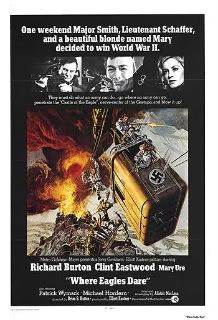
Following on the success of The Guns of Navarone, the books of Alistair MacLean were seen as a source of cinematic gold just waiting to be mined. There wasn’t a lot of character development in these stories, but the twisty plots and non-stop action made up for that. Where Eagles Dare is about an Allied mission (headed up by Richard Burton and Clint Eastwood) behind enemy lines to rescue a captured American general from the Nazis before they can force him to reveal the details of the D-Day invasion. The difficulty for our heroes lies in the fact that the general is being held in the Schloss Adler, an almost impenetrable castle perched on a mountain top, and accessible only by cable car. As if this were not enough, it looks as though there is a traitor lurking among our intrepid group. To go deeper into the plot would require some massive spoilers, and I don’t want to do that here. Suffice to say that the film treats us to double cross piled onto double cross, lots of big spectacular explosions, huge numbers of Nazis mowed down by Burton and Eastwood, and a fantastic fight with an ice pick atop a moving cable car. By the end everything has been resolved satisfactorily and two and a half hours of escapist bliss have whizzed by.  

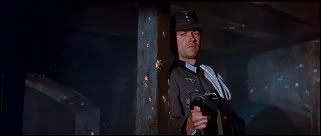
Clint Eastwood asking the whole German army if they feel lucky. 

There’s a great cast for this movie, even if they’re all playing roles which are basically caricatures. Richard Burton’s Major Smith seems capable of planning and talking his way out of even the most hopeless situations. Clint’s Lieutenant Schaffer is cool, ruthless and laconic; a WWII version of The Man With No Name. Mary Ure and Ingrid Pitt look good while helping out the heroes and, crucially, they do not indulge in any girly histrionics – something which should never happen in a proper Boy’s Own adventure anyway. The support cast is also well stocked with Ferdy Mayne and Anton Diffring playing German officers (what else?). Derren Nesbitt is ideal as the suspicious Gestapo major, although his German accent wouldn’t stand up to too much analysis.

Where Eagles Dare has been out on DVD from Warner for ages. The anamorphic scope transfer is good enough and there’s a ‘Making of’ featurette on the disc. I don’t see this getting an upgrade any time soon since it’s probably seen as too lowbrow for the SE treatment. For me, it will always remain one of those links to an increasingly distant past – an innocent and adventurous world where Richard Burton will forever intone “Broadsword calling Danny Boy…..Broadsword calling Danny Boy” 

Attack

attack_zps7cxft2gs

Robert Aldrich made one of many people’s favorite war movies in The Dirty Dozen. In fact he made all kinds of great movies encompassing almost every genre. By 1956 he had turned out a handful of fine pictures, including Kiss Me Deadly and Vera Cruz. That year he turned his hand to the war movie and came up with the superior and intense Attack. This came at a time when the war film was transitioning from the flag-waving efforts of the forties to more bitter and realistic portrayals of combat.

The story focuses on the strains within a WWII company of US soldiers during the Battle of the Bulge. The company is under the command of Capt. Cooney (Eddie Albert), a privileged man who joined the army to satisfy the wishes of his father. However, Cooney is an undisguised coward whose position only remains tenable due to his friendship with Col. Bartlett (Lee Marvin), the battalion commander. The situation in the company has reached crisis point after Cooney’s inaction has caused the death of a squad of Lt. Costa’s (Jack Palance) men. When orders come through that a small town must be taken and held, Costa delivers an ultimatum to his superior – if he fouls up again then Costa will kill him.

Jack Palance reaches the breaking point

The film was adapted from a stage play and, as is often the case, is a real actor’s movie. Both Palance and Albert hold centre stage and the focus is on the duel between these two. Palance’s performance is raw and painful to watch as his endurance is fully tested. The latter part of the movie, when betrayal and the pointless slaughter drive him to the edge of reason, is something to behold. Eddie Albert gives him a good run for his money, forcing the viewer to both pity and despise Capt. Cooney. Lee Marvin’s colonel is at once cunning, ambitious, cynical, and the absolute epitome of cool machismo. Of the support cast, Buddy Ebson, Robert Strauss and Richard Jaeckel all give entertaining turns.

This is one of the finest war movies of the fifties and bears comparison to the best of Sam Fuller. It is probably one of Aldrich’s least known films but deserves a much wider recognition. It is on DVD in R1 and R2 from MGM and the full screen image looks very good. Being an MGM release the only supplement is a trailer. However, a movie as good as this should have a place in any self-respecting war collection.

The Steel Helmet

jm0aujv

If you look at that small subgenre that is the Korean War movie, the efforts of Sam Fuller stand head and shoulders above the others. That’s not intended to disparage those other films which deal with that largely forgotten conflict such as Lewis Milestone’s Pork Chop Hill or Anthony Mann’s Men in War. However, Fuller’s Korean movies have that gritty believability that really set them apart. Both The Steel Helmet and the later Fixed Bayonets! deal with small groups of grunts caught up in desperate battles against overwhelming odds. Fuller’s presentation of war is a bleak one where there are no false heroics; just a bunch of regular guys doing what they have to in order to stay alive.

The Steel Helmet opens with Gene Evans’ Sgt. Zack, bound hand and foot, dragging himself along the ground amid the bodies of his massacred comrades. He’s just had the luckiest of lucky escapes – an execution squad bullet having entered his helmet and rattling round inside before exiting harmlessly. From here on the story follows Zack and the rag-tag bunch of stragglers he picks up as they make their way to an abandoned Buddhist temple to set up a forward observation post. Fuller never relents and the intensity of the story builds satisfyingly to the climactic assault on the temple by the communist forces.

Along the way the members of the group are revealed to us, and through this we get a glimpse of post-WWII American society. Among this odd group there’s a black medic and a Japanese-American veteran who serve to point up the racial prejudice prevalent at the time. There are also the quirky characters of the young soldier who lost all his hair through scarlet fever, and the silent G.I. whose only dialogue comes, poignantly, at the point of death. The locals are presented through the contrasting figures of “Short Round”, the South Korean boy who befriends Zack, and the malevolent, rat-like North Korean major. It is the sneering and callous reference to the boy’s fate by the red major that provokes Zack into an uncharacteristic, yet very understandable, reaction.

Which brings me to Gene Evans. His portrayal of Zack is the lynch-pin that holds the whole thing together. He is the consummate professional soldier – weary and cynical but dedicated to getting the job done and undeniably human. Evans would give a similar performance in Fuller’s next Korean drama Fixed Bayonets! and you have to wonder why his career never really took off from here. He plays the kind of three dimensional man’s man that is sadly absent in today’s cinema – well, that’s progress for you.

I’m not sure if anyone has seen any parallels between Fuller’s work and that of Howard Hawks. To me, both directors were attracted to the concept of the small group under siege and the emphasis on professionalism. However, while Hawks would use a lightness of touch, Fuller’s direction is like a pile-driver battering your senses.

Released by Criterion last year as part of their Eclipse series, The Steel Helmet comes in a set with I Shot Jesse James and The Baron of Arizona. While the film doesn’t appear to have undergone any restoration, it looks just fine and is worth the price of the set on it’s own.