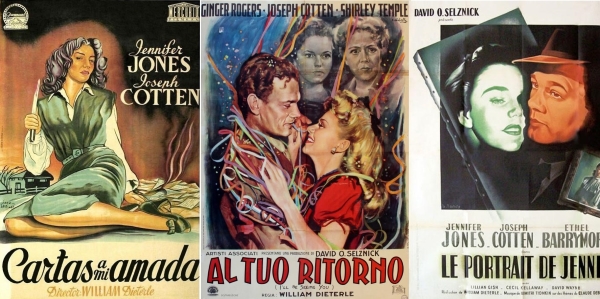
Ford famously labeled himself, somewhat disingenuously perhaps, a director of westerns. Hitchcock styled himself and entered the public consciousness as the Master of Suspense. DeMille cast himself as the consummate showman, the king of the epics. Mann and Boetticher are closely associated with the western, Siodmak with noir. Kramer seemed to want to challenge the viewer’s conscience, Capra went in search of the heart of America. So many filmmakers, so many associations. Watch enough movies and the mere mention of certain names, for better or worse, call to mind particular genres, themes or aims. I found myself reflecting on this recently as I settled down to revisit a trio of William Dieterle movies from the 1940s: I’ll Be Seeing You (1944), Love Letters (1945) and Portrait of Jennie (1948). They are all different movies, they tell different stories in different ways yet they all have in common that overwhelming sense of flawed romanticism which seems to have appealed to the director. Seeing them again in fairly close succession, the impression I was left with, and which I’ve noted before is the compassion and humanism underpinning Dieterle’s work.
Joseph Cotten is the male lead in all three movies and his slightly stiff air that picks at the facade of confidence and nonchalance he presents is routinely on view. In some instances, notably in I’ll Be Seeing You where his character’s PTSD is one of the plot drivers, this vague “otherness” is to the fore. That element is still there in Love Letters, although it is much less pronounced and clearly secondary to the traumatic amnesia of Jennifer Jones’ enigmatic ingenue. And Portrait of Jennie – arguably Dieterle’s masterpiece – raises unresolved questions about his overall grip on reality. There his Eben Adams is an artist whose need for a muse and concomitant quest for a solid basis for his art (reflecting that universal need to seek out a basis for our very existence) plays out as a dreamy fantasy where art, love and time itself are fused magically. Jones again is the fey presence at the heart of it all and it’s interesting to compare her oneiric style of performance to the more grounded approach adopted by Ginger Rogers in I’ll Be Seeing You.
Anyway, watching these films again, thinking about their commonality and the sensibility they share had me assessing my own journey towards ever greater acceptance of the whole notion of the auteur. At one time I was more resistant to the theory, and I know a number of visitors to this site are at least skeptical of it, but I have grown much more comfortable with it over the years. It doesn’t apply to all filmmakers of course and not all had a discernible vision that they impressed upon their pictures. However, when that vision can be detected in a number of major works – as in the case of Dieterle, and this despite the heavy hand of a dominant producer like Selznick in some of those films – then I think the auteur principle deserves to be given serious consideration. I certainly haven’t seen everything by William Dieterle but what I have, regardless of genre, typically touches on that romanticism whose strength lies paradoxically in its imperfection. The three movies I have mentioned here all display this in spades, to such an extent that I find it impossible to ignore.




 Riding the High Country