
Sampling the pleasures of the uncomplicated world of B movies is something I never tire of. Remember, despite what some glib types might tell you, a B movie does not mean a bad movie. There is an art to producing a slick and brisk piece of entertainment on a budget. Back in the days of the big studios, this was easier to do of course. There were specialized units dedicated to churning out support features and a large pool of talent on both sides of the camera who could be relied on to produce work that might not have cost a lot but was still polished and professional. Spy Hunt (1950) is an example of this, a 75 minute mystery adventure, shot with a certain elan by George Sherman using an attractive cast and benefiting from a script derived from a Victor Canning novel.

As soon as the titles appear on screen, it will be apparent to anyone familiar with films of this era that we’re in solid B territory. Those titles are accompanied by the immediately recognizable music that was used to introduce the Rathbone/Bruce Sherlock Holmes series for Universal throughout the 1940s. Others may disagree, but I find something rather comforting in that, like meeting up with old friends after a long separation. Then the opening scene takes place on a train, even better a train speeding through the night to some unspecified destination – and so we are powered along from the sense of the familiar towards the unknown, with pace, urgency and mystery jogging by our side. A furtive figure locks himself in, and proceeds to conceal a strip of microfilm inside a cigarette. Disembarking on a platform in Milan, that same man lights up, takes a brief drag on the cigarette, and then discards it with elaborate casualness. He’s caught the attention of someone first, however. Someone who nonchalantly recovers that cigarette and saunters off alone. The someone in question is a woman by the name of Catherine (Marta Toren), a spy or courier for some government – the name is never revealed and it’s not something the viewer needs to know anyway as the microfilm itself is in the nature of a Hitchcockian MacGuffin, a plot device that is vital to the characters but of only marginal importance to the audience. Some sly subterfuge on Catherine’s part ensures that said microfilm ends up secreted within the collar of one of a pair of panthers being transported across Europe and eventually on to a circus in the US. To do so, she first has to distract the big cats’ escort, a drifter called Steve Quain (Howard Duff) who is keen to earn his passage back to the States. It all sounds like a neat if somewhat convoluted plan, but others are on to it and what ought to have been a harmless deception ends up with the freight car being uncoupled and derailed, two dangerous cats inadvertently released into the wilds of Switzerland, and Quain facing the threat posed by a ruthless but unidentified antagonist who is eager to reclaim the elusive microfilm.

The title says it all really, the film being essentially a pursuit by spies and assorted agents of a piece of damning evidence, blending in elements of the whodunit (the identity of the villain is deftly kept a matter of suspicion and conjecture till near the end) and the outdoor adventure. The fact that the escaped panthers pose a real danger to all who cross their path, animals and people alike, provides an original twist to what would otherwise be a fairly standard espionage yarn. While I’ve read a few Victor Canning novels and seen a number of adaptations of his work – Golden Salamander, Venetian Bird, The House of the Seven Hawks, and Hitchcock’s Family Plot – I’ve not yet had the opportunity to read Panther’s Moon, which was the basis of this film, but scanning a brief synopsis of its plot suggests the movie is quite faithful to the source material. George Sherman directs with assurance, wasting no time on the irrelevancies and managing to create a few notable setups that emphasize the suspense, from the atmospheric views of the railway siding by night to carefully composed overhead shots in the Swiss inn as well as some fine close-ups.

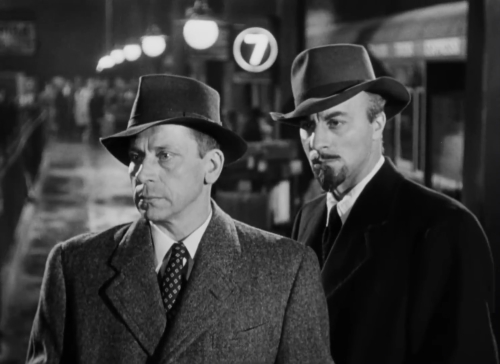
Howard Duff presents an honest, two-fisted likeability in the lead that was a trademark of his time at Universal. Marta Toren makes for a resourceful spy and an attractive headache for Duff. Neither one is stretched dramatically yet they turn in the type of work that makes it no chore whatsoever to spend an hour and a bit in their company. Robert Douglas and Philip Friend are dutifully suspicious in support and are well backed up by Walter Slezak, Philip Dorn and Kurt Kreuger. Watching these actors do their thing had me thinking how I often find myself influenced by the roles I first saw certain performers take on. For instance, Slezak has a relatively benign part in this movie, but somewhere at the back of my mind (and this is despite my knowledge of his work in sympathetic roles such as that in Mankiewicz’s People Will Talk) I still associate him with sinister characters like those he played in Lifeboat or The Fallen Sparrow. Similarly, for better or worse, I find I forever associate Philip Dorn with Passage to Marseille and Kurt Kreuger with Preston Sturges’ Unfaithfully Yours.
Spy Hunt has been released by Kino in the US in one of their film noir sets. Previously, it had been a title, like so many Universal-International movies, that one read or heard about while wondering if a copy that was viewable would ever turn up. The last few years has seen some remarkable progress in that area and there are now far fewer of these “lost” rarities. Having said that, I do want to point out that I can see no real justification for marketing this movie as film noir. That’s not meant as a criticism of the film, just a footnote for those who haven’t seen it to make them aware that it’s an espionage mystery first and foremost. Of course if the film noir label makes it easier to market it and get it out there for people to see, then so be it.


Sounds like a solid and fun B flick. Adding it to my ever growing to watch list.
Maddy
LikeLiked by 1 person
Maddy, that’s a good way to describe it. Sherman was always very reliable with this kind of stuff, although he was even better with westerns. The story has enough going on, and enough slightly unusual stuff via the whole panther business, to keep one’s attention, and it has to be said that Toren and Duff make for extremely companionable leads.
LikeLike
I have gained tremendous repect for those folks who make B Movie Westerns. They kept Westerns alive during a huge lull in the action – and demonstrate and unflinching love for the Genre. And it is true as you say, some have proven worthy.
LikeLiked by 1 person
Yes, it’s important to remember that the Bs and programmers were the bread and butter of all genre filmmaking. Without them, the higher profile efforts would struggle to exist.
LikeLike
Been working a bit on Film Noir of late and it is definitely a term that used say too loosely! THE THIN MAN is on the Wikipedia list 😳 This one sounds like fun, thanks Colin – presumably if there was any location filming this was Universal using up some of its funds frozen in Italy?
LikeLike
Labels don’t bother me too much to be honest, although they can create a very false impression. I feel this marketed as noir just for the sake of convenience, and I’m fine with that if it helps to get the movie released.
I don’t think there was any location work on this outside of the US, and the Universal lot at that.
LikeLiked by 1 person
I saw this one a few years ago and enjoyed it. Quite a cast . I remember Ivan Triesault always good too.
I think Philip Friend was seeing whether he could make it in Hollywood- don’t think he stayed long.
I always remember Philip Dorn in “I Remember Mama.”
Marta Toren very good.
LikeLike
Triesault had a wonderfully sinister face and such a bone-chilling stare. He made a fine conspirator in Notorious and he was a memorable presence even in small roles.
LikeLike
The first time I took notice of Philip Dorn was in UNDERGROUND (WB 1941). To this day, I still first and foremost, associate Dorn with this film.
LikeLike
That was a good role for him. A lot of us do seem to think of certain actors in terms of the first parts we saw them play.
LikeLiked by 1 person
I’ve read Victor Canning’s novel Panther’s Moon. It’s excellent. Canning was a fine spy writer in the pre-James Bond style.
And almost all the movies based on his novels are worth seeing.
LikeLike
I liked the adaptations of Victor Canning’s writing that I have seen. I have a few of his books too that I really should get round to.
LikeLiked by 1 person
Colin – nice article. Can you email me asap at Dan@SpyMovieNavigator.com? Thanks!
LikeLike
I enjoyed your article about a film I had never heard of before stumbling across it on YouTube last night, but once started, watched all the way through. You described it well, thanks! I thought the climax was terrifically done, a model of suspense and cleverness. I like Marta Toren a lot~sorry I can’t figure out how to put the accent marks on her name~and always delight in coming across one of her films. Two faves are Scirocco, with Bogart, and The Man Who Watched the Trains Go By, with Claude Rains. I loved the shot in Spy Hunt where Howard Duff is positioned between the caged panthers and the mysterious Toren outside the train, as if director George Sherman were posing the question: who is more dangerous, the panthers or the woman?
LikeLiked by 1 person
Thanks, good to hear you enjoyed my comments.
Toren was always an attractive presence, even if some of her films were not all they might have been. I like that interpretation of Sherman’s filming of that scene, an interesting reading.
LikeLike
Thanks and my pleasure, look forward to reading more of your posts!
I agree, her career didn’t hit the heights of a friend like Ingrid Bergman, but I find Toren really beautiful as a woman and compelling as a character in whatever role she played.
LikeLiked by 1 person