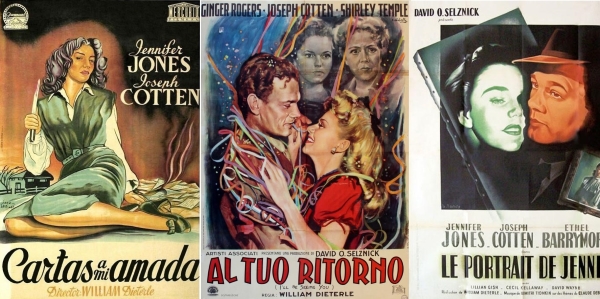
Ford famously labeled himself, somewhat disingenuously perhaps, a director of westerns. Hitchcock styled himself and entered the public consciousness as the Master of Suspense. DeMille cast himself as the consummate showman, the king of the epics. Mann and Boetticher are closely associated with the western, Siodmak with noir. Kramer seemed to want to challenge the viewer’s conscience, Capra went in search of the heart of America. So many filmmakers, so many associations. Watch enough movies and the mere mention of certain names, for better or worse, call to mind particular genres, themes or aims. I found myself reflecting on this recently as I settled down to revisit a trio of William Dieterle movies from the 1940s: I’ll Be Seeing You (1944), Love Letters (1945) and Portrait of Jennie (1948). They are all different movies, they tell different stories in different ways yet they all have in common that overwhelming sense of flawed romanticism which seems to have appealed to the director. Seeing them again in fairly close succession, the impression I was left with, and which I’ve noted before is the compassion and humanism underpinning Dieterle’s work.
Joseph Cotten is the male lead in all three movies and his slightly stiff air that picks at the facade of confidence and nonchalance he presents is routinely on view. In some instances, notably in I’ll Be Seeing You where his character’s PTSD is one of the plot drivers, this vague “otherness” is to the fore. That element is still there in Love Letters, although it is much less pronounced and clearly secondary to the traumatic amnesia of Jennifer Jones’ enigmatic ingenue. And Portrait of Jennie – arguably Dieterle’s masterpiece – raises unresolved questions about his overall grip on reality. There his Eben Adams is an artist whose need for a muse and concomitant quest for a solid basis for his art (reflecting that universal need to seek out a basis for our very existence) plays out as a dreamy fantasy where art, love and time itself are fused magically. Jones again is the fey presence at the heart of it all and it’s interesting to compare her oneiric style of performance to the more grounded approach adopted by Ginger Rogers in I’ll Be Seeing You.
Anyway, watching these films again, thinking about their commonality and the sensibility they share had me assessing my own journey towards ever greater acceptance of the whole notion of the auteur. At one time I was more resistant to the theory, and I know a number of visitors to this site are at least skeptical of it, but I have grown much more comfortable with it over the years. It doesn’t apply to all filmmakers of course and not all had a discernible vision that they impressed upon their pictures. However, when that vision can be detected in a number of major works – as in the case of Dieterle, and this despite the heavy hand of a dominant producer like Selznick in some of those films – then I think the auteur principle deserves to be given serious consideration. I certainly haven’t seen everything by William Dieterle but what I have, regardless of genre, typically touches on that romanticism whose strength lies paradoxically in its imperfection. The three movies I have mentioned here all display this in spades, to such an extent that I find it impossible to ignore.
 Riding the High Country
still not convinced about the auteur theory.
You make no mention of the writers who are the story creators.
LikeLiked by 2 people
A marketing ploy sold to the public by romantic pseudo-intellectuals.
LikeLike
Personally, I don’t think of myself as an intellectual, neither pseudo nor de facto, and I’ve no interest whatsoever in marketing of any kind. Yet the concept of the auteur has grown on me with the passage of time, so go figure. I will, however, own up to being something of a romantic.
LikeLiked by 2 people
Fair enough point. Ultimately, I see the director as having the most influential role in what appears on the screen, always in collaboration with others needless to say. And as I said, it’s not something that can be applied to all directors, some leave less of themselves on show, but I think there are those whose imprint is greater and whose touch is more evident. Mind you, I’m not trying to sell anyone else on the idea really. It’s just a position I have found myself gravitating towards over time and my recent viewings happened to focus my attention on it anew.
LikeLiked by 1 person
all that money can buy is his masterpiece. Jeanne is syrup
LikeLike
All That Money Can Buy/The Devil and Daniel Webster is a fine movie. But I can only call them as I see them, and what can I say – I’m partial to syrup.
LikeLike
I too would have to include ALL THAT MONEY CAN BUY among the best of Dieterle’s works, along with HUNCHBACK OF NOTRE DAME, though JENNIE is a beautiful, genuinely magical film. I love it.
LikeLike
Everyone making films is an artist no matter at what level. Yes..?
LikeLike
I don’t know if I’d go that far. There are probably more craftsmen, though some (many?) of them may aspire to be artists.
LikeLike
There are always going to be 100 Earl Bellamys for every Jeannot Swarc in any creative profession.
LikeLiked by 1 person
It’s been many years since I saw Hunchback but it’s a visually splendid movie.
LikeLiked by 1 person
The Blu ray is incredible. The look of the picture is brought out so wonderfully by the disc. I was in awe. Maureen O’Hara looks amazing in Hi def. The movie is enthralling still.
LikeLiked by 1 person
I recall the old DVD I have looking pretty good, though I can imagine such a detail rich movie looking particularly fine in HD.
LikeLike
Have you seen Rope of Sand? I have once a long, long time ago and the brutality/sadism and Paul Henreid’s performance kept it in my memory. I’ve heard that Lancaster loathed this movie, though I don’t remember anything to be ashamed of in it.
LikeLiked by 1 person
Yes Xavier, I have seen Rope of Sand and featured it here a few yeas ago when I was going through a handful of Dieterle titles.
It looks superb, as most of Dieterle’s (and Hal Wallis productions for that matter) do, but the script probably could have been tighter. Not a bad movie by any means though.
LikeLike
I am with Lancaster, I wouldn’t say I like it. Brutality without purpose and something smelling of Casablanca rip off in the background.
LikeLike
I’m a major fan of Rope of Sand. I guess it’s just the sort of movie that appeals to me.
LikeLike
I like Writer Robert Riskin’s comment:
He went into Frank Capra’s office with 120 blank pages and said;
“Let’s see you give THAT the Capra touch!”
( Riskin wrote It Happened One Night, Lost Horizon, Mr Deeds Goes to Town).
Auteur means author. The theme, the ideas, the dialogue, the characters.
writer /director Billy Wilder championed the writer before he started directing. He called the auteur theory stupid ie that the director is the author of the film.
LikeLiked by 2 people
I don’t believe we’re meant to take auteur as a direct translation, it’s ore a way of identifying the person with the greater creative influence. Not the sole influence, just the greater part as he/she is the one ultimately responsible for directing and putting on screen the combined efforts of the writers, performers and so on. If cinema were a text based form of art or expression, then the case for the writer as auteur first and foremost would be obviously stronger. Nevertheless, it is primarily a visual medium, and it is the director who is on set and drawing together all the component parts. When that person has a clear vision and sensibility, then it is almost inevitably going to rub off and be apparent in the work they produce. It can be seen in the work of many of the great directors – themes, motifs, visual touches and flourishes and a sense of their presence – regardless of the combination of writers, cinematographers, editors or performers they happen to be working with. That shouldn’t be taken as a denigration of the efforts and contributions of other people working on the movies, merely an acknowledgment that the guy calling the shots on set, with the caveat attached that he has a particular vision in mind, is going to leave more of his fingerprints on the finished film.
LikeLike
I remember when Ridley Scott, ‘hot’ after Alien and maybe a little less so after Blade Runner, seemed ready for a career as the “John Ford of science fiction films” but a few box-office bombs (Blade Runner and Legend) put paid to that.
I suppose auteur theory simply reflects the predilections of certain directors. A heavily visual stylist like Ridley Scott would obviously be inclined to visual-impact films like science fiction and fantasy, whereas directors with a flair for intellectual films like, say, Christopher Nolan, make films that deliberately tie their narratives into knots, like riddles for the audience. Hitchcock, of course, had a flair for manipulating suspense and tension- I doubt he’d have had much success making a western or romance picture.
What I find curious about this line of thinking, is that while the likes of Hitchcock, Ford, Capra etc are sometimes championed as auteurs, as if that makes them superior directors, in a way its just praising what they are good at and managed to get away with repeating, whereas someone like Robert Wise, who made all kinds of films of various genre, while perhaps considered a lesser director because he’s hardly an auteur in the accepted mold, could ironically be argued as superior to those championed auteurs simply because he could try his hand at anything with considerable success.
Another spin on auteur theory is that it makes it easier for the marketing department- “from the master of suspense!” etc when selling a film. Imagine selling West Side Story as” from the guy who made the Earth Stand Still!”
LikeLiked by 1 person
I’d say most of the great directors were quite versatile and could turn their hand to a range of genres, although I agree that in some cases their comfort in moving from one genre to another has led to their being less celebrated than ought to be the case. I’m thinking particularly of people like Raoul Walsh and Michael Curtiz here.
But Ford worked with ease and success in all kinds of genre – which is why I said I think he was being somewhat disingenuous in that famous comment on his own credentials – and Hitchcock arguably crosses and incorporates so many genres in his filmmaking that his body of work is practically a genre in itself. Wilder was mentioned above by Vienna as someone who dismissed the auteur theory, while I’d say he could be held up as an example of the concept in action.
Ultimately, it all comes down to how we perceive filmmaking, and what we take away from it. When I come away from a movie and think: “I’ve just seen a John Ford/Preston Sturges/William Dieterle/Anthony Mann/Douglas Sirk/ (delete as appropriate) film”, then I feel I’ve seen an auteur practice their art. It works for me, but I’m happy to acknowledge this won’t satisfy everybody else.
LikeLiked by 1 person
As Thomas Mitchell said while Ford was shooting Stagecach and bullying people: Remember, I saw Mary of Scotland.’
LikeLike
I like how Mitchell also said “…and I’d crawl over those rocks to work for him again”.
LikeLike
Absolutely, but Ford bullied folks, and Mitchell responded.
LikeLike
Yes, I’m always glad when somebody stood up to him. Aggravates me how he treated a class act like Ben Johnson.
LikeLike
Thomas Mitchell in 1939 had quite a year. Stagecoach, Only Angels Have Wings, Mr. Smith Goes to Washington and Gone With the Wind.
LikeLike
Yes, so many classics. I think the Oscar for him was a year achievement award for so many great roles.
LikeLiked by 1 person
No question about that.
LikeLike
It’s always boggled me that such a deeply, er, flawed individual also happened to be the greatest filmmaker America ever produced, and that this nasty bully was responsible for so many humane, heart-warming masterpieces. Guess his “methods” worked after all.
LikeLike
By all accounts, Ford was most assuredly not a man at peace with himself. To varying degrees, that is probably true of all great artists, that need to reach inside and pose questions about the human condition has to grow out of some discontent. That’s not meant to paper over some of the well-documented rotten behavior he displayed throughout his career though, just an observation on how flaws in artists is far from uncommon.
LikeLike
Yes I agree with that. One of my favorite authors William Faulkner was a genius but a fairly terrible human being quite a bit of the time. Ford, Faulkner, Peckinpah, Mitchum I don’t think were helped in their life by being such alcoholics either.
LikeLike
You are bang on.
LikeLike
Auteurism is interesting to consider within the studio system where (as all the reading incl Sarris suggests) sometimes there’s only so much room, or limited paths to distinguishable individual expression, and the director’s (and/or editor’s) outlet is visual, elements and patterns within the film that they can control. Which partly addresses the “what about the writer” issue, since writers often lose that kind of “power” in shooting/editing if not long before. And as you point out, the original politique des auteurs wasn’t meant to be thought of as literal “authorship.” More that there are authors making what should be evaluated as art (if I recall, don’t quote me) Like you, neither fully convinced nor trying to convince anyone, but always interested in it as a way of watching.
LikeLike
Yes, I just like noting when the touch of certain filmmakers is discernible enough to be worthy of mention. There are plenty of perfectly accomplished journeymen who never give that sense, but the directors who do tend to display it regularly and consistently enough to get me thinking. Incidences or examples from the studio era are indeed more fascinating (and yes, from my perspective more convincing too) largely due to the fact that the opportunities were, as you note, far more constrained.
As I said in earlier replies, I’m not seeking to sell anyone on this. I’m at the place I’m at on it and that’s good enough for me. I’m not in the least bit shy when it comes to proselytizing with regard to the merits of certain filmmakers and performers – I positively enjoy doing so – but I don’t plan to sell anyone on how they ought to evaluate or read movies.
LikeLiked by 1 person
Well put. I love collecting films by performers and directors. Ford, Peckinpah, and Kubrick for example I am able to follow the careers by discs and I get a real kick out of it to see their imprint on the films and how it evolved.
LikeLiked by 1 person
William Dieterle’s best movie by far is The Last Flight (1931). It’s also Hollywood’s most successful attempt to capture existentialism on film. And maybe Hollywood’s best film dealing with the way war destroys men.
LikeLike
I’ve never seen that movie so can’t comment on how I’d place it in terms of Dieterle’s other work. Reading a little about it suggests it may not suffer from that static staginess that spoils a lot of early sound films for me, so I’ll look out for it in the future. Something else that struck me was the relative brevity of the careers of the main cast members – again, a lot of early sound performers seemed to fade fast.
LikeLike
I would love to hear your take on The Last Flight if you get a chance to see it. It has a tone that sets it apart from other Hollywood movies. I regard it as a definite neglected masterpiece.
LikeLike
There have been so many books on film directors. What we need are some book-length studies on screenwriters, cinematographers, production designers. I’d be interested in a “The Films of Nicholas Musuraca” book for example.
Looking at the whole body of work by some of these guys might lead cinephiles to regard the auteur theory in a different light.
And maybe more studies of the films made by various studies at particular times. Maybe a book on 1940s RKO crime films for example.
LikeLiked by 2 people
Why…sosomeone who has no idea about time show business will tell the rest of us what to think? The hell with that.
LikeLike
But isn’t that what auteurist theory was, and is? Academics and critics with no real understanding of how movies actually got made telling us how to think about movies?
In fact film scholarship and film academia have always been about imposing weird and wonderful theories (theories totally disconnected from reality) on movie viewers.
Feminist film theory being an outstanding example. Total La-La Land stuff.
LikeLike
That may very well be, but we must use our heads, follow the filmmakers, directors, actors, studios, and producers, we like best, and leave it at that Oh, and the pictures the theatres want. This is the entertainment industry, not a hobby. Feel free to like something successful, or despise it, and anything in between. The critics are not filmmakers, they are just old men with soft bodies who expound on their own feelings. These men and women mean nothing other than to promote and provide entertainment of their own making.
No study is required.
LikeLike
I don’t think there’s anything wrong with discussing movies or offering different takes on movies or analysing them up to a point.
It’s only a problem when people try to over-analyse movies, or when critics or academics waft off into Film Theory Pixie Land, or try to impose wildly anachronistic ideological interpretations.
It’s fun and useful to argue about Vertigo and whether Scotty Ferguson is actually the hero, the victim or the villain, as long as the arguments are based on what’s actually in the movie. But when people start rabbiting on about theoretical concepts like the Male Gaze that exist only in the fevered imaginations of academics the discussions cease to be useful.
LikeLike
That is all fine with me…but about Scotty: He is nothing just a cardboard character manipulated by a team of filmmakers for an effect. It has no meaning. That critics have anointed thsi thing the best film in the world makes my point.
LikeLike
I think there have been critical appraisals of cinematographers. Whether there have been many book length versions, I couldn’t say. I doubt it would lead to any reassessment of the auteur concept though – at the end of the day, those people really only were able to influence one aspect of the process, they were not tying everything together and controlling how it was presented on screen.
LikeLike
Although I have not seen any of the three Dieterle films mentioned I enjoyed your essay very much, another fine example of your skills as a wordsmith.
Some rather good news,our friend Walter has returned to commenting after a ten month sabbatical; who knows this may entice Jerry to make a welcome return.
LikeLiked by 1 person
Thank you. I hope you get a chance to see some of these some time, John.
Nice to hear people are interacting again – obviously, I’ve been a lot less active myself of late and that’s probably going to continue for the foreseeable future.
LikeLike
Frown 😦
LikeLike
I guess these films are out on other imprints,but in February Germany’s Explosive Media are releasing two Boetticher non Westerns on Blu Ray RED BALL EXPRESS and THE KILLER IS LOOSE.
LikeLiked by 1 person
Thanks for passing that on. I have satisfactory DVDs of both, but I might be tempted into a HD upgrade.
LikeLike
In a possible futile mission to keep this topic/post/thread alive and as Colin states that his time is limited these days, I thought I’d chip in a bit about Dieterle and then move on to other stuff.
I do like Dieterle’s Noirs DARK CITY and THE TURNING POINT which are worth a mention. Some of his Pre Codes which I have never seen intrest me;THE LAST FLIGHT which Dee mentions sounds right up my street and is easy enough to track down. Less easy to find, at least in watchable quality is 6 HOURS TO LIVE a sort of Pre Code Sci Fi which,I think I would also enjoy. I’ve had FOG OVER FRISCO on the back burner for ages and Heaven only knows why I’ve never got ’round to getting it.
I had a communication from Jerry who states that he’s following RTHC but still cannot comment but will try again. Right now WordPress have decided that I am john knight all in lower case, which I have never used, still at least my comments are getting through. Jerry mentioned that he’s very excited about the release of the Pre Code Western LAW AND ORDER on Blu Ray. I’m very interested in seeing some of Edward L Cahn’s Pre Code films before he decided to just churn ’em out-during that period he was obviously a very creative film maker, so much so the Museum Of Modern Art are said to be restoring two of his most sought after films. AFRAID TO TALK (1932) sounds like something Dee would love; Bert Greene a gentleman who contributes to other blogs I follow said this “Afraid To Talk sure is an ultra bleak, downbeat film,so much so I have not been inclined to watch it again” Mr Greene has film knowledge that is most impressive,he’s forgotten more about film than I’ll ever know. LAUGHTER IN HELL (1933) MOMA states was Cahn’s last film as a major director but having said that some of his work at MGM is very impressive especisally his Crime Does Not Pay shorts. A couple of Cahn MGM Programmers are also worth checking out MAIN STREET AFTER DARK and in particular DANGEROUS PARTNERS.
LikeLike
Yes, John, time is a big factor in my scaled back efforts of late.
Thanks for passing on the fact Jerry is following along, I do miss his contributions but I quite understand how WordPress has made thing much more complicated than it ought to be.
You prefaced your comment here by mentioning The Turning Point, a film I enjoyed a lot too and posted about some years ago here. Thanks too for mentioning Fog Over Frisco, a movie I recall seeing a very long time ago and liked. I wouldn’t mind seeing it again actually.
LikeLike
Colin, I really enjoy your thoughtful write-ups, and I think your writing is so excellently readable. Your thoughts brought to us through your writing results into the wonderful discussions by way of the commentators who visit your site. Everyone has a different or similar take on the subject at hand. The points raised by everyone are viable and worthy of discussion. I enjoy this tremendously and it makes my day better, even though I might not agree on something or other that is said. I sincerely hope these discussions continue and I think they will because of everyone involved.
I’ve been offline for a while because my e-mail was hacked, and I’ve been somewhat cautious about getting back online. Also, I’ve been busy helping my daughter in her business. Though I may not comment I still read your blog when time permeants. Life does get in the way.
Well, life is getting in the way again. Keep doing what you are doing, and commentators keep on commenting. Take care and have a good day.
LikeLiked by 1 person
That’s very kind of you, Walter – much appreciated.
And I’m pleased to learn your email woes have been resolved.
LikeLike
I just had a feeling that keeping this thread alive might be futile although I was delighted to see Walter make a welcome return. I hope we hear again from him soon,and it will not be too long before Colin posts another rewarding essay. As it happens I only follow RTHC and Toby’s blogs constantly and as Toby is ultra busy these days with books and commentaries my online activities are curtailed somewhat.
LikeLiked by 1 person
Might be something new this weekend or thereabouts. Maybe.
LikeLiked by 1 person
Hey Colin, while you are quiet and pre-disposed have you ever considered starting an Open Thread so the gang can comment on any subject they wish? Could be fun and informative as the thread meanders from link to link.
LikeLike
I hadn’t actually, but I’ll bear it in mind. I suppose it could be based round a poll or something similar to allow for a jumping off point.
LikeLike
Great post Colin 🙂 What a coincidence 🙂 I was actually planning on watching some of William Dieterle’s films because it has been a long time 🙂 Personally, I am a huge proponent of the auteur theory, but it is important to credit the crew because they played a significant role in fulfilling the director’s vision. Also, let us not forget that in the end, the true auteur of both Gone With the Wind and The Wizard of Oz was David O. Selznick for the former and MGM for the latter. Why? Despite presenting Victor Fleming as the credited director on both, both of them had a few directors attached and they all remained uncredited 🙂
LikeLike
Serendipity, that’s the word for it, John.
I can go along with that approach to movie watching, I’m happy to acknowledge the efforts of all the contributors to the filmmaking process, and I see no reason why that can’t go hand in hand with accepting the auteur theory as well. It doesn’t always have to be an either/or scenario, and lines are blurred too on occasion. Selznick certainly lends weight to that.
LikeLiked by 1 person
Regarding the auteur theory, my nod goes to someone who did it all and is rarely mentioned on this site……….Orson Welles.
LikeLiked by 1 person
Yes, couldn’t argue with that. I have featured some Welles movies here in the past, both those he directed and those he acted in, but it has been a while now.
Incidentally, When I was back in Ireland during the summer visiting the family, I happened to be listening to BBC Radio Ulster one day and there was a lengthy interview with Northern Irish critic and writer/broadcaster Mark Cousins. He spoke a lot about Welles and the interview ended with Welles’ delightful rendition of “I Know What It Is To Be Young”
LikeLiked by 1 person
That he is scottpstorm 🙂 In fact, even when he is working with a low-budget, he was able to make the most out of very little. One time I watched a clip of Chimes at Midnight (which I seen all of) online on youtube and one of the comments implied that Welles direction on the film is a visual effect in itself. In other words, Welles make us believe that we are watching a big-budgeted film with how he stages everything 🙂
LikeLiked by 1 person