Without having initially planned to do so, I ended up watching a selection of movies directed by Alfred Hitchcock all through September. I tried to choose those titles I had not seen for quite some time and have been jotting down and recording my thoughts on each in brief as I’ve gone along. Having done so, I figured I might as well assemble them here as an end of month round-up. So here goes:
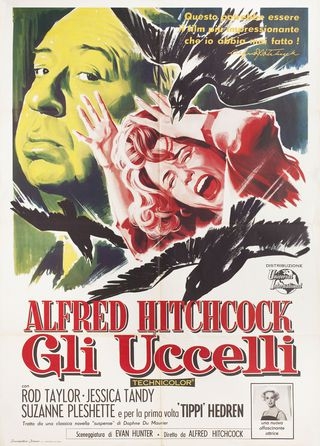
The Birds (1963)
It’s been many years since I last watched this and I’d forgotten just how well constructed it is, not to mention its technical proficiency bearing in mind the era.
That long, slow build-up is the work of a deeply confident filmmaker. It’s never boring or tedious and the gradual, estrogen-fueled tension, with all the cats among the pigeons, is drawn ever tighter in tiny but finely judged increments. When the full chaos is finally unleashed in the apocalyptic latter half Rod Taylor does get to flex bit of muscle, literally and figuratively.
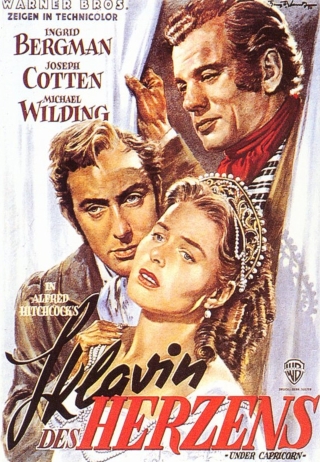
Under Capricorn (1949)
Very much lesser Hitchcock, a movie which barely anyone ever has a good word to say for. Well, I’ll at least say that it is handsomely shot, courtesy of Jack Cardiff, and the acting is fine even if Michael Wilding does lay the whimsy on with a trowel at times.
But yes, it is a problematic movie. And that is largely because it tells a story which is thin, not uninteresting in itself but too thin for its running time. It needed to be trimmed and compressed, which would have been hard to do because of the other great flaw – the director’s insistence at the time on experimenting with long takes. It hamstrung the previous year’s Rope (though that one has other issues dragging it down too) and was a technique that was antithetical to Hitchcock’s style.
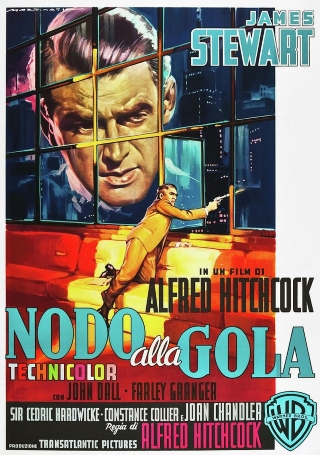
Rope (1948)
I’ve never especially liked this. The technical ambition is admirable, and I’ve always been somewhat hypnotized by the seamless skill involved in the gradual change in the lighting of the studio bound skyline as the tale unfolds in real time. However, the whole continuous take conceit imposes huge limitations on the cast and crew and the process must have been a genuine pain for everyone involved. As with Under Capricorn, the entire business works to undermine the director’s natural strengths.
The biggest problem I have with the movie though is the coldness and indeed the malice at its core. Nobody aside from Cedric Hardwicke’s anxious and compassionate father comes out of it well. That’s not to say it’s badly played of course. Granger could do that weak sister act with his eyes closed and Dall has the clinical and supercilious aspects down pat too – he always seemed to manage that though and there’s a hint of that inherent unlikeability also found in Laurence Harvey in all his parts. James Stewart nails the creeping suspicion that blossoms into horror and then outrage and (self?) disgust. But his character is not really sympathetic either – a man of his intelligence ought to have realized the kind of seeds his intellectual posing was planting.
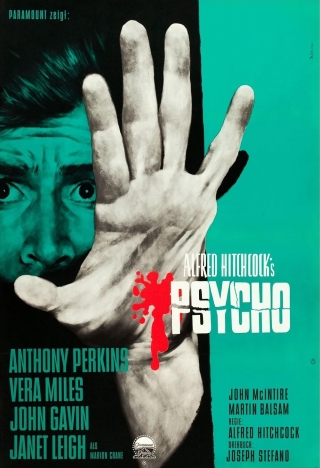
Psycho (1960)
It’s probably 15 years, maybe even more, since I last watched this. The first half always worked best for me and I still feel the same. The paranoia and gnawing guilt of Janet Leigh’s Marion is perfectly encapsulated in the minimalist style of that whole opening section – the rain, the ever more frantic musing, Herrmann’s nervy score and those seemingly permanent close ups of Leigh’s huge, expressive eyes.
And then there’s that frankly sublime sequence in the motel cabin. Cagey and uncomfortable, pathetically flirtatious and taut all at the same time. I reckon it’s the best scene in the entire movie. What follows in the last hour engages me less. It remains visually astounding and technically flawless, but too much of the artful subtlety drains away with the bath water. It still grips and shocks at times, just much more conventionally and it never again approaches the emotional precipice that was teased by the interaction amid stuffed birds, sandwiches and milk.
Nevertheless, it is still undeniably a great piece of cinema, the heights approached and attained in that first hour and the total assurance of a director genuinely in love with his medium are enough to ensure that.
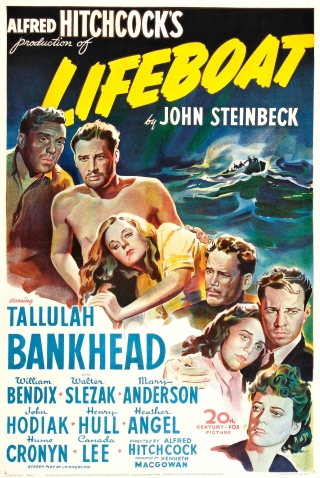
Lifeboat (1944)
A wartime propaganda picture from Hitchcock. Still, being a Hitchcock movie there’s more to it than that – by a circuitous route it winds up as something of a celebration of cohesiveness. Just about every stratum of western society is represented, from Henry Hull’s super rich kingpin to John Hodiak’s blue collar revolutionary, from the stoicism of Canada Lee to the louche decadence of Tallulah Bankhead. All the disparate characters are by turns gulled, threatened and finally drawn together by the malignant presence of Walter Slezak’s cool and cunning Nazi.
It’s another of the director’s challenges to himself, an exercise in the potential of confinement that makes up for in intensity what it arguably lacks in suspense. Alongside the more eye-catching dramatics of those further up the cast list, it’s satisfying to watch the slow development of a gentle romance between fairly regular Hitchcock collaborator Hume Cronyn and Mary Anderson, an actress who never much graduated beyond supporting roles except perhaps in the rarely seen but rather good Chicago Calling.
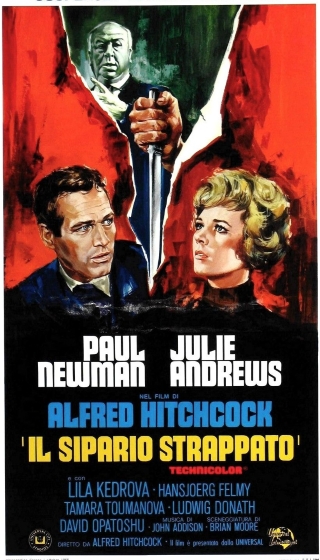
Torn Curtain (1966)
This is the point at which Hitchcock’s decline can be discerned. This Cold War thriller starts out as a double-cross drama where the bluff is drawn out too long before turning into a more successful cross-country chase, the kind of affair Hitchcock could make with his eyes closed.
The first half of the movie misses more than it hits, the brief bookstore scene in Copenhagen errs just on the right side of oddness, but the drab grey/green palate when events move to East Germany reflects the dullness of much of that section, not helped by a listless and detached performance by Paul Newman and an uncomfortable looking Julie Andrews. Some of it does work though – I like the entire build up to the farmhouse scene where the Stasi spook Gromek is laboriously disposed of, and Ludwig Donath is spikily entertaining as a caricatured professor.
The bus ride/pursuit has its moments, helped by John Addison’s slightly eccentric score and an earnest David Opatoshu. There are a few late flourishes too – the hiding among a crowd/creating a distraction ploy is revisited for at least the fourth time – off the top of my head variations thereof are employed in The 39 Steps, Saboteur and North By Northwest if not more.
So, a mixed bag all told. I guess it does more wrong than it does right yet I’ve always had a greater fondness for it than it probably deserves.
 Riding the High Country
My local cinema have a two month run of Hitch classics so I’ve seen 39 Steps and North by Northwest back to back and found they are practically the same movie. Both brilliant though
LikeLiked by 1 person
David, I think you could add Saboteur to those two and make up a trio of very close relatives, all variations on the same essential theme. Young and Innocent isn’t far off either.
LikeLike
Frenzy fits the innocent man on the run trying to clear his name motif as well. 39 and NbyNW literally have whole scenes in common: the train, the initial stabbing. The auction and the political speech are similar comic suspense scenes. The suave villain. Saboteur adds the national monument that NbyNW uses. Keep up the good work. I always enjoy your reviews
LikeLiked by 1 person
The 39 Steps is the better movie. Hitch’s 30s movies were so lean and mean. So many of his 50s movies are great but would have been better trimmed by half an hour or so.
LikeLike
Cary Grant is a significant improvement.
LikeLike
Yes, although I think Eva Marie Saint is a slight downgrade.
There’s nothing wrong with North by Northwest that couldn’t have been fixed by some drastic pruning.
LikeLiked by 1 person
A very interesting mixture, all experimental in their own way. ROPE has really grown on me over the decades and it seems to me that the technique does serve the story – though cold and callous centre in unavoidable. Can’t say that about the tedious CAPRICORN though. Really like your “cats among the pigeons” line about the rich and strange, THE BIRDS – nice! 😁
LikeLike
Under Capricorn drags from the middle on as there just isn’t enough of a story to support its length. And then the frequent long takes sap any pace and momentum as well. Rope is cruel and chilly but it does move.
LikeLiked by 1 person
Hitch’s experiments were very hit or miss. Rear Window, Dial M for Murder, Vertigo, The Birds were (to my way of thinking) experiments that were triumphs. Lifeboat, Rope, Under Capricorn, Psycho were (for me) failed experiments. But at least he was willing to take risks.
LikeLike
Rear Window was okay, but erventually a bore. Lifeboat just great. Rope, waste matter, worse than even Under Capricorn. Psycho is a; homosexual dream, not to my taste. Dial M okay, but not better than that, Vertigo the worst of all.I guess The Birds was all right to see a single ime, but not embrace.
LikeLike
Hitchcock’s movies in the 50s were increasingly bloated. Oddly enough (for me) Rear Window suffers less from this than most of his 50s films.
Rope is a train wreck. I was bored by Lifeboat.
Vertigo is a masterpiece but it’s surprising how many people dislike it. It is much more in the mode of European art cinema and it’s no coincidence that it’s based on a French novel. I’m getting the feeling that you prefer his more conventional movies?
LikeLike
I’m sure I’ve said it before, but I find little to fault in anything Hitchcock did in the 1950s. It was his peak period, his confidence in his own filmmaking was growing all the time and the results were increasingly assured, smooth and seamless with every passing year.
I don’t see his work from that time as bloated at all, there’s nothing there which doesn’t need to be and the pacing is remarkably consistent. By this stage, the scripting and visuals were highly polished and what was on screen was there for a reason. From my perspective, a film that is bloated is one which has a story that is too slight to support is length, one which is in danger of collapsing the attention of the viewer due to inherent weaknesses in its structure. As I said, Under Capricorn does suffer from this, and the later Topaz has issues arising out of the convolutions of an intrinsically weak story. I don’t see any of his 1950s output as beset with that kind of problem.
LikeLiked by 1 person
I think his 50s movies are in general considerably better than his 40s movies, apart from his two 40s masterpieces Rebecca and Shadow of a Doubt.
But he made great movies throughout his career. I finally got around to rewatching Family Plot a few nights and I enjoyed it enormously.
LikeLike
For years I was broadly indifferent to Family Plot, not especially liking it but not really disliking it either. It just felt like a tame end to a long career. However, it has grown on me through time. While it’s never going to be ranked among the director’s top tier work it shouldn’t e regarded as failure. The peaks of a decade earlier were gone and there’s no complexity to speak of, certainly nothing approaching what he’d touched on in his finest works. Still, it is smoothly entertaining in its own gentle way. It also has a different feel to a lot of thrillers being made in the early to mid 1970s and when one stops to think about it Hitchcock’s movies generally existed slightly apart from much of was being made around them.
LikeLiked by 1 person
Yeah, Family Plot does feel a bit quirky for 1976. Quirky in a charming way. Which I like. It reminds me a little bit of one of my favourite Hitchcock movies, The Trouble With Harry. There’s some slightly wicked black comedy. And it’s an enjoyable romp. Hitch didn’t want every movie to be a journey into the dark night of the soul.
And it’s so wildly different to Frenzy. He could so easily have just tried to do another Frenzy.
LikeLike
I find both TO CATCH A THIEF and the remake of THE MAN WHO KNEW TOO MUCH a little dull in fact (THIEF has always felt a little heavy handed to me, though it is in fact a fine little entertainment most of the time). When it comes to Hitchcock there are only a few that don’t necessarily succeed for me and Colin has identified most of them (I might add STAGE FRIGHT) but all are of value just the same.
LikeLiked by 2 people
Yes, I know what you mean about all three of those, although I’m fine with them personally. To Catch a Thief is a picture postcard affair at heart, a love note to Kelly and the Riviera and works very well indeed on that level.
The Man Who Knew Too Much is arguably less than the sum of its parts but a few of those parts are extraordinarily well done – , the marketplace in Marrakesh, the whole Ambrose Chapel business (false trails and all), the Albert Hall sequence.
I find Stage Fright more enjoyable too nowadays, the black comedy that underpins it feels more consistently successful for one thing.
LikeLiked by 1 person
When I saw Stage Fright for the first time years ago I reacted the way so many people reacted at the time – I was outraged. He broke the rules!
But now having seen lots of movies from the 60s to the 90s, especially European movies, that gleefully ride roughshod over the narrative conventions I’m no longer shocked. Now it seems like a bold innovation that was years ahead of its time.
Now I can just enjoy Marlene’s performance, and the comedy elements you mentioned, without feeling guilty.
LikeLike
The more I’ve thought about it, the less convinced I am he actually “broke any rules”, or conventions, for that matter. I reckon everything is put out there for the viewer, it’s merely a matter of successful misdirection or prestidigitation on the part of the filmmaker.
There are quite a few elements I very much enjoy in the film, but it’s one I might like to post on in more depth at some point so I won’t go into too many more details just at the moment.
LikeLiked by 1 person
I thought the remake of The Man Who Knew Too Much was very plodding. It’s three-quarters of an hour longer than the 1934 version!
The two 50s Hitchcock movies I actively dislike are The Wrong Man (I can’t stand Henry Fonda) and I Confess (I can’t stand Montgomery Clift).
LikeLike
Obviously if you don’t like the actor it’s hard to enjoy the film no matter its merits. Man Who Knew is a bit too long but full of good things – and the Albert Hall sequence being so much longer is a huge bonus.
LikeLike
I have no problem with either actor and I thought both were well chosen for their respective roles. Despite my reservations regarding the Method, Clift used the technique as well as anyone I’ve seen – he knew how to a lot through small reactions and his character’s inner turmoil comes across very effectively for me. Similarly, Fonda’s ability to impart dignity under pressure is given a thorough workout. Those movies, particularly The Wrong Man, have a much more sombre tone and that’s in keeping with their themes, and maybe their overt Catholicism too.
LikeLike
Regarding I Confess, not such a good picture but anything with Brian Aherne has some merit.
Barry
LikeLike
I probably like it better than a lot of people do. But I can understand how it’s not to everyone’s taste. Like all of Hitchcock’s prime era work, it should still be of interest even if it doesn’t entirely work for viewers.
LikeLike
The fifties are not so hot, but the sixties stink straight out. Boring!
LikeLike
A decade of two halves in my opinion.
LikeLiked by 1 person
Hitchcock in the 60s – The Birds is a masterpiece, Marnie is excellent.
Torn Curtain might have worked had it been half an hour shorter and made ten years earlier, with decent male and female leads.
The total lack of star power sinks Topaz. John Vernon and Karin Dor are very good but they were not bankable stars in the US. And if they wanted a star with a French accent Alain Delon would have been an obvious choice. Plus it’s based on a book by that most dreary of novelists, Leon Uris. And it needed to be an hour shorter.
LikeLike
The Birds does have some clever effects and moments, but no one that creates a spark of either stardom or on screen intelligence.
LikeLike
About Leon Uris, your hero Alfred Hitchcock selected it.
LikeLike
The best Hitchcock’s? Foreign Correspondent, Notorious, Suspicion, and Hitch has it right in all these films as to who the bad guys are, then and now.
LikeLike
Suspicion went so tantalisingly close to greatness. But that ending….
One story (possibly apocryphal?) I’ve heard is that Cary Grant was responsible for ruining the movie by vetoing Hitch’s ending.
Notorious also goes close to greatness but the Hays Code seriously weakened it and as a result Devlin’s behaviour makes no sense.
I thought Foreign Correspondent was so-so.
LikeLike
Devlin makes perfect sense to me, and Foreign Corrspondent is modern, names the villains as allied with the peace movement., and the hero naive.
LikeLike
as usual, great post and super posters.
Maybe my least favourite Hitchcocks. I haven’t even seen Under Capricorn.
LikeLike
Thanks. As I said, I went for the movies I’d not seen for a longer time as opposed to those I have tended to revisit more often. I’m going to continue rewatching more of his movies in the weeks ahead, but am less likely to post anything on them here as I’ve already put up dedicated posts on some of them.
LikeLike
I’d love to hear your thoughts on really early Hitchcock. Movies like the very quirky Rich and Strange.
LikeLike
Oh Dear, my Dear . . . I put both volumes of Gottlieb’s “Hitchcock on Hitchcock” on my transit-read/sleepless nights book reader just last week.
You’re a beauty, Buddy, and once again, if I haven’t said it before or can’t remember anymore . . . THANK YOU for what you do and will hopefully continue to do!
The comments section here, and here I address the participants, is equally enjoyable to me . . . it’s such a modern rarity to see intelligent discussion that remains on topic.
Lord, the catalogue Hitchcockian is such a treasure, and we are so fortunate to have access to its contents.
Let’s live, and let’s enjoy life’s filmic treasures and pleasures along the way!
LikeLiked by 1 person
Whoa AND Daddy!
A simple click of the provided “Alfred Hitchock” flag at the bottom leads to so much more on the topic. Nicely arranged, and I am most definitely riding the range on this very high cinematic country.
LikeLiked by 1 person
It’s a pleasure to view and put out a few thoughts on a Hitchcock movie, something I only occasionally do here – so much has been written on them, and written well too, that I frequently feel my contributions will be rather redundant. I hope to come back to some full length piece on his work at a point in the future though.
LikeLiked by 1 person
Heavens no, far from redundant! But, if you insist, I’ll settle for divinely superfluous beauty, or somethin’ or other along them lines.
LikeLike
And I’ll stop adding unnecessary clutter to the comments section here and now . . .
Cheers to film!
LikeLike
I agree about Psycho. Brilliant in parts but flawed. The daring narrative gimmick halfway through has the effect of making us not really care what happens after that. And it has the same problem as Robert Bloch’s novel – what’s really going on is much much too obvious.
Michael Powell’s Peeping Tom, made the same year, is a much more successful film.
LikeLike
And The Birds has that ending. You just couldn’t end a Hollywood movie that way in 1963 but Hitchcock did it anyway.
LikeLike
Thanks for posting this. I now want to go through my Hitch Blu/DVDs which ironically I was doing last night. Just recently picked up ‘Lifeboat’ trying to fill my American collection. Like you I adore his ’50s work. ‘Rear Window’ and ‘Vertigo’ are such favorites. I love watching his career unfold and the richness of the material on disc makes it easier. I love this bite sized look on his work. Like Ford, Peckinpah, and Hawks I could talk on Hitch forever.
LikeLike
I just felt like throwing a few thoughts out there on the selection I’d been watching of late. I mentioned these piecemeal elsewhere and thought I might as well gather them int a post to share since none of them had been featured on the site before. But yes, there’s always something to chew the fat over when it comes to all the great directors. Expect something on Ford later this year, though almost certainly on one particular movie. Which one? We’ll have to wait and see…
LikeLike
Oh good. I think I might have an idea of the Ford.
LikeLiked by 1 person
Having just watched the movie again, I’ve pasted in a few observations on Torn Curtain, simply to round out this piece.
LikeLike
Thanks. I think your comments are spot on. The two leads were miscast. I take it you like ‘Marnie’ though?
LikeLike
Marnie is better, but not definiive.
LikeLike
Yes I do. Marnie is Hitchcock’s last great movie, in my opinion. I hope to give it a rewatch within the next few weeks.
LikeLiked by 1 person
Yes, when I watched it recently I liked it too. Hendren and Connery were good together. Look forward to your thoughts on it.
LikeLike
I’ve been watching quite a lot of Hitchcock lately but not necessarily commenting on everything so I won’t commit to posting on the film, not ruling it out either of course.
LikeLike
Hedren was the world’s worst actress but it worked in her favour in Marnie. Her performance is so weird and disconnected and emotionally flat that it works perfectly.
Amazing that such a relentless actress gave birth to such a talented daughter (Melanie Griffith).
LikeLike
Careful now. It is fine not to like someone’s work, but successful people are never the world’s worst of anything and Hitch is getting quite pounding in his old age,which is fine with me.
LikeLike
The two leads in Turn Curtain are absolutely awful. So which actor/actress combination would have worked better?
LikeLike
There’s a stiffness to the performances, but not what I’d term “absolutely awful” – that’s too strong in my view.
Frankly, I’m not sure different personnel would have made much difference. These were big stars, experienced and accomplished actors. The script necessarily requires a degree of detachment from the players, both of whom are trapped in a situation that demands they deceive those around them for much of the running time, and that deception in the early stages includes those closest. This is going to lends a degree of distance to a performance whoever plays the role, and then it comes down to how that aspect is interpreted by the actors cast.
It may be that the interpretations and thus the performances are true and honest (and I think this is actually the case) to the characters as written, but that this particular truth doesn’t make for the most riveting cinema.
LikeLiked by 1 person
Excellently put.
LikeLike
Really enjoyed reading your thoughts on these, Colin (especially this gem: “. . . Michael Wilding does lay the whimsy on with a trowel at times.”). I definitely like Rope more than you — I don’t know why, but it just grabbed me the first time I saw it. I was really on the edge of my seat. I can’t with Under Capricorn, that’s for darn sure. And I’ve not yet been able to bring myself to watch Torn Curtain. I suspect I may never.
Karen
LikeLike
Thanks, Karen.
I wouldn’t say you ought to avoid Torn Curtain – I don’t usually advise anyone to avoid films for that matter, well all react in our own way having viewed them after all. I don’t know if you’ve seen Topaz, but it’s certainly a cut above that and not a total failure even if some elements don’t come together.
LikeLike
I agree. I think one should watch ‘Torn Curtain’. Its perfectly watchable. I just watched Ford’s ‘Two Rode Together’ again today (yes, again) and one always hears how terrible it is, Ford’s negative opinion of it, waste of time, blah, blah etc. It is not a waste of time. Flawed, certainly. Watchable, indeed fascinating though to see where this artist was in his career. So like ‘Torn Curtain’ I recommend the watch of films that still have worth in them.
LikeLike
Two Rode Together is good neough for me,especially the work of Stewart and Andy Devine.
LikeLike
Topaz is 45 minutes too long. It has zero star power. The hero is a French spy. Did no-one think to offer the part to Alain Delon? Delon could do a great French accent, seeing as he was French. And Delon had charisma.
LikeLiked by 1 person
Torn Curtain has just never been appealing to me, based on the plot descriptions and other reviews I’ve read. Same with Topaz, The Trouble With Harry, and Frenzy. (I only saw Family Plot because it was the movie selection in a classic film meetup group I’m in.) I just feel like I like his earlier stuff — The Birds is pretty much the cutoff for me.
LikeLiked by 1 person
Bingo.
LikeLiked by 1 person
The Trouble With Harry was a film that did not sound the least bit appealing to me when I read descriptions and the like about it. I figured I never really needed to see it. When I finally got round to it – I think a late night TV screening around 1989 – I was very pleasantly surprised. It’s certainly different from his other work, particularly of that period, but it has a terrific charm all of its own. The cinematography is nothing short of breathtaking at times with colors that I can only describe as rapturous. And the relationship that develops between Edmund Gwenn and Mildred Natwick is a delight.
LikeLike
Yes, I really enjoy it too. On Blu the colors really pop.
LikeLike
The Trouble With Harry is one of Hitchcock’s best films. It’s not a suspense film. It’s a black comedy. It’s a good-natured feelgood comedy about an inconvenient corpse. And somehow it manages to be both a black comedy and a feelgood comedy. It’s clever and witty.
Of Hitchcock’s other movies the closest in feel is Family Plot (which I also adore).
And The Trouble With Harry is visually gorgeous.
LikeLike
Had it been made ten years earlier with real actors Torn Curtain could have been a good 1950s Hitchcock spy movie. It has some very good moments. It’s just very very 1950s.
LikeLike
You mean that neither Paul Newman or Julie Andrews were real actors?
LikeLike
Yes, that’s what I mean.
LikeLike
Re-think your premise. Julie is great, Paul miscast, but they are both successful giants of the business.
LikeLike
Being a successful actor and being a good actor are not the same thing.
LikeLike
Yeah, thye are. What business are you in?
LikeLike
I’ve never thought of commercial success as having any connection with quality.
LikeLike
Then you are not thinking.
LikeLike
Newman was a very good actor and as he got older was better and better. ‘Nobody’s Fool’ was a treat.
LikeLiked by 1 person
Also, ‘The Hustler’ was one of the great performances.
LikeLike
I guess I was fortunate to have seen many Hitchcock pictures in huge single screen cinemas in the 50’s and 60’s. REAR WINDOW and THE MAN WHO KNEW TOO MUCH made a huge impact, the former a masterpiece and the latter a Worldwide smash,an enormous crowd pleaser. I agree with Colin’s earlier comment that MARNIE was Hitchcock’s last great movie, which I saw on the massive single screen at the Odeon Hammersmith at the time,the impact of which,still remains with me.
I deeply regret that i never saw VERTIGO on a huge single screen, sadly only on a tiny screen in a multiplex back in the 80’s.
I have never seen TORN CURTAIN, nothing could induce me into the cinema to see a Julie Andrews movie. FRENZY was interesting,the times had moved on Hitch had not. The low octane star power makes one wonder how much better it would have been had the original choices been involved. I undertand Micheal Caine turned the film down,I guess because he did not want to be the heavy opposite arch rival Oliver Reed.
Later Caine played the heavy in De Palma’s dire DRESSED TO KILL.
De Palma was no Hitchcock,could never be, OBSESSION was pretty good, DRESSED TO KILL garbage and BODY DOUBLE even worse. Lots of sacred cows have been slain on this most entertaining Hitch Forum so I thought I’d join in the fun
LikeLike
I’ve been fortunate enough to see a fair few Hitchcock revivals on the big screen in Athens over the years, maybe not as big as the screens you mention though, John.
De Palma is an interesting figure. I rather like his films even if they are often derivative. No, he’s no Hitchcock but up until his last couple of movies he was someone clearly in love with filmmaking, and I reckon that in itself is something worth celebrating.
LikeLike
On De Palma even ‘Black Dahlia’ is worth a reevaluation. I hate Mia Kirshner was only in it for a few moments as the doomed woman as she was incredible. I think the film got a raw deal in the end flaws and all.
LikeLike
It’s not bad overall, typically stylish in places and always watchable. The two movies he made after that are much weaker, Domino in particular looking very cheap indeed.
LikeLike
I guess you have noted Powerhouse’s January releases. IVY is a film totally new to me which I first became aware of through your wonderful review of several years back.
I was also unaware that Imprint have already released this title.
It’s nice to have something to look forward to in the New Year-will you upgrade?
LikeLike
Yes all those January titles are worthwhile. As it happens, I’ll be putting up a piece of my own on Undertow, maybe next month. I also quite like All My Sons and would like to upgrade but seeing as these are all individual LE releases, and priced correspondingly, I will have to wait a while till standard editions appear.
I would have thought those kinds of films would have been added to a noir box of some kind, but I wonder ho well the classic noir boxes sell for the company. I just took delivery of the second Universal Noir box having seen it competitively priced at Amazon – a long time to get round to it but I thought the lineup was variable – and it struck me that it’s been out for some time for a limited edition. I have preorder their upcoming box of British noir though.
LikeLike
Loved reading your thoughts on these, Colin. I agree that Torn Curtain marks the decline. The best bit of that film for me is the farmhouse sequence. I think Frenzy is the last truly great film that he made.
LikeLike
Thanks. Personally, I used to feel better about Frenzy, but I have cooled on it in recent years. It was an example of Hitchcock trying to catch the mood or style of the times and while it is more focused than than its immediate predecessor, it also drifts too much (for my tastes these days anyway) into that slightly tawdry prurience that was thought o be fashionable. It does some things well, but leaves a nasty taste too.
LikeLiked by 1 person
I agree that Frenzy definitely leaves a nasty aftertaste. It proved he could produce a film of the time and still add in some of his signature touches though.
LikeLiked by 1 person
Very true, and the fact I’m now not as keen on the film overall doesn’t mean I’m suggesting it’s a poor quality effort – it’s just a reflection of how I respond to it.
LikeLike