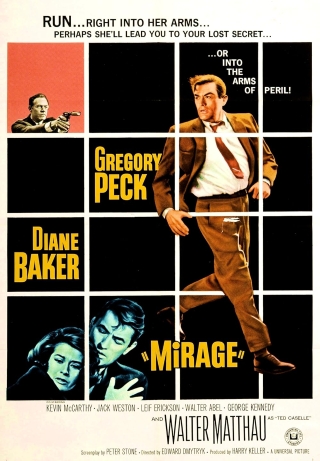
A journey from darkness into light. That is as succinct a description of Mirage (1965) as any I can imagine. It is a slickly told tale of confusion, loss of identity and amnesia all wrapped in an almost dizzying aura of disorientation, which is perhaps only reasonable given the fact the movie was made right in the middle of the socially, artistically and politically tumultuous 1960s.
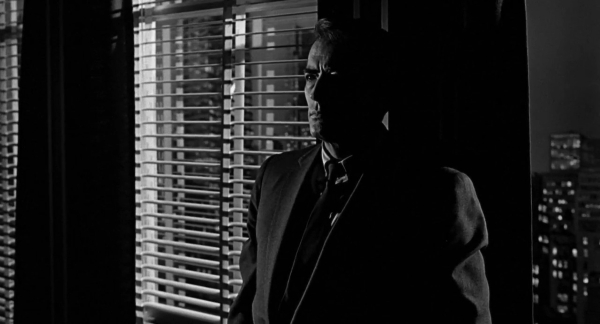
The titles appear over a nighttime tableau of a brightly lit New York skyline. And then, just as the film proper begins, one high rise building is abruptly plunged into darkness and so too is the world of our protagonist. In the gloom and flickering shadows cast by hastily struck matches and cigarette lighters David Stillwell (Gregory Peck) emerges into a corridor of bustling and chattering silhouettes, phantom forms looming out of and retreating back into the darkness, men and women wrenched suddenly from their corporate conviviality and left to flounder in an environment which has been rendered simultaneously bewildering and alluring by the simple expedient of a random power cut. Stillwell exchanges some banter with strangers and colleagues alike before heading for the stairs. There he runs into a young woman, Shela (Diane Baker), who appears to know him yet also talks in apparent riddles. Descending from the 27th floor, their conversation veers from dime store philosophy to coy flirtation, and in among it all is an intriguing reference to a mysterious Major. By the time the they reach the street level, suspicion and obfuscation has overtaken them. The girl has become inexplicably indignant and Stillwell is about to come face to face with the fact he is something of a cipher, not least in his own eyes.
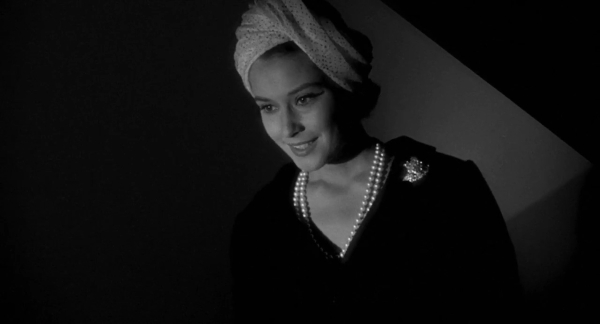
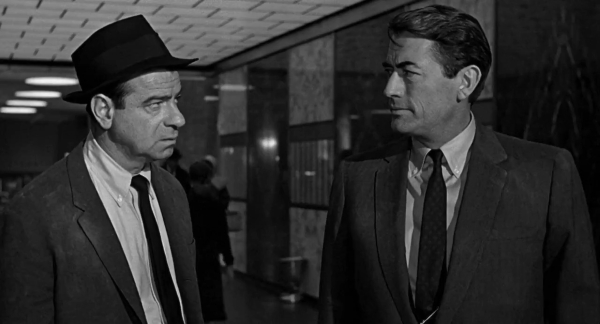
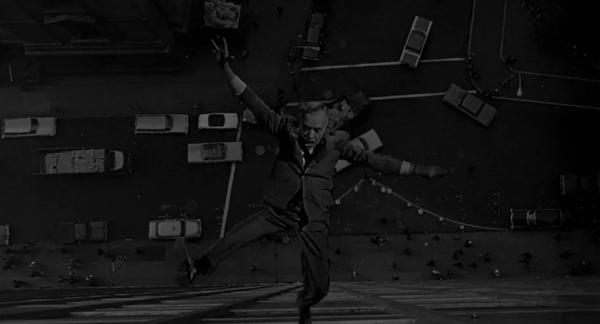
When practically everything one thinks one knows is thrown into question, when sudden death and the ever present threat of further violence start to become commonplace, when one’s normally assured awareness of self is challenged at every turn, then doubts about sanity and reality start to creep in. There is the dreadful realization on the part of Stillwell that, quite improbably, he has no memory of the last two years of his life. He knows his name, and where he’s supposed to live, but that’s about it. The job he’s supposed to do feels unfamiliar, he has no friends he can recall and odd images pop up in his mind: a conversation beneath the boughs of a tree in a place far from the city, the shocked face of a man plummeting from a window high above the unforgiving sidewalk. With complexities and confusion piling on top of each other, with the girl drifting in and out of the picture, he consults first a rude and bellicose psychiatrist (Robert H Harris) and then a novice private eye (Walter Matthau) in his quest to discover who he actually is.
Adapted by Peter Stone (Charade) from a novel by Howard Fast, which I haven’t read and thus can’t comment on the script’s fidelity or otherwise to the source, Mirage is probably the last good movie made by Edward Dmytryk. It is what we have come to refer to as “Hitchcockian”, a twisty thriller with an everyman lead adrift amid a baffling set of circumstances, replete with a MacGuffin about chemical formulae and profiteering. Stories built around episodes of amnesia tend to grab the attention and there is a natural curiosity about what is really going on. The movie captures the perplexity of a man who cannot be sure of who or what he is, although the fear that should accompany it isn’t as well developed. The old noir staple of the flashback sequence is in evidence, or maybe it would be more accurate to speak of flashback moments. Isolated instances of the past regularly intrude on the present – a snatch of conversation, a word here and there, a man moments away from death. All of this evokes the feeling of knowledge swirling around the periphery of the mind, of memories darting glances at consciousness before retreating again to the security of oblivion. It works in that it keeps the viewer off balance and provides a kind of connection to the character on screen groping his way toward the truth.
The role of Stillwell wouldn’t have been a great stretch for Gregory Peck, a star who audiences generally trusted from the get-go. He had the air of a man you want to believe in yet he could also project internal conflict and pressures quite convincingly. In short, he came across as a guy it was possible to imagine getting himself tangled up in a mess such as this. Diane Baker is fine, but perhaps the role as written could have provided her with a bit more mystery, another layer of uncertainty for the hero to contend with. Walter Matthau again charms and amuses as the detective who blunders around nearly as blindly as Peck, using his hangdog weariness to excellent effect. On the other hand, Kevin McCarthy is wasted as Peck’s colleague, which is not to say he plays his part poorly. His screen time is limited and the role is underdeveloped – he does the slippery smarm well but flits in and out of the narrative too much to make any impression. Jack Weston and George Kennedy are enjoyably odd as enforcers, the former all craven obsequiousness while the latter is as belligerent and boorish as usual. Solid backup is provided by Robert H Harris, Walter Abel and Leif Erickson.
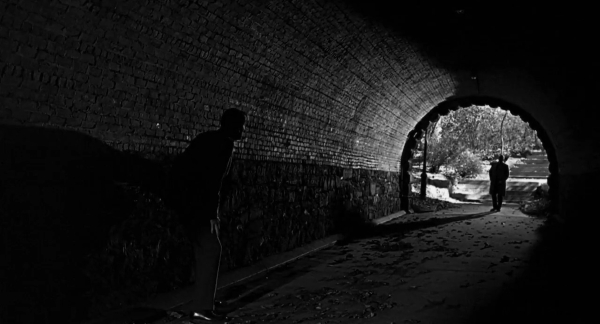
All told, Mirage is an admirable attempt at channeling the process of memory recovery, depicting a psychological struggle using the visual language of the cinema. That’s on a purely technical level, but the movie works quite successfully as an entertaining thriller too. The film has long been available on a well authored DVD in the US and it has also been subsequently released on Blu-ray. I have this German BD, which I can heartily recommend.
As an Amazon associate, I earn a small commission on any purchases completed by following affiliated links from this site. Should you feel inclined to make a purchase in this way, you will be making a contribution toward the upkeep of this site.
 Riding the High Country
Really enjoyed your post Colin, thanks. This one is a real favourite. Prwtty much the last classic era Film Noir in my book. Great choice. I only have the old DVD, glad to hear the Blu-ray is decent. It is pretty close to the book in fact. Back in my blogging days I had the real honour of being contacted by Fast’s widow who left some nice comments about my review of the book.
LikeLiked by 2 people
I had a good time revisiting it, it had been quite a while since I’d last seen it.
By the way, here’s the link to your blog post which attracted the aforementioned comments by Howard Fast’s widow: https://bloodymurder.wordpress.com/2012/01/20/mirage-1952-by-howard-fast/
LikeLiked by 1 person
Old news mate 🙂 Really fun to read our back and forth from back then.
LikeLike
Yes indeed, I don’t know about you but I find it difficult to process the fact that was all of 14 years ago.
LikeLike
Utterly unreal, my friend.
LikeLike