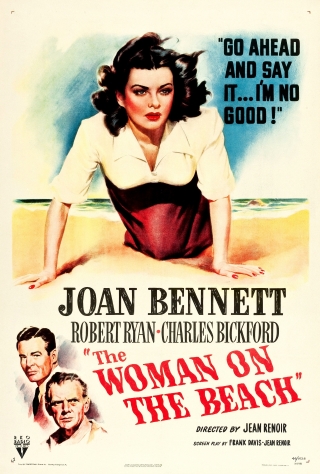
There’s something powerfully compelling about post-WWII cinema, the turbulence of a world still not healed of its wounds and the corresponding emotional discord that makes for great drama. Film noir was a terrific conduit for such storytelling, stemming from the willingness of that form to embrace instability and shadowy uncertainty, its ability to confront universal doubts within the easily identifiable framework of small scale personal crises. Of course not all of them worked out exactly as planned, but sometimes those that didn’t still exert their own curious attraction. The Woman on the Beach (1947) was made near the end of Jean Renoir’s time working in Hollywood and the reshoots and edits he had to complete before it was released probably contribute to some of the uneven quality it displays.
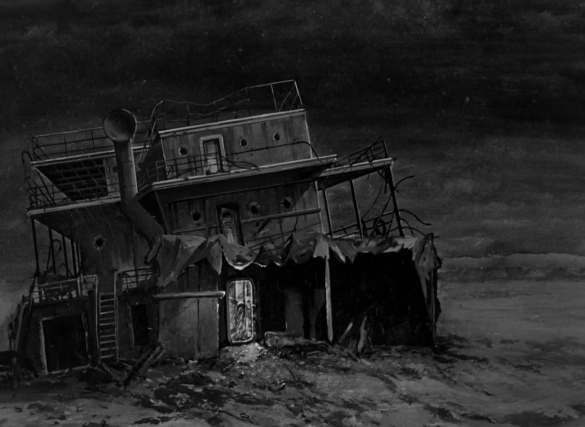
Films that are set in coastal locations have an atmosphere all of their own, the sense of being at the literal edge of the world can on occasion manifest itself in characters who are living on the edge emotionally. So it is with The Woman on the Beach, where the focus remains firmly on three characters throughout and the themes of guilt, bitterness, disappointment and betrayal are all probed and analyzed extensively. The main point of view figure is Scott Burnett (Robert Ryan), an officer in the Coast Guard struggling with PTSD. This is how he is first introduced, in the throes of a nightmare where he’s simultaneously drowning and walking the seabed among the dead, yet he is also tantalizingly close to a form of renewal, personified by a woman who approaches out of the murk to take hold of him. That woman is a representation of his fiancée Eve (Nan Leslie). All of this appears on screen in the oneiric opening scene, a wonderfully shot sequence that briefly fills in a significant amount of background detail by simply employing some imaginative visuals – very cinematic and very effective. Scott knows he’s not a well man, even though he’s recovered from his physical wounds the mental scars remain raw. On one of his habitual rides along the shore he comes across the hulking superstructure of a beached wreck. Alongside, and drifting out of the sea mist, is a woman. This is Peggy Butler (Joan Bennett), alluring, remote and with a troubled air, she is the wife of a former painter who has been rendered blind. Tod Butler (Charles Bickford) was once a prominent artist, now subsisting largely on a diet of jealousy and paranoia, washed down with a brandy chaser. What we have therefore are three damaged individuals thrown together by circumstance and it’s virtually inevitable that one of those eternal triangles, albeit an exceptionally toxic one, so beloved of dramatists will develop.
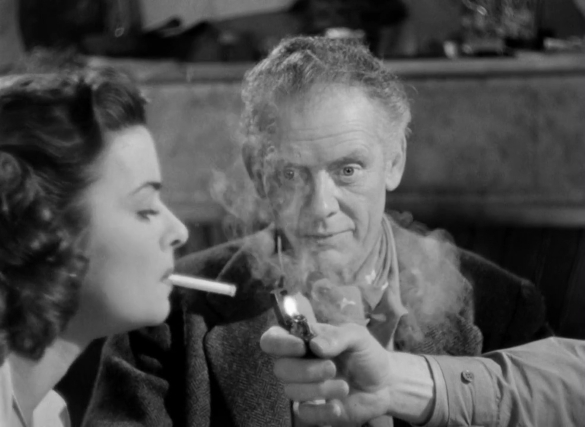
Now that I can’t paint anymore, this stuff of mine gets more valuable every day. There’s an old saying in my trade: a man never gets rich until he’s dead. I assure you a blind painter’s just the same as a dead man.
That’s a delicious piece of dialogue, communicating both the superficial observation about the supposed worth of artists and their work, and also a subtextual one about sexual potency that is highly apposite given the barren and unfulfilling relationship which has grown up between Tod and Peggy. It runs all through the movie, not least in Peggy’s unconcealed frustration, her contempt for the dull and domestic and her thirst for virility; in essence a yearning for all the elements of the past that have slipped from her grasp. Indeed all the three main characters are haunted by their pasts. This, along with the need to cease internal hostilities and lay ghosts to rest, is one of the major themes which is explored. By the end, a classic, cleansing conflagration is seen to have banished all those spirits while also tentatively pointing the way towards a hope for the future. Granted that finish may not be wholly convincing considering all the bile and bad feeling that preceded it, but it does bring a degree of satisfaction and ties up at least some of the loose ends.
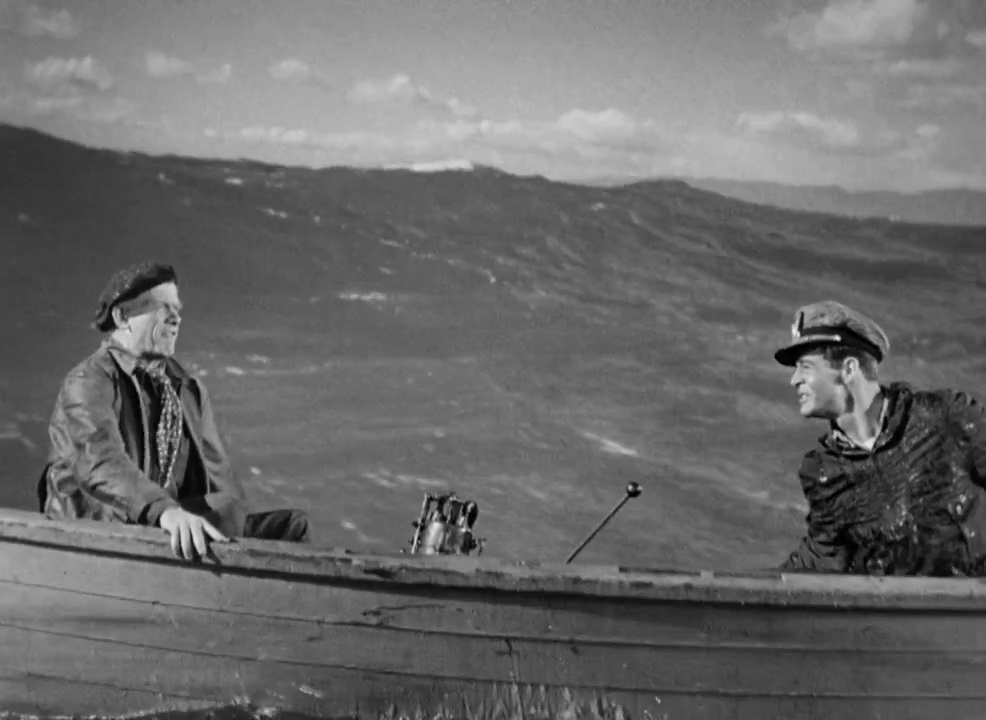
Last time, I posted on a movie which was made under the supervision of Val Lewton and this time we’re looking at one which was originally planned to be overseen by the same man. That didn’t come to pass though and Renoir ended up being granted a fairly free hand during production, but difficulties seem to have arisen when the primary shooting wrapped. I haven’t been able to ascertain the exact nature of the reshoots and edits requested by RKO but all indications are that they were extensive. Something which struck me as I watched the movie was the inconsistency, or maybe I should say the abruptness, of some of the character developments, but I’ll return to that. What does work well is the tone and emotional timbre, that rarefied atmosphere that grows out of isolation. All three characters become locked into a poisonous dependency that threatens to devolve into a virtual danse macabre. Renoir captures this shifting tone very effectively, from the breathless suspense of the walk along the treacherous cliff to the unbridled melodrama of Tod and Scott’s confrontation on the storm lashed fishing boat, and finally the psychological catharsis of the climax in the Butler house.
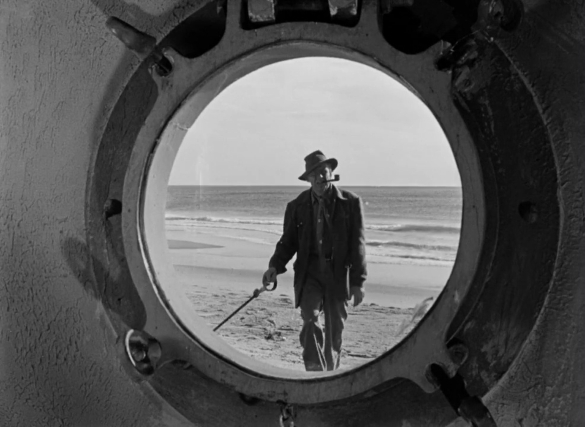
Unusually, I find the performances slightly tricky to assess, not because they are weak or ineffectual though. If anything, there’s a refreshing honesty on display. As a rule, the path of a given main character traces an arc from the opening of a movie right through to the close. Typically, there is a consistency to that arc, a logic that follows the dictates of the work’s internal logic and the traits of that character which have been presented. I won’t say that is absent here, but it’s certainly lacking at times. Maybe Ryan’s traumatized vet can be forgiven for veering off course occasionally yet it’s hard to reconcile the troubled but likeable and liked guy we meet at the start, a man with enough compassion to baulk at the idea of shunning the hospitality of a blind man who’s short of company, with the driven figure who both openly covets another man’s wife and is coldly dismissive of his own fiancée. Is it down to the survivor’s guilt gnawing away at him, the latent death wish he’s been nurturing? Perhaps, but it does feel like there is some connective strand missing. Similarly, Bennett’s crass coquetry appears to burst forth with little foreshadowing, only to retreat into grasping desperation before attaining a kind of redemption at the very end. Of the three protagonists, Bickford navigates a truer course, his bitterness and disgust for himself and others has a constancy that may not be at all admirable but does make more sense in context.
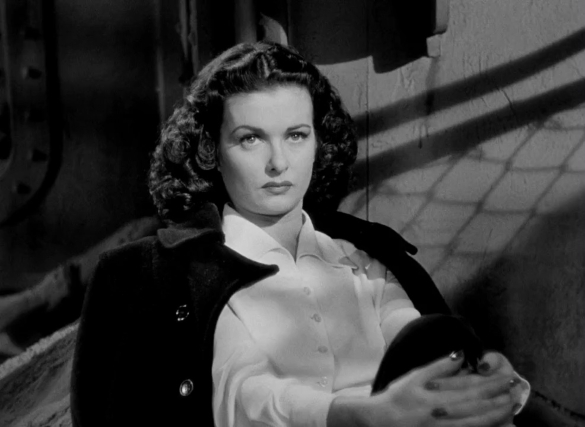
The Woman on the Beach is available as a Warner Archive title and the transfer is more than satisfactory, something that is particularly important with movies whose visuals are among their main selling points. Renoir’s eye for the arresting image, those visual beats that propel a story along in the most cinematic fashion are a pleasure to witness. The film is undoubtedly flawed yet it intrigues me and it beguiles me. Maybe that’s enough in the final analysis.
As an Amazon associate, any purchases made through clicks on links to that site earn a small commission that assists in the upkeep of the blog.


A superbly written look at the film, Colin. I really got a lot out of it. Thanks. Not seen it in a very long while, must admit, but that sense of abruptness and occasional character inconsistency is something I do recall. It has probably to some extent stopped me going back. Must remedy that.
LikeLiked by 1 person
It’s an imperfect work, no doubt about that. Still, there’s something hypnotic about it too, lots of supercharged melodrama backed up by the director’s wonderful visual style. The sense of a self-contained, even self-obsessed, world captured on film is strong, like watching the drama unfold inside one of those glass snow globes that has been given a good hard shake.
LikeLike