Chase a Crooked Shadow

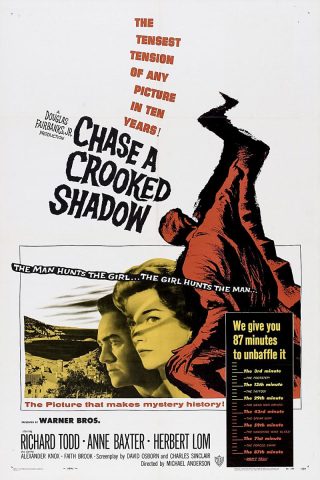
Throughout the 60s Hammer produced a smattering of what have come to be referred to as “mini-Hitchcocks”, due to the acknowledged influence of Psycho. Broadly speaking, these movies usually featured a damsel-in-distress plot where all was not quite as it seemed at first glance. While it’s undeniable that Hitchcock’s 1960 shocker played a significant part in bringing about these films it seems to me that they also owe something to Michael Anderson’s 1958 suspenser Chase a Crooked Shadow: there’s a small cast, an isolated and endangered woman with a question mark over her psychological state, and men whose motives and loyalties are not always clear.

Kim Prescott (Anne Baxter) is a wealthy heiress living in a sprawling villa in Spain. Her father was a victim of suicide and her brother has perished in a road accident in South Africa – or so it would appear. After a late night gathering at the villa, when all the guests have departed, a stranger turns up claiming to be the brother back from the dead. Ward Prescott (Richard Todd) alleges that he was turned over by a guy he gave a lift to, and that the thief was the one who died in the smash-up. Kim remains unconvinced, determinedly so in fact, and calls in the police. Vargas (Herbert Lom), the local police chief, can find nothing wrong with Ward’s credentials and is powerless to do anything. Within a disconcertingly short period of time, Ward has taken up residence in the villa, hired his own new staff, and is causing Kim to question her mental state. She maintains both her hostility and her disbelief yet is unable to convince anyone else that this man in her house is an impostor. The viewer is left to wonder who is telling the truth and, if Ward is indeed merely an impersonator, what the purpose of the subterfuge and masquerade is. There are plenty of clues and red herrings sprinkled throughout, but it’s not until the very end that everything is revealed – all I’ll just say is that it’s unwise to jump to any premature conclusions.

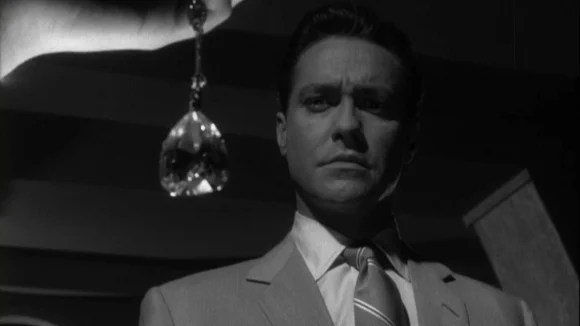
Director Michael Anderson brings Chase a Crooked Shadow in at a tight 84 minutes and judges the pace well. The plot never has a chance to sag and there are some nicely staged sequences – in particular, there’s a well shot and hair-raising scene involving a high speed race around a picturesque mountain road with precipitous drops flashing into view. Anderson does indulge in a bit of flashiness here and there: low angle shots and some slightly self-conscious focusing on foreground objects (like the screencap above), but they generally serve to add to the suspense and feeling of unease. Aside from the twisty plotting, the film depends heavily on the performances of the three leads, and they hold up well. Both Richard Todd and Anne Baxter bring an ambiguous quality to their respective characters which this kind of “is he or isn’t he” drama calls for. Baxter is just brittle enough as the woman under pressure and avoids descending into hammy histrionics. The recently deceased Richard Todd was always a solid performer and his inherent reserve is used to good effect to keep the viewer guessing. In contrast, Herbert Lom’s policeman plays the anchor role in a movie where no one else can really be trusted. It’s not a showy part in any way, but it is a vital one as it helps provide a necessary point of reference.

Chase a Crooked Shadow is available on DVD in the UK via Optimum, and it’s not a bad transfer. The image is 1.33:1, although 1.66:1 would seem a more likely ratio for British movies of the period, and is quite clear and detailed. There are vertical lines and scratches that appear intermittently all the way through, and the blacks could be a little blacker at times. However, none of this is seriously distracting and shouldn’t count heavily against the transfer. Once again Optimum have added nothing to the disc, no subs and no trailer but it can be bought very cheap. This is the kind of movie that’s very appealing to those who enjoy tense British thrillers and it’s a highly competent production. Anyone familiar with the Hammer movies I alluded to at the beginning will recognise the parallels – but that’s no bad thing.

Warlock

Warlock (1959) is a movie that could be approached on a number of levels: as a psychological piece, an early example of revising the myth, an allegory and even as an apology. It’s an exceedingly complex film, which is paradoxically both its strength and its weakness, and also one that remains consistently fascinating. Essentially, this is a variation on the “town tamer” western – almost a sub-genre in itself – but the dense plotting takes it off in a number of directions.

The town of Warlock has become one of those wide open places where the law can only lurk in the shadows, hoping not to draw any unwelcome attention to itself. It has turned into a stamping ground for a band of murderous cowboys, referred to as San Pabloites, who have imposed a reign of terror on the seemingly ineffectual citizens. When one of their number is murdered and the sheriff humiliatingly run out of town the residents decide that the time has come for a positive response. A decision is taken, albeit grudgingly, to hire the services of one Clay Blaisedell (Henry Fonda) for the position of de facto town marshal. Blaisedell, a thinly disguised version of Wyatt Earp, arrives in town along with his friend Tom Morgan (Anthony Quinn) and sets about restoring law and order on his own terms whilst also overseeing the establishment of a gambling house and saloon. The no-holds-barred tactics of the new marshal soon see him in conflict not only with the San Pablo outlaws but also with those who have employed him, and by extension with the newly appointed sheriff. This man is Johnny Gannon (Richard Widmark), formerly one of the San Pabloites but now a reformed character – and in truth the film is as much about him as anything else. While all this is going on, Morgan is quietly scheming away in the background and manipulating events for his own ends. Sooner or later, a showdown (or more accurately a series of showdowns) will have to occur before matters can be resolved.

Warlock is a film with a whole lot going on, arguably too much for its own good. The parallel with the Wyatt Earp story is an interesting one in that it was, up to that point anyway, much closer to the reality of the situation. Blaisedell’s marshal is no shining hero bent on bringing law to the territory; he’s a professional gunman, ”handy with colts” in his own words, seeking out another pay day and raking in a little extra on the side via his saloon. If the relationship between Blaisedell and Morgan is supposed to hold up a mirror to that between Earp and Doc Holliday then it’s a skewed image that’s presented. Morgan is a crippled soul, both literally and physically, and considerably more dangerous than his partner. So far so good, but Morgan has taken friendship and loyalty to the extreme – to the point that it has twisted itself into a kind of jealous worship. Many commentators have stated that Morgan’s feelings for Blaisedell border on the homoerotic, and I can see where that notion comes from, but I don’t buy into it myself. For one thing, the director Edward Dmytryk said that that wasn’t a correct reading of the film. While Morgan’s obsessiveness towards his friend is clearly off-centre it seems to me more a product of his insecurities and self-loathing than anything else. The other main point of interest is the pivotal figure of Johnny Gannon. It’s hard not to see Dmytryk (one of the Hollywood Ten who became a “friendly witness”) projecting himself onto this character who turns his back on friends, family and associates to follow what he views as his own righteous path. Gannon’s conversion seems justified in a particularly intense scene where he confronts his old comrades in their lair in an attempt at conciliation. This gesture is spurned and results in the kind of brutal sadism that rivals James Stewart’s mutilation in The Man from Laramie.

This was Edward Dmytryk’s last good film, but that doesn’t mean it’s not without its problems. As I said, Warlock is a movie rich in plot but such richness can bring about a slightly hamstrung end product. The fact that there are so many plot strands, and the necessity to tie them all up, means that the film has three separate climaxes. The effect of this is to lessen the impact of all of them. That, of course, is more a problem with the scripting than Dmytryk’s direction, which is solid enough and contains some well thought out camera angles. The action, when it comes along, is handled competently and the gunfights are all suitably dramatic.

The three leads turn in good performances, with Henry Fonda putting a different spin on the part of the lawman to that which he created with John Ford the previous decade. Anthony Quinn keeps things fairly controlled as Morgan, though he does sail perilously close to the kind of scenery chewing that he was prone to lapse into on occasion. Richard Widmark is also especially good as the outlaw-turned-sheriff who visibly grows in stature and confidence as the story progresses. His faltering romance with a worldly Dorothy Malone (playing the fabulously named Lily Dollar) has enough realism to prevent it from merely being the kind of extraneous padding that is often the case.

As far as I can tell, Warlock should be available on DVD pretty much everywhere. Optimum’s UK disc presents the film in a very fine anamorphic scope transfer. It’s generally sharp as a tack throughout and the colours really do justice to Joe MacDonald’s classy cinematography. Unfortunately, there’s not a thing on the disc in the way of extras, but that’s about par for the course with Optimum releases. OK, this film may not be one of the front line classics in the western genre but it does help its development along. The movie’s greatest flaw is trying to pack in too much story, thus throwing itself off balance. However, there are still a lot of positives to take away from it.

Along the Great Divide

78_zpszloc5xwd

-You’re new in the territory.

-The law isn’t.

That exchange takes place during the tense standoff that opens Raoul Walsh’s Along the Great Divide (1951). This is a film that examines notions of law and justice and, like any quality western, also looks into the hearts of the characters and their motivations. The framework of the story is a fairly standard pursuit through vast open spaces but the fact that it’s got a relatively small cast allows time for the psychology of each of the main players to be thoroughly probed.

When Len Merrick (Kirk Douglas), a US Marshal, chances upon a mob of angry cattlemen bent on a lynching he’s duty bound to call a halt to proceedings. His dogged determination to see the law run its prescribed course will plunge him into a tangled mess of jealousy, revenge and violence. The man on the end of the rope is Pop Keith (Walter Brennan), a homesteader whose fondness for rustling has landed him in deep trouble. Keith has been accused of the murder of the local cattle baron’s son, and the father is keen to visit justice on the old man personally. With the reluctant help of his two deputies (John Agar and Ray Teal) Merrick takes the prisoner into custody and sets about escorting him back to what passes for civilisation, and a fair trial. However, the relentless pursuit of the lynch mob means that the lawmen, with Keith’s daughter Ann (Virginia Mayo) in tow, need to alter their plans. If their prisoner is to be delivered into the hands of the proper authorities then the only way to do so is by traversing the unforgiving desert in high summer. This punishing trek is further complicated by ambush, treachery and the psychological taunting of the marshal. Keith has stumbled upon a dark secret in Merrick’s past relating to his father, and baits him mercilessly every step of the way. The situation isn’t made any easier when Merrick not only finds himself becoming attracted to the daughter but he also realizes that his doubts regarding Keith’s guilt are growing by the day. By the time the climax rolls round, Merrick will have to face down both his enemies and the demons of his past before he can make peace with his own conscience.

£6

Along the Great Divide is typical Raoul Walsh fare, with hard men braving a hostile environment and battling both the elements and themselves. For the most part, the movie was shot outdoors on location at Lone Pine and the director made the most of what the landscape had to offer. The ambush among those familiar rock formations is skilfully handled, and the desert crossing has a realistically dusty and arduous feel. This was the first western role that Kirk Douglas took on and he seemed to slip very naturally into the genre. He portrays Merrick as a complex yet competent man who tries his best to do the right thing, even though he’s not always sure what that is. Walter Brennan is as reliable as usual as the wily old timer whose amiability and charm are undercut by a streak of malice that he freely indulges at Merrick’s expense. In the role of the tomboyish daughter Virginia Mayo is also highly effective, with her tough and feisty character giving a grittier edge to the romantic angle. As for the support cast, John Agar and Ray Teal are fine as Merrick’s deputies, the former loyal and steadfast while the latter is conniving and slippery.

This movie has made an appearance in R1 as part of the Warner Archive programme, but there’s an excellent pressed disc available in R2 from France. Warner obviously had a strong print to work with for that R2 disc presents the film very appealingly. The image is sharp and highly detailed (with the exception of a few zoom shots which are softer and have heavier grain) with little in the way of damage. Bearing in mind the short running time and the total absence of extras, it seems a bit odd that the movie has been granted a dual layer disc. However, this means that there’s no issue with compression. As with all Warner French releases I’ve seen, the subtitles are optional and can be switched off via the main menu. It’s hard to go wrong with a western directed by Raoul Walsh, and Along the Great Divide is one of his usual polished and well-crafted works. Recommended.


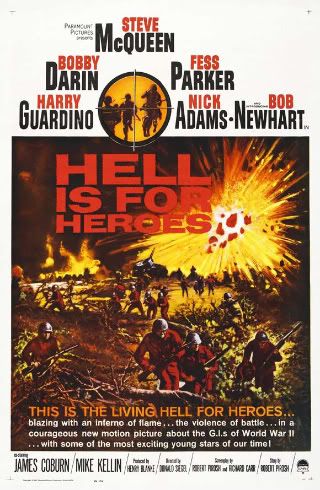
Hell is for Heroes

Poster

Don Siegel’s Hell is for Heroes (1962) is one of those small scale, low budget war movies that bears comparison with some of the stuff Sam Fuller knocked out at the beginning of his career. It’s the kind of film that keeps the focus firmly on the guys at the bottom of the ladder, and thus manages to address the futility and brutality of war while still acknowledging the courage of the lowly, ordinary grunts who find themselves having to be extraordinary just to stay alive. War movies in the 1960s would increasingly move towards the big budget spectacular, but this one is almost a throwback to the previous decade due to the small cast and character driven plot.

The story here concerns a battle weary squad of US soldiers on the fringes of the Siegfried Line in 1944. Although their fighting strength has been severely weakened the troops aren’t overly anxious as they figure they’re on the point of being shipped out and finally heading back home. Their meagre ranks are added to with the arrival of a replacement, Reese (Steve McQueen). He’s a former master sergeant, busted back to private for flaking out and stealing a jeep. In fact, Reese is a man dangerously near the end of his tether; his distinguished service record has saved him from falling further but he keeps on chipping away at the corners of army discipline. An evening’s visit to the nearby town’s off limits bar would probably have done for him if it hadn’t been for the intervention of Sergeant Pike (Fess Parker), an old acquaintance. When news comes through that there will be no welcome departure, just a move back onto the line, the only man not to show dismay is Reese. For these men the news is about to get even worse, as they are to be left behind as a temporary rearguard while the bulk of the force move on. The challenge is for the isolated squad to fool the Germans into thinking that they’re a much bigger force. To this end the troops devise a number of ingenious ploys, from running a backfiring jeep in low gear to simulate the sound of a tank to stringing ammo boxes full of rocks through the bushes so the enemy might take their rattling for the movements of patrols. This is all well and good but a brutal assault by a German patrol (which sees Reese in his element, even savagely hacking one man to pieces with a butcher knife) renews the danger. With no guarantee when the main force will return to back them up, the squad need to decide between sitting it out in hope or taking the initiative and trying to knock out a pillbox. Reese urges action while the cautious Sergeant Larkin (Harry Guardino) counsels patience. In the end, a stray shell makes their decision for them and Reese gets to lead a tense sortie through a minefield. There are no happy endings in this movie, just sudden and graphic deaths, hard decisions, and harder consequences. Even the final scene offers no real respite; the army surges on amid fallen bodies and there’s no end in sight – more positions will have to be taken and more men will have to give their lives.

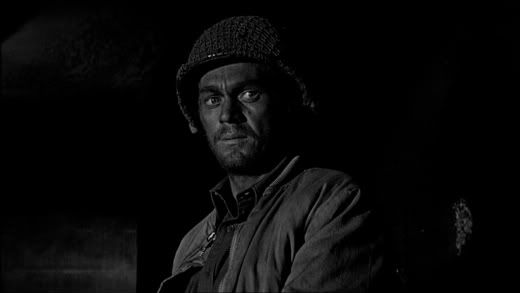
Close to the edge - Steve McQueen in Hell is for Heroes.

The part of Reese was ideal for Steve McQueen who must have relished playing the moody loner unburdened by excess dialogue, and it had the added bonus of handing him the opportunity to show off all those twitchy mannerisms that audiences have come to associate with him. It’s really McQueen’s picture from beginning to end and it’s always a pleasure to watch him keep all that angst and bottled up machismo raging just below the surface. He gets some good support from Fess Parker and Harry Guardino, as the respectively sympathetic and exasperated sergeants, and from a bespectacled James Coburn – the squad’s technical jack-of-all-trades. The novelty casting of Bob Newhart and Bobby Darin is altogether less satisfying, but it’s not enough to do any serious damage to the film. Don Siegel’s direction is as tight and professional as could be, and he works wonders on what must have been a small budget. The stark monochrome photography adds just the right touch of bleakness and, while this is essentially a character study, Siegel’s handling of the action scenes is urgent, exciting and realistic. 

Paramount’s R2 DVD of Hell is for Heroes offers an excellent transfer. The movie is presented 1.78:1 anamorphic and looks in very good shape all the way through. There’s not an extra to be found on the disc, which is the only black mark against it for me. This isn’t one of the best known war movies, nor is it likely to be one of the more familiar works of either McQueen or Siegel. However, for fans of the genre, star or director it does deserve to be seen. It’s a powerful little movie that doesn’t try to manipulate the viewer or preach – it simply presents a dispassionate view of war and the men involved.

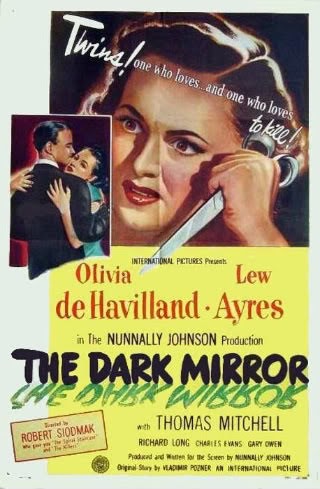
The Dark Mirror

poster175

The 1940s saw a run of movies that attempted to cash in on the craze for psychoanalysis. Probably the most prominent among these was Hitchcock’s Spellbound, but there was no shortage of imitators (there was even an entire series based on this premise, namely Columbia’s Crime Doctor pictures starring Warner Baxter). Generally, such films used large dollops of cod Freudian psycho-babble to simultaneously jazz up and lend a touch of gravitas to the plot. Robert Siodmak’s The Dark Mirror (1946) is one of the more successful efforts, helped largely by an outstanding central performance from Olivia de Havilland.

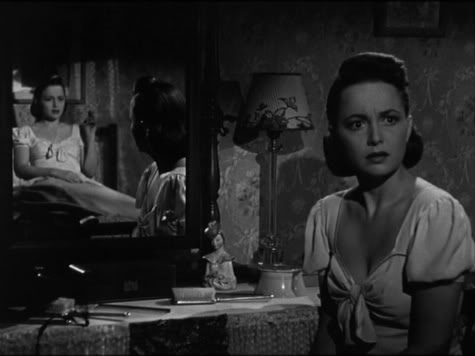
The Dark Mirror is basically a murder mystery that uses the gimmick of having a crime committed by one of a pair of identical twins – the problem for the authorities (and the audience) is working out which one did the deed, and how to prove it. The opening shot is of the apartment of the victim with the corpse lying sprawled before a symbolically broken mirror. At first the case seems clear cut as the detective in charge, Lt. Stevenson (Thomas Mitchell), has witnesses that can easily identify the woman seen leaving the scene of the crime. Well, we’d be looking at a pretty short movie if that’s all there were to it. The problem is that the woman in question is either Terry or Ruth Collins (Olivia de Havilland), one of whom has a cast iron alibi for the evening – but which one? With the official investigation grinding to a halt due to the impossibility of the circumstances, Stevenson turns to analyst Dr. Elliott (Lew Ayres) for help. Elliott agrees to undertake a private examination of the twins to try and discover which one has the psychological profile consistent with a murderess. In so doing he utilizes all the recognisable tools of the trade from ink blots and free association through to a polygraph. Although he satisfies himself as to which sister is the most likely culprit, the proof remains stubbornly elusive. What complicates the situation even further is the fact that Elliott finds himself becoming increasingly attracted to the “good” sister while the other jealously works behind the scenes to undermine her sibling’s sanity.

£5

From a purely technical point of view the illusion of having the same actress playing scenes in a dual role works extremely well. One scene in particular called for one of the twins to sit next to the other and rest her head on her sister’s shoulder, and it’s a compliment to the film’s level of technical accomplishment that this effect is carried off so believably. Personally, I was really only aware that I was watching process work in one slightly ropey shot late in the movie where one sister addressed the other, who was positioned behind her, via an artificial looking mirror setup. Aside from this, Siodmak’s direction is assured throughout, and he wraps the whole thing up in a tight and pacy 82 minutes (PAL). As I said at the beginning, Olivia de Havilland’s performance is one of this film’s great strengths. It’s no mean feat to play twins with markedly different characters and remain convincing, but she managed it with aplomb. Thomas Mitchell’s cop is there to help ground the story for the viewer, and he plays his part well enough – if I have any criticism it’s that he imbued it with a little too much lightheartedness. Lew Ayres, on the other hand, was the weak link for me, never completely selling me on the idea that he was an eminent psychiatrist.

Working out where the rights to a film lie can sometimes be akin to blundering one’s way through a minefield. This was originally an International picture, later to be combined into Universal International, but the R1 home video rights don’t seem to belong to Universal now. A few years ago, when the rights to the Republic library reverted back to Paramount from Artisan they announced this title (along with a few others complete with artwork) for release on R1 DVD. However, Paramount then promptly licensed the library to Lions Gate and those titles disappeared off the schedule. Bearing all that in mind, I’d imagine the chances of The Dark Mirror making an appearance on DVD in R1 are slim to non-existent at the moment. However, the film did get a release in Germany late last year via Koch Media (I think there’s also a French disc out there, but something tells me it suffers from the dreaded burnt in subtitles) and it’s a very attractive disc. It comes in a book style digipack with a booklet – 10 pages, but all in German – and boasts a nice transfer. The image is generally very strong and sharp, although there are a few instances of weakness and heavier grain. All told, it’s a pleasing disc of a hard to find movie. Slowly, more and more of Robert Siodmak’s noir films are making their way onto DVD and I found this latest addition very welcome. I’d place it somewhere in the mid-range of the director’s work, which should be recommendation enough in itself.


The Unforgiven

poster120

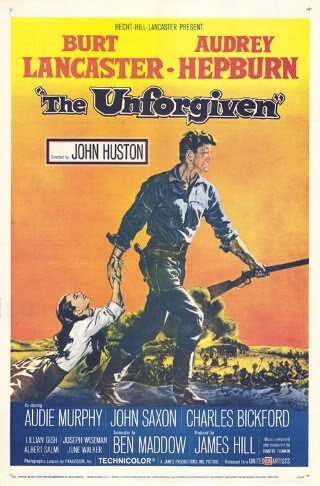
John Huston has to be one of my favourite directors but I’ve only just realised that, before today, I hadn’t written up any of his films on this blog. A quick browse through his lengthy and wide ranging filmography also drew my attention to the fact that he only made two westerns – I’m not counting The Misfits or The Treasure of the Sierra Madre, although some probably would – and I thought that seemed a little odd. The Unforgiven (1960) is a movie that doesn’t get talked up very much (the director professed a dislike of it which may have hurt its reputation some) but I believe it’s worthy of a bit of attention. The movie derives from a story by Alan Le May (The Searchers) and, perhaps unsurprisingly, concerns the fate of captives. What makes The Unforgiven a little different is the fact that the abduction that forms the background is a reversal of the usual white child spirited away by Indians one. In this case the settlers have taken a Kiowa baby and adopted her as one of their own. This storyline offers the opportunity to examine the effects of racism not only within the community but within the confines of the family as well.

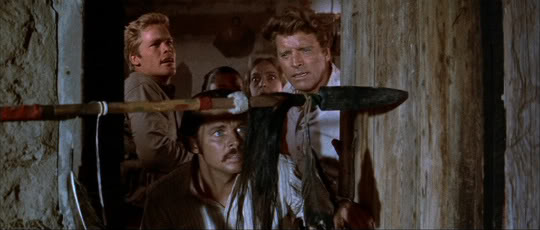
The Zachary’s are a close knit frontier family who, with the father dead as a result of a Kiowa raid, are held together by eldest son Ben (Burt Lancaster). He, with the help of brothers Cash (Audie Murphy) and Andy (Doug McClure), has been putting together a herd of cattle to send to Wichita and make their fortune. The family’s future looks secure and there is a chance of marrying the only sister, Rachel (Audrey Hepburn), into a neighbouring family of fellow ranchers, thereby cementing their partnership. However, the Zacharys’ dreams are built on shaky foundations and are soon to be swept away. Into their midst rides a mysterious old man (Joseph Wiseman), clad in a decaying Civil War uniform complete with sabre. In between quoting scripture he tosses out casual innuendo relating to a dark secret held by the Zacharys. Before long, Ben and Cash find themselves having to hunt down this otherworldly figure, knowing as they do that he intends to destroy them. This leads to one of the most memorable scenes in the film, as the two brothers chase their ghostlike quarry through a swirling dust storm – the old man seeming to appear and disappear at will, and then rushing out of the clouds of windswept sand with his sabre swinging murderously. Nevertheless, despite their best efforts, their nemesis evades them and poisons their neighbours and former friends against them. By the time the Kiowa turn up outside the sod covered family home demanding the return of what they claim belongs to them the Zacharys are about to tear themselves apart. Cash is an unashamed racist haunted by visions of his father’s death at the hands of the Kiowa, and barely able to contain his contempt and hatred for the red men. Therefore, Ben must prove himself the rock upon which the others can depend in order to weather the gathering storm.

£3

I’ve read that John Huston may have been displeased with the final product due to the fact that Audrey Hepburn later suffered a miscarriage, possibly as a result of a fall during production, not to mention that Audie Murphy almost drowned etc. Be that as it may, the film remains a solid, professional piece of work from Huston. He and DOP Franz Planer made excellent use of the wide angle lens to capture the scenery around Durango, and it contrasts well with the dark and claustrophobic interiors of the Zachary home. Apart from the aforementioned dust storm, the action scenes during the climactic siege are quite impressive.

The cast as a whole acquit themselves very well, with Lancaster displaying his customary stoicism interspersed with the occasional witticism. Audrey Hepburn would hardly rank as anyone’s idea of a western heroine but I thought she was pretty convincing in a difficult role. Audie Murphy never gets a lot of credit as an actor but this movie, probably more than any other, shows just how capable he was. He invests the character of Cash with a simmering mix of conflicting emotions that enables him to steal almost every scene he’s in. Lillian Gish also has a high old time as the tough matriarch with a steely resolve, and has a wonderful scene where she sits playing the piano outside at night to counter the music of the Kiowa medicine men. Joseph Wiseman chews up everything in sight as the spectral (no pun intended) Abe Kelsey, a genuinely scary yet pitiful husk of a man driven insane by grief and a desire for vengeance on those he deems responsible for past wrongs.

Given the indifferent treatment MGM often handed their catalogue releases the R2 DVD of The Unforgiven is actually quite pleasing. It’s given a handsome anamorphic scope transfer that has little damage on show save for a bit of light speckling here and there. Since this film is not widely regarded as one of Huston’s greatest it’s no real surprise that the only extra available is the theatrical trailer. I think this movie has been unjustly maligned by many and, even if it never comes to be seen as vintage Huston, it does work well as a mature western that at least tries to tackle a complicated issue. All in all, I like it and feel the performances and photography are ample reasons to give it a go.

Hustle

37uwwis

I’m unsure how to categorise a film like Hustle (1975). Should I refer to it as neo-noir, post-noir, or use some other unwieldy title? Let’s just put it this way, if the movie had been made twenty years earlier it would have been classed as film noir. It has all the ingredients of classic era noir but it’s just not of the right vintage. As a result we’re left with a stylish 70s critique of a corrupt system and a world that’s lost its way. Incidentally, it’s also a damned fine film.

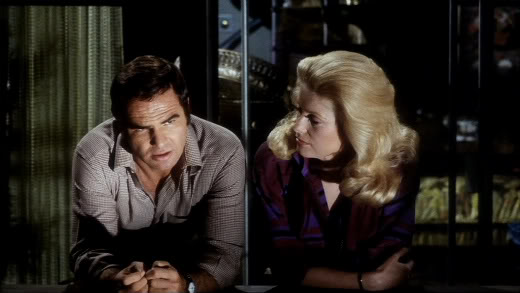
Phil Gaines (Burt Reynolds) is a homicide cop with a long list of things wrong in his life. At first glance everything might seem just dandy since we first see him reclining in bed and being pampered by his beautiful French girlfriend. However, his situation is far from ideal. The girlfriend, Nicole (Catherine Deneuve), works as an upmarket call girl and Gaines is just about dealing with this. The two of them plan and dream of hopping a jet and seeing out their days in Rome but neither one really has the ability to break away from their lifestyles. Nicole’s excuse is the need to earn a living and Gaines keeps putting it on the long finger, preferring to gaze at the fading photographic calender tacked on his office wall whilst indulging in idle fantasy. In addition, his job is increasingly getting on top of him and shows no signs of improving as his next case looms. The body of a young girl is found washed up on the beach and triggers an investigation that will eventually expose corruption in high places and drive Gaines to finally become more than a mere spectator. The girl in question was a hooker/dancer, a runaway whose life descended into seediness instead of the glamour she sought. Everyone appears inclined to write the whole thing off as another pathetic suicide, everyone except the girl’s father that is. Marty Hollinger (Ben Johnson) is a Korean War vet with an axe to grind and an obsessive streak. It’s his unwillingness to let the matter lie that pushes Gaines to dig ever deeper until the truth is exposed. By the end of the movie that truth is laid bare but, as in life, it doesn’t necessarily help anyone. The ending itself is a real choker and unapologetically noir in tone.

£4

Robert Aldrich generally invested his films with a brutal honesty and cynicism, and Hustle isn’t any exception in that regard. He never shies away from the unsavoury and paints a bleak picture of 1970s America, a place where average people are simply nobodies and the wealthy are hopelessly corrupt – in Phil Gaines words, “Guatemala with colour TV.” That rank degeneracy is best exemplified by the villain of the piece, a marvellously sleazy turn by Eddie Albert. In the lead, Burt Reynolds does very well and shows that, when the director and material were right, he was more than capable as an actor. He’s made an excessive number of fairly ropey films but, here and there, the odd gem turns up. He has some excellent moments in this movie, especially when his simmering jealously is dangerously near the surface as he tortures himself listening to Nicole take dirty phone calls from her faceless clients. Catherine Deneuve displayed the right kind of cool detachment that was necessary for her part, and she’s certainly very easy on the eyes. There’s plenty of great support from Paul Winfield, Eileen Brennan and Ernest Borgnine but Ben Johnson rises above them all. He turns in an absolute blinder as the emotionally scarred veteran who feels his country owes him something, and has allowed that massive chip on his shoulder to tear his family apart. The way he forces himself to confront the lifestyle his daughter adopted is as painful for the viewer to watch as it is for him to experience. A real class act was Mr Johnson.

Paramount’s R2 DVD of Hustle offers an excellent image, as was usually the case with that company. The 1.78:1 anamorphic transfer is clean and sharp throughout, and I can see no reason to criticise it. However, there’s absolutely nothing in the way of extra content and that is a little disappointing. Overall, I’d rate Hustle as a very fine example of modern noir from a highly accomplished director and a cast that’s uniformly good.

Two Rode Together

“The worst piece of crap I’ve done in twenty years.” Those were John Ford’s own words when assessing Two Rode Together (1961). Even now, critics never seem to have anything very positive to say about this film. Ford’s work in the 60s was certainly patchy, even more so when it’s held up for comparison against his earlier movies. I’m not sure this is as much of a dog as its reputation suggests; it’s a weak John Ford film for sure, but even a lesser work from the great man always had some points to recommend it.

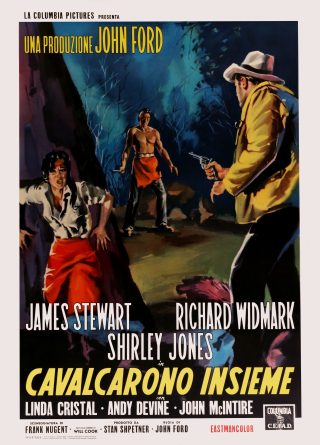
Two Rode Together is frequently referred to as a rehash of themes explored in The Searchers, and that’s one of the problems identified right away. Where the earlier classic had depth, gravity and passion this film feels superficial and, at times, cartoonish. However, I’m not convinced the two movies ought to be compared too closely. For one thing, The Searchers focused on the quest and those involved in it, whereas Two Rode Together is really about the consequences of rehabilitation for the rescued captives. Guthrie McCabe (James Stewart) is a marshal in the town of Tascosa, an enviable position in that it entitles him to a 10% cut of everything in the place. His idyllic lifestyle is interrupted, however, when Lt. Jim Gary (Richard Widmark) and his troops arrive to escort the dissipated lawman back to the fort. The army intend to press the reluctant McCabe into acting as a scout/intermediary in order to make contact with the Comanche Quanah Parker (Henry Brandon) and trade for the release of white captives. McCabe is nothing if not a coldly realistic man, and he knows full well that what the army is asking is basically a fool’s errand. Although his cynicism is viewed with contempt by the soldiers, subsequent events will prove that it’s his assessment that’s more grounded in reality. Lt. Gary is sent along to keep a watchful eye on McCabe (he’s regarded as an amoral mercenary at best), and in so doing has his eyes opened and his preconceptions challenged. When it becomes apparent that the surviving captives have been so deeply integrated into Comanche life as to be unrecognizable the decision is taken to return with only two captives: a teenager, Running Wolf, and a Mexican woman, Elena (Linda Cristal). Instead of being greeted as heroes and saviors, both McCabe and Gary find themselves viewed as being partly responsible for the tragedy that ensues. The fear, hatred and suspicion of the Comanche are so deeply ingrained in the whites that there can be no happy homecoming for anyone, and McCabe’s cynicism and skepticism that were initially painted as repugnant are now seen to be vindicated.

John Ford’s penchant for broad, knockabout comedy is very much an acquired taste, and you’re either OK with it or you’re not. I mention this because Two Rode Together is liberally laced with instances of trademark Fordian humor. A good deal of this is centered around Andy Devine’s grossly overweight Sgt. Posey and it’s of the hit and miss variety. What’s altogether more successful is the gentle jibing that takes place between Widmark and Stewart as it helps to flesh out and humanize their characters. Ford’s direction is unaccountably flat in general, and really only strikes home in the scenes that focus on the desperation and emotional pain of the homesteaders who yearn for news of their loved ones. Even the landscapes look dull and uninspiring, which is atypical for a Ford film. Of course, news came through during shooting of the passing of the director’s old crony and frequent collaborator Ward Bond, and that may go some way to explaining the slightly detached feeling that permeates the whole picture. If it weren’t for the performances of Widmark and Stewart then this movie would be a real tough slog. Their scenes together constitute the core of the film and help keep it afloat. Widmark is good enough but I didn’t get the impression that he was operating at full throttle, whereas Jimmy Stewart throws himself into the part completely. By this time Stewart had mastered the art of icy indignation and half-suppressed emotion, and it serves him well in the later scenes where he confronts the ugly face of naked racism back at the fort. Of the female characters Shirley Jones received third billing but her part is an undeveloped one and seems to peter out just when it should have taken center stage. Linda Cristal fares much better as the former captive who’s deeply unsure of her place in society; her discomfort is nearly tangible when she’s paraded in front of the army wives, and she visibly wilts before their prying eyes.

Two Rode Together remains absent on DVD in the US but it’s widely available in R2. Sony’s UK disc offers an anamorphic widescreen transfer that’s goodish without being in any way exceptional. It could use a bit of a clean up but there aren’t any serious flaws. Both colors and sharpness are reasonable enough but, like the movie itself, don’t exactly pop off the screen. There are absolutely no extras at all but this title can be picked up very cheaply, so one shouldn’t complain too much. Well, this is a long way from classic Ford but the playing of the two leads does raise it above the mundane and lends some class. The truth is it’s not a bad little western – it’s just not a great John Ford western.

Gambit

Poster

I’m not sure if the caper movie could be referred to as a genre in itself. It’s basically an offshoot of the heist movie, which in turn has its origins in the world of thrillers. To me a caper should be a humorous take on a criminal enterprise and it should have a certain gloss or stylishness about it. As such, the 1960s were arguably the ideal period for these films, and I’m of the opinion that the best examples are to be found in that decade. Gambit (1966) checks all the boxes as far as I’m concerned: it’s got a couple of glamorous stars in the lead roles, a slightly convoluted plot that never takes itself too seriously, pretty locations, and an abundance of charm and style.

The structure of the film is one of its major assets, with the first half hour showing Harry Dean (Michael Caine) meticulously setting up the perfect crime before everything falls to pieces. Our hero has his sights on a priceless sculpture owned by a reclusive billionaire, Ahmad Shahbandar (Herbert Lom), and has planned what he thinks is a foolproof method of snatching it. For the final pieces of his scheme to fall into place he needs a woman to play the part of his wife. Of course it can’t be just any woman, he needs someone who closely resembles Shahbandar’s late wife. Enter Nicole Chang (Shirley MacLaine), an exotic dancer of Eurasian stock who just happens to be a ringer for the former Mrs Shahbandar. This is the leverage Harry hopes to use to get near enough to both the billionaire and his precious artifact. I don’t want to give away too much of the plot for anyone who hasn’t seen this, so I’ll stick to saying that the humour and suspense come not only from watching how the best laid plans come unstuck but how they can be pasted back together again.

Shirley MacLaine & Michael Caine 

Michael Caine had just done Alfie and The Ipcress File before this movie and had pretty much cornered the market for mouthy cockneys. It’s a lot of fun watching his Harry Dean go from the assured, smooth operator of the opening to the increasingly flustered and shouty blunderer of the rest of the film. Shirley MacLaine is probably even better as the would-be pawn who ends up bailing Harry out of a succession of uncomfortable situations. When one remembers that the actress doesn’t even open her mouth for the first half hour or so it just proves what a classy performer she is. Herbert Lom was another piece of great casting and always gave a memorable performance in every thing I’ve seen him in. He more or less plays two roles in this film and does so with the greatest of ease. Ronald Neame directed fluidly and kept the pace tight throughout. He also handled the combination of humour and suspense with a deft touch, maintaining a nice balance all the way. It’s also worth mentioning that this gentleman celebrated his 98th birthday last year since he’s one of the few remaining links to the golden age of cinema – here’s hoping he gets to celebrate many more.

Gambit is on DVD in the UK via Second Sight and they’ve done an excellent job on the presentation. The anamorphic scope transfer looks fantastic with strong, bright colours and a clean, sharp image. The disc has the added bonus of carrying a commentary track with the director, something I always appreciate on the rare occasion it’s available for older movies. This film is also now available in the US via Universal’s burn on demand programme – currently exclusive to Amazon. I have no idea how the editions stack up against each other but I will say that I managed to pick up my R2 on sale before Christmas for an absolute pittance. It remains to be seen whether the R1 counterpart will drop significantly in price. All told, I enjoyed the film enormously. It’s a delightful and fun piece right from the start, and I can’t say it disappoints on any level. The perfect tonic for those bleak evenings in the depths of winter – highly recommended.

Backlash

poster150

Backlash (1956) is one of those films that seems to have slipped through the cracks. I’m not sure if it would be correct to call it a forgotten film, but it’s certainly not one that you hear mentioned much when the genre’s notables come up for discussion. It fits neatly into the “psychological western” category due to its less than perfect hero and mature themes. At first glance it may appear to be just another tale of a man seeking revenge (not that that’s a bad thing in itself), but as the story develops it becomes clear that this is a film which is going to dig a little deeper.

The opening shots of the film, with a lone rider traversing a rugged landscape to come upon a man filling in a grave, set the tone for the movie and establish the isolation of the two principal characters. The fact that both of them are soon under attack from a gunman perched in the rocks high above underlines the danger of the quest they are about to set out upon. There is also an undercurrent of suspicion and mistrust that will follow them now as neither one can be sure that the other isn’t responsible for setting the ambush. The rider is Karyl Orton (Donna Reed) and the gravedigger is Jim Slater (Richard Widmark); both are in search of the truth, and maybe $60,000 in gold. Years before, five men died at this spot at the hands of the Apache but one other escaped with his life and the gold, leaving his partners to their fate. Slater believes the father he never knew was one of the five, and Karyl believes her estranged husband to be another. With Slater seeking vengeance and closure, and the woman with her eyes on the gold they set out to identify and track down the mysterious sixth man. The manhunt pitches both these characters into one perilous situation after another, from a murderous Apache raid to a range war. Along the way their relationship slowly develops, although it’s no smooth ride for either of them – at one point Slater hauls off and belts Karyl full in the face for putting his life in danger, and she later takes an almost perverse pleasure in sealing up his wounds with a heated blade. By the end of the movie both these people will have to face down their own personal demons and maybe take something of real value away from the experience.

£11

Backlash was made at a time when Sturges’ and Widmark’s stars were on the rise. John Sturges had just come off the magnificent Bad Day at Black Rock and would shortly go on to make Gunfight at the O.K. Corral. He was close to his peak at this point and handled just about every aspect of the picture perfectly. Action and suspense blend seamlessly together and the Arizona locations look particularly fine through the wide lens. Widmark was also doing some of his best work around this time and this film must have helped him along nicely. His bony features and distinctive nasal giggle had landed him plenty of villainous roles but they were also ideally suited to playing the kind of damaged men that psychological westerns thrived on. He turns in a great performance here, obsessively digging into the past, searching for the truth and searching for himself – all the while fearing what he might learn yet unable to stop himself. Conversely, Donna Reed’s movie career was soon to end and she was close to moving into a successful run on television. With an impressive list of credits behind her she does well as the feisty, courageous woman-with-a-past. The support cast are solid too with Barton MacLane and an eye-rolling John McIntire standing out especially. A good screenplay is key to the success of any film and having Borden Chase’s name attached never hurt any. It struck me that the episodic structure and the underlying theme bore at least a passing resemblance to the writer’s earlier Winchester 73. 

Backlash has had a number of releases on DVD in R2 but the UK disc appears to be the only one with a proper widescreen image – there’s a R4 available but I’m not sure how it’s presented. Optimum’s UK disc has the movie looking very nice in a 2:1 anamorphic transfer, and I’ve been reliably informed that this is indeed the correct ratio for the film. There’s very little damage to be seen and colors and detail all looked excellent to my eyes. Surprisingly, for an Optimum release, the theatrical trailer is included but that’s it as far as extras go. However, when the main feature is there in OAR and looking good then I’m not about to complain. Backlash is a good example of a high quality mid 50s western – one that I rate and recommend.