The Outlaw

Poster

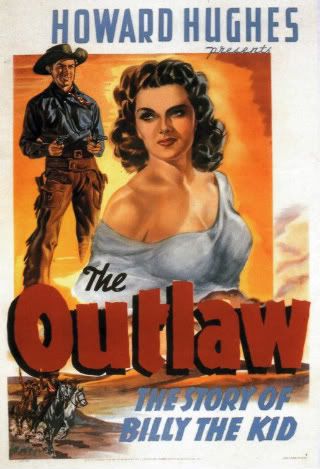
It’s hard to know where to begin with a film like The Outlaw (1943), or indeed what to make of it at all. It takes the characters of Billy the Kid and Pat Garrett and dumps them into a story that bears no relation to reality and frequently defies logic too. Ultimately, it’s a showcase for the fantasies and obsessions of Howard Hughes (two very prominent ones in particular) and its failure as a motion picture can be traced back to that. There are some astonishingly bad aspects to this film but, almost perversely, there are also times when it looks like it might just turn the corner and become something worthwhile. However, it never manages to tear itself free of Hughes’ grip, and every time an opportunity to go somewhere interesting arises it misses its step and simply lapses back into parody. 

Within minutes of the opening the viewer is shown the meeting of Billy (Jack Buetel), Pat Garrett (Thomas Mitchell) and…Doc Holliday (Walter Huston). Yes, that’s right – Doc Holliday. So right from the off all semblance of reality is swept away and it’s clear that what follows is going to strain credibility to the absolute limit. Anyway, it transpires that Billy stands accused of stealing Doc’s horse – whether or not he did is never really resolved and the saga of the disputed ownership recurs time after tiresome time throughout the movie. Just when it looks like these two noted gunslingers are going to shoot it out the party is broken up by the intervention of Doc’s long time buddy Garrett. The result is that Doc finds himself ruefully admiring the Kid’s pluck and subsequently taking his side, much to the disappointment of Garrett. This switch of allegiances is regarded not only as a breach of friendship but also as a kind of humiliation by Garrett. When a saloon killing forces him to place Billy under arrest, Garrett is once again wrong-footed by Doc and their enmity is sealed. With Billy wounded and the law in hot pursuit, Doc leaves the Kid in the care of his girl Rio (Jane Russell) while he heads for the hills and safety. Now Rio and the Kid had met before, in a dark stable where they wrestled around some. However, the Kid is now laid low by his wound and the resulting fever, so he’s in no condition to continue where he left off. This lengthy sequence in Doc’s cabin, as Rio nurses the Kid back to health and falls for him in the process, is supposed to define the central relationships of the film. The fact is though it kills the narrative stone dead and contains not only some truly awful shots but also has the misfortune of being dominated by two performers making very obvious debuts. The only good thing to be said is that it contains an imaginative method employed by Rio to break a dangerous fever – I’ll have to see if it works the next time I’m running a temperature. After this tedious interlude the story attempts to regain some momentum with Garrett finally catching up with his quarry, only to be blindsided again. There is some dramatic tension to be had from seeing Garrett’s disillusionment spiralling off into murderous frustration, but as soon as this happens Hughes manages to drain all the pathos away and negate what should have been a powerful moment. And that sort of sums up the whole production.
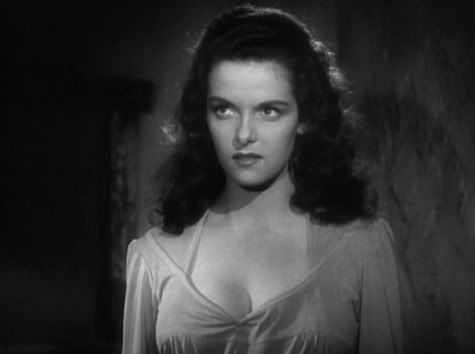
Playing with a stacked deck - Jane Russell in The Outlaw.

The Outlaw is of course remembered for the furore it caused with the censors and the Hays Office. Were it not for Howard Hughes’ fascination with Jane Russell’s ample form, and the battle he undertook to have his picture exhibited, this movie would likely have faded into obscurity. Hughes’ shooting style, seen at its worst and most self-indulgent in the interminable cabin sequence mentioned above, is an object lesson in bad filmmaking. The zooms, cuts and fades employed are jarring and meaningless exercises, like a schoolboy playing with a new toy. The action scenes that punctuate the story do have some merit though and are worthy of attention. I also think it’s fair to say that the shots in the movie that retain some style and character are likely the result of having the great Gregg Toland behind the camera. As for the acting, Buetel and Russell are clearly making their first picture – Russell fares better, and her subsequent career can be seen as proof that she did have ability. Buetel, on the other hand, is very weak and it’s almost cruel to see his lack of range exposed by the presence of two classy old veterans like Walter Huston and Thomas Mitchell. If one wanted to be generous it could be argued that Buetel managed to convey the sense of awkwardness and innocence of a young man forced to grow up too soon. Both Huston and Mitchell really anchor the film and prevent it spinning off course completely; when one or other is on screen there’s always a feeling of reassurance, and the only real criticism is that they’re far too old to play the characters they’re supposed to be. The big dramatic scene that forms the climax, where Doc shoots pieces from the Kid’s ears to provoke him into drawing, gives Huston a chance to impose himself as Mitchell sits slyly in the wings. Mitchell, of course, gets his big moment too when he follows up by pouring out his pent up frustration and shredded pride. This should have seen things end on a high note but Hughes’ botches it again with an ending that’s ridiculous and insulting in equal measure. Thus far I’ve pointed out many of the shortcomings of this movie, but there’s one more that needs to be mentioned. The score. Music plays an integral part in film; it can enhance a mood and complement a scene, it can even lend a whole new dimension to a sequence. But, used poorly, it can also draw the life from a picture and sap the tension. What I can only describe as “comedy cues” pepper the action in The Outlaw at the most inappropriate moments and actively damage a number of key scenes.

The Outlaw has long been a staple of the PD market and there are countless editions of it floating around on DVD. For the purposes of this piece I viewed the Legend Films version that came out about two years ago. Legend, of course, are known for their penchant for colouring in old B&W movies; however, they also do a clean up of the print beforehand and offer both versions. The B&W print is probably as good as I’ve seen the film looking, although it’s certainly not perfect either. There’s a softness about the image at times, especially evident in the longer shots, and some instances of minor damage. This release was a two disc set: the first disc offering both the restored B&W and the colourised versions, and the second comprising only the colourised one with a commentary by Jane Russell and Terry Moore. Frankly, I have no intention of ever watching the crayoned in version so I’ve yet to hear the commentary – I’ll probably give it a listen some time in the background when I don’t have to endure the garish visuals. Anyway, I think it ought to be clear that I’m not a fan of this particular movie. In its defence I will admit that Walter Huston and Thomas Mitchell give good performances and there are a few well staged action scenes. But the acting of the young leads, Buetel especially, leaves a lot to be desired. That and Hughes’ mediocre direction combined with some ill-conceived scoring really drag the film down. It’s the kind of picture that perhaps deserves to be seen for its poorness alone. Basically, though, it’s a half baked turkey that’s not worth going out of one’s way to catch.
Billy the Kid

poster217-1

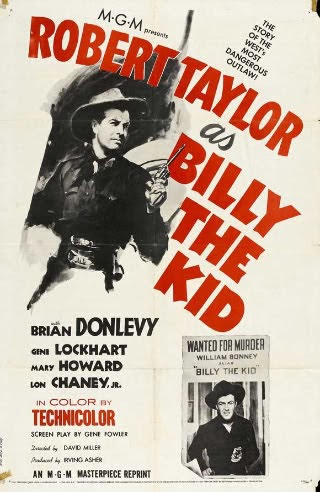
It’s been a long time since I committed myself to doing a themed series. Having done a few of them in the past I kept putting this particular one off. Why? Well firstly, this kind of thing requires watching a number of predetermined films more or less back to back, and I normally baulk at that kind of discipline as I prefer to go with whatever strikes my fancy at a given time. Moreover, I knew that running a series on Billy the Kid means sitting through a few poor movies. Anyway, I finally got myself into the right mood and I’ve decided to delve into it. As with other series I’ve done I’m not claiming that this will be an exhaustive analysis of each and every cinematic representation of this figure – there are just too many movies that feature Mr Bonney. In the coming weeks, I’ll be covering what I think are all the major portrayals. I’ll obviously touch on the historical accuracy of the various films, but I don’t want to dwell too much on that side of things as I’m no expert and, besides, good history and good cinema don’t necessarily go hand in hand. So, let’s kick things off with Billy the Kid (1941), a film that dances around the facts, changes the names of just about every major character, but remains an entertaining piece all the same.

The opening sees Billy (Robert Taylor) breaking an old pal Pedro (Frank Puglia) out of jail, and subsequently finding himself drawn unwittingly into what would become this movie’s version of the Lincoln County War. In short, there’s a conflict brewing between two rival ranchers, Hickey (Gene Lockhart) and Keating (Ian Hunter) – read Murphy and Tunstall respectively – and Billy is hired as a troubleshooter by the former. One of his first tasks for his new master is to participate in a stampede of Keating’s herd. This excitingly shot sequence leads to a fateful reunion between Billy and an old friend from his childhood, Jim Sherwood (Brian Donlevy playing what’s really the Pat Garrett role), who’s now foreman for Keating. As the two men sit around the campfire it’s clear that a bond still exists, but circumstances have placed them at loggerheads. Gradually though, Billy comes to see that Hickey’s methods are unjustifiable and, after being impressed by the dignity of Keating, it’s not long before a switch in allegiances takes place. So, the two friends become allies under the moderating influence of Keating. Even after Pedro is callously murdered and Billy is itching for revenge, Keating counsels restraint. His way is to work within the law to topple Hickey. Such noble sentiments are cast aside though when Keating himself falls victim to the Hickey faction. The result is the outbreak of open warfare, and Billy and Sherwood, while united in their goal, stand divided over the methods to be used. Inevitably, these two will have to confront each other in combat. It’s surely no secret how the showdown ends, although this film depicts events in a much more heroic way. Leaving historical airbrushing aside, the face-off between Sherwood and Billy is effectively done, as is the earlier retribution that’s meted out to Keating’s murderers.

Robert Taylor was 30 years old when he made this picture and looked far too mature to play the callow youth of the title. Still, he turns in a good performance as a man who cannot escape the mistakes of his past. The script explains his descent into lawlessness as a consequence of his father’s being murdered and his resulting thirst for revenge. The upshot is that Taylor gives the audience an early take on the “angry young man” persona that cinema would explore in later decades. He starts out scowling and clad in black leather, easing into more relaxed and typical cowboy garb for the mid section when Keating’s got him cooled down a little, and finishes the same as the plot turns full circle to bring him back into confrontation with the law. Brian Donlevy frequently played the villain in westerns so it’s kind of refreshing to see him on the right side of the law for a change. The scenes where he and Taylor get to act as pals have a certain charm and affability that form a nice contrast to the later ones when they must lock horns and face each other down. The other characters are all painted with broad strokes though, Lockhart’s conniving runt and Hunter’s fair-minded crusader leaving us in no doubt who the heroes and villains are. Having said that, both men handle their material well and if complaints of black and white characterisation are to be made then the fault lies with the writing and not the acting. One of the really positive points of the movie is the wonderful location shooting in Monument Valley; director David Miller may not have been in John Ford’s league but he created some memorable images of tiny human figures dwarfed by those familiar rock formations. The climactic ride to marshal forces and take on Hickey is a great sequence that’s only marred by the puzzling decision to intercut sumptuous long shots with close-ups and poor back projection.

To my knowledge, there are currently two options for acquiring this film – one is from Warner/Impulso in Spain and the other is a DVD-R through the Warner Archive in the US. The Spanish disc is a weak effort that has a kind of hazy softness throughout – I thought it improved marginally as it went on but that may have just been me getting used to it. The print has had no work whatsoever done to it and there are numerous instances of scratches, damage, cue blips and the like. On the plus side, the colours seem to have held up well enough and make the location work look very attractive. As with all the Spanish Warner discs I’ve seen the subs on the English track are fully removable regardless of what the main menu seems to suggest. I’ve seen some screen captures from the US disc and they certainly appeared to be of better quality – crisper, sharper and better defined. The film itself is a fairly typical early 40s effort that combines solid drama with lighter moments. If close adherence to the facts is a prerequisite then this is not the film for you. If, on the other hand, you’re looking for a reasonably entertaining western with professional performances and good location work it should check most of the boxes. Robert Taylor westerns are always good value and I’d rate this as one of his medium efforts.


Ramrod

Range wars have always been a favorite backdrop for westerns, men struggling over a piece of land upon which they have built their dreams being an ideal source of conflict. It’s not so common though to see a woman as one of the aggressors, and certainly not one as petite and vulnerable looking as Veronica Lake. However, if there’s a lesson to be learned from Ramrod (1947) it’s surely that one should never be taken in by appearances.

This is a lean, brisk movie where things happen fast and no time is wasted. Within minutes of the opening the main protagonists of the story are introduced and their motivations laid out. Everything revolves around Connie Dickason (Veronica Lake), a headstrong young woman hell bent on establishing herself in her own right and independent of her rancher father. We’re pitched immediately into the middle of a potentially explosive situation where Connie’s betrothed, a sheepman, is about to confront her father and his enforcer, Frank Ivey (Preston Foster). Ivey is the man Connie’s father would like to see her paired off with and he’s not averse to the idea himself. When the the sheepman decides that he values his hide more and thus backs down Connie turns her attention to a drifting cowboy and former drunk, Dave Nash (Joel McCrea). Nash has no interest in involving himself in the Dickason’s affairs at first, but a run-in with the bullying Ivey leads to a change of heart. He decides to sign on with her as her foreman, or ramrod, and face down her father and Ivey. Nash wants to use the law to secure Connie’s rights but she has other ideas on how to go about things. At the heart of the picture are Connie’s machinations, seductively playing the men off against each other to achieve her own ends. All of this deceit inevitably leads to tragedy and the loss of many innocent lives, although Connie blithely dismisses the bloodshed as a necessary if distasteful step on the road to fulfilling her ambitions. It’s only at the end, when her dreams are almost within her grasp, that this scheming puppeteer realises that her self-absorbed ruthlessness has driven away the very thing she desired most.

Joel McCrea’s portrayal of Nash is spot on, his calm and inner strength fitting for a man who has come face to face with personal tragedy and dragged himself back from despair. His honest, straight shooting persona is also ideal for a man who finds himself duped and manipulated by Connie. In fact, every man in the film falls prey to her deceptions at one point or another. Lake was clearly trading on her film noir credentials as she plays what is essentially a femme fatale out west. Her diminutive stature obviously rules out the possibility of her involving herself directly in any of the violence but her awareness of and confidence in her own femininity, and its attendant power, ensures that she calls the shots at almost every point. Director Andre de Toth was married to Lake at this time and he handles not only her scenes but the whole film very well. While he couldn’t be classed as one of the great directors, de Toth was certainly competent and made enough good films to be worthy of more attention. Aside from a number of very enjoyable collaborations with Randolph Scott, he also made the superior Day of the Outlaw and a handful of quality noirs. He was especially good at shooting action and the stalking by night of McCrea’s friend is particularly well done. It’s also worth noting the tough edge he brought to proceedings with a cigar ground into a man’s hand to provoke a gunfight and a savagely brutal beating being some of the highlights.

While there are plenty of good things to say about Ramrod the film, unfortunately, that not the case with the DVD. The only edition that I’m aware of is the Suevia release from Spain, and it’s pretty poor stuff. The master looks to be taken from an old VHS cassette and all the expected faults are present in the transfer. The image is scratchy, dirty and lacking in definition, and the audio is weak too. Despite that, it remains quite watchable, although there is an especially bad section beginning on the hour mark and continuing for about two minutes. In terms of quality it’s reminiscent of a mid-range PD title. However, as things stand, it’s the only version available – I’m not sure where the rights for this reside but I have a hunch it could be with MGM. On the plus side it can be had for very little money and there are no forced subs on the English track. I think this is a neglected little western with noir undertones that is well worth a look; anything starring McCrea and directed by de Toth deserves that at least. I’d imagine a decent release would go some way towards elevating its status.

Kiss of Death

poster230

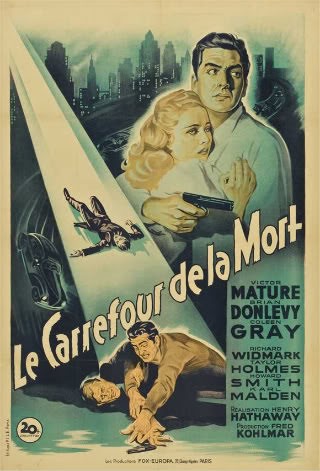
Stool pigeon, squealer, informer – these words all evoke images of weak, low-life types who are willing to spill it all and damn their friends for personal gain. It’s not easy to portray such people without resorting to stereotypes like the tragic, pitiful dupe, or maybe the moral/political crusader. Kiss of Death (1947) is the tale of a man who happily shops his partners in crime, but he comes across as the hero mainly because his actions are guided by his devotion to his family and not greed or some trite ethical principle.

Nick Bianco (Victor Mature) is a career hood who’s spent his life on the wrong side of the law. The opening voiceover narration establishes the fact that Bianco’s record now precludes him from holding down any meaningful job, and thus limits his choices. When a pre-Christmas jewel robbery goes wrong he finds himself on a downward spiral where his already restricted options will be narrowed even more. Initially, Bianco holds firm to the doctrine of honour among thieves and spurns the approaches of Assistant DA D’Angelo (Brian Donlevy). So he takes the jail time and the criminal kudos that comes with it, choosing to leave things up to his crooked lawyer. It’s only when he hears of the suicide of his wife (who’s never seen incidentally) and the subsequent packing off of his two daughters to an orphanage that he undergoes a change of heart. Both his lawyer’s ineffectiveness and the news of the inappropriate behaviour of his former comrades cause him to reassess his position. Striking a deal with D’Angelo gets Bianco out on parole but that’s not the end of it. The law demands more from him and Bianco finds himself drawn deeper into the DA’s plans. The ultimate goal is to secure the conviction of one Tommy Udo (Richard Widmark), a ruthless hoodlum with a psychopathic streak. Although Bianco secures the evidence the trial is a failure and Udo walks. It’s now that the real nightmare begins; Bianco has a new wife and a new identity, and all that will surely be swept away when (not if) Udo tracks him down and exacts his revenge. It’s in this second half of the story that the film shows its true noir credentials and moves away from the early melodramatic gangster movie feel. Bianco’s world shrinks to the point where he is eventually left with only one viable course of action.

£22

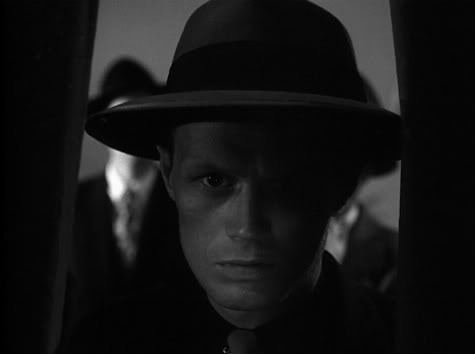
Kiss of Death is a good movie for many reasons, but over the years it’s come to be remembered mainly for the debut of Richard Widmark. The performance is so intense and memorable that it’s hard to believe Widmark had never been on screen before. The fact that this giggling maniac who delights in shoving a crippled woman to her death down a staircase has featured in so many clips through time has maybe drained some of the shock value away. However, there’s no denying the chilling quality that Widmark brings to every scene he’s in – whether it all came down to the actor’s own nervousness or not he has a kind of electric menace that demands you give him your full attention. In contrast, Victor Mature is like a rabbit caught in the headlights when confronted with this raw aggression. That’s not meant as a criticism of Mature’s performance; his role is that of man trapped by his own past and some poor decisions, and he brings off the mounting sense of isolation, desperation and fear that any man in Bianco’s position must surely experience.

In the supporting parts, Donlevy is his usual strutting and brusque self as the Assistant DA who’s not averse to bending the law his way in order to achieve his ends. Coleen Gray, who also provides the voiceover, is the new wife who finds herself thrust into a perilous situation – although she must surely have expected that her life with Bianco would be less than smooth given her knowledge of his past – and she’s sweet and sympathetic in the role. Henry Hathaway’s no nonsense direction makes sure that the action moves along, and neatly avoids the kind of sermonising that could easily derail things. He also blends the extensive location work into proceedings and this does lend a touch of realism.

The US release of Kiss of Death on DVD (although it’s out in the UK too) via Fox’s noir line is a typically strong one, the transfer being crisp and clean throughout. There are some nice extras too: a commentary by James Ursini and Alain Silver, a gallery and the trailer. The movie has points to make about the inadequacy (and possibly the corrupt nature) of law enforcement, and the failings of the penal system. However, this stuff has all been done before and it’s therefore refreshing that the abiding memory one takes away from a viewing is that of Widmark’s sniggering nutjob. I think it’s fair to say that it’s this powerhouse performance that elevates the movie above other noir pictures.


3 Godfathers


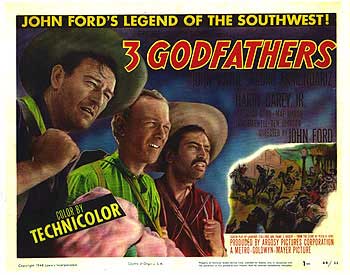
MPW-9143There haven’t been too many westerns that are set around Christmas, in fact I’m struggling to think of any others apart from 3 Godfathers (1948) and the earlier versions of the same story. While it starts out as a fairly standard western it soon turns into a play on the nativity story and the journey of the three wise men. It’s one of John Ford’s more sentimental pieces and the symbolism is laid on a little thick at times, but the cast and visuals carry it through the sticky patches. I’ll grant that the whole thing can seem a bit contrived yet the story, and its message of redemption and the good that lurks within all of us, remains affecting.

The movie opens in fairly conventional fashion, with the three main protagonists Robert Hightower (John Wayne), Pedro (Pedro Amendariz) and The Abilene Kid (Harry Carey Jr) surveying a town they’re about to enter and rob. Before they can get down to business, however, they get chatting to a local resident (Ward Bond) who turns out to be the local lawman. Thus far much of the action is played for laughs, and broad Fordian laughs at that, and the light heartedness even extends to the raid on the bank. The first really serious note is struck when The Abilene Kid takes a bullet to the shoulder as they attempt their getaway. As the three men race out into the desert with the law hot on their heels, one shot finds its target and punctures the vitally important water bag. Safe in the knowledge that no one is going to travel far in the parched wilderness with only a limited supply of water the lawman eases back and sets about laying a trap. That singe shot has essentially sealed the fate of the three outlaws, as they discover that the law (with the help of the railroad) is one jump ahead of them and bent on keeping them away from any source of water. In an effort to outsmart the authorities, the men double back but in so doing stumble upon a situation that will bring about profound changes within them all. They come across an abandoned wagon containing a pregnant woman who’s about to give birth. Their most basic human instincts are aroused by this pitiful scene and, after seeing that the baby is delivered, find themselves giving their oath to the now dying mother to protect her infant son. From this point on a gradual transformation takes place wherein each man suppresses his own selfish needs in order to ensure the fulfillment of their promise. As they trudge across the gruelling desert, shedding their possessions along the way, they come to view the protection of their new godson as the only purpose in their lives. As such, their trek turns into a kind of pilgrimage to cleanse themselves of the evil that had motivated them until that time. As I said the symbolism can be a little heavy handed (following a star to the town of New Jerusalem etc.) but the hardship of the journey and the fact that these hardened criminals are willing to sacrifice themselves for the sake of an innocent and a promise prevents the film from becoming a parody.

John Ford opened the film with an onscreen tribute to his departed friend Harry Carey Sr and then took the further step of casting the latter’s son in the pivotal role of The Abilene Kid, the conscience of the three bad men. However, that’s about as far as the old man’s sentimentality went for it’s well documented that he drove his cast mercilessly in the searing heat of Death Valley. Despite, or maybe because, of this the performances of the three leads are first rate. Carey in particular is touching as the callow youth who’s simultaneously running from and striving to retain some of his boyish innocence. The way he calmly accepts his fate before such thoughts enter his companions’ heads is a fine piece of acting. In fact, Ford granted the young man some of the best scenes in the movie: singing over the grave of the baby’s mother and then his own death scene. Both Armendariz and Wayne were handed more straightforward roles as the older and more experienced men and they don’t disappoint either. The part of Robert Hightower has none of the complexity of Wayne’s more famous and prestigious performances yet he does all the script and director ask of him, and carries the picture alone for a significant time. The bulk of the action takes place outdoors on location in Death Valley and Ford creates some beautiful and bleak images – the dust storm (with all its attendant symbolism) being a particular highlight. The support cast is filled up with all the familiar faces from the “Stock Company”, Ward Bond and Mae Marsh getting the lion’s share of the screen time.

3 Godfathers is widely available on DVD from Warner. I have the R2 disc, but I’ve heard that the US version is the same, and the transfer is a good one. Print damage is minimal and the colour is strong, the outdoor scenes faring best to my eyes. The only extra included is the theatrical trailer, and a variety of subtitle options. While this is not one of Ford’s very best, it remains a top film by anyone’s standards. In a way, it’s what you might call a typical Ford movie in that it contains most of his trademark visual and thematic motifs. All in all, it’s a satisfying and uplifting production that works well both as a seasonal film and as a traditional western.

Finally, as this will be my last post before the holidays I want to take the time to wish all those who have followed, commented or just stopped by a very happy and peaceful Christmas. Be seeing you again in the New Year.


Odd Man Out

Today is the third birthday of Riding the High Country, and for that reason I wanted to feature a movie that occupies a special place in my affections. Belfast isn’t a city that one would normally associate with film noir. Still and all, it’s not such an outlandish setting when you actually think about it a little. It’s a city with an especially dark past (and a future that remains far from certain for that matter) that’s seen more than its fair share of death and mayhem. Carol Reed’s Odd Man Out (1947) uses the shadowy post-war city as the backdrop for a story that’s a haunting mix of tragedy, love and intrigue. It’s also a very Irish tale, and perhaps that’s why it has always resonated with me and fascinated me.

It’s the story of one man’s last hours, and how this impacts on his friends, enemies and even those who are strangers. Johnny McQueen (James Mason) is the OC of the IRA in Belfast (the film never specifically identifies the name or the place, referring only to “the organisation” and “a Northern Irish city”, but that’s the what and the where in any case) who’s only recently escaped from prison. He’s been laid up in a safe house and is about to emerge again to lead a robbery. Although doubts are expressed about his suitability for the task, due to his having been out of circulation for so long, he shrugs them off and insists on going ahead with the plan. The raid proves disastrous through a combination of bad luck, physical weakness on Johnny’s part, and the incompetence and cowardice of his associates. The end result is that is a man is killed, Johnny is shot and wounded, and worst of all is abandoned on the streets of Belfast. As the light begins to fade and the temperature drops, one man sets out on his final journey around the city while the police cast their net and the avenues of escape are progressively narrowed. This torturous odyssey of a dying man takes on a dreamlike quality as he stumbles through darkly hostile backstreets and decaying tenements. Along the way he crosses paths with a motley selection of characters who respond variously with charity, pity and fear – but always with an undercurrent of suspicion and self-interest at the back of it. In a sense the film offers a sneak peak at the flip side of the Irish character that all of us born on that island know about but rarely acknowledge. The complex and frankly dangerous history of Northern Ireland, which frequently left many ordinary people caught precariously in the middle, probably intensified this. The resultant attitude was born of a combination of “whatever you say, say nothing” and “but what’s in it for me”, and was maybe the only alternative if you wanted to survive. If that all sounds a little negative, there’s something altogether finer at the heart of the picture though. Kathleen (Kathleen Ryan), Johnny’s girl, is driven on not by any base interest but by her love. She knows that she has no future with this doomed fugitive, but her devotion sees her scour the snowbound city for him so she can protect him and simply be with him. When the couple eventually unite on the icy docks in the shadow of the Albert clock, with the police closing in remorselessly, it’s Kathleen who takes the only option open to her to ensure they remain together. That finale has real emotional power that refuses to fade however many times it’s viewed.

Sometimes I think it’s strange that it should be a British crew, writer and leading man that managed to get so deeply into the Irish mindset. On the other hand, maybe it takes an outsider to see people as they are and thus it’s easier for them to strip away the superficial and get to the essence. Of course, author and screenwriter F L Green was married to an Irishwoman and lived in Belfast so he did have first hand knowledge to draw upon. Carol Reed’s commonly acknowledged masterpiece is The Third Man, and that film is regarded as the cornerstone of his reputation. However, over time, I’ve come to the conclusion that Odd Man Out is the better movie. Stylistically, both films use  similar techniques –  disconcertingly tilted angles, deep shadow, and a forbidding city as a backdrop. Odd Man Out is the more intimate story though and it’s plot is simpler and more emotionally involving, which gives it the edge for me. James Mason is simply immense as the dead man walking, and the role of Johnny McQueen remained the one he rated highest for the rest of his life. I also feel he gave his greatest performance in what was a very difficult part, conveying an enormous amount of pathos and emotion with only minimal dialogue. It’s heartbreaking to see this shambling figure shunted from person to person, with the only thought in most of their heads being how to get shot of this burden before disaster befalls them too. Kathleen Ryan’s work is memorable too as the only person who actually cares for Johnny. The scene in the priest’s house when she talks of her love and how it has consumed her totally is exceptionally moving and all the more effective and credible due to her understated acting. I’ve already mentioned the powerful finale and it’s worth noting that the restraint of both Mason and Ryan contributes significantly to its success. The rest of the cast is dominated by fine Irish character players with strong theatrical backgrounds. A few notable exceptions are William Hartnell as a nervy barman, and Robert Newton as a half-crazed artist bent on painting Johnny’s portrait in order to capture the truth about life as seen through the eyes of a dying man. Newton’s performance is probably the weakest part of the whole film, being far too hammy and ostentatious. The location filming in Belfast adds to the authenticity of the picture and Robert Krasker managed to capture the threatening feel of the city by night. As a footnote, it’s also worth mentioning that the Crown Bar featured in the film (although the interiors were actually a pretty accurate studio reproduction) still exists and looks the same. It’s across the street from the Europa, Europe’s most bombed hotel, and I drank there many times when I lived in Belfast as a student.

The UK DVD of Odd Man Out from Network is a wonderful presentation. It sports one of the best B&W transfers out there with deep, rich blacks and excellent contrast. It’s also loaded with quality extras including a documentary on Mason, an archive interview with the star, the script and a gallery. There’s also a 24 page booklet by Steve Rogers which is very detailed and full of great stills and advertising material. This title was also available as part of Optimum’s James Mason Collection, but I have no idea how that disc stacks up, and anyway it looks as though the Optimum set has gone or is about to go out of print. This film is one of my all-time favourites and I can’t praise it highly enough. Apart from the startling visuals and heartfelt performances, it’s notable that this picture succeeds in rising above the political minefield of its setting to tell a marvellously human story that’s not afraid of probing the darkness before ending on a note of hopeful tragedy…and that’s about as Irish a paradox as you can get. If you haven’t seen this film yet then you’ve been missing out on a piece of cinema that is exceptionally fine.

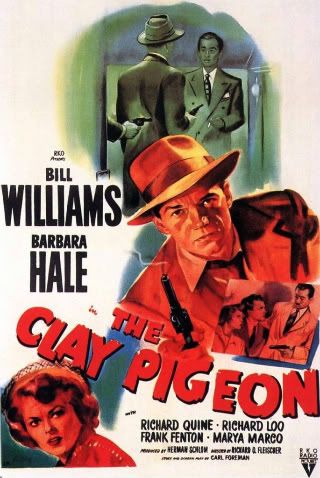
The Clay Pigeon

Poster

The issues faced by returning war veterans have been tackled by more than a few film noirs. Generally, the difficulties related to an inability to settle back into civilian life or the fact that the old familiar things had changed in their absence. The hero of The Clay Pigeon (1949), however, is presented with a set of circumstances that are of an altogether different nature. This movie falls into the nightmare/amnesia sub-genre, wherein a character has no memory of a crucial period and thus finds himself confronted by the consequences of actions that he has blocked out. This kind of storyline has enormous potential of course, but The Clay Pigeon never exploits it to the full.

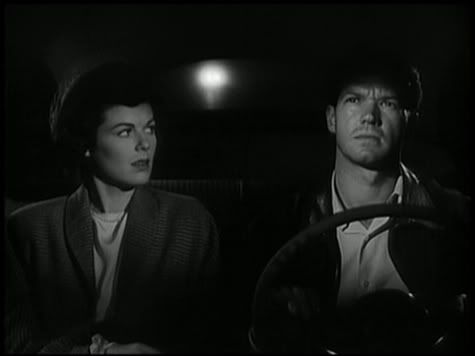
Jim Fletcher (Bill Williams) is a sailor, waking up in hospital after sustaining a bad head injury. He knows his name and most of the details about his past life, but he can’t recall what led to his being in hospital. And there’s the rub: Fletcher has been accused of treason during his time in a Japanese POW camp. What’s even worse is that his actions apparently led to the torture and subsequent killing of his friend. Knowing that he’s faced with a court martial at which he has little chance of clearing himself, Fletcher decides that his only alternative is to duck out and try to get to the bottom of it all by himself. Naturally, a penniless fugitive isn’t likely to make much headway without some assistance, so he takes a chance on contacting his friend’s widow. Unsurprisingly, this lady, Martha (Barbara Hale), is both suspicious and hostile initially. She grudgingly agrees to go along to Los Angeles though when a call to another old buddy, Ted Niles (Richard Quine) promises further help. Whatever doubts Martha may have had are gradually eroded on that long drive, particularly when an unknown car tries to force them off the road to their death. Their arrival in LA reveals just how complex and deadly a mess Fletcher has blundered into – a lethal conspiracy involving counterfeiting, war criminals and personal treachery. The whole thing culminates in a chase through Chinatown, followed by a train journey that exposes the real traitor.

Barbara Hale and Bill Williams spot danger looming.

The Clay Pigeon is a genuine B picture, coming in at little over an hour in length and never really pausing for breath. As such, there’s no time for any kind of character development amid the chasing and dodging. If anything, that’s probably the biggest weakness of the film: in these kinds of stories the audience needs to be kept guessing as to whether or not the hero is really as clean cut as he’d like us to believe. As it is, neither the audience nor the character of Fletcher has the least suspicion that he may indeed be the villain of the piece after all. I can’t honestly say that the fault lies with Bill Williams’ amiable playing as the part was written that way for him. I’d be more inclined to place the blame on Carl Foreman’s script (whose dearth of characters makes it pretty obvious who the traitor is right from the off) and the cheap-jack production values. That’s not to say there’s nothing positive to take away; Williams and Hale play well off each other, and the location filming is very welcome. This was one of Richard Fleischer’s earliest directorial efforts and he manages to create some nice angles and images, and does his best to create tension from a script that seems bent on draining away every vestige of suspense. The opening, the night drive to LA, and the Chinatown sequence are all ably handled and point to better things ahead for the director.

The movie comes to DVD from French distributor Montparnasse (I think there are Spanish and Italian editions out there too) and the transfer is one of their more typical efforts. It’s not especially bad, but there’s a slightly heavy-looking image that may have some contrast boosting, and it appears to be interlaced. Extras are confined to an eminently missable introduction. However the disc is certainly passable and the subs are not forced on the English track. It’s probably worth bearing in mind too that this film is likely to be a candidate for the Warner Archive in R1, so a vastly improved transfer isn’t something I’d be holding my breath for. All in all, The Clay Pigeon is pacy little B noir that passes the time painlessly. I just feel that a bit of fine tuning to the script might have added some much needed ambiguity and resulted in a more memorable film.

Shadow of a Doubt

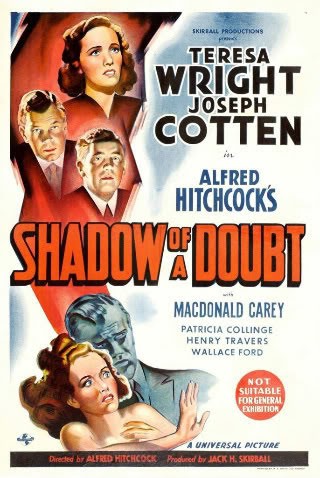
There are people who will tell you that Hitchcock never made a true film noir, and they cite the presence of countless personal motifs littering his work as evidence that what we’re watching is a “Hitchcock movie” as opposed to noir. That’s a point of view I can understand, even sympathize with to some extent, but I still feel that there are a number of Hitch’s movies that do fit snugly into that category. Shadow of a Doubt (1943) is a prime candidate for inclusion due to the dark heart that beats beneath the deceptively bright surface, and the ambiguous attitude it displays towards the villain.

The opening is typical Hitchcock, starting with a cityscape and then zeroing in shot by shot to the window of a grotty tenement. Charlie Oakley (Joseph Cotten) is reclining on his bed, but is interrupted when his landlady comes to inform him that two strangers have been asking for him. It’s made clear that Charlie is being sought in connection with criminal activities. The exact nature of these crimes are only alluded to at first, but the viewers suspicions are allowed to build gradually until it’s finally revealed that Charlie is the killer of a series of wealthy widows – The Merry Widow Murderer. Of course, this isn’t just a standard did-he-or-didn’t-he, hunt-for-a-killer picture; the doubt of the title refers not so much to the viewers as to the villain’s family, and to his niece in particular. In order to find some respite from the relentless manhunt underway, Charlie goes to stay with his sister’s family in Santa Rosa, California. This unexpected arrival is a source of celebration for the sister and especially the niece, also called Charlie (Teresa Wright) in his honour. Young Charlie is on the cusp of adulthood, and bemoaning the fact that her family’s life has descended into a monotonous series of drab non-events. The appearance of the Uncle whom she idolises promises to inject some energy and excitement into her sleepy, small town existence. This certainly seems to be the case at first, as she parades her uncle around town like a trophy or a returning hero. Gradually though, this innocent adulation begins to be eroded by the seemingly insignificant occurrences that begin to pile up. When two detectives masquerading as reporters (Macdonald Carey and Wallace Ford) turn up Young Charlie has her suspicions confirmed. In a marvellously filmed sequence in a deserted public library, the full extent of Uncle Charlie’s crimes is revealed as his niece reads the truth in a newspaper, the camera standing in for her eyes as she has the ground yanked out from under her – the camera pulling back and away to leave her small, isolated and burdened with knowledge in this shrine to learning. The dilemma facing Young Charlie is that she cannot act upon this information without destroying her family, and especially her emotionally fragile mother (Patricia Collinge). The situation is complicated even further when she realizes that her outwardly affectionate uncle can’t afford to let her walk around knowing what she does.

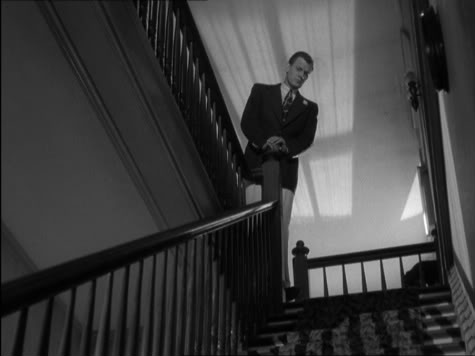
Shadow of a Doubt is commonly referred to as Hitchcock’s favourite film, and it’s easy to see why that would be the case. It’s a dark ode to Americana that’s reminiscent of Capra, an outsider’s view of an idealized world. Hitchcock’s Santa Rosa is not, as I’ve heard it suggested, the home to dark secrets but a wholesome community into which darkness steals (from it’s true origin, the urban center) before being duly expelled. Most of Hitchcock’s trademark visual style is on view, from high tracking shots to zooms and unnerving close-ups. The whole movie is chock full of memorable scenes and shots so it’s hard to pick out favourites. However, two sequences stand out for me: the first is Uncle Charlie’s arrival in Santa Rosa, the train rolling into the spotless station and pumping out a huge cloud of noxious black smoke to represent the evil it carries within; the other (less frequently mentioned) scene takes place when Uncle Charlie has just heard that the authorities have effectively cleared him. As the relieved man struts into the house and bounds up the stairs with a renewed vigour, he pauses halfway up, turns slowly, and sees the slight figure of his niece framed in the doorway below. It’s at this point that we know he’s going to kill her, he has no other alternative – it’s a subtle yet chilling moment that never fails to make the hairs on the back of my neck stand up, even after countless viewings.

Joseph Cotten had that kind of easy charm that meant he wasn’t chosen to play the heavy in too many films. He uses his natural affability to good effect here and is entirely believable as a man who seems to make friends everywhere he goes. It also makes our knowledge of his true nature all the more shocking and adds some real punch to those moments when he lets his mask slide a little. All in all, you can’t help but have a sneaking admiration for him – sure he’s evil, but his evil has such an urbane and attractive sheen that it almost wins you over. Playing against that and holding onto viewer sympathy is a big ask, but Teresa Wright pulls it off. She matures perfectly as the story progresses and the threats to her safety escalate. By the end the viewers are faced with their own dilemma, not really wanting to see harm come to either uncle or niece. The main support comes from Patricia Collinge as the vulnerable and trusting mother. It’s her trust in and deep adoration for her rotten brother that gives real substance to the film, and it’s to her credit that the part retains the requisite emotional pull without becoming cloying. Henry Travers and Hume Cronyn are cast mainly as a kind of macabre comic relief, needling each other of an evening about the best way to bump the other off. If I have any real criticism to make it relates to Macdonald Carey’s detective. It just feels like padding in a film that doesn’t require any; if his budding romance with Teresa Wright was included to strengthen the notion of her growing up then it’s unnecessary, that aspect being more than adequately covered by the meatier sections of the picture.

Universal’s UK release of Shadow of a Doubt on DVD is a very satisfactory one, showing little damage and staying sharp and clear for the most part. There’s a nice selection of extras including the trailer and galleries. Best of all is a half hour documentary on the making of the film that has contributions from Teresa Wright, Hume Cronyn and others. I won’t try and argue that this is Hitchcock’s best film, but it is a very accomplished work. It serves as a study on the loss of innocence and the darkness that lurks behind a polished facade – and it’s a highly entertaining movie.

Key Largo

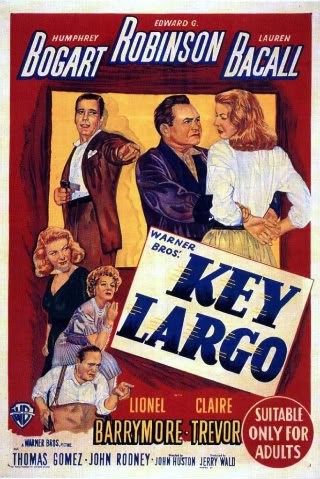
It’s hard to watch a film like Key Largo (1948) without being reminded of endings; it represented the final screen collaboration of Humphrey Bogart with both Lauren Bacall and Edward G Robinson, and it was one of the last movies he would make for Warner Brothers. Not only that, but it was also one of the last hurrahs for the old style gangster picture – but more about that later. It’s also a production that can be viewed from a number of angles: as a character driven drama, a gangster/noir mash-up, a commentary on the situation facing returning veterans, or as an allegory on fascism. Now this kind of multi-faceted approach can either lead to an unfocused piece or add to the rewatch value. I think the latter wins out here.

If the title and written prologue weren’t enough then the opening helicopter shot establishes the fact that the action takes place along the Florida Keys. As the camera zooms in on a bus making its way along the linking causeway we get our first glimpse of Frank McCloud (Bogart), a WWII veteran paying a visit to the relatives of a fallen comrade. McCloud’s destination is a hotel that, owing to the fact it’s the off-season, is virtually closed down. There is, however, one group of guests in residence when he gets there. None of these people seem especially friendly or anxious to welcome another visitor, and one of thier number, a Mr Brown, is conspicuous by remaining closed in his room. By and by, it emerges that McCloud’s companions are actually criminals, although that fact was unknown to the hotel owner, Temple (Lionel Barrymore), and his daughter-in-law Nora (Bacall). If McCloud had any suspicions, they are confirmed by the appearance of Mr Brown. Mr Brown isn’t his real name of course – he is one Johnny Rocco (Robinson), a one-time mob kingpin bent on rebuilding his criminal empire. At this point the already oppressive atmosphere grows heavier, both figuratively and literally, as an approaching hurricane threatens to tear up everything in its path. In the midst of all this, a duel develops between Rocco and McCloud – one that will finally be resolved on a motor launch bound for Cuba.

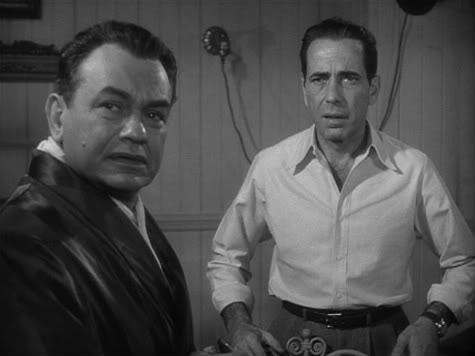
Key Largo was made at what was arguably the height of John Huston’s career, and its success is due to a combination of top class scripting (with Richard Brooks), photography, and acting. Bogart and Robinson occupy centre stage and their war of wills is what drives the whole thing forward. Eddie G’s Rocco is a devious and bullish creation, yearning for past glories that he must surely know in his heart are unattainable. Rocco and his cohorts are seen cowering before nature’s primal force and attempting to brass it out with a show of transparent bravado, pronouncing with unconvincing confidence that prohibition must surely come back and how things will be different this time. But these men are aware that they’re living out of time and it’s interesting to note that Al Capone, on whom Rocco was clearly based, was dead a year at that point. Bogart’s weary vet is one of his more complex characters, and could be compared to his Rick from Casablanca. Both men are initially reluctant to get involved or “stick their neck out” but do so eventually for the right reasons. The difference, however, is that Rick’s passivity was motivated by considerations of profitability whereas McCloud’s was the result of a deep disillusionment. That should have struck a chord with contemporary audiences: a whole generation of young men had marched off and risked their lives (and seen others lose theirs) in order to rid the world of oppression and fascism, only to return home and be confronted by a domestic version.

There are two key scenes that help define McCloud’s character. The first is a wonderfully photographed series of close-ups that show Rocco whispering suggestively into Nora’s ear (not a word is heard, but the inference is clear enough) before she spits contemptuously into his outraged face. With an unspoken dignity, McCloud moves across and quietly puts an arm around her shoulder before gently leading her away. I remember hearing Richard Brooks refer to this scene in a documentary as a moment of simple decency that everyone would like to emulate, and that’s hard to argue with. A similar situation takes place when Rocco humiliates his woman (Claire Trevor) by forcing her to sing unaccompanied as the price for the drink she craves. When he then goes back on his word, McCloud again does the right thing by pouring a whisky for the devastated woman despite the danger to himself. This is not a man who avoids confrontation due to cowardice or fear of personal injury but one who has grown apathetic and merely needs a prod to show his true colours. The aforementioned Claire Trevor deservedly won an Oscar for her role as the faded, alcoholic singer whose pride and self respect have been pushed into the background. That scene where she degrades herself in front of strangers through desperation is toe-curlingly effective and probably clinched the award for her. Lauren Bacall, in the only other significant female role, is much more subdued and is called on to do little more than gaze soulfully at Bogart. Of the four films Bogart and Bacall made together, this one is markedly different. The two Howard Hawks pictures had that director’s breezy playfulness about them, while Dark Passage was almost a study in bizarre coincidence. Key Largo has a grim, downbeat tone throughout that may surprise, or even disappoint, those hoping for a rerun of the couple’s previous work together.

Key Largo has been out on DVD for a long time now but the transfer still holds up well enough. I have the Warner UK version and the image is hard to fault, being pretty crisp all the way. I thought the dialogue levels were a little low but that’s probably just a feature of the film as there are a number of hushed conversations, and anyway Max Steiner’s atmospheric scoring doesn’t suffer. Extras are almost non-existent and are limited to the film’s trailer. The movie itself is a good example of how well Bogart and Huston worked together (it may come up wanting for those seeking out another Bogart/Bacall pairing though) and is the kind of picture that rewards multiple viewings. It gets the thumbs up from me.

Yellow Sky

spmzuhf


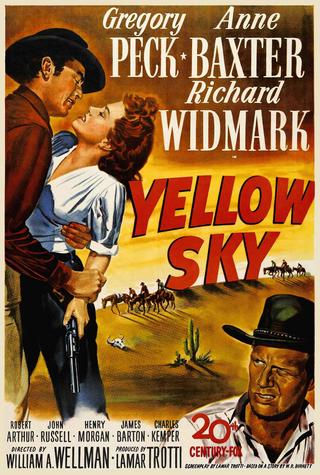
OK, so I’ve taken a break from this thing for a while now. I’ve generally found that I need to take a step back from time to time and allow myself a chance to recharge the batteries before starting anew. My last post was on a western, and my latest one is also another oater – for the sake of continuity if nothing else. Yellow Sky (1948) is a typically stylish William Wellman movie that trades on those perennial themes of greed and honor.

The film opens with a bank raid in a small town and concludes, with a quirky twist, in that same town. However, the robbery plays only a small part in the story; it’s the events that it leads to that form the core of the movie. Stretch Dawson (Gregory Peck) is the laconic leader of a band of outlaws who think they’ve just made an easy killing. While their initial getaway appears to have been clean there is a troop of soldiers on their trail, and the outlaw gang find themselves forced onto a barren and punishing expanse of salt flats in an effort to elude capture. From this early stage the first cracks appear in the group. Stretch is the acknowledged boss but his authority begins to be challenged by Lengthy (John Russell) and especially by Dude (Richard Widmark). As these men haul themselves painfully across the hellish landscape they are driven to the very limits of human endurance. Just as they are about to succumb to the effects of exhaustion and dehydration they stumble into the abandoned former mining town of Yellow Sky, and this is the point at which the story becomes most interesting. The old ghost town is not all it seems – for one thing it’s not strictly a ghost town at all. There are two inhabitants, an old half-crazed prospector and his daughter ‘Mike’ (Anne Baxter). Even in their weakened state the outlaws are not so dumb as to believe these two are living there for the good of their health. Putting two and two together, they decide that there’s only one reason anyone would choose to live in a dead town – gold. What remains to be seen is how far each individual is prepared to go in order to satisfy his craving for riches, and whether or not the notion of honour among thieves has any basis in truth. Like all the best westerns, it raises questions about one’s word of honour and, in this case, if that has any value for those who live outside the law.

£19

William Wellman’s direction offers a lesson in style, utilizing close-ups, long shots, deep focus, shadows and high contrast. There’s also an especially notable shot down the smoothly rifled barrel of a gun (see pic. above) which foreshadows the famous 007 pre-credits sequences. I’d also like to mention the climactic shootout between Peck, Widmark and Russell that takes place in the gloomy ruins of the town saloon – all the gunplay is unseen by the audience with only the bloody aftermath revealed. The location photography is another positive feature, with the inhospitable Death Valley occupying the first half before the action moves to Lone Pine for the scenes around the titular town. When looking at the characters, the first thing that jumps out is that every single one is known only by a nickname from beginning to end – the sole exceptions being Peck and Baxter, whose full names are revealed to the viewer. Peck handled his leading role competently as the reluctant hero who eventually finds a kind of redemption. John Russell and Richard Widmark make for a worthy couple of adversaries, the former consumed by pure animal lust and the latter with a hunger for wealth and the power to visit retribution on those he feels have slighted him in the past. Widmark in particular is the epitome of villainy, still at that stage in his career when he tended to get typecast as nasty pieces of work for the hero to vanquish. Anne Baxter’s role called for her to be a kind of self-sufficient tomboy who still remains sexually provocative. To her credit, she managed this balancing act and emerged as a fully rounded character that you can believe in. Throughout the film she proves herself the equal of the male cast members and her only concession to the traditional image of femininity comes at the very end when she dons a frivolous little hat that Stretch has brought her as a gift.

The R1 DVD from Fox presents Yellow Sky in a handsome full frame transfer that’s clean and sharp for the most part. Extras on the disc consist of galleries of advertising material and a selection of trailers. The film itself is absorbing and well paced and it was only at the end that I realized how little violence is present, and how even that takes place off screen. This is one of those late-40s westerns that helped usher in the more complex works that dominated the following decade. Recommended.