Hell Bent for Leather

hbl1

You know, the more westerns I watch, and discuss with others, the more convinced I’ve become that the smaller, less ambitious productions actually offer a better representation of the strengths and weaknesses of the genre. The leaner budgets mean that the writing, shooting and performances are more honed, less indulgent, and therefore maybe a little more honest and direct. Hell Bent for Leather (1960) is what is known as a programmer; the B western had disappeared and been absorbed by television, but there was still a place for those movies which weren’t going to open as headline A features. The movie is a fine example of economy filmmaking; it demonstrates the benefits of a simple yet tight plot, a small and experienced cast, and a director capable of making the most of his locations.

The story is a very simple one, a case of mistaken identity leading to a desperate manhunt. At the risk of overselling it, Hell Bent for Leather tells a kind of Kafkaesque tale of senseless persecution, the reasoning behind it all only gradually becoming apparent as the narrative unfolds. It opens starkly, with a lone figure staggering out of the wilderness, clutching a shotgun. It’s clear the man is dehydrated and nearing exhaustion, but salvation is at hand – he spies a horseman who has just stopped to eat and rest. This is Clay Santell (Audie Murphy), a horse dealer travelling on business. No sooner has Santell extended the hand of hospitality to the bedraggled figure who’s stumbled upon his camp than that gesture backfires spectacularly. Finding himself viciously clubbed to the ground and his mount stolen in payment for his kindness, Santell only has time to loose off a single shot, winging his assailant and causing him to drop his distinctive shotgun. Santell is now in a similar fix to the man he foolishly tried to help, forced to make his way on foot to the nearest settlement. After this shock beginning, the plot slowly takes on a surreal, nightmarish quality. That shotgun Santell picked up has a history; it belonged to a notorious outlaw who’s been terrorizing the area, in fact most of the townsfolk are at that moment burying his latest victims. However, descriptions of the wanted man are vague, vague enough to fit a lot of men, someone like Santell for instance. There does remain one hope though, the marshal who’s been on the killer’s trail and knows him by sight. Incredibly though, when this lawman, Deckett (Stephen McNally), turns up, he immediately identifies Santell as his quarry. In the face of such a predicament, Santell takes the only option open to him: he makes a break for it with a local girl, Janet (Felicia Farr), as hostage and heads for the hills. What remains to be seen is whether Santell can stay one step ahead of the relentless posse, convince anyone of his innocence and, crucially, discover what motive lies behind Deckett’s seemingly inexplicable actions.

£2

It’s difficult to watch any western from this period that is shot in and around Lone Pine, featuring a limited central cast and a minimalist plot, and not be reminded of Budd Boetticher. I wouldn’t go so far as to suggest Hell Bent for Leather measures up to the quality of Boetticher at his best (there are issues with the script, which I’ll come back to, preventing such comparisons) but it certainly treads a nearby path. The film was presided over by George Sherman, one of those journeymen directors whose work, in spite of a long and varied career, tends to be glossed over if not wholly neglected. However, a look at his credits for the late 40s and on through into the 50s reveals a number of quality genre pieces. Sherman shot the bulk of this film outdoors on location, and made the most of Lone Pine’s distinctive rock formations. These serve both as the backdrop and also the main stage upon which the drama is played out. Whether the camera was positioned at ground level, the viewers’ gaze straining upwards to pick out the tiny figures scrambling over the sun-baked surface, or high above and aimed down through the narrow gaps with cold objectivity, the primal, treacherous nature of the terrain is always apparent. Also, for a movie that involves comparatively little gunplay, Sherman maintains the sense of danger and menace, both through the expert handling of his locations and by ensuring that the pace is never allowed to flag.

As I mentioned, the biggest problem with this film comes from the writing, or at least one aspect of it. When you look at a Boetticher movie, especially those written by Burt Kennedy, you’re immediately struck by the quality of the characterization. Those films all provide the leads with plausible and relatively full backstories. Now, Hell Bent for Leather is essentially a three-hander, revolving around Santell, Janet and Deckett. The details concerning the latter two are filled in as the story goes along, quite deftly too, but Santell’s background is not. By the end of the movie, we don’t know any more about this man than we did in the opening minutes. As a result, the lead, the man with whom we must sympathize, is left as a kind of cipher, a guy to whom bad things happen just because – very existentialist but not entirely satisfactory.

Given the lack of assistance from the script, it says a lot for Audie Murphy’s abilities that he was able to make the part of Clay Santell work. Murphy rarely gets much credit for his acting, but he could turn in a decent enough performance when the film was of some quality. Even though his part is provided with virtually no background, he still makes Santell a man worth rooting for in Hell Bent for Leather. Being cast in what’s essentially the role of the underdog naturally helps to garner sympathy but he also managed to keep the character real, remaining convincing as he moved from bemusement and disbelief through panic and determination.

£3

Felicia Farr had already shown she could handle the role of a western heroine with some accomplishment in a series of films with Delmer Daves, and continued that trend here. Her character is fleshed out as the movie progresses, and she does come across as a woman with an inner strength that keeps her going in the face of adversity. The best, or most interesting, part in the movie was handed to Stephen McNally, an actor who was always a strong supporting player. He really gets under the skin of the driven, slightly unhinged Deckett. At first, this might appear to be a fairly one-dimensional character, but he develops further towards the end. By the time we reach the climax, there’s been enough revealed about Deckett to explain his actions and even create a touch of pathos.

At the moment, Hell Bent for Leather is available on DVD in three countries: Spain, France and Germany. The German release comes via Koch Media, and it’s another of their strong efforts. The film is presented in anamorphic scope, with good levels of detail and rich colour. As for extras, there’s the theatrical trailer, a gallery and booklet of liner notes in German. The disc offers both the original English soundtrack and a German dub, there are no subtitles at all. It’s also worth mentioning that Pegasus in the UK are rumoured to have this movie lined up for release so, bearing in mind the high quality transfers of Universal titles they have recently put out and their competitive prices, it may be worth holding off on this one for a bit. I feel this film is a superior little programmer that’s well acted and directed, and looks very attractive. It’s one of Audie Murphy’s most enjoyable pictures and also highlights the directorial skills of the underrated George Sherman. All in all, this is a solid, nicely crafted western that represents the genre well and shows what can be achieved with a limited budget and a bit of imagination.



No Name on the Bullet

I’ve been watching a lot of short, stripped down movies lately, and enjoying them very much. Apart from the pacing, I’m also fond of the tighter storytelling techniques that shorter running times necessitate. These movies impose a discipline on both writers and directors that often seems to stimulate creativity and artistry rather than restrict them. In a way, the elimination of flab tends to focus the minds of those behind the cameras and, when there is a natural talent present, result in a more vibrant picture. Jack Arnold’s No Name on the Bullet (1959) is a low budget sprinter of a movie that provides its lead with maybe his very best role, tells the audience an absorbing tale, and offers plenty of food for thought.

The story is one of fear – a fear ostensibly sparked by an outside force but, in reality, having its true origin within a community and, more specifically, within the hearts and collective conscience of the residents. When a sombre stranger rides into town the effect on the locals is both remarkable and rapid. What starts out as a kind of smouldering dread soon deepens into panic and, later, outright terror. You see, the stranger in the midst of these fearful townsfolk is one John Gant (Audie Murphy), a hired assassin whose notoriety has taken on near mythical proportions. He is known to get his man without fail, and with sufficient cunning to ensure that no criminal charges can be brought against him. Without doubt, this is a fearsome reputation in itself, but what provokes the atmosphere of unbearable tension is the mystery surrounding the identity of Gant’s intended target. As the shadow of the gunman casts a dark pall over the town the locals’ fevered imaginations take possession of them and, one by one, their dark pasts and guilty secrets start to emerge. The growing sense of terror, and their apparent inability to rid themselves of Gant’s presence, eventually turns the residents upon each other, and the body count rises accordingly. Amid all the mayhem and psychological torment Gant sits inscrutable and unperturbed, while the viewer is left wondering not only who the next victim will be but also whether or not this grim angel of death is the hero or the villain of the piece.

Jack Arnold is best known for his 50s sci-fi work and he brings the paranoia that was such a strong element of the era and genre to the western in No Name on the Bullet. The film is a set-bound affair, confined for the majority of its running time to the centre of the small town. Obviously, budgetary constraints played a significant part in the decision to shoot it thus, but it ends up being one of the strong points. While most westerns benefit from location shooting and evocative landscapes, the fact that the action here rarely leaves the streets of the backlot serves to enhance the feeling of the residents being trapped by fate.

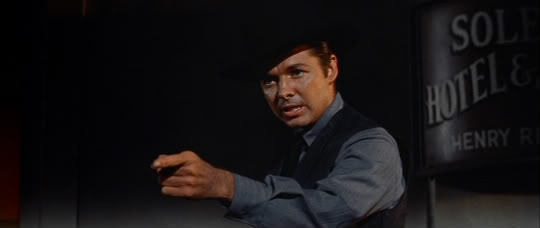
If Arnold’s direction creates the pressure cooker atmosphere the man with his hand firmly clamped on the lid is Audie Murphy. At one point, one of the characters tells him he speaks more like a preacher than a gunman. And that’s indeed the impression he conveys throughout; his expression remains dour and judgmental, and even his clothes have a puritan-like severity. Moreover, it’s entirely in keeping with the notion that Gant is the embodiment of retribution, a seemingly indestructible instrument of justice. Murphy’s baby face features and soft voice, as he sits endlessly sipping coffee and surveying everyone and everything like some malign deity, accentuate the character’s menace – even more so when one considers the real man’s war record. In a way, Gant represents a higher law, the local variety being weak (wounded and ineffectual) when faced with a crisis, eliciting the deeply harboured guilty feelings of all and dispensing punishment to the deserving. Normally, an overt absence of character development would be viewed as a minus, but having Gant remain essentially a cipher feels somehow appropriate – other characters speculate about his past but Gant himself reveals nothing. Murphy’s low key performance is both subtle and powerful, arguably his greatest. By way of conclusion, and I guess this constitutes a mild spoiler, it’s worth noting that this allegedly deadly killer never actually takes a life at any point.

Universal’s UK DVD of No Name on the Bullet is a very basic affair without any extras whatsoever, unless you count the array of language and subtitle options. However, and this is what matters most anyway, the image is excellent. The film has a strong anamorphic scope transfer with honestly negligible print damage on view. For me, the movie is a wonderful example of what a talented director and star can achieve on a budget. All in all, a memorable film with the guts and integrity to avoid any artificially happy ending, and I strongly recommend it.

The Unforgiven

poster120

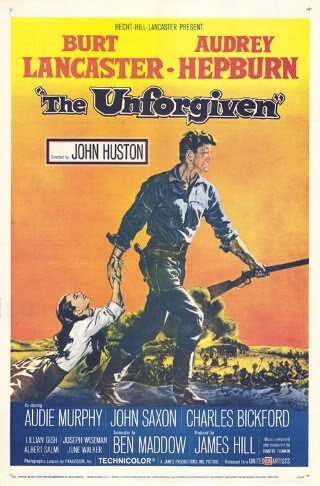
John Huston has to be one of my favourite directors but I’ve only just realised that, before today, I hadn’t written up any of his films on this blog. A quick browse through his lengthy and wide ranging filmography also drew my attention to the fact that he only made two westerns – I’m not counting The Misfits or The Treasure of the Sierra Madre, although some probably would – and I thought that seemed a little odd. The Unforgiven (1960) is a movie that doesn’t get talked up very much (the director professed a dislike of it which may have hurt its reputation some) but I believe it’s worthy of a bit of attention. The movie derives from a story by Alan Le May (The Searchers) and, perhaps unsurprisingly, concerns the fate of captives. What makes The Unforgiven a little different is the fact that the abduction that forms the background is a reversal of the usual white child spirited away by Indians one. In this case the settlers have taken a Kiowa baby and adopted her as one of their own. This storyline offers the opportunity to examine the effects of racism not only within the community but within the confines of the family as well.

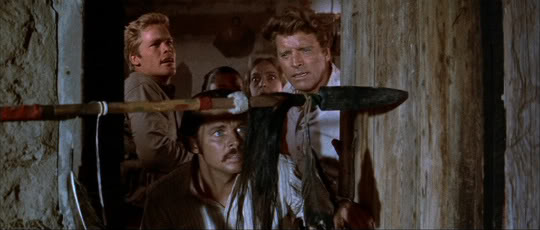
The Zachary’s are a close knit frontier family who, with the father dead as a result of a Kiowa raid, are held together by eldest son Ben (Burt Lancaster). He, with the help of brothers Cash (Audie Murphy) and Andy (Doug McClure), has been putting together a herd of cattle to send to Wichita and make their fortune. The family’s future looks secure and there is a chance of marrying the only sister, Rachel (Audrey Hepburn), into a neighbouring family of fellow ranchers, thereby cementing their partnership. However, the Zacharys’ dreams are built on shaky foundations and are soon to be swept away. Into their midst rides a mysterious old man (Joseph Wiseman), clad in a decaying Civil War uniform complete with sabre. In between quoting scripture he tosses out casual innuendo relating to a dark secret held by the Zacharys. Before long, Ben and Cash find themselves having to hunt down this otherworldly figure, knowing as they do that he intends to destroy them. This leads to one of the most memorable scenes in the film, as the two brothers chase their ghostlike quarry through a swirling dust storm – the old man seeming to appear and disappear at will, and then rushing out of the clouds of windswept sand with his sabre swinging murderously. Nevertheless, despite their best efforts, their nemesis evades them and poisons their neighbours and former friends against them. By the time the Kiowa turn up outside the sod covered family home demanding the return of what they claim belongs to them the Zacharys are about to tear themselves apart. Cash is an unashamed racist haunted by visions of his father’s death at the hands of the Kiowa, and barely able to contain his contempt and hatred for the red men. Therefore, Ben must prove himself the rock upon which the others can depend in order to weather the gathering storm.

£3

I’ve read that John Huston may have been displeased with the final product due to the fact that Audrey Hepburn later suffered a miscarriage, possibly as a result of a fall during production, not to mention that Audie Murphy almost drowned etc. Be that as it may, the film remains a solid, professional piece of work from Huston. He and DOP Franz Planer made excellent use of the wide angle lens to capture the scenery around Durango, and it contrasts well with the dark and claustrophobic interiors of the Zachary home. Apart from the aforementioned dust storm, the action scenes during the climactic siege are quite impressive.

The cast as a whole acquit themselves very well, with Lancaster displaying his customary stoicism interspersed with the occasional witticism. Audrey Hepburn would hardly rank as anyone’s idea of a western heroine but I thought she was pretty convincing in a difficult role. Audie Murphy never gets a lot of credit as an actor but this movie, probably more than any other, shows just how capable he was. He invests the character of Cash with a simmering mix of conflicting emotions that enables him to steal almost every scene he’s in. Lillian Gish also has a high old time as the tough matriarch with a steely resolve, and has a wonderful scene where she sits playing the piano outside at night to counter the music of the Kiowa medicine men. Joseph Wiseman chews up everything in sight as the spectral (no pun intended) Abe Kelsey, a genuinely scary yet pitiful husk of a man driven insane by grief and a desire for vengeance on those he deems responsible for past wrongs.

Given the indifferent treatment MGM often handed their catalogue releases the R2 DVD of The Unforgiven is actually quite pleasing. It’s given a handsome anamorphic scope transfer that has little damage on show save for a bit of light speckling here and there. Since this film is not widely regarded as one of Huston’s greatest it’s no real surprise that the only extra available is the theatrical trailer. I think this movie has been unjustly maligned by many and, even if it never comes to be seen as vintage Huston, it does work well as a mature western that at least tries to tackle a complicated issue. All in all, I like it and feel the performances and photography are ample reasons to give it a go.

Night Passage

pound8_zps0j825if3

Two brothers, one an outlaw and the other a former railroad troubleshooter in disgrace, square off. That’s the basic premise of  Night Passage.

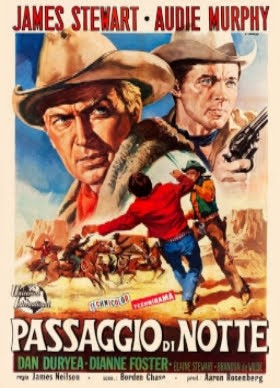
Jimmy Stewart is the honest man who is now reduced to scratching out a living as an accordion player after letting his no-good sibling Audie Murphy escape five years previously. He gets a last chance to redeem himself when his ex-boss hires him again. The railroad payroll has been repeatedly robbed by a gang of outlaws led by The Utica Kid (Murphy) and Whitey Harbin (Dan Duryea) – Stewart is assigned to see that the next one gets through. So the stage is set for a showdown.

Night Passage is the Anthony Mann western that never was. Mann was slated to direct Jimmy Stewart once again but pulled out at the last minute. His replacement was James Neilson (a debut director) and he managed to produce a serviceable movie, but fails to properly use the edgy quality that Mann always seemed to extract from his lead.

There are a number of weaknesses present, not least the overuse of Stewart’s accordian playing! The plot tries to pack in too many ideas and never really develops any of them sufficiently; Murphy and Stewart’s battle for the soul of Brandon De Wilde could have been expanded upon. It is shown early on that Stewart’s old flame is now married to his boss, but again nothing much is made of this.

Nevertheless, there are lots of good things here. The cinematography of William H. Daniels shows off the Colorado scenery to breathtaking effect in some beautiful shots and Dimitri Tiomkin provides one of his great trademark scores. I’ve heard it said that his music is sometimes too overpowering and in-your-face but I can’t think of any examples of his work that I didn’t like. Murphy is good in the role of the black sheep; he always seemed to give better performances when playing anti-heroic characters (No Name on the Bullet and John Huston’s The Unforgiven come to mind). There’s also a fine array of familiar support players in Jay C. Flippen, Jack Elam, Olive Carey, Hugh Beaumont and Paul Fix.

The film is available on DVD from Universal and looks very nice indeed in anamorphic scope – I have the R2 but I imagine the R1 uses the same transfer. Recommended.