100 Rifles

100Rifles_Poster

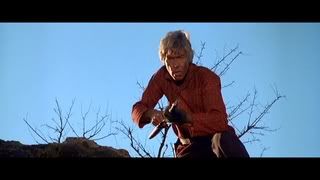
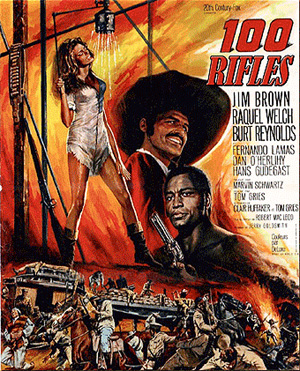
1969 saw the release of two westerns that featured Americans dabbling in the Mexican revolution. Both pictures involved hijacked arms shipments, trains, advancing technology, European military advisers and elaborately staged shootouts with the Federales. One, of course, was Sam Peckinpah’s seminal, genre-defining masterpiece  The Wild Bunch – the other was Tom Gries’ popcorn entertainment 100 Rifles. Since copious amounts of scholarly writing has already been devoted to the former, I’m going to look at the latter.

A year before, Tom Gries had directed the thoughtful and elegiac Will Penny – his next project was a distinct departure. 100 Rifles tells of Lyedecker, an American lawman (Jim Brown), who ventures south of the border in pursuit of Yaqui Joe (Burt Reynolds) who has stolen a consignment of weapons – the hundred rifles of the title. The guns are to be presented to the Yaqui Indians to assist them in their struggle against the Mexican authorities. Naturally, the Federales – led by a thoroughly sadistic Fernando Lamas – are keen to acquire these rifles for themselves. And there you have it. Will Lyedecker carry out his sworn duty and bring Joe back for trial? Will he be seduced by the plight of the Yaqui? Will the Federales beat them all to the chase? By the time the movie hurtles along to its grandstand climax all those questions have been resolved.

All the main players give amiable performances here with likable heroes and hissable villains. Burt Reynolds may not be the greatest actor in the world, but it’s hard not to like him on screen. Jim Brown is merely passable and Fernando Lamas is suitably vile. Dan O’Herlihy is always watchable as the railroad boss with shifting allegiances. But the real standout here is Raquel Welch as the revolutionary, Sarita. The scene where she stops a whole trainload of Federales as she takes a shower under a water tower is reason enough to see this film on its own!

OK, so this isn’t the best western you’ll ever see but its heart is in the right place, there’s more than enough action to satisfy, and Jerry Goldsmith’s score suits the mood of the piece perfectly. Available in a great looking anamorphic transfer from Fox in R1.

 

The Big Clock

bpnijge

The Big Clock is a 1948 thriller about a race against time; a manhunt where the protagonist is essentially hunting himself. Does that sound complicated? Well, the plot is complex but it never becomes incomprehensible.

George Stroud (Ray Milland) is the overworked editor of a crime magazine who yearns for a holiday with his family. Just when this seems in sight his boss, time-obsessed media tycoon Earl Janoth (Charles Laughton), insists that he postpone his vacation and follow up on a breaking news story. In a fit of pique, he tenders his resignation and ends up spending a drunken evening with Janoth’s mistress. While exiting the girl’s apartment Stroud sees his boss arriving, while the boss sees only a silhouette. Goaded into a rage by the mistress, Janoth clubs her to death. On the advice of his reptilian chief executive (George Macready) he now plans to pin the deed on the shadowy stranger he glimpsed in the corridor. To this end, Stroud is recalled to co-ordinate the manhunt.

This is a great suspenseful picture, and you really sense Milland’s mounting horror as he is forced to use his own investigative team and techniques to gradually build up a profile of the mystery man; a man who he knows better than anyone. The two principal female roles are taken by Maureen O’Sullivan (who was married to director John Farrow) as Stroud’s wife, and Rita Johnson as the ill-fated mistress. I always enjoy anything with that inveterate scene stealer Charles Laughton, and he gives one of his more restrained performances here. There are lots of familiar faces in the support cast, not least Laughton’s real life spouse Elsa Lanchester as an eccentric artist and her turn damn near steals the whole show. Harry Morgan also shows up as a darkly menacing gunman on Janoth’s payroll, made all the more sinister by the fact that his character utters not a word on screen. Seasoned noir watchers may also recognise Harold Vermilyea who remains forever memorable, for me at least, as the doomed Waldo Evans from Sorry, Wrong Number.

If the plot to this movie seems slightly familiar that may be due to the fact that it was remade in the 80’s as No Way Out, with Kevin Costner and Gene Hackman in the Milland and Laughton roles respectively. That film was not bad but, to my mind at least, not a patch on the original – isn’t that usually the case?

The Big Clock is available in R1 as part of the now, apparently, defunct Universal Noir line. If any fans of classic noir/suspense don’t already own this, I can only ask – Why?


Night Passage

pound8_zps0j825if3

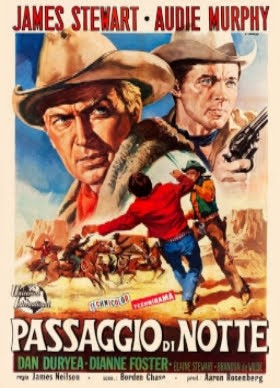
Two brothers, one an outlaw and the other a former railroad troubleshooter in disgrace, square off. That’s the basic premise of  Night Passage.

Jimmy Stewart is the honest man who is now reduced to scratching out a living as an accordion player after letting his no-good sibling Audie Murphy escape five years previously. He gets a last chance to redeem himself when his ex-boss hires him again. The railroad payroll has been repeatedly robbed by a gang of outlaws led by The Utica Kid (Murphy) and Whitey Harbin (Dan Duryea) – Stewart is assigned to see that the next one gets through. So the stage is set for a showdown.

Night Passage is the Anthony Mann western that never was. Mann was slated to direct Jimmy Stewart once again but pulled out at the last minute. His replacement was James Neilson (a debut director) and he managed to produce a serviceable movie, but fails to properly use the edgy quality that Mann always seemed to extract from his lead.

There are a number of weaknesses present, not least the overuse of Stewart’s accordian playing! The plot tries to pack in too many ideas and never really develops any of them sufficiently; Murphy and Stewart’s battle for the soul of Brandon De Wilde could have been expanded upon. It is shown early on that Stewart’s old flame is now married to his boss, but again nothing much is made of this.

Nevertheless, there are lots of good things here. The cinematography of William H. Daniels shows off the Colorado scenery to breathtaking effect in some beautiful shots and Dimitri Tiomkin provides one of his great trademark scores. I’ve heard it said that his music is sometimes too overpowering and in-your-face but I can’t think of any examples of his work that I didn’t like. Murphy is good in the role of the black sheep; he always seemed to give better performances when playing anti-heroic characters (No Name on the Bullet and John Huston’s The Unforgiven come to mind). There’s also a fine array of familiar support players in Jay C. Flippen, Jack Elam, Olive Carey, Hugh Beaumont and Paul Fix.

The film is available on DVD from Universal and looks very nice indeed in anamorphic scope – I have the R2 but I imagine the R1 uses the same transfer. Recommended.


The Last Hard Men

Sometimes the title of a movie is almost prophetic; James Coburn and Charlton Heston were probably among the last real tough guy actors. But everything must change and be replaced, and that’s the underlying theme of this 1976 end-of-the-trail western.

In the early years of the 20th century Zack Provo (Coburn), along with a half dozen others, escapes from a chain gang and goes on the run. News of the breakout reaches retired lawman Sam Burgade (Heston) who realises that Provo will come gunning for him. It was Burgade who ran Provo to ground and he knows that old scores will have to be settled. With the abduction of Burgade’s daughter (Barbara Hershey), the chase is on – ending only after an orgy of sub-Peckinpah slow motion violence.

James Coburn

The movie was directed by Andrew V. McLaglen and, like most of his work, promises more than it ultimately delivers. McLaglen, an apprentice of John Ford, always knew how to film a landscape and offers some pleasing images here. The main problem is that he seems to be trying to remake Big Jake in the style of Peckinpah, and it never really comes off. However, we’ve seen all this before, and seen it done better. Heston tosses out some lines about how the times are changing, but it doesn’t feel like it has any real conviction. Jerry Goldsmith provides a rousing score but again there’s nothing original – it is the same one he produced for 100 Rifles a few years before. All in all, not a bad movie but not a great one either. If you’re a western fan, or a Heston or Coburn completist like me, you’ll want to check it out – just don’t expect too much. 

The film is widely available in continental Europe, though not in the UK yet, from Fox. The transfer is a solid one, with a sharp anamorphic scope image and strong, bright colours.

Garden of Evil

pound2_zpscs4r15df

Look at her! Taking four men like us to a mountain of gold.

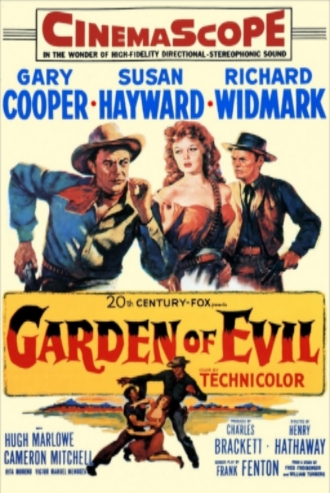
So says Richard Widmark’s Fisk, and in so doing he about sums up the plot of the movie. In a nutshell, a desperate woman (Susan Hayward) hires four men (Widmark, Gary Cooper, Cameron Mitchell and Victor Mendoza), who are all hanging around a dead-end Mexican town, to accompany her into the badlands on a mission of mercy; her husband is lying trapped in a mine deep in Apache country. What follows is an adventure tale that ties in some weighty themes such as, loyalty, greed, lust and infidelity. There are also some fairly explicit religious-moral allusions with the only features visible in a lava covered town being the church steeple and the entrance to the gold mine. Why, there’s even a crucifixion!

However, the film is never heavy-going and there is more than enough action to satisfy genre fans. The climactic chase and battle with the Apache is especially well-handled by veteran director Henry Hathaway. In fact, the whole thing moves along at a good pace and, at a little over an hour and a half, never outstays its welcome.

9189dab5-37c6-4b3f-83ae-08113175b540_zpszgfo6vzm

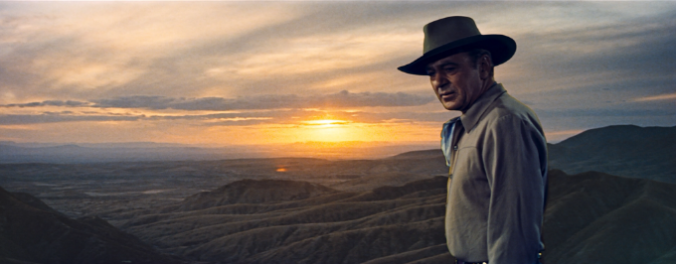
I love these early scope films from Fox, and this a great looking picture. Hathaway makes fine use of the widescreen process to show off the Mexican locations; some of the photography on the high mountain pass is simply stunning. The score is a bit of an unexpected one, by Bernard Herrmann no less. Herrmann, being Hitchcock’s composer of choice, is not a name you’d automatically associate with westerns. Nevertheless, the combination of soaring and ominous tones fits the mood of this movie perfectly.

There is, though, one very odd aspect to this film. Now, I won’t claim to be highly knowledgable of American Indians but the Apache we see here are the strangest looking bunch I’ve ever come across – surely the Apache never had Mohican haircuts!

That aside, I highly recommend this movie. How can you not love a western with Gary Cooper and Richard Widmark. I think both men give excellent performances, although I may be a little biased since I’m a huge fan of Coop. He gets to deliver the last line of the film while squinting into the sunset –

The garden of evil – if the earth was made of gold, I guess men would die for a handful of dirt.

Great stuff!

The October Man

92ekbeh

British attempts at producing film noir have traditionally been regarded as a notch down from their Hollywood counterparts. There is, sometimes, that sense of the genteel that the harder-edged Hollywood movies don’t suffer from. However, when BritNoir is at its best it’s more than capable of competing with productions from across the pond. The Third Man, The Fallen Idol, It Always Rains on Sunday, Brighton Rock, for example, are all films that belong in the front rank of noir. The October Man (1947) may not be quite in the same league as those other titles but it’s not far off.

When you see a film boasting a script by Eric Ambler, you know you’re on fairly safe ground. Ambler was, first and foremost, a novelist and gave us some of the best espionage/mystery fiction of the last century. I would strongly urge anyone unfamiliar with his writing to seek it out, although I believe a good deal of it has shamefully fallen out of print. His script here contains those staples of any good noir, namely murder, guilt and psychological imbalance.

The story concerns Jim Ackalnd (John Mills) who we see in the opening scenes riding a bus and knotting his handkerchief into the shape of a rabbit for the amusement of the small girl seated next to him. The child – played by Mills’ own daughter Juliet – is the daughter of some friends, and Jim is accompanying her back home. As the bus makes its way along a  country road in torrential rain, a brake failure causes a fatal accident at a level crossing. This results in the death of the child and Mills spends a year in hospital with a fractured skull and brain damage. As Jim is released from hospital we learn that he remains racked with guilt and has already attempted suicide. He moves into a rundown boarding house peopled by an assortment of fine British character actors including a poisonous Joyce Carey, Catherine Lacey as the put upon manageress, and Edward Chapman (who should be recognizable as Mr Grimsdale from numerous Norman Wisdom movies). He also makes the acquaintance of model Kay Walsh, of which more later.

Jim’s life seems to be getting back on track and a romance with Joan Greenwood helps give him some renewed hope for the future. However, things are about to go pear-shaped – this is the world of noir after all. The model turns up dead in a park and a cheque from Jim is found close to the body; worse still he was out walking alone when the crime took place. This, combined with some malicious gossip from the other residents, leads the police to suspect Jim – and Jim to query his own sanity. With the psychological pressure mounting and distrust surrounding him, it falls to Jim to try to find the real killer before the net closes around him.

John Mills

Roy Ward Baker provides his usual solid, unfussy direction but the real star is the cinematography. Erwin Hillier lays the noir atmosphere on thick, with lots of smoke, fog, deep shadows and harsh white lighting to pin the focus on the hapless Jim. John Mills plays the role perfectly as the quiet and essentially decent man driven to the very limit. Mills was ideal casting for this kind of part and would reprise it a few years later in the similarily themed The Long Memory. In fact, the acting is uniformly strong throughout and the scenes in the boarding house are memorable.

So, where does the weakness lie? Perhaps surprisingly, the fault is with Amblers script. I always feel that this kind of movie benefits enormously from creating suspicions in the viewers mind about the hero. In this case, we are never really in any doubt that Mills is innocent, moreover, the identity of the real killer is fairly obvious right from the off. Personally, I also found the repeated use of the knotted handkerchief motif – used to point up the mental strain of Jim – a little tiresome towards the end.

Generally though, this is one of the better examples of BritNoir and I would certainly recommend it to any fan of suspense/noir. The film is currently unavailable on DVD anywhere, save grey market copies, as far as I know. I believe the rights may currently reside with Optimum/Network/ITV in R2, all of whom have released some little known gems in the past. I very much hope they get around to this one soon.

Station West

220px-station_west_poster_small

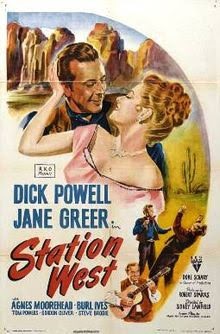
What an oddball little western this is. It opens with Dick Powell’s stranger riding into town and checking into a hotel run by a guitar strumming (and uncredited) Burl Ives who just happens to be singing about a stranger riding into town. At this point we’re not seeing any western conventions being stretched. However, as soon as this slight figure crosses the street, enters the saloon and starts to throw out the kind of wise cracks and casual insults that would surely earn anyone the ass-kicking of a lifetime, we can be sure this is no average oater.

Powell is not really your average western hero, and here this is explained by his being an undercover army intelligence officer. Mind you, I’m not suggesting that Powell isn’t tough enough to be a westerner (a brutal and well photographed brawl with Guinn “Big Boy” Williams leaves that in no doubt) but he doesn’t sound like a cowboy. In truth, this is a lot of what makes the picture so entertaining. If you are familiar with Powell’s role in Murder, My Sweet then this film will conjure images of Marlowe riding the range.

Another thing the movie has going for it is the cast. In addition to Powell we have Jane Greer, playing another dangerous vamp, who seems to own the whole town. Agnes Moorehead is Powell’s contact with the army, and Raymond Burr is the town lawyer with a gambling problem – all wide-eyed weakness and far removed from Perry Mason. The aforementioned Williams doesn’t have much to do here except look mean, but (as with Ward Bond) I find something reassuring about the presence of his familiar mug in a film. Burl Ives’ small role as “either the town poet or the village idiot” is also most welcome.


The plot revolves around hijacked gold shipments but, in a Chandleresque way, it doesn’t seem so important. The real joy here is the fusion of hard-boiled noir dialogue with western locales. If you are seeking an authentic and gritty representation of the Old West, then look elsewhere. On the other hand, if you are a fan of westerns and noir and want to see the best elements of both working in tandem, then Station West is worth a look.

The film is available on DVD from France in a transfer that is just adequate. It’s an RKO picture so it may get a R1 release from Warner one day, although the company seems to show little appetite for westerns right now.